EP4534156A1 - Balle de golf - Google Patents
Balle de golf Download PDFInfo
- Publication number
- EP4534156A1 EP4534156A1 EP24198466.5A EP24198466A EP4534156A1 EP 4534156 A1 EP4534156 A1 EP 4534156A1 EP 24198466 A EP24198466 A EP 24198466A EP 4534156 A1 EP4534156 A1 EP 4534156A1
- Authority
- EP
- European Patent Office
- Prior art keywords
- hardness
- spherical core
- golf ball
- center
- rubber
- Prior art date
- Legal status (The legal status is an assumption and is not a legal conclusion. Google has not performed a legal analysis and makes no representation as to the accuracy of the status listed.)
- Pending
Links
Images
Classifications
-
- A—HUMAN NECESSITIES
- A63—SPORTS; GAMES; AMUSEMENTS
- A63B—APPARATUS FOR PHYSICAL TRAINING, GYMNASTICS, SWIMMING, CLIMBING, OR FENCING; BALL GAMES; TRAINING EQUIPMENT
- A63B37/00—Solid balls; Rigid hollow balls; Marbles
- A63B37/0003—Golf balls
- A63B37/007—Characteristics of the ball as a whole
- A63B37/0072—Characteristics of the ball as a whole with a specified number of layers
- A63B37/0075—Three piece balls, i.e. cover, intermediate layer and core
-
- A—HUMAN NECESSITIES
- A63—SPORTS; GAMES; AMUSEMENTS
- A63B—APPARATUS FOR PHYSICAL TRAINING, GYMNASTICS, SWIMMING, CLIMBING, OR FENCING; BALL GAMES; TRAINING EQUIPMENT
- A63B37/00—Solid balls; Rigid hollow balls; Marbles
- A63B37/0003—Golf balls
- A63B37/005—Cores
- A63B37/006—Physical properties
- A63B37/0062—Hardness
-
- A—HUMAN NECESSITIES
- A63—SPORTS; GAMES; AMUSEMENTS
- A63B—APPARATUS FOR PHYSICAL TRAINING, GYMNASTICS, SWIMMING, CLIMBING, OR FENCING; BALL GAMES; TRAINING EQUIPMENT
- A63B37/00—Solid balls; Rigid hollow balls; Marbles
- A63B37/0003—Golf balls
- A63B37/0023—Covers
- A63B37/0029—Physical properties
- A63B37/0031—Hardness
-
- A—HUMAN NECESSITIES
- A63—SPORTS; GAMES; AMUSEMENTS
- A63B—APPARATUS FOR PHYSICAL TRAINING, GYMNASTICS, SWIMMING, CLIMBING, OR FENCING; BALL GAMES; TRAINING EQUIPMENT
- A63B37/00—Solid balls; Rigid hollow balls; Marbles
- A63B37/0003—Golf balls
- A63B37/0038—Intermediate layers, e.g. inner cover, outer core, mantle
- A63B37/0039—Intermediate layers, e.g. inner cover, outer core, mantle characterised by the material
-
- A—HUMAN NECESSITIES
- A63—SPORTS; GAMES; AMUSEMENTS
- A63B—APPARATUS FOR PHYSICAL TRAINING, GYMNASTICS, SWIMMING, CLIMBING, OR FENCING; BALL GAMES; TRAINING EQUIPMENT
- A63B37/00—Solid balls; Rigid hollow balls; Marbles
- A63B37/0003—Golf balls
- A63B37/0038—Intermediate layers, e.g. inner cover, outer core, mantle
- A63B37/004—Physical properties
- A63B37/0043—Hardness
-
- A—HUMAN NECESSITIES
- A63—SPORTS; GAMES; AMUSEMENTS
- A63B—APPARATUS FOR PHYSICAL TRAINING, GYMNASTICS, SWIMMING, CLIMBING, OR FENCING; BALL GAMES; TRAINING EQUIPMENT
- A63B37/00—Solid balls; Rigid hollow balls; Marbles
- A63B37/0003—Golf balls
- A63B37/005—Cores
- A63B37/0051—Materials other than polybutadienes; Constructional details
-
- A—HUMAN NECESSITIES
- A63—SPORTS; GAMES; AMUSEMENTS
- A63B—APPARATUS FOR PHYSICAL TRAINING, GYMNASTICS, SWIMMING, CLIMBING, OR FENCING; BALL GAMES; TRAINING EQUIPMENT
- A63B37/00—Solid balls; Rigid hollow balls; Marbles
- A63B37/0003—Golf balls
- A63B37/005—Cores
- A63B37/006—Physical properties
- A63B37/0062—Hardness
- A63B37/00621—Centre hardness
-
- A—HUMAN NECESSITIES
- A63—SPORTS; GAMES; AMUSEMENTS
- A63B—APPARATUS FOR PHYSICAL TRAINING, GYMNASTICS, SWIMMING, CLIMBING, OR FENCING; BALL GAMES; TRAINING EQUIPMENT
- A63B37/00—Solid balls; Rigid hollow balls; Marbles
- A63B37/0003—Golf balls
- A63B37/005—Cores
- A63B37/006—Physical properties
- A63B37/0062—Hardness
- A63B37/00622—Surface hardness
-
- A—HUMAN NECESSITIES
- A63—SPORTS; GAMES; AMUSEMENTS
- A63B—APPARATUS FOR PHYSICAL TRAINING, GYMNASTICS, SWIMMING, CLIMBING, OR FENCING; BALL GAMES; TRAINING EQUIPMENT
- A63B37/00—Solid balls; Rigid hollow balls; Marbles
- A63B37/0003—Golf balls
- A63B37/005—Cores
- A63B37/006—Physical properties
- A63B37/0062—Hardness
- A63B37/0063—Hardness gradient
-
- A—HUMAN NECESSITIES
- A63—SPORTS; GAMES; AMUSEMENTS
- A63B—APPARATUS FOR PHYSICAL TRAINING, GYMNASTICS, SWIMMING, CLIMBING, OR FENCING; BALL GAMES; TRAINING EQUIPMENT
- A63B37/00—Solid balls; Rigid hollow balls; Marbles
- A63B37/0003—Golf balls
- A63B37/007—Characteristics of the ball as a whole
- A63B37/0077—Physical properties
- A63B37/00776—Slab hardness
-
- A—HUMAN NECESSITIES
- A63—SPORTS; GAMES; AMUSEMENTS
- A63B—APPARATUS FOR PHYSICAL TRAINING, GYMNASTICS, SWIMMING, CLIMBING, OR FENCING; BALL GAMES; TRAINING EQUIPMENT
- A63B37/00—Solid balls; Rigid hollow balls; Marbles
- A63B37/0003—Golf balls
- A63B37/007—Characteristics of the ball as a whole
- A63B37/0077—Physical properties
- A63B37/0092—Hardness distribution amongst different ball layers
- A63B37/00922—Hardness distribution amongst different ball layers whereby hardness of the cover is lower than hardness of the intermediate layers
-
- C—CHEMISTRY; METALLURGY
- C08—ORGANIC MACROMOLECULAR COMPOUNDS; THEIR PREPARATION OR CHEMICAL WORKING-UP; COMPOSITIONS BASED THEREON
- C08L—COMPOSITIONS OF MACROMOLECULAR COMPOUNDS
- C08L7/00—Compositions of natural rubber
-
- C—CHEMISTRY; METALLURGY
- C08—ORGANIC MACROMOLECULAR COMPOUNDS; THEIR PREPARATION OR CHEMICAL WORKING-UP; COMPOSITIONS BASED THEREON
- C08L—COMPOSITIONS OF MACROMOLECULAR COMPOUNDS
- C08L9/00—Compositions of homopolymers or copolymers of conjugated diene hydrocarbons
-
- A—HUMAN NECESSITIES
- A63—SPORTS; GAMES; AMUSEMENTS
- A63B—APPARATUS FOR PHYSICAL TRAINING, GYMNASTICS, SWIMMING, CLIMBING, OR FENCING; BALL GAMES; TRAINING EQUIPMENT
- A63B2209/00—Characteristics of used materials
Definitions
- the present disclosure relates to a golf ball, and particularly relates to a golf ball comprising a spherical core, an intermediate layer and an outermost cover.
- JP S60-92780 A discloses a range golf ball obtained by vulcanizing a composition containing 100 parts by weight of a base rubber, 3 to 35 parts by weight of a low-resilient rubber, 20 to 30 parts by weight of methacrylic acid, and 20 to 50 parts by weight of a metal compound that can form a metal salt with methacrylic acid.
- the spin rate varies depending on the hitting points of the golf ball.
- the hitting point is unstable, and thus it is difficult to control the spin rate.
- difference in the hitting points causes a great variation in the spin rate of the golf ball, thus the golf ball also has a great variation in the distance (rolling distance) until the ball stops, and it becomes more difficult to control the flight distance.
- the natural rubber is prepared by slicing plants that produce natural rubber latex, collecting the latex, and coagulating the rubber component contained in the latex.
- the natural rubber may be used solely, or at least two of them may be used in combination.
- the natural rubber examples include a CV grade in which a rubber viscosity is stabilized by adding a viscosity stabilizer to the raw latex, and a non-CV grade in which a rubber viscosity is not stabilized. These natural rubbers may be used solely, or at least two of them may be used in combination. Among them, the CV grade having the stabilized viscosity is particularly preferable. It is noted that the natural rubber may be either one of SMR (Standard Malaysian Rubber) or SVR (Standard Vietnam Rubber).
- the natural rubber As the natural rubber, Technical Specified Rubbers (TSR), and Ribbed Smoked Sheet (RSS) are preferable.
- the natural rubber may contain a viscosity stabilizer.
- the amount of the 1,2-vinyl bond in the high-cis polybutadiene is preferably 2.0 mass % or less, more preferably 1.7 mass % or less, and even more preferably 1.5 mass % or less.
- the high-cis polybutadiene is preferably one synthesized using a rare-earth element catalyst.
- a neodymium catalyst employing a neodymium compound which is a lanthanum series rare-earth element compound is used, a polybutadiene rubber having a high amount of the cis-1,4 bond and a low amount of the 1,2-vinyl bond is obtained with an excellent polymerization activity, and thus such polybutadiene rubber is particularly preferable.
- the molecular weight distribution Mw/Mn (Mw: weight average molecular weight, Mn: number average molecular weight) of the high-cis polybutadiene is preferably 2.0 or more, more preferably 2.2 or more, and even more preferably 2.4 or more, and is preferably 6.0 or less, more preferably 5.0 or less, and even more preferably 4.0 or less. If the molecular weight distribution (Mw/Mn) of the high-cis polybutadiene falls within the above range, the processability is enhanced.
- the molecular weight distribution is measured by gel permeation chromatography ("HLC-8120GPC" available from Tosoh Corporation) using a differential refractometer as a detector under the conditions of column: GMHHXL (available from Tosoh Corporation), column temperature: 40 °C, and mobile phase: tetrahydrofuran, and calculated by converting based on polystyrene standard.
- HLC-8120GPC gel permeation chromatography
- Examples of the metal ion constituting the metal salt of the ⁇ , ⁇ -unsaturated carboxylic acid having 3 to 8 carbon atoms include a monovalent metal ion such as sodium, potassium and lithium; a divalent metal ion such as magnesium, calcium, zinc, barium and cadmium; a trivalent metal ion such as aluminum; and other metal ions such as tin and zirconium.
- the metal component may be used solely or as a mixture of at least two of them.
- the divalent metal ion such as magnesium, calcium, zinc, barium and cadmium is preferably used as the metal component.
- the divalent metal salt of the ⁇ , ⁇ -unsaturated carboxylic acid having 3 to 8 carbon atoms is used, a metal crosslinking easily generates between the rubber molecules.
- zinc acrylate is preferable, because zinc acrylate enhances the resilience of the obtained golf ball.
- the ⁇ , ⁇ -unsaturated carboxylic acid having 3 to 8 carbon atoms and/or the metal salt thereof may be used solely, or at least two of them may be used in combination.
- the amount of the co-crosslinking agent can be appropriately adjusted depending on the desired hardness of the spherical core.
- the amount of the co-crosslinking agent is preferably 20 parts by mass or more, more preferably 23 parts by mass or more, and even more preferably 25 parts by mass or more, and is preferably 60 parts by mass or less, more preferably 55 parts by mass or less, and even more preferably 50 parts by mass or less, with respect to 100 parts by mass of the base rubber.
- the crosslinking initiator is blended to crosslink the base rubber component.
- an organic peroxide is suitable.
- the organic peroxide include dicumyl peroxide, 1,1-bis(t-butylperoxy)-3,3,5-trimethylcyclohexane, 2,5-dimethyl-2,5-di(t-butylperoxy) hexane and di-t-butyl peroxide.
- These organic peroxides may be used solely or as a mixture of at least two of them. Among them, dicumyl peroxide is preferably used.
- the metal compound is not particularly limited, as long as it can neutralize the ⁇ , ⁇ -unsaturatedcarboxylic acid having 3 to 8 carbon atoms in the rubber composition.
- the metal compound include a metal hydroxide such as magnesium hydroxide, zinc hydroxide, calcium hydroxide, sodium hydroxide, lithium hydroxide, potassium hydroxide, and copper hydroxide; a metal oxide such as magnesium oxide, calcium oxide, zinc oxide, and copper oxide; and a metal carbonate such as magnesium carbonate, zinc carbonate, calcium carbonate, sodium carbonate, lithium carbonate, and potassium carbonate.
- the divalent metal compound is preferable, the zinc compound is more preferable. This is because the divalent metal compound reacts with the ⁇ , ⁇ -unsaturated carboxylic acid having 3 to 8 carbon atoms to form a metal crosslinking.
- the metal compound may be used solely, or at least two of them may be used in combination.
- organic sulfur compound examples include thiophenols, thionaphthols, polysulfides, thiurams, thiocarboxylic acids, dithiocarboxylic acids, sulfenamides, dithiocarbamates, and thiazoles.
- organic sulfur compound diphenyl disulfides (e.g. diphenyl disulfide, bis(pentabromophenyl) disulfide), thiophenols, and thionaphthols (e.g. 2-thionaphthol) are preferably used.
- the rubber composition may further contain a carboxylic acid and/or a metal salt thereof.
- a carboxylic acid and/or the metal salt thereof a carboxylic acid having 1 to 30 carbon atoms and/or a metal salt thereof is preferable.
- an aliphatic carboxylic acid a saturated fatty acid or an unsaturated fatty acid
- an aromatic carboxylic acid such as benzoic acid
- the amount of the carboxylic acid and/or the metal salt thereof is preferably 1 part by mass or more and 40 parts by mass or less with respect to 100 parts by mass of the base rubber.
- the rubber composition can be obtained by kneading the base rubber, the co-crosslinking agent, the crosslinking initiator, and the other optional components.
- the kneading method is not particularly limited.
- the kneading can be conducted with a conventional kneading machine such as a kneading roll, a banbury mixer and a kneader.
- the spherical core can be molded, for example, by heat pressing the core rubber composition.
- the molding conditions for heat pressing the core rubber composition may be determined appropriately depending on the rubber composition.
- the heat pressing is preferably carried out at a temperature of 130 °C to 200 °C for 10 to 60 minutes, or carried out in a two-step heating of heating at a temperature of 130 °C to 150 °C for 20 to 40 minutes followed by heating at a temperature of 160 °C to 180 °C for 5 to 15 minutes.
- the hardness difference (H 2.5 -H0), the hardness difference (H 12.5 -H 10 ) and the hardness difference (H 15 -H 12.5 ) fall within the above range, the deformation amount of the spherical core becomes greater on approach shots, the ball initial velocity right after hitting the golf ball can be controlled to a lower level, and the flight distance controllability on approach shots is further enhanced.
- the hardness difference (H 2.5 -H0) between the hardness (H 2.5 ) at the point having the radial distance of 2.5 mm from the center of the spherical core and the center hardness (H0) of the spherical core is preferably 3.0 or more, more preferably 3.3 or more, and even more preferably 3.5 or more, and is preferably 12.0 or less, more preferably 11.0 or less, and even more preferably 10.0 or less in Shore C hardness.
- the hardness difference (H 15 -H 12.5 ) between the hardness (H 15 ) at the point having the radial distance of 15 mm from the center of the spherical core and the hardness (H 12.5 ) at the point having the radial distance of 12.5 mm from the center of the spherical core is preferably 3.0 or more, more preferably 3.4 or more, and even more preferably 3.8 or more, and is preferably 10.0 or less, more preferably 9.0 or less, and even more preferably 8.0 or less in Shore C hardness.
- the hardness (H 5.0 ), the hardness (H 7.5 ) and the hardness (H 10 ) of the spherical core preferably satisfy relationships of H 7.5 -H 5.0 ⁇ 3.0 and H 10 -H 7.5 ⁇ 3.0 in Shore C hardness. If the hardness difference (H 7.5 -H 5.0 ) and the hardness difference (H 10 -H 7.5 ) fall within the above range, the deformation energy derived from the hitting on approach shots is easily transmitted to the inside of the spherical core, and the properties of the spherical core easily exert.
- the hardness difference (H 7.5 -H 5.0 ) between the hardness (H 7.5 ) at the point having the radial distance of 7.5 mm from the center of the spherical core and the hardness (H 5.0 ) at the point having the radial distance of 5.0 mm from the center of the spherical core is preferably 0.2 or more, more preferably 0.3 or more, and even more preferably 0.4 or more, and is preferably less than 3.0, more preferably 2.8 or less, and even more preferably 2.6 or less in Shore C hardness.
- the hardness difference (Hs-HO) between the surface hardness (Hs) of the spherical core and the center hardness (H0) of the spherical core is preferably 20 or more, more preferably 22 or more, and even more preferably 24 or more in Shore C hardness. If the hardness difference (Hs-HO) is 20 or more, the shot feeling on driver shots is better.
- the hardness difference (Hs-HO) is preferably 40 or less, more preferably 37 or less, and even more preferably 35 or less in Shore C hardness.
- the center hardness (H0) of the spherical core is preferably 42 or more, more preferably 44 or more, and even more preferably 46 or more, and is preferably 60 or less, more preferably 57 or less, and even more preferably 55 or less in Shore C hardness.
- the surface hardness (Hs) of the spherical core is preferably 70 or more, more preferably 72 or more, and even more preferably 74 or more, and is preferably 90 or less, more preferably 87 or less, and even more preferably 85 or less in Shore C hardness.
- the diameter of the spherical core is preferably 34.8 mm or more, more preferably 36.8 mm or more, and even more preferably 38.0 mm or more, and is preferably 42.2 mm or less, more preferably 41.8 mm or less, even more preferably 41.2 mm or less, and most preferably 40.8 mm or less.
- the compression deformation amount of the spherical core (shrinking amount of the spherical core along the compression direction) when applying a load from an initial load of 98 N to a final load of 1275 N to the spherical core is preferably 2.0 mm or more, more preferably 2.5 mm or more, and even more preferably 3.0 mm or more, and is preferably 5.0 mm or less, more preferably 4.5 mm or less, and even more preferably 4.0 mm or less. If the compression deformation amount falls within the above range, the shot feeling is better.
- the golf ball according to the present disclosure comprises an intermediate layer covering the spherical core.
- the thickness (Tm) of the intermediate layer is preferably 0.8 mm or more, more preferably 0.9 mm or more, and even more preferably 1.0 mm or more, and is preferably 3.0 mm or less, more preferably 2.6 mm or less, and even more preferably 2.2 mm or less. It is noted that in the case that the intermediate layer has a plurality of layers, the total thickness of all the intermediate layers is deemed as the thickness Tm of the intermediate layer.
- the slab hardness (Hm) of the intermediate layer composition forming the intermediate layer is preferably greater than the slab hardness (Hc) of the cover composition forming the outermost cover. If the slab hardness (Hm) is greater than the slab hardness (Hc), the controllability of the flight distance on approach shots can be further enhanced, and the spin rate on driver shots can be controlled.
- the thickness (Tc) of the outermost cover is preferably 0.4 mm or more, more preferably 0.5 mm or more, and even more preferably 0.6 mm or more, and is preferably 1.0 mm or less, more preferably 0.9 mm or less, and even more preferably 0.8 mm or less.
- the urethane resin has a urethane bond in the molecule.
- the urethane bond may be formed by a reaction between a polyol and a polyisocyanate.
- the polyol is a raw material for the urethane bond and has a plurality of hydroxy groups.
- a low molecular weight polyol or a high molecular weight polyol may be used.
- thermoplastic styrene based elastomer examples include TEFABLOC T3221C, T3339C, SJ4400N, SJ5400N, SJ6400N, SJ7400N, SJ8400N, SJ9400N, and SR04 (available from Mitsubishi Chemical Corporation).
- the amount of the urethane resin in the base resin is preferably 50 mass % or more, more preferably 60 mass % or more, and even more preferably 70 mass % or more.
- the base resin of the cover composition may consist of the urethane resin (preferably the thermoplastic urethane elastomer).
- the resin composition (intermediate layer composition) forming the intermediate layer preferably contains the ionomer resin as the base resin. If the intermediate layer composition contains the ionomer resin, the resilience performance of the golf ball is enhanced, and particularly the resilience performance on driver shots is excellent.
- the amount of the ionomer resin is preferably 50 mass % or more, more preferably 60 mass % or more, and even more preferably 70 mass % or more in the base resin of the intermediate layer composition.
- the thermoplastic styrene elastomer is also preferably used in combination.
- the method for molding the intermediate layer is not particularly limited, and examples thereof include a method which comprises molding the intermediate layer composition into a half shell in advance, covering the spherical core with two of the half shells, and performing compression molding; and a method which comprises injection molding the intermediate layer composition directly onto the spherical core to cover the spherical core.
- Examples of the method for molding the cover include a method which comprises molding the cover composition into a hollow shell, covering the spherical body (the spherical core or the spherical body having the intermediate layer formed) with a plurality of the shells, and performing compression molding (preferably a method which comprises molding the cover composition into a hollow half-shell, covering the spherical body with two of the half-shells, and performing compression molding); and a method which comprises directly injection molding the cover composition directly onto the spherical body.
- the golf ball body having the cover formed thereon is ejected from the mold, and is preferably subjected to surface treatments such as deburring, cleaning and sandblast where necessary.
- the golf ball according to the present disclosure comprises a spherical core, an intermediate layer covering the spherical core, and an outermost cover covering the intermediate layer.
- Examples of the construction of the golf ball include a three-piece golf ball composed of a single-layered spherical core, a single-layered intermediate layer covering the spherical core, and an outermost cover covering the intermediate layer; and a multi-piece golf ball (such as a four-piece golf ball, a five-piece golf ball or the like) composed of a single-layered spherical core, at least two intermediate layers covering the spherical core, and an outermost cover covering the intermediate layers.
- the compression deformation amount (shrinking amount along the compression direction) of the golf ball when applying a load from an initial load of 98 N to a final load of 1275 N to the golf ball is preferably 2.0 mm or more, more preferably 2.1 mm or more, and even more preferably 2.2 mm or more, and is preferably 3.0 mm or less, more preferably 2.9 mm or less, and even more preferably 2.8 mm or less. If the compression deformation amount falls within the above range, the shot feeling on driver shots is better.
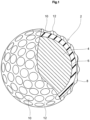
- the figure shows one example of the golf ball according to the present disclosure.
- the figure is a partially cutaway cross-sectional view showing a golf ball 2 according to one embodiment of the present disclosure.
- the golf ball 2 comprises a spherical core 4, an intermediate layer 6 covering the spherical core 4, and an outermost cover 8 covering the intermediate layer 6.
- a plurality of dimples 10 are formed on the surface of the outermost cover 8.
- Other portions than the dimples 10 on the surface of the golf ball are lands 12.
- the golf ball 2 is provided with a paint layer and a mark layer on an outer side of the outermost cover 8, but these layers are not depicted.
- a wedge (“RTX (registered trademark) 3 BLADE", Loft angle: 58°, available from Cleveland Golf Inc.) was installed on a swing machine available from Golf Laboratories, Inc.
- the hitting point was set at the face center.
- the golf ball was hit under a condition of a head speed of 16 m/sec, and the ball velocity and spin rate right after hitting the golf ball, and the rolling distance (the distance from the landing point to the stop point) were measured.
- the measurement was conducted twelve times for each golf ball, and the average value thereof was adopted as the measurement value for that golf ball.
- the ball velocity and spin rate were measured by continuously taking a sequence of photographs of the golf ball right after hitting the golf ball.
- a wedge (“RTX (registered trademark) 3 BLADE", Loft angle: 58°, available from Cleveland Golf Inc.) was used by 20 golfers to conduct an actual hitting on a 20-yard approach shot, and the shot feeling was evaluated in three stages: hard, ordinary and soft.
- the materials were kneaded with a kneading roll to obtain the core compositions.
- A1 A2 B1 B2 Formulation (parts by mass) Polybutadiene rubber 20 20 - Natural rubber 80 80 100 100 Zinc diacrylate 45.0 45.0 46.3 46.3 Zinc oxide 5 5 5 5 Barium sulfate Appropriate amount *1) Appropriate amount *1) Appropriate amount *1) Appropriate amount *1) Benzoic acid - - - - Bis(pentabromophenyl) disulfide - - - - Diphenyl disulfide - - - - Dicumyl peroxide 0.9 0.9 0.9 0.9 Molding condition Vulcanizing temperature (°C) 170 170 170 Vulcanizing time (min) 20 20 20 20 20 20 20 20 20 20 20 20 20 20 20 20 20 20 20 20 20 20 20 20 20 20 20 20 20 20 20 20 20 20 20 20 20 20 20 20 20 20 20 20 20 20 20 20 20 20 20 20 20 20 20 20 20 20 20 20 20 20 20 20 20 20 20 20 20 20 20 20 20 20 20
- Thickness (mm) 1.0 1.0 1.0 1.0 1.0 1.0 1.0 1.0 1.0 1.0 1.0 1.0 1.0 1.0 1.0 1.0 1.0 1.0 1.0 1.0 1.0 1.0 1.0 1.0 1.0 1.0 1.0 1.0 1.0 1.0 1.0 1.0 1.0 1.0 1.0 1.0 1.0 1.0 1.0 1.0 1.0 1.0 1.0 1.0 1.0 1.0 1.0 1.0 1.0 1.0 1.0 1.0 1.0 1.0 1.0 1.0 1.0 1.0 1.0 1.0 1.0 1.0 1.0 1.0 1.0 1.0 1.0 1.0 1.0 1.0 1.0 1.0 1.0 1.0 1.0 1.0 1.0 1.0 1.0 1.0 1.0 1.0 1.0 1.0 1.0 1.0 1.0 1.0 1.0 1.0 1.0 1.0 1.0 1.0 1.0 1.0 1.0 1.0 1.0 1.0 1.0 1.0 1.0 1.0 1.0 1.0 1.0 1.0 1.0 1.0 1.0 1.0 1.0 1.0 1.0 1.0 1.0 1.0 1.0 1.0 1.0 1.0 1.0 1.0
- the golf balls No. 1 to 7 are the cases that the spherical core is formed from a rubber composition containing a natural rubber, has a hardness distribution satisfying a relationship of H0 ⁇ H 2.5 ⁇ H 5.0 ⁇ H 7.5 ⁇ H 10 ⁇ H 12.5 ⁇ H 15 ⁇ Hs, and has the center hardness (H0) of 60 or less in Shore C hardness, and a slab hardness of an intermediate layer composition is greater than a slab hardness of a cover composition.
- These golf balls No. 1 to 7 have a ball velocity controlled to a low level, a reduced rolling distance, and a good shot feeling on approach shots. Thus, these golf balls No. 1 to 7 have a good shot feeling and improved controllability on approach shots.
- the golf balls No. 8 to 10, 12 and 13 are the cases that the spherical core is formed from a rubber composition not containing a natural rubber.
- the golf ball No. 11 is the case that a slab hardness of an intermediate layer composition is smaller than a slab hardness of a cover composition, although the spherical core is formed from a rubber composition containing a natural rubber, has a hardness distribution satisfying a relationship of H0 ⁇ H 2.5 ⁇ H 5.0 ⁇ H 7.5 ⁇ H 10 ⁇ H 12.5 ⁇ H 15 ⁇ Hs, and has the center hardness (H0) of 60 or less in Shore C hardness.
- the present disclosure (1) is a golf ball comprising a spherical core, an intermediate layer covering the spherical core, and an outermost cover covering the intermediate layer, wherein the spherical core is formed from a rubber composition containing a base rubber, a co-crosslinking agent, and a crosslinking initiator, the base rubber contains a natural rubber, a center hardness (H0) of the spherical core, a hardness (H 2.5 ) at a point having a radial distance of 2.5 mm from a center of the spherical core, a hardness (H 5.0 ) at a point having a radial distance of 5.0 mm from the center of the spherical core, a hardness (H 7.5 ) at a point having a radial distance of 7.5 mm from the center of the spherical core, a hardness (H 10 ) at a point having a radial distance of 10 mm from the center of the s
- the present disclosure (2) is the golf ball according to the present disclosure (1), wherein the center hardness (H0), the hardness (H 2.5 ), the hardness (H 10 ), the hardness (H 12.5 ) and the hardness (H 15 ) satisfy relationships of H 2.5 -H0 ⁇ 3.0, H 12.5 -H 10 ⁇ 3.0 and H 15 -H 12.5 ⁇ 3.0 in Shore C hardness.
- the present disclosure (4) is the golf ball according to any one of the present disclosures (1) to (3), wherein a hardness difference (Hs-HO) between the surface hardness (Hs) of the spherical core and the center hardness (H0) of the spherical core is 20 or more in Shore C hardness.
- Hs-HO hardness difference
- the present disclosure (7) is the golf ball according to any one of the present disclosures (1) to (6), wherein an intermediate layer composition forming the intermediate layer is a resin composition containing an ionomer resin as a base resin, and a slab hardness of the intermediate layer composition forming the intermediate layer is 50 or more in Shore D hardness.
Landscapes
- Health & Medical Sciences (AREA)
- General Health & Medical Sciences (AREA)
- Physical Education & Sports Medicine (AREA)
- Chemical & Material Sciences (AREA)
- Chemical Kinetics & Catalysis (AREA)
- Medicinal Chemistry (AREA)
- Polymers & Plastics (AREA)
- Organic Chemistry (AREA)
- Engineering & Computer Science (AREA)
- Materials Engineering (AREA)
- Compositions Of Macromolecular Compounds (AREA)
Applications Claiming Priority (1)
| Application Number | Priority Date | Filing Date | Title |
|---|---|---|---|
| JP2023172935A JP2025063592A (ja) | 2023-10-04 | 2023-10-04 | ゴルフボール |
Publications (1)
| Publication Number | Publication Date |
|---|---|
| EP4534156A1 true EP4534156A1 (fr) | 2025-04-09 |
Family
ID=92675998
Family Applications (1)
| Application Number | Title | Priority Date | Filing Date |
|---|---|---|---|
| EP24198466.5A Pending EP4534156A1 (fr) | 2023-10-04 | 2024-09-04 | Balle de golf |
Country Status (4)
| Country | Link |
|---|---|
| US (1) | US20250114666A1 (fr) |
| EP (1) | EP4534156A1 (fr) |
| JP (1) | JP2025063592A (fr) |
| KR (1) | KR20250049169A (fr) |
Citations (6)
| Publication number | Priority date | Publication date | Assignee | Title |
|---|---|---|---|---|
| JPS6092780A (ja) | 1983-10-27 | 1985-05-24 | 住友ゴム工業株式会社 | 練習場用ゴルフボ−ル |
| JPS6171069A (ja) | 1984-09-14 | 1986-04-11 | 住友ゴム工業株式会社 | 練習場用ゴルフボ−ル |
| JP2006218294A (ja) * | 2005-02-07 | 2006-08-24 | Bridgestone Sports Co Ltd | マルチピースソリッドゴルフボール |
| JP2020103340A (ja) * | 2018-12-26 | 2020-07-09 | 住友ゴム工業株式会社 | ゴルフボール |
| US20210106879A1 (en) * | 2019-10-15 | 2021-04-15 | Bridgestone Sports Co., Ltd. | Multi-piece solid golf ball |
| JP2023172935A (ja) | 2022-05-24 | 2023-12-06 | タイコ・エレクトロニクス・テクノロジー・(エスアイピー)・カンパニー・リミテッド | 弾性端子フェルール、端子アセンブリ、および充電台 |
-
2023
- 2023-10-04 JP JP2023172935A patent/JP2025063592A/ja active Pending
-
2024
- 2024-05-13 KR KR1020240062710A patent/KR20250049169A/ko active Pending
- 2024-09-04 EP EP24198466.5A patent/EP4534156A1/fr active Pending
- 2024-09-19 US US18/890,481 patent/US20250114666A1/en active Pending
Patent Citations (6)
| Publication number | Priority date | Publication date | Assignee | Title |
|---|---|---|---|---|
| JPS6092780A (ja) | 1983-10-27 | 1985-05-24 | 住友ゴム工業株式会社 | 練習場用ゴルフボ−ル |
| JPS6171069A (ja) | 1984-09-14 | 1986-04-11 | 住友ゴム工業株式会社 | 練習場用ゴルフボ−ル |
| JP2006218294A (ja) * | 2005-02-07 | 2006-08-24 | Bridgestone Sports Co Ltd | マルチピースソリッドゴルフボール |
| JP2020103340A (ja) * | 2018-12-26 | 2020-07-09 | 住友ゴム工業株式会社 | ゴルフボール |
| US20210106879A1 (en) * | 2019-10-15 | 2021-04-15 | Bridgestone Sports Co., Ltd. | Multi-piece solid golf ball |
| JP2023172935A (ja) | 2022-05-24 | 2023-12-06 | タイコ・エレクトロニクス・テクノロジー・(エスアイピー)・カンパニー・リミテッド | 弾性端子フェルール、端子アセンブリ、および充電台 |
Also Published As
| Publication number | Publication date |
|---|---|
| JP2025063592A (ja) | 2025-04-16 |
| US20250114666A1 (en) | 2025-04-10 |
| KR20250049169A (ko) | 2025-04-11 |
Similar Documents
| Publication | Publication Date | Title |
|---|---|---|
| US11185744B2 (en) | Golf ball | |
| US11167177B2 (en) | Golf ball | |
| US20200129815A1 (en) | Golf ball | |
| US9884226B2 (en) | Golf ball | |
| EP4534156A1 (fr) | Balle de golf | |
| US10183197B2 (en) | Golf ball | |
| EP4548983A1 (fr) | Balle de golf | |
| US20250114665A1 (en) | Golf ball | |
| US20250269240A1 (en) | Golf ball | |
| US20250135294A1 (en) | Golf ball | |
| US20250041670A1 (en) | Golf ball | |
| US20250041672A1 (en) | Golf ball | |
| JP3243007U (ja) | ゴルフボール | |
| US20250170459A1 (en) | Golf ball | |
| US20250170458A1 (en) | Golf ball | |
| EP4470636B1 (fr) | Balle de golf | |
| JP3243008U (ja) | ゴルフボール | |
| JP3243005U (ja) | ゴルフボール | |
| JP3243331U (ja) | ゴルフボール | |
| JP3243006U (ja) | ゴルフボール | |
| EP4470634B1 (fr) | Balle de golf | |
| JP2025022497A (ja) | ゴルフボール | |
| JP2001178849A (ja) | ソリッドゴルフボール |
Legal Events
| Date | Code | Title | Description |
|---|---|---|---|
| PUAI | Public reference made under article 153(3) epc to a published international application that has entered the european phase |
Free format text: ORIGINAL CODE: 0009012 |
|
| STAA | Information on the status of an ep patent application or granted ep patent |
Free format text: STATUS: THE APPLICATION HAS BEEN PUBLISHED |
|
| AK | Designated contracting states |
Kind code of ref document: A1 Designated state(s): AL AT BE BG CH CY CZ DE DK EE ES FI FR GB GR HR HU IE IS IT LI LT LU LV MC ME MK MT NL NO PL PT RO RS SE SI SK SM TR |
|
| STAA | Information on the status of an ep patent application or granted ep patent |
Free format text: STATUS: REQUEST FOR EXAMINATION WAS MADE |
|
| 17P | Request for examination filed |
Effective date: 20250902 |
|
| P01 | Opt-out of the competence of the unified patent court (upc) registered |
Free format text: CASE NUMBER: UPC_APP_0005138_4534156/2026 Effective date: 20260212 |
|
| GRAP | Despatch of communication of intention to grant a patent |
Free format text: ORIGINAL CODE: EPIDOSNIGR1 |
|
| STAA | Information on the status of an ep patent application or granted ep patent |
Free format text: STATUS: GRANT OF PATENT IS INTENDED |