EP4534302A1 - Vorhersage von strassenoberflächenbetriebsbedingungen - Google Patents
Vorhersage von strassenoberflächenbetriebsbedingungen Download PDFInfo
- Publication number
- EP4534302A1 EP4534302A1 EP24181183.5A EP24181183A EP4534302A1 EP 4534302 A1 EP4534302 A1 EP 4534302A1 EP 24181183 A EP24181183 A EP 24181183A EP 4534302 A1 EP4534302 A1 EP 4534302A1
- Authority
- EP
- European Patent Office
- Prior art keywords
- vehicle
- operating conditions
- wheel
- sensor
- processing circuitry
- Prior art date
- Legal status (The legal status is an assumption and is not a legal conclusion. Google has not performed a legal analysis and makes no representation as to the accuracy of the status listed.)
- Pending
Links
- 238000005259 measurement Methods 0.000 claims abstract description 124
- 238000000034 method Methods 0.000 claims abstract description 89
- 238000003860 storage Methods 0.000 claims abstract description 27
- 238000004590 computer program Methods 0.000 claims abstract description 16
- 238000012545 processing Methods 0.000 claims description 127
- 230000000007 visual effect Effects 0.000 claims description 7
- 230000008901 benefit Effects 0.000 description 50
- 238000005096 rolling process Methods 0.000 description 39
- 230000033001 locomotion Effects 0.000 description 30
- 230000006870 function Effects 0.000 description 23
- 238000013459 approach Methods 0.000 description 22
- 230000006399 behavior Effects 0.000 description 15
- 230000003466 anti-cipated effect Effects 0.000 description 13
- 230000009471 action Effects 0.000 description 12
- 230000011218 segmentation Effects 0.000 description 10
- XLYOFNOQVPJJNP-UHFFFAOYSA-N water Substances O XLYOFNOQVPJJNP-UHFFFAOYSA-N 0.000 description 10
- 238000007726 management method Methods 0.000 description 9
- 239000010426 asphalt Substances 0.000 description 8
- 230000001133 acceleration Effects 0.000 description 7
- 238000004891 communication Methods 0.000 description 7
- 230000009286 beneficial effect Effects 0.000 description 6
- 238000009529 body temperature measurement Methods 0.000 description 6
- 238000005265 energy consumption Methods 0.000 description 6
- 238000010586 diagram Methods 0.000 description 5
- 238000005457 optimization Methods 0.000 description 5
- 244000025254 Cannabis sativa Species 0.000 description 4
- 239000004927 clay Substances 0.000 description 4
- 239000004576 sand Substances 0.000 description 4
- 239000002689 soil Substances 0.000 description 4
- 238000012549 training Methods 0.000 description 4
- 230000006978 adaptation Effects 0.000 description 3
- 238000010276 construction Methods 0.000 description 3
- 230000003247 decreasing effect Effects 0.000 description 3
- 238000005516 engineering process Methods 0.000 description 3
- 230000007613 environmental effect Effects 0.000 description 3
- 230000004927 fusion Effects 0.000 description 3
- 238000002329 infrared spectrum Methods 0.000 description 3
- 238000002372 labelling Methods 0.000 description 3
- 238000010801 machine learning Methods 0.000 description 3
- 239000000463 material Substances 0.000 description 3
- 238000012544 monitoring process Methods 0.000 description 3
- 230000001953 sensory effect Effects 0.000 description 3
- 230000003044 adaptive effect Effects 0.000 description 2
- 238000013480 data collection Methods 0.000 description 2
- 239000000446 fuel Substances 0.000 description 2
- 230000006872 improvement Effects 0.000 description 2
- 230000008569 process Effects 0.000 description 2
- 238000011002 quantification Methods 0.000 description 2
- 230000005855 radiation Effects 0.000 description 2
- 230000009467 reduction Effects 0.000 description 2
- 230000004044 response Effects 0.000 description 2
- 239000013589 supplement Substances 0.000 description 2
- 238000012546 transfer Methods 0.000 description 2
- 238000003491 array Methods 0.000 description 1
- 238000013528 artificial neural network Methods 0.000 description 1
- 230000005540 biological transmission Effects 0.000 description 1
- 238000004422 calculation algorithm Methods 0.000 description 1
- 230000008859 change Effects 0.000 description 1
- 239000002131 composite material Substances 0.000 description 1
- 238000001816 cooling Methods 0.000 description 1
- 238000001514 detection method Methods 0.000 description 1
- 238000009826 distribution Methods 0.000 description 1
- 230000000694 effects Effects 0.000 description 1
- 239000002828 fuel tank Substances 0.000 description 1
- 230000010354 integration Effects 0.000 description 1
- 230000003993 interaction Effects 0.000 description 1
- 239000004973 liquid crystal related substance Substances 0.000 description 1
- 238000013507 mapping Methods 0.000 description 1
- 238000005065 mining Methods 0.000 description 1
- 238000012986 modification Methods 0.000 description 1
- 230000004048 modification Effects 0.000 description 1
- 230000003287 optical effect Effects 0.000 description 1
- 230000008447 perception Effects 0.000 description 1
- 230000002093 peripheral effect Effects 0.000 description 1
- 230000002085 persistent effect Effects 0.000 description 1
- 238000013439 planning Methods 0.000 description 1
- 239000007787 solid Substances 0.000 description 1
- 238000001228 spectrum Methods 0.000 description 1
- 238000013526 transfer learning Methods 0.000 description 1
- 238000012384 transportation and delivery Methods 0.000 description 1
- 230000001960 triggered effect Effects 0.000 description 1
- 238000011179 visual inspection Methods 0.000 description 1
- 238000010792 warming Methods 0.000 description 1
Images




Classifications
-
- B—PERFORMING OPERATIONS; TRANSPORTING
- B60—VEHICLES IN GENERAL
- B60W—CONJOINT CONTROL OF VEHICLE SUB-UNITS OF DIFFERENT TYPE OR DIFFERENT FUNCTION; CONTROL SYSTEMS SPECIALLY ADAPTED FOR HYBRID VEHICLES; ROAD VEHICLE DRIVE CONTROL SYSTEMS FOR PURPOSES NOT RELATED TO THE CONTROL OF A PARTICULAR SUB-UNIT
- B60W40/00—Estimation or calculation of non-directly measurable driving parameters for road vehicle drive control systems not related to the control of a particular sub unit, e.g. by using mathematical models
- B60W40/02—Estimation or calculation of non-directly measurable driving parameters for road vehicle drive control systems not related to the control of a particular sub unit, e.g. by using mathematical models related to ambient conditions
- B60W40/06—Road conditions
- B60W40/068—Road friction coefficient
-
- B—PERFORMING OPERATIONS; TRANSPORTING
- B60—VEHICLES IN GENERAL
- B60W—CONJOINT CONTROL OF VEHICLE SUB-UNITS OF DIFFERENT TYPE OR DIFFERENT FUNCTION; CONTROL SYSTEMS SPECIALLY ADAPTED FOR HYBRID VEHICLES; ROAD VEHICLE DRIVE CONTROL SYSTEMS FOR PURPOSES NOT RELATED TO THE CONTROL OF A PARTICULAR SUB-UNIT
- B60W40/00—Estimation or calculation of non-directly measurable driving parameters for road vehicle drive control systems not related to the control of a particular sub unit, e.g. by using mathematical models
- B60W40/02—Estimation or calculation of non-directly measurable driving parameters for road vehicle drive control systems not related to the control of a particular sub unit, e.g. by using mathematical models related to ambient conditions
- B60W40/06—Road conditions
-
- B—PERFORMING OPERATIONS; TRANSPORTING
- B60—VEHICLES IN GENERAL
- B60T—VEHICLE BRAKE CONTROL SYSTEMS OR PARTS THEREOF; BRAKE CONTROL SYSTEMS OR PARTS THEREOF, IN GENERAL; ARRANGEMENT OF BRAKING ELEMENTS ON VEHICLES IN GENERAL; PORTABLE DEVICES FOR PREVENTING UNWANTED MOVEMENT OF VEHICLES; VEHICLE MODIFICATIONS TO FACILITATE COOLING OF BRAKES
- B60T8/00—Arrangements for adjusting wheel-braking force to meet varying vehicular or ground-surface conditions, e.g. limiting or varying distribution of braking force
- B60T8/17—Using electrical or electronic regulation means to control braking
- B60T8/171—Detecting parameters used in the regulation; Measuring values used in the regulation
-
- B—PERFORMING OPERATIONS; TRANSPORTING
- B60—VEHICLES IN GENERAL
- B60W—CONJOINT CONTROL OF VEHICLE SUB-UNITS OF DIFFERENT TYPE OR DIFFERENT FUNCTION; CONTROL SYSTEMS SPECIALLY ADAPTED FOR HYBRID VEHICLES; ROAD VEHICLE DRIVE CONTROL SYSTEMS FOR PURPOSES NOT RELATED TO THE CONTROL OF A PARTICULAR SUB-UNIT
- B60W40/00—Estimation or calculation of non-directly measurable driving parameters for road vehicle drive control systems not related to the control of a particular sub unit, e.g. by using mathematical models
- B60W40/10—Estimation or calculation of non-directly measurable driving parameters for road vehicle drive control systems not related to the control of a particular sub unit, e.g. by using mathematical models related to vehicle motion
- B60W40/1005—Driving resistance
-
- H—ELECTRICITY
- H04—ELECTRIC COMMUNICATION TECHNIQUE
- H04W—WIRELESS COMMUNICATION NETWORKS
- H04W4/00—Services specially adapted for wireless communication networks; Facilities therefor
- H04W4/30—Services specially adapted for particular environments, situations or purposes
- H04W4/40—Services specially adapted for particular environments, situations or purposes for vehicles, e.g. vehicle-to-pedestrians [V2P]
- H04W4/46—Services specially adapted for particular environments, situations or purposes for vehicles, e.g. vehicle-to-pedestrians [V2P] for vehicle-to-vehicle communication [V2V]
-
- B—PERFORMING OPERATIONS; TRANSPORTING
- B60—VEHICLES IN GENERAL
- B60W—CONJOINT CONTROL OF VEHICLE SUB-UNITS OF DIFFERENT TYPE OR DIFFERENT FUNCTION; CONTROL SYSTEMS SPECIALLY ADAPTED FOR HYBRID VEHICLES; ROAD VEHICLE DRIVE CONTROL SYSTEMS FOR PURPOSES NOT RELATED TO THE CONTROL OF A PARTICULAR SUB-UNIT
- B60W2422/00—Indexing codes relating to the special location or mounting of sensors
-
- B—PERFORMING OPERATIONS; TRANSPORTING
- B60—VEHICLES IN GENERAL
- B60W—CONJOINT CONTROL OF VEHICLE SUB-UNITS OF DIFFERENT TYPE OR DIFFERENT FUNCTION; CONTROL SYSTEMS SPECIALLY ADAPTED FOR HYBRID VEHICLES; ROAD VEHICLE DRIVE CONTROL SYSTEMS FOR PURPOSES NOT RELATED TO THE CONTROL OF A PARTICULAR SUB-UNIT
- B60W2530/00—Input parameters relating to vehicle conditions or values, not covered by groups B60W2510/00 or B60W2520/00
- B60W2530/20—Tyre data
-
- B—PERFORMING OPERATIONS; TRANSPORTING
- B60—VEHICLES IN GENERAL
- B60W—CONJOINT CONTROL OF VEHICLE SUB-UNITS OF DIFFERENT TYPE OR DIFFERENT FUNCTION; CONTROL SYSTEMS SPECIALLY ADAPTED FOR HYBRID VEHICLES; ROAD VEHICLE DRIVE CONTROL SYSTEMS FOR PURPOSES NOT RELATED TO THE CONTROL OF A PARTICULAR SUB-UNIT
- B60W2555/00—Input parameters relating to exterior conditions, not covered by groups B60W2552/00, B60W2554/00
- B60W2555/20—Ambient conditions, e.g. wind or rain
-
- B—PERFORMING OPERATIONS; TRANSPORTING
- B60—VEHICLES IN GENERAL
- B60W—CONJOINT CONTROL OF VEHICLE SUB-UNITS OF DIFFERENT TYPE OR DIFFERENT FUNCTION; CONTROL SYSTEMS SPECIALLY ADAPTED FOR HYBRID VEHICLES; ROAD VEHICLE DRIVE CONTROL SYSTEMS FOR PURPOSES NOT RELATED TO THE CONTROL OF A PARTICULAR SUB-UNIT
- B60W2556/00—Input parameters relating to data
- B60W2556/45—External transmission of data to or from the vehicle
-
- B—PERFORMING OPERATIONS; TRANSPORTING
- B60—VEHICLES IN GENERAL
- B60W—CONJOINT CONTROL OF VEHICLE SUB-UNITS OF DIFFERENT TYPE OR DIFFERENT FUNCTION; CONTROL SYSTEMS SPECIALLY ADAPTED FOR HYBRID VEHICLES; ROAD VEHICLE DRIVE CONTROL SYSTEMS FOR PURPOSES NOT RELATED TO THE CONTROL OF A PARTICULAR SUB-UNIT
- B60W2556/00—Input parameters relating to data
- B60W2556/45—External transmission of data to or from the vehicle
- B60W2556/50—External transmission of data to or from the vehicle of positioning data, e.g. GPS [Global Positioning System] data
Definitions
- the disclosure relates generally to vehicle control.
- the disclosure relates to prediction of road surface operating conditions for a vehicle.
- the disclosure can be applied to heavy-duty vehicles, such as trucks, buses, and construction equipment, among other vehicle types. Other examples include equipment for mining, construction, and forestry.
- heavy-duty vehicles such as trucks, buses, and construction equipment, among other vehicle types.
- Other examples include equipment for mining, construction, and forestry.
- the disclosure may be described with respect to a particular vehicle, the disclosure is not restricted to any particular vehicle.
- operating condition parameter values are known, or at least measured or estimated with some suitable accuracy. Examples of such useful parameters include rolling resistance and tire-road friction.
- operating condition parameter values comprise, or be derivable from, road surface operating conditions.
- a problem with existing approaches for vehicle control is that there is no reliable information regarding upcoming (i.e., future) parameter values, such as upcoming road surface operating conditions of a vehicle. Thereby, it becomes cumbersome to plan vehicle control actions adequately ahead of time. For example, safety issues and/or under-utilization of available control capacity may occur if the vehicle control uses currently measured parameter values as an estimation of upcoming parameter values.
- Various aspects may aim to solve, mitigate, alleviate, or eliminate at least some of the above or other disadvantages.
- a computer system for prediction of road surface operating conditions of a vehicle.
- the computer system comprises processing circuitry configured to receive at least a portion of a shared operating conditions model from a remote statistics processor, receive real-time sensor measurement data from sensors of the vehicle, determine a vehicle-specific operating conditions model based on the portion of the shared operating conditions model and the real-time sensor measurement data, and use the vehicle-specific operating conditions model to predict upcoming operating conditions for the vehicle.
- the first aspect of the disclosure may seek to provide information relating to road surface operating conditions of a vehicle.
- a technical benefit may include improved vehicle control.
- a technical benefit may include that the vehicle control can benefit from collective knowledge based on measurements by a fleet of many vehicles, as well as currently relevant measurements for the vehicle under consideration.
- a vehicle which comprises the computer system of the first aspect and one or more sensor(s) for prediction of road surface operating conditions of the vehicle.
- the second aspect of the disclosure may seek to provide a vehicle with improved vehicle control.
- a technical benefit may include that the vehicle is capable to operate in a safe and efficient manner.
- the at least one temperature sensor may be further configured to measure an ambient temperature above the portion of the ground surface to be traveled by the wheel, and/or the sensor arrangement may further comprise a humidity sensor mounted in vicinity of the wheel, and configured to measure an ambient humidity above the portion of the ground surface to be traveled by the wheel, and/or the sensor arrangement may further comprise an audio sensor mounted in vicinity of the wheel, and configured to measure sound above the portion of the ground surface to be traveled by the wheel.
- a technical benefit may include that information specifically relevant for the wheel is further improved, thereby further improving the prediction of road surface operating conditions of a vehicle.
- a computer system for prediction of road surface operating conditions of a specific vehicle.
- the computer system comprises processing circuitry configured to receive respective sensor measurement data from a plurality of vehicles, determine a shared operating conditions model based on the measurement data, and cause provision of at least a portion of the shared operating conditions model to the specific vehicle.
- the third aspect of the disclosure may seek to provide information relating to road surface operating conditions of a one or more vehicle(s).
- a technical benefit may include improved vehicle control.
- a technical benefit may include that the vehicle control can benefit from collective knowledge based on measurements by a fleet of many vehicles.
- a server node which comprises the computer system of the third aspect.
- the fourth aspect of the disclosure may seek to provide improved vehicle control for a fleet of many vehicles.
- a technical benefit may include that the vehicles are enabled to operate in a safe and efficient manner.
- a computer-implemented method for prediction of road surface operating conditions of a vehicle.
- the method comprises receiving (by processing circuitry of a computer system) at least a portion of a shared operating conditions model from a remote statistics processor, receiving (by the processing circuitry) real-time sensor measurement data from sensors of the vehicle, determining (by the processing circuitry) a vehicle-specific operating conditions model based on the portion of the shared operating conditions model and the real-time sensor measurement data, and using (by the processing circuitry) the vehicle-specific operating conditions model to predict upcoming operating conditions for the vehicle.
- the fifth aspect of the disclosure may seek to provide information relating to road surface operating conditions of a vehicle.
- a technical benefit may include improved vehicle control.
- a technical benefit may include that the vehicle control can benefit from collective knowledge based on measurements by a fleet of many vehicles, as well as currently relevant measurements for the vehicle under consideration.
- the method may further comprise causing (by the processing circuitry) the sensor measurement data to be uploaded to the remote statistics processor.
- a technical benefit may include that the collective knowledge based on measurements by a fleet of many vehicles is continuously updated.
- the portion of the shared operating conditions model may be determined by a location of the vehicle and/or a time of reception of the portion of the shared operating conditions model.
- a technical benefit may include that only currently relevant part(s) of the shared operating conditions model need to be transferred to the vehicle.
- the vehicle-specific operating conditions model may provide respective certainty metrics for road surface operating condition type(s), and wherein the upcoming operating conditions for the vehicle are predicted by road surface operating condition type selection based on the certainty metrics.
- a technical benefit may include improved prediction accuracy compared to if a single road surface operating condition type was provided by the vehicle-specific operating conditions model as basis for the prediction.
- a technical benefit may include that the certainty metrics may be used to improve safety and reliability of vehicle control.
- a computer-implemented method for prediction of road surface operating conditions of a specific vehicle.
- the method comprises receiving (by processing circuitry of a computer system) respective sensor measurement data from a plurality of vehicles, determining (by the processing circuitry) a shared operating conditions model based on the measurement data, and causing (by the processing circuitry) provision of at least a portion of the shared operating conditions model to the specific vehicle.
- the sixth aspect of the disclosure may seek to provide information relating to road surface operating conditions of a one or more vehicle(s).
- a technical benefit may include improved vehicle control.
- a technical benefit may include that the vehicle control can benefit from collective knowledge based on measurements by a fleet of many vehicles.
- the portion of the shared operating conditions model may be determined by a location of the specific vehicle and/or a time of provision of the portion of the shared operating conditions model.
- a technical benefit may include that only currently relevant part(s) of the shared operating conditions model need to be transferred to the vehicle.
- the shared operating conditions model may provide respective certainty metrics for road surface operating condition type(s).
- a technical benefit may include improved prediction accuracy compared to if a single road surface operating condition type was provided by the shared operating conditions model as basis for the prediction.
- a technical benefit may include that the certainty metrics may be used to improve safety and reliability of vehicle control.
- a computer program product which comprises program code for performing, when executed by the processing circuitry, the method of the fifth aspect or the sixth aspect.
- the seventh aspect of the disclosure may seek to convey program code for improving vehicle control.
- a technical benefit may include that new vehicles and/or legacy vehicles may be conveniently configured, by software installation/update, to provide information relating to road surface operating conditions of a vehicle.
- a technical benefit may include that new remote vehicle servers and/or legacy remote vehicle servers may be conveniently configured, by software installation/update, to provide information relating to road surface operating conditions of a vehicle.
- a non-transitory computer-readable storage medium comprises instructions, which when executed by the processing circuitry, cause the processing circuitry to perform the method of the fifth aspect or the sixth aspect.
- the eighth aspect of the disclosure may seek to convey program code for improving vehicle control.
- a technical benefit may include that new vehicles and/or legacy vehicles may be conveniently configured, by software installation/update, to provide information relating to road surface operating conditions of a vehicle.
- a technical benefit may include that new remote vehicle servers and/or legacy remote vehicle servers may be conveniently configured, by software installation/update, to provide information relating to road surface operating conditions of a vehicle.
- providing/receiving at least a portion of a shared operating conditions model includes situations where only a part of the shared operating conditions model is provided/received, as well as situations where the shared operating conditions model is provided/received in full.
- time of provision/reception current time should be understood to include time interval(s) and or recurring time units (e.g., a specific season, a specific month, a specific time (interval) of the day, etc.).
- vehicle control may be improved if upcoming operating conditions (e.g., relating to road surface) can be accurately predicted.
- Approaches as exemplified herein aim to accomplish such accurate prediction by means of a general operating conditions model shared among a plurality of vehicles (a shared/common operating conditions model) and a vehicle-specific operating conditions model which is determined based on the shared operating conditions model.
- FIG. 1 schematically illustrates a scenario where the approaches exemplified herein may be applicable.
- the example scenario of FIG. 1 relates to a vehicle fleet that comprises a plurality of vehicles 11, 12, 13, 14, 15, 16, 17.
- all vehicles of the vehicle fleet may be associated with a same vehicle manufacturer and/or a same vehicle owner.
- the vehicles of the vehicle fleet may be associated with different manufacturers and/or different owners.
- the vehicle fleet is associated with a shared operating conditions model 10.
- the shared operating conditions model 10 may be stored and/or handled by a statistics processor (e.g., a cloud service function or some other central vehicle service function).
- a statistics processor e.g., a cloud service function or some other central vehicle service function.
- One or more (e.g., all) of the vehicles 11, 12, 13, 14, 15, 16, 17 of the vehicle fleet are configured to upload sensor measurement data to the statistics processor for updating of the shared operating conditions model 10.
- the shared operating conditions model 10 is configured to be (partially or fully) downloaded to one or more (e.g., all) of the vehicles 11, 12, 13, 14, 15, 16, 17 of the vehicle fleet. This is exemplified for the vehicle 17 in FIG. 1 .
- One or more (e.g., all) of the vehicles 11, 12, 13, 14, 15, 16, 17 of the vehicle fleet are configured to determine a vehicle-specific operating conditions model based on the shared operating conditions model as downloaded and based on real-time sensor measurement data for the relevant vehicle. This is exemplified for the vehicle 17 in FIG. 1 , where the vehicle-specific operating conditions model 20 is based on the shared operating conditions model 10 and on measurement data from sensors 90 of the vehicle 17.
- a computer system for prediction of road surface operating conditions may be provided by a statistics processor (e.g., implemented by a server or a system of servers), wherein the computer system comprises processing circuitry configured to receive respective sensor measurement data from a plurality of vehicles 11, 12, 13, 14, 15, 16, 17 and determine a shared operating conditions model 10 based on the measurement data.
- the processing circuitry may be further configured to cause provision of (at least a portion of) the shared operating conditions model 10 to one or more specific vehicle(s) 17.
- a vehicle 17 may comprise a computer system for prediction of road surface operating conditions of the vehicle, wherein the computer system comprises processing circuitry configured to receive (at least a portion of) a shared operating conditions model 10 from a remote statistics processor.
- the processing circuitry may be further configured to receive real-time sensor measurement data from sensors 90 of the vehicle 17, and determine a vehicle-specific operating conditions model 20 based on (the portion of) the shared operating conditions model and the real-time sensor measurement data.
- the processing circuitry may be further configured to use the vehicle-specific operating conditions model to predict upcoming operating conditions for the vehicle, and/or cause the sensor measurement data to be uploaded to the remote statistics processor for updating of the shared operating conditions model 10.
- FIG. 2 schematically illustrates an example vehicle 200 for cargo transport where the techniques disclosed herein can be advantageously applied.
- the vehicle 200 comprises a truck/tractor/towing unit 210 configured to tow one or more trailer unit(s) 211 in a known manner.
- the tractor unit 210 and/or any of the trailer unit(s) 211 may comprise one or more sensor(s) 260; e.g., a sensor arrangement suitable for determining upcoming operating conditions of a wheel.
- the sensor arrangement may correspond to the sensor arrangement 160 of FIG. 5 , which is described later herein.
- tractor unit 210 and/or any of the trailer unit(s) 211 may comprise a vehicle control unit (VCU) 250 configured to perform various vehicle (unit) control functions, such as vehicle motion management (VMM), based on a vehicle-specific operating conditions model.
- VCU 250 may comprise the processing circuitry 151 of FIG. 5 , which is described later herein.
- the VCU 250 may be further configured to upload and/or download information to/from a wheel operating conditions database 290 comprising a shared operating conditions model.
- the uploading/downloading may be implemented in any suitable way (e.g., via wireless communication techniques).
- the tractor unit 210 and/or any of the trailer unit(s) 211 may comprise a transceiver 270 for uploading/downloading in relation to the database 290.
- the wheel operating conditions database 290 may be implemented in any suitable way (using, e.g., a cloud service, general-purpose storage, dedicated storage, etc.). In some examples, the wheel operating conditions database 290 is comprised in, or otherwise accessible via, a server 291 implementing a remote statistics processor.
- FIG. 3 illustrates a first (computer-implemented) method 30 and a second (computer-implemented) method 40 according to some examples, for prediction of road surface operating conditions for vehicle(s).
- the first method 30 is performed by processing circuitry comprised in each of one or more vehicle(s) (compare with vehicles 11, 12, 13, 14, 15, 16, 17 of FIG. 1 and the VCU 250 of the vehicle 200 of FIG. 2 ).
- the second method 40 is performed by processing circuitry comprised in a remote statistics processor (compare with the server 291 of FIG. 2 ).
- the second method 40 comprises receiving respective sensor measurement data from a plurality of vehicles (e.g., a vehicle fleet), as illustrated by 41.
- the first method 30 may, optionally, comprise uploading sensor measurement data, as illustrated by 31.
- not all vehicles need to be configured to upload measurement data.
- all vehicles are configured to upload measurement data.
- only some vehicles are configured to upload measurement data, while those that are not can still benefit from using the shared operating conditions model.
- the sensor measurement data may be received from the vehicle(s) continuously (e.g., sent by frequent reporting by the vehicles as the measurements are performed), at some pre-determined reporting times, or on request from the remote statistics processor. It should be noted that a vehicle configured to upload measurement data need not upload all measurement data that it collects.
- the vehicle(s) can upload their vehicle-specific operating conditions model (or a portion of it) to the remote statistic processor for adaptation of the shared operating conditions model.
- the second method 40 further comprises determining a shared operating conditions model (compare with 10 of FIG. 1 ) based on the received measurement data, as illustrated by 42.
- the second method 40 also comprises providing at least a portion of the shared operating conditions model to each of one or more vehicle(s), as illustrated by 43.
- the shared operating conditions model is provided in full to each of one or more vehicle(s).
- only a portion (part) of the shared operating conditions model is provided to a vehicle; where the provided portion may be based on vehicle-specific conditions (e.g., location of the vehicle and/or current time).
- the first method 30 comprises receiving (the portion of) the shared operating conditions model from the remote statistics processor, as illustrated by 33.
- the shared operating conditions model may be provided to the vehicle(s) continuously (e.g., as soon as there is an update to the shared operating conditions model), at some pre-determined model sharing times (e.g., periodically), or on request from the vehicle(s).
- the shared operating conditions model may be provided to a vehicle only when the vehicle has a high capacity connection for downloading (e.g., wired connection or high capacity wireless connection).
- the portion can be selected in any suitable way.
- a request from the vehicle may indicate a desired portion of the shared operating conditions model.
- the portion of the shared operating conditions model may be determined by a location of the specific vehicle and/or a time of provision of the portion of the shared operating conditions model.
- the vehicle can receive only particulars of the shared operating conditions model which are relevant for its current and upcoming situation. This has the potential of reducing the communication resources needed in the transfer of the shared operating conditions model from the remote statistics processor to the vehicle, and/or reducing the storing resources needed for keeping the shared operating conditions model in the vehicle.
- the scenarios where only a portion of the shared operating conditions model is provided may be realized by developing distinct model iterations tailored to potential vehicle-specific conditions (e.g., location, time, etc.), wherein the collection of all distinct model iterations may be seen as the shared operating conditions model and each distinct model iteration may be seen as a portion of the shared operating conditions model.
- vehicle-specific conditions e.g., location, time, etc.
- the first method 30 also comprises receiving real-time sensor measurement data from sensors of the vehicle, as illustrated by 34.
- This measurement data may, or may not, also be uploaded to the remote statistics processor (compare with 31) at a later stage.
- the first method 30 further comprises determining a vehicle-specific operating conditions model (compare with 20 of FIG. 1 ) based on the portion of the shared operating conditions model and the real-time sensor measurement data, as illustrated by 35.
- the first method 30 also comprises using the vehicle-specific operating conditions model to predict upcoming operating conditions for the vehicle, as illustrated by 36.
- the predicted upcoming operating conditions for the vehicle may be used in any suitable way (e.g., in a vehicle motion management, VMM, function).
- the predicted upcoming operating conditions may be used to control the vehicle with the aim to fulfill one or more optimization condition(s) (e.g., reduce/minimize tire wear, reduce/minimize rolling resistance, increase/maximize vehicle range before refueling/recharging, reduce/minimize probability of grip loss, reduce/minimize deviation from a target for global forces, etc.).
- the predicted upcoming operating conditions may be used as constraints in a control allocation problem used for control of the vehicle.
- the first method 30 may return to any of 31, 33, 34 after execution of 35 or 36, and the second method 40 may return to 41 after execution of 42 or 43. It should also be noted that it is not necessary that all measurements received in 34 are used for determining the vehicle-specific operating conditions model in 35, as illustrated by the alternative path from 34 to 36.
- FIG. 4 schematically illustrates principles of a shared operating conditions model 10 according to some examples (compare with 10 of FIG. 1 ).
- the shared operating conditions model 10 of FIG. 4 is determined based on measurement data provided by a vehicle fleet, as illustrated by 51 (compare with 41, 42 of FIG. 3 ).
- the shared operating conditions model 10 of FIG. 4 may be further based on infrastructure data and/or other data, as illustrated by 52 and 53.
- the data to be used is jointly processed to provide the shared operating conditions model 10, as illustrated by 50.
- infrastructure data include information regarding road surface material (asphalt, gravel, grass, soil, clay, sand, etc.).
- Examples of other data include information regarding weather (current weather and/or weather statistics).
- the sensor measurement data from sensors of the vehicle(s) may comprise any suitable measurement data from any suitable sensor(s).
- sensors include visual sensor(s) (e.g., camera(s)), temperature sensor(s), humidity sensor(s), audio sensor(s), radar sensor(s), lidar sensor(s), inertial measurement unit(s) (IMU(s)), wheel speed sensor(s), etc.
- the sensor measurement data includes image data captured by one or more cameras combined with one or more other type(s) of sensor data (e.g., as collected by the sensor arrangement of FIG. 5 which will be described later herein). Since the approaches exemplified herein aim to predict the operating conditions of the road surface ahead, some forecasting capability of the conditions is needed and any combination of sensory with includes image data of the road surface to be travelled by the vehicle is particularly suitable for these purposes.
- the road surface operating conditions may comprise any suitable parameters.
- Typical examples of parameters that describe the road surface operating conditions include friction, bearing of the road surface, solidity, surface material (asphalt, gravel, grass, soil, clay, sand, etc.), presence of foreign material (water, oil, snow, etc.), a dependency between wheel slip and longitudinal force, etc.
- a VMM function can use will use the dependency between wheel slip and longitudinal force to set a slip limit depending on the surface conditions (e.g., in order to maximize grip, etc.).
- a road surface operating condition type may be defined using any one or more suitable parameters.
- Example classes may be defined by a single parameter (e.g., classes: asphalt, gravel, grass, soil, clay, sand, water, snow, ice, etc.) or by any suitable combination of parameters (e.g., classes: dry asphalt, wet asphalt, oily asphalt, dry gravel, wet gravel, etc.).
- the shared operating conditions model and/or the vehicle-specific operating conditions model provides respective certainty metrics for road surface operating condition type(s) (e.g., 80% probability of asphalt with ⁇ 5% (un)certainty). Then, the upcoming operating conditions for the vehicle may be predicted by selecting a road surface operating condition type based on the certainty metrics.
- road surface operating condition type(s) e.g., 80% probability of asphalt with ⁇ 5% (un)certainty.
- the determination of the shared operating conditions model based on the measurement data may be accomplished using any suitable approach.
- machine learning possibly trained on data collected in scenarios with known road surface operating conditions
- the shared operating conditions model may be trained on a large dataset (e.g., acquired from a fleet) using self-supervised learning.
- Self-supervised learning is typically implemented such that the model learns from the data itself without explicit labels. It leverages auxiliary tasks (e.g., predicting missing parts of an input) to create useful representations. Self-supervised learning is particularly effective when labeled data is scarce. For self-supervised learning, objectives like contrastive loss, predictive coding, or auto-encoder reconstruction loss are commonly used.
- retraining may become preferable.
- Regular monitoring of data drift e.g., based on the uploaded measurement data
- retraining may be triggered according to some predefined schedule. Incremental updates allow the model to learn from new data without starting from scratch.
- Both training and retraining may be seen as included in the determination of the shared operating conditions model.
- the shared operating conditions model may be realized using any one of various suitable forms (e.g., deep neural networks, transformer architecture, etc.).
- the shared operating conditions model can be a generative model, but it can also take another form (e.g., a discriminative model).
- the shared operating conditions model can be a Bayesian model.
- a purpose of the shared operating conditions model is to capture general knowledge regarding operating conditions and features that can be useful across various tasks.
- the individual vehicle(s) can then fine-tune the last couple of layers of the shared operating conditions model using local sensory inputs and transfer learning to acquire the vehicle-specific operating conditions model.
- the determination of the vehicle-specific operating conditions model based on the shared operating conditions model and the real-time sensor measurement data may be accomplished using any suitable approach.
- machine learning may be employed to refine the shared model based on the real-time sensor measurement data.
- Contextual adaptation may be employed to determine the vehicle-specific operating conditions model locally in a vehicle.
- the shared operating conditions model (or a portion of it) is typically deployed in an individual vehicle initially, and is adapted such that the vehicle comes to host a vehicle-specific operating conditions model - tailored to its unique context.
- the localized (vehicle-specific) models can act as specialized interpreters; extracting meaningful insights from local sensory data.
- the vehicle-specific operating conditions model may utilize variational autoencoder (VAE) principles, which facilitate efficient representation in a compact latent space.
- VAE variational autoencoder
- the encoder network processes raw sensor data (such as camera images, LiDAR scans, etc.) to compress it into a concise form.
- the decoder network then reconstructs the original data from this latent representation.
- the vehicle-specific operating conditions model may utilize joint semantic segmentation and friction estimation. Building on the semantic understanding provided by the shared operating conditions model, the vehicle-specific operating conditions model may perform two tasks: semantic segmentation (wherein a detailed map is generated that identify road surface types and/or conditions) and friction estimation (wherein local friction coefficients are estimated).
- a first source is real-world vehicle behavior (vehicle dynamic responses, e.g., wheel slip, lateral acceleration, etc.), which can provide the ground truth for friction estimation.
- a second source is pseudo-labels for semantic segmentation, which may be generated by the shared operating conditions model and which may evolve iteratively during training.
- the vehicle-specific operating conditions model may aim to minimize a composite loss function comprising segmentation loss (which aligns predicted segmentation masks with pseudo-labels) and friction estimation loss (which compares predicted friction coefficients with the ground truth).
- a customized objective function balances robust latent space representation and accurate segmentation and friction results. This smoothness may enhance the ability of the model to handle ambiguous or noisy inputs while maintaining interpretability.
- the customized objective function may include parameters corresponding to Lagrange multipliers of a constrained optimization problem, that may be used as tuning parameters to provide better performance of the model in specific vehicles.
- the vehicle-specific operating conditions model can, for example, be a Bayesian model.
- the shared operating conditions model and the vehicle-specific operating conditions model have the same (or similar) architecture.
- the approaches suggested herein provides for dynamic road friction prediction using adaptive multi-source data fusion and online learning.
- the friction coefficient between the tires and the road surface is an important parameter that influences vehicle dynamics, the stopping distance, etc.
- the approaches suggested herein may be applied to the field of advanced driver assistance systems (ADAS) and/or autonomous vehicle technology.
- ADAS advanced driver assistance systems
- approaches are proposed for predicting the tire-road friction coefficient for improved vehicle control and safety functionality.
- the proposed friction estimation methodology can be integrated into the perception and sensor processing pipeline of self-driving vehicles.
- the friction estimation may be used to calculate aggregated capabilities (e.g., on vehicle level, or on vehicle unit level), which may be provided to some higher level tactical controller (e.g., ADAS).
- ADAS tactical controller
- the friction prediction can be used to adjust ADAS system behavior ahead of time in low-grip conditions. For example, forward collision warning distances can be increased when detecting an icy patch of road ahead.
- a target of the proposed approaches is to enhance road safety and optimize vehicle control by addressing the challenge of accurately predicting road friction conditions.
- An example underlying problem to be solved revolves around the limitations of existing systems that rely solely on real-time estimation, leading to insufficient accuracy and adaptability in various driving scenarios. Improvement of road safety and vehicle performance may be achieved by combining the strengths of a cloud-based general model with individual vehicle adaptability through online learning. A possible goal is to overcome the limitations of existing friction estimation systems, providing accurate and adaptive predictions across a spectrum of driving scenarios.
- data collection is achieved by sensors on each vehicle capturing real-time data (including, e.g., images, vehicle dynamics, environmental conditions, etc.), and the collected data is transmitted to a centralized cloud server (e.g., using secure transmission).
- a cloud-based model is trained on the aggregated dataset from the fleet, wherein the training involves learning complex patterns and relationships within the diverse data.
- the trained general model may be pushed to each connected vehicle for deployment, where online learning algorithms may adapt the general model to the specific operating conditions of each vehicle, and continuous fine-tuning may enhance the accuracy of the model for individual scenarios.
- the model use data fusion (wherein the model integrates data from various sources relating to, e.g., image and vehicle dynamics) and employs semantic segmentation (wherein different road surface types are identified).
- the model can estimate friction coefficients based on the identified road surfaces, and uncertainty quantification may provide a confidence level for each prediction.
- real-time, vehicle-specific friction predictions may be provided, which enables optimization of vehicle control and safety.
- the ground truth used for the shared model may be based on dataset construction wherein one or more expert(s) are responsible for building and maintaining the dataset (e.g., comprising information from various driving scenarios, road types, environmental conditions, etc.), including labeling to establish the ground truth for friction estimation.
- semantic segmentation labels may be derived from the dataset by associating image pixels with respective road surface type(s) (e.g., asphalt, gravel, grass, soil, clay, sand, ice, water, etc.).
- the ground truth used for the vehicle-specific model may be calculated using collected real-time vehicle signals (including, e.g., dynamic parameters such as wheel speed, acceleration, wheel torque, driveline torque, measured force(s), and other relevant factors that directly reflect the interaction between the vehicle and the road surface).
- Semantic segmentation labels may be provided using a pseudo-label generating model.
- the vehicle-specific model may be trained using the same (or a similar) type of dataset as the shared model, but without expert labeling. Instead, pseudo-labels may be dynamically generated in real-time based on learned patterns.
- the one or more sensor(s) of the vehicle may comprise at least one visual sensor and a sensor arrangement for determining upcoming operating conditions of a wheel of the vehicle.
- a sensor arrangement for determining upcoming operating conditions of a wheel of a vehicle.
- the sensor arrangement comprises at least one temperature sensor.
- the at least one temperature sensor is configured to be mounted in vicinity of the wheel.
- the at least one temperature sensor is configured to measure a ground surface temperature of a portion of the ground surface to be traveled by the wheel, and/or a tire temperature of the outer surface of a tire of the wheel.
- the first additional aspect of the disclosure may seek to improve the determination of operating conditions of a vehicle by providing knowledge regarding upcoming operating conditions of a wheel of a vehicle.
- a technical benefit may include improved vehicle control due to the knowledge regarding upcoming operating conditions.
- the at least one temperature sensor may be further configured to measure an ambient temperature above the portion of the ground surface to be traveled by the wheel.
- a technical benefit may include that the determination of operating conditions of the vehicle - and thereby the vehicle control - may be further improved by increased knowledge regarding upcoming operating conditions of the wheel of the vehicle.
- the sensor arrangement may further comprise a humidity sensor configured to be mounted in vicinity of the wheel, and to measure an ambient humidity above the portion of the ground surface to be traveled by the wheel.
- a technical benefit may include that the determination of operating conditions of the vehicle - and thereby the vehicle control - may be further improved by increased knowledge regarding upcoming operating conditions of the wheel of the vehicle.
- the sensor arrangement may further comprise an audio sensor configured to be mounted in vicinity of the wheel, and to measure sound above the portion of the ground surface to be traveled by the wheel.
- an audio sensor configured to be mounted in vicinity of the wheel, and to measure sound above the portion of the ground surface to be traveled by the wheel.
- each sensor of the sensor arrangement may be further configured to provide measurement data to processing circuitry.
- a technical benefit may include that the processing circuitry has improved information available to determine upcoming operating condition parameter values for vehicle control.
- one or more of: the at least one temperature sensor, the humidity sensor, and the audio sensor may be configured for mounting in front of a foremost axle of the vehicle.
- a technical benefit may include that the measurement data is un-disturbed by events relating to other wheels of the vehicle.
- a computer system comprising processing circuitry.
- the processing circuitry is configured to receive measurement data from a sensor arrangement according to the first additional aspect.
- the processing circuitry is also configured to predict an upcoming rolling resistance and/or an upcoming tire-ground friction based on the measurement data.
- the second additional aspect of the disclosure may seek to improve the accuracy of operating condition parameter value prediction for a vehicle.
- a technical benefit may include improved vehicle control due to the improved accuracy.
- the processing circuitry may be configured to predict the upcoming rolling resistance and/or the upcoming tire-ground friction further based on a wheel behavior model.
- a technical benefit may include that the prediction method is matched to the vehicle control (e.g., by using corresponding models for prediction and vehicle control).
- a technical benefit may include flexible prediction (e.g., by allowing use of different models).
- the processing circuitry may be configured to update the wheel behavior model based on the received measurement data.
- a technical benefit may include that the model can be dynamically adapted (e.g., improved) in relation to the vehicle behavior for the measured operating conditions and/or the determined parameter values.
- the processing circuitry may be configured to predict the upcoming rolling resistance and/or the upcoming tire-ground friction further based on one or more of: Tire Pressure Monitoring System (TPMS) data (indicative of - for example - one or more of: an inner temperature of the tire, a tire pressure, local acceleration, a tire contact patch), climate system data, wiper sensor data, tire manufacturer data, and remote source weather data associated with current location of the vehicle and/or with anticipated route of the vehicle.
- TPMS Tire Pressure Monitoring System
- a technical benefit may include further improvement of the accuracy of operating condition parameter value prediction for a vehicle.
- the processing circuitry may be configured to upload the measurement data and/or corresponding metadata to a wheel operating conditions database which is accessible by one or more other vehicles.
- a technical benefit may include that other vehicle(s) can improve their knowledge of operating conditions along an upcoming (anticipated) route.
- the other vehicle(s) can obtain knowledge of operating conditions at their location without making measurements of their own, and/or can improve the accuracy of predicted parameter value(s) by combining their own measurements with information obtained from the wheel operating conditions database.
- the other vehicle(s) can obtain specific knowledge of operating conditions along the upcoming route ahead of their location (i.e., before it is possible to perform measurements of their own).
- the processing circuitry may be further configured to download further wheel operating conditions data from the wheel operating conditions database, wherein the further wheel operating conditions data is associated with one or more of: current location of the vehicle, anticipated route of the vehicle, and tire type.
- the processing circuitry may be configured to predict the upcoming rolling resistance and/or the upcoming tire-ground friction further based on the downloaded further wheel operating conditions data.
- a technical benefit may include that the knowledge of operating conditions along an upcoming (anticipated) route may be improved. For example, the accuracy of predicted parameter value(s) at the location of the vehicle can be improved by combining the measurements performed by the vehicle with information obtained from the wheel operating conditions database. Alternatively or additionally, the vehicle can obtain specific knowledge of operating conditions along the upcoming route ahead of its location (i.e., before it is possible to perform measurements by the vehicle).
- the processing circuitry may be further configured to dynamically determine a remaining travelling range until energy replenishment of the vehicle is needed based on the predicted upcoming rolling resistance.
- a technical benefit may include that estimation accuracy for the remaining travelling range is improved.
- the processing circuitry is further configured to dynamically adjust (382) vehicle operation to reduce energy consumption responsive to the determined remaining travelling range being shorter than a remaining anticipated route of the vehicle.
- a technical benefit may include that a probability to reach the end of an anticipated route (e.g., an energy replenishment location) is increased.
- an operating conditions determination system which comprises the sensor arrangement of the first additional aspect and the computer system of the second additional aspect.
- the third additional aspect of the disclosure may seek to provide a collection of interrelated devices suitable for improving the accuracy of operating condition parameter value prediction for a vehicle.
- a technical benefit may include improved vehicle control due to the improved accuracy.
- a vehicle comprising the sensor arrangement of the first additional aspect, or the operating conditions determination system of the third additional aspect.
- the fourth additional aspect of the disclosure may seek to provide a vehicle with improved vehicle control.
- a computer-implemented method comprises receiving, by processing circuitry of a computer system, measurement data from a sensor arrangement according to the first additional aspect, and predicting, by the processing circuitry, an upcoming rolling resistance and/or an upcoming tire-ground friction based on the measurement data.
- the sixth additional aspect of the disclosure may seek to improve the accuracy of operating condition parameter value prediction for a vehicle.
- a technical benefit may include improved vehicle control due to the improved accuracy.
- a computer program product which comprises program code for performing, when executed by the processing circuitry, the method of the sixth additional aspect.
- the seventh additional aspect of the disclosure may seek to convey program code for improving vehicle control.
- a technical benefit may include that new vehicles and/or legacy vehicles may be conveniently configured, by software installation/update, to predict an upcoming rolling resistance and/or an upcoming tire-ground friction based on measurement data providing knowledge regarding upcoming operating conditions of a wheel of the vehicle.
- a non-transitory computer-readable storage medium comprises instructions, which when executed by the processing circuitry, cause the processing circuitry to perform the method the sixth additional aspect.
- the eighth additional aspect of the disclosure may seek to convey program code for improving vehicle control.
- a technical benefit may include that new vehicles and/or legacy vehicles may be conveniently configured, by software installation/update, to predict an upcoming rolling resistance and/or an upcoming tire-ground friction based on measurement data providing knowledge regarding upcoming operating conditions of a wheel of the vehicle.
- vehicle control may be improved if operating condition parameter values, such as rolling resistance and/or tire-road friction, are known, or at least measured or estimated with some suitable accuracy.
- operating condition parameter values such as rolling resistance and/or tire-road friction
- force allocation in a vehicle management approach may be improved in the sense that the probability of allocating forces that cannot be fulfilled by the actuators is decreased, and/or in that the probability of unnecessarily restricting the forces is decreased.
- the vehicle typically has no risk of understeering, and the predicted maximum speed is typically not limited in the predicted curvature.
- the speed limit can be adjusted accordingly (e.g., by limiting the global forces values that are available for allocation in a vehicle motion management function).
- the rolling resistance may typically be higher than anticipated without application of the proposed approaches. Consequently, the remaining travelling range until energy replenishment may be overestimated.
- problems associated with energy shortage may be solved (or at least mitigated) by range extending actions (e.g., reduction of vehicle speed, reduction of climate system energy consumption, etc.) and/or by re-scheduling the upcoming stop for energy replenishment.
- a problem with existing approaches for vehicle control is that there is no reliable information regarding upcoming (i.e., future) parameter values. Thereby, it becomes cumbersome to plan vehicle control actions adequately ahead of time.
- a sensor arrangement is provided, which is suitable for mounting in the vicinity of (e.g., in front of) a wheel of a vehicle.
- the sensor arrangement is configured to perform measurements relating to the upcoming situation for the wheel (e.g., various data for temperatures, humidity, and sound).
- the measurement data is preferably provided to processing circuitry configured to predict upcoming rolling resistance and/or upcoming tire-road friction based on the measurement data. Thereby, the information regarding upcoming parameter values becomes more accurate and reliable.
- the predicted upcoming parameter values may be used for vehicle control, which may be consequently improved. Alternatively or additionally, the predicted upcoming parameter values may be used for other purposes.
- the term "upcoming” may be interpreted as something to occur in the near future (e.g., within a time window with limited duration and starting at the current moment in time, or very slightly after the current moment in time).
- the time window may start immediately after the current moment in time or slightly thereafter (e.g., in the interval of 0 to 5 seconds after the current moment in time).
- the duration of the time window may be in an interval of 1 to 10 seconds. More generally, the term "upcoming” may refer to any suitable time (or time period) in the future.
- a time window starting at, or relatively soon after, the current moment in time and/or with a relatively short duration is typically suitable for capturing relatively sudden changes in operating conditions (e.g., due to a water puddle or a snow patch on the road surface).
- a time window starting relatively later and/or with a relatively long duration is typically suitable for capturing relatively slow variations in operating conditions (e.g., due to thermal dynamics of the tire).
- the term "vicinity” may be interpreted as a location in, or on, the vehicle, which is within a certain distance from some suitable reference point of the wheel. Alternatively or additionally, the term “vicinity” may be interpreted as a location from which it is possible to obtain the measurements that the corresponding sensor is configured to perform.
- a temperature sensor configured to measure a road surface temperature of a portion of the road surface to be traveled by the wheel may be preferably mounted such that it has (during traveling of the vehicle) an infrared spectrum line-of-sight to a ground surface area just in front of the wheel (e.g., within 5-50 cm in front of the lowermost part of the wheel, where it touches the ground surface).
- the portion of the road surface to be traveled by the wheel may comprise a road surface portion that is yet (largely) unaffected/undisturbed by the wheel.
- the portion of the road surface to be traveled by the wheel may comprise a road surface portion in front of the wheel (using the default movement direction of the vehicle as reference for "in front of) or a road surface portion behind the wheel when the vehicle is reversing (using the default movement direction of the vehicle as reference for "behind”).
- a temperature sensor configured to measure a tire temperature of the outer surface of a tire of the wheel may be preferably mounted such that it has (during traveling of the vehicle) an infrared spectrum line-of-sight to a suitable outer surface area of the wheel (e.g., a front-most surface area of the wheel, or an area of the wheel between the front-most surface area of the wheel and the lowermost part of the wheel).
- a suitable outer surface area of the wheel e.g., a front-most surface area of the wheel, or an area of the wheel between the front-most surface area of the wheel and the lowermost part of the wheel.
- the outer surface area of the wheel may comprise a tire surface portion that is yet (largely) unaffected/undisturbed by the upcoming contact between the wheel and the road surface.
- a temperature sensor configured to measure an ambient temperature above the portion of the road surface to be traveled by the wheel may be preferably mounted such that it has (during traveling of the vehicle) an infrared spectrum line-of-sight to a suitable portion of the surroundings of the wheel, such as a space just above the ground surface area and just in front of the wheel (e.g., within 5-50 cm above the ground surface, and within 5-50 cm in front of the lowermost part of the wheel).
- a humidity sensor configured to measure an ambient humidity above the portion of the road surface to be traveled by the wheel may be preferably mounted such that it has direct access to a suitable portion of the surroundings of the wheel, such as a space just above the ground surface area and just in front of the wheel (e.g., within 5-50 cm above the ground surface, and within 5-50 cm in front of the lowermost part of the wheel), wherein direct access may be interpreted as a probing tool of the humidity sensor reaching the suitable portion of the surroundings of the wheel.
- the humidity sensor may be configured to measure an ambient humidity anywhere in a vicinity of the road surface to be traveled, or even anywhere in a vicinity of the vehicle.
- the vicinity of the road surface to be traveled, or the vicinity of the vehicle may be any suitable location which is undisturbed by additional humidity sources (e.g., vehicle outlets of - for example - hot gas, splashing of tires, etc.).
- an audio sensor configured to measure sound above the portion of the road surface to be traveled by the wheel may be preferably mounted such that it has (during traveling of the vehicle) an audio line-of-sight to a suitable portion of the surroundings of the wheel, such as a space just above the ground surface area and just in front of the wheel. More generally, the audio sensor may be configured to measure sound in a more general vicinity of the wheel (e.g., capturing splashing sounds caused by wet or snowy road surface).
- a combination of an audio sensor and a humidity sensor may be particularly beneficial. Such a combination typically increases the reliability of detection of certain conditions (e.g., humid conditions such as rain, wet surface, snowy surface, etc.).
- mounting a sensor in vicinity of a wheel comprises mounting the sensor in front of the corresponding wheel axle, and/or in front of the wheel.
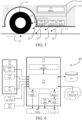
- FIG. 5 schematically illustrates a sensor arrangement 160 mounted in vicinity of (e.g., in front of) a wheel 110 of a vehicle 111 according to some examples.
- the wheel 110 has a traveling direction indicated by 112, along a road surface indicated by 113.
- the sensor arrangement 160 comprises at least one temperature sensor 120, a humidity sensor 130 (optional), and an audio sensor 140 (optional).
- the at least one temperature sensor 120 is configured to measure a tire temperature of the outer surface of the tire of the wheel 110. Furthermore, as indicated by 122, the at least one temperature sensor 120 is configured to measure a road surface temperature of a portion of the road surface 113 to be traveled by the wheel 110. In some examples, as indicated by 123, the at least one temperature sensor 120 is also configured to measure an ambient temperature above the portion of the road surface 113 to be traveled by the wheel 110.
- the at least one temperature sensor 120 may comprise a single temperature sensor configured to perform all of the temperature measurements 121, 122, and (optionally) 123.
- the at least one temperature sensor 120 may comprise two, three, or more temperature sensors, each configured to perform one, or some, of the temperature measurements 121, 122, and (optionally) 123.
- the at least one temperature sensor 120 may comprise a first temperature sensor configured to perform the temperature measurement 121, a second temperature sensor configured to perform the temperature measurement 122, and (optionally) a third temperature sensor configured to perform the temperature measurement 123.
- Each of the at least one temperature sensor(s) 120 may be implemented using any suitable sensor configured to measure temperature (e.g., an infra-red, IR, sensor).
- IR infra-red
- the humidity sensor 130 is configured to measure an ambient humidity above the portion of the road surface 113 to be traveled by the wheel 110.
- the humidity sensor 130 may be implemented using any suitable sensor configured to measure humidity (e.g., a capacitive humidity sensor, a thermal humidity sensor, or a resistive humidity sensor).
- a capacitive humidity sensor e.g., a capacitive humidity sensor, a thermal humidity sensor, or a resistive humidity sensor.
- the audio sensor 140 is configured to measure sound above the portion of the road surface 113 to be traveled by the wheel 110.
- the audio sensor 140 may be implemented using any suitable sensor configured to measure sound (e.g., a microphone).
- the sensor arrangement 160 is suitable for determining upcoming operating conditions of the wheel 110.
- the road surface 113 and its immediate surroundings are typically relatively undisturbed when the measurements are performed, which may yield more useful information.
- road surface and ambient temperature measurements are not affected by recent traveling of other wheels (e.g., warming up by pressure and contact, cooling down by splashing of water, etc.).
- ambient humidity measurements are not affected by recent traveling of other wheels (e.g., increased humidity by splashing of water, etc.).
- sensors are not affected by debris stirred by recent traveling of other wheels.
- FIG. 5 also schematically illustrates a computer system 150 comprising processing circuitry 151. Together, the computer system 150 and the sensor arrangement 160, may be seen as an operating conditions determination system.
- the computer system 150 is illustrated as mounted close to the wheel 110, and in direct association with the sensor arrangement 160. However, it should be noted that the computer system 150 may be located at any suitable position in/on the vehicle 111. In some examples, the computer system 150 is distributed over multiple locations in/on the vehicle 111.
- An operable connection between the sensor arrangement 160 and the computer system 150 may be implemented in any suitable way (e.g., via wired, or wireless, communication). Furthermore, the operable connection may be implemented as a direct connection between the sensor arrangement 160 and the computer system 150 (e.g., by the sensor arrangement comprising an interface unit - such as a tire-road surface sensor interface, TRS I/O - configured to receive the sensor data from each sensor and provide it to the computer system 150), or may be implemented as a connection via one or more intermediate entities.
- an interface unit - such as a tire-road surface sensor interface, TRS I/O - configured to receive the sensor data from each sensor and provide it to the computer system 150
- Each sensor of the sensor arrangement 160 is configured to provide measurement data to the processing circuitry 151 (e.g., by using the operable connection between the sensor arrangement 160 and the computer system 150).
- the processing circuitry 151 is configured to receive the measurement data, and predict an upcoming rolling resistance and/or an upcoming tire-road friction based on the measurement data.
- a relatively high outer surface tire temperature 121 may cause the processing circuitry 151 to predict a relatively low upcoming rolling resistance and/or a relatively high upcoming tire-road friction.
- a relatively high road surface temperature 122 may cause the processing circuitry 151 to predict a relatively low upcoming rolling resistance and/or a relatively high upcoming tire-road friction.
- a relatively high ambient temperature 123 may cause the processing circuitry 151 to predict a relatively low upcoming rolling resistance and/or a relatively high upcoming tire-road friction.
- a relatively high ambient humidity 133 may cause the processing circuitry 151 to predict a relatively low upcoming tire-road friction.
- a sound 143 indicative of a relatively wet/snowy road surface may cause the processing circuitry 151 to predict a relatively high upcoming rolling resistance and/or a relatively low upcoming tire-road friction.
- the processing circuitry may be configured analyze the sound measurement data to detect whether it comprises sound patterns that are likely caused by wet/snowy conditions, or a relatively high sound level may be considered to indicate wet/snowy conditions.
- the processing circuitry 151 is configured to take also other information into account when predicting the upcoming rolling resistance and/or the upcoming tire-road friction.
- a Tire Pressure Monitoring System (TPMS) of the vehicle 111 may provide data (indicative of - for example - one or more of: an inner temperature of the tire, a tire pressure, local acceleration, a tire contact patch) to the processing circuitry 151, and it may affect the prediction in a similar way as the outer surface tire temperature 121. Meanwhile, it should be noted that the inner temperature of the tire typically changes more slowly than the outer surface tire temperature.
- TPMS Tire Pressure Monitoring System
- the TPMS may provide indications of thermal capacity and wear of the tire, and that data may affect the prediction (e.g., a relatively high thermal capacity may provide for a relatively slow response by the tire to external conditions).
- a climate system of the vehicle 111 may provide data indicative of climate parameters (e.g., ambient temperature of the vehicle, ambient humidity of the vehicle, intensity or sun radiation, direction of sun radiation, etc.) to the processing circuitry 151, and the climate parameters may affect the prediction in a similar way as the ambient temperature 123, and/or the ambient humidity 133.
- climate parameters e.g., ambient temperature of the vehicle, ambient humidity of the vehicle, intensity or sun radiation, direction of sun radiation, etc.
- the climate parameters from the climate system are typically different from the corresponding parameter values obtained in a vicinity of the wheel (which is why the approaches of measurements close to the wheel as described herein are beneficial), but the parameter values from the climate system may be used as supplements/enhancements of the corresponding parameter values obtained in a vicinity of the wheel.
- a weighted average between parameter values from the climate system and the corresponding parameter values obtained in a vicinity of the wheel may be used to represent the parameter under consideration.
- a wiper sensor of the vehicle 111 may provide data indicative of wet/snowy conditions to the processing circuitry 151, and that data may affect the prediction in a similar way as the ambient humidity 133, and/or the sound 143.
- the processing circuitry 151 may have access to tire manufacturer data (e.g., indicating thermal capacity and wear of the tire), and that data may affect the prediction as exemplified above.
- tire manufacturer data e.g., indicating thermal capacity and wear of the tire
- the processing circuitry 151 may have access to remote source weather data (e.g., temperature, humidity, wet/snowy conditions) associated with current location of the vehicle and/or with anticipated route of the vehicle, and that data may affect the prediction in a similar way as the ambient temperature 123, and/or the ambient humidity 133, and/or the sound 143.
- remote source weather data e.g., temperature, humidity, wet/snowy conditions
- the parameter values from the remote source weather data are typically different from (and/or less detailed than) the corresponding parameter values obtained in a vicinity of the wheel (which is why the approaches of measurements close to the wheel as described herein are beneficial), but the parameter values from the remote source weather data may be used as supplements/enhancements of the corresponding parameter values obtained in a vicinity of the wheel.
- a weighted average between parameter values from the remote source weather data and the corresponding parameter values obtained in a vicinity of the wheel may be used to represent the parameter under consideration.
- a sensor arrangement as described herein may be used to measure road surface temperature of a portion of the road surface to be traveled by the wheel, tire temperature of the outer surface of a tire of the wheel, ambient temperature above the portion of the road surface to be traveled by the wheel, and/or ambient humidity above the portion of the road surface to be traveled by the wheel.
- This measurement data may be supplemented by information from TPMS.
- measurements by an audio sensor may be used to confirm or reject findings by the humidity sensor (e.g., if the humidity sensor detects close to 100% humidity and the audio sensor detects splashing sounds, it can be assumed that the road surface is wet).
- the predicted tire-road friction may indicate relatively high friction for relatively high measured temperature(s) and relatively low measured humidity, high-to-medium friction for relatively high measured temperature(s) and relatively high measured humidity, medium-to-low friction when water sounds are detected for relatively high measured temperature(s) and relatively high measured humidity, and low friction when water/snow sounds are detected for relatively low measured temperature(s) (e.g., close to zero degrees Celsius) and relatively high measured humidity.
- the processing circuitry 151 may be configured to additionally perform one or more further tasks; as will be exemplified further below.
- FIG. 6 schematically illustrates an operating conditions determination system 300 comprising a sensor arrangement (SA) 360 and a computer system (CS) 350.
- SA sensor arrangement
- CS computer system
- the sensor arrangement 360 may correspond to the sensor arrangement 160 of FIG. 5 and/or the sensor arrangement 260 of FIG. 2 .
- computer system 350 may correspond to the computer system 150 of FIG. 5 and/or may be comprised in the VCU 250 of FIG. 2 .
- the sensor arrangement 360 is suitable for determining upcoming operating conditions of a wheel of a vehicle, and comprises at least one temperature sensor (TS) 320, (optionally) a humidity sensor (HS) 330, and (optionally) an audio sensor (AS) 340; all configured to be mounted in vicinity of the wheel.
- TS temperature sensor
- HS humidity sensor
- AS audio sensor
- the temperature sensor 320 is configured to measure a tire temperature of the outer surface of a tire of the wheel, a road surface temperature of a portion of the road surface to be traveled by the wheel, and (optionally) an ambient temperature above the portion of the road surface to be traveled by the wheel.
- the humidity sensor 330 is configured to measure an ambient humidity above the portion of the road surface to be traveled by the wheel.
- the audio sensor 340 is configured to measure sound above the portion of the road surface to be traveled by the wheel.
- Each sensor is configured to provide measurement data to processing circuitry of the computer system 350.
- the processing circuitry may comprise a predictor (PD) 351, configured to receive the measurement data from the sensor(s) 320, 330, 340 of the sensor arrangement 360, and predict an upcoming rolling resistance (ROLL) 353 and/or an upcoming tire-road friction (FRIC) 352 based on the measurement data.
- PD predictor
- ROLL rolling resistance
- FRIC upcoming tire-road friction
- the processing circuitry of the computer system 350 may be configured to assume that upcoming operating conditions are equivalent (or at least similar) to the currently performed measurements. Then, the currently performed measurements may be used to predict (e.g., via a wheel behavior model) the tire temperature going forward. The predicted tire temperature, along with an anticipated vehicle speed, can be used to determine an estimation of the upcoming rolling resistance. If water or snow is detected, the estimation of the upcoming rolling resistance may be adjusted accordingly.
- the predictor 351 may be configured to receive further information from one or more other sources than the sensor arrangement 360, and to include such further information in the prediction of upcoming rolling resistance 353 and/or upcoming tire-road friction 352.
- the further information is exemplified by data from a climate system (CL SYS) 361, data from a wiper sensor (WS) 362, and weather data from a remote source (WEATH) 363. It should be noted that any suitable further information from any suitable source may be used in the prediction; in addition to the measurement data from the sensor arrangement 360.
- the predicted upcoming rolling resistance 353 and/or upcoming tire-road friction 352 may be provided to a vehicle motion management function (VMM) 380, which is configured to use the predicted values as suitable (e.g., according to known approaches for using rolling resistance and/or tire-road friction to allocate forces and generate actuator instructions).
- VMM vehicle motion management function
- the predicted upcoming rolling resistance 353 may be used to dynamically determine (estimate) a remaining travelling range (RTR) 354 until energy replenishment of the vehicle is needed based on the predicted upcoming rolling resistance.
- RTR remaining travelling range
- a relatively high rolling resistance may lead to relatively high energy consumption; thereby draining a fuel tank or a battery relatively fast.
- a default estimation of remaining travelling range based on the current level of fuel or battery load may be decreased when the rolling resistance is relatively high; and vice versa.
- the dynamically determined remaining travelling range 354 may be rendered at a user interface (UI) 381.
- the UI 381 may provide information to a driver of the vehicle regarding the need for energy replenishment (e.g., fuel refill or battery recharge).
- the UI 381 may provide information to an autonomous, or semi-autonomous, route planning system regarding the need for energy replenishment.
- the dynamically determined remaining travelling range 354 may be used to dynamically adjust vehicle operation, as illustrated by 382; typically to reduce energy consumption responsive to the determined remaining travelling range being shorter than a remaining anticipated route of the vehicle.
- the adjusted vehicle operation may be input to the VMM 380 (e.g., as motion requests) for implementation.
- the adjustment of the vehicle operation may take any suitable form.
- the speed of the vehicle may be reduced, and/or auxiliary devices (e.g., a climate system) may be put in an energy saving mode. Further exemplification is provided in EP 4215875 A1 .
- adjustments of the vehicle operation to reduce energy consumption may collectively be termed as range management.
- an example of an anticipated route is a transport mission (e.g., where a certain delivery should be made to a certain location within a certain time).
- the predictor 351 may have access to a behavior model 370, which describes how the wheel behaves under different operating conditions.
- the wheel behavior model 370 may be any suitable model for wheel behavior.
- the behavior model 370 may provide a mapping between measurement data values and rolling resistance value and/or tire-road friction value.
- the model of wheel behavior may be a differential model associated with the tire.
- the predictor 351 may base the prediction on the wheel behavior model 370.
- the wheel behavior model 370 may be updated based on the received measurement data. For example, if it is noted that the predicted value(s) of rolling resistance and/or tire-road friction seems erroneous, the model may be adjusted accordingly.
- the measurement data from the sensor arrangement 360 and/or corresponding metadata are uploaded to a wheel operating conditions database 390, which is accessible (for upload and/or download) by one or more other vehicles.
- the uploaded information may be labeled to indicate a geographical location of the vehicle, and/or tire type.
- the database 390 may be configured to collect such uploaded information from a plurality of vehicles, and compile/consolidate it to provide corresponding statistics.
- the database 390 may be able to provide reliable (up-to-date) and geographically detailed information regarding operating conditions.
- the database 390 may be able to provide information (e.g., geographical location and rolling resistance and/or tire-road friction) relating to occurrence of slippery portions of an otherwise dry road under generally dry weather conditions.
- the information of the database 390 may be shared (for upload and/or download) among authorized vehicles only.
- any vehicle may be allowed to download information of the database 390, while only authorized vehicles are allowed to perform uploading.
- the predictor 351 may be further configured to download further wheel operating conditions data (e.g., measurement data statistics, predicted value(s), updated model, etc.) from the wheel operating conditions database 390, which may improve the performance of the predictor when the upcoming rolling resistance and/or the upcoming tire-road friction is further based on the downloaded further wheel operating conditions data.
- the further wheel operating conditions data may be associated with the current location of the vehicle and/or with the anticipated route of the vehicle.
- the further wheel operating conditions data may be associated with and tire type of the vehicle.
- the further wheel operating conditions data from the wheel operating conditions database 390 may be built from measurements performed at different moments in time. Thus, some of the further wheel operating conditions data may be based on old measurements, and may therefore be less relevant since road conditions can change rapidly. Hence, it may be beneficial to relay not only on such further wheel operating conditions data, but to also have an on-board sensor arrangement.
- the statistics of the database 390 may comprise operating conditions information along continuous - or finely gridded - geographical lines (e.g., corresponding to routes that vehicles of a truck fleet using the suggested sensor arrangement travel).
- the sensors may be configured to perform measurements at any suitable measurement intervals. For example, relatively rapid changes in the operating conditions might only be properly detected when the sensor arrangement is configured to perform measurements relatively often.
- FIG. 7 illustrates a method 400 according to some examples.
- the method 400 is a computer-implemented method, and may be implemented by processing circuitry of a computer system (e.g., any of the computer system 150 of FIG. 5 , the VCU 250 of FIG. 2 , and the computer system 350 of FIG. 6 ).
- the method 400 comprises receiving measurement data from a sensor arrangement (e.g., any of the sensor arrangement 160 of FIG. 5 , the sensor arrangement 220 of FIG. 2 , and the sensor arrangement 360 of FIG. 6 ).
- a sensor arrangement e.g., any of the sensor arrangement 160 of FIG. 5 , the sensor arrangement 220 of FIG. 2 , and the sensor arrangement 360 of FIG. 6 .
- the method 400 may also comprise acquiring further data as described and exemplified herein (e.g., data from a climate system, data from a wiper sensor, remote source weather data, data from a wheel operating conditions database, etc.).
- step 420 may comprise acquiring data from one or more visual sensor(s) of the vehicle (e.g., camera(s)).
- step 410 and/or step 420 may be seen as comprised in step 34 of the method 30 in FIG. 3 .
- the method 400 also comprises predicting an upcoming rolling resistance and/or an upcoming tire-road friction based on the measurement data; and on the further data when applicable.
- step 430 may be seen as comprised in step 36 of the method 30 in FIG. 3 .
- the method 400 may also comprise updating the wheel behavior model based on the received measurement data.
- step 450 may be seen as comprised in step 35 of the method 30 in FIG. 3 .
- the method 400 may also comprise uploading the measurement data and/or corresponding metadata to a wheel operating conditions database, which is accessible by one or more other vehicles.
- step 460 may be seen as comprised in step 31 of the method 30 in FIG. 3 .
- the method 400 may also comprise dynamically determining a remaining travelling range until energy replenishment of the vehicle is needed based on the predicted upcoming rolling resistance.
- the method 400 may also comprise dynamically adjusting vehicle operation to reduce energy consumption responsive to the determined remaining travelling range being shorter than a remaining anticipated route of the vehicle.
- the method 400 may also comprise providing the predicted upcoming rolling resistance and/or upcoming tire-road friction to a VMM function.
- optional step 490 may comprise providing the adjusted vehicle operation of step 480 to the VMM function.
- FIG. 8 schematically illustrates functionality 600 for actuation control of a wheel 610 according to some examples.
- the control of the wheel 610 is performed via some example motion support devices (MSDs) 620; here comprising a propulsion device (PR) 621, such as an electric machine (EM) and a power steering arrangement (ST) 622.
- MSDs motion support devices
- PR propulsion device
- EM electric machine
- ST power steering arrangement
- a power steering arrangement and a propulsion device are examples of actuators which can be controlled by one or more MSD control units (MSDC) 640.
- MSDC MSD control units
- any suitable actuator(s) may be used as MSD(s), and that FIG. 8 only represents an example of MSDs.
- Other examples include various types of brakes.
- a vehicle motion management (VMM) function 650 may be employed to perform force allocation to meet received motion requests in a safe and robust manner.
- the VMM function 650 communicates actuator instructions to the different MSDs via the MDS control unit(s).
- the VMM function 650 manages both force generation and MSD coordination; i.e., it determines what forces that are required for different wheels and vehicle units in order to fulfil the motion requests, for instance to accelerate the vehicle according to a requested acceleration profile and/or to generate a requested curvature motion by the vehicle.
- the VMM function 650 may be comprised in the VCU 250 of FIG. 2 .
- the VMM function 650 typically uses estimated/predicted parameter values associated with the operating conditions of the vehicle (e.g., to dynamically adjust limitations of the force allocation). Examples of such parameter values include rolling resistance and tire-road friction.
- the parameter values may be provided in the form of upcoming rolling resistance and/or upcoming tire-road friction from a computer system (CS) 670, and may be based on measurement data from a sensor arrangement (SA) 660.
- the computer system 670 may comprise the processing circuitry 151 of FIG. 5 and the sensor arrangement 660 may comprise the sensor arrangement 160 of FIG. 5 .
- the computer system 670 may be comprised in the VCU 250 of FIG.
- the computer system 670 may comprise the processing circuitry 350 of FIG. 6 and the sensor arrangement 660 may comprise the sensor arrangement 360 of FIG. 6 .
- the computer system 670 may be configured to cause performance of (e.g., perform) one or more steps of the method 400 of FIG. 7 and/or one or more steps of the method 30 of FIG. 3 .
- FIG. 9 schematically illustrates a simplified vehicle motion management (VMM) 650' according to some examples.
- VMM vehicle motion management
- the VMM 650' may illustrate a possible implementation of the VMM function 650 of FIG. 8 .
- the VMM 650' may be comprised in the vehicle control unit 250 of FIG. 2 .
- the VMM 650' comprises motion estimation (ME) 651, global force generation (GFG) 452, and motion coordination (MC) 653.
- the motion estimation 651 is configured to provide a representation of the current motion of the vehicle to the global force generation 652.
- the current motion may be represented by parameters such as vertical force F z , friction between road and tire ⁇ , vehicle velocity in relation to a vehicle-centered coordinate system v x , road gradient (or road slope) ⁇ , road banking ⁇ , etc.
- the global force generation 652 is configured to determine global forces elements v based on the representation of the current motion and based on motion requests 671 (e.g., an acceleration request, a steering angle, etc.), and to provide the determined global forces elements to the motion coordination 653.
- motion requests 671 e.g., an acceleration request, a steering angle, etc.
- the motion requests may originate from driver controls of the vehicle (e.g., steering wheel, accelerator pedal, brake pedal, etc.).
- the motion requests may originate from an autonomous - or semi-autonomous - driving control function of the vehicle (e.g., requesting longitudinal speed, longitudinal acceleration, steering angle, etc.).
- the global force generation 652 may be improved by knowledge regarding upcoming rolling resistance and/or upcoming tire-road friction, which may be predicted as described herein and provided at 681.
- the motion coordination 653 is configured to determine actuator request elements u based on the global forces elements v .
- the motion coordination 653 is also configured to provide the actuator request elements u 691, for operation of the motion support devices.
- FIG. 10 is a schematic diagram of a computer system 700 for implementing examples disclosed herein.
- the computer system 700 is adapted to execute instructions from a computer-readable medium to perform these and/or any of the functions or processing described herein.
- the computer system 700 may be connected (e.g., networked) to other machines in a LAN (Local Area Network), LIN (Local Interconnect Network), automotive network communication protocol (e.g., FlexRay), an intranet, an extranet, or the Internet. While only a single device is illustrated, the computer system 700 may include any collection of devices that individually or jointly execute a set (or multiple sets) of instructions to perform any one or more of the methodologies discussed herein.
- any reference in the disclosure and/or claims to a computer system, computing system, computer device, computing device, control system, control unit, electronic control unit (ECU), processor device, processing circuitry, etc. includes reference to one or more such devices to individually or jointly execute a set (or multiple sets) of instructions to perform any one or more of the methodologies discussed herein.
- control system may include a single control unit or a plurality of control units connected or otherwise communicatively coupled to each other, such that any performed function may be distributed between the control units as desired.
- such devices may communicate with each other or other devices by various system architectures, such as directly or via a Controller Area Network (CAN) bus, etc.
- CAN Controller Area Network
- the computer system 700 may comprise at least one computing device or electronic device capable of including firmware, hardware, and/or executing software instructions to implement the functionality described herein.
- the computer system 700 may include processing circuitry 702 (e.g., processing circuitry including one or more processor devices or control units), a memory 704, and a system bus 706.
- the computer system 700 may include at least one computing device having the processing circuitry 702.
- the system bus 706 provides an interface for system components including, but not limited to, the memory 704 and the processing circuitry 702.
- the processing circuitry 702 may include any number of hardware components for conducting data or signal processing or for executing computer code stored in memory 704.
- the processing circuitry 702 may, for example, include a general-purpose processor, an application specific processor, a Digital Signal Processor (DSP), an Application Specific Integrated Circuit (ASIC), a Field Programmable Gate Array (FPGA), a circuit containing processing components, a group of distributed processing components, a group of distributed computers configured for processing, or other programmable logic device, discrete gate or transistor logic, discrete hardware components, or any combination thereof designed to perform the functions described herein.
- the processing circuitry 702 may further include computer executable code that controls operation of the programmable device.
- the system bus 706 may be any of several types of bus structures that may further interconnect to a memory bus (with or without a memory controller), a peripheral bus, and/or a local bus using any of a variety of bus architectures.
- the memory 704 may be one or more devices for storing data and/or computer code for completing or facilitating methods described herein.
- the memory 704 may include database components, object code components, script components, or other types of information structure for supporting the various activities herein. Any distributed or local memory device may be utilized with the systems and methods of this description.
- the memory 704 may be communicably connected to the processing circuitry 702 (e.g., via a circuit or any other wired, wireless, or network connection) and may include computer code for executing one or more processes described herein.
- the memory 704 may include non-volatile memory 708 (e.g., read-only memory (ROM), erasable programmable read-only memory (EPROM), electrically erasable programmable read-only memory (EEPROM), etc.), and volatile memory 710 (e.g., random-access memory (RAM)), or any other medium which can be used to carry or store desired program code in the form of machine-executable instructions or data structures and which can be accessed by a computer or other machine with processing circuitry 702.
- a basic input/output system (BIOS) 712 may be stored in the non-volatile memory 708 and can include the basic routines that help to transfer information between elements within the computer system 700.
- BIOS basic input/output system
- the computer system 700 may further include or be coupled to a non-transitory computer-readable storage medium such as the storage device 714, which may comprise, for example, an internal or external hard disk drive (HDD) (e.g., enhanced integrated drive electronics (EIDE) or serial advanced technology attachment (SATA)), HDD (e.g., EIDE or SATA) for storage, flash memory, or the like.
- HDD enhanced integrated drive electronics
- SATA serial advanced technology attachment
- the storage device 714 and other drives associated with computer-readable media and computer-usable media may provide non-volatile storage of data, data structures, computer-executable instructions, and the like.
- Computer-code which is hard or soft coded may be provided in the form of one or more modules.
- the module(s) can be implemented as software and/or hard-coded in circuitry to implement the functionality described herein in whole or in part.
- the modules may be stored in the storage device 714 and/or in the volatile memory 710, which may include an operating system 716 and/or one or more program modules 718.
- All or a portion of the examples disclosed herein may be implemented as a computer program 720 stored on a transitory or non-transitory computer-usable or computer-readable storage medium (e.g., single medium or multiple media), such as the storage device 714, which includes complex programming instructions (e.g., complex computer-readable program code) to cause the processing circuitry 702 to carry out actions described herein.
- the computer-readable program code of the computer program 720 can comprise software instructions for implementing the functionality of the examples described herein when executed by the processing circuitry 702.
- the storage device 714 may be a computer program product (e.g., readable storage medium) storing the computer program 720 thereon, where at least a portion of a computer program 720 may be loadable (e.g., into a processor) for implementing the functionality of the examples described herein when executed by the processing circuitry 702.
- the processing circuitry 702 may serve as a controller or control system for the computer system 700 that is to implement the functionality described herein.
- the computer system 700 may include an input device interface 722 configured to receive input and selections to be communicated to the computer system 700 when executing instructions, such as from a keyboard, mouse, touch-sensitive surface, etc. Such input devices may be connected to the processing circuitry 702 through the input device interface 722 coupled to the system bus 706 but can be connected through other interfaces, such as a parallel port, an Institute of Electrical and Electronic Engineers (IEEE) 1394 serial port, a Universal Serial Bus (USB) port, an IR interface, and the like.
- the computer system 700 may include an output device interface 724 configured to forward output, such as to a display, a video display unit (e.g., a liquid crystal display (LCD) or a cathode ray tube (CRT)).
- the computer system 700 may include a communications interface 726 suitable for communicating with a network as appropriate or desired.
- the described examples and their equivalents may be realized in software or hardware or a combination thereof.
- the examples may be performed by general purpose circuitry.
- general purpose circuitry include digital signal processors (DSP), central processing units (CPU), co-processor units, field programmable gate arrays (FPGA) and other programmable hardware.
- DSP digital signal processors
- CPU central processing units
- FPGA field programmable gate arrays
- the examples may be performed by specialized circuitry, such as application specific integrated circuits (ASIC).
- ASIC application specific integrated circuits
- the general purpose circuitry and/or the specialized circuitry may, for example, be associated with or comprised in an electronic apparatus such as a VCU.
- the electronic apparatus may comprise arrangements, circuitry, and/or logic according to any of the examples described herein. Alternatively or additionally, the electronic apparatus may be configured to perform method steps according to any of the examples described herein.
- a computer program product comprises a non-transitory computer readable medium such as, for example, a universal serial bus (USB) memory, a plug-in card, an embedded drive, or a read only memory (ROM).
- FIG. 11 illustrates a computer program product exemplified as a non-transitory computer-readable medium in the form of a compact disc (CD) ROM 800.
- the computer-readable medium has stored thereon program code 840 comprising instructions.
- the program code is loadable into processing circuitry (PROC; e.g., a data processing unit) 820, which may, for example, be comprised in a device 810, such as a VCU or a server node.
- PROC processing circuitry
- the program code When loaded into the processing circuitry, the program code may be stored in a memory (MEM) 830 associated with, or comprised in, the processing circuitry. According to some examples, the program code may, when loaded into, and run by, the processing circuitry, cause execution of method steps according to, for example, any of the methods described herein.
- MEM memory
- FIG. 12 schematically illustrates, in terms of a number of functional units, the components of a control unit 900 according to some examples.
- This control unit 900 may be comprised in the vehicle 200 (e.g., in the form of a VCU 250) or in a server node.
- Processing circuitry 910 is provided using any combination of one or more of a suitable central processing unit CPU, multiprocessor, microcontroller, digital signal processor DSP, etc., capable of executing software instructions stored in a computer program product, e.g. in the form of a storage medium 930.
- the processing circuitry 910 may further be provided as at least one application specific integrated circuit ASIC, or field programmable gate array FPGA.
- processing circuitry 910 is configured to cause the control unit 900 to perform a set of operations, or steps, such as any of the methods discussed in connection to FIGs. 3 and 7 .
- control unit 900 for controlling a heavy-duty vehicle 200 to predict road surface operating conditions of a vehicle as described herein.
- the storage medium 930 may store the set of operations
- the processing circuitry 910 may be configured to retrieve the set of operations from the storage medium 930 to cause the control unit 900 to perform the set of operations.
- the set of operations may be provided as a set of executable instructions.
- the processing circuitry 910 is thereby arranged to execute methods as herein disclosed.
- control unit 900 for controlling an articulated vehicle 200 comprising a tractor 210 and/or one or more towed vehicle units 211, the control unit comprising processing circuitry 910, an interface 920 coupled to the processing circuitry 910, and a memory 930 coupled to the processing circuitry 910, wherein the memory comprises machine readable computer program instructions that, when executed by the processing circuitry, causes the control unit to perform the methods discussed herein.
- the storage medium 930 may also comprise persistent storage, which, for example, can be any single one or combination of magnetic memory, optical memory, solid state memory or even remotely mounted memory.
- the control unit 900 may further comprise an interface 920 for communications with at least one external device.
- the interface 920 may comprise one or more transmitters and receivers, comprising analogue and digital components and a suitable number of ports for wireline or wireless communication.
- the processing circuitry 910 controls the general operation of the control unit 900, e.g., by sending data and control signals to the interface 920 and the storage medium 930, by receiving data and reports from the interface 920, and by retrieving data and instructions from the storage medium 930.
- Other components, as well as the related functionality, of the control node are omitted in order not to obscure the concepts presented herein.
- Example 1 A computer system for prediction of road surface operating conditions of a vehicle, the computer system comprising processing circuitry configured to: receive at least a portion of a shared operating conditions model from a remote statistics processor; receive real-time sensor measurement data from sensors of the vehicle; determine a vehicle-specific operating conditions model based on the portion of the shared operating conditions model and the real-time sensor measurement data; and use the vehicle-specific operating conditions model to predict upcoming operating conditions for the vehicle.
- Example 2 The computer system of Example 1, wherein the processing circuitry is further configured to cause the sensor measurement data to be uploaded to the remote statistics processor.
- Example 3 The computer system of any of Examples 1-2, wherein the portion of the shared operating conditions model is determined by a location of the vehicle and/or a time of reception of the portion of the shared operating conditions model.
- Example 4 The computer system of any of Examples 1-3, wherein the vehicle-specific operating conditions model provides respective certainty metrics for road surface operating condition type(s), and wherein the upcoming operating conditions for the vehicle are predicted by road surface operating condition type selection based on the certainty metrics.
- Example 5 A vehicle comprising the computer system of any of Examples 1-4 and one or more sensor(s) for prediction of road surface operating conditions of the vehicle.
- Example 6 The vehicle of Example 5, wherein the one or more sensor(s) of the vehicle comprise at least one visual sensor and a sensor arrangement for determining upcoming operating conditions of a wheel of the vehicle, wherein the sensor arrangement comprises at least one temperature sensor mounted in vicinity of the wheel, and configured to measure a ground surface temperature of a portion of the ground surface to be traveled by the wheel and/or a tire temperature of the outer surface of a tire of the wheel.
- Example 7 The vehicle of Example 6, wherein the at least one temperature sensor is further configured to measure an ambient temperature above the portion of the ground surface to be traveled by the wheel, and/or wherein the sensor arrangement further comprises a humidity sensor mounted in vicinity of the wheel, and configured to measure an ambient humidity above the portion of the ground surface to be traveled by the wheel, and/or wherein the sensor arrangement further comprises an audio sensor mounted in vicinity of the wheel, and configured to measure sound above the portion of the ground surface to be traveled by the wheel.
- the at least one temperature sensor is further configured to measure an ambient temperature above the portion of the ground surface to be traveled by the wheel
- the sensor arrangement further comprises a humidity sensor mounted in vicinity of the wheel, and configured to measure an ambient humidity above the portion of the ground surface to be traveled by the wheel
- the sensor arrangement further comprises an audio sensor mounted in vicinity of the wheel, and configured to measure sound above the portion of the ground surface to be traveled by the wheel.
- Example 8 A computer system for prediction of road surface operating conditions of a specific vehicle, the computer system comprising processing circuitry configured to: receive respective sensor measurement data from a plurality of vehicles; determine a shared operating conditions model based on the measurement data; and cause provision of at least a portion of the shared operating conditions model to the specific vehicle.
- Example 9 A server node comprising the computer system of Example 8.
- Example 10 A computer-implemented method for prediction of road surface operating conditions of a vehicle, the method comprising: receiving (by processing circuitry of a computer system) at least a portion of a shared operating conditions model from a remote statistics processor; receiving (by the processing circuitry) real-time sensor measurement data from sensors of the vehicle; determining (by the processing circuitry) a vehicle-specific operating conditions model based on the portion of the shared operating conditions model and the real-time sensor measurement data; and using (by the processing circuitry) the vehicle-specific operating conditions model to predict upcoming operating conditions for the vehicle.
- Example 11 The method of Example 10, further comprising causing (by the processing circuitry) the sensor measurement data to be uploaded to the remote statistics processor.
- Example 12 The method of any of Examples 10-11, wherein the portion of the shared operating conditions model is determined by a location of the vehicle and/or a time of reception of the portion of the shared operating conditions model.
- Example 13 The method of any of Examples 10-12, wherein the vehicle-specific operating conditions model provides respective certainty metrics for road surface operating condition type(s), and wherein the upcoming operating conditions for the vehicle are predicted by road surface operating condition type selection based on the certainty metrics.
- Example 14 The method of any of Examples 10-13, wherein the one or more sensor(s) of the vehicle comprise at least one visual sensor and a sensor arrangement for determining upcoming operating conditions of a wheel of the vehicle, wherein the sensor arrangement comprises at least one temperature sensor mounted in vicinity of the wheel, and configured to measure a ground surface temperature of a portion of the ground surface to be traveled by the wheel and/or a tire temperature of the outer surface of a tire of the wheel.
- Example 15 The method of Example 14, wherein the at least one temperature sensor is further configured to measure an ambient temperature above the portion of the ground surface to be traveled by the wheel, and/or wherein the sensor arrangement further comprises a humidity sensor mounted in vicinity of the wheel, and configured to measure an ambient humidity above the portion of the ground surface to be traveled by the wheel, and/or wherein the sensor arrangement further comprises an audio sensor mounted in vicinity of the wheel, and configured to measure sound above the portion of the ground surface to be traveled by the wheel.
- Example 16 A computer-implemented method for prediction of road surface operating conditions of a specific vehicle, the method comprising: receiving (by processing circuitry of a computer system) respective sensor measurement data from a plurality of vehicles; determining (by the processing circuitry) a shared operating conditions model based on the measurement data; and causing (by the processing circuitry) provision of at least a portion of the shared operating conditions model to the specific vehicle.
- Example 17 The method of Example 16, wherein the portion of the shared operating conditions model is determined by a location of the specific vehicle and/or a time of provision of the portion of the shared operating conditions model.
- Example 18 The method of any of Examples 16-17, wherein the shared operating conditions model provides respective certainty metrics for road surface operating condition type(s).
- Example 19 A computer program product comprising program code for performing, when executed by the processing circuitry, the method of any of Examples 10-18.
- Example 20 A non-transitory computer-readable storage medium comprising instructions, which when executed by the processing circuitry, cause the processing circuitry to perform the method of any of Examples 10-18.
- Relative terms such as “below” or “above” or “upper” or “lower” or “horizontal” or “vertical” may be used herein to describe a relationship of one element to another element as illustrated in the Figures. It will be understood that these terms and those discussed above are intended to encompass different orientations of the device in addition to the orientation depicted in the Figures. It will be understood that when an element is referred to as being “connected” or “coupled” to another element, it can be directly connected or coupled to the other element, or intervening elements may be present. In contrast, when an element is referred to as being “directly connected” or “directly coupled” to another element, there are no intervening elements present.
Landscapes
- Engineering & Computer Science (AREA)
- Transportation (AREA)
- Mechanical Engineering (AREA)
- Physics & Mathematics (AREA)
- Automation & Control Theory (AREA)
- Mathematical Physics (AREA)
- Computer Networks & Wireless Communication (AREA)
- Signal Processing (AREA)
- Traffic Control Systems (AREA)
- Arrangements For Transmission Of Measured Signals (AREA)
Priority Applications (1)
| Application Number | Priority Date | Filing Date | Title |
|---|---|---|---|
| US18/905,508 US20250115248A1 (en) | 2023-10-06 | 2024-10-03 | Prediction of road surface operating conditions |
Applications Claiming Priority (1)
| Application Number | Priority Date | Filing Date | Title |
|---|---|---|---|
| PCT/EP2023/077683 WO2025073375A1 (en) | 2023-10-06 | 2023-10-06 | Sensor arrangement for determining operating conditions of a vehicle |
Publications (1)
| Publication Number | Publication Date |
|---|---|
| EP4534302A1 true EP4534302A1 (de) | 2025-04-09 |
Family
ID=88297030
Family Applications (1)
| Application Number | Title | Priority Date | Filing Date |
|---|---|---|---|
| EP24181183.5A Pending EP4534302A1 (de) | 2023-10-06 | 2024-06-10 | Vorhersage von strassenoberflächenbetriebsbedingungen |
Country Status (3)
| Country | Link |
|---|---|
| US (1) | US20250115248A1 (de) |
| EP (1) | EP4534302A1 (de) |
| WO (1) | WO2025073375A1 (de) |
Cited By (1)
| Publication number | Priority date | Publication date | Assignee | Title |
|---|---|---|---|---|
| US12617388B2 (en) * | 2021-12-20 | 2026-05-05 | Volvo Truck Corporation | Predictive heavy-duty vehicle motion management based on environment sensing |
Families Citing this family (1)
| Publication number | Priority date | Publication date | Assignee | Title |
|---|---|---|---|---|
| US20250388223A1 (en) * | 2024-06-21 | 2025-12-25 | Ford Global Technologies, Llc | Systems and methods to adjust vehicle parameters in a geofenced area |
Citations (4)
| Publication number | Priority date | Publication date | Assignee | Title |
|---|---|---|---|---|
| US20190217864A1 (en) * | 2016-09-13 | 2019-07-18 | Panasonic Intellectual Property Management Co., Ltd. | Road surface condition prediction system, driving assistance system, road surface condition prediction method, and data distribution method |
| US10936940B2 (en) * | 2016-02-11 | 2021-03-02 | Volvo Car Corporation | Arrangement and method for predicting road friction within a road network |
| EP3581454B1 (de) * | 2018-06-12 | 2022-08-10 | Volvo Car Corporation | System und verfahren zur verwendung von aggregierten wetterdaten für den strassenbelagszustand und schätzungen der strassenreibung |
| EP4215875A1 (de) | 2022-01-20 | 2023-07-26 | Volvo Truck Corporation | Verarbeitungseinheit und verfahren zum ermöglichen einer zuverlässigen entfernungsschätzung für ein fahrzeug entlang einer route |
Family Cites Families (4)
| Publication number | Priority date | Publication date | Assignee | Title |
|---|---|---|---|---|
| WO2001003953A2 (en) * | 1999-07-12 | 2001-01-18 | Geomat Insights, Llc | Wireless remote tire parameter measurement method and apparatus |
| JP3904153B2 (ja) * | 2002-11-26 | 2007-04-11 | マツダ株式会社 | 車両用情報提供装置 |
| US9085205B2 (en) * | 2012-12-21 | 2015-07-21 | Continental Automotive Systems, Inc. | Tire tread temperature sensor and diagnostics for in-vehicle display |
| KR20230087117A (ko) * | 2021-12-09 | 2023-06-16 | 현대모비스 주식회사 | 자율주행 민감도 변경 방법 및 장치 |
-
2023
- 2023-10-06 WO PCT/EP2023/077683 patent/WO2025073375A1/en active Pending
-
2024
- 2024-06-10 EP EP24181183.5A patent/EP4534302A1/de active Pending
- 2024-10-03 US US18/905,508 patent/US20250115248A1/en active Pending
Patent Citations (4)
| Publication number | Priority date | Publication date | Assignee | Title |
|---|---|---|---|---|
| US10936940B2 (en) * | 2016-02-11 | 2021-03-02 | Volvo Car Corporation | Arrangement and method for predicting road friction within a road network |
| US20190217864A1 (en) * | 2016-09-13 | 2019-07-18 | Panasonic Intellectual Property Management Co., Ltd. | Road surface condition prediction system, driving assistance system, road surface condition prediction method, and data distribution method |
| EP3581454B1 (de) * | 2018-06-12 | 2022-08-10 | Volvo Car Corporation | System und verfahren zur verwendung von aggregierten wetterdaten für den strassenbelagszustand und schätzungen der strassenreibung |
| EP4215875A1 (de) | 2022-01-20 | 2023-07-26 | Volvo Truck Corporation | Verarbeitungseinheit und verfahren zum ermöglichen einer zuverlässigen entfernungsschätzung für ein fahrzeug entlang einer route |
Non-Patent Citations (1)
| Title |
|---|
| M. OTOOFI ET AL.: "Estimating friction coefficient using generative modelling", 2023 IEEE INTERNATIONAL CONFERENCE ON MECHATRONICS (ICM, March 2023 (2023-03-01) |
Cited By (1)
| Publication number | Priority date | Publication date | Assignee | Title |
|---|---|---|---|---|
| US12617388B2 (en) * | 2021-12-20 | 2026-05-05 | Volvo Truck Corporation | Predictive heavy-duty vehicle motion management based on environment sensing |
Also Published As
| Publication number | Publication date |
|---|---|
| US20250115248A1 (en) | 2025-04-10 |
| WO2025073375A1 (en) | 2025-04-10 |
Similar Documents
| Publication | Publication Date | Title |
|---|---|---|
| CN104925001B (zh) | 车辆传感器诊断系统和方法以及包括这种系统的车辆 | |
| EP4114701B1 (de) | Autonomes fahrzeug und verfahren mit einer überwachung von lokalisierungsfehlern | |
| US20180164119A1 (en) | System and method for generating an environmental condition database using automotive sensors | |
| CN111201173B (zh) | 用于确定车辆轮胎与车道之间的接触的摩擦值的方法以及用于控制车辆的车辆功能的方法 | |
| US11794750B1 (en) | Snow friction determination by autonomous vehicle | |
| US12346850B1 (en) | Systems and methods for determining fleet capacity | |
| US20250115248A1 (en) | Prediction of road surface operating conditions | |
| CN110641473A (zh) | 运输基础设施通信和控制 | |
| KR102738777B1 (ko) | 자율주행 트램용 슬립 슬라이드 예방 시스템 및 이를 이용한 슬립 슬라이드 예방 방법 | |
| US12233916B2 (en) | Method and system for determining a mover model for motion forecasting in autonomous vehicle control | |
| US12534108B2 (en) | Systems and methods of fleet road de-icing with autonomous vehicles | |
| US12570124B2 (en) | Emergency heating system for electric vehicle (EV) running out of power | |
| CN120003534A (zh) | 一种车辆控制方法、装置及电子设备 | |
| EP4678495A1 (de) | Ansätze zur bestimmung von betriebsbedingungen eines fahrzeugs | |
| JP2025539141A (ja) | 道路状態を検出するための方法 | |
| EP4065438B1 (de) | Verfahren, vorrichtungen, systeme und computerprogrammprodukt zum schätzen von strassenzustandsinformationen | |
| JP2023050804A (ja) | 路面判定装置、及び、路面判定方法 | |
| US20260048749A1 (en) | Vehicle motion estimation | |
| US12617388B2 (en) | Predictive heavy-duty vehicle motion management based on environment sensing | |
| EP4534369A1 (de) | Bestimmung der stabilität eines fahrzeugs auf basis einer bewegung von an dem fahrzeug befestigten anhängern | |
| CN120621333A (zh) | 车辆巡航控制方法、装置、车载计算设备和车辆 | |
| EP4442528A1 (de) | Computerimplementiertes verfahren zur schätzung der reifenverschlechterung und datenverarbeitungssystem | |
| US20250058766A1 (en) | Predictive heavy-duty vehicle motion management based on environment sensing | |
| CN115416628A (zh) | 刹车控制方法、装置、设备与计算机可读存储介质 | |
| CN120942304A (zh) | 一种车辆控制方法和相关设备 |
Legal Events
| Date | Code | Title | Description |
|---|---|---|---|
| PUAI | Public reference made under article 153(3) epc to a published international application that has entered the european phase |
Free format text: ORIGINAL CODE: 0009012 |
|
| STAA | Information on the status of an ep patent application or granted ep patent |
Free format text: STATUS: REQUEST FOR EXAMINATION WAS MADE |
|
| 17P | Request for examination filed |
Effective date: 20241219 |
|
| AK | Designated contracting states |
Kind code of ref document: A1 Designated state(s): AL AT BE BG CH CY CZ DE DK EE ES FI FR GB GR HR HU IE IS IT LI LT LU LV MC ME MK MT NL NO PL PT RO RS SE SI SK SM TR |