EP4534476A1 - Procédé et installation de production d'hydrogène - Google Patents
Procédé et installation de production d'hydrogène Download PDFInfo
- Publication number
- EP4534476A1 EP4534476A1 EP23020461.2A EP23020461A EP4534476A1 EP 4534476 A1 EP4534476 A1 EP 4534476A1 EP 23020461 A EP23020461 A EP 23020461A EP 4534476 A1 EP4534476 A1 EP 4534476A1
- Authority
- EP
- European Patent Office
- Prior art keywords
- gas stream
- process gas
- hydrogen
- carbon dioxide
- enriched
- Prior art date
- Legal status (The legal status is an assumption and is not a legal conclusion. Google has not performed a legal analysis and makes no representation as to the accuracy of the status listed.)
- Withdrawn
Links
Images
Classifications
-
- C—CHEMISTRY; METALLURGY
- C01—INORGANIC CHEMISTRY
- C01B—NON-METALLIC ELEMENTS; COMPOUNDS THEREOF; METALLOIDS OR COMPOUNDS THEREOF NOT COVERED BY SUBCLASS C01C
- C01B3/00—Hydrogen; Gaseous mixtures containing hydrogen; Separation of hydrogen from mixtures containing it; Purification of hydrogen; Reversible storage of hydrogen
- C01B3/02—Production of hydrogen; Production of gaseous mixtures containing hydrogen
- C01B3/32—Production of hydrogen; Production of gaseous mixtures containing hydrogen by reaction of gaseous or liquid organic compounds with gasifying agents, e.g. water, carbon dioxide or air
- C01B3/34—Production of hydrogen; Production of gaseous mixtures containing hydrogen by reaction of gaseous or liquid organic compounds with gasifying agents, e.g. water, carbon dioxide or air by reaction of hydrocarbons with gasifying agents
-
- B—PERFORMING OPERATIONS; TRANSPORTING
- B01—PHYSICAL OR CHEMICAL PROCESSES OR APPARATUS IN GENERAL
- B01D—SEPARATION
- B01D53/00—Separation of gases or vapours; Recovering vapours of volatile solvents from gases; Chemical or biological purification of waste gases, e.g. engine exhaust gases, smoke, fumes, flue gases, aerosols
- B01D53/02—Separation of gases or vapours; Recovering vapours of volatile solvents from gases; Chemical or biological purification of waste gases, e.g. engine exhaust gases, smoke, fumes, flue gases, aerosols by adsorption, e.g. preparative gas chromatography
- B01D53/04—Separation of gases or vapours; Recovering vapours of volatile solvents from gases; Chemical or biological purification of waste gases, e.g. engine exhaust gases, smoke, fumes, flue gases, aerosols by adsorption, e.g. preparative gas chromatography with stationary adsorbents
- B01D53/047—Pressure swing adsorption
-
- C—CHEMISTRY; METALLURGY
- C01—INORGANIC CHEMISTRY
- C01B—NON-METALLIC ELEMENTS; COMPOUNDS THEREOF; METALLOIDS OR COMPOUNDS THEREOF NOT COVERED BY SUBCLASS C01C
- C01B3/00—Hydrogen; Gaseous mixtures containing hydrogen; Separation of hydrogen from mixtures containing it; Purification of hydrogen; Reversible storage of hydrogen
- C01B3/50—Separation of hydrogen or hydrogen-containing gases from gaseous mixtures, e.g. purification
- C01B3/501—Separation of hydrogen or hydrogen-containing gases from gaseous mixtures, e.g. purification by diffusion
-
- C—CHEMISTRY; METALLURGY
- C01—INORGANIC CHEMISTRY
- C01B—NON-METALLIC ELEMENTS; COMPOUNDS THEREOF; METALLOIDS OR COMPOUNDS THEREOF NOT COVERED BY SUBCLASS C01C
- C01B3/00—Hydrogen; Gaseous mixtures containing hydrogen; Separation of hydrogen from mixtures containing it; Purification of hydrogen; Reversible storage of hydrogen
- C01B3/50—Separation of hydrogen or hydrogen-containing gases from gaseous mixtures, e.g. purification
- C01B3/508—Separation of hydrogen or hydrogen-containing gases from gaseous mixtures, e.g. purification by using hydrogen storage media
-
- C—CHEMISTRY; METALLURGY
- C01—INORGANIC CHEMISTRY
- C01B—NON-METALLIC ELEMENTS; COMPOUNDS THEREOF; METALLOIDS OR COMPOUNDS THEREOF NOT COVERED BY SUBCLASS C01C
- C01B2203/00—Integrated processes for the production of hydrogen or synthesis gas
- C01B2203/02—Processes for making hydrogen or synthesis gas
- C01B2203/0205—Processes for making hydrogen or synthesis gas containing a reforming step
- C01B2203/0211—Processes for making hydrogen or synthesis gas containing a reforming step containing a non-catalytic reforming step
- C01B2203/0216—Processes for making hydrogen or synthesis gas containing a reforming step containing a non-catalytic reforming step containing a non-catalytic steam reforming step
-
- C—CHEMISTRY; METALLURGY
- C01—INORGANIC CHEMISTRY
- C01B—NON-METALLIC ELEMENTS; COMPOUNDS THEREOF; METALLOIDS OR COMPOUNDS THEREOF NOT COVERED BY SUBCLASS C01C
- C01B2203/00—Integrated processes for the production of hydrogen or synthesis gas
- C01B2203/02—Processes for making hydrogen or synthesis gas
- C01B2203/0205—Processes for making hydrogen or synthesis gas containing a reforming step
- C01B2203/0227—Processes for making hydrogen or synthesis gas containing a reforming step containing a catalytic reforming step
- C01B2203/0244—Processes for making hydrogen or synthesis gas containing a reforming step containing a catalytic reforming step the reforming step being an autothermal reforming step, e.g. secondary reforming processes
-
- C—CHEMISTRY; METALLURGY
- C01—INORGANIC CHEMISTRY
- C01B—NON-METALLIC ELEMENTS; COMPOUNDS THEREOF; METALLOIDS OR COMPOUNDS THEREOF NOT COVERED BY SUBCLASS C01C
- C01B2203/00—Integrated processes for the production of hydrogen or synthesis gas
- C01B2203/02—Processes for making hydrogen or synthesis gas
- C01B2203/0266—Processes for making hydrogen or synthesis gas containing a decomposition step
- C01B2203/0277—Processes for making hydrogen or synthesis gas containing a decomposition step containing a catalytic decomposition step
-
- C—CHEMISTRY; METALLURGY
- C01—INORGANIC CHEMISTRY
- C01B—NON-METALLIC ELEMENTS; COMPOUNDS THEREOF; METALLOIDS OR COMPOUNDS THEREOF NOT COVERED BY SUBCLASS C01C
- C01B2203/00—Integrated processes for the production of hydrogen or synthesis gas
- C01B2203/02—Processes for making hydrogen or synthesis gas
- C01B2203/0283—Processes for making hydrogen or synthesis gas containing a CO-shift step, i.e. a water gas shift step
-
- C—CHEMISTRY; METALLURGY
- C01—INORGANIC CHEMISTRY
- C01B—NON-METALLIC ELEMENTS; COMPOUNDS THEREOF; METALLOIDS OR COMPOUNDS THEREOF NOT COVERED BY SUBCLASS C01C
- C01B2203/00—Integrated processes for the production of hydrogen or synthesis gas
- C01B2203/04—Integrated processes for the production of hydrogen or synthesis gas containing a purification step for the hydrogen or the synthesis gas
- C01B2203/0415—Purification by absorption in liquids
-
- C—CHEMISTRY; METALLURGY
- C01—INORGANIC CHEMISTRY
- C01B—NON-METALLIC ELEMENTS; COMPOUNDS THEREOF; METALLOIDS OR COMPOUNDS THEREOF NOT COVERED BY SUBCLASS C01C
- C01B2203/00—Integrated processes for the production of hydrogen or synthesis gas
- C01B2203/04—Integrated processes for the production of hydrogen or synthesis gas containing a purification step for the hydrogen or the synthesis gas
- C01B2203/042—Purification by adsorption on solids
- C01B2203/043—Regenerative adsorption process in two or more beds, one for adsorption, the other for regeneration
-
- C—CHEMISTRY; METALLURGY
- C01—INORGANIC CHEMISTRY
- C01B—NON-METALLIC ELEMENTS; COMPOUNDS THEREOF; METALLOIDS OR COMPOUNDS THEREOF NOT COVERED BY SUBCLASS C01C
- C01B2203/00—Integrated processes for the production of hydrogen or synthesis gas
- C01B2203/08—Methods of heating or cooling
- C01B2203/0805—Methods of heating the process for making hydrogen or synthesis gas
- C01B2203/0811—Methods of heating the process for making hydrogen or synthesis gas by combustion of fuel
- C01B2203/0827—Methods of heating the process for making hydrogen or synthesis gas by combustion of fuel at least part of the fuel being a recycle stream
-
- C—CHEMISTRY; METALLURGY
- C01—INORGANIC CHEMISTRY
- C01B—NON-METALLIC ELEMENTS; COMPOUNDS THEREOF; METALLOIDS OR COMPOUNDS THEREOF NOT COVERED BY SUBCLASS C01C
- C01B2203/00—Integrated processes for the production of hydrogen or synthesis gas
- C01B2203/14—Details of the flowsheet
- C01B2203/142—At least two reforming, decomposition or partial oxidation steps in series
Definitions
- the invention relates to a process and a plant for producing hydrogen.
- carbonaceous feedstocks can be converted using steam reforming, partial oxidation, autothermal reforming, or a combination of these processes. All of these processes produce carbon dioxide. Typically, the carbon dioxide is separated from a product mixture of the aforementioned processes using chemical or physical scrubbing or pressure swing adsorption.
- the separated carbon dioxide is not required and converted in a subsequent process, such as the production of urea or methanol, it is conventionally released into the atmosphere.
- the hydrogen produced in this way is also referred to as gray hydrogen.
- the aim here is to avoid the release of carbon dioxide into the atmosphere as much as possible through suitable process steps. After its separation, the carbon dioxide is typically compressed, purified, and then liquefied before being permanently stored, for example, in a storage facility. This process is also referred to as sequestration.
- the proposed method for producing a hydrogen product comprises forming a first process gas stream containing hydrogen, carbon dioxide and one or more further carbon compounds using one or more preparation steps, wherein the first process gas stream or a part thereof is subjected to a first pressure swing adsorption to obtain a second process gas stream which is enriched in hydrogen compared to the first process gas stream and depleted in carbon dioxide and in the one or more further carbon compounds, and a third process gas stream which is enriched in carbon dioxide and in the one or more further carbon compounds and depleted in hydrogen compared to the first process gas stream, wherein the second process gas stream or a part thereof is used as the hydrogen product or is processed thereto, wherein the third process gas stream or a part thereof is subjected to a first pressure swing adsorption to obtain a fourth process gas stream which is enriched in carbon dioxide and depleted in hydrogen and in the one or more further carbon compounds compared to the third process gas stream, and a fifth process gas stream which is enriched in hydrogen and in the one or more further carbon compounds compared
- the one or more further carbon compounds may be or comprise, in particular, methane and/or carbon monoxide. These are therefore compounds from which or by using which hydrogen can be formed, either by splitting off hydrogen from the molecule, particularly in the case of methane, or by reaction with a reactant, particularly in the case of carbon monoxide with water during the water-gas shift, in which hydrogen and carbon dioxide are formed.
- the entire fifth process gas stream is subjected to the second pressure swing adsorption
- other embodiments provide that only a first portion of the fifth process gas stream is subjected to the second pressure swing adsorption and a second portion of the fifth process gas stream is subjected to the second pressure swing adsorption while obtaining a A permeate stream enriched in hydrogen and depleted in the one or more further carbon compounds, and a retentate stream enriched in the one or more further carbon compounds and depleted in hydrogen compared to the fifth process gas stream, are subjected to membrane separation, wherein the retentate stream or a portion thereof is recycled as feed to the one or at least one of the multiple provision steps.
- the permeate stream or a portion thereof can be combined with the residual gas from the first pressure swing adsorption or a portion thereof and fed to the carbon dioxide removal process.
- the hydrogen contained thereby ultimately ends up back on the second pressure swing adsorption process and can thus be recovered as a product.
- the hydrogen-rich permeate stream can be returned to the process in such a way that the hydrogen it contains ultimately, i.e., after several cycles, ends up back on the second pressure swing adsorption and can be removed from the system.
- the advantage is that the hydrogen is then not returned to the preparation step(s), such as autothermal reforming or water gas shift, where it would even be partially converted again due to the reactions taking place there. The produced hydrogen is thus retained.
- the hydrogen-poor retentate stream in particular containing other carbon compounds, can be returned to the main process.
- the second process gas stream and/or the sixth process gas stream can have a hydrogen content of more than 90% on a molar basis; in examples, this is a hydrogen content of more than 90%, 95%, 99%, 99.5%, or 99.9% on a molar basis.
- the corresponding hydrogen can then be suitably processed, for example, liquefied, compressed, subcooled, etc.
- the fourth process gas stream may have a carbon dioxide content of more than 90% on a molar basis, in particular a carbon dioxide content of more than 90%, 95%, 99%, 99.5%, or 99.9% on a molar basis. Such a carbon dioxide stream is particularly suitable for sequestration or other use.
- the fifth process gas stream may have a carbon dioxide content of less than 10% on a molar basis, in particular a carbon dioxide content of less than 5%, 1%, 0.5%, or 0.1% on a molar basis. This enables a significant reduction in the direct carbon dioxide emissions of a corresponding process.
- any variant of carbon dioxide removal can be provided; for example, it can be carried out using physical scrubbing, chemical scrubbing, and/or adsorption.
- Corresponding processes are also known per se and have been described in the specialist literature.
- the first and second portions of the sixth process gas stream can be adjusted according to a heating gas requirement of the process, for example, based on a pressure in a heating gas system. This allows for precise adjustment.
- the proposed plant for producing a hydrogen product is designed to form a first process gas stream containing hydrogen, carbon dioxide and one or more further carbon compounds by means of one or more preparation steps, to convert the first process gas stream or a part thereof to obtain a second process gas stream which, compared to the first Process gas stream enriched in hydrogen and depleted in carbon dioxide and in the one or more further carbon compounds, and a third process gas stream which is enriched in carbon dioxide and in the one or more further carbon compounds compared to the first process gas stream and depleted in hydrogen, to a first pressure swing adsorption, to use the second process gas stream or a portion thereof as the hydrogen product or to process it thereto, to subject the third process gas stream or a portion thereof to carbon dioxide removal to obtain a fourth process gas stream which is enriched in carbon dioxide and depleted in hydrogen and in the one or more further carbon compounds compared to the third process gas stream, and a fifth process gas stream which is enriched in hydrogen and in the one or more further carbon compounds compared to the third process gas stream and depleted in
- Carbon dioxide separated from product mixtures of corresponding processes is typically compressed, purified, i.e. in particular dried, and then either compressed in gaseous state to pipeline pressure and/or liquefied and pressurized in liquid state or pumped and finally sequestered.
- Liquid and gaseous streams, gas mixtures or the like may, as used herein, be “rich” or “poor” in one or more components, where “rich” may mean a content of at least 50%, 75%, 90%, 95%, 99%, 99.5%, 99.9% or 99.99% and “poor” may mean a content of at most 50%, 25%, 10%, 5%, 1%, 0.1% or 0.01% on a molar, weight or volume basis.
- Liquid and gaseous material streams, gas mixtures, or the like, as used herein, may also be enriched or depleted in one or more components, whereby these terms refer to a content in another material stream used to form the material stream.
- a material stream in question is "enriched” if it has at least 2 times, 5 times, 10 times, 100 times, or 1,000 times the content of the designated component(s), and “depleted” if it has at most 0.5 times, 0.1 times, 0.01 times or 0.001 times the content of the designated component(s), in each case in relation to the material stream from which the material stream in question was formed.
- a "part" of a material stream is referred to here, this can be a proportion with the same composition that has merely been diverted from an initial stream, but also a proportion of a different composition and possibly only a component of the initial stream that has been separated by means of a process such as condensation, evaporation, boiling, distillation, rectification, absorption, flashing, membrane separation, separation or the like. is formed or remains as a residue in a corresponding step.
- a “part” can also be present after a combination of any of the above-mentioned steps, for example, after separation of a diverted portion.
- CCR carbon capture rate
- CI carbon intensity
- This figure describes the amount of carbon dioxide that ultimately ends up in the atmosphere during the production of the hydrogen product. Indirect emissions, such as those from electricity consumption, are also taken into account. This figure is usually expressed in kg of carbon dioxide equivalent per kg of hydrogen or in kg of carbon dioxide equivalent per (lower or upper) calorific value.
- a major challenge is to cover the plant's heating gas requirements as precisely as possible without creating a surplus or shortfall.
- Excess fuel gas can be used to generate steam (either by expanding the plant's steam system or by using an additional steam generator). However, in addition to the additional costs, the production of steam, a generally undesirable byproduct, is sometimes not desirable. Excess fuel gas can also be recycled back into the main process. Various recycling options exist, for example, before the gas generation step, such as autothermal reforming, before water gas shift, or before hydrogen purification, such as pressure swing adsorption. All variants have the disadvantage that the creation of a cycle always leads to the concentration of inerts. This not only requires the main process path to be significantly larger, but also reduces the plant's energy efficiency.
- the proposed designs include, as already explained several times before, extracting exactly or essentially enough hydrogen from a hydrogen-rich heating gas stream to cover the plant's heating gas demand, and feeding the extracted hydrogen directly into the product, thereby also reducing the required feedstock quantity. Furthermore, unnecessary recirculation and the associated concentration of, for example, inerts are avoided, as is the loss of hydrogen (due to back-reaction) when recirculation occurs in a preparation step.
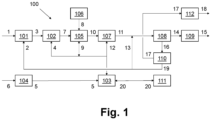
- a hydrocarbon-containing feedstock 1 is fed to the process 100.
- the feedstock 1 is suitably pretreated in a feed pretreatment 101, to which recycled tail gas 2 may also be fed.
- a pretreated feedstream 3 obtained in this way is fed to a pre-reformer 102, to which steam 4 may also be fed from a steam system 103, which may be supplied with treated water 5 from a water treatment 104, which in turn is fed with feedwater 6.
- Steam 20 may also be exchanged with a steam turbine 111.
- a material stream 7 from the pre-reforming 102 is fed to an autothermal reforming 105, which can be fed with oxygen 8 from an air separation 106 and deliver steam 9 or can be supplied with such.
- a synthesis gas 10 from the autothermal reforming 105 is fed to a water gas shift 107 to obtain a shifted synthesis gas 11, which is also fed with Steam 12 from the steam system 103 can be operated.
- the shifted synthesis gas 11, previously and hereinafter also referred to as the first process gas stream can be combined with further tail gas 13 before being fed to a pressure swing adsorption 108 to obtain a hydrogen stream 14, which can be subjected to compression 109 to obtain a compressed hydrogen product 15.
- the hydrogen stream was, and is hereinafter, also referred to as the second process gas stream.
- a residual gas 16 is further obtained, previously and subsequently also referred to as the third process gas stream, which is fed to a carbon dioxide separation 110.
- Carbon dioxide 17 separated here can be fed to a carbon dioxide storage 112, from which a carbon dioxide product 18 can be withdrawn.
- a tail gas from the carbon dioxide removal 110 previously and subsequently also referred to as the fifth process gas stream, which is again designated 19 here, can be recycled in the embodiment illustrated here, as explained in the form of tail gas stream 2 and/or 13.
- a cycle is established as illustrated.
- the cycle volume depends on the fuel gas demand. It can become very high when fuel gas demand is low and lead to unacceptably high concentrations of, for example, inert substances.
- a further disadvantage is the loss of hydrogen (through reverse reaction) if the recirculation occurs in a preparation step of the type described above.
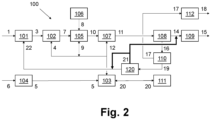
- FIG 2 A method according to a proposed embodiment is illustrated and designated overall by 100, which overcomes corresponding disadvantages.
- the tail gas of the carbon dioxide removal 110 i.e. the fifth process gas stream
- a further pressure swing adsorption 120 which is smaller than the pressure swing adsorption 108.
- the pressure swing adsorption 108 was, and will be, referred to below as first pressure swing adsorption 108, the pressure swing adsorption 120 also as second pressure swing adsorption.
- hydrogen 21 is separated from the tail gas 19.
- This hydrogen 21 was, and is hereinafter also referred to as the sixth process gas stream, and, as illustrated by bold flow arrows, a first portion is transferred into the hydrogen stream 14, i.e. ultimately into the hydrogen product, and a second portion is transferred into the tail gas 22 used as fuel gas of the further pressure swing adsorption 120.
- the tail gas 22 was, and is hereinafter also referred to as the seventh process gas stream.
- the hydrogen separated in the further pressure swing adsorption 120 is partially fed into the overall product stream, but it can also, as needed, be fed to the fuel gas of the tail gas 22 to maintain the pressure in the fuel system. This extracts the exact amount of hydrogen from the tail gas 19 that is required to balance the fuel gas balance and ensure that no excess fuel gas remains.
- the plant components involved in the cycle are designed only for the actual quantities, without having to consider additional cycle quantities. This makes these plant components approximately 5 to 20% smaller (depending on the cycle quantities). Power consumers, such as compressors, also consume correspondingly less power. This more than offsets the additional investment in the small, additional pressure swing adsorption unit 120. The technical risk of cycles is completely eliminated.
- the heating gas requirement can be precisely balanced. This optimizes the overall feed gas requirement.
- the designs proposed here can be used for all plants for the production of hydrogen with carbon dioxide separation 110 (blue hydrogen), as long as a hydrogen-rich fuel gas or tail gas exists which is available in excess compared to the heating gas requirement of the plant.
- One design includes the fact that Not all of the hydrogen-rich fuel gas is fed to the further pressure swing adsorption 120, but only a portion of it. The remaining portion can then be fed back into the main process. The remaining portion is fed either upstream of the autothermal reforming 105, upstream of the water gas shift 107, or upstream of the first pressure swing adsorption 110. Even if this again establishes a cycle with the disadvantages described above, this cycle is nevertheless minimized and, under certain circumstances (depending on the fuel gas demand of the fired heater), may even be necessary.
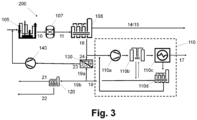
- FIG. 3 is designated overall by 200.
- the graphic representation of the individual components differs, whereby the components and material flows designated with identical reference numerals as previously may be the same or substantially the same.
- a representation of certain components such as a steam system 103, a feed treatment 101, a hydrogen compression 112 and the like has been omitted solely for reasons of clarity. These can also be seen in the Figure 3 presented method 200 may be present.
- Carbon dioxide removal 110 is in Figure 3 in more detail than previously described. It comprises a compressor 110a, an adsorptive dryer 110b, the actual cleaning process 110c, and a pressure swing adsorption process 110d. Its operation is well known. Since the specific implementation of carbon dioxide removal 110 is not relevant here, further explanations will be omitted. However, the same or comparable material streams 17 and 19 are formed as previously explained.
- a portion 19a of the residual gas from the carbon dioxide removal 110 which is returned to the process, is subjected to a membrane separation 130 in order to achieve a depletion of the hydrogen in a recycle stream 23, which is formed as retentate from the membrane separation 130 and can be returned to the autothermal reforming 105 by means of a compressor or blower 140.
- a hydrogen-rich permeate 24 is formed, which is returned to the process in such a way that the hydrogen is ultimately and via the carbon dioxide removal 110 and the fraction 19b lands on the further pressure swing adsorption 120 and can be removed from the system.
- the advantage is that the hydrogen is then not returned to the autothermal reforming 105 or the shift 107, where it would even be partially converted again due to the reactions taking place there.
Landscapes
- Chemical & Material Sciences (AREA)
- Organic Chemistry (AREA)
- Engineering & Computer Science (AREA)
- Chemical Kinetics & Catalysis (AREA)
- Combustion & Propulsion (AREA)
- Inorganic Chemistry (AREA)
- Analytical Chemistry (AREA)
- General Chemical & Material Sciences (AREA)
- Oil, Petroleum & Natural Gas (AREA)
- Health & Medical Sciences (AREA)
- General Health & Medical Sciences (AREA)
- Hydrogen, Water And Hydrids (AREA)
Priority Applications (3)
| Application Number | Priority Date | Filing Date | Title |
|---|---|---|---|
| EP23020461.2A EP4534476A1 (fr) | 2023-10-05 | 2023-10-05 | Procédé et installation de production d'hydrogène |
| AU2024355577A AU2024355577A1 (en) | 2023-10-05 | 2024-09-25 | Method and plant for producing hydrogen |
| PCT/EP2024/025284 WO2025073386A1 (fr) | 2023-10-05 | 2024-09-25 | Procédé et installation de production d'hydrogène |
Applications Claiming Priority (1)
| Application Number | Priority Date | Filing Date | Title |
|---|---|---|---|
| EP23020461.2A EP4534476A1 (fr) | 2023-10-05 | 2023-10-05 | Procédé et installation de production d'hydrogène |
Publications (1)
| Publication Number | Publication Date |
|---|---|
| EP4534476A1 true EP4534476A1 (fr) | 2025-04-09 |
Family
ID=88291217
Family Applications (1)
| Application Number | Title | Priority Date | Filing Date |
|---|---|---|---|
| EP23020461.2A Withdrawn EP4534476A1 (fr) | 2023-10-05 | 2023-10-05 | Procédé et installation de production d'hydrogène |
Country Status (3)
| Country | Link |
|---|---|
| EP (1) | EP4534476A1 (fr) |
| AU (1) | AU2024355577A1 (fr) |
| WO (1) | WO2025073386A1 (fr) |
Citations (4)
| Publication number | Priority date | Publication date | Assignee | Title |
|---|---|---|---|---|
| US20100287981A1 (en) * | 2009-05-18 | 2010-11-18 | American Air Liquide, Inc. | Processes For The Recovery Of High Purity Hydrogen And High Purity Carbon Dioxide |
| US20120291481A1 (en) * | 2011-05-18 | 2012-11-22 | Air Liquide Large Industries U.S. Lp | Process For Recovering Hydrogen And Carbon Dioxide |
| WO2022213053A1 (fr) * | 2021-03-29 | 2022-10-06 | Uop Llc | Procédé de production d'un produit enrichi en hydrogène et récupération de co2 dans une unité de processus de production d'hydrogène |
| EP4098610A1 (fr) * | 2021-05-31 | 2022-12-07 | L'Air Liquide Société Anonyme pour l'Etude et l'Exploitation des Procédés Georges Claude | Procédé et installation de production d'hydrogène pur par vaporeformage à émission réduite de dioxyde de carbone |
-
2023
- 2023-10-05 EP EP23020461.2A patent/EP4534476A1/fr not_active Withdrawn
-
2024
- 2024-09-25 WO PCT/EP2024/025284 patent/WO2025073386A1/fr active Pending
- 2024-09-25 AU AU2024355577A patent/AU2024355577A1/en active Pending
Patent Citations (4)
| Publication number | Priority date | Publication date | Assignee | Title |
|---|---|---|---|---|
| US20100287981A1 (en) * | 2009-05-18 | 2010-11-18 | American Air Liquide, Inc. | Processes For The Recovery Of High Purity Hydrogen And High Purity Carbon Dioxide |
| US20120291481A1 (en) * | 2011-05-18 | 2012-11-22 | Air Liquide Large Industries U.S. Lp | Process For Recovering Hydrogen And Carbon Dioxide |
| WO2022213053A1 (fr) * | 2021-03-29 | 2022-10-06 | Uop Llc | Procédé de production d'un produit enrichi en hydrogène et récupération de co2 dans une unité de processus de production d'hydrogène |
| EP4098610A1 (fr) * | 2021-05-31 | 2022-12-07 | L'Air Liquide Société Anonyme pour l'Etude et l'Exploitation des Procédés Georges Claude | Procédé et installation de production d'hydrogène pur par vaporeformage à émission réduite de dioxyde de carbone |
Non-Patent Citations (1)
| Title |
|---|
| VON A.O. ONI ET AL.: "Comparative assessment of blue hydrogen from steam methane reforming, autothermal reforming, and natural gas decomposition technologies for natural gas-producing regions", ENERGY CONVERSION AND MANAGEMENT, vol. 254, 2022, pages 115245 |
Also Published As
| Publication number | Publication date |
|---|---|
| AU2024355577A1 (en) | 2026-04-09 |
| WO2025073386A1 (fr) | 2025-04-10 |
Similar Documents
| Publication | Publication Date | Title |
|---|---|---|
| EP3954650A1 (fr) | Procédé et installation de fabrication d'hydrogène et de séparation du dioxyde de carbone | |
| EP3323786B1 (fr) | Procédé de fabrication combinée de méthanol et d'ammoniac | |
| EP4324815A1 (fr) | Procédé et installation de production de méthanol et de gaz de synthèse | |
| EP4201878A1 (fr) | Procédé de production d'hydrogène à faible émission de dioxyde de carbone | |
| EP3969433A1 (fr) | Procédé et installation de synthèse de méthanol | |
| EP3513863A1 (fr) | Procédé et installation destinés à l'obtention d'hélium pur | |
| DE112020001970T5 (de) | Synthetik-Produkt-Herstellungssystem und Synthetik-Produktherstellungsverfahren | |
| EP3466869B1 (fr) | Procédé de fabrication combinée de méthanol et d'ammoniac | |
| EP4197967A1 (fr) | Procédé et installation de production de méthanol et de monoxyde de carbone | |
| EP1975123A2 (fr) | Procédé et dispositif pour la génération de gaz de synthèse | |
| EP4534476A1 (fr) | Procédé et installation de production d'hydrogène | |
| DE2911669A1 (de) | Verfahren zur erzeugung von wasserstoff | |
| DE102021210549A1 (de) | Verfahren zur Ammoniaksynthese und Anlage zur Herstellung von Ammoniak | |
| EP3674261B1 (fr) | Procédé de synthèse d'un composé contenant de l'hydrogène | |
| EP4045172A1 (fr) | Procédé et installation pour la fabrication d'un produit gazeux riche en monoxyde de carbone | |
| EP4660132A1 (fr) | Procédé et installation de fourniture d'un produit hydrogène | |
| BE1029787B1 (de) | Verfahren zur Ammoniaksynthese und Anlage zur Herstellung von Ammoniak | |
| AT526550B1 (de) | Verfahren zur kontinuierlichen Produktion von Wasserstoff, Kohlenstoffdioxid und Stickstoff | |
| EP4620902A1 (fr) | Procédé et installation de production d'ammoniac | |
| LU103148B1 (de) | Verfahren und Anlage zur Synthese von Methanol | |
| WO2015106952A1 (fr) | Procédé et dispositif de production de diméthyle éther | |
| EP4334242B1 (fr) | Procédé de synthèse d'ammoniac et installation de production d'ammoniac | |
| WO2019137827A1 (fr) | Fabrication d'un produit gazeux contenant du monoxyde de carbone | |
| EP4656594A1 (fr) | Procédé et installation de production d'un produit à base d'hydrogène et d'un produit à base de monoxyde de carbone | |
| EP3530612A1 (fr) | Procédé et installation de fourniture d'un produit gazeux contenant essentiellement ou exclusivement l'hydrogène |
Legal Events
| Date | Code | Title | Description |
|---|---|---|---|
| STAA | Information on the status of an ep patent application or granted ep patent |
Free format text: STATUS: UNKNOWN |
|
| PUAI | Public reference made under article 153(3) epc to a published international application that has entered the european phase |
Free format text: ORIGINAL CODE: 0009012 |
|
| STAA | Information on the status of an ep patent application or granted ep patent |
Free format text: STATUS: THE APPLICATION HAS BEEN PUBLISHED |
|
| AK | Designated contracting states |
Kind code of ref document: A1 Designated state(s): AL AT BE BG CH CY CZ DE DK EE ES FI FR GB GR HR HU IE IS IT LI LT LU LV MC ME MK MT NL NO PL PT RO RS SE SI SK SM TR |
|
| STAA | Information on the status of an ep patent application or granted ep patent |
Free format text: STATUS: THE APPLICATION IS DEEMED TO BE WITHDRAWN |
|
| 18D | Application deemed to be withdrawn |
Effective date: 20251010 |