EP4534604A1 - Leitfähige harzzusammensetzung, verfahren zur herstellung davon und formartikel damit - Google Patents
Leitfähige harzzusammensetzung, verfahren zur herstellung davon und formartikel damit Download PDFInfo
- Publication number
- EP4534604A1 EP4534604A1 EP24203439.5A EP24203439A EP4534604A1 EP 4534604 A1 EP4534604 A1 EP 4534604A1 EP 24203439 A EP24203439 A EP 24203439A EP 4534604 A1 EP4534604 A1 EP 4534604A1
- Authority
- EP
- European Patent Office
- Prior art keywords
- weight
- resin composition
- conductive resin
- parts
- polyarylene ether
- Prior art date
- Legal status (The legal status is an assumption and is not a legal conclusion. Google has not performed a legal analysis and makes no representation as to the accuracy of the status listed.)
- Pending
Links
- 239000011342 resin composition Substances 0.000 title claims abstract description 84
- 238000000034 method Methods 0.000 title claims abstract description 37
- RTZKZFJDLAIYFH-UHFFFAOYSA-N Diethyl ether Chemical compound CCOCC RTZKZFJDLAIYFH-UHFFFAOYSA-N 0.000 claims description 122
- 229920000412 polyarylene Polymers 0.000 claims description 61
- 125000003118 aryl group Chemical group 0.000 claims description 56
- 229920005989 resin Polymers 0.000 claims description 48
- 239000011347 resin Substances 0.000 claims description 48
- OKTJSMMVPCPJKN-UHFFFAOYSA-N Carbon Chemical compound [C] OKTJSMMVPCPJKN-UHFFFAOYSA-N 0.000 claims description 46
- 238000004898 kneading Methods 0.000 claims description 46
- 239000002041 carbon nanotube Substances 0.000 claims description 45
- 229910021393 carbon nanotube Inorganic materials 0.000 claims description 45
- 239000004952 Polyamide Substances 0.000 claims description 33
- 229920002647 polyamide Polymers 0.000 claims description 33
- 229920001971 elastomer Polymers 0.000 claims description 32
- 239000005011 phenolic resin Substances 0.000 claims description 31
- 150000002170 ethers Chemical class 0.000 claims description 29
- 239000000376 reactant Substances 0.000 claims description 29
- 239000000806 elastomer Substances 0.000 claims description 27
- XLYOFNOQVPJJNP-UHFFFAOYSA-N water Substances O XLYOFNOQVPJJNP-UHFFFAOYSA-N 0.000 claims description 13
- 239000004594 Masterbatch (MB) Substances 0.000 claims description 12
- VZCYOOQTPOCHFL-UPHRSURJSA-N maleic acid Chemical compound OC(=O)\C=C/C(O)=O VZCYOOQTPOCHFL-UPHRSURJSA-N 0.000 claims description 11
- FPYJFEHAWHCUMM-UHFFFAOYSA-N maleic anhydride Chemical compound O=C1OC(=O)C=C1 FPYJFEHAWHCUMM-UHFFFAOYSA-N 0.000 claims description 11
- VZCYOOQTPOCHFL-UHFFFAOYSA-N trans-butenedioic acid Natural products OC(=O)C=CC(O)=O VZCYOOQTPOCHFL-UHFFFAOYSA-N 0.000 claims description 11
- PPBRXRYQALVLMV-UHFFFAOYSA-N Styrene Natural products C=CC1=CC=CC=C1 PPBRXRYQALVLMV-UHFFFAOYSA-N 0.000 claims description 10
- 238000010521 absorption reaction Methods 0.000 claims description 10
- KRKNYBCHXYNGOX-UHFFFAOYSA-N citric acid Chemical compound OC(=O)CC(O)(C(O)=O)CC(O)=O KRKNYBCHXYNGOX-UHFFFAOYSA-N 0.000 claims description 9
- VZCYOOQTPOCHFL-OWOJBTEDSA-N Fumaric acid Chemical compound OC(=O)\C=C\C(O)=O VZCYOOQTPOCHFL-OWOJBTEDSA-N 0.000 claims description 8
- OFOBLEOULBTSOW-UHFFFAOYSA-N Propanedioic acid Natural products OC(=O)CC(O)=O OFOBLEOULBTSOW-UHFFFAOYSA-N 0.000 claims description 7
- 239000011976 maleic acid Substances 0.000 claims description 7
- 125000000524 functional group Chemical group 0.000 claims description 6
- 125000003700 epoxy group Chemical group 0.000 claims description 5
- 239000005060 rubber Substances 0.000 claims description 5
- JAHNSTQSQJOJLO-UHFFFAOYSA-N 2-(3-fluorophenyl)-1h-imidazole Chemical compound FC1=CC=CC(C=2NC=CN=2)=C1 JAHNSTQSQJOJLO-UHFFFAOYSA-N 0.000 claims description 4
- OFNISBHGPNMTMS-UHFFFAOYSA-N 3-methylideneoxolane-2,5-dione Chemical compound C=C1CC(=O)OC1=O OFNISBHGPNMTMS-UHFFFAOYSA-N 0.000 claims description 4
- 229930185605 Bisphenol Natural products 0.000 claims description 4
- 125000003277 amino group Chemical group 0.000 claims description 4
- IISBACLAFKSPIT-UHFFFAOYSA-N bisphenol A Chemical compound C=1C=C(O)C=CC=1C(C)(C)C1=CC=C(O)C=C1 IISBACLAFKSPIT-UHFFFAOYSA-N 0.000 claims description 4
- 239000003822 epoxy resin Substances 0.000 claims description 4
- 239000001530 fumaric acid Substances 0.000 claims description 4
- 125000002887 hydroxy group Chemical group [H]O* 0.000 claims description 4
- LVHBHZANLOWSRM-UHFFFAOYSA-N methylenebutanedioic acid Natural products OC(=O)CC(=C)C(O)=O LVHBHZANLOWSRM-UHFFFAOYSA-N 0.000 claims description 4
- 229920000647 polyepoxide Polymers 0.000 claims description 4
- WQNHWIYLCRZRLR-UHFFFAOYSA-N 2-(3-hydroxy-2,5-dioxooxolan-3-yl)acetic acid Chemical compound OC(=O)CC1(O)CC(=O)OC1=O WQNHWIYLCRZRLR-UHFFFAOYSA-N 0.000 claims description 3
- 125000003178 carboxy group Chemical group [H]OC(*)=O 0.000 claims description 3
- 125000003011 styrenyl group Chemical group [H]\C(*)=C(/[H])C1=C([H])C([H])=C([H])C([H])=C1[H] 0.000 claims 1
- 229910052751 metal Inorganic materials 0.000 abstract description 8
- 239000002184 metal Substances 0.000 abstract description 8
- 229920001577 copolymer Polymers 0.000 description 25
- -1 polyphenylene Polymers 0.000 description 25
- 239000000047 product Substances 0.000 description 15
- 229920002302 Nylon 6,6 Polymers 0.000 description 12
- 229920000098 polyolefin Polymers 0.000 description 11
- 230000009102 absorption Effects 0.000 description 9
- 239000000463 material Substances 0.000 description 9
- 238000010422 painting Methods 0.000 description 9
- 229920002292 Nylon 6 Polymers 0.000 description 8
- 150000001875 compounds Chemical class 0.000 description 7
- 230000000704 physical effect Effects 0.000 description 7
- FACXGONDLDSNOE-UHFFFAOYSA-N buta-1,3-diene;styrene Chemical compound C=CC=C.C=CC1=CC=CC=C1.C=CC1=CC=CC=C1 FACXGONDLDSNOE-UHFFFAOYSA-N 0.000 description 6
- 238000002156 mixing Methods 0.000 description 6
- 229920001955 polyphenylene ether Polymers 0.000 description 6
- 229920000468 styrene butadiene styrene block copolymer Polymers 0.000 description 6
- 239000004593 Epoxy Substances 0.000 description 5
- 238000005238 degreasing Methods 0.000 description 5
- 239000000178 monomer Substances 0.000 description 5
- 239000000243 solution Substances 0.000 description 5
- SMZOUWXMTYCWNB-UHFFFAOYSA-N 2-(2-methoxy-5-methylphenyl)ethanamine Chemical compound COC1=CC=C(C)C=C1CCN SMZOUWXMTYCWNB-UHFFFAOYSA-N 0.000 description 4
- NIXOWILDQLNWCW-UHFFFAOYSA-N 2-Propenoic acid Natural products OC(=O)C=C NIXOWILDQLNWCW-UHFFFAOYSA-N 0.000 description 4
- 229920000299 Nylon 12 Polymers 0.000 description 4
- 229920000572 Nylon 6/12 Polymers 0.000 description 4
- 150000001732 carboxylic acid derivatives Chemical class 0.000 description 4
- 230000000052 comparative effect Effects 0.000 description 4
- 230000006866 deterioration Effects 0.000 description 4
- 238000002347 injection Methods 0.000 description 4
- 239000007924 injection Substances 0.000 description 4
- 238000004519 manufacturing process Methods 0.000 description 4
- 238000005259 measurement Methods 0.000 description 4
- VNWKTOKETHGBQD-UHFFFAOYSA-N methane Chemical compound C VNWKTOKETHGBQD-UHFFFAOYSA-N 0.000 description 4
- 230000004048 modification Effects 0.000 description 4
- 238000012986 modification Methods 0.000 description 4
- 239000003973 paint Substances 0.000 description 4
- 239000008188 pellet Substances 0.000 description 4
- 229920006128 poly(nonamethylene terephthalamide) Polymers 0.000 description 4
- 229920000642 polymer Polymers 0.000 description 4
- 229920005672 polyolefin resin Polymers 0.000 description 4
- 239000002994 raw material Substances 0.000 description 4
- NIXOWILDQLNWCW-UHFFFAOYSA-M Acrylate Chemical compound [O-]C(=O)C=C NIXOWILDQLNWCW-UHFFFAOYSA-M 0.000 description 3
- IJGRMHOSHXDMSA-UHFFFAOYSA-N Atomic nitrogen Chemical compound N#N IJGRMHOSHXDMSA-UHFFFAOYSA-N 0.000 description 3
- WSFSSNUMVMOOMR-UHFFFAOYSA-N Formaldehyde Chemical compound O=C WSFSSNUMVMOOMR-UHFFFAOYSA-N 0.000 description 3
- 229920006121 Polyxylylene adipamide Polymers 0.000 description 3
- 230000008901 benefit Effects 0.000 description 3
- 239000011248 coating agent Substances 0.000 description 3
- 239000011247 coating layer Substances 0.000 description 3
- 238000000576 coating method Methods 0.000 description 3
- 230000000694 effects Effects 0.000 description 3
- 238000010559 graft polymerization reaction Methods 0.000 description 3
- 239000000203 mixture Substances 0.000 description 3
- 239000000126 substance Substances 0.000 description 3
- 239000004094 surface-active agent Substances 0.000 description 3
- GJYCVCVHRSWLNY-UHFFFAOYSA-N 2-butylphenol Chemical compound CCCCC1=CC=CC=C1O GJYCVCVHRSWLNY-UHFFFAOYSA-N 0.000 description 2
- ROGIWVXWXZRRMZ-UHFFFAOYSA-N 2-methylbuta-1,3-diene;styrene Chemical compound CC(=C)C=C.C=CC1=CC=CC=C1 ROGIWVXWXZRRMZ-UHFFFAOYSA-N 0.000 description 2
- VSKJLJHPAFKHBX-UHFFFAOYSA-N 2-methylbuta-1,3-diene;styrene Chemical compound CC(=C)C=C.C=CC1=CC=CC=C1.C=CC1=CC=CC=C1 VSKJLJHPAFKHBX-UHFFFAOYSA-N 0.000 description 2
- HEDRZPFGACZZDS-UHFFFAOYSA-N Chloroform Chemical compound ClC(Cl)Cl HEDRZPFGACZZDS-UHFFFAOYSA-N 0.000 description 2
- 101000576320 Homo sapiens Max-binding protein MNT Proteins 0.000 description 2
- 229920000571 Nylon 11 Polymers 0.000 description 2
- 229920003189 Nylon 4,6 Polymers 0.000 description 2
- 229920000393 Nylon 6/6T Polymers 0.000 description 2
- ISWSIDIOOBJBQZ-UHFFFAOYSA-N Phenol Chemical compound OC1=CC=CC=C1 ISWSIDIOOBJBQZ-UHFFFAOYSA-N 0.000 description 2
- 239000004721 Polyphenylene oxide Substances 0.000 description 2
- 150000008064 anhydrides Chemical class 0.000 description 2
- 238000012662 bulk polymerization Methods 0.000 description 2
- 229910052799 carbon Inorganic materials 0.000 description 2
- 239000006229 carbon black Substances 0.000 description 2
- 239000007859 condensation product Substances 0.000 description 2
- 239000004020 conductor Substances 0.000 description 2
- 238000005520 cutting process Methods 0.000 description 2
- 230000002542 deteriorative effect Effects 0.000 description 2
- YSEKNCXYRGKTBJ-UHFFFAOYSA-N dimethyl 2-hydroxybutanedioate Chemical compound COC(=O)CC(O)C(=O)OC YSEKNCXYRGKTBJ-UHFFFAOYSA-N 0.000 description 2
- 239000012153 distilled water Substances 0.000 description 2
- 238000009826 distribution Methods 0.000 description 2
- 239000002079 double walled nanotube Substances 0.000 description 2
- 238000007720 emulsion polymerization reaction Methods 0.000 description 2
- 238000001125 extrusion Methods 0.000 description 2
- 238000005227 gel permeation chromatography Methods 0.000 description 2
- 230000009477 glass transition Effects 0.000 description 2
- 238000010438 heat treatment Methods 0.000 description 2
- 229910052738 indium Inorganic materials 0.000 description 2
- 239000003999 initiator Substances 0.000 description 2
- 238000001746 injection moulding Methods 0.000 description 2
- 239000002048 multi walled nanotube Substances 0.000 description 2
- 239000002071 nanotube Substances 0.000 description 2
- 230000007935 neutral effect Effects 0.000 description 2
- 150000002989 phenols Chemical class 0.000 description 2
- 229920006111 poly(hexamethylene terephthalamide) Polymers 0.000 description 2
- 229920006380 polyphenylene oxide Polymers 0.000 description 2
- 230000008569 process Effects 0.000 description 2
- 150000003254 radicals Chemical class 0.000 description 2
- 230000009467 reduction Effects 0.000 description 2
- 239000002109 single walled nanotube Substances 0.000 description 2
- 239000002904 solvent Substances 0.000 description 2
- 238000001179 sorption measurement Methods 0.000 description 2
- MGSRCZKZVOBKFT-UHFFFAOYSA-N thymol Chemical compound CC(C)C1=CC=C(C)C=C1O MGSRCZKZVOBKFT-UHFFFAOYSA-N 0.000 description 2
- LDHQCZJRKDOVOX-UHFFFAOYSA-N trans-crotonic acid Natural products CC=CC(O)=O LDHQCZJRKDOVOX-UHFFFAOYSA-N 0.000 description 2
- 229920002554 vinyl polymer Polymers 0.000 description 2
- 239000004711 α-olefin Substances 0.000 description 2
- KMOUUZVZFBCRAM-OLQVQODUSA-N (3as,7ar)-3a,4,7,7a-tetrahydro-2-benzofuran-1,3-dione Chemical compound C1C=CC[C@@H]2C(=O)OC(=O)[C@@H]21 KMOUUZVZFBCRAM-OLQVQODUSA-N 0.000 description 1
- KJCVRFUGPWSIIH-UHFFFAOYSA-N 1-naphthol Chemical compound C1=CC=C2C(O)=CC=CC2=C1 KJCVRFUGPWSIIH-UHFFFAOYSA-N 0.000 description 1
- NFAOATPOYUWEHM-UHFFFAOYSA-N 2-(6-methylheptyl)phenol Chemical compound CC(C)CCCCCC1=CC=CC=C1O NFAOATPOYUWEHM-UHFFFAOYSA-N 0.000 description 1
- QLIBJPGWWSHWBF-UHFFFAOYSA-N 2-aminoethyl methacrylate Chemical compound CC(=C)C(=O)OCCN QLIBJPGWWSHWBF-UHFFFAOYSA-N 0.000 description 1
- QTWJRLJHJPIABL-UHFFFAOYSA-N 2-methylphenol;3-methylphenol;4-methylphenol Chemical compound CC1=CC=C(O)C=C1.CC1=CC=CC(O)=C1.CC1=CC=CC=C1O QTWJRLJHJPIABL-UHFFFAOYSA-N 0.000 description 1
- IQUPABOKLQSFBK-UHFFFAOYSA-N 2-nitrophenol Chemical compound OC1=CC=CC=C1[N+]([O-])=O IQUPABOKLQSFBK-UHFFFAOYSA-N 0.000 description 1
- WJQOZHYUIDYNHM-UHFFFAOYSA-N 2-tert-Butylphenol Chemical compound CC(C)(C)C1=CC=CC=C1O WJQOZHYUIDYNHM-UHFFFAOYSA-N 0.000 description 1
- SNCMCDMEYCLVBO-UHFFFAOYSA-N 3-aminopropyl 2-methylprop-2-enoate Chemical compound CC(=C)C(=O)OCCCN SNCMCDMEYCLVBO-UHFFFAOYSA-N 0.000 description 1
- AYKYXWQEBUNJCN-UHFFFAOYSA-N 3-methylfuran-2,5-dione Chemical compound CC1=CC(=O)OC1=O AYKYXWQEBUNJCN-UHFFFAOYSA-N 0.000 description 1
- KNDQHSIWLOJIGP-UHFFFAOYSA-N 826-62-0 Chemical compound C1C2C3C(=O)OC(=O)C3C1C=C2 KNDQHSIWLOJIGP-UHFFFAOYSA-N 0.000 description 1
- GAWIXWVDTYZWAW-UHFFFAOYSA-N C[CH]O Chemical group C[CH]O GAWIXWVDTYZWAW-UHFFFAOYSA-N 0.000 description 1
- 229920000049 Carbon (fiber) Polymers 0.000 description 1
- DGAQECJNVWCQMB-PUAWFVPOSA-M Ilexoside XXIX Chemical compound C[C@@H]1CC[C@@]2(CC[C@@]3(C(=CC[C@H]4[C@]3(CC[C@@H]5[C@@]4(CC[C@@H](C5(C)C)OS(=O)(=O)[O-])C)C)[C@@H]2[C@]1(C)O)C)C(=O)O[C@H]6[C@@H]([C@H]([C@@H]([C@H](O6)CO)O)O)O.[Na+] DGAQECJNVWCQMB-PUAWFVPOSA-M 0.000 description 1
- 229920006309 Invista Polymers 0.000 description 1
- CERQOIWHTDAKMF-UHFFFAOYSA-N Methacrylic acid Chemical compound CC(=C)C(O)=O CERQOIWHTDAKMF-UHFFFAOYSA-N 0.000 description 1
- 229920000305 Nylon 6,10 Polymers 0.000 description 1
- CTQNGGLPUBDAKN-UHFFFAOYSA-N O-Xylene Chemical compound CC1=CC=CC=C1C CTQNGGLPUBDAKN-UHFFFAOYSA-N 0.000 description 1
- 239000005062 Polybutadiene Substances 0.000 description 1
- 239000004698 Polyethylene Substances 0.000 description 1
- 229920000265 Polyparaphenylene Polymers 0.000 description 1
- 239000005844 Thymol Substances 0.000 description 1
- BZHJMEDXRYGGRV-UHFFFAOYSA-N Vinyl chloride Chemical compound ClC=C BZHJMEDXRYGGRV-UHFFFAOYSA-N 0.000 description 1
- 239000002253 acid Substances 0.000 description 1
- 238000002479 acid--base titration Methods 0.000 description 1
- 239000000654 additive Substances 0.000 description 1
- 230000000996 additive effect Effects 0.000 description 1
- 150000001299 aldehydes Chemical class 0.000 description 1
- 150000001336 alkenes Chemical class 0.000 description 1
- 238000004458 analytical method Methods 0.000 description 1
- IHWUGQBRUYYZNM-UHFFFAOYSA-N bicyclo[2.2.1]hept-2-ene-3,4-dicarboxylic acid Chemical compound C1CC2(C(O)=O)C(C(=O)O)=CC1C2 IHWUGQBRUYYZNM-UHFFFAOYSA-N 0.000 description 1
- NIDNOXCRFUCAKQ-UHFFFAOYSA-N bicyclo[2.2.1]hept-5-ene-2,3-dicarboxylic acid Chemical compound C1C2C=CC1C(C(=O)O)C2C(O)=O NIDNOXCRFUCAKQ-UHFFFAOYSA-N 0.000 description 1
- LLEMOWNGBBNAJR-UHFFFAOYSA-N biphenyl-2-ol Chemical compound OC1=CC=CC=C1C1=CC=CC=C1 LLEMOWNGBBNAJR-UHFFFAOYSA-N 0.000 description 1
- 239000004917 carbon fiber Substances 0.000 description 1
- 239000003795 chemical substances by application Substances 0.000 description 1
- HNEGQIOMVPPMNR-IHWYPQMZSA-N citraconic acid Chemical compound OC(=O)C(/C)=C\C(O)=O HNEGQIOMVPPMNR-IHWYPQMZSA-N 0.000 description 1
- 229940018557 citraconic acid Drugs 0.000 description 1
- 239000011231 conductive filler Substances 0.000 description 1
- 238000005336 cracking Methods 0.000 description 1
- 229930003836 cresol Natural products 0.000 description 1
- LDHQCZJRKDOVOX-NSCUHMNNSA-N crotonic acid Chemical compound C\C=C\C(O)=O LDHQCZJRKDOVOX-NSCUHMNNSA-N 0.000 description 1
- IFDVQVHZEKPUSC-UHFFFAOYSA-N cyclohex-3-ene-1,2-dicarboxylic acid Chemical compound OC(=O)C1CCC=CC1C(O)=O IFDVQVHZEKPUSC-UHFFFAOYSA-N 0.000 description 1
- 238000011161 development Methods 0.000 description 1
- YPTLFOZCUOHVFO-SREVYHEPSA-N diethyl (z)-2-methylbut-2-enedioate Chemical compound CCOC(=O)\C=C(\C)C(=O)OCC YPTLFOZCUOHVFO-SREVYHEPSA-N 0.000 description 1
- IEPRKVQEAMIZSS-AATRIKPKSA-N diethyl fumarate Chemical compound CCOC(=O)\C=C\C(=O)OCC IEPRKVQEAMIZSS-AATRIKPKSA-N 0.000 description 1
- VKNUORWMCINMRB-UHFFFAOYSA-N diethyl malate Chemical compound CCOC(=O)CC(O)C(=O)OCC VKNUORWMCINMRB-UHFFFAOYSA-N 0.000 description 1
- ZWWQRMFIZFPUAA-UHFFFAOYSA-N dimethyl 2-methylidenebutanedioate Chemical compound COC(=O)CC(=C)C(=O)OC ZWWQRMFIZFPUAA-UHFFFAOYSA-N 0.000 description 1
- VGQLNJWOULYVFV-UHFFFAOYSA-N dimethyl bicyclo[2.2.1]hept-5-ene-2,3-dicarboxylate Chemical compound C1C2C=CC1C(C(=O)OC)C2C(=O)OC VGQLNJWOULYVFV-UHFFFAOYSA-N 0.000 description 1
- IBZFNIMEOXVZMC-UHFFFAOYSA-N dimethyl cyclohex-3-ene-1,2-dicarboxylate Chemical compound COC(=O)C1CCC=CC1C(=O)OC IBZFNIMEOXVZMC-UHFFFAOYSA-N 0.000 description 1
- ZMXDDKWLCZADIW-UHFFFAOYSA-N dimethylformamide Substances CN(C)C=O ZMXDDKWLCZADIW-UHFFFAOYSA-N 0.000 description 1
- 229910001873 dinitrogen Inorganic materials 0.000 description 1
- 239000006185 dispersion Substances 0.000 description 1
- 238000001493 electron microscopy Methods 0.000 description 1
- 230000007613 environmental effect Effects 0.000 description 1
- 125000001033 ether group Chemical group 0.000 description 1
- 238000011156 evaluation Methods 0.000 description 1
- 239000012467 final product Substances 0.000 description 1
- 238000010528 free radical solution polymerization reaction Methods 0.000 description 1
- 239000000446 fuel Substances 0.000 description 1
- NKHAVTQWNUWKEO-UHFFFAOYSA-N fumaric acid monomethyl ester Natural products COC(=O)C=CC(O)=O NKHAVTQWNUWKEO-UHFFFAOYSA-N 0.000 description 1
- 125000003055 glycidyl group Chemical group C(C1CO1)* 0.000 description 1
- 230000020169 heat generation Effects 0.000 description 1
- 229920001519 homopolymer Polymers 0.000 description 1
- AKPUJVVHYUHGKY-UHFFFAOYSA-N hydron;propan-2-ol;chloride Chemical compound Cl.CC(C)O AKPUJVVHYUHGKY-UHFFFAOYSA-N 0.000 description 1
- 238000007654 immersion Methods 0.000 description 1
- 150000002500 ions Chemical class 0.000 description 1
- LDHQCZJRKDOVOX-IHWYPQMZSA-N isocrotonic acid Chemical compound C\C=C/C(O)=O LDHQCZJRKDOVOX-IHWYPQMZSA-N 0.000 description 1
- 150000002576 ketones Chemical class 0.000 description 1
- 238000000691 measurement method Methods 0.000 description 1
- 238000002844 melting Methods 0.000 description 1
- 230000008018 melting Effects 0.000 description 1
- WSFSSNUMVMOOMR-NJFSPNSNSA-N methanone Chemical compound O=[14CH2] WSFSSNUMVMOOMR-NJFSPNSNSA-N 0.000 description 1
- NKHAVTQWNUWKEO-IHWYPQMZSA-N methyl hydrogen fumarate Chemical compound COC(=O)\C=C/C(O)=O NKHAVTQWNUWKEO-IHWYPQMZSA-N 0.000 description 1
- 125000000325 methylidene group Chemical group [H]C([H])=* 0.000 description 1
- 238000002715 modification method Methods 0.000 description 1
- 238000000465 moulding Methods 0.000 description 1
- 229910052757 nitrogen Inorganic materials 0.000 description 1
- JRZJOMJEPLMPRA-UHFFFAOYSA-N olefin Natural products CCCCCCCC=C JRZJOMJEPLMPRA-UHFFFAOYSA-N 0.000 description 1
- 229920006131 poly(hexamethylene isophthalamide-co-terephthalamide) Polymers 0.000 description 1
- 229920002857 polybutadiene Polymers 0.000 description 1
- 229920000573 polyethylene Polymers 0.000 description 1
- 229920013716 polyethylene resin Polymers 0.000 description 1
- 238000002459 porosimetry Methods 0.000 description 1
- 239000011148 porous material Substances 0.000 description 1
- 238000012545 processing Methods 0.000 description 1
- 229920006395 saturated elastomer Polymers 0.000 description 1
- 229910052708 sodium Inorganic materials 0.000 description 1
- 239000011734 sodium Substances 0.000 description 1
- 239000007787 solid Substances 0.000 description 1
- 239000011115 styrene butadiene Substances 0.000 description 1
- 125000001424 substituent group Chemical group 0.000 description 1
- 239000000758 substrate Substances 0.000 description 1
- 238000010557 suspension polymerization reaction Methods 0.000 description 1
- 229920001059 synthetic polymer Polymers 0.000 description 1
- 238000012360 testing method Methods 0.000 description 1
- UFDHBDMSHIXOKF-UHFFFAOYSA-N tetrahydrophthalic acid Natural products OC(=O)C1=C(C(O)=O)CCCC1 UFDHBDMSHIXOKF-UHFFFAOYSA-N 0.000 description 1
- 238000005979 thermal decomposition reaction Methods 0.000 description 1
- 229960000790 thymol Drugs 0.000 description 1
- 238000004448 titration Methods 0.000 description 1
- 229920001567 vinyl ester resin Polymers 0.000 description 1
- 239000012855 volatile organic compound Substances 0.000 description 1
- 239000003643 water by type Substances 0.000 description 1
- 239000008096 xylene Substances 0.000 description 1
- 150000003739 xylenols Chemical class 0.000 description 1
Images
Classifications
-
- C—CHEMISTRY; METALLURGY
- C08—ORGANIC MACROMOLECULAR COMPOUNDS; THEIR PREPARATION OR CHEMICAL WORKING-UP; COMPOSITIONS BASED THEREON
- C08L—COMPOSITIONS OF MACROMOLECULAR COMPOUNDS
- C08L77/00—Compositions of polyamides obtained by reactions forming a carboxylic amide link in the main chain; Compositions of derivatives of such polymers
- C08L77/06—Polyamides derived from polyamines and polycarboxylic acids
-
- C—CHEMISTRY; METALLURGY
- C08—ORGANIC MACROMOLECULAR COMPOUNDS; THEIR PREPARATION OR CHEMICAL WORKING-UP; COMPOSITIONS BASED THEREON
- C08J—WORKING-UP; GENERAL PROCESSES OF COMPOUNDING; AFTER-TREATMENT NOT COVERED BY SUBCLASSES C08B, C08C, C08F, C08G or C08H
- C08J3/00—Processes of treating or compounding macromolecular substances
- C08J3/20—Compounding polymers with additives, e.g. colouring
- C08J3/22—Compounding polymers with additives, e.g. colouring using masterbatch techniques
- C08J3/226—Compounding polymers with additives, e.g. colouring using masterbatch techniques using a polymer as a carrier
-
- C—CHEMISTRY; METALLURGY
- C08—ORGANIC MACROMOLECULAR COMPOUNDS; THEIR PREPARATION OR CHEMICAL WORKING-UP; COMPOSITIONS BASED THEREON
- C08J—WORKING-UP; GENERAL PROCESSES OF COMPOUNDING; AFTER-TREATMENT NOT COVERED BY SUBCLASSES C08B, C08C, C08F, C08G or C08H
- C08J7/00—Chemical treatment or coating of shaped articles made of macromolecular substances
- C08J7/04—Coating
- C08J7/044—Forming conductive coatings; Forming coatings having anti-static properties
-
- C—CHEMISTRY; METALLURGY
- C08—ORGANIC MACROMOLECULAR COMPOUNDS; THEIR PREPARATION OR CHEMICAL WORKING-UP; COMPOSITIONS BASED THEREON
- C08K—Use of inorganic or non-macromolecular organic substances as compounding ingredients
- C08K3/00—Use of inorganic substances as compounding ingredients
- C08K3/02—Elements
- C08K3/04—Carbon
- C08K3/041—Carbon nanotubes
-
- C—CHEMISTRY; METALLURGY
- C08—ORGANIC MACROMOLECULAR COMPOUNDS; THEIR PREPARATION OR CHEMICAL WORKING-UP; COMPOSITIONS BASED THEREON
- C08L—COMPOSITIONS OF MACROMOLECULAR COMPOUNDS
- C08L71/00—Compositions of polyethers obtained by reactions forming an ether link in the main chain; Compositions of derivatives of such polymers
- C08L71/08—Polyethers derived from hydroxy compounds or from their metallic derivatives
- C08L71/10—Polyethers derived from hydroxy compounds or from their metallic derivatives from phenols
- C08L71/12—Polyphenylene oxides
-
- C—CHEMISTRY; METALLURGY
- C08—ORGANIC MACROMOLECULAR COMPOUNDS; THEIR PREPARATION OR CHEMICAL WORKING-UP; COMPOSITIONS BASED THEREON
- C08J—WORKING-UP; GENERAL PROCESSES OF COMPOUNDING; AFTER-TREATMENT NOT COVERED BY SUBCLASSES C08B, C08C, C08F, C08G or C08H
- C08J2371/00—Characterised by the use of polyethers obtained by reactions forming an ether link in the main chain; Derivatives of such polymers
- C08J2371/08—Polyethers derived from hydroxy compounds or from their metallic derivatives
- C08J2371/10—Polyethers derived from hydroxy compounds or from their metallic derivatives from phenols
- C08J2371/12—Polyphenylene oxides
-
- C—CHEMISTRY; METALLURGY
- C08—ORGANIC MACROMOLECULAR COMPOUNDS; THEIR PREPARATION OR CHEMICAL WORKING-UP; COMPOSITIONS BASED THEREON
- C08J—WORKING-UP; GENERAL PROCESSES OF COMPOUNDING; AFTER-TREATMENT NOT COVERED BY SUBCLASSES C08B, C08C, C08F, C08G or C08H
- C08J2377/00—Characterised by the use of polyamides obtained by reactions forming a carboxylic amide link in the main chain; Derivatives of such polymers
- C08J2377/06—Polyamides derived from polyamines and polycarboxylic acids
-
- C—CHEMISTRY; METALLURGY
- C08—ORGANIC MACROMOLECULAR COMPOUNDS; THEIR PREPARATION OR CHEMICAL WORKING-UP; COMPOSITIONS BASED THEREON
- C08J—WORKING-UP; GENERAL PROCESSES OF COMPOUNDING; AFTER-TREATMENT NOT COVERED BY SUBCLASSES C08B, C08C, C08F, C08G or C08H
- C08J2409/00—Characterised by the use of homopolymers or copolymers of conjugated diene hydrocarbons
- C08J2409/06—Copolymers with styrene
-
- C—CHEMISTRY; METALLURGY
- C08—ORGANIC MACROMOLECULAR COMPOUNDS; THEIR PREPARATION OR CHEMICAL WORKING-UP; COMPOSITIONS BASED THEREON
- C08J—WORKING-UP; GENERAL PROCESSES OF COMPOUNDING; AFTER-TREATMENT NOT COVERED BY SUBCLASSES C08B, C08C, C08F, C08G or C08H
- C08J2463/00—Characterised by the use of epoxy resins; Derivatives of epoxy resins
-
- C—CHEMISTRY; METALLURGY
- C08—ORGANIC MACROMOLECULAR COMPOUNDS; THEIR PREPARATION OR CHEMICAL WORKING-UP; COMPOSITIONS BASED THEREON
- C08J—WORKING-UP; GENERAL PROCESSES OF COMPOUNDING; AFTER-TREATMENT NOT COVERED BY SUBCLASSES C08B, C08C, C08F, C08G or C08H
- C08J2471/00—Characterised by the use of polyethers obtained by reactions forming an ether link in the main chain; Derivatives of such polymers
- C08J2471/08—Polyethers derived from hydroxy compounds or from their metallic derivatives
- C08J2471/10—Polyethers derived from hydroxy compounds or from their metallic derivatives from phenols
- C08J2471/12—Polyphenylene oxides
-
- C—CHEMISTRY; METALLURGY
- C08—ORGANIC MACROMOLECULAR COMPOUNDS; THEIR PREPARATION OR CHEMICAL WORKING-UP; COMPOSITIONS BASED THEREON
- C08J—WORKING-UP; GENERAL PROCESSES OF COMPOUNDING; AFTER-TREATMENT NOT COVERED BY SUBCLASSES C08B, C08C, C08F, C08G or C08H
- C08J2477/00—Characterised by the use of polyamides obtained by reactions forming a carboxylic amide link in the main chain; Derivatives of such polymers
- C08J2477/06—Polyamides derived from polyamines and polycarboxylic acids
-
- C—CHEMISTRY; METALLURGY
- C08—ORGANIC MACROMOLECULAR COMPOUNDS; THEIR PREPARATION OR CHEMICAL WORKING-UP; COMPOSITIONS BASED THEREON
- C08K—Use of inorganic or non-macromolecular organic substances as compounding ingredients
- C08K2201/00—Specific properties of additives
- C08K2201/001—Conductive additives
-
- C—CHEMISTRY; METALLURGY
- C08—ORGANIC MACROMOLECULAR COMPOUNDS; THEIR PREPARATION OR CHEMICAL WORKING-UP; COMPOSITIONS BASED THEREON
- C08K—Use of inorganic or non-macromolecular organic substances as compounding ingredients
- C08K2201/00—Specific properties of additives
- C08K2201/002—Physical properties
- C08K2201/006—Additives being defined by their surface area
-
- C—CHEMISTRY; METALLURGY
- C08—ORGANIC MACROMOLECULAR COMPOUNDS; THEIR PREPARATION OR CHEMICAL WORKING-UP; COMPOSITIONS BASED THEREON
- C08K—Use of inorganic or non-macromolecular organic substances as compounding ingredients
- C08K2201/00—Specific properties of additives
- C08K2201/011—Nanostructured additives
-
- C—CHEMISTRY; METALLURGY
- C08—ORGANIC MACROMOLECULAR COMPOUNDS; THEIR PREPARATION OR CHEMICAL WORKING-UP; COMPOSITIONS BASED THEREON
- C08L—COMPOSITIONS OF MACROMOLECULAR COMPOUNDS
- C08L2205/00—Polymer mixtures characterised by other features
- C08L2205/02—Polymer mixtures characterised by other features containing two or more polymers of the same C08L -group
- C08L2205/025—Polymer mixtures characterised by other features containing two or more polymers of the same C08L -group containing two or more polymers of the same hierarchy C08L, and differing only in parameters such as density, comonomer content, molecular weight, structure
-
- C—CHEMISTRY; METALLURGY
- C08—ORGANIC MACROMOLECULAR COMPOUNDS; THEIR PREPARATION OR CHEMICAL WORKING-UP; COMPOSITIONS BASED THEREON
- C08L—COMPOSITIONS OF MACROMOLECULAR COMPOUNDS
- C08L2205/00—Polymer mixtures characterised by other features
- C08L2205/03—Polymer mixtures characterised by other features containing three or more polymers in a blend
- C08L2205/035—Polymer mixtures characterised by other features containing three or more polymers in a blend containing four or more polymers in a blend
-
- C—CHEMISTRY; METALLURGY
- C08—ORGANIC MACROMOLECULAR COMPOUNDS; THEIR PREPARATION OR CHEMICAL WORKING-UP; COMPOSITIONS BASED THEREON
- C08L—COMPOSITIONS OF MACROMOLECULAR COMPOUNDS
- C08L2310/00—Masterbatches
Definitions
- the present disclosure relates to a conductive resin composition, a method of preparing the same, and a molded article including the same, and more particularly to a conductive resin composition having excellent moisture stability and processability in addition to excellent rigidity and conductivity; being capable of minimizing the influence of moisture and heat when exposed to external environments due to these properties; and thus being suitable for exterior parts replacing metal parts used in automobiles, a method of preparing the conductive resin composition, and a molded article including the conductive resin composition.
- the blended resin is a resin prepared for the purpose of combining excellent heat resistance and impact resistance of polyphenylene ether and excellent solvent resistance of a polyamide. However, the blended resin does not have sufficient heat resistance due to poor compatibility.
- US Patent No. 6221283 discloses a technique for improving the conductivity of a conductive resin by including a continuous phase polyamide, a compatibilizer, and a conductivity imparting agent
- Japanese Patent No. 3565836 discloses a method of preparing a resin composition with improved fluidity and impact resistance by including polyphenylene ether, a polyamide, and carbon black
- US Patent No. 6352654 discloses a conductive resin composition prepared by mixing a polyphenylene ether-polyamide blended resin and conductive carbon black to improve adhesion and ductility of a paint to the blended resin.
- such a blended resin may have a limit in improving heat resistance.
- pinholes may be generated on the surface of the molded product, and thus appearance may be deteriorated.
- mechanical properties or dimensional stability may be deteriorated by moisture.
- the present disclosure has been made in view of the above problems, and it is an object of the present disclosure to provide a conductive resin composition having excellent moisture stability and processability in addition to excellent appearance, rigidity, and conductivity; being capable of minimizing the influence of moisture and heat when exposed to external environments due to these properties; and thus being suitable for exterior parts replacing metal parts used in automobiles, a method of preparing the same, and a molded article including the same.
- a conductive resin composition including: (A) 100 parts by weight of a base resin including a polyamide, a polyarylene ether and an aromatic elastomer; (B) 3 to 10 parts by weight of a polyarylene ether modified with multi-carboxylic acid; (C) 1 to 3.4 parts by weight of a polyfunctional reactant; (D) 0.5 to 3.2 parts by weight of carbon nanotubes; and (E) 0.3 to 3.4 parts by weight of an aromatic phenol resin.
- the polyarylene ether modified with multi-carboxylic acid and (D) the carbon nanotubes may be included as a masterbatch.
- the base resin includes 30 to 70 % by weight of a polyamide, 20 to 60 % by weight of a polyarylene ether and 1 to 20 % by weight of an aromatic elastomer.
- the aromatic elastomer may be a styrene-based rubber.
- the multi-carboxylic acid may be at least one selected from maleic acid, maleic anhydride, fumaric acid, citric acid, citric anhydride, itaconic acid, and itaconic anhydride.
- the multi-carboxylic acid may be included in an amount of 1.0 % by weight or less based on 100 % by weight in total of the conductive resin composition.
- the polyfunctional reactant may include two or more functional groups selected from the group consisting of a carboxyl group, an amine group, a hydroxyl group, a maleic acid group, and an epoxy group.
- the polyfunctional reactant may include a bisphenol A-type epoxy resin.
- the carbon nanotubes may have a BET surface area of 180 to 600 m 2 /g.
- the aromatic phenol resin may have a softening point of 70 °C or higher.
- a conductive resin composition including: (A) 100 parts by weight of a base resin including a polyamide, a polyarylene ether and an aromatic elastomer; (B) 3 to 10 parts by weight of a polyarylene ether modified with multi-carboxylic acid; (C) 1 to 3.4 parts by weight of a polyfunctional reactant;
- the conductive resin composition may have a heat distortion temperature of 180 °C or higher.
- the conductive resin composition may have a volume resistance of 10 ⁇ 5 Ohm.cm or less.
- the conductive resin composition has a flow index of 5 g/10 min or more measured as 280 °C.
- a method of preparing a conductive resin composition including: kneading and extruding (A) 100 parts by weight of a base resin including a polyamide, a polyarylene ether and an aromatic elastomer; (B) 3 to 10 parts by weight of a polyarylene ether modified with multi-carboxylic acid; (C) 1 to 3.4 parts by weight of a polyfunctional reactant; (D) 0.5 to 3.2 parts by weight of carbon nanotubes; and (E) 0.3 to 3.4 parts by weight of an aromatic phenol resin, wherein the kneading and extruding are performed using an extruder equipped with 9 or more kneading blocks, and (B) the polyarylene ether modified with multi-carboxylic acid and (D) the carbon nanotubes are added as a masterbatch including (B) the polyarylene ether and (D) the carbon nanotubes.
- a method of preparing a conductive resin composition including: kneading and extruding (A) 100 parts by weight of a base resin including a polyamide, a polyarylene ether and an aromatic elastomer; (B) 3 to 10 parts by weight of a polyarylene ether modified with multi-carboxylic acid; (C) 1 to 3.4 parts by weight of a polyfunctional reactant; (D) 0.5 to 3.2 parts by weight of carbon nanotubes; and (E) 0.3 to 3.4 parts by weight of an aromatic phenol resin, wherein the kneading and extruding are performed using an extruder equipped with 9 or more kneading blocks, (B) the polyarylene ether modified with multi-carboxylic acid and (D) the carbon nanotubes are added as a masterbatch including (B) the polyarylene ether and (D) the carbon nanotubes, and the conductive resin
- a molded article including the conductive resin composition described above.
- the molded article may be an electrostatically painted exterior automobile component.
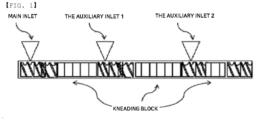
- FIG. 1 schematically illustrates an extruder equipped with 9 or more kneading blocks for preparing the conductive resin composition of the present disclosure.
- the present inventors confirmed that, when a conductive resin composition was prepared by mixing a base resin including a polyamide, a polyarylene ether and an aromatic elastomer with a polyarylene ether modified with multi-carboxylic acid, a reactant having two or more polyfunctional groups, a masterbatch of carbon nanotubes having a predetermined BET surface area, and an aromatic phenol resin in a predetermined composition ratio, a molded article including the conductive resin composition had excellent rigidity, conductivity and processability, and was hardly affected by moisture and heat when exposed to external environments. Based on these results, the present inventors conducted further studies to complete the present disclosure.
- the conductive resin composition of the present disclosure includes (A) 100 parts by weight of the base resin including a polyamide, a polyarylene ether and an aromatic elastomer; (B) 3 to 10 parts by weight of the polyarylene ether modified with multi-carboxylic acid; (C) 1 to 3.4 parts by weight of the polyfunctional reactant; (D) 0.5 to 3.2 parts by weight of the carbon nanotubes; and (E) 0.3 to 3.4 parts by weight of the aromatic phenol resin.
- the conductive resin composition has excellent moisture stability and processability in addition to excellent rigidity and conductivity, is capable of minimizing the influence of moisture and heat when exposed to external environments, and thus is applicable to exterior parts replacing metal parts used in automobiles.
- the conductive resin composition of the present disclosure includes (A) 100 parts by weight of the base resin including a polyamide, a polyarylene ether and an aromatic elastomer; (B) 3 to 10 parts by weight of the polyarylene ether modified with multi-carboxylic acid; (C) 1 to 3.4 parts by weight of the polyfunctional reactant; (D) 0.5 to 3.2 parts by weight of the carbon nanotubes; and (E) 0.3 to 3.4 parts by weight of the aromatic phenol resin, and has a water absorption rate of 0.55 % or less.
- the conductive resin composition has excellent moisture stability and processability in addition to excellent rigidity and conductivity, is capable of minimizing the influence of moisture and heat when exposed to external environments, and thus is applicable to exterior parts replacing metal parts used in automobiles.
- the polyamide of the present disclosure may be, for example, one or more selected from the group consisting of polyamide 6, polyamide 66, polyamide 46, polyamide 11, polyamide 12, polyamide 610, polyamide 612, polyamide 6/66, polyamide 6/612, polyamide MXD6, polyamide 6/MXD6, polyamide 66/MXD6, polyamide 6T, polyamide 6I, polyamide 6/6T, polyamide 6/6I, polyamide 66/6T, polyamide 66/6I, polyamide 6/6T/6I, polyamide 66/6T/6I, polyamide 9T, polyamide 9I, polyamide 6/9T, polyamide 6/9I, polyamide 66/9T, polyamide 6/12/9T, polyamide 66/12/9T, polyamide 6/12/9I and polyamide 66/12/6I, more preferably a homopolymer or copolymer including one or more selected from polyamide 6, polyamide 66, polyamide 46, polyamide 11 and polyamide 12, and most preferably may include polyamide 66.
- the polyamide may be included in an amount of preferably 30 to 80 % by weight, more preferably 40 to 70 % by weight, more preferably 30 to 60 % by weight in the base resin. In this range, conductivity, appearance quality and moisture stability are all excellent.
- the polyamide may be prepared by a method commonly practiced in the art to which the present disclosure pertains, or commercially available products may be used as the polyamide, without particular limitation.
- the polyarylene ether of the present disclosure is preferably polyphenylene ether (PPE), and as a specific example, may include one or more selected from the group consisting of poly(2,6-dimethyl1,4-phenylene)ether, poly(2,6-diethyl-1,4-phenylene)ether, poly(2,6-dipropyl-1,4-phenylene)ether, poly(2-methyl6-ethyl-1,4-phenylene)ether, poly(2-methyl-6-propyl-1,4-phenylene)ether, poly(2-ethyl-6-propyl-1,4-phenylene)ether, poly(2,6-diphenyl-1,4-phenylene)ether, poly(2,3,6-trimethyl-1,4-phenylene)ether, poly(2,3,6-triethyl-1,4-phenylene)ether, and copolymers thereof, preferably poly(2,6-dimethyl-1,4-phenylene) or a copolymer thereof.
- the polyarylene ether is preferably included in an amount of 15 to 60 % by weight, more preferably 20 to 60 % by weight, still more preferably 25 to 60 % by weight, still more preferably 35 to 60 % by weight. In this case, heat resistance and mechanical strength may be excellent.
- the polyarylene ether means a polymer prepared by copolymerizing a major monomer and a comonomer, and as specific example, may be selected from a copolymer of poly(2,6-dimethyl-1,4-phenylene)ether and poly(2,3,6-trimethyl-1,4-phenylene)ether; a copolymer of poly(2,6-dimethyl-1,4-phenylene)ether and poly(2,3,6-triethyl-1,4-phenylene)ether; and combinations thereof.
- the polyarylene ether copolymer is a copolymer of poly(2,6-dimethyl-1,4-phenylene)ether and poly(2,3,6-trimethyl-1,4-phenylene)ether.
- the polyarylene ether preferably has an intrinsic viscosity of 0.2 to 0.8 dl/g, more preferably 0.3 to 0.6 dl/g, still more preferably 0.35 to 0.5 dl/g as measured at 25 °C in chloroform as a solvent. Within this range, heat resistance, processability, and appearance may be excellent while maintaining mechanical properties at a high level.
- the polyarylene ether may be prepared by a method commonly practiced in the art to which the present disclosure pertains, or commercially available products may be used as the polyarylene ether, without particular limitation.
- the aromatic elastomer of the present disclosure is preferably styrene-based rubber.
- the aromatic elastomer may include one or more selected from styrene-butadiene-styrene (SBS) copolymers, styrene-ethylene-butylene-styrene (SEBS) copolymers, styrene-butadiene (SB) copolymers, styrene-isoprene (SI) copolymers, styrene-isoprene-styrene (SIS) copolymers, alpha-methylstyrene-butadiene copolymers, styrene-ethylene-propylene copolymers, styrene-ethylene-propylene-styrene copolymers, styrene-(ethylene-butylene/styrene copolymer)-styrene copo
- the aromatic elastomer may include one or more selected from the group consisting of styrene-butadiene-styrene (SBS) copolymers, styrene-ethylene-butylene-styrene (SEBS) copolymers, and maleic anhydride-modified styrene-ethylene-butylene-styrene copolymers, as a more preferred example, a styrene-butadiene-styrene (SBS) copolymer.
- SBS styrene-butadiene-styrene
- SEBS styrene-ethylene-butylene-styrene
- SBS styrene-butadiene-styrene
- the aromatic elastomer is preferably included in an amount of 1 to 20 % by weight, more preferably 3 to 20 % by weight, still more preferably 3 to 15 % by weight, still more preferably 5 to 10 % by weight. Within this range, in addition to mechanical properties and conductivity, appearance and moisture stability may be excellent.
- the content of an aromatic vinyl compound-derived structural unit is preferably 20 to 40 % by weight, more preferably 25 to 35 % by weight. Within this range, mechanical properties may be excellent.
- the content of the structural unit may be the content of the polymerized monomer.
- the content of rubber is preferably 60 to 80 % by weight, more preferably 65 to 75 % by weight. Within this range, mechanical properties may be excellent.
- emulsion polymerization suspension polymerization, solution polymerization, or bulk polymerization may be used.
- emulsion polymerization or bulk polymerization may be used.
- the polyarylene ether modified with multi-carboxylic acid of the present disclosure may be added as an additive to enhance compatibility between (A) the base resin and (D) the carbon nanotubes described below and to impart processability.
- the term "modification” is not particularly limited if it is a modification by a polymer modification method commonly used in the technical field to which the present disclosure belongs, and for example, it may mean grafting by introducing a multi-carboxylic acid into an unmodified polymer, and as another example, it may mean copolymerizing by introducing a multi-carboxylic acid as a comonomer during the production of an unmodified copolymer.
- the multi-carboxylic acid may be at least one selected from maleic acid, maleic anhydride, fumaric acid, fumaric anhydride, citric acid, citric anhydride, itaconic acid and itaconic anhydride, and more preferably may include maleic acid. In this case, even a small amount of addition facilitates kneading and molding.
- maleic acid is not particularly limited if it is a substituent recognized as a maleic acid group in the technical field to which the present disclosure belongs, and as a particular example, it means a functional group derived from maleic acid or maleic anhydride.
- the multi-carboxylic acid is preferably included in an amount of, for example, 1 % by weight or less, preferably 0.9 % by weight or less, more preferably 0.01 to 0.9 % by weight, more preferably 0.01 to 0.5 % by weight, even more preferably 0.01 to 0.2 % by weight based on 100 % by weight in total of the conductive resin composition.
- the polyarylene ether modified with multi-carboxylic acid may be included in an amount of preferably 3 to 10 parts by weight, more preferably 3 to 9 parts by weight, more preferably 4 to 9 parts by weight based on 100 parts by weight in total of the base resin. In this range, appearance quality, conductivity and moisture stability may be greatly improved without deteriorating the original mechanical properties of the resin.
- the polyfunctional reactants of the present disclosure preferably include two or more functional groups selected from the group consisting of a carboxyl group, an amine group, a hydroxyl group, a maleic acid group, and an epoxy group.
- the polyfunctional reactants may include 2 to 5 functional groups selected therefrom. In this case, conductivity and moisture stability may be excellent.
- a bisphenol A-type epoxy resin having an epoxy functional group at end thereof may be included.
- conductivity and moisture stability may be excellent.
- the bisphenol A-type epoxy resin preferably has an average epoxy equivalent of 2,000 to 6,000 and/or a number average molecular weight of 3,000 to 10,000 g/mol and/or a glass transition temperature of 50 to 120 °C, and/or is preferably a solid at room temperature. Within this range, appearance and moisture stability may be greatly improved without deterioration in the intrinsic mechanical properties of a resin.
- number average molecular weight may be measured through gel permeation chromatography (GPC, Waters Breeze).
- glass transition temperature may be measured using a Pyris 6 DSC (Perkin Elmer Co.).
- the average epoxy equivalent is average molecular weight per one epoxy group.
- the polyfunctional reactant may be included in an amount of preferably 1 to 3.4 parts by weight, more preferably 1 to 3 parts by weight, more preferably 1 to 2.5 parts by weight. In this range, appearance quality, conductivity and moisture stability may be greatly improved without deteriorating the original mechanical properties of the resin.
- the polyfunctional reactant may be prepared by a method commonly practiced in the art to which the present disclosure pertains, or commercially available products may be used as the polyfunctional reactant, without particular limitation
- the carbon nanotubes of the present disclosure preferably have a BET surface area of 180 to 600 m 2 /g, more preferably 180 to 400 m 2 /g, still more preferably 180 to 300 m 2 /g, still more preferably 200 to 300 m 2 /g. Within this range, processability and conductivity may be greatly improved.
- the BET surface area may be measured using a nitrogen adsorption method.
- the BET surface area may be measured by a BET 6-point method according to a nitrogen gas adsorption/distribution method using pore distribution measuring instrument (Porosimetry analyzer, Belsorp-II mini, Bell Japan Inc.).
- the BET surface area may be measured by a Brunauer, Emmett, or Teller method according to ASTM 6556.
- the carbon nanotubes may include one or more selected from the group consisting of single-walled carbon nanotubes (SWCNTs), double-walled carbon nanotubes (DWCNTs), and multi-walled carbon nanotubes (MWCNTs).
- SWCNTs single-walled carbon nanotubes
- DWCNTs double-walled carbon nanotubes
- MWCNTs multi-walled carbon nanotubes
- the carbon nanotubes may be bundle-type (rope-type) nanotubes or non-bundle-type (entangle-type) nanotubes.
- the carbon nanotubes preferably have an average diameter of 5 to 30 nm, more preferably 7 to 20 nm, still more preferably 10 to 15 nm. Within this range, conductivity and appearance may be greatly improved.
- a measurement method commonly practiced in the art to which the present disclosure pertains may be used to measure the average diameter of the carbon nanotubes without particular limitation.
- the average diameter of the carbon nanotubes may be measured by electron microscopy analysis.
- the carbon nanotubes may be a masterbatch of a polyolefin modified with a multi-carboxylic acid.
- the types of the multi-carboxylic acid are the same as those described the item of (B) the polyarylene ether modified with multi-carboxylic acid.
- the polyolefin may include, for example, a polyolefin modified with multi-carboxylic acid, preferably a polyolefin, particularly a polyethylene, which contains an alpha-olefin, modified with multi-carboxylic acid.
- the modified polyolefin may be a copolymer in which the polyolefin is grafted with a hydroxyl group-containing ethylenically unsaturated compound, amino group-containing ethylenically unsaturated compound, epoxy group-containing ethylenically unsaturated compound, an aromatic vinyl compound, an unsaturated carboxylic acid and its derivative, a vinyl ester compound, or vinyl chloride or the like, more preferably a copolymer in which an unsaturated carboxylic acid or an anhydride monomer or derivative thereof is grafted.
- Examples of the unsaturated carboxylic acid may include acrylic acid, methacrylic acid, maleic acid, fumaric acid, tetrahydrophthalic acid, itaconic acid, citraconic acid, crotonic acid, isocrotonic acid, norbornene dicarboxylic acid, and bicyclo[2.2.1]hept-2-ene-5,6-dicarboxylic acid.
- examples of the anhydride monomer or derivative thereof may include malenylchloride, malenylimide, maleic anhydride, itaconic anhydride, citraconic anhydride, tetrahydrophthalic anhydride, bicyclo[2.2.1]hept-2-ene-5,6-dicarboxylic acid anhydride, dimethyl malate, monomethyl maleate, diethyl malate, diethyl fumarate, dimethyl itaconate, diethyl citraconate, dimethyltetrahydrophthalate, dimethyl bicyclo[2.2.1]hept-2-ene-5,6-dicarboxylate, hydroxyethyl (meth)acrylate, hydroxypropyl (meth)acrylate, glycidyl (meth)acrylate, aminoethyl methacrylate, and aminopropyl methacrylate.
- the modified polyolefin may be a copolymer in which acrylic acid or maleic anhydride is grafted onto polyolefin.
- the content (% by weight) of the compound grafted onto the modified olefin i.e., acrylic acid or maleic anhydride
- the content of acrylic acid or maleic anhydride contained in the modified polyolefin resin corresponds to a grafting ratio.
- the modified polyolefin may be obtained by heating a monomer such as the unsaturated carboxylic acid in the presence or absence of a radical initiator to undergo graft polymerization.
- the graft polymerization is particularly preferable when performed in the presence of a radical initiator, as this can increase the efficiency of the graft polymerization reaction.
- the use amount may be preferably 0.1 to 3.2 parts by weight, more preferably 0.1 to 3 parts by weight, more preferably 0.1 to 2.8 parts by weight, even more preferably 0.3 to 2.5 parts by weight, most preferably 0.5 to 2.0 parts by weight based on 100 parts by weight in total of the base resin. In this range, mechanical properties, processability and conductivity maybe superior, and appearance quality and heat resistance may be excellent.
- the aromatic phenol resin of the present disclosure may be a polyhydroxyphenol-type compound.
- the polyhydroxyphenol-type compound may be, for example, a condensation product of a phenol compound and an aldehyde or a ketone, and as a particular example, may be a synthetic polymer obtained by reacting phenol or a substituted phenol with formaldehyde.
- the aromatic phenol resin may be, for example, linked by methylene and/or ether groups, and, as a particular example, may be phenol, cresol; xylenol; naphthol; an alkylphenol such as butylphenol, tert-butylphenol, isooctylphenol, nitrophenol, and phenylphenol; or any other substituted phenol.
- the aromatic phenol resin may be a condensation product of phenol resin and formaldehyde, and may have a molecular weight of 600 to 4000 g/mol, preferably 900 to 2500 g/mol.
- aromatic phenol resins include products such as Renosin and Hirenol. In this case, moisture stability may be improved, and workability may be improved by lowering melt viscosity.
- the aromatic phenol resin may have a softening point of, for example, 70 °C or higher, preferably 80 °C or higher, more preferably 90 to 130 °C, In this range, moisture stability and workability may be greatly improved.
- the softening point may be measured at a heating rate of 2É using an FP90/FP83HT device manufactured by Mettler Toledo.
- the aromatic phenol resin may be included in an amount of preferably 0.3 to 3.4 parts by weight, more preferably 0.3 to 3 parts by weight, more preferably 0.5 to 2.5 parts by weight based on 100 parts by weight in total of the base resin. In this range, moisture stability and the processability of the base resin may be greatly improved due to the dispersion effect with the polyfunctional reactant described above.
- the aromatic phenol resin may be prepared by a method commonly practiced in the art to which the present disclosure pertains, or commercially available products may be used as the aromatic phenol resin, without particular limitation.
- the conductive resin composition of the present disclosure includes (A) 100 parts by weight of the base resin including a polyamide, a polyarylene ether and an aromatic elastomer; (B) 3 to 10 parts by weight of the polyarylene ether modified with multi-carboxylic acid; (C) 1 to 3.4 parts by weight of the polyfunctional reactant; (D) 0.5 to 3.2 parts by weight of the carbon nanotubes; and (E) 0.3 to 3.4 parts by weight of the aromatic phenol resin, and has a water absorption rate of 0.55 % or less.
- the conductive resin composition has a heat distortion temperature of preferably 180 °C or higher, more preferably 185 °C or higher, 185 to 200 °C as a particular example, 185 to 195 °C as a preferred example. Within this range, physical property balance, moisture stability, conductivity, and appearance may be excellent.
- the conductive resin composition is molded into a flat specimen with dimensions of 100 mm X 100 mm X 3 mm using an 80-ton Engel injection molding machine.
- a water absorption rate thereof measured as an increased weight % after immersion in distilled water at 23°C for 48 hours may be preferably 0.55% or less, more preferably 0.01 to 0.55 %, still more preferably 0.1 to 0.55 %, even still more preferably 0.3 to 0.55%, In this range, the physical property balance may be superior, and heat resistance, conductivity and appearance quality may be excellent.
- the volume resistance of the conductive resin composition which is measured using PRS-801 equipment (Prostat Co.) is preferably 10 ⁇ 7 Ohm.cm or less, more preferably 10 ⁇ 3 to 10 ⁇ 5 Ohm.cm. Within this range, physical property balance, heat resistance, moisture stability, and appearance may be excellent.
- the conductive resin composition preferably has a notched Izod impact strength of 170 J/m or more, more preferably 170 to 280 J/m, 170 to 250 J/m as a preferred example, as measured under conditions of a specimen thickness of 4 mm and a measurement temperature of 25 °C according to ISO 180A. Within this range, physical property balance, heat resistance, conductivity, moisture stability, and appearance may be excellent.
- the conductive resin composition As a measurement result of the resin, discharged under conditions of 280°C and 5 kg load, according to ISO 1133, the conductive resin composition has a melting index of 7 g/10 min, more preferably 10 to 25 J/m. Within this range, physical property balance, heat resistance, conductivity, moisture stability, and appearance may be excellent.
- the method of preparing the conductive resin composition of the present disclosure includes kneading and extruding preferably (A) 100 parts by weight of the base resin including a polyamide, a polyarylene ether and an aromatic elastomer; (B) 3 to 10 parts by weight of the polyarylene ether modified with multi-carboxylic acid; (C) two or more types of the polyfunctional reactants 1 to 3.4 parts by weight; (D) 0.5 to 3.2 parts by weight of the carbon nanotubes; and (E) 0.3 to 3.4 parts by weight of the aromatic phenol resin, wherein the kneading and extruding are performed using an extruder equipped with 9 or more kneading blocks, and (B) the polyarylene ether modified with multi-carboxylic acid and (D) the carbon nanotubes are added as a masterbatch including (B) the polyarylene ether and (D) the carbon nanotubes.
- the method of preparing the conductive resin composition of the present disclosure kneading and extruding (A) 100 parts by weight of the base resin including a polyamide, a polyarylene ether and an aromatic elastomer; (B) 3 to 10 parts by weight of the polyarylene ether modified with multi-carboxylic acid; (C) two or more types of polyfunctional reactants 1 to 3.4 parts by weight; (D) 0.5 to 3.2 parts by weight of the carbon nanotubes; and (E) 0.3 to 3.4 parts by weight of the aromatic phenol resin, wherein the kneading and extruding are performed using an extruder equipped with 9 or more kneading blocks, (B) the polyarylene ether modified with multi-carboxylic acid and (D) the carbon nanotubes are added as a masterbatch including (B) the polyarylene ether and (D) the carbon nanotubes, and the conductive resin composition has a water absorption rate of 0.55 %
- the kneading and extruding may be performed at a barrel temperature of 230 to 310 °C, preferably 240 to 300 °C, more preferably 250 to 290 °C, still more preferably 250 to 280 °C.
- throughput per unit time may be high, melt-kneading may be sufficiently performed, and thermal decomposition of resin components may be prevented.
- the kneading and extruding may be performed at a screw rotation rate of 100 to 500 rpm, preferably 150 to 400 rpm, more preferably 100 to 350 rpm, still more preferably 150 to 320 rpm, still more preferably 200 to 310 rpm.
- throughput per unit time may be high, process efficiency may be excellent, and excessive cutting of carbon nanotubes may be prevented, thereby improving the conductivity of a final product.
- the conductive resin composition obtained by the kneading and extrusion may be provided in a pellet form.
- FIG. 1 the present disclosure will be described with reference to FIG. 1 .
- FIG. 1 schematically illustrates an extruder equipped with 9 or more kneading blocks for preparing the conductive resin composition of the present disclosure.
- the type of extruder is not particularly limited, and an extruder commonly used in the art may be appropriately selected and used.
- an extruder commonly used in the art may be appropriately selected and used.
- a single-screw extruder equipped with one screw or a multi-screw extruder equipped with a plurality of screws may be used.
- a twin-screw extruder equipped with two screws is preferably used.
- the extruder includes a raw material feeder for feeding materials into a barrel, a screw for conveying and kneading the fed materials, and a die for extruding the kneaded materials.
- the screw consists of a plurality of screw elements for various functions.
- one or more raw material feeders may be provided, and two or more raw material feeders may be provided, as needed.
- a main inlet may be provided, and two or more auxiliary inlets may be optionally provided.
- the base resin, the polyarylene ether modified with multi-carboxylic acid, the polyfunctional reactant, the carbon nanotubes, and the aromatic phenol resin may be fed into the main inlet batchwise.
- the base resin and the polyfunctional reactant may be fed into the main inlet, and then the polyarylene ether modified with multi-carboxylic acid, the carbon nanotubes, and the aromatic phenol resin may be fed into the auxiliary inlets.
- components other than a polyamide may be fed into the main inlet, and a polyamide may be fed into the auxiliary inlets.
- the base resin and the polyfunctional reactant may be fed into the main inlet, and some of the polyarylene ether modified with multi-carboxylic acid, carbon nanotubes and the aromatic phenol resin may be fed into the auxiliary inlet 1, and then the remainder may be fed into the auxiliary inlet 2.
- each kneading block consists of a plurality of discs, preferably 3 to 7 discs, 5 to 7 discs, 3 to 5 discs, or 4 to 5 discs, and has a polygonal cross-section or an elliptical cross-section.
- the kneading blocks are arranged continuously in a direction in which materials are conveyed.
- the phase angle of the discs is preferably 45 to 90°.
- the kneading block includes a forward kneading block capable of conveying, distributing, and mixing materials, a neutral kneading block capable of distributing and mixing materials without conveying the same, and a backward kneading block capable of conveying materials in a direction opposite to the conveying direction.
- the conductive concentrated resin composition according to the present disclosure may be prepared using a method including a step of performing kneading and extrusion using an extruder equipped with 9 or more, preferably 10 or more, more preferably 12 or more kneading blocks, as a preferred example, 9 to 18 kneading blocks, as a more preferred example, 10 to 18 kneading blocks, as a still more preferred example, 12 to 16 kneading blocks.
- it may be effective to arrange the kneading blocks in the order of forward kneading blocks, neutral kneading blocks, and backward kneading blocks with respect to a resin flow direction.
- a continuous or separate block combination may be used. In this case, the dispersibility of a conductive filler and compatibility between compositions may be further improved, and thus a high-quality conductive resin composition may be provided.
- 9 or more kneading blocks may be arranged continuously, or may be arranged discontinuously between screws.
- 3 to 6 kneading blocks may be provided continuously between the main inlet and the auxiliary inlet 1
- 3 to 8 kneading blocks may be provided continuously between the auxiliary inlet 1 and the auxiliary inlet 2
- 2 to 5 kneading blocks may be provided between the auxiliary inlet 2 and an outlet (not shown) .
- the molded article of the present disclosure may be, for example, molded with the conductive resin composition of the present disclosure and formed by coating the surface thereof with a coating layer.
- the surface and the coating layer have excellent coating appearance quality and there is an effect of delaying cracking after coating.
- the coating layer may be a paint formed electrostatically on a substrate surface made of the conductive resin composition.
- the method of manufacturing the molded article may include, for example, a step of injection-molding the above-described conductive resin composition; and a step of electrostatically painting the injection-molded article.
- excellent paint appearance quality may be provided without deterioration of mechanical properties including surface impact, and processability.
- the conductive resin composition may be, for example, an extruded pellet. In this case, reproducibility, process stability, processability, and the like may be excellent.
- the method of manufacturing the molded article may include, for example, a degreasing step of removing oil, etc. from the injection-molded article before the painting step.
- oil may be preferably removed by treating the injection-molded article with a surfactant.
- the surfactant is not particularly limited if it is a surfactant commonly used in the degreasing step in the technical field to which the present disclosure belongs.
- the degreasing step may be performed, for example, at 40 to 60 °C for 1 to 30 minutes, preferably at 50 to 60 °C for 5 to 10 minutes. In this range, excellent degreasing efficiency may be provided.
- a painting method is not particularly limited and may be appropriately selected and performed within the scope of what is usually practiced, and, preferably, an electrostatic painting method may be performed.
- the use of the molded article is not particularly limited, but it may preferably be an automobile exterior part. In this case, the demanding paint appearance and breakage reliability required in the automobile industry may be greatly satisfied.
- the components shown Tables 1 and 2 were melt-kneaded and extruded under conditions of a temperature 250 to 310 °C and a rotation rate (rpm) of 300 revolutions/min using a twin-screw extruder equipped with 10 mixing blocks (T40, SM Co.) to prepare pellets, and the prepared pellets were injected using an injection machine (80 tons, Engel Co.) to prepare specimens for evaluation.
- the twin-screw extruder has a total of two or more inlets. Components other than the polyamide were fed into a main inlet, and the polyamide was fed into the auxiliary inlets.
- the conductive resin composition according to the present disclosure had excellent rigidity, conductivity and processability and was almost unaffected by moisture and heat due to exposure to an external environment, making it suitable for electrostatic painting of automobiles.
- the present invention has an effect of providing a conductive resin composition having excellent moisture stability and processability in addition to excellent rigidity and conductivity; being capable of minimizing the influence of moisture and heat when exposed to external environments due to these properties; and thus being suitable for exterior parts replacing metal parts used in automobiles, a method of preparing the conductive resin composition, and a molded article including the conductive resin composition.
Landscapes
- Chemical & Material Sciences (AREA)
- Health & Medical Sciences (AREA)
- Chemical Kinetics & Catalysis (AREA)
- Medicinal Chemistry (AREA)
- Polymers & Plastics (AREA)
- Organic Chemistry (AREA)
- Engineering & Computer Science (AREA)
- Materials Engineering (AREA)
- Nanotechnology (AREA)
- Compositions Of Macromolecular Compounds (AREA)
- Physics & Mathematics (AREA)
- Dispersion Chemistry (AREA)
- Spectroscopy & Molecular Physics (AREA)
- General Chemical & Material Sciences (AREA)
Applications Claiming Priority (1)
| Application Number | Priority Date | Filing Date | Title |
|---|---|---|---|
| KR1020230131372A KR20250048839A (ko) | 2023-10-04 | 2023-10-04 | 전도성 수지 조성물, 이의 제조방법 및 이를 포함하는 성형품 |
Publications (1)
| Publication Number | Publication Date |
|---|---|
| EP4534604A1 true EP4534604A1 (de) | 2025-04-09 |
Family
ID=92932741
Family Applications (1)
| Application Number | Title | Priority Date | Filing Date |
|---|---|---|---|
| EP24203439.5A Pending EP4534604A1 (de) | 2023-10-04 | 2024-09-30 | Leitfähige harzzusammensetzung, verfahren zur herstellung davon und formartikel damit |
Country Status (3)
| Country | Link |
|---|---|
| US (1) | US20250115760A1 (de) |
| EP (1) | EP4534604A1 (de) |
| KR (1) | KR20250048839A (de) |
Citations (6)
| Publication number | Priority date | Publication date | Assignee | Title |
|---|---|---|---|---|
| US6221283B1 (en) | 1999-05-07 | 2001-04-24 | General Electric Company | Conductive compositions with compositionally controlled bulk resistivity |
| US6352654B1 (en) | 1997-03-17 | 2002-03-05 | General Electric Company | Conductive polyphenylene ether-polyamide compositions and method for their preparation |
| JP3565836B2 (ja) | 2000-04-26 | 2004-09-15 | 旭化成ケミカルズ株式会社 | ポリアミド/ポリフェニレンエーテル樹脂組成物用ポリアミドマスターペレットの製造方法 |
| US20070205401A1 (en) * | 2004-04-14 | 2007-09-06 | Asahi Kasel Chemicals Corporation | Conductive Resin Composition |
| EP3992245A1 (de) * | 2020-08-04 | 2022-05-04 | LG Chem, Ltd. | Leitfähige harzzusammensetzung, verfahren zu deren herstellung und daraus hergestellter formkörper |
| KR20230131372A (ko) | 2022-03-04 | 2023-09-13 | 에이치엘만도 주식회사 | 인버터 장치와 인버터 장치의 제어 모듈 및 이들의 제어 방법 |
-
2023
- 2023-10-04 KR KR1020230131372A patent/KR20250048839A/ko active Pending
-
2024
- 2024-09-30 EP EP24203439.5A patent/EP4534604A1/de active Pending
- 2024-10-03 US US18/905,928 patent/US20250115760A1/en active Pending
Patent Citations (6)
| Publication number | Priority date | Publication date | Assignee | Title |
|---|---|---|---|---|
| US6352654B1 (en) | 1997-03-17 | 2002-03-05 | General Electric Company | Conductive polyphenylene ether-polyamide compositions and method for their preparation |
| US6221283B1 (en) | 1999-05-07 | 2001-04-24 | General Electric Company | Conductive compositions with compositionally controlled bulk resistivity |
| JP3565836B2 (ja) | 2000-04-26 | 2004-09-15 | 旭化成ケミカルズ株式会社 | ポリアミド/ポリフェニレンエーテル樹脂組成物用ポリアミドマスターペレットの製造方法 |
| US20070205401A1 (en) * | 2004-04-14 | 2007-09-06 | Asahi Kasel Chemicals Corporation | Conductive Resin Composition |
| EP3992245A1 (de) * | 2020-08-04 | 2022-05-04 | LG Chem, Ltd. | Leitfähige harzzusammensetzung, verfahren zu deren herstellung und daraus hergestellter formkörper |
| KR20230131372A (ko) | 2022-03-04 | 2023-09-13 | 에이치엘만도 주식회사 | 인버터 장치와 인버터 장치의 제어 모듈 및 이들의 제어 방법 |
Also Published As
| Publication number | Publication date |
|---|---|
| KR20250048839A (ko) | 2025-04-11 |
| US20250115760A1 (en) | 2025-04-10 |
Similar Documents
| Publication | Publication Date | Title |
|---|---|---|
| CN1134507C (zh) | 导电性聚醚-聚酰胺组合物及其制备方法 | |
| JP3844436B2 (ja) | 導電性樹脂組成物及びその製法 | |
| JPWO2001081473A1 (ja) | 導電性樹脂組成物及びその製法 | |
| DE69027743T2 (de) | Oberflächliche Bestrahlung von geformten Polypropylengegeständen | |
| CN1181497C (zh) | 组分控制体电阻率的导电组合物 | |
| EP3992245B1 (de) | Leitfähige harzzusammensetzung, verfahren zu deren herstellung und daraus hergestellter formkörper | |
| CN100537665C (zh) | 导电树脂组合物和成型树脂制品 | |
| WO2004092275A1 (ja) | 樹脂成形体及び導電性樹脂組成物 | |
| EP1734077B1 (de) | Polyamid/polyphenylenetherharz-zusammensetzung | |
| EP4534604A1 (de) | Leitfähige harzzusammensetzung, verfahren zur herstellung davon und formartikel damit | |
| US20210269617A1 (en) | Thermoplastic resin composition having excellent heat resistance and electromagnetic wave shielding capacity, method of preparing thermoplastic resin composition, and injection-molded article manufactured using thermoplastic resin composition | |
| KR102707171B1 (ko) | 전도성 수지 조성물, 이의 제조방법 및 이를 포함하는 성형품 | |
| EP4349912A1 (de) | Leitfähige harzzusammensetzung, verfahren zur herstellung davon und formprodukt damit | |
| TWI921657B (zh) | 導電樹脂組成物、其製備方法以及包括其之模製物 | |
| EP3865539B1 (de) | Thermoplastische harzzusammensetzung und methode zur herstellung eines formartikels damit | |
| CN101585965B (zh) | 成型树脂制品和导电树脂组合物 | |
| CN100376008C (zh) | 生产导电母粒的方法 |
Legal Events
| Date | Code | Title | Description |
|---|---|---|---|
| PUAI | Public reference made under article 153(3) epc to a published international application that has entered the european phase |
Free format text: ORIGINAL CODE: 0009012 |
|
| STAA | Information on the status of an ep patent application or granted ep patent |
Free format text: STATUS: REQUEST FOR EXAMINATION WAS MADE |
|
| 17P | Request for examination filed |
Effective date: 20240930 |
|
| AK | Designated contracting states |
Kind code of ref document: A1 Designated state(s): AL AT BE BG CH CY CZ DE DK EE ES FI FR GB GR HR HU IE IS IT LI LT LU LV MC ME MK MT NL NO PL PT RO RS SE SI SK SM TR |