EP4534703A1 - Austenitische fe-ni-cr-legierung mit hervorragender oxidationsbeständigkeit und verfahren zur herstellung davon - Google Patents
Austenitische fe-ni-cr-legierung mit hervorragender oxidationsbeständigkeit und verfahren zur herstellung davon Download PDFInfo
- Publication number
- EP4534703A1 EP4534703A1 EP23809966.7A EP23809966A EP4534703A1 EP 4534703 A1 EP4534703 A1 EP 4534703A1 EP 23809966 A EP23809966 A EP 23809966A EP 4534703 A1 EP4534703 A1 EP 4534703A1
- Authority
- EP
- European Patent Office
- Prior art keywords
- alloy
- mass
- austenitic
- oxidation resistance
- oxidation
- Prior art date
- Legal status (The legal status is an assumption and is not a legal conclusion. Google has not performed a legal analysis and makes no representation as to the accuracy of the status listed.)
- Pending
Links
Images
Classifications
-
- C—CHEMISTRY; METALLURGY
- C22—METALLURGY; FERROUS OR NON-FERROUS ALLOYS; TREATMENT OF ALLOYS OR NON-FERROUS METALS
- C22C—ALLOYS
- C22C38/00—Ferrous alloys, e.g. steel alloys
- C22C38/18—Ferrous alloys, e.g. steel alloys containing chromium
- C22C38/40—Ferrous alloys, e.g. steel alloys containing chromium with nickel
- C22C38/54—Ferrous alloys, e.g. steel alloys containing chromium with nickel with boron
-
- C—CHEMISTRY; METALLURGY
- C21—METALLURGY OF IRON
- C21C—PROCESSING OF PIG-IRON, e.g. REFINING, MANUFACTURE OF WROUGHT-IRON OR STEEL; TREATMENT IN MOLTEN STATE OF FERROUS ALLOYS
- C21C7/00—Treating molten ferrous alloys, e.g. steel, not covered by groups C21C1/00 - C21C5/00
- C21C7/04—Removing impurities by adding a treating agent
-
- C—CHEMISTRY; METALLURGY
- C21—METALLURGY OF IRON
- C21C—PROCESSING OF PIG-IRON, e.g. REFINING, MANUFACTURE OF WROUGHT-IRON OR STEEL; TREATMENT IN MOLTEN STATE OF FERROUS ALLOYS
- C21C7/00—Treating molten ferrous alloys, e.g. steel, not covered by groups C21C1/00 - C21C5/00
-
- C—CHEMISTRY; METALLURGY
- C21—METALLURGY OF IRON
- C21D—MODIFYING THE PHYSICAL STRUCTURE OF FERROUS METALS; GENERAL DEVICES FOR HEAT TREATMENT OF FERROUS OR NON-FERROUS METALS OR ALLOYS; MAKING METAL MALLEABLE, e.g. BY DECARBURISATION OR TEMPERING
- C21D3/00—Diffusion processes for extraction of non-metals; Furnaces therefor
- C21D3/02—Extraction of non-metals
- C21D3/04—Decarburising
-
- C—CHEMISTRY; METALLURGY
- C21—METALLURGY OF IRON
- C21D—MODIFYING THE PHYSICAL STRUCTURE OF FERROUS METALS; GENERAL DEVICES FOR HEAT TREATMENT OF FERROUS OR NON-FERROUS METALS OR ALLOYS; MAKING METAL MALLEABLE, e.g. BY DECARBURISATION OR TEMPERING
- C21D6/00—Heat treatment of ferrous alloys
- C21D6/004—Heat treatment of ferrous alloys containing Cr and Ni
-
- C—CHEMISTRY; METALLURGY
- C21—METALLURGY OF IRON
- C21D—MODIFYING THE PHYSICAL STRUCTURE OF FERROUS METALS; GENERAL DEVICES FOR HEAT TREATMENT OF FERROUS OR NON-FERROUS METALS OR ALLOYS; MAKING METAL MALLEABLE, e.g. BY DECARBURISATION OR TEMPERING
- C21D8/00—Modifying the physical properties of ferrous metals or ferrous alloys by deformation combined with, or followed by, heat treatment
-
- C—CHEMISTRY; METALLURGY
- C21—METALLURGY OF IRON
- C21D—MODIFYING THE PHYSICAL STRUCTURE OF FERROUS METALS; GENERAL DEVICES FOR HEAT TREATMENT OF FERROUS OR NON-FERROUS METALS OR ALLOYS; MAKING METAL MALLEABLE, e.g. BY DECARBURISATION OR TEMPERING
- C21D8/00—Modifying the physical properties of ferrous metals or ferrous alloys by deformation combined with, or followed by, heat treatment
- C21D8/02—Modifying the physical properties of ferrous metals or ferrous alloys by deformation combined with, or followed by, heat treatment during manufacturing of plates or strips
- C21D8/021—Modifying the physical properties of ferrous metals or ferrous alloys by deformation combined with, or followed by, heat treatment during manufacturing of plates or strips involving particular fabrication steps or treatments of ingots or slabs
-
- C—CHEMISTRY; METALLURGY
- C21—METALLURGY OF IRON
- C21D—MODIFYING THE PHYSICAL STRUCTURE OF FERROUS METALS; GENERAL DEVICES FOR HEAT TREATMENT OF FERROUS OR NON-FERROUS METALS OR ALLOYS; MAKING METAL MALLEABLE, e.g. BY DECARBURISATION OR TEMPERING
- C21D8/00—Modifying the physical properties of ferrous metals or ferrous alloys by deformation combined with, or followed by, heat treatment
- C21D8/06—Modifying the physical properties of ferrous metals or ferrous alloys by deformation combined with, or followed by, heat treatment during manufacturing of rods or wires
-
- C—CHEMISTRY; METALLURGY
- C21—METALLURGY OF IRON
- C21D—MODIFYING THE PHYSICAL STRUCTURE OF FERROUS METALS; GENERAL DEVICES FOR HEAT TREATMENT OF FERROUS OR NON-FERROUS METALS OR ALLOYS; MAKING METAL MALLEABLE, e.g. BY DECARBURISATION OR TEMPERING
- C21D9/00—Heat treatment, e.g. annealing, hardening, quenching or tempering, adapted for particular articles; Furnaces therefor
- C21D9/0075—Heat treatment, e.g. annealing, hardening, quenching or tempering, adapted for particular articles; Furnaces therefor for rods of limited length
-
- C—CHEMISTRY; METALLURGY
- C21—METALLURGY OF IRON
- C21D—MODIFYING THE PHYSICAL STRUCTURE OF FERROUS METALS; GENERAL DEVICES FOR HEAT TREATMENT OF FERROUS OR NON-FERROUS METALS OR ALLOYS; MAKING METAL MALLEABLE, e.g. BY DECARBURISATION OR TEMPERING
- C21D9/00—Heat treatment, e.g. annealing, hardening, quenching or tempering, adapted for particular articles; Furnaces therefor
- C21D9/46—Heat treatment, e.g. annealing, hardening, quenching or tempering, adapted for particular articles; Furnaces therefor for sheet metals
-
- C—CHEMISTRY; METALLURGY
- C21—METALLURGY OF IRON
- C21D—MODIFYING THE PHYSICAL STRUCTURE OF FERROUS METALS; GENERAL DEVICES FOR HEAT TREATMENT OF FERROUS OR NON-FERROUS METALS OR ALLOYS; MAKING METAL MALLEABLE, e.g. BY DECARBURISATION OR TEMPERING
- C21D9/00—Heat treatment, e.g. annealing, hardening, quenching or tempering, adapted for particular articles; Furnaces therefor
- C21D9/52—Heat treatment, e.g. annealing, hardening, quenching or tempering, adapted for particular articles; Furnaces therefor for wires; for strips ; for rods of unlimited length
-
- C—CHEMISTRY; METALLURGY
- C22—METALLURGY; FERROUS OR NON-FERROUS ALLOYS; TREATMENT OF ALLOYS OR NON-FERROUS METALS
- C22C—ALLOYS
- C22C30/00—Alloys containing less than 50% by weight of each constituent
-
- C—CHEMISTRY; METALLURGY
- C22—METALLURGY; FERROUS OR NON-FERROUS ALLOYS; TREATMENT OF ALLOYS OR NON-FERROUS METALS
- C22C—ALLOYS
- C22C30/00—Alloys containing less than 50% by weight of each constituent
- C22C30/02—Alloys containing less than 50% by weight of each constituent containing copper
-
- C—CHEMISTRY; METALLURGY
- C22—METALLURGY; FERROUS OR NON-FERROUS ALLOYS; TREATMENT OF ALLOYS OR NON-FERROUS METALS
- C22C—ALLOYS
- C22C33/00—Making ferrous alloys
- C22C33/04—Making ferrous alloys by melting
-
- C—CHEMISTRY; METALLURGY
- C22—METALLURGY; FERROUS OR NON-FERROUS ALLOYS; TREATMENT OF ALLOYS OR NON-FERROUS METALS
- C22C—ALLOYS
- C22C38/00—Ferrous alloys, e.g. steel alloys
- C22C38/001—Ferrous alloys, e.g. steel alloys containing N
-
- C—CHEMISTRY; METALLURGY
- C22—METALLURGY; FERROUS OR NON-FERROUS ALLOYS; TREATMENT OF ALLOYS OR NON-FERROUS METALS
- C22C—ALLOYS
- C22C38/00—Ferrous alloys, e.g. steel alloys
- C22C38/002—Ferrous alloys, e.g. steel alloys containing In, Mg, or other elements not provided for in one single group C22C38/001 - C22C38/60
-
- C—CHEMISTRY; METALLURGY
- C22—METALLURGY; FERROUS OR NON-FERROUS ALLOYS; TREATMENT OF ALLOYS OR NON-FERROUS METALS
- C22C—ALLOYS
- C22C38/00—Ferrous alloys, e.g. steel alloys
- C22C38/004—Very low carbon steels, i.e. having a carbon content of less than 0,01%
-
- C—CHEMISTRY; METALLURGY
- C22—METALLURGY; FERROUS OR NON-FERROUS ALLOYS; TREATMENT OF ALLOYS OR NON-FERROUS METALS
- C22C—ALLOYS
- C22C38/00—Ferrous alloys, e.g. steel alloys
- C22C38/005—Ferrous alloys, e.g. steel alloys containing rare earths, i.e. Sc, Y, Lanthanides
-
- C—CHEMISTRY; METALLURGY
- C22—METALLURGY; FERROUS OR NON-FERROUS ALLOYS; TREATMENT OF ALLOYS OR NON-FERROUS METALS
- C22C—ALLOYS
- C22C38/00—Ferrous alloys, e.g. steel alloys
- C22C38/02—Ferrous alloys, e.g. steel alloys containing silicon
-
- C—CHEMISTRY; METALLURGY
- C22—METALLURGY; FERROUS OR NON-FERROUS ALLOYS; TREATMENT OF ALLOYS OR NON-FERROUS METALS
- C22C—ALLOYS
- C22C38/00—Ferrous alloys, e.g. steel alloys
- C22C38/04—Ferrous alloys, e.g. steel alloys containing manganese
-
- C—CHEMISTRY; METALLURGY
- C22—METALLURGY; FERROUS OR NON-FERROUS ALLOYS; TREATMENT OF ALLOYS OR NON-FERROUS METALS
- C22C—ALLOYS
- C22C38/00—Ferrous alloys, e.g. steel alloys
- C22C38/06—Ferrous alloys, e.g. steel alloys containing aluminium
-
- C—CHEMISTRY; METALLURGY
- C22—METALLURGY; FERROUS OR NON-FERROUS ALLOYS; TREATMENT OF ALLOYS OR NON-FERROUS METALS
- C22C—ALLOYS
- C22C38/00—Ferrous alloys, e.g. steel alloys
- C22C38/18—Ferrous alloys, e.g. steel alloys containing chromium
- C22C38/40—Ferrous alloys, e.g. steel alloys containing chromium with nickel
- C22C38/42—Ferrous alloys, e.g. steel alloys containing chromium with nickel with copper
-
- C—CHEMISTRY; METALLURGY
- C22—METALLURGY; FERROUS OR NON-FERROUS ALLOYS; TREATMENT OF ALLOYS OR NON-FERROUS METALS
- C22C—ALLOYS
- C22C38/00—Ferrous alloys, e.g. steel alloys
- C22C38/18—Ferrous alloys, e.g. steel alloys containing chromium
- C22C38/40—Ferrous alloys, e.g. steel alloys containing chromium with nickel
- C22C38/44—Ferrous alloys, e.g. steel alloys containing chromium with nickel with molybdenum or tungsten
-
- C—CHEMISTRY; METALLURGY
- C22—METALLURGY; FERROUS OR NON-FERROUS ALLOYS; TREATMENT OF ALLOYS OR NON-FERROUS METALS
- C22C—ALLOYS
- C22C38/00—Ferrous alloys, e.g. steel alloys
- C22C38/18—Ferrous alloys, e.g. steel alloys containing chromium
- C22C38/40—Ferrous alloys, e.g. steel alloys containing chromium with nickel
- C22C38/50—Ferrous alloys, e.g. steel alloys containing chromium with nickel with titanium or zirconium
-
- C—CHEMISTRY; METALLURGY
- C22—METALLURGY; FERROUS OR NON-FERROUS ALLOYS; TREATMENT OF ALLOYS OR NON-FERROUS METALS
- C22C—ALLOYS
- C22C38/00—Ferrous alloys, e.g. steel alloys
- C22C38/18—Ferrous alloys, e.g. steel alloys containing chromium
- C22C38/40—Ferrous alloys, e.g. steel alloys containing chromium with nickel
- C22C38/58—Ferrous alloys, e.g. steel alloys containing chromium with nickel with more than 1.5% by weight of manganese
-
- C—CHEMISTRY; METALLURGY
- C23—COATING METALLIC MATERIAL; COATING MATERIAL WITH METALLIC MATERIAL; CHEMICAL SURFACE TREATMENT; DIFFUSION TREATMENT OF METALLIC MATERIAL; COATING BY VACUUM EVAPORATION, BY SPUTTERING, BY ION IMPLANTATION OR BY CHEMICAL VAPOUR DEPOSITION, IN GENERAL; INHIBITING CORROSION OF METALLIC MATERIAL OR INCRUSTATION IN GENERAL
- C23C—COATING METALLIC MATERIAL; COATING MATERIAL WITH METALLIC MATERIAL; SURFACE TREATMENT OF METALLIC MATERIAL BY DIFFUSION INTO THE SURFACE, BY CHEMICAL CONVERSION OR SUBSTITUTION; COATING BY VACUUM EVAPORATION, BY SPUTTERING, BY ION IMPLANTATION OR BY CHEMICAL VAPOUR DEPOSITION, IN GENERAL
- C23C8/00—Solid state diffusion of only non-metal elements into metallic material surfaces; Chemical surface treatment of metallic material by reaction of the surface with a reactive gas, leaving reaction products of surface material in the coating, e.g. conversion coatings, passivation of metals
- C23C8/06—Solid state diffusion of only non-metal elements into metallic material surfaces; Chemical surface treatment of metallic material by reaction of the surface with a reactive gas, leaving reaction products of surface material in the coating, e.g. conversion coatings, passivation of metals using gases
- C23C8/08—Solid state diffusion of only non-metal elements into metallic material surfaces; Chemical surface treatment of metallic material by reaction of the surface with a reactive gas, leaving reaction products of surface material in the coating, e.g. conversion coatings, passivation of metals using gases only one element being applied
- C23C8/10—Oxidising
- C23C8/16—Oxidising using oxygen-containing compounds, e.g. water, carbon dioxide
- C23C8/18—Oxidising of ferrous surfaces
-
- C—CHEMISTRY; METALLURGY
- C21—METALLURGY OF IRON
- C21D—MODIFYING THE PHYSICAL STRUCTURE OF FERROUS METALS; GENERAL DEVICES FOR HEAT TREATMENT OF FERROUS OR NON-FERROUS METALS OR ALLOYS; MAKING METAL MALLEABLE, e.g. BY DECARBURISATION OR TEMPERING
- C21D2211/00—Microstructure comprising significant phases
- C21D2211/001—Austenite
Definitions
- the present invention relates to austenitic Fe-Ni-Cr alloy, and relates to austenitic Fe-Ni-Cr alloy having superior oxidation resistance in high temperature environments.
- thermal power generating boilers, chemical plants, and reacting furnaces for purifying polysilicon are used under severe high temperature conditions at 700 to 900 °C
- materials to be used should be superior in high temperature strength, high temperature corrosion resistance, and oxidation resistance.
- oxidation resistance following properties can be mentioned in which surface protective oxidation scale which mainly contains Cr 2 O 3 and which is formed on the material surface in such a high temperature environment is dense, and fit of the scale with respect to the material is high.
- Fe-Cr-Ni alloys are focused on.
- Patent Document 1 proposes austenitic stainless steel plate in which trace amounts of REMs (Rare Earth Metals) are added to stainless steel, and an upper limit of Mn content is defined according to Ni content and REM content so that rate of growth of Cr 2 O 3 oxide film generated on the surface the steel plate is suppressed.
- Patent Document 2 proposes a heat resistant steel material for a reformer in which Si content is defined according to Cr and Ni contents in steel material so that fit of Cr 2 O 3 generated on the surface of steel material is improved.
- Ni-Cr-Fe alloys having superior creep strength and strain release cracking resistance properties by complex addition of Ti, Al, and REM is proposed (For example, see Patent document 3).
- the alloy is produced by adjusting compositions in a high frequency induction furnace, obtaining a slab, and performing hot rolling of the slab, in a laboratory scale. It is impossible to apply the technique for mass production such as a 60 t level or the like.
- the technique mentions that all REMs are effective on the contrary, only Nd is mainly added, and Ce, La, and Y are merely added in some of the alloys.
- the technique does not include a removing process of S and O, and therefore, the technique cannot be realized unless the raw materials are carefully selected. Then, in some cases, REM may be oxidized or sulfurized, it is not an industrially reliable proposal and cannot achieve the original purpose. Therefore, according to the technique, it is difficult to rapidly and accurately provide an alloy in which creep strength is improved by adding REM at an industrial level.
- the present invention has been completed in view of the above circumstances, and an object of the present invention is to provide austenitic Fe-Ni-Cr alloys having superior oxidation resistance even when exposed to severe high temperature environments.
- an internal oxide layer consisting of oxides of Cr, Si, Mn, Al, Ti, La, Ce, and Y may be formed immediately below the protective oxidation scale formed on the surface in a high temperature environment, as a result of studying behavior of formation of the internal oxide layer in detail, the inventors found that there was a good correlation between area ratio of the internal oxide layer and weight reduction by oxidation in the high temperature oxidation test. Practically, in an area of 0.005 mm 2 in the internal oxide layer immediately below the surface oxidation scale, oxidation resistance was improved in a case in which the area ratio of the internal oxide occupied not less than 30%.
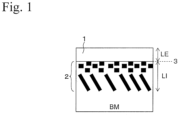
- Fig. 1 is a schematic view explaining surface structure of Fe-Cr-Ni alloy plate in a high temperature oxidation test according to an embodiment of the present invention.
- C is an element which contributes to stabilizing an austenitic phase. However, if it is added excessively, carbides may be formed by combining Cr, Mo, and the like, amount of Cr solid-solved therearound may be decreased, and oxidation resistance may be deteriorated. On the other hand, since C also has an effect of increasing alloy strength by solid solution strengthening, the lower limit is set to be 0.004 mass%. Therefore, C is limited to 0.004 to 0.13 mass%. It is desirably 0.005 to 0.080 mass%, and more desirably 0.006 to 0.070 mass%.
- Si is an element effective for improving oxidation resistance and avoidance of separating of oxide film.
- the effects can be obtained by addition of not less than 0.15 mass%. However, if it is added excessively, precipitation of intermetallic compound such as ⁇ phase may be promoted and surface damage due to the intermetallic compounds may be generated, content is set to be 0.15 to 1.0 mass%. It is desirably 0.16 to 0.8 mass% and more desirably 0.17 to 0.6 mass%.
- Mn is an element which stabilizes an austenitic phase and has action of deoxidation, it is necessary to add not less than 0.03 mass% to obtain the effects.
- Mn may also cause precipitation of intermetallic compounds such as ⁇ phase and deterioration of oxidation resistance, and it is not desirable to add more than the required amount. Therefore, it is necessary to limit it to 0.03 to 2.0 mass%. It is desirably 0.03 to 1.50 mass% and more desirably 0.03 to 1.00 mass%.
- P is an element inevitably contained as an impurity, and an element which degrades hot workability since it may segregate at crystalline grain boundaries as a phosphide. Therefore, it is desirable to be reduced as much as possible. However, production cost may increase by attempting to extremely reduce P content. Therefore, in the present invention, P is limited to not more than 0.040 mass%. It is desirably not more than 0.030 mass% and more desirably not more than 0.020 mass%.
- S is an element inevitably contained as an impurity. It may easily segregate at crystalline grain boundaries, and in particular, may extremely degrade hot workability. Furthermore, it may form compounds with Cr which contribute to oxidation resistance mentioned below so that Cr, which is necessary to form the surface oxidation scale, is consumed, fit between oxide film and parent material may be deteriorated so that the oxide film may separate, oxidation may be promoted, and it is a harmful element for oxidation resistance. Since the harmfulness is extremely exhibited if it is contained at more than 0.003 mass%, it is necessary to limit it to not more than 0.003 mass%. It is desirably not more than 0.002 mass%, and more desirably not more than 0.001 mass%. As mentioned below, S can be reduced by addition of Al and reaction with slag components.
- Ni is an element which stabilizes the austenitic phase, and it has an action to restrain precipitation of intermetallic compounds such as a ⁇ phase. Furthermore, it also has an action to improve heat resistance and high temperature strength. In order to obtain the above effects sufficiently, it is added at not less than 20 mass%. On the other hand, excessive addition may cause deterioration of hot workability, increase in hot deformation resistance and increase in cost. Therefore, Ni content is set to be 20.0 to 38.0 mass%. It is desirably 21.0 to 36.0 mass% and more desirably 22.0 to 35.0 mass%.
- Cr is an element which contributes to preventing corrosion in high temperature environments, and also has effects of forming a protective oxide film on the surface of an alloy in high temperature environments and reducing high temperature oxidation. It is necessary to be contained at not less than 18.0 mass% in order to sufficiently obtain the above effects. However, if Cr is added excessively, surface oxidation scale may form excessively, and fit may be deteriorated and oxidation resistance may be deteriorated. In addition, since stability of austenitic phase may be decreased and thereby Ni may need to be added in large amounts, the content is set to be 18.0 to 28.0 mass%. It is desirably 19.0 to 26.0 mass% and more desirably 20.0 to 25.0 mass%.
- Mo has an effect of being solid-solved into an alloy and increasing high temperature strength even in a small amount of addition.
- Mo may be preferentially oxidized and oxidation scale may separate, which are regarded as adverse effects. Therefore, from the viewpoint of maintaining fit of protective surface oxidation scale, Mo is limited to not more than 1.0 mass%. It is desirably not more than 0.8 mass% and more desirably not more than 0.6 mass%.
- N is an element which is inevitably contained as an impurity; however, since it is also an element which generates an austenitic phase, it contributes to stabilization of structure.
- Al, Ti, Zr or the like is added like in the present invention, N may combine with these elements, thereby precipitating nitrides. Then, hot deformation resistance may be extremely increased and hot workability may be degraded.
- N content is set to be not more than 0.03 mass%. It is desirably not more than 0.02 mass% and more desirably not more than 0.01 mass%.
- Oxygen is blown in during decarburization. During this, N moves to CO gas bubbles as nitrogen gas and is removed from the system, and thus, N can be controlled within the range of the present invention.
- B has an effect of helping an effect of rare earth metals (REMs) by grain boundary segregation, and is an element which contributes to high temperature strength.
- REMs rare earth metals
- the surface oxidation scale may be porous, thereby deteriorating fit, welding property, and hot workability of an alloy.
- B content is set to be not more than 0.01 mass%. It is desirably not more than 0.008 mass% and more desirably not more than 0.006 mass%.
- S concentration can be controlled within the range of the present invention at not more than 0.003 mass%. In order to satisfy this condition, it is necessary to contain Al at not less than 0.10 mass%. However, if it is added excessively, reaction may be extremely promoted toward the right-hand side of the formula (c), Ca concentration may be more than 0.002 mass%, excessive Ca-Al oxides inclusions may be formed, and Al in the alloy may be consumed there by deteriorating oxidation resistance.
- 3 CaO + 2 Al ⁇ 3 Ca ⁇ + Al 2 O 3
- Zr is a homologous element of Ti, since it acts effectively to form a dense black film and to improve oxidation resistance similarly to Ti, it can be used as an alternative element of Ti. Since effect of Zr is superior to that of Ti, an effect can be obtained even by adding a small amount. If it is added excessively, large amounts of carbonitrides may be formed, thereby causing surface damage, and therefore, the upper limit is set to be 0.6 mass%. It is desirably 0.01 to 0.4 mass% and more desirably 0.05 to 0.3 mass%.
- Ca is an element which is a contaminant from CaO in the slag, as mentioned above, in the alloy of the present invention. Since Ca forms large amounts of Ca-Al oxide inclusions and consumes Al in an alloy, thereby reducing oxidation resistance, it is necessary that Ca be reduced to a low level. Therefore, it is necessary that Al concentration be controlled 0.10 to 1.00 mass% and oxygen concentration be controlled 0.0002 to 0.0030 mass%. Therefore, it is necessary that Ca be not more than 0.002 mass%.
- the formula (1) indicates extent of the effect by multiple regression analysis as a formula in oxidation resistance of Fe-Cr-Ni alloy.
- Si, Ni, Cr, Al, Ti, Zr and REM (La, Ce and Y) improve oxidation resistance which is evaluated by cycle testing in which temperature is repeatedly increased from room temperature to about 700 to 900°C in a mixed gas atmosphere consisting of 7%O 2 -16%H 2 O -10%CO 2 - 0.5%CO -0.1%NO 2 -bal.N 2 .
- S deteriorates fit between oxide film and parent material, thereby oxide film separates, and promoting oxidation.
- the lower limit and the upper limit of these elements are set to be 47 and 85 respectively, based on the formula (1). It is desirably 48 to 84 and more desirably 50 to 83. 40 ⁇ 0.6xSi +1.3xCr +23.53xAl +5.88 xTi +3074xREM -5067xS -0.8xMn - 816xN ⁇ 0
- the formula (2) shows the extent of the effect by multiple regression analysis as a formula in oxidation resistance of Fe-Cr-Ni alloy.
- each of REMs, Si, Cr, Al, and Ti densely forms internal oxides, reduces oxidizing rate by restraint of internal diffusion of oxygen and improves oxidation resistance.
- the Fe-Cr-Ni alloy plate according to one embodiment of the present invention has Fe-Cr-Ni-alloy containing compositions satisfying the above formulae (1) to (3) as a basis material BM.
- oxidation scale mainly containing Cr oxide is formed on the surface of Fe-Cr-Ni alloy parent material of the present invention, and internal oxide layer containing at least one kind selected from Cr, Si, Mn, Al, Ti and REM is formed immediately below an interface between the scale and the alloy.
- thickness of the surface oxidation scale corresponds to region LE which is from the outermost layer of the surface oxidation scale to the interface of the scale and the alloy in the observation of cross-sectional microstructure after the test
- thickness of the internal oxide layer corresponds to region LI which is to a position at which oxygen intensity of GDS analysis is 1/4 of intensity peak at the interface of the scale and the alloy.
- a range of measurement of area ratio of the internal oxide layer mentioned below is a range of 0.005 mm 2 which is surrounded by 0.05 mm of interface direction and 0.1 mm of depth direction when the scale and the alloy interface is regarded as the upper end, and the area ratio of the internal oxide containing at least one kind selected from Cr, Si, Mn, Al, Ti, and REM in the range of 0.005 mm 2 is measured.
- the oxidation scale mainly containing Cr oxide is formed on the surface of alloy parent material in the cycle testing in which temperature is repeatedly increased from room temperature to 700 to 900°C in a mixture gas atmosphere consisting of 7%O 2 -16%H 2 O -10%CO 2 -0.5%CO -0.1%NO 2 -bal.N 2 , and oxidation resistance in high temperature environments is obtained.
- thickness of the protective surface oxidation scale formed in the above high temperature environment be 10 to 100 ⁇ m. It is desirably 12 to 90 ⁇ m and more desirably 12 to 80 ⁇ m.
- the internal oxide layer includes Cr type oxide which is before transiting to the surface oxidation scale being an outer layer and an oxide which contains at least one kind selected from Si, Mn, Al, Ti, and REMs.
- Each of the obtained test pieces was provided to a repeating oxidation test of900°C x 10 minutes, 700°C x 10 minutes, 900°C x 10 minutes, and room temperature x 20 minutes were one cycle in a mixed gas atmosphere consisting of 7%O 2 -16%H 2 O -10%CO 2 -0.5%CO - 0.1%NO 2 -bal.N 2 .
- evaluation was performed based on a value in which weight change excluding weight of separated scale was divided by surface area before the test.
- raw material such as iron scrap, stainless steel scrap, ferronickel, ferrochromium and the like were melted in an electric furnace, a mixed gas of oxygen and a noble gas was blown in n AOD (Argon oxygen decarburization) furnace or a VOD (Vacuum oxygen decarburization) furnace so as to decarburize and refine, Cr oxides in the slag were reduced by adding calcined lime, Fe-Si alloy, Al or the like, CaO-SiO 2 -Al 2 O 3 -MgO-F slag was formed by adding fluorite so as to deoxidize and desulfurize, and Ni base alloy containing at least one selected from La, Ce, and Y was added.
- n AOD Aron oxygen decarburization
- VOD Vauum oxygen decarburization
- CaO-SiO 2 -Al 2 O 3 -MgO-F slag Reason for using CaO-SiO 2 -Al 2 O 3 -MgO-F slag is that, as mentioned above, deoxidizing and desulfurizing can be effectively promoted, and furthermore, REMs can be effectively added without being oxidized or sulfurized during addition of REM.
- CaO concentration in the slag be in a range of 40 to 80%. That is, the above desulfurizing reaction may not be promoted if the content is less than 40%.
- Ca may be more than 0.002% in melt steel if the content is more than 80%.
- Al 2 O 3 concentration be not more than 50%.
- a slab was produced by a continuous casting apparatus, and it is desirable that the slab be hot-rolled, and further cold-rolled, if necessary, so as to obtain kinds of steel materials such as thin steel plate, thick steel plate, shaped steel, bar steel, wire material and the like.
- the production method is not limited to continuous casting, and an ingot casting-cogging rolling method can be employed to produce a slab.
- the slab was hot rolled until it reached a thickness of 8 mm, and cold rolling, heat treatment, and acid washing were repeated to produce a cold-rolled coil having thickness of 2 to 3 mm.
- the final annealing temperature and time were 1150 °C and 1 minute, respectively.
- a piece for testing having a width of 20 mm, length of 30 mm, and thickness of 2 mm was collected from the plate.
- a surface of the test piece was polished using #320 emery paper under wet conditions and in a high vacuum atmosphere heat treatment furnace was a vacuum of 5.0 x 10 -3 Pa.
- the inside was filled with mixed gas atmosphere consisting of 7%O 2 -16%H 2 O -10%CO 2 - 0.5%CO -0.1%NO 2 -bal.N 2 , and repeated oxidation testing was performed, in which 1 cycle of the testing was conducted in an atmosphere maintained at 900°C for 10 minutes, temperature was adjusted at a temperature decrease rate of 40 °C/min, atmosphere was maintained at 700°C for 10 minutes, temperature was adjusted at temperature increase rate of 40 °C/min, atmosphere was maintained at 900°C for 10 minutes, and then, the atmosphere was maintained at room temperature for 20 minutes.
- microstructures in cross section was observed after the test, so that thickness of surface oxidation scale and area ratio of internal oxide layer formed immediately below the surface oxidation scale were measured.
- Steel plates Nos. 1 to 17 shown in Tables 1 and 2 are Examples of the present invention, satisfied the conditions of the present invention, and exhibited superior oxidation resistance.
- steel plates Nos. 18 to 37 are Comparative Examples.
- the steel plate of No. 21 contained large amounts of B, the steel did not satisfy the formula (1) and had inferior oxidation resistance. Furthermore, since Al 2 O 3 concentration in slag was high at 52% and CaO concentration was low at 28%, O content was high, alumina inclusions adhered to an immersed nozzle, and the inclusions that fell off seriously damaged the surface.
- the steel plate of No. 26 did not satisfy the formula (1). Furthermore, since Mo content was high, fitting of scale was decreased thereby deteriorating oxidation resistance.
- Ni content was high, the steel plate of No. 30 did not satisfy the formula (1). Planned costs could not be accomplished since hot workability was deteriorated and hot deformation resistance was increased, thereby increasing production cost. Furthermore, since Mn content was low, effects of deoxidation action and stabilization of austenitic phase could not be sufficiently obtained. Furthermore, an effect in which oxidation resistance was improved and an effect in which S inhibiting oxidation resistance was fixed as inclusions could not be sufficiently obtained since the steel did not satisfy the formula (3).
Landscapes
- Chemical & Material Sciences (AREA)
- Engineering & Computer Science (AREA)
- Organic Chemistry (AREA)
- Metallurgy (AREA)
- Materials Engineering (AREA)
- Mechanical Engineering (AREA)
- Crystallography & Structural Chemistry (AREA)
- Thermal Sciences (AREA)
- Physics & Mathematics (AREA)
- Chemical Kinetics & Catalysis (AREA)
- Manufacturing & Machinery (AREA)
- Treatment Of Steel In Its Molten State (AREA)
- Heat Treatment Of Steel (AREA)
Applications Claiming Priority (2)
| Application Number | Priority Date | Filing Date | Title |
|---|---|---|---|
| JP2022086913A JP7158618B1 (ja) | 2022-05-27 | 2022-05-27 | 耐酸化性に優れたオーステナイト系Fe-Ni-Cr合金およびその製造方法 |
| PCT/JP2023/017180 WO2023228699A1 (ja) | 2022-05-27 | 2023-05-02 | 耐酸化性に優れたオーステナイト系Fe-Ni-Cr合金およびその製造方法 |
Publications (1)
| Publication Number | Publication Date |
|---|---|
| EP4534703A1 true EP4534703A1 (de) | 2025-04-09 |
Family
ID=83691958
Family Applications (1)
| Application Number | Title | Priority Date | Filing Date |
|---|---|---|---|
| EP23809966.7A Pending EP4534703A1 (de) | 2022-05-27 | 2023-05-02 | Austenitische fe-ni-cr-legierung mit hervorragender oxidationsbeständigkeit und verfahren zur herstellung davon |
Country Status (6)
| Country | Link |
|---|---|
| US (1) | US20250320593A1 (de) |
| EP (1) | EP4534703A1 (de) |
| JP (1) | JP7158618B1 (de) |
| KR (1) | KR20250011631A (de) |
| CN (1) | CN119278287A (de) |
| WO (1) | WO2023228699A1 (de) |
Families Citing this family (2)
| Publication number | Priority date | Publication date | Assignee | Title |
|---|---|---|---|---|
| CN119121032A (zh) * | 2024-07-12 | 2024-12-13 | 包头钢铁(集团)有限责任公司 | 一种稀土处理热轧装甲钢板的制备方法 |
| WO2026075177A1 (ja) * | 2024-10-01 | 2026-04-09 | 日本製鉄株式会社 | 合金材 |
Family Cites Families (6)
| Publication number | Priority date | Publication date | Assignee | Title |
|---|---|---|---|---|
| JP3918443B2 (ja) | 2001-03-02 | 2007-05-23 | 住友金属工業株式会社 | 改質器用オーステナイト系合金ならびに耐熱用鋼材およびそれを用いた改質器 |
| JP4078881B2 (ja) | 2001-09-25 | 2008-04-23 | 住友金属工業株式会社 | 熱交換器用オーステナイト系ステンレス鋼板 |
| ES2714371T3 (es) * | 2009-04-01 | 2019-05-28 | Nippon Steel & Sumitomo Metal Corp | Método para producir una tubería de aleación de Cr-Ni sin costura de alta resistencia |
| JP5880338B2 (ja) * | 2012-08-01 | 2016-03-09 | 新日鐵住金株式会社 | 金属材料およびボイラ用材料 |
| ES2843268T3 (es) * | 2016-10-05 | 2021-07-16 | Nippon Steel Corp | Aleación de Ni-Cr-Fe |
| KR102799610B1 (ko) | 2016-12-09 | 2025-04-23 | 엘지전자 주식회사 | 음용수 공급 장치 및 그 제어 방법 |
-
2022
- 2022-05-27 JP JP2022086913A patent/JP7158618B1/ja active Active
-
2023
- 2023-05-02 CN CN202380040430.3A patent/CN119278287A/zh active Pending
- 2023-05-02 WO PCT/JP2023/017180 patent/WO2023228699A1/ja not_active Ceased
- 2023-05-02 US US18/867,310 patent/US20250320593A1/en active Pending
- 2023-05-02 KR KR1020247038738A patent/KR20250011631A/ko active Pending
- 2023-05-02 EP EP23809966.7A patent/EP4534703A1/de active Pending
Also Published As
| Publication number | Publication date |
|---|---|
| JP2023174197A (ja) | 2023-12-07 |
| WO2023228699A1 (ja) | 2023-11-30 |
| US20250320593A1 (en) | 2025-10-16 |
| KR20250011631A (ko) | 2025-01-21 |
| CN119278287A (zh) | 2025-01-07 |
| JP7158618B1 (ja) | 2022-10-21 |
Similar Documents
| Publication | Publication Date | Title |
|---|---|---|
| EP2163658B1 (de) | Ferritisches edelstahlblech mit hervorragender korrosionsbeständigkeit gegenüber schwefelsäure und herstellungsverfahren dafür | |
| JP4824640B2 (ja) | 二相ステンレス鋼およびその製造方法 | |
| EP1538224B1 (de) | Stahlprodukt mit verringerter menge von aluminiumoxid-clustern | |
| KR102876862B1 (ko) | 금속 박용 스테인레스강, 스테인레스강 박 및 그것들의 제조 방법 | |
| EP4534703A1 (de) | Austenitische fe-ni-cr-legierung mit hervorragender oxidationsbeständigkeit und verfahren zur herstellung davon | |
| CN115667563B (zh) | 耐疲劳特性优异的析出硬化型马氏体系不锈钢板 | |
| KR102755706B1 (ko) | 스테인레스강, 스테인레스 강재 및 스테인레스강의 제조 방법 | |
| JP5616283B2 (ja) | Fe−Ni−Cr−Mo合金およびその製造方法 | |
| US12553115B2 (en) | Stainless steel with good mirror polishability and method for producing same | |
| EP2341160B1 (de) | Ferritischer Edelstahl und Herstellungsverfahren dafür | |
| JP2018031028A (ja) | Fe−Ni−Cr−Mo合金とその製造方法 | |
| JP7530447B2 (ja) | 耐疲労特性に優れた析出硬化型マルテンサイト系ステンレス鋼 | |
| US20240376561A1 (en) | Precipitation hardening martensitic stainless steel having excellent weldability, and method for producing the same | |
| EP1669471B1 (de) | Hochduktiles Stahlblech und Verfahren zu dessen Herstellung | |
| EP4636107A1 (de) | Austenitbasierte ni-cr-fe-legierung mit hervorragender oxidationsbeständigkeit und verfahren zur herstellung davon | |
| JP7369266B1 (ja) | 表面性状に優れたFe-Cr-Ni系合金およびその製造方法 | |
| EP1852514A1 (de) | Blech aus extrem kohlenstoffarmem stahl und gussstück aus extrem kohlenstoffarmem stahl mit hervorragenden oberflächeneigenschaften, hervorragender bearbeitbarkeit und verformbarkeit | |
| JP2007177303A (ja) | 延性に優れた鋼及びその製造方法 | |
| TW202132588A (zh) | 肥粒鐵系不鏽鋼 |
Legal Events
| Date | Code | Title | Description |
|---|---|---|---|
| STAA | Information on the status of an ep patent application or granted ep patent |
Free format text: STATUS: THE INTERNATIONAL PUBLICATION HAS BEEN MADE |
|
| PUAI | Public reference made under article 153(3) epc to a published international application that has entered the european phase |
Free format text: ORIGINAL CODE: 0009012 |
|
| STAA | Information on the status of an ep patent application or granted ep patent |
Free format text: STATUS: REQUEST FOR EXAMINATION WAS MADE |
|
| 17P | Request for examination filed |
Effective date: 20250102 |
|
| AK | Designated contracting states |
Kind code of ref document: A1 Designated state(s): AL AT BE BG CH CY CZ DE DK EE ES FI FR GB GR HR HU IE IS IT LI LT LU LV MC ME MK MT NL NO PL PT RO RS SE SI SK SM TR |
|
| DAV | Request for validation of the european patent (deleted) | ||
| DAX | Request for extension of the european patent (deleted) |