EP4535443A1 - Anode für lithiumsekundärbatterie und anodenherstellungsvorrichtung dafür - Google Patents
Anode für lithiumsekundärbatterie und anodenherstellungsvorrichtung dafür Download PDFInfo
- Publication number
- EP4535443A1 EP4535443A1 EP24771145.0A EP24771145A EP4535443A1 EP 4535443 A1 EP4535443 A1 EP 4535443A1 EP 24771145 A EP24771145 A EP 24771145A EP 4535443 A1 EP4535443 A1 EP 4535443A1
- Authority
- EP
- European Patent Office
- Prior art keywords
- negative electrode
- electrode active
- magnet part
- active material
- carbon
- Prior art date
- Legal status (The legal status is an assumption and is not a legal conclusion. Google has not performed a legal analysis and makes no representation as to the accuracy of the status listed.)
- Pending
Links
Images


Classifications
-
- H—ELECTRICITY
- H01—ELECTRIC ELEMENTS
- H01M—PROCESSES OR MEANS, e.g. BATTERIES, FOR THE DIRECT CONVERSION OF CHEMICAL ENERGY INTO ELECTRICAL ENERGY
- H01M4/00—Electrodes
- H01M4/02—Electrodes composed of, or comprising, active material
- H01M4/04—Processes of manufacture in general
- H01M4/0402—Methods of deposition of the material
- H01M4/0404—Methods of deposition of the material by coating on electrode collectors
-
- B—PERFORMING OPERATIONS; TRANSPORTING
- B05—SPRAYING OR ATOMISING IN GENERAL; APPLYING FLUENT MATERIALS TO SURFACES, IN GENERAL
- B05C—APPARATUS FOR APPLYING FLUENT MATERIALS TO SURFACES, IN GENERAL
- B05C21/00—Accessories or implements for use in connection with applying liquids or other fluent materials to surfaces, not provided for in groups B05C1/00 - B05C19/00
-
- F—MECHANICAL ENGINEERING; LIGHTING; HEATING; WEAPONS; BLASTING
- F26—DRYING
- F26B—DRYING SOLID MATERIALS OR OBJECTS BY REMOVING LIQUID THEREFROM
- F26B13/00—Machines and apparatus for drying fabrics, fibres, yarns, or other materials in long lengths, with progressive movement
- F26B13/007—Treating a particular portion of the web or plate, e.g. the edge
-
- F—MECHANICAL ENGINEERING; LIGHTING; HEATING; WEAPONS; BLASTING
- F26—DRYING
- F26B—DRYING SOLID MATERIALS OR OBJECTS BY REMOVING LIQUID THEREFROM
- F26B13/00—Machines and apparatus for drying fabrics, fibres, yarns, or other materials in long lengths, with progressive movement
- F26B13/10—Arrangements for feeding, heating or supporting materials; Controlling movement, tension or position of materials
- F26B13/101—Supporting materials without tension, e.g. on or between foraminous belts
-
- F—MECHANICAL ENGINEERING; LIGHTING; HEATING; WEAPONS; BLASTING
- F26—DRYING
- F26B—DRYING SOLID MATERIALS OR OBJECTS BY REMOVING LIQUID THEREFROM
- F26B15/00—Machines or apparatus for drying objects with progressive movement; Machines or apparatus with progressive movement for drying batches of material in compact form
- F26B15/10—Machines or apparatus for drying objects with progressive movement; Machines or apparatus with progressive movement for drying batches of material in compact form with movement in a path composed of one or more straight lines, e.g. compound, the movement being in alternate horizontal and vertical directions
- F26B15/12—Machines or apparatus for drying objects with progressive movement; Machines or apparatus with progressive movement for drying batches of material in compact form with movement in a path composed of one or more straight lines, e.g. compound, the movement being in alternate horizontal and vertical directions the lines being all horizontal or slightly inclined
- F26B15/18—Machines or apparatus for drying objects with progressive movement; Machines or apparatus with progressive movement for drying batches of material in compact form with movement in a path composed of one or more straight lines, e.g. compound, the movement being in alternate horizontal and vertical directions the lines being all horizontal or slightly inclined the objects or batches of materials being carried by endless belts
-
- F—MECHANICAL ENGINEERING; LIGHTING; HEATING; WEAPONS; BLASTING
- F26—DRYING
- F26B—DRYING SOLID MATERIALS OR OBJECTS BY REMOVING LIQUID THEREFROM
- F26B25/00—Details of general application not covered by group F26B21/00 or F26B23/00
- F26B25/001—Handling, e.g. loading or unloading arrangements
-
- F—MECHANICAL ENGINEERING; LIGHTING; HEATING; WEAPONS; BLASTING
- F26—DRYING
- F26B—DRYING SOLID MATERIALS OR OBJECTS BY REMOVING LIQUID THEREFROM
- F26B25/00—Details of general application not covered by group F26B21/00 or F26B23/00
- F26B25/001—Handling, e.g. loading or unloading arrangements
- F26B25/003—Handling, e.g. loading or unloading arrangements for articles
-
- F—MECHANICAL ENGINEERING; LIGHTING; HEATING; WEAPONS; BLASTING
- F26—DRYING
- F26B—DRYING SOLID MATERIALS OR OBJECTS BY REMOVING LIQUID THEREFROM
- F26B25/00—Details of general application not covered by group F26B21/00 or F26B23/00
- F26B25/001—Handling, e.g. loading or unloading arrangements
- F26B25/003—Handling, e.g. loading or unloading arrangements for articles
- F26B25/004—Handling, e.g. loading or unloading arrangements for articles in the shape of discrete sheets
-
- F—MECHANICAL ENGINEERING; LIGHTING; HEATING; WEAPONS; BLASTING
- F26—DRYING
- F26B—DRYING SOLID MATERIALS OR OBJECTS BY REMOVING LIQUID THEREFROM
- F26B25/00—Details of general application not covered by group F26B21/00 or F26B23/00
- F26B25/06—Chambers, containers, or receptacles
-
- F—MECHANICAL ENGINEERING; LIGHTING; HEATING; WEAPONS; BLASTING
- F26—DRYING
- F26B—DRYING SOLID MATERIALS OR OBJECTS BY REMOVING LIQUID THEREFROM
- F26B3/00—Drying solid materials or objects by processes involving the application of heat
- F26B3/28—Drying solid materials or objects by processes involving the application of heat by radiation, e.g. from the sun
-
- F—MECHANICAL ENGINEERING; LIGHTING; HEATING; WEAPONS; BLASTING
- F26—DRYING
- F26B—DRYING SOLID MATERIALS OR OBJECTS BY REMOVING LIQUID THEREFROM
- F26B3/00—Drying solid materials or objects by processes involving the application of heat
- F26B3/28—Drying solid materials or objects by processes involving the application of heat by radiation, e.g. from the sun
- F26B3/30—Drying solid materials or objects by processes involving the application of heat by radiation, e.g. from the sun from infrared-emitting elements
-
- H—ELECTRICITY
- H01—ELECTRIC ELEMENTS
- H01M—PROCESSES OR MEANS, e.g. BATTERIES, FOR THE DIRECT CONVERSION OF CHEMICAL ENERGY INTO ELECTRICAL ENERGY
- H01M4/00—Electrodes
- H01M4/02—Electrodes composed of, or comprising, active material
- H01M4/04—Processes of manufacture in general
- H01M4/0471—Processes of manufacture in general involving thermal treatment, e.g. firing, sintering, backing particulate active material, thermal decomposition, pyrolysis
-
- H—ELECTRICITY
- H01—ELECTRIC ELEMENTS
- H01M—PROCESSES OR MEANS, e.g. BATTERIES, FOR THE DIRECT CONVERSION OF CHEMICAL ENERGY INTO ELECTRICAL ENERGY
- H01M4/00—Electrodes
- H01M4/02—Electrodes composed of, or comprising, active material
- H01M4/13—Electrodes for accumulators with non-aqueous electrolyte, e.g. for lithium-accumulators; Processes of manufacture thereof
- H01M4/133—Electrodes based on carbonaceous material, e.g. graphite-intercalation compounds or CFx
-
- H—ELECTRICITY
- H01—ELECTRIC ELEMENTS
- H01M—PROCESSES OR MEANS, e.g. BATTERIES, FOR THE DIRECT CONVERSION OF CHEMICAL ENERGY INTO ELECTRICAL ENERGY
- H01M4/00—Electrodes
- H01M4/02—Electrodes composed of, or comprising, active material
- H01M4/13—Electrodes for accumulators with non-aqueous electrolyte, e.g. for lithium-accumulators; Processes of manufacture thereof
- H01M4/139—Processes of manufacture
- H01M4/1393—Processes of manufacture of electrodes based on carbonaceous material, e.g. graphite-intercalation compounds or CFx
-
- B—PERFORMING OPERATIONS; TRANSPORTING
- B05—SPRAYING OR ATOMISING IN GENERAL; APPLYING FLUENT MATERIALS TO SURFACES, IN GENERAL
- B05D—PROCESSES FOR APPLYING FLUENT MATERIALS TO SURFACES, IN GENERAL
- B05D2252/00—Sheets
- B05D2252/02—Sheets of indefinite length
-
- B—PERFORMING OPERATIONS; TRANSPORTING
- B05—SPRAYING OR ATOMISING IN GENERAL; APPLYING FLUENT MATERIALS TO SURFACES, IN GENERAL
- B05D—PROCESSES FOR APPLYING FLUENT MATERIALS TO SURFACES, IN GENERAL
- B05D3/00—Pretreatment of surfaces to which liquids or other fluent materials are to be applied; After-treatment of applied coatings, e.g. intermediate treating of an applied coating preparatory to subsequent applications of liquids or other fluent materials
- B05D3/02—Pretreatment of surfaces to which liquids or other fluent materials are to be applied; After-treatment of applied coatings, e.g. intermediate treating of an applied coating preparatory to subsequent applications of liquids or other fluent materials by baking
- B05D3/0254—After-treatment
-
- B—PERFORMING OPERATIONS; TRANSPORTING
- B05—SPRAYING OR ATOMISING IN GENERAL; APPLYING FLUENT MATERIALS TO SURFACES, IN GENERAL
- B05D—PROCESSES FOR APPLYING FLUENT MATERIALS TO SURFACES, IN GENERAL
- B05D3/00—Pretreatment of surfaces to which liquids or other fluent materials are to be applied; After-treatment of applied coatings, e.g. intermediate treating of an applied coating preparatory to subsequent applications of liquids or other fluent materials
- B05D3/20—Pretreatment of surfaces to which liquids or other fluent materials are to be applied; After-treatment of applied coatings, e.g. intermediate treating of an applied coating preparatory to subsequent applications of liquids or other fluent materials by magnetic fields
- B05D3/207—Pretreatment of surfaces to which liquids or other fluent materials are to be applied; After-treatment of applied coatings, e.g. intermediate treating of an applied coating preparatory to subsequent applications of liquids or other fluent materials by magnetic fields post-treatment by magnetic fields
-
- F—MECHANICAL ENGINEERING; LIGHTING; HEATING; WEAPONS; BLASTING
- F26—DRYING
- F26B—DRYING SOLID MATERIALS OR OBJECTS BY REMOVING LIQUID THEREFROM
- F26B5/00—Drying solid materials or objects by processes not involving the application of heat
- F26B5/04—Drying solid materials or objects by processes not involving the application of heat by evaporation or sublimation of moisture under reduced pressure, e.g. in a vacuum
- F26B5/047—Drying solid materials or objects by processes not involving the application of heat by evaporation or sublimation of moisture under reduced pressure, e.g. in a vacuum for continuous drying of material in long length, e.g. webs
-
- H—ELECTRICITY
- H01—ELECTRIC ELEMENTS
- H01M—PROCESSES OR MEANS, e.g. BATTERIES, FOR THE DIRECT CONVERSION OF CHEMICAL ENERGY INTO ELECTRICAL ENERGY
- H01M4/00—Electrodes
- H01M4/02—Electrodes composed of, or comprising, active material
- H01M2004/026—Electrodes composed of, or comprising, active material characterised by the polarity
- H01M2004/027—Negative electrodes
-
- Y—GENERAL TAGGING OF NEW TECHNOLOGICAL DEVELOPMENTS; GENERAL TAGGING OF CROSS-SECTIONAL TECHNOLOGIES SPANNING OVER SEVERAL SECTIONS OF THE IPC; TECHNICAL SUBJECTS COVERED BY FORMER USPC CROSS-REFERENCE ART COLLECTIONS [XRACs] AND DIGESTS
- Y02—TECHNOLOGIES OR APPLICATIONS FOR MITIGATION OR ADAPTATION AGAINST CLIMATE CHANGE
- Y02E—REDUCTION OF GREENHOUSE GAS [GHG] EMISSIONS, RELATED TO ENERGY GENERATION, TRANSMISSION OR DISTRIBUTION
- Y02E60/00—Enabling technologies; Technologies with a potential or indirect contribution to GHG emissions mitigation
- Y02E60/10—Energy storage using batteries
Definitions
- the negative electrode slurry used in manufacturing an active layer of a negative electrode for a lithium secondary battery has a form in which graphite, a carbon-based negative electrode active material, is mixed with a dispersant.
- water is generally utilized as the dispersant.
- Water is a solvent having a large surface tension, and the negative electrode slurry included therein exhibits a phenomenon of reducing the surface area exposed to air after applied to the negative electrode current collector due to the large surface tension of water. Accordingly, the negative electrode slurry applied on the negative electrode current collector forms a curved surface having an edge end at a predetermined angle with the surface of the negative electrode current collector toward the interior of the slurry.
- the curved surface causes the potential energy of the molecules near the surface of the liquid and the molecules inside the liquid to differ due to the large surface tension of the water, and such energy deviation may increase the kinetic energy of the components contained in the negative electrode slurry.
- the increase in kinetic energy of each of these components acts as a factor that hinders the orientation of graphite using a magnetic field.
- the orientation of the crystal surface of the graphite by the magnetic force is realized by rotating the crystal surface of the graphite by applying a magnetic force greater than the kinetic energy of the graphite.
- the kinetic energy of the graphite contained at the edge end is increased because the molecules near the liquid surface and the molecules inside the liquid have different energy. Accordingly, when a magnetic field is applied to the front surface of the negative electrode slurry, the center of the negative electrode slurry having a flat exposed surface is implemented with a high orientation of the graphite, but the edge end of the negative electrode slurry having a curved exposed surface is implemented with a low orientation of the graphite.
- the present disclosure is directed to providing a negative electrode manufacturing technology in which a carbon-based negative electrode active material such as graphite contained in a negative electrode active layer has a high orientation, and in which such orientation is uniformly realized.
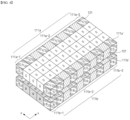
- the first magnet part and the second magnet part may include a plurality of unit magnets disposed along the transfer direction (x-axis direction) and the width direction (y-axis direction) of the electrode sheet.
- first magnet part and the second magnet part may have a length of 0.5 m to 10 m along the transfer direction of the electrode sheet; and the length in the width direction may have a ratio of 105% to 150% based on the length in the width direction of the negative electrode slurry, respectively.
- the negative electrode active layer is divided in the width direction of the negative electrode active layer into a flat region located at the center and having a uniform thickness; and a sliding region located at an edge of the negative electrode active layer and having a thickness gradient, wherein the flat region and the sliding region may satisfy the following Formula 1: 0.9 ⁇ O . I sliding / O . I center ⁇ 1.3 wherein Formula 1,
- the flat region of the negative electrode active layer may have a degree of alignment (O.I center ) of 0.1 to 1.5.
- the negative electrode manufacturing device for lithium secondary battery is capable of simultaneously performing crystal surface orientation and pre-drying of the carbon-based negative electrode active material at the edge end of the negative electrode slurry by providing a drying part using light energy at the width direction edge of the magnet part that aligns the crystal surface of the carbon-based negative electrode active material.
- first magnet part 110a and the second magnet part 110b may include unit magnets 111a and 111b, respectively, and supporting parts 112a and 112b for fixing the unit magnets.
- the crystal surfaces of the carbon-based negative electrode active material included in the negative electrode slurry S are aligned along the direction in which the attractive force acts, the crystal surfaces of the carbon-based negative electrode active material are aligned at a higher angle with respect to the current collector C (or electrode sheet).
- first magnet part 110a and the second magnet part 110b may have a predetermined length along the transfer direction of the electrode sheet in order to sufficiently apply a magnetic field necessary for the crystal surface of the carbon-based negative electrode active material contained in the negative electrode slurry S to be aligned at a high angle with respect to the negative electrode current collector C.
- the first drying part 121 may be disposed on a side of one or more of the first magnet part 110a and the second magnet part 110b and may include means for irradiating light or applying a wavelength of light to the surface of the negative electrode slurry.
- the first drying part 121 may be disposed singly on the width direction (y-axis direction) edge side of the magnet part located in the upper portion of the negative electrode slurry transferred, along the transfer direction of the electrode sheet as shown in FIG. 3 .
- the first drying part 121 may be disposed singly on the width direction (y-axis direction) edge side of the magnet part located in the upper portion of the negative electrode slurry transferred, along the transfer direction of the electrode sheet as shown in FIG. 3 .
- the first magnet part 110a and the second magnet part 110b may be divided into a first section 111a-1 and 111b-1, respectively, in which the length ratio of the magnet part is greater than 0% and less than or equal to 10%; a second section 111a-2 and 111b-2, respectively, in which the length ratio of the magnet part is greater than 10% and less than or equal to 90%; and a third section 111a-3 and 111b-3, respectively, in which the length ratio of the magnet part is greater than 90% and less than or equal to 100%, based on a point where the electrode sheet is introduced along the transfer direction of the electrode sheet.
- the second drying part 122 may be disposed adjacent to the terminal of the oriented part 110 from which the electrode sheet is carried out, in other words, the terminal of each magnet part 110a and 110b, in order to prevent the crystal surface of the carbon-based negative electrode active material contained in the center of the negative electrode slurry from losing its degree of orientation after carried out from the oriented part 110.
- the terminal of the oriented part/magnet part and the second drying part are disposed adjacent may mean that the outlet of the oriented part 110: 110a and 110b, from which the electrode sheet with a magnetic field applied to the negative electrode slurry is carried out, and the inlet of the second drying part 122, into which the electrode sheet is brought in, are disposed to contact or have a predetermined separation distance.
- the present disclosure can cause the negative electrode slurry S to be drawn into the drying part 120 for drying immediately after leaving the terminals of the oriented parts, thereby minimizing the decrease in the orientation of the carbon-based negative electrode active material.
- the second drying part 122 may have a structure including a wall blocking the periphery except for the inlet and outlet for bringing in and carrying out the electrode sheet and drying means (not shown) for drying the electrode sheet with the electrode slurry S applied on the inner wall of the wall.
- a negative electrode for a lithium secondary battery according to the present disclosure includes a negative electrode active layer comprising a carbon-based negative electrode active material on at least one side of the negative electrode current collector.
- the negative electrode active layer is a layer embodying the electrical activity of the negative electrode and is prepared by applying a negative electrode slurry including a negative electrode active material embodying an electrochemical redox reaction during charging and discharging of the battery to at least one surface of the negative electrode current collector, and then drying and rolling the negative electrode slurry.
- the curved surface causes the potential energy of the molecules near the liquid surface and the molecules inside the liquid to be different because of the large surface tension of the water, and this energy deviation acts as a factor that hinders the orientation of the graphite using a magnetic field. Therefore, in general, when a magnetic field is applied to the negative electrode slurry, the center portion of the negative electrode slurry having a flat surface is implemented with a high orientation of the graphite, but the edge end region of the negative electrode slurry having a curved surface is implemented with a low orientation of the graphite.
- the negative electrode according to the present disclosure is manufactured by the negative electrode manufacturing device of the present disclosure described above, so that the crystal surface of the carbon-based negative electrode active material contained in the edge end region of the negative electrode slurry is aligned to have a high angle with respect to the surface of the negative electrode current collector, and thus the overall degree of orientation and uniformity of the negative electrode active layer is excellent.
- the above degree of alignment (O.I) may indicate that when the value is close to 0, the angle or tilt of the plane of the graphite layer with respect to the surface of the negative electrode current collector is close to 90°, and when the value is larger, the tilt with respect to the surface of the negative electrode current collector is close to 0° or 180°.
- a degree of alignment (O.I) of the carbon-based negative electrode active material of 1.5 or less means that when the carbon-based negative electrode active material includes graphite, the crystal surface, meaning the graphite layer plane, is aligned such that it has a high angle/tilt with respect to the negative electrode current collector, such as an angle/tilt of 60° or more, 70° or more, 70° to 90°, 80° to 90°, 65° to 85°, or 70° to 85°.
- the negative electrode according to the present disclosure not only has an overall low degree of alignment (O.I) of the carbon-based negative electrode active material contained in the negative electrode active layer, but also has an excellent uniformity of the degree of alignment (O.I), so that the above equation 1 can be satisfied with 0.9 to 1.3 (in other words, 0.9 ⁇ [O.I sliding ]/[O.I center ] ⁇ 1.3).
- the negative active layer of the negative electrode may satisfy the above Formula 1 as 0.9 to 1.2 (i.e., 0.9 ⁇ [O.I sliding ]/[O.I center ] ⁇ 1.2); 0.9 to 1.1 (i.e., 0.9 ⁇ [O.I sliding ]/[O.I center ] ⁇ 1.1); 1.0 to 1.3 (i.e., 1.0 ⁇ [O.I sliding ]/[O.I center ] ⁇ 1.3); 1.0 to 1. 2 (i.e., 1.0 ⁇ [O.I sliding ]/[O.I center ] ⁇ 1.2); 1.1 to 1.2 (i.e., 1.1 ⁇ [O.I sliding ]/[O.I center ] ⁇ 1.2); 1.2 to 1.3 (i.e., 1. 2 ⁇ [O.I sliding ]/[O.I center [ ⁇ 1.3); or 1.0 to 1.15 (i.e., 1.0 ⁇ [O.I sliding ]/[O.I center ] ⁇ 1.15).
- Formula 1 indicates a ratio of the degree of alignment (O.I) of the carbon-based negative electrode active material contained in the flat region S 1 and the sliding region S 2 of the negative electrode active layer, respectively, wherein the closer the ratio is to 1, the less the deviation is.
- the negative electrode according to the present disclosure can minimize the deviation of the degree of alignment of the carbon-based negative electrode active material contained in the flat region S 1 and the sliding region S 2 , respectively, by adjusting the alignment ratio of the carbon-based negative electrode active material contained in the flat region S 1 and the sliding region S 2 , respectively, to 0.7 to 1.3. Accordingly, the negative electrode can uniformly realize lithium mobility and electron mobility in the negative electrode active layer, thereby further improving the charge and discharge characteristics of the negative electrode.
- the sliding region S 2 may have a thickness gradient that decreases in thickness as it progresses outwardly, thereby the exposed surface of the curved shape may have a predetermined inclination angle with respect to the negative electrode current collector.
- the sliding region S 2 may have an inclination angle of 70° or more for the exposed surface to the negative electrode current collector, more specifically, an inclination angle of 75° or more; 80° or more; 85° or more; 70° to 85°; 75° to 80°; 70° to 75°.
- the negative electrode active layer may have a structure in which two separate layers are stacked, depending on the battery model or product usage to which the negative electrode of the present disclosure is applied, but is not limited thereto.
- the advantage of having a two-layer structure of the negative electrode active layer on the negative electrode current collector is that the composition of each negative electrode active layer can be easily controlled, thereby providing the advantage that an energy-efficient active material of the battery can be applied as the negative electrode active material to improve the electrical performance of the negative electrode, as well as to improve and/or prevent problems caused thereby (e.g., poor surface adhesion of the negative electrode current collector and the negative electrode active layer).
- the carbon-based negative electrode active material may include a mixed graphite comprising a mixture of natural graphite and artificial graphite.
- the blended graphite may be a mixture of natural graphite and artificial graphite in a weight ratio of 10 to 50:50 to 90, or 10 to 30:70 to 90.
- the mixed graphite may prevent the adhesion of the negative electrode current collector and the negative electrode active layer from being reduced due to the natural graphite of less than 10 parts by weight with respect to the overall weight, and may prevent the charge and discharge capacity of the negative electrode from being reduced due to the natural graphite of more than 50 parts by weight.
- the carbon-based negative electrode active material may have an average particle diameter (D 50 ) of 0.5 ⁇ m to 20 ⁇ m, and more specifically, may have an average particle diameter (D 50 ) of 0.5 ⁇ m to 15 ⁇ m; 0.5 ⁇ m to 10 ⁇ m; 5 ⁇ m to 20 ⁇ m; 10 ⁇ m to 20 ⁇ m; 12 ⁇ m to 18 ⁇ m; 2 ⁇ m to 7 ⁇ m; 0.5 ⁇ m to 5 ⁇ m; or 1 ⁇ m to 3 ⁇ m.
- D 50 average particle diameter
- the content of the binder may be from 0.1 to 10 parts by weight, and more specifically from 0.1 to 8 parts by weight, 0.1 to 5 parts by weight, 0.1 to 3 parts by weight, or 2 to 6 parts by weight, based on the overall 100 parts by weight of the negative electrode active layer.
- the present disclosure can control the content of the binder contained in the negative electrode active layer to the above range, thereby preventing the adhesion of the active layer from deteriorating due to a low content of binder or the electrical properties of the electrode from deteriorating due to an excess of binder.
- the step of forming the negative electrode active layer may be performed by applying a magnetic field to the negative electrode slurry applied using the negative electrode manufacturing device according to the present disclosure and drying it.
- the magnetic field may be applied with an intensity of 2,000G (Gauss) to 9,000G (Gauss), more specifically 2,000G to 8,000G; 2,000G to 7,000G; 2,000G to 6,000G; 4,000G to 9,000G; 4,000G to 7,000G; 6,000G to 9,000G; 2,500G to 5,500G; 3,000G to 5,500G; 3,500G to 5,500G; 4,000G to 5,500G; 3,500G to 4,500G; or 4,500G to 5,000G.
- 2,000G Gauss
- 9,000G Gauss
- the magnetic field may be applied for 5 seconds to 60 seconds, more specifically, it may be applied for 10 seconds to 60 seconds; 10 seconds to 30 seconds; 30 seconds to 60 seconds; 40 seconds to 50 seconds; 15 seconds to 35 seconds; or 10 seconds to 50 seconds.
- the magnetic field may be applied to the negative electrode slurry at an intensity of 4,700 ⁇ 100 G for 12 seconds to 33 seconds.
- a negative electrode active material was prepared by mixing natural graphite and artificial graphite in a 2:8 weight ratio, and carbon black as a conductor and carboxymethylcellulose (CMC) and styrene butadiene rubber (SBR) as binders. Then, a negative electrode slurry was prepared by mixing 95 parts by weight of mixed graphite, 1 part by weight of carbon black, 1.5 parts by weight of carboxymethylcellulose (CMC) and 2.5 parts by weight of styrene butadiene rubber (SBR) with water so that the solids were 50%.
- CMC carboxymethylcellulose
- SBR styrene butadiene rubber
- a region having a length ratio of 98.5% in the width direction of the negative electrode active layer in the center was set as a flat region, and regions disposed on both sides of said flat region with a total length ratio of 1.5% (each having a length ratio of 0.75%) were set as sliding regions.
- the negative electrode for lithium secondary battery was prepared by rolling the negative active layer at a pressure of 100MPa to 150 MPa and a transfer speed of 3 m/s at 50 ⁇ 1°C.
- the negative electrode manufacturing device used for magnetic field application and drying of the negative electrode slurry had a first magnet part and a second magnet part disposed in the upper portion and the lower portion of the copper thin plate, respectively, wherein 1 the length ratio of the first magnet part and the second magnet part in the width direction relative to the length of the negative electrode slurry was adjusted as shown in Table 1.
- the negative electrode for lithium secondary battery according to the present disclosure has an excellent orientation of the carbon-based negative electrode active material contained in the negative electrode active layer and a high degree of orientation uniformity.
- the negative electrodes of the comparative example without the first drying part have a degree of alignment (O.I center ) of the carbon-based negative electrode active material contained in the flat region of the negative electrode active layer that exceeds 2.5, and a ratio of the degree of alignment of the flat region and the sliding region that indicates the uniformity of the orientation of the carbon-based negative electrode active material is 1.5 or more.
- the negative electrode of the examples provided with the first drying part has a degree of alignment (O.I center ) of the carbon-based negative electrode active material contained in the flat region of the negative electrode active layer of less than 2.4, and a ratio of the degree of alignment of the flat region and the sliding region indicative of the uniformity of the orientation of the carbon-based negative electrode active material is less than or equal to 1.3.
- the planar crystal surface of the carbon-based negative electrode active material contained in the negative electrode active layer is uniformly aligned at a high angle close to vertical with respect to the negative electrode current collector.
- the negative electrode manufacturing device can realize a high orientation of the crystal surface of the carbon-based negative electrode active material contained in the sliding region of the negative electrode active layer, and thus, a negative electrode with excellent overall orientation and orientation uniformity of the negative electrode active layer can be manufactured.
- the manufactured negative electrode has uniformly excellent lithium mobility and electron mobility of the negative electrode active layer, thereby having excellent charge and discharge performance.
Landscapes
- Engineering & Computer Science (AREA)
- Chemical & Material Sciences (AREA)
- General Engineering & Computer Science (AREA)
- Mechanical Engineering (AREA)
- Chemical Kinetics & Catalysis (AREA)
- Electrochemistry (AREA)
- General Chemical & Material Sciences (AREA)
- Life Sciences & Earth Sciences (AREA)
- Materials Engineering (AREA)
- Manufacturing & Machinery (AREA)
- Microbiology (AREA)
- Combustion & Propulsion (AREA)
- Textile Engineering (AREA)
- Health & Medical Sciences (AREA)
- Molecular Biology (AREA)
- Battery Electrode And Active Subsutance (AREA)
Applications Claiming Priority (2)
| Application Number | Priority Date | Filing Date | Title |
|---|---|---|---|
| KR1020230032299A KR20240138719A (ko) | 2023-03-13 | 2023-03-13 | 리튬 이차전지용 음극 및 이를 위한 음극 제조장치 |
| PCT/KR2024/003085 WO2024191146A1 (ko) | 2023-03-13 | 2024-03-11 | 리튬 이차전지용 음극 및 이를 위한 음극 제조장치 |
Publications (2)
| Publication Number | Publication Date |
|---|---|
| EP4535443A1 true EP4535443A1 (de) | 2025-04-09 |
| EP4535443A4 EP4535443A4 (de) | 2026-03-25 |
Family
ID=92756115
Family Applications (1)
| Application Number | Title | Priority Date | Filing Date |
|---|---|---|---|
| EP24771145.0A Pending EP4535443A4 (de) | 2023-03-13 | 2024-03-11 | Anode für lithiumsekundärbatterie und anodenherstellungsvorrichtung dafür |
Country Status (6)
| Country | Link |
|---|---|
| US (1) | US20260005215A1 (de) |
| EP (1) | EP4535443A4 (de) |
| JP (1) | JP2025522214A (de) |
| KR (1) | KR20240138719A (de) |
| CN (1) | CN119547213A (de) |
| WO (1) | WO2024191146A1 (de) |
Family Cites Families (12)
| Publication number | Priority date | Publication date | Assignee | Title |
|---|---|---|---|---|
| JP2004220926A (ja) * | 2003-01-15 | 2004-08-05 | Matsushita Electric Ind Co Ltd | 非水電解質二次電池用負極 |
| JP4904782B2 (ja) * | 2005-11-16 | 2012-03-28 | パナソニック株式会社 | 電極板の製造方法およびその製造装置 |
| JP5652682B2 (ja) * | 2011-03-11 | 2015-01-14 | トヨタ自動車株式会社 | 非水電解質二次電池とその製造方法 |
| JP2013069432A (ja) * | 2011-09-20 | 2013-04-18 | Toyota Motor Corp | リチウムイオン二次電池とその製造方法 |
| US9911972B2 (en) * | 2011-12-14 | 2018-03-06 | Toyota Jidosha Kabushiki Kaisha | Non-aqueous electrolyte secondary battery and method for manufacturing negative electrode for secondary battery |
| KR101972235B1 (ko) * | 2017-10-25 | 2019-08-23 | 재단법인대구경북과학기술원 | 리튬이차전지 음극 제조방법 및 리튬이차전지 제조방법 |
| WO2021109133A1 (zh) * | 2019-12-06 | 2021-06-10 | 宁德时代新能源科技股份有限公司 | 二次电池及含有它的装置 |
| DE102019135308A1 (de) * | 2019-12-19 | 2021-06-24 | Battrion Ag | Verfahren und Vorrichtung zur Ausrichtung von Partikeln in einer Paste |
| KR102834733B1 (ko) * | 2020-04-02 | 2025-07-15 | 주식회사 엘지에너지솔루션 | 전극 기재의 가장자리를 가열하는 과정을 포함하는 전극 제조 방법 및 제조 시스템 |
| KR102706490B1 (ko) * | 2020-08-28 | 2024-09-11 | 삼성에스디아이 주식회사 | 리튬 이차 전지용 전극 조립체 및 이를 포함하는 리튬 이차 전지 |
| WO2023008752A1 (ko) * | 2021-07-26 | 2023-02-02 | 주식회사 엘지에너지솔루션 | 전극 건조 장치 및 이를 포함하는 전극 제조 시스템, 그리고 전극을 제조하는 방법 및 이에 의해 제조된 전극 |
| KR102588312B1 (ko) | 2021-08-30 | 2023-10-16 | 주식회사 나무풍경 | 높이 조절이 가능하고 의자로도 사용 가능한 스탠딩 데스크 |
-
2023
- 2023-03-13 KR KR1020230032299A patent/KR20240138719A/ko active Pending
-
2024
- 2024-03-11 EP EP24771145.0A patent/EP4535443A4/de active Pending
- 2024-03-11 JP JP2025500342A patent/JP2025522214A/ja active Pending
- 2024-03-11 WO PCT/KR2024/003085 patent/WO2024191146A1/ko not_active Ceased
- 2024-03-11 US US18/992,275 patent/US20260005215A1/en active Pending
- 2024-03-11 CN CN202480003338.4A patent/CN119547213A/zh active Pending
Also Published As
| Publication number | Publication date |
|---|---|
| US20260005215A1 (en) | 2026-01-01 |
| CN119547213A (zh) | 2025-02-28 |
| WO2024191146A1 (ko) | 2024-09-19 |
| JP2025522214A (ja) | 2025-07-11 |
| KR20240138719A (ko) | 2024-09-20 |
| EP4535443A4 (de) | 2026-03-25 |
Similar Documents
| Publication | Publication Date | Title |
|---|---|---|
| US12322786B2 (en) | Negative electrode for lithium secondary battery, and magnetic alignment device for negative electrode for same | |
| CN118541828A (zh) | 用于锂二次电池的负极及其制造方法 | |
| EP4421901A1 (de) | Magnetische ausrichtungsvorrichtung für anode und anodenherstellungsverfahren damit | |
| CN118901151A (zh) | 锂二次电池用负极及其制造方法 | |
| EP4503156A1 (de) | Negativelektrodenherstellungsvorrichtung für sekundärbatterie | |
| EP4478446A1 (de) | Negativelektrode für lithiumsekundärbatterie und verfahren zur herstellung davon | |
| EP4513585A1 (de) | Negativelektrode für lithiumsekundärbatterie und verfahren zur herstellung davon | |
| US20260005215A1 (en) | Anode for Lithium Secondary Battery, and Anode Manufacturing Apparatus Therefor | |
| KR20240038296A (ko) | 음극용 자성 정렬 장치 및 이를 이용한 음극의 제조방법 | |
| US20250105253A1 (en) | Negative Electrode for Lithium Secondary Battery and Lithium Secondary Battery Comprising Same | |
| EP4503157A1 (de) | Anodenherstellungsvorrichtung für eine sekundärbatterie | |
| EP4503159A1 (de) | Vorrichtung zur herstellung einer sekundärbatterieanode | |
| EP4503158A1 (de) | Vorrichtung zur herstellung einer negativelektrode für eine sekundärbatterie | |
| KR102886362B1 (ko) | 리튬 이차전지용 음극 및 이의 제조방법 | |
| KR20240085828A (ko) | 리튬 이차전지용 음극 및 이의 제조방법 | |
| KR20250046416A (ko) | 리튬 이차전지용 음극 및 이의 제조방법 | |
| CN118901150A (zh) | 锂二次电池用负极及其制造方法 |
Legal Events
| Date | Code | Title | Description |
|---|---|---|---|
| STAA | Information on the status of an ep patent application or granted ep patent |
Free format text: STATUS: THE INTERNATIONAL PUBLICATION HAS BEEN MADE |
|
| PUAI | Public reference made under article 153(3) epc to a published international application that has entered the european phase |
Free format text: ORIGINAL CODE: 0009012 |
|
| STAA | Information on the status of an ep patent application or granted ep patent |
Free format text: STATUS: REQUEST FOR EXAMINATION WAS MADE |
|
| 17P | Request for examination filed |
Effective date: 20250102 |
|
| AK | Designated contracting states |
Kind code of ref document: A1 Designated state(s): AL AT BE BG CH CY CZ DE DK EE ES FI FR GB GR HR HU IE IS IT LI LT LU LV MC ME MK MT NL NO PL PT RO RS SE SI SK SM TR |
|
| A4 | Supplementary search report drawn up and despatched |
Effective date: 20260220 |
|
| RIC1 | Information provided on ipc code assigned before grant |
Ipc: H01M 4/04 20060101AFI20260216BHEP Ipc: H01M 4/133 20100101ALI20260216BHEP Ipc: F26B 5/04 20060101ALI20260216BHEP Ipc: B05D 3/00 20060101ALI20260216BHEP Ipc: F26B 13/00 20060101ALI20260216BHEP Ipc: F26B 3/30 20060101ALI20260216BHEP Ipc: F26B 15/18 20060101ALI20260216BHEP Ipc: B05D 3/02 20060101ALI20260216BHEP Ipc: F26B 25/06 20060101ALI20260216BHEP Ipc: F26B 3/28 20060101ALI20260216BHEP Ipc: H01M 4/02 20060101ALI20260216BHEP Ipc: F26B 13/10 20060101ALI20260216BHEP Ipc: F26B 25/00 20060101ALI20260216BHEP |