EP4535445A1 - Dispositif électrochimique et dispositif électronique - Google Patents
Dispositif électrochimique et dispositif électronique Download PDFInfo
- Publication number
- EP4535445A1 EP4535445A1 EP22949775.5A EP22949775A EP4535445A1 EP 4535445 A1 EP4535445 A1 EP 4535445A1 EP 22949775 A EP22949775 A EP 22949775A EP 4535445 A1 EP4535445 A1 EP 4535445A1
- Authority
- EP
- European Patent Office
- Prior art keywords
- lithium
- positive electrode
- composite oxide
- active material
- nickel composite
- Prior art date
- Legal status (The legal status is an assumption and is not a legal conclusion. Google has not performed a legal analysis and makes no representation as to the accuracy of the status listed.)
- Pending
Links
Images
Classifications
-
- H—ELECTRICITY
- H01—ELECTRIC ELEMENTS
- H01M—PROCESSES OR MEANS, e.g. BATTERIES, FOR THE DIRECT CONVERSION OF CHEMICAL ENERGY INTO ELECTRICAL ENERGY
- H01M4/00—Electrodes
- H01M4/02—Electrodes composed of, or comprising, active material
- H01M4/13—Electrodes for accumulators with non-aqueous electrolyte, e.g. for lithium-accumulators; Processes of manufacture thereof
- H01M4/131—Electrodes based on mixed oxides or hydroxides, or on mixtures of oxides or hydroxides, e.g. LiCoOx
-
- H—ELECTRICITY
- H01—ELECTRIC ELEMENTS
- H01M—PROCESSES OR MEANS, e.g. BATTERIES, FOR THE DIRECT CONVERSION OF CHEMICAL ENERGY INTO ELECTRICAL ENERGY
- H01M4/00—Electrodes
- H01M4/02—Electrodes composed of, or comprising, active material
- H01M4/36—Selection of substances as active materials, active masses, active liquids
- H01M4/362—Composites
- H01M4/366—Composites as layered products
-
- H—ELECTRICITY
- H01—ELECTRIC ELEMENTS
- H01M—PROCESSES OR MEANS, e.g. BATTERIES, FOR THE DIRECT CONVERSION OF CHEMICAL ENERGY INTO ELECTRICAL ENERGY
- H01M4/00—Electrodes
- H01M4/02—Electrodes composed of, or comprising, active material
- H01M4/36—Selection of substances as active materials, active masses, active liquids
- H01M4/48—Selection of substances as active materials, active masses, active liquids of inorganic oxides or hydroxides
- H01M4/52—Selection of substances as active materials, active masses, active liquids of inorganic oxides or hydroxides of nickel, cobalt or iron
- H01M4/525—Selection of substances as active materials, active masses, active liquids of inorganic oxides or hydroxides of nickel, cobalt or iron of mixed oxides or hydroxides containing iron, cobalt or nickel for inserting or intercalating light metals, e.g. LiNiO2, LiCoO2 or LiCoOxFy
-
- H—ELECTRICITY
- H01—ELECTRIC ELEMENTS
- H01M—PROCESSES OR MEANS, e.g. BATTERIES, FOR THE DIRECT CONVERSION OF CHEMICAL ENERGY INTO ELECTRICAL ENERGY
- H01M10/00—Secondary cells; Manufacture thereof
- H01M10/05—Accumulators with non-aqueous electrolyte
- H01M10/052—Li-accumulators
- H01M10/0525—Rocking-chair batteries, i.e. batteries with lithium insertion or intercalation in both electrodes; Lithium-ion batteries
-
- H—ELECTRICITY
- H01—ELECTRIC ELEMENTS
- H01M—PROCESSES OR MEANS, e.g. BATTERIES, FOR THE DIRECT CONVERSION OF CHEMICAL ENERGY INTO ELECTRICAL ENERGY
- H01M4/00—Electrodes
- H01M4/02—Electrodes composed of, or comprising, active material
- H01M2004/021—Physical characteristics, e.g. porosity, surface area
-
- H—ELECTRICITY
- H01—ELECTRIC ELEMENTS
- H01M—PROCESSES OR MEANS, e.g. BATTERIES, FOR THE DIRECT CONVERSION OF CHEMICAL ENERGY INTO ELECTRICAL ENERGY
- H01M4/00—Electrodes
- H01M4/02—Electrodes composed of, or comprising, active material
- H01M2004/026—Electrodes composed of, or comprising, active material characterised by the polarity
- H01M2004/028—Positive electrodes
-
- Y—GENERAL TAGGING OF NEW TECHNOLOGICAL DEVELOPMENTS; GENERAL TAGGING OF CROSS-SECTIONAL TECHNOLOGIES SPANNING OVER SEVERAL SECTIONS OF THE IPC; TECHNICAL SUBJECTS COVERED BY FORMER USPC CROSS-REFERENCE ART COLLECTIONS [XRACs] AND DIGESTS
- Y02—TECHNOLOGIES OR APPLICATIONS FOR MITIGATION OR ADAPTATION AGAINST CLIMATE CHANGE
- Y02E—REDUCTION OF GREENHOUSE GAS [GHG] EMISSIONS, RELATED TO ENERGY GENERATION, TRANSMISSION OR DISTRIBUTION
- Y02E60/00—Enabling technologies; Technologies with a potential or indirect contribution to GHG emissions mitigation
- Y02E60/10—Energy storage using batteries
Definitions
- the application relates to the technical field of batteries, and in particular, to an electrochemical device and an electronic device.
- this application provides an electrochemical device and an electronic device to at least partially solve the foregoing problems existing in the prior art.
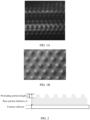
- this application provides an electrochemical device including a positive electrode, where the positive electrode includes a positive electrode current collector and a positive electrode active material layer disposed on a surface of the positive electrode current collector, where the positive electrode active material layer includes a base portion and a protruding portion on a surface of the base portion away from the current collector, where a thickness of the base portion is d microns, and a height of the protruding portion is a microns; and the positive electrode active material layer includes a positive electrode active material, and the positive electrode active material includes a lithium-nickel composite oxide, where a molar proportion of element nickel in the lithium-nickel composite oxide in metal elements other than lithium in the lithium-nickel composite oxide is x, satisfying: 0.2d ⁇ x ⁇ a ⁇ 1.15d ⁇ x.
- a gap can be reserved for the swelling of the electrode plate, providing a stress release space, and further the foregoing relation is satisfied, so that the prepared electrochemical device can not only support high-rate discharge, but also have longer high-temperature cycle life and safety performance across the lifespan.
- the positive electrode active material layer has N protruding portions per square centimeter, where N is 1 to 25. In some embodiments, N is 4 to 25. With the number N of protruding portions set within the foregoing range, the protruding portions can provide sufficient support, reserving enough space for swelling, and further improving the high-temperature cycle life of the electrochemical device, without adding to the complication and complexity of processing technology.
- the electrochemical device satisfies at least one of the following conditions: (1) 5 ⁇ a ⁇ 70; (2) 30 ⁇ d ⁇ 100; (3) 0.4 ⁇ x ⁇ 0.95; or (4) a ⁇ 0.95 d.
- the electrochemical device satisfies at least one of the following conditions: (a) an average particle size of the first primary particles is 1 micron to 6 microns; (b) an average particle size of the second primary particles is 100 nanometers to 2 microns; or (c) an average particle size of the secondary particles is 8 microns to 15 microns.
- This application employs the foregoing design, that is, protruding portions being constructed on the base portion of the positive electrode active material layer, allowing for reservation of a gap for the swelling of the electrode plate, providing a stress release space, thereby alleviating this issue.
- the height a microns of the protruding portion, the thickness d microns of the base portion, and the molar proportion x of element nickel in the lithium-nickel composite oxide in metal elements other than lithium in the lithium-nickel composite oxide satisfy the relation of 0.2d ⁇ x ⁇ a ⁇ 1.15d ⁇ x, a lithium-ion battery prepared can not only support high-rate discharge, but also have a longer high-temperature cycle life and safety performance across the lifespan, thereby meeting the needs for use of terminals in harsh scenarios.
- the lithium-nickel composite oxide includes Li m Ni x Co y Mn z M a1 O 2 ⁇ q T q , where M includes Al, Nb, Mg, Ti, W, Ga, Zr, W, Y, V, Sr, Mo, Ru, Ag, Sn, Au, La, Ce, Pr, Nd, Sm, or Gd, and T includes at least one of F, Cl, Br, I, N or S, where 0.2 ⁇ m ⁇ 1.2, 0.4 ⁇ x ⁇ 0.95, 0 ⁇ y ⁇ 0.5, 0 ⁇ z ⁇ 0.5, 0 ⁇ a1 ⁇ 0.02, and 0 ⁇ q ⁇ 0.2.
- the positive electrode active material layer includes a first layer and a second layer, where the first layer is located between the positive electrode current collector and the second layer, where based on a mass of the first layer, a mass percentage of a binder in the first layer is b1, and based on a mass of the second layer, a mass percentage of a binder in the second layer is b1, satisfying: b21b1 ⁇ 1.2.
- the lithium-nickel composite oxide swells and shrinks, the second layer away from the current collector experiences a relatively large strain. More binder contained in the second layer away from the current collector helps to suppress the thickness change of the electrode plate, thereby improving the high-temperature cycle life of the electrochemical device.
- the application relates to an electronic device including the electrochemical device according to any one of the foregoing embodiments.
- a negative electrode active material at least one of a carbon material, a silicon material, or lithium titanate
- a negative electrode binder are dispersed in a solvent system in a specific mass ratio, fully stirred and mixed, and the resulting mixture is applied onto a negative electrode current collector, followed by drying and cold calendering, to obtain a negative electrode.
- Step (4) The positive electrode active material, a conductive agent, and a binder are fully stirred and mixed in a solvent system according to a specific weight ratio, and then applied onto a positive electrode current collector, with the coating weight controlled, followed by drying, to obtain a positive electrode plate for later use.
- Step (5) A pressing roller with circular dots having a required protrusion height is used to cold calender the foregoing positive electrode plate, with diameter of the circle controlled to be within a range of 0.5 mm to 5 mm, and the longest intercept of other shapes controlled to be within this range.
- the cold-calendered positive electrode plate is slit and cut to obtain a positive electrode.
- the foregoing steps (1) and/or (2) may further include a doping and/or coating step, and the foregoing step (4) may be controlled to form one or more positive electrode active material layers.
- the solvent includes but is not limited to, for example, N-methylpyrrolidone, acetone, or water. In some embodiments, the amount of solvent can be appropriately adjusted.
- the positive electrode current collector has a thickness in a range of 3 microns to 20 microns, but this disclosure is not limited thereto.
- the positive electrode current collector is conductive and does not cause adverse chemical changes in a prepared battery.
- Examples of the positive electrode current collector include but are not limited to copper, stainless steel, aluminum, nickel, titanium, or alloys (such as copper-nickel alloy).
- the surface of the positive electrode current collector may include small irregularities (such as surface roughness) to enhance adhesion of the surface of the positive electrode current collector to the positive electrode active material.
- the current collector may be used in multiple forms, for example, membrane, sheet, foil, web, porous structure, or foam, but this disclosure is not limited thereto.
- polyethylene (PE) porous polymeric film is used as the separator.
- material of the separator may include glass fiber, polyester, polyethylene, polypropylene, polytetrafluoroethylene, or a combination thereof.
- the separator has pores with a diameter in a range of 0.01 micron to 1 micron, and a thickness in a range of 5 microns to 100 microns.
- the electrolyte solution includes an organic solvent, a lithium salt, and an additive.
- the organic solvent includes at least one of ethylene carbonate (EC), propylene carbonate (PC), diethyl carbonate (DEC), ethyl methyl carbonate (EMC), dimethyl carbonate (DMC), propyl propionate, or ethyl propionate.
- the lithium salt amounts to 5% to 30% based on a mass of the electrolyte solution. In some embodiments, the lithium salt amounts to 6% to 25% based on the mass of the electrolyte solution.
- the additive includes at least one of fluoroethylene carbonate, vinylene carbonate, vinyl ethylene carbonate, 1,3-propane sultone, vinyl sulfate, adiponitrile, succinonitrile, glutaronitrile, 1,3,6-hexanetrinitrile, 1,2,6-hexanetrinitrile, succinic anhydride, lithium difluorophosphate, or lithium tetrafluoroborate.
- the positive electrode, the separator, and the negative electrode are stacked in order, with the separator placed between the positive and negative electrodes for separation, and the stack is wound to produce a jelly roll.
- the jelly roll obtained by winding is placed in an outer package, followed by electrolyte solution injection and sealing, and then processes including formation, degassing and trimming are carried out to produce a lithium-ion battery.
- the application provides an electronic device including the electrochemical device described above.
- Step (3) A pressing roller with circular dots having a protrusion height of 20 microns was used to cold calender the foregoing primary positive electrode plate, with diameter of the circle controlled to be within a range of 0.5 mm to 5 mm, and the cold-calendered electrode plate was slit and cut to produce a desired positive electrode.
- the height a of the protruding portions was set to 20 microns
- the thickness d of the base portion was set to 75 microns
- a gap b between the protruding portions was set to 10 millimeters.
- Negative electrode A negative electrode active material artificial graphite, a conductive agent acetylene black, a binder styrene butadiene rubber (SBR), and a thickener sodium carboxymethyl cellulose (CMC) were fully stirred and mixed in a deionized water solvent system according to a mass ratio of 95:2:2:1, and applied on a Cu foil, followed by drying and cold calendering, to produce a negative electrode.
- SBR binder styrene butadiene rubber
- CMC thickener sodium carboxymethyl cellulose
- Electrolyte solution Ethylene carbonate (abbreviated as EC), diethyl carbonate (abbreviated as DEC), propylene carbonate (abbreviated as PC) were evenly mixed according to a weight ratio of 2:6:2 in an argon atmosphere glove box with a water content less than 10ppm. Then a fully dried lithium salt LiPF 6 was dissolved in the above solvent, the content of LiPF 6 is 12.5%. Then 1.5% 1,3-propane sultone, 3% fluoroethylene carbonate, and 2% adiponitrile were added. The substance contents were based on a total weight of the electrolyte solution.
- EC Ethylene carbonate
- DEC diethyl carbonate
- PC propylene carbonate
- Examples 15-16 and 18-19 differed from example 2 in that sizes of primary particles of the secondary particles and secondary particles of the positive electrode active material were adjusted.
- Examples 17 and 20-22 differed from example 2 in blending with primary particles, and a mass ratio of primary particles to secondary particles in the positive electrode active material was 1:1, where a preparation method of the primary particles was as follows: precursor and lithium hydroxide (LiOH) were prepared according to a stoichiometric ratio of the lithium-nickel composite oxide, and mixed evenly to obtain a mixture, after drying, performing first calcination at 800°C for 16 h to obtain the primary particles.
- precursor and lithium hydroxide (LiOH) were prepared according to a stoichiometric ratio of the lithium-nickel composite oxide, and mixed evenly to obtain a mixture, after drying, performing first calcination at 800°C for 16 h to obtain the primary particles.
- Super-P conductive carbon black
- CNT carbon nanotubes
- PVDF binder
- Super-P conductive carbon black
- CNT carbon nanotubes
- PVDF binder
- Example 1 None No 97.8% 1230
- Example 2 None No 98.2% 1300
- Example 3 None No 98.5% 1390
- Example 4 Slight spotted lithium precipitation No 97.5% 1000
- Example 5 None No 94.5% 890
- Example 6 None No 95.0% 1010
- Example 7 None No 95.8% 1180
- Example 8 None No 96.9% 1400
- Example 9 None No 98.6% 780
- Example 10 None No 96.1% 1100
- Example 11 None No 95.0% 900
- Example 12 None No 98.6% 1350
- Example 13 None No 97.5% 1380
- Example 14 None No 96.5% 1280
- Example 15 None No 96.5% 910
- Example 16 None No 96.0% 1280
- Example 17 None No 94.3% 1320
- Example 18 None No 91.0% 1290
- Example 19 None No 88.0% 1020
- Example 20 None No 90.0% 1420
- Example 21 None No 96.1% 1500
- Example 22
- Average particle size of particles A scanning electron microscope was used to take photos of a cross section of the positive electrode plate of the battery under test, 50 first primary particles were randomly selected and their longest diameters were measured, and an average value thereof was taken as the average particle size of the first primary particles. 50 secondary particles were randomly selected and their longest diameters were measured, and an average value thereof was taken as the average particle size of the secondary particles. 50 second primary particles in secondary particles were randomly selected and their longest diameters were measured, and an average value thereof was taken as the average particle size of the second primary particles.
- a mixed solvent was used to dissolve the positive electrode active material of the battery under test (for example, 0.4 g of positive electrode active material dissolved in a mixed solvent of 10 ml aqua regia (nitric acid and hydrochloric acid mixed at a ratio of 1:1) and 2 ml HF), diluted to 100 mL, and then ICP-OES (Inductively Coupled Plasma-Optical Emission Spectrometer, equipment model: ICAP6300) was used to test and determine contents of element Ni, element Co, element Mn, and element M in the positive electrode active material. The element contents of the primary particles and the secondary particles in the positive electrode active material were tested using SEM-EDS.
- ICP-OES Inductively Coupled Plasma-Optical Emission Spectrometer, equipment model: ICAP6300
- Test of binder content Samples of upper and lower layers of the positive electrode active material layer of the battery under test were taken, and the respective binder contents of the upper and lower layers in the positive electrode active material layer were obtained by thermogravimetric analysis.
- Test of base portion thickness d and protruding portion height a of the positive electrode active layer The positive electrode plate of the battery under test was treated with a slicer to obtain a cross section perpendicular to the surface of the positive electrode current collector, and a scanning electron microscope was used to randomly select 20 places on the surface of the base portion and measure their thicknesses, and an average value was taken as the base portion thickness d; and 20 protruding portions were randomly selected, and the heights from their apexes to the current collector were measured, where the average value thereof was H.
- This application employs the foregoing design, that is, the protruding portions being constructed on the base portion of the positive electrode active material layer of the positive electrode plate, allowing for reservation of a gap for the swelling of the electrode plate, providing a stress release space, thereby alleviating this issue.
- a lithium-ion battery prepared can not only support high-rate discharge, but also have a longer high-temperature cycle life and safety performance across the lifespan.
- the positive electrode active material in examples 17 and 20 to 22 includes first primary particles and secondary particles formed by aggregation of second primary particles, where a molar proportion of element nickel in the first primary particles in metals other than lithium in the first primary particles is x1, and a molar proportion of element nickel in the secondary particles in metals other than lithium in the secondary particles is x2.
- a molar proportion of element nickel in the first primary particles in metals other than lithium in the first primary particles is x1
- a molar proportion of element nickel in the secondary particles in metals other than lithium in the secondary particles is x2.
- Table 2 where 0.02 ⁇ x1 - x2 ⁇ 0.35.
- a higher Ni content leads to more Li ions deintercalated under the same voltage and more obvious change of the C-axis.
- extreme shrinkage value of the C-axis is above 5% when the Ni content is greater than 80, and is reduced to 3% when the Ni content is less than or equal to 60.
- Ni content of the secondary particles with a larger particle size to be lower than that of the first primary particles with a smaller particle size can effectively alleviate uneven electrode plate swelling.
- particle fragmentation can be effectively prevented by blending up the primary particles and secondary particles. Therefore, in this application, different particle morphologies are set and different Ni contents are set for particles with different morphologies, that is, appropriately reducing the Ni content in secondary particles with a large particle size and increasing the Ni content in primary particles with a small particle size, which balances the deintercalation speed and distribution of Li ions, further alleviating electrode plate swelling, and improving a high-temperature cycle life of the electrochemical device.
- Lithium-nickel composite oxides demonstrate high temperature rise during a high-rate application process. Doping can improve the interface stability at high temperature and improve cycling performance. In another perspective, doping can increase interface impedance during fast charging, slowing down lithium precipitation at the positive electrode plane and corners, and improving safety performance at the final stage of the lifespan.
- the doping element is selected from at least one of Al, Nb, Mg, Ti, W, Ga, Zr, W, Y, V, Sr, Mo, Ru, Ag, Sn, Au, La, Ce, Pr, Nd, Sm, or Gd, and a molar proportion a1 of the doping element in the lithium-nickel composite oxide in metal elements other than lithium in the lithium-nickel composite oxide, satisfies 0.1% ⁇ a1 ⁇ 2%, a relatively good high-temperature cycle life is obtained.
- the binder contents in the first layer and the second layer of the positive electrode active material layer are changed, so that there is more binder in the second layer away from the current collector, which is more conducive to restraining thickness change of the electrode plate, thereby improving the high-temperature cycle life of the lithium-ion battery.
Landscapes
- Chemical & Material Sciences (AREA)
- Chemical Kinetics & Catalysis (AREA)
- Electrochemistry (AREA)
- General Chemical & Material Sciences (AREA)
- Composite Materials (AREA)
- Inorganic Chemistry (AREA)
- Engineering & Computer Science (AREA)
- Materials Engineering (AREA)
- Battery Electrode And Active Subsutance (AREA)
- Secondary Cells (AREA)
Applications Claiming Priority (1)
| Application Number | Priority Date | Filing Date | Title |
|---|---|---|---|
| PCT/CN2022/104074 WO2024007187A1 (fr) | 2022-07-06 | 2022-07-06 | Dispositif électrochimique et dispositif électronique |
Publications (2)
| Publication Number | Publication Date |
|---|---|
| EP4535445A1 true EP4535445A1 (fr) | 2025-04-09 |
| EP4535445A4 EP4535445A4 (fr) | 2025-09-17 |
Family
ID=88046476
Family Applications (1)
| Application Number | Title | Priority Date | Filing Date |
|---|---|---|---|
| EP22949775.5A Pending EP4535445A4 (fr) | 2022-07-06 | 2022-07-06 | Dispositif électrochimique et dispositif électronique |
Country Status (4)
| Country | Link |
|---|---|
| US (1) | US20250140815A1 (fr) |
| EP (1) | EP4535445A4 (fr) |
| CN (1) | CN116802826A (fr) |
| WO (1) | WO2024007187A1 (fr) |
Families Citing this family (1)
| Publication number | Priority date | Publication date | Assignee | Title |
|---|---|---|---|---|
| WO2026000105A1 (fr) * | 2024-06-24 | 2026-01-02 | 宁德时代新能源科技股份有限公司 | Élément de batterie cylindrique, batterie et dispositif électrique |
Family Cites Families (7)
| Publication number | Priority date | Publication date | Assignee | Title |
|---|---|---|---|---|
| JP2013062105A (ja) * | 2011-09-13 | 2013-04-04 | Hitachi Ltd | リチウムイオン二次電池 |
| CN202633449U (zh) * | 2012-03-06 | 2012-12-26 | 宁德新能源科技有限公司 | 一种锂离子电池及其正极片 |
| CN103367702B (zh) * | 2013-07-18 | 2017-05-03 | 东莞新能源科技有限公司 | 锂离子电池极片及包含该极片的锂离子电池 |
| CN107437623B (zh) * | 2016-05-27 | 2021-02-19 | 宁德时代新能源科技股份有限公司 | 锂离子电池正极片及其制备方法 |
| CN111384372B (zh) * | 2018-12-29 | 2021-03-23 | 宁德时代新能源科技股份有限公司 | 一种高压实密度正极材料及电化学储能装置 |
| CN111613770B (zh) * | 2019-02-26 | 2021-05-11 | 荣盛盟固利新能源科技有限公司 | 一种锂离子电池极片 |
| CN111640912A (zh) * | 2020-05-13 | 2020-09-08 | 力神动力电池系统有限公司 | 一种正极极片及其制备方法和锂离子二次电池 |
-
2022
- 2022-07-06 WO PCT/CN2022/104074 patent/WO2024007187A1/fr not_active Ceased
- 2022-07-06 EP EP22949775.5A patent/EP4535445A4/fr active Pending
- 2022-07-06 CN CN202280010637.1A patent/CN116802826A/zh active Pending
-
2024
- 2024-12-31 US US19/006,363 patent/US20250140815A1/en active Pending
Also Published As
| Publication number | Publication date |
|---|---|
| WO2024007187A1 (fr) | 2024-01-11 |
| CN116802826A (zh) | 2023-09-22 |
| EP4535445A4 (fr) | 2025-09-17 |
| US20250140815A1 (en) | 2025-05-01 |
Similar Documents
| Publication | Publication Date | Title |
|---|---|---|
| EP3844830B1 (fr) | Cathode et dispositif électrochimique | |
| CN113097441B (zh) | 电化学装置及电子装置 | |
| US20240097124A1 (en) | Positive active material, positive electrode plate and lithium-ion secondary battery | |
| EP4318658A1 (fr) | Plaque d'électrode négative et dispositif électrochimique la comprenant, et dispositif électronique | |
| CN113839012B (zh) | 一种正极活性材料及包含其的电化学装置 | |
| US20230343933A1 (en) | Negative electrode active material, electrochemical apparatus, and electronic apparatus | |
| EP4358188A1 (fr) | Électrode négative, appareil électrochimique et appareil électronique | |
| EP4394915A1 (fr) | Dispositif électrochimique et dispositif électronique | |
| US20240014390A1 (en) | Electrochemical Apparatus and Electronic Apparatus | |
| US20240250260A1 (en) | Electrochemical apparatus and electronic apparatus | |
| US20240332523A1 (en) | Electrochemical apparatus and electronic apparatus | |
| US20230216026A1 (en) | Positive electrode material, and electrochemical apparatus and electronic apparatus containing same | |
| US20250309365A1 (en) | Electrochemical apparatus and electronic apparatus | |
| WO2022198614A1 (fr) | Matériau d'électrode négative, son procédé de préparation, dispositif électrochimique et dispositif électronique | |
| WO2025213754A1 (fr) | Batterie et dispositif électrique | |
| US20240339617A1 (en) | Secondary battery and electronic apparatus | |
| US20240243282A1 (en) | Electrochemical device and electronic device | |
| US20250140815A1 (en) | Electrochemical device and electronic device | |
| WO2023044625A1 (fr) | Graphite artificiel composite et son procédé de préparation, batterie secondaire contenant du graphite artificiel composite et appareil de consommation d'énergie | |
| WO2021138814A1 (fr) | Dispositif électrochimique et dispositif électronique comprenant le dispositif électrochimique | |
| CN115810788A (zh) | 一种锂离子电池、电池模块、电池包及用电装置 | |
| US12597599B2 (en) | Negative electrode material and electrochemical apparatus and electronic apparatus containing same | |
| US20220320484A1 (en) | Electrochemical device and electronic device | |
| EP4489099A1 (fr) | Appareil électrochimique et dispositif électronique | |
| EP4546465A1 (fr) | Dispositif électrochimique et dispositif électronique comprenant celui-ci |
Legal Events
| Date | Code | Title | Description |
|---|---|---|---|
| STAA | Information on the status of an ep patent application or granted ep patent |
Free format text: STATUS: THE INTERNATIONAL PUBLICATION HAS BEEN MADE |
|
| PUAI | Public reference made under article 153(3) epc to a published international application that has entered the european phase |
Free format text: ORIGINAL CODE: 0009012 |
|
| STAA | Information on the status of an ep patent application or granted ep patent |
Free format text: STATUS: REQUEST FOR EXAMINATION WAS MADE |
|
| 17P | Request for examination filed |
Effective date: 20241230 |
|
| AK | Designated contracting states |
Kind code of ref document: A1 Designated state(s): AL AT BE BG CH CY CZ DE DK EE ES FI FR GB GR HR HU IE IS IT LI LT LU LV MC MK MT NL NO PL PT RO RS SE SI SK SM TR |
|
| REG | Reference to a national code |
Ref country code: DE Ref legal event code: R079 Free format text: PREVIOUS MAIN CLASS: H01M0004130000 Ipc: H01M0004360000 |
|
| A4 | Supplementary search report drawn up and despatched |
Effective date: 20250818 |
|
| RIC1 | Information provided on ipc code assigned before grant |
Ipc: H01M 4/36 20060101AFI20250811BHEP Ipc: H01M 4/13 20100101ALI20250811BHEP Ipc: H01M 10/0525 20100101ALI20250811BHEP Ipc: H01M 4/525 20100101ALI20250811BHEP Ipc: H01M 4/131 20100101ALI20250811BHEP Ipc: H01M 4/02 20060101ALI20250811BHEP |
|
| DAV | Request for validation of the european patent (deleted) | ||
| DAX | Request for extension of the european patent (deleted) |