EP4535607A2 - Systemes et methodes pour un chariot de chargement d'un systeme de mesure automatique de harnais sans fil - Google Patents
Systemes et methodes pour un chariot de chargement d'un systeme de mesure automatique de harnais sans fil Download PDFInfo
- Publication number
- EP4535607A2 EP4535607A2 EP24194427.1A EP24194427A EP4535607A2 EP 4535607 A2 EP4535607 A2 EP 4535607A2 EP 24194427 A EP24194427 A EP 24194427A EP 4535607 A2 EP4535607 A2 EP 4535607A2
- Authority
- EP
- European Patent Office
- Prior art keywords
- charging
- wireless
- slots
- wireless test
- test module
- Prior art date
- Legal status (The legal status is an assumption and is not a legal conclusion. Google has not performed a legal analysis and makes no representation as to the accuracy of the status listed.)
- Pending
Links
Images







Classifications
-
- H—ELECTRICITY
- H02—GENERATION; CONVERSION OR DISTRIBUTION OF ELECTRIC POWER
- H02J—ELECTRIC POWER NETWORKS; CIRCUIT ARRANGEMENTS OR SYSTEMS FOR SUPPLYING OR DISTRIBUTING ELECTRIC POWER; SYSTEMS FOR STORING ELECTRIC ENERGY
- H02J50/00—Circuit arrangements or systems for wireless supply or distribution of electric power
- H02J50/005—Mechanical details of housing or structure aiming to accommodate the power transfer means, e.g. mechanical integration of coils, antennas or transducers into emitting or receiving devices
-
- B—PERFORMING OPERATIONS; TRANSPORTING
- B62—LAND VEHICLES FOR TRAVELLING OTHERWISE THAN ON RAILS
- B62B—HAND-PROPELLED VEHICLES, e.g. HAND CARTS OR PERAMBULATORS; SLEDGES
- B62B3/00—Hand carts having more than one axis carrying transport wheels; Steering devices therefor; Equipment therefor
- B62B3/002—Hand carts having more than one axis carrying transport wheels; Steering devices therefor; Equipment therefor characterised by a rectangular shape, involving sidewalls or racks
- B62B3/005—Details of storage means, e.g. drawers, bins or racks
-
- G—PHYSICS
- G01—MEASURING; TESTING
- G01R—MEASURING ELECTRIC VARIABLES; MEASURING MAGNETIC VARIABLES
- G01R1/00—Details of instruments or arrangements of the types included in groups G01R5/00 - G01R13/00 and G01R31/00
- G01R1/02—General constructional details
- G01R1/04—Housings; Supporting members; Arrangements of terminals
-
- G—PHYSICS
- G01—MEASURING; TESTING
- G01R—MEASURING ELECTRIC VARIABLES; MEASURING MAGNETIC VARIABLES
- G01R31/00—Arrangements for testing electric properties; Arrangements for locating electric faults; Arrangements for electrical testing characterised by what is being tested not provided for elsewhere
- G01R31/005—Testing of electric installations on transport means
-
- G—PHYSICS
- G01—MEASURING; TESTING
- G01R—MEASURING ELECTRIC VARIABLES; MEASURING MAGNETIC VARIABLES
- G01R31/00—Arrangements for testing electric properties; Arrangements for locating electric faults; Arrangements for electrical testing characterised by what is being tested not provided for elsewhere
- G01R31/50—Testing of electric apparatus, lines, cables or components for short-circuits, continuity, leakage current or incorrect line connections
- G01R31/52—Testing for short-circuits, leakage current or ground faults
-
- G—PHYSICS
- G01—MEASURING; TESTING
- G01R—MEASURING ELECTRIC VARIABLES; MEASURING MAGNETIC VARIABLES
- G01R31/00—Arrangements for testing electric properties; Arrangements for locating electric faults; Arrangements for electrical testing characterised by what is being tested not provided for elsewhere
- G01R31/50—Testing of electric apparatus, lines, cables or components for short-circuits, continuity, leakage current or incorrect line connections
- G01R31/58—Testing of lines, cables or conductors
-
- G—PHYSICS
- G01—MEASURING; TESTING
- G01R—MEASURING ELECTRIC VARIABLES; MEASURING MAGNETIC VARIABLES
- G01R31/00—Arrangements for testing electric properties; Arrangements for locating electric faults; Arrangements for electrical testing characterised by what is being tested not provided for elsewhere
- G01R31/50—Testing of electric apparatus, lines, cables or components for short-circuits, continuity, leakage current or incorrect line connections
- G01R31/66—Testing of connections, e.g. of plugs or non-disconnectable joints
- G01R31/67—Testing the correctness of wire connections in electric apparatus or circuits
-
- H—ELECTRICITY
- H02—GENERATION; CONVERSION OR DISTRIBUTION OF ELECTRIC POWER
- H02J—ELECTRIC POWER NETWORKS; CIRCUIT ARRANGEMENTS OR SYSTEMS FOR SUPPLYING OR DISTRIBUTING ELECTRIC POWER; SYSTEMS FOR STORING ELECTRIC ENERGY
- H02J13/00—Circuit arrangements for providing remote monitoring or remote control of equipment in a power distribution network
- H02J13/12—Monitoring network conditions, e.g. electrical magnitudes or operational status
-
- H—ELECTRICITY
- H02—GENERATION; CONVERSION OR DISTRIBUTION OF ELECTRIC POWER
- H02J—ELECTRIC POWER NETWORKS; CIRCUIT ARRANGEMENTS OR SYSTEMS FOR SUPPLYING OR DISTRIBUTING ELECTRIC POWER; SYSTEMS FOR STORING ELECTRIC ENERGY
- H02J13/00—Circuit arrangements for providing remote monitoring or remote control of equipment in a power distribution network
- H02J13/13—Circuit arrangements for providing remote monitoring or remote control of equipment in a power distribution network characterised by the transmission of data to equipment in the power network
- H02J13/1331—Circuit arrangements for providing remote monitoring or remote control of equipment in a power distribution network characterised by the transmission of data to equipment in the power network using wireless data transmission
-
- H—ELECTRICITY
- H02—GENERATION; CONVERSION OR DISTRIBUTION OF ELECTRIC POWER
- H02J—ELECTRIC POWER NETWORKS; CIRCUIT ARRANGEMENTS OR SYSTEMS FOR SUPPLYING OR DISTRIBUTING ELECTRIC POWER; SYSTEMS FOR STORING ELECTRIC ENERGY
- H02J50/00—Circuit arrangements or systems for wireless supply or distribution of electric power
- H02J50/30—Circuit arrangements or systems for wireless supply or distribution of electric power using light, e.g. lasers
-
- H—ELECTRICITY
- H02—GENERATION; CONVERSION OR DISTRIBUTION OF ELECTRIC POWER
- H02J—ELECTRIC POWER NETWORKS; CIRCUIT ARRANGEMENTS OR SYSTEMS FOR SUPPLYING OR DISTRIBUTING ELECTRIC POWER; SYSTEMS FOR STORING ELECTRIC ENERGY
- H02J50/00—Circuit arrangements or systems for wireless supply or distribution of electric power
- H02J50/40—Circuit arrangements or systems for wireless supply or distribution of electric power using two or more transmitting or receiving devices
- H02J50/402—Circuit arrangements or systems for wireless supply or distribution of electric power using two or more transmitting or receiving devices the two or more transmitting or the two or more receiving devices being integrated in the same unit, e.g. power mats with several coils or antennas with several sub-antennas
-
- H—ELECTRICITY
- H02—GENERATION; CONVERSION OR DISTRIBUTION OF ELECTRIC POWER
- H02J—ELECTRIC POWER NETWORKS; CIRCUIT ARRANGEMENTS OR SYSTEMS FOR SUPPLYING OR DISTRIBUTING ELECTRIC POWER; SYSTEMS FOR STORING ELECTRIC ENERGY
- H02J7/00—Circuit arrangements for charging or discharging batteries or for supplying loads from batteries
- H02J7/50—Circuit arrangements for charging or discharging batteries or for supplying loads from batteries acting upon multiple batteries simultaneously or sequentially
-
- H—ELECTRICITY
- H02—GENERATION; CONVERSION OR DISTRIBUTION OF ELECTRIC POWER
- H02J—ELECTRIC POWER NETWORKS; CIRCUIT ARRANGEMENTS OR SYSTEMS FOR SUPPLYING OR DISTRIBUTING ELECTRIC POWER; SYSTEMS FOR STORING ELECTRIC ENERGY
- H02J7/00—Circuit arrangements for charging or discharging batteries or for supplying loads from batteries
- H02J7/70—Circuit arrangements for charging or discharging batteries or for supplying loads from batteries characterised by the mechanical construction
- H02J7/731—Circuit arrangements for charging or discharging batteries or for supplying loads from batteries characterised by the mechanical construction specially adapted for holding portable devices containing batteries
-
- H—ELECTRICITY
- H02—GENERATION; CONVERSION OR DISTRIBUTION OF ELECTRIC POWER
- H02J—ELECTRIC POWER NETWORKS; CIRCUIT ARRANGEMENTS OR SYSTEMS FOR SUPPLYING OR DISTRIBUTING ELECTRIC POWER; SYSTEMS FOR STORING ELECTRIC ENERGY
- H02J2105/00—Networks for supplying or distributing electric power characterised by their spatial reach or by the load
- H02J2105/30—Networks for supplying or distributing electric power characterised by their spatial reach or by the load the load networks being external to vehicles, i.e. exchanging power with vehicles
Definitions
- a system includes a computer system and a plurality of wireless test modules.
- Each wireless test module includes a wireless transceiver and is operable to physically couple to an electrical wiring harness.
- the computer system is operable to send test instructions to the plurality of wireless test modules according to an automated test plan.
- Each wireless test module is operable to wirelessly receive one or more of the plurality of test instructions from the computer system using the wireless transceiver and perform one or more tests on the electrical wiring harness according to received one or more test instructions from the computer system.
- Each wireless test module is further operable to wirelessly communicate test results to the computer system using the wireless transceiver.
- a system includes hot-swap connectors for connecting a chassis of a wireless test module to a variable front end of the wireless test module.
- the variable front end of the wireless test module is operable to mate to an aircraft connector.
- the hot-swap connectors include a WTM side hot-swap connector and a front end side hot-swap connector located between the chassis of the wireless test module and the variable front end of the wireless test module.
- the WTM side hot-swap connector is operable to mate to a front end side hot-swap connector to connect the chassis of the wireless test module to the variable front end of the wireless test module.
- the WTM side hot-swap connector includes a female connector, an alignment peg configured to couple to the variable front end of the wireless test module, a slip ring configured to secure the wireless test module in place, and an electrically erasable programmable read-only memory (EEPROM) read/write wire integrated on a circuit board operable to read/write data of the aircraft connector.
- the front end side hot-swap connector includes a male connector, an alignment peg configured to couple to the chassis of the wireless test module, a thread configured to couple to a slip ring of a WTM side hot-swap connector, and an EEPROM integrated on a circuit board operable to store data of the aircraft connector.
- the WTM side hot-swap connector is further operable to attach the variable front end of the wireless test module to the chassis of the wireless test module.
- the WTM side hot-swap connector is further operable to detach the variable front end of the wireless test module from the chassis of the wireless test module.
- the WTM side hot-swap connector is further operable to transfer the data to the wireless test module when the chassis of the wireless test module and the variable front end of the wireless test module mate.
- the WTM side hot-swap connector is a universal connector located at an end of the chassis of the wireless test module that is attached to a front end side hot-swap connector located at an end of the variable front end of the wireless test module.
- the wireless test module is further operable to wirelessly communicate, using a wireless transceiver, with a computer system to transfer the data stored on an EEPROM associated with the EEPROM read/write wire.
- the female connector includes a plurality of contacts in a range of 48 contacts to 128 contacts.
- the EEPROM read/write wire is configured to couple to the chassis of the wireless test module.
- the WTM side hot-swap connector further includes a jumper harness configured to couple to the wireless test module.
- the WTM side hot-swap connector is operable to swap to a different wireless test module with address information updated automatically in real time when the wireless test module malfunctions.
- the male connector includes a plurality of contacts in a range of 48 contact to 128 contacts.
- the front end side hot-swap connector further includes a plurality of connectors configured to couple to a wire jumper of the aircraft connector.
- the wireless test module is further operable to wirelessly communicate, using a wireless transceiver, with a computer system to transfer the data stored on the EEPROM.
- the data on the EEPROM is automatically incorporated into a testing software of the computer system without human data entry.
- the front end side hot-swap connector is further operable to swap to a different wireless test module with address information updated automatically in real time when the wireless test module malfunctions.
- a system includes a battery pack module for a wireless test module.
- the battery pack module includes a wireless charging battery, a wireless battery pack holder operable to contain the wireless charging battery, an injected molded pogo pin holder comprising a plurality of pogo pins, and a wireless charging receiver operable to wirelessly charge the wireless charging battery.
- the injected molded pogo pin holder is coupled to the wireless battery pack holder using a set of screws.
- the injected molded pogo pin holder is operable to couple to the wireless test module.
- the battery pack module includes a steel retractable spring plunger comprising pull rings operable to hold the battery pack module together by attaching to the WTM using a second set of screws.
- the computer-implemented method may use the plurality of wireless test modules to perform one or more tests on the plurality of electrical wiring harnesses according to the plurality of test instructions.
- the one or more tests are selected from a plurality of tests comprising a continuity check, a voltage isolation check, a time domain reflectometer (TDR) test, a fiberoptic test, a diode polarity check, and a resistance measurement check.
- the computer-implemented method may use the plurality of WTMs to wirelessly communicate test results to the computer server for display.
- the computer-implemented method may implement a WTM board support package to apply a core operating application for the plurality of wireless test modules to perform the one or more tests on the plurality of electrical wiring harnesses according to the plurality of test instructions.
- a system includes an apparatus for charging a WHAMS.
- the apparatus includes a charging cart, a mobile aluminum frame, a plurality of light-emitting diode (LED) indicators, and a plurality of charging slots.
- the WHAMS include a plurality of wireless test modules. Each of the plurality of charging slots is associated with a respective wireless test module of the WHAMS.
- the charging cart is operable to charge the plurality of wireless test modules of the WHAMS.
- the mobile aluminum frame is operable to support the charging cart.
- the plurality of LED indicators are operable to identify a status of the plurality of the wireless test modules during setup and storage of the WHAMS.
- the present disclosure provides wireless harness automated measurement systems and methods.
- Certain disclosed embodiments utilize one or more wireless test modules (WTMs) that each physically and electrically couple to a connector of the electrical wiring harness under test.
- the one or more wireless test modules are utilized in a wireless harness automated measurement system (WHAMS) for a mobile test solution to validate electrical harnesses, while mitigating inefficiencies of traditional cable-based testing using the cabinet-style test machines.
- the wireless test modules send and receive electrical test signals through one or more wires of the electrical wiring harness and then, unlike current hard-wired solutions, wirelessly report test results back to a central computer systems such as a laptop.
- the hardware commonality of the wireless test module chassis also provides easy swapping in case of malfunction. If one wireless test module become inoperable, critical testing activity can continue without delay by simply replacing the inoperable wireless test module chassis with another available unit. As a result, test operators are able to complete testing of an electrical wiring harness without the requirement of test equipment troubleshooting or repair.
- each wireless test module 120 is not physically connected to central computer system 130 but instead wirelessly communicates with central computer system 130 using a wireless protocol such as Zigbee, Bluetooth, or WI-FI.
- a wireless protocol such as Zigbee, Bluetooth, or WI-FI.
- FIGURES 2A-2B illustrate various examples of testing an electrical wiring harness 110 by wireless harness automated measurement system 100, according to some embodiments.
- two wireless test modules 120 are utilized to perform testing on electrical wiring harness 110: a source wireless test module 120A and a destination wireless test module 120B.
- source wireless test module 120A is physically coupled to a first wiring harness connector 115A
- destination wireless test module 120B is physically coupled to a second wiring harness connector 115B.
- Two electrical wires 111 are utilized during testing in this scenario: a first electrical wire 111A and a second electrical wire 111B.
- Second electrical wire 111B is used as a return line in this example.
- Both electrical wires 111A and 111B are physically and electrically coupled to both source wireless test module 120A and destination wireless test module 120B via wiring harness connectors (e.g., wireless harness connectors 115A and 115B of FIGURE 1 ).
- Source wireless test module 120A introduces a flow of electrical current on first electrical wire 111A, and destination wireless test module 120B internally connects first electrical wire 111A to second electrical wire 111B using, for example, electrical relays.
- Source wireless test module 120A may then measure voltage and current across first electrical wire 111A and second electrical wire 111B in order to perform various electrical tests as described herein.
- Destination wireless test module 120B also measures current and voltage to ensure electrical current actually reaches Destination wireless test module 120B.
- Destination wireless test module 120B includes a pin multiplexing component, such as a high voltage capable solid state multiplexing block 616, which is configured to provide connections by transmitting a signal over one or more channels in a variety of switching and digital control applications.
- options other than second electrical wire 111B may be utilized for an electrical return path or ground.
- an electrical shield within electrical wiring harness 110 may be utilized for the electrical return path or ground.
- an electrical jumper e.g., a wire
- wireless harness automated measurement system 100 utilizes central computer system 130 and one or more wireless test modules 120 to test electrical wiring harness 110.
- one or more wireless test modules 120 are physically connected to one or more wiring harness connectors 115 of electrical wiring harness 110.
- source wireless test module 120A is physically coupled to first wiring harness connector 115A and destination wireless test module 120B is physically coupled to second wiring harness connector 115B as illustrated in FIGURE 2A .
- wireless test module 120A is physically coupled to first wiring harness connector 115A and a loopback connector (or other similar device) 202 is physically coupled to second wiring harness connector 115B as illustrated in FIGURE 2B .
- a wireless test module is the primary electrical testing hardware of the WHAMS.
- the wireless test module is a cylindrical, wirelessly enabled communication and testing node capable of conducting a variety of electrical checkouts by mating with the discrete electrical connectors of an aircraft or other electrical harness.
- the wireless test module may communicate with a radio transceiver powered by the central computer system 130. As a result, the central computer system 130 sends various types of commands to the wireless test module for test execution and reporting.
- the wireless test module is capable of operating on its own or within scalable networks of a plurality of wireless test modules for use on large harness assemblies.
- the one or more charge cabinets are configured to be scalable in large increments of test points.
- the one or more charge cabinets are configured to be deployable for a harness configuration requiring less than or equal to a predetermined number of test points.
- the one or more charge cabinets include a plurality of connectors with various pin counts, types, and units for a majority of the work being completed.
- the one or more large charge cabinets use a panel of generic connector interfaces for a plurality of test adaptor cables to plug into.
- the plurality of test adaptor cables are double ended and unique in length, increasing weight and fabrication cost of the traditional electrical harness testing hardware. Thus, it is difficult to transport and deploy the traditional electrical harness testing hardware in an agile manor for multi-build environment usage.
- Wireless test module 120 may be configured to automatically identify the test adaptor, such as variable front end 126, which is connected to wireless test module 120.
- Variable front end 126 may use electrical connector 302 to couple to a wiring harness connector of an electrical wiring harness.
- wireless test module 120 may be configured to physically couple to an electrical wiring harness for performing one or more electrical tests on the electrical wiring harness (e.g., continuity checks, voltage isolation checks, diode polarity checks, resistance measurement checks, etc.).
- wireless test module 120 may be configured to use wireless transceiver 121 to wirelessly receive a plurality of test instructions (e.g., test instructions 150 of FIGURE 1 ) according to an automated test plan from the central computer system (e.g., central computer system 130 of FIGURE 1 ).
- the wireless test module When the wireless test module is powered off and power is applied to the charging port, the wireless test module may be configured to power on and begin charging.
- the wireless test module may include a plurality of light-emitting diode (LED) indicators to facilitate visual communication with the user visually.
- the LED indicators are orange colored and located on an end of the wireless test module 120.
- the wireless test module (e.g., wireless test module 120 of FIGURE 1 ) may be configured to operate independently or within a scalable network of wireless test modules for use on large harness assemblies.
- the wireless test module may be configured to generate a low voltage output of approximately 2.4 Volts (V) for a resistance/continuity test.
- the wireless test module may be configured to generate a voltage output within a range of 100V to 500V for high voltage testing with a tolerance on the output voltage of +/- 3% +/- 2V.
- the wireless test module may be configured to measure resistance with an accuracy of 10% +/- 1 ohm for a resistance in a 1 ohm to 50 ohm range.
- the wireless test module may be configured to measure resistance with an accuracy of 5% +/- 1 ohm for a resistance in a 51 ohm to 250 ohm range.
- the wireless test module may be configured to measure resistance with an accuracy of 10% +/- 1 ohm for a resistance in a 251 ohm to 1 million (M) ohm range.
- the wireless test module may be configured to measure resistance with an accuracy in a range of 6% and 10% using high voltages.
- the accuracy for resistance measurements using the 100V high voltage is 10% for a resistance in a 1M ohm to 50M ohm range.
- the accuracy for resistance measurements using the 500V high voltage is 6% for a resistance in the 1M ohm to 50M ohm range.
- the WHAMS is configured to perform one or more electronic tests for functional automated check (FAC) on a plurality of electronic wiring harnesses for vehicles such as aircraft and automobiles.
- FAC functional automated check
- the variety in connector types on the vehicles is immense.
- the WHAMS may use a plurality of wireless test modules to test every unique connector of the vehicles. Because the vehicles are tested in pieces, the plurality of wireless test modules may use hot-swap connectors to separate connectors from the plurality of wireless test modules to decrease production cost and increase flexibility of the WHAMS.
- WTM side hot-swap connector 402 is a custom-designed universal connector.
- WTM side hot-swap connector 402 may be located on an end of the chassis of the wireless test module that is attached to another custom-designed universal connector, such as a front side hot-swap connector, located at an end of the variable front end that mates with the wireless test module.
- WTM side hot-swap connector 402 is operable to attach the variable front end of the wireless test module to the chassis of the wireless test module.
- WTM side hot-swap connector 402 is operable to detach the variable front end of the wireless test module from the chassis of the wireless test module.
- WTM side hot-swap connector 402 includes an alignment peg 702, a slip ring 704, an electrically erasable programmable read-only memory (EEPROM) read/write wire 706, a jumper harness 708, and a female connector, such as a surface-mount female connector 710.
- Alignment peg 702 is configured to mate to the variable front end of the wireless test module.
- Slip ring 704 is configured to secure the wireless test module in place for quick and secure connection. Thus, the variable front end may attach and detach quickly from the wireless test module.
- EEPROM read/write wire 706 may be integrated on a circuit board to read/write data of the wireless test module.
- FIGURES 7B and 7C illustrate a front end side hot-swap connector 404 coupling to wireless test module 120 of FIGURE 3 , according to some embodiments.
- Front end side hot-swap connector 404 is a custom designed universal connector located on an end of the variable front end of the wireless test module that is attached to another custom designed universal connector, such as the WTM hot-swap connector, located at an end of the chassis of the wireless test module.
- front end side hot-swap connector 404 is operable to attach the variable front end of the wireless test module to the chassis of the wireless test module.
- front end side hot-swap connector 404 is operable to detach the variable front end of the wireless test module from the chassis of the wireless test module.
- Front end side hot-swap connector 404 is operable to transfer data from/to the wireless test module when the chassis of the wireless test module and the variable front end of the wireless test module mate. Front end side hot-swap connector 404 is operable to swap to a different wireless test module with address information updated automatically in real time when the wireless test module malfunctions.
- EEPROM 726 may be integrated on a circuit board to store data of the wireless test module.
- the wireless test module is operable to use a wireless transceiver to wirelessly communicate with the central computer system to transfer the data stored on EEPROM 726.
- the data on EEPROM 726 may be automatically incorporated into a testing software of the central computer system without human data entry.
- Plurality of connectors 728 are configured to mate with a wire jumper to an aircraft connector.
- Surface-mount male connector 730 includes a plurality of contacts in a range of 48 contacts to 128 contacts. For example, surface-mount male connector 730 may include 100 contacts.
- FIGURES 8A-8C illustrate example variable front ends 802 that may be installed on wireless test module 120 of FIGURE 3 , according to some embodiments.
- variable front ends 802 in FIGURES 8A-8C may couple to a wiring harness connector (e.g., wiring harness connector 115 of FIGURE 1 ), such as an aircraft connector, with various pins.
- a wiring harness connector e.g., wiring harness connector 115 of FIGURE 1
- the WHAMS may use a mobile charging cart to charge a plurality of wireless test modules in parallel.
- the mobile charging cart is configured to hold and charge the plurality of wireless test modules and locate the plurality of wireless test modules when needed for testing.
- the mobile charging cart may ensure the plurality of wireless test modules are completely charged at time of production use.
- the mobile charging cart may locate the plurality of wireless test modules through a pick by flight function which lights up the plurality of wireless test modules that is called for when needed for testing.
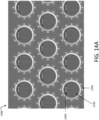
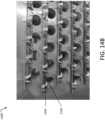
- FIGURES 14A and 14B illustrate a layout 1400 of a plurality of charging slots 1106 on a deck in charging cart system 1100 of FIGURES 11A-C .
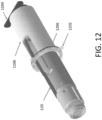
- Each of the plurality of charging slots 1106 is associated with a respective injection molded pogo pin block 1204 and a respective LED ring 1206.
- FIGURE 14C shows a 1500W single output power supply operable to supply power to the plurality of wireless test modules in the charging cart.
- FIGURE 14D shows a plurality of LED indicators 1104 that may assist in identifying the status of a respective wireless test module, as well as help locate where the modules are at any given time. In particular, each of the plurality of LED indicators turns red to indicate that an identified wireless test module associated with the respective LED indicator is currently charging.
- FIGURE 15 illustrates a calibration fixture 1500 for a wireless test module, according to some embodiments.
- Calibration fixture 1500 includes a switchboard 1502, a connector 1504, and a grounding cable 1506.
- switchboard 1502 includes a plurality of switches 1508 .
- Connector 1504 is used to attach calibration fixture 1500 to the wireless test module.
- Grounding cable 1506 is used to connect calibration fixture 1500 directly to the earth.
- the calibration method may use calibration fixture 1500 to apply the controlled periodic calibration process in an automated approach to record the internal resistance of each of the plurality of FETs.
- the controlled periodic calibration process may include one or more of the following five operations: (1) run internal measurement tests, (2) run resistance accuracy tests (RATs), (3) store calibration factors, (4) store RAT history, and (5) recall updated calibration factors at test time.
- RATs run resistance accuracy tests
- FIGURE 16B shows first switch 1606 is turned off and second switch 1608 is turned on.
- the calibration method uses calibration fixture 1500 to run calibration on wireless test module 120
- the calibration method measures a second resistance value of the plurality of FETs from a second internal measurement test for wireless test module 120.
- the second resistance value measures resistance on a second path along both high side FET 1602 and/or low side FET 1604 of wireless test module 120 and calibration fixture 1500.
- the second resistance value is associated with a resistance of high side FET 1602, a resistance of low side FET 1604, contact resistances, and trace/wire resistance on a calibration board.
- the first resistance value may be in a range of 120 ohms to 140 ohms.
- the calibration method determines a resistance calibration value by subtracting the first resistance value of the plurality of FETs from the second resistance value of the plurality of FETs.
- the resistance calibration value is a low side calibrated value.
- the resistance calibration value may be in a range of 40 ohms to 50 ohms.
- the calibration method may compare the resistance calibration value to a predetermined value. For example, if the predetermined value for low side FET 1604 is 45 ohms, the calibration method may determine that the resistance calibration value matches the predetermined value.
- the calibration method is configured to perform the RATs using a plurality of resistors of calibration fixture 1500.
- the calibration method may determine that the resistance calibration value does not match the predetermined value. The calibration method determines a failed result for the controlled periodic calibration process for wireless test module 120.
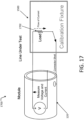
- FIGURE 17 illustrates a resistance accuracy test 1700 using calibration fixture 1500 of FIGURE 15 , according to some embodiments.
- Resistance accuracy test 1700 is configured to validate a plurality of resistors of calibration fixture 1500.
- the plurality of resistors may have resistor values in a range from 1 ohm to 50M ohms.
- calibration fixture 1500 may use a plurality of pins to adjust the resistor values of calibration fixture 1500. All pins run the RATs with a 1 ohm value, and one pin runs the RATs with higher values.
- the calibration method selects a resistor 1702 from the plurality of resistors of calibration fixture 1500 and a test, such as a continuity test, associated with the wireless test module 120.
- the custom power controller component is configured to implement a custom power controller suite to manage a plurality of batteries for the plurality of wireless test modules.
- the test generation, execution, and module management component is configured to implement one or more algorithms to generate a test plan and/or a graphic user interface (GUI) for running various system functions.
- GUI graphic user interface
- the test plan may include a map of the plurality of electrical wiring harnesses, a plurality of harness connections associated with each of the plurality of wireless test modules, a hookup file, and one or more electrical tests associated with the plurality of electrical wiring harnesses.
- the hookup file defines the plurality of wireless test modules assigned to the plurality of harness connections.
- the test plan is generated using additional harness information of splices, passive equipment, and resignment of lose leads.
- the test plan is generated to check wires and unused pins in network configurations for each of the plurality of electrical wiring harnesses.
- the test generation, execution, and module management component may interpret wire lists for the plurality of electrical wiring harnesses and generate a test plan based on testing criteria received from a user.
- the test generation, execution, and module management component is configured to determine a grounding mechanism for testing each electrical wiring harnesses and use input data to analyze each electrical wiring harnesses.
- the application interfaces 1800 illustrated in FIGURES 18A and 18B include a first user interface 1806 for test plan generation.
- First user interface 1806 may be implemented to define multiple harness features and monitor the creation of the test plan, send alerts of potential errors in conversion.
- application interfaces 1800 include a fifth user interface 1814 for module software maintenance and updating.
- Fifth user interface 1814 may be implemented for a user to wirelessly update one or more software packages on the plurality of wireless test modules.
- Fifth user interface 1814 may be applied to facilitate an easy transition of new capabilities to the floor with minimal touch labor.
- the controlling method may choose a plurality of actions for planning the testing of the plurality of electronical wiring harnesses, such as module identification, power off, and harness hookup.
- the controlling method may allow for whole scale network changes, such as operational wireless channel and loading of different harnesses for different tests.
- a plurality of test instructions are generated based on the test plan and the plurality of wireless testing modules.
- each of the plurality of wireless test modules is operable to wirelessly receive one or more of the plurality of test instructions from the computer system.
- the plurality of test instructions are one or more signals, operations, commands, and the like.
- test results are sent to the computer system by wirelessly communicating with the computer system using the plurality of WTMs.
- test results are collected by the computer system for the one or more electrical tests and displayed on a user interface for a user to visually inspect status of the plurality of electronic wiring harnesses through color coded reporting. For example, a passing test is highlighted in a green color and a failing test is highlighted in a different color, such as red, orange, or yellow, based on a condition of the failure of the failing test.
- method 1900 may end.
- computer system 2000 may be an embedded computer system, a system-on-chip (SOC), a single-board computer system (SBC) (such as, for example, a computer-on-module (COM) or system-on-module (SOM)), a desktop computer system, a laptop or notebook computer system, an interactive kiosk, a mainframe, a mesh of computer systems, a mobile telephone, a personal digital assistant (PDA), a server, a tablet computer system, an augmented/virtual reality device, or a combination of two or more of these.
- SOC system-on-chip
- SBC single-board computer system
- COM computer-on-module
- SOM system-on-module
- computer system 2000 may include one or more computer systems 2000; be unitary or distributed; span multiple locations; span multiple machines; span multiple data centers; or reside in a cloud, which may include one or more cloud components in one or more networks.
- one or more computer systems 2000 may perform without substantial spatial or temporal limitation one or more steps of one or more methods described or illustrated herein.
- one or more computer systems 2000 may perform in real time or in batch mode one or more steps of one or more methods described or illustrated herein.
- One or more computer systems 2000 may perform at different times or at different locations one or more steps of one or more methods described or illustrated herein, where appropriate.
- processor 2002 executes only instructions in one or more internal registers or internal caches or in memory 2004 (as opposed to storage 2006 or elsewhere) and operates only on data in one or more internal registers or internal caches or in memory 2004 (as opposed to storage 2006 or elsewhere).
- One or more memory buses (which may each include an address bus and a data bus) may couple processor 2002 to memory 2004.
- Bus 2012 may include one or more memory buses, as described below.
- one or more memory management units (MMUs) reside between processor 2002 and memory 2004 and facilitate accesses to memory 2004 requested by processor 2002.
- memory 2004 includes random access memory (RAM).
- This RAM may be volatile memory, where appropriate. Where appropriate, this RAM may be dynamic RAM (DRAM) or static RAM (SRAM). Moreover, where appropriate, this RAM may be single-ported or multi-ported RAM.
- Memory 2004 may include one or more memories 2004, where appropriate.
- this ROM may be mask-programmed ROM, programmable ROM (PROM), erasable PROM (EPROM), electrically erasable PROM (EEPROM), electrically alterable ROM (EAROM), or flash memory or a combination of two or more of these.
- This disclosure contemplates mass storage 2006 taking any suitable physical form.
- Storage 2006 may include one or more storage control units facilitating communication between processor 2002 and storage 2006, where appropriate.
- storage 2006 may include one or more storages 2006.
- communication interface 2010 includes hardware, software, or both providing one or more interfaces for communication (such as, for example, wireless communications) between computer system 2000 and one or more other devices or system.
- communication interface 2010 may include a network interface controller (NIC) or network adapter for communicating with an Ethernet or other wire-based network or a wireless NIC (WNIC) or wireless adapter for communicating with a wireless network, such as a WI-FI network.
- NIC network interface controller
- WNIC wireless NIC
- WI-FI network wireless network
- computer system 2000 may communicate with a wireless PAN (WPAN) (such as, for example, a BLUETOOTH WPAN), a WI-FI network, a WI-MAX network, a cellular telephone network (such as, for example, a Global System for Mobile Communications (GSM) network, a Long-Term Evolution (LTE) network, or a 5G network), or other suitable wireless network or a combination of two or more of these.
- WPAN wireless PAN
- WI-FI such as, for example, a BLUETOOTH WPAN
- WI-MAX such as, for example, a Global System for Mobile Communications (GSM) network, a Long-Term Evolution (LTE) network, or a 5G network
- GSM Global System for Mobile Communications
- LTE Long-Term Evolution
- 5G 5G network
- Computer system 2000 may include any suitable communication interface 2010 for any of these networks, where appropriate.
- Communication interface 2010 may include one or more communication interfaces 2010, where appropriate.
- bus 2012 includes hardware, software, or both coupling components of computer system 2000 to each other.
- bus 2012 may include an Accelerated Graphics Port (AGP) or other graphics bus, an Enhanced Industry Standard Architecture (EISA) bus, a front-side bus (FSB), a HYPERTRANSPORT (HT) interconnect, an Industry Standard Architecture (ISA) bus, an INFINIBAND interconnect, a low-pin-count (LPC) bus, a memory bus, a Micro Channel Architecture (MCA) bus, a Peripheral Component Interconnect (PCI) bus, a PCI-Express (PCIe) bus, a serial advanced technology attachment (SATA) bus, a Video Electronics Standards Association local (VLB) bus, or another suitable bus or a combination of two or more of these.
- Bus 2012 may include one or more buses 2012, where appropriate.
Landscapes
- Engineering & Computer Science (AREA)
- Power Engineering (AREA)
- Physics & Mathematics (AREA)
- General Physics & Mathematics (AREA)
- Computer Networks & Wireless Communication (AREA)
- Optics & Photonics (AREA)
- Chemical & Material Sciences (AREA)
- Combustion & Propulsion (AREA)
- Transportation (AREA)
- Mechanical Engineering (AREA)
- Testing Of Short-Circuits, Discontinuities, Leakage, Or Incorrect Line Connections (AREA)
- Charge And Discharge Circuits For Batteries Or The Like (AREA)
Applications Claiming Priority (1)
| Application Number | Priority Date | Filing Date | Title |
|---|---|---|---|
| US18/468,156 US12413098B2 (en) | 2023-09-15 | 2023-09-15 | Systems and methods for a charging cart of a wireless harness automated measurement system |
Publications (2)
| Publication Number | Publication Date |
|---|---|
| EP4535607A2 true EP4535607A2 (fr) | 2025-04-09 |
| EP4535607A3 EP4535607A3 (fr) | 2025-04-23 |
Family
ID=92302528
Family Applications (1)
| Application Number | Title | Priority Date | Filing Date |
|---|---|---|---|
| EP24194427.1A Pending EP4535607A3 (fr) | 2023-09-15 | 2024-08-13 | Systemes et methodes pour un chariot de chargement d'un systeme de mesure automatique de harnais sans fil |
Country Status (4)
| Country | Link |
|---|---|
| US (1) | US12413098B2 (fr) |
| EP (1) | EP4535607A3 (fr) |
| JP (1) | JP2025043321A (fr) |
| AU (1) | AU2024205141A1 (fr) |
Families Citing this family (1)
| Publication number | Priority date | Publication date | Assignee | Title |
|---|---|---|---|---|
| CN120948948B (zh) * | 2025-10-15 | 2026-03-24 | 江苏博沃汽车电子系统有限公司 | 一种汽车电器盒总成线束检测装置 |
Family Cites Families (67)
| Publication number | Priority date | Publication date | Assignee | Title |
|---|---|---|---|---|
| US5072185A (en) | 1990-11-13 | 1991-12-10 | Cablescan, Inc. | Wire harness modular interface adapter system and testing apparatus |
| US5852796A (en) | 1996-11-15 | 1998-12-22 | Ut Automotive Dearborn, Inc. | Computerized testing method and system for wire harnesses |
| JPH11150809A (ja) | 1997-09-15 | 1999-06-02 | Honda Motor Co Ltd | バッテリ・レンタルシステム |
| US6222374B1 (en) | 1999-01-29 | 2001-04-24 | Deere & Company | Wiring harness diagnostic system |
| KR100310971B1 (ko) | 1999-08-19 | 2001-10-18 | 엄병윤 | 와이어 하네스 시험방법 및 이를 수행하기 위한 시스템 |
| KR100335357B1 (ko) | 2000-05-02 | 2002-05-06 | 주도식 | 다기능 고속 와이어링 하네스 결선 오류 검사 시스템 및그 검사방법 |
| US6718284B2 (en) | 2002-01-30 | 2004-04-06 | Cirris Systems Corporation | Smart module and adapter apparatus |
| US7368919B2 (en) | 2004-09-02 | 2008-05-06 | Ziota Technology Inc. | Wireless portable automated harness scanner system and method therefor |
| KR200447162Y1 (ko) | 2007-07-18 | 2009-12-30 | (주) 대하전선 | 하네스제품 조립상태 양품,불량 검사장비 |
| US7881887B2 (en) | 2008-07-14 | 2011-02-01 | Sikorsky Aircraft Corporation | Wireless wireharness testing system |
| US8441230B2 (en) | 2008-09-08 | 2013-05-14 | Techtronic Power Tools Technology Limited | Battery charger |
| WO2010083461A2 (fr) | 2009-01-19 | 2010-07-22 | Bretford Manufacturing Inc | Système électrique pour un chariot informatique |
| US8373383B2 (en) | 2009-10-13 | 2013-02-12 | Dell Products L.P. | Smart cart to automatically manage portable information handling systems |
| WO2011143578A1 (fr) | 2010-05-14 | 2011-11-17 | St. Clair Technologies, Inc. | Analyseur de continuité électrique |
| US8547108B2 (en) | 2010-11-24 | 2013-10-01 | Ziota Technology Inc. | Universal mate-in cable interface system |
| US9810732B2 (en) | 2010-11-24 | 2017-11-07 | Ziota Technology Inc. | Universal mate-in cable interface system |
| US10088501B2 (en) | 2010-11-24 | 2018-10-02 | Ziota Technology Inc. | Universal mate-in cable interface system |
| US9250283B2 (en) | 2011-06-17 | 2016-02-02 | Psiber Data Systems, Inc | System and method for automated testing of an electric cable harness |
| DE102011087152B4 (de) | 2011-11-25 | 2013-08-14 | Digalog Industrie-Mikroelektronik Gmbh | Testsystem und Testverfahren für Kabelbäume |
| CN102681539A (zh) | 2012-06-08 | 2012-09-19 | 江南大学 | 一种线束的智能测试方法 |
| US9166417B2 (en) | 2012-08-21 | 2015-10-20 | Makita Corporation | Charger |
| FR2997507B1 (fr) | 2012-10-29 | 2014-11-28 | Labinal | Systeme et procede de surveillance d'un reseau maille de retour de courant d'un aeronef |
| CN203133218U (zh) | 2013-03-06 | 2013-08-14 | 江南大学 | 一种线束的自动测试装置 |
| US9667092B2 (en) | 2013-03-20 | 2017-05-30 | Halo International SEZC Ltd. | Power charging kit with wireless and direct charging connectivity |
| KR101378427B1 (ko) | 2013-09-02 | 2014-03-26 | 주식회사 지오나스 | 다수의 모바일 기기용 충전식 보관장치 |
| CN103499967A (zh) | 2013-09-09 | 2014-01-08 | 广西三立科技发展有限公司 | 电控系统多功能诊断线束 |
| ES2751372T3 (es) | 2014-02-24 | 2020-03-31 | Airbus Defence And Space Sa | Sistema para realizar pruebas eléctricas a mazos eléctricos |
| US9094495B1 (en) | 2014-04-21 | 2015-07-28 | Symbol Technologies, Llc | System and method for energy management within a group of devices |
| US20170264112A1 (en) | 2014-09-18 | 2017-09-14 | Takashin Co., Ltd. | Charging system |
| US11428724B2 (en) | 2014-09-24 | 2022-08-30 | Kinney Industries, Inc. | Testing systems and methods |
| CN104615444A (zh) | 2015-02-28 | 2015-05-13 | 苏州路之遥科技股份有限公司 | 线束智能测试机系统执行操作方法 |
| SE1550754A1 (sv) | 2015-06-08 | 2016-10-18 | Nok9 Ab | A testing device for wireless power transfer, and an associated method |
| US20160377665A1 (en) * | 2015-06-25 | 2016-12-29 | John Caravella | Wire harness testing apparatus and method |
| CN204706933U (zh) | 2015-07-07 | 2015-10-14 | 成都迈奥信息技术有限公司 | 一种便携式无线充电移动电源 |
| CN104917258A (zh) | 2015-07-07 | 2015-09-16 | 成都迈奥信息技术有限公司 | 一种便携式无线充电移动电源 |
| US10110042B2 (en) * | 2015-09-01 | 2018-10-23 | Dell Products, Lp | Cart for wirelessly recharging mobile computing devices |
| US10044205B1 (en) * | 2015-09-04 | 2018-08-07 | Borroughs Corporation | Wireless charging cart and charging rack |
| CN105425099A (zh) | 2015-12-25 | 2016-03-23 | 西安电子工程研究所 | 一种基于无线通讯实现自动查线功能的系统及方法 |
| CN205657446U (zh) | 2016-03-03 | 2016-10-19 | 深圳市爱的声音响科技有限公司 | 一种无线充电设备 |
| US11271427B2 (en) | 2016-04-15 | 2022-03-08 | Halo2Cloud Llc | Portable power charger adapted for attachment to an electronic device for charging |
| EP3244509B1 (fr) * | 2016-05-11 | 2020-09-16 | Greatbatch Ltd. | Batteries autoclavables de chargement sans fil à l'intérieur d'un plateau stérilisable |
| CN107367373A (zh) | 2016-05-13 | 2017-11-21 | 陕西昱琛航空设备有限公司 | 一种光缆线束组件连接故障检查装置及检查方法 |
| US20180017608A1 (en) | 2016-07-12 | 2018-01-18 | Ford Motor Company Of Canada, Limited | Electrical in-system process control tester |
| CN106646082A (zh) | 2016-12-14 | 2017-05-10 | 中航通飞研究院有限公司 | 一种基于无线路由的飞机线束导通检测装置 |
| CN106855600A (zh) | 2016-12-14 | 2017-06-16 | 中航通飞研究院有限公司 | 一种基于rfid的飞机线束导通无线检测装置 |
| KR20180001950U (ko) | 2016-12-20 | 2018-06-28 | 주식회사 스마트원 | 충전 보관함 |
| US11447105B2 (en) | 2018-03-29 | 2022-09-20 | Gogoro Inc. | Systems and methods for managing batteries in a battery exchange station |
| CN108828362B (zh) | 2018-06-29 | 2020-09-29 | 西南大学 | 线束接插件可靠性测试装置 |
| CN108767957B (zh) | 2018-07-27 | 2024-05-31 | 天宝电子(惠州)有限公司 | 一种交流输入无线充电装置、系统及方法 |
| DE102018214326A1 (de) | 2018-08-24 | 2020-02-27 | Airbus Operations Gmbh | Kabelbaumtestsystem und Testverfahren zum Überprüfen von Kabelbäumen |
| US10996286B2 (en) * | 2018-11-29 | 2021-05-04 | The Boeing Company | Test system and method for a wiring harness |
| CN109470974A (zh) | 2018-12-10 | 2019-03-15 | 沈阳兴华航空电器有限责任公司 | 一种基于无线技术的线缆测试系统和方法 |
| CN113169575A (zh) | 2018-12-21 | 2021-07-23 | Oppo广东移动通信有限公司 | 充电装置、待充电设备、充电方法及计算机存储介质 |
| CN110829614A (zh) | 2019-12-12 | 2020-02-21 | 深圳市金宇鸿科技有限公司 | 一种新型无线充电移动电源 |
| TWI728652B (zh) | 2020-01-15 | 2021-05-21 | 大陸商東莞寶德電子有限公司 | 無線充電滑鼠及其充電方法 |
| KR20210107374A (ko) | 2020-02-24 | 2021-09-01 | 경남대학교 산학협력단 | 차량용 와이어 하네스의 검사 및 진단 시스템 |
| EP3872512B1 (fr) | 2020-02-27 | 2026-02-11 | Aptiv Technologies AG | Panneau d'ensemble de câblage et procédé permettant de vérifier des connexions lors de l'assemblage d'un faisceau de câbles |
| KR102133155B1 (ko) | 2020-05-11 | 2020-07-13 | 주식회사 에스알솔루션 | 휴대 단말기 충전함 |
| CN111645617B (zh) | 2020-05-14 | 2021-11-23 | 摩登汽车(盐城)有限公司 | 用于电动汽车三电系统的线束诊断系统及电动汽车 |
| CN213069014U (zh) | 2020-06-02 | 2021-04-27 | 西安安泰电子科技有限公司 | 一种线束电阻的测试装置 |
| CN111948427B (zh) | 2020-08-10 | 2023-02-03 | 中国工程物理研究院机械制造工艺研究所 | 一种用于复杂线束组件快速检测的系统及检测方法 |
| CN212908116U (zh) | 2020-08-24 | 2021-04-06 | 北京日端电子有限公司 | 一种线束接头 |
| CN214069675U (zh) | 2020-11-10 | 2021-08-27 | 苏州市九工智能科技有限公司 | 磁吸式无线充电宝装置 |
| CN112698244A (zh) | 2020-12-08 | 2021-04-23 | 丹阳众智信息科技有限公司 | 线束无线检测系统及方法 |
| GB2602000B (en) | 2020-12-10 | 2023-12-27 | Bae Systems Plc | Improvements in and relating to electrical testing |
| CN214045626U (zh) | 2020-12-31 | 2021-08-24 | 泰姆瑞技术(深圳)有限公司 | 一种高效测试高速线束信号传输特性的设备 |
| CN114122803B (zh) | 2021-11-19 | 2022-08-05 | 河南省鼎润科技实业有限公司 | 一种线束连接器 |
-
2023
- 2023-09-15 US US18/468,156 patent/US12413098B2/en active Active
-
2024
- 2024-07-26 AU AU2024205141A patent/AU2024205141A1/en active Pending
- 2024-08-13 EP EP24194427.1A patent/EP4535607A3/fr active Pending
- 2024-09-12 JP JP2024158551A patent/JP2025043321A/ja active Pending
Also Published As
| Publication number | Publication date |
|---|---|
| EP4535607A3 (fr) | 2025-04-23 |
| JP2025043321A (ja) | 2025-03-28 |
| US12413098B2 (en) | 2025-09-09 |
| AU2024205141A1 (en) | 2025-04-03 |
| US20250096606A1 (en) | 2025-03-20 |
Similar Documents
| Publication | Publication Date | Title |
|---|---|---|
| US20230417813A1 (en) | Testing systems and methods | |
| US20200064387A1 (en) | Cable Harness Test System And Test Method For Checking Cable Harnesses | |
| EP4524589A1 (fr) | Systèmes et procédés pour modules de test sans fil d'un système de mesure automatisé de faisceau sans fil | |
| US12413098B2 (en) | Systems and methods for a charging cart of a wireless harness automated measurement system | |
| EP4524598B1 (fr) | Systèmes et procédés d'étalonnage d'un système de mesure automatique de harnais sans fil | |
| EP4528891A1 (fr) | Systèmes et procédés pour un bloc-batterie d'un système de mesure automatisé de faisceau sans fil | |
| EP4524587A1 (fr) | Systèmes et procédés pour connecteurs à remplacement à chaud d'un système de mesure automatisé de faisceau sans fil | |
| EP4524591A1 (fr) | Systèmes et procédés de mesure automatisée de harnais sans fil | |
| EP4524590A1 (fr) | Systèmes et procédés de fonctionnement d'un système de mesure automatisé de harnais sans fil | |
| CN108072855B (zh) | 一种测试装置及测试系统 | |
| EP3729576A2 (fr) | Dispositif de mesure et de test électronique multicanal automatique | |
| CN116873220B (zh) | 基于多代理技术的飞机电传台架测试系统及方法 | |
| CN107478928B (zh) | 微型化移动式测试系统 | |
| CN220455439U (zh) | 一种能够快速检测线缆导通的自动测试设备 | |
| KR20150062744A (ko) | 차량 및 엔진 점검 방법 및 장치 | |
| US20230368588A1 (en) | Managing data protection settings for an electronic control unit | |
| CN204439751U (zh) | 一种直升机无线电系统电缆原位转接测试装置 | |
| CN114564411A (zh) | 工作环境模拟设备的自动化测试方法、装置、电子设备及其系统 |
Legal Events
| Date | Code | Title | Description |
|---|---|---|---|
| PUAI | Public reference made under article 153(3) epc to a published international application that has entered the european phase |
Free format text: ORIGINAL CODE: 0009012 |
|
| STAA | Information on the status of an ep patent application or granted ep patent |
Free format text: STATUS: THE APPLICATION HAS BEEN PUBLISHED |
|
| PUAL | Search report despatched |
Free format text: ORIGINAL CODE: 0009013 |
|
| AK | Designated contracting states |
Kind code of ref document: A2 Designated state(s): AL AT BE BG CH CY CZ DE DK EE ES FI FR GB GR HR HU IE IS IT LI LT LU LV MC ME MK MT NL NO PL PT RO RS SE SI SK SM TR |
|
| AK | Designated contracting states |
Kind code of ref document: A3 Designated state(s): AL AT BE BG CH CY CZ DE DK EE ES FI FR GB GR HR HU IE IS IT LI LT LU LV MC ME MK MT NL NO PL PT RO RS SE SI SK SM TR |
|
| RIC1 | Information provided on ipc code assigned before grant |
Ipc: H04B 17/00 20150101ALI20250319BHEP Ipc: G01R 31/00 20060101ALI20250319BHEP Ipc: G01R 1/04 20060101ALI20250319BHEP Ipc: H02J 7/00 20060101AFI20250319BHEP |
|
| STAA | Information on the status of an ep patent application or granted ep patent |
Free format text: STATUS: REQUEST FOR EXAMINATION WAS MADE |
|
| 17P | Request for examination filed |
Effective date: 20250728 |