EP4535716A2 - Calcul sur des valeurs chiffrées lwe - Google Patents
Calcul sur des valeurs chiffrées lwe Download PDFInfo
- Publication number
- EP4535716A2 EP4535716A2 EP25153289.1A EP25153289A EP4535716A2 EP 4535716 A2 EP4535716 A2 EP 4535716A2 EP 25153289 A EP25153289 A EP 25153289A EP 4535716 A2 EP4535716 A2 EP 4535716A2
- Authority
- EP
- European Patent Office
- Prior art keywords
- encrypted
- lwe
- polynomial
- glwe
- bootstrapping
- Prior art date
- Legal status (The legal status is an assumption and is not a legal conclusion. Google has not performed a legal analysis and makes no representation as to the accuracy of the status listed.)
- Pending
Links
Images




Classifications
-
- G—PHYSICS
- G06—COMPUTING OR CALCULATING; COUNTING
- G06F—ELECTRIC DIGITAL DATA PROCESSING
- G06F9/00—Arrangements for program control, e.g. control units
- G06F9/06—Arrangements for program control, e.g. control units using stored programs, i.e. using an internal store of processing equipment to receive or retain programs
- G06F9/44—Arrangements for executing specific programs
- G06F9/4401—Bootstrapping
-
- H—ELECTRICITY
- H04—ELECTRIC COMMUNICATION TECHNIQUE
- H04L—TRANSMISSION OF DIGITAL INFORMATION, e.g. TELEGRAPHIC COMMUNICATION
- H04L9/00—Cryptographic mechanisms or cryptographic arrangements for secret or secure communications; Network security protocols
- H04L9/008—Cryptographic mechanisms or cryptographic arrangements for secret or secure communications; Network security protocols involving homomorphic encryption
-
- H—ELECTRICITY
- H04—ELECTRIC COMMUNICATION TECHNIQUE
- H04L—TRANSMISSION OF DIGITAL INFORMATION, e.g. TELEGRAPHIC COMMUNICATION
- H04L9/00—Cryptographic mechanisms or cryptographic arrangements for secret or secure communications; Network security protocols
- H04L9/30—Public key, i.e. encryption algorithm being computationally infeasible to invert or user's encryption keys not requiring secrecy
- H04L9/3093—Public key, i.e. encryption algorithm being computationally infeasible to invert or user's encryption keys not requiring secrecy involving Lattices or polynomial equations, e.g. NTRU scheme
Definitions
- homomorphic cryptography may be applied in fields such as health care in which privacy regulations may make it difficult to share plain data, but computations on encrypted medical data may be allowable.
- a medical model developed, say, to classify medical data may be configured to receive medical data from a third party, say a hospital, in encrypted form.
- the medical model might, e.g., classify medical data, e.g., as normal or abnormal, or as having some particular medical syndrome, disease, or other disorder.
- the medical model may be applied to medical data that is received in encrypted form. This means that the party that offers the medical model does not have access to the plain medical data that corresponds to the encrypted medical data.
- the user of the service can decrypt the result of the medical model application.
- FHE uses noisy ciphertexts for security reasons.
- encryption of a data item may comprise mapping the data item to a point in a key-dependent lattice, to which some noise is added.
- LWE-encrypted values whose encryptions depend on the cryptographic hardness of the Learning With Errors problem, or variants depending e.g. on the Ring Learning With Errors (RLWE) problem or the Generalized Learning With Errors (GLWE) problem.
- the noise When a data item has just been encrypted the noise is low - the encryption is fresh. For example, the amount of noise is so low, that if a data item were to be decrypted, the noise can be removed at some point in the decryption process, e.g., by rounding. On the other hand, the noise should be high enough to make attacks on the system sufficiently hard. For example, in the hypothetical absence of noise, many homomorphic encryption schemes could be attacked with linear algebra, or other efficient algorithms, e.g., lattice-based algorithms. When a data item is encrypted, noise is added that is chosen so that attacks are hard while homomorphic operations can still be performed.
- TFHE-like schemes make them an appealing choice for a wide range of applications. Because bootstrapping is relatively efficient compared to many other FHE schemes, it is much more feasible to perform relatively complex computations, e.g., with a multiplicative depth of at least 10, at least 50, or at least 100.
- the cryptographic parameters of TFHE-like schemes can be selected based on the required precision and resulting computational cost, independently from the quantity of homomorphic operations and their circuit depth.
- bootstrapping is so inefficient that, in practice, these schemes are typically applied in a levelled way, meaning that their parameters are selected depending on a given computation such that it can be performed without the need for bootstrapping. Such a levelled approach is not feasible for more complex computations, however, so in such cases, TFHE-like schemes are particularly beneficial.
- Using the PBS to perform multiplication can have at least two disadvantages.
- the first one is that a PBS is relatively expensive in terms of computational efficiency and memory and storage requirements for the key material it uses.
- the second one is that the known PBS has the restriction that its input needs to have a bit of padding, in other words, the most significant bit of an LWE-encrypted input value to which the PBS is applied, needs to be zero, or at least, to be known. This is a consequence of the way in which the existing PBS evaluates the LWE decryption in the exponent of the GLWE-encrypted monomial, as is discussed in more detail elsewhere.
- This restriction of the PBS restricts which values can be multiplied by using it, e.g., x + y and x - y in the example above may both be required to have a bit of padding. This is undesirable, because it restricts the size of the values that can be computed on, or necessitates the use of larger parameters to allow computations on values of a given size, making the computations less efficient.
- the inventors managed to find an alternative way to perform multiplications in TFHE-like schemes. Namely, the inventors were able to implement a multiplication of LWE-encrypted input values a, b of a TFHE-like scheme by converting them to GLWE-encrypted polynomials p(x), q(x) using a cryptographic key switching operation.
- a coefficient of the polynomial product e.g., the constant coefficient
- the desired product value can then be obtained as an LWE encryption by applying a cryptographic sample extraction operation to the GLWE-encrypted product or an encryption derived from it.
- the output of the known PBS for such known parameters may have a relatively small number of noiseless bits, e.g., less than 8.
- GLWE multiplication is typically applied in settings with much more noiseless bits, e.g., at least 20, at least 100, or at least 250. In the TFHE-like setting, applying techniques from this setting would be expected to add so much noise to the message that its meaningful contents would completely disappear.
- the inventors found that using GLWE polynomial multiplication in the TFHE setting, greatly improves efficiency. It was found possible to reduce the cost of a multiplication from twice doing a PBS at a cost of over 500 external products, to performing operations with a cost equivalent to less than 7 external products. Also the amount of key material needed for the multiplication was found to be reduced, by a factor of over two. Another advantage is that it is possible to multiply two LWE-encrypted values without the need for a bit of padding. This means that given the same parameters, it is possible to perform multiplications on larger values. It also enables various other applications that were not possible before in the TFHE setting, various examples of which are given throughout this specification.
- LWE-encrypted product values By enabling the computation of LWE-encrypted product values without padding, many other applications are enabled as well. For many of these applications, it is not important how exactly this product value is determined, e.g., it is irrelevant for these applications whether or not it is done with a key switching, a GLWE-encrypted polynomial multiplication, and a sample extraction. Although the inventors are not aware of existing alternative techniques for efficiently computing LWE-encrypted product values, the inventors do envisage the use of these applications in combination with any other current or future technique for computing an LWE-encrypted product value, e.g., any technique resulting in a product value without padding.
- the functions f 0 and f 1 have a domain that is half the size of the domain of f(x). Namely, both functions can ignore the most significant bit of the function. Also the identity function only needs to be evaluated on a domain that is half the size of the domain of f ( x ). Performing three programmable bootstrappings of a domain of half the size may be more efficient than performing one bootstrapping of the full size of the domain. Thus, surprisingly, efficiency of performing a programmable bootstrapping can be improved, while still, a bit of padding is not needed. Another advantage is that the three bootstrappings can be performed in parallel, making it particularly efficient to implement the PBS in a multithreaded way.
- the programmable bootstrapping to apply the function and the programmable bootstrapping to apply the constant function share their blind rotation operations.
- a single GLWE-encrypted monomial may be computed that is then multiplied by respective test polynomials for the function and the constant function. If two functions f 0 ,f 1 are used as discussed herein, they can share the blind rotation as well. Since the blind rotation is an expensive part of the programmable bootstrapping, being able to share it greatly improves efficiency.
- test polynomial can be constructed such that other coefficients with a fixed offset from the output coefficient, e.g., coefficients directly following the output coefficient, correspond to outputs of further functions.
- the respective polynomial coefficients can then be extracted to obtain the respective function outputs. This way, multiple functions can be computed using the same programmable bootstrapping.
- This technique is not only efficient, but interestingly, also the resulting noise growth is limited because it is independent from the evaluated functions.
- This technique can also be combined with using redundant test polynomials to account for noise.
- circuit bootstrapping by applying the multiple respective functions to the LWE-encrypted input value, a circuit bootstrapping operation may be performed.
- circuit bootstrapping can be used to convert a LWE ciphertext to a ciphertext for use in a levelled evaluation, for example, to a GGSW ciphertext.
- Circuit bootstrapping is a computationally intensive procedure, of which evaluating multiple functions on the same LWE ciphertext is an important part. Thus, it benefits particularly from the provided techniques.
- respective extracted LWE-encrypted least significant parts may be added together to obtain an LWE-encrypted output value representing a bootstrapping of the input value.
- a programmable bootstrapping may be applied to reduce noise in an LWE-encrypted binary value.
- binary values are represented as zero or half the modulus of the LWE encryption
- two particularly efficient ways of performing this programmable bootstrapping are possible.
- One way is to multiply the GLWE-encrypted monomial for the binary value by a test polynomial such that the programmable bootstrapping results in an LWE-encrypted bootstrapping output equal to plus or minus a quarter of the LWE modulus.
- a quarter of the LWE modulus can then be added to obtain a bootstrapping of the input bit that is equal to zero or half the modulus.
- an addition or multiplication may be performed that keeps only a most significant part, e.g., that discards the k least significant bits.
- an addition or multiplication can be implemented efficiently by means of a programmable bootstrapping without padding.
- one way to implement these operations is to first compute the full LWE-encrypted sum or product, possibly after first scaling the inputs such that the computation of the sum or product preserves the most significant bits. Then, the programmable bootstrapping may be used to extract the least significant part, e.g., k bits, by applying an identity function, suitably rescaled if needed, to the LWE-encrypted sum or product, while using a modulus switching to scale the LWE-encrypted sum or product such that the programmable bootstrapping results in the LWE-encrypted least significant part.
- an identity function suitably rescaled if needed
- This scaling of the LWE-encrypted sum or product to keep only the least significant part is possible because a programmable bootstrapping is used that does not need a bit of padding. Because of the scaling, the identity function needs to be applied to a domain only the size of the least significant part, improving its efficiency.
- the LWE-encrypted least significant part may then be extracted from the LWE-encrypted sum or product to get the desired LWE-encrypted result.
- Medical data may comprise a medical image.
- a medical image may comprise, e.g., multi-dimensional image data, e.g., to two-dimensional (2D), three-dimensional (3D) or four-dimensional (4D) images, acquired by various acquisition modalities such as, but not limited to, standard X-ray Imaging, Computed Tomography (CT), Magnetic Resonance Imaging (MRI), Ultrasound (US), Positron Emission Tomography (PET), Single Photon Emission Computed Tomography (SPECT), and Nuclear Medicine (NM).
- CT Computed Tomography
- MRI Magnetic Resonance Imaging
- US Ultrasound
- PET Positron Emission Tomography
- SPECT Single Photon Emission Computed Tomography
- NM Nuclear Medicine
- the provided techniques may be used to evaluate a neural network on encrypted inputs.
- the party evaluating the neural network may or may not have plaintext access to the trained parameters of the neural network, e.g., weights and biases.
- the techniques provided herein e.g., the improved multiplication and the programmable bootstrapping without the need for a padding bit, improve the efficiency of evaluating the neural network, or, looking at it from another way, improve the precision that can be obtained with the same cryptographic parameters.
- the computer program comprises computer program code adapted to perform all or part of the steps of an embodiment of the method when the computer program is run on a computer.
- the computer program is embodied on a computer readable medium.
- Various embodiments relate to values that are encrypted based on the Learning With Errors (LWE) problem or the Generalized Learning With Errors (GLWE) problem.
- LWE Learning With Errors
- GLWE Generalized Learning With Errors
- q is a modulus
- N is a polynomial ring dimension, typically, a power of two
- R q Z / qZ X / f X
- ( S 1 , ⁇ ,S k ) e is the secret key
- E is the error polynomial in
- RLWE Ring Learning With Errors
- a GLWE-encrypted polynomial can be obtained by taking N > 1 and any k (thus, RLWE encryption of polynomials is an example of GLWE encryption of polynomials).
- the polynomial ring dimension N used in GLWE is typically a power of 2.
- the random elements may be sampled as polynomials with coefficients sampled from the uniform distribution in Z/qZ.
- the error polynomial may be sampled according to an error distribution related to the GLWE problem, e.g., a Gaussian distribution ⁇ ⁇ .
- the secret key may be sampled according to a secret key distribution related to the GLWE problem, e.g., a uniform binary, uniform ternary or Gaussian distribution.
- the ring defines both the message space and the ciphertext space.
- the parameters of the TFHE-like LWE- and GLWE-based ciphertexts that are used may be selected based on a desired security level and based on a desired accuracy of operations such as multiplication of LWE ciphertexts and/or applying a programmable bootstrapping as described herein, in other words, a noise level resulting from applying these operations.
- a detailed noise analysis for multiplying LWE ciphertexts according to the proposed techniques is provided herein. Noise levels for other operations proposed herein can be derived from noise levels of their sub-operations as is known per se.
- the security parameters may be selected independently of the computational complexity, e.g. independently of the multiplicative depth of the computation. This is unlike for non-TFHE-like schemes, where the security parameters are typically chosen to limit or eliminate bootstrappings.
- This modulus is typically selected independent from the computation to be carried out, e.g., it is selected depending on a desired precision and/or efficiency.
- Parameters n and/or ⁇ may be selected to achieve a desired security level, also typically independently from the computation to be carried out.
- n may be set to at least 512 and/or at most 2048 or 4096, e.g., to 1024.
- n are not typically used in non-TFHE-like encryption schemes, where such values would severely restrict the computations that can be performed; instead, in non-TFHE-like schemes, q and n are typically both selected based on the desired security level, such that q may be much larger.
- LWE encryption may be regarded as a special case of GLWE encryption, namely, using polynomials with degree smaller than one.
- the special case of LWE encryption is meant to be excluded, e.g. an encryption is meant according to a GLWE encryption with a polynomial ring dimension larger than one.
- the polynomial to be encrypted can be a degree-zero, e.g., constant, polynomial, however.
- the above examples are symmetric key encryption schemes, in which the same symmetric key is used both to encrypt and to decrypt messages.
- the above examples can also be adapted to the asymmetric key setting, in which the public key used for encryption is different from the private key used for decryption.
- Such a transformation is known per se, see e.g. Z. Brakerski and V. Vaikuntanathan, "Fully Homomorphic Encryption from Ring-LWE and Security for Key Dependent Messages", proceedings CRYPTO2011.
- Symmetric keys are used as examples throughout this specification, with the understanding that symmetric keys can be used as well.
- the provided techniques can be used in combination with TFHE-like encryption scheme based on the LWE problem, e.g., an encryption scheme based on LWE that supports programmable bootstrapping.
- TFHE fast fully homomorphic encryption over the torus
- this also includes the encryption scheme of L. Ducas and D. Micciancio, "FHEW: bootstrapping homomorphic encryption in less than a second”, proceedings EUROCRYPT 2015, for example.
- the cryptographic key switching operation may be used to determine a GLWE-encrypted output polynomial from a set of LWE-encrypted input values.
- the output polynomial can for example be a degree-0 polynomial having an input value as constant coefficient. More generally, the output polynomial may be defined as a linear function over the one or more input values.
- the key switching can be a private key switching.
- Private key switching allows to apply a private linear or Lipschitzian function f : Z / qZ p ⁇ Z / qZ X over p LWE ciphertexts ct s i i ⁇ 1 p and creates a GLWE ciphertext GLWE SK ( f (m 1 , ⁇ , m p )) using a key switching key KSK.
- the key switching key may hide the function being applied.
- This key switching operation may be denoted as follows: CT out ⁇ PrivateKS ct i i ⁇ 1 p KSK .
- the key switching can also be a public key switching.
- the linear or Lipschitzian function f to be applied is known to, and may be selected by, the device performing the key switching. This operation may be denoted as follows: CT out ⁇ PublicKS ct i i ⁇ 1 p KSK f .
- the key switching can be a packing key switching in which the GLWE-encrypted output polynomial has respective LWE-encrypted input values as coefficients.
- packing key switching is implemented using public key switching, although it is also possible to use private key switching.
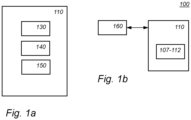
- Fig. 1a schematically shows an example of an embodiment of a device 110 for performing a computation on LWE-encrypted values.
- An LWE-encrypted value may be an encryption of a value based on a Learning With Errors problem.
- the encryption may support a programmable bootstrapping operation.
- the programmable bootstrapping operation may evaluate an LWE decryption in an exponent of a GLWE-encrypted monomial.
- a GLWE-encrypted polynomial may be an encryption of a polynomial based on a Generalized Learning With Errors problems.
- Device 110 may comprise a processor system 130, a storage 140, and a communication interface 150.
- Storage 140 may comprise local storage, e.g., a local hard drive or electronic memory.
- Storage 140 may comprise non-local storage, e.g., cloud storage. In the latter case, storage 140 may comprise a storage interface to the non-local storage.
- storage 140 may be for storing a set of auxiliary keys for performing the computation.
- the auxiliary keys may not allow to decrypt the LWE-encrypted values.
- the auxiliary keys may comprise a set of bootstrapping keys for performing the programmable bootstrapping operation.
- Storage 140 may store additional information, such as LWE-encrypted values and/or GLWE-encrypted ciphertext used to perform the computation, as also discussed elsewhere.
- the communication interface 150 may be used to send or receive digital data.
- device 110 may be configured to receive a set of LWE-encrypted values on which to perform the computation, e.g., from a data-provider device.
- Device 110 may perform the computation, e.g., including one or more computations of LWE-encrypted product values and/or one or more programmable bootstrappings.
- Device 110 may transmit the result of the computation, e.g. LWE-encrypted output values, to another device, e.g., the data-provider device or another device.
- Processor system 130 may be configured to compute an LWE-encrypted product value based on one or more LWE-encrypted input values.
- the computation of the product value may involve applying a cryptographic key switching operation to the set of LWE-encrypted input values to determine one or more GLWE-encrypted input polynomials.
- a coefficient of an input polynomial may be a linear combination of the set of input values.
- the computation may further comprise applying an encrypted polynomial multiplication based on the one or more GLWE-encrypted input polynomials to obtain a GLWE-encrypted output polynomial.
- the computation may further comprise applying a cryptographic sample extraction operation based on the GLWE-encrypted output polynomial.
- the LWE-encrypted product value may be obtained as an encryption of a polynomial coefficient.
- the processor system may be configured to perform a sequence of homomorphic encryption operations, which may include arithmetic operations on encrypted values such as addition and multiplication, but may also include arithmetic operations on encrypted polynomials. Homomorphic operations may also include operations like a key switching, a bootstrap, and the like.
- Fig. 1b schematically shows an example of an embodiment of an encrypted computation system 100.
- System 100 is configured for performing a computation using homomorphic encryption, e.g., fully homomorphic encryption.
- the computation may involve a computation by a MultLWE unit 107-112 of an LWE-encrypted product value.
- the system 100 in this example comprises a data-provider device 160 and an encrypted computing device 110.
- Device 110 may be configured to receive encrypted data items from a data-provider 160. At least some data items may be received in encrypted form. Some data items may be received in plain format.
- the computation is run on the received data items and possibly also on stored data items. Interestingly, the computation may be performed on the encrypted data, without decrypting the data, e.g., without converting encrypted data items to data in a plain format.
- the device 110 in this example may be based on device 110 of Fig. 1a , e.g., may comprise processor system 130, storage 140, and/or communication interface 150 of Fig. 1a .
- device 110 comprises a MultLWE unit 107-112, e.g., implemented by a processor system of the device.
- MultLWE unit 121 may compute LWE-encrypted product value based on LWE-encrypted input values.
- the LWE-encrypted input values may be or may be based on LWE-encrypted values provided by the data-provider device 160.
- Alternatives to perform an encrypted computation without a MultLWE unit are also possible and discussed throughout this specification, e.g., device 110 may comprise a GenPBS unit that may or may not be based on MultLWE.
- the encrypted computation system 100 may comprise multiple encrypted computing devices, e.g., two, three or more than three.
- the encrypted computation may be distributed among the multiple encrypted computing devices.
- the encrypted computing devices may exchange intermediate computation results, typically encrypted, among each other.
- Each encrypted multiplication device may be implemented like encrypted computing device 110, and may perform a computation of an LWE-encrypted product value as described herein.
- Homomorphic encryption schemes can be applied in many settings.
- encrypted computing device 110 may be operated by a cloud provider.
- the cloud provider may offer computation and storage services to its clients.
- data provider device 160 of Fig. 1b e.g., a client of the cloud provider, can send their data in encrypted form.
- the cloud provider can still perform the required computations, and/or the required storage, but is not able to know the corresponding to plain data.
- data provider device 160 may use an encryption key of a type corresponding to the particular homomorphic encryption system used, to encrypt the data items.
- a corresponding decryption key may be used to decrypt the encrypted data items. Encryption and decryption keys may be the same-and typically are so.
- the encrypted computation system 100 may be used to offer the model, say, for use with medical data. This can be done with plain model parameters or encrypted model parameters-in both cases with encrypted data, e.g., encrypted input, intermediate and output data. Using plain model parameters is usually much more efficient. In both cases, an effect of the system is that a computation is performed, say an image classification, e.g., a medical image classification, without the computer knowing the plain data items. For example, a mammogram may be evaluated for cancer, without the image ever being in the plain at an encrypted computing device 110 and without any encrypted computing device 110, or a coalition of such devices, knowing what the outcome of the cancer evaluation is. From a privacy point of view it may be acceptable to operate a plain model on encrypted privacy sensitive data, while it might not be acceptable to operate on plain privacy sensitive data.
- system 100 may be used for protected control of a device.
- a device even a large device such as a power plant, may send sensor values to an encrypted computing device 110, and receive encrypted control signals in return. The control signals being computed from the sensor signals.
- An attacker of the system may be able to determine the contents of data going to and from one or more encrypted computing devices 110, or even gain access to intermediate data of these devices, but he will not be helped by that as the data is encrypted. Even a full break of all encrypted computing devices 110 of a system 100 will not reveal the data, as the decryption key is not known to these devices.
- Computing the control signal may involve such mathematical operations as linear algebra, averages, matrix multiplication, polynomial evaluations, and so on, all of which are possible to execute with homomorphic encryption operations.
- the encrypted data items may represent all kinds of data.
- encrypted data items may represent numbers that need to be averaged, or which are used for linear regression, etc.
- the encrypted data items may represent an image.
- each pixel of the image may correspond to one or more encrypted data items.
- a grey-scale pixel may be represented by a grey level, which in turn may be represented by a single encrypted data item.
- 256 grey levels may be encoded in a single encrypted data item.
- a colour pixel may be represented as multiple colour levels, e.g., RGB levels, which in turn may be represented by a tuple of encrypted data items.
- three 256-level colours may be encoded in three encrypted data items.
- how many encrypted data items are used to represent some type of data depends on the capacity of the homomorphic encryption scheme. For example, more restrictive homomorphic encryption schemes may only be capable of encoding one bit per encrypted data item. In that case, one colour pixel, may require 24 encrypted data items.
- noise increase may depend on the type of operation, e.g., addition versus multiplication, and on the other parameters if any.
- a homomorphic encryption operation may be a scalar multiplication: a multiplication with a known, e.g., plain, value.
- multiplication with a larger value may increase the noise more than multiplication with a smaller number.
- Exactly how much noise increases given the operations performed can be calculated mathematically, or could be estimated empirically. While some operations may add significant amounts of noise, others may not add noise, e.g., an addition with a plain constant.
- a set of homomorphic encryption operations may be defined for the computation. For example, from the homomorphic encryption operations a network or circuit of operations may be built that together implement the computation, e.g., by an external compiler device or by the computation device itself.
- the operations may include Boolean operations.
- the operations may include at least one computation of an LWE-encrypted product value.
- the way the homomorphic encryption operations are combined e.g., which operation is applied to which operand in the pool, determines the computation that is being performed.
- the computation may be represented as a list of homomorphic encryption operations that are to be performed together with an indication on which encrypted data item they are to be performed.
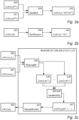
- Fig. 2a (showing GenMult unit 205) schematically shows an example of an embodiment of a method of applying an encrypted GLWE multiplication, using a GenMult unit 205.
- an encrypted polynomial multiplication may be performed by computing a product, e.g., a tensor product, followed by a relinearization and/or key switching. Both for the product and for the relinearization/key switching, several techniques are known.
- Fig. 2b (showing GenSquare unit 206) schematically shows an example of an embodiment of a method of applying an encrypted GLWE multiplication, using GenSquare unit 206. This example is based on the example of Fig. 2a , and the various alternatives discussed with respect to that figure apply here as well.
- an encrypted polynomial multiplication may be performed by computing a product, e.g., a tensor product, followed by a relinearization and/or a key switching.
- the product being computed is a square of the input GLWE-encrypted polynomial 243.
- GenSquare unit 206 may output a GLWE encryption 244 of the square of the polynomial.
- GenMult discussed with respect to Fig. 2a may be adapted to obtain an implementation of GenSquare as follows:
- a i ′ A i 1 ⁇ B 2 + B 1 ⁇ A i 2 Q ⁇ q depending on S i k terms
- the noise formula can be adapted.
- the message polynomial M contains 0 ⁇ ⁇ ⁇ N filled coefficients, and their corresponding error terms following a Gaussian distribution N 0 ⁇ fill 2 , and there are N - ⁇ empty coefficients with containing error from the distribution N 0 ⁇ emp 2 .
- the variance of the error at the output of the tensor product can be estimated by the following formula:
- Fig. 2c (showing MultLWE units 207-212) schematically shows an example of an embodiment of a method of computing an LWE-encrypted product value using a MultLWE unit 207, 208, 209, 210, 211, or 212.
- This example shows the computation of an LWE-encrypted product value 262 based on one or more LWE-encrypted input values.
- two LWE-encrypted input values 260, 261 are shown, but it is also possible to use just one LWE-encrypted input value, e.g., to compute its square, or to use more, for example, to compute a cube or an inner product, as also discussed below.
- the LWE-encrypted input values 260-261 may be encrypted under the same key.
- the respective MultLWE units 207-212 discussed with respect to this figure may compute the LWE-encrypted product value 262 by applying a cryptographic key switching operation 200 to the set of LWE-encrypted input values 260-261 to determine one or more GLWE-encrypted input polynomials 245-246.
- a coefficient of an input polynomial 245-246 is a linear combination of the set of input values.
- the key switching can be implemented as a packing key switching PackingKS as described herein.
- the number of GLWE-encrypted input polynomials 245-246 can vary, e.g., it can be one (e.g., for using GenSquare to compute an encrypted GLWE multiplication), two (e.g., for using GenMult to compute an encrypted GLWE multiplication), or more (e.g., for repeatedly using GenSquare and/or GenMult).
- an encrypted polynomial multiplication 205-206 may be applied, resulting in a GLWE-encrypted output polynomial 247.
- the encrypted polynomial multiplication may be a multiplication GenMult 205, e.g., as discussed with respect to Fig. 2a or using any other technique for performing a polynomial multiplication of two, possibly different, GLWE-encrypted polynomials.
- the encrypted polynomial multiplication can also be a squaring GenSquare 205, e.g., as discussed with respect to Fig. 2b or using any other technique for performing a polynomial squaring of GLWE-encrypted polynomials.
- a GLWE-encrypted polynomial can be multiplied multiple times by itself to compute a power of the polynomial, e.g., a cube.
- additional operations in the GLWE-encrypted domain to the output polynomial 247 e.g., additional additions and/or scalar multiplications.
- an arithmetic circuit may be applied on the GLWE-encrypted input polynomials 245-246 in the GLWE-encrypted domain that includes the one or more multiplications 205-206. The arithmetic circuit may result in multiple GLWE-encrypted polynomials.
- additional operations may be applied in between the tensor product and the relinearization/key switching of the GenMult and GenSquare operations, e.g., using lazy relinearization.
- a cryptographic sample extraction operation 201 may be applied.
- the sample extraction may be applied to the output polynomial 247 or, more generally, to the result of applying the arithmetic circuit in the GLWE-encrypted domain.
- the sample extraction may result in an LWE-encrypted product value 262 encrypting a coefficient of the polynomial to which it is applied.
- the LWE-encrypted product value 262 may generally represent the result of a polynomial function applied to the LWE-encrypted inputs 260-261, e.g., a degree-2 function such as a square, a product, or an inner product; or a function of degree higher than 2, such as a cube. It is also possible to extract multiple coefficients and/or extract coefficients from multiple GLWE-encrypted polynomials, as desired. Using sample extraction to obtain a LWE encryption of a coefficient from a GLWE encryption is known per se, e.g., from "TFHE: fast fully homomorphic encryption over the torus".
- the size of the keys needed is 2 nNl KS integers for the key switching plus 2 Nl RLK integers for the relinearization key used in GenMult 205, for a total of 2N ( nl KS + l RLK ) integers.
- the keys are of total size n ( l ' KS ( n + 1) + 4l' PBS N ) integers.
- the l factors are relatively small compared to n , and all of about the same size. As a consequence, a reduction in the size of the used key material by a factor of over 2 can be observed. As above, the reduction is similar also for other product computations such as inner products and squares.
- MultLWE units as described herein may be configured such that LWE-encrypted product value 262 is encrypted under the same key as the LWE-encrypted input values 260, 261, but it is also possible for the product value 262 to be encrypted under a different key.
- the input and output keys are the same, with the understanding that the techniques are also applicable in the case that the input and output keys are different.
- lazy relinearization may be applied in combination with the presented techniques. For example, additional operations may be applied to non-relinearized GLWE-encrypted polynomials by applying them to the output of MultLWE unit 207-212 from which the relinearization operation of GenMult 205 or GenSquare 206, and the SampleExtract operation 201, are removed to be performed later in a different unit.
- the remaining parts of MultLWE 207, 208 may be denoted as follows:
- MultLWE units 207 and 208 both allow to multiply two LWE-encrypted values.
- MultLWE unit 207 has the advantage of resulting in a less noisy output.
- MultLWE unit 208 has the advantage of being more computationally efficient. Therefore, depending on the situation, MultLWE unit 207 or 208 may be preferred to perform the multiplication.
- MultLWE unit 209 multiple first LWE-encrypted input values may be packed into respective coefficients of the first GLWE-encrypted input polynomial 245, and multiple second LWE-encrypted input values may be packed into respective coefficients of the second GLWE-encrypted input polynomial 246.
- a GLWE-encrypted output polynomial 247 may obtained in which respective coefficients correspond to products of respective first and second input values. These respective coefficients may then be extracted by SampleExtract unit 201.
- SampleExtract unit 201 a single GLWE-encrypted polynomial multiplication 245 may suffice to compute respective LWE-encrypted products, resulting in an improved efficiency.
- This unit may be implemented as follows:
- the encryptions from the first set of LWE-encrypted input values have the same scaling factor ⁇ 1 , and similarly for the scaling factor ⁇ 2 of the second set of LWE-encrypted input values.
- the example can be adapted to accept different respective scaling factors ⁇ i 1 and ⁇ i 2 .
- This algorithm may start with 2 sets of ⁇ LWE ciphertexts, pack each set into one GLWE ciphertext with a precise order, compute a multiplication (e.g., tensor product followed by a relinearization) and extract each result located in precise coefficients.
- a multiplication e.g., tensor product followed by a relinearization
- MultLWE 209 may use two PackingKS and one GenMult. The alternative costs 2 ⁇ PackingKS and ⁇ GenMult . Those PackingKS will be a bit less costly as the polynomials to be put in the FFT will be mostly sparse, but it is needed to do ⁇ of them. Overall, the inventors found that the present algorithm shows better performance than doing ⁇ MultLWEs independently.
- MultLWE unit 210 multiple LWE-encrypted input values may be packed into respective coefficients of a single GLWE-encrypted input polynomial 245.
- the coefficients may be selected such that using GenSquare 246 to compute a square of the input polynomial 245, results in a GLWE-encrypted output polynomial 247 having squares of the respective input values as respective coefficients. These coefficients may then be extracted.
- This unit may be implemented as follows:
- this implementation can be adapted to support different respective scaling factors for the respective LWE-encrypted input values.
- MultLWE unit 210 can also be adapted to compute respective products between respective first and second sets of LWE-encrypted input values.
- the first and second sets of LWE-encrypted values may be packed into a single GLWE-encrypted input polynomial 245 such that its square has the respective products as coefficients.
- This algorithm may start with 2 sets of ⁇ LWE ciphertexts, pack each set into one GLWE ciphertext with a precise order, compute a multiplication (e.g., tensor product followed by a relinearization) and finally extract the result located in a precise coefficient.
- a multiplication e.g., tensor product followed by a relinearization
- this implementation can be adapted to support different respective scaling factors for the respective LWE-encrypted input values.
- This algorithm may start with 1 set of ⁇ LWE ciphertexts, pack the set into one GLWE ciphertext with a precise order, compute a square (e.g., tensor product followed by a relinearization) and finally extract one result located in a precise coefficient.
- a square e.g., tensor product followed by a relinearization
- a noise analysis is now provided of the operations performed by MultLWE units 207-212.
- Units 207-208 may perform a packing key switching, before the multiplication or the square and a final sample extraction.
- the sample extraction may not impact the noise, while the PackingKS may have an impact on the noise.
- Var E PackingKS ⁇ 2 + n ⁇ q 2 12 ⁇ 2 l ⁇ 1 12 ⁇ Var s i + E 2 s i + n 4 ⁇ Var s i + n ⁇ l ⁇ ⁇ KSK 2 ⁇ ⁇ 2 + 2 12 .
- Units 209-212 may first use a key switch to pack LWE ciphertexts into one GLWE ciphertext. This may increase the noise according to the estimates given by the formulas for Var( E PackingKS ).
- the last step may be a multiplication or a square (e.g., using a tensor product and a relinearization) which may also increase the noise. This noise may be as discussed with respect to Fig. 2a .
- Fig. 3a (showing GenPBS unit 313, GenPBS* unit 313a, and GenMonomialLift unit 313b) schematically shows an example of an embodiment of a method of applying a programmable bootstrapping operation using GenPBS unit 313.
- This method may be applied in combination with the computation of an LWE-encrypted product value using a MultLWE unit, e.g., as discussed with respect to Fig. 2c .
- the programmable bootstrapping may be applied to the LWE-encrypted product value or to an LWE-encrypted value computed from it.
- the techniques discussed with respect to this figure can also be used in settings without a MultLWE unit.
- the programmable bootstrapping GenPBS may be applied to an LWE-encrypted input value 360.
- a programmable bootstrapping may be performed based on an evaluation 303 of an LWE decryption in an exponent of a GLWE-encrypted monomial.
- Such an evaluation is also known as a blind rotation.
- the blind rotation typically uses a set of bootstrapping keys that allow the LWE decryption to be performed only in the exponent, e.g., it is not possible to decrypt the LWE-encrypted value to obtain its plaintext as such, but only to obtain a GLWE-encrypted monomial that corresponds to the plaintext.
- the programmable bootstrapping 313 may determine a rescaling 330 of the LWE-encrypted input value by performing a modulus switching operation 302.
- the modulus switching operation 302 may scale the LWE-encrypted input value 360 to the set of exponents of GLWE-encrypted monomials, e.g., the set of integers modulo 2N. It is known to scale the LWE-encrypted input value 360 linearly to the set [0,2 N ], that is, by computing x ⁇ 2 N ⁇ x q .
- This more versatile modulus switching may be parameterized by one or both of two parameters and ⁇ .
- Parameter may define a size of a most significant portion of the input value that is not considered in the PBS, e.g., a number of most significant bits.
- Parameter ⁇ may define a number of functions that may in some embodiments be evaluated at the same time in a single PBS, e.g., the number of functions may be 2 ⁇ .
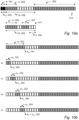
- Fig. 10a The newly introduced parameters ( , ⁇ ) are illustrated in Fig. 10a .
- the figure shows a LWE-encrypted input value 010 on which the modulus switching may be applied.
- the result may be a scaled LWE-encrypted ciphertext 011 mapped to the set [0,2N], 005 of exponents of GLWE-encrypted monomials.
- the LWE-encrypted input value 010 may contain the message, having a first part m , 001 of size x, 004, e.g., bits; and a second part m, 002.
- the LWE-encrypted input value may also contain an error part e, 003.
- the scaled LWE-encrypted ciphertext may contain the part m , 002 of the message, while part m , 001, is removed due to the scaling.
- the scaled LWE-encrypted ciphertext may further contain an error part e ', 007.
- the error part 007 may be followed a chunk of size ⁇ , 006, e.g., of ⁇ bits, that does not contain an error.
- the modulus switching 302 may multiply the respective elements a i by a factor depending on the two parameters, e.g., 2 N ⁇ 2 ⁇ q ⁇ 2 ⁇ if the parameters represent bit sizes; round the result; and rescale by another factor depending on the parameter ⁇ , e.g., 2 ⁇ if ⁇ is a bit size, before mapping the result to the set of exponents of GLWE-encrypted polynomials, e.g., reducing modulo 2N.
- blind rotation 303 may be applied to the scaled LWE-encrypted ciphertext 330.
- the blind rotation may be used to apply a univariate function to the input value, which is why this type of bootstrapping is often referred to as a programmable bootstrapping.
- the function being applied may or may not be the identity function.
- the function to be evaluated may be represented by a test polynomial 350, also referred to as a Look-Up Table (LUT).
- the blind rotation may start with the test polynomial and, by performing the decryption in the exponent of a GLWE-encrypted monomial that is multiplied by the test polynomial, effectively rotate the test polynomial to obtain a GLWE-encrypted polynomial 351 in which the coefficient of the test polynomial corresponding to the encrypted input value is rotated to a certain fixed place, e.g., to the constant coefficient.
- a LUT is said to be r-redundant if each coefficient is repeated r times consecutively. This redundancy allows to remove the noise during the PBS.
- the test polynomial 350 may be represented as a trivial GLWE encryption, e.g., without randomness, e.g., ( 0 , P LUT ), of the look-up table P LUT .
- P LUT may be a redundant look-up table of size N.
- the encrypted look-up table may be rotated, e.g., by using a loop of CMux operations, according to the scaled LWE ciphertext 330 and using a bootstrapping key. It is also possible to use a non-trivial GLWE-encryption 350 of the look-up table P LUT .
- the notation P LUT and its variants is used to represent both trivial and non-trivial GLWE encryptions 350 of the look-up table.
- a cryptographic sample extraction 301 ct out ⁇ SampleExtract i (CT in ) may optionally be applied to this GLWE-encrypted polynomial 351 that extracts this ith coefficient as a LWE-encrypted output value 361.
- ⁇ and m' may be characterized as follows:
- the programmable bootstrapping may include the sample extraction 301.
- additional operations may be performed on the result 351 of the blind rotation 303 in the GLWE-encrypted domain before switching back to the LWE-encrypted domain. This is shown in the figure as GenPBS* operation 313a.
- Fig. 3b (showing GenPBS unit 313' and GenPBS* unit 313a') schematically shows an example of an embodiment of a method of applying a programmable bootstrapping operation using a GenPBS unit 313'. This example is based on that of Fig. 3a , and the various options described with respect to that figure as well.
- the GLWE-encrypted monomial 352 may be multiplied by one or more respective test polynomials for the respective functions, thus obtaining one or more GLWE-encrypted polynomials 353, 354 that have the function outputs as fixed coefficients as described with respect to Fig. 3a .
- One or more of the test polynomials may be encrypted, in which case a multiplication of GLWE-encrypted operations may be performed, e.g., using GenMult unit 205 as discussed with respect to Fig. 2a , or using other techniques as known per se.
- test polynomials may be plain, in which case a multiplication CMult 304 of the GLWE-encrypted monomial 352 by a plain polynomial may be performed using techniques that are known per se.
- the LWE-encrypted function outputs 362-363 may represent the output of one or more programmable bootstrappings GenPBS 313' without key switching, e.g., corresponding to GenPBS unit 313 of Fig. 3a .
- the technique of Fig. 3b may be more efficient than that of Fig. 3a .
- This technique is known per se for programmable bootstrapping that is not parameterizable by parameters ( , ⁇ ) from S. Carpov et al., "New techniques for multi-value input homomorphic evaluation and applications", Proceedings CT-RSA 2019 .
- the polynomial multiplication 304-305 may then be used to multiply the output of the GenPBS* unit by the respective polynomials P f i 1 , received as an encrypted or plain input.
- it is possible to define polynomials P f i 1 with coefficients smaller than those of P fi in which case this alternative can result in an efficiency improvement.
- a disadvantage of the programmable bootstrapping known in the art, e.g., GenPBS 313 in the special case ( , ⁇ ) (0,0), is that it only works if the most significant bit is known, e.g., known to be zero. The function effectively ignores the most significant bit), and its sign may be incorrect. This is why, in the prior art, it needs to be assumed that inputs to the programmable bootstrapping have a bit of padding as most significant bit. Also for the generalized version GenPBS 413, its output 461 may be guaranteed to be correct only up to sign.
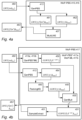
- the correction may be performed by first computing the LWE-encrypted function output 461 and then multiplying it by the LWE-encrypted constant 462 by using a MultLWE unit 462, thus resulting in LWE-encrypted corrected function output 463.
- a MultLWE unit 462 may be used, or more generally, any technique for multiplying LWE-encrypted values that does not require padding.
- a WoP-PBS unit 415 using GenPBS 313 of Fig. 3a may be implemented as follows:
- This example involves evaluating a monomial lift on the input ciphertext ct in .
- the rotation induced by the encrypted monomial may be the same, leading to identical signs.
- This example is based on the same idea as Fig. 4a , namely, to correct an LWE-encrypted function output up to the sign that is computed by a programmable bootstrapping by using LWE-encrypted constant output correct up to that same sign.
- the correction is applied in the GLWE domain prior to the sample extraction of the programmable bootstrapping.
- an LWE-encrypted input value 460 shown in the figure is an LWE-encrypted input value 460.
- a programmable bootstrapping operation 417 may be applied to the LWE-encrypted input value.
- the programmable bootstrapping may involve a GenPBS* operation 413a, e.g., using GenPBS* 313a of Fig. 3a or GenPBS* of Fig. 3b , resulting in a GLWE-encrypted polynomial 450 having the function output correct up to the sign as a coefficient.
- this polynomial may first be corrected to ensure that it is correct and not just correct up to the sign.
- the programmable bootstrapping 413 may be used to apply a constant function to the LWE-encrypted input value 460, resulting in an LWE-encrypted constant output 464 correct up to the same sign as the GLWE-encrypted polynomial 450.
- the programmable bootstrapping 413 may be used to apply a constant function to the LWE-encrypted input value 460, resulting in an LWE-encrypted constant output 464 correct up to the same sign as the GLWE-encrypted polynomial 450.
- the programmable bootstrapping 413 of the constant function may share operations with the programmable bootstrapping 413a of the function to be applied, e.g., programmable bootstrapping 413 may be implemented as GenPBS 313' of Fig. 3b with programmable bootstrapping 413 being implemented as GenPBS* 313', with both using the result 352 of the GenMonomialLift operation 313b.
- the GLWE-encrypted monomial 450 may already have been multiplied by the test polynomial for the function to be applied, e.g., as a result of applying the GenPBS* operation 413a, but this is not needed.
- the GenMult operation 405 may also be applied to the result of applying a GenMonomialLift operation 413b to the LWE-encrypted ciphertext 460, with the outcome of the GenMult operation 405 then being multiplied by the test polynomial.
- a product 451 of the monomial correct up to the sign, the test polynomial, and the constant polynomial correct up to the sign may be obtained.
- a fixed coefficient of that polynomial 451 may correspond to the desired function output. In this case however, the coefficient is correct, not just correct up to the sign.
- the LWE-encrypted corrected function output 463' may then be obtained from this polynomial 451 by performing a SampleExtract operation 401 to extract the fixed coefficient.
- WoP-ML operation 417b may be implemented as follows:
- the GenPBS 413 for ct Sign may overlap with the GenPBS* 413a/GenMonomialLift 413b, e.g., the computation of ct Sign may be performed as ct Sign ⁇ CT ML ⁇ P 1 . This may improve efficiency at the expense of resulting in higher noise.
- the encryption of the bit ⁇ may be obtained by computing a programmable bootstrapping using a constant function.
- GenPBS 513 may be applied to the LWE-encrypted input value 560 to apply the first function, the second function and a constant function to the LWE-encrypted input value 560.
- GenPBS 313 of Fig. 3a , GenPBS 313' of Fig. 3b , or PBSmanyLUT 619' of Fig. 6 may be used.
- the scaling may be performed in such a way that one more bit of the LWE-encrypted input message 560 is ignored.
- WoP-PBS 415-417 scale the input message to the domain [0, N ]
- WoP-PBS 518 may scale the input message to the domain [0, 2 N ].
- the present WoP-PBS may be regarded as providing a higher precision. More generally, given a number of ⁇ ⁇ 0 most significant bits of the input message to be ignored, GenPBS may be called with this same value ⁇ .
- the computation of the LWE-encrypted constant output 563 may be performed using the same scaling to provide a result correct up to the same sign.
- the MultLWE operation 507-509 may be used to compute an LWE-encrypted product 565 of the LWE-encrypted second function output 562 and the LWE-encrypted constant output 563, wherein the LWE-encrypted constant output 563 is translated to form a selection bit for the second function output, thereby obtaining an LWE-encrypted conditionally selected second function output 565.
- the LWE-encrypted conditionally selected outputs 564, 565 may be added in an AddLWE operation 529 to obtain the LWE-encrypted overall function output 566.
- the MultLWE operation can be MultLWE operation 207, 208, or 209 of Fig. 2c , for example, but it is also possible to use any other technique for LWE-encrypted multiplication that does not need padding.
- the LWE-encrypted input message 560 does not have its most significant bit set.
- the LWE-encrypted first function output 561 may correspond to the output of the overall function, with a sign that is also correct.
- WoP-PBS 518 may be implemented as follows:
- MultLWE any one of MultLWE units 307, 308, 309 can be used.
- Using MultLWE unit 309 generally provides better performance than MultLWE units 307, 308.
- a separate MultLWE unit 507-509 and a separate AddLWE unit 529 it is also possible to use a single MultLWE unit to directly compute the sum of the products, e.g., MultLWE unit 211: ct out ⁇ PackedSumProducts ct ⁇ i 0 1 ct f i 0 1 RLK KSK This may provide even better performance.
- CT ML ⁇ GenMonomialLift (ct in , BSK, ⁇ out , , ⁇ ) ct f 0 ⁇ SampleExtract 0 (CT ML ⁇ P f 0 ) ct f 1 ⁇ SampleExtract 0 (CT ML ⁇ P f 1 ) ct Sign ⁇ SampleExtract 0 (CT ML ⁇ P 1 )
- Fig. 6 (showing WoP-PBSmanyLUT unit 619) schematically shows an example of an embodiment of a method of applying multiple functions to an LWE-encrypted input value using WoP-PBSmanyLUT unit 619.
- the inventors realized that, by performing the programmable bootstrapping using the generalized modulus switching as discussed with respect to Fig. 3a-3b , it becomes possible to apply multiple respective functions to the LWE-encrypted input value 660 efficiently.
- a test polynomial 650 may be used that represents function outputs of the multiple respective functions, say, 2 ⁇ functions.
- the test polynomial f ( x ) may be defined by coefficient-wise interleaving of the test polynomials f 1 ( x ), f 2 ( x ), ... for the respective functions.
- the first 2 ⁇ coefficients may represent respective constant coefficients of the f i
- the next 2 ⁇ coefficients may represent respective degree-one coefficients of the f i , etc.
- the modulus switching of the programmable bootstrapping 613a may be performed using the discussed test polynomial in such a way that the ⁇ lowest bits of the scaled LWE-encrypted ciphertext are set to zero.
- the blind rotation may then result in a GLWE-encrypted polynomial 651 of which the constant coefficient (or another fixed coefficient) corresponds to the output of the first function, and the following coefficients correspond to the outputs of the other functions. Setting the ⁇ lowest bits to zero may ensure that the 2 ⁇ coefficients starting at the fixed coefficient are the function outputs of the respective functions applied to the same input.
- an encryption of f 1 ( m ) ⁇ ⁇ out may be obtained.
- the next coefficient of the GLWE ciphertext may represent f 2 ( m ) ⁇ ⁇ out .
- 2 ⁇ output ciphertexts may be obtained, one for each represented function.
- the complexity is approximately the same as for a PBS evaluating only one function, and also the size of the key material is the same as for a PBS evaluating one function.
- the LWE ciphertext may be scaled by any factor ⁇ instead of 2 ⁇ to allow the evaluation of at most ⁇ functions using a single blind rotation.
- PBSmanyLUT 619' are typically correct only up to a sign, e.g., unless it can be assumed that their most significant bit is zero. Despite this limitation, PBSmanyLUT 619' is still an advantageous application of GenPBS* 613a that may be used independently.
- PBSmanyLUT unit 619' may be implemented as follows:
- a programmable bootstrapping operation 613 may be used to apply a constant function to the LWE-encrypted input value 660, resulting in an LWE-encrypted constant output 662 correct up to the sign.
- This LWE-encrypted constant output 662 may then be used to correct the programmable bootstrapping of the test polynomial 650 representing the multiple functions.
- the LWE-encrypted constant output e.g., GenPBS unit 313 or 313' can be used.
- the LWE-encrypted constant output can also be one of the LWE-encrypted outputs 661 of PBSmanyLUT 619'.
- the correction may be performed by multiplying the respective LWE-encrypted function outputs 661 by the LWE-encrypted constant output 662, e.g., using a MultLWE unit as discussed with respect to Fig. 2c , or any other technique of multiplying LWE-encrypted values.
- the multiplication of the monomial 651, the constant polynomial 641, and the test polynomial 650 can in principle be done in any order.
- SampleExtract 601' and PackingKS 600' are not performed, except that SampleExtract 601' may possibly be used to compute the LWE-encrypted constant output 662.
- a sample extraction operation 601 may then be used to extract the respective function outputs 663, correct not only up to the sign, similarly to SampleExtract 601'.
- SampleExtract 601' is performed, and the LWE-encrypted function outputs 661 correct up to the sign may be converted to a GLWE-encrypted polynomial 640 having the respective function outputs as coefficients, after which GenMult 605 and SampleExtract 601 may be performed as described above.
- This alternative can be used in case it is desired to perform the correction with GenMult 605 in the GLWE domain using different GLWE parameters than those use for GenPBS* 613.
- the provided techniques for efficiently evaluating multiple functions on the same LWE-encrypted input value 660 may be used to more efficiently implement a so-called circuit bootstrapping operation.
- such an operation coverts an LWE-encrypted input value 660 representing a bit to a ciphertext for use in a levelled evaluation, e.g., a GGSW ciphertext.
- circuit bootstrapping may apply l PBS operations to the same input ciphertext, which may be replaced by a single invocation of PBSmanyLUT 619' or WoP-PBSmanyLUT 619.
- the modulus switching may scale the LWE-encrypted input value such that the LWE-encrypted function output 761 encrypts a least significant part of the input value. For example, to extract the least significant 4 bits of a 16-bit value, the most significant 12 bits may be ignored, etcetera.
- a PBS is needed only of the size of the part to be extracted, not of the overall message size, which can greatly improve efficiency.
- the input value 760 itself need not have a bit of padding. This is not possible in a PBS that requires a bit of padding since the bit preceding the part to be extracted is not known.
- Decomp unit 720 may be implemented as follows:
- a key switching may be performed in the relinearization that is computed in the GLWE polynomial that is part of the WoP-PBS. This allows to improve efficiency if the chosen LWE dimension is smaller than the original LWE dimension. Instead of computing an identity function using the WoP-PBS 715-718, it is also optionally possible to use another function if desired.
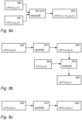
- Fig. 7b (showing LP-WoP-BS unit 721) schematically shows an example of an embodiment of a method of bootstrapping an LWE-encrypted input value using LP-WoP-BS unit 721.
- LP-WoP-BS unit 721 may be implemented as follows:
- Fig. 7c (showing LP-WoP-PBS unit 722) schematically shows an example of an embodiment of a method of applying an overall function to an LWE-encrypted input value using LP-WoP-PBS unit 722.
- the Decomp unit 720 of Fig. 7a may be used to obtain respective extracted LWE-encrypted most significant parts 761-0 to 761- ⁇ of the input value.
- a DecompF unit 727 may be used to apply an overall function to the LWE-encrypted input value 770 by applying respective programmable bootstrapping operations to the respective extracted LWE-encrypted most significant parts 761-i.
- LP-WoP-PBS unit 722 may be implemented as:
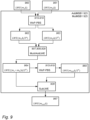
- Fig. 8a schematically shows an example of an embodiment of a method of computing an AND gate on one or more LWE-encrypted binary input values.
- noise in an LWE-encrypted bit 862 is reduced by performing a programmable bootstrapping using a GenPBS unit 813, e.g., GenPBS 313 or 313', wherein the GLWE-encrypted monomial for the binary value 862 is multiplied by a test polynomial such that the programmable bootstrapping results in an LWE-encrypted bootstrapping output 863 equal to plus or minus a quarter of the LWE modulus.
- GenPBS unit 813 e.g., GenPBS 313 or 313'
- the GLWE-encrypted monomial for the binary value 862 is multiplied by a test polynomial such that the programmable bootstrapping results in an LWE-encrypted bootstrapping output 863 equal to plus or minus a quarter of the LWE modulus.
- an encryption 865 of the same bit as encryption 862 may be obtained with an amount of noise that is independent of the amount of noise in encryption 862, so noise may be reduced.
- a GenPBS unit 813 is used, e.g., GenPBS 313 or 313', wherein the modulus switching scales the LWE-encrypted binary value 862 such that the programmable bootstrapping results in an LWE-encrypted function output 865' that is equal to zero or half the LWE modulus and that thus directly represents a bootstrapping of the input ciphertext 862.
- Fig. 9 (showing AddMSB1 unit 923 and MulMSB2 unit 925) schematically shows an example of an embodiment of a method of adding or multiplying LWE-encrypted input values and keeping a most significant part using AddMSB1 unit 923 or MulMSB1 unit 925.
- Such units may be used to efficiently evaluate an arithmetic circuit on LWE-encrypted integers modulo 2 p , p > 1.
- Such an arithmetic circuit may include any combination of the following operators acting on encrypted values m 1 , m 2 e ⁇ 0, 2 p - 1 ⁇ :
- the arithmetic circuit may include one or more opposite operations.
- An opposite may be computed of an LWE-encrypted ciphertext by performing a homomorphic negation.
- the arithmetic circuit may include one or more "MuILSB" operations.
- a MulMSB operation may be performed on LWE-encrypted ciphertexts by performing an LWE-encrypted multiplication, e.g., using any MultLWE 207-212 of Fig. 2c or by using another technique for LWE-encrypted multiplication.
- any WoPPBS with the identity function can be used, e.g., WoPPBS 415, 416, 518 or LP-WoP-BS 721 in particular due to its efficiency.
- the arithmetic circuit may include one or more AddMSB operations and/or one or more MulMSB operations.
- Fig. 9 shows an example of performing an AddMSB operation or a MulMSB operation on a first LWE-encrypted input value 960 and a second LWE-encrypted input value 961, using an AddMSB1 unit 923 or a MulMSB1 unit 925, respectively.
- a WoP-PBS unit 915-919 may be used, e.g., WoP-PBS 415, 416, 417, 518, or WoP-PBSmanyLUT 619 to apply an identity function to the LWE-encrypted input values 960, 961, to obtain LWE-encrypted padded input values 962, 963 to which p bits of padding are added.
- This step is optional and is not needed for example if the bits of padding are already present due to an earlier operation.
- AddMSB1 unit 923 Given the LWE-encrypted padded input values 962, 963, an addition operation AddLWE, 929 may be applied to obtain a LWE-encrypted sum 964 of the padded input values 962, 963.
- AddLWE, 929 For MulMSB1 unit 925, a multiplication operation MultLWE 907, 908 may be applied to obtain an LWE-encrypted product 964 of the padded input values 962, 963.
- MultLWE unit 207 or 208, or any other technique for multiplying LWE-encrypted input values may be used.
- the desired output 967 of unit 923, 925 may correspond to the p most significant bits of this result.
- this output may be obtained by using the programmable bootstrapping 915-919 to apply an identity function to the LWE-encrypted sum or product, wherein the modulus switching of the programmable bootstrapping scales the LWE-encrypted sum or product 964 such that the programmable bootstrapping results in an LWE-encrypted least significant part 965 of the sum or product.
- AddMSB1 unit 923 may be implemented as follows:
- MulMSB1 unit 925 may be implemented as follows:
- AddMSB can be implemented as follows:
- MulMSB may be implemented as follows:
- Fig. 11 schematically shows an example of an embodiment of a method 1200 of performing a computation on LWE-encrypted values.
- An LWE-encrypted value may be an encryption of a value based on a Learning With Errors problem.
- the encryption may support a programmable bootstrapping operation.
- the programmable bootstrapping operation may evaluate an LWE decryption in an exponent of a GLWE-encrypted monomial.
- a GLWE-encrypted polynomial may be an encryption of a polynomial based on a Generalized Learning With Errors problem.
- the method may comprise obtaining 1210 a set of auxiliary keys for performing the computation.
- the auxiliary keys may not allow to decrypt the LWE-encrypted values.
- the auxiliary keys may comprise a set of bootstrapping keys for performing the programmable bootstrapping operation.
- the method may comprise computing 1220 an LWE-encrypted product value based on one or more LWE-encrypted input values.
- the computing 1220 may comprise applying 1221 a cryptographic key switching operation to the set of LWE-encrypted input values to determine one or more GLWE-encrypted input polynomials.
- a coefficient of an input polynomial may be a linear combination of the set of input values.
- the computing 1220 may comprise applying 1222 an encrypted polynomial multiplication based on the one or more GLWE-encrypted input polynomials to obtain a GLWE-encrypted output polynomial.
- the computing 1220 may comprise applying 1223 a cryptographic sample extraction operation based on the GLWE-encrypted output polynomial, thereby obtaining the LWE-encrypted product value as an encryption of a polynomial coefficient.
- the order of the steps can be performed in the shown order, but the order of the steps can be varied or some steps may be executed in parallel.
- steps other method steps may be inserted.
- the inserted steps may represent refinements of the method such as described herein, or may be unrelated to the method.
- some steps may be executed, at least partially, in parallel.
- a given step may not have finished completely before a next step is started.
- the presently disclosed subject matter also extends to computer programs, particularly computer programs on or in a carrier, adapted for putting the presently disclosed subject matter into practice.
- the program may be in the form of source code, object code, a code intermediate source, and object code such as partially compiled form, or in any other form suitable for use in the implementation of an embodiment of the method.
- An embodiment relating to a computer program product comprises computer executable instructions corresponding to each of the processing steps of at least one of the methods set forth. These instructions may be subdivided into subroutines and/or be stored in one or more files that may be linked statically or dynamically.
- Another embodiment relating to a computer program product comprises computer executable instructions corresponding to each of the devices, units and/or parts of at least one of the systems and/or products set forth.
- the devices described herein comprise one or more microprocessors which executes appropriate software stored at the system; for example, that software may have been downloaded and/or stored in a corresponding memory, e.g., a volatile memory such as RAM or a non-volatile memory such as Flash.
- the systems may, in whole or in part, be implemented in programmable logic, e.g., as field-programmable gate array (FPGA).
- FPGA field-programmable gate array
- the systems may be implemented, in whole or in part, as a so-called application-specific integrated circuit (ASIC), e.g., an integrated circuit (IC) customized for their particular use.
- ASIC application-specific integrated circuit
- the circuits may be implemented in CMOS, e.g., using a hardware description language such as Verilog, VHDL, etc.
- the systems may comprise circuits for the evaluation of cryptographic primitives.
- Fig. 11b shows a computer readable medium 1000 having a writable part 1010, and a computer readable medium 1001 also having a writable part.
- Computer readable medium 1000 is shown in the form of an optically readable medium.
- Computer readable medium 1001 is shown in the form of an electronic memory, in this case a memory card.
- Computer readable medium 1000 and 1001 may store data 1020 wherein the data may indicate instructions, which when executed by a processor system, cause a processor system to perform an embodiment of a method of performing a computation on LWE-encrypted values, according to an embodiment.
- Fig. 11c shows in a schematic representation of a processor system 1140 according to an embodiment of a device for performing a computation on LWE-encrypted values.
- the processor system comprises one or more integrated circuits 1110.
- the architecture of the one or more integrated circuits 1110 is schematically shown in Fig. 6b.
- Circuit 1110 comprises a processing unit 1120, e.g., a CPU, for running computer program components to execute a method according to an embodiment and/or implement its modules or units.
- Circuit 1110 comprises a memory 1122 for storing programming code, data, etc. Part of memory 1122 may be read-only.
- Circuit 1110 may comprise a communication element 1126, e.g., an antenna, connectors or both, and the like.
- Circuit 1110 may comprise a dedicated integrated circuit 1124 for performing part or all of the processing defined in the method.
- Processor 1120, memory 1122, dedicated IC 1124 and communication element 1126 may be connected to each other via an interconnect 1130, say a bus.
- the processor system 1110 may be arranged for contact and/or contact-less communication, using an antenna and/or connectors, respectively.
- any reference signs placed between parentheses shall not be construed as limiting the claim.
- Use of the verb 'comprise' and its conjugations does not exclude the presence of elements or steps other than those stated in a claim.
- the article 'a' or 'an' preceding an element does not exclude the presence of a plurality of such elements.
- Expressions such as "at least one of” when preceding a list of elements represent a selection of all or of any subset of elements from the list. For example, the expression, "at least one of A, B, and C" should be understood as including only A, only B, only C, both A and B, both A and C, both B and C, or all of A, B, and C.
- the presently disclosed subject matter may be implemented by hardware comprising several distinct elements, and by a suitably programmed computer.
- the device claim enumerating several parts several of these parts may be embodied by one and the same item of hardware.
- the mere fact that certain measures are recited in mutually different dependent claims does not indicate that a combination of these measures cannot be used to advantage.
Landscapes
- Engineering & Computer Science (AREA)
- Computer Security & Cryptography (AREA)
- Computer Networks & Wireless Communication (AREA)
- Signal Processing (AREA)
- Theoretical Computer Science (AREA)
- General Physics & Mathematics (AREA)
- Physics & Mathematics (AREA)
- Mathematical Physics (AREA)
- Algebra (AREA)
- Mathematical Analysis (AREA)
- Mathematical Optimization (AREA)
- Pure & Applied Mathematics (AREA)
- Computing Systems (AREA)
- Software Systems (AREA)
- General Engineering & Computer Science (AREA)
- Storage Device Security (AREA)
- Complex Calculations (AREA)
Applications Claiming Priority (4)
| Application Number | Priority Date | Filing Date | Title |
|---|---|---|---|
| EP21290033 | 2021-05-26 | ||
| EP21197779.8A EP4096148A1 (fr) | 2021-05-26 | 2021-09-20 | Calcul sur les valeurs chiffrées lwe |
| PCT/EP2022/063874 WO2022248396A1 (fr) | 2021-05-26 | 2022-05-23 | Calcul sur des valeurs chiffrées par apprentissage avec erreurs (lwe) |
| EP22732416.7A EP4348925A1 (fr) | 2021-05-26 | 2022-05-23 | Calcul sur des valeurs chiffrées par apprentissage avec erreurs (lwe) |
Related Parent Applications (1)
| Application Number | Title | Priority Date | Filing Date |
|---|---|---|---|
| EP22732416.7A Division EP4348925A1 (fr) | 2021-05-26 | 2022-05-23 | Calcul sur des valeurs chiffrées par apprentissage avec erreurs (lwe) |
Publications (2)
| Publication Number | Publication Date |
|---|---|
| EP4535716A2 true EP4535716A2 (fr) | 2025-04-09 |
| EP4535716A3 EP4535716A3 (fr) | 2025-06-25 |
Family
ID=82156359
Family Applications (2)
| Application Number | Title | Priority Date | Filing Date |
|---|---|---|---|
| EP25153289.1A Pending EP4535716A3 (fr) | 2021-05-26 | 2022-05-23 | Calcul sur des valeurs chiffrées lwe |
| EP22732416.7A Pending EP4348925A1 (fr) | 2021-05-26 | 2022-05-23 | Calcul sur des valeurs chiffrées par apprentissage avec erreurs (lwe) |
Family Applications After (1)
| Application Number | Title | Priority Date | Filing Date |
|---|---|---|---|
| EP22732416.7A Pending EP4348925A1 (fr) | 2021-05-26 | 2022-05-23 | Calcul sur des valeurs chiffrées par apprentissage avec erreurs (lwe) |
Country Status (6)
| Country | Link |
|---|---|
| US (1) | US20240267222A1 (fr) |
| EP (2) | EP4535716A3 (fr) |
| JP (1) | JP2024521787A (fr) |
| KR (1) | KR20240011769A (fr) |
| IL (1) | IL308567A (fr) |
| WO (1) | WO2022248396A1 (fr) |
Families Citing this family (10)
| Publication number | Priority date | Publication date | Assignee | Title |
|---|---|---|---|---|
| JP7228286B1 (ja) * | 2021-10-20 | 2023-02-24 | 株式会社アクセル | 暗号処理装置、暗号処理方法、及び暗号処理プログラム |
| JP7228287B1 (ja) * | 2021-11-15 | 2023-02-24 | 株式会社アクセル | 暗号処理装置、暗号処理方法、及び暗号処理プログラム |
| JP7187076B1 (ja) * | 2021-11-26 | 2022-12-12 | 株式会社アクセル | 暗号処理装置、暗号処理方法、及び暗号処理プログラム |
| US12362905B2 (en) * | 2021-12-09 | 2025-07-15 | Electronics And Telecommunications Research Institute | Computing apparatus and method of integrating different homomorphic operations in homomorphic encryption |
| EP4221069A1 (fr) * | 2022-01-28 | 2023-08-02 | Samsung Electronics Co., Ltd. | Appareil et procédé de chiffrement homomorphe à l'aide d'un automorphisme |
| US20240340158A1 (en) * | 2023-04-10 | 2024-10-10 | Samsung Electronics Co., Ltd. | Apparatus and method with homomorphic encryption operation |
| EP4395226A1 (fr) * | 2023-04-18 | 2024-07-03 | Vaultree, Ltd. | Comparaison de données chiffrées à l'aide d'une évaluation bootstraping impliquant des schéma entièrement homomorphique basé sur les tores |
| KR20240173606A (ko) * | 2023-06-05 | 2024-12-12 | 주식회사 크립토랩 | 전자 장치 및 그의 키교환 방법 |
| WO2025122159A1 (fr) * | 2023-12-08 | 2025-06-12 | Pqsecure Technologies, Llc | Système et procédé de traitement informatique configurés pour effectuer un masquage d'ordre inférieur dans une conception masquée d'ordre supérieur |
| US20260100822A1 (en) * | 2024-10-08 | 2026-04-09 | Circle Internet Group, Inc. | Improved security and efficiency for multi-party computation wallets |
Family Cites Families (1)
| Publication number | Priority date | Publication date | Assignee | Title |
|---|---|---|---|---|
| US11177935B2 (en) * | 2018-08-31 | 2021-11-16 | Microsoft Technology Licensing, Llc | Homomorphic evaluation of tensor programs |
-
2022
- 2022-05-23 WO PCT/EP2022/063874 patent/WO2022248396A1/fr not_active Ceased
- 2022-05-23 US US18/563,752 patent/US20240267222A1/en active Pending
- 2022-05-23 JP JP2023572791A patent/JP2024521787A/ja active Pending
- 2022-05-23 EP EP25153289.1A patent/EP4535716A3/fr active Pending
- 2022-05-23 KR KR1020237044127A patent/KR20240011769A/ko active Pending
- 2022-05-23 EP EP22732416.7A patent/EP4348925A1/fr active Pending
- 2022-05-23 IL IL308567A patent/IL308567A/en unknown
Non-Patent Citations (8)
| Title |
|---|
| A. GUIMARAES ET AL., REVISITING THE FUNCTIONAL BOOTSTRAP IN TFHE |
| A. GUIMARAES ET AL.: "Revisiting the functional bootstrap in TFHE", IACR TRANS. CRYPTOGR. HARDW. EMBED. SYST., no. 2, 2021, pages 229 - 253 |
| C. BOURA ET AL.: "CHIMERA: Combining Ring-LWE-based Fully Homomorphic Encryption schemes", J. MATH. CRYPTOL., vol. 14, no. 1, pages 316 - 338 |
| I. CHILLOTTI ET AL., PROGRAMMABLE BOOTSTRAPPING ENABLES EFFICIENT HOMOMORPHIC INFERENCE OF DEEP NEURAL NETWORKS, Retrieved from the Internet <URL:https://eprint.iacr.org/2021/091/20210127:133406> |
| I. CHILLOTTI ET AL.: "TFHE: fast fully homomorphic encryption over the torus", J. CRYPTOL., vol. 33, no. 1, 2020, pages 34 - 91, XP036987049, DOI: 10.1007/s00145-019-09319-x |
| J. FAN ET AL., SOMEWHAT PRACTICAL FULLY HOMOMORPHIC ENCRYPTION, Retrieved from the Internet <URL:https://eprint.iacr.org/2012/144> |
| M. ALBRECHT ET AL.: "On the concrete hardness of Learning with Errors", JOURNAL OF MATHEMATICAL CRYPTOLOGY |
| S. CARPOV ET AL.: "New techniques for multi-value input homomorphic evaluation and applications", PROCEEDINGS CT-RSA, 2019 |
Also Published As
| Publication number | Publication date |
|---|---|
| IL308567A (en) | 2024-01-01 |
| WO2022248396A1 (fr) | 2022-12-01 |
| KR20240011769A (ko) | 2024-01-26 |
| US20240267222A1 (en) | 2024-08-08 |
| EP4535716A3 (fr) | 2025-06-25 |
| EP4348925A1 (fr) | 2024-04-10 |
| JP2024521787A (ja) | 2024-06-04 |
Similar Documents
| Publication | Publication Date | Title |
|---|---|---|
| EP4535716A2 (fr) | Calcul sur des valeurs chiffrées lwe | |
| US12143467B2 (en) | Encrypted scalar multiplication | |
| US12574206B2 (en) | Blind rotation for use in fully homomorphic encryption | |
| EP4049405B1 (fr) | Cryptographie totalement homomorphe avec représentation améliorée des éléments de données | |
| EP4096148A1 (fr) | Calcul sur les valeurs chiffrées lwe | |
| EP4352913B1 (fr) | Calcul crypté comprenant une rotation aveugle | |
| EP4473696B1 (fr) | Optimisation des paramètres de calcul crypté | |
| EP4087177A1 (fr) | Rotation aveugle à utiliser dans le cadre de cryptage entièrement homomorphique | |
| CN117643012A (zh) | Lwe加密值的计算 | |
| EP4195577A1 (fr) | Calcul crypté comprenant une rotation aveugle | |
| EP4344121B1 (fr) | Calcul crypté avec rotation aveugle | |
| EP4573693B1 (fr) | Jeux de clés avec des éléments communs ou prédéfinis | |
| EP4449666B1 (fr) | Calcul sur des valeurs codées et chiffrées |
Legal Events
| Date | Code | Title | Description |
|---|---|---|---|
| PUAI | Public reference made under article 153(3) epc to a published international application that has entered the european phase |
Free format text: ORIGINAL CODE: 0009012 |
|
| STAA | Information on the status of an ep patent application or granted ep patent |
Free format text: STATUS: THE APPLICATION HAS BEEN PUBLISHED |
|
| AC | Divisional application: reference to earlier application |
Ref document number: 4348925 Country of ref document: EP Kind code of ref document: P |
|
| AK | Designated contracting states |
Kind code of ref document: A2 Designated state(s): AL AT BE BG CH CY CZ DE DK EE ES FI FR GB GR HR HU IE IS IT LI LT LU LV MC MK MT NL NO PL PT RO RS SE SI SK SM TR |
|
| REG | Reference to a national code |
Ref country code: DE Ref legal event code: R079 Free format text: PREVIOUS MAIN CLASS: H04L0009000000 Ipc: H04L0009300000 |
|
| PUAL | Search report despatched |
Free format text: ORIGINAL CODE: 0009013 |
|
| AK | Designated contracting states |
Kind code of ref document: A3 Designated state(s): AL AT BE BG CH CY CZ DE DK EE ES FI FR GB GR HR HU IE IS IT LI LT LU LV MC MK MT NL NO PL PT RO RS SE SI SK SM TR |
|
| RIC1 | Information provided on ipc code assigned before grant |
Ipc: H04L 9/00 20220101ALI20250521BHEP Ipc: H04L 9/30 20060101AFI20250521BHEP |
|
| P01 | Opt-out of the competence of the unified patent court (upc) registered |
Free format text: CASE NUMBER: UPC_APP_7724_4535716/2025 Effective date: 20250924 |
|
| STAA | Information on the status of an ep patent application or granted ep patent |
Free format text: STATUS: REQUEST FOR EXAMINATION WAS MADE |
|
| 17P | Request for examination filed |
Effective date: 20260102 |