EP4535772A2 - Codage de parametres morphologiques progressifs de lentilles - Google Patents
Codage de parametres morphologiques progressifs de lentilles Download PDFInfo
- Publication number
- EP4535772A2 EP4535772A2 EP25157349.9A EP25157349A EP4535772A2 EP 4535772 A2 EP4535772 A2 EP 4535772A2 EP 25157349 A EP25157349 A EP 25157349A EP 4535772 A2 EP4535772 A2 EP 4535772A2
- Authority
- EP
- European Patent Office
- Prior art keywords
- virtual
- optical
- lens
- camera
- parameters
- Prior art date
- Legal status (The legal status is an assumption and is not a legal conclusion. Google has not performed a legal analysis and makes no representation as to the accuracy of the status listed.)
- Pending
Links
Images



Classifications
-
- G—PHYSICS
- G06—COMPUTING OR CALCULATING; COUNTING
- G06T—IMAGE DATA PROCESSING OR GENERATION, IN GENERAL
- G06T7/00—Image analysis
- G06T7/80—Analysis of captured images to determine intrinsic or extrinsic camera parameters, i.e. camera calibration
-
- H—ELECTRICITY
- H04—ELECTRIC COMMUNICATION TECHNIQUE
- H04N—PICTORIAL COMMUNICATION, e.g. TELEVISION
- H04N23/00—Cameras or camera modules comprising electronic image sensors; Control thereof
- H04N23/60—Control of cameras or camera modules
- H04N23/62—Control of parameters via user interfaces
-
- H—ELECTRICITY
- H04—ELECTRIC COMMUNICATION TECHNIQUE
- H04N—PICTORIAL COMMUNICATION, e.g. TELEVISION
- H04N23/00—Cameras or camera modules comprising electronic image sensors; Control thereof
- H04N23/60—Control of cameras or camera modules
- H04N23/67—Focus control based on electronic image sensor signals
-
- H—ELECTRICITY
- H04—ELECTRIC COMMUNICATION TECHNIQUE
- H04N—PICTORIAL COMMUNICATION, e.g. TELEVISION
- H04N23/00—Cameras or camera modules comprising electronic image sensors; Control thereof
- H04N23/60—Control of cameras or camera modules
- H04N23/69—Control of means for changing angle of the field of view, e.g. optical zoom objectives or electronic zooming
Definitions
- the present disclosure relates to processing and capturing video data for a video capture system, and more specifically, to automatically switching between optical lens parameters and virtual lens parameters.
- the present disclosure provides for implementing a technique for automatically shifting between optical lens parameters and virtual lens parameters depending on the physical location of a camera in relation to a defined fixed focal target.
- the spatial awareness of the physical scene includes orientation of the optical camera in relation to the display screen. In one implementation, the spatial awareness of the physical scene is managed by a processor and a storage unit in combination with the display screen. In one implementation, the spatial awareness of the physical scene includes an indoor positional system. In one implementation, the method further includes communicating the virtual lens parameters to a virtual camera system to render a virtual scene on the display screen. In one implementation, the virtual lens parameters are continuously communicated to the virtual camera system, even when the optical lens parameters are used, so that the virtual camera system can adjust settings for real-time operation. In one implementation, the virtual camera system provides a virtual camera and lens with same characteristics as the optical camera. In one implementation, the method further includes communicating position and orientation of the optical camera to the virtual camera system. In one implementation, the virtual camera system includes an algorithm that converts the optical lens parameters and orientation of the optical camera into converted virtual lens parameters. In one implementation, the method further includes calculating and displaying at least one of depth of field and auto-exposure using the converted virtual lens parameters.
- a system of shifting between virtual lens parameters and optical lens parameters includes: an optical camera and lens positioned within a physical scene; a display screen positioned within the physical scene; and a processor to provide a spatial awareness of the physical scene including position and orientation of the display screen to the optical camera, to create a feedback loop between the optical camera and the lens to receive the lens settings from the lens, to determine when focus of the lens is beyond an optical focal limit from the lens settings, and to enable the lens to automatically shift from using the optical lens parameters to using the virtual lens parameters when the focus of the lens moves beyond the optical focal limit.
- the spatial awareness of the physical scene includes orientation of the optical camera in relation to the display screen.
- the processor manages the spatial awareness of the physical scene in combination with the display screen and a storage unit.
- the system further includes an indoor positional system to provide the spatial awareness of the physical scene to the processor.
- the system further includes a virtual camera system to render a virtual scene on the display screen using the virtual lens parameters.
- the virtual camera system provides a virtual camera and lens with same characteristics as the optical camera.
- the virtual camera system includes a conversion function to map parameters from the optical camera to the virtual camera.
- the virtual camera system includes an algorithm that converts the optical lens parameters and orientation of the optical camera into converted virtual lens parameters.
- the processor calculates and displays at least one of depth of field and auto-exposure using the converted virtual lens parameters.
- FIG. 2A is a block diagram of a video capture system 200 in accordance with one implementation of the present disclosure.
- the video capture system 200 includes a camera 210 and lens 220, a display screen 230, and other components for video capture such as a processor 240 and a storage unit 242.
- the camera 210 includes optical lens parameters, virtual lens parameters, and a physical scene awareness aspect.
- the camera 210 manages the physical scene awareness aspect in combination with the display screen 230, the processor 240, and the storage unit 242.
- the system 200 also includes an indoor positional system (IPS) 244 and an automated way to use the appropriate parameters (i.e., optical or virtual) in combination with the processor 240 and the storage unit 242.
- IPS indoor positional system
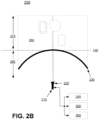
- the camera 210 is configured to sense its own location with respect to the physical space and determine the focus target (i.e., where the display screen 130 is physically located) in the scene for which the focus and zoom cannot go beyond. As the optical zoom or focus is changed on the lens and the focus target is reached, the lens is automatically switched off of the optical operation and is made to work effectively with virtual zoom and focus (while still operating the optical controls). The camera 210 then sends the digital parameters (e.g., the virtual lens parameters) to the system 200 which updates the virtual camera with the corresponding values.
- the digital parameters e.g., the virtual lens parameters
- the lens 120 operates similarly to optical to digital focus and zoom found in consumer point-and-shoot cameras. However, this implementation is configured so that the digital version forwards the optical lens parameters, as opposed to a singular multiplier value.
- the camera 210 stores a representation of the physical scene. In one implementation, the representation is stored as a "scene registration" as part of its firmware. In another implementation, the representation is stored in storage that is housed externally, such as in a small hardware unit attached to the camera 210, or as part of an entirely separate system communicated with using high-speed networking.
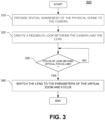
- this feedback loop system determines that the optical lens parameters can no longer be used because the focus of the lens 220 is beyond the optical focal limit 140, the lens 220 automatically switches to the parameters of the virtual zoom and focus 270.
- These virtual parameters are communicated to an external virtual camera system that does the rendering of the virtual scene 260 on the display screen 230. In one implementation, these virtual parameters may always be sent, even when the optical parameters are used, so that the virtual camera system can adjust settings as required in real-time.
- FIG. 3 is a flow diagram illustrating a method 300 for seamless virtual and optical lens parameter shifting for a camera positioned within a physical scene in accordance with one implementation of the present disclosure.
- the seamless virtual and optical lens parameter shifting enables zooms and focuses which operate "beyond the screen” but still remain “inside the volume.”
- a spatial awareness of the physical scene including position and orientation of the display screen 230, is provided to the camera 210 (including the lens 220), at step 310.
- the spatial awareness also includes the orientation of the camera 210 in relation to the display screen 230 and the physical space.
- the camera 210 manages the physical scene awareness aspect in combination with the display screen 230, the processor 240, and the storage unit 242.
- the system 200 also includes an indoor positional system (IPS) 244 and an automated way to use the appropriate parameters (i.e., optical or virtual) in combination with the processor 240 and the storage unit 242.
- IPS indoor positional system
- the virtual camera system provides a virtual camera and lens with the same characteristics as the optical version.
- the virtual camera system can include a conversion function that will map the parameters from the optical system to the virtual system. Additionally, the position and orientation of the optical camera are communicated to the virtual camera system.
- the virtual camera system includes an algorithm that converts the optical lens parameters and the optical camera spatial information into the virtual equivalents. This optical to virtual conversion is used to, but not limited to, calculate and display such effects as depth of field (DoF), auto-exposure, and other camera effects.
- DoF depth of field
- the virtual camera system can zoom and focus into the virtual 3D objects in a way that is not possible or difficult using an optical solution only.
- the computer system 400 stores and executes the lens parameter shifting application 490 of FIG. 4B .
- the computer system 400 may be in communication with a software program 404.
- Software program 404 may include the software code for the lens parameter shifting application 490.
- Software program 404 may be loaded on an external medium such as a CD, DVD, or a storage drive, as will be explained further below.
- the computer system 400 may be connected to a network 480.
- the network 480 can be connected in various different architectures, for example, client-server architecture, a Peer-to-Peer network architecture, or other type of architectures.
- network 480 can be in communication with a server 485 that coordinates engines and data used within the lens parameter shifting application 490.
- the network can be different types of networks.
- the network 480 can be the Internet, a Local Area Network or any variations of Local Area Network, a Wide Area Network, a Metropolitan Area Network, an Intranet or Extranet, or a wireless network.
- multiple camera systems can be used together, such as using a rig mounted with more than one optical camera or a production setting with multiple camera rigs.
- the system adjusts which set of optical parameters to use based on selecting an active camera.
Landscapes
- Engineering & Computer Science (AREA)
- Multimedia (AREA)
- Signal Processing (AREA)
- Human Computer Interaction (AREA)
- Computer Vision & Pattern Recognition (AREA)
- Physics & Mathematics (AREA)
- General Physics & Mathematics (AREA)
- Theoretical Computer Science (AREA)
- Studio Devices (AREA)
- Automatic Focus Adjustment (AREA)
Applications Claiming Priority (4)
| Application Number | Priority Date | Filing Date | Title |
|---|---|---|---|
| US202163148753P | 2021-02-12 | 2021-02-12 | |
| US17/399,846 US11729507B2 (en) | 2021-02-12 | 2021-08-11 | Progressive morphological lens parameter encoding |
| EP21926012.2A EP4268190B1 (fr) | 2021-02-12 | 2021-11-04 | Codage de paramètre de lentille morphologique progressive |
| PCT/US2021/058119 WO2022173475A1 (fr) | 2021-02-12 | 2021-11-04 | Codage de paramètre de lentille morphologique progressive |
Related Parent Applications (2)
| Application Number | Title | Priority Date | Filing Date |
|---|---|---|---|
| EP21926012.2A Division EP4268190B1 (fr) | 2021-02-12 | 2021-11-04 | Codage de paramètre de lentille morphologique progressive |
| EP21926012.2A Division-Into EP4268190B1 (fr) | 2021-02-12 | 2021-11-04 | Codage de paramètre de lentille morphologique progressive |
Publications (2)
| Publication Number | Publication Date |
|---|---|
| EP4535772A2 true EP4535772A2 (fr) | 2025-04-09 |
| EP4535772A3 EP4535772A3 (fr) | 2025-06-04 |
Family
ID=82800690
Family Applications (2)
| Application Number | Title | Priority Date | Filing Date |
|---|---|---|---|
| EP21926012.2A Active EP4268190B1 (fr) | 2021-02-12 | 2021-11-04 | Codage de paramètre de lentille morphologique progressive |
| EP25157349.9A Pending EP4535772A3 (fr) | 2021-02-12 | 2021-11-04 | Codage de parametres morphologiques progressifs de lentilles |
Family Applications Before (1)
| Application Number | Title | Priority Date | Filing Date |
|---|---|---|---|
| EP21926012.2A Active EP4268190B1 (fr) | 2021-02-12 | 2021-11-04 | Codage de paramètre de lentille morphologique progressive |
Country Status (5)
| Country | Link |
|---|---|
| US (1) | US11729507B2 (fr) |
| EP (2) | EP4268190B1 (fr) |
| CN (2) | CN119887948A (fr) |
| CA (1) | CA3186402A1 (fr) |
| WO (1) | WO2022173475A1 (fr) |
Families Citing this family (2)
| Publication number | Priority date | Publication date | Assignee | Title |
|---|---|---|---|---|
| US11393125B1 (en) * | 2019-12-09 | 2022-07-19 | Gopro, Inc. | Systems and methods for dynamic optical medium calibration |
| US20230186550A1 (en) * | 2021-12-09 | 2023-06-15 | Unity Technologies Sf | Optimizing generation of a virtual scene for use in a virtual display environment |
Family Cites Families (15)
| Publication number | Priority date | Publication date | Assignee | Title |
|---|---|---|---|---|
| US5990935A (en) * | 1997-04-04 | 1999-11-23 | Evans & Sutherland Computer Corporation | Method for measuring camera and lens properties for camera tracking |
| US8014985B2 (en) | 1999-03-26 | 2011-09-06 | Sony Corporation | Setting and visualizing a virtual camera and lens system in a computer graphic modeling environment |
| JP4688990B2 (ja) * | 1999-08-02 | 2011-05-25 | 富士フイルム株式会社 | レンズシステム |
| GB2400253B (en) | 2003-03-29 | 2005-11-16 | Hewlett Packard Development Co | Combined optical and digital zoom |
| US7683962B2 (en) | 2007-03-09 | 2010-03-23 | Eastman Kodak Company | Camera using multiple lenses and image sensors in a rangefinder configuration to provide a range map |
| US7809260B2 (en) | 2007-08-02 | 2010-10-05 | Canon Kabushiki Kaisha | Image capturing apparatus and method for controlling same |
| US9304319B2 (en) | 2010-11-18 | 2016-04-05 | Microsoft Technology Licensing, Llc | Automatic focus improvement for augmented reality displays |
| CN104349020B (zh) | 2014-12-02 | 2017-11-03 | 北京中科大洋科技发展股份有限公司 | 一种虚拟摄像机与真实摄像机切换的方法 |
| US10574956B2 (en) * | 2015-08-07 | 2020-02-25 | Christie Digital Systems Usa, Inc. | System and method for automatic alignment and projection mapping |
| KR101690646B1 (ko) * | 2016-08-02 | 2016-12-28 | 아이피랩 주식회사 | 시 스루 디스플레이를 위한 카메라 구동 장치 및 그 방법 |
| CN110581943B (zh) * | 2018-06-11 | 2021-04-02 | 宏碁股份有限公司 | 针对非平面屏幕的色不均瑕疵补偿系统 |
| US12393262B2 (en) * | 2019-08-02 | 2025-08-19 | Arvind Sanjeev | Methods and systems of a handheld spatially aware mixed-reality projection platform |
| CN112311965B (zh) * | 2020-10-22 | 2023-07-07 | 北京虚拟动点科技有限公司 | 虚拟拍摄方法、装置、系统及存储介质 |
| CN112330736B (zh) | 2020-11-02 | 2024-08-20 | 北京虚拟动点科技有限公司 | 一种场景画面的拍摄方法、装置、电子设备及存储介质 |
| US20220257173A1 (en) * | 2021-02-17 | 2022-08-18 | Optum Technology, Inc. | Extended-reality skin-condition-development prediction and visualization |
-
2021
- 2021-08-11 US US17/399,846 patent/US11729507B2/en active Active
- 2021-11-04 EP EP21926012.2A patent/EP4268190B1/fr active Active
- 2021-11-04 CN CN202510052272.4A patent/CN119887948A/zh active Pending
- 2021-11-04 CA CA3186402A patent/CA3186402A1/fr active Pending
- 2021-11-04 CN CN202180058252.8A patent/CN116057573B/zh active Active
- 2021-11-04 EP EP25157349.9A patent/EP4535772A3/fr active Pending
- 2021-11-04 WO PCT/US2021/058119 patent/WO2022173475A1/fr not_active Ceased
Also Published As
| Publication number | Publication date |
|---|---|
| WO2022173475A1 (fr) | 2022-08-18 |
| US20220264016A1 (en) | 2022-08-18 |
| EP4268190B1 (fr) | 2025-10-15 |
| EP4535772A3 (fr) | 2025-06-04 |
| CN116057573B (zh) | 2026-03-17 |
| CA3186402A1 (fr) | 2022-08-18 |
| EP4268190A4 (fr) | 2024-06-19 |
| US11729507B2 (en) | 2023-08-15 |
| CN119887948A (zh) | 2025-04-25 |
| EP4268190A1 (fr) | 2023-11-01 |
| CN116057573A (zh) | 2023-05-02 |
Similar Documents
| Publication | Publication Date | Title |
|---|---|---|
| US12033355B2 (en) | Client/server distributed camera calibration | |
| KR101870067B1 (ko) | 로봇 디바이스 동작의 가상 표현을 디스플레이하는 증강 현실을 위한 방법 및 시스템 | |
| CN102098499B (zh) | 一种云台摄像机控制方法及其装置和系统 | |
| CN102668585B (zh) | 图像数据生成辅助装置和图像数据生成辅助方法 | |
| EP4268190B1 (fr) | Codage de paramètre de lentille morphologique progressive | |
| EP2880635A1 (fr) | Système et procédé permettant de générer un modèle tridimensionnel dynamique | |
| CN103514620B (zh) | 3d立体动画全流程制作云计算平台 | |
| JP2015033103A (ja) | 画像処理装置、画像処理方法、およびプログラム | |
| US11792511B2 (en) | Camera system utilizing auxiliary image sensors | |
| CN104750443A (zh) | 一种显示控制方法及电子设备 | |
| CN116320335A (zh) | 一种投影设备及调整投影画面尺寸的方法 | |
| JP2013025649A (ja) | 画像処理装置及び画像処理方法、プログラム | |
| WO2014159515A1 (fr) | Paquet de synthèse pour une navigation de vue interactive dans une scène | |
| KR20240078637A (ko) | 다중-카메라 시스템들에 대한 카메라 스위칭오버 제어 기술들 | |
| US20230412786A1 (en) | Matching segments of video for virtual display of a space | |
| JP2010166218A (ja) | カメラシステム及びその制御方法 | |
| US9160904B1 (en) | Gantry observation feedback controller | |
| CN105450918A (zh) | 一种图像处理方法和摄像机 | |
| KR101481103B1 (ko) | 이미지 기반에 의한 사용자 참여형 멀티미디어 융합 콘텐츠 제공 시스템 | |
| US20200202571A1 (en) | Calibrating volumetric rig with structured light | |
| JP2012054724A (ja) | 画像処理装置、及びその制御方法 | |
| CN111510635B (zh) | 云台故障的确定方法、装置、存储介质及电子装置 | |
| US8054332B2 (en) | Advanced input controller for multimedia processing | |
| JP2020109687A (ja) | 棚割情報生成システム | |
| US20240331292A1 (en) | Modifying a portion of a semantically segmented 3d mesh |
Legal Events
| Date | Code | Title | Description |
|---|---|---|---|
| PUAI | Public reference made under article 153(3) epc to a published international application that has entered the european phase |
Free format text: ORIGINAL CODE: 0009012 |
|
| STAA | Information on the status of an ep patent application or granted ep patent |
Free format text: STATUS: REQUEST FOR EXAMINATION WAS MADE |
|
| 17P | Request for examination filed |
Effective date: 20250225 |
|
| AC | Divisional application: reference to earlier application |
Ref document number: 4268190 Country of ref document: EP Kind code of ref document: P |
|
| AK | Designated contracting states |
Kind code of ref document: A2 Designated state(s): AL AT BE BG CH CY CZ DE DK EE ES FI FR GB GR HR HU IE IS IT LI LT LU LV MC MK MT NL NO PL PT RO RS SE SI SK SM TR |
|
| REG | Reference to a national code |
Ref country code: DE Ref legal event code: R079 Free format text: PREVIOUS MAIN CLASS: H04N0005262000 Ipc: H04N0023670000 |
|
| PUAL | Search report despatched |
Free format text: ORIGINAL CODE: 0009013 |
|
| AK | Designated contracting states |
Kind code of ref document: A3 Designated state(s): AL AT BE BG CH CY CZ DE DK EE ES FI FR GB GR HR HU IE IS IT LI LT LU LV MC MK MT NL NO PL PT RO RS SE SI SK SM TR |
|
| RIC1 | Information provided on ipc code assigned before grant |
Ipc: H04N 23/69 20230101ALI20250429BHEP Ipc: H04N 23/67 20230101AFI20250429BHEP |
|
| RAP3 | Party data changed (applicant data changed or rights of an application transferred) |
Owner name: SONY GROUP CORPORATION Owner name: SONY PICTURES ENTERTAINMENT, INC. |