EP4535800A2 - Service musical avec vidéo animée - Google Patents
Service musical avec vidéo animée Download PDFInfo
- Publication number
- EP4535800A2 EP4535800A2 EP25160091.2A EP25160091A EP4535800A2 EP 4535800 A2 EP4535800 A2 EP 4535800A2 EP 25160091 A EP25160091 A EP 25160091A EP 4535800 A2 EP4535800 A2 EP 4535800A2
- Authority
- EP
- European Patent Office
- Prior art keywords
- audio content
- content
- motion video
- primary audio
- video content
- Prior art date
- Legal status (The legal status is an assumption and is not a legal conclusion. Google has not performed a legal analysis and makes no representation as to the accuracy of the status listed.)
- Pending
Links
Images



Classifications
-
- H—ELECTRICITY
- H04—ELECTRIC COMMUNICATION TECHNIQUE
- H04N—PICTORIAL COMMUNICATION, e.g. TELEVISION
- H04N21/00—Selective content distribution, e.g. interactive television or video on demand [VOD]
- H04N21/40—Client devices specifically adapted for the reception of or interaction with content, e.g. set-top-box [STB]; Operations thereof
- H04N21/43—Processing of content or additional data, e.g. demultiplexing additional data from a digital video stream; Elementary client operations, e.g. monitoring of home network or synchronising decoder's clock; Client middleware
- H04N21/4302—Content synchronisation processes, e.g. decoder synchronisation
- H04N21/4307—Synchronising the rendering of multiple content streams or additional data on devices, e.g. synchronisation of audio on a mobile phone with the video output on the TV screen
- H04N21/43072—Synchronising the rendering of multiple content streams or additional data on devices, e.g. synchronisation of audio on a mobile phone with the video output on the TV screen of multiple content streams on the same device
-
- H—ELECTRICITY
- H04—ELECTRIC COMMUNICATION TECHNIQUE
- H04N—PICTORIAL COMMUNICATION, e.g. TELEVISION
- H04N21/00—Selective content distribution, e.g. interactive television or video on demand [VOD]
- H04N21/40—Client devices specifically adapted for the reception of or interaction with content, e.g. set-top-box [STB]; Operations thereof
- H04N21/43—Processing of content or additional data, e.g. demultiplexing additional data from a digital video stream; Elementary client operations, e.g. monitoring of home network or synchronising decoder's clock; Client middleware
- H04N21/434—Disassembling of a multiplex stream, e.g. demultiplexing audio and video streams, extraction of additional data from a video stream; Remultiplexing of multiplex streams; Extraction or processing of SI; Disassembling of packetised elementary stream
- H04N21/4341—Demultiplexing of audio and video streams
-
- H—ELECTRICITY
- H04—ELECTRIC COMMUNICATION TECHNIQUE
- H04N—PICTORIAL COMMUNICATION, e.g. TELEVISION
- H04N21/00—Selective content distribution, e.g. interactive television or video on demand [VOD]
- H04N21/40—Client devices specifically adapted for the reception of or interaction with content, e.g. set-top-box [STB]; Operations thereof
- H04N21/43—Processing of content or additional data, e.g. demultiplexing additional data from a digital video stream; Elementary client operations, e.g. monitoring of home network or synchronising decoder's clock; Client middleware
- H04N21/439—Processing of audio elementary streams
-
- H—ELECTRICITY
- H04—ELECTRIC COMMUNICATION TECHNIQUE
- H04N—PICTORIAL COMMUNICATION, e.g. TELEVISION
- H04N21/00—Selective content distribution, e.g. interactive television or video on demand [VOD]
- H04N21/40—Client devices specifically adapted for the reception of or interaction with content, e.g. set-top-box [STB]; Operations thereof
- H04N21/43—Processing of content or additional data, e.g. demultiplexing additional data from a digital video stream; Elementary client operations, e.g. monitoring of home network or synchronising decoder's clock; Client middleware
- H04N21/439—Processing of audio elementary streams
- H04N21/4394—Processing of audio elementary streams involving operations for analysing the audio stream, e.g. detecting features or characteristics in audio streams
-
- H—ELECTRICITY
- H04—ELECTRIC COMMUNICATION TECHNIQUE
- H04N—PICTORIAL COMMUNICATION, e.g. TELEVISION
- H04N21/00—Selective content distribution, e.g. interactive television or video on demand [VOD]
- H04N21/40—Client devices specifically adapted for the reception of or interaction with content, e.g. set-top-box [STB]; Operations thereof
- H04N21/45—Management operations performed by the client for facilitating the reception of or the interaction with the content or administrating data related to the end-user or to the client device itself, e.g. learning user preferences for recommending movies, resolving scheduling conflicts
- H04N21/4508—Management of client data or end-user data
- H04N21/4532—Management of client data or end-user data involving end-user characteristics, e.g. viewer profile, preferences
-
- H—ELECTRICITY
- H04—ELECTRIC COMMUNICATION TECHNIQUE
- H04N—PICTORIAL COMMUNICATION, e.g. TELEVISION
- H04N21/00—Selective content distribution, e.g. interactive television or video on demand [VOD]
- H04N21/80—Generation or processing of content or additional data by content creator independently of the distribution process; Content per se
- H04N21/81—Monomedia components thereof
- H04N21/8106—Monomedia components thereof involving special audio data, e.g. different tracks for different languages
- H04N21/8113—Monomedia components thereof involving special audio data, e.g. different tracks for different languages comprising music, e.g. song in MP3 format
Definitions
- the present application relates generally to the technical field of data processing, and, in various embodiments, to methods and systems of providing motion video content along with audio content.
- Example methods and systems of providing motion video content along with audio content are disclosed.
- numerous specific details are set forth in order to provide a thorough understanding of example embodiments. It will be evident, however, to one skilled in the art that the present embodiments may be practiced without these specific details.
- a computer-implemented implemented method comprises: receiving primary audio content; determining that at least one reference audio content satisfies a predetermined similarity threshold based on a comparison of the primary audio content with the at least one reference audio content; for each one of the at least one reference audio content, identifying motion video content based on the motion video content being stored in association with the one of the at least one reference audio content and not stored in association with the primary audio content; and causing the identified motion video content to be displayed on a device concurrently with a presentation of the primary audio content on the device.
- the primary audio content comprises music.
- the comparison comprises a comparison of fingerprint data of the primary audio content with fingerprint data of the at least one reference audio content.
- the identifying of the motion video content is further based on a profile of a user associated with the device.
- the causing the identified motion video content to be displayed on the device concurrently with the presentation of the primary audio content on the device comprises: synchronizing data of the at least one reference audio content with data of the primary audio content; and synchronizing the identified motion video content with the primary audio content based on the synchronizing of the data of the at least one reference audio content with the data of the primary audio content.
- the synchronizing of the data of the at least one reference audio content with the data of the primary audio content is based on a comparison of fingerprint data of the at least one reference audio content with fingerprint data of the primary audio content.
- the at least one reference audio content comprises at least two reference audio content, each one of the at least two reference audio content being stored in association with different motion video content, the identified motion video content comprising a portion of each of the different motion video content.
- a system comprises: at least one processor; and a non-transitory computer-readable medium storing executable instructions that, when executed, cause the at least one processor to perform operations comprising: receiving primary audio content; determining that at least one reference audio content satisfies a predetermined similarity threshold based on a comparison of the primary audio content with the at least one reference audio content; for each one of the at least one reference audio content, identifying motion video content based on the motion video content being stored in association with the one of the at least one reference audio content and not stored in association with the primary audio content; and causing the identified motion video content to be displayed on a device concurrently with a presentation of the primary audio content on the device.
- the primary audio content comprises music.
- the comparison comprises a comparison of fingerprint data of the primary audio content with fingerprint data of the at least one reference audio content.
- the identifying of the motion video content is further based on a profile of a user associated with the device.
- the causing the identified motion video content to be displayed on the device concurrently with the presentation of the primary audio content on the device comprises: synchronizing data of the at least one reference audio content with data of the primary audio content; and synchronizing the identified motion video content with the primary audio content based on the synchronizing of the data of the at least one reference audio content with the data of the primary audio content.
- the synchronizing of the data of the at least one reference audio content with the data of the primary audio content is based on a comparison of fingerprint data of the at least one reference audio content with fingerprint data of the primary audio content.
- the at least one reference audio content comprises at least two reference audio content, each one of the at least two reference audio content being stored in association with different motion video content, the identified motion video content comprising a portion of each of the different motion video content.
- a non-transitory machine-readable storage medium tangibly embodies a set of instructions that, when executed by at least one processor, causes the at least one processor to perform operations comprising: receiving primary audio content; determining, by at least one hardware processor, that at least one reference audio content satisfies a predetermined similarity threshold based on a comparison of the primary audio content with the at least one reference audio content; for each one of the at least one reference audio content, identifying motion video content based on the motion video content being stored in association with the one of the at least one reference audio content and not stored in association with the primary audio content; and causing the identified motion video content to be displayed on a device concurrently with a presentation of the primary audio content on the device.
- the comparison comprises a comparison of fingerprint data of the primary audio content with fingerprint data of the at least one reference audio content.
- the identifying of the motion video content is further based on a profile of a user associated with the device.
- the causing the identified motion video content to be displayed on the device concurrently with the presentation of the primary audio content on the device comprises: synchronizing data of the at least one reference audio content with data of the primary audio content; and synchronizing the identified motion video content with the primary audio content based on the synchronizing of the data of the at least one reference audio content with the data of the primary audio content.
- the synchronizing of the data of the at least one reference audio content with the data of the primary audio content is based on a comparison of fingerprint data of the at least one reference audio content with fingerprint data of the primary audio content.
- the at least one reference audio content comprises at least two reference audio content, each one of the at least two reference audio content being stored in association with different motion video content, the identified motion video content comprising a portion of each of the different motion video content.
- FIG. 1 is a block diagram illustrating a network environment 100 suitable for providing motion video content along with audio content, in accordance with some example embodiments.
- the network environment 100 includes a content provider 110, one or more devices 130, and one or more data sources 140 (e.g., data source 140-1 through data source 140-N), all of which are communicatively coupled to each other via a network 120.
- the content provider 110, the device(s) 130, and the data source(s) 140 may each be implemented in a computer system, in whole or in part, as described below with respect to FIG. 8 .
- any of the machines, providers, modules, databases, devices, or data sources shown in FIG. 1 may be implemented in a computer modified (e.g., configured or programmed) by software to be a special-purpose computer to perform one or more of the functions described herein for that machine, provider, module, database, device, or data source.
- a computer system able to implement any one or more of the methodologies described herein is discussed below with respect to FIG. 8 .
- a "database” is a data storage resource and may store data structured as a text file, a table, a spreadsheet, a relational database (e.g., an object-relational database), a triple store, a hierarchical data store, or any suitable combination thereof.
- any two or more of the databases, devices, or data sources illustrated in FIG. 1 may be combined into a single machine, and the functions described herein for any single database, device, or data source may be subdivided among multiple databases, devices, or data sources.
- the network 120 may be any network that enables communication between or among machines, databases, and devices. Accordingly, the network 120 may be a wired network, a wireless network (e.g., a mobile or cellular network), or any suitable combination thereof.
- the network 120 may include one or more portions that constitute a private network, a public network (e.g., the Internet), or any suitable combination thereof. Accordingly, the network 120 may include one or more portions that incorporate a local area network (LAN), a wide area network (WAN), the Internet, a mobile telephone network (e.g., a cellular network), a wired telephone network (e.g., a plain old telephone system (POTS) network), a wireless data network (e.g., WiFi network or WiMax network), or any suitable combination thereof.
- LAN local area network
- WAN wide area network
- POTS plain old telephone system
- WiFi network Wireless Fidelity
- transmission medium shall be taken to include any intangible medium that is capable of storing, encoding, or carrying instructions for execution by a machine, and includes digital or analog communication signals or other intangible media to facilitate communication of such software.
- the content provider 110 comprises a computer system configured to provide audio content and video content to devices, such as device 130.
- the content provider 110 comprises any combination of one or more of a reference determination module 112, a video identification module 114, a presentation module 116, and one or more databases 118.
- the modules 112, 114, and 116, and the database(s) 118 reside on a machine having a memory and at least one processor.
- the modules 112, 114, and 116, and the database(s) 118 reside on the same machine, while in other example embodiments, one or more of modules 112, 114, and 116 and database(s) 118 reside on separate remote machines that communicate with each other via a network, such as network 120.
- the reference determination module 112 is configured to receive primary audio content.
- the audio content may comprise music, such as a single song recording. However, it is contemplated that other types of audio content are also within the scope of the present disclosure.
- the reference determination module 112 is configured to identify, or otherwise determine, at least one reference audio content that satisfies a predetermined similarity threshold based on a comparison of the primary audio content with the reference audio content. For example, the reference determination module 112 may search a plurality of reference audio content stored on database(s) 118 for reference audio content that satisfies the predetermined similarity threshold. Additionally, or alternatively, the reference determination module 112 may search one or more external data sources 140 for reference audio content that satisfies the predetermined similarity threshold.
- the external data sources 140 may comprise data sources that are separate and independent from the content provider 110.
- the comparison of the primary audio content with the reference audio content comprises a comparison of data of the primary audio content with data of the reference audio content.
- the data being compared may comprise fingerprint data that uniquely identifies or characterizes the corresponding audio content.
- FIG. 2 illustrates a comparison of primary audio content with a plurality of reference audio content, in accordance with some example embodiments.
- fingerprint data 212 of primary audio content 210 is compared with a plurality of fingerprint data 222 (e.g., fingerprint data 222-1, ..., fingerprint data 222-N) of a plurality of reference audio content 220 (e.g., reference audio content 220-1, ..., reference audio content 220-N).
- each comparison generates corresponding statistical data that indicates a level of similarity between the primary audio content and the reference audio content.
- One example of such statistical data is a bit error rate.
- the reference determination module 112 determines if the statistical data corresponding to a reference audio content 220 satisfies a predetermined threshold.
- the reference determination module 112 is configured to use an exact fingerprint match between the fingerprint data 212 of the primary audio content 210 and the fingerprint data 222 of the reference audio content 220 as the predetermined threshold. For example, the reference determination module 112 may search through the plurality of reference audio content 220 to match one version of an audio recording (e.g., compressed or noisy) to a version of the same audio recording that is not degraded.
- an audio recording e.g., compressed or noisy
- the reference determination module 112 is configured to use a fuzzy fingerprint match between the fingerprint data 212 of the primary audio content 210 and the fingerprint data 222 of the reference audio content 220 as the predetermined threshold. For example, the reference determination module 112 may search through the plurality of reference audio content 220 and match a recording of a song (or a theatrical performance, narration, or the like) to a different performance or recording of the same song (or theatrical performance, narration, or the like).
- the reference determination module 112 is configured to use a match between audio characteristics, such as chords, rhythmic features, instrument onsets, and the like, of the primary audio content 210 and such audio characteristics of the reference audio content 220 as the predetermined threshold. For example, the reference determination module 112 may search through the plurality of reference audio content 220 and match one audio recording with another audio recording simply based on particular level of similarity between the audio characteristics of the different audio recordings, such as matching two different songs based on a determination of a high level of similarity between the rhythmic features of the two different songs.
- audio characteristics such as chords, rhythmic features, instrument onsets, and the like
- the video identification module 114 identifies motion video content based on the motion video content being stored in association with the reference audio content and not stored in association with the primary audio content. In some example embodiments, the video identification module 114 is configured to identify the motion video content also based on a profile of a user 132 associated with the device 130 to which the combination of the primary audio content and the identified motion video content will be presented. In some example embodiments, user profiles are stored in database(s) 118.
- the presentation module 116 is configured to cause the motion video content identified by the video identification module 114 to be displayed on the device 130 concurrently with a presentation of the primary audio content on the device 132.
- the primary audio content comprises a song
- the content provider 110 has thus dynamically created a music video for a song for which the content provider 110 was storing a music video.
- the presentation module 116 is configured to synchronize data of the reference audio content with data of the primary audio content, and then synchronize the identified motion video content with the primary audio content based on the synchronizing of the data of the reference audio content with the data of the primary audio content.
- the synchronizing of the data of the reference audio content with the data of the primary audio content is based on a comparison of fingerprint data of the reference audio content with fingerprint data of the primary audio content.
- the audio segments 310 of the primary audio content 210 and the audio segments 320 of the reference audio content 220 are aligned along a time domain in accordance with their respective timestamps as a result of the presentation module 116 synchronizing them.
- the video segments 322 of the motion video content 320 are aligned with the audio segments 320 of the reference audio content 220 with which it is associated.
- the presentation module 116 uses the synchronization of the audio segments of the 320 of the reference audio content 220 with the audio segments 310 of the primary audio content 210, as well as the synchronization of the video segments 322 of the motion video content 320 with the audio segments 320 of the reference audio content 220, the presentation module 116 synchronizes the video segments 322 of the motion video content 320 with the audio segments 310 of the primary audio content 210.
- FIGS. 4A-4B are conceptual diagrams illustrating the synchronizing of different motion video contents with primary audio content, in accordance with some example embodiments.
- a primary audio content 210 is shown as being made up of audio segments 310-1, 310-2, 310-3, and 310-4
- reference audio content 220 is shown as being made up of audio segments 320-1, 320-2, 320-3, and 320-4.
- Reference audio content 220 is also shown as being stored in association with motion video content 320, which is shown as being made up of video segments 322-1, 322-2, 322-3, and 322-4.
- the audio segments 310 of the primary audio content 210 and the audio segments 320 of the reference audio content 220 are aligned along a time domain in accordance with their respective timestamps as a result of the presentation module 116 synchronizing them.
- the video segments 322 of the motion video content 320 are aligned with the audio segments 320 of the reference audio content 220 with which it is associated.
- FIG. 4A another reference audio content 420 is shown as being made up of audio segments 420-1, 420-2, 420-3, and 420-4.
- Reference audio content 420 is also shown as being stored in association with motion video content 420, which is shown as being made up of video segments 422-1, 422-2, 422-3, and 422-4.
- the audio segments 420-1, 420-2, 420-3, and 420-4 of the reference audio content 420 and the video segments 422-1, 422-2, 422-3, and 422-4 are aligned with the audio segments 310-1, 310-2, 310-3, and 310-4 of the primary audio content 210.
- the presentation module 116 uses the synchronizations to generate a motion video content 425 from portions of the motion video content 320 and portions of the motion video content 420.
- video segment 322-1 is synchronized with audio segment 310-1
- video segment 322-2 is synchronized with audio segment 310-2
- video segment 422-3 is synchronized with audio segment 310-3
- video segment 422-4 is synchronized with audio segment 310-4.
- the presentation module 116 is configured to synchronize the audio segments 310 of the primary audio content 210 with the audio segments 320 of the reference audio content 220 based on an exact fingerprint match between the audio segments 310 of the primary audio content 210 and the audio segments 320 of the reference audio content 220.
- the presentation module 116 may synchronize the audio segments 310 of the primary audio content 210 with the audio segments 320 of the reference audio content 220 based on a match between one version of an audio recording (e.g., compressed or noisy) and a version of the same audio recording that is not degraded.
- the presentation module 116 is configured to synchronize the audio segments 310 of the primary audio content 210 with the audio segments 320 of the reference audio content 220 using a match between audio characteristics, such as chords, rhythmic features, instrument onsets, and the like, of the audio segments 310 of the primary audio content 210 with such audio characteristics of the audio segments 320 of the reference audio content 220.
- the presentation module 116 may synchronize the audio segments 310 of the primary audio content 210 with the audio segments 320 of the reference audio content 220 based on particular level of similarity between the audio characteristics of different audio recordings, such as synchronizing two different songs based on a determination of a high level of similarity between the rhythmic features of the two different songs.
- the video identification module 114 and the presentation module 116 are configured to identify different motion video content to synchronize and display concurrently with the same primary audio content, thereby changing the video experience for the same primary audio content from one playback to the next.
- the change in the video experience from one presentation of the primary audio content to the next may be partial, such as by swapping out one video segment or one scene for another video segment or another scene, while maintaining at least one video segment or one scene from one presentation to the next.
- the change in the video experience from one presentation of the primary audio content to the next may be complete, such as by replacing all of the video segments used for a presentation of the primary audio content with completely different video segments for a subsequent presentation of the primary audio content.
- video content covering an entire live performance of a song may be synchronized and displayed concurrently with primary audio content, and then on a subsequent day, video content covering an entire performance of the same song in a studio (e.g., different from the live performance) may be synchronized and displayed concurrently with the same primary audio content instead of the video content covering the entire live performance of the song.
- Such changing of the video experience may be based on detected changes in popularity of the video content (e.g., changes in the total number of YouTube views of video content from day to day), or may be based on detected changes in preferences or behavior of the user who is to be presented with the video content along with the primary audio content (e.g., changes in the user's viewing habits of video content on YouTube), or may be random. It is contemplated that other factors may be used to cause the changing of video content from one presentation to another.
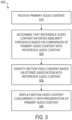
- FIG. 5 is a flowchart illustrating a method 500 of providing motion video content along with audio content, in accordance with some example embodiments.
- Method 500 can be performed by processing logic that can comprise hardware (e.g., circuitry, dedicated logic, programmable logic, microcode, etc.), software (e.g., instructions run on a processing device), or a combination thereof.
- the method 500 is performed by the content provider 110 of FIG. 1 , or any combination of one or more of its components or modules.
- the content provider 110 receives primary audio content.
- the primary audio content comprises music (e.g., a song).
- the content provider 110 determines that at least one reference audio content satisfies a predetermined similarity threshold based on a comparison of the primary audio content with the at least one reference audio content.
- the comparison comprises a comparison of fingerprint data of the primary audio content with fingerprint data of the at least one reference audio content.
- the content provider 110 identifies motion video content based on the motion video content being stored in association with the one of the at least one reference audio content and not stored in association with the primary audio content.
- the identifying of the motion video content is further based on a profile of a user associated with the device.
- the content provider 110 causes the identified motion video content to be displayed on a device concurrently with a presentation of the primary audio content on the device. It is contemplated that any of the other features described within the present disclosure can be incorporated into method 500.
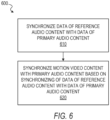
- the content provider synchronizes data of at least one reference audio content with data of primary audio content.
- the content provider 110 synchronizes identified motion video content with the primary audio content based on the synchronizing of the data of the at least one reference audio content with the data of the primary audio content.
- the synchronizing of the data of the at least one reference audio content with the data of the primary audio content is based on a comparison of fingerprint data of the at least one reference audio content with fingerprint data of the primary audio content. It is contemplated that any of the other features described within the present disclosure can be incorporated into method 600.
- FIG. 7 is a block diagram illustrating a mobile device 700, according to an example embodiment.
- the mobile device 700 can include a processor 702.
- the processor 702 can be any of a variety of different types of commercially available processors suitable for mobile devices 700 (for example, an XScale architecture microprocessor, a Microprocessor without Interlocked Pipeline Stages (MIPS) architecture processor, or another type of processor).
- the memory 704 can be adapted to store an operating system (OS) 706, as well as application programs 708, such as a mobile location enabled application that can provide LBSs to a user.
- OS operating system
- application programs 708 such as a mobile location enabled application that can provide LBSs to a user.
- the processor 702 can be coupled, either directly or via appropriate intermediary hardware, to a display 710 and to one or more input/output (I/O) devices 712, such as a keypad, a touch panel sensor, a microphone, and the like.
- the processor 702 can be coupled to a transceiver 714 that interfaces with an antenna 716.
- the transceiver 714 can be configured to both transmit and receive cellular network signals, wireless data signals, or other types of signals via the antenna 716, depending on the nature of the mobile device 700.
- a GPS receiver 718 can also make use of the antenna 716 to receive GPS signals.
- Modules can constitute either software modules (e.g., code embodied on a machine-readable medium or in a transmission signal) or hardware modules.
- a hardware module is a tangible unit capable of performing certain operations and can be configured or arranged in a certain manner.
- one or more computer systems e.g., a standalone, client, or server computer system
- one or more hardware modules of a computer system e.g., a processor or a group of processors
- software e.g., an application or application portion
- a hardware module can be implemented mechanically or electronically.
- a hardware module can comprise dedicated circuitry or logic that is permanently configured (e.g., as a special-purpose processor, such as a field-programmable gate array (FPGA) or an application-specific integrated circuit (ASIC)) to perform certain operations.
- a hardware module can also comprise programmable logic or circuitry (e.g., as encompassed within a general-purpose processor or other programmable processor) that is temporarily configured by software to perform certain operations. It will be appreciated that the decision to implement a hardware module mechanically, in dedicated and permanently configured circuitry, or in temporarily configured circuitry (e.g., configured by software) can be driven by cost and time considerations.
- the term "hardware module” should be understood to encompass a tangible entity, be that an entity that is physically constructed, permanently configured (e.g., hardwired) or temporarily configured (e.g., programmed) to operate in a certain manner and/or to perform certain operations described herein.
- hardware modules are temporarily configured (e.g., programmed)
- each of the hardware modules need not be configured or instantiated at any one instance in time.
- the hardware modules comprise a general-purpose processor configured using software
- the general-purpose processor can be configured as respective different hardware modules at different times.
- Software can accordingly configure a processor, for example, to constitute a particular hardware module at one instance of time and to constitute a different hardware module at a different instance of time.
- the methods described herein can be at least partially processor-implemented. For example, at least some of the operations of a method can be performed by one or more processors or processor-implemented modules. The performance of certain of the operations can be distributed among the one or more processors, not only residing within a single machine, but deployed across a number of machines. In some example embodiments, the processor or processors can be located in a single location (e.g., within a home environment, an office environment or as a server farm), while in other embodiments the processors can be distributed across a number of locations.
- the one or more processors can also operate to support performance of the relevant operations in a "cloud computing" environment or as a “software as a service” (SaaS). For example, at least some of the operations can be performed by a group of computers (as examples of machines including processors), these operations being accessible via a network and via one or more appropriate interfaces (e.g., APIs).
- SaaS software as a service
- Example embodiments can be implemented in digital electronic circuitry, or in computer hardware, firmware, software, or in combinations of them.
- Example embodiments can be implemented using a computer program product, e.g., a computer program tangibly embodied in an information carrier, e.g., in a machine-readable medium for execution by, or to control the operation of, data processing apparatus, e.g., a programmable processor, a computer, or multiple computers.
- a computer program can be written in any form of programming language, including compiled or interpreted languages, and it can be deployed in any form, including as a stand-alone program or as a module, subroutine, or other unit suitable for use in a computing environment.
- a computer program can be deployed to be executed on one computer or on multiple computers at one site or distributed across multiple sites and interconnected by a communication network.
- operations can be performed by one or more programmable processors executing a computer program to perform functions by operating on input data and generating output.
- Method operations can also be performed by, and apparatus of example embodiments can be implemented as, special purpose logic circuitry (e.g., a FPGA or an ASIC).
- a computing system can include clients and servers.
- a client and server are generally remote from each other and typically interact through a communication network. The relationship of client and server arises by virtue of computer programs running on the respective computers and having a client-server relationship to each other.
- both hardware and software architectures merit consideration. Specifically, it will be appreciated that the choice of whether to implement certain functionality in permanently configured hardware (e.g., an ASIC), in temporarily configured hardware (e.g., a combination of software and a programmable processor), or a combination of permanently and temporarily configured hardware can be a design choice.
- hardware e.g., machine
- software architectures that can be deployed, in various example embodiments.
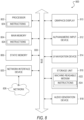
- FIG. 8 is a block diagram of a machine in the example form of a computer system 800 within which instructions 824 for causing the machine to perform any one or more of the methodologies discussed herein can be executed, in accordance with an example embodiment.
- the machine operates as a standalone device or can be connected (e.g., networked) to other machines.
- the machine can operate in the capacity of a server or a client machine in a server-client network environment, or as a peer machine in a peer-to-peer (or distributed) network environment.
- the machine can be a personal computer (PC), a tablet PC, a set-top box (STB), a Personal Digital Assistant (PDA), a cellular telephone, a web appliance, a network router, switch or bridge, or any machine capable of executing instructions (sequential or otherwise) that specify actions to be taken by that machine.
- PC personal computer
- PDA Personal Digital Assistant
- STB set-top box
- WPA Personal Digital Assistant
- a cellular telephone a web appliance
- network router switch or bridge
- machine any machine capable of executing instructions (sequential or otherwise) that specify actions to be taken by that machine.
- machine shall also be taken to include any collection of machines that individually or j ointly execute a set (or multiple sets) of instructions to perform any one or more of the methodologies discussed herein.
- the example computer system 800 includes a processor 802 (e.g., a central processing unit (CPU), a graphics processing unit (GPU) or both), a main memory 804 and a static memory 806, which communicate with each other via a bus 808.
- the computer system 800 can further include a video display unit 810 (e.g., a liquid crystal display (LCD) or a cathode ray tube (CRT)).
- the computer system 800 also includes an alphanumeric input device 812 (e.g., a keyboard), a user interface (UI) navigation (or cursor control) device 814 (e.g., a mouse), a disk drive unit 816, a signal generation device 818 (e.g., a speaker) and a network interface device 820.
- a processor 802 e.g., a central processing unit (CPU), a graphics processing unit (GPU) or both
- main memory 804 e.g., RAM
- static memory 806 e.g.,
- machine-readable media include non-volatile memory, including by way of example semiconductor memory devices (e.g., Erasable Programmable Read-Only Memory (EPROM), Electrically Erasable Programmable Read-Only Memory (EEPROM), and flash memory devices); magnetic disks such as internal hard disks and removable disks; magneto-optical disks; and compact disc-read-only memory (CD-ROM) and digital versatile disc (or digital video disc) read-only memory (DVD-ROM) disks.
- semiconductor memory devices e.g., Erasable Programmable Read-Only Memory (EPROM), Electrically Erasable Programmable Read-Only Memory (EEPROM), and flash memory devices
- EPROM Erasable Programmable Read-Only Memory
- EEPROM Electrically Erasable Programmable Read-Only Memory
- flash memory devices e.g., Electrically Erasable Programmable Read-Only Memory (EEPROM), and flash memory devices
- magnetic disks such as internal hard disks and removable disks
Landscapes
- Engineering & Computer Science (AREA)
- Multimedia (AREA)
- Signal Processing (AREA)
- Databases & Information Systems (AREA)
- Two-Way Televisions, Distribution Of Moving Picture Or The Like (AREA)
- Information Retrieval, Db Structures And Fs Structures Therefor (AREA)
- Information Transfer Between Computers (AREA)
- User Interface Of Digital Computer (AREA)
- Reverberation, Karaoke And Other Acoustics (AREA)
Applications Claiming Priority (3)
| Application Number | Priority Date | Filing Date | Title |
|---|---|---|---|
| US15/475,488 US10462512B2 (en) | 2017-03-31 | 2017-03-31 | Music service with motion video |
| EP18778336.0A EP3603089A4 (fr) | 2017-03-31 | 2018-03-30 | Service de musique avec vidéo animée |
| PCT/US2018/025392 WO2018183841A1 (fr) | 2017-03-31 | 2018-03-30 | Service de musique avec vidéo animée |
Related Parent Applications (1)
| Application Number | Title | Priority Date | Filing Date |
|---|---|---|---|
| EP18778336.0A Division EP3603089A4 (fr) | 2017-03-31 | 2018-03-30 | Service de musique avec vidéo animée |
Publications (2)
| Publication Number | Publication Date |
|---|---|
| EP4535800A2 true EP4535800A2 (fr) | 2025-04-09 |
| EP4535800A3 EP4535800A3 (fr) | 2025-07-09 |
Family
ID=63671266
Family Applications (2)
| Application Number | Title | Priority Date | Filing Date |
|---|---|---|---|
| EP18778336.0A Ceased EP3603089A4 (fr) | 2017-03-31 | 2018-03-30 | Service de musique avec vidéo animée |
| EP25160091.2A Pending EP4535800A3 (fr) | 2017-03-31 | 2018-03-30 | Service musical avec vidéo animée |
Family Applications Before (1)
| Application Number | Title | Priority Date | Filing Date |
|---|---|---|---|
| EP18778336.0A Ceased EP3603089A4 (fr) | 2017-03-31 | 2018-03-30 | Service de musique avec vidéo animée |
Country Status (6)
| Country | Link |
|---|---|
| US (6) | US10462512B2 (fr) |
| EP (2) | EP3603089A4 (fr) |
| JP (4) | JP6876825B2 (fr) |
| KR (7) | KR102242226B1 (fr) |
| CN (2) | CN112616081A (fr) |
| WO (1) | WO2018183841A1 (fr) |
Families Citing this family (7)
| Publication number | Priority date | Publication date | Assignee | Title |
|---|---|---|---|---|
| US10462512B2 (en) * | 2017-03-31 | 2019-10-29 | Gracenote, Inc. | Music service with motion video |
| US11455497B2 (en) * | 2018-07-23 | 2022-09-27 | Accenture Global Solutions Limited | Information transition management platform |
| KR102215256B1 (ko) * | 2019-11-18 | 2021-02-15 | 주식회사 인공지능연구원 | 동기화된 음성과 동작을 지원하는 멀티미디어 저작 장치 및 그 방법 |
| CN115299067A (zh) * | 2020-04-02 | 2022-11-04 | 谷歌有限责任公司 | 用于同步视频流的方法、系统和介质 |
| KR20230037385A (ko) * | 2021-09-09 | 2023-03-16 | 삼성전자주식회사 | 동영상을 촬영하는 전자 장치 및 그 동작 방법 |
| US11757992B2 (en) * | 2021-11-05 | 2023-09-12 | Roku, Inc. | Synchronization of multimedia content presentation across multiple devices in a watch party |
| US20250284451A1 (en) * | 2024-03-08 | 2025-09-11 | Ya Horng Electronic Co., Ltd. | Turntable driving device |
Family Cites Families (30)
| Publication number | Priority date | Publication date | Assignee | Title |
|---|---|---|---|---|
| EP1354318A1 (fr) * | 2000-12-22 | 2003-10-22 | Muvee Technologies Pte Ltd | Systeme et procede de production de supports multimedia |
| DE10133333C1 (de) * | 2001-07-10 | 2002-12-05 | Fraunhofer Ges Forschung | Verfahren und Vorrichtung zum Erzeugen eines Fingerabdrucks und Verfahren und Vorrichtung zum Identifizieren eines Audiosignals |
| EP1652385B1 (fr) * | 2003-07-25 | 2007-09-12 | Koninklijke Philips Electronics N.V. | Procede et dispositif de generation et de detection d'empreintes pour la synchronisation audio et video |
| US7490775B2 (en) * | 2004-12-30 | 2009-02-17 | Aol Llc, A Deleware Limited Liability Company | Intelligent identification of multimedia content for synchronization |
| KR100686521B1 (ko) * | 2005-09-23 | 2007-02-26 | 한국정보통신대학교 산학협력단 | 비디오 및 메타데이터의 통합을 위한 비디오 멀티미디어응용 파일 형식의 인코딩/디코딩 방법 및 시스템 |
| JP5050445B2 (ja) | 2006-08-11 | 2012-10-17 | カシオ計算機株式会社 | 動画再生装置及び動画再生方法 |
| US20100027663A1 (en) * | 2008-07-29 | 2010-02-04 | Qualcomm Incorporated | Intellegent frame skipping in video coding based on similarity metric in compressed domain |
| US8887190B2 (en) * | 2009-05-28 | 2014-11-11 | Harris Corporation | Multimedia system generating audio trigger markers synchronized with video source data and related methods |
| JP5706718B2 (ja) | 2011-03-02 | 2015-04-22 | Kddi株式会社 | 動画合成システム及び方法並びに動画合成プログラム及びその記憶媒体 |
| US8843584B2 (en) * | 2011-06-02 | 2014-09-23 | Google Inc. | Methods for displaying content on a second device that is related to the content playing on a first device |
| KR101264099B1 (ko) | 2011-07-07 | 2013-05-14 | 한국전기연구원 | 다중 접합 반도체의 공극 검사 장치 및 방법 |
| US20160277808A1 (en) * | 2011-08-08 | 2016-09-22 | Lei Yu | System and method for interactive second screen |
| WO2013023287A1 (fr) | 2011-08-16 | 2013-02-21 | Destiny Software Productions Inc. | Rendu vidéo basé sur un script |
| US8717499B2 (en) | 2011-09-02 | 2014-05-06 | Dialogic Corporation | Audio video offset detector |
| KR20130055748A (ko) * | 2011-11-21 | 2013-05-29 | 한국전자통신연구원 | 콘텐츠 추천 시스템 및 방법 |
| JP2013131871A (ja) * | 2011-12-20 | 2013-07-04 | Sharp Corp | 編集装置、遠隔制御装置、テレビジョン受像機、特定音声信号、編集システム、編集方法、プログラム、および、記録媒体 |
| US9609395B2 (en) * | 2012-03-26 | 2017-03-28 | Max Abecassis | Second screen subtitles function |
| KR102105313B1 (ko) * | 2012-06-28 | 2020-04-29 | 구글 엘엘씨 | 셋탑 박스에서 오디오 핑거프린트들의 시퀀스 생성 |
| WO2014018652A2 (fr) * | 2012-07-24 | 2014-01-30 | Adam Polak | Synchronisation d'éléments multimédias |
| JP5725309B2 (ja) * | 2013-07-29 | 2015-05-27 | ブラザー工業株式会社 | カラオケ投稿システム、カラオケ装置及び複合動画作成方法 |
| EP3079283A1 (fr) * | 2014-01-22 | 2016-10-12 | Radioscreen GmbH | Système de synchronisation de contenu de diffusion audio |
| US20150301718A1 (en) * | 2014-04-18 | 2015-10-22 | Google Inc. | Methods, systems, and media for presenting music items relating to media content |
| US9392144B2 (en) | 2014-06-23 | 2016-07-12 | Adobe Systems Incorporated | Video synchronization based on an audio cue |
| US20160066064A1 (en) * | 2014-08-28 | 2016-03-03 | Dozo LLP | Clip Start Point |
| US20160065641A1 (en) * | 2014-08-28 | 2016-03-03 | Beau Ner Chesluk | Global Distribution Model |
| US20160165227A1 (en) | 2014-12-04 | 2016-06-09 | Arris Enterprises, Inc. | Detection of audio to video synchronization errors |
| US10521672B2 (en) * | 2014-12-31 | 2019-12-31 | Opentv, Inc. | Identifying and categorizing contextual data for media |
| JP2017038152A (ja) * | 2015-08-07 | 2017-02-16 | ヤマハ株式会社 | 映像処理装置および映像処理方法 |
| EP3142118A1 (fr) | 2015-09-10 | 2017-03-15 | Luis Solsona Sagrado | Synchronisation de composantes audio et vidéo d'un signal de transmission audiovisuel |
| US10462512B2 (en) * | 2017-03-31 | 2019-10-29 | Gracenote, Inc. | Music service with motion video |
-
2017
- 2017-03-31 US US15/475,488 patent/US10462512B2/en active Active
-
2018
- 2018-03-30 KR KR1020217001757A patent/KR102242226B1/ko active Active
- 2018-03-30 WO PCT/US2018/025392 patent/WO2018183841A1/fr not_active Ceased
- 2018-03-30 CN CN202011470939.6A patent/CN112616081A/zh active Pending
- 2018-03-30 EP EP18778336.0A patent/EP3603089A4/fr not_active Ceased
- 2018-03-30 KR KR1020217011024A patent/KR102275586B1/ko active Active
- 2018-03-30 EP EP25160091.2A patent/EP4535800A3/fr active Pending
- 2018-03-30 KR KR1020217032260A patent/KR102426468B1/ko active Active
- 2018-03-30 JP JP2019553961A patent/JP6876825B2/ja active Active
- 2018-03-30 KR KR1020227025797A patent/KR102540087B1/ko active Active
- 2018-03-30 KR KR1020197028691A patent/KR102069106B1/ko active Active
- 2018-03-30 CN CN201880023124.8A patent/CN110476433B/zh not_active Expired - Fee Related
- 2018-03-30 KR KR1020217020969A patent/KR102312686B1/ko active Active
- 2018-03-30 KR KR1020207001487A patent/KR102207075B1/ko active Active
-
2019
- 2019-09-19 US US16/576,612 patent/US10897644B2/en active Active
-
2020
- 2020-12-30 US US17/137,986 patent/US11240551B2/en active Active
-
2021
- 2021-04-26 JP JP2021073981A patent/JP7227298B2/ja active Active
-
2022
- 2022-01-10 US US17/572,291 patent/US11770578B2/en active Active
-
2023
- 2023-02-09 JP JP2023018484A patent/JP7573664B2/ja active Active
- 2023-08-21 US US18/452,836 patent/US12108105B2/en active Active
-
2024
- 2024-08-30 US US18/821,897 patent/US12568269B2/en active Active
- 2024-10-15 JP JP2024179938A patent/JP7830594B2/ja active Active
Also Published As
Similar Documents
| Publication | Publication Date | Title |
|---|---|---|
| US12568269B2 (en) | Music service with motion video | |
| US10819811B2 (en) | Accumulation of real-time crowd sourced data for inferring metadata about entities | |
| CN104598515A (zh) | 歌曲搜索方法、装置和系统 | |
| US11218377B2 (en) | Prediction of loss of network connection and caching of content | |
| US9911063B1 (en) | Identifying images using pre-loaded image identifiers | |
| CN110633252B (zh) | 基于区块链的数据处理方法、装置、系统以及电子设备 | |
| US11210710B2 (en) | Techniques for inserting advertising content into digital content | |
| US20250239257A1 (en) | Correcting Audio Drift |
Legal Events
| Date | Code | Title | Description |
|---|---|---|---|
| PUAI | Public reference made under article 153(3) epc to a published international application that has entered the european phase |
Free format text: ORIGINAL CODE: 0009012 |
|
| STAA | Information on the status of an ep patent application or granted ep patent |
Free format text: STATUS: THE APPLICATION HAS BEEN PUBLISHED |
|
| AC | Divisional application: reference to earlier application |
Ref document number: 3603089 Country of ref document: EP Kind code of ref document: P |
|
| AK | Designated contracting states |
Kind code of ref document: A2 Designated state(s): AL AT BE BG CH CY CZ DE DK EE ES FI FR GB GR HR HU IE IS IT LI LT LU LV MC MK MT NL NO PL PT RO RS SE SI SK SM TR |
|
| REG | Reference to a national code |
Ref country code: DE Ref legal event code: R079 Free format text: PREVIOUS MAIN CLASS: H04N0021810000 Ipc: H04N0021434000 |
|
| PUAL | Search report despatched |
Free format text: ORIGINAL CODE: 0009013 |
|
| AK | Designated contracting states |
Kind code of ref document: A3 Designated state(s): AL AT BE BG CH CY CZ DE DK EE ES FI FR GB GR HR HU IE IS IT LI LT LU LV MC MK MT NL NO PL PT RO RS SE SI SK SM TR |
|
| RIC1 | Information provided on ipc code assigned before grant |
Ipc: H04N 21/439 20110101ALI20250603BHEP Ipc: H04N 21/45 20110101ALI20250603BHEP Ipc: H04N 21/81 20110101ALI20250603BHEP Ipc: H04N 21/43 20110101ALI20250603BHEP Ipc: H04N 21/434 20110101AFI20250603BHEP |
|
| STAA | Information on the status of an ep patent application or granted ep patent |
Free format text: STATUS: REQUEST FOR EXAMINATION WAS MADE |
|
| 17P | Request for examination filed |
Effective date: 20260106 |