EP4537655A1 - Protection tubulaire pour plants - Google Patents
Protection tubulaire pour plants Download PDFInfo
- Publication number
- EP4537655A1 EP4537655A1 EP24202259.8A EP24202259A EP4537655A1 EP 4537655 A1 EP4537655 A1 EP 4537655A1 EP 24202259 A EP24202259 A EP 24202259A EP 4537655 A1 EP4537655 A1 EP 4537655A1
- Authority
- EP
- European Patent Office
- Prior art keywords
- strip
- protective strip
- protective
- end sections
- section
- Prior art date
- Legal status (The legal status is an assumption and is not a legal conclusion. Google has not performed a legal analysis and makes no representation as to the accuracy of the status listed.)
- Pending
Links
Images

Classifications
-
- A—HUMAN NECESSITIES
- A01—AGRICULTURE; FORESTRY; ANIMAL HUSBANDRY; HUNTING; TRAPPING; FISHING
- A01G—HORTICULTURE; CULTIVATION OF VEGETABLES, FLOWERS, RICE, FRUIT, VINES, HOPS OR SEAWEED; FORESTRY; WATERING
- A01G13/00—Protection of plants
- A01G13/20—Protective coverings for plants
- A01G13/28—Protective coverings for plants protecting young plants
Definitions
- the at least one protective strip is made of veneer is, with the protective strip being particularly preferably made from rotary-cut veneer.
- Veneer typically refers to 0.5 mm to 8 mm thick sheets of wood, whereby the protective strip can, not necessarily but expediently, have a thickness of 0.5 mm to 8 mm.
- the veneer but also generally the protective strip, has a thickness of 1.8 mm to approximately 2.5 mm.
- the protective strips can be easily manufactured from the veneer, which means that the protective sheets can be produced in a resource-saving manner and also have good deformability and breathability, which allows a natural climate for the plant to be protected.
- the at least one retaining means holds the two legs pre-tensioned or braced against each other.
- the at least one retaining means can be a wooden nail, dowel, wire, rope, or a clamp or similar.
- the at least one retaining means Preferably, the at least one end section of the at least two end sections is clamped in the receiving area throughout the application period. This clamping allows the plant to independently open the loop through growth, preventing the protective strip from cutting into the plant and damaging it.
- the at least one retaining means prevents, for example, the connection between the at least one protective sheet and the floor rod from becoming loose due to deformation.
- Wood in particular, "works” and warps, reacting, for example, to fluctuations in humidity and temperature.
- the two end sections of the at least one protective strip are arranged adjacent to each other in the holding section along a longitudinal axis of the base rod.
- the at least one protective strip is therefore helical. It may also be advantageous if the two end sections are arranged in the same axial position along the longitudinal axis. For example, the two end sections can be arranged one above the other in the receiving area.
- a further embodiment of the present invention provides that the at least one protective strip is E-shaped and has a single first end portion and a plurality of second end portions. This alternative embodiment can simplify the attachment of the end portions.
- a further development of the present invention provides for several strip-shaped protective blades to be arranged adjacent to one another along the longitudinal axis in the receiving area.
- the number of protective blades can be chosen arbitrarily, whereby the protective blades should typically protect the plant up to a height of 1 m to 1.60 m, preferably 1.2 m.
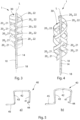
- Figure 1 shows a preferred embodiment of a barking, sweeping, and/or browsing protection device 1, which will be referred to simply as the device below for simplicity.
- the device 1 is intended to protect plants, preferably mechanically, from damage caused by wild animals and grazing animals.
- the device 1 comprises a ground rod 10, which defines an orientation of a longitudinal axis L.
- the ground rod 10 is preferably made of domestic softwood.
- the floor rod 10 is made from a single piece with a preferably rectangular cross-section, for example, 45 x 25 mm, and has a plug-in section 14 and a holding section 15.
- the floor rod 10 preferably has a total length of 1.5 m.
- a plurality of openings 16 can be provided which are arranged parallel along the longitudinal axis L and/or which are arranged spaced apart from one another in the longitudinal axis L.
- the opening 16 divides the base rod 10, which has a rectangular cross section, into cuboid or rectangular legs 11, 12, which are preferably of equal cross section.
- the opening 16 can be machined into the base rod 10, for example by sawing or milling.
- the device 1 has a plurality of protective strips 20.
- the respective protective strip 20 can also be referred to as a strip-shaped protective sheet or as a protective veneer strip and has a first end section 21 and a second end section 22 on opposite sides.
- the protective strip 20 is made of a natural and renewable material.
- the protective strip 20 is made of a veneer, wherein the veneer is preferably a rotary-cut veneer made of hardwood, for example, beech.
- the protective strip 20 preferably has a thickness between 1 mm and 5 mm and has a rectangular shape, wherein the length can be several times greater than the width.
- the protective strip 20 can be formed into a loop 30 or a circle, whereby the two opposite end sections 21, 22 can be connected to the ground rod 10.
- the loop 30 can be arranged around the plant during the intended use of the device 1, which mechanically protects the plant from wild animals and grazing animals.
- the fastening of the protective strip 20 to the base rod 10 can take place in the holding section 15, wherein at least one of the two end sections 21, 22 is arranged in the holding section 15 and is held there between the legs 11, 12.
- a retaining means 40 can be provided, by which the two legs 11, 12 are held against each other.
- the retaining means can be, for example, a dowel, a clamp, a nail, or rope-shaped, in particular made of wire, whereby the retaining means 40 can preferably also be made of a natural material.
- the device 1 has five protective strips 20, wherein the respective end regions 21, 22 of the individual protective strips 20 and the adjacent protective strips 20 are arranged adjacent to one another along the longitudinal axis L.
- the protective strips 20 are helically shaped.
- An unintentional slipping out of the respective end section 21 and/or 22 of the protective strips 20 from the holding section 15 can also be prevented, for example, by the use of adhesives. It can also be advantageous if at least one of the two end sections 21, 22 is sanded, whereby the static friction between the end sections 21, 22 and the base rod 10 or the legs 11, 12 can be increased.
- at least one of the two End sections 21, 22 of the protective strip 20 are provided with sand grains, wherein the sand grains are held to the protective strip 20 by means of an adhesive based on glue, adhesive or resin.
- Another particularly biological way of attaching or additionally attaching the protective strips 20 to the legs 11, 12 or to the ground pole 10 is the use of fungi that naturally bond the wood of the ground pole 10 and the protective strip 20.
- the ground pole and/or the at least one protective strip 20 are provided with chemical protection against barking, raking, and/or browsing.
- the chemical protection against barking, raking, and/or browsing prevents game from approaching and possibly damaging the device 1 while still reaching the protected plant.
- the protective strips 20 are arranged with a greater pitch in the helix, whereby the protective strips 20 of the devices 1 are arranged more rigidly. This makes it more difficult, for example, for wild animals and grazing animals to bend the protective strips 20 aside in order to reach the plant to be protected.
- the individual protective strips 20 are arranged helically in the same direction, with two adjacent protective strips 20 crossing each other.
- the individual protective strips 20 are provided with indices (1...5).
- the protective strips 20 are arranged helically and in opposite directions.
- the protective strips 20 can form a kind of mesh, wherein in this embodiment the number of protective strips 20 preferably corresponds to an even number.
- FIGS 5a and 5b show two different holding means 40, which are designed in the manner of a clamp.
- the respective holding means 40 can be made of spring steel or a spring steel wire and comprises three U-shaped holding means sections 41, 42, 43 that can engage around the base rod 10.
- the two opposite holding means sections 41, 43 converge at the end facing away from the central holding means section 42 to generate a clamping force.
- the angle between the holding means sections 41, 42, 43 is approximately 80°.
- the retaining means section 41 may further include a retaining lug 44 that can engage around the base rod 10. When attaching the retaining means 40, the retaining lug 44 facilitates assembly.
- the holding means section 43 can also have a protruding lever arm 45, which in particular serves to simplify the attachment of the holding means 40 due to its leverage effect.
- the holding means 40 shown is the curved configuration of the central holding means section 42.
- the central holding means section 42 is slightly concave in shape in order to improve the clamping effect of the holding means 40.
Landscapes
- Health & Medical Sciences (AREA)
- General Health & Medical Sciences (AREA)
- Toxicology (AREA)
- Life Sciences & Earth Sciences (AREA)
- Environmental Sciences (AREA)
- Catching Or Destruction (AREA)
Applications Claiming Priority (1)
| Application Number | Priority Date | Filing Date | Title |
|---|---|---|---|
| DE102023127813.4A DE102023127813A1 (de) | 2023-10-11 | 2023-10-11 | Schäl-, Fege- und/oder Verbissschutzvorrichtung für Pflanzen, vorzugsweise Forstpflanzen |
Publications (1)
| Publication Number | Publication Date |
|---|---|
| EP4537655A1 true EP4537655A1 (fr) | 2025-04-16 |
Family
ID=92899752
Family Applications (1)
| Application Number | Title | Priority Date | Filing Date |
|---|---|---|---|
| EP24202259.8A Pending EP4537655A1 (fr) | 2023-10-11 | 2024-09-24 | Protection tubulaire pour plants |
Country Status (2)
| Country | Link |
|---|---|
| EP (1) | EP4537655A1 (fr) |
| DE (1) | DE102023127813A1 (fr) |
Citations (7)
| Publication number | Priority date | Publication date | Assignee | Title |
|---|---|---|---|---|
| US1744203A (en) * | 1928-12-12 | 1930-01-21 | Edward P Becker | Reenforced veneer and method of preventing same from splitting |
| EP0240532A1 (fr) | 1985-10-04 | 1987-10-14 | Tubex Ltd | Abris pour arbres. |
| DE102005022067A1 (de) | 2005-05-12 | 2006-11-16 | Siegfried Kolb | Verbiß und Fegeschutz für junge Forstpflanzen |
| EP4230029A1 (fr) * | 2022-02-17 | 2023-08-23 | Franz Eschlbeck | Élément denté et enveloppe formée par celui-ci en tant qu'aide à la croissance et/ou à la protection des plantes, ainsi qu'enveloppe |
| DE102022000793A1 (de) | 2022-03-08 | 2023-09-14 | Neo-Plastic Dr. Doetsch Diespeck Gmbh | Verbissschutz |
| DE202024000301U1 (de) * | 2024-02-16 | 2024-03-07 | Helmuth Römer | Erdbefestigung für Wuchsschutz- und Baumstamm-Schutzumhüllungen |
| EP4491360A1 (fr) * | 2023-07-12 | 2025-01-15 | Smart Corp | Dispositif de protection de plants végétaux en feuille de bois cousue et procédé de mise en oeuvre |
Family Cites Families (4)
| Publication number | Priority date | Publication date | Assignee | Title |
|---|---|---|---|---|
| WO1987004897A1 (fr) * | 1986-02-15 | 1987-08-27 | David George Holladay | Ameliorations relatives a des abris pour plantes |
| DE19949790A1 (de) * | 1998-10-16 | 2000-05-11 | Mag Johannes Maierhofer | Schutzvorrichtung vor Wildverbiss- und Fegeschäden bei Bäumen |
| FR2785497A1 (fr) * | 1998-11-05 | 2000-05-12 | Export Services Bureau Esb | Manchon de protection pour jeunes arbres ou vegetaux |
| DE102022116559A1 (de) * | 2021-07-04 | 2023-01-05 | Bernhard Helm | Schutzelement |
-
2023
- 2023-10-11 DE DE102023127813.4A patent/DE102023127813A1/de active Pending
-
2024
- 2024-09-24 EP EP24202259.8A patent/EP4537655A1/fr active Pending
Patent Citations (7)
| Publication number | Priority date | Publication date | Assignee | Title |
|---|---|---|---|---|
| US1744203A (en) * | 1928-12-12 | 1930-01-21 | Edward P Becker | Reenforced veneer and method of preventing same from splitting |
| EP0240532A1 (fr) | 1985-10-04 | 1987-10-14 | Tubex Ltd | Abris pour arbres. |
| DE102005022067A1 (de) | 2005-05-12 | 2006-11-16 | Siegfried Kolb | Verbiß und Fegeschutz für junge Forstpflanzen |
| EP4230029A1 (fr) * | 2022-02-17 | 2023-08-23 | Franz Eschlbeck | Élément denté et enveloppe formée par celui-ci en tant qu'aide à la croissance et/ou à la protection des plantes, ainsi qu'enveloppe |
| DE102022000793A1 (de) | 2022-03-08 | 2023-09-14 | Neo-Plastic Dr. Doetsch Diespeck Gmbh | Verbissschutz |
| EP4491360A1 (fr) * | 2023-07-12 | 2025-01-15 | Smart Corp | Dispositif de protection de plants végétaux en feuille de bois cousue et procédé de mise en oeuvre |
| DE202024000301U1 (de) * | 2024-02-16 | 2024-03-07 | Helmuth Römer | Erdbefestigung für Wuchsschutz- und Baumstamm-Schutzumhüllungen |
Also Published As
| Publication number | Publication date |
|---|---|
| DE102023127813A1 (de) | 2025-04-17 |
Similar Documents
| Publication | Publication Date | Title |
|---|---|---|
| DE102015116080A1 (de) | Biologisch abbaubare Wuchshülle | |
| DE2935987A1 (de) | Klemme zum verbinden zweier sich kreuzender draehte oder staebe | |
| DE102022116559A1 (de) | Schutzelement | |
| EP4537655A1 (fr) | Protection tubulaire pour plants | |
| DE202023105891U1 (de) | Vorrichtung zum Schäl-, Fege- und/oder Verbissschutz für Pflanzen, vorzugsweise Forstpflanzen | |
| DE102010007959B4 (de) | Gartengerät | |
| DE202012003153U1 (de) | Vorrichtung zur Stabilisierung von Pflanzen mit insbesondere schweren Fruchtständen | |
| DE202022001284U1 (de) | Pflanzenschutz, insbesondere für junge Bäume und Sträucher insbesondere Forstpflanzen | |
| DE102016120404B4 (de) | Schutzvorrichtung für junge Pflanzen, insbesondere junge Forstpflanzen | |
| DE19949790A1 (de) | Schutzvorrichtung vor Wildverbiss- und Fegeschäden bei Bäumen | |
| EP3808161B1 (fr) | Dent de raclage pour un appareil de travail du sol | |
| DE102020102551A1 (de) | Reisigbesen | |
| DE202020103999U1 (de) | Fegeschutzvorrichtung | |
| AT522592B1 (de) | Fegeschutzvorrichtung | |
| DE102020121739A1 (de) | Flachmaterial für eine verbissschutzvorrichtung, verbissschutzvorrichtung | |
| DE102016105250B3 (de) | Vorrichtung zur Wachstumshilfe und zum Schutz einzelner Triebe von Bäumen | |
| DE3305337A1 (de) | Pflanzenstab | |
| AT349257B (de) | Pflanzenstuetzpfahl | |
| DE202009012232U1 (de) | Hohlspaten | |
| DE202024103326U1 (de) | Wuchshülle | |
| AT408404B (de) | Schutzvorrichtung vor wildverbiss- und fegeschäden bei bäumen | |
| DE202023104562U1 (de) | Stabförmiges Haltesystem | |
| DE202025000522U1 (de) | Haltestab-Varianten mit Keilspitze zur Befestigung von Wuchsschutzhüllen am Erdreich | |
| DE202019103222U1 (de) | Bodenabdeckung zum Baumschutz | |
| EP3628154A1 (fr) | Dispositif de protection |
Legal Events
| Date | Code | Title | Description |
|---|---|---|---|
| PUAI | Public reference made under article 153(3) epc to a published international application that has entered the european phase |
Free format text: ORIGINAL CODE: 0009012 |
|
| STAA | Information on the status of an ep patent application or granted ep patent |
Free format text: STATUS: THE APPLICATION HAS BEEN PUBLISHED |
|
| AK | Designated contracting states |
Kind code of ref document: A1 Designated state(s): AL AT BE BG CH CY CZ DE DK EE ES FI FR GB GR HR HU IE IS IT LI LT LU LV MC ME MK MT NL NO PL PT RO RS SE SI SK SM TR |
|
| STAA | Information on the status of an ep patent application or granted ep patent |
Free format text: STATUS: REQUEST FOR EXAMINATION WAS MADE |
|
| 17P | Request for examination filed |
Effective date: 20251009 |