EP4538314A1 - Copolymère multi-bloc ester-amide, procédé de production d'un copolymère multi-bloc ester-amide, copolymère ester-amide et procédé de production d'un copolymère ester-amide - Google Patents
Copolymère multi-bloc ester-amide, procédé de production d'un copolymère multi-bloc ester-amide, copolymère ester-amide et procédé de production d'un copolymère ester-amide Download PDFInfo
- Publication number
- EP4538314A1 EP4538314A1 EP23819688.5A EP23819688A EP4538314A1 EP 4538314 A1 EP4538314 A1 EP 4538314A1 EP 23819688 A EP23819688 A EP 23819688A EP 4538314 A1 EP4538314 A1 EP 4538314A1
- Authority
- EP
- European Patent Office
- Prior art keywords
- formula
- mmol
- carbon atoms
- block copolymer
- experiment example
- Prior art date
- Legal status (The legal status is an assumption and is not a legal conclusion. Google has not performed a legal analysis and makes no representation as to the accuracy of the status listed.)
- Pending
Links
Images





Classifications
-
- C—CHEMISTRY; METALLURGY
- C08—ORGANIC MACROMOLECULAR COMPOUNDS; THEIR PREPARATION OR CHEMICAL WORKING-UP; COMPOSITIONS BASED THEREON
- C08G—MACROMOLECULAR COMPOUNDS OBTAINED OTHERWISE THAN BY REACTIONS ONLY INVOLVING UNSATURATED CARBON-TO-CARBON BONDS
- C08G69/00—Macromolecular compounds obtained by reactions forming a carboxylic amide link in the main chain of the macromolecule
- C08G69/02—Polyamides derived from amino-carboxylic acids or from polyamines and polycarboxylic acids
- C08G69/08—Polyamides derived from amino-carboxylic acids or from polyamines and polycarboxylic acids derived from amino-carboxylic acids
- C08G69/14—Lactams
- C08G69/24—Pyrrolidones or piperidones
-
- C—CHEMISTRY; METALLURGY
- C08—ORGANIC MACROMOLECULAR COMPOUNDS; THEIR PREPARATION OR CHEMICAL WORKING-UP; COMPOSITIONS BASED THEREON
- C08G—MACROMOLECULAR COMPOUNDS OBTAINED OTHERWISE THAN BY REACTIONS ONLY INVOLVING UNSATURATED CARBON-TO-CARBON BONDS
- C08G69/00—Macromolecular compounds obtained by reactions forming a carboxylic amide link in the main chain of the macromolecule
- C08G69/44—Polyester-amides
-
- C—CHEMISTRY; METALLURGY
- C07—ORGANIC CHEMISTRY
- C07D—HETEROCYCLIC COMPOUNDS
- C07D207/00—Heterocyclic compounds containing five-membered rings not condensed with other rings, with one nitrogen atom as the only ring hetero atom
- C07D207/02—Heterocyclic compounds containing five-membered rings not condensed with other rings, with one nitrogen atom as the only ring hetero atom with only hydrogen or carbon atoms directly attached to the ring nitrogen atom
- C07D207/18—Heterocyclic compounds containing five-membered rings not condensed with other rings, with one nitrogen atom as the only ring hetero atom with only hydrogen or carbon atoms directly attached to the ring nitrogen atom having one double bond between ring members or between a ring member and a non-ring member
- C07D207/22—Heterocyclic compounds containing five-membered rings not condensed with other rings, with one nitrogen atom as the only ring hetero atom with only hydrogen or carbon atoms directly attached to the ring nitrogen atom having one double bond between ring members or between a ring member and a non-ring member with hetero atoms or with carbon atoms having three bonds to hetero atoms with at the most one bond to halogen, e.g. ester or nitrile radicals, directly attached to ring carbon atoms
- C07D207/24—Oxygen or sulfur atoms
- C07D207/26—2-Pyrrolidones
- C07D207/263—2-Pyrrolidones with only hydrogen atoms or radicals containing only hydrogen and carbon atoms directly attached to other ring carbon atoms
- C07D207/27—2-Pyrrolidones with only hydrogen atoms or radicals containing only hydrogen and carbon atoms directly attached to other ring carbon atoms with substituted hydrocarbon radicals directly attached to the ring nitrogen atom
-
- C—CHEMISTRY; METALLURGY
- C08—ORGANIC MACROMOLECULAR COMPOUNDS; THEIR PREPARATION OR CHEMICAL WORKING-UP; COMPOSITIONS BASED THEREON
- C08G—MACROMOLECULAR COMPOUNDS OBTAINED OTHERWISE THAN BY REACTIONS ONLY INVOLVING UNSATURATED CARBON-TO-CARBON BONDS
- C08G63/00—Macromolecular compounds obtained by reactions forming a carboxylic ester link in the main chain of the macromolecule
- C08G63/68—Polyesters containing atoms other than carbon, hydrogen and oxygen
- C08G63/685—Polyesters containing atoms other than carbon, hydrogen and oxygen containing nitrogen
- C08G63/6854—Polyesters containing atoms other than carbon, hydrogen and oxygen containing nitrogen derived from polycarboxylic acids and polyhydroxy compounds
- C08G63/6856—Dicarboxylic acids and dihydroxy compounds
-
- C—CHEMISTRY; METALLURGY
- C08—ORGANIC MACROMOLECULAR COMPOUNDS; THEIR PREPARATION OR CHEMICAL WORKING-UP; COMPOSITIONS BASED THEREON
- C08G—MACROMOLECULAR COMPOUNDS OBTAINED OTHERWISE THAN BY REACTIONS ONLY INVOLVING UNSATURATED CARBON-TO-CARBON BONDS
- C08G63/00—Macromolecular compounds obtained by reactions forming a carboxylic ester link in the main chain of the macromolecule
- C08G63/91—Polymers modified by chemical after-treatment
- C08G63/914—Polymers modified by chemical after-treatment derived from polycarboxylic acids and polyhydroxy compounds
- C08G63/916—Dicarboxylic acids and dihydroxy compounds
-
- C—CHEMISTRY; METALLURGY
- C08—ORGANIC MACROMOLECULAR COMPOUNDS; THEIR PREPARATION OR CHEMICAL WORKING-UP; COMPOSITIONS BASED THEREON
- C08G—MACROMOLECULAR COMPOUNDS OBTAINED OTHERWISE THAN BY REACTIONS ONLY INVOLVING UNSATURATED CARBON-TO-CARBON BONDS
- C08G69/00—Macromolecular compounds obtained by reactions forming a carboxylic amide link in the main chain of the macromolecule
- C08G69/40—Polyamides containing oxygen in the form of ether groups
-
- C—CHEMISTRY; METALLURGY
- C08—ORGANIC MACROMOLECULAR COMPOUNDS; THEIR PREPARATION OR CHEMICAL WORKING-UP; COMPOSITIONS BASED THEREON
- C08G—MACROMOLECULAR COMPOUNDS OBTAINED OTHERWISE THAN BY REACTIONS ONLY INVOLVING UNSATURATED CARBON-TO-CARBON BONDS
- C08G81/00—Macromolecular compounds obtained by interreacting polymers in the absence of monomers, e.g. block polymers
-
- C—CHEMISTRY; METALLURGY
- C08—ORGANIC MACROMOLECULAR COMPOUNDS; THEIR PREPARATION OR CHEMICAL WORKING-UP; COMPOSITIONS BASED THEREON
- C08J—WORKING-UP; GENERAL PROCESSES OF COMPOUNDING; AFTER-TREATMENT NOT COVERED BY SUBCLASSES C08B, C08C, C08F, C08G or C08H
- C08J5/00—Manufacture of articles or shaped materials containing macromolecular substances
- C08J5/18—Manufacture of films or sheets
-
- C—CHEMISTRY; METALLURGY
- C08—ORGANIC MACROMOLECULAR COMPOUNDS; THEIR PREPARATION OR CHEMICAL WORKING-UP; COMPOSITIONS BASED THEREON
- C08J—WORKING-UP; GENERAL PROCESSES OF COMPOUNDING; AFTER-TREATMENT NOT COVERED BY SUBCLASSES C08B, C08C, C08F, C08G or C08H
- C08J2377/00—Characterised by the use of polyamides obtained by reactions forming a carboxylic amide link in the main chain; Derivatives of such polymers
- C08J2377/12—Polyester-amides
-
- C—CHEMISTRY; METALLURGY
- C08—ORGANIC MACROMOLECULAR COMPOUNDS; THEIR PREPARATION OR CHEMICAL WORKING-UP; COMPOSITIONS BASED THEREON
- C08J—WORKING-UP; GENERAL PROCESSES OF COMPOUNDING; AFTER-TREATMENT NOT COVERED BY SUBCLASSES C08B, C08C, C08F, C08G or C08H
- C08J2387/00—Characterised by the use of unspecified macromolecular compounds, obtained otherwise than by polymerisation reactions only involving unsaturated carbon-to-carbon bonds
Definitions
- the present invention relates to a novel copolymer and a method for producing the novel copolymer, particularly to an ester-amide block copolymer having a novel copolymer structure and a method for producing the ester-amide block copolymer, and an ester-amide copolymer and a method for producing the ester-amide copolymer.
- a polyamide that has an amide bond is utilized as one of engineering plastics.
- polyamides such as nylon 6, nylon 10, and nylon 12 which are obtained through ring-opening polymerization of a cyclic lactam are representative materials and used as thermoplastic engineering plastics and as fiber materials.
- Nylon 4 has recently attracted attention because it has biodegradability, which other polyamides do not have, while having characteristics such as high heat resistance and high mechanical strength.
- PTL 1 discloses, as an example of modification of nylon 4, the production of a polyamide 4 copolymer by performing copolymerization with ⁇ -caprolactam using a basic polymerization catalyst and an initiator having a branched structure during polymerization of 2-pyrrolidone.
- PTL 2 discloses the production of various block copolymers containing polyamide 4 by introducing an azo group into the macromolecular chain of polyamide 4.
- PTL 3 discloses the production of an aliphatic polyester amide by using a polyester oligomer having biodegradability as an initiator for polymerization of 2-pyrrolidone.
- NPL 1 discloses the synthesis of a diblock copolymer of a polybutylene succinate having an ester bond and polyamide 4.
- the present inventors have found that a composite material having excellent moldability can be obtained by preparing a multi-block copolymer of an aliphatic polyester and a polyamide and have thus completed the present invention. Furthermore, physical properties suitable for a certain application can be obtained by adjusting the blend ratio between the aliphatic polyester and the polyamide.
- x, m, n, and l are any integer selected from the following ranges.
- x is 1 to 11, preferably 3 to 5 or 11 (an alkyl chain of 3 to 5 or 11 carbon atoms) from the viewpoint of availability of cyclic lactam for use in a reaction step, and more preferably 3 from the viewpoint of biodegradability.
- m represents an integer of 1 to 60, and, for ease of purification of the product, preferably 10 to 60, and more preferably 15 to 60.
- n represents an integer of 1 to 120, and, for ease of purification of the product, preferably 5 to 80, and more preferably 5 to 20.
- l represents an integer of 2 to 100, and, for ease of purification of the product, preferably 2 to 50, and more preferably 2 to 30.
- the combination of m, n, and l may be any combination of integers such that the number-average molecular weight of the resulting block copolymer becomes 5,000 to 2,000,000, preferably 8,000 to 50,000.
- the molecular weight is less than the lower limit, the strength of the resin decreases.
- the solubility of the compound decreases, and a good moldability is not achieved as compared with the case where the molecular weight is equal to or less than the upper limit.
- examples of the "alkyl chain" of R 1 and R 2 include linear alkyl chains of 1 to 20 carbon atoms.
- R 1 is preferably an alkyl chain of 2 to 12 carbon atoms, more preferably 2 to 6 carbon atoms, and still more preferably 2 to 4 carbon atoms, from the viewpoint of availability of a divalent alcohol for use in the reaction step.
- R 2 is preferably an alkyl chain of 1 to 6 carbon atoms, more preferably 2 to 5 carbon atoms, from the viewpoint of availability of a dicarboxylic acid for use in the reaction step.
- alkyl chain of R 3 examples include a linear alkyl chain of 1 to 10 carbon atoms, more preferably 3 to 5 carbon atoms from the viewpoint of availability of a synthetic raw material.
- the numbers of carbon atoms of the alkyl chains of R 1 , R 2 , and R 3 may be the same as or different from one another.
- Examples of the substituent that may be contained in R 1 , R 2 , and R 3 include a hydrocarbon group of 1 to 10 carbon atoms, more preferably 1 to 6 carbon atoms, an oxygen-containing group, a nitrogen-containing group, and a halogen atom.
- hydrocarbon group examples include an alkyl group, such as a methyl group, an ethyl group, an n-propyl group, an isopropyl group, an n-butyl group, an isobutyl group, a sec-butyl group, a t-butyl group, a neopentyl group, and an n-hexyl group, a cyclohexyl group, and a phenyl group.
- alkyl group such as a methyl group, an ethyl group, an n-propyl group, an isopropyl group, an n-butyl group, an isobutyl group, a sec-butyl group, a t-butyl group, a neopentyl group, and an n-hexyl group, a cyclohexyl group, and a phenyl group.
- oxygen-containing group examples include a hydroxy group, an alkoxy group, an aryloxy group, an ester group, an acyl group, a carboxy group, a carbonyl group, and an epoxy group.
- nitrogen-containing group examples include an amino group, an imino group, an amide group, an imido group, a hydrazino group, a hydrazono group, a nitro group, a nitroso group, a cyano group, an isocyano group, a cyanic acid ester group, an amidino group, and a diazo group.
- halogen atom examples include a fluorine atom, a chlorine atom, a bromine atom, and an iodine atom.
- R 1 , R 2 , and R 3 are preferably an alkyl chain that does not have oxygen-containing groups, nitrogen-containing groups, or halogen atom-containing substituents, and more preferably an alkyl chain having no substituent, from the viewpoint of stabilization.
- heteroaromatic chains examples include furan-2,3-diyl, furan-2,4-diyl, furan-2,5-diyl, pyridine-2,3-yl, pyridine-2,4-yl, pyridine-2,5-yl, pyridine-2,6-yl, pyridine-3,4-yl, pyridine-3,5-yl, pyrrolo-2,3-diyl, pyrrolo-2,4-diyl, pyrrolo-2,5-diyl, pyrrolo-3,4-diyl, thieno-2,3-diyl, thieno-2,4-diyl, thieno-2,5-diyl, and thieno-3,4-diyl.
- furan-2,3-diyl, furan-2,4-diyl, furan-2,5-diyl, thieno-2,3-diyl, thieno-2,4-diyl, thieno-2,5-diyl, thieno-3,4-diyl and the like are preferred, and furan-2,5-diyl, thieno-2,5-diyl and the like are more preferred.
- R 4 is an aliphatic hydrocarbon chain containing a hetero atom
- examples thereof include those containing two alkyl chains of 1 to 10 carbon atoms (preferably 2 carbon atoms) and a hetero atom in between (in this case, the number of carbon atoms is the total of the two alkyl chains, and is 2 to 20 (preferably 4 carbon atoms)).
- an alkylene group containing heteroatoms or a dialkyl ether chain, a dialkyl amine chain, a dialkyl sulfide chain, a dialkyl phosphine chain, and a dialkyl silane chain such as 2-oxapropane-1,3-diyl, 3-oxapentane-1,5-diyl, 4-oxaheptane-1,7-diyl, 2-azapropane-1,3-diyl, 3-azapentane-1,5-diyl, 4-azaheptane-1,7-diyl, 2-thiapropane-1,3-diyl, 3-thiapentane-1,5-diyl, 4-thiaheptane-1,7-diyl, 2-silapropane-1,3-diyl, 3-silapentane-1,5-diyl, 4-silaheptane-1,7-diyl,
- the two alkyl chains may be different from each other.
- 2-oxapropane-1,3-diyl, 3-oxapentane-1,5-diyl, 4-oxaheptane-1,7-diyl, and the like are preferred from the viewpoint of ease of handling, and 2-oxapropane-1,3-diyl is more preferred.
- R 4 is preferably a group containing two aromatic hydrocarbon chains of 6 carbon atoms and a hetero atom in between or an aromatic hydrocarbon chain having 6 carbon atoms and containing no hetero atoms.
- R 4 is more preferably a group containing two aromatic hydrocarbon chains of 6 carbon atoms and a hetero atom in between.
- Such a multi-block copolymer has a number-average molecular weight of, for example, 5,000 to 2,000,000, and preferably 8,000 to 50,000.
- an aliphatic polyester resin is a polymer in which aliphatic alkyl chains (R 1 and R 2 ) are linked by ester bonds, and examples thereof include a polybutylene succinate, a polybutylene adipate, and a polybutylene succinate adipate.
- the polyamide resin is a polymer that has an amide bond obtained through ring-opening polymerization of a cyclic lactam.
- One aspect of the present invention provides a method for producing a multi-block copolymer represented by the formula (1), including a step of bonding a polyester-containing compound represented by the following formula (3): (in the formula (3), R 1 and R 2 each represent an alkyl chain of 1 to 20 carbon atoms having hydrogen atoms or substituents, and R 3 represents an alkyl chain of 1 to 10 carbon atoms having hydrogen atoms or substituents; R 1 , R 2 , and R 3 may be the same as or different from one another; Y is NH, O (oxygen), or S (sulfur); and m represents an integer of 1 to 60) to
- the compound represented by the formula (3) when the YH group is an amino group, the compound is represented by the following formula (5).
- the amino group may be in the form of a salt such as a hydrochloride, sulfate or nitrate, as shown in the following formula (7).
- Y is preferably NH (the YH group is an amino group) from the viewpoint of the reaction rate with a carboxylic acid. (In the formulas (5) and (7), m is an integer of 1 to 60.)
- the ratio of the compound represented by the formula (3) to the compound represented by the formula (4), these compounds being used in the reaction, may be a molar ratio of 1:1.
- the reaction is preferably performed under the conditions of being in the presence of a condensing agent.
- a condensing agent that can be used in the reaction include, but are not limited to, a carbodiimide-based condensing agent. Examples thereof include N,N-diisopropylcarbodiimide (DIC), 1-[3-(dimethylamino)propyl]-3-ethylcarbodiimide (EDCI), and 1-[3-(dimethylamino)propyl]-3-ethylcarbodiimide hydrochloride (EDCI ⁇ HCl).
- DIC N,N-diisopropylcarbodiimide
- EDCI 1-[3-(dimethylamino)propyl]-3-ethylcarbodiimide
- EDCI ⁇ HCl 1-[3-(dimethylamino)propyl]-3-ethylcarbodiimide hydrochloride
- CDI carbonyldiimidazole
- DTMM 4-(4,6-dimethoxy-1,3,5-triazin-2-yl)-4-methylmorpholinium chloride
- COMPU 1-cyano-2-ethoxy-2-oxoethylidenaminooxy)dimethylamino-morpholino-carbenium hexafluorophosphate
- HATU 1-[bis(dimethylamino)methylene]-1H-1,2,3-triazolo[4,5-b]pyridinium 3-oxido hexafluorophosphate
- the usage amount of the condensing agent may be 1 to 5 molar equivalents relative to the carboxy group in the compound represented by the formula (3).
- the solvent used for the reaction it is preferable to use a solvent that dissolves both the polyester represented by the formula (3) and the polyamide represented by the formula (4), and specific examples thereof include, but are not limited to, N,N-dimethylformamide, N-methylpyrrolidone, and N,N-dimethylacetamide.
- Salts are preferably added to the solvent in order to promote dissolution of the polyamide, and specific examples thereof include lithium chloride, lithium bromide, lithium iodide, and calcium chloride.
- a base can be added to the reaction as needed to activate the amine-terminus.
- a base include triethylamine, N,N-diisopropylethylamine, pyridine, 2,6-lutidine, 2,4,6-collidine, and N,N-dimethyl-4-aminopyridine (DMAP).
- the base may be added in an amount of 1 to 10 molar equivalents relative to the compound represented by the formula (3) (for example, a compound in which the YH group is an amino group).
- the reaction can be performed under conditions of about 0 to 150°C, and more preferably about 80 to 120°C.
- the reaction can be performed under conditions in which a reaction time is 0.5 to 6.0 hours.
- the compound represented by the formula (3) is obtained by introducing an R 3 CO-NH 2 group into the OH terminal of the compound represented by the following formula (8) (an OH-terminated polyester).
- the compound represented by the formula (3) can be obtained by, after the introduction of an R 3 CO-NH-Boc group, removing a Boc group.
- the compound can be obtained by, for example, after the introduction of an R 3 CO-Y-tert-Bu group, removing a tert-Bu group.
- R 3 represents an alkyl chain of 1 to 10 carbon atoms having hydrogen atoms or substituents.
- R 1 and R 2 each represent an alkyl chain of 1 to 20 carbon atoms having hydrogen atoms or substituents, and may be the same as or different from each other.
- m represents an integer of 1 to 60).
- the R 3 CO-NH-Boc group can be introduced, for example, by reacting the compound of the formula (8) with an N-Boc protected amino acid.
- N-Boc protected amino acid include 4-(tert-butoxycarbonylamino)butyric acid, 5-(tert-butoxycarbonylamino)pentanoic acid, and 6-(tert-butoxycarbonylamino) hexanoic acid.
- the compound represented by the formula (8) and the N-Boc protected amino acid are preferably reacted at a molar ratio of 1:1 to 1:5.
- a solvent such as dichloromethane, chloroform, or a mixed solvent thereof can be used.
- a carbodiimide-based condensing agent can be used. Examples thereof include N,N-diisopropylcarbodiimide (DIC), 1-[3-(dimethylamino)propyl]-3-ethylcarbodiimide (EDCI), and 1-[3-(dimethylamino)propyl]-3-ethylcarbodiimide hydrochloride (EDCI ⁇ HCl).
- the usage amount of the condensing agent may be 1 to 5 molar equivalents relative to the N-Boc protected amino acid.
- N,N-dimethyl-4-aminopyridine (DMAP), 1-hydroxybenzotriazole, or 1-hydroxy-7-azabenzotriazole may be added to the reaction as needed.
- the amount of the condensation aid added may be about 0 to 2 molar equivalents relative to the N-Boc protected amino acid.
- the reaction can be performed under conditions of about -20°C to 60°C, more preferably, about 0 to 40°C.
- the reaction can be performed under conditions in which a reaction time is 1 to 4 hours.
- pure water is added to stop the reaction.
- the reaction solution is concentrated, washed, and dried to obtain a compound represented by the formula (9) (a both-ends NH-Boc-terminated polyester), for example, as a white solid.
- the compound can be similarly synthesized using a condensing agent such as DIC, CDI, or the like, and a base such as triethylamine, N,N-diisopropylethylamine, pyridine, 2,6-lutidine, 2,4,6-collidine, or N,N-dimethyl-4-aminopyridine (DMAP).
- a condensing agent such as DIC, CDI, or the like
- a base such as triethylamine, N,N-diisopropylethylamine, pyridine, 2,6-lutidine, 2,4,6-collidine, or N,N-dimethyl-4-aminopyridine (DMAP).
- R 1 and R 2 each represent an alkyl chain of 1 to 20 carbon atoms having hydrogen atoms or substituents
- R 3 represents an alkyl chain of 1 to 10 carbon atoms having hydrogen atoms or substituents.
- R 1 , R 2 and R 3 may
- R 1 and R 2 each represent an alkyl chain of 1 to 20 carbon atoms having hydrogen atoms or substituents
- R 3 represents an alkyl chain of 1 to 10 carbon atoms having hydrogen atoms or substituents.
- R 1 , R 2 and R 3 may be the same as or different from one another.
- m represents an integer of 1 to 60).
- the compound represented by the above-mentioned formula (8) (OH-terminated polyester) can be produced by reacting a divalent alcohol (OH-R 1 -OH) (R 1 is an alkyl chain of 1 to 20 carbon atoms having hydrogen atoms or substituents) with a dicarboxylic acid (COOH-R 2 -COOH) (R 2 is an alkyl chain of 1 to 20 carbon atoms having hydrogen atoms or substituents).
- the following chemical reaction formulas (13) and (14) show examples of reaction formulas when the polyamide side is PA4 and the polyester side is PBS with respect to the above-described reaction. Furthermore, the following chemical reaction formula (15) shows an example of a reaction formula in which a multi-block copolymer (compound of the formula (2)) is produced using a polyamide component (compound of the formula (6)) and a polyester component (compound of the formula (7)), which are products in the chemical reaction formula (13) and the chemical reaction formula (14), respectively.
- the blend ratio of the polyamide 4 component and the polyester component the physical properties can be adjusted according to the usages. For example, when the heat resistance is enhanced, the polyamide component ratio in the macromolecular may be increased by copolymerizing a polyamide having a high average degree of polymerization and a polyester having a low average degree of polymerization.
- a multi-block copolymer was synthesized through a reaction step (step 6) for a reaction between a both-ends amino group-terminated PBS and a both-ends carboxy group-terminated PA4.
- These reactants are synthesized by synthesis steps (steps 1 to 3) for the both-ends amino group-terminated PBS and synthesis steps (steps 4 to 5) for the both-ends carboxy group-terminated PA4, respectively.
- synthesis step for the both-ends amino group-terminated PBS or the synthesis step for the both-ends carboxy group-terminated PA4 is performed first does not matter.
- 1,4-butanediol manufactured by FUJIFILM Wako Pure Chemical Corporation, 8.395 g, 93.15 mmol
- succinic acid manufactured by FUJIFILM Wako Pure Chemical Corporation, 10.00 g, 84.68 mmol
- DMAP manufactured by FUJIFILM Wako Pure Chemical Corporation, 4.345 g, 35.57 mmol
- dichloromethane manufactured by FUJIFILM Wako Pure Chemical Corporation, 267 mL
- the mixture was cooled in an ice bath, and then added with EDCI ⁇ HCl (manufactured by Peptide Institute, Inc., 51.138 g, 266.75 mmol). The mixture was stirred for 30 minutes, and then further stirred at room temperature for 3 hours. Thereafter, 50 mL of pure water was added to terminate the reaction. The resultant mixed solution was concentrated, and the residue was washed with 200 mL of methanol twice and with 200 mL of pure water once and then vacuum dried at 45°C to obtain a target product (both-ends hydroxyl group-terminated PBS) as a white solid. The yield amount was 11.521 g, and the yield was 75%.
- the molecular weight distribution measurement was performed by GPC, and Mn and Mw were calculated as 4.5 kDa and 10.2 kDa, respectively ( Fig. 1 ).
- the same reagent and the same apparatus were used for the parts that correspond with Experiment Example 1, unless otherwise stated.
- the molecular weight of the both-ends amino group-terminated PBS could not be calculated.
- a both-ends amino group-terminated PBS was obtained by the same methods as in Experiment Example 11, except that the both-ends NH-Boc-terminated PBS (12.106 g, 3.66 mmol) obtained in Experiment Example 8 and a 4M hydrogen chloride/ethyl acetate solution (60 mL) were used.
- a both-ends amino group-terminated PBS was obtained by the same methods as in Experiment Example 11, except that the both-ends NH-Boc-terminated PBS (11.882 g, 1.88 mmol) obtained in Experiment Example 9 and a 4M hydrogen chloride/ethyl acetate solution (60 mL) were used.
- the resultant solution was dropped to a mixed solvent of 20 mL of water and 180 mL of acetone to obtain a precipitate.
- the obtained precipitate was filtered and collected, washed with 100 mL of acetone and 100 mL of pure water in this order, and vacuum dried at 45°C to obtain a target product (both-ends carboxy group-terminated PA4) as a white solid.
- the yield amount was 0.97 g, and the yield was 37%.
- the molecular weight distribution measurement was performed by GPC, and Mn and Mw were calculated as 2.0 kDa and 4.7 kDa, respectively ( Fig. 7 ).
- a both-ends carboxy group-terminated PA4 was obtained by the same methods as in Experiment Example 17, except that the PA4 polymerization reaction initiator (1.562 g, 4.00 mmol) obtained in Experiment Example 16, 2-pyrrolidone (3.404 g, 40.00 mmol), and t-BuOK (0.090 g, 0.80 mmol) were used.
- a both-ends carboxy group-terminated PA4 was obtained by the same methods as in Experiment Example 17, except that the PA4 polymerization reaction initiator (1.100 g, 2.82 mmol) obtained in Experiment Example 16, 2-pyrrolidone (4.796 g, 56.35 mmol), and t-BuOK (0.126 g, 1.13 mmol) were used.
- a both-ends carboxy group-terminated PA4 was obtained by the same methods as in Experiment Example 17, except that the PA4 polymerization reaction initiator (1.400 g, 3.59 mmol) obtained in Experiment Example 16, 2-pyrrolidone (12.207 g, 143.43 mmol), and t-BuOK (0.322 g, 2.87 mmol) were used.
- the yield amount was 0.23 g, and the yield was 84%.
- the molecular weight distribution measurement was performed by GPC, and Mn and Mw were calculated as 12.7 kDa and 50.5 kDa, respectively ( Fig. 9 ).
- l alphabet 'l'
- m was calculated as 16 from the peak area ratio between 11 and 3 of the 1 H-NMR spectrum shown in Fig. 10
- n was calculated as 6 from the peak area ratio between 11, and 10 and 13.
- This PBS-PA4 multi-block copolymer was defined as sample 1.
- the yield amount was 3.17 g and the yield was 95%.
- the molecular weight distribution measurement was performed by GPC, and Mn and Mw were calculated as 28.1 kDa and 75.7 kDa, respectively.
- l alphabet 'l'
- m and n were calculated as 32 and 5, respectively.
- This PBS-PA4 multi-block copolymer was defined as sample 6.
- a PBS-PA4 multi-block copolymer was obtained by the same methods as in Experiment Example 23, except that the both-ends amino group-terminated PBS (2.268 g, 0.40 mmol) obtained in Experiment Example 14, N,N-diisopropylethylamine (0.103 g, 0.80 mmol), N,N-dimethylformamide (15 mL), lithium chloride (1.500 g, 35.39 mmol), the both-ends carboxy group-terminated PA4 (0.819 g, 0.40 mmol) obtained in Experiment Example 20, HOAt (109 mg, 0.80 mmol), and EDCI ⁇ HCl (0.109 g, 0.88 mmol) were used.
- a PBS-PA4 multi-block copolymer was obtained by the same methods as in Experiment Example 23, except that the both-ends amino group-terminated PBS (2.268 g, 0.40 mmol) obtained in Experiment Example 14, N,N-diisopropylethylamine (0.103 g, 0.80 mmol), N,N-dimethylformamide (15 mL), lithium chloride (1.500 g, 35.39 mmol), the both-ends carboxy group-terminated PA4 (1.465 g, 0.40 mmol) obtained in Experiment Example 22, HOAt (109 mg, 0.80 mmol), and EDCI ⁇ HCl (0.169 g, 0.88 mmol) were used.
- the yield amount was 3.46 g and the yield was 94%.
- the molecular weight distribution measurement was performed by GPC, and Mn and Mw were calculated as 39.2 kDa and 111.0 kDa, respectively.
- l alphabet 'l'
- m and n were calculated as 35 and 20, respectively.
- This PBS-PA4 multi-block copolymer was defined as sample 8.
- a PBS-PA4 multi-block copolymer was obtained by the same methods as in Experiment Example 23, except that the both-ends amino group-terminated PBS (2.776 g, 0.30 mmol) obtained in Experiment Example 15, N,N-diisopropylethylamine (0.078 g, 0.60 mmol), N,N-dimethylformamide (15 mL), lithium chloride (1.500 g, 35.39 mmol), the both-ends carboxy group-terminated PA4 (0.334 g, 0.30 mmol) obtained in Experiment Example 18, HOAt (82 mg, 0.60 mmol), and EDCI ⁇ HCl (0.127 g, 0.66 mmol) were used.
- the yield amount was 2.99 g and the yield was 97%.
- the molecular weight distribution measurement was performed by GPC, and Mn and Mw were calculated as 27.6 kDa and 73.0 kDa, respectively.
- l alphabet 'l'
- m and n were calculated as 55 and 5, respectively.
- This PBS-PA4 multi-block copolymer was defined as sample 9.
- a PBS-PA4 multi-block copolymer was obtained by the same methods as in Experiment Example 23, except that the both-ends amino group-terminated PBS (2.776 g, 0.30 mmol) obtained in Experiment Example 15, N,N-diisopropylethylamine (0.078 g, 0.60 mmol), N,N-dimethylformamide (15 mL), lithium chloride (1.500 g, 35.39 mmol), the both-ends carboxy group-terminated PA4 (0.614 g, 0.30 mmol) obtained in Experiment Example 20, HOAt (82 mg, 0.60 mmol), and EDCI ⁇ HCl (0.127 g, 0.66 mmol) were used.
- a PBS-PA4 multi-block copolymer was obtained by the same methods as in Experiment Example 23, except that the both-ends amino group-terminated PBS (2.314 g, 0.25 mmol) obtained in Experiment Example 15, N,N-diisopropylethylamine (0.065 g, 0.50 mmol), N,N-dimethylformamide (15 mL), lithium chloride (1.500 g, 35.39 mmol), the both-ends carboxy group-terminated PA4 (0.916 g, 0.25 mmol) obtained in Experiment Example 22, HOAt (68 mg, 0.50 mmol), and EDCI ⁇ HCl (0.105 g, 0.55 mmol) were used.
- a measurement apparatus including a degassing device (FG-32) (23.0 kPa) manufactured by FLOM Corporation, a liquid feeding pump (PU-4185) (flow rate: 0.15 mL/min) manufactured by Jasco Corporation, an autosampler (AS-4150) (20 ⁇ L sample loop, sample concentration: 1 mg/mL) manufactured by Jasco Corporation, a column oven (CO-4060) (40°C) manufactured by Jasco Corporation, an RI detector (RI-4035) manufactured by Jasco Corporation, and columns (LF-404 and LF-G) manufactured by Showa Denko K.K.
- FG-32 degassing device
- PU-4185 liquid feeding pump
- AS-4150 autosampler
- AS-4150 20 ⁇ L sample loop, sample concentration: 1 mg/mL
- a column oven CO-4060
- RI detector RI-4035
- columns LF-404 and LF-G manufactured by Showa Denko K.K.
- Tm1 is a first melting point derived from PBS
- Tm2 is a second melting point derived from PA4
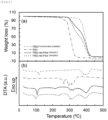
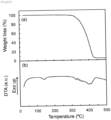
- Td10 is a temperature at which 10% by mass relative to the total weight of the multi-block copolymer decomposes (disappears).
- the PBS-PA4 multi-block copolymer of Example 1 can also be easily molded into a film.
- this film was irradiated with light having a wavelength of 260 to 1600 nm at a 1-nm step using a UV-visible spectrophotometer (manufactured by Shimadzu Corporation, SoliedSpec-3700) to measure the light transmittance.
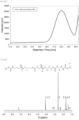
- Fig. 13 shows the measurement result of the light transmittance of the film. Note that Fig. 13 also shows a result of the PBS film obtained by the same methods for comparison.
- the PBS film was prepared using about 0.1 g of the above-described commercially available PBS by the same methods as those for the PBS-PA4 multi-block copolymer film.
- An ester-amide copolymer of the present example was synthesized through a reaction between a both-ends amino group-terminated PBS synthesized by the synthesis steps (steps 1A to 3A) of the both-ends amino group-terminated PBS and 4,4'-oxybisbenzoic acid (formula (20)).
- Step 1A Synthesis of one-end NH-Boc-terminated butanediol (compound represented by the following formula (22))
- 1,4-butanediol manufactured by FUJIFILM Wako Pure Chemical Corporation, 15.771 g, 175.00 mmol
- 4-(tert-butoxycarbonylamino)butyric acid manufactured by Tokyo Chemical Industry Co., Ltd., 7.113 g, 35.00 mmol
- DMAP manufactured by FUJIFILM Wako Pure Chemical Corporation, 0.855 g, 7.00 mmol
- tetrahydrofuran manufactured by FUJIFILM Wako Pure Chemical Corporation, 53 mL
- the mixture was cooled in an ice bath, added with EDCI ⁇ HCl (manufactured by Peptide Institute, Inc., 10.065 g, 52.50 mmol), and stirred at room temperature for 4 hours.
- the reaction solution was concentrated, and then added with 100 mL of ethyl acetate to be diluted.
- the diluted solution was liquid-separated and washed with 50 mL of a 1M KHSO 4 aqueous solution and 50 mL of saturated NaHCO 3 in this order.
- Fig. 14 shows the measurement result of a 1 H-NMR spectrum. Since each peak could be assigned to an intended structure, it was confirmed that the target product was obtained.
- Step 2A Synthesis of both-ends NH-Boc-terminated PBS (compound represented by the following formula (17)))
- the mixture was cooled in an ice bath, added with EDCI ⁇ HCl (manufactured by Peptide Institute, Inc., 5.483 g, 28.60 mmol), and stirred at room temperature for 3 hours.
- the reaction solution was diluted with dichloromethane to 50 mL.
- the diluted solution was liquid-separated and washed with 50 mL of pure water, 50 mL of a 1M KHSO 4 aqueous solution, 50 mL of saturated NaHCO 3 , and 50 mL of a saturated salt solution in this order.
- Step 3A Synthesis of both-ends amino group-terminated PBS (compound represented by the following formula (7))
- a target product (both-ends amino group-terminated PBS) was obtained as a white solid by the same method as the method according to Experiment Example 11, except that the both-ends NH-Boc-terminated PBS (4.000 g, 6.32 mmol) obtained in Experiment Example 35 and a 4 M hydrogen chloride/ethyl acetate solution (16 mL) were used.
- the yield amount was 3.093 g, and the yield was 94%.
- the yield amount was 0.57 g, and the yield was 88%.
- Experiment Examples 34 to 37 1 H-NMR was measured using a nuclear magnetic resonance spectrometer (JNM-ECX400) manufactured by JEOL Ltd.
- JNM-ECX400 nuclear magnetic resonance spectrometer
- Experiment Examples 34 to 35 10 mg of a specimen was dissolved in deuterated chloroform (manufactured by Aldrich, 1 mL, deuteration rate: 99.8% or more, containing 0.03 vol% tetramethyl silane) to prepare a measurement sample.
- Experiment Example 36 10 mg of a specimen was dissolved in deuterated methanol (manufactured by Aldrich, 1 mL, deuteration rate: 99.8% or more) to prepare a measurement sample.
- the compound (sample 12) obtained in Experiment Example 37 exhibits a single melting point (Tm) derived from the repeating structure of an ester amide. It was found that the melting point of the resultant product was higher than that of a commercially available PBS and heat resistance had improved. Since this melting point is lower than the above-described decomposition temperature (270 to 280°C) of PA4, it can be said that moldability had improved. Furthermore, it can be said that a film can also be easily molded in the present example similarly to in Example 1. In addition, according to the present example, the heat resistance is lower than that of the multi-block copolymer of Example 1, but the moldability improves. Therefore, the present example is suitable for a packaging film for food or the like.
- the ester-amide copolymer such as the multi-block copolymer according to the present invention is usable as films or sheets used for a food package, a protective film, and a packaging material, and other various molded articles.
Landscapes
- Chemical & Material Sciences (AREA)
- Organic Chemistry (AREA)
- Health & Medical Sciences (AREA)
- Chemical Kinetics & Catalysis (AREA)
- Medicinal Chemistry (AREA)
- Polymers & Plastics (AREA)
- Engineering & Computer Science (AREA)
- Manufacturing & Machinery (AREA)
- Materials Engineering (AREA)
- General Chemical & Material Sciences (AREA)
- Polyamides (AREA)
Applications Claiming Priority (3)
| Application Number | Priority Date | Filing Date | Title |
|---|---|---|---|
| JP2022091265 | 2022-06-06 | ||
| JP2022191365A JP2023178934A (ja) | 2022-06-06 | 2022-11-30 | エステルアミドマルチブロック共重合体及びエステルアミドマルチブロック共重合体の製造方法、エステルアミド共重合体及びエステルアミド共重合体の製造方法 |
| PCT/JP2023/019715 WO2023238706A1 (fr) | 2022-06-06 | 2023-05-26 | Copolymère multi-bloc ester-amide, procédé de production d'un copolymère multi-bloc ester-amide, copolymère ester-amide et procédé de production d'un copolymère ester-amide |
Publications (1)
| Publication Number | Publication Date |
|---|---|
| EP4538314A1 true EP4538314A1 (fr) | 2025-04-16 |
Family
ID=89118141
Family Applications (1)
| Application Number | Title | Priority Date | Filing Date |
|---|---|---|---|
| EP23819688.5A Pending EP4538314A1 (fr) | 2022-06-06 | 2023-05-26 | Copolymère multi-bloc ester-amide, procédé de production d'un copolymère multi-bloc ester-amide, copolymère ester-amide et procédé de production d'un copolymère ester-amide |
Country Status (3)
| Country | Link |
|---|---|
| US (1) | US20250361361A1 (fr) |
| EP (1) | EP4538314A1 (fr) |
| WO (1) | WO2023238706A1 (fr) |
Families Citing this family (1)
| Publication number | Priority date | Publication date | Assignee | Title |
|---|---|---|---|---|
| JP2026010598A (ja) * | 2024-07-09 | 2026-01-22 | 国立研究開発法人産業技術総合研究所 | 共重合体、フィルム、及び共重合体の製造方法 |
Family Cites Families (7)
| Publication number | Priority date | Publication date | Assignee | Title |
|---|---|---|---|---|
| JPH0757801B2 (ja) * | 1987-05-30 | 1995-06-21 | ダイセル化学工業株式会社 | 新規ポリエ−テル・エステル・アミド・ブロック・コポリマ− |
| DE59103151D1 (de) * | 1990-05-26 | 1994-11-10 | Bayer Ag | Lactamschmelzen mit erhöhter Viskosität und ihre Verwendung. |
| JP4150791B2 (ja) | 2003-05-07 | 2008-09-17 | 独立行政法人産業技術総合研究所 | ポリアミド4誘導体、ポリアミド4を含むブロック共重合体及びその製造法 |
| JP5207343B2 (ja) | 2007-03-09 | 2013-06-12 | 独立行政法人産業技術総合研究所 | 生分解性ポリエステルアミド及びその製造方法 |
| JP5283058B2 (ja) | 2007-12-28 | 2013-09-04 | 独立行政法人産業技術総合研究所 | 分岐構造を導入したポリアミド4共重合体及びその製造方法 |
| JP5988049B2 (ja) | 2011-05-13 | 2016-09-07 | 国立研究開発法人産業技術総合研究所 | ナイロン4樹脂組成物成形体及びその製造方法 |
| US8497342B2 (en) * | 2011-06-03 | 2013-07-30 | Boston Scientific Scimed, Inc. | Liquid crystal block copolymer and methods of making and using the same |
-
2023
- 2023-05-26 EP EP23819688.5A patent/EP4538314A1/fr active Pending
- 2023-05-26 WO PCT/JP2023/019715 patent/WO2023238706A1/fr not_active Ceased
- 2023-05-26 US US18/872,645 patent/US20250361361A1/en active Pending
Also Published As
| Publication number | Publication date |
|---|---|
| US20250361361A1 (en) | 2025-11-27 |
| WO2023238706A1 (fr) | 2023-12-14 |
Similar Documents
| Publication | Publication Date | Title |
|---|---|---|
| JP2023178934A (ja) | エステルアミドマルチブロック共重合体及びエステルアミドマルチブロック共重合体の製造方法、エステルアミド共重合体及びエステルアミド共重合体の製造方法 | |
| Secker et al. | Poly (α‐Peptoid) s Revisited: Synthesis, Properties, and Use as Biomaterial | |
| EP3604395B1 (fr) | Copolymère séquencé | |
| Bazzar et al. | Novel fluorescent light-emitting polymer composites bearing 1, 2, 4-triazole and quinoxaline moieties: Reinforcement and thermal stabilization with silicon carbide nanoparticles by epoxide functionalization | |
| EP2719714B1 (fr) | Copolymère de lactide, son procédé de préparation et composition de résine en contenant | |
| EP4538314A1 (fr) | Copolymère multi-bloc ester-amide, procédé de production d'un copolymère multi-bloc ester-amide, copolymère ester-amide et procédé de production d'un copolymère ester-amide | |
| Akbulut et al. | Synthesis and characterization of polyphenylenes with polypeptide and poly (ethylene glycol) side chains | |
| Chen et al. | Flexible preparation of polyamide-6 based thermoplastic elastomers via amide exchange | |
| Han et al. | Preparation and characterization of high molecular weight poly (butylene succinate) | |
| Guo et al. | Synthesis, characterization, and biodegradation of copolymers of unsaturated and saturated poly (ester amide) s | |
| De Wit et al. | Syntheses, characterization, and functionalization of poly (ester amide) s with pendant amine functional groups | |
| Qu et al. | Carbonyl aziridines: strained amides for rapid polyamide synthesis | |
| Koyama et al. | Polycondensations of hydroxycarboxylic acids derived from optically active aminoalcohols and acid anhydrides—syntheses of functional poly (ester‐amide) s | |
| Wisse et al. | Multicomponent supramolecular thermoplastic elastomer with peptide‐modified nanofibers | |
| Zhu et al. | Thermoreversible supramolecular polyurethanes with self‐complementary quadruple hydrogen‐bonded end groups | |
| Kamei et al. | Synthesis of polypeptides from activated urethane derivatives of α‐amino acids | |
| Kricheldorf et al. | Imidazole‐initiated polymerizations of α‐amino acid N‐carboxyanhydrides–simultaneous chain‐growth and step‐growth polymerization | |
| EP4129965A1 (fr) | Résine thermoplastique présentant une liaison carbonate | |
| Franz et al. | Synthesis of Functional Polydepsipeptides via Direct Ring‐Opening Polymerization and Post‐Polymerization Modification | |
| Faghihi et al. | Optically active and organosoluble poly (amide-imide) s derived from N, N′-(Pyromellitoyl) bis-l-histidine and various diamines: synthesis and characterization | |
| Ali Mohamed et al. | Quasi‐alternating polyesteramides from ε‐caprolactone and α‐amino acids | |
| CN105452335B (zh) | 生产含二酰胺链段的热塑性聚合物的方法 | |
| Melis et al. | Poly (α-alkyl γ-glutamate) s of microbial origin: I. Ester derivatization of poly (γ-glutamic acid) and thermal degradation | |
| Kim | Cooperative H-bonding on the Topology Controlled Polyether toward Advanced Adhesive Materials | |
| KR102326790B1 (ko) | 폴리아미드 공중합체 및 이를 포함하는 폴리아미드 필름 |
Legal Events
| Date | Code | Title | Description |
|---|---|---|---|
| STAA | Information on the status of an ep patent application or granted ep patent |
Free format text: STATUS: THE INTERNATIONAL PUBLICATION HAS BEEN MADE |
|
| PUAI | Public reference made under article 153(3) epc to a published international application that has entered the european phase |
Free format text: ORIGINAL CODE: 0009012 |
|
| STAA | Information on the status of an ep patent application or granted ep patent |
Free format text: STATUS: REQUEST FOR EXAMINATION WAS MADE |
|
| 17P | Request for examination filed |
Effective date: 20241213 |
|
| AK | Designated contracting states |
Kind code of ref document: A1 Designated state(s): AL AT BE BG CH CY CZ DE DK EE ES FI FR GB GR HR HU IE IS IT LI LT LU LV MC ME MK MT NL NO PL PT RO RS SE SI SK SM TR |
|
| DAV | Request for validation of the european patent (deleted) | ||
| DAX | Request for extension of the european patent (deleted) |