EP4538433A1 - Rohr für mehrreihiges koaxiales schmelzgeblasenes system - Google Patents
Rohr für mehrreihiges koaxiales schmelzgeblasenes system Download PDFInfo
- Publication number
- EP4538433A1 EP4538433A1 EP24201103.9A EP24201103A EP4538433A1 EP 4538433 A1 EP4538433 A1 EP 4538433A1 EP 24201103 A EP24201103 A EP 24201103A EP 4538433 A1 EP4538433 A1 EP 4538433A1
- Authority
- EP
- European Patent Office
- Prior art keywords
- tube
- tubes
- profile
- dimension
- multirow
- Prior art date
- Legal status (The legal status is an assumption and is not a legal conclusion. Google has not performed a legal analysis and makes no representation as to the accuracy of the status listed.)
- Pending
Links
Images




Classifications
-
- D—TEXTILES; PAPER
- D01—NATURAL OR MAN-MADE THREADS OR FIBRES; SPINNING
- D01D—MECHANICAL METHODS OR APPARATUS IN THE MANUFACTURE OF ARTIFICIAL FILAMENTS, THREADS, FIBRES, BRISTLES OR RIBBONS
- D01D4/00—Spinnerette packs; Cleaning thereof
- D01D4/02—Spinnerettes
- D01D4/027—Spinnerettes containing inserts
-
- D—TEXTILES; PAPER
- D04—BRAIDING; LACE-MAKING; KNITTING; TRIMMINGS; NON-WOVEN FABRICS
- D04H—MAKING TEXTILE FABRICS, e.g. FROM FIBRES OR FILAMENTARY MATERIAL; FABRICS MADE BY SUCH PROCESSES OR APPARATUS, e.g. FELTS, NON-WOVEN FABRICS; COTTON-WOOL; WADDING ; NON-WOVEN FABRICS FROM STAPLE FIBRES, FILAMENTS OR YARNS, BONDED WITH AT LEAST ONE WEB-LIKE MATERIAL DURING THEIR CONSOLIDATION
- D04H3/00—Non-woven fabrics formed wholly or mainly of yarns or like filamentary material of substantial length
- D04H3/08—Non-woven fabrics formed wholly or mainly of yarns or like filamentary material of substantial length characterised by the method of strengthening or consolidating
- D04H3/16—Non-woven fabrics formed wholly or mainly of yarns or like filamentary material of substantial length characterised by the method of strengthening or consolidating with bonds between thermoplastic filaments produced in association with filament formation, e.g. immediately following extrusion
-
- B—PERFORMING OPERATIONS; TRANSPORTING
- B29—WORKING OF PLASTICS; WORKING OF SUBSTANCES IN A PLASTIC STATE IN GENERAL
- B29C—SHAPING OR JOINING OF PLASTICS; SHAPING OF MATERIAL IN A PLASTIC STATE, NOT OTHERWISE PROVIDED FOR; AFTER-TREATMENT OF THE SHAPED PRODUCTS, e.g. REPAIRING
- B29C48/00—Extrusion moulding, i.e. expressing the moulding material through a die or nozzle which imparts the desired form; Apparatus therefor
- B29C48/03—Extrusion moulding, i.e. expressing the moulding material through a die or nozzle which imparts the desired form; Apparatus therefor characterised by the shape of the extruded material at extrusion
- B29C48/05—Filamentary, e.g. strands
-
- B—PERFORMING OPERATIONS; TRANSPORTING
- B29—WORKING OF PLASTICS; WORKING OF SUBSTANCES IN A PLASTIC STATE IN GENERAL
- B29C—SHAPING OR JOINING OF PLASTICS; SHAPING OF MATERIAL IN A PLASTIC STATE, NOT OTHERWISE PROVIDED FOR; AFTER-TREATMENT OF THE SHAPED PRODUCTS, e.g. REPAIRING
- B29C48/00—Extrusion moulding, i.e. expressing the moulding material through a die or nozzle which imparts the desired form; Apparatus therefor
- B29C48/03—Extrusion moulding, i.e. expressing the moulding material through a die or nozzle which imparts the desired form; Apparatus therefor characterised by the shape of the extruded material at extrusion
- B29C48/09—Articles with cross-sections having partially or fully enclosed cavities, e.g. pipes or channels
-
- D—TEXTILES; PAPER
- D01—NATURAL OR MAN-MADE THREADS OR FIBRES; SPINNING
- D01D—MECHANICAL METHODS OR APPARATUS IN THE MANUFACTURE OF ARTIFICIAL FILAMENTS, THREADS, FIBRES, BRISTLES OR RIBBONS
- D01D5/00—Formation of filaments, threads, or the like
- D01D5/253—Formation of filaments, threads, or the like with a non-circular cross section; Spinnerette packs therefor
-
- D—TEXTILES; PAPER
- D04—BRAIDING; LACE-MAKING; KNITTING; TRIMMINGS; NON-WOVEN FABRICS
- D04H—MAKING TEXTILE FABRICS, e.g. FROM FIBRES OR FILAMENTARY MATERIAL; FABRICS MADE BY SUCH PROCESSES OR APPARATUS, e.g. FELTS, NON-WOVEN FABRICS; COTTON-WOOL; WADDING ; NON-WOVEN FABRICS FROM STAPLE FIBRES, FILAMENTS OR YARNS, BONDED WITH AT LEAST ONE WEB-LIKE MATERIAL DURING THEIR CONSOLIDATION
- D04H1/00—Non-woven fabrics formed wholly or mainly of staple fibres or like relatively short fibres
- D04H1/40—Non-woven fabrics formed wholly or mainly of staple fibres or like relatively short fibres from fleeces or layers composed of fibres without existing or potential cohesive properties
- D04H1/42—Non-woven fabrics formed wholly or mainly of staple fibres or like relatively short fibres from fleeces or layers composed of fibres without existing or potential cohesive properties characterised by the use of certain kinds of fibres insofar as this use has no preponderant influence on the consolidation of the fleece
- D04H1/4391—Non-woven fabrics formed wholly or mainly of staple fibres or like relatively short fibres from fleeces or layers composed of fibres without existing or potential cohesive properties characterised by the use of certain kinds of fibres insofar as this use has no preponderant influence on the consolidation of the fleece characterised by the shape of the fibres
- D04H1/43912—Non-woven fabrics formed wholly or mainly of staple fibres or like relatively short fibres from fleeces or layers composed of fibres without existing or potential cohesive properties characterised by the use of certain kinds of fibres insofar as this use has no preponderant influence on the consolidation of the fleece characterised by the shape of the fibres fibres with noncircular cross-sections
-
- D—TEXTILES; PAPER
- D01—NATURAL OR MAN-MADE THREADS OR FIBRES; SPINNING
- D01D—MECHANICAL METHODS OR APPARATUS IN THE MANUFACTURE OF ARTIFICIAL FILAMENTS, THREADS, FIBRES, BRISTLES OR RIBBONS
- D01D5/00—Formation of filaments, threads, or the like
- D01D5/08—Melt spinning methods
- D01D5/098—Melt spinning methods with simultaneous stretching
-
- D—TEXTILES; PAPER
- D04—BRAIDING; LACE-MAKING; KNITTING; TRIMMINGS; NON-WOVEN FABRICS
- D04H—MAKING TEXTILE FABRICS, e.g. FROM FIBRES OR FILAMENTARY MATERIAL; FABRICS MADE BY SUCH PROCESSES OR APPARATUS, e.g. FELTS, NON-WOVEN FABRICS; COTTON-WOOL; WADDING ; NON-WOVEN FABRICS FROM STAPLE FIBRES, FILAMENTS OR YARNS, BONDED WITH AT LEAST ONE WEB-LIKE MATERIAL DURING THEIR CONSOLIDATION
- D04H1/00—Non-woven fabrics formed wholly or mainly of staple fibres or like relatively short fibres
- D04H1/40—Non-woven fabrics formed wholly or mainly of staple fibres or like relatively short fibres from fleeces or layers composed of fibres without existing or potential cohesive properties
- D04H1/54—Non-woven fabrics formed wholly or mainly of staple fibres or like relatively short fibres from fleeces or layers composed of fibres without existing or potential cohesive properties by welding together the fibres, e.g. by partially melting or dissolving
- D04H1/56—Non-woven fabrics formed wholly or mainly of staple fibres or like relatively short fibres from fleeces or layers composed of fibres without existing or potential cohesive properties by welding together the fibres, e.g. by partially melting or dissolving in association with fibre formation, e.g. immediately following extrusion of staple fibres
Definitions
- the present invention relates to a tube for a multirow coaxial melt-blown system of the type specified in the preamble of the first claim.
- the present invention relates to an element that is part of a system designed to enable the making of extruded polymer filaments intended to directly or indirectly produce a non-woven fabric, also known as TNT.
- non-woven fabric As is known, non-woven fabric, or TNT, is an industrial product similar to a fabric but produced through processes different from weaving and knitting.
- the fibers are arranged randomly without any discernible ordered structure, whereas in a fabric, the fibers typically have two predominant and orthogonal directions, commonly referred to as weft and warp.
- weft and warp two predominant and orthogonal directions
- TNT is used for hygienic and sanitary products
- lower-quality TNT is predominantly used in geotextiles.
- non-woven fabrics also known by the English term “nonwoven fabric,” can be generally classified into spunlace, spunbond, and melt-blown.
- multirow coaxial melt-blown systems or multirow coaxial melt-blown systems, are particularly known.
- these systems provide for the stretching of the polymer that exits from the tubes, arranged in rows, through air that passes coaxially from the outside of the tube and pushes the fiber downward.
- spin packs which consist of several different components designed to interact with each other.
- a spin pack is composed of a spinneret and a diffusion device that includes one or more components known as air plates.
- the spinneret can itself be connected to a taper and/or a breaker plate.
- the breaker plate is also connected to an extrusion head designed to convey at least polymer fluid and possibly also air or gas under pressure to the spin pack.
- the breaker plate and taper fundamentally share the same characteristics as the breaker plate and taper used in spunbond and melt-blown technologies.
- Multirow coaxial melt-blown systems including spin packs do not include a diffusion device having a support adapted to support an air knife, do not have a cusp, nor do they have a simple die designed solely for polymer outflow.
- the spinneret is essentially a support that holds the tubes designed to expel polymer filaments.
- the diffusion device is thus attached to the spinneret and includes an intermediate plate or air plate, which allows the passage of the said tubes and the outflow of air or other pressurized gas, and an external mask, or external air plate, usually of a divergent shape, through which the polymer filament outflows, pushed downward by air, before reaching the conveyor belts present in any non-woven fabric manufacturing plant.
- the tubes present inside the multirow coaxial melt-blown systems of the prior art include only a circular outlet, which does not allow for the production of non-woven fabrics with different mechanical properties.
- conventional tubes have the sole function of channeling the polymer along an axis.
- the technical task underlying the present invention is to devise a tube for a multirow coaxial melt-blown system capable of overcoming at least part of the cited drawbacks.
- a significant aim of the invention is to provide a tube for a multirow coaxial melt-blown system that enables the production of non-woven fabric with different mechanical properties.
- Another significant aim of the invention is to make a tube for a multirow coaxial melt-blown system that adds functionalities to those typically associated with the tubes. Furthermore, a further task of the invention is to make a tube for a multirow coaxial melt-blown system that allows to add internal stresses to the polymer exiting the die without using additional components.
- first”, “second”, “upper”, “lower”, “primary”, and “secondary” do not necessarily identify an order, a priority of relation, or relative position, but can be used simply to distinguish between different components.
- processing refers to the actions and/or processes of a computer or similar electronic computing device that manipulates and/or transforms data represented as physical quantities such as electrical quantities in registers of a computer system and/or memory into other data similarly represented as physical quantities within computer systems, registers, or other storage, transmission, or display devices.
- the tube for a multirow coaxial melt-blown system according to the invention is globally denoted by number 1.
- the tube 1 is, as such, an element of substantially elongated shape, including a cavity through which liquid polymer can flow to allow extrusion, for example, from a die.
- the tube 1 therefore, defines a development axis 1a.
- the development axis 1a is substantially the axis around which the tube 1 is developed. Moreover, the development axis 1a is the axis along which the liquid polymer can flow and, therefore, it is the axis along which the cavity defined by the tube 1 is developed.
- the inner surface 2 is substantially closed. Moreover, it is developed around the development axis 1a, being in fact facing it.
- the inner surface 2 therefore, encloses the cavity.
- tube 1 defines a plurality of profiles 3.
- the profiles 3 are mutually identical. Additionally, they are arranged in succession along the development axis 1a.
- the profiles 3 are substantially formed along the development axis 1a by the inner surface 2 and determine the overall shape of the cavity.
- the profile 3 is defined on a sectional plane 1b.
- the sectional plane 1b is preferably perpendicular to the development axis 1a.
- the sectional plane 1b is substantially a virtual plane that, by cutting the tube 1 perpendicularly to the development axis 1a, defines the profile 3 formed by the inner surface 2 on itself.
- the profile 3 defines a first extension area.
- the extension area is the portion of two-dimensional space contained within the profile 3.
- the profile 3 can preferably be inscribed in a circle.
- the circle is also determined on the sectional plane 1b.
- the circle is a simple virtual geometric element within which the profile 3 can be geometrically inscribed.
- the circle in addition, defines a second extension area on the sectional plane 1b.
- the profile 3 does not correspond to the shape of the circle.
- the first extension area is less than 90% of the second extension area. Even more in detail, preferably, the first extension area is less than 60% of the second extension area.
- the profile 3 can be made according to different embodiments.
- the profile 3 can be a convex figure.
- a convex figure is one wherein every segment joining any two points of it is entirely contained within the figure itself.
- the profile 3 if it is convex, it preferably defines a first dimension 3a and a second dimension 3b.
- the first dimension 3a is substantially the maximum dimension that the profile 3 determines in one direction.
- the second dimension 3b is also the maximum dimension in a direction perpendicular to the first dimension 3a.
- the second dimension 3b is less than 90% of the first dimension 3a. Even more in detail, the second dimension 3b may be less than 60% of the first dimension 3a.
- dimensions may refer to well-defined geometric profiles 3.
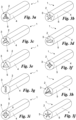
- a convex profile 3 may have an approximately equilateral triangular shape, as shown in Figure 2d , or an approximately rectangular shape, possibly slightly curved at the sides, as shown in Figure 2e .
- the first dimension 3a may be given by the height
- the second dimension 3b may be given by the base side on which the height lies.
- dimensions 3a and 3b may correspond to the respective sides.
- the profile 3 may be concave instead.
- concavity of a figure is evident when there is at least one segment joining a pair of points of the figure that is not entirely contained within the figure itself.
- the profile 3 is concave, it preferably includes at least one convex portion 30.
- the convex portion 30 is a part of the concave profile 3 that can be identified within the profile 3, so as to be delimited at least in part, and that exhibits the characteristic of convexity.
- the convex portion 30, like the convex profile 3, can define a third dimension 30a and a fourth dimension 30b.
- the third dimension 30a is substantially the maximum dimension that the convex portion 30 determines in one direction.
- the fourth dimension 30b is also the maximum dimension in a direction perpendicular to the third dimension 30a.
- the fourth dimension 30b is less than 90% of the third dimension 30a. Even more in detail, the fourth dimension 30b may be less than 60% of the third dimension 30a.
- a convex portion 30 of a profile 3 may have an approximately triangular shape, as shown in Figure 2h , or an approximately rectangular shape, as shown in Figures 2g and 2j , possibly with one side beveled as in Figure 2a , or even trapezoidal, as shown in Figures 2b-2c .
- the first dimension 3a may be given by the height
- the second dimension 3b may be given by the base side on which the height lies.
- dimensions 3a and 3b may correspond to the respective sides.
- a concave profile 3 may be formed by two or more convex portions 30 intersecting one another.
- the concave profile 3 may define a cross shape having three to five pointed ends. For example, three as in Figures 2a and 2c , or four as in Figures 2f and 2i , or even five as in Figures 2b and 2j .
- the tube 1 may also include an outer surface 4.
- the outer surface 4 is also closed. Moreover, the outer surface 4 develops around the inner surface 2. Thus, the outer surface 4 surrounds the inner surface 2.
- the outer surface 4, which faces the outside of tube 1 and therefore is not in contact with the cavity, is connected to the inner surface 2 through a wall 5.
- the wall 5 is thus surrounded by surfaces 2 and 4, and therefore the surfaces define faces opposite to the wall 5.
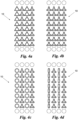
- the outer surface 4 may therefore be cylindrical, as shown in Figures 3a-3j , 5a-5d , and 6a-6d , or the outer surface 4 may alternatively be shaped like the inner surface 2. In this way, surfaces 2 and 4 determine a constant thickness for the wall 5, as shown, for example, in Figures 1 and 4a-4d .
- tube 1 may be used with other tubes to form a pack of tubes to be used in a system.
- the invention also includes a pack of tubes including a plurality of tubes 1.
- the pack may include a plurality of tubes 1, all defining the same profile 3, as in Figures 5a-5d .
- the pack may include a plurality of said tubes 1 defining respective mutually different profiles 3, as in Figures 4a-4d and 6b-6d .
- the pack may include a plurality of tubes 1 and a plurality of tubes defining each a circular profile, i.e., having a conventional profile according to prior art, as in Figures 4c and 6a .
- the invention also includes a multirow coaxial melt-blown system comprising a pack of tubes as just described according to the various possible embodiments.
- the operation of the tube 1 for a multirow coaxial melt-blown system is substantially similar to the operation of any tube of the prior art, in that it allows the polymer fluid to be conveyed along the development axis 1a.
- the tube 1 for a multirow coaxial melt-blown system according to the invention achieves important advantages.
- the tube 1 for a multirow coaxial melt-blown system allows the production of non-woven fabric with different mechanical properties compared to non-woven fabrics made with conventional tubes.
- the tube 1 for a multirow coaxial melt-blown system adds functionalities to those typically associated with tubes.
- the tube 1 for a multirow coaxial melt-blown system allows the introduction of internal stresses to the polymer exiting the die without using additional components.
Landscapes
- Engineering & Computer Science (AREA)
- Textile Engineering (AREA)
- Mechanical Engineering (AREA)
- Extrusion Moulding Of Plastics Or The Like (AREA)
- Prostheses (AREA)
- Spinning Methods And Devices For Manufacturing Artificial Fibers (AREA)
Applications Claiming Priority (1)
| Application Number | Priority Date | Filing Date | Title |
|---|---|---|---|
| IT102023000021345A IT202300021345A1 (it) | 2023-10-13 | 2023-10-13 | Tubetto per impianto di tipo melt-blown coassiale multifila |
Publications (1)
| Publication Number | Publication Date |
|---|---|
| EP4538433A1 true EP4538433A1 (de) | 2025-04-16 |
Family
ID=89322068
Family Applications (1)
| Application Number | Title | Priority Date | Filing Date |
|---|---|---|---|
| EP24201103.9A Pending EP4538433A1 (de) | 2023-10-13 | 2024-09-18 | Rohr für mehrreihiges koaxiales schmelzgeblasenes system |
Country Status (5)
| Country | Link |
|---|---|
| US (1) | US20250122656A1 (de) |
| EP (1) | EP4538433A1 (de) |
| JP (1) | JP2025067827A (de) |
| CN (1) | CN119824558A (de) |
| IT (1) | IT202300021345A1 (de) |
Citations (2)
| Publication number | Priority date | Publication date | Assignee | Title |
|---|---|---|---|---|
| US4248577A (en) * | 1977-06-14 | 1981-02-03 | Rhone-Poulenc Textile | Spinneret assembly |
| US20070128404A1 (en) * | 2005-12-06 | 2007-06-07 | Invista North America S.Ar.L. | Hexalobal cross-section filaments with three major lobes and three minor lobes |
Family Cites Families (1)
| Publication number | Priority date | Publication date | Assignee | Title |
|---|---|---|---|---|
| US20160023392A1 (en) * | 2012-02-13 | 2016-01-28 | The University Of Akron | Methods and apparatus for the production of multi-component fibers |
-
2023
- 2023-10-13 IT IT102023000021345A patent/IT202300021345A1/it unknown
-
2024
- 2024-09-18 EP EP24201103.9A patent/EP4538433A1/de active Pending
- 2024-09-27 JP JP2024169454A patent/JP2025067827A/ja active Pending
- 2024-10-01 US US18/903,781 patent/US20250122656A1/en active Pending
- 2024-10-12 CN CN202411423151.8A patent/CN119824558A/zh active Pending
Patent Citations (2)
| Publication number | Priority date | Publication date | Assignee | Title |
|---|---|---|---|---|
| US4248577A (en) * | 1977-06-14 | 1981-02-03 | Rhone-Poulenc Textile | Spinneret assembly |
| US20070128404A1 (en) * | 2005-12-06 | 2007-06-07 | Invista North America S.Ar.L. | Hexalobal cross-section filaments with three major lobes and three minor lobes |
Also Published As
| Publication number | Publication date |
|---|---|
| US20250122656A1 (en) | 2025-04-17 |
| JP2025067827A (ja) | 2025-04-24 |
| CN119824558A (zh) | 2025-04-15 |
| IT202300021345A1 (it) | 2025-04-13 |
Similar Documents
| Publication | Publication Date | Title |
|---|---|---|
| KR910002887B1 (ko) | 플라스틱 물질의 메시(mesh) 구조물 | |
| US4600544A (en) | Packing unit and method of making | |
| KR820001945B1 (ko) | 플라스틱 재료 망상 구조물의 제조방법 | |
| GB1569828A (en) | Orientated packing members for mass transfer columns | |
| EP4538433A1 (de) | Rohr für mehrreihiges koaxiales schmelzgeblasenes system | |
| US8245372B2 (en) | Needle for a textile machine | |
| US7857162B2 (en) | Tablet feeder | |
| HU218724B (hu) | Javított nedvszívású nemszőtt textília | |
| EP4650504A1 (de) | Spinndüse für mehrreihige koaxiale spinnvlies- und/oder schmelzgeblasene pflanzen | |
| EP4108815B1 (de) | Mehrreihiges koaxiales schmelzblassystem | |
| EP1923118A1 (de) | Faserartiger Block zur verbesserten Dunstbeseitigung und Stoffübertragung | |
| KR20200062210A (ko) | 능직 제지 직물 | |
| US8458870B2 (en) | Needle for a textile machine | |
| US6902787B2 (en) | Industrial fabric with asymmetrically apertured tiles | |
| US8245373B2 (en) | Needle holder for a textile machine | |
| EP4621112A1 (de) | Spinndüse für mehrreihige koaxiale spinnvlies- und/oder schmelzgeblasene pflanzen | |
| KR102090684B1 (ko) | 다단계 촉각감지 센서 | |
| BR102024021103A2 (pt) | Tubo para sistema coaxial via sopro de linhas múltiplas | |
| EP4296407A1 (de) | Anlage zur herstellung von schmelzgeblasenem vliesstoff | |
| CN217539429U (zh) | 横截面具有负泊松比效应的环状结构 | |
| US20230203715A1 (en) | Distributor of polymer for spunbond and/or melt-blown type implant | |
| JP3178942B2 (ja) | 繊維束積層体の製造方法 | |
| US2027432A (en) | Vending device | |
| EP4621113A1 (de) | Mehrreihen-koaxial-schmelzblasanlage | |
| JP2965207B2 (ja) | 3成分複合紡糸口金装置 |
Legal Events
| Date | Code | Title | Description |
|---|---|---|---|
| PUAI | Public reference made under article 153(3) epc to a published international application that has entered the european phase |
Free format text: ORIGINAL CODE: 0009012 |
|
| STAA | Information on the status of an ep patent application or granted ep patent |
Free format text: STATUS: THE APPLICATION HAS BEEN PUBLISHED |
|
| STAA | Information on the status of an ep patent application or granted ep patent |
Free format text: STATUS: REQUEST FOR EXAMINATION WAS MADE |
|
| AK | Designated contracting states |
Kind code of ref document: A1 Designated state(s): AL AT BE BG CH CY CZ DE DK EE ES FI FR GB GR HR HU IE IS IT LI LT LU LV MC ME MK MT NL NO PL PT RO RS SE SI SK SM TR |
|
| 17P | Request for examination filed |
Effective date: 20250331 |