EP4538599A1 - Appareil de cuisson et son procédé de commande - Google Patents
Appareil de cuisson et son procédé de commande Download PDFInfo
- Publication number
- EP4538599A1 EP4538599A1 EP23872778.8A EP23872778A EP4538599A1 EP 4538599 A1 EP4538599 A1 EP 4538599A1 EP 23872778 A EP23872778 A EP 23872778A EP 4538599 A1 EP4538599 A1 EP 4538599A1
- Authority
- EP
- European Patent Office
- Prior art keywords
- image
- set value
- cooking device
- food ingredient
- acquiring
- Prior art date
- Legal status (The legal status is an assumption and is not a legal conclusion. Google has not performed a legal analysis and makes no representation as to the accuracy of the status listed.)
- Pending
Links
Images




Classifications
-
- F—MECHANICAL ENGINEERING; LIGHTING; HEATING; WEAPONS; BLASTING
- F24—HEATING; RANGES; VENTILATING
- F24C—DOMESTIC STOVES OR RANGES ; DETAILS OF DOMESTIC STOVES OR RANGES, OF GENERAL APPLICATION
- F24C15/00—Details
-
- F—MECHANICAL ENGINEERING; LIGHTING; HEATING; WEAPONS; BLASTING
- F24—HEATING; RANGES; VENTILATING
- F24C—DOMESTIC STOVES OR RANGES ; DETAILS OF DOMESTIC STOVES OR RANGES, OF GENERAL APPLICATION
- F24C15/00—Details
- F24C15/008—Illumination for oven cavities
-
- F—MECHANICAL ENGINEERING; LIGHTING; HEATING; WEAPONS; BLASTING
- F24—HEATING; RANGES; VENTILATING
- F24C—DOMESTIC STOVES OR RANGES ; DETAILS OF DOMESTIC STOVES OR RANGES, OF GENERAL APPLICATION
- F24C7/00—Stoves or ranges heated by electric energy
- F24C7/08—Arrangement or mounting of control or safety devices
-
- F—MECHANICAL ENGINEERING; LIGHTING; HEATING; WEAPONS; BLASTING
- F24—HEATING; RANGES; VENTILATING
- F24C—DOMESTIC STOVES OR RANGES ; DETAILS OF DOMESTIC STOVES OR RANGES, OF GENERAL APPLICATION
- F24C7/00—Stoves or ranges heated by electric energy
- F24C7/08—Arrangement or mounting of control or safety devices
- F24C7/082—Arrangement or mounting of control or safety devices on ranges, e.g. control panels, illumination
-
- F—MECHANICAL ENGINEERING; LIGHTING; HEATING; WEAPONS; BLASTING
- F24—HEATING; RANGES; VENTILATING
- F24C—DOMESTIC STOVES OR RANGES ; DETAILS OF DOMESTIC STOVES OR RANGES, OF GENERAL APPLICATION
- F24C7/00—Stoves or ranges heated by electric energy
- F24C7/08—Arrangement or mounting of control or safety devices
- F24C7/082—Arrangement or mounting of control or safety devices on ranges, e.g. control panels, illumination
- F24C7/083—Arrangement or mounting of control or safety devices on ranges, e.g. control panels, illumination on tops, hot plates
-
- F—MECHANICAL ENGINEERING; LIGHTING; HEATING; WEAPONS; BLASTING
- F24—HEATING; RANGES; VENTILATING
- F24C—DOMESTIC STOVES OR RANGES ; DETAILS OF DOMESTIC STOVES OR RANGES, OF GENERAL APPLICATION
- F24C7/00—Stoves or ranges heated by electric energy
- F24C7/08—Arrangement or mounting of control or safety devices
- F24C7/082—Arrangement or mounting of control or safety devices on ranges, e.g. control panels, illumination
- F24C7/085—Arrangement or mounting of control or safety devices on ranges, e.g. control panels, illumination on baking ovens
-
- G—PHYSICS
- G01—MEASURING; TESTING
- G01J—MEASUREMENT OF INTENSITY, VELOCITY, SPECTRAL CONTENT, POLARISATION, PHASE OR PULSE CHARACTERISTICS OF INFRARED, VISIBLE OR ULTRAVIOLET LIGHT; COLORIMETRY; RADIATION PYROMETRY
- G01J1/00—Photometry, e.g. photographic exposure meter
- G01J1/02—Details
-
- G—PHYSICS
- G01—MEASURING; TESTING
- G01J—MEASUREMENT OF INTENSITY, VELOCITY, SPECTRAL CONTENT, POLARISATION, PHASE OR PULSE CHARACTERISTICS OF INFRARED, VISIBLE OR ULTRAVIOLET LIGHT; COLORIMETRY; RADIATION PYROMETRY
- G01J1/00—Photometry, e.g. photographic exposure meter
- G01J1/02—Details
- G01J1/0219—Electrical interface; User interface
-
- G—PHYSICS
- G06—COMPUTING OR CALCULATING; COUNTING
- G06V—IMAGE OR VIDEO RECOGNITION OR UNDERSTANDING
- G06V10/00—Arrangements for image or video recognition or understanding
- G06V10/10—Image acquisition
- G06V10/12—Details of acquisition arrangements; Constructional details thereof
- G06V10/14—Optical characteristics of the device performing the acquisition or on the illumination arrangements
-
- G—PHYSICS
- G06—COMPUTING OR CALCULATING; COUNTING
- G06V—IMAGE OR VIDEO RECOGNITION OR UNDERSTANDING
- G06V10/00—Arrangements for image or video recognition or understanding
- G06V10/10—Image acquisition
- G06V10/12—Details of acquisition arrangements; Constructional details thereof
- G06V10/14—Optical characteristics of the device performing the acquisition or on the illumination arrangements
- G06V10/141—Control of illumination
-
- G—PHYSICS
- G06—COMPUTING OR CALCULATING; COUNTING
- G06V—IMAGE OR VIDEO RECOGNITION OR UNDERSTANDING
- G06V10/00—Arrangements for image or video recognition or understanding
- G06V10/40—Extraction of image or video features
- G06V10/56—Extraction of image or video features relating to colour
-
- G—PHYSICS
- G06—COMPUTING OR CALCULATING; COUNTING
- G06V—IMAGE OR VIDEO RECOGNITION OR UNDERSTANDING
- G06V10/00—Arrangements for image or video recognition or understanding
- G06V10/70—Arrangements for image or video recognition or understanding using pattern recognition or machine learning
- G06V10/77—Processing image or video features in feature spaces; using data integration or data reduction, e.g. principal component analysis [PCA] or independent component analysis [ICA] or self-organising maps [SOM]; Blind source separation
- G06V10/80—Fusion, i.e. combining data from various sources at the sensor level, preprocessing level, feature extraction level or classification level
- G06V10/809—Fusion, i.e. combining data from various sources at the sensor level, preprocessing level, feature extraction level or classification level of classification results, e.g. where the classifiers operate on the same input data
- G06V10/811—Fusion, i.e. combining data from various sources at the sensor level, preprocessing level, feature extraction level or classification level of classification results, e.g. where the classifiers operate on the same input data the classifiers operating on different input data, e.g. multi-modal recognition
-
- G—PHYSICS
- G06—COMPUTING OR CALCULATING; COUNTING
- G06V—IMAGE OR VIDEO RECOGNITION OR UNDERSTANDING
- G06V20/00—Scenes; Scene-specific elements
- G06V20/60—Type of objects
- G06V20/68—Food, e.g. fruit or vegetables
-
- H—ELECTRICITY
- H04—ELECTRIC COMMUNICATION TECHNIQUE
- H04N—PICTORIAL COMMUNICATION, e.g. TELEVISION
- H04N23/00—Cameras or camera modules comprising electronic image sensors; Control thereof
- H04N23/60—Control of cameras or camera modules
-
- H—ELECTRICITY
- H04—ELECTRIC COMMUNICATION TECHNIQUE
- H04N—PICTORIAL COMMUNICATION, e.g. TELEVISION
- H04N23/00—Cameras or camera modules comprising electronic image sensors; Control thereof
- H04N23/60—Control of cameras or camera modules
- H04N23/61—Control of cameras or camera modules based on recognised objects
-
- H—ELECTRICITY
- H04—ELECTRIC COMMUNICATION TECHNIQUE
- H04N—PICTORIAL COMMUNICATION, e.g. TELEVISION
- H04N23/00—Cameras or camera modules comprising electronic image sensors; Control thereof
- H04N23/60—Control of cameras or camera modules
- H04N23/62—Control of parameters via user interfaces
-
- H—ELECTRICITY
- H04—ELECTRIC COMMUNICATION TECHNIQUE
- H04N—PICTORIAL COMMUNICATION, e.g. TELEVISION
- H04N23/00—Cameras or camera modules comprising electronic image sensors; Control thereof
- H04N23/70—Circuitry for compensating brightness variation in the scene
-
- H—ELECTRICITY
- H04—ELECTRIC COMMUNICATION TECHNIQUE
- H04N—PICTORIAL COMMUNICATION, e.g. TELEVISION
- H04N7/00—Television systems
- H04N7/18—Closed-circuit television [CCTV] systems, i.e. systems in which the video signal is not broadcast
- H04N7/183—Closed-circuit television [CCTV] systems, i.e. systems in which the video signal is not broadcast for receiving images from a single remote source
Definitions
- the disclosure relates to a cooking device and a controlling method thereof, and more particularly, to a cooking device that can recognize an image for a food ingredient, and a controlling method thereof.
- an image of the food ingredient may be acquired by fixing a set value for a parameter related to the camera to an initial value without changing it.
- an image acquired as such is provided to a user, there is a problem that the quality of the image provided to the user may be degraded.
- a cooking device that can acquire an image for a food ingredient while a cooking process is being performed and perform recognition for the food ingredient at a high recognition rate, and at the same time, provide an image of high quality including information on the food ingredient to a user, and a controlling method thereof.
- a cooking device includes: a camera; at least one memory storing at least one instruction; and at least one processor configured to execute the at least one instruction to: based on identifying a first event related to acquiring an image of a food ingredient arranged in the cooking device, adjust a set value for at least one parameter related to the camera and acquire a first set value, acquire, through the camera and based on the first set value, at least one image of the food ingredient arranged in the cooking device, based on identifying a second event while the at least one image is being acquired, acquire a second set value, acquire a first image of the food ingredient based on the second set value, and provide the first image to a user, acquire a second image wherein the second set value used in acquiring the first image is changed to the first set value, and input the second image into an object recognition model configured to recognize the food ingredient, and acquire information on the food ingredient based on the second image.
- the cooking device may further include at least one sensor, and the first event may include at least one of receiving a user input for performing a cooking operation of the cooking device, detecting through the at least one sensor that a door of the cooking device was closed, or detecting through the at least one sensor that the food ingredient is arranged in the cooking device.
- the second event may include at least one of identifying that a color of the food ingredient changed while a parameter stabilizing operation is being performed, detecting through the at least one sensor that an illumination around the cooking device changed while the parameter stabilizing operation is being performed, or receiving a user input requesting an image of the food ingredient while the parameter stabilizing operation is not being performed.
- the cooking device may further include a communicator, and the at least one processor may be further configured to execute the at least one instruction to, based on acquiring the first image, control the communicator to transmit the first image to a user terminal of the user.
- the cooking device may further include a light emitter, and the at least one processor may be further configured to execute the at least one instruction to control at least one of a color or a brightness of a light irradiated by the light emitter based on a color of the food ingredient included in the first image.
- the acquiring the second image may further include acquiring the second image by changing the second set value to the first set value in data for the first image.
- the acquiring the second image may further include acquiring the second image by inputting the first set value, the second set value, and the first image into a trained image acquisition model.
- the first event may include at least one of receiving a user input for performing a cooking operation of the cooking device, detecting through at least one sensor that a door of the cooking device was closed, or detecting through the at least one sensor that the food ingredient is arranged in the cooking device.
- the method may further include, based on acquiring the first image, transmitting the first image to a user terminal of the user.
- a non-transitory computer readable medium has instructions stored therein, which when executed by at least one processor cause the at least one processor to execute a method of controlling a cooking device, the method including: based on identifying a first event related to acquiring an image of a food ingredient arranged in the cooking device, adjusting a set value for at least one parameter related to a camera of the cooking device and acquiring a first set value; acquiring, through the camera and based on the first set value, at least one image of the food ingredient arranged in the cooking device; based on identifying a second event while the at least one image is being acquired, acquiring a second set value, acquiring a first image of the food ingredient based on the second set value, and providing the first image to a user; acquiring a second image wherein the second set value used in acquiring the first image is changed to the first set value; and inputting the second image into an object recognition model configured to recognize the food ingredient, and acquiring information on the food ingredient based on the second image
- the acquiring the second image may further include acquiring the second image by inputting the first set value, the second set value, and the first image into a trained image acquisition model.
- expressions such as “have,” “may have,” “include,” and “may include” denote the existence of such characteristics (e.g.: elements such as numbers, functions, operations, and components), and do not exclude the existence of additional characteristics.
- one element e.g., a first element
- another element e.g., a second element
- the description in the disclosure that one element is "(operatively or communicatively) coupled with/to" or “connected to” another element should be interpreted to include both the case where the one element is directly coupled to the another element, and the case where the one element is coupled to the another element through still another element (e.g., a third element).
- one element e.g., a first element
- another element e.g., a second element
- still another element e.g., a third element
- the expression “configured to” used in the disclosure may be interchangeably used with other expressions such as “suitable for,” “having the capacity to,” “designed to,” “adapted to,” “made to,” and “capable of,” depending on cases.
- the term “configured to” does not necessarily mean that a device is “specifically designed to” in terms of hardware.
- the expression “a device configured to” may mean that the device “is capable of” performing an operation together with another device or component.
- a processor configured to perform A, B, and C may mean a dedicated processor (e.g., an embedded processor) for performing the corresponding operations, or a generic-purpose processor (e.g., a CPU or an application processor) that can perform the corresponding operations by executing one or more software programs stored in a memory device.
- a module or “a part” may perform at least one function or operation, and may be implemented as hardware or software, or as a combination of hardware and software. Also, a plurality of “modules” or “parts” may be integrated into at least one module and implemented as at least one processor, excluding “a module” or “a part” that needs to be implemented as specific hardware.
- FIG. 1 is a diagram illustrating a cooking device 100 according to one or more embodiments of the disclosure.
- the cooking device 100 according to the disclosure refers to a device that can cook a food ingredient by providing heat to the food ingredient by using gas, electricity, vapor, etc.
- the cooking device 100 according to the disclosure may be an electric oven as illustrated in FIG. 1 , and other than this, any devices that can cook a food ingredient such as a cooktop and an electric range, etc. can fall under the cooking device 100 according to the disclosure without a limitation on the types.
- the cooking device 100 may perform recognition for a food ingredient by acquiring an image for the food ingredient while a cooking process proceeds, and at the same time, provide an image including information on the food ingredient to the user.
- recognition for a food ingredient by acquiring an image for the food ingredient while a cooking process proceeds, and at the same time, provide an image including information on the food ingredient to the user.
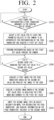
- FIG. 2 is a flow chart illustrating a method of controlling the cooking device 100 according to one or more embodiments of the disclosure.
- the cooking device 100 may maintain the current operation, and identify again whether the first event occurred until the first event occurs in operation S210. In contrast, if the first event is identified in operation S210-Y, the cooking device 100 may adjust a set value for at least one parameter related to the camera 110 to be appropriate for the photographing of the food ingredient, and acquire a first set value in operation S220.
- the first set value for the at least one parameter means a set value that was initially acquired by performing a parameter stabilizing operation, i.e., the initial set value.
- the cooking device 100 may perform a cooking operation in response to occurrence of the first event.
- the cooking device 100 may perform a cooking operation based on a user input that was separately input before the occurrence of the first event or after the occurrence of the first event.
- the cooking device 100 may perform a predetermined cooking operation in response to identification of the first event.
- the first event is a case wherein it is detected that a door included in the cooking device 100 was closed, the cooking device 100 may perform a predetermined cooking operation based on a separate user input for performing the cooking operation.
- the cooking device 100 may store the acquired first set value in a memory 120. This is for acquiring a second image by post-processing the first image by using the first set value, as will be described below.
- the cooking device 100 may identify whether a second event for changing the first set value to a second set value occurred in operation S240.
- the second event is a term for generally referring to situations wherein it is necessary to adjust the set value for the at least one parameter to be appropriate for photographing of the food ingredient. That is, while a cooking operation is being performed, various factors such as the color of the food ingredient, the focal distance from the food ingredient, the illumination around the cooking device 100, etc. may change, and in this case, the cooking device 100 may acquire a new set value according to the parameter stabilizing operation.
- the second event may include at least one of a case wherein it is identified that the color of the food ingredient changed while the parameter stabilizing operation according to the disclosure is being performed, a case wherein it is detected that the illumination around the cooking device 100 changed through the at least one sensor 150 while the parameter stabilizing operation is being performed, or a case wherein a user input requesting an image for the food ingredient is received while the parameter stabilizing operation is not being performed.
- the cooking device 100 may acquire the first image for the food ingredient based on the second set value which is a set value adjusted from the set value for the at least one parameter to be appropriate for the photographing of the current food ingredient.
- the first image is an image acquired based on the second set value appropriate for the photographing of the current food ingredient, and it may be an image appropriate for a case wherein information on the current cooking state is provided to the user.
- the cooking device 100 may acquire the second image wherein the second set value used in acquiring the first image was changed to the first set value in operation S260. Specifically, the cooking device 100 may acquire the second image by performing post-processing for the first image, or acquire the second image by using a neural network model for post-processing of an image.
- the second image is an image that was acquired by changing the set value of the first image to the first set value which is the initial set value, and refers to an image for being input into an object recognition model. That is, in object recognition, it would be easy in terms of the object recognition rate to use the second image having the first set value which is the initial set value rather than the first image which can clearly indicate the state of the current food ingredient, and thus the cooking device 100 may not input the first image into the object recognition model, but input the second image having the initial set value into the object recognition model.
- the cooking device 100 may acquire the second image by changing the second set value to the first set value in data for the first image. For example, in a case where the first set value includes the feature that the r gain value of the white balance is 20, and the second set value includes the feature that the r gain value of the white balance is 23, the cooking device 100 may subtract the r gain value of the second set value from the data for the first image as much as 3, and may thereby acquire the second image wherein the second set value was changed to the first set value in the data for the first image.
- FIG. 3 is a flow chart for illustrating an embodiment evaluating whether a parameter stabilizing operation was activated according to the disclosure.
- the cooking device 100 may identify whether the first event for photographing a food ingredient arranged in the cooking device 100 occurred in operation S310. Then, if the first event is identified in operation S310-Y, the cooking device 100 may adjust a set value for at least one parameter related to the camera 110 to be appropriate for photographing of the food ingredient and acquire the first set value in operation S315. As the process of identifying whether the first event occurred and the parameter stabilizing operation were described above with reference to FIG. 2 , overlapping explanation regarding the same content will be omitted.
- the cooking device 100 may fix the set value for the at least one parameter to the first set value in operation S320. Then, the cooking device 100 may perform photographing based on the first set value through the camera 110 in operation S325. In other words, if the first set value which is the initial set value is acquired as a result of the parameter stabilizing operation being performed, the cooking device 100 may stop the parameter stabilizing operation, and perform photographing based on the first set value.
- the cooking device 100 may perform the parameter stabilizing operation again and acquire the second set value, and provide an image acquired based on the second set value to the user.
- the cooking device 100 may acquire the second image for the food ingredient based on the fixed first set value in a state wherein the parameter stabilizing operation was stopped, and perform object recognition by using the second image.
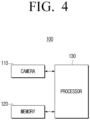
- FIG. 4 is a block diagram schematically illustrating a configuration of the cooking device 100 according to one or more embodiments of the disclosure.
- FIG. 5 is a block diagram illustrating a plurality of modules according to one or more embodiments of the disclosure.
- the camera 110 may acquire an image for at least one object.
- the camera 110 may include an image sensor, and the image sensor may convert light that comes in through a lens into an electric image signal.
- the processor 130 may acquire an image for a food ingredient through the camera 110. Specifically, the processor 130 may acquire the second image for a food ingredient based on the first set value for the at least one parameter. Also, the processor 130 may acquire the first image for a food ingredient based on the second set value for the at least one parameter.
- the memory 120 At least one instruction regarding the cooking device 100 may be stored. Also, in the memory 120, an operating system (O/S) for driving the cooking device 100 may be stored. In addition, in the memory 120, various kinds of software programs or applications for the cooking device 100 to operate according to the various embodiments of the disclosure may be stored. Further, the memory 120 may include a semiconductor memory such as a flash memory or a magnetic storage medium such as a hard disk.
- O/S operating system
- various kinds of software programs or applications for the cooking device 100 to operate according to the various embodiments of the disclosure may be stored. Further, the memory 120 may include a semiconductor memory such as a flash memory or a magnetic storage medium such as a hard disk.
- various kinds of software modules for the cooking device 100 to operate according to the various embodiments of the disclosure may be stored, and the processor 130 may control the operations of the cooking device 100 by executing the various kinds of software modules stored in the memory 120. That is, the memory 120 may be accessed by the processor 130, and reading/recording/correction/deletion/update, etc. of data by the processor 130 may be performed.
- the term memory 120 may be used as meaning including the memory 120, a ROM and a RAM inside the processor 130, or a memory card installed on the cooking device 100 (e.g., a micro SD card, a memory stick).
- various kinds of necessary information within a range for achieving the purpose of the disclosure may be stored in the memory 120, and the information stored in the memory 120 may be updated as it is received from an external device or input by the user.
- the processor 130 controls the overall operations of the cooking device 100.
- the processor 130 may be connected with the components of the cooking device 100 including the camera 110 and the memory 120, and may control the overall operations of the cooking device 100 by executing the at least one instruction stored in the memory 120 as described above.
- the processor 130 may be implemented in various methods.
- the processor 130 may be implemented as at least one of an application specific integrated circuit (ASIC), an embedded processor, a microprocessor, a hardware control logic, a hardware finite state machine (FSM), or a digital signal processor (DSP).
- ASIC application specific integrated circuit
- FSM hardware finite state machine
- DSP digital signal processor
- the term processor 130 may be used as meaning including a central processing unit (CPU), a graphic processing unit (GPU), and a microprocessor unit (MPU), etc.
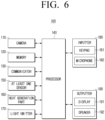
- FIG. 6 is a block diagram illustrating in detail a configuration of the cooking device 100 according to one or more embodiments of the disclosure.
- the cooking device 100 may further include a communicator 140, at least one sensor 150, a heat generation part 160, a light emitter 170, an inputter 180, and an outputter 190.
- a communicator 140 the components as illustrated in FIG. 4 and FIG. 6 are merely exemplary ones, and in carrying out the disclosure, it is obvious that new components can be added in addition to the components as illustrated in FIG. 4 and FIG. 6 , or some components can be omitted.
- the communicator 140 may include a circuit, and perform communication with an external device.
- the processor 130 may receive various kinds of data or information from an external device connected through the communicator 140, and transmit various kinds of data or information to the external device.
- the communicator 140 may include at least one of a WiFi module, a Bluetooth module, a wireless communication module, an NFC module, or a ultra wide band (UWB) module.
- a WiFi module and a Bluetooth module may perform communication by a WiFi method and a Bluetooth method, respectively.
- various types of connection information such as an SSID, etc. is transmitted and received first, and connection of communication is performed by using the information, and various types of information can be transmitted and received thereafter.
- a wireless communication module may perform communication according to various communication standards such as IEEE, Zigbee, 3rd Generation (3G), 3rd Generation Partnership Project (3GPP), Long Term Evolution (LTE), 5th Generation (5G), etc.
- an NFC module may perform communication by a near field communication (NFC) method of using a 13.56MHz band among various RF-ID frequency bands such as 135kHz, 13.56MHz, 433MHz, 860 - 960MHz, and 2.45GHz.
- NFC near field communication
- a UWB module may correctly measure a Time of Arrival (ToA) which is the time when a pulse reaches a target, and an Angle of Arrival (AoA) which is a pulse arrival angle in a transmission device through communication between UWB antennas, and accordingly, the UWB module can perform correct distance and location recognition in an error range of within scores of cm indoors.
- ToA Time of Arrival
- AoA Angle of Arrival
- the processor 130 may detect opening or closing of the door included in the cooking device 100 through the door sensor. Then, if it is detected that the door was closed through the door sensor, the processor 130 may identify that the first event occurred, and if it is detected that the door was opened through the door sensor, the processor 130 may detect that the cooking operation was stopped.
- the processor 130 may detect whether a food ingredient is arranged in the cooking device 100 through the weight detection sensor. Then, if it is detected that a food ingredient is arranged in the cooking device 100 through the weight detection sensor, the processor 130 may identify that the first event occurred.
- the processor 130 may detect the illumination around the cooking device 100 through the illumination sensor while the parameter stabilizing operation is being performed. Then, if it is detected that the illumination around the cooking device 100 was changed through the illumination sensor, the processor 130 may change the set value for the at least one parameter based on the changed illumination.
- the processor 130 may receive a user input for performing a cooking operation, a user input for setting the time when the cooking operation is performed, a user input for finishing the cooking operation, a user input for requesting an image for a food ingredient, etc. through the inputter 180.
- the outputter 190 may include a circuit, and the processor 130 may output various functions that can be performed by the cooking device 100 through the outputter 190. Also, the outputter 190 may include at least one of a display 191, a speaker 192, or an indicator.
- the display 191 may output image data by control by the processor 130. Specifically, the display 191 may output an image stored in advance in the memory 120 by control by the processor 130.
- a system may include the cooking device 100, a server 200, and a user terminal 300.
- the server 200 may include the image acquisition model.
- the cooking device 100 may control the communicator to transmit the first set value which the initial set value for the at least one parameter, the second set value which is the current set value, and the data for the first image to the server 200.
- the server 200 may input the first set value, the second set value, and the data for the first image into the trained image acquisition model, and acquire the second image wherein the second set value used in acquiring the first image was changed to the first set value, and transmit the image to the cooking device 100.
- the server 200 may include an object recognition model.
- the cooking device 100 may control the communicator to transmit data for the second image to the server 200.
- the server 200 may input the data for the second image into the object recognition model, and acquire information on a food ingredient included in the second image.
- the cooking device 100 may control the communicator to transmit the first image to the user terminal 300. Then, when the first image is received, the user terminal 300 may output the first image through the display of the user terminal 300.
- the user terminal 300 may receive a user input for performing a cooking operation, a user input for setting the time when the cooking operation is performed, a user input for finishing the cooking operation, a user input for requesting an image for a food ingredient, etc., and transmit the received user input to the cooking device 100.
- the controlling method of the cooking device 100 may be implemented as a program and provided to the cooking device 100.
- a program including the controlling method of the cooking device 100 may be provided while being stored in a non-transitory computer readable medium.
- the controlling method of the cooking device 100 includes the operations of, based on identifying a first event for photographing a food ingredient arranged in the cooking device 100, adjusting a set value for at least one parameter related to the camera of the cooking device 100 to be appropriate for photographing of the food ingredient and acquiring a first set value, based on identifying a second event for changing the first set value to a second set value while the photographing is being performed based on the first set value through the camera, acquiring a first image for the food ingredient based on the second set value and providing the image to a user, acquiring a second image wherein the second set value used in acquiring the first image was changed to the first set value, and inputting the second image into an object recognition model for recognizing the food ingredient, and acquiring information on the food ingredient included in the second image.
- the cooking device 100 can acquire an image for a food ingredient while a cooking process is being performed and perform recognition for the food ingredient at a high recognition rate, and at the same time, provide an image including clear information on the food ingredient to the user.
- Functions related to artificial intelligence according to the disclosure are operated through the processor 130 and the memory of the cooking device 100.
- the processor 130 may consist of one or a plurality of processors 130.
- the one or plurality of processors 130 may include at least one of a central processing unit (CPU), a graphic processing unit (GPU), or a neural processing unit (NPU), but are not limited to the aforementioned examples of the processor 130.
- CPU central processing unit
- GPU graphic processing unit
- NPU neural processing unit
- a GPU is a processor 130 for mass operations such as a floating point operation used for graphic processing, etc., and it can perform mass operations in parallel by massively integrating cores.
- a GPU may be advantageous for a parallel processing method such as a convolution operation, etc. compared to a CPU.
- a GPU may be used as a co-processor 130 for supplementing the function of a CPU.
- the processor 130 for mass operations is not limited to the aforementioned examples excluding cases wherein it is specified as the aforementioned GPU.
- An NPU is a processor 130 specialized for an artificial intelligence operation using an artificial neural network, and it can implement each layer constituting an artificial neural network as hardware (e.g., silicon).
- the NPU is designed to be specialized according to the required specification of a company, and thus it has a lower degree of freedom compared to a CPU or a GPU, but it can effectively process an artificial intelligence operation required by the company.
- the processor 130 specialized for an artificial intelligence operation an NPU may be implemented in various forms such as a tensor processing unit (TPU), an intelligence processing unit (IPU), a vision processing unit (VPU), etc.
- the artificial intelligence processor 130 is not limited to the aforementioned examples excluding cases wherein it is specified as the aforementioned NPU.
- the one or plurality of processors 130 may be implemented as a system on chip (SoC).
- SoC may further include a memory, and a network interface such as a bus, etc. for data communication between the processor 130 and the memory other than the one or plurality of processors 130.
- the cooking device 100 may perform an operation related to artificial intelligence (e.g., an operation related to learning or inference of an artificial intelligence model) by using some processors 130 among the plurality of processors 130.
- the cooking device 100 may perform an operation related to artificial intelligence by using at least one of a GPU, an NPU, a VPU, a TPU, or a hardware accelerator specialized for artificial intelligence operations such as a convolution operation, a matrix product operation, etc. among the plurality of processors 130.
- the cooking device 100 can process an operation related to artificial intelligence by using the generic-purpose processor 130 such as a CPU, etc.
- the cooking device 100 may perform an operation related to artificial intelligence by using a multicore (e.g., a dual core, a quad core, etc.) included in one processor 130.
- a multicore e.g., a dual core, a quad core, etc.
- the cooking device 100 may perform artificial intelligence operations such as a convolution operation, a matrix product operation, etc. in parallel by using multicores included in the processor 130.
- the one or plurality of processors 130 perform control to process input data according to pre-defined operation rules or an artificial intelligence model stored in the memory.
- the predefined operation rules or the artificial intelligence model are characterized in that they are made through learning.
- being made through learning means that predefined operation rules or an artificial intelligence model having desired characteristics are made by applying a learning algorithm to a plurality of learning data.
- Such learning may be performed in a device itself wherein artificial intelligence is performed according to the disclosure, or performed through a separate server/system.
- a storage medium that is readable by machines may be provided in the form of a non-transitory storage medium.
- a non-transitory storage medium only means that the storage medium is a tangible device, and does not include signals (e.g.: electromagnetic waves), and the term does not distinguish a case wherein data is stored in the storage medium semi-permanently and a case wherein data is stored in the storage medium temporarily.
- signals e.g.: electromagnetic waves
- a non-transitory storage medium may include a buffer wherein data is stored temporarily.
- the method according to the various embodiments described in the disclosure may be provided while being included in a computer program product.
- a computer program product refers to a product, and it can be traded between a seller and a buyer.
- a computer program product can be distributed in the form of a storage medium that is readable by machines (e.g., a compact disc read only memory (CD-ROM)), or may be distributed directly between two user devices (e.g., smartphones), and distributed on-line (e.g.: download or upload) through an application store (e.g., Play Store TM ).
- CD-ROM compact disc read only memory
- At least a portion of a computer program product may be stored in a machine-readable storage medium such as the server of the manufacturer, the server of the application store, and the memory of the relay server at least temporarily, or may be generated temporarily.
- each of the components may consist of a singular object or a plurality of objects.
- some sub components may be omitted, or other sub components may be further included in the various embodiments.
- some components e.g., a module or a program
- a part or “a module” used in the disclosure may include a unit implemented as hardware, software, or firmware, and may be interchangeably used with, for example, terms such as a logic, a logical block, a component, or a circuit.
- a part or “a module” may be a component constituted as an integrated body or a minimum unit or a part thereof performing one or more functions.
- a module may be constituted as an application-specific integrated circuit (ASIC).
- ASIC application-specific integrated circuit
- the various embodiments of the disclosure may be implemented as software including instructions stored in machine-readable storage media, which can be read by machines (e.g., computers).
- the machines refer to devices that call instructions stored in a storage medium, and can operate according to the called instructions, and the devices may include an electronic device according to the aforementioned embodiments (e.g., the cooking device 100).
Landscapes
- Engineering & Computer Science (AREA)
- Multimedia (AREA)
- Physics & Mathematics (AREA)
- General Physics & Mathematics (AREA)
- Theoretical Computer Science (AREA)
- Chemical & Material Sciences (AREA)
- Combustion & Propulsion (AREA)
- Mechanical Engineering (AREA)
- General Engineering & Computer Science (AREA)
- Signal Processing (AREA)
- Human Computer Interaction (AREA)
- Computer Vision & Pattern Recognition (AREA)
- Spectroscopy & Molecular Physics (AREA)
- Health & Medical Sciences (AREA)
- Artificial Intelligence (AREA)
- Computing Systems (AREA)
- Databases & Information Systems (AREA)
- Evolutionary Computation (AREA)
- General Health & Medical Sciences (AREA)
- Medical Informatics (AREA)
- Software Systems (AREA)
- Electric Ovens (AREA)
- General Preparation And Processing Of Foods (AREA)
- Cookers (AREA)
Applications Claiming Priority (2)
| Application Number | Priority Date | Filing Date | Title |
|---|---|---|---|
| KR1020220125712A KR20240045864A (ko) | 2022-09-30 | 2022-09-30 | 조리 기기 및 이의 제어 방법 |
| PCT/KR2023/011691 WO2024071655A1 (fr) | 2022-09-30 | 2023-08-08 | Appareil de cuisson et son procédé de commande |
Publications (2)
| Publication Number | Publication Date |
|---|---|
| EP4538599A1 true EP4538599A1 (fr) | 2025-04-16 |
| EP4538599A4 EP4538599A4 (fr) | 2025-10-08 |
Family
ID=90478304
Family Applications (1)
| Application Number | Title | Priority Date | Filing Date |
|---|---|---|---|
| EP23872778.8A Pending EP4538599A4 (fr) | 2022-09-30 | 2023-08-08 | Appareil de cuisson et son procédé de commande |
Country Status (5)
| Country | Link |
|---|---|
| US (1) | US12407795B2 (fr) |
| EP (1) | EP4538599A4 (fr) |
| KR (1) | KR20240045864A (fr) |
| CN (1) | CN119866418A (fr) |
| WO (1) | WO2024071655A1 (fr) |
Families Citing this family (1)
| Publication number | Priority date | Publication date | Assignee | Title |
|---|---|---|---|---|
| US20240093874A1 (en) * | 2022-09-15 | 2024-03-21 | Samsung Electronics Co., Ltd. | Cooking device |
Family Cites Families (20)
| Publication number | Priority date | Publication date | Assignee | Title |
|---|---|---|---|---|
| JP2013214194A (ja) * | 2012-04-02 | 2013-10-17 | Sharp Corp | レシピ提供システム |
| US11156366B2 (en) | 2015-09-10 | 2021-10-26 | Brava Home, Inc. | Dynamic heat adjustment of a spectral power distribution configurable cooking instrument |
| US11388788B2 (en) * | 2015-09-10 | 2022-07-12 | Brava Home, Inc. | In-oven camera and computer vision systems and methods |
| KR20180083167A (ko) * | 2017-01-12 | 2018-07-20 | 엘지전자 주식회사 | 조리 기기 및 그를 포함하는 조리 시스템 |
| KR102329592B1 (ko) * | 2017-12-30 | 2021-11-19 | 미디어 그룹 코 엘티디 | 재료 인식을 기반으로 하는 음식 준비 방법 및 시스템 |
| US20190285283A1 (en) | 2018-03-14 | 2019-09-19 | Whirlpool Corporation | Cooking appliance with an imaging device |
| CN111345699B (zh) | 2018-12-20 | 2022-06-28 | 九阳股份有限公司 | 一种烹饪设备的控制方法和烹饪设备 |
| US20220273139A1 (en) * | 2019-05-17 | 2022-09-01 | Samarth Mahapatra | System and Method for Optimal Food Cooking or Heating Operations |
| DE102019113281A1 (de) * | 2019-05-20 | 2020-11-26 | Miele & Cie. Kg | Belichtungsregelung von Gargütern |
| KR102756648B1 (ko) * | 2019-08-26 | 2025-01-20 | 엘지전자 주식회사 | 인공지능 기반 조리 제어 방법 및 지능형 디바이스 |
| EP3811832B1 (fr) | 2019-08-30 | 2024-11-20 | LG Electronics Inc. | Dispositif de cuisson équipé d'une caméra |
| KR102756877B1 (ko) | 2019-12-12 | 2025-01-17 | 엘지전자 주식회사 | 조리장치 및 조리장치 제어방법 |
| AU2021340635B2 (en) * | 2020-09-08 | 2024-11-21 | June Life, Inc. | System and method for individual heating element control |
| KR20220041611A (ko) | 2020-09-25 | 2022-04-01 | 삼성전자주식회사 | 조리 장치 및 그 제어 방법 |
| US12223663B2 (en) * | 2020-10-30 | 2025-02-11 | Qualcomm Incorporated | Frame processing and/or capture instruction systems and techniques |
| KR20220059726A (ko) | 2020-11-03 | 2022-05-10 | 엘지전자 주식회사 | 조리 기기 및 그의 동작 방법 |
| US12070156B2 (en) * | 2021-03-19 | 2024-08-27 | Haier Us Appliance Solutions, Inc. | System and method for detecting food items and managing cooking timers on a cooktop appliance |
| CN113729500A (zh) | 2021-08-26 | 2021-12-03 | 深圳数影科技有限公司 | 烹饪设备的控制方法、烹饪设备、控制装置与存储介质 |
| CN215734964U (zh) | 2021-09-16 | 2022-02-01 | 宁波方太厨具有限公司 | 烹饪电器及其照明装置 |
| US12256151B2 (en) * | 2022-03-25 | 2025-03-18 | Google Llc | Methods and systems for user adjustable region based brightness settings |
-
2022
- 2022-09-30 KR KR1020220125712A patent/KR20240045864A/ko active Pending
-
2023
- 2023-08-08 CN CN202380065635.7A patent/CN119866418A/zh active Pending
- 2023-08-08 WO PCT/KR2023/011691 patent/WO2024071655A1/fr not_active Ceased
- 2023-08-08 EP EP23872778.8A patent/EP4538599A4/fr active Pending
-
2024
- 2024-04-10 US US18/631,880 patent/US12407795B2/en active Active
Also Published As
| Publication number | Publication date |
|---|---|
| KR20240045864A (ko) | 2024-04-08 |
| WO2024071655A1 (fr) | 2024-04-04 |
| CN119866418A (zh) | 2025-04-22 |
| EP4538599A4 (fr) | 2025-10-08 |
| US12407795B2 (en) | 2025-09-02 |
| US20240259535A1 (en) | 2024-08-01 |
Similar Documents
| Publication | Publication Date | Title |
|---|---|---|
| US10967146B2 (en) | Control method and apparatus for managing sleep environment | |
| CN112470171A (zh) | 选择用于有监督机器学习问题的神经网络架构 | |
| US12223411B2 (en) | Electronic apparatus and method of controlling thereof | |
| US20240259535A1 (en) | Cooking device and controlling method thereof | |
| US9183709B2 (en) | Wearable device as an ambient information display | |
| US12175362B2 (en) | Electronic apparatus and method of controlling thereof | |
| US20220316731A1 (en) | Electronic apparatus and method for controlling thereof | |
| CN109725719A (zh) | 设备控制方法、装置及电子设备、存储介质 | |
| US12105780B2 (en) | Electronic apparatus and control method thereof | |
| CN111989917A (zh) | 电子设备及其控制方法 | |
| US20240212649A1 (en) | Electronic apparatus and controlling method thereof | |
| KR20210121910A (ko) | 전자 장치 및 그 제어 방법 | |
| KR20240028225A (ko) | 로봇 및 로봇의 제어 방법 | |
| KR20240008746A (ko) | 전자 장치 및 전자 장치의 제어 방법 | |
| US11196400B2 (en) | Method for controlling equalizer based on artificial intelligence | |
| KR20230109209A (ko) | 육류 숙성 기능을 갖는 냉장고 및 그 제어 방법 | |
| KR20200051540A (ko) | 서버 및 그것의 동작 방법 | |
| US12067754B2 (en) | Electronic device and method of inferring object in image | |
| US20250231729A1 (en) | Electronic device and method for controlling electronic device | |
| US20250213180A1 (en) | Electronic device and controlling method of electronic device | |
| CN121844552A (zh) | 电子设备和控制电子设备的方法 | |
| EP4524741A1 (fr) | Dispositif électronique et procédé de commande de dispositif électronique | |
| KR20250165506A (ko) | 조리 기기 및 이의 제어 방법 | |
| KR20250033827A (ko) | 전자 장치 및 전자 장치의 제어 방법 | |
| US20260100030A1 (en) | Electronic apparatus and control method thereof |
Legal Events
| Date | Code | Title | Description |
|---|---|---|---|
| STAA | Information on the status of an ep patent application or granted ep patent |
Free format text: STATUS: THE INTERNATIONAL PUBLICATION HAS BEEN MADE |
|
| PUAI | Public reference made under article 153(3) epc to a published international application that has entered the european phase |
Free format text: ORIGINAL CODE: 0009012 |
|
| STAA | Information on the status of an ep patent application or granted ep patent |
Free format text: STATUS: REQUEST FOR EXAMINATION WAS MADE |
|
| 17P | Request for examination filed |
Effective date: 20250110 |
|
| AK | Designated contracting states |
Kind code of ref document: A1 Designated state(s): AL AT BE BG CH CY CZ DE DK EE ES FI FR GB GR HR HU IE IS IT LI LT LU LV MC ME MK MT NL NO PL PT RO RS SE SI SK SM TR |
|
| A4 | Supplementary search report drawn up and despatched |
Effective date: 20250908 |
|
| RIC1 | Information provided on ipc code assigned before grant |
Ipc: F24C 7/08 20060101AFI20250902BHEP Ipc: F24C 15/00 20060101ALI20250902BHEP Ipc: H04N 23/62 20230101ALI20250902BHEP Ipc: G06V 20/68 20220101ALI20250902BHEP Ipc: G06V 10/14 20220101ALI20250902BHEP Ipc: G06V 10/141 20220101ALI20250902BHEP Ipc: G06V 10/80 20220101ALI20250902BHEP Ipc: G01J 1/02 20060101ALI20250902BHEP Ipc: H04N 7/18 20060101ALI20250902BHEP Ipc: H04N 23/60 20230101ALI20250902BHEP Ipc: G06V 10/56 20220101ALI20250902BHEP |
|
| DAV | Request for validation of the european patent (deleted) | ||
| DAX | Request for extension of the european patent (deleted) |