EP4538863A1 - Dispositif électronique pour compiler des fichiers sur la base d'événements désignés, et procédé associé - Google Patents
Dispositif électronique pour compiler des fichiers sur la base d'événements désignés, et procédé associé Download PDFInfo
- Publication number
- EP4538863A1 EP4538863A1 EP23852728.7A EP23852728A EP4538863A1 EP 4538863 A1 EP4538863 A1 EP 4538863A1 EP 23852728 A EP23852728 A EP 23852728A EP 4538863 A1 EP4538863 A1 EP 4538863A1
- Authority
- EP
- European Patent Office
- Prior art keywords
- file
- electronic device
- application
- processor
- preset event
- Prior art date
- Legal status (The legal status is an assumption and is not a legal conclusion. Google has not performed a legal analysis and makes no representation as to the accuracy of the status listed.)
- Pending
Links
Images



Classifications
-
- G—PHYSICS
- G06—COMPUTING OR CALCULATING; COUNTING
- G06F—ELECTRIC DIGITAL DATA PROCESSING
- G06F8/00—Arrangements for software engineering
- G06F8/40—Transformation of program code
- G06F8/41—Compilation
-
- G—PHYSICS
- G06—COMPUTING OR CALCULATING; COUNTING
- G06F—ELECTRIC DIGITAL DATA PROCESSING
- G06F11/00—Error detection; Error correction; Monitoring
- G06F11/07—Responding to the occurrence of a fault, e.g. fault tolerance
- G06F11/0703—Error or fault processing not based on redundancy, i.e. by taking additional measures to deal with the error or fault not making use of redundancy in operation, in hardware, or in data representation
- G06F11/0793—Remedial or corrective actions
-
- G—PHYSICS
- G06—COMPUTING OR CALCULATING; COUNTING
- G06F—ELECTRIC DIGITAL DATA PROCESSING
- G06F9/00—Arrangements for program control, e.g. control units
- G06F9/06—Arrangements for program control, e.g. control units using stored programs, i.e. using an internal store of processing equipment to receive or retain programs
- G06F9/46—Multiprogramming arrangements
- G06F9/48—Program initiating; Program switching, e.g. by interrupt
-
- G—PHYSICS
- G06—COMPUTING OR CALCULATING; COUNTING
- G06F—ELECTRIC DIGITAL DATA PROCESSING
- G06F9/00—Arrangements for program control, e.g. control units
- G06F9/06—Arrangements for program control, e.g. control units using stored programs, i.e. using an internal store of processing equipment to receive or retain programs
- G06F9/46—Multiprogramming arrangements
- G06F9/54—Interprogram communication
-
- G—PHYSICS
- G06—COMPUTING OR CALCULATING; COUNTING
- G06F—ELECTRIC DIGITAL DATA PROCESSING
- G06F9/00—Arrangements for program control, e.g. control units
- G06F9/06—Arrangements for program control, e.g. control units using stored programs, i.e. using an internal store of processing equipment to receive or retain programs
- G06F9/46—Multiprogramming arrangements
- G06F9/54—Interprogram communication
- G06F9/542—Event management; Broadcasting; Multicasting; Notifications
-
- G—PHYSICS
- G06—COMPUTING OR CALCULATING; COUNTING
- G06F—ELECTRIC DIGITAL DATA PROCESSING
- G06F9/00—Arrangements for program control, e.g. control units
- G06F9/06—Arrangements for program control, e.g. control units using stored programs, i.e. using an internal store of processing equipment to receive or retain programs
- G06F9/44—Arrangements for executing specific programs
- G06F9/4401—Bootstrapping
Definitions
- the following descriptions relate to an electronic device for compiling files on basis of designated events, and a method therefor.
- an electronic device may include a processor, and memory for storing instructions.
- the processor to drive the instructions in a first type, when the instructions stored in the memory are executed, may detect a preset event to cause termination of an application executed by the processor.
- the processor may identify, in response to detecting the preset event, the number that the preset event occurred based on execution of the application.
- the processor based on the identified number, may obtain a binary file associated with execution of the application by compiling a non-binary file that corresponds to instructions in the first type associated with the preset event and includes instructions in a second type different from the first type.
- the processor 120 may execute, for example, software (e.g., a program 140) to control at least one other component (e.g., a hardware or software component) of the electronic device 101 coupled with the processor 120, and may perform various data processing or computation.
- the processor 120 may store a command or data received from another component (e.g., the sensor module 176 or the communication module 190) in volatile memory 132, process the command or the data stored in the volatile memory 132, and store resulting data in non-volatile memory 134.
- the processor 120 may include a main processor 121 (e.g., a central processing unit (CPU) or an application processor (AP)), or an auxiliary processor 123 (e.g., a graphics processing unit (GPU), a neural processing unit (NPU), an image signal processor (ISP), a sensor hub processor, or a communication processor (CP)) that is operable independently from, or in conjunction with, the main processor 121.
- a main processor 121 e.g., a central processing unit (CPU) or an application processor (AP)
- auxiliary processor 123 e.g., a graphics processing unit (GPU), a neural processing unit (NPU), an image signal processor (ISP), a sensor hub processor, or a communication processor (CP)
- the main processor 121 may be adapted to consume less power than the main processor 121, or to be specific to a specified function.
- the auxiliary processor 123 may be implemented as separate from, or as part of the main processor 121.
- the auxiliary processor 123 may include a hardware structure specified for artificial intelligence model processing.
- An artificial intelligence model may be generated by machine learning. Such learning may be performed, e.g., by the electronic device 101 where the artificial intelligence is performed or via a separate server (e.g., the server 108). Learning algorithms may include, but are not limited to, e.g., supervised learning, unsupervised learning, semi-supervised learning, or reinforcement learning.
- the artificial intelligence model may include a plurality of artificial neural network layers.
- the artificial neural network may be a deep neural network (DNN), a convolutional neural network (CNN), a recurrent neural network (RNN), a restricted boltzmann machine (RBM), a deep belief network (DBN), a bidirectional recurrent deep neural network (BRDNN), deep Q-network or a combination of two or more thereof but is not limited thereto.
- the artificial intelligence model may, additionally or alternatively, include a software structure other than the hardware structure.
- the audio module 170 may convert a sound into an electrical signal and vice versa. According to an embodiment, the audio module 170 may obtain the sound via the input module 150, or output the sound via the sound output module 155 or a headphone of an external electronic device (e.g., an electronic device 102) directly (e.g., wiredly) or wirelessly coupled with the electronic device 101.
- an external electronic device e.g., an electronic device 102
- directly e.g., wiredly
- wirelessly e.g., wirelessly
- the sensor module 176 may detect an operational state (e.g., power or temperature) of the electronic device 101 or an environmental state (e.g., a state of a user) external to the electronic device 101, and then generate an electrical signal or data value corresponding to the detected state.
- the sensor module 176 may include, for example, a gesture sensor, a gyro sensor, an atmospheric pressure sensor, a magnetic sensor, an acceleration sensor, a grip sensor, a proximity sensor, a color sensor, an infrared (IR) sensor, a biometric sensor, a temperature sensor, a humidity sensor, or an illuminance sensor.
- the haptic module 179 may convert an electrical signal into a mechanical stimulus (e.g., a vibration or a movement) or electrical stimulus which may be recognized by a user via his tactile sensation or kinesthetic sensation.
- the haptic module 179 may include, for example, a motor, a piezoelectric element, or an electric stimulator.
- the communication module 190 may support establishing a direct (e.g., wired) communication channel or a wireless communication channel between the electronic device 101 and the external electronic device (e.g., the electronic device 102, the electronic device 104, or the server 108) and performing communication via the established communication channel.
- the communication module 190 may include one or more communication processors that are operable independently from the processor 120 (e.g., the application processor (AP)) and supports a direct (e.g., wired) communication or a wireless communication.
- AP application processor
- a corresponding one of these communication modules may communicate with the external electronic device via the first network 198 (e.g., a short-range communication network, such as Bluetooth TM , wireless-fidelity (Wi-Fi) direct, or infrared data association (IrDA)) or the second network 199 (e.g., a long-range communication network, such as a legacy cellular network, a 5G network, a next-generation communication network, the Internet, or a computer network (e.g., LAN or wide area network (WAN)).
- first network 198 e.g., a short-range communication network, such as Bluetooth TM , wireless-fidelity (Wi-Fi) direct, or infrared data association (IrDA)
- the second network 199 e.g., a long-range communication network, such as a legacy cellular network, a 5G network, a next-generation communication network, the Internet, or a computer network (e.g., LAN or wide area network (WAN)).
- the wireless communication module 192 may support a peak data rate (e.g., 20Gbps or more) for implementing eMBB, loss coverage (e.g., 164dB or less) for implementing mMTC, or U-plane latency (e.g., 0.5ms or less for each of downlink (DL) and uplink (UL), or a round trip of 1ms or less) for implementing URLLC.
- a peak data rate e.g., 20Gbps or more
- loss coverage e.g., 164dB or less
- U-plane latency e.g., 0.5ms or less for each of downlink (DL) and uplink (UL), or a round trip of 1ms or less
- the antenna module 197 may transmit or receive a signal or power to or from the outside (e.g., the external electronic device) of the electronic device 101.
- the antenna module 197 may include an antenna including a radiating element composed of a conductive material or a conductive pattern formed in or on a substrate (e.g., a printed circuit board (PCB)).
- the antenna module 197 may include a plurality of antennas (e.g., array antennas). In such a case, at least one antenna appropriate for a communication scheme used in the communication network, such as the first network 198 or the second network 199, may be selected, for example, by the communication module 190 (e.g., the wireless communication module 192) from the plurality of antennas.
- the signal or the power may then be transmitted or received between the communication module 190 and the external electronic device via the selected at least one antenna.
- another component e.g., a radio frequency integrated circuit (RFIC)
- RFIC radio frequency integrated circuit
- the electronic device may be one of various types of electronic devices.
- the electronic devices may include, for example, a portable communication device (e.g., a smartphone), a computer device, a portable multimedia device, a portable medical device, a camera, a wearable device, or a home appliance. According to an embodiment of the disclosure, the electronic devices are not limited to those described above.
- each of such phrases as “A or B,” “at least one of A and B,” “at least one of A or B,” “A, B, or C,” “at least one of A, B, and C,” and “at least one of A, B, or C,” may include any one of or all possible combinations of the items enumerated together in a corresponding one of the phrases.
- such terms as “1st” and “2nd,” or “first” and “second” may be used to simply distinguish a corresponding component from another, and does not limit the components in other aspect (e.g., importance or order).
- an element e.g., a first element
- operatively or “communicatively”, as “coupled with,” or “connected with” another element
- the element may be coupled with the other element directly (e.g., wiredly), wirelessly, or via a third element.
- a method may be included and provided in a computer program product.
- the computer program product may be traded as a product between a seller and a buyer.
- the computer program product may be distributed in the form of a machine-readable storage medium (e.g., compact disc read only memory (CD-ROM)), or be distributed (e.g., downloaded or uploaded) online via an application store (e.g., PlayStore TM ), or between two user devices (e.g., smart phones) directly. If distributed online, at least part of the computer program product may be temporarily generated or at least temporarily stored in the machine-readable storage medium, such as memory of the manufacturer's server, a server of the application store, or a relay server.
- CD-ROM compact disc read only memory
- an application store e.g., PlayStore TM
- two user devices e.g., smart phones
- the electronic device 101 may include at least one of storage 210, or the processor 120.
- the processor 120, and the storage 210 may be electronically and/or operably coupled with each other by an electronic component such as a communication bus.
- an electronic component such as a communication bus.
- a portion e.g., at least a portion of the processor 120, and/or the storage 210) of hardware component illustrated in FIG. 2 may be included in a single integrated circuit such as a system on a chip (SoC).
- SoC system on a chip
- a type and/or the number of the hardware component included in the electronic device 101 are not limited to those illustrated in FIG. 2 .
- the electronic device 101 may include only a portion of the hardware component illustrated in FIG. 2 .
- the processor 120, and/or the storage 210 are illustrated in a single number, but may be plural.
- the electronic device 101 may include the storage 210.
- the storage 210 may correspond to the non-volatile memory 134 of FIG. 1 .
- the storage 210 may store instructions that cause an operation of the electronic device 101.
- the processor 120 may cause the operation of the electronic device 101 when driving the instructions stored in the storage 210.
- driving the instruction may include the processor 120 invoking (or loading) at least one instruction to execute the invoked (or loaded) instruction.
- driving the instruction may include the processor 120 executing a function corresponding to the instruction by driving the instruction.
- the electronic device 101 may identify a partition formed in the storage 210.
- the partition is a unit for managing data (e.g., a file, and/or a directory) stored in the storage 210, and may be referred to as volume and/or a logical drive.
- the partition may include at least a portion of a single non-volatile memory, or may be formed by merging different portions of different non-volatile memories.
- the number of the partition formed in the storage 210 may be one or more.
- the electronic device 101 may identify an area in the partition. For example, one area of a plurality of areas formed in a first partition based on an interaction between the electronic device 101 and a user may correspond to a first directory 220 of FIG. 2 .
- the directory may be a structure for classifying files stored in the partition.
- the structure may include an uppermost directory. Other directories included in the structure may be directly or indirectly connected to the uppermost directory.
- the first directory 220 may include files that may be executed by the user of the electronic device 101.
- a file 221 may be executed by the user of electronic device 101 and executed by the processor 120.
- a second directory 230 may be included in a system partition.
- the second directory 230 may include a bootclass.
- the second directory 230 may include a system server class.
- a second file 231 included in the second directory 230 may include instructions loaded by the processor 120, based on identification of accessing a system service of the operating system (e.g., the operating system 142 of FIG. 1 ) by the at least one application when at least one of the applications included in the first directory 220 is executed, and/or accessing a resource (e.g., an application programming interface (API)) provided by the operating system.
- the processor 120 of the electronic device 101 may perform validation, update, and/or mounting of the second file 231 in the second directory 230 based on an android pony express (APEX) container format while performing boot-up of the electronic device 101.
- APEX android pony express
- the validation may be performed by a process, such as the update, and/or the mount may be performed by a process, such as an APEX module.
- the update based on the APEX container format may include updating a system component (e.g., a native service, a library, a hardware abstraction layer (HAL), and/or a class library) based on the second file 231.
- the update of the APEX container format and/or the second file 231 based on the APEX module may be limitedly performed based on the update of the APEX container format provided by the operating system of the electronic device 101, and damage to, and/or update of a package file associated with the application.
- the APEX module and/or APEX container format may include at least one of one or more resources (e.g., icon, image, and/or video), a design element (e.g., an xml file to define a layout of activity), and/or metadata (e.g., an xml file with a preset name such as manifest) required for the execution of the application.
- resources e.g., icon, image, and/or video
- a design element e.g., an xml file to define a layout of activity
- metadata e.g., an xml file with a preset name such as manifest
- the crash of the application is an event in which execution of the application by the processor 120 is stopped, and may occur in case that the processor 120 accesses to an area in which access based on the application is restricted in the memory (e.g., the volatile memory 132 of FIG. 1 ) based on the execution of the application.
- the area may include, by an operating system executed by the processor 120, one area assigned to another application different from the application, and/or the operating system.
- the crash may occur in a case that the processor 120 accesses to an area of the memory corresponding to an object that has not been initialized based on the execution of an application.
- the crash may occur in a case that a value stored in the area of the memory is changed by an unexpected operation, or in a case that the area of the memory does not have a valid address.
- the crash may occur in a case that the processor does not indicate the address assigned to the area of the memory, or the valid address.
- the electronic device 101 may perform the mount on the directories 220, 230, and 240.
- Performing the mount may include assigning text for invoking each of the directories 220, 230, and 240.
- the text may be uniquely assigned to each of the directories 220, 230, and 240.
- the text uniquely assigned to each of the directories 220, 230, and 240 may be referred to as a directory name.
- the directory name may be a connected text based on a preset text (e.g., a delimiter such as "/").
- the directory name assigned to the area may be "/data/dir212".
- the directory name assigned to the area may be "/data/dir919/dir212".
- the instructions in the second type may be configured with a source code and/or a byte code.
- the source code may include a C language, a JAVA language, and/or a basic (beginner's all-purpose symbolic instruction code).
- the instructions in the second type may refer to the instructions readable by an interpreter, and/or a first application 260, which are software executed by the processor 120, such as a byte code.
- the first application 260 may be referred to as a virtual machine application (e.g., a java virtual machine (JVM)).
- the byte code may be the instruction having a preset length (e.g., 1 byte).
- the processor 120 may identify the information included in the third file 241 through a third application 280.
- the processor 120 may compile the file associated with the first file 221 and/or the second file 231 based on the fourth application 290, based on the information identified through the third application 280.
- the fourth application 290 may include the application for compiling packages including the instructions in the second type different from the first type.
- the fourth application 290 may be referred to as an on-device refresh (odrefresh) tool.
- the file with the file extension in the form of the '.vdex' may include an uncompressed dex code in the file with the file extension in the form of the '.apk'.
- the file with the file extension in the form of the '.vdex' may include metadata to increase speed of checking whether it matches the first file 221.
- the file with the file extension in the form of the '.odex' may include a code compiled in an ahead of time (AOT) method used in a method of the file with the file extension in the form of the '.apk'.
- AOT ahead of time
- the file associated with the generation of the first file 221 may be configured with the instructions in the second type.
- the processor 120 may compile at least the portion of the file associated with the generation of the first file 221 configured with the instructions in the second type.
- the processor 120 may obtain the first file 221 including the instructions in the first type, based on compiling at least the portion of the file associated with the generation of the first file 211.
- a first file 221 of FIG. 3 may include the first file 221 of FIG. 2 .
- the first file 221 may include instructions in a first type for executing an application.
- a second file 231 of FIG. 3 may include the second file 231 of FIG. 2 .
- the second file 231 may include instructions in the first type commonly provided to applications.
- a first directory 220 of FIG. 3 may include the first directory 220 of FIG. 2 .
- the first directory 220 may include a directory associated with the applications that may be executed by a user of the electronic device 101.
- a second directory 230 of FIG. 3 may include the second directory 230 of FIG. 2 .
- the second directory 230 may include files loaded by a system and commonly provided to the applications.
- a third file 241 of FIG. 3 may include the third file 241 of FIG. 2 .
- the third file 241 may include information associated with a preset event that occurred in the first file 221, and/or the second file 231.
- the electronic device 101 may execute the first file 221 stored in the first directory 220 based on a first application 260.
- the first application may be referred to as a virtual machine application (e.g., JVM).
- the electronic device 101 may identify the preset event (e.g., crash) that termination of the application associated with execution of the first file 221 is caused.
- the first file 211 may be what the electronic device 101 compiled a file having a file extension in a form of'.apk'.
- the first file 211 may include a file having the file extension in the form of '.odex' generated based on the compilation.
- the preset event may occur based on damage to at least one of the instructions included in the first file 221.
- the information associated with the preset event may include a thread identifier (TID).
- the processor 120 may obtain the process identifier (PID) of the first file 221 in which the preset event occurred through the second application 270.
- the processor 120 may obtain, through the second application 270, an identifier (e.g., a thread identifier) assigned to a thread, which is a unit of work executed by the processor 120 based on the instructions in the first file 221.
- the processor 120 may obtain information of a form such as Table 1 below. [Table 1] pid: 22222, tid: 32222, name: Thread-100 >>> com.example ⁇
- a 'pid' of the Table 1 may mean the process identifier.
- a 'tid' of the Table 1 may mean the identifier assigned to the thread.
- a 'name' of the Table 1 may mean the name indicating the first file 221.
- the processor 120 may obtain, through the second application 270, the identifier of an instruction, a register, and/or memory in which the preset event occurred in the first file 221.
- the identifier may include the memory, and/or an address of the register associated with the preset event.
- the memory, and/or the address of the register associated with the preset event may be referred to as a "fault address'.
- the processor 120 may obtain the address in which the preset event occurred through information such as Table 2 below. [Table 2] signal 11 (SIGSEGV), code 1 (SEGV MAPERR), fault addr 0xee2c0
- the stack information may include a directory of a file in which the preset event occurred.
- the processor 120 may output the stack information based on a 'logcat' command.
- the processor 120 may store the outputted stack information.
- the processor 120 may store the stack information in the third directory 240.
- the processor 120 may identify the third file 241, including the stack information, through a third application 280.
- the processor 120 may stack backtrace the information included in the third file 241 through the third application 280.
- the processor 120 may stack backtrace such as Table 4 below.
- the processor 120 may execute a fourth application 290 based on the third application 280.
- the fourth application 290 may include a 'dex to odex tool'.
- the processor 120 may compile the fourth file 310 associated with the compilation of the first file 221 based on the execution of the fourth application 290.
- the fourth file 310 may include a file for obtaining the first file 211.
- the fourth file 310 may have the file extension in the form of '.apk'.
- the fourth file 310 may be configured with instructions in a second type.
- the processor 120 may obtain the first file 221 by compiling the fourth file 310.
- the electronic device 101 may obtain the first file 221 by compiling the fourth file 310. By obtaining the first file 221, the electronic device 101 may prevent repeated termination of the application due to repeated occurrence of the preset event.
- a first file 221 of FIG. 4 may include the first file 221 of FIG. 1 , FIG. 2 , and/or FIG. 3 .
- the first file 221 may include instructions in a first type for executing an application.
- a second file 231 of FIG. 4 may include the second file 231 of FIG. 1 , FIG. 2 , and/or FIG. 3 .
- the second file 231 may include instructions in the first type commonly provided to applications.
- a third file 241 of FIG. 4 may include the third file 241 of FIG. 1 , FIG. 2 , and/or FIG. 3 .
- the third file 241 may include information associated with a preset event that occurred in the first file 221 and/or the second file 231.
- the electronic device 101 may compile the fifth file 410 for obtaining the second file 231 in a case that the preset event occurred, based on the file (e.g., the second file 231) included in the system partition.
- the electronic device 101 may reduce occurrence of the preset event by obtaining the second file 231 by compiling the fifth file 410.
- the electronic device 101 may increase the stability of the application by reducing a calculation of the processor 120 by reducing the occurrence of the preset event.
- the electronic device 101 may reduce frequency at which the application terminated by the preset event is terminated, by reducing the occurrence of the preset event.
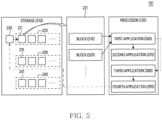
- FIG. 5 is an example of a processor that executes a file stored in storage of an electronic device according to an embodiment.
- An electronic device 101 of FIG. 5 may be an example of the electronic device 101 of FIG. 1 , FIG. 2 , FIG. 3 , and/or FIG. 4 .
- the processor 120 may identify that the block 520 was driven greater than or equal to the preset number in preset time.
- the processor 120 may compile a file including the block 510 and/or the block 520, based on identifying that the block 520 was driven greater than or equal to the preset number in the preset time.
- the processor 120 of the electronic device 101 may execute instructions in the first type and/or instructions in the second type in the block 520 based on information (e.g., crash information) on the identified error, based on identifying the error by the execution of instructions in the first type in the block 510, in a state of executing instructions in the first type and/or instructions in the second type in the block 520.
- the information may be stored in memory (e.g., the memory 130 of FIG. 1 ) and/or the storage 210, based on a data structure such as an exception object of Java.
- the processor 120 may invoke the block 520 for handling of the error.
- the processor 120 may drive the instructions included in the block 520 by invoking the block 520, based on identifying the error in the block 510 while driving the block 510.
- the processor 120 may obtain information as illustrated in Table 5 below, based on that the preset event occurred in the block 510. [Table 5] 05-26 03:08:11.578 10268 6950 6950 E AndroidRuntime: Process: com.sec.android.app.voicenote, PID: 6950
- the processor 120 may obtain information associated with time (e.g., a timestamp) that the preset event occurred, such as '05-26 03:08:11.578'.
- the processor 120 may obtain a name (e.g., a package name) indicating an application associated with the execution of the first file 221.
- the name indicating the application may be referred to as 'com.sec.android.app.voicenote'.
- the processor 120 may obtain a process identifier (PID) of the first file 221.
- the process identifier may be referred to as '6950'.
- the methods may include the block 510, the block 520, and/or the instructions.
- the list of methods may be obtained in a form such as Table 7 below.
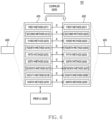
- FIG. 6 is an example illustrating a file compiled by a compiler according to an embodiment.
- An electronic device 101 of FIG. 6 may be an example of the electronic device 101 of FIG. 1 , FIG. 2 , FIG. 3 , FIG. 4 , and/or FIG. 5 .
- the electronic device 101 may execute instructions in the second type, based on a virtual machine application (e.g., the first application 260 of FIG. 1 to FIG. 5 ).
- instructions in the second type may be uncompiled methods.
- the second method 652, the third method 653, the seventh method 657, and/or the ninth method 659 may be methods not compiled by the compiler 620.
- the second method 652, the third method 653, the seventh method 657, and/or the ninth method 659 may be methods configured with instructions in the second type.
- the electronic device 101 may drive the uncompiled methods (e.g., the second method 652, the third method 653, the seventh method 657, and/or the ninth method 659), based on the virtual machine application.
- the electronic device 101 may compile instructions in the second type into instructions in the first type, based on the compiler 620.
- the electronic device 101 may compile the first method 611, the second method 612, the fourth method 614, the sixth method 615, and/or the eighth method 618, which include instructions in the second type, to convert them into methods having instructions in the first type.
- the electronic device 101 may identify the preset event causing the termination of the application while executing the application associated with the file 600.
- the electronic device 101 may identify whether the preset event occurred greater than or equal to the preset number during the preset duration.
- the electronic device 101 may compile at least one method included in the file 600, based on that the preset event occurred. By compiling at least one method, the electronic device 101 may reduce the frequency of termination of the application, and/or the number of the termination of the application, when executing the application associated with the execution of the file 600.
- FIG. 7 is an example of a flowchart of an operation of an electronic device according to an embodiment.
- An electronic device of FIG. 7 may be an example of the electronic device 101 of FIG. 1 , FIG. 2 , FIG. 3 , FIG. 4 , FIG. 5 , and/or FIG. 6 .
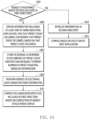
- the electronic device may detect a preset event causing termination of an application executed by a processor.
- the preset event causing the termination of the application may be generated based on at least one of instructions included in files associated with the application.
- the instructions may include instructions in a first type, and/or instructions in a second type.
- instructions in the first type may be referred to as a native code.
- instructions in the second type may be referred to as a byte code, and/or a source code.
- the electronic device may identify the number that the preset event occurred, based on detecting the preset event.
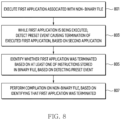
- FIG. 8 is an example of a flowchart of an operation of an electronic device according to an embodiment.
- An electronic device of FIG. 8 may be an example of the electronic device 101 of FIG. 1 , FIG. 2 , FIG. 3 , FIG. 4 , FIG. 5 and/or FIG. 6 , and/or the electronic device of FIG. 7 .
- the electronic device may identify whether the first application was terminated based on at least one of the instructions stored in the binary file obtained by compiling the non-binary file, based on detecting the preset event.
- the non-binary file may be referred to as the fourth file 310 of FIG. 3 , the fifth file 410 of FIG. 4 , and/or the sixth file 530 of FIG. 5 .
- the binary file may be referred to as the first file 221 of FIG. 3 , the second file 231 of FIG. 4 , and/or the first file 221 of FIG. 5 .
- at least one of the instructions stored in the binary file may include at least one of the methods.
- the method may include a functional unit invoked when the application is executed.
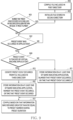
- the electronic device may identify whether the number that a preset event occurred in a file included in a first directory is greater than or equal to the preset number (e.g., 5 times).
- the first directory may be referred to as the second directory 230 of FIG. 2 .
- the preset event may cause the application to be terminated.
- the event may be referred to as a crash causing termination of the application.
- the crash may include an error that occurred in instructions included in a native crash, a java crash, and a bootclass, and an error that occurred in instructions included in a system server class.
- the electronic device may initialize a file stored in a second directory.
- the electronic device may execute reboot of the electronic device, based on identifying that the number that the preset event occurred in the file included in the first directory is greater than or equal to the preset number.
- the electronic device may initialize the file included in the second directory, based on completing the reboot.
- the second directory may be referred to as the third directory 240 of FIG. 2 , FIG. 3 , FIG. 4 , and/or FIG. 5 .
- the second directory may include a file associated with compilation stored in storage (e.g., the storage 210 of FIG. 2 , FIG. 3 , FIG. 4 , and/or FIG. 5 ).
- initializing the file stored in the second directory may include deleting the file stored in the second directory.
- the electronic device may compile the file included in the first directory.
- the electronic device may execute a tool that identifies validity of compilation output such as 'odrefresh', based on completion of the reboot.
- the electronic device may compile the file included in the first directory by executing a 'dex to odex tool'.
- the file included in the first directory may have a file extension in a form of a '.apk'.
- the file included in the first directory may have a file extension in the form of '.jar'.
- the electronic device may obtain a file different from the file by compiling the file included in the first directory.
- the electronic device may obtain the file having a file extension in the form of '.vdex', '.odex', and/or '.art' by compiling the file included in the first directory.
- the electronic device may identify whether the preset event is tracked by a virtual machine application.
- the virtual machine application may include the first application 260 of FIG. 2 , FIG. 3 , FIG. 4 , and/or FIG. 5 .
- the virtual machine application may be for driving instructions in the second type while the application is being executed.
- the virtual machine application may drive instructions in the second type such as a byte code.
- the electronic device may obtain information including at least one of a name (e.g., a package name) indicating the application, the number that the preset event occurred, or time (e.g., a timestamp) that the preset event occurred.
- the electronic device may store the information in the storage of the electronic device, based on obtaining the information including at least one of the name (e.g., the package name) indicating the application, the number that the preset event occurred, or the time (e.g., the timestamp) that the preset event occurred.
- the electronic device may identify that the preset event occurred from the file included in the third directory.
- the third directory may be referred to as the first directory 220 of FIG. 2 , FIG. 3 , FIG. 4 , and/or FIG. 5 .
- the third directory may include the file associated with the execution of the application.
- the file included in the third directory may include the file invoked and executed by the application when the application is executed.
- the electronic device may compile the file associated with the execution of the application based on the information. For example, the electronic device may compile the file in which the preset event tracked by the virtual machine application occurred, based on the information. For example, the electronic device may compile the file in which the preset event that is not tracked by the virtual machine application occurred based on the information. According to an embodiment, the electronic device may compile the file associated with the execution of the application, based on that the information was obtained greater than or equal to the preset number during the preset duration (e.g., 3 minutes) by the preset event.
- the preset duration e.g. 3 minutes
- the electronic device may display a visual object for notifying completion of the compilation in a display, based on completing compilation of the file associated with the execution of the application.
- the visual object may include a pop-up window, and/or notification.
- the electronic device may display the pop-up window, and/or the notification on at least a partial area of a screen displayed in the display.
- the electronic device may identify whether reboot is performed based on files included in a first directory.
- the first directory may include files commonly provided when applications are executed.
- the first directory may include files referred to as a bootclass or a system server class.
- the first directory may be referred to as the second directory 230 of FIG. 2 , FIG. 3 , FIG. 4 , and/or FIG. 5 .
- the electronic device may identify that a preset event occurred while executing an application.
- the preset event may cause termination of the application.
- the preset event may cause the termination of the application, based on an error of instructions invoked while executing the application.
- the electronic device may identify that the preset event occurred, based on at least one of the files included in the first directory.
- the electronic device may obtain information including at least one of a name (e.g., a package name) indicating the application, time (e.g., a timestamp) that the preset event occurred, or the number that the preset event occurred, based on that the preset event occurred.
- the electronic device may perform reboot of the electronic device based on the stored information. For example, the electronic device may perform the reboot of the electronic device, based on storing the information, by identifying the preset event that occurred greater than or equal to the preset number in the preset duration.
- the electronic device may initialize information included in a second directory.
- the second directory may be referred to as the third directory 240 of FIG. 2 , FIG. 3 , FIG. 4 , and/or FIG. 5 .
- the second directory may include information in which a preset error occurred.
- initializing the information may include deleting a file including the information.
- the processor may identify, in response to detecting the preset event, a number that the preset event occurred based on execution of the application.
- the processor based on the identified number, may obtain a binary file (e.g., the first file 221 of FIG. 3 , the second file 231 of FIG. 4 , the first file 221 of FIG. 5 , and/or the file 605 of FIG. 6 ) associated with execution of the application by compiling a non-binary file (e.g., the fourth file 310 of FIG. 3 , the fifth file 410 of FIG. 4 , the sixth file 530 of FIG. 5 , and/or the file 600 of FIG. 6 ) that corresponds to instructions in the first type associated with the preset event and includes instructions in a second type different from the first type.
- a binary file e.g., the first file 221 of FIG. 3 , the second file 231 of FIG. 4 , the first file 221 of FIG. 5 , and/or the file 605 of FIG. 6
- the processor may identify that the number that the preset event occurred is greater than or equal to a preset number during preset duration.
- the processor may store, within the memory, by obtaining information associated with at least one of the number that the preset event occurred, or the time that the preset event occurred, the information.
- the electronic device may include a display.
- the processor may display, in the display, a visual object to notify that the binary file is obtained by compiling the non-binary file.
- an electronic device e.g., the electronic device 101 of FIG. 1 , FIG. 2 , FIG. 3 , FIG. 4 , FIG. 5 , and/or FIG. 6
- a processor e.g., the processor 120 of FIG. 1 , FIG. 2 , FIG. 3 , FIG. 4 , FIG. 5 , and/or FIG. 6
- memory e.g., the memory 130 of FIG. 1 , and/or the storage 210 of FIG. 2 , FIG. 3 , FIG. 4 , and/or FIG. 5
- FIG. 6 e.g., the electronic device 101 of FIG. 1 , FIG. 2 , FIG. 3 , FIG. 4 , FIG. 5 , and/or FIG. 6
- memory e.g., the memory 130 of FIG. 1 , and/or the storage 210 of FIG. 2 , FIG. 3 , FIG. 4 , and/or FIG. 5
- the processor may identify whether the first application has been terminated based on at least one of the instructions stored in the binary file, based on detecting the preset event based on the second application.
- the processor may perform a compilation on the non-binary file in response to identifying that the first application has been terminated based on at least one of the instructions stored in the binary file.
- the processor may identify that the number that the preset event occurred is greater than or equal to a preset number during preset duration.
- the processor based on detecting the preset event, may obtain at least one of information including a name indicating the application that the preset event occurred, time that the preset event occurred, or the number that the preset event occurred.
- the processor based on the information, may obtain the binary file associated with the execution of the first application by compiling the non-binary file.
- the processor may obtain at least one of information on the number that the preset event occurred, or time that the preset event occurred during the preset duration, based on a first block (e.g., the block 520 of FIG. 5 ) to handle an error in the first application.
- the processor based on the information, may compile the non-binary file including instructions in the second type corresponding to a second block (e.g., the block 510 of FIG. 5 ) matched to the first block.
- a method of an electronic device may include detecting, using a processor (e.g., the processor 120 of FIG. 1 , FIG. 2 , FIG. 3 , FIG. 4 , and/or FIG. 5 ) to drive instructions in a first type, a preset event to cause termination of an application executed by the processor.
- the method of the electronic device may include identifying, in response to detecting the preset event, a number that the preset event occurred based on execution of the application.
- the method of the electronic device may include storing, within memory (e.g., the memory 130 of FIG. 1 and/or the storage 210 of FIG. 2 , FIG. 3 , FIG. 4 , and/or FIG. 5 ), information including the number that the preset event occurred to cause the termination of the application.
- the method of the electronic device based on identifying the identified number greater than a preset number, may include performing reboot of the processor.
- the method of the electronic device, in a state of performing the reboot may include obtaining the binary file by compiling the non-binary file stored in a preset directory different from a directory (e.g., the second directory 230 of FIG. 2 , FIG. 3 , FIG. 4 , and/or FIG. 5 ) where a third file (e.g., the second file 231 of FIG. 2 , FIG. 3 , FIG. 4 , and/or FIG. 5 ) corresponding to the application is stored.
- a directory e.g., the second directory 230 of FIG
- the method of the electronic device may include storing, within the preset directory, instructions in the first type commonly provided to a plurality of applications including the application stored in the electronic device.
- the method of the electronic device may include obtaining information including at least one of a name indicating the application that the preset event occurred, time that the preset event occurred, or the number that the preset event occurred.
- the method of the electronic device may include obtaining the binary file associated with the execution of the application by compiling the non-binary file.
- the method of the electronic device may include identifying that the number that the preset event occurred is greater than or equal to a preset number during preset duration.
- the method of the electronic device may include storing, within the memory, by obtaining information associated with at least one of the number that the preset event occurred, or the time that the preset event occurred, the information.
- the method of the electronic device may include displaying, in a display, a visual object to notify that the binary file is obtained by compiling the non-binary file.
- a method of an electronic device e.g., the electronic device 101 of FIG. 1 , FIG. 2 , FIG. 3 , FIG. 4 , FIG. 5 , and/or FIG. 6 ), based on a binary file (e.g., the first file 221 of FIG. 3 , the second file 231 of FIG. 4 , and/or the first file 221 of FIG. 5 ) generated by compiling a non-binary file (e.g., the fourth file 310 of FIG. 3 , the fifth file 410 of FIG. 4 , and/or the sixth file 530 of FIG.
- a binary file e.g., the first file 221 of FIG. 3 , the second file 231 of FIG. 4 , and/or the first file 221 of FIG. 5
- a non-binary file e.g., the fourth file 310 of FIG. 3 , the fifth file 410 of FIG. 4 , and/or the sixth file 530 of FIG.
- instructions in a second type for obtaining instructions in a first type are stored may include executing a first application associated with the non-binary file.
- the method of the electronic device may include detecting a preset event to cause termination of the executed first application, based on a second application different from the first application while the first application is being executed.
- the method of the electronic device may include identifying whether the first application has been terminated based on at least one of the instructions stored in the binary file, based on detecting the preset event based on the second application.
- the method of the electronic device may include performing a compilation on the non-binary file in response to identifying that the first application has been terminated based on at least one of the instructions stored in the binary file.
- the method of the electronic device may include obtaining at least one of information including a name indicating the application that the preset event occurred, time that the preset event occurred, or the number that the preset event occurred.
- the method of the electronic device may include obtaining the binary file associated with the execution of the first application by compiling the non-binary file.
- the method of the electronic device may include obtaining at least one of information on the number that the preset event occurred, or time that the preset event occurred during the preset duration, based on a first block (e.g., the block 520 of FIG. 5 ) to handle an error in the first application.
- the method of the electronic device may include compiling the non-binary file in which instructions in the second type corresponding to a second block (e.g., the block 510 of FIG. 5 ) matched to the first block are included.
- the method of the electronic device may compile the non-binary file.
- the electronic device may be one of various types of electronic devices.
- the electronic devices may include, for example, a portable communication device (e.g., a smartphone), a computer device, a portable multimedia device, a portable medical device, a camera, a wearable device, or a home appliance. According to an embodiment of the disclosure, the electronic devices are not limited to those described above.
- each of such phrases as “A or B,” “at least one of A and B,” “at least one of A or B,” “A, B, or C,” “at least one of A, B, and C,” and “at least one of A, B, or C,” may include any one of or all possible combinations of the items enumerated together in a corresponding one of the phrases.
- such terms as “1st” and “2nd,” or “first” and “second” may be used to simply distinguish a corresponding component from another, and does not limit the components in other aspect (e.g., importance or order).
- an element e.g., a first element
- operatively or “communicatively”, as “coupled with,” or “connected with” another element
- the element may be coupled with the other element directly (e.g., wiredly), wirelessly, or via a third element.
- a method may be included and provided in a computer program product.
- the computer program product may be traded as a product between a seller and a buyer.
- the computer program product may be distributed in the form of a machine-readable storage medium (e.g., compact disc read only memory (CD-ROM)), or be distributed (e.g., downloaded or uploaded) online via an application store (e.g., PlayStore TM ), or between two user devices (e.g., smart phones) directly. If distributed online, at least part of the computer program product may be temporarily generated or at least temporarily stored in the machine-readable storage medium, such as memory of the manufacturer's server, a server of the application store, or a relay server.
- CD-ROM compact disc read only memory
- an application store e.g., PlayStore TM
- two user devices e.g., smart phones
- each component e.g., a module or a program of the above-described components may include a single entity or multiple entities, and some of the multiple entities may be separately disposed in different components. According to various embodiments, one or more of the above-described components may be omitted, or one or more other components may be added. Alternatively or additionally, a plurality of components (e.g., modules or programs) may be integrated into a single component. In such a case, according to various embodiments, the integrated component may still perform one or more functions of each of the plurality of components in the same or similar manner as they are performed by a corresponding one of the plurality of components before the integration.
Landscapes
- Engineering & Computer Science (AREA)
- Theoretical Computer Science (AREA)
- General Engineering & Computer Science (AREA)
- Software Systems (AREA)
- Physics & Mathematics (AREA)
- General Physics & Mathematics (AREA)
- Multimedia (AREA)
- Quality & Reliability (AREA)
- Stored Programmes (AREA)
Applications Claiming Priority (3)
| Application Number | Priority Date | Filing Date | Title |
|---|---|---|---|
| KR20220101532 | 2022-08-12 | ||
| KR1020220115226A KR20240022948A (ko) | 2022-08-12 | 2022-09-13 | 지정된 이벤트에 기반하여 파일을 컴파일하기 위한 전자 장치 및 그 방법 |
| PCT/KR2023/008878 WO2024034841A1 (fr) | 2022-08-12 | 2023-06-26 | Dispositif électronique pour compiler des fichiers sur la base d'événements désignés, et procédé associé |
Publications (2)
| Publication Number | Publication Date |
|---|---|
| EP4538863A1 true EP4538863A1 (fr) | 2025-04-16 |
| EP4538863A4 EP4538863A4 (fr) | 2025-10-08 |
Family
ID=89851962
Family Applications (1)
| Application Number | Title | Priority Date | Filing Date |
|---|---|---|---|
| EP23852728.7A Pending EP4538863A4 (fr) | 2022-08-12 | 2023-06-26 | Dispositif électronique pour compiler des fichiers sur la base d'événements désignés, et procédé associé |
Country Status (3)
| Country | Link |
|---|---|
| US (1) | US20250165234A1 (fr) |
| EP (1) | EP4538863A4 (fr) |
| WO (1) | WO2024034841A1 (fr) |
Family Cites Families (5)
| Publication number | Priority date | Publication date | Assignee | Title |
|---|---|---|---|---|
| US7424705B2 (en) * | 2004-03-11 | 2008-09-09 | Intel Corporation | Dynamic management of compiled code |
| US9092616B2 (en) * | 2012-05-01 | 2015-07-28 | Taasera, Inc. | Systems and methods for threat identification and remediation |
| US20150309813A1 (en) * | 2012-08-31 | 2015-10-29 | iAppSecure Solutions Pvt. Ltd | A System for analyzing applications in order to find security and quality issues |
| US9460284B1 (en) * | 2015-06-12 | 2016-10-04 | Bitdefender IPR Management Ltd. | Behavioral malware detection using an interpreter virtual machine |
| KR102007881B1 (ko) * | 2017-04-27 | 2019-08-06 | 국방과학연구소 | 빠르고 정확한 실행 시간 예측을 위한 하이브리드 명령어 집합 시뮬레이션 방법 및 시스템 |
-
2023
- 2023-06-26 EP EP23852728.7A patent/EP4538863A4/fr active Pending
- 2023-06-26 WO PCT/KR2023/008878 patent/WO2024034841A1/fr not_active Ceased
-
2025
- 2025-01-17 US US19/030,679 patent/US20250165234A1/en active Pending
Also Published As
| Publication number | Publication date |
|---|---|
| EP4538863A4 (fr) | 2025-10-08 |
| US20250165234A1 (en) | 2025-05-22 |
| WO2024034841A1 (fr) | 2024-02-15 |
Similar Documents
| Publication | Publication Date | Title |
|---|---|---|
| US11327739B2 (en) | Method and apparatus for improving runtime performance after application update in electronic device | |
| US11435985B2 (en) | Electronic device and operation method thereof | |
| EP3977264B1 (fr) | Procédé d'optimisation d'application et dispositif électronique le prenant en charge | |
| US12379911B2 (en) | Application installation method and electronic device for supporting same | |
| US11836503B2 (en) | Electronic device for executing heterogeneous operating systems and method therefor | |
| EP3987395B1 (fr) | Dispositif électronique pour exécuter des instructions à l'aide de coeurs de processeur et de diverses versions d'architectures d'ensembles d'instructions | |
| KR102372644B1 (ko) | 운영 체제의 운용 방법 및 이를 지원하는 전자 장치 | |
| US11875035B2 (en) | Electronic device and method for managing memory using the same | |
| EP4538863A1 (fr) | Dispositif électronique pour compiler des fichiers sur la base d'événements désignés, et procédé associé | |
| US12050900B2 (en) | Method for updating application and electronic device of the same | |
| KR102842580B1 (ko) | 하이퍼바이저를 이용한 가상 머신 모니터링 방법 및 이를 지원하는 전자 장치 | |
| US11953983B2 (en) | Electronic device and method for initializing electronic device | |
| KR102771882B1 (ko) | 전자 장치 및 이를 이용한 메모리 관리 방법 | |
| KR102951497B1 (ko) | 전자 장치 및 전자 장치의 커널 모듈 로딩 방법 | |
| KR20240022948A (ko) | 지정된 이벤트에 기반하여 파일을 컴파일하기 위한 전자 장치 및 그 방법 | |
| US12223185B2 (en) | Electronic device and method for managing memory of electronic device | |
| EP4524724A1 (fr) | Dispositif électronique et procédé de compilation de paquets sur la base d'un ordre obtenu par interaction | |
| EP4372549A1 (fr) | Dispositif électronique pour obtenir des informations utilisées pour compiler une application, et procédé associé | |
| EP4538866A1 (fr) | Procédé de mise à jour d'une application et dispositif électronique associé | |
| EP4390694A1 (fr) | Dispositif électronique de récupération de fichier et procédé de fonctionnement de dispositif électronique | |
| KR20250020247A (ko) | 펌웨어를 업데이트하기 위한 전자 장치, 방법 및 컴퓨터 판독 가능 저장 매체 | |
| KR20260019342A (ko) | 전자 장치 및 전자 장치에서 bios를 이용한 csme 복원 방법 |
Legal Events
| Date | Code | Title | Description |
|---|---|---|---|
| STAA | Information on the status of an ep patent application or granted ep patent |
Free format text: STATUS: THE INTERNATIONAL PUBLICATION HAS BEEN MADE |
|
| PUAI | Public reference made under article 153(3) epc to a published international application that has entered the european phase |
Free format text: ORIGINAL CODE: 0009012 |
|
| STAA | Information on the status of an ep patent application or granted ep patent |
Free format text: STATUS: REQUEST FOR EXAMINATION WAS MADE |
|
| 17P | Request for examination filed |
Effective date: 20250109 |
|
| AK | Designated contracting states |
Kind code of ref document: A1 Designated state(s): AL AT BE BG CH CY CZ DE DK EE ES FI FR GB GR HR HU IE IS IT LI LT LU LV MC ME MK MT NL NO PL PT RO RS SE SI SK SM TR |
|
| A4 | Supplementary search report drawn up and despatched |
Effective date: 20250910 |
|
| RIC1 | Information provided on ipc code assigned before grant |
Ipc: G06F 8/41 20180101AFI20250904BHEP Ipc: G06F 9/54 20060101ALI20250904BHEP Ipc: G06F 9/4401 20180101ALI20250904BHEP Ipc: G06F 9/48 20060101ALI20250904BHEP Ipc: G06F 11/07 20060101ALI20250904BHEP |
|
| DAV | Request for validation of the european patent (deleted) | ||
| DAX | Request for extension of the european patent (deleted) |