EP4538879A1 - Elektronische vorrichtung zur steuerung der ausführung eines prozesses und verfahren dafür - Google Patents
Elektronische vorrichtung zur steuerung der ausführung eines prozesses und verfahren dafür Download PDFInfo
- Publication number
- EP4538879A1 EP4538879A1 EP24755473.6A EP24755473A EP4538879A1 EP 4538879 A1 EP4538879 A1 EP 4538879A1 EP 24755473 A EP24755473 A EP 24755473A EP 4538879 A1 EP4538879 A1 EP 4538879A1
- Authority
- EP
- European Patent Office
- Prior art keywords
- electronic device
- group
- processor
- processes
- schedule
- Prior art date
- Legal status (The legal status is an assumption and is not a legal conclusion. Google has not performed a legal analysis and makes no representation as to the accuracy of the status listed.)
- Pending
Links
Images




Classifications
-
- G—PHYSICS
- G06—COMPUTING OR CALCULATING; COUNTING
- G06F—ELECTRIC DIGITAL DATA PROCESSING
- G06F9/00—Arrangements for program control, e.g. control units
- G06F9/06—Arrangements for program control, e.g. control units using stored programs, i.e. using an internal store of processing equipment to receive or retain programs
- G06F9/46—Multiprogramming arrangements
- G06F9/48—Program initiating; Program switching, e.g. by interrupt
- G06F9/4806—Task transfer initiation or dispatching
- G06F9/4843—Task transfer initiation or dispatching by program, e.g. task dispatcher, supervisor, operating system
- G06F9/4881—Scheduling strategies for dispatcher, e.g. round robin, multi-level priority queues
-
- G—PHYSICS
- G06—COMPUTING OR CALCULATING; COUNTING
- G06F—ELECTRIC DIGITAL DATA PROCESSING
- G06F9/00—Arrangements for program control, e.g. control units
- G06F9/06—Arrangements for program control, e.g. control units using stored programs, i.e. using an internal store of processing equipment to receive or retain programs
- G06F9/46—Multiprogramming arrangements
- G06F9/48—Program initiating; Program switching, e.g. by interrupt
- G06F9/4806—Task transfer initiation or dispatching
- G06F9/4843—Task transfer initiation or dispatching by program, e.g. task dispatcher, supervisor, operating system
- G06F9/4881—Scheduling strategies for dispatcher, e.g. round robin, multi-level priority queues
- G06F9/4893—Scheduling strategies for dispatcher, e.g. round robin, multi-level priority queues taking into account power or heat criteria
Definitions
- the present disclosure relates to an electronic device for controlling execution of a process and a method thereof.
- a processor e.g., central processing unit (CPU) of an electronic device may support multitasking for substantially simultaneously executing a plurality of functions.
- the processor and/or a system process (or an operating system) executed by the processor may schedule a time section (or time slot) in which the processor is occupied by each of the plurality of processes and/or the plurality of threads.
- a method of an electronic device may include determining, while executing instructions based on a plurality of processes, schedule groups respectively corresponding to the plurality of processes based on states of the plurality of processes.
- the method may include adjusting, in response to switching the at least one process from a first schedule group for execution in background to other schedule groups or switching from the other schedule groups to the first schedule group based on the determination of the schedule groups, a length of a time section used for execution of the at least one process.
- the method may include executing the at least one process in the time section having the adjusted length.
- a non-transitory computer-readable storage medium may include instructions.
- the instructions when executed by a processor of an electronic device, may cause the processor to determine, based on state of a plurality of processes, a schedule group respectively corresponding to the plurality of processes.
- the instructions when executed by the processor, may cause the processor to adjust, in response to switching the at least one process from a first schedule group for execution in background to other schedule groups or switching from the other schedule groups to the first schedule group, based on the determination of the schedule group, a length of a time section used for execution of the at least one process.
- the instructions when executed by the processor, may cause the processor to execute the at least one process in the time section having the adjusted length.
- FIG. 1 illustrates an exemplary block diagram for describing hardware configuration of an electronic device according to an embodiment.
- the electronic device 101 may be referred to as a terminal (or a user terminal).
- the terminal may include smart accessories such as a smartwatch 101-1, a smart ring 101-2, and/or a head-mounted device (HMD).
- the terminal may include a personal computer (PC), such as a laptop and a desktop.
- the terminal may include a smartphone 101-3, a smartpad, and/or a tablet PC.
- the smartwatch 101-1, the smart ring 101-2 and/or the smartphone 101-3 are illustrated as an exemplary form factor of the electronic device 101.
- the embodiment is not limited thereto.
- the electronic device 101 may include at least one of a processor 110, a memory 120, a display 130, a sensor 140, or a communication circuit 150.
- the processor 110, the memory 120, the display 130, the sensor 140, and the communication circuit 150 may be electrically and/or operably coupled with each other by an electronical component such as a communication bus 102.
- an electronical component such as a communication bus 102.
- the operational coupling of the electronical components may mean that a direct connection or an indirect connection between the electronical components is established by wire or wirelessly so that a second electronical component is controlled by a first electronical component.
- the processor 110 may manage or schedule one or more tasks to be performed by the electronic device 101 based on a process (or a thread).
- the process may be a unit of task and/or calculation performed by the processor 110.
- the processor 110 may generate, terminate, or manage the process classified by a program (or a software application) installed in the electronic device 101.
- the processor 110 may schedule an order and/or a time section in which the instructions (e.g., the instructions included in different software applications) are executed, based on the plurality of the processes.
- An example of a scheduling operation of the processor 110 based on the processes will be described with reference to FIG. 2 .
- the memory 120 of the electronic device 101 may include the hardware component for storing data and/or the instruction inputted to or outputted from the processor 110.
- the memory 120 may include volatile memory such as random-access memory (RAM) and/or non-volatile memory such as read-only memory (ROM).
- the volatile memory may include at least one of dynamic RAM (DRAM), static RAM (SRAM), Cache RAM, and pseudo SRAM (SRAM).
- the non-volatile memory may include at least one of programmable ROM (PROM), erasable PROM (EPROM), electrically erasable PROM (EEPROM), flash memory, hard disk, compact disk, solid state drive (SSD), and embedded multi media card (eMMC).
- PROM programmable ROM
- EPROM erasable PROM
- EEPROM electrically erasable PROM
- flash memory hard disk, compact disk, solid state drive (SSD), and embedded multi media card (eMMC).
- the display 130 of the electronic device 101 may output visualized information to a user.
- the display 130 may be controlled by a controller such as a graphic processing unit (GPU), and may output visualized information to the user.
- the display 130 may include a liquid crystal display (LCD), a plasma display panel (PDP), and/or one or more light emitting diode (LED).
- the LED may include an organic LED (OLED).
- the display 130 may include a flat panel display (FPD), a flexible display, and/or electronic paper. An embodiment is not limited thereto, and the display 130 may have at least a partially curved shape or a deformable shape.
- the sensor 140 of the electronic device 101 may generate electronic information that may be processed by the processor 110 and/or the memory 120 from non-electronic information associated with the electronic device 101.
- the sensor 140 may include a touch sensor 142 for detecting an external object (e.g., a user's finger) on one surface (e.g., a front surface of the electronic device 101 on which the display 130 is disposed) of a housing of the electronic device 101.
- the touch sensor 142 may be referred as a touch sensor panel (TSP).
- TSP touch sensor panel
- the processor 110 may detect an external object that is in contact with the display 130 or is floating on the display 130.
- the processor 110 may execute a function associated with a specific visual object corresponding to a position of the external object on the display 130 among the visual objects displayed on the display 130.
- a touch sensor 142 is illustrated as an example of the sensor 140, but an embodiment is not limited thereto, and the sensor 140 may include a global positioning system (GPS) sensor.
- GPS global positioning system
- the sensor 140 may generate information representing a geographical location of the electronic device 101 based on a global navigation satellite system (GNSS) such as galileo and/or a Bertdou (compass).
- GNSS global navigation satellite system
- the sensor 140 may include an image sensor, an illuminance sensor, a grip sensor, a hall sensor, a proximity sensor, a photoplethysmogram (PPG) sensor, a fingerprint sensor, an audio sensor (e.g., a microphone), and/or a time-of-flight (ToF) sensor for detecting electromagnetic wave including light.
- PPG photoplethysmogram
- ToF time-of-flight
- one or more instructions (or commands) representing calculation and/or operations to be performed by the processor 110 on data may be stored.
- the set of one or more instructions may be referred to as firmware, an operating system, a process, a routine, a sub-routine and/or software application (hereinafter, application).
- application software application
- the electronic device 101 and/or the processor 110 may perform at least one of operations of FIG. 2 , FIG. 4 , and/or FIG. 6 .
- the installation of an application in the electronic device 101 may mean that one or more instructions provided in the form of the application are stored in the memory 120 of the electronic device 101, and the one or more applications are stored in an executable format (e.g., a file with an extension designated by the operating system of the electronic device 101).
- an executable format e.g., a file with an extension designated by the operating system of the electronic device 101.
- the program for controlling the order of the instructions inputted to the processor 110 and/or the processes (or the threads) executed by the processor 110 may be classified as the kernel layer 190.
- the program for managing information used to control the order of the process such as a process group library 182 (e.g., libprocessgroup), may be classified as the native layer 180.
- the program included in the native layer 180 may configured with instructions (e.g., instructions directly readable by the processor 110) different from the instructions of a virtual machine-based executable type, such as a java byte code. An embodiment is not limited thereto.
- the program designed to target a user of the electronic device 101 may be classified in the application layer 160.
- the programs classified as the application layer 160 a gallery application 162 for browsing a photo and/or a video, a call application 164 for a voice call and/or a video call, and/or a game application 166 are illustrated, but an embodiment is not limited thereto.
- the programs (e.g., a software application) classified as the application layer 160 may call the application programming interface (API) and cause execution of the function supported by the programs classified as the platform layer 170.
- API application programming interface
- the processor 110 of the electronic device 101 may control execution of the programs divided into blocks and illustrated in FIG. 1 based on the process. While executing instructions based on the plurality of processes, the processor 110 may detect or check states of the plurality of processes. The processor 110 may classify the processes as designated (or preset, predetermined, or specified) schedule groups based on the states of the processes. As an example without limitation, the schedule groups may include a top-application schedule group, a foreground schedule group, a background schedule group, and/or a root schedule group. The schedule group may be referred as a sched group. An operation in which the processor 110 of the electronic device 101 classifies a process as any one of the schedule groups will be described with reference to FIG. 3 .
- the processor 110 of the electronic device 101 may schedule a resource to be used to execute each of the processes based on the result of classifying the processes as the schedule group.
- the resource may represent availability of the processor 110 and/or the electronic device 101 consumed or occupied for execution of the process.
- the resource scheduled by the processor 110 may include a length of the time section of the processor 110 used to execute instructions of the process.
- An embodiment is not limited thereto, and the resource scheduled by the processor 110 may include a size of a portion assigned for the process in the memory 120 and/or a port number assigned to the process to use the network.
- the processor 110 of the electronic device 101 may prevent or reduce a delay in execution of the processes for scheduling, by reducing frequency of scheduling.
- An operation of determining the length of the time section for executing the instructions of the process by the processor 110 based on scheduling will be described with reference to FIGS. 4 and/or 5.
- the processor 110 of the electronic device 101 may support the function of transmitting and/or receiving information between processes.
- the function may be executed based on the API provided by the platform layer 170 and/or a preset data structure (e.g., an intent object).
- a preset data structure e.g., an intent object
- the processor 110 may execute instructions of another process.
- the processor 110 may adjust (e.g., delay) timing of executing the function for transmitting information between the processes, based on a usage of the processor 110 changed by execution of the processes. An operation of adjusting the timing at which the processor 110 executes the function will be described with reference to FIGS. 6 and/or 7.
- the processor 110 of the electronic device 101 may perform reducing a load on the processor 110.
- the electronic device 101 may reduce frequency of scheduling the processes or simplify the operation of scheduling the processes. For example, since time and/or the load consumed in scheduling may slow response speed in case of the low-performance device, the processor 110 of the electronic device 101 may reduce frequency of scheduling the processes.
- the electronic device 101 may change the timing of executing the function of transmitting information between processes.
- a processor of an electronic device may detect a change in a state of a process.
- a state of the operation 210 may include an execution state of the process executed by the processor.
- the state of the operation 210 may be distinguished by at least one of whether a screen provided by the process is displayed on a display (e.g., a display 130 of FIG. 2 ) of the electronic device, whether an audio signal provided by the process is outputted through a speaker of the electronic device, whether an animation for a screen change is reproduce by the process, or whether an operation such as download, upload, and/or update is performed by the process.
- the processor of the electronic device may detect the change in the state of the process based on instructions included in the process. For example, based on executing the instructions for switching to a background state that does not occupy an output means of the electronic device (e.g., the display 130 and/or the speaker in FIG. 2 ), the processor may switch the process corresponding to the instructions to the background state.
- the processor may detect the change in the state of the process by tracking or monitoring the state of the process.
- the processor of the electronic device may determine a schedule group corresponding to the process among a plurality of preset schedule groups based on a changed state. While executing the plurality of processes, the processor may determine the schedule group respectively corresponding to the plurality of processes based on states of the plurality of processes. That is, the processor may determine, for each of the plurality of processes, a corresponding schedule group among the plurality of predetermined schedule groups based on the state (e.g. the changed state) of the process.
- the preset schedule groups of the operation 220 may include a top-application schedule group corresponding to the process providing the screen displayed on the display (e.g., the display 130 of FIG. 2 ) of the electronic device.
- the preset schedule groups of the operation 220 may include a foreground schedule group corresponding to a process that is not included in the top-application schedule group, and a process that provides an audio signal outputted by the electronic device, or provides the animation (or visual effect) displayed on the display.
- the preset schedule groups of the operation 220 may include a background schedule group and/or a root schedule group corresponding to the process that is not included in the top-application schedule group and/or the foreground schedule group.
- the processor may classify the process switched to the background state as the background schedule group.
- the processor of the electronic device may check whether the process is included in a first preset schedule group associated with a background execution.
- the first preset schedule group of the operation 230 may include the background schedule group.
- the processor may perform an operation 240.
- the processor may perform an operation 250.
- the processor may perform operation 250.
- the processor of the electronic device may change the process group corresponding to the process to the root process group.
- the processor classifies the process using two process groups, one or more processes classified as the background process group of the operation 240 and other processes may be classified as the root process group of the operation 250.
- the process executed in the background may be classified as the background process group, and other processes not classified as the background process group may be classified as the root process group.
- the processor may classify the plurality of processes as any one of the background process group or the root process group.
- the processor of the electronic device may perform scheduling of the processor associated with execution of the process based on profile information of the background process group and/or the root process group.
- the processor may perform scheduling of processes classified as the background process group or the root process group based on profile information of a corresponding process group.
- the profile information of the operation 260 may correspond to the process group (e.g., the background process group and/or the root process group of the operations 240 and 250) used by the electronic device.
- the profile information may include time of the processor used for execution of the process included in the process group, the limitation of an input and an output of memory (e.g., memory 120 of FIG. 2 ), and/or the size of the cache and/or page formed for execution of the process in the memory.
- a child process group of a specific process group may inherit at least a portion of the profile information of the specific process group. Based on the inheritance, the scheduling for process included in the child process group may be performed based on the profile information of the specific process group.
- the processor may redetermine a length of a time section used for execution of the at least one process, and execute the at least one process in the time section having the redetermined length.
- the processor may execute, in the case that the at least one process is switched from a schedule group in the second process group (e.g. the root process group) to another schedule group in the second process group, the at least one process without redetermining a length of a time section used for execution of the at least one process.
- a schedule group in the second process group e.g. the root process group
- a top-application schedule group 321 may be set to classify a process associated with a screen displayed on a display (e.g., the display 130 of FIG. 2 ).
- the screen may have a form of a figure (e.g., a rectangle and/or a rectangle with rounded corner) occupying at least a portion of a display area of the display, such as a window and/or an activity.
- the process corresponding to the screen currently displayed on the display may be classified as a top-application schedule group 321.
- the background schedule group 324 may be set to classify the process that is explicitly switched to a background state by instructions.
- the background schedule group 324 may be set to classify the process switched to the background state by a system process of the electronic device (e.g., the activity manager service 172 of FIG. 1 ).
- the processor may select or filter the process to be classified as the background schedule group 324 among the processes not classified as the top-application schedule group 321 and the foreground schedule group 322 among a plurality of processes.
- the electronic device may adjust a resource (e.g., a time resource of the processor used for execution of the process) of the electronic device to be occupied for execution of the process by using the process group.
- the electronic device may assign a resource to each of the processes by using the background process group corresponding to the background schedule group 324 and the root process group corresponding to all of other schedule groups (e.g., the top-application schedule group 321, the foreground schedule group 322 and/or the root schedule group 323).
- the processor may maintain resources assigned to the process without changing the process group corresponding to the process.
- the processor may not change the resource.
- the processor may change the process group corresponding to the process and perform scheduling for the process again.
- the processor of the electronic device may detect a change in the schedule group of the process.
- the process may be reclassified from any one of the preset schedule groups to another based on the change in state of the process.
- the preset schedule groups may include the schedule groups described with reference to FIG. 3 .
- the processor detecting the change in the schedule group may perform an operation 420.
- FIG. 5 illustrates an exemplary operation of an electronic device for scheduling a time resource of a processor using a process group corresponding to processes.
- the electronic device 101 and/or the processor 110 of FIG. 1 may perform an operation of the electronic device described with reference to FIG. 5 .
- the operation of FIG. 5 may be associated with at least one of the operations of FIG. 2 and/or FIG. 4 .
- a hierarchical relationship between a root process group 510 and a background process group 520, which is a sub-process group of the root process group 510 is illustrated as an example.
- the background process group 520 may inherit or use at least a portion of information (e.g., profile information) for scheduling the process of the root process group 510.
- information e.g., profile information
- at least one of memory bandwidth limit, cache memory size upper limit, time resource share of the processor, and/or network resource limit applied to the process of the root process group 510 may be applied to the process of the background process group 520.
- the processor may schedule the at least one process based on first profile information corresponding to the first process group (e.g.
- background process group 520 in the case that the at least one process is switched to the first process group, and may schedule the at least one process based on second profile information corresponding to the second process group (e.g. root process group 510) in the case that the at least one process is switched to the second process group.
- second profile information corresponding to the second process group e.g. root process group 510
- FIG. 5 an exemplary state of the electronic device executing six processes is illustrated.
- the number of the processes executed by the electronic device is not limited to the exemplary state of FIG. 5 .
- a first process 531, a second process 532, and a third process 533 may be classified as the background process group 520, and a fourth process 534, a fifth process 535, and a sixth process 536 may be classified as the root process group 510.
- the operation in which the electronic device classifies a plurality of processes may be performed based on the operations of FIG. 2 and/or FIG. 4 .
- An embodiment is not limited thereto, and the process executed at the kernel layer and/or the platform layer may be classified as the root process group 510.
- the electronic device may calculate duration of the processor that executes each of the processes based on a weight.
- the 'CPU_shares' (or 'CPU.shares') of FIG. 5 may be a numeric value used for the calculation of the process.
- the numeric value may be referred as a weight, a time slice, and/or a quantum.
- the electronic device may determine, based on weights respectively assigned to the plurality of processes, lengths of time sections used to execute each of the plurality of processes.
- the lengths of time sections used to execute processes in the first process group e.g.
- the electronic device may change the weight (e.g., 1024) assigned to the background process group 520 based on the state of the processor (e.g., a load and/or usage). For example, in response to at least one of a preset event, such as receiving a touch input, usage of the processor increased above threshold, a temperature of the processor exceeding threshold temperature, and/or update, the processor may change the weight. For example, the processor may adjust the first weight based on at least one of a usage of the processor, a temperature identified by a temperature sensor of the electronic device, or a touch input identified via a touch sensor of the electronic device.
- a preset event such as receiving a touch input
- usage of the processor increased above threshold
- a temperature of the processor exceeding threshold temperature and/or update
- the processor may change the weight.
- the processor may adjust the first weight based on at least one of a usage of the processor, a temperature identified by a temperature sensor of the electronic device, or a touch input identified via a touch sensor of the electronic device.
- the electronic device may determine, based on the weights respectively assigned to the plurality of processes, lengths of time sections used to execute each of the plurality of processes.
- a rate of the time section of the processor used for executing the process may correspond to the sum of the weights of all the processes and the rate of the weight assigned to the process.
- the rate at which the processor executes six processes may be calculated as Table 1. [Table 1] Process 1 2 3 4 5 6 Sum Weight 170.7 170.7 170.7 1024 1024 1024 4096 Time Resource Share 4.17% 4.17% 4.17% 25% 25% 25% 87.51%
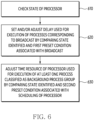
- FIG. 6 illustrates an example of a flowchart of an electronic device according to an embodiment.
- the electronic device 101 and/or the processor 110 of FIG. 1 may perform an operation of the electronic device described with reference to FIG. 6 .
- the operation of FIG. 6 may be associated with at least one of the operations of FIGS. 2 and/or 4.
- a processor of the electronic device may check or detect a state of the processor.
- the processor may obtain parameters representing the state of the processor.
- the parameters may include a temperature of the electronic device and/or the processor, the usage of processor used by executing the process, and/or whether a touch input has been identified.
- the processor of the electronic device may adjust a time resource of the processor used for execution of at least one process classified as a background process group by comparing the state of the processor checked based on the operation 610 and a second preset condition associated with a scheduling of processor. Similar to the first preset condition of the operation 620, the second preset condition may include at least one of the usage of the processor, whether the touch input has been received, and/or the temperature of the processor. Based on the second preset condition, the processor may adjust the weight that is used to determine the time resource of the processes included in the background process group. For example, the processor may change a coefficient applied to the weight of FIG. 5 .
- FIG. 7 illustrates an exemplary operation of an electronic device transmitting information between processes.
- the electronic device 101 and/or the processor 110 of FIG. 1 may perform an operation of the electronic device described with reference to FIG. 7 .
- the operation of the electronic device described with reference to FIG. 7 may be associated with the operations of FIGS. 2 , 4 and/or 6.
- the processor may identify the processes corresponding to the intent object 710 among a plurality of processes, based on a condition (e.g., an intent filter) set by the intent object 710.
- the processor of the electronic device may execute the plurality of processes based on the intent object 710. For example, based on execution of the plurality of processes, the processor may broadcast information included in the intent object 710 to the plurality of processes.
- the processor may perform the broadcast based on the intent object 710 by using broadcast services for each of the processes classified as a background process group and the processes classified as a root process group.
- FIG. 4 an exemplary state of the electronic device executing four processes (e.g., a first process 721, a second process 722, a third process 723, and a fourth process 724) based on the intent object 710 is illustrated.
- the electronic device that has identified the intent object 710 may sequentially execute the intent object 710 and/or four processes corresponding to the request associated with the intent object 710 based on the delay set by the operation 620 of FIG. 6 .
- the delay may be adjusted based on at least one of a usage of the processor of the electronic device, a temperature of the electronic device, or a touch input identified by the electronic device. For example, the delay may be proportional to the usage and/or the temperature. The delay may be set by a look-up table based on the usage and/or the temperature. The delay may increase when the touch input is received.
- the processor may execute the first process 721 based on the intent object 710, and then execute the second process 722 based on the delay according to the state of the processor.
- the processor may execute the second process 722 at a timing after the delay from a timing (e.g., a timing of identifying termination response of the first process 721) of detecting the completion of the operation of the first process 721 based on the intent object 710.
- the processor may prevent four processes associated with the intent object 710 from being executed in an overlapping manner.
- the processor may prevent rapid increase in the usage of the processor.
- the processor may prevent saturation of the processor. Since the saturation of the processor is prevented, the processor may respond faster to a user input such as the touch input.
- FIG. 8 is graphs illustrating a usage of a processor of an electronic device in a time domain while according to an embodiment, the electronic device is booted.
- a timing t2 when the CPU usage of the first electronic device is decreased may be after a timing t1 when the CPU usage of the second electronic device is decreased.
- the booting of the first electronic device may be completed later than the booting of the second electronic device.
- the second electronic device may perform scheduling for the process with only two process groups, and may perform the operation associated with an intent object using a delay based on state of the processor. Since the second electronic device more efficiently controls CPU usage, after the first electronic device and the second electronic device are simultaneously turned on, the usage of the booting-based second electronic device may be reduced earlier than the usage of the first electronic device.
- the artificial neural network may be a deep neural network (DNN), a convolutional neural network (CNN), a recurrent neural network (RNN), a restricted boltzmann machine (RBM), a deep belief network (DBN), a bidirectional recurrent deep neural network (BRDNN), deep Q-network or a combination of two or more thereof but is not limited thereto.
- the artificial intelligence model may, additionally or alternatively, include a software structure other than the hardware structure.
- the input module 950 may receive a command or data to be used by another component (e.g., the processor 920) of the electronic device 901, from the outside (e.g., a user) of the electronic device 901.
- the input module 950 may include, for example, a microphone, a mouse, a keyboard, a key (e.g., a button), or a digital pen (e.g., a stylus pen).
- the audio module 970 may convert a sound into an electrical signal and vice versa. According to an embodiment, the audio module 970 may obtain the sound via the input module 950, or output the sound via the sound output module 955 or a headphone of an external electronic device (e.g., an electronic device 902) directly (e.g., wiredly) or wirelessly coupled with the electronic device 901.
- an external electronic device e.g., an electronic device 902
- directly e.g., wiredly
- wirelessly e.g., wirelessly
- a connecting terminal 978 may include a connector via which the electronic device 901 may be physically connected with the external electronic device (e.g., the electronic device 902).
- the connecting terminal 978 may include, for example, a HDMI connector, a USB connector, a SD card connector, or an audio connector (e.g., a headphone connector).
- the camera module 980 may capture a still image or moving images.
- the camera module 980 may include one or more lenses, image sensors, image signal processors, or flashes.
- the power management module 988 may manage power supplied to the electronic device 901. According to one embodiment, the power management module 988 may be implemented as at least part of, for example, a power management integrated circuit (PMIC).
- PMIC power management integrated circuit
- the wireless communication module 992 may support a 5G network, after a 4G network, and next-generation communication technology, e.g., new radio (NR) access technology.
- the NR access technology may support enhanced mobile broadband (eMBB), massive machine type communications (mMTC), or ultra-reliable and low-latency communications (URLLC).
- eMBB enhanced mobile broadband
- mMTC massive machine type communications
- URLLC ultra-reliable and low-latency communications
- the wireless communication module 992 may support a high-frequency band (e.g., the mmWave band) to achieve, e.g., a high data transmission rate.
- the antenna module 997 may transmit or receive a signal or power to or from the outside (e.g., the external electronic device) of the electronic device 901.
- the antenna module 997 may include an antenna including a radiating element composed of a conductive material or a conductive pattern formed in or on a substrate (e.g., a printed circuit board (PCB)).
- the antenna module 997 may include a plurality of antennas (e.g., array antennas). In such a case, at least one antenna appropriate for a communication scheme used in the communication network, such as the first network 998 or the second network 999, may be selected, for example, by the communication module 990 (e.g., the wireless communication module 992) from the plurality of antennas.
- the signal or the power may then be transmitted or received between the communication module 990 and the external electronic device via the selected at least one antenna.
- another component e.g., a radio frequency integrated circuit (RFIC)
- RFIC radio frequency integrated circuit
- the antenna module 997 may form a mmWave antenna module.
- the mmWave antenna module may include a printed circuit board, a RFIC disposed on a first surface (e.g., the bottom surface) of the printed circuit board, or adjacent to the first surface and capable of supporting a designated high-frequency band (e.g., the mmWave band), and a plurality of antennas (e.g., array antennas) disposed on a second surface (e.g., the top or a side surface) of the printed circuit board, or adjacent to the second surface and capable of transmitting or receiving signals of the designated high-frequency band.
- a RFIC disposed on a first surface (e.g., the bottom surface) of the printed circuit board, or adjacent to the first surface and capable of supporting a designated high-frequency band (e.g., the mmWave band)
- a plurality of antennas e.g., array antennas
- each of such phrases as “A or B,” “at least one of A and B,” “at least one of A or B,” “A, B, or C,” “at least one of A, B, and C,” and “at least one of A, B, or C,” may include any one of, or all possible combinations of the items enumerated together in a corresponding one of the phrases.
- such terms as “1st” and “2nd,” or “first” and “second” may be used to simply distinguish a corresponding component from another, and does not limit the components in other aspect (e.g., importance or order).
- the machine-readable storage medium may be provided in the form of a non-transitory storage medium.
- non-transitory simply means that the storage medium is a tangible device, and does not include a signal (e.g., an electromagnetic wave), but this term does not differentiate between where data is semi-permanently stored in the storage medium and where the data is temporarily stored in the storage medium.
- an electronic device e.g., an electronic device 101 in FIG. 1 and/or electronic devices 901 and 902 in FIG. 9
- an electronic device may include memory (e.g., memory 120 in FIG. 1 ) for storing instructions and the processor (e.g., the processor 110 in FIG. 1 ) for executing the instructions.
- the processor may be configured to determine, while executing the instructions based on a plurality of processes, schedule groups respectively corresponding to the plurality of processes based on states of the plurality of processes.
- the processor may be configured to adjust, in response to switching the at least one process from a first schedule group (e.g., a background schedule group 324 in FIG. 3 ) for execution in background to other schedule groups or switching from the other schedule groups to the first schedule group based on the determination of the schedule groups, a length of a time section used for execution of the at least one process.
- the processor may be configured to execute the at least one process in the time section having the adjusted length.
- the processor of the electronic device may have an improved response speed by efficiently performing scheduling for the plurality of processes.
- the electronic device may perform scheduling for the plurality of processes to prevent a rapid increase in the load of the processor.
- the electronic device may process the user input such as the touch input based on an increased response speed.
- the processor may be configured to classify the at least one process switched to the first schedule group from the other schedule groups as a first process group corresponding to profile information for executing in background.
- the processor may be configured to classify the at least one process switched to the other schedule groups from the first schedule group as a root process group.
- the processor may be configured to, based on requests for transmitting information between the plurality of processes, sequentially execute processes respectively corresponding to the requests based on a preset delay.
- the processor may be configured to adjust the preset delay based on at least one of the usage of the processor, the temperature identified by the temperature sensor of the electronic device, or the touch event identified based on the touch sensor of the electronic device.
- the processor may be configured to detect the requests based on an intent object.
- the processor may be configured to classify the plurality of processes as any one of the first process group for executing in background and the second process group different from the first process group, based on schedule groups respectively corresponding to the plurality of processes.
- the method of the electronic device may include determining, while executing the instructions based on the plurality of processes, schedule groups respectively corresponding to the plurality of processes based on states of the plurality of processes.
- the method may include adjusting, in response to switching the at least one process from the first schedule group for execution in background to other schedule groups or switching from the other schedule groups to the first schedule group based on the determination of the schedule groups, the length of the time section used for execution of the at least one process.
- the method may include executing the at least one process in the time section having the adjusted length.
- the method may include classifying the at least one process switched to the first schedule group from the other schedule groups as the first process group corresponding to profile information for executing in background.
- the method may include classifying the at least one process switched to the other schedule groups from the first schedule group as the root process group.
- the adjusting may include determining lengths of time sections used for executing each of the plurality of processes based on weights assigned to each of the plurality of processes.
- the weights assigned to each of the plurality of processes may be selected among the first weight associated with the first process group corresponding to the first schedule group for executing in the background and the second weight associated with the second process group different from the first process group.
- the adjusting may include adjusting the first weight based on at least one of the usage of the processor of the electronic device, the temperature identified by the temperature sensor of the electronic device, or the touch input identified based on the touch sensor of the electronic device.
- sequentially executing processes respectively corresponding to the requests may include adjusting the preset delay based on at least one of the usage of the processor of the electronic device, the temperature identified by the temperature sensor of the electronic device, or the touch event identified based on the touch sensor of the electronic device.
- the method may include detecting the requests based on the intent object.
- the instructions when executed by the processor, may cause the processor to classify the at least one process switched to the first schedule group from the other schedule groups as the first process group corresponding to profile information for executing in background.
- the instructions when executed by the processor, may cause the processor to determine lengths of time sections used for executing each of the plurality of processes based on weights assigned to each of the plurality of processes.
- the weights assigned to each of the plurality of processes may be selected among the first weight associated with the first process group corresponding to the first schedule group for executing in the background and the second weight associated with the second process group different from the first process group.
- the instructions when executed by the processor, may cause the processor to adjust the first weight based on at least one of the usage of the processor, the temperature identified by the temperature sensor of the electronic device, or the touch input identified based on the touch sensor of the electronic device.
- the instructions when executed by the processor, may cause the processor to detect the requests based on the intent object.
- the instructions when executed by the processor, may cause the processor to classify the plurality of processes as any one of the first process group for executing in background and the second process group different from the first process group, based on schedule groups respectively corresponding to the plurality of processes.
- the instructions when executed by an electronic device, may cause the electronic device to determine, based on weights respectively assigned to the plurality of processes, lengths of time sections used to execute each of the plurality of processes.
- the lengths of time sections used to execute processes in the first process group may be determined based on a first weight corresponding to the first process group.
- the lengths of time sections used to execute processes in the second process group may be determined based on a second weight corresponding to the second process group.
- the instructions of the second example when executed by an electronic device, may cause the electronic device to adjust the first weight based on at least one of a usage of the processor, a temperature identified by a temperature sensor of the electronic device, or a touch input identified via a touch sensor of the electronic device.
- the first weight of the second or third example may be divided among each process in the first process group; and each process in the second process group may be assigned the second weight.
- the first profile information and second profile information of the fifth example may include at least one of: memory bandwidth limit; time resource share of the processor; cache memory size limit; and network resource limit.
- the instructions of any of the first to sixth examples when executed by an electronic device, may cause the electronic device to sequentially execute, based on requests for transmitting information between the plurality of processes, processes respectively corresponding to the requests based on a preset delay.
- the method of the eleventh example, wherein redetermining a length of a time section may comprise determining, based on weights respectively assigned to the plurality of processes, lengths of time sections used to execute each of the plurality of processes.
- the lengths of time sections used to execute processes in the first process group may be determined based on a first weight corresponding to the first process group.
- the lengths of time sections used to execute processes in the second process group may be determined based on a second weight corresponding to the second process group.
- the method of the twelfth example, wherein redetermining a length of a time section may comprise adjusting the first weight based on at least one of a usage of the processor of the electronic device, a temperature identified by a temperature sensor of the electronic device, or a touch input identified via a touch sensor of the electronic device.
- the first profile information and second profile information of the fifteenth example may include at least one of: memory bandwidth limit; time resource share of the processor of the electronic device; cache memory size limit; and network resource limit.
- the method of any of the eleventh to sixteenth examples may comprise sequentially executing, based on requests for transmitting information between the plurality of processes, processes respectively corresponding to the requests based on a preset delay.
- the method of the seventeenth example may comprise adjusting the preset delay based on at least one of a usage of the processor of the electronic device, a temperature identified by a temperature sensor of the electronic device, or a touch event identified via a touch sensor of the electronic device.
- the method of any one of the eleventh to nineteenth examples may comprise executing, in the case that the at least one process is switched from a schedule group in the second process group to another schedule group in the second process group, the at least one process without redetermining a length of a time section used for execution of the at least one process.
- a non-transitory computer-readable storage medium including instructions may be provided.
- the instructions may, when executed by a processor of an electronic device, cause the electronic device to perform the method of any one of the eleventh to twentieth examples.
- the device described above may be implemented as a hardware component, a software component, and/or a combination of a hardware component and a software component.
- the devices and components described in the embodiments may be implemented by using one or more general purpose computers or special purpose computers, such as a processor, controller, arithmetic logic unit (ALU), digital signal processor, microcomputer, field programmable gate array (FPGA), programmable logic unit (PLU), microprocessor, or any other device capable of executing and responding to instructions.
- the processing device may perform an operating system (OS) and one or more software applications executed on the operating system.
- the processing device may access, store, manipulate, process, and generate data in response to the execution of the software.
- the software may include a computer program, code, instruction, or a combination of one or more thereof, and may configure the processing device to operate as desired or may command the processing device independently or collectively.
- the software and/or data may be embodied in any type of machine, component, physical device, computer storage medium, or device, to be interpreted by the processing device or to provide commands or data to the processing device.
- the software may be distributed on network-connected computer systems and stored or executed in a distributed manner.
- the software and data may be stored in one or more computer-readable recording medium.
- the method according to the embodiment may be implemented in the form of a program command that may be performed through various computer means and recorded on a computer-readable medium.
- the medium may continuously store a program executable by the computer or may temporarily store the program for execution or download.
- the medium may be various recording means or storage means in the form of a single or a combination of several hardware, but is not limited to a medium directly connected to a certain computer system, and may exist distributed on the network.
Landscapes
- Engineering & Computer Science (AREA)
- Software Systems (AREA)
- Theoretical Computer Science (AREA)
- Physics & Mathematics (AREA)
- General Engineering & Computer Science (AREA)
- General Physics & Mathematics (AREA)
- Stored Programmes (AREA)
Applications Claiming Priority (3)
| Application Number | Priority Date | Filing Date | Title |
|---|---|---|---|
| KR20230110184 | 2023-08-22 | ||
| KR1020230113173A KR20250028932A (ko) | 2023-08-22 | 2023-08-28 | 프로세스의 실행을 제어하기 위한 전자 장치 및 그 방법 |
| PCT/KR2024/012279 WO2025042164A1 (ko) | 2023-08-22 | 2024-08-19 | 프로세스의 실행을 제어하기 위한 전자 장치 및 그 방법 |
Publications (2)
| Publication Number | Publication Date |
|---|---|
| EP4538879A1 true EP4538879A1 (de) | 2025-04-16 |
| EP4538879A4 EP4538879A4 (de) | 2025-12-31 |
Family
ID=92593336
Family Applications (1)
| Application Number | Title | Priority Date | Filing Date |
|---|---|---|---|
| EP24755473.6A Pending EP4538879A4 (de) | 2023-08-22 | 2024-08-19 | Elektronische vorrichtung zur steuerung der ausführung eines prozesses und verfahren dafür |
Country Status (2)
| Country | Link |
|---|---|
| EP (1) | EP4538879A4 (de) |
| WO (1) | WO2025042164A1 (de) |
Family Cites Families (7)
| Publication number | Priority date | Publication date | Assignee | Title |
|---|---|---|---|---|
| CA2131406C (en) * | 1993-09-21 | 2002-11-12 | David D'souza | Preemptive multi-tasking with cooperative groups of tasks |
| JP2006172229A (ja) * | 2004-12-16 | 2006-06-29 | Nec Corp | タスクの動作制御方法、タスクの動作制御システムおよびプログラム |
| CN105320570B (zh) * | 2015-11-09 | 2019-01-29 | 深圳市万普拉斯科技有限公司 | 资源管理方法和系统 |
| KR102501240B1 (ko) * | 2016-03-18 | 2023-02-17 | 삼성전자주식회사 | 태스크 스케줄링 방법 및 이를 구현한 전자 장치 |
| JP2021077180A (ja) * | 2019-11-12 | 2021-05-20 | 富士通株式会社 | ジョブスケジューリングプログラム、情報処理装置及びジョブスケジューリング方法 |
| CN113849284B (zh) * | 2021-08-19 | 2025-06-17 | Oppo广东移动通信有限公司 | 任务运行方法、装置、存储介质以及终端 |
| CN114385337B (zh) * | 2022-01-10 | 2023-10-20 | 杭州电子科技大学 | 一种用于分布式工作流系统的任务分组调度方法 |
-
2024
- 2024-08-19 EP EP24755473.6A patent/EP4538879A4/de active Pending
- 2024-08-19 WO PCT/KR2024/012279 patent/WO2025042164A1/ko active Pending
Also Published As
| Publication number | Publication date |
|---|---|
| WO2025042164A1 (ko) | 2025-02-27 |
| EP4538879A4 (de) | 2025-12-31 |
Similar Documents
| Publication | Publication Date | Title |
|---|---|---|
| US11481020B2 (en) | Electronic device for controlling process and method thereof | |
| KR20220102715A (ko) | 전자 장치 및 밝기 조절 방법 | |
| US20250365660A1 (en) | Electronic device for providing user interface associated with power-saving function and operation method thereof | |
| EP4210306B1 (de) | Elektronische vorrichtung und helligkeitsanpassungsverfahren | |
| US20250110536A1 (en) | Electronic device and method for adjusting frequencies of respective circuits included in processor, and computer-readabale storage medium | |
| CN117203616A (zh) | 电子设备及电子设备的传感器数据处理方法 | |
| EP4538879A1 (de) | Elektronische vorrichtung zur steuerung der ausführung eines prozesses und verfahren dafür | |
| KR20220131023A (ko) | 멀티 프로세서를 포함하는 전자 장치 및 그 운용 방법 | |
| US12182389B2 (en) | Method for processing touch input and an electronic device thereof | |
| US12175259B2 (en) | Processor for initializing model file of application and electronic device including the same | |
| EP4261681A1 (de) | Elektronische vorrichtung und verfahren zum laden eines kernelmoduls einer elektronischen vorrichtung | |
| US11282167B1 (en) | Electronic device including flexible display and method of operation thereof | |
| KR20250028932A (ko) | 프로세스의 실행을 제어하기 위한 전자 장치 및 그 방법 | |
| KR20240028261A (ko) | 프로세서에 포함된 각각의 회로들의 주파수들을 조절하기 위한 전자 장치, 방법, 및 컴퓨터 판독 가능 저장 매체 | |
| US20250231802A1 (en) | Electronic device for controlling release of plurality of processes and method therefor | |
| US20260073469A1 (en) | Electronic device, method, and computer-readable storage medium for maintaining execution of software application | |
| EP4485445A1 (de) | Elektronische vorrichtung und verfahren zur steuerung der helligkeit einer anzeige | |
| EP4398545A1 (de) | Elektronische vorrichtung zur steuerung der funktion eines prozesses, der einem oder mehreren messengerdatensätzen entspricht, und verfahren dafür | |
| US20250138792A1 (en) | Electronic device for obtaining information used to compile application, and method thereof | |
| US12135994B2 (en) | Electronic device including multi processor and method for operating the same | |
| US20250224796A1 (en) | Electronic device and method for controlling overheat of the electronic device based on controlling background process in the electronic device | |
| KR20250149085A (ko) | 렌더링을 위한 프로세스를 식별하는 전자 장치, 방법, 및 비-일시적 컴퓨터 판독 가능 기록 매체 | |
| KR20240048432A (ko) | 복수의 프로세스들의 릴리즈를 제어하기 위한 전자 장치 및 그 방법 | |
| EP4654015A1 (de) | Elektronische vorrichtung, verfahren und nichttransitorisches computerlesbares speichermedium zur identifizierung eines rendering-prozesses | |
| KR20260012098A (ko) | 실행할 기능을 결정하기 위한 전자 장치, 방법, 및 비일시적 컴퓨터 판독 가능 저장 매체 |
Legal Events
| Date | Code | Title | Description |
|---|---|---|---|
| STAA | Information on the status of an ep patent application or granted ep patent |
Free format text: STATUS: UNKNOWN |
|
| STAA | Information on the status of an ep patent application or granted ep patent |
Free format text: STATUS: THE INTERNATIONAL PUBLICATION HAS BEEN MADE |
|
| PUAI | Public reference made under article 153(3) epc to a published international application that has entered the european phase |
Free format text: ORIGINAL CODE: 0009012 |
|
| STAA | Information on the status of an ep patent application or granted ep patent |
Free format text: STATUS: REQUEST FOR EXAMINATION WAS MADE |
|
| 17P | Request for examination filed |
Effective date: 20240823 |
|
| AK | Designated contracting states |
Kind code of ref document: A1 Designated state(s): AL AT BE BG CH CY CZ DE DK EE ES FI FR GB GR HR HU IE IS IT LI LT LU LV MC ME MK MT NL NO PL PT RO RS SE SI SK SM TR |
|
| A4 | Supplementary search report drawn up and despatched |
Effective date: 20251127 |
|
| RIC1 | Information provided on ipc code assigned before grant |
Ipc: G06F 9/48 20060101AFI20251121BHEP Ipc: G06F 9/50 20060101ALI20251121BHEP Ipc: G06F 3/041 20060101ALI20251121BHEP |