EP4539272A1 - Source laser intégrée à largeur de raie étroite avec amplificateur optique - Google Patents
Source laser intégrée à largeur de raie étroite avec amplificateur optique Download PDFInfo
- Publication number
- EP4539272A1 EP4539272A1 EP24204916.1A EP24204916A EP4539272A1 EP 4539272 A1 EP4539272 A1 EP 4539272A1 EP 24204916 A EP24204916 A EP 24204916A EP 4539272 A1 EP4539272 A1 EP 4539272A1
- Authority
- EP
- European Patent Office
- Prior art keywords
- optical
- waveguide
- laser source
- laser
- light
- Prior art date
- Legal status (The legal status is an assumption and is not a legal conclusion. Google has not performed a legal analysis and makes no representation as to the accuracy of the status listed.)
- Withdrawn
Links
Images



Classifications
-
- H—ELECTRICITY
- H01—ELECTRIC ELEMENTS
- H01S—DEVICES USING THE PROCESS OF LIGHT AMPLIFICATION BY STIMULATED EMISSION OF RADIATION [LASER] TO AMPLIFY OR GENERATE LIGHT; DEVICES USING STIMULATED EMISSION OF ELECTROMAGNETIC RADIATION IN WAVE RANGES OTHER THAN OPTICAL
- H01S5/00—Semiconductor lasers
- H01S5/06—Arrangements for controlling the laser output parameters, e.g. by operating on the active medium
- H01S5/065—Mode locking; Mode suppression; Mode selection ; Self pulsating
- H01S5/0651—Mode control
- H01S5/0653—Mode suppression, e.g. specific multimode
- H01S5/0654—Single longitudinal mode emission
-
- H—ELECTRICITY
- H01—ELECTRIC ELEMENTS
- H01S—DEVICES USING THE PROCESS OF LIGHT AMPLIFICATION BY STIMULATED EMISSION OF RADIATION [LASER] TO AMPLIFY OR GENERATE LIGHT; DEVICES USING STIMULATED EMISSION OF ELECTROMAGNETIC RADIATION IN WAVE RANGES OTHER THAN OPTICAL
- H01S5/00—Semiconductor lasers
- H01S5/06—Arrangements for controlling the laser output parameters, e.g. by operating on the active medium
- H01S5/068—Stabilisation of laser output parameters
-
- H—ELECTRICITY
- H01—ELECTRIC ELEMENTS
- H01S—DEVICES USING THE PROCESS OF LIGHT AMPLIFICATION BY STIMULATED EMISSION OF RADIATION [LASER] TO AMPLIFY OR GENERATE LIGHT; DEVICES USING STIMULATED EMISSION OF ELECTROMAGNETIC RADIATION IN WAVE RANGES OTHER THAN OPTICAL
- H01S5/00—Semiconductor lasers
- H01S5/02—Structural details or components not essential to laser action
- H01S5/026—Monolithically integrated components, e.g. waveguides, monitoring photo-detectors, drivers
-
- H—ELECTRICITY
- H01—ELECTRIC ELEMENTS
- H01S—DEVICES USING THE PROCESS OF LIGHT AMPLIFICATION BY STIMULATED EMISSION OF RADIATION [LASER] TO AMPLIFY OR GENERATE LIGHT; DEVICES USING STIMULATED EMISSION OF ELECTROMAGNETIC RADIATION IN WAVE RANGES OTHER THAN OPTICAL
- H01S5/00—Semiconductor lasers
- H01S5/06—Arrangements for controlling the laser output parameters, e.g. by operating on the active medium
- H01S5/062—Arrangements for controlling the laser output parameters, e.g. by operating on the active medium by varying the potential of the electrodes
- H01S5/06209—Arrangements for controlling the laser output parameters, e.g. by operating on the active medium by varying the potential of the electrodes in single-section lasers
- H01S5/0622—Controlling the frequency of the radiation
-
- H—ELECTRICITY
- H01—ELECTRIC ELEMENTS
- H01S—DEVICES USING THE PROCESS OF LIGHT AMPLIFICATION BY STIMULATED EMISSION OF RADIATION [LASER] TO AMPLIFY OR GENERATE LIGHT; DEVICES USING STIMULATED EMISSION OF ELECTROMAGNETIC RADIATION IN WAVE RANGES OTHER THAN OPTICAL
- H01S5/00—Semiconductor lasers
- H01S5/06—Arrangements for controlling the laser output parameters, e.g. by operating on the active medium
- H01S5/068—Stabilisation of laser output parameters
- H01S5/0683—Stabilisation of laser output parameters by monitoring the optical output parameters
- H01S5/0687—Stabilising the frequency of the laser
-
- H—ELECTRICITY
- H01—ELECTRIC ELEMENTS
- H01S—DEVICES USING THE PROCESS OF LIGHT AMPLIFICATION BY STIMULATED EMISSION OF RADIATION [LASER] TO AMPLIFY OR GENERATE LIGHT; DEVICES USING STIMULATED EMISSION OF ELECTROMAGNETIC RADIATION IN WAVE RANGES OTHER THAN OPTICAL
- H01S5/00—Semiconductor lasers
- H01S5/10—Construction or shape of the optical resonator, e.g. extended or external cavity, coupled cavities, bent-guide, varying width, thickness or composition of the active region
- H01S5/12—Construction or shape of the optical resonator, e.g. extended or external cavity, coupled cavities, bent-guide, varying width, thickness or composition of the active region the resonator having a periodic structure, e.g. in distributed feedback [DFB] lasers
-
- H—ELECTRICITY
- H01—ELECTRIC ELEMENTS
- H01S—DEVICES USING THE PROCESS OF LIGHT AMPLIFICATION BY STIMULATED EMISSION OF RADIATION [LASER] TO AMPLIFY OR GENERATE LIGHT; DEVICES USING STIMULATED EMISSION OF ELECTROMAGNETIC RADIATION IN WAVE RANGES OTHER THAN OPTICAL
- H01S5/00—Semiconductor lasers
- H01S5/10—Construction or shape of the optical resonator, e.g. extended or external cavity, coupled cavities, bent-guide, varying width, thickness or composition of the active region
- H01S5/12—Construction or shape of the optical resonator, e.g. extended or external cavity, coupled cavities, bent-guide, varying width, thickness or composition of the active region the resonator having a periodic structure, e.g. in distributed feedback [DFB] lasers
- H01S5/124—Construction or shape of the optical resonator, e.g. extended or external cavity, coupled cavities, bent-guide, varying width, thickness or composition of the active region the resonator having a periodic structure, e.g. in distributed feedback [DFB] lasers incorporating phase shifts
-
- H—ELECTRICITY
- H01—ELECTRIC ELEMENTS
- H01S—DEVICES USING THE PROCESS OF LIGHT AMPLIFICATION BY STIMULATED EMISSION OF RADIATION [LASER] TO AMPLIFY OR GENERATE LIGHT; DEVICES USING STIMULATED EMISSION OF ELECTROMAGNETIC RADIATION IN WAVE RANGES OTHER THAN OPTICAL
- H01S5/00—Semiconductor lasers
- H01S5/10—Construction or shape of the optical resonator, e.g. extended or external cavity, coupled cavities, bent-guide, varying width, thickness or composition of the active region
- H01S5/14—External cavity lasers
-
- H—ELECTRICITY
- H01—ELECTRIC ELEMENTS
- H01S—DEVICES USING THE PROCESS OF LIGHT AMPLIFICATION BY STIMULATED EMISSION OF RADIATION [LASER] TO AMPLIFY OR GENERATE LIGHT; DEVICES USING STIMULATED EMISSION OF ELECTROMAGNETIC RADIATION IN WAVE RANGES OTHER THAN OPTICAL
- H01S5/00—Semiconductor lasers
- H01S5/50—Amplifier structures not provided for in groups H01S5/02 - H01S5/30
-
- H—ELECTRICITY
- H01—ELECTRIC ELEMENTS
- H01S—DEVICES USING THE PROCESS OF LIGHT AMPLIFICATION BY STIMULATED EMISSION OF RADIATION [LASER] TO AMPLIFY OR GENERATE LIGHT; DEVICES USING STIMULATED EMISSION OF ELECTROMAGNETIC RADIATION IN WAVE RANGES OTHER THAN OPTICAL
- H01S5/00—Semiconductor lasers
- H01S5/005—Optical components external to the laser cavity, specially adapted therefor, e.g. for homogenisation or merging of the beams or for manipulating laser pulses, e.g. pulse shaping
- H01S5/0085—Optical components external to the laser cavity, specially adapted therefor, e.g. for homogenisation or merging of the beams or for manipulating laser pulses, e.g. pulse shaping for modulating the output, i.e. the laser beam is modulated outside the laser cavity
-
- H—ELECTRICITY
- H01—ELECTRIC ELEMENTS
- H01S—DEVICES USING THE PROCESS OF LIGHT AMPLIFICATION BY STIMULATED EMISSION OF RADIATION [LASER] TO AMPLIFY OR GENERATE LIGHT; DEVICES USING STIMULATED EMISSION OF ELECTROMAGNETIC RADIATION IN WAVE RANGES OTHER THAN OPTICAL
- H01S5/00—Semiconductor lasers
- H01S5/02—Structural details or components not essential to laser action
- H01S5/022—Mountings; Housings
- H01S5/023—Mount members, e.g. sub-mount members
- H01S5/02325—Mechanically integrated components on mount members or optical micro-benches
- H01S5/02326—Arrangements for relative positioning of laser diodes and optical components, e.g. grooves in the mount to fix optical fibres or lenses
-
- H—ELECTRICITY
- H01—ELECTRIC ELEMENTS
- H01S—DEVICES USING THE PROCESS OF LIGHT AMPLIFICATION BY STIMULATED EMISSION OF RADIATION [LASER] TO AMPLIFY OR GENERATE LIGHT; DEVICES USING STIMULATED EMISSION OF ELECTROMAGNETIC RADIATION IN WAVE RANGES OTHER THAN OPTICAL
- H01S5/00—Semiconductor lasers
- H01S5/02—Structural details or components not essential to laser action
- H01S5/028—Coatings ; Treatment of the laser facets, e.g. etching, passivation layers or reflecting layers
- H01S5/0287—Facet reflectivity
-
- H—ELECTRICITY
- H01—ELECTRIC ELEMENTS
- H01S—DEVICES USING THE PROCESS OF LIGHT AMPLIFICATION BY STIMULATED EMISSION OF RADIATION [LASER] TO AMPLIFY OR GENERATE LIGHT; DEVICES USING STIMULATED EMISSION OF ELECTROMAGNETIC RADIATION IN WAVE RANGES OTHER THAN OPTICAL
- H01S5/00—Semiconductor lasers
- H01S5/06—Arrangements for controlling the laser output parameters, e.g. by operating on the active medium
- H01S5/068—Stabilisation of laser output parameters
- H01S5/0683—Stabilisation of laser output parameters by monitoring the optical output parameters
-
- H—ELECTRICITY
- H01—ELECTRIC ELEMENTS
- H01S—DEVICES USING THE PROCESS OF LIGHT AMPLIFICATION BY STIMULATED EMISSION OF RADIATION [LASER] TO AMPLIFY OR GENERATE LIGHT; DEVICES USING STIMULATED EMISSION OF ELECTROMAGNETIC RADIATION IN WAVE RANGES OTHER THAN OPTICAL
- H01S5/00—Semiconductor lasers
- H01S5/10—Construction or shape of the optical resonator, e.g. extended or external cavity, coupled cavities, bent-guide, varying width, thickness or composition of the active region
- H01S5/1003—Waveguide having a modified shape along the axis, e.g. branched, curved, tapered, voids
- H01S5/101—Curved waveguide
-
- H—ELECTRICITY
- H01—ELECTRIC ELEMENTS
- H01S—DEVICES USING THE PROCESS OF LIGHT AMPLIFICATION BY STIMULATED EMISSION OF RADIATION [LASER] TO AMPLIFY OR GENERATE LIGHT; DEVICES USING STIMULATED EMISSION OF ELECTROMAGNETIC RADIATION IN WAVE RANGES OTHER THAN OPTICAL
- H01S5/00—Semiconductor lasers
- H01S5/10—Construction or shape of the optical resonator, e.g. extended or external cavity, coupled cavities, bent-guide, varying width, thickness or composition of the active region
- H01S5/1003—Waveguide having a modified shape along the axis, e.g. branched, curved, tapered, voids
- H01S5/1014—Tapered waveguide, e.g. spotsize converter
-
- H—ELECTRICITY
- H01—ELECTRIC ELEMENTS
- H01S—DEVICES USING THE PROCESS OF LIGHT AMPLIFICATION BY STIMULATED EMISSION OF RADIATION [LASER] TO AMPLIFY OR GENERATE LIGHT; DEVICES USING STIMULATED EMISSION OF ELECTROMAGNETIC RADIATION IN WAVE RANGES OTHER THAN OPTICAL
- H01S5/00—Semiconductor lasers
- H01S5/10—Construction or shape of the optical resonator, e.g. extended or external cavity, coupled cavities, bent-guide, varying width, thickness or composition of the active region
- H01S5/1082—Construction or shape of the optical resonator, e.g. extended or external cavity, coupled cavities, bent-guide, varying width, thickness or composition of the active region with a special facet structure, e.g. structured, non planar, oblique
- H01S5/1085—Oblique facets
Definitions
- Various embodiments of the disclosure relate generally to optical circuits. More particularly, various embodiments of the disclosure relate to an integrated narrow linewidth laser source with an optical amplifier for optical power control and stabilization.
- Conventional narrow linewidth laser sources may include, for example, distributed feedback lasers and gain chip-based external cavity lasers.
- the optical linewidth, output power, and lasing wavelength of these narrow linewidth laser sources may depend on a drive current applied to the distributed feedback lasers and gain chips of the external cavity lasers. Therefore, when the drive current is varied to control and stabilize the output power of the light emitted by these narrow linewidth laser sources, the optical linewidth and the lasing wavelength may also be affected and altered. Further, during the process of controlling and stabilizing the output power of the emitted light, the performance of the narrow linewidth laser sources may be affected due to a change in the optical linewidth of the emitted light and the change in the lasing wavelength of the narrow linewidth laser sources. The optical linewidth and the lasing wavelength of the narrow linewidth laser sources must, therefore, be maintained constant for various high-precision laser applications.
- Integrated devices and methods for controlling and stabilizing an output power of a narrow linewidth laser source without any impact to a narrow optical linewidth and a lasing wavelength of the narrow linewidth laser source are provided substantially as shown in, and/or described in connection with, at least one of the figures, as set forth more completely in the claims.
- Various embodiments of the disclosure may be found in the disclosed devices and methods for setting, controlling, and stabilizing an output power of light emitted by a narrow linewidth laser source without any impact to a narrow optical linewidth of the emitted light and a lasing wavelength of the narrow linewidth laser source.
- Various embodiments of the disclosure provide an integrated device for controlling a resultant output power of an emitted amplified light to a configurable level while maintaining the narrow optical linewidth and the lasing wavelength in the emitted amplified light constant.
- Narrow linewidth laser sources may refer to laser devices configured to emit light with a minimal range of optical frequencies or wavelengths, resulting in a narrow spectral width also referred to as a "narrow optical linewidth".
- Optical linewidth may refer to a width (e.g., a full-width at half-maximum "FWHM") of an emission spectrum of a laser source, that is, the width of a range of optical frequencies or wavelengths that the laser source emits.
- the optical linewidth is substantially small, resulting in an emission of light at a very specific and well-defined frequency or wavelength. Narrower the optical linewidth, the closer the light is to a single frequency with minimal spread, resulting in highly monochromatic laser light.
- a laser source with an optical linewidth of less than 1 megahertz (MHz) may be considered to have a narrow linewidth.
- a narrow linewidth laser source may, therefore, refer to a single-frequency laser source that produces light with a substantially narrow optical emission spectrum or optical linewidth.
- a narrow optical linewidth may imply that the light emitted by the narrow linewidth laser source may be highly coherent, with a long coherence length. A longer coherence length may allow the light to maintain its phase over a greater distance, which may be useful for applications that rely on stable interference patterns.
- the narrower optical linewidth may therefore enhance the usefulness of narrow linewidth laser sources for applications that require precise wavelength control, high spectral purity, and stability of the emitted light.
- Narrow linewidth laser sources are useful for various applications including, for example, Frequency-Modulated Continuous-Wave (FMCW) coherent communications, photonic sensing, interferometry, Light Detection and Ranging (LiDAR) systems, or the like.
- the narrow optical linewidth of the light emitted by these laser sources may provide lower dispersion and higher Signal-to-Noise Ratios (SNRs) in these applications.
- SNRs Signal-to-Noise Ratios
- a drive current may be utilized to control an optical output power of a narrow linewidth laser source under its operating temperature condition.
- drive current may refer to an electric current applied to a laser source to allow the laser source to operate and emit light with a specific output power.
- the achievable optical linewidth of an optical emission may depend on the design and build of a laser chip; however, the value of this optical linewidth may change when the drive current is varied.
- a lasing wavelength of the narrow linewidth laser source may also depend on the drive current.
- lasing wavelength may refer to a central wavelength (or frequency) of light that a laser source may emit in its lasing mode and around which an output spectrum of the laser source is concentrated.
- the term "gain" may refer to a factor by which an input light signal, for example, the light received from the narrow linewidth laser source, is amplified.
- the gain may be measured, for example, as the ratio of output power to input power in decibel (dB). A higher gain results in a higher output optical signal.
- the integrated device may allow the narrow linewidth laser source to operate at a fixed current to emit a light having a narrow optical linewidth.
- the integrated device may allow the settings of the narrow linewidth laser source to be left unchanged, while the settings of the optical amplifier may be changed, for example, by varying the drive current applied to the optical amplifier to generate an amplified light having the same narrow optical linewidth and lasing wavelength as those emitted by the narrow linewidth laser source.
- the O-band may have a central wavelength of 1310 nanometers (nm), the C-band may have a central wavelength of 1550 nm, and the L-band may have a central wavelength of 1600 nm.
- the optical amplifier in the integrated device may be selected based on the lasing wavelength of the laser source. For example, if the laser source is configured to generate a lasing wavelength in the O-band of the optical spectrum, the optical amplifier that may operate in the O-band is selected for integration with the laser source to match with the laser source.
- the output end of the laser waveguide may be a straight active waveguide.
- straight active waveguide may refer to a linear optical waveguide that may transmit and guide light within the laser source, and include an optically active material or active components that can change properties of the light or modulate the light.
- the output end of the laser waveguide may be a passive angled waveguide.
- passive angled waveguide may refer to a type of optical waveguide configured to guide light within the laser source while utilizing an angled interface to manage light propagation and coupling. The passive angled waveguide may not actively amplify or modulate the light, but may merely guide the light.
- the integrated device may further include at least one controller operably coupled to the laser source.
- the controller may be configured to control an applied drive current that maintains the initial output power of the light.
- the integrated device may further include at least one controller operably coupled to the optical amplifier.
- the controller may be configured to vary an optical gain of the optical amplifier to amplify the initial output power of the light from the laser source and stabilize the resultant output power to the configurable level.
- the optical amplifier may be further configured to adjust an optical power drift from the initial output power of the light from the laser source during the control of the resultant output power of the emitted amplified light to the configurable level.
- the optical amplifier of the integrated device may be configured to operate with a reverse bias and a forward bias.
- the optical amplifier may receive the light from the laser source, amplify the received light, emit the amplified light, and control a resultant output power of the emitted amplified light to a configurable level while maintaining the narrow optical linewidth in the emitted amplified light constant.
- the optical amplifier may operate as an optical absorber, and suppress the received light having the narrow optical linewidth without requiring a change to a drive current of the laser source.
- the integrated device 102 disclosed herein may include a narrow linewidth laser source 104 configured to emit a light 108 having a narrow optical linewidth at an initial output power.
- the narrow linewidth laser source 104 may be a Distributed FeedBack (DFB) laser operating in the infrared wavelength region of an electromagnetic spectrum.
- the DFB laser may refer to a laser device whose active medium may include a repeating corrugated structure.
- the corrugated structure may be a periodic variation of a refractive index and thus acts as a diffraction grating, which provides optical feedback throughout the corrugated structure.
- the DFB laser may emit only a single wavelength, thereby being able to produce a substantially narrow optical linewidth output.
- the DFB laser may emit a light 108 having a narrow optical linewidth of, for example, 1 kilohertz (kHz) to 1 megahertz (MHz), and an output power of some tens of milliwatts (mW) or above 100 mW.
- the narrow linewidth laser source 104 may be a gain chip-based External Cavity Laser (ECL).
- the integrated device 102 may further include an optical amplifier 106.
- FIG. 1 illustrates the integration of the narrow linewidth laser source 104 with the optical amplifier 106.
- the optical amplifier 106 may be a Semiconductor Optical Amplifier (SOA).
- SOA may refer to a device that amplifies light through stimulated emission by utilizing a semiconductor material as a gain medium.
- the disclosure herein refers to the optical amplifier 106 being an SOA; however, the scope of the disclosure herein is not limited to the optical amplifier 106 being an SOA, but extends to include any optical amplifier configured to set, control, and stabilize an output power of a light 110 emitted by the integrated device 102 without any impact to the narrow optical linewidth of the emitted light 108 and a lasing wavelength of the narrow linewidth laser source 104.
- the SOA 106 may receive the light 108 from the narrow linewidth laser source 104 and amplify the received light 108.
- the received light 108 may travel through a narrow path in the semiconductor material of the SOA 106.
- the SOA 106 may interact with excited electrons within an active gain layer comprising a bulk layer, quantum wells, quantum wires, or quantum dots, of the semiconductor material. Through the process of stimulated emission, these electrons may lose energy and emit photons of the same wavelength as the received light 108, creating a population inversion that may generate gain within the semiconductor material. This gain may amplify the received light 108 as the received light 108 travels through the SOA 106.
- the SOA 106 may emit the amplified light 110 through an output port of the SOA 106.
- the SOA 106 may control a resultant output power of the emitted amplified light 110 to a configurable level while maintaining the narrow optical linewidth in the emitted amplified light 110 constant.
- the SOA 106 may maintain a lasing wavelength of the narrow linewidth laser source 104 constant during the control of the resultant output power of the emitted amplified light 110 to the configurable level. That is, the emitted amplified light 110 may have the same narrow optical linewidth and lasing wavelength as the light 108 emitted by the narrow linewidth laser source 104.
- the narrow linewidth laser source 104 may be driven to operate at settings of temperature and current whereby performance parameters of the narrow optical linewidth and the lasing wavelength are met.
- design considerations including, for example, active waveguide design and device length, are implemented for realizing the narrow optical linewidth in the narrow linewidth laser source 104.
- a longer narrow linewidth laser source 104 may emit a light 108 having a narrower optical linewidth.
- the targeted narrow optical linewidth may be achieved over a particular operating current of the narrow linewidth laser source 104.
- Any fine-tuning of the resultant output power of the emitted amplified light 110 can be realized by driving the SOA 106 to achieve the required optical gain for the desired output power under continuous monitoring.
- the resultant output power of the integrated device 102 may be fine-tuned by varying the drive current of the SOA 106, which in turn, may vary the optical gain of the SOA 106. In this manner, the narrow optical linewidth and the lasing wavelength may remain unchanged while the optical output power is varied according to requirements.
- the SOA 106 may also serve to even out any optical power drift or variation from the narrow linewidth laser source 104 to achieve a stabilized optical output. By varying the drive current of the SOA 106 to tune its optical gain, any power drift from the narrow linewidth laser source 104 can be compensated and any power variation evened out.
- the controller 114 may be configured to vary an optical gain of the SOA 106 to amplify the initial output power of the light 108 from the narrow linewidth laser source 104 and stabilize the resultant output power of the emitted amplified light 110 to the configurable level.
- the integrated device 102 including the narrow linewidth laser source 104 and the SOA 106 may be fabricated by conventional fabrication processes of epitaxial layer growth, waveguide formation, contact metallizations, bar cleaving, optical coating deposition, and final die cleaving.
- the integrated device 102 including the narrow linewidth laser source 104 and the SOA 106 may be mounted on any heat dissipation substrate made, for example, of aluminum nitride, silicon carbide, or the like.
- FIG. 2 is a graphical representation 200 that illustrates a spectral distribution of a narrow linewidth laser source 104 and an amplified spectrum thereof, in accordance with an embodiment of the present disclosure.
- the graphical representation 200 is described in conjunction with FIG. 1 .
- the spectral distribution may be represented with wavelength on a horizontal axis and output power on a vertical axis.
- the graphical representation 200 in FIG. 2 illustrates a spectral profile 202 of the narrow linewidth laser source 104, for example, a DFB laser, whereby optical power density P o ( ⁇ ) increases to its peak value (referred to as a lasing wavelength), before falling off to a power baseline.
- the optical linewidth ⁇ may refer to a wavelength separation between two points where the optical power density is half of its peak power density value as represented by lines 206 and 208 in FIG. 2 .
- the optical power may increase to GP o ( ⁇ ), where G is the optical gain or amplification factor.
- the SOA 106 may control a resultant output power of the emitted amplified light 110 to a configurable level while maintaining the narrow optical linewidth ⁇ in the emitted amplified light 110 constant.
- the output end 306B from the straight laser waveguide 306 of the DFB laser 302 may be optically coupled into the angled input end 308A of the amplifier waveguide 308 of the SOA 304.
- the two chips, that is, the DFB laser 302 and the SOA 304 may be butt-coupled in close proximity to each other.
- the DFB laser 302 and the SOA 304 may be lens-coupled in close proximity to each other.
- microlenses may be utilized for optically coupling the output end 306B of the laser waveguide 306 of the DFB laser 302 into the input end 308A of the amplifier waveguide 308 of the SOA 304. In various embodiments as illustrated in FIG.
- the input end 408A of the amplifier waveguide 408 may be perpendicular to the input facet 404A of the SOA 404 as illustrated in FIG. 4 .
- the input end 408A of the amplifier waveguide 408 may be a straight waveguide.
- the output end 408B of the amplifier waveguide 408 may be angled with respect to the output facet 404B of the SOA 404 as illustrated in FIG. 4 .
- the laser waveguide 406 of the DFB laser 402 may be straight and normal to its facets, that is, the rear facet 402A and the front facet 402B, while the SOA 404 may include a straight waveguide at its input facet 404A and an angled waveguide at its output facet 404B.
- an anti-reflection coating (not shown) is applied on the input end 408A at the input facet 404A and on the output end 408B at the output facet 404B of the SOA 404 for all configurations of the SOA 404.
- the input end 408A of the amplifier waveguide 408 of the SOA 404 may be straight and normal to the input facet 404A of the SOA 404
- the anti-reflection coating applied to this straight input facet 404A must have a substantially low reflectivity of, for example, much less than 10 -4 , to substantially suppress any back-reflection from this input facet 404A.
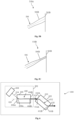
- the output end 506B of the laser waveguide 506 may be angled with respect to the front facet 502B of the DFB laser 502 as illustrated in FIG. 5A .
- the output end 506B (or the output waveguide portion) of the laser waveguide 506 may be an optically transparent, angled waveguide.
- the SOA 504 may be oriented with respect to the DFB laser 502 such that an output optical axis 510 of the DFB laser 502 may be aligned with an input optical axis 512 of the SOA 504.
- the output optical axis 510 of the DFB laser 502 may refer to an optical axis of the output end 506B (or the output waveguide portion) of the laser waveguide 506.
- the input optical axis 512 of the SOA 504 may refer to an optical axis of the input end 508A (or the input waveguide portion) of the amplifier waveguide 508.
- the output optical axis 510 of the DFB laser 502 may be collinear with the input optical axis 512 of the SOA 504.
- the angled output end 506B of the laser waveguide 506 of the DFB laser 502 may be optically coupled into the angled input end 508A of the amplifier waveguide 508 of the SOA 504.
- the passive angled waveguide at the output end 506B of the laser waveguide 506 may allow optical coupling of the light 514 between the output end 506B of the laser waveguide 506 and the input end 508A of the amplifier waveguide 508.
- the input end 712A of the amplifier waveguide 712 may be perpendicular to the input facet 710A of the SOA 710 as illustrated in FIG. 7 .
- the input end 712A of the amplifier waveguide 712 may be a straight waveguide.
- the output end 712B of the amplifier waveguide 712 may be angled with respect to the output facet 710B of the SOA 710 as illustrated in FIG. 7 .
- the output end 712B of the amplifier waveguide 712 may be an angled waveguide.
- the laser waveguide 708 of the gain chip 706 may be angled with respect to the rear facet 706A and straight and normal to the front facet 706B, while the SOA 710 may include a straight waveguide at its input facet 710A and an angled waveguide at its output facet 710B.
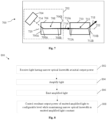
- FIG. 9 is a flowchart 900 that illustrates an operation of an optical amplifier 106 in the integrated device 102 at a forward bias and a reverse bias, in accordance with an embodiment of the present disclosure.
- the flowchart 900 is described in conjunction with FIG. 1 , FIGS. 3-5A , and FIGS. 6-7 .
- an optical amplifier 106 for example, an SOA, may receive a voltage from a controller 114 operably coupled to the optical amplifier 106.
- it may be determined whether the optical amplifier 106 is operated at a forward bias.
- the SOA 106 may also implement an alternate function as a shutter or an on/off switch.
- the SOA 106 may serve as an optical absorber configured to substantially absorb or suppress the output light 108, thereby enabling an extinction of an output light 108 having a narrow optical linewidth without any change of the drive current to the narrow linewidth laser source 104.
Landscapes
- Physics & Mathematics (AREA)
- Condensed Matter Physics & Semiconductors (AREA)
- General Physics & Mathematics (AREA)
- Electromagnetism (AREA)
- Optics & Photonics (AREA)
- Semiconductor Lasers (AREA)
Applications Claiming Priority (1)
| Application Number | Priority Date | Filing Date | Title |
|---|---|---|---|
| US202363589771P | 2023-10-12 | 2023-10-12 |
Publications (1)
| Publication Number | Publication Date |
|---|---|
| EP4539272A1 true EP4539272A1 (fr) | 2025-04-16 |
Family
ID=93014895
Family Applications (1)
| Application Number | Title | Priority Date | Filing Date |
|---|---|---|---|
| EP24204916.1A Withdrawn EP4539272A1 (fr) | 2023-10-12 | 2024-10-07 | Source laser intégrée à largeur de raie étroite avec amplificateur optique |
Country Status (3)
| Country | Link |
|---|---|
| US (1) | US20250125582A1 (fr) |
| EP (1) | EP4539272A1 (fr) |
| CN (1) | CN119834055A (fr) |
Citations (2)
| Publication number | Priority date | Publication date | Assignee | Title |
|---|---|---|---|---|
| US20180342850A1 (en) * | 2016-02-12 | 2018-11-29 | Furukawa Electric Co., Ltd. | Laser module |
| CN113169516A (zh) * | 2018-12-04 | 2021-07-23 | 华为技术有限公司 | 一种具有更大动态范围的光放大器 |
-
2024
- 2024-10-07 EP EP24204916.1A patent/EP4539272A1/fr not_active Withdrawn
- 2024-10-08 CN CN202411396246.5A patent/CN119834055A/zh active Pending
- 2024-10-11 US US18/913,672 patent/US20250125582A1/en active Pending
Patent Citations (2)
| Publication number | Priority date | Publication date | Assignee | Title |
|---|---|---|---|---|
| US20180342850A1 (en) * | 2016-02-12 | 2018-11-29 | Furukawa Electric Co., Ltd. | Laser module |
| CN113169516A (zh) * | 2018-12-04 | 2021-07-23 | 华为技术有限公司 | 一种具有更大动态范围的光放大器 |
Non-Patent Citations (3)
| Title |
|---|
| LIANPING HOU ET AL: "Narrow linewidth laterally coupled 1.55 [mu]m AlGaInAs/InP distributed feedback lasers integrated with a curved tapered semiconductor optical amplifier", OPTICS LETTERS, OPTICAL SOCIETY OF AMERICA, US, vol. 37, no. 21, 1 November 2012 (2012-11-01), pages 4525 - 4527, XP001579280, ISSN: 0146-9592, [retrieved on 20121029], DOI: 10.1364/OL.37.004525 * |
| VOIGT D. ET AL: "Characterization of a high-power tapered semiconductor amplifier system :", APPLIED PHYSICS B, vol. 72, no. 3, 1 February 2001 (2001-02-01), Berlin/Heidelberg, pages 279 - 284, XP093253391, ISSN: 0946-2171, DOI: 10.1007/s003400100513 * |
| WANG X ET AL: "High-power, spectrally stabilized, near-diffraction-limited 970 nm laser light source based on truncated-tapered semiconductor optical amplifiers with low confinement factors", SEMICONDUCTOR SCIENCE TECHNOLOGY, IOP PUBLISHING LTD, GB, vol. 27, no. 1, 8 December 2011 (2011-12-08), pages 15010, XP020216318, ISSN: 0268-1242, DOI: 10.1088/0268-1242/27/1/015010 * |
Also Published As
| Publication number | Publication date |
|---|---|
| CN119834055A (zh) | 2025-04-15 |
| US20250125582A1 (en) | 2025-04-17 |
Similar Documents
| Publication | Publication Date | Title |
|---|---|---|
| EP1210753B1 (fr) | Source laser accordable, a amplificateur optique integre | |
| EP2854241B1 (fr) | Source laser Mopa avec commande de longueur d'onde | |
| EP0624284B1 (fr) | Structure de gain de laser a semi-conducteur evasee, dotee de rainures deflectrices de la cavite | |
| US6445724B2 (en) | Master oscillator vertical emission laser | |
| US4744089A (en) | Monolithic semiconductor laser and optical amplifier | |
| US6580740B2 (en) | Semiconductor laser device having selective absorption qualities | |
| EP3425755B1 (fr) | Unité d'émission de lumière de surface | |
| US11837838B1 (en) | Laser having tapered region | |
| Wenzel et al. | 10 W continuous-wave monolithically integrated master-oscillator power-amplifier | |
| US20210083458A1 (en) | Semiconductor optical amplifier | |
| US7760782B2 (en) | Distributed bragg reflector type directly modulated laser and distributed feed back type directly modulated laser | |
| US6816531B1 (en) | High-power, kink-free, single mode laser diodes | |
| EP3392986B1 (fr) | Laser accordable et son procédé de commande | |
| US6810067B2 (en) | Single mode grating-outcoupled surface emitting laser with broadband and narrow-band DBR reflectors | |
| US6870871B2 (en) | Semiconductor laser devices, and semiconductor laser modules and optical communication systems using the same | |
| US6829285B2 (en) | Semiconductor laser device and method for effectively reducing facet reflectivity | |
| EP1241751B1 (fr) | Diode laser à haute puissance à mode unique sans un coude | |
| EP4539272A1 (fr) | Source laser intégrée à largeur de raie étroite avec amplificateur optique | |
| US7457341B2 (en) | Low loss grating for high efficiency wavelength stabilized high power lasers | |
| JP2002374037A (ja) | 半導体レーザモジュール、それを用いたファイバ増幅器と光通信システム | |
| Adachi et al. | 100° C, 25 Gbit/s direct modulation of 1.3 µm surface emitting laser | |
| US7313159B2 (en) | Apparatus and method for providing a single-mode grating-outcoupled surface emitting laser with detuned second-order outcoupler grating | |
| CN116073221A (zh) | 光学装置、用于放大种子光的方法和光纤放大器 | |
| US20240322529A1 (en) | Spatial and temporal adjustment of laser device drive current using asic drives | |
| Mauerhoff et al. | Miniaturized wavelength stabilized laser module emitting at 619nm |
Legal Events
| Date | Code | Title | Description |
|---|---|---|---|
| PUAI | Public reference made under article 153(3) epc to a published international application that has entered the european phase |
Free format text: ORIGINAL CODE: 0009012 |
|
| STAA | Information on the status of an ep patent application or granted ep patent |
Free format text: STATUS: THE APPLICATION HAS BEEN PUBLISHED |
|
| AK | Designated contracting states |
Kind code of ref document: A1 Designated state(s): AL AT BE BG CH CY CZ DE DK EE ES FI FR GB GR HR HU IE IS IT LI LT LU LV MC ME MK MT NL NO PL PT RO RS SE SI SK SM TR |
|
| STAA | Information on the status of an ep patent application or granted ep patent |
Free format text: STATUS: THE APPLICATION IS DEEMED TO BE WITHDRAWN |
|
| 18D | Application deemed to be withdrawn |
Effective date: 20251017 |