EP4541600A2 - Leitfähige aufnahmeschicht für thermische bildgebung mit einer empfängerdeckschicht mit einem tensid - Google Patents
Leitfähige aufnahmeschicht für thermische bildgebung mit einer empfängerdeckschicht mit einem tensid Download PDFInfo
- Publication number
- EP4541600A2 EP4541600A2 EP25162793.1A EP25162793A EP4541600A2 EP 4541600 A2 EP4541600 A2 EP 4541600A2 EP 25162793 A EP25162793 A EP 25162793A EP 4541600 A2 EP4541600 A2 EP 4541600A2
- Authority
- EP
- European Patent Office
- Prior art keywords
- water
- receiving layer
- dispersible
- dye
- aqueous
- Prior art date
- Legal status (The legal status is an assumption and is not a legal conclusion. Google has not performed a legal analysis and makes no representation as to the accuracy of the status listed.)
- Pending
Links
Images




Classifications
-
- B—PERFORMING OPERATIONS; TRANSPORTING
- B41—PRINTING; LINING MACHINES; TYPEWRITERS; STAMPS
- B41M—PRINTING, DUPLICATING, MARKING, OR COPYING PROCESSES; COLOUR PRINTING
- B41M5/00—Duplicating or marking methods; Sheet materials for use therein
- B41M5/50—Recording sheets characterised by the coating used to improve ink, dye or pigment receptivity, e.g. for ink-jet or thermal dye transfer recording
- B41M5/52—Macromolecular coatings
-
- B—PERFORMING OPERATIONS; TRANSPORTING
- B41—PRINTING; LINING MACHINES; TYPEWRITERS; STAMPS
- B41M—PRINTING, DUPLICATING, MARKING, OR COPYING PROCESSES; COLOUR PRINTING
- B41M2205/00—Printing methods or features related to printing methods; Location or type of the layers
- B41M2205/02—Dye diffusion thermal transfer printing (D2T2)
-
- B—PERFORMING OPERATIONS; TRANSPORTING
- B41—PRINTING; LINING MACHINES; TYPEWRITERS; STAMPS
- B41M—PRINTING, DUPLICATING, MARKING, OR COPYING PROCESSES; COLOUR PRINTING
- B41M2205/00—Printing methods or features related to printing methods; Location or type of the layers
- B41M2205/06—Printing methods or features related to printing methods; Location or type of the layers relating to melt (thermal) mass transfer
-
- B—PERFORMING OPERATIONS; TRANSPORTING
- B41—PRINTING; LINING MACHINES; TYPEWRITERS; STAMPS
- B41M—PRINTING, DUPLICATING, MARKING, OR COPYING PROCESSES; COLOUR PRINTING
- B41M2205/00—Printing methods or features related to printing methods; Location or type of the layers
- B41M2205/32—Thermal receivers
-
- B—PERFORMING OPERATIONS; TRANSPORTING
- B41—PRINTING; LINING MACHINES; TYPEWRITERS; STAMPS
- B41M—PRINTING, DUPLICATING, MARKING, OR COPYING PROCESSES; COLOUR PRINTING
- B41M2205/00—Printing methods or features related to printing methods; Location or type of the layers
- B41M2205/34—Both sides of a layer or material are treated, e.g. coated
-
- B—PERFORMING OPERATIONS; TRANSPORTING
- B41—PRINTING; LINING MACHINES; TYPEWRITERS; STAMPS
- B41M—PRINTING, DUPLICATING, MARKING, OR COPYING PROCESSES; COLOUR PRINTING
- B41M2205/00—Printing methods or features related to printing methods; Location or type of the layers
- B41M2205/40—Cover layers; Layers separated from substrate by imaging layer; Protective layers; Layers applied before imaging
-
- B—PERFORMING OPERATIONS; TRANSPORTING
- B41—PRINTING; LINING MACHINES; TYPEWRITERS; STAMPS
- B41M—PRINTING, DUPLICATING, MARKING, OR COPYING PROCESSES; COLOUR PRINTING
- B41M5/00—Duplicating or marking methods; Sheet materials for use therein
- B41M5/50—Recording sheets characterised by the coating used to improve ink, dye or pigment receptivity, e.g. for ink-jet or thermal dye transfer recording
- B41M5/52—Macromolecular coatings
- B41M5/5254—Macromolecular coatings characterised by the use of polymers obtained by reactions only involving carbon-to-carbon unsaturated bonds, e.g. vinyl polymers
-
- B—PERFORMING OPERATIONS; TRANSPORTING
- B41—PRINTING; LINING MACHINES; TYPEWRITERS; STAMPS
- B41M—PRINTING, DUPLICATING, MARKING, OR COPYING PROCESSES; COLOUR PRINTING
- B41M5/00—Duplicating or marking methods; Sheet materials for use therein
- B41M5/50—Recording sheets characterised by the coating used to improve ink, dye or pigment receptivity, e.g. for ink-jet or thermal dye transfer recording
- B41M5/52—Macromolecular coatings
- B41M5/5263—Macromolecular coatings characterised by the use of polymers obtained otherwise than by reactions only involving carbon-to-carbon unsaturated bonds
- B41M5/5272—Polyesters; Polycarbonates
Definitions
- thermal transfer systems have been developed to obtain prints from pictures that have been generated from a camera or scanning device. According to one way of obtaining such prints, an electronic picture is first subjected to color separation by color filters. The respective color-separated images are then converted into electrical signals. These signals are then transmitted to a thermal printer. To obtain the print, a cyan, magenta or yellow dye donor element is placed face-to-face with a thermal image receiver element. The two are then inserted between a thermal printing head and a platen roller. A line-type thermal printing head is used to apply heat from the back of the dye-donor sheet. The thermal printing head has many heating elements and is heated sequentially in response to one of the cyan, magenta or yellow signals. The process is then repeated for the other colors. A color hard copy is thus obtained which corresponds to the original picture viewed on a screen.
- Another approach involves hot-melt extrusion of the dye image receiving layer formulation onto a support. Multiple layers can be co-extruded in the preparation of the thermal image receiver element. Such methods are highly effective to prepare useful thermal image receiver elements, but they restrict the type of materials that can be incorporated into the dye image receiving layer due to the high temperatures used for the extrusion process.
- U.S. Patent 7,993,559 Dontula et al.
- U.S. Patent Application Publication 2010/0330306 Dontula et al.
- U.S. Patent Application Publication 2008/0220190 (Majumdar et al.
- aqueous coating formulations typically include a water-soluble or water-dispersible polymer as the binder matrix.
- aqueous-coated dye image receiving layers can exhibit problems in typical customer printing environments where high speed printing requires a smooth separation of dye donor element and the thermal image receiver element with no sticking between the contacting surfaces of the two elements. Printing such images in high humidity environments can be particularly troublesome for sticking with aqueous-coated dye image receiver layers. Moreover, such thermal image receiver elements are often deficient in providing adequate dye density in the thermally formed images. Aqueous-coated layers can also fall apart when contacted with water.
- This invention relates to a conductive thermal image receiver element that has an aqueous-based coatable dye-receiving layer comprising a release agent, a cross linking agent, a water-dispersible acrylic polymer, a water-dispersible polyester and a water-dispersible conductive polymeric material.
- the invention further relates to a conductive thermal image receiver element that has an aqueous-based coatable dye-receiving layer comprising a release agent, a cross linking agent, water-dispersible acrylic polymer, a water-dispersible polyester and a receiver overcoat layer comprising a water-dispersible conductive polymeric material.
- a surfactant may be added to the receiver overcoat layer, or excess surfactant can be added in the manufacture of the water-dispersible acrylic polymer.
- This invention also relates to a method for making this thermal image receiver element as well as method for using it to provide a dye image by thermal transfer from a donor element.
- an embodiment of the present invention provides a conductive thermal image receiver element comprising a support, and having on at least one side of the support: an electrically conductive layer comprising an outermost layer wherein the outermost layer is an aqueous coatable dye-receiving layer having a thickness ranging from 0.1 ⁇ m to 5 ⁇ m, and wherein the aqueous dye-receiving layer comprises a water-dispersible release agent, a cross-linking agent, and polymer binder matrix consisting essentially of: (1) a water-dispersible acrylic polymer comprising chemically reacted or chemically non-reacted hydroxyl, phospho, phosphonate, sulfo, sulfonate, carboxy, or carboxylate groups; (2) a water-dispersible polyester that has a T g of 30oC or less, wherein the water-dispersible acrylic polymer is present in an amount of at least 55 weight % of the total aqueous coatable dye-receiving layer weight and
- the water-dispersible conductive polymeric material can be present in the aqueous dye-receiving layer at an amount ranging from 0.75% to 2.0 % by weight, or an amount ranging from 1.0% to 1.25% by weight, or an amount ranging from 0.75% to 1.5% by weight.
- the conductive thermal image receiver element may have, in addition, any one or more of the following features.
- the water-dispersible acrylic polymer may comprise chemically reacted or chemically non-reacted carboxy or carboxylate groups and may be crosslinked through hydroxyl or carboxy groups to provide aminoester, urethane, amide, or urea groups.
- the water-dispersible acrylic polymer may also comprise recurring units derived from: (a) one or more ethylenically unsaturated polymerizable acrylates or methacrylates comprising acyclic alkyl ester, cycloalkyl ester, or aryl ester groups having at least 4 carbon atoms, (b) one or more carboxy-containing or sulfo-containing ethylenically unsaturated polymerizable acrylates or methacrylates, and (c) optionally styrene or a styrene derivative, wherein the (a) recurring units represent at least 20 mol % and up to and including 99 mol % of the total recurring units, and the (b) recurring units represent at least 1 mol % and up to and including 10 mol %.
- the water-dispersible acrylic polymer is present in an amount of at least 55 weight % and up to and including 90 weight % of the total aqueous coatable dye-receiving layer weight.
- the water-dispersible acrylic polymer may be present in an amount of at least 60 weight % and up to and including 90 weight % of the total dry image receiving layer weight.
- the weight ratio of the water-dispersible acrylic polymer to the water-dispersible polyester in the polymer binder matrix is from 1:1 to and including 20:1, or more specifically, from 4:1 up to and including 15:1.
- the water-dispersible polyester has a T g of at least -10oC and up to and including 30oC and the dye image receiving layer itself has a T g of at least 35oC and up to and including 70oC.
- the outermost layer of the thermal image receiver element has a dry thickness ranging from 0.8 ⁇ m to 2.0 ⁇ m, or from 1.2 to 1.4 ⁇ m, or from 0.1 ⁇ m to 5 ⁇ m.
- the support is a polymeric film or a resin-coated cellulosic paper base, a microvoided polymeric film or wherein the support comprises a cellulosic paper base or a synthetic paper base.
- the conductive thermal image receiver element of the present invention may be a single-sided or duplex thermal image receiver.
- a duplex thermal image receiver element typically comprises the same or different aqueous coatable dye-receiving layer on both opposing sides of the support.
- the aqueous coatable dye-receiving layer may be disposed directly on one or both opposing sides of the support.
- the conductive thermal image receiver element of the present invention may comprise one or more intermediate layers between the support and the aqueous coatable dye-receiving layer on one or both opposing sides of the support.
- useful release agents are selected from the group consisting of a water-dispersible fluorine-based surfactant, a silicone-based surfactant, a modified silicone oil, a polysiloxane, a modified polysiloxane and a cross-linked amino modified polydimethyl siloxane. More specifically, the water-dispersible release agent may be a polysilicone that is modified with amino side chains or terminal groups, and is present in an amount of at least 1 weight to 3 weight %, based on the total dry image receiving layer weight.
- the water-dispersible release agent may be a water-dispersible polyoxyalkylene-modified dimethylsiloxane graft copolymer having at least one alkylene oxide pendant chain having more than 45 alkoxide units.
- the water-dispersible release agent is present in an amount of at least 1.0% to and including 5 % by weight, based on the total dry image receiving layer weight.
- crosslinking agent may be a carbodiimide or an aziridine derivative compound.
- the crosslinking agent is an individual compound or mixture of compounds chosen from the group consisting of melamine formaldehyde resins, glycoluril formaldehyde resins, plycarboxylic acids and anhydrides, plyamines, epihalohydrins, diepoxides, dialdehydes, diols, carboxylic acid halides, ketenes, aziridines, carbodiimides, and isocyanates.
- a conductive thermal image receiver element comprising a support, and having one or both opposing sides of the support: a dry image receiving layer having a T g of at least 35oC and up to and including 60oC, which dry image receiving layer is the outermost layer of the thermal image receiver element, has a dry thickness of at least 1 ⁇ m and up to and including 3 ⁇ m, and comprises a water dispersible release agent, a cross-linking agent, a water-dispersible conductive polymeric material, and a polymer binder matrix that consists essentially of: (1) a water-dispersible acrylic polymer comprising chemically reacted or chemically non-reacted carboxy or carboxylate groups, wherein the water-dispersible acrylic polymer comprises recurring units derived from: (a) one or more ethylenically unsaturated polymerizable acrylates or methacrylates comprising acrylic alkyl ester, cycloalkyl ester, or aryl ester groups having at least 4
- a thermal image receiver element comprising a support, and having on at least one side of the support: a dry image receiving layer as the outermost layer of the thermal image receiver element, the dry image receiving layer having a T g of at least 25°C and up to and including 70°C, a dry thickness of at least 0.5 ⁇ m and up to and including 5 ⁇ m, the dry image receiving layer comprising a water-dispersible release agent, a crosslinking agent, a water-dispersible conductive polymeric material, and a polymer binder matrix consisting essentially of: (1) one or more water-dispersible acrylic polymers derived from one or more ethylenically unsaturated polymerizable monomers; and (2) a water-dispersible polyester that has a T g of 30oC or less, wherein the one or more water-dispersible acrylic polymers are present in an amount of at least 55 weight % and up to and including 90 weight % based on the total dry image receiving layer weight; the one or more water-dispersible
- an imaging assembly comprising a thermal image receiver element according to any of the specifications described herein, wherein the thermal image receiver element is placed in thermal association with a thermal donor element.
- Another embodiment of the present invention provides a method for making the conductive thermal image receiver element of claim 1, comprising: (A) applying an aqueous image receiving layer formulation to one or both opposing sides of a support, the aqueous image receiving layer formulation comprising a water-dispersible release agent, a cross-linking agent, a water dispersible conductive polymeric material, and a polymer binder composition consisting essentially of: (1) a water-dispersible acrylic polymer comprising chemically reacted or chemically non-reacted hydroxyl, phospho, phosphonate, sulfo, sulfonate, carboxy, or carboxylate groups, and (2) a water-dispersible polyester that has a T g of 30oC or less, wherein the water-dispersible acrylic polymer is present in an amount of at least 55 weight % of the resulting total dry image receiving layer weight, and is present in the polymeric binder matrix at a dry ratio to the water-dispersible polyester of at least 1:1 to and including 20:
- the aqueous image receiving layer formulation may additionally be heat treated at a temperature of at least 70oC.
- the method may further comprise the steps of applying the aqueous image receiving layer formulation to the support and drying it to provide the dry image receiving layer in a predetermined pattern.
- Another embodiment of the present invention provides a method for making a thermal image, comprising: imagewise transferring a clear polymeric film, one or more dye images, or both a clear polymeric film and one or more dye images, from a thermal donor element to the image receiving layer of the any of the dry conductive thermal image receiving element described herein.
- an embodiment of the present invention which provides a conductive thermal image receiver element comprising a support, and having on at least one side of the support: an electrically conductive layer comprising an outermost layer wherein the outermost layer is an aqueous coatable dye-receiving layer having a thickness ranging from 1.0 ⁇ m to 1.2 ⁇ m and wherein the aqueous dye-receiving layer comprises a water dispersible release agent, a cross-linking agent, and polymer binder matrix consisting essentially of: (1) a water-dispersible acrylic polymer comprising chemically reacted or chemically non-reacted hydroxyl, phospho, phosphonate, sulfo, sulfonate, carboxy, or carboxylate groups; (2) a water-dispersible polyester that has a T g of 30oC or less; wherein the water-dispersible acrylic polymer is present in an amount of at least 55 weight % of the total aqueous coatable dye-receiving
- the thickness of the receiver overcoat layer ranges from 0.1 ⁇ m to 0.62 ⁇ m, from 0.10 ⁇ m to 0.8 ⁇ m, or from 0.29 ⁇ m to 0.62 ⁇ m.
- the water-dispersible conductive polymeric material may be present in the receiver overcoat layer in an amount of greater than or equal to 1.0% by weight, or in the range of 1.0 % to 3.0% by weight, or 1.2% to 3.0% by weight of the total dry weight of the receiver overcoat layer. In other terms, the water-dispersible conductive polymeric material may be present in the receiver overcoat layer at greater than 10.76 mg/cm 3 .
- the present invention provides a method for making the thermal image receiver element of claim 30, comprising: (A) applying an aqueous coatable dye-receiving layer formulation to one or both opposing sides of a support, the aqueous coatable dye-receiving layer formulation comprising a water-dispersible release agent, a cross-linking agent, and a polymer binder composition consisting essentially of: (1) a water-dispersible acrylic polymer comprising chemically reacted or chemically non-reacted hydroxyl, phospho, phosphonate, sulfo, sulfonate, carboxy, or carboxylate groups, and (2) a water-dispersible polyester that has a T g of 30oC or less; wherein the water-dispersible acrylic polymer is present in an amount of at least 55 weight % of the resulting total dry image receiving layer weight, and is present in the polymeric binder matrix at a dry ratio to the water-dispersible polyester of at least 1:1 to and including 9.2:1, or at least
- the aqueous coatable dye-receiving layer formulation is heat treated at a temperature of at least 70oC. Further, the aqueous coatable dye-receiving layer formulation is applied to the support and dried to provide the dry image receiving layer in a predetermined pattern. The same aqueous coatable dye-receiving layer formulation may be applied to both opposing sides of the support.
- a feature of the present invention is the inclusion of conductive polymeric material in the outermost layer of a thermal image receiver element.
- the water-dispersible conductive polymeric material comprises Poly(3,4-ethylendioxythiophene)-poly(styrenesulfonate).
- the water-dispersible conductive polymeric material may consist essentially of Poly(3,4-ethylendioxythiophene)-poly(styrenesulfonate) and a polar solvent.
- an embodiment of the present invention provides a conductive thermal image receiver element with an aqueous coatable dye-receiving layer that consists in part of a receiver overcoat layer, wherein the receiver overcoat layer comprises a water-dispersible conductive polymeric material and a surfactant.
- the receiver overcoat layer comprises a water-dispersible conductive polymeric material and a surfactant.
- surfactant is present in the receiver overcoat layer at about 2.5 weight %, or in an amount ranging from 1 to 5 weight %.
- a dispersant may also be included in the receiver overcoat.
- a useful dispersant is a latex polymer comprising benzyl methacrylate and methacrylic acid.
- the surfactant is present in the receiver overcoat at about 1 to 4% by weight, or more specifically about 2%, and the dispersant is present in the receiver overcoat at about 0.5 to 2% by weight, or more specifically about 0.5% to 1.5% by weight, based on the total dry weight of the receiver overcoat layer.
- a further embodiment of the present invention provides a conductive thermal image receiver element comprising a support, and having on at least one side of the support: an electrically conductive layer comprising an outermost layer wherein the outermost layer is an aqueous coatable dye-receiving layer having a thickness ranging from 0.1 ⁇ m to 5 ⁇ m, and wherein the aqueous dye-receiving layer comprises a water-dispersible release agent, a cross-linking agent, and polymer binder matrix consisting essentially of: (1) a water-dispersible acrylic polymer comprising chemically reacted or chemically non-reacted hydroxyl, phospho, phosphonate, sulfo, sulfonate, carboxy, or carboxylate groups, wherein the water-dispersible acrylic polymer comprises excess surfactant in excess of 1% used to prepare the acrylic polymer; (2) a water-dispersible polyester that has a T g of 30oC or less, wherein the water-dispersible acrylic polymer is
- a conductive thermal image receiver element comprising a support, and having on at least one side of the support: an electrically conductive layer comprising an outermost layer wherein the outermost layer is an aqueous coatable dye-receiving layer having a thickness ranging from 0.1 ⁇ m to 5 ⁇ m, and wherein the aqueous dye-receiving layer comprises a water-dispersible release agent, a cross-linking agent, and polymer binder matrix consisting essentially of: (1) a water-dispersible acrylic polymer comprising chemically reacted or chemically non-reacted hydroxyl, phospho, phosphonate, sulfo, sulfonate, carboxy, or carboxylate groups, wherein the water-dispersible acrylic polymer comprises excess surfactant in excess of 1% used to prepare the acrylic polymer; (2) a water-dispersible polyester that has a T g of 30oC or less; wherein the water-dispersible acrylic polymer is present in an
- a further feature of the present invention is the inclusion of one or more antifoamers in the dye-receiving layer of a thermal image receiver element.
- an embodiment provides a conductive thermal image receiver element with a dye-receiving layer, as described throughout this disclosure, wherein the dye-receiving layer comprises a surfactant and an antifoamer.
- the antifoamer may be selected from the group consisting of: DYNOL 607 by Air Products ® , TEGO FOAMEX 800 by Evonik ® , TEGO FOAMEX 805 by Evonik ® , TEGO FOAMEX 825 by Evonik ® , SILWET L-7200 by Momentive ® , SILWET L-7210 by Momentive ® , SILWET L-7220 by Momentive ® , SILWET L-7607 by Momentive ® , Dow Corning ® 6 Additive, Dow Corning ® 62 Additive, XIAMETER AFE-1430 by Dow Corning ® , SILTECH C-4830, by Siltech, AIRASE 5300 by Air Products ® , AIRASE 5500 by Air Products ® , and AIRASE 5700 by Air Products ® .
- the antifoamer is present in an amount of 0.01 to 0.32 % by weight based on the total dry weight of the dye
- the dye-receiving layer comprising an antifoamer is derived from an aqueous polymer emulsion.
- aqueous polymer emulsion yields a foam height of less than or equal to 3.5 cm above an initial liquid level after mixing the aqueous polymer emulsion at 2000 rpm for two minutes. More specifically, the aqueous polymer emulsion yields a foam height of 0 cm above the initial liquid level after mixing the aqueous polymer emulsion at 2000 rpm for two minutes and waiting an additional minute.
- Glass transition temperatures can be determined using Differential Scanning Calorimetry (DSC) and known procedures, for example wherein differential power input is monitored for the sample composition and a reference as they are both heated at a constant rate and maintained at the same temperature.
- the differential power input can be plotted as a function of the temperature and the temperature at which the plot undergoes a sharp slope change is generally assigned as the T g of the sample polymer or dry image receiving layer composition.
- % solids or weight % are stated in reference to the total dry weight of a specific composition or layer.
- thermal donor element is used to refer to an element (defined below) that can be used to thermally transfer a dye, ink, clear film, or metal. It is not necessary that each thermal donor element transfer only a dye or ink.
- thermal association is used to refer to two different elements that are disposed in a relationship that allows thermal transfer of a dye, metal, or thin polymer film. Such a relationship generally requires intimate physical contact of the two elements while they are being heated.
- aqueous-coated is used to refer to a layer that is applied or coated out of an aqueous coating formulation.
- aqueous coatable is used to refer to a layer that is applied or coated as an aqueous coating formulation but then can dry to become a dry layer.
- polymer and “resin” mean the same thing.
- acrylic polymer is meant in encompass both homopolymers having the same recurring unit along the organic backbone, as well as copolymers having two or more different recurring units along the backbone.
- ethylenically unsaturated polymerizable monomer refers to an organic compound that has one or more ethylenically unsaturated polymerizable groups (such as vinyl groups) that can be polymerized to provide an organic backbone chain of carbon atoms, and optionally various side chains attached to the organic backbone.
- the polymerized product of a particular ethylenically unsaturated polymerizable monomer, within the organic backbone, is called a "recurring unit.”
- the various recurring units in the water-dispersible acrylic polymers used in the practice of this invention are distributed along the backbone of a given polymer in a random fashion, although blocks of common recurring units can be found but are not purposely formed along the organic backbone.
- water-dispersible and “water-dispersibility,” when used in reference to the acrylic polymers, polyesters, and release agents used in the practice of this invention, refer to the property in which these polymers are generally dispersed in an aqueous media during their manufacture or coating onto a support. They mean that the acrylic polymers and polyesters are generally supplied and used in the form of aqueous dispersions. They are not soluble in the aqueous media but they do not readily settle within the aqueous media. These terms do not refer to the acrylic polymers and polyesters, once coated and dried, as being re-dispersible in an aqueous medium. Rather, when such acrylic polymers and polyesters are dried on a support, they generally stay intact when contacted with water or aqueous solutions.
- antistat means a water-dispersible conductive polymeric material (as described in more detail below).
- Embodiments of thermal image receiver elements disclosed herein comprise an outermost image receiving layer on one or both (opposing) sides of a support (described below).
- the DRL is the outermost layer so that transfer of a dye, clear film, or metal can occur.
- the outermost layer is a two-layer DRL/ROC combination. The ROC lies on top of the DRL.
- both the ROC and DRL accept the transfer of dye, clear film, or metal donor material.
- one or more additional layers can be located between the dye image receiving layer and the support.
- the DRL and ROC layers are formed as aqueous dispersions that are coated on one or both sides of the support.
- the following describes the components of such aqueous dispersions for the DRL and ROC layers.
- the dry image receiving layer (also referred to herein as an aqueous coatable dye-receiving layer or sometimes as an image receiving layer or more simply, as DRL) is the outermost layer in the single-layer thermal image receiver element embodiment and second most outer layer in the two-layer thermal image receiver element embodiment (the ROC lies on top of the DRL in that embodiment).
- the DRL generally has a T g of at least 25oC and up to and including 70oC, or typically at least 35oC and up to and including 70oC, or at least 35oC and up to and including 60oC.
- the T g is 30oC or less.
- the dry image receiving layer T g is measured as described above with differential scanning calorimeter (DSC) by evaluating the dry image receiving layer formulation containing a polymer binder matrix that comprises one or more of the following components: (1) a water-dispersible acrylic polymer, (2) a water-dispersible polyester, and (3) water-dispersible conductive polymeric material.
- DSC differential scanning calorimeter
- the aqueous coatable dye-receiving layer has a dry thickness of at least 0.1 ⁇ m and up to and including 5 ⁇ m, and typically at least 0.5 ⁇ m and up to and including 3 ⁇ m. In certain embodiments the aqueous coatable dye-receiving layer has a dry thickness of 1.2 ⁇ m to 1.5 ⁇ m, while in other embodiments, the DRL has a dry thickness of 0.7 ⁇ m to 1 ⁇ m. This dry thickness is an average value measured over at least 10 places in an appropriate electron scanning micrograph or other appropriate means and it is possible that there can be some places in the layer that exceed the noted average dry thickness.
- the aqueous coatable dye-receiving layer comprises a polymer binder matrix that consists essentially of (1) a water dispersible acrylic polymer and (2) a water dispersible polyester.
- a water dispersible conductive polymeric material also referred to herein as conductive polymer or antistat may additionally be included in the DRL.
- each comprises chemically reacted or chemically non-reacted hydroxyl, phospho, phosphonate, sulfo, sulfonate, carboxy, or carboxylate groups, and particularly chemically reacted or chemically non-reacted carboxy or carboxylate groups.
- the term water-dispersible acrylic polymers includes styrene acrylic copolymers.
- the water-dispersible acrylic polymer can be crosslinked (generally after the image receiving layer formulation has been applied to the support) through hydroxyl or carboxy groups to provide aminoester, urethane, amide, or urea groups. Mixtures of these water-dispersible acrylic polymers can be used if desired, having the same or different reactive groups.
- Such water-dispersible acrylic polymers can be designed from one or more ethylenically unsaturated polymerizable monomers that will provide the desired properties of the resulting dry image receiving layer (T g , crosslinkability, resistance to transferred dye fade, and thermal transferability).
- the useful water-dispersible acrylic polymers comprise recurring units that are derived predominantly (greater than 50 mol %) from one or more ethylenically unsaturated polymerizable monomers that provide the desired properties. The remainder of the recurring units can be derived from different ethylenically unsaturated polymerizable monomers.
- the water-dispersible acrylic polymer comprises recurring units derived from a combination of: (a) one or more ethylenically unsaturated polymerizable acrylates or methacrylates comprising acyclic alkyl ester, cycloalkyl ester, or aryl ester groups; (b) one or more carboxy-containing or sulfo-containing ethylenically unsaturated polymerizable acrylate or methacrylate, and (c) optionally styrene or a styrene derivative.
- the acyclic alkyl ester, cycloalkyl ester, or aryl ester groups can be substituted or unsubstituted, and they can have up to and including 14 carbon atoms.
- the acyclic alkyl ester groups comprise linear and branched, substituted or unsubstituted alkyl groups including aryl-substituted alkyl groups, and aryloxy-substituted alkyl groups and can have at least 1 carbon atom and up to and including 22 carbon atoms.
- the cycloalkyl ester groups generally have at least 5 carbon atoms and up to and including 10 carbon atoms in the ring, and can be substituted or substituted cyclic ester groups including alkylsubstituted cyclic ester rings.
- Useful aryl ester groups include phenyl ester and naphthyl ester groups, which can be substituted or unsubstituted with one or more groups on the aromatic rings.
- ethylenically unsaturated polymerizable acrylates or methacrylates include but are not limited to, n-butyl acrylate, n-butyl methacrylate, t- butyl acrylate, t-butyl methacrylate, benzyl acrylate, benzyl methacrylate, 2-phenoxyethyl acrylate, stearyl methacrylate, cyclohexyl acrylate, cyclohexyl methacrylate, isobornyl methacrylate, 2-chloroethyl acrylate, benzyl 2-propyl acrylate, n-butyl 2-bromoacrylate, phenoxyacrylate, and phenoxymethacrylate.
- ethylenically unsaturated polymerizable acrylates and methacrylates include benzyl acrylate, benzyl methacrylate, t-butyl acrylate, and 2-phenoxyethyl acrylate.
- hydroxy-, phospho-, carboxy- or sulfo-containing ethylenically unsaturated polymerizable acrylates and methacrylates include but are not limited to, acrylic acid, sodium salt, methacrylic acid, potassium salt, 2-acrylamido-2-methylpropane sulfonic acid, 2-acrylamido-2-methylpropane sulfonic acid, sodium salt, 2-sulfoethyl methacrylate, sodium salt, 3-sulfopropyl methacrylate, sodium salt, and similar compounds.
- Acrylic acid and methacrylic acid, or salts thereof, are particularly useful so that the water-dispersible acrylic polymers comprise chemically reacted or chemically non-reacted carboxy or carboxylate groups.
- the (c) ethylenically unsaturated polymerizable monomers include but are not limited to styrene, ⁇ -methyl styrene, 4-methyl styrene, 4-acetoxystyrene, 2-bromostyrene, ⁇ -bromostyrene, 2,4-dimethylstyrene, 4-ethoxystyrene, 3-trifluoromethylstyrene, 4-vinylbenzoic acid, vinyl benzyl chloride, vinyl benzyl acetate, and vinyl toluene. Styrene is particularly useful.
- the (a) recurring units generally represent at least 20 mol % and up to and including 99 mol % of the total recurring units, or more typically at least 30 mol % and up to and including 98 mol % of the total recurring units in the polymer.
- the (b) recurring units generally represent at least 1 mol % and up to and including 10 mol %, and typically at least 2 mol % and up to and including 5 mol %, of the total recurring units in the polymer.
- the recurring units derived from those monomers are generally present in an amount of at least 30 mol % and up to and including 80 mol %, or typically at least 50 mol % and up to and including 70 mol %, of the total recurring units in the polymer.
- the water-dispersible acrylic polymers used in the practice of this invention can be prepared using readily available reactants and known addition polymerization conditions and free radical initiators. The preparation of some representative copolymers used in the present invention is provided below and in Table I and II.
- some useful water-dispersible acrylic polymers can be obtained from Fujikura (Japan), DSM, and Eastman Kodak Company.
- the water-dispersible acrylic polymers are provided as aqueous dispersions.
- Useful water-dispersible acrylic polymers also generally have a number average molecular weight (M n ) of at least 5,000 and up to and including 1,000,000, as measured using size exclusion chromatography.
- Useful water dispersible acrylic polymers include, but are not limited to NeoCryl TM A-6092, NeoCryl TM XK-22-, NeoCryl TM 6092, and NeoCryl TM 6015, Dow ® AVANSE MV-100, AVANSE 200, RHOPLEX TM acrylic product series, such as, Phoplex 585, HG-706, VSR-50, Z-Clean 1500, Lubrizol Carboset and Carbotac acrylic product series, Arkema ® ENCOR All - Acrylic emulsions and SNAP acrylic polymers, such as, SNAP 720 and 728, etc. In certain embodiments mixtures of polymers are used (see herein below). Sometimes the water-dispersible acrylic polymers are referred to herein as "acrylic latex" or "acrylic polymer latex.”
- the thermal image receiver elements include the water-dispersible acrylic polymer that comprises recurring units derived from: (a) one or more ethylenically unsaturated polymerizable acrylates or methacrylates comprising acyclic alkyl, cycloalkyl, or aryl ester groups having at least 4 carbon atoms, (b) one or more carboxy-containing or sulfo-containing ethylenically unsaturated polymerizable acrylate or methacrylate, and (c) optionally styrene or a styrene derivative, and wherein the (a) recurring units represent at least 10 mol % and up to and including 99 mol % of the total recurring units, and the (b) recurring units represent at least 1 mol % and up to and including 10 mol %.
- the water-dispersible acrylic polymer in the dry image receiving layer can be crosslinked through hydroxyl or carboxy groups using a suitable crosslinking agent (described below) to provide aminoester, urethane, amide, or urea groups.
- a suitable crosslinking agent described below
- the one or more water-dispersible acrylic polymers are present in an amount of at least 55 weight %, and typically at least 60 weight % and up to and including 80 weight % or 90 weight %, based on the total dry image receiving layer weight.
- Each of the one or more water-dispersible polyesters that are present in the polymer binder matrix has a T g of 30oC or less, or typically a T g of at least -10oC and up to and including 30oC, or even at least 0oC and up to and including 20oC.
- the water-dispersible polyester has a T g of 30oC or less.
- the water-dispersible polyester is a film-forming polymer that provides a generally homogeneous film when coated as dried.
- Such polyesters can comprise some water-dispersible groups such as sulfo, sulfonate, carboxyl, or carboxylate groups in order to enhance the water-dispersibility.
- Useful water-dispersible polyesters can be prepared using known diacids by reaction with suitable diols.
- the diols are aliphatic glycols and the diacids are aromatic diacids such as phthalate, isophthalate, and terephthalate, in a suitable molar ratio.
- Mixtures of diacids can be reacted with mixtures of glycols.
- Either or both of the diacid or diol can comprise suitable sulfo or carboxy groups to improve water-dispersibility.
- a commercial source of a useful water-dispersibility polyester is described in the Examples below.
- Two useful water-dispersible polyesters are copolyesters of isophthalate and diethylene glycol, and a copolymer formed from a mixture of isophthalate and terephthalate with ethylene glycol and neopentyl glycol.
- An exemplary polyester is Vylonal ® MD-1480, available from Toyobo ® .
- Other water-dispersible copolyesters are Vylonal ® MD-1400, MD-1335, MD-1930, MD-1985, etc. also available from Toyobo ® , and Eastman AQ 1350, AQ 1395, AQ 2350, and Eastek 1400, etc. available from Eastman.
- the useful water-dispersible polyesters useful in the present invention can be obtained from some commercial sources such as Toyobo ® (Japan) and Eastman Chemical Company, and can also be readily prepared using known starting materials and condensation polymerization conditions.
- the one or more water-dispersible acrylic polymers are present in the polymer binder matrix at a dry ratio to the water-dispersible polyester of at least 1:1, or typically at least 1:1 up to and including 6:1, or more likely at least 1.5:1 up to and including 4:1.
- the one or more water-dispersible acrylic polymers are present in the polymer binder matrix at a dry ratio to the water-dispersible polyester of at least 1:1 up to and including 9.2:1.
- the one or more water-dispersible acrylic polymers are present in the polymer binder matrix at a dry ratio to the water-dispersible polyester of at least 1:1, or at least 4:1 and up to and including 20:1, or at least 1:1 up to and including 20:1, or at least 4:1 up to and including 15:1.
- the receiver overcoat layer is the outermost layer in the double-layer thermal image receiver element embodiment. This layer is not present in the single-layer DRL embodiment.
- the aqueous coatable receiver overcoat layer has a dry thickness of at least 0.1 ⁇ m and up to and including 5.0 ⁇ m, and typically at least 0.2 ⁇ m and up to and including 1.0 ⁇ m. In certain embodiments the aqueous coatable receiver overcoat layer has a dry thickness of 0.2 ⁇ m to 0.4 ⁇ m, while in other embodiments, the ROC has a dry thickness of 0.4 ⁇ m to 0.7 ⁇ m, or about 0.62 ⁇ m. According to the two-layer DRL/ROC embodiment ( FIG. 1B ), the combined thickness of the aqueous coatable ROC and aqueous coatable DRL is about 0.8 ⁇ m to 2.0 ⁇ m, or more specifically 1.0 ⁇ m to 1.2 ⁇ m.
- the aqueous coatable receiver overcoat layer formulation comprises a polymer binder matrix composition that consists essentially of the (1) water-dispersible acrylic polymer and (2) water-dispersible polyester that were described with reference to the DRL, in all of the same respects.
- the ROC additionally comprises water-dispersible conductive polymeric material component (as described below), as well as additional surfactants and optional addenda such as a surfactant used in the emulsification of the water-dispersible acrylic polymer, one or more release agents, one or more crosslinking agents, and any other addenda described herein.
- the weight ratio of the water-dispersible acrylic polymer to the water-dispersible polyester in such formulations is at least 1:1 to and including 6:1, or typically at least 1.5:1 to and including 5:1.
- the weight ratio of the water-dispersible acrylic polymer to the water-dispersible polyester in such formulations is at least 1:1 to and including 9.2:1.
- the one or more water-dispersible acrylic polymers are present in the polymer binder matrix at a dry ratio to the water-dispersible polyester of at least 1:1, or typically at least 4:1 and up to and including 20:1, or more likely at least 1:1 and up to and including 20:1, or even at least 4:1 and up to and including 15:1.
- water-dispersible conductive polymeric material is present in the DRL.
- water-diserpsible conductive polymeric material is only added to the ROC.
- Exemplary water dispersible conductive polymeric materials include thiophenes such as Poly(3,4-ethylendioxythiophene)-poly(styrenesulfonate), known as PEDOT or PEDT.
- Baytron ® P and Clevios ® P are commercially available PEDOT solutions that are an aqueous solution that is 1.3% of the conjugated polymer PEDOT:PSS. PSS stands for poly(styrenesulfonate).
- the PEDOT:PSS conjugate is mixed with an alcohol such as diethylene glycol or any other polar solvent, which enhances the conductivity of the conjugated PEDOT:PSS polymer.
- PEDOT:PSS is a conjugated polymer that carries positive charges and yet is still optically transparent.
- the multi-layered conductive thermal image receiver element of the present invention provides excellent electrical conductivity to enable efficient and effective dissipation of the electrostatic charge that is normally generated during the media transport and image forming process. This buildup of static charge causes undesirable print defects, such as white dropouts and creasing on the actual printed image.
- the present invention eliminates the buildup of static charge, leads to better print quality and improves the stacking and handling of the prints.
- Another benefit to the present invention is that it can be used in all printers and thus can be considered a universal printer media that can be used in many types of printers, including thermal printers.
- the water dispersible conductive polymeric material may be present in the DRL (single-layer embodiment) or the ROC (two-layer embodiment) in an amount ranging from 0.5% to 3.0%, or more specifically, from 1.0% to 2.0% or 1.5% to 2.5% by mass based on the dry mass of the respective layer to which the conductive polymer is added.
- the water dispersible conductive polymeric material is added to the dye-receiving layer, while in other embodiments, such material is added to the receiver overcoat layer.
- conductive polymeric material may be added to the ROC layer and not the DRL layer. In practice, the ROC and DRL layers shown in FIG. 1B are coated almost simultaneously.
- the water dispersible conductive polymeric material may be present in the receiver overcoat layer in an amount equal to or greater than 1% by dry mass, or alternatively, in an amount equal to or greater than 1.4% by dry mass.
- the conductive polymeric material may also be present in the receiver overcoat in an amount at a range of 1.2% to 3% or at a range of 1% to 3%.
- the water dispersible conductive polymeric material is present in the ROC at a concentration of greater than or equal to 10.76 mg/cm 3 .
- FIG. 2 provides exemplary polymer binder matrix compositions where the water dispersible conductive polymeric material is present within the aqueous coatable dye-receiving layer for single-layer DRL embodiments-i.e., none of the samples in FIG. 2 had an ROC layer.
- C1-C6 represent control samples
- E1-E2 represent examples according to the invention.
- conductive polymeric material was added to sub-layers and not to the DRL. While all four samples exhibited no buckling and no creasing, all but C1 suffered from image bleeding. Image bleeding was measured after one week at variable conditions: 35°C/50% relative humidity; 40°C/50% relative humidity; and 50°C/50% relative humidity.
- Control sample C1 did not suffer from either buckling/creasing or image bleeding. However, to achieve such results, it was required to increase the thickness of the DRL significantly. Control examples C5 and C6 did not include any conductive polymeric material in the DRL and both test samples resulted in undesirable buckling and creasing. For invention examples E1 and E2, conductive polymeric material was added to the DRL, as opposed to the sub-layers. Both E1 and E2 exhibited no buckling, no creasing, and no image bleeding. Yet, the DRL thickness was held at 1.4 ⁇ m and a significantly less amount of conductive material was required.
- conductive polymeric material added to the DRL, the inventors were able to avoid undesirable buckling, creasing, and image bleeding without having to sacrifice the thinness of the DRL and without having to add a significant amount of conductive material.
- the surface electrical resistance (“SER") of each sample was also tested. During printing, it is advantageous to maintain low surface resistivity to dissipate static electricity. As can be seen in FIG. 2 , adding conductive polymeric material to the DRL helps with achieving this desired result.
- the aqueous coatable ROC and aqueous coatable DRL each may contain one more of any of the following additional addenda: plasticizers, defoamers, coating aids, charge control agents, thickeners or viscosity modifiers, antiblocking agents, UV absorbers, coalescing aids, matte beads (such as organic matte particles), antioxidants, stabilizers, and fillers as is known in the art for aqueous-coated formulations
- plasticizers defoamers
- coating aids charge control agents
- thickeners or viscosity modifiers antiblocking agents
- UV absorbers coalescing aids
- matte beads such as organic matte particles
- antioxidants stabilizers
- fillers as is known in the art for aqueous-coated formulations
- the receiver overcoat layer comprises a polymer binder matrix consisting essentially of (1) a water-dispersible acrylic polymer and (2) a water-dispersible polyester, as well as (3) a water-dispersible conductive polymeric material.
- the ROC layer may further comprise one or more release agents, one or more crosslinking agents, one or more antifoamers, and one or more surfactants or emulsifiers.
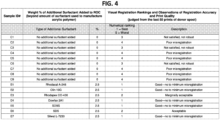
- an amount of surfactant is added to the aqueous ROC dispersion. Namely, surfactant is added to the ROC dispersion after the acrylic polymer is already formed, which is in addition to the amount of surfactant that is used as an emulsifier in the manufacture or suspension of the acrylic polymer. Hence, such added surfactant is sometimes referred to herein as "additional surfactant.”
- a surfactant/emulsifier is required to manufacture acrylic polymers with water dispersible properties.
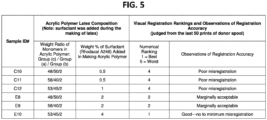
- "excess surfactant” is added at the time that the acrylic polymer is made.
- This excess surfactant is an extra amount of surfactant in excess of what is required to actually make the acrylic polymer and is added at the time that the acrylic polymer is actually made.
- surfactant in the amount of 1% is required for the manufacture of acrylic polymers.
- “excess surfactant” is the amount of surfactant used to make the acrylic polymers that is in excess of 1%. For example, FIG.
- Group (c) monomers are styrene or styrene derivatives
- Group (a) monomers are ethylenically unsaturated polymerizable acrylates or methacrylates comprising acyclic alkyl, cycloalkyl, or aryl ester groups having at least 4 carbon atoms
- Group (b) monomers are carboxy-containing or sulfo-containing ethylenically unsaturated polymerizable acrylate or methacrylate.
- Useful surfactants are anionic or non-ionic surfactants.
- Useful anionic surfactants include, but are not limited to, the following: Rhodocal ® A-246 (Sodium C14-C16 sulfonate), Rhodapex ® CO-436 (40% solids in 12-16% ethanol); DOWFAX 2A1 (alkyldiphenyloxide disulfonate), SDBS (Sodium Dodecyl Benzenesulfonate) and ADS (sodium dodecyl sulfate).
- Useful non-ionic surfactants include, but are not limited to, the following: Olin-10G TM (P-isonoylphenoxypoly(glycidol)) or SILWET L-7230 (a copolymer of silicone, ethylenoxide and propyleneoxide).
- the amount of "excess” or “additional” surfactant added to the formulation is in the range from 1% to 5% by weight, or 2% to 5% by weight, or by 3% to 4% by weight. In certain embodiments the additional surfactant is added to the formulation at about 2.5% by weight, or 1% to 3% by weight, or 2% to 2.5% by weight, or 2% to 3% by weight.
- the inventors were able to reduce the number of misregistrations. Because misregistrations appear to happen more frequently at the end of the donor ribbon spool, the inventors judged visual registration and registration accuracy by testing and analyzing the last section of prints of a donor spool (for example, the last 50 pages when the donor spool normally would print about 250 prints). As one skilled in the art would appreciate, when there is a misregistration, the print quality is reduced as the lines, edges, or boundaries are fuzzy and not sharp. Moreover, misregistrations cause the edges or boundaries to be incorrectly colored because of incorrect overlap of the various colors of the donor element that are transferred to the receiver element.
- the blue and yellow dye are transferred to the receiver element on top of each other.
- the edges or boundaries of the print may appear either yellow or blue, instead of green, because there was not a perfect overlap of the blue and yellow dye to achieve the green color.
- foams are easily generated during the preparation of dispersions and during any subsequent coating application process. Foaming occurs particularly when dispersions, like the ones discussed previously, undergo high shearing processes. High shearing processes include high-speed stirring at about 1000 rpm (revolution per minute) or greater and high-speed coating application at about 150 mpm (meter per minute) or greater. During a high shearing process, an objectionable amount of foam is generated, which usually causes coating defects, unwanted compositional fluctuation, and messy overflow, among other undesirable effects. Moreover, excess foaming requires one to frequently change the filters of the coating equipment.
- antifoamers include compounds with high silicone content, such as structured siloxane defoamers, polyorganosiloxane, resinous siloxane compounds, and polyether siloxane copolymers.
- Useful antifoamers include, but are not limited to, the commercially available antifoamers listed in FIG. 7 .
- FIG. 7 is a table showing how various concentrations of various types of antifoamers affect the foam height above initial liquid level after the aqueous dispersion has been subjected to a high shearing process.
- the sample dispersions each underwent high-speed mixing at 2000 rpm for two minutes. Foam height measurements were taken immediately after the mixing process ended ("0 minutes after 2 min mix"), one minute after the mixing process ended, and two minutes after the mixing process ended.
- control dispersion sample C1 did not include an antifoamer, and as expected, the foam height above initial liquid level was at one of the highest levels observed of any sample.
- Dispersion samples F1-F17 each included an antifoamer at varying amounts, but none of those dispersion samples effectively reduced foam levels after a high shearing stirring process.
- Dispersion samples E10-E30 proved more effective at reducing foam levels after a high shearing stirring process. The results in FIG. 7 evidence that certain types of antifoamers effectively reduce foam levels after high shearing processes, whereas other types of antifoamers do not effectively reduce foam levels.
- each of the DRL dispersion samples listed in FIG. 7 comprise all of the same components-namely, a water-dispersible acrylic polymer, a water-dispersible polyester, a release agent, a cross-linking agent, and a surfactant.
- FIG. 6 is a table showing how various concentrations of various types of antifoamers affect the foam height above the initial liquid level of several aqueous DRL dispersions.
- All of the dispersion samples E1-E12 and C13-C14 are aqueous DRL dispersions comprising the same cross-linking agent, release agent, water-dispersible polyester, and water-dispersible acrylic polymer.
- the papers include a broad range of papers, from high end papers, such as photographic paper to low end papers, such as newsprint.
- Ektacolor ® paper Eastman Kodak Co.
- the paper can be made on a standard continuous fourdrinier wire machine or on other modern paper formers. Any pulp known in the art to provide paper can be used. Bleached hardwood chemical kraft pulp is useful as it provides brightness, a smooth starting surface, and good formation while maintaining strength.
- a particularly useful support is a paper base that is coated with a resin on either side.
- Biaxially oriented base supports include a paper base and a biaxially oriented polyolefin sheet, typically polypropylene, laminated to one or both sides of the paper base.
- Such supports can contain pigments, air voids or foam voids to enhance their opacity.
- the support can also comprise microporous materials such as polyethylene polymer-containing material sold by PPG Industries, Inc., Pittsburgh, Pennsylvania under the trade name of Teslin ® , Tyvek ® synthetic paper (DuPont Corp.), impregnated paper such as Duraform ® , and OPPalyte ® films (Mobil Chemical Co.) and other composite films listed in U.S. Patent 5,244,861 that is incorporated herein by reference.
- Useful composite sheets are disclosed in, for example, U.S. Patents 4,377,616 (Ashcraft et al. ), 4,758,462 (Park et al. ), and 4,632,869 (Park et al. ), the disclosures of which are incorporated by reference.
- the support can be voided, which means voids formed from added solid and liquid matter, or "voids" containing gas.
- the void-initiating particles, which remain in the finished packaging sheet core, should be from at least 0.1 and up to and including 10 ⁇ m in diameter and typically round in shape to produce voids of the desired shape and size.
- Microvoided polymeric films are particularly useful in some embodiments. For example, some commercial products having these characteristics that can be used as support are commercially available as 350K18 from ExxonMobil and KTS-107 (from HSI, South Korea).
- Biaxially oriented sheets while described as having at least one layer, can also be provided with additional layers that can serve to change the properties of the biaxially oriented sheet. Such layers might contain tints, antistatic or conductive materials, or slip agents to produce sheets of unique properties.
- Biaxially oriented sheets can be formed with surface layers, referred to herein as skin layers, which would provide an improved adhesion, or look to the support and photographic element.
- the biaxially oriented extrusion can be carried out with as many as 10 layers if desired to achieve some particular desired property.
- the biaxially oriented sheet can be made with layers of the same polymeric material, or it can be made with layers of different polymeric composition.
- Useful transparent supports can be composed of glass, cellulose derivatives, such as a cellulose ester, cellulose triacetate, cellulose diacetate, cellulose acetate propionate, cellulose acetate butyrate, polyesters, such as poly(ethylene terephthalate), poly(ethylene naphthalate), poly-1,4-cyclohexanedimethylene terephthalate, poly(butylene terephthalate), and copolymers thereof, polyimides, polyamides, polycarbonates, polystyrene, polyolefins, such as polyethylene or polypropylene, polysulfones, polyacrylates, polyether imides, and mixtures thereof.
- transparent means the ability to pass visible radiation without significant deviation or absorption.
- the support used in the thermal image receiver elements can have a thickness of at least 50 ⁇ m and up to and including 500 ⁇ m or typically at least 75 ⁇ m and up to and including 350 ⁇ m.
- Antioxidants, brightening agents, antistatic or conductive agents, plasticizers and other known additives can be incorporated into the support, if desired.
- Useful antistatic agents in the substrate include but are not limited to, metal particles, metal oxides, inorganic oxides, metal antimonates, inorganic non-oxides, and electronically conductive polymers, examples of which are described in U.S. Patent Application 2011/0091667 (noted above) that is incorporated herein by reference.
- Particularly useful antistatic agents are inorganic or organic electrolytes. Alkali metal and alkaline earth salts (or electrolytes) such as sodium chloride, potassium chloride, and calcium chloride, and electrolytes comprising polyacids are useful.
- alkali metal salts include lithium, sodium, or potassium polyacids such as salts of polyacrylic acid, poly(methacrylic acid), maleic acid, itaconic acid, crotonic acid, poly(sulfonic acid), or mixed polymers of these compounds.
- the raw base support can contain various clays such as smectite clays that include exchangeable ions that impart conductivity to the raw base support.
- Polymerized alkylene oxides such as combinations of polymerized alkylene oxide and alkali metal salts as described in U.S. Patents 4,542,095 (Steklenski et al. ) and 5,683,862 (Majumdar et al. ) are useful as electrolytes.
- the antistatic agents can be present in the support (such as a cellulose raw base support) in an amount of up to 0.5 weight % or typically at least 0.01 weight % and up to and including 0.4 weight % based on the total support dry weight.
- the base support comprises a synthetic paper that is typically cellulose-free, having a polymer core that has adhered thereto at least one flange layer.
- the polymer core comprises a homopolymer such as a polyolefin, polystyrene, polyester, polyvinylchloride, or other typical thermoplastic polymers; their copolymers or their blends thereof; or other polymeric systems like polyurethanes and polyisocyanurates. These materials can have been expanded either through stretching resulting in voids or through the use of a blowing agent to consist of two phases, a solid polymer matrix, and a gaseous phase. Other solid materials can be present in the form of fillers that are of organic (polymeric, fibrous) or inorganic (glass, ceramic, metal) origin.
- the support comprises a synthetic paper that can be cellulose-free, having a foamed polymer core or a foamed polymer core that has adhered thereto at least one flange layer.
- the polymers described for use in a polymer core can also be employed in manufacture of the foamed polymer core layer, carried out through several mechanical, chemical, or physical means as are known in the art.
- polyolefins such as polyethylene and polypropylene, their blends and their copolymers are used as the matrix polymer in the foamed polymer core along with a chemical blowing agent such as sodium bicarbonate and its mixture with citric acid, organic acid salts, azodicarbon-amide, azobisformamide, azobisisobutyrolnitrile, diazoaminobenzene, 4,4'-oxybis(benzene sulfonyl hydrazide) (OBSH), N,N'-dinitrosopentamethyl-tetramine (DNPA), sodium borohydride, and other blowing agent agents well known in the art.
- a chemical blowing agent such as sodium bicarbonate and its mixture with citric acid, organic acid salts, azodicarbon-amide, azobisformamide, azobisisobutyrolnitrile, diazoaminobenzene, 4,4'-oxybis(benzene sulfonyl hydrazide) (
- Useful chemical blowing agents would be sodium bicarbonate/citric acid mixtures, azodicarbonamide; though others can also be used. These foaming agents can be used together with an auxiliary foaming agent, nucleating agent, and a cross-linking agent.
- the thermal image receiver element comprises an aqueous coatable dye-receiving layer on only one side of the support
- a slip layer or anti-curl layer on the "backside" (non-imaging) of the support using suitable polymers such as acrylate or methacrylate polymers, vinyl resins such as copolymers derived from vinyl chloride and vinyl acetate, poly(vinyl alcohol-co-vinyl butyral), polyvinyl acetate, cellulose acetate, or ethyl cellulose.
- the backside slip layer can also comprise one or more suitable antistatic agents or anti-conductive agents that are known in the art.
- This slip layer can also include lubricants such as oils or semicrystalline organic solids such as beeswax.
- lubricants such as oils or semicrystalline organic solids such as beeswax.
- Useful anti-curl layers can comprise one or more polyolefins such mixtures of polyethylene and polypropylene.
- thermal image receiver elements of this invention can be prepared as follows.
- An image receiving layer was prepared by applying an aqueous coatable dye-receiving image receiving layer formulation to at least one side of a support, and in some embodiments, the same or different aqueous coatable dye-receiving layer formulations can be applied to opposing sides of a support to provide a duplex thermal image receiving element.
- the applied aqueous coatable dye-receiving layer formulation comprises a polymer binder composition that consists essentially of the (1) and (2) polymer components described above and any optional addenda such as a surfactant used as an emulsifier for making the water-dispersible acrylic polymer, one or more release agents, one or more crosslinking agents and any other addenda described herein.
- the weight ratio of the water-dispersible acrylic polymer to the water-dispersible polyester in such formulations is at least 1:1 to and including 6:1, or typically at least 1.5:1 to and including 5:1.
- the weight ratio of the water-dispersible acrylic polymer to the water-dispersible polyester in such formulations is at least 1:1 to and including 9.2:1.
- the one or more water-dispersible acrylic polymers are present in the polymer binder matrix at a dry ratio to the water-dispersible polyester of at least 1:1, or typically at least 4:1 and up to and including 20:1, or more likely at least 1:1 and up to and including 20:1, or even at least 4:1 and up to and including 15:1.
- These formulations can be applied to the support using any useful technique including coating with appropriate equipment and conditions, including but not limited to hopper coating, curtain coating, rod coating, gravure coating, roller coating, dip coating, and spray coating.
- the support materials are described above, but before applying the aqueous coatable dye-receiving layer formulation, the support can be treated to improve adhesion using any suitable technique such as acid etching, flame treatment, corona discharge treatment, or glow discharge treatment, or it can be treated with a suitable primer layer.
- any suitable technique such as acid etching, flame treatment, corona discharge treatment, or glow discharge treatment, or it can be treated with a suitable primer layer.
- a conductive image receiving layer was prepared by applying an aqueous coatable dye-receiving image receiving layer formulation comprising a conductive polymer to at least one side of a support, and in some embodiments, the same or different aqueous coatable dye-receiving layer formulations can be applied to opposing sides of a support to provide a duplex thermal image receiving element.
- the applied aqueous coatable dye-receiving layer formulation comprises a polymer binder composition that consists essentially of the (1) water-dispersible acrylic polymer, (2) water-dispersible polyester, and (3) water-dispersible conductive polymeric material components described above and any optional addenda such as one or more surfactants or dispersants used as an emulsifier for the water-dispersible acrylic polymer, one or more release agents, one or more crosslinking agents, and any other addenda described above.
- the weight ratio of the water-dispersible acrylic polymer to the water-dispersible polyester in such formulations is at least 1:1 to and including 6:1, or typically at least 1.5:1 to and including 5:1.
- the weight ratio of the water-dispersible acrylic polymer to the water-dispersible polyester in such formulations is at least 1:1 to and including 9.2:1.
- the one or more water-dispersible acrylic polymers are present in the polymer binder matrix at a dry ratio to the water-dispersible polyester of at least 1:1, or typically at least 4:1 and up to and including 20:1, or more likely at least 1:1 and up to and including 20:1, or even at least 4:1 and up to and including 15:1.
- the amount of the (3) water dispersible conductive polymeric material in the formulation ranges from > 0.75% to 2% or 1.0% to 1.25%.
- formulations can be applied to the support using any useful technique including coating with appropriate equipment and conditions, including but not limited to hopper coating, curtain coating, rod coating, gravure coating, roller coating, dip coating, and spray coating.
- the support materials are described above, but before applying the aqueous coatable dye-receiving layer formulation, the support can be treated to improve adhesion using any suitable technique such as acid etching, flame treatment, corona discharge treatment, or glow discharge treatment, or it can be treated with a suitable primer layer.
- the image receiving layer is composed of two layers, namely, an aqueous coatable dye-receiving layer and an aqueous coatable overcoat layer comprising a conductive polymer.
- the image layer was prepared by first applying an aqueous coatable dye-receiving image receiving layer formulation to at least one side of a support, and in some embodiments, the same or different aqueous coatable dye-receiving layer formulations can be applied to opposing sides of a support to provide a duplex thermal image receiving element.
- the applied aqueous coatable dye-receiving layer formulation comprises a polymer binder composition that consists essentially of the (1) water-dispersible acrylic polymer and (2) water-dispersible polyester components described above and any optional addenda such as one or more surfactants or dispersants used as an emulsifier for making the water-dispersible acrylic polymer, one or more release agents, one or more crosslinking agents, and any other addenda described herein.
- the weight ratio of the water-dispersible acrylic polymer to the water-dispersible polyester in such formulations is at least 1:1 to and including 6:1, or typically at least 1.5:1 to and including 5:1.
- the weight ratio of the water-dispersible acrylic polymer to the water-dispersible polyester in such formulations is at least 1:1 to and including 9.2:1.
- the one or more water-dispersible acrylic polymers are present in the polymer binder matrix at a dry ratio to the water-dispersible polyester of at least 1:1, or typically at least 4:1 and up to and including 20:1, or more likely at least 1:1 and up to and including 20:1, or even at least 4:1 and up to and including 15:1.
- formulations can be applied to the support using any useful technique including coating with appropriate equipment and conditions, including but not limited to hopper coating, curtain coating, rod coating, gravure coating, roller coating, dip coating, and spray coating.
- the support materials are described herein, but before applying the aqueous coatable dye-receiving layer formulation, the support can be treated to improve adhesion using any suitable technique such as acid etching, flame treatment, corona discharge treatment, or glow discharge treatment, or it can be treated with a suitable primer layer.
- an overcoat layer was prepared by applying an aqueous coatable dye-receiving image receiving layer formulation comprising a conductive polymer overcoated to the dye-receiving layer at least on one side of a support coated with an aqueous coatable dye-receiving layer, and in some embodiments, the same or different aqueous coatable dye-receiving layer formulations comprising a conductive polymer can be applied to opposing sides of a support coated with an aqueous coatable dye-receiving layer to provide a duplex thermal image receiving element.
- formulations can be applied to the support using any useful technique including coating with appropriate equipment and conditions, including but not limited to hopper coating, curtain coating, rod coating, gravure coating, roller coating, dip coating, and spray coating.
- the support materials are described above, but before applying the aqueous coatable dye-receiving layer formulation, the support can be treated to improve adhesion using any suitable technique such as acid etching, flame treatment, corona discharge treatment, or glow discharge treatment, or it can be treated with a suitable primer layer.
- the image receiving layer is composed of two layers, namely, an aqueous coatable dye-receiving layer and an aqueous coatable overcoat layer comprising additional surfactant and conductive polymer.
- the image layer was prepared by first applying an aqueous coatable dye-receiving image receiving layer formulation to at least one side of a support, and in some embodiments, the same or different aqueous coatable dye-receiving layer formulations can be applied to opposing sides of a support to provide a duplex thermal image receiving element.
- the applied aqueous coatable dye-receiving layer formulation comprises a polymer binder composition that consists essentially of the (1) water-dispersible acrylic polymer and (2) water-dispersible polyester components described above and any optional addenda such as a surfactant used as an emulsifier used for making the water-dispersible acrylic polymer, one or more release agents, one or more crosslinking agents, and any other addenda described herein.
- the weight ratio of the water-dispersible acrylic polymer to the water-dispersible polyester in such formulations is at least 1:1 to and including 6:1, or typically at least 1.5:1 to and including 5:1.
- the weight ratio of the water-dispersible acrylic polymer to the water-dispersible polyester in such formulations is at least 1:1 to and including 9.2:1.
- the one or more water-dispersible acrylic polymers are present in the polymer binder matrix at a dry ratio to the water-dispersible polyester of at least 1:1, or typically at least 4:1 and up to and including 20:1, or more likely at least 1:1 and up to and including 20:1, or even at least 4:1 and up to and including 15:1.
- an overcoat layer was prepared by applying an aqueous coatable dye-receiving image receiving layer formulation comprising an additional surfactant and conductive polymer to the aqueous coatable dye-receiving layer described herein (or as described in (A)) at least on one side of a support coated with an aqueous coatable dye-receiving layer, and in some embodiments, the same or different aqueous coatable dye-receiving layer formulations comprising additional surfactant and a conductive polymer can be applied to opposing sides of a support coated with an aqueous coatable dye-receiving layer to provide a duplex thermal image receiving element.
- the applied aqueous coatable overcoat layer formulation comprises a polymer binder composition that consists essentially of the (1) water-dispersible acrylic polymer, (2) water-dispersible polyester, and (3) water-dispersible conductive polymeric material components described herein and additional surfactants, and optional addenda such as a surfactant used in the emulsification of the water-dispersible acrylic polymer, one or more release agents, one or more crosslinking agents, and any other addenda described herein.
- the weight ratio of the water-dispersible acrylic polymer to the water-dispersible polyester in such formulations is at least 1:1 to and including 6:1, or typically at least 1.5:1 to and including 5:1.
- the weight ratio of the water-dispersible acrylic polymer to the water-dispersible polyester in such formulations is at least 1:1 to and including 9.2:1.
- the one or more water-dispersible acrylic polymers are present in the polymer binder matrix at a dry ratio to the water-dispersible polyester of at least 1:1, or typically at least 4:1 and up to and including 20:1, or more likely at least 1:1 and up to and including 20:1, or even at least 4:1 and up to and including 15:1.
- the amount of water dispersible conductive polymeric material is as discussed above.
- the amount of additional surfactant added to the formulation is as discussed above.
- formulations can be applied to the support using any useful technique including coating with appropriate equipment and conditions, including but not limited to hopper coating, curtain coating, rod coating, gravure coating, roller coating, dip coating, and spray coating.
- the support materials are described above, but before applying the aqueous coatable dye-receiving layer formulation, the support can be treated to improve adhesion using any suitable technique such as acid etching, flame treatment, corona discharge treatment, or glow discharge treatment, or it can be treated with a suitable primer layer.
- the formulation is applied as described in (A) to (D) above, it is dried under suitable conditions of at least 20oC and up to and including 100oC, and typically at a temperature of at least 60oC. Drying can be carried out in an oven or drying chamber if desired, especially in a manufacturing apparatus or production line. Drying facilitates in the crosslinking of the aqueous image receiving layer formulation and especially through the reactive groups in the water-dispersible acrylic polymer using the appropriate crosslinking agent. Crosslinking can improve the adhesion of the aqueous coatable dye-receiving layer to the support or any immediate layer that is disposed below the aqueous coatable dye-receiving layer.
- the aqueous coatable dye-receiving layer formulation can be treated to additional heating to enhance the crosslinking of at least some of the water-dispersible acrylic polymer, and this heat treatment can be carried out in any suitable manner with suitable equipment such as an oven, at a temperature of at least 70oC for as long as necessary to remove at least 95% of the water in the aqueous coatable dye-receiving layer formulation.
- aqueous coatable dye-receiving layer formulation is generally applied to the support in a uniform manner to cover most or the entire support surface, sometimes it is applied to the support and dried in a manner to form a predetermined pattern of the aqueous coatable dye-receiving layer.
- one or more intermediate layers formulation can be applied directly to one or both sides of the support to provide one or more intermediate layers as described above.
- the aqueous coatable dye-receiving layer formulation is then applied to the one or more intermediate layers on one or both sides of the support.
- an intermediate layer can be coated out of a suitable formulation to provide cushioning, thermal insulation, antistatic properties, or other desirable properties to enhance manufacturability, element stability, thermal image transfer, and image stability.
- the intermediate layer formulations are also generally applied as aqueous compositions in which the various polymeric components and any fillers, surfactants, antistatic agents, and other desirable components are dispersed or dissolved in water or a water/alcohol solvent.
- the intermediate layer formulations can be applied using any suitable technique.
- Thermal donor elements can be used with the thermal image receiver element of this invention to provide the thermal transfer of dye, clear polymeric films, or metallic effects.
- Such thermal donor elements generally comprise a support having thereon an ink or dye containing layer (sometimes known as a thermal dye donor layer), a thermally transferable polymeric film, or a layer of metal particles or flakes.
- thermal donor elements Any ink or dye can be used in thermal donor elements provided that it is transferable to the dry image receiving layer of the thermal image receiver element by the action of heat.
- Thermal donor elements are described, for example, in U.S. Patents 4,916,112 (Henzel et al. ), 4,927,803 (Bailey et al. ), and 5,023,228 (Henzel ) that are all incorporated herein by reference.
- a thermal donor element in a thermal dye transfer method of printing, can be used that comprises a poly(ethylene terephthalate) support coated with sequential repeating areas (for example, patches) of cyan, magenta, or yellow ink or dye, and the ink or dye transfer steps can be sequentially performed for each color to obtain a multi-color ink or dye transfer image on either or both sides the thermal image receiver element.
- the support can include a black ink for labeling, identification, or text.
- a thermal donor element can also include a clear protective layer ("laminate”) that can be thermally transferred onto the thermal image receiver elements, either over the transferred dye images or in non-dyed portions of the thermal image receiver element.
- a clear protective layer (“laminate") that can be thermally transferred onto the thermal image receiver elements, either over the transferred dye images or in non-dyed portions of the thermal image receiver element.
- Thermal donor elements conventionally comprise a support having thereon a dye containing layer. Any dye can be used in the dye containing layer provided that it is transferable to the dry image receiving layer by the action of heat. Especially good results have been obtained with diffusible dyes, such as the magenta dyes described in U.S. Patent 7,160,664 (Goswami et al. ) that is incorporated herein by reference.
- Thermal donor element can include a single color area (patch) or multiple colored areas (patches) containing dyes suitable for thermal printing.
- a "dye" can be one or more dye, pigment, colorant, or a combination thereof, and can optionally be in a binder or carrier as known to practitioners in the art.
- the dye layer can include a magenta dye combination and further comprise a yellow dye-donor patch comprising at least one bis-pyrazolone-methine dye and at least one other pyrazolone-methine dye, and a cyan dye-donor patch comprising at least one indoaniline cyan dye.
- a dye can be selected by taking into consideration hue, lightfastness, and solubility of the dye in the dye-containing layer binder and the aqueous coatable dye-receiving layer binder.
- the dye-containing layers can also include various addenda such as surfactants, antioxidants, UV absorbers, or non-transferable colorants in amounts that are known in the art.
- useful antioxidants or light stabilizers are described for example in U.S. Patent 4,855,281 (Byers ) and U.S. Patent Application Publications 2010/0218887 and 2011/0067804 (both of Vreeland ) that are incorporated herein by reference.
- the N-oxyl radicals derived from hindered amines described in the Vreeland publications are particularly useful as light stabilizers for thermal transferred dye images, both in the transferred dye layers and in protective overcoats applied to the transferred dye images.
- Polymeric films can be thermally transferred from the donor transfer element to the thermal image receiver element.
- the compositions of such polymeric films are known in the art as described for example U.S. Patents 6,031,556 (Tutt et al. ) and 6,369,844 (Neumann et al. ) that are incorporated herein by reference.
- the two Vreeland publications described above provide descriptions of protective polymeric films, their compositions, and uses.
- the thermal donor elements comprise a layer of metal or metal salt that can be thermally transferred to the thermal image receiver elements.
- metals can provide metallic effects, highlights, or undercoats for later transferred dye images.
- Useful metals that can be transferred include but are not limited to, gold, copper, silver, aluminum, and other as described below.
- thermal donor elements are described for example, in U.S. Patents 5,312,683 (Chou et al. ) and 6,703,088 (Hayashi et al. ) both of which are incorporated herein by reference.
- thermal donor elements can comprise a "slip” or “slipping” layer as described for example, in the Vreeland publications noted above.
- a thermal dye donor element can be employed which comprises a poly(ethylene terephthalate) support coated with sequential repeating areas of cyan, magenta, and yellow dyes (optionally black dyes or pigments), and the dye transfer steps are sequentially performed for each color to obtain a three-color (or four-color) dye transfer image on either or both sides of the support of the thermal image receiver element.
- Thermal transfer of a polymeric film can also be achieved in the same or different process to provide a protective overcoat on either or both sides of the support.
- the thermal donor element can also be used to transfer a metal to either or both sides of the thermal image transfer element.
- An imaging assemblage generally comprises (a) a thermal donor element, and (b) a thermal image receiver element of this invention in a superposed relationship with the thermal donor element, so that the dye-containing layer, polymeric film, or metal of the thermal donor element is in thermal association or intimate contact with the aqueous coatable dye-receiving layer. Imaging can be carried out using this assembly using known processes.
- the imaging method can be carried out using either a single-head printing apparatus or a dual-head printing apparatus in which either head can be used to image one or both sides of the support.
- a duplex thermal image receiver element of this invention can be transported in a printing operation using capstan rollers before, during, or after forming the image.
- a duplex thermal image receiver element is disposed within a rotating carousel that is used to position either side of the duplex thermal image receiver element in relationship with the printing head for imaging. In this manner, a clear film a metal pattern or layer can be transferred to either or both sides, along with the various transferred color images.
- TABLE II describes the chemical properties of the water-dispersible acrylic polymers (as emulsions) that were prepared using the ethylenically unsaturated polymerizable monomers shown in TABLE I.
- Emulsion Copolymer T g Average Latex Particle Size (nm) Mole % Aromatic Recurring Units pH Emulsion % Solids E-1 54.9 95.8 84.4 8.0 37.9 E-2 51.2 100.3 43.7 8.0 38.9 E-3 49.3 81.9 63.8 8.0 38.4 E-4 55.4 98.1 87.5 8.0 40.4 E-5 49.9 107.8 51.3 8.0 40.3 E-6 50.6 85.4 70.0 8.0 39.4 E-7 62.8 82.4 78.4 8.0 39.4 E-8 50.3 81.2 70.2 8.0 39.0 E-9 46.8 81.7 69.8 8.0 37.0 E-10 50.2 80.6 73.8 7.4 36.7 E-11 58.5 85.7 97.1 7.4 38.3 E-12 58.5 87.9 9
- Control Examples and Invention Examples I1 through I58 were prepared using aqueous image receiving layer formulations that were designed to provide a dye image receiving layer having a dry coverage of 2.2 g/m 2 .
- the aqueous image receiving layer formulations were designed to provide image receiving layers having a dry coverage of 1.1 g/m 2 .
- all aqueous image receiving layer formulations was designed to have about 10% solids that would include all of the solid components shown for each formulation in TABLE III below.
- Control C1 For the Control C1 formulation, all of the solids were the water-dispersible polyester (Vylonal ® MD-1480, provided as 25 weight % dispersion in water from Toyobo ® ) that provided 100% of the solids in the resulting dye image receiving layer.
- the Control C1 image receiving layer formulation was prepared by dispersing only the water-dispersible polyester in water with brief stirring, and the Control C2 image receiving layer formulation was similarly prepared with 98 % solids of the same water-dispersible polyester dispersion as well as 2 % solids of the release agent (Siltech ® E2150).
- Control formulations C3 to C31 and Invention formulations I1 to I29 were prepared by preparing the release agent (35 weight % dispersion) was diluted with about 258 g of water, and then the acrylic polymer emulsion (see TABLE II for % solids) was added to this mixture, with brief stirring.
- the Control formulations C3 to C31 contained no water-dispersible polyesters.
- the resulting image receiving layer comprised 30 weight % of the water-dispersible polyester (Vylonal ® MD-1480, provided as 25 weight % dispersion in water from Toyobo ® ), 67 weight % of the acrylic polymer, and 3 weight % of the release agent (Siltech ® E2150, provided as 35 weight % dispersion in water from Siltech).
- the water-dispersible polyester Vylonal ® MD-1480, provided as 25 weight % dispersion in water from Toyobo ®
- the acrylic polymer 67 weight % of the acrylic polymer
- 3 weight % of the release agent Silicontech ® E2150, provided as 35 weight % dispersion in water from Siltech.
- the resulting image receiving layer comprised 30 weight % of the water-dispersible polyester (Vylonal ® MD-1480, provided as 25 weight % dispersion in water from Toyobo ® ), 64 weight % of the acrylic polymer, 4 weight % of the crosslinking agent (carbodiimide XL-1, provided as 40 weight % dispersion in water from DSM), and 2 weight % of the release agent (Siltech ® E2150).
- the water-dispersible polyester Vylonal ® MD-1480, provided as 25 weight % dispersion in water from Toyobo ®
- 64 weight % of the acrylic polymer 64 weight %
- 4 weight % of the crosslinking agent (carbodiimide XL-1, provided as 40 weight % dispersion in water from DSM)
- 2 weight % of the release agent Siltech ® E2150.
- the release agent 35 weight % dispersion
- the polyester dispersion 25 weight % dispersion
- the acrylic polymer see TABLE II for % solids
- carbodiimide crosslinking agent XL-1 40 weight % dispersion
- the resulting image receiving layer comprised 15 weight % of the water-dispersible polyester (Vylonal ® MD-1480, provided as 25 weight % dispersion in water from Toyobo ® ), 32 weight % of the acrylic polymer, 1 weight % of the crosslinking agent (carbodiimide XL-1, provided as 40 weight % dispersion in water from DSM), and 1 weight % of the release agent (Siltech ® E2150).
- Each dye image receiving layer formulation was machine coated onto a sample of substrate comprising microvoided layers on opposing sides of a paper stock base (such as KTS-107 laminate that is available from HSI, South Korea) and dried to provide the 2.2 (or 1.1) g/m 2 dry coverage for the resulting dry image receiving layer. There was no intermediate layer between the support and the dry image receiving layer for any of the thermal image receiving elements.
- a paper stock base such as KTS-107 laminate that is available from HSI, South Korea
- the resulting image receiving layer comprised 9 and 6.8 weight % of the water-dispersible polyester (Vylonal ® MD-1480, provided as 25 weight % dispersion in water from Toyobo ® ), 80.8 and 81.2 weight % of the acrylic polymer, 9 and 11 weight % of the crosslinking agent (carbodiimide XL-1, provided as 40 weight % dispersion in water from DSM), and 1.2 and 1 weight % of the release agent (Siltech ® E2150), respectively.
- Each dye image receiving layer formulation was machine coated onto a sample of substrate comprising microvoided layers on opposing sides of a paper stock base (such as ExxonMobil Vulcan laminate that is available from ExxonMobil, USA) and dried to provide the 1.32 g/m 2 dry coverage for the resulting dry image receiving layer. There was no intermediate layer between the support and the dry image receiving layer for any of the thermal image receiving elements.
- a paper stock base such as ExxonMobil Vulcan laminate that is available from ExxonMobil, USA
- Control and Invention dye image receiving layer formulations and resulting thermal image receiver element were evaluated for various properties in the following manner.
- Coating quality was visually evaluated (without magnification) and given one of three ratings.
- a visual rating of "poor” means that the coated and dried image receiving layer was not uniform as coating lines were visible and reticulation (mottle) was very prominent.
- a visual rating of "OK” means some coating lines and reticulation were evident but the dry image receiving layer quality was acceptable.
- a visual evaluation of "Good” means that the dry image receiving layer was very uniformly glossy and smooth with no visibly noticeable coating lines or reticulation.
- the donor-receiver sticking quality was visually evaluated (without magnification) after "printing” or forming the thermal assembly of donor element and thermal image receiver element.
- An evaluation of “poor” means that the dye donor layer in the donor element generally delaminated from the donor element support during thermal dye transfer (printing).
- An evaluation of "OK” means that dye donor layer did not delaminate from the donor element support, but there was chattering noise in the printer and some chatter lines in some of the resulting thermally transferred dye images.
- An evaluation of "Good” means that no sticking defects were evident in the resulting thermally transferred dye images.
- a smooth gradual transition of optical density is critical for a quality highlight print. Therefore, a measure of grey-scale transition at a low optical density region, such as, in the situation of a highlight printing, was visually evaluated (without magnification) by determining the density continuity over 18 incremental optical density steps from minimum density (D min , or energy step 18) to maximum density (D max >1.5 or energy step 1) and at which step (step x) the particular image was lost or discontinuity in optical density was observed, which can also be illustrated effectively in a sensitometric curves, that is, optical density vs. energy steps, and the associated sensitometric data.
- An evaluation of "Poor” means that a difference in optical density, that is, ⁇ OD ⁇ 0.015 between step x and step 18 (or D min ), or a least-square slope that is ⁇ 0.002 (absolute value) based on the sensitometric curve between step x and step 18 (or D min ), was obtained.
- An evaluation of "OK” means that an optical density difference ( ⁇ OD) of at least 0.010 to 0.058 between step x and step 18 (or D min ), or a least-square slope at least 0.002 to 0.006 (absolute value) based on the sensitometric curve between step x and step 18 (or D min ), was obtained.
- D max of Neutral is a measure of an aim maximum optical density of a neutral hue that can be obtained from an imaged thermal print using a given set of dye donor elements, thermal image receiver elements, and thermal printing conditions. Since the aim neutral hue, D max of Neutral, is composed of a composite of the thermally transferred yellow, magenta, and cyan dyes from respective color dye donor element patches, the optical density of the respective color dye, that is D max (Red of Neutral), D max (Green of Neutral), and D max (Blue of Neutral), can be obtained separately in the printed thermal images using a Gretag Macbeth SpectroScan machine. In the results shown below in TABLE III, the smaller absolute values are better because they show a smaller deviation of the image color from the aim optical density at D max , and the color images are thus closer to that aim optical density.
- Controls C1 and C2 When the acrylic latex was not present (Controls C1 and C2), the donor ribbon (element) did not separate easily during the thermal printing process and it usually stuck tightly to the thermal image receiving element, causing serious printing and print quality problems. In addition, the image receiving layer of Control C1 tended to adhere to the opposite side of the thermal image receiver element, particularly when it was in roll form or in cut sheet stacked format.
- Control C1 no release agent
- Control C2 release agent
Landscapes
- Thermal Transfer Or Thermal Recording In General (AREA)
Applications Claiming Priority (3)
| Application Number | Priority Date | Filing Date | Title |
|---|---|---|---|
| US14/599,607 US9440473B2 (en) | 2013-12-07 | 2015-01-19 | Conductive thermal imaging receiving layer with receiver overcoat layer comprising a surfactant |
| EP16707987.0A EP3247568B1 (de) | 2015-01-19 | 2016-01-15 | Leitende wärmebildtaufnahmeschicht mit empfängerdeckschicht mit einem tensid |
| PCT/US2016/013626 WO2016118418A1 (en) | 2015-01-19 | 2016-01-15 | Conductive thermal imaging receiving layer with receiver overcoat layer comprising a surfactant |
Related Parent Applications (1)
| Application Number | Title | Priority Date | Filing Date |
|---|---|---|---|
| EP16707987.0A Division EP3247568B1 (de) | 2015-01-19 | 2016-01-15 | Leitende wärmebildtaufnahmeschicht mit empfängerdeckschicht mit einem tensid |
Publications (2)
| Publication Number | Publication Date |
|---|---|
| EP4541600A2 true EP4541600A2 (de) | 2025-04-23 |
| EP4541600A3 EP4541600A3 (de) | 2025-06-25 |
Family
ID=55453256
Family Applications (2)
| Application Number | Title | Priority Date | Filing Date |
|---|---|---|---|
| EP16707987.0A Active EP3247568B1 (de) | 2015-01-19 | 2016-01-15 | Leitende wärmebildtaufnahmeschicht mit empfängerdeckschicht mit einem tensid |
| EP25162793.1A Pending EP4541600A3 (de) | 2015-01-19 | 2016-01-15 | Leitfähige aufnahmeschicht für thermische bildgebung mit einer empfängerdeckschicht mit einem tensid |
Family Applications Before (1)
| Application Number | Title | Priority Date | Filing Date |
|---|---|---|---|
| EP16707987.0A Active EP3247568B1 (de) | 2015-01-19 | 2016-01-15 | Leitende wärmebildtaufnahmeschicht mit empfängerdeckschicht mit einem tensid |
Country Status (3)
| Country | Link |
|---|---|
| EP (2) | EP3247568B1 (de) |
| CN (1) | CN107206824B (de) |
| WO (1) | WO2016118418A1 (de) |
Families Citing this family (1)
| Publication number | Priority date | Publication date | Assignee | Title |
|---|---|---|---|---|
| CN110431021A (zh) * | 2017-03-03 | 2019-11-08 | 柯达阿拉里斯股份有限公司 | 具有导电染料接收层的热图像接收器元件 |
Citations (58)
| Publication number | Priority date | Publication date | Assignee | Title |
|---|---|---|---|---|
| GB2083726A (en) | 1980-09-09 | 1982-03-24 | Minnesota Mining & Mfg | Preparation of multi-colour prints by laser irradiation and materials for use therein |
| US4377616A (en) | 1981-12-30 | 1983-03-22 | Mobil Oil Corporation | Lustrous satin appearing, opaque film compositions and method of preparing same |
| US4542095A (en) | 1984-07-25 | 1985-09-17 | Eastman Kodak Company | Antistatic compositions comprising polymerized alkylene oxide and alkali metal salts and elements thereof |
| US4541830A (en) | 1982-11-11 | 1985-09-17 | Matsushita Electric Industrial Co., Ltd. | Dye transfer sheets for heat-sensitive recording |
| US4632869A (en) | 1985-09-03 | 1986-12-30 | Mobil Oil Corporation | Resin composition, opaque film and method of preparing same |
| US4695287A (en) | 1985-12-24 | 1987-09-22 | Eastman Kodak Company | Cyan dye-donor element used in thermal dye transfer |
| US4698651A (en) | 1985-12-24 | 1987-10-06 | Eastman Kodak Company | Magenta dye-donor element used in thermal dye transfer |
| US4701439A (en) | 1985-12-24 | 1987-10-20 | Eastman Kodak Company | Yellow dye-donor element used in thermal dye transfer |
| US4743582A (en) | 1986-10-06 | 1988-05-10 | Eastman Kodak Company | N-alkyl-or n-aryl-aminopyrazolone merocyanine dye-donor element used in thermal dye transfer |
| US4753922A (en) | 1987-11-20 | 1988-06-28 | Eastman Kodak Company | Neutral-black dye-donor element for thermal dye transfer |
| US4757046A (en) | 1986-10-06 | 1988-07-12 | Eastman Kodak Company | Merocyanine dye-donor element used in thermal dye transfer |
| US4758462A (en) | 1986-08-29 | 1988-07-19 | Mobil Oil Corporation | Opaque film composites and method of preparing same |
| US4769360A (en) | 1987-09-14 | 1988-09-06 | Eastman Kodak Company | Cyan dye-donor element for thermal dye transfer |
| US4855281A (en) | 1987-10-23 | 1989-08-08 | Eastman Kodak Company | Stabilizer-donor element used in thermal dye transfer |
| US4910187A (en) | 1987-09-03 | 1990-03-20 | Fuji Photo Film Co., Ltd. | Heat-sensitive transfer material |
| US4916112A (en) | 1989-06-30 | 1990-04-10 | Eastman Kodak Company | Slipping layer containing particulate ester wax for dye-donor element used in thermal dye transfer |
| US4927803A (en) | 1989-04-28 | 1990-05-22 | Eastman Kodak Company | Thermal dye transfer receiving layer of polycarbonate with nonaromatic diol |
| US5023228A (en) | 1990-06-13 | 1991-06-11 | Eastman Kodak Company | Subbing layer for dye-donor element used in thermal dye transfer |
| US5026677A (en) | 1989-05-31 | 1991-06-25 | Agfa-Gevaert, N.V. | Dyes and dye-donor elements for use in thermal dye sublimation transfer |
| US5101035A (en) | 1989-08-26 | 1992-03-31 | Basf Aktiengesellschaft | Merocyanine-like thiazole dyes and thermal transfer thereof |
| US5142089A (en) | 1989-05-31 | 1992-08-25 | Agfa-Gevaert, N.V. | Dyes and dye-donor elements for use in thermal dye sublimation transfer |
| US5244861A (en) | 1992-01-17 | 1993-09-14 | Eastman Kodak Company | Receiving element for use in thermal dye transfer |
| US5250496A (en) | 1992-01-17 | 1993-10-05 | Eastman Kodak Company | Receiving element with cellulose paper support for use in thermal dye transfer |
| US5312683A (en) | 1993-05-07 | 1994-05-17 | Minnesota Mining And Manufacturing Company | Solvent coated metallic thermal mass transfer donor sheets |
| US5356859A (en) | 1993-12-20 | 1994-10-18 | Eastman Kodak Company | Release agent for thermal dye transfer receiving element |
| US5374601A (en) | 1991-05-10 | 1994-12-20 | Dai Nippon Printing Co., Ltd. | Thermal transfer sheet |
| US5476943A (en) | 1993-03-22 | 1995-12-19 | Konica Corporation | Dye and heat sensitive transfer material comprising the same |
| US5532202A (en) | 1993-12-28 | 1996-07-02 | Dai Nippon Printing Co., Ltd. | Thermal transfer sheet |
| US5635440A (en) | 1993-05-25 | 1997-06-03 | Dai Nippon Printing Co., Ltd. | Thermal transfer sheet for formation of color image |
| US5683862A (en) | 1996-10-31 | 1997-11-04 | Eastman Kodak Company | Poly(ethylene oxide) and alkali metal salt antistatic backing layer for photographic paper coated with polyolefin layer |
| US5804531A (en) | 1997-12-22 | 1998-09-08 | Eastman Kodak Company | Thermal dye transfer system with polyester ionomer receiver |
| US5866506A (en) | 1997-06-25 | 1999-02-02 | Eastman Kodak Company | Assemblage and Process for thermal dye transfer |
| US6031556A (en) | 1996-07-29 | 2000-02-29 | Eastman Kodak Company | Overcoat for thermal imaging process |
| US6265345B1 (en) | 1998-06-29 | 2001-07-24 | Dai Nippon Printing Co., Ltd. | Thermal transfer sheet |
| US6369844B1 (en) | 2000-08-11 | 2002-04-09 | Eastman Kodak Company | Laser imaging process |
| US6372689B1 (en) | 1999-05-25 | 2002-04-16 | Ricoh Company, Ltd. | Thermal transfer image receiving material and thermal transfer recording method using the receiving material |
| US20030181331A1 (en) | 2002-02-20 | 2003-09-25 | Dai Nippon Printing Co., Ltd. | Thermal transfer sheet |
| US6692879B2 (en) | 2001-03-09 | 2004-02-17 | Dai Nippon Printing Co., Ltd. | Thermal transfer recording material |
| US6703088B2 (en) | 2000-10-04 | 2004-03-09 | Dai Nippon Printing Co., Ltd. | Thermal transfer sheet |
| US20050227023A1 (en) | 2004-03-31 | 2005-10-13 | Tomoko Araki | Thermal transfer sheet with dye layer containing specific polyol resin |
| US7160664B1 (en) | 2005-12-22 | 2007-01-09 | Eastman Kodak Company | Magenta dye mixture |
| US20080220190A1 (en) | 2007-03-05 | 2008-09-11 | Debasis Majumdar | Aqueous subbing for extruded thermal dye receiver |
| US20080254383A1 (en) | 2007-03-29 | 2008-10-16 | Fujifilm Corporation | Image-forming method using heat-sensitive transfer system |
| US20090061124A1 (en) | 2007-08-29 | 2009-03-05 | Fujifilm Corporation | Heat-sensitive transfer image-receiving sheet and method of producing the same |
| US7501382B2 (en) | 2003-07-07 | 2009-03-10 | Eastman Kodak Company | Slipping layer for dye-donor element used in thermal dye transfer |
| US20090252903A1 (en) | 2008-03-31 | 2009-10-08 | Fujifilm Corporation | Heat-sensitive transfer sheet |
| US20100218887A1 (en) | 2009-03-02 | 2010-09-02 | Vreeland William B | Heat transferable material for improved image stability |
| US7820359B2 (en) | 2006-09-29 | 2010-10-26 | Fujifilm Corporation | Heat-sensitive transfer image-receiving sheet and coating composition for forming heat-sensitive transfer image-receiving sheet |
| US20100330306A1 (en) | 2009-06-24 | 2010-12-30 | Narasimharao Dontula | Extruded image receiver elements |
| US20110027505A1 (en) | 2009-07-31 | 2011-02-03 | Debasis Majumdar | Image receiver elements with aqueous dye receiving layer |
| US20110067804A1 (en) | 2009-09-23 | 2011-03-24 | Vreeland William B | Dye transferable material with improved image stability |
| US20110091667A1 (en) | 2009-10-20 | 2011-04-21 | Debasis Majumdar | Thermal dye image receiver elements |
| US20110117299A1 (en) | 2009-11-19 | 2011-05-19 | Teh-Ming Kung | Image receiver elements |
| US7993559B2 (en) | 2009-06-24 | 2011-08-09 | Eastman Kodak Company | Method of making thermal imaging elements |
| US8105978B2 (en) | 2007-03-30 | 2012-01-31 | Fujifilm Corporation | Thermal transfer ink sheet, ink cartridge, coating composition for dye layer of thermal transfer ink sheet, and thermal transfer recording method |
| US8114813B2 (en) | 2007-03-30 | 2012-02-14 | Fujifilm Corporation | Thermal transfer ink sheet, ink cartridge, coating composition for dye layer of thermal transfer ink sheet, and thermal transfer recording method |
| US8129309B2 (en) | 2007-03-29 | 2012-03-06 | Fujifilm Corporation | Heat-sensitive transfer sheet for use in heat-sensitive transfer system and image-forming method using heat-sensitive transfer system |
| US8435925B2 (en) | 2010-06-25 | 2013-05-07 | Eastman Kodak Company | Thermal receiver elements and imaging assemblies |
Family Cites Families (5)
| Publication number | Priority date | Publication date | Assignee | Title |
|---|---|---|---|---|
| JP2000131868A (ja) * | 1998-10-29 | 2000-05-12 | Dainippon Printing Co Ltd | 受像シート及び記録方法 |
| US20040135126A1 (en) * | 2001-06-26 | 2004-07-15 | Schwark Dwight W. | Coating composition containing polythiophene and solvent mixture |
| US8012550B2 (en) * | 2006-10-04 | 2011-09-06 | 3M Innovative Properties Company | Ink receptive article |
| US8895221B2 (en) * | 2012-06-08 | 2014-11-25 | Kodak Alaris Inc. | Thermal image receiver elements prepared using aqueous formulations |
| CN105102236B (zh) * | 2013-04-08 | 2017-05-31 | 柯达阿拉里斯股份有限公司 | 使用水性调配物制备的热图像接收器元件 |
-
2016
- 2016-01-15 EP EP16707987.0A patent/EP3247568B1/de active Active
- 2016-01-15 EP EP25162793.1A patent/EP4541600A3/de active Pending
- 2016-01-15 CN CN201680006214.7A patent/CN107206824B/zh active Active
- 2016-01-15 WO PCT/US2016/013626 patent/WO2016118418A1/en not_active Ceased
Patent Citations (60)
| Publication number | Priority date | Publication date | Assignee | Title |
|---|---|---|---|---|
| GB2083726A (en) | 1980-09-09 | 1982-03-24 | Minnesota Mining & Mfg | Preparation of multi-colour prints by laser irradiation and materials for use therein |
| US4377616A (en) | 1981-12-30 | 1983-03-22 | Mobil Oil Corporation | Lustrous satin appearing, opaque film compositions and method of preparing same |
| US4541830A (en) | 1982-11-11 | 1985-09-17 | Matsushita Electric Industrial Co., Ltd. | Dye transfer sheets for heat-sensitive recording |
| US4542095A (en) | 1984-07-25 | 1985-09-17 | Eastman Kodak Company | Antistatic compositions comprising polymerized alkylene oxide and alkali metal salts and elements thereof |
| US4632869A (en) | 1985-09-03 | 1986-12-30 | Mobil Oil Corporation | Resin composition, opaque film and method of preparing same |
| US4695287B1 (de) | 1985-12-24 | 1990-03-27 | Eastman Kodak Co | |
| US4695287A (en) | 1985-12-24 | 1987-09-22 | Eastman Kodak Company | Cyan dye-donor element used in thermal dye transfer |
| US4698651A (en) | 1985-12-24 | 1987-10-06 | Eastman Kodak Company | Magenta dye-donor element used in thermal dye transfer |
| US4701439A (en) | 1985-12-24 | 1987-10-20 | Eastman Kodak Company | Yellow dye-donor element used in thermal dye transfer |
| US4758462A (en) | 1986-08-29 | 1988-07-19 | Mobil Oil Corporation | Opaque film composites and method of preparing same |
| US4743582A (en) | 1986-10-06 | 1988-05-10 | Eastman Kodak Company | N-alkyl-or n-aryl-aminopyrazolone merocyanine dye-donor element used in thermal dye transfer |
| US4757046A (en) | 1986-10-06 | 1988-07-12 | Eastman Kodak Company | Merocyanine dye-donor element used in thermal dye transfer |
| US4910187A (en) | 1987-09-03 | 1990-03-20 | Fuji Photo Film Co., Ltd. | Heat-sensitive transfer material |
| US4769360A (en) | 1987-09-14 | 1988-09-06 | Eastman Kodak Company | Cyan dye-donor element for thermal dye transfer |
| US4855281A (en) | 1987-10-23 | 1989-08-08 | Eastman Kodak Company | Stabilizer-donor element used in thermal dye transfer |
| US4753922A (en) | 1987-11-20 | 1988-06-28 | Eastman Kodak Company | Neutral-black dye-donor element for thermal dye transfer |
| US4927803A (en) | 1989-04-28 | 1990-05-22 | Eastman Kodak Company | Thermal dye transfer receiving layer of polycarbonate with nonaromatic diol |
| US5142089A (en) | 1989-05-31 | 1992-08-25 | Agfa-Gevaert, N.V. | Dyes and dye-donor elements for use in thermal dye sublimation transfer |
| US5026677A (en) | 1989-05-31 | 1991-06-25 | Agfa-Gevaert, N.V. | Dyes and dye-donor elements for use in thermal dye sublimation transfer |
| US4916112A (en) | 1989-06-30 | 1990-04-10 | Eastman Kodak Company | Slipping layer containing particulate ester wax for dye-donor element used in thermal dye transfer |
| US5101035A (en) | 1989-08-26 | 1992-03-31 | Basf Aktiengesellschaft | Merocyanine-like thiazole dyes and thermal transfer thereof |
| US5023228A (en) | 1990-06-13 | 1991-06-11 | Eastman Kodak Company | Subbing layer for dye-donor element used in thermal dye transfer |
| US5374601A (en) | 1991-05-10 | 1994-12-20 | Dai Nippon Printing Co., Ltd. | Thermal transfer sheet |
| US5244861A (en) | 1992-01-17 | 1993-09-14 | Eastman Kodak Company | Receiving element for use in thermal dye transfer |
| US5250496A (en) | 1992-01-17 | 1993-10-05 | Eastman Kodak Company | Receiving element with cellulose paper support for use in thermal dye transfer |
| US5288690A (en) | 1992-01-17 | 1994-02-22 | Eastman Kodak Company | Receiving element with cellulose paper support for use in thermal dye transfer |
| US5476943A (en) | 1993-03-22 | 1995-12-19 | Konica Corporation | Dye and heat sensitive transfer material comprising the same |
| US5312683A (en) | 1993-05-07 | 1994-05-17 | Minnesota Mining And Manufacturing Company | Solvent coated metallic thermal mass transfer donor sheets |
| US5635440A (en) | 1993-05-25 | 1997-06-03 | Dai Nippon Printing Co., Ltd. | Thermal transfer sheet for formation of color image |
| US5356859A (en) | 1993-12-20 | 1994-10-18 | Eastman Kodak Company | Release agent for thermal dye transfer receiving element |
| US5532202A (en) | 1993-12-28 | 1996-07-02 | Dai Nippon Printing Co., Ltd. | Thermal transfer sheet |
| US6031556A (en) | 1996-07-29 | 2000-02-29 | Eastman Kodak Company | Overcoat for thermal imaging process |
| US5683862A (en) | 1996-10-31 | 1997-11-04 | Eastman Kodak Company | Poly(ethylene oxide) and alkali metal salt antistatic backing layer for photographic paper coated with polyolefin layer |
| US5866506A (en) | 1997-06-25 | 1999-02-02 | Eastman Kodak Company | Assemblage and Process for thermal dye transfer |
| US5804531A (en) | 1997-12-22 | 1998-09-08 | Eastman Kodak Company | Thermal dye transfer system with polyester ionomer receiver |
| US6265345B1 (en) | 1998-06-29 | 2001-07-24 | Dai Nippon Printing Co., Ltd. | Thermal transfer sheet |
| US6372689B1 (en) | 1999-05-25 | 2002-04-16 | Ricoh Company, Ltd. | Thermal transfer image receiving material and thermal transfer recording method using the receiving material |
| US6369844B1 (en) | 2000-08-11 | 2002-04-09 | Eastman Kodak Company | Laser imaging process |
| US6703088B2 (en) | 2000-10-04 | 2004-03-09 | Dai Nippon Printing Co., Ltd. | Thermal transfer sheet |
| US6692879B2 (en) | 2001-03-09 | 2004-02-17 | Dai Nippon Printing Co., Ltd. | Thermal transfer recording material |
| US20030181331A1 (en) | 2002-02-20 | 2003-09-25 | Dai Nippon Printing Co., Ltd. | Thermal transfer sheet |
| US7501382B2 (en) | 2003-07-07 | 2009-03-10 | Eastman Kodak Company | Slipping layer for dye-donor element used in thermal dye transfer |
| US20050227023A1 (en) | 2004-03-31 | 2005-10-13 | Tomoko Araki | Thermal transfer sheet with dye layer containing specific polyol resin |
| US7160664B1 (en) | 2005-12-22 | 2007-01-09 | Eastman Kodak Company | Magenta dye mixture |
| US7820359B2 (en) | 2006-09-29 | 2010-10-26 | Fujifilm Corporation | Heat-sensitive transfer image-receiving sheet and coating composition for forming heat-sensitive transfer image-receiving sheet |
| US20080220190A1 (en) | 2007-03-05 | 2008-09-11 | Debasis Majumdar | Aqueous subbing for extruded thermal dye receiver |
| US20080254383A1 (en) | 2007-03-29 | 2008-10-16 | Fujifilm Corporation | Image-forming method using heat-sensitive transfer system |
| US8129309B2 (en) | 2007-03-29 | 2012-03-06 | Fujifilm Corporation | Heat-sensitive transfer sheet for use in heat-sensitive transfer system and image-forming method using heat-sensitive transfer system |
| US8105978B2 (en) | 2007-03-30 | 2012-01-31 | Fujifilm Corporation | Thermal transfer ink sheet, ink cartridge, coating composition for dye layer of thermal transfer ink sheet, and thermal transfer recording method |
| US8114813B2 (en) | 2007-03-30 | 2012-02-14 | Fujifilm Corporation | Thermal transfer ink sheet, ink cartridge, coating composition for dye layer of thermal transfer ink sheet, and thermal transfer recording method |
| US20090061124A1 (en) | 2007-08-29 | 2009-03-05 | Fujifilm Corporation | Heat-sensitive transfer image-receiving sheet and method of producing the same |
| US20090252903A1 (en) | 2008-03-31 | 2009-10-08 | Fujifilm Corporation | Heat-sensitive transfer sheet |
| US20100218887A1 (en) | 2009-03-02 | 2010-09-02 | Vreeland William B | Heat transferable material for improved image stability |
| US7993559B2 (en) | 2009-06-24 | 2011-08-09 | Eastman Kodak Company | Method of making thermal imaging elements |
| US20100330306A1 (en) | 2009-06-24 | 2010-12-30 | Narasimharao Dontula | Extruded image receiver elements |
| US20110027505A1 (en) | 2009-07-31 | 2011-02-03 | Debasis Majumdar | Image receiver elements with aqueous dye receiving layer |
| US20110067804A1 (en) | 2009-09-23 | 2011-03-24 | Vreeland William B | Dye transferable material with improved image stability |
| US20110091667A1 (en) | 2009-10-20 | 2011-04-21 | Debasis Majumdar | Thermal dye image receiver elements |
| US20110117299A1 (en) | 2009-11-19 | 2011-05-19 | Teh-Ming Kung | Image receiver elements |
| US8435925B2 (en) | 2010-06-25 | 2013-05-07 | Eastman Kodak Company | Thermal receiver elements and imaging assemblies |
Also Published As
| Publication number | Publication date |
|---|---|
| CN107206824A (zh) | 2017-09-26 |
| EP3247568A1 (de) | 2017-11-29 |
| WO2016118418A1 (en) | 2016-07-28 |
| EP4541600A3 (de) | 2025-06-25 |
| EP3247568B1 (de) | 2025-04-02 |
| CN107206824B (zh) | 2019-06-28 |
Similar Documents
| Publication | Publication Date | Title |
|---|---|---|
| EP3077213B1 (de) | Leitfähiges farbstoffempfangselement für thermische übertragungsaufzeichnung | |
| US8895221B2 (en) | Thermal image receiver elements prepared using aqueous formulations | |
| EP3288769B1 (de) | Leitfähiges thermobildempfängerelement mit empfängerdeckschicht | |
| CN105102236B (zh) | 使用水性调配物制备的热图像接收器元件 | |
| US9707788B2 (en) | Conductive thermal imaging receiving layer with receiver overcoat layer | |
| US8691489B2 (en) | Thermal image receiver elements prepared using aqueous formulations | |
| US10272707B2 (en) | Thermal image receiver element with conductive dye-receiving layer | |
| EP3129236B1 (de) | Leitfähiges farbstoffempfangselement für thermische übertragungsaufzeichnung | |
| EP3247568B1 (de) | Leitende wärmebildtaufnahmeschicht mit empfängerdeckschicht mit einem tensid | |
| US8916326B2 (en) | Thermal image receiver elements having release agents | |
| US9440473B2 (en) | Conductive thermal imaging receiving layer with receiver overcoat layer comprising a surfactant | |
| EP3589496B1 (de) | Thermobildempfängerelement mit leitfähiger farbempfangsschicht | |
| CN104520116B (zh) | 使用水性调配物制备的热图像接收器元件 |
Legal Events
| Date | Code | Title | Description |
|---|---|---|---|
| PUAI | Public reference made under article 153(3) epc to a published international application that has entered the european phase |
Free format text: ORIGINAL CODE: 0009012 |
|
| STAA | Information on the status of an ep patent application or granted ep patent |
Free format text: STATUS: THE APPLICATION HAS BEEN PUBLISHED |
|
| AC | Divisional application: reference to earlier application |
Ref document number: 3247568 Country of ref document: EP Kind code of ref document: P |
|
| AK | Designated contracting states |
Kind code of ref document: A2 Designated state(s): AL AT BE BG CH CY CZ DE DK EE ES FI FR GB GR HR HU IE IS IT LI LT LU LV MC MK MT NL NO PL PT RO RS SE SI SK SM TR |
|
| PUAL | Search report despatched |
Free format text: ORIGINAL CODE: 0009013 |
|
| AK | Designated contracting states |
Kind code of ref document: A3 Designated state(s): AL AT BE BG CH CY CZ DE DK EE ES FI FR GB GR HR HU IE IS IT LI LT LU LV MC MK MT NL NO PL PT RO RS SE SI SK SM TR |
|
| RIC1 | Information provided on ipc code assigned before grant |
Ipc: B41M 5/52 20060101AFI20250521BHEP |
|
| STAA | Information on the status of an ep patent application or granted ep patent |
Free format text: STATUS: REQUEST FOR EXAMINATION WAS MADE |
|
| 17P | Request for examination filed |
Effective date: 20251222 |