EP4541813A2 - Verfahren zur herstellung von ph-abhängigen antikörpern - Google Patents
Verfahren zur herstellung von ph-abhängigen antikörpern Download PDFInfo
- Publication number
- EP4541813A2 EP4541813A2 EP24221775.0A EP24221775A EP4541813A2 EP 4541813 A2 EP4541813 A2 EP 4541813A2 EP 24221775 A EP24221775 A EP 24221775A EP 4541813 A2 EP4541813 A2 EP 4541813A2
- Authority
- EP
- European Patent Office
- Prior art keywords
- histidine
- amino acid
- antibody
- antigen
- engineered
- Prior art date
- Legal status (The legal status is an assumption and is not a legal conclusion. Google has not performed a legal analysis and makes no representation as to the accuracy of the status listed.)
- Pending
Links
Images


Classifications
-
- C—CHEMISTRY; METALLURGY
- C07—ORGANIC CHEMISTRY
- C07K—PEPTIDES
- C07K16/00—Immunoglobulins [IG], e.g. monoclonal or polyclonal antibodies
-
- C—CHEMISTRY; METALLURGY
- C07—ORGANIC CHEMISTRY
- C07K—PEPTIDES
- C07K16/00—Immunoglobulins [IG], e.g. monoclonal or polyclonal antibodies
- C07K16/18—Immunoglobulins [IG], e.g. monoclonal or polyclonal antibodies against material from animals or humans
-
- A—HUMAN NECESSITIES
- A61—MEDICAL OR VETERINARY SCIENCE; HYGIENE
- A61K—PREPARATIONS FOR MEDICAL, DENTAL OR TOILETRY PURPOSES
- A61K39/00—Medicinal preparations containing antigens or antibodies
- A61K2039/51—Medicinal preparations containing antigens or antibodies comprising whole cells, viruses or DNA/RNA
- A61K2039/53—DNA (RNA) vaccination
-
- C—CHEMISTRY; METALLURGY
- C07—ORGANIC CHEMISTRY
- C07K—PEPTIDES
- C07K2317/00—Immunoglobulins specific features
- C07K2317/20—Immunoglobulins specific features characterized by taxonomic origin
- C07K2317/22—Immunoglobulins specific features characterized by taxonomic origin from camelids, e.g. camel, llama or dromedary
-
- C—CHEMISTRY; METALLURGY
- C07—ORGANIC CHEMISTRY
- C07K—PEPTIDES
- C07K2317/00—Immunoglobulins specific features
- C07K2317/50—Immunoglobulins specific features characterized by immunoglobulin fragments
- C07K2317/55—Fab or Fab'
-
- C—CHEMISTRY; METALLURGY
- C07—ORGANIC CHEMISTRY
- C07K—PEPTIDES
- C07K2317/00—Immunoglobulins specific features
- C07K2317/50—Immunoglobulins specific features characterized by immunoglobulin fragments
- C07K2317/56—Immunoglobulins specific features characterized by immunoglobulin fragments variable (Fv) region, i.e. VH and/or VL
- C07K2317/565—Complementarity determining region [CDR]
-
- C—CHEMISTRY; METALLURGY
- C07—ORGANIC CHEMISTRY
- C07K—PEPTIDES
- C07K2317/00—Immunoglobulins specific features
- C07K2317/50—Immunoglobulins specific features characterized by immunoglobulin fragments
- C07K2317/56—Immunoglobulins specific features characterized by immunoglobulin fragments variable (Fv) region, i.e. VH and/or VL
- C07K2317/567—Framework region [FR]
-
- C—CHEMISTRY; METALLURGY
- C07—ORGANIC CHEMISTRY
- C07K—PEPTIDES
- C07K2317/00—Immunoglobulins specific features
- C07K2317/60—Immunoglobulins specific features characterized by non-natural combinations of immunoglobulin fragments
- C07K2317/62—Immunoglobulins specific features characterized by non-natural combinations of immunoglobulin fragments comprising only variable region components
- C07K2317/622—Single chain antibody (scFv)
-
- C—CHEMISTRY; METALLURGY
- C07—ORGANIC CHEMISTRY
- C07K—PEPTIDES
- C07K2317/00—Immunoglobulins specific features
- C07K2317/70—Immunoglobulins specific features characterized by effect upon binding to a cell or to an antigen
- C07K2317/76—Antagonist effect on antigen, e.g. neutralization or inhibition of binding
-
- C—CHEMISTRY; METALLURGY
- C07—ORGANIC CHEMISTRY
- C07K—PEPTIDES
- C07K2317/00—Immunoglobulins specific features
- C07K2317/90—Immunoglobulins specific features characterized by (pharmaco)kinetic aspects or by stability of the immunoglobulin
- C07K2317/92—Affinity (KD), association rate (Ka), dissociation rate (Kd) or EC50 value
-
- C—CHEMISTRY; METALLURGY
- C07—ORGANIC CHEMISTRY
- C07K—PEPTIDES
- C07K2317/00—Immunoglobulins specific features
- C07K2317/90—Immunoglobulins specific features characterized by (pharmaco)kinetic aspects or by stability of the immunoglobulin
- C07K2317/94—Stability, e.g. half-life, pH, temperature or enzyme-resistance
-
- G—PHYSICS
- G01—MEASURING; TESTING
- G01N—INVESTIGATING OR ANALYSING MATERIALS BY DETERMINING THEIR CHEMICAL OR PHYSICAL PROPERTIES
- G01N2500/00—Screening for compounds of potential therapeutic value
- G01N2500/04—Screening involving studying the effect of compounds C directly on molecule A (e.g. C are potential ligands for a receptor A, or potential substrates for an enzyme A)
Definitions
- Antibodies may be engineered to retain high affinity antigen binding at neutral pH (e.g. pH 7.4) and to show decreased binding at acidic pH (e.g. pH 4.5-6.0).
- pH-dependent antigen binding allows dissociation of the antibody-antigen complex in the acidified endosome (-pH 6.0) and FcRn-mediated recycling of free antibody, in turn promoting enhanced antigen clearance that may enable less frequent or lower antibody dosing.
- pH-dependent antibody-antigen binding relies on the presence of ionizable histidine residues that mediate structural transitions in binding or folding of the interacting antibody. Alterations of electrostatic interactions that are induced upon histidine protonation at lower pH-values can lead to decreased binding affinity.
- Histidine mutations may be introduced at any amino acid position in the CDRs of the VH domain and the VL domain.
- the rate of histidine mutation is adjusted to achieve on average three random mutations per library variant.
- the complete library therefore theoretically contains variants including all possible combinations of three random histidine substitutions in the CDRs.
- the applicant has performed a systematic analysis of the natural occurrence of histidine residues within the complementarity-determining regions (CDRs) of a large repertoire of functional (i.e. antigen-binding) antibody variable domains.
- CDRs complementarity-determining regions
- the results of this analysis enabled the applicant to derive a "heat-map" of natural histidine occurrence within native antibodies.
- the "heat-map” provides both a list of "hot-spot” amino acid residues within the CDRs at which histidine may occur naturally within the antibody repertoire, and also a list of "cold-spot” amino acid residues in the CDRs at which histidine typically does not naturally occur.
- the "hot-spot” and “cold-spot” lists can be applied to the engineering of pH-dependent antibody variants for example in a rational design or a combinatorial approach.
- the invention provides a method of preparing an engineered antibody exhibiting pH-dependent binding to its antigen, comprising preparing the engineered antibody by substituting at least one amino acid residue of a parental antibody with a histidine residue, wherein at least one amino acid residue selected from the following hot-spot list is substituted with histidine: VH CDR1 H31, H32, H33, H35 VH CDR2 H50, H52, H52a, H53, H56, H58, H59, H62, H63 VH CDR3 H95, H96, H97, H98, H99, H100, H100a, H100b, H100c, H100d, H100e, H100f, H100h, H100i, H100j, H100l, H101, H102 VL CDR1 L27, L27d, L29, L30, L31, L32, L34 VL CDR2 L51, L52, L53, L54, L55 VL CDR3 L89, L90
- the engineered antibody exhibits improved pH-dependent binding (i.e. greater pH-dependence), as compared to the parental antibody, as a result of the histidine substitution(s).
- the engineered antibody identified in step (c) exhibits improved pH-dependent binding (i.e. greater pH-dependence), as compared to the parental antibody, as a result of the histidine substitution(s).
- the invention further provides method of preparing an engineered antibody exhibiting pH dependent binding to its antigen, comprising the steps of: (a) identifying a parental antibody which binds to an antigen; (b) preparing a panel of engineered variants of said parental antibody, wherein each of said engineered variants in said panel differs from said parental antibody by substitution of at least one amino acid residue with a histidine residue, wherein at least one amino acid residue selected from the following hot-spot list is substituted with histidine: VH CDR1 H31, H32, H33, H35 VH CDR2 H50, H52, H52a, H53, H56, H58, H59, H62, H63 VH CDR3 H95, H96, H97, H98, H99, H100, H100a, H100b, H100c, H100d, H100e, H100f, H100h, H100i, H100j, H100l, H101, H102 VL CDR1 L27, L27d, L29
- the engineered antibody identified in step (e) exhibits improved pH-dependent binding (i.e. greater pH-dependence), as compared to the parental antibody, as a result of the histidine substitution(s).
- the invention provides an engineered antibody exhibiting pH dependent binding to its antigen wherein at least one amino acid in the CDRs of the engineered antibody is a histidine residue, characterised in that at least one amino acid residue selected from the following hot-spot list is a histidine residue: VH CDR1 H31, H32, H33, H35 VH CDR2 H50, H52, H52a, H53, H56, H58, H59, H62, H63 VH CDR3 H95, H96, H97, H98, H99, H100, H100a, H100b, H100c, H100d, H100e, H100f, H100h, H100i, H100j, H100l, H101, H102 VL CDR1 L27, L27d, L29, L30, L31, L32, L34 VL CDR2 L51, L52, L53, L54, L55 VL CDR3 L89, L90, L91, L92, L93, L
- Table B (cold-spot residue positions) VH CDR1 H34, H35a, H35b, H35c VH CDR2 H51, H52b, H52c, H54, H55, H57, H60, H61, H64, H65 VH CDR3 H100g, H100k, H100m, H100n VL CDR1 L24, L25, L26, L27a, L27b, L27c, L27e, L28, L33 VL CDR2 L50, L51a, L51b, L51c, L51d, L56 VL CDR3 L95, L95d, L95e, L95f, L97
- the method is also applicable to engineering of pH-dependent binding in other parental antibodies, and antigen-binding fragments, such as to Fab, F(ab'), F(ab') 2 , Fv, scFv, diabodies, triabodies, minibodies etc, and any other modified immunoglobulin configuration comprising an antigen binding site provided by paired VH and VL domains.
- the parental antibody, or the variable domains or CDRs thereof may be derived from a camelid species, including but not limited to llama, camel, dromedary, alpaca, vicu ⁇ a or guanaco.
- At least one of the amino acid positions substituted with histidine must be selected from the "hot-spot” list (Table A). In certain embodiments at least two, at least three, at least four, or at least five of the amino acid positions substituted with histidine are selected from the "hot spot” list. In certain embodiments, all of the histidine substitutions in the engineered antibody are made at amino acid positions selected from the hot-spot list (Table A), i.e. only residues in the hot-spot list may be selected for substitution with histidine.
- histidine substitutions may be included at one or more positions that are not on the hot-spot list, provided that at least one of the histidine substitutions is made at a position selected from the hot-spot list (Table A).
- one or more histidine substitutions may be included at "cold-spot" positions within VH CDR3 and/or VL CDR3.
- amino acid positions in the parental antibody that are preferably not selected for substitution with histidine. These amino acid positions are those shown on the "cold-spot” list (Table B).
- the engineered antibodies prepared according to the methods described herein must include at least one amino acid position on the cold-spot list (Table B) which is not substituted with histidine. In certain embodiments, at least two, at least three, at least four, or at least five of the amino acid positions on the cold-spot list (Table B) are not substituted with histidine. In further embodiments, none of the amino acid positions on the cold-spot list (Table B) are substituted with histidine.
- all of the amino acid residues substituted with histidine are selected from the hot-spot list (Table A), with the proviso that one or more of the following residues may be additionally substituted with histidine: H100g, H100k, H100m, H100n, L95, L95d, L95e, L95f, L97.
- Engineered antibodies into which one or more histidine substitutions have been introduced in accordance with the methods described herein may exhibit pH-dependent binding to a target antigen.
- pH-dependent binding means that the antigen-binding activity of the antibody at acidic pH differs from the antigen-binding activity of the antibody at neutral pH.
- affinity of the antibody for its antigen may be used as an indicator of antigen-binding activity.
- an engineered antibody exhibits "pH-dependent binding” if the affinity of the engineered antibody for its antigen at acidic pH is lower than the affinity of the engineered antibody for its antigen at neutral pH.
- the dissociation rate constant (k d ) for the antibody-antigen interaction may be used as an indicator of antigen-binding activity.
- an engineered antibody exhibits "pH-dependent binding" if the dissociation rate constant (k d ) for the engineered antibody-antigen interaction at acidic pH is higher than the dissociation rate constant (k d ) for the engineered antibody-antigen interaction at neutral pH.
- the ratio of the dissociation rate constant (k d ) for the engineered antibody-antigen interaction at acidic pH to the dissociation rate constant (k d ) for the engineered antibody-antigen interaction at neutral pH may be at least 1.5, or at least 2, or at least 5, or at least 10.
- the dissociation rate constant (k d ) for the engineered antibody at acidic pH is higher than the dissociation rate constant (k d ) for the parental antibody at the same acidic pH.
- the k d at acidic pH is increased, as compared to the parental antibody, as a result of the histidine substitutions.
- the ratio of the dissociation rate constant (k d ) for the engineered antibody-antigen interaction at acidic pH to the dissociation rate constant (k d ) for the parental antibody-antigen interaction at the same acidic pH may be at least 1.5, or at least 2, or at least 5, or at least 10.
- the dissociation rate (k d ) at acidic pH is a particularly relevant measure of pH-dependent binding in view of the antibody recycling pathway in vivo.
- a faster dissociation of the antibody-antigen complex at acidic pH (pH 5.5-6.0) enables release of the antigen within the acidified endosome.
- the equilibrium dissociation constant (K D ) may be used as an indicator of antigen-binding activity.
- an engineered antibody exhibits "pH-dependent binding" if the equilibrium dissociation constant (K D ) for the engineered antibody-antigen interaction at acidic pH is higher than the equilibrium dissociation constant (K D ) for the engineered antibody-antigen interaction at neutral pH.
- the ratio of the equilibrium dissociation constant (K D ) for the engineered antibody-antigen interaction at acidic pH to the equilibrium dissociation constant (K D ) for the engineered antibody-antigen interaction at neutral pH may be greater than 1.5, or greater than 2, or greater than 5, or greater than 10.
- the engineered antibody may exhibit 20-40 fold stronger antigen binding at neutral pH versus antigen binding at acidic pH.
- the engineered antibody may exhibit a equilibrium dissociation constant (K D ) for its antigen at acidic pH (e.g. pH 5.5) which is in the range of from 10-20 nM; whereas the K D of the engineered antibody for its antigen at neutral pH (e.g. pH 7.4) may be around 0.5 nM or less.
- acidic pH e.g. pH 5.5
- neutral pH e.g. pH 7.4
- Other measures of antigen-binding activity which may be used to indicate pH-dependent binding may include the affinity constant or the association rate constant (k a ) or on-rate (k on ).
- the measure of antigen-binding activity may be blocking potency, i.e. IC50 in a suitable assay.
- the engineered antibody containing one or more histidine substitutions exhibits greater pH-dependence of binding to its antigen, as compared to the parental antibody.
- greater pH dependence of binding is meant that the difference between antigen-binding activity at acidic pH and antigen-binding activity at neutral pH is significantly greater for the engineered antibody than for the parental antibody from which it was derived.
- the parental antibody may exhibit no significant pH-dependence of binding to its target antigen, and pH dependence may be introduced into the engineered variant as a consequence of the one or more histidine substitutions. In other embodiments, the parental antibody may exhibit a measurable pH dependence, which is significantly increased in the engineered variant as a consequence of the one or more histidine substitutions.
- the engineered antibody may exhibit significantly lower antigen-binding activity at acidic pH as compared to the parental antibody from which it was derived, whereas the antigen-binding activity of the engineered antibody at neutral pH may be comparable to that of the parental antibody from which it was derived (i.e. not significantly different).
- the engineered antibody exhibits greater pH-dependence of binding to its antigen, as compared to the parental antibody, whilst retaining at least 80% of the parental antibody's antigen-binding activity at neutral pH. In further embodiments, the engineered antibody may retain at least 80%, at least 85%, at least 90%, at least 95% or 100% of the parental antibody's antigen-binding activity at neutral pH, whilst still exhibiting pH-dependent binding.
- the engineered antibody exhibits greater pH-dependence of binding to its antigen, as compared to the parental antibody, whilst retaining at least 80%, at least 85%, at least 90%, at least 95% or 100% of the parental antibody's affinity for said antigen at neutral pH.
- the engineered antibody may exhibit an equilibrium dissociation constant (K D ) for the target antigen at neutral pH which is no more than 20%, or no more than 15%, or no more than 10%, or no more than 5% greater than the K D of the parental antibody for the target antigen at neutral pH.
- the engineered antibody may exhibit an equilibrium dissociation constant (K D ) for the target antigen at neutral pH which is substantially equal to the K D of the parental antibody for the target antigen at neutral pH.
- the introduction of pH-dependence may result in a reduction in the affinity of the engineered antibody for its antigen at neutral pH.
- a reduction in affinity at neutral pH may be acceptable, provided the desired pH-dependence of binding is achieved.
- the parental antibody exhibits particularly high affinity for its antigen at neutral pH
- a reduction in affinity of the engineered antibody for its antigen at neutral pH can be tolerated if this is accompanied by a significant improvement in pH-dependence (i.e. provided that the desired "fold-difference" between binding at neutral pH and binding at acidic pH is achieved).
- the affinity of the engineered antibody for its target antigen at neutral pH may be up to 10-fold, or even 20-fold lower than the affinity of the parental antibody for that antigen at neutral pH, provided that the desired pH-dependence of binding is also achieved.
- acidic pH refers to pH in the range of from pH 4.0 to pH 6.5, preferably pH 4.5 to pH 6.0, more preferably pH 5.5 to pH 6.0, and more preferably pH 5.5 to pH 5.8.
- neutral pH refers to pH in a range of from pH 6.7 to pH 10.0, preferably pH 7.0 to pH 8.0, more preferably pH 7.4.
- pH-dependent binding may be evaluated by comparing antigen-binding activity of an antibody at acidic pH 5.5 with antigen-binding activity of the same antibody at neutral pH 7.4.
- pH-dependent binding may be evaluated by comparing antigen-binding activity of an antibody at acidic pH6.0 with antigen-binding activity of the same antibody at neutral pH 7.4.
- antigen-binding activity of an antibody at a defined pH can be measured by Biacore ® (GE Healthcare), as described in the accompanying experimental examples, by ELISA or using the MSD platform.
- amino acid residues of a parental antibody may be selected for replacement with histidine, or not to be replaced with histidine, based on a "heat-map" of the occurrence of histidine residues at certain amino acid positions within the CDRs of functional antibodies within a natural antibody repertoire.
- the "heat-map” provides both a list of "hot-spot” amino acid residue positions within the CDRs, and framework positions proximal to the CDRs, at which histidine may occur naturally within the antibody repertoire, and also a list of "cold-spot” amino acid residue positions in the CDRs, and framework positions proximal to the CDRs, at which histidine typically does not naturally occur.
- antibody repertoire is meant a population of antibodies displaying antigen-binding activity.
- a “natural antibody repertoire” is typically a population of antibodies raised by immunisation of a host with target antigen.
- the repertoire may comprise antibodies against more than one target antigen.
- a "heat-map" of histidine occurrence has been derived from a diverse repertoire of llama antibodies, which was itself derived by immunisation of host animals with multiple different target antigens.
- the antibodies isolated from these immunizations were also screened by a specific phage display selection, allowing enrichment of antibodies exhibiting pH-dependent antigen binding.
- substitution or “replacement” of an amino acid residue are used interchangeably herein.
- substitution requires that an amino acid residue at a defined amino acid position in the parental antibody is replaced with a different amino acid residue, i.e. a histidine residue, which does not naturally occur at that position in the parental antibody.
- the "heat-map" of histidine occurrence described herein provides a list of hot-spot amino acid positions at which histidine has been observed to occur naturally.
- the parental antibody of interest from which the engineered antibody is to be derived, may naturally contain a histidine residue at one or more of the amino acid positions on the hot-spot list.
- the natural histidine residue would generally be retained within the engineered antibody, since it may contribute to pH-dependent antigen binding.
- this naturally occurring histidine would not be counted as a histidine substitution.
- the methods described herein therefore require that the engineered antibody must contain at least one additional histidine residue at one or more of the hot-spot amino acid positions, in comparison to the parental antibody from which it was derived.
- the introduction of one or more additional histidine residues into the engineered antibody may improve pH-dependent binding of the engineered antibody (i.e. lead to greater pH dependence of binding to the target antigen), even for a parental antibody which already includes a hot-spot histidine residue.
- Candidate amino acid residues for replacement with histidine are selected from the "hot-spot” list (Table A), in which amino acid positions in the CDRs, and framework positions proximal to the CDRs, of the VH and VL domains are identified according to the KABAT numbering system ( Kabat et al., Sequences of Proteins of Immunological Interest, 5th Ed. Public Health Service, National Institutes of Health, Bethesda, MD. (1991 ).
- the engineered antibody must include at least one histidine substitution at an amino acid position selected from Table A.
- Various approaches may be used to select the most appropriate histidine substitutions to confer pH-dependent antigen binding in a parental antibody of interest. If structural information for the binding interaction of the parental antibody to its target antigen is available, then it may be appropriate to employ a "rational design" approach to select candidate amino acids from the hot-spot list for histidine replacement. Hot-spot residues that directly participate in the antigen-antibody binding interaction or that are likely to influence the overall structure of the antigen-binding interface of the parental antibody may be selected based on such structural information.
- Engineered variants of the parental antibody in which one or more of the selected hot-spot residues, or different combinations thereof, are substituted with histidine may then be synthesised and screened for pH-dependent antigen binding, for example using the screening methods described herein.
- Candidate residues for histidine substitution may also be selected based on the variable domain family or subtype of the parental antibody. Described herein are various subtype-specific lists of hot-spot residues, also derived from the heat map of histidine occurrence within the antibody repertoire. In certain embodiments, wherein the variable domain family or subtype of the VH and/or VL domain of the parental antibody is known, candidate residues for histidine substitution may be selected from the following subtype-specific or family-specific hot-spot lists. These lists are not intended to be limiting, but merely provide guidance for the amino acid positions which may be most appropriate for histidine replacement for a particular variable domain family or subtype. For any given variable domain, amino acid positions for possible replacement with histidine may be selected from the complete hot-spot list (Table A), irrespective of the variable domain family or subtype.
- Table A complete hot-spot list
- Table VH3A VH3 family hot-spot residues
- Table VH3B VH3 family cold-spot residues) CDR1 H34, H35a, H35b, H35c CDR2 H51, H52b, H52c, H54, H55, H57, H60, H61, H63, H64, H65 CDR3 H100g, H100h, H100i, H100k, H100l, H100m, H100n
- Table VH1A VH1 family hot-spot residues
- CDR1 H35 CDR2 H52 CDR3 H100h H102
- Table VH1B VH1 family cold-spot residues
- Table VH4A VH4 family hot-spot residues
- Table VH4B VH4 family cold-spot residues
- Table V ⁇ 1 A (V ⁇ 1 family hot-spot residues) CDR1 L31, L32 CDR2 CDR3 L91, L93, L95a, L95b, L96
- Table V ⁇ 1 B (V ⁇ 1 family cold-spot residues) CDR1 L24, L25, L26, L27, L27a, L27b, L27c, L27d, L27e, L28, L29, L30, L33, L34 CDR2 L50, L51, L51a, L51b, L51c, L51d, L52, L53, L54, L55, L56 CDR3 L89, L90, L92, L94, L95, L95c, L95d, L95e, L95f, L97
- Table V ⁇ 2A V ⁇ 2 family hot-spot residues
- CDR1 CDR2 CDR3 L95a L96 FR L87
- Table V ⁇ 2B V ⁇ 2 family cold-spot residues
- CDR2 L50, L51, L51a, L51b, L51c, L51d, L52, L53, L54, L55, L56 CDR3 L89, L90, L91, L92, L93, L94, L95, L95b, L95c, L95d, L95e, L95f, L97
- V ⁇ 3A V ⁇ 3 family hot-spot residues
- Table V ⁇ 3B V ⁇ 3 family cold-spot residues
- V ⁇ 5A V ⁇ 5 family hot-spot residues
- Table V ⁇ 5B V ⁇ 5 family cold-spot residues
- CDR2 L50 L51, L51a, L51b, L51c, L51d, L52, L54, L55, L56 CDR3 L89, L90, L91, L93, L94, L95, L95a, L95b, L95d, L95e, L95f, L97
- Table V ⁇ 8A V ⁇ 8 family hot-spot residues
- CDR1 L31 CDR2 L55 CDR3 L89, L91, L95b
- Table V ⁇ 8B V ⁇ 8 family cold-spot residues
- CDR1 L24 L25, L26, L27, L27a, L27b, L27c, L27d, L27e, L28, L29, L30, L32, L33, L34
- Table VK1A VK1 family hot-spot residues
- CDR1 L31 L32 CDR2 CDR3 L89, L90, L91, L93
- Table VK1B VK1 family cold-spot residues
- CDR1 L24 L25, L26, L27, L27a, L27b, L27c, L27d, L27e, L28, L29, L30, L33, L34
- Table VK2A VK2 family hot-spot residues
- Table VK2B VK2 family cold-spot residues
- Table VK4A VK4 family hot-spot residues
- Table VK4B VK4 family cold-spot residues
- Particular embodiments of the methods of the invention may be based on construction of a panel of engineered variants of a parental antibody which is then screened in order to identify one or more engineered variants exhibiting the desired pH-dependent binding.
- Construction of the panel of variants allows systematic mutational analysis of a large number of possible histidine replacements at amino acid positions defined by the heat map. This method differs from prior art combinatorial methods in that the construction of the panel of variants is guided by the heat-map of histidine occurrence, hence it is not necessary or desirable to sample all possible amino acid positions in the CDRs, and combinations thereof, as candidates for histidine replacement.
- the systematic mutational analysis methods described herein generally comprise the steps of:
- This method requires the preparation of a panel of engineered variants of the parental antibody of interest, wherein each of the engineered variants in the panel differs from the parental antibody by substitution of at least one amino acid with histidine. Selection of amino acid positions for replacement with histidine is also based on the heat-map of histidine occurrence.
- Each of the engineered variants in the panel must contain at least one histidine substitution at an amino acid position selected from the hot-spot list (Table A), whereas at least one amino acid residue selected from the cold-spot list (Table B) is not substituted with histidine.
- each of the engineered variants in the panel will comprise a different pattern of histidine substitution, so as to allow the effects of different histidine substitutions on pH-dependent antigen binding to be analysed in parallel.
- each of the engineered variants in the panel may comprise a single histidine substitution at one of the hot-spot amino acid positions listed (Table A).
- each of the engineered variants in the panel comprises a different histidine substitution at one of the hot-spot amino acid positions listed (Table A).
- Table A Such a panel allows the effect of histidine substitution at individual hot-spot amino acid positions on pH-dependent binding to be analysed.
- the panel of engineered variants may be representative of the entire hot-spot list, i.e.
- the panel may include variants having single histidine substitutions at each of the amino acid positions listed in Table A, or may be representative of a selected sub-set of the hot-spot list, such as for example a sub-set of substitutions relevant to one or more specific variable domain families or subtypes.
- the panel may also include variants comprising histidine substitutions at one or more of the "cold-spot" positions within VH CDR3 or VL CDR3.
- the panel prepared in step (b) may include engineered variants comprising different combinations of two or more, three of more, four or more or five or more histidine substitutions, with the proviso that at least one of said substitutions must be at a hot-spot amino acid position selected from Table A, whereas at least one amino acid from Table B is not substituted with histidine.
- all of said histidine substitutions are made at hot-spot amino acid positions selected from Table A.
- the panel may also include variants comprising histidine substitutions at one or more of the "cold-spot" positions within VH CDR3 or VL CDR3, optionally in combination with histidine substitutions at one or more of the hot-spot amino acid positions.
- an initial screen may be performed on a panel of engineered variants containing single histidine substitutions, as described above, in order to identify single amino acid positions at which histidine substitution can confer pH-dependent binding. Based on the results of this initial screen, one or more further engineered variants may be constructed in which histidine substitutions previously identified as conferring pH-dependent binding are combined.
- Such a method may comprise the following steps:
- step (b) comprises preparing a panel of engineered variants of said parental antibody, wherein each of said engineered variants in said panel differs from said parental antibody by substitution of at least one amino acid residue in the VH domain with a histidine residue, wherein at least one amino acid residue selected from the heavy chain hot-spot list (Table HA) is substituted with histidine and at least one amino acid residue selected from the heavy chain cold-spot list (Table HB) is not substituted with histidine.
- the panel may also include variants comprising histidine substitutions at the "cold-spot" positions within VH CDR3.
- the engineered variants will comprise a mutant VH domain, comprising one or more histidine substitutions, paired with the VL domain of the parental antibody.
- Such libraries allow screening for histidine substitutions in the VH domain which confer pH-dependent binding.
- Table HA VH hot-spot residue positions
- Table HB VH cold-spot residue positions
- step (b) comprises preparing a panel of engineered variants of said parental antibody, wherein each of said engineered variants in said panel differs from said parental antibody by substitution of at least one amino acid residue in the VL domain with a histidine residue, wherein at least amino acid residue selected from the light chain hot-spot list (Table LA) is substituted with histidine and at least one amino acid residue selected from the light chain hot-spot list (Table LB) is not substituted with histidine.
- the panel may also include variants comprising histidine substitutions at the "cold-spot" positions within VL CDR3.
- the engineered variants will comprise a mutant VL domain, comprising one or more histidine substitutions, paired with the VH domain of the parental antibody.
- Such libraries allow screening for histidine substitutions in the VL domain which confer pH-dependent binding.
- Table LA VL hot-spot residue positions
- Table LB VL cold-spot residue positions
- the "hot spot” and “cold spot” residue positions may be selected from the following lists: Table V ⁇ A (V ⁇ hot-spot residues) CDR1 L30, L31, L32, L34, CDR2 L51, L52, L53, L55, CDR3 L89, L91, L92, L93, L95a, L95b, L95c, L96 Table V ⁇ B (V ⁇ cold-spot residues) CDR1 L24, L25, L26, L27, L27a, L27b, L27c, L27d, L27e, L28, L29, L33 CDR2 L50, L51a, L51b, L51c, L51d, L54, L56 CDR3 L90, L94, L95, L95d, L95e, L95f, L97
- the "hot spot” and “cold spot” residue positions may be selected from the following lists: Table VKA (VK hot-spot residues) CDR1 L27, L27d, L29, L31, L32 CDR2 L53, L54, L55 CDR3 L89, L90, L91, L92, L93, L94, L96 Table VKB (VK cold-spot residues) CDR1 L24, L25, L26, L27A, L27b, L27c, L27e, I27f, L28, L30, L33, L34 CDR2 L50, L51, L51a, L51b, L51c, L51d, L52, L56 CDR3 L95, L95a, L95b, L95c, L95d, L95e, L95f, L97
- This approach enables the identification of synergies between histidine mutations identified in the initial (separate) VH and VL domain screens.
- the best performing VH mutations i.e. those conferring the greatest degree of pH dependence
- screening methods may be used to identify engineered antibodies exhibiting pH-dependent binding to a target antigen. Such screening methods may comprise steps of:
- antigen-binding activity of an antibody at a defined pH can be determined by Biacore ® (GE Healthcare), as described in the accompanying experimental examples.
- Other suitable techniques include ELISA or MSD, which may be used to determine antigen binding at a specific antibody concentration (such as EC50), under different pH conditions (e.g. pH 7.4 and pH 5.5).
- the methods described herein may include steps of measuring the antigen binding activity of the engineered antibody at neutral pH and at acidic pH, and comparing one or more parameters of the binding at neutral pH and/or acidic pH in order to determine that the engineered antibody exhibits pH-dependent binding.
- the antigen-binding activity of the engineered antibody may be measured by dual pH ELISA, as described in the accompanying examples.
- initial binding of the antibody to antigen is assessed at neutral pH (e.g. pH 7.4), followed by a washing step at acidic pH (e.g. pH 5.5).
- neutral pH e.g. pH 7.4
- acidic pH e.g. pH 5.5
- the selected engineered antibody will exhibit lower affinity for its antigen at acidic pH than at neutral pH.
- any significant difference in affinity at acidic pH versus affinity at neutral pH may be indicative of pH-dependent binding.
- the dissociation rate constant (k d ), i.e. the off-rate, for the engineered antibody-antigen interaction at acidic pH may be higher than the dissociation rate constant (k d ) for the engineered antibody-antigen interaction at neutral pH.
- any significant difference in (k d ) at acidic pH versus (k d ) at neutral pH may be indicative of pH-dependent binding.
- the ratio of the dissociation rate constant (k d ) for the engineered antibody-antigen interaction at acidic pH to the dissociation rate constant (k d ) for the engineered antibody-antigen interaction at neutral pH may be at least 1.5, or at least 2, or at least 5, or at least 10. When multiple histidine mutations are combined, the overall degree of pH-dependence may be increased.
- the equilibrium dissociation constant (K D ) for the engineered antibody-antigen interaction at acidic pH may be higher than the equilibrium dissociation constant (K D ) for the engineered antibody-antigen interaction at neutral pH.
- any significant difference in K D at acidic pH versus K D at neutral pH may be indicative of pH-dependent binding.
- the ratio of the equilibrium dissociation constant (K D ) for the engineered antibody-antigen interaction at acidic pH to the equilibrium dissociation constant (K D ) for the engineered antibody-antigen interaction at neutral pH may be greater than 1.5, or greater 2, or greater than 5, or greater than 10.
- combining histidine mutations may achieve around 20-40 fold stronger antigen binding at neutral pH versus antigen binding at acidic pH.
- improvements in pH-dependent binding may be achieved with or without significant impact on affinity for the target antigen at neutral pH.
- the engineered antibody may exhibit an equilibrium dissociation constant (K D ) for its antigen at acidic pH (e.g. pH 5.5) which is in the range of from 10-20 nM; whereas the K D of the engineered antibody for its antigen at neutral pH (e.g. 7.4) may be around 0.5 nM or less.
- acidic pH e.g. pH 5.5
- neutral pH e.g. 7.4
- acidic pH refers to pH in the range of from pH 4.0 to pH 6.5, preferably pH 4.5 to pH 6.0, more preferably pH 5.5 to pH 6.0, and more preferably pH 5.5 to pH 5.8.
- neutral pH refers to pH in a range of from pH 6.7 to pH 10.0, preferably pH 7.0 to pH 8.0, more preferably pH 7.4.
- pH-dependent binding may be evaluated by comparing antigen-binding activity of an antibody at acidic pH 5.5 with antigen-binding activity of the same antibody at neutral pH 7.4.
- pH-dependent binding may be evaluated by comparing antigen-binding activity of an antibody at acidic pH 6.0 with antigen-binding activity of the same antibody at neutral pH 7.4.
- the methods described herein may, additionally or alternatively, include steps of measuring the antigen-binding activity of the parental antibody at acidic pH and/or at neutral pH and comparing parameters of this binding interaction to the corresponding binding parameters of the engineered antibody-antigen interaction.
- the dissociation rate constant (k d ) for the engineered antibody at acidic pH may be higher than the dissociation rate constant (k d ) for the parental antibody at the same acidic pH.
- the k d at acidic pH e.g. pH 5.5
- the ratio of the dissociation rate constant (k d ) for the engineered antibody-antigen interaction at acidic pH to the dissociation rate constant (k d ) for the parental antibody-antigen interaction at the same acidic pH may be at least 1.5, or at least 2, or at least 5, or at least 10.
- an engineered antibody exhibiting pH dependent binding to its antigen wherein at least one amino acid in the CDRs of the engineered antibody is a histidine residue, characterised in that at least one amino acid residue selected from the hot-spot list (Table A) is a histidine residue and at least one amino acid residue from the cold-spot list (Table B) is not a histidine residue.
- engineered antibody is meant an antibody whose amino acid sequence has been deliberately altered or mutated in vitro.
- engineered antibodies are antibody variants in which the amino acid sequences of the CDRs of the antibody have been deliberately altered or mutated in order to introduce one or more additional histidine residues.
- the CDRs of antibody VL and VH domains can typically be defined as comprising the following amino acids: residues 24-34 (CDRL1), 50-56 (CDRL2) and 89-97 (CDRL3) in the light chain variable domain, and residues 31-35 or 31-35c (CDRH1), 50-65 (CDRH2) and 95-102 (CDRH3) in the heavy chain variable domain ( Kabat et al., Sequences of Proteins of Immunological Interest, 5th Ed. Public Health Service, National Institutes of Health, Bethesda, MD. (1991 )).
- the engineered antibody may include a total of 1, 2, 3, 4, 5, or more histidine residues in the CDRs of the VH domain, or the VL domain or both the VH domain and the VL domain.
- At least one of the histidine residues in the CDRs of the engineered antibody must occur at an amino acid position selected from the "hot-spot” list (Table A). In certain embodiments at least two, at least three, at least four, or at least five of the histidine residues must occur at amino acid positions selected from the "hot spot” list. In certain embodiments, all of the histidine residues in the engineered antibody occur at amino acid positions selected from the hot-spot list (Table A), As described herein, there are certain amino acid positions in the CDRs of the engineered antibody that are preferably not occupied by histidine residues. These amino acid positions are those shown on the "cold-spot” list (Table B).
- the engineered antibodies must include at least one amino acid position on the cold-spot list (Table B) which is not occupied by a histidine residue. In certain embodiments, at least two, at least three, at least four, or at least five of the amino acid positions on the cold-spot list (Table B) are not histidine. In further embodiments, none of the amino acid positions on the cold-spot list (Table B) are histidine. As an exception to this, in certain embodiments it is permissible to also include histidine substitutions at the "cold-spot" positions within VH CDR3 or VL CDR3, and combinations thereof.
- the engineered antibody exhibits pH-dependent binding to its antigen, meaning that the antigen-binding activity of the antibody at acidic pH differs from the antigen-binding activity of the antibody at neutral pH.
- the engineered antibody has lower affinity for its antigen at acidic pH than at neutral pH.
- the dissociation rate constant (k d ) for the engineered antibody-antigen interaction at acidic pH is higher than the dissociation rate constant (k d ) for the engineered antibody-antigen interaction at neutral pH.
- the equilibrium dissociation constant (K D ) for the engineered antibody-antigen interaction at acidic pH is higher than the equilibrium dissociation constant (K D ) for the engineered antibody-antigen interaction at neutral pH.
- the engineered antibody may exhibit 20-40 fold stronger antigen binding at neutral pH versus antigen binding at acidic pH.
- the engineered antibody may exhibit an equilibrium dissociation constant (K D ) for its antigen at acidic pH (e.g. pH 5.5) which is in the range of from 10-20 nM; whereas the K D of the engineered antibody for its antigen at neutral pH (e.g. 7.4) may be around 0.5 nM or less.
- acidic pH e.g. pH 5.5
- neutral pH e.g. 7.4
- engineered antibodies described herein are typically four-chain immunoglobulins of the conventional type, in which antigen-binding specificity is provided by paired VH and VL domains, contributing six CDRs to the antigen-binding site.
- engineered antibodies also encompasses antigen-binding fragments of conventional immunoglobulins and engineered antigen-binding constructs, including but not limited to Fab, F(ab'), F(ab') 2 , Fv, scFv, diabodies, triabodies, minibodies etc, and any other modified immunoglobulin configuration comprising an antigen binding site provided by paired VH and VL domains.
- the engineered antibodies may comprise a constant region, comprising one or more or all of a CH1 domain, hinge region, CH2 domain and CH3 domain.
- the engineered antibodies may comprise an Fc region (comprised of CH2 and CH3 domain) which may confer one or more antibody effector functions.
- the Fc region of the engineered antibody may itself by engineered or modified in order to confer useful functional properties.
- the engineered antibody may be of any antibody class including: IgA, IgD, IgE, IgG, or IgM. In preferred embodiments, the engineered antibody is an IgG.
- the engineered antibody may be an IgG of any subclass (isotype) including: IgG1, IgG2, IgG3 or IgG4.
- the engineered antibody may comprise an Fc region that is capable of binding to the neonatal Fc receptor (FcRn).
- FcRn neonatal Fc receptor
- the Fc region of the engineered antibody may be modified in order to enhance binding to the neonatal Fc receptor, FcRn. Examples of Fc modifications conferring increased binding to FcRn include amino acid substitutions at one or more amino acid positions in the CH2 and/or CH3 domains of the Fc region.
- Suitable Fc mutations include the Abdeg TM mutations described by Vaccaro et al., Nature Biotechnology, Vol. 23, 1283-1288 (2005 ).
- Abdeg TM mutants are engineered variants of human IgG, including but not limited to human IgG1,containing mutations of Met252, Ser254, Thr256, His 433 and Asn434 to Tyr252, Thr254, Glu256, Lys433 and Phe434 (EU numbering).
- Engineered antibodies e.g. engineered human IgG1 carrying the Abdeg TM mutations exhibit enhanced affinity for binding to FcRn relative to their wild type counterparts, and bind more stably to FcRn during exocytic events at the cell surface.
- Preferred engineered antibodies combine one or more histidine substitutions in the CDRs of the variable domains, as defined herein, with Abdeg mutations in the Fc region.
- NHance TM mutants are engineered variants of human IgG, including but not limited to human IgG1, containing mutations of His 433 and Asn434 to Lys433 and Phe434 (EU numbering).
- Engineered antibodies e.g. engineered human IgG1 carrying the NHance TM mutations exhibit enhanced affinity for binding to FcRn relative to their wild type counterparts.
- Preferred engineered antibodies combine one or more histidine substitutions in the CDRs of the variable domains, as defined herein, with NHance TM mutations in the Fc region.
- the engineered antibody may comprise variable domains (VH and VL) that are engineered variants of the variable domains of a camelid-derived antibody (e.g. a llama antibody) comprising one or more histidine substitutions in the CDRs, and the Fc region of a human IgG (e.g. human IgG1) comprising the Abdeg TM mutations Tyr252, Thr254, Glu256, Lys433 and Phe434 (EU numbering)
- VH and VL are engineered variants of the variable domains of a camelid-derived antibody (e.g. a llama antibody) comprising one or more histidine substitutions in the CDRs, and the Fc region of a human IgG (e.g. human IgG1) comprising the Abdeg TM mutations Tyr252, Thr254, Glu256, Lys433 and Phe434 (EU numbering)
- the engineered antibody may comprise variable domains (VH and VL) that are engineered variants of the variable domains of a camelid-derived antibody (e.g. a llama antibody) comprising one or more histidine substitutions in the CDRs, and the Fc region of a human IgG (e.g. human IgG1) comprising the NHance TM mutations Lys433 and Phe434 (EU numbering).
- VH and VL are engineered variants of the variable domains of a camelid-derived antibody (e.g. a llama antibody) comprising one or more histidine substitutions in the CDRs, and the Fc region of a human IgG (e.g. human IgG1) comprising the NHance TM mutations Lys433 and Phe434 (EU numbering).
- active antigen removal utilises engineered antibodies to mimic the action of cell-surface endocytic receptors, enabling selective elimination of the target antigen from plasma.
- engineered antibodies bind to the corresponding antigen present in plasma (at neutral pH) to form an antigen-antibody complex. This complex is randomly absorbed into the endosomes (usually via pinocytosis) where the antibody Fc part will bind to the FcRn when the pH becomes acidic.
- bound antigen Due to the pH-dependent antigen binding property of the engineered antibody, bound antigen will be released in the acidic endosome and targeted for degradation via a lysosome pathway. The free antibody (still bound to FcRn, but no longer bound to its antigen) will be then be recycled back to the cell surface, where it can participate in further rounds of antigen binding and internalisation. Fc mutations that favour binding to FcRn at acidic pH without substantially affecting the binding at pH 7.4 are able to enhance this "active antigen removal" process.
- the engineered antibodies may also include any other mutation or modification which improves the uptake of antibodies in the endosomes, including for example changes in pl, changes in charge, changes in FcRn affinity at pH 7.4 and/or pH6.0; any mutation or modification which promotes increased binding to any other "high recycling" Fc receptor such for example the Fc ⁇ receptors, especially Fc ⁇ RIIb; or any mutation that increase immune complex formation (e.g. complement binding sites).
- any other mutation or modification which improves the uptake of antibodies in the endosomes including for example changes in pl, changes in charge, changes in FcRn affinity at pH 7.4 and/or pH6.0; any mutation or modification which promotes increased binding to any other "high recycling" Fc receptor such for example the Fc ⁇ receptors, especially Fc ⁇ RIIb; or any mutation that increase immune complex formation (e.g. complement binding sites).
- the engineered antibody may be an engineered variant of a parental antibody from human, murine, rat, rabbit, camelid, or other mammalian species, or a chimeric antibody.
- the engineered antibody may be an engineered variant of a camelid antibody isolated from a camelid species such as llama, camel, dromedary, guanaco, vicu ⁇ a, etc, or an engineered variant of a camelid-human chimeric antibody (e.g. a llama-human chimera), in which the variable domains (or CDRs thereof) are derived from a camelid species (e.g. llama) and the constant domains are human.
- a camelid-human chimeric antibody e.g. a llama-human chimera
- the antigen-binding specificity of the engineered antibody i.e. the nature of the target antigen to which it binds, is not particularly limited.
- the applicant has demonstrated that the methodology provided herein is applicable to the engineering of pH-dependent variants of a number of different parental antibodies with different antigen-binding properties.
- the described techniques for engineering of pH-dependent antigen binding represent a principle of general application, which is not limited to antibodies binding one specific target antigen.
- Each target antigen project comprised active llama immunization with purified antigen or DNA expressing the target (DNA vaccination), Fab or scFv phage display library construction and phage display selection and screening for specific binders.
- the phage display was done according to standard procedure, usually up to 3 rounds of selection using trypsin as eluting agent followed by expression of the Fab (or scFv) in the periplasmic extract and identification of the Fab (or scFv) binders by ELISA, MSD or SPR (Biacore).
- Example 2 Use of the heat map to increase pH dependency.
- the pH dependency of antibody 5D1 directed against a second antigen target was introduced using the heat map.
- 18 positions were amenable for histidine replacement in the VH of 5D1 and 12 in the Vlambda of 5D1 (see table 2).
- histidine residues were naturally present at positions 55 and 91 of the VL, reducing further the number of mutants to be tested.
- the closest germline of the VL is a VL8, the position L49 in FR2 was not mutated to histidine in the initial screens. However, based on the structural conservation of the CDR2 loop this position could have been mutated as well according to the heat map.
- a synthetic gene was ordered (Geneart, Thermo Scientific).
- the lyophilized DNA was diluted in H 2 O and recloned in a mammalian expression vector containing the human constant domains (CH1-CH2-CH3 for the VH or Clambda for the VLambda or Ckappa for the Vkappa) using standard DNA recloning method (restriction enzyme and T4 ligase).
- the generated constructs were sequence verified and used to transiently transfect 10ml of HEK293 cells in suspension to produce a panel of engineered variant antibodies, each containing a single HIS substitution.
- Each single VH 5D1 mutant was transfected individually with the wild-type light chain, whilst each single VL 5D1 mutant was transfected individually with the wild-type heavy chain.
- HEK293 cells were grown in Freestyle 293 Expression Medium (Gibco) at 37 °C, 5% CO 2 and transfections were performed at an optimal density of 0.5-0.8 ⁇ 10 6 cells/ mL.
- the transfection mixture contained 40 ⁇ L of OPTI-MEM (Gibco), 1.5 ⁇ g of polyethyleneimine (PEI) (Polysciences) and 0.5 ⁇ g DNA per mL HEK293 culture.
- the ratio applied for heavy chain and light chain was 1 to 3.
- the beads with the bound functional mABs were transferred to a 96 well 0.45 ⁇ m filter plate (PALL) and consecutively washed with 1x PBS, 1x PBS containing 0.5 M NaCl (ChemLab) and 0.5x PBS containing 0.15 M NaCl (ChemLab), each time applying the vacuum in between washing steps.
- the bound mABs were eluted using 50 mM sodium citrate (Sigma-Aldrich) containing 0.3 M NaCl (ChemLab) at pH 3. Eluted fractions were neutralized with 1M KHPO 4 /KH 2 PO 4 (VWR) at pH 8 and protein concentrations were measured in NanoDrop 2000 (Thermo Scientific). The screening was done either by Biacore, or using the MSD platform.
- CM5 chips For screening by Biacore, several setups can be used.
- a "direct” setup the binding of the purified antibody to the coated antigen on a CM5 chips (GE Healthcare) was measured at pH 7.4 or pH5.5 according to manufacturer's instructions at 25 °C in HBSEP buffer (0.01 M 4-(2-Hydroxyethyl)-1-piperazineethanesulfonic acid (HEPES) pH 7.4, 0.15 M NaCl (ChemLab), 3 mM EDTA, 0.005% (v/ v) Surfactant P20) at pH 7.4 or using the same buffer but adjusted to pH 5.5 by adding 1 M HCl.
- HBSEP buffer 0.01 M 4-(2-Hydroxyethyl)-1-piperazineethanesulfonic acid (HEPES) pH 7.4, 0.15 M NaCl (ChemLab), 3 mM EDTA, 0.005% (v/ v) Surfactant P20) at pH 7.4 or using the same
- the mutated antibody is capture on a Chip is coated with a polyclonal anti human IgG in all channels.
- mABs are injected in HBSEP to reach an RU of 150-300, followed by the injection of ligand (analyte) at varying concentration in HBSEP buffer at pH 7.4 or adjusted pH at 5.5. After each cycle, regeneration of the chip surface was done by 10 s injection of 10 mM glycine at pH 1.5. All kinetic analyses were done using appropriate software provided by GE Healthcare.
- plate For the testing of the antibodies using the MSD platform, plate (MSD) was coated O/N with the target in 1x PBS at 4 °C. The plate are then washed 3x with 200 ⁇ L of 1x PBS blocked with 150 ⁇ L of 1x PBS with 1 % (m/ v) Casein (Sigma-Aldrich) for 1-2h at RT, shaking at 600 rpm.
- the plate is then washed 3x with 200 ⁇ L of 1x PBS containing 0.05 % (m/ v) Tween (Merck) (pH 7.4) or citrate buffer (0.05 M citric acid (Sigma-Aldrich), 0.14 M sodium citrate (Sigma-Aldrich), 0.15 M NaCl (ChemLab)) containing 0.05% (m/ v) Tween (Merck) (pH 5.5).
- citrate buffer 0.05 M citric acid (Sigma-Aldrich), 0.14 M sodium citrate (Sigma-Aldrich), 0.15 M NaCl (ChemLab)
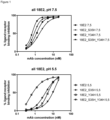
- VLm3, VHm6 and VHm13 all had an effect on the pH dependency, these mutations were combined within the same antibody.
- the double HIS mutants VLm3/VHm6 and VLm3/VHm13 were made simply by combining the plasmid encoding for each of the chain together during the transfection of the HEK293 cells.
- the pH dependency of the resulting antibodies was tested in MSD (see Figure 4 ).
- the pH dependency of antibody 3D6 directed against the second antigen target was introduced using the heat map. According to the heat map and CDR length, 25 positions were amenable for histidine replacement in the VH of 3D6 and 16 in the Vkappa of 3D6 (see table 6). 21 of these 25 positions were tested in an initial screen.
- a synthetic gene was ordered (Geneart, Thermo Scientific), cloned in appropriate expression vector and antibody was produced as indicated in example 3.
- the pH dependency of the antibodies was tested in a capture setup, where a Biacore T200 chip was coated with high amount of an anti-human Fc antibody (8000 RU).
- the 3D6 antibody wild type or mutants were injected (2 ⁇ g/ml) in HBS-EP pH 7.4 to reach preferably 100-200RU.
- the target was injected at 2.5 or 10 nM and washed using an HBS-EP buffer at pH 7.4 or 5.5.
- the equilibrium dissociation constant KD (M) at pH 7.4 was measured using the T200 software.
- the new VH and VK mutants were further combined with each other simply by combining the plasmid encoding for each of the chain together during the transfection of the HEK293 cells.
- the antibody 3D6VHm23/VKm11 was done by co-transfecting the VHm23 mutant DNA with the mutant VKm11 DNA.
- the pH dependency of the resulting antibodies was tested using Biacore ® , as described in example 5.
- the antibodies with good pH dependency and with a good affinity at pH 7.4 were further characterized with the only difference that a higher concentration of the target was added (0.04 nM; 0.1 nM; 0.37 nM; 1.1 nM; 3.3 nM and 10 nM).
- the KD (M) at pH 7.4 was measured using the T200 software. Only the dissociation constant (kd s-1) was extracted from the fitting at pH 5.5. The top 5 antibodies are indicated in table 10. Table:10 pH diss kd (1/s) KD (M) Rmax (RU) kd diff 3D6wt(old) 7.4 2.4E-04 3.9E-10 46 2.7 5.5 6.5E-04 nt 47 3D6VHm23/VKm11 7.4 3.3E-04 5.6E-10 55 15151515 5.5 5.0E+01 nt 85 3D6VHm24/VKm11 7.4 3.0E-04 5.2E-10 51 15.3 5.5 4.6E-03 nt 62 3D6VHm25/VKm5 7.4 2.8E-04 4.7E-10 60 28.2 5.5 7.9E-03 nt 74 3D6VHm13/VKm16 7.4 4.4E-04 8.9E-10 55 13.4 5.5 5.9E-03
- a method of preparing an engineered antibody exhibiting pH-dependent binding to its antigen comprising preparing the engineered antibody by substituting at least one amino acid residue of a parental antibody with a histidine residue, wherein at least one amino acid residue selected from the following hot-spot list is substituted with histidine: VH CDR1 H31, H32, H33, H35 VH CDR2 H50, H52, H52a, H53, H56, H58, H59, H62, H63 VH CDR3 H95, H96, H97, H98, H99, H100, H100a, H100b, H100c, H100d, H100e, H100f, H100h, H100i, H100j, H100l, H101, H102 VL CDR1 L27, L27d, L29, L30, L31, L32, L34 VL CDR2 L51, L52, L53, L54, L55 VL
- a method of preparing an engineered antibody exhibiting pH-dependent binding to its antigen comprising the steps of: (a) providing a parental antibody which binds to an antigen; (b) preparing a panel of engineered variants of said parental antibody, wherein each of said engineered variants in said panel differs from said parental antibody by substitution of at least one amino acid residue with a histidine residue, wherein at least one amino acid residue selected from the following hot-spot list is substituted with histidine: VH CDR1 H31, H32, H33, H35 VH CDR2 H50, H52, H52a, H53, H56, H58, H59, H62, H63 VH CDR3 H95, H96, H97, H98, H99, H100, H100a, H100b, H100c, H100d, H100e, H100f, H100h, H100i, H100j, H100l, H101, H102 VL CDR1 L27, L27d, L29, L30,
- step (b) comprises preparing a panel of engineered variants of said parental antibody, wherein each of said engineered variants in said panel differs from said parental antibody by substitution of at least one amino acid residue in the VH domain with a histidine residue, wherein at least one amino acid residue selected from the following hot-spot list is substituted with histidine: VH CDR1 H31, H32, H33, H35, VH CDR2 H50, H52, H52a, H53, H56, H58, H59, H62, H63, VH CDR3 H95, H96, H97, H98, H99, H100, H100a, H100b, H100c, H100d, H100e, H100f, H100h, H100i, H100j, H100l, H101, H102 and at least one amino acid residue from the following cold-spot list is not substituted with histidine: VH CDR1 H34, H35a, H35b
- step (b) comprises preparing a panel of engineered variants of said parental antibody, wherein each of said engineered variants in said panel differs from said parental antibody by substitution of at least one amino acid residue in the VL domain with a histidine residue, wherein at least one amino acid residue selected from the following hot-spot list is substituted with histidine: VL CDR1 L27, L27d, L29, L30, L31, L32, L34 VL CDR2 L51, L52, L53, L54, L55 VLCDR3 L89, L90, L91, L92, L93, L94, L95, L95a, L95b, L95c, L95d, L95e, L95f, L96, L97 and at least one amino acid residue selected from the following cold-spot list is not substituted with histidine: VL CDR1 L24, L25, L26, L27a, L27b, L27c, L27e, L28,
- a method of preparing an engineered antibody exhibiting pH dependent binding to its antigen comprising the steps of: (a) identifying a parental antibody which binds to an antigen; (b) preparing a panel of engineered variants of said parental antibody, wherein each of said engineered variants in said panel differs from said parental antibody by substitution of at least one amino acid residue with a histidine residue, wherein at least one amino acid residue selected from the following hot-spot list is substituted with histidine: VH CDR1 H31, H32, H33, H35 VH CDR2 H50, H52, H52a, H53, H56, H58, H59, H62, H63 VH CDR3 H95, H96, H97, H98, H99, H100, H100a, H100b, H100c, H100d, H100e, H100f, H100h, H100i, H100j, H100l, H101, H102 VL CDR1 L27, L27d, L29, L30,
- step (d) comprise histidine residues at four or more of the selected amino acid positions identified in step (c). 31.
- a method of preparing an engineered antibody exhibiting pH dependent binding to its antigen comprising the steps of: (a) identifying a parental antibody which binds to an antigen; (b) preparing a first panel of engineered variants of said parental antibody, wherein each of said engineered variants in said panel differs from said parental antibody by substitution of at least one amino acid residue in the VH domain with a histidine residue, wherein at least one amino acid residue selected from the following hot-spot list is substituted with histidine: VH CDR1 H31, H32, H33, H35, VH CDR2 H50, H52, H52a, H53, H56, H58, H59, H62, H63, VH CDR3 H95, H96, H97, H98, H99, H100, H100a, H100b, H100c, H100d, H100e, H100f, H100h, H100i, H100j, H100l, H101, H102 and at least one amino acid residue from the following
- 43. An engineered antibody which exhibits pH dependent binding to its antigen wherein at least one amino acid in the CDRs of the engineered antibody is a histidine residue, characterised in that at least one amino acid residue selected from the following hot-spot list is a histidine residue: VH CDR1 H31, H32, H33, H35 VH CDR2 H50, H52, H52a, H53, H56, H58, H59, H62, H63 VH CDR3 H95, H96, H97, H98, H99, H100, H100a, H100b, H100c, H100d, H100e, H100f, H100h, H100i, H100j, H100l, H101, H102 VL CDR1 L27, L27d, L29, L30, L31, L32, L34 VL CDR2 L51, L52
- the engineered antibody of clause 43 wherein said engineered antibody has lower affinity for its antigen at acidic pH than at neutral pH.
- 45. The engineered antibody of clause 43 wherein the dissociation rate constant (k d ) for the engineered antibody-antigen interaction at acidic pH is higher than the dissociation rate constant (k d ) for the engineered antibody-antigen interaction at neutral pH.
- 46. The engineered antibody of clause 43 or clause 44 wherein the equilibrium dissociation constant (K D ) for the engineered antibody-antigen interaction at acidic pH is higher than the equilibrium dissociation constant (K D ) for the engineered antibody-antigen interaction at neutral pH. 47.
- the engineered antibody of any one of clauses 43 to 53 which is an engineered variant of a camelid antibody. 55.
- the engineered antibody of any one of clauses 43 to 54 which comprises an Fc region, wherein said antibody binds to the neonatal Fc receptor (FcRn).
Landscapes
- Chemical & Material Sciences (AREA)
- Organic Chemistry (AREA)
- Health & Medical Sciences (AREA)
- General Health & Medical Sciences (AREA)
- Biochemistry (AREA)
- Biophysics (AREA)
- Life Sciences & Earth Sciences (AREA)
- Genetics & Genomics (AREA)
- Medicinal Chemistry (AREA)
- Molecular Biology (AREA)
- Proteomics, Peptides & Aminoacids (AREA)
- Immunology (AREA)
- Peptides Or Proteins (AREA)
- Medicines Containing Antibodies Or Antigens For Use As Internal Diagnostic Agents (AREA)
- Preparation Of Compounds By Using Micro-Organisms (AREA)
Applications Claiming Priority (3)
| Application Number | Priority Date | Filing Date | Title |
|---|---|---|---|
| GBGB1707484.0A GB201707484D0 (en) | 2017-05-10 | 2017-05-10 | Method of preparing ph-dependent antibodies |
| PCT/EP2018/062179 WO2018206748A1 (en) | 2017-05-10 | 2018-05-10 | Method of preparing ph-dependent antibodies |
| EP18725795.1A EP3625249B1 (de) | 2017-05-10 | 2018-05-10 | Verfahren zur herstellung von ph-abhängigen antikörpern |
Related Parent Applications (2)
| Application Number | Title | Priority Date | Filing Date |
|---|---|---|---|
| EP18725795.1A Division EP3625249B1 (de) | 2017-05-10 | 2018-05-10 | Verfahren zur herstellung von ph-abhängigen antikörpern |
| EP18725795.1A Division-Into EP3625249B1 (de) | 2017-05-10 | 2018-05-10 | Verfahren zur herstellung von ph-abhängigen antikörpern |
Publications (2)
| Publication Number | Publication Date |
|---|---|
| EP4541813A2 true EP4541813A2 (de) | 2025-04-23 |
| EP4541813A3 EP4541813A3 (de) | 2025-07-16 |
Family
ID=59065692
Family Applications (2)
| Application Number | Title | Priority Date | Filing Date |
|---|---|---|---|
| EP24221775.0A Pending EP4541813A3 (de) | 2017-05-10 | 2018-05-10 | Verfahren zur herstellung von ph-abhängigen antikörpern |
| EP18725795.1A Active EP3625249B1 (de) | 2017-05-10 | 2018-05-10 | Verfahren zur herstellung von ph-abhängigen antikörpern |
Family Applications After (1)
| Application Number | Title | Priority Date | Filing Date |
|---|---|---|---|
| EP18725795.1A Active EP3625249B1 (de) | 2017-05-10 | 2018-05-10 | Verfahren zur herstellung von ph-abhängigen antikörpern |
Country Status (12)
| Country | Link |
|---|---|
| US (2) | US12060413B2 (de) |
| EP (2) | EP4541813A3 (de) |
| JP (2) | JP7668617B2 (de) |
| CN (1) | CN110612308B (de) |
| AU (1) | AU2018265466B2 (de) |
| CA (1) | CA3061430A1 (de) |
| ES (1) | ES3021333T3 (de) |
| GB (1) | GB201707484D0 (de) |
| HU (1) | HUE071295T2 (de) |
| IL (1) | IL270554B2 (de) |
| PL (1) | PL3625249T3 (de) |
| WO (1) | WO2018206748A1 (de) |
Families Citing this family (18)
| Publication number | Priority date | Publication date | Assignee | Title |
|---|---|---|---|---|
| WO2018007999A1 (en) | 2016-07-08 | 2018-01-11 | Staten Biotechnology B.V. | Anti-apoc3 antibodies and methods of use thereof |
| CN110506056A (zh) | 2017-04-21 | 2019-11-26 | 斯塔滕生物技术有限公司 | 抗apoc3抗体和其使用方法 |
| PE20210119A1 (es) | 2017-10-31 | 2021-01-19 | Staten Biotechnology B V | Anticuerpos anti-apoc3 y metodos de uso de estos |
| GB201802487D0 (en) | 2018-02-15 | 2018-04-04 | Argenx Bvba | Cytokine combination therapy |
| MX2020010724A (es) * | 2018-04-12 | 2020-11-06 | Amgen Inc | Metodos para preparar composiciones proteicas estables. |
| GB2589049C (en) * | 2019-04-11 | 2024-02-21 | argenx BV | Anti-IgE antibodies |
| CN111978393B (zh) * | 2019-05-23 | 2024-06-18 | 厦门大学 | 抗乙肝病毒新型抗体及其用途 |
| CN110669778A (zh) * | 2019-09-19 | 2020-01-10 | 上海药明生物技术有限公司 | 一种对抗体pH依赖结合活性的快速改造及筛选方法 |
| GB202016814D0 (en) | 2020-10-22 | 2020-12-09 | Cambridge Mechatronics Ltd | An actuator assembly |
| IL314367A (en) | 2022-01-18 | 2024-09-01 | argenx BV | Antibodies to galectin 10 |
| WO2024056049A1 (zh) * | 2022-09-16 | 2024-03-21 | 同润生物医药(上海)有限公司 | 具有pH依赖性的抗CTLA4抗体或抗原结合片段 |
| CN121443632A (zh) * | 2023-05-09 | 2026-01-30 | 丹麦科技大学 | pH敏感抗体 |
| EP4731670A2 (de) * | 2023-06-23 | 2026-04-29 | Mythic Therapeutics, Inc. | Ph-sensitive anti-itgb6-antikörper und verwendungen davon |
| GB202319605D0 (en) | 2023-12-20 | 2024-01-31 | argenx BV | Monovalent binding molecules and methods of use |
| CN118221809B (zh) * | 2024-01-25 | 2026-02-10 | 四川大学 | 一种对新型冠状病毒S-RBD具有pH依赖结合特性的纳米抗体及其潜在应用 |
| CN118240073B (zh) * | 2024-04-19 | 2026-01-30 | 四川大学 | 一种对新型冠状病毒原始株和变异株S-RBD具有pH依赖结合特性的纳米抗体改造及其潜在应用 |
| WO2025229206A1 (en) * | 2024-05-03 | 2025-11-06 | argenx BV | Monovalent anti-iga binding molecules and methods of use |
| WO2026015652A2 (en) * | 2024-07-10 | 2026-01-15 | Lycia Therapeutics, Inc. | Anti-ige antibodies with ph-dependent binding characteristics |
Citations (2)
| Publication number | Priority date | Publication date | Assignee | Title |
|---|---|---|---|---|
| WO2010001251A2 (en) | 2008-07-02 | 2010-01-07 | Argen-X B.V. | Antigen binding polypeptides |
| US8163881B2 (en) | 2005-05-31 | 2012-04-24 | The Board Of Regents Of The University Of Texas System | Immunoglobulin molecules with improved characteristics |
Family Cites Families (4)
| Publication number | Priority date | Publication date | Assignee | Title |
|---|---|---|---|---|
| KR102057826B1 (ko) | 2008-04-11 | 2019-12-20 | 추가이 세이야쿠 가부시키가이샤 | 복수 분자의 항원에 반복 결합하는 항원 결합 분자 |
| EP2825036B1 (de) * | 2012-03-16 | 2018-05-02 | Regeneron Pharmaceuticals, Inc. | Durch histidin manipulierte leichtkettige antikörper und genetisch modifizierte nager zur erzeugung davon |
| US9540449B2 (en) * | 2012-08-13 | 2017-01-10 | Regeneron Pharmaceuticals, Inc. | Anti-PCSK9 antibodies with pH-dependent binding characteristics |
| CA2953714C (en) * | 2014-06-30 | 2021-05-18 | Ralf Guenther | Anti-tnfa antibodies with ph-dependent antigen binding |
-
2017
- 2017-05-10 GB GBGB1707484.0A patent/GB201707484D0/en not_active Ceased
-
2018
- 2018-05-10 CN CN201880030586.2A patent/CN110612308B/zh active Active
- 2018-05-10 JP JP2019561746A patent/JP7668617B2/ja active Active
- 2018-05-10 WO PCT/EP2018/062179 patent/WO2018206748A1/en not_active Ceased
- 2018-05-10 CA CA3061430A patent/CA3061430A1/en active Pending
- 2018-05-10 ES ES18725795T patent/ES3021333T3/es active Active
- 2018-05-10 HU HUE18725795A patent/HUE071295T2/hu unknown
- 2018-05-10 IL IL270554A patent/IL270554B2/en unknown
- 2018-05-10 PL PL18725795.1T patent/PL3625249T3/pl unknown
- 2018-05-10 AU AU2018265466A patent/AU2018265466B2/en active Active
- 2018-05-10 US US16/606,656 patent/US12060413B2/en active Active
- 2018-05-10 EP EP24221775.0A patent/EP4541813A3/de active Pending
- 2018-05-10 EP EP18725795.1A patent/EP3625249B1/de active Active
-
2023
- 2023-05-16 JP JP2023080909A patent/JP2023113686A/ja active Pending
-
2024
- 2024-06-28 US US18/758,532 patent/US20250059262A1/en active Pending
Patent Citations (2)
| Publication number | Priority date | Publication date | Assignee | Title |
|---|---|---|---|---|
| US8163881B2 (en) | 2005-05-31 | 2012-04-24 | The Board Of Regents Of The University Of Texas System | Immunoglobulin molecules with improved characteristics |
| WO2010001251A2 (en) | 2008-07-02 | 2010-01-07 | Argen-X B.V. | Antigen binding polypeptides |
Non-Patent Citations (4)
| Title |
|---|
| KABAT ET AL.: "Sequences of Proteins of Immunological Interest", PUBLIC HEALTH SERVICE, NATIONAL INSTITUTES OF HEALTH, 1991 |
| SARKAR ET AL., NAT BIOTECHNOL, vol. 20, 2002, pages 908 - 13 |
| SCHROTER ET AL., MABS, vol. 7, no. 1, 2015, pages 138 - 151 |
| VACCARO ET AL., NATURE BIOTECHNOLOGY, vol. 23, 2005, pages 1283 - 1288 |
Also Published As
| Publication number | Publication date |
|---|---|
| GB201707484D0 (en) | 2017-06-21 |
| IL270554A (en) | 2019-12-31 |
| ES3021333T3 (en) | 2025-05-26 |
| JP2023113686A (ja) | 2023-08-16 |
| IL270554B2 (en) | 2024-12-01 |
| CN110612308B (zh) | 2024-04-16 |
| WO2018206748A1 (en) | 2018-11-15 |
| US12060413B2 (en) | 2024-08-13 |
| EP4541813A3 (de) | 2025-07-16 |
| AU2018265466B2 (en) | 2024-09-05 |
| EP3625249C0 (de) | 2025-02-19 |
| EP3625249A1 (de) | 2020-03-25 |
| CN110612308A (zh) | 2019-12-24 |
| PL3625249T3 (pl) | 2025-07-28 |
| US20220177555A1 (en) | 2022-06-09 |
| IL270554B1 (en) | 2024-08-01 |
| HUE071295T2 (hu) | 2025-08-28 |
| CA3061430A1 (en) | 2018-11-15 |
| AU2018265466A1 (en) | 2019-11-14 |
| US20250059262A1 (en) | 2025-02-20 |
| EP3625249B1 (de) | 2025-02-19 |
| JP7668617B2 (ja) | 2025-04-25 |
| JP2020519598A (ja) | 2020-07-02 |
Similar Documents
| Publication | Publication Date | Title |
|---|---|---|
| US20250059262A1 (en) | Method of preparing ph-dependent antibodies | |
| JP7583707B2 (ja) | 抗cd47抗体及びその応用 | |
| AU2012328921B2 (en) | Immunobinders directed against TNF | |
| CN107849136B (zh) | 抗TfR抗体及其在治疗增殖性和炎性疾病中的用途 | |
| KR20230123981A (ko) | Il-4r에 결합하는 항체 가변 도메인 | |
| JP6660957B2 (ja) | 新規の抗−tfpi抗体及びこれを含む組成物 | |
| CA2877446A1 (en) | Antibodies comprising sequences from camelidae to highly conserved targets | |
| CN116888151A (zh) | 结合il-4r的抗体可变结构域 | |
| US10919955B2 (en) | Rodent combinatorial antibody libraries | |
| JP2025505650A5 (de) | ||
| CN107002114A (zh) | 用于确定cdc引发抗体的测定试验和方法 | |
| CN111875704B (zh) | 一种egfr抗体及其应用 | |
| KR20190137294A (ko) | 항체 라이브러리 및 이를 이용한 항체 스크리닝 방법 | |
| EP4183800A1 (de) | Neue sars-cov-2-neutralisierende antikörper | |
| JP2025532482A (ja) | Egfrを標的とする二重エピトープ四価抗体 | |
| EP4709748A1 (de) | Ph-empfindliche antikörper | |
| HK1236581A1 (en) | Assay and method for determining cdc eliciting antibodies |
Legal Events
| Date | Code | Title | Description |
|---|---|---|---|
| PUAI | Public reference made under article 153(3) epc to a published international application that has entered the european phase |
Free format text: ORIGINAL CODE: 0009012 |
|
| STAA | Information on the status of an ep patent application or granted ep patent |
Free format text: STATUS: REQUEST FOR EXAMINATION WAS MADE |
|
| 17P | Request for examination filed |
Effective date: 20241219 |
|
| AC | Divisional application: reference to earlier application |
Ref document number: 3625249 Country of ref document: EP Kind code of ref document: P |
|
| AK | Designated contracting states |
Kind code of ref document: A2 Designated state(s): AL AT BE BG CH CY CZ DE DK EE ES FI FR GB GR HR HU IE IS IT LI LT LU LV MC MK MT NL NO PL PT RO RS SE SI SK SM TR |
|
| PUAL | Search report despatched |
Free format text: ORIGINAL CODE: 0009013 |
|
| AK | Designated contracting states |
Kind code of ref document: A3 Designated state(s): AL AT BE BG CH CY CZ DE DK EE ES FI FR GB GR HR HU IE IS IT LI LT LU LV MC MK MT NL NO PL PT RO RS SE SI SK SM TR |
|
| RIC1 | Information provided on ipc code assigned before grant |
Ipc: C07K 16/00 20060101AFI20250610BHEP |