EP4543127A1 - Organisation d'un ensemble d'occasions de canal d'accès aléatoire - Google Patents
Organisation d'un ensemble d'occasions de canal d'accès aléatoire Download PDFInfo
- Publication number
- EP4543127A1 EP4543127A1 EP23204935.3A EP23204935A EP4543127A1 EP 4543127 A1 EP4543127 A1 EP 4543127A1 EP 23204935 A EP23204935 A EP 23204935A EP 4543127 A1 EP4543127 A1 EP 4543127A1
- Authority
- EP
- European Patent Office
- Prior art keywords
- ros
- network device
- prach
- user equipment
- primary
- Prior art date
- Legal status (The legal status is an assumption and is not a legal conclusion. Google has not performed a legal analysis and makes no representation as to the accuracy of the status listed.)
- Pending
Links
Images



Classifications
-
- H—ELECTRICITY
- H04—ELECTRIC COMMUNICATION TECHNIQUE
- H04W—WIRELESS COMMUNICATION NETWORKS
- H04W74/00—Wireless channel access
- H04W74/002—Transmission of channel access control information
- H04W74/006—Transmission of channel access control information in the downlink, i.e. towards the terminal
-
- H—ELECTRICITY
- H04—ELECTRIC COMMUNICATION TECHNIQUE
- H04W—WIRELESS COMMUNICATION NETWORKS
- H04W74/00—Wireless channel access
- H04W74/08—Non-scheduled access, e.g. ALOHA
- H04W74/0808—Non-scheduled access, e.g. ALOHA using carrier sensing, e.g. carrier sense multiple access [CSMA]
- H04W74/0816—Non-scheduled access, e.g. ALOHA using carrier sensing, e.g. carrier sense multiple access [CSMA] with collision avoidance
Definitions
- the present disclosure is related to but not limited to communication networks as defined by the 3GPP standard, such as the 6G standard.
- the disclosure in particular relates to the use of the random access channel (RACH) and the random access (RA) procedure (also referred to as RACH procedure). More specifically, the disclosure relates to the physical layer design in the context of RA procedures, i.e. the random access channel resource allocation and the design of RACH occasions (ROs).
- RACH random access channel
- RA random access procedure
- ROs RACH occasions
- a random access (RA) procedure is a procedure whereby a user equipment (UE) initiates a connection with a network for transmitting mobile-originating data or in response to a paging message for receiving mobile-terminating data.
- the RA procedure is a procedure present in earlier versions of mobile systems including GSM, GPRS, UMTS and LTE, with some changes in messages exchanged between the UE and the network. This procedure is not limited to connection initiation and may be performed for various different reasons, such as a handover to a new cell, the need for uplink synchronization, a scheduling request when no uplink (UL) resources are reserved for the UE (no PUCCH), or for beam recovery.
- UL uplink
- Network energy saving is of great importance for environmental sustainability, to reduce environmental impact (greenhouse gas emissions), and for operational cost savings.
- 5G, and in future 6G are becoming pervasive across industries and geographical areas, handling more advanced services and applications requiring very high data rates (e.g. XR), networks are being denser, use more antennas, larger bandwidths and more frequency bands.
- XR very high data rates
- Certain embodiments of the disclosure suggest a random access channel resource allocation. Certain embodiments may enable network energy savings e.g. when the load is low in the system.
- Certain embodiments may facilitate a more flexible use of radio resources. More specifically, certain embodiments may dynamically allow for a high PRACH capacity with low initial access latency in certain situations while also allowing for a low network energy consumption in other situations. Certain embodiments may allow for the above effects with a low signaling overhead.
- the user equipment may comprise means for receiving, from a network device, configuration information organizing a set of a random access channel, RACH, occasions, ROs, into primary and secondary ROs.
- the user equipment may further comprise means for receiving, from the network device, a status indicating whether physical random access channel, PRACH, detection is performed by the network device during the secondary ROs.
- the user equipment may further comprise means for transmitting a PRACH preamble based on the received configuration information and the received status.
- the network device may comprise means for transmitting, to a user equipment, configuration information organizing a set of a random access channel, RACH, occasions, ROs, into primary and secondary ROs.
- the network device may further comprise means for transmitting, to the user equipment, a status indicating whether physical random access channel, PRACH, detection is performed by the network device for the secondary ROs.
- the network device may further comprise means for performing PRACH detection according to the configuration information and the status.
- the method may comprise receiving, from a network device, configuration information organizing a set of a random access channel, RACH, occasions, ROs into primary and secondary ROs.
- the method may comprise receiving, from the network device, a status indicating whether physical random access channel, PRACH, detection is performed by the network device during the secondary ROs.
- the method may comprise transmitting a PRACH preamble based on the received configuration information and the received status.
- the method may comprise transmitting, to a user equipment, configuration information organizing a set of a random access channel, RACH, occasions, ROs into primary and secondary ROs.
- the method may comprise transmitting, to the user equipment, a status indicating whether physical random access channel, PRACH, detection is performed by the network device for the secondary ROs.
- the method may comprise performing PRACH detection according to the configuration information and the status.
- any of the disclosed devices may generally be a stationary device or a mobile device.
- the user equipment may in particular be a terminal device.
- the user equipment may be a mobile device, such as a smartphone, a tablet, a wearable, smart glasses, a smartwatch, a low power device, an IoT device, an IIoT device, a vehicle, a truck, a drone, an airplane, or the like.
- the user equipment may also be part of a relaying scenario. That is, the user equipment may also be the mobile termination part of an integrated access and backhaul (IAB) node, as it may perform the user equipment functionalities.
- IAB integrated access and backhaul
- a network device may in particular be understood to be a wireless communication station installed at a fixed or mobile location and may in particular be or comprise an entity of the radio access network of the communication system.
- the network device may be, comprise, or be part of a base station of a communication network of any generation (e.g. a 6gNB, gNB, eNodeB, NodeB, BTS or the like) of the 3 GPP standard.
- the communication system may in particular be a cellular communication system.
- the network device may in particular be or comprise a central unit (CU) and/or a distributed unit (DU), such as a gNB-CU and/or gNB-DU.
- CU central unit
- DU distributed unit
- the network device may be or comprise a hardware or software component implementing a certain functionality.
- the network device may also be part of a relaying scenario, so that the network device may also be the DU part of an integrated access and backhaul (IAB) node, as it may performs the network device functionalities.
- the network device may be an entity as defined by 3GPP 5G or NR standard (also referred to as a gNB). Accordingly, while the network device may be understood to be implemented in or be a single device or module, the network node may also be implemented across or comprise multiple devices or modules.
- Multiple network device of the exemplary aspect may in particular establish a communication system or network, which may in particular be a NR or 5G system (5GS) or part thereof or any other mobile communications system defined by a past or future standard, in particular successors of the present 3GPP standards, such as the 6G standard.
- a network device of the exemplary second aspect may be capable of being in direct and/or indirect communication with the exemplary user equipment of the first aspect.
- the means or functionality of any of the disclosed user equipment and network device can be implemented in hardware and/or software. They may comprise one or multiple modules or units providing the respective functionality. They may for instance comprise at least one processor for executing instructions for performing the required functions, and at least one memory storing the instructions. Alternatively, they could comprise for instance circuitry that is designed to implement the required functions, for instance implemented in a chipset or a chip, like an integrated circuit. In general, the means may comprise for instance one or more processing means or processors.
- a respective user equipment or network device comprising at least one processor and at least one memory storing instructions that, when executed by the at least one processor, cause the respective apparatus (e.g. the user equipment or the network device) at least to perform a method according to the respective aspect of the present disclosure.
- any of the above-disclosed exemplary aspects may, however, in general be performed by an apparatus, which may be a module or a component for a device, for example a chip.
- the disclosed apparatus e.g. the user equipment or network device
- a computer program when executed by a processor of a respective apparatus (e.g. the user equipment or network device) causing said apparatus to perform a method according to the respective aspect.
- the instructions may be stored on a storage medium that is readable by a processor, in particular a transitory and/or non-transitory medium.
- the storage medium could for example be a disk or a memory or the like.
- the storage medium may be intended for taking part in the operation of a device, like an internal or external memory, for instance a Read-Only Memory (ROM) or a hard disk, or be intended for distribution of a program or library including the instructions, like an optical disc.
- ROM Read-Only Memory
- the configuration information may organize a set of a random access channel, RACH, occasions, ROs, into primary and secondary ROs.
- the configuration may be a cell-specific configuration and may be transmitted to multiple or all UEs in the cell. Accordingly, the configuration may be transmitted as a broadcast signal in the respective cell, for instance.
- a RACH occasion or RO may be understood to be a specific time and/or frequency resource, in which a user equipment may start (or is expected by the network to start) a random access procedure, i.e. to transmit a random access preamble.
- the primary ROs may be considered to be or referred to as first ROs or ROs of a first type.
- the secondary ROs may be considered to be or referred to as second ROs or ROs of a second type.
- the configuration information may configure, for the user equipment, one or multiple primary ROs, and one or more multiple secondary ROs.
- the configured RACH occasions may be configured for a certain reference period, as will be explained in more detail below.
- the reference period and the set of ROs configured therein may be repeated. For instance, there may be at least one primary RO and at least one secondary RO in a respective reference period.
- the user equipment may receive a status from the network device.
- the status may indicate whether physical random access channel, PRACH, detection (i.e., PRACH preamble detection) is performed by the network device during the secondary ROs.
- PRACH physical random access channel
- the status may indicate whether the PRACH detection is performed for all or for some secondary ROs.
- the status may thus be considered to be an activation or availability status for one or more of the secondary ROs.
- the network device may perform PRACH detection either for all or for none of the secondary ROs, which may then be indicated by the status.
- the network device may perform PRACH detection for some of the secondary ROs, and it may then be indicated by the status for which secondary ROs PRACH detection is performed.
- the secondary ROs may be further subdivided in two or more groups of secondary ROs.
- the status may for instance be a status signaling, which may be transmitted via lower or higher layer signaling.
- the network may provision the use of secondary ROs via broadcast and/or dedicated signaling to the user equipment(s), as will be explained in more detail below.
- the network device may temporarily skip or suspend PRACH detection for one or more (e.g. partially or all) secondary ROs for the purpose of energy saving or for utilizing the resources otherwise.
- the secondary ROs may be made only partially available, e.g. the signaling may indicate that some of the secondary ROs are made available for RA procedures and the rest of the ROs may be reserved for other uses.
- secondary ROs may be made available only for predefined RACH reasons or RACH types.
- the network device may then perform PRACH detection according to the configuration information and the status. Accordingly, the network device may perform PRACH detection on the primary ROs and, depending on the status, may or may not perform PRACH detection on the secondary ROs.
- the user equipment may then transmit a PRACH preamble to the network device based on the received configuration information.
- the user equipment may also utilize the received status indicating whether PRACH detection is performed by the network device during the secondary ROs, e.g. for determining whether to transmit the PRACH preamble on the primary or secondary ROs.
- the transmission of the PRACH preamble may be part of a 2-step or 4-step RA procedure, as further detailed below.
- the network device may then receive, from the user equipment, a PRACH preamble according to the configuration information and the status signaling.
- primary ROs may ROs in which the network is always performing PRACH detection.
- secondary ROs may be ROs in which the network may not necessarily or may not always be performing PRACH detection.
- the network may for instance decide, when the load is low, not to perform PRACH detection in secondary ROs and keep radio frequency and baseband parts switched off during the secondary ROs to facilitate energy savings. Due to the transmission of the status, the user equipment will be informed about whether the network will perform PRACH detection only in the primary ROs or in both, the primary and secondary ROs, so that the user equipment can utilize the information in its strategy for deciding which ROs to use for a RA procedure.
- the secondary ROs can be radio resources that can be used also for other DL and/or UL signals and channels. For example the user equipment could perform DL reception during secondary ROs in the case of dynamic slot format indication (SFI) or downlink (DL) grant.
- SFI dynamic slot format indication
- DL downlink
- the set of ROs may correspond to a physical random access channel, PRACH, configuration period.
- the PRACH configuration period may for instance be selected from and thus be 10, 20, 40, 80 or 160 msec.
- the set of ROs (and thus a respective reference period, for which the set of ROs is configured) may correspond to an association period.
- the association period may indicate a number of PRACH configuration periods.
- the association period may for instance indicate 1, 2, 4, 8 or 16 PRACH configuration periods.
- the set of ROs (and thus a respective reference period, for which the set of ROs is configured) may correspond to an association pattern period.
- An association pattern period may include one or more association periods.
- the set of ROs (and thus a respective reference period, for which the set of ROs is configured) may correspond to a fixed time period.
- the fixed time period may be predetermined and set by specifications, or configured via signaling.
- the set of ROs comprises at least one primary RO for each synchronization signaling block, SSB, and/or at least one secondary RO for each SSB.
- Each SSB typically corresponds to a particular beam (or spatial filter) and respective coverage area, and is identified by a particular SSB index.
- the primary ROs there may be at least once a primary RO (or a respective set of PRACH resources) for each SSB within a certain period (e.g. a 160 ms period).
- the secondary ROs there may be one or multiple secondary ROs (or respective sets of PRACH resources) for each SSB within a certain time period (e.g. a 160 ms period).
- the status may be transmitted and received via broadcast signaling. Additionally or alternatively, the status may be transmitted and received via a short paging message. Additionally or alternatively, the status may be transmitted and received via downlink control information (DCI). Additionally or alternatively, the status may be transmitted and received via a group-common downlink control information (DCI). Additionally or alternatively, the status may be transmitted and received via a paging physical downlink shared channel, PDSCH, transmission. Additionally or alternatively, the status may be transmitted and received via dedicated signaling. Generally, the status may be signaled via one or multiple of the aforementioned options.
- DCI downlink control information
- DCI group-common downlink control information
- the status may be transmitted and received via a paging physical downlink shared channel, PDSCH, transmission. Additionally or alternatively, the status may be transmitted and received via dedicated signaling.
- the status may be signaled via one or multiple of the aforementioned options.
- primary ROs may be ROs for which the network device is expected to perform PRACH detection.
- a user equipment may assume that the network will generally perform PRACH detection for respective primary ROs and can expect that the network will respond to a random access request (except from cases where there is a signaling error or a contention, for instance).
- secondary ROs may be ROs for which the network device is not expected to generally or always perform PRACH detection. For instance, the network may temporarily deactivate or skip PRACH detection for some or all secondary ROs.
- the secondary ROs are allowed to have a different availability than primary ROs.
- secondary ROs are allowed to have a lower availability than primary ROs.
- a user equipment may nevertheless try to perform random access procedure on the secondary ROs. However, if a user equipment is aware of the status of the secondary ROs, the user equipment may act accordingly and adapt its strategy regarding whether to use primary or secondary ROs.
- primary ROs may be (e.g. time domain) resources usable for uplink (UL) transmission only.
- secondary ROs may be (e.g. time domain) resources usable for uplink (UL) transmission and downlink (DL) reception.
- the primary ROs may only be used for UL transmission (such as transmission of PRACH preambles)
- the secondary ROs may also be used for DL reception (e.g. in case no PRACH detection is performed for respective secondary ROs).
- the user equipment may comprise means for transmitting, to the network device, information indicating that a RA procedure using one or more secondary ROs was unsuccessful.
- the network device may comprise means for receiving, from the user equipment, information indicating that a RA procedure using one or more secondary ROs was unsuccessful.
- the user equipment may attempt performing a RA procedure on respective secondary ROs for a predefined number of times (e.g. once or multiple times, e.g. at least 2, 3, 4 or 5 times). If this is unsuccessful, the user equipment may for instance then attempt performing a RA procedure on the primary ROs.
- the information indicating that the RA procedure was unsuccessful may be transmitted as part of a subsequent (e.g.
- the subsequent RA procedure may be a RA procedure directly subsequent to the one or more unsuccessful RA procedure on the one or more secondary ROs.
- the subsequent RA procedure may be performed on a primary RO.
- the network device may comprise means for, responsive to receiving the information indicating that the RA procedure was unsuccessful, starting performing PRACH detection during the secondary ROs. For instance, the network device may start performing PRACH detection during a part or all of the secondary ROs. The network device may consider the information indicating that a RA procedure using one or more secondary ROs was unsuccessful as an indication that the secondary ROs may be needed (e.g. because the load increases and more ROs are required to provide a sufficient number of ROs for the user equipments). When starting (or stopping) performing PRACH detection, the network device may transmit, to the user equipment, a corresponding status indicating that PRACH detection is now performed (or stopped) by the network device for one or more secondary ROs.
- the PRACH preamble is transmitted on a primary RO.
- the user equipment may assume that a RA procedure on the secondary ROs will likely not be successful. Accordingly, the user equipment may thus directly perform the RA procedure (i.e. transmit the PRACH preamble) on a primary RO.
- the PRACH preamble is transmitted on a primary RO or a secondary RO.
- the user equipment may assume that RA procedures on both the primary and the secondary ROs will likely be successful. Accordingly, the user equipment may for instance utilize any of the primary and secondary ROs for performing the RA procedure.
- the PRACH preamble may be transmitted as part of a contention-based RA procedure.
- the PRACH preamble may be transmitted as part of the first step (e.g. MsgA) of a 2-step RA procedure.
- the PRACH preamble may be transmitted as part of the first step (Msg1) of a 4-step RA procedure.
- the disclosure of a method step shall also be considered as a disclosure of means for performing the respective method step.
- the disclosure of means for performing a method step shall also be considered as a disclosure of the method step itself.
- Fig. 1 an example communication system, in which the present disclosure may be applied, is first described. While the specific radio system in the examples below is a 5G system, this is only to be considered a non-limiting example, and the invention may likewise be employed in past or future generation mobile communication systems or communication systems from a different standard development organization. The disclosure is in particular also applicable to 6G networks. Thus, the term gNB as used in the following shall be understood to also cover future base stations, such as a 6gNB.
- Fig. 1 shows a 5G communication network 100, which employs the New Radio (NR) technology and also an architecture for which the different sublayers of the RAN may be split into two logical entities in a communication network control element (like gNB), which are referred to as distributed unit (DU, as an example of a network node according to the present disclosure) and central unit (CU, as a further example of a network node according to the present disclosure).
- DU distributed unit
- CU central unit
- the CU is a logical node that controls the operation of one or more DUs over a front-haul interface (referred to as F1 interface).
- the DU is a logical node including a subset of the gNB functions, depending on the functional split option.
- the layer 1 and layer 2 protocols may be implemented in the DU, while the layer 3 protocols may be implemented in the CU.
- a first user equipment (UE) 110 is connected to a cell 1 of a network node or base station, a gNB 120 via a communication beam of the cell 1.
- the gNB 120 is provided with a CU 123 and two DUs 121 and 122 being connected to the CU 123 by a F1 interface.
- Cell 1 may be considered to be a serving cell or source cell for the UE 110.
- each gNB may provide one or more cells, and may further provide a plurality of beams within each cell for coverage enhancement.
- each base station or gNB is connected to a core network 130, such as a 5GC, via respective interfaces, indicated as NG interfaces.
- each gNB is connected with each other by means of a specific interface, which is referred to e.g. as an Xn-C interface. Any of these network entities, such as the gNB, gNB-DU, gNB-CU and/or 5GC, may individually or together be an example of a network node according to the present disclosure.
- the UE 110 may perform a random access procedure with the network (e.g. with the base station, gNB, 6gNB, etc.) for various reasons such as accessing the network.
- the network e.g. with the base station, gNB, 6gNB, etc.
- a RA procedure may be categorized into contention based random access (CBRA) and contention free random access (CFRA).
- CBRA contention based random access
- CFRA contention free random access
- the different aspects may generally be employed in CFRA and CBRA.
- the disclosed aspects may be specifically advantageous for use in CBRA, which will be explained in more detail in the following. Accordingly, it is understood that the following features described with respect to random access procedures may be exemplary features of the aspects disclosed herein.
- the UE may select a preamble randomly from a pool of preambles shared with other UEs. This means that the UE has a potential risk of selecting the same preamble as another UE and subsequently may experience conflict or contention.
- the gNB uses a contention resolution mechanism to handle this type of access requests. In this procedure, not all random access procedures succeed.
- Fig. 2 shows a signaling chart 200 for a 4-step CBRA procedure.
- a UE 210 performs a PRACH preamble transmission (so called "Msg1") to a gNB 220.
- the UE may transmit the PRACH preamble using a particular transmit beam or transmit spatial filter in correspondence with a particular receive beam or receive spatial filter of the gNB.
- the preamble may be considered to be associated with a certain synchronization signal block, SSB and a certain beamforming configuration for this SSB.
- the UE receives a random access response (so called "Msg2").
- Msg2 a random access response
- the gNB Upon receiving the PRACH preamble, the gNB sends an RA response over the physical downlink shared channel (PDSCH) scheduled via the physical downlink control channel (PDCCH).
- the response may contain the RA preamble identifier, timing alignment information, initial uplink grant, and/or a temporary C-RNTI.
- One PDSCH can carry RA responses to multiple UEs.
- the UE monitors the PDCCH and waits for an RA response within an RA response window.
- the UE receives a response containing an RA-preamble identifier corresponding to the transmitted RA preamble, then the response is successful. If the UE does not receive a response within the RA response window or fails to verify the response, the response is unsuccessful. The UE may retry the RA procedure, for instance as long as the number of RA attempts is smaller than a predefined upper limit, e.g. 10. Otherwise, the random access procedure may be considered to have failed.
- a predefined upper limit e.g. 10.
- the UE may perform a scheduled UL transmission (so called "Msg3") over a physical uplink shared channel (PUSCH).
- the signaling messages and information sent by the UE may vary across different RA scenario. For instance, in case of an initial radio resource control (RRC) connection setup, a RRCSetupRequest message carrying a non-access stratum (NAS) UE_ID may be transmitted over the common control channel (CCCH) in transparent mode (TM)) at the radio link control (RLC) protocol layer. The message is not segmented. For instance, in case of an RRC connection reestablishment, a RRC Reestablishment Request message may be transmitted over the CCCH in TM at the RLC protocol layer.
- RRC radio resource control
- a RRC Reestablishment Request message may be transmitted over the CCCH in TM at the RLC protocol layer.
- the message is not segmented.
- a contention-based RA (instead of non-contention-based RA) may be triggered if the UE accesses the target cell and no dedicated preambles are available during the handover.
- the RRC Handover Confirm message and cell radio network temporary identifier (C-RNTI) may be transmitted over the dedicated control channel (DCCH).
- DCCH dedicated control channel
- BSR buffer status report
- at least the C-RNTI of the UE may be transmitted.
- contention resolution may be performed (so called "Msg4").
- Msg3 contention resolution timer
- the gNB may assist the UE in contention resolution using the C-RNTI on the PDCCH or using the UE Contention Resolution Identity IE on the PDSCH.
- the UE may keep monitoring the PDCCH before the timer expires, and considers the contention resolution successful and stops the timer if either of the following conditions is met:
- the UE may consider the contention resolution failed. Then, the UE may perform another RA attempt, e.g. if the number of RA attempts has not reached the upper limit (such as 10). However, if the number of RA attempts has reached the upper limit, the random access procedure may be considered failed.
- the UE may perform another RA attempt, e.g. if the number of RA attempts has not reached the upper limit (such as 10). However, if the number of RA attempts has reached the upper limit, the random access procedure may be considered failed.
- transmit and receive beamforming at the gNB is supported for both SSB transmissions and PRACH preamble receptions, respectively.
- the gNB can transmit multiple SSBs in a cell. Depending on the carrier frequency range there is a maximum number of SSBs that can be supported per cell.
- the following table shows the FR1 and FR2 options in NR but also provides expected parameters e.g. for the new 6G band 7-20 GHz.
- PRACH resources may be associated to the various SSBs.
- the UE may select the PRACH preamble and/or RACH occasion (time and frequency resource on which the preamble is transmitted) based on the selected SSB.
- the UE may select the SSB which is strong enough in terms of L1-RSRP measurement.
- PRACH resources i.e. PRACH preambles and/or PRACH occasions, may have association to the SSBs.
- a UE may be provided a number N of SS/PBCH blocks associated with one PRACH occasion and a number R of contention based preambles per SS/PBCH block per valid PRACH occasion by ssb-perRACH-OccasionAndCB-PreamblesPerSSB in RACH-ConfigCommon.
- N ⁇ 1 one SS/PBCH block is mapped to 1/N consecutive valid PRACH occasions, and R contention based preambles with consecutive indexes associated with the SS/PBCH block per valid PRACH occasion start from preamble index 0.
- N SS/PBCH blocks are associated with one PRACH occasion, and each SSB is associated with R preambles, with index starts from n ⁇ N preamble total / N , where N preamble total is provided by totalNumberOfRA-Preambles in RACH-ConfigCommon and is an integer multiple of N, 0 ⁇ n ⁇ N-1.
- SS/PBCH block indexes may be provided by ssb-PositionsInBurst in SIB 1 or in ServingCellConfigCommon and may be mapped to valid PRACH occasions in the following order:
- An association period may start from frame 0.
- An association period, for mapping SS/PBCH blocks to PRACH occasions may be the smallest value in the set determined by the PRACH configuration period according to Table 8.1-1 repeated below (corresponding Table 8.1-1 in 3GPP TS 38.213) such that N TX SSB SS/PBCH blocks are mapped at least once to the PRACH occasions within the association period.
- N TX SSB may be obtained from the value of ssb-PositionsInBurst in SIB1 or in ServingCellConfigCommon.
- An association pattern period may include one or more association periods and may be determined so that a pattern between PRACH occasions and SS/PBCH blocks repeats at most every 160 msec.
- PRACH occasions not associated with SS/PBCH blocks after an integer number of association periods, if any, may not be used for PRACH transmissions.
- the PRACH resources may be allocated across a 160 ms period.
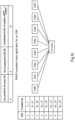
- the following table illustrates an example of the allocation principle where number of SSBs is 6, PRACH configuration period is 80 ms and PRACH configuration index is 9 (below table shows PRACH configuration index 9).
- Radio frame (10 ms) 0 1 2 3 4 5 6 7 8 9 10 11 12 13 14 15 Slot index in radio frame 7 7 7 7 7 7 7 7 7 7 RO for SSB index 0 1 2 3 4 5 0 1 2 3 4 5
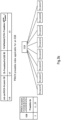
- the following table may be considered as a generalization of the PRACH resource allocation principle within a 160 ms RACH allocation pattern period (as a non-limiting example) where SSBs are having associated ROs four times (as a non-limiting example) within said 160 ms.
- “1" indicates the ROs for SSBs first time within the 160ms
- "2” indicates the ROs for SSBs second time within the 160ms
- "3" indicates the ROs for SSBs third time within the 160ms
- "4" indicates the ROs for SSBs fourth time within the 160ms.
- Radio frame (10 ms) 0 1 2 3 4 5 6 7 8 9 10 11 12 13 14 15 1 1 2 2 3 3 4 4
- the network energy consumption in low system load coming from the PRACH reception in all the allocated ROs may be a problem.
- PRACH detection is rather complex operation and in low load situations may cause relatively high energy consumption.
- Below table illustrates the base station's power consumption model defined in 3GPP Release 18 Study Item on Network Energy Saving (3GPP TR 38.864). From that, it can be seen that there is a significant difference in gNB power consumption between the states of active UL reception and light or deep sleep (when there is no active UL reception). Accordingly, it would be desirable to allow a base station to use a lower power state for as much time as possible. Power state Characteristic Relative power per slot (vs.
- Fig. 4 shows a flow diagram 400 illustrating an example method performed by a network device, such as a gNB or 6gNB for implementing the second example aspect of the disclosure.
- the network device configures RACH resources in the cell and may provide the configuration to one or more UEs, e.g. via broadcast signaling (e.g. as system information) to all UEs and/or via dedicated signaling to connected UEs, action 401.
- the configuration information organizes a set of a random access channel, RACH, occasions, ROs, into primary and secondary ROs, i.e. the configuration comprises both primary ROs and secondary ROs.
- primary ROs there may be at least once the set of PRACH resources for each SSB within a reference period, such as a 160 ms period.
- secondary ROs there may be one or multiple sets of PRACH resources for each SSB within the refence period, i.e. the 160 ms period, for instance.
- the network device may determine that the load (e.g. a random access load, a cell load, an initial access load and/or a handover load of the network device) is sufficiently low (e.g. below a threshold) and may therefore decide to change to an energy saving mode (such a micro sleep, light sleep or deep sleep) and may therefore stop performing PRACH detection in one or more secondary ROs, action 402. However, there may be reasons other than a sufficiently low load for the network device to stop performing PRACH detection on the secondary ROs. Likewise, the network device may determine that the load (e.g. a random access load, a cell load, an initial access load and/or a handover load of the network device) is sufficiently high (e.g.
- the network device may signal the decision by transmitting the status of the PRACH detection for the secondary ROs to specific or all UEs, action 403.
- the status may be transmitted via broadcast signaling, e.g. via a short paging message transmitted using a certain DCI format (PDCCH only).
- the status may be transmitted via a paging PDSCH transmission.
- the status may be transmitted via dedicated signaling to connected UEs.
- the network device may perform PRACH detection according to the transmitted configuration information and the transmitted status, action 404.
- the network device may receive information from one or multiple UEs (for instance in a Msg3 of an RA procedure) that they have tried to perform random access in one or more secondary ROs without success, action 405. In response thereto, the network device may decide to start performing PRACH detection in one or more secondary ROs, action 406.
- the network device may signal the decision, i.e. the changed status indicating the PRACH detection for the secondary ROs, to respective UEs, action 407.
- the network device may use broadcast signaling or dedicated signaling for transmitting the status to respective UEs.
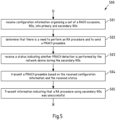
- Fig. 5 shows a flow diagram 500 illustrating an example method performed by a user equipment for implementing the first example aspects of the disclosure.
- the UE may receive a RACH configuration information organizing a set of a random access channel, RACH, occasions, ROs, into primary and secondary ROs, action 501, which may be received as broadcast signaling (e.g. via system information) or as dedicated signaling.
- the configuration comprises both primary ROs and secondary ROs.
- primary ROs there may be at least one set of PRACH resources for each SSB within a reference period, such as a 160 ms period.
- For secondary ROs there may be one or multiple sets of PRACH resources for each SSB within the reference period, such as the 160 ms period.
- the UE may then determine that there is a need to perform an RA procedure and to send a PRACH preamble, action 502. This may for instance be the case for any of the above 10 mentioned RACH scenarios or cases (such as initial access, connection re-establishment, handover etc.).
- the UE may further receive, from the network device, a status indicating whether physical random access channel, PRACH, detection is performed by the network device during the secondary ROs, action 503.
- This information may be exploited for transmitting the PRACH preamble, i.e. the UE may utilize this information by transmitting a PRACH preamble not only based on the received configuration information but also on the received status, action 504.
- the UE may receive an indication from the network device, that PRACH detection is not performed on secondary ROs. The UE may use this information and transmit the next PRACH preamble on a primary RO. In the other case, the UE may receive an indication from the network device that PRACH detection is performed on secondary ROs. Accordingly, the UE may use this information and determine that it can transmit PRACH preambles on primary and secondary ROs. Accordingly, the UE may transmit the next PRACH either on a primary RO or on a secondary RO, e.g. depending on the timing, which ever RO can be used first.
- the UE may attempt to transmit a respective PRACH preamble via any of the primary ROs or secondary ROs based on the received configuration information, and also irrespective of a received status on whether PRACH detection is active on the secondary ROs.
- the selection which RO(s) to use for a RA attempt may be up to the UE. For instance, considering the case that the UE has not received any status regarding the PRACH detection on the secondary ROs, the UE may perform a RA attempt by transmitting a PRACH preamble on a secondary RO.
- the UE may decide for the next attempt to transmit the PRACH preamble on the next primary RO and without any further RA attempt on a secondary RO.
- the UE may further indicate to the network (e.g. in UL PUSCH transmission, such as Msg3) that it has previously performed a RA attempt on a secondary RO without success, action 505. This may then lead to the network device to start performing PRACH detection on secondary ROs, as described with respect to actions 405, 406 of Fig. 4 .
- the above described approach offers various advantages.
- PRACH detection on secondary ROs the system can offer a high PRACH capacity with low initial access latency at the costs of high(er) network energy consumption.
- the system can allow for a low network energy consumption. While this may lead to low(er) PRACH capacity with higher initial access latency, this may be acceptable in certain scenarios (e.g. low load scenarios).
- the proposed solution has the advantage that it provides a significantly more lightweight and flexible procedure with lower signaling overhead.
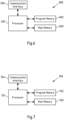
- user equipment 600 may be one of a smartphone, a tablet computer, a notebook computer, a smart watch, a smart band, an LPWAN device, an IoT device, an eMTC device or a vehicle or a part thereof.
- Processor 601 may represent a single processor or two or more processors, which are for instance at least partially coupled, for instance via a bus.
- Processor 601 executes a program code stored in program memory 602 (for instance program code causing user equipment 600 in connection with a network device or base station) to perform one or more of the embodiments of a method according to the present disclosure or parts thereof, when executed on processor 601, and interfaces with a main memory 603.
- Program memory 602 may also contain an operating system for processor 601. Some or all of memories 602 and 603 may also be included into processor 601.
- One of or both of a main memory and a program memory of a processor could be fixedly connected to the processor (e.g. processor 601) or at least partially removable from the processor, for instance in the form of a memory card or stick.
- a program memory may for instance be a non-volatile memory. It may for instance be a FLASH memory (or a part thereof), any of a ROM, PROM, EPROM, MRAM or a FeRAM (or a part thereof) or a hard disc (or a part thereof), to name but a few examples.
- a program memory may for instance comprise a first memory section that is fixedly installed, and a second memory section that is removable from, for instance in the form of a removable SD memory card.
- a main memory may for instance be a volatile memory. It may for instance be a DRAM memory, to give non-limiting example. It may for instance be used as a working memory for processor 601 when executing an operating system, an application, a program, and/or the like.
- Processor 601 further controls a communication interface 604 (e.g. radio interface) configured to receive and/or transmit data and/or information.
- communication interface 604 may be configured to transmit and/or receive radio signals from a network node, such as a base station, in particular as described herein.
- a network node such as a base station
- any computer program code based processing required for receiving and/or evaluating radio signals may be stored in an own memory of communication interface 604 and executed by an own processor of communication interface 604 and/or it may be stored for example in memory 603 and executed for example by processor 601.
- the communication interface 604 may further comprise a BLE and/or Bluetooth radio interface including a BLE transmitter, receiver or transceiver.
- radio interface 604 may additionally or alternatively comprise a WLAN radio interface including at least a WLAN transmitter, receiver or transceiver.
- the components 602 to 604 of user equipment 600 may for instance be connected with processor 601 by means of one or more serial and/or parallel busses.
- user equipment 600 may comprise various other components.
- user equipment 600 may optionally comprise a user interface (e.g. a touch-sensitive display, a keyboard, a touchpad, a display, etc.).
- a user interface e.g. a touch-sensitive display, a keyboard, a touchpad, a display, etc.
- Fig. 7 is a block diagram of an exemplary embodiment of a network device 700, such as a base station (in particular a gNB or 6gNB).
- network device 700 may be configured for scheduling and/or transmitting signals to the user equipment(s), as described above.
- Network device 700 comprises a processor 701.
- Processor 701 may represent a single processor or two or more processors, which are for instance at least partially coupled, for instance via a bus.
- Processor 701 executes a program code stored in program memory 702 (for instance program code causing network device 700 to perform alone or together with the user equipment 600 embodiments according to the present disclosure or parts thereof), and interfaces with a main memory 703.
- Program memory 702 may also comprise an operating system for processor 701. Some or all of memories 702 and 703 may also be included into processor 701.
- processor 701 controls a communication interface 704 which is for example configured to communicate according to a cellular communication system like a 2G/3G/4G/5G cellular communication system.
- Communication interface 704 of network device 700 may be realized by radio heads for instance and may be provided for communication between network node and the user equipment, as described above.
- the components 702 to 704 of network device 700 may for instance be connected with processor 701 by means of one or more serial and/or parallel busses.
- user equipment 600 and network device 700 may comprise various other components.
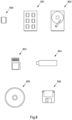
- Fig. 8 is a schematic illustration of examples of tangible and non-transitory computer-readable storage media according to the present disclosure that may for instance be used to implement memory 602 of Fig. 6 or memory 702 of Fig. 7 .
- Fig. 8 displays a flash memory 800, which may for instance be soldered or bonded to a printed circuit board, a solid-state drive 801 comprising a plurality of memory chips (e.g. Flash memory chips), a magnetic hard drive 802, a Secure Digital (SD) card 803, a Universal Serial Bus (USB) memory stick 804, an optical storage medium 805 (such as for instance a CD-ROM or DVD) and a magnetic storage medium 806.
- SD Secure Digital
- USB Universal Serial Bus
- connection in the described embodiments is to be understood in a way that the involved components are operationally coupled.
- connections can be direct or indirect with any number or combination of intervening elements, and there may be merely a functional relationship between the components.
- circuitry refers to any of the following:
- circuitry' also covers an implementation of merely a processor (or multiple processors) or section of a processor and its (or their) accompanying software and/or firmware.
- the term 'circuitry' also covers, for example, a baseband integrated circuit or applications processor integrated circuit for a mobile phone.
- Any processor may comprise but is not limited to one or more microprocessors, one or more processor(s) with accompanying digital signal processor(s), one or more processor(s) without accompanying digital signal processor(s), one or more special-purpose computer chips, one or more field-programmable gate arrays (FPGAS), one or more controllers, one or more application-specific integrated circuits (ASICS), or one or more computer(s).
- FPGAS field-programmable gate arrays
- ASICS application-specific integrated circuits
- the relevant structure/hardware has been programmed in such a way to carry out the described function.
- any of the actions or steps described or illustrated herein may be implemented using executable instructions in a general-purpose or special-purpose processor and stored on a computer-readable storage medium (e.g., disk, memory, or the like) to be executed by such a processor.
- a computer-readable storage medium e.g., disk, memory, or the like
- References to 'computer-readable storage medium' should be understood to encompass specialized circuits such as FPGAs, ASICs, signal processing devices, and other devices.
- any of the actions described or illustrated herein may be implemented using executable instructions in a general-purpose or special-purpose processor and stored on a computer-readable storage medium (e.g., disk, memory, or the like) to be executed by such a processor.
- a computer-readable storage medium e.g., disk, memory, or the like
- References to ⁇ computer-readable storage medium' should be understood to encompass specialized circuits such as FPGAs, ASICs, signal processing devices, and other devices.
- A, or B, or C, or a combination thereof' or "at least one of A, B and C” may be understood to be not exhaustive and to include at least the following: (i) A, or (ii) B, or (iii) C, or (iv) A and B, or (v) A and C, or (vi) B and C, or (vii) A and B and C.
Landscapes
- Engineering & Computer Science (AREA)
- Computer Networks & Wireless Communication (AREA)
- Signal Processing (AREA)
- Mobile Radio Communication Systems (AREA)
Priority Applications (2)
| Application Number | Priority Date | Filing Date | Title |
|---|---|---|---|
| EP23204935.3A EP4543127A1 (fr) | 2023-10-20 | 2023-10-20 | Organisation d'un ensemble d'occasions de canal d'accès aléatoire |
| PCT/EP2024/077040 WO2025082717A1 (fr) | 2023-10-20 | 2024-09-26 | Organisation d'un ensemble d'occasions de canal d'accès aléatoire |
Applications Claiming Priority (1)
| Application Number | Priority Date | Filing Date | Title |
|---|---|---|---|
| EP23204935.3A EP4543127A1 (fr) | 2023-10-20 | 2023-10-20 | Organisation d'un ensemble d'occasions de canal d'accès aléatoire |
Publications (1)
| Publication Number | Publication Date |
|---|---|
| EP4543127A1 true EP4543127A1 (fr) | 2025-04-23 |
Family
ID=88506554
Family Applications (1)
| Application Number | Title | Priority Date | Filing Date |
|---|---|---|---|
| EP23204935.3A Pending EP4543127A1 (fr) | 2023-10-20 | 2023-10-20 | Organisation d'un ensemble d'occasions de canal d'accès aléatoire |
Country Status (2)
| Country | Link |
|---|---|
| EP (1) | EP4543127A1 (fr) |
| WO (1) | WO2025082717A1 (fr) |
Citations (4)
| Publication number | Priority date | Publication date | Assignee | Title |
|---|---|---|---|---|
| US20210392697A1 (en) * | 2020-06-12 | 2021-12-16 | Qualcomm Incorporated | Random access channel beam management |
| WO2022203787A1 (fr) * | 2021-03-25 | 2022-09-29 | Qualcomm Incorporated | Activation et désactivation d'occasions de canal d'accès aléatoire |
| US20230116354A1 (en) * | 2021-10-07 | 2023-04-13 | Qualcomm Incorporated | Two-step random access channel procedure |
| WO2023193802A1 (fr) * | 2022-04-07 | 2023-10-12 | 维沃移动通信有限公司 | Procédé et appareil d'indication ssb, et dispositif, système et support d'enregistrement |
-
2023
- 2023-10-20 EP EP23204935.3A patent/EP4543127A1/fr active Pending
-
2024
- 2024-09-26 WO PCT/EP2024/077040 patent/WO2025082717A1/fr active Pending
Patent Citations (4)
| Publication number | Priority date | Publication date | Assignee | Title |
|---|---|---|---|---|
| US20210392697A1 (en) * | 2020-06-12 | 2021-12-16 | Qualcomm Incorporated | Random access channel beam management |
| WO2022203787A1 (fr) * | 2021-03-25 | 2022-09-29 | Qualcomm Incorporated | Activation et désactivation d'occasions de canal d'accès aléatoire |
| US20230116354A1 (en) * | 2021-10-07 | 2023-04-13 | Qualcomm Incorporated | Two-step random access channel procedure |
| WO2023193802A1 (fr) * | 2022-04-07 | 2023-10-12 | 维沃移动通信有限公司 | Procédé et appareil d'indication ssb, et dispositif, système et support d'enregistrement |
Non-Patent Citations (2)
| Title |
|---|
| 3GPP TR 38.864 |
| 3GPP TS 38.213 |
Also Published As
| Publication number | Publication date |
|---|---|
| WO2025082717A1 (fr) | 2025-04-24 |
Similar Documents
| Publication | Publication Date | Title |
|---|---|---|
| US10785808B2 (en) | Random access method and equipment | |
| US12402173B2 (en) | Method for random access resource configuration, terminal device, and network device | |
| US12279229B2 (en) | Method and apparatus for monitoring paging occasion in a wireless communication system | |
| WO2022077488A1 (fr) | Équipement utilisateur, station de base et procédé d'identification d'équipement utilisateur | |
| US20240155725A1 (en) | Method and apparatus for updating rna during sdt in wireless communication system | |
| US12501352B2 (en) | Determination of active time with discontinuous reception groups | |
| CN110945957A (zh) | 执行随机接入过程的方法和装置 | |
| US12501515B2 (en) | Indication for small data transmission | |
| US11968741B2 (en) | Method and device for switching an IoT mode in wireless communication system | |
| US20260107319A1 (en) | Method and apparatus for common channel transmission handling for network energy saving in wireless communication system | |
| CN118339904A (zh) | 无线通信系统中生成用于波束故障恢复的mac ce的方法和装置 | |
| US20240381446A1 (en) | Device identification method and apparatus | |
| US12160828B2 (en) | Discontinuous reception processing method, and terminal device | |
| KR20210146974A (ko) | 채널 전송 방법, 전자 기기 및 저장 매체 | |
| KR20250099340A (ko) | 무선 통신 시스템에서 네트워크 에너지 절감을 위한 si 획득 방법 및 장치 | |
| EP4572424A1 (fr) | Procédé, équipement utilisateur, dispositif de traitement et support de stockage pour la réception d'un signal de liaison descendante, et procédé et station de base pour la transmission d'un signal de liaison descendante | |
| US20250024507A1 (en) | Method and system for self optimization of random access channel in wireless communication system | |
| KR20250043469A (ko) | 무선 통신 시스템에서 설정된 자원들을 이용한 랜덤 액세스 및 스몰 데이터 전송을 위한 장치 및 방법 | |
| CN118283718A (zh) | 通信方法和通信装置 | |
| EP4543127A1 (fr) | Organisation d'un ensemble d'occasions de canal d'accès aléatoire | |
| EP4576727A2 (fr) | Procédé et dispositif d'accès aléatoire, terminal et support de stockage | |
| US20230180333A1 (en) | Method and apparatus for handling pucch resource for enhanced beam failure recovery in wireless communication system | |
| WO2025083028A1 (fr) | Organisation d'un ensemble d'occasions de canal d'accès aléatoire | |
| CN121080033A (zh) | 用于在无线通信系统中处理随机接入信道信息的方法和装置 | |
| CN120530712A (zh) | 随机接入过程的系统和方法 |
Legal Events
| Date | Code | Title | Description |
|---|---|---|---|
| PUAI | Public reference made under article 153(3) epc to a published international application that has entered the european phase |
Free format text: ORIGINAL CODE: 0009012 |
|
| STAA | Information on the status of an ep patent application or granted ep patent |
Free format text: STATUS: THE APPLICATION HAS BEEN PUBLISHED |
|
| AK | Designated contracting states |
Kind code of ref document: A1 Designated state(s): AL AT BE BG CH CY CZ DE DK EE ES FI FR GB GR HR HU IE IS IT LI LT LU LV MC ME MK MT NL NO PL PT RO RS SE SI SK SM TR |
|
| STAA | Information on the status of an ep patent application or granted ep patent |
Free format text: STATUS: REQUEST FOR EXAMINATION WAS MADE |
|
| 17P | Request for examination filed |
Effective date: 20251021 |