EP4544929A1 - Filter für rauchartikel mit lyocell-tow und rauchartikel damit - Google Patents
Filter für rauchartikel mit lyocell-tow und rauchartikel damit Download PDFInfo
- Publication number
- EP4544929A1 EP4544929A1 EP24750577.9A EP24750577A EP4544929A1 EP 4544929 A1 EP4544929 A1 EP 4544929A1 EP 24750577 A EP24750577 A EP 24750577A EP 4544929 A1 EP4544929 A1 EP 4544929A1
- Authority
- EP
- European Patent Office
- Prior art keywords
- smoking article
- filter
- peg
- lyocell
- polyethylene glycol
- Prior art date
- Legal status (The legal status is an assumption and is not a legal conclusion. Google has not performed a legal analysis and makes no representation as to the accuracy of the status listed.)
- Pending
Links
Images

Classifications
-
- A—HUMAN NECESSITIES
- A24—TOBACCO; CIGARS; CIGARETTES; SIMULATED SMOKING DEVICES; SMOKERS' REQUISITES
- A24D—CIGARS; CIGARETTES; TOBACCO SMOKE FILTERS; MOUTHPIECES OF CIGARS OR CIGARETTES; MANUFACTURE OF TOBACCO SMOKE FILTERS OR MOUTHPIECES
- A24D3/00—Tobacco smoke filters, e.g. filter tips or filtering inserts; Filters specially adapted for simulated smoking devices; Mouthpieces of cigars or cigarettes
- A24D3/06—Use of materials for tobacco smoke filters
- A24D3/08—Use of materials for tobacco smoke filters of organic materials as carrier or major constituent
- A24D3/10—Use of materials for tobacco smoke filters of organic materials as carrier or major constituent of cellulose or cellulose derivatives
-
- A—HUMAN NECESSITIES
- A24—TOBACCO; CIGARS; CIGARETTES; SIMULATED SMOKING DEVICES; SMOKERS' REQUISITES
- A24D—CIGARS; CIGARETTES; TOBACCO SMOKE FILTERS; MOUTHPIECES OF CIGARS OR CIGARETTES; MANUFACTURE OF TOBACCO SMOKE FILTERS OR MOUTHPIECES
- A24D3/00—Tobacco smoke filters, e.g. filter tips or filtering inserts; Filters specially adapted for simulated smoking devices; Mouthpieces of cigars or cigarettes
- A24D3/04—Tobacco smoke filters characterised by their shape or structure
-
- A—HUMAN NECESSITIES
- A24—TOBACCO; CIGARS; CIGARETTES; SIMULATED SMOKING DEVICES; SMOKERS' REQUISITES
- A24D—CIGARS; CIGARETTES; TOBACCO SMOKE FILTERS; MOUTHPIECES OF CIGARS OR CIGARETTES; MANUFACTURE OF TOBACCO SMOKE FILTERS OR MOUTHPIECES
- A24D3/00—Tobacco smoke filters, e.g. filter tips or filtering inserts; Filters specially adapted for simulated smoking devices; Mouthpieces of cigars or cigarettes
- A24D3/06—Use of materials for tobacco smoke filters
- A24D3/067—Use of materials for tobacco smoke filters characterised by functional properties
-
- A—HUMAN NECESSITIES
- A24—TOBACCO; CIGARS; CIGARETTES; SIMULATED SMOKING DEVICES; SMOKERS' REQUISITES
- A24D—CIGARS; CIGARETTES; TOBACCO SMOKE FILTERS; MOUTHPIECES OF CIGARS OR CIGARETTES; MANUFACTURE OF TOBACCO SMOKE FILTERS OR MOUTHPIECES
- A24D3/00—Tobacco smoke filters, e.g. filter tips or filtering inserts; Filters specially adapted for simulated smoking devices; Mouthpieces of cigars or cigarettes
- A24D3/06—Use of materials for tobacco smoke filters
- A24D3/067—Use of materials for tobacco smoke filters characterised by functional properties
- A24D3/068—Biodegradable or disintegrable
-
- A—HUMAN NECESSITIES
- A24—TOBACCO; CIGARS; CIGARETTES; SIMULATED SMOKING DEVICES; SMOKERS' REQUISITES
- A24D—CIGARS; CIGARETTES; TOBACCO SMOKE FILTERS; MOUTHPIECES OF CIGARS OR CIGARETTES; MANUFACTURE OF TOBACCO SMOKE FILTERS OR MOUTHPIECES
- A24D3/00—Tobacco smoke filters, e.g. filter tips or filtering inserts; Filters specially adapted for simulated smoking devices; Mouthpieces of cigars or cigarettes
- A24D3/06—Use of materials for tobacco smoke filters
- A24D3/14—Use of materials for tobacco smoke filters of organic materials as additive
-
- A—HUMAN NECESSITIES
- A24—TOBACCO; CIGARS; CIGARETTES; SIMULATED SMOKING DEVICES; SMOKERS' REQUISITES
- A24D—CIGARS; CIGARETTES; TOBACCO SMOKE FILTERS; MOUTHPIECES OF CIGARS OR CIGARETTES; MANUFACTURE OF TOBACCO SMOKE FILTERS OR MOUTHPIECES
- A24D1/00—Cigars; Cigarettes
- A24D1/02—Cigars; Cigarettes with special covers
Definitions
- the present invention relates to a smoking article filter in which polyethylene glycol (PEG) is added as a phenol reducing material to lyocell tow and a smoking article including the smoking article filter.
- PEG polyethylene glycol
- Typical cigarette filters include cellulose acetate tow formed by extracting cellulose from wood pulp and acetylating the extracted cellulose. Also, cigarette filters are assembled into cigarette products, distributed to consumers, provided for smoking, and then finally discarded after smoking is completed. Also, some cigarette filters are directly discarded as manufacturing residue from a cigarette filter manufacturing plant. This cigarette filter waste is collected as refuse and landfilled for disposal. In addition, in some cases, smoked cigarettes are left in the natural environment without being collected as refuse.
- a phenol reducing material such as polyethylene glycol (PEG) or triethyl citrate (TEC)
- PEG polyethylene glycol
- TEC triethyl citrate
- One object of the present invention is to provide a smoking article filter in which polyethylene glycol (PEG), whose content and/or molecular weight are/is designed to be optimal, is added to lyocell tow to constitute the smoking article filter, thereby more effectively removing components such as phenols present in cigarette smoke during smoking and having excellent biodegradability.
- PEG polyethylene glycol
- Another object of the present invention is to provide a smoking article including a smoking article filter in which polyethylene glycol (PEG), whose content and/or molecular weight are/is designed to be optimal, is added to lyocell tow to constitute the smoking article filter, thereby more effectively removing components such as phenols present in cigarette smoke during smoking and having excellent biodegradability.
- PEG polyethylene glycol
- a smoking article filter including: lyocell tow including lyocell fibers; and a phenol reducing material dispersed in the lyocell tow, wherein the phenol reducing material includes polyethylene glycol (PEG), the polyethylene glycol (PEG) has a weight average molecular weight (MW) in a range of 500 to 700, and the content of the polyethylene glycol (PEG) relative to a weight of the lyocell tow ranges from 1 wt% to 30 wt%.
- PEG polyethylene glycol
- MW weight average molecular weight
- the content of the polyethylene glycol (PEG) relative to the weight of the lyocell tow may range from 19 wt% to 21 wt%.
- the polyethylene glycol (PEG) may have a weight average molecular weight (MW) of 600.
- the smoking article filter may have a hardness in a range of 86% to 88%.
- the phenol reducing material may further include triethyl citrate (TEC).
- TEC triethyl citrate
- the content of the polyethylene glycol (PEG) relative to the weight of the lyocell tow may range from 19 wt% to 21 wt%.
- the smoking article filter may have a hardness in a range of 86% to 88%.
- a smoking article filter and a smoking article including the same it is possible to provide a lyocell filter to which lyocell tow, to which polyethylene glycol (PEG) is added as a phenol reducing material, is applied, and in this way, components such as phenols present in cigarette smoke can be more effectively removed during smoking.
- PEG polyethylene glycol
- polyethylene glycol (PEG) does not act as a plasticizer for lyocell tow, which is hydrophilic, despite being added to the lyocell tow, it is possible to provide a smoking article filter having excellent biodegradability while having phenol reducing performance and a smoking article including the smoking article filter.
- first, second, A, B, (a), and (b) may be used. Such terms are only used for distinguishing one component from another component, and the essence, order, sequence, or the like of the corresponding component is not limited by the terms.
- a certain component is described as being “connected,” “coupled,” or “linked” to another component, it should be understood that, although the component may be directly connected or linked to the other component, still another component may also be “connected,” “coupled,” or “linked” between the two components.
- smoking article may refer to any product that can be smoked or any product that can provide a smoking experience, regardless of whether the product is based on tobacco, tobacco derivatives, expanded tobacco, reconstituted tobacco, or tobacco substitutes.
- smoking articles may include products that can be smoked, such as cigarettes, cigars, and cigarillos.
- smoking material may refer to any type of material that may be used in a smoking article.
- upstream or “upstream direction” may refer to a direction moving away from an oral region of a smoker
- downstream or “downstream direction” may refer to a direction approaching the oral region of the smoker.
- longitudinal direction may refer to a direction corresponding to a longitudinal axis of a smoking article.
- FIG. 1 is a view illustrating a schematic configuration of a smoking article according to one embodiment of the present invention.
- smoking article may refer to anything capable of generating an aerosol, such as tobacco (cigarettes) and cigars.
- the smoking article may include an aerosol-generating material or an aerosol-forming substrate.
- the smoking article may include a solid material based on tobacco raw materials, such as reconstituted tobacco leaves, shredded tobacco, and reconstituted tobacco.
- a smoking material may include volatile compounds.
- upstream or upstream direction refers to a direction moving away from an oral region of a user smoking a smoking article 100
- downstream or “downstream direction” refers to a direction approaching the oral region of the user smoking the smoking article 100.
- a smoking material portion 10 is disposed upstream or in an upstream direction of a smoking article filter portion 20 (a smoking article filter 20 or a filter portion 20).
- the smoking article 100 is a combustion-type cigarette is described as an example.
- the present invention is not limited thereto, and the smoking article 100 may also be a heating-type cigarette or the like that is used together with an aerosol generation device (not illustrated) such as an electronic cigarette device.
- the present invention relates to the smoking article filter 20 (or the smoking article filter portion 20) included in the smoking article 100, and the smoking article filter 20 according to one embodiment of the present invention includes lyocell tow including lyocell fibers and a phenol reducing material added to the lyocell tow.
- the phenol reducing material corresponds to a substance that can specifically reduce phenols generated during smoking, and the phenol reducing material may at least include polyethylene glycol (PEG). In some embodiments, the phenol reducing material may further include triethyl citrate (TEC). However, the phenol reducing material additionally added to polyethylene glycol (PEG) is not limited thereto and may be any other substance as long as the substance can reduce phenols generated during smoking.
- the lyocell fibers are eco-friendly fibers made of cellulose extracted from wood pulp.
- the lyocell tow refers to a bundle formed by cross-connecting adjacent lyocell fibers.
- the lyocell fibers may have a shaped cross-section.
- the shaped cross-section is defined as a cross-section having a shape including a plurality of protrusions instead of having a circular shape.
- a cross-section having a shape in which a plurality of protrusions extend from the center may be referred to as "shaped cross-section.”
- the lyocell fibers may have a Y-shaped cross-section with three protrusions branching from the center, a cross-shaped cross-section with four protrusions, a star-shaped cross-section with five protrusions, or an O-shaped cross-section, but the present invention is not limited thereto.
- the phenol reducing material may be uniformly dispersed in lyocell tow and may be distributed throughout the entire region of the lyocell tow constituting the smoking article filter.
- the phenol reducing material at least including polyethylene glycol (PEG) may be applied on surfaces of lyocell fibers constituting the lyocell tow, and despite the phenol reducing material including polyethylene glycol (PEG) being applied on the surfaces of the lyocell fibers, polyethylene glycol may not act as a plasticizer between the lyocell fibers.
- the smoking article filter to which lyocell tow is applied according to the present invention includes a phenol reducing material including polyethylene glycol (PEG) that is dispersed in the lyocell tow and thus may have a greater effect of reducing phenols generated during smoking, compared to a smoking article filter to which the phenol reducing material is not added.
- PEG polyethylene glycol
- polyethylene glycol (PEG) included in the phenol reducing material has a weight average molecular weight (MW) in a range of 50 to 10,000, 50 to 2,500, 200 to 2,000, 500 to 700, or a weight average molecular weight (MW) of 600.
- phenol reducing performance may vary according to a molecular weight of the polyethylene glycol (PEG). Specifically, in a case where polyethylene glycol (PEG) dispersed in the lyocell tow has a weight average molecular weight (MW) in the above-mentioned range, phenol reducing performance of the smoking article filter manufactured using the lyocell tow may be excellent.
- PEG polyethylene glycol
- phenol reducing performance of the smoking article filter manufactured using the lyocell tow may be the best, but a molecular weight of the polyethylene glycol (PEG) is not limited thereto.
- the content of polyethylene glycol (PEG) relative to the weight of the lyocell tow may range from 1 wt% to 30 wt%, 2 wt% to 28 wt%, 4 wt% to 25 wt%, 8 wt% to 24 wt%, 13 wt% to 23 wt%, 18 wt% to 22 wt%, 19 wt% to 21 wt% or may be 20 wt%.
- the phenol reducing material includes polyethylene glycol (PEG) in the above-mentioned range, phenol reducing performance may be excellent while physical properties of the smoking article filter are maintained.
- the smoking article filter including the lyocell tow in which the phenol reducing material is dispersed has a hardness of 70% or more.
- the hardness of the smoking article filter may range from 70% to 90%, 75% to 90%, 80% to 90%, 85% to 90%, or 86% to 88%.
- the hardness of the smoking article filter is a numerical value of a degree to which a diameter of the smoking article filter is maintained when the smoking article filter is pressed with a force of a certain level in a direction perpendicular to the longitudinal direction of the smoking article filter and may be a percentage value of a ratio of a diameter of the smoking article filter after the force is applied to a diameter of the smoking article filter before the force is applied.
- a smoking article filter was manufactured in the same manner as in Example 1 except that PEG 400, instead of PEG 200, was used in a phenol reducing material.
- a smoking article filter was manufactured in the same manner as in Example 1 except that PEG 600, instead of PEG 200, was used in a phenol reducing material.
- a smoking article filter was manufactured in the same manner as in Example 1 except that PEG 1000, instead of PEG 200, was used in a phenol reducing material.
- a smoking article filter was manufactured in the same manner as in Example 1 except that PEG 2000, instead of PEG 200, was used in a phenol reducing material.
- a smoking article filter was manufactured in the same manner as in Example 1 except that a phenol reducing material was not injected onto the lyocell tow.
- Smoking articles were manufactured using the smoking article filters of Comparative Example 1 and Examples 1 to 5, smoke components emitted during smoking using the cigarette smoking machine HAUNI LX20 manual (linear type) as a smoking device were collected using a Cambridge filter pad (CFP), and in order to extract substances from the smoke components collected on the CFP, 30 mL of 1% acetic acid was added and then stirred, the substances were filtered using a 0.45 ⁇ m PVDF syringe filter, phenols in the smoke of each smoking article filter were measured and analyzed using an Alliance HPLC-FLD analysis device of Waters Corporation, and results thereof are shown in Table 1 below.
- CFP Cambridge filter pad
- a phenol reducing effect varies according to the molecular weight of PEG included in the phenol reducing material. Specifically, it can be seen that the amount of delivered phenol or cresols significantly decreased in the case of Example 3 in which PEG 600 was included, compared to Comparative Example 1 and Examples 1, 2, 4, and 5.
- a smoking article filter was manufactured in the same manner as in Example 6 except that content of added PEG 600 included in a phenol reducing material was 8 wt%, instead of 3 wt%, relative to the weight of the lyocell tow.
- a smoking article filter was manufactured in the same manner as in Example 6 except that content of added PEG 600 included in a phenol reducing material was 13 wt%, instead of 3 wt%, relative to the weight of the lyocell tow.
- a smoking article filter was manufactured in the same manner as in Example 6 except that content of added PEG 600 included in a phenol reducing material was 20 wt%, instead of 3 wt%, relative to the weight of the lyocell tow.
- a smoking article filter was manufactured in the same manner as in Example 6 except that content of added PEG 600 included in a phenol reducing material was 30 wt%, instead of 3 wt%, relative to the weight of the lyocell tow.
- a smoking article filter was manufactured in the same manner as in Example 6 except that a phenol reducing material was not injected onto the lyocell tow.
- Smoking articles were manufactured using the smoking article filters of Comparative Example 2 and Examples 6 to 10, smoke components emitted during smoking using the cigarette smoking machine HAUNI LX20 manual (linear type) as a smoking device were collected using a Cambridge filter pad (CFP), and in order to extract substances from the smoke components collected on the CFP, 30 mL of 1% acetic acid was added and then stirred, the substances were filtered using a 0.45 ⁇ m PVDF syringe filter, phenols in the smoke of each smoking article filter were measured and analyzed using an Alliance HPLC-FLD analysis device of Waters Corporation, and results thereof are shown in Table 2 below.
- CFP Cambridge filter pad
- the amount of delivered phenol decreased in the smoking article filters of Examples 6 to 10 manufactured using the lyocell tow in which the phenol reducing material including PEG 600 was dispersed, compared to the smoking article filter of Comparative Example 2 in which the phenol reducing material was not dispersed in the lyocell tow.
- a phenol reducing effect varies according to the content of PEG 600 included in the phenol reducing material. Specifically, it can be seen that the amount of delivered phenol or cresols significantly decreased in the cases of Examples 9 and 10 in which content of PEG 600 was 20 wt% and 30 wt%, respectively, relative to the weight of the lyocell tow, compared to Comparative Example 2 and Examples 6 to 8.
- Lyocell tow including lyocell fibers was wrapped with general porous wrapping paper having a basis weight of 21 gsm, and then a solution containing water was injected into the lyocell fibers to manufacture a smoking article filter.
- Lyocell tow including lyocell fibers was wrapped with general porous wrapping paper having a basis weight of 21 gsm, and then a solution containing PEG and water was injected into the lyocell fibers to manufacture a smoking article filter.
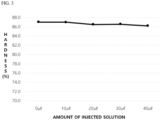
- Smoking article filters were manufactured in the same manner as in Manufacture Example 1 and Manufacture Example 2 except for varying the amount of solution injected into the lyocell tow, and a hardness of the manufactured smoking article filters was evaluated.
- Filter hardness % D ⁇ a / D ⁇ 100
- D represents a filter diameter (mm)
- a represents a distance (mm) the filter moves downward (is pressed) due to a 300-g weight.
- Measured values necessary to calculate the hardness of the cigarette filter may be obtained using a device generally used in the art, and for example, DHT 200TM of Filtrona Co., Ltd. may be used. In measuring hardness, the applied force takes into account a force actually applied when a smoker holds a cigarette.
- a hardness value of 85% or more obtained through the cigarette filter according to one embodiment of the present invention is technically significant in that it shows that hardness can be secured at a level that allows the cigarette filter according to one embodiment of the present invention, which uses lyocell tow, which is an eco-friendly material, to replace the conventional cigarette filter made of cellulose acetate.
- the results of measuring the hardness of a smoking article filter according to the amount of a solution injected into lyocell tow when the solution contained water is shown in the graph of FIG. 2
- the results of measuring the hardness of a smoking article filter according to the amount of a solution injected into lyocell tow when the solution contained water and PEG is shown in the graph of FIG. 3 .
- the hardness of the smoking article filter decreases linearly as the amount of injected water increases. This may be considered to be due to the hardness of the smoking article filter decreasing as water (moisture) permeates through lyocell fibers constituting the hydrophilic lyocell tow or permeates between the lyocell fiber structures, causing the lyocell fiber structure to change due to an external force.
- the smoking article filter according to the present invention may have excellent phenol reducing performance while physical properties of the smoking article filter are maintained.
- the amount of added PEG is greater in the case where paper is used compared to the case where lyocell fibers are used. That is, since the amount of PEG added to implement the same resistance to draw is smaller when lyocell fibers are used compared to when paper is used, the amount of phenol reducing material for manufacturing a smoking article filter may be reduced, and manufacturing costs may be reduced.
- FIG. 1 is a view illustrating a schematic configuration of a smoking article according to one embodiment of the present invention.
- the smoking article 100 includes the smoking material portion 10 and the filter portion 20, and the above-described smoking article filter is applied to the filter portion 20 of the smoking article 100.
- the smoking material portion 10 is positioned upstream of the filter portion 20.
- the smoking material portion 10 may be filled with a smoking material such as raw tobacco leaves, reconstituted tobacco leaves, or a mixture of tobacco leaves and reconstituted tobacco leaves.
- a processed smoking material may be filled in the smoking material portion 10 in the form of a sheet or shredded tobacco.
- the smoking material portion 10 may have the form of a longitudinally extending rod whose length, circumference, and diameter are not particularly limited, but the length, circumference, and diameter may be adjusted to sizes generally used in the art in consideration of the amount of smoking material filled therein, user preferences, or the like.
- the smoking material portion 10 may include at least one aerosol-generating material among glycerin, propylene glycol, ethylene glycol, dipropylene glycol, diethylene glycol, triethylene glycol, tetraethylene glycol, and oleyl alcohol.
- the smoking material portion 10 may contain other additives such as a flavoring agent, a wetting agent, and/or an acetate compound.
- the aerosol-generating material and the additive may be contained in the smoking material.
- the filter portion 20 is disposed downstream of the smoking material portion 10 and serves as a filter through which an aerosol material generated in the smoking material portion 10 passes right before being inhaled by the user.
- the filter portion 20 may be manufactured using various materials or manufactured in various forms.
- the filter portion 20 basically includes the above-described cigarette filter including lyocell tow in which a plurality of lyocell fibers are bonded using a binder.
- the cigarette filter including the lyocell tow may replace all or part of the filter portion 20 of existing smoking articles, and when the cigarette filter replaces part of the filter portion 20, a filter material that is used conventionally may be used together.
- a cellulose acetate filter, a hollow tube filter, or the like may be used as the conventional filter material.
- the filter portion 20 is illustrated as a mono filter formed of a single filter in FIG. 1 , but the present invention is not limited thereto.
- the filter portion 20 may be provided as a dual filter, a triple filter, or the like, which includes two or more filters, in order to increase filter efficiency.
- the filter (hereinafter, "lyocell filter”) of the present invention that includes lyocell tow including lyocell fibers and a phenol reducing material dispersed in the lyocell tow may be applied as any one filter of the plurality of filters, and a cellulose acetate filter and/or a paper filter may be applied as the other or another filter of the plurality of filters.
- a length of the lyocell filter of the present invention may be 25% to 50% of the overall length of the filter portion 20.
- a crushable capsule (not illustrated) having a structure in which a liquid including a flavoring is wrapped with a film may be included in the filter portion 20.
- the exterior of the smoking material portion 10 and the filter portion 20 may be wrapped with a wrapper 30a or 30b.
- the smoking material portion 10 may be wrapped with a smoking material portion wrapper 30a.
- Some of the cigarette smoke generated in a typical combustion process of the smoking material portion 10 is released into the atmosphere through the smoking material portion wrapper 30a before passing through the cigarette filter, and sidestream smoke gives an unpleasant feeling to people exposed thereto.
- sidestream smoke such as filling conventional cigarette paper with a filler such as magnesium oxide, titanium oxide, cerium oxide, aluminum oxide, calcium carbonate, and zirconium carbonate.
- a filler such as magnesium oxide, titanium oxide, cerium oxide, aluminum oxide, calcium carbonate, and zirconium carbonate.
- tobacco smoke taste degradation, combustion interruption, ash integrity degradation, or the like may occur, and it is difficult to address the above-mentioned problem through suitable combinations of materials contained in the filler.
- a filler in which magnesium oxide (MgO and/or Mg(OH) 2 ) and calcium carbonate (CaCO 3 ) are mixed is applied to the smoking material portion wrapper 30a according to one embodiment of the present invention in order to prevent tobacco smoke taste degradation, ash integrity degradation, and combustion interruption while reducing sidestream smoke.
- MgO and/or Mg(OH) 2 magnesium oxide
- CaCO 3 calcium carbonate
- the filter portion 20 may be wrapped with a filter portion wrapper 30b.
- the filter portion wrapper 30b may be manufactured using grease-resistant wrapping paper, and an aluminum foil may be further included at an inner surface of the filter portion wrapper 30b.
- the smoking material portion 10 wrapped with the smoking material portion wrapper 30a and the filter portion 20 wrapped with the filter portion wrapper 30b may be wrapped together with tipping paper 40.
- the tipping paper 40 may be wrapped around at least a portion (for example, a partial downstream region) of the smoking material portion wrapper 30a and an outer periphery of the filter portion wrapper 30b.
- the tipping paper 40 may be made of nonporous wrapping paper that has not been treated to be grease-resistant, but the present invention is not limited thereto.
- the tipping paper 40 may include an incombustible material to prevent a phenomenon in which the filter portion 20 burns, but the present invention is not limited thereto.
- the smoking article 100 may further include a hollow tube structure which is a tubular structure including a hollow formed therein.
- the hollow tube structure may be disposed downstream of the lyocell filter.
- perforations may be formed in the hollow tube structure, but the present invention is not limited thereto. Perforations may not be formed in the hollow tube structure.
- the perforations when perforations are formed in the hollow tube structure, the perforations may be formed at a position spaced 10 mm to 15 mm from the downstream end of the smoking article 100 in the upstream direction.
Landscapes
- Chemical & Material Sciences (AREA)
- Engineering & Computer Science (AREA)
- Materials Engineering (AREA)
- Life Sciences & Earth Sciences (AREA)
- Biodiversity & Conservation Biology (AREA)
- Cigarettes, Filters, And Manufacturing Of Filters (AREA)
Applications Claiming Priority (3)
| Application Number | Priority Date | Filing Date | Title |
|---|---|---|---|
| KR20230014851 | 2023-02-03 | ||
| KR1020230192964A KR20240122317A (ko) | 2023-02-03 | 2023-12-27 | 라이오셀 토우를 포함하는 흡연 물품용 필터, 및 이를 포함하는 흡연 물품 |
| PCT/KR2024/001513 WO2024162780A1 (ko) | 2023-02-03 | 2024-02-01 | 라이오셀 토우를 포함하는 흡연 물품용 필터, 및 이를 포함하는 흡연 물품 |
Publications (1)
| Publication Number | Publication Date |
|---|---|
| EP4544929A1 true EP4544929A1 (de) | 2025-04-30 |
Family
ID=92147027
Family Applications (1)
| Application Number | Title | Priority Date | Filing Date |
|---|---|---|---|
| EP24750577.9A Pending EP4544929A1 (de) | 2023-02-03 | 2024-02-01 | Filter für rauchartikel mit lyocell-tow und rauchartikel damit |
Country Status (5)
| Country | Link |
|---|---|
| EP (1) | EP4544929A1 (de) |
| JP (1) | JP2025537990A (de) |
| CN (1) | CN120456838A (de) |
| TW (1) | TW202448345A (de) |
| WO (1) | WO2024162780A1 (de) |
Family Cites Families (5)
| Publication number | Priority date | Publication date | Assignee | Title |
|---|---|---|---|---|
| KR100617983B1 (ko) * | 2005-01-07 | 2006-08-31 | 주식회사 케이티앤지 | 궐련용 필터 |
| KR20150035800A (ko) * | 2012-07-13 | 2015-04-07 | 필립모리스 프로덕츠 에스.에이. | 흡연 물품을 위한 분해가능한 필터 |
| KR102029981B1 (ko) * | 2017-10-31 | 2019-10-08 | 주식회사 케이티앤지 | 담배 필터, 이의 제조방법 및 이를 포함하는 담배 |
| DE102020119388B4 (de) * | 2020-07-22 | 2023-08-17 | Delfortgroup Ag | Plissiertes filtermaterial für rauchartikel |
| DE102021115456A1 (de) * | 2021-06-15 | 2022-12-15 | Delfortgroup Ag | Filtermaterial für segmente für rauchartikel mit reduzierter kriechneigung |
-
2024
- 2024-02-01 JP JP2025531897A patent/JP2025537990A/ja active Pending
- 2024-02-01 EP EP24750577.9A patent/EP4544929A1/de active Pending
- 2024-02-01 TW TW113103915A patent/TW202448345A/zh unknown
- 2024-02-01 WO PCT/KR2024/001513 patent/WO2024162780A1/ko not_active Ceased
- 2024-02-01 CN CN202480006405.8A patent/CN120456838A/zh active Pending
Also Published As
| Publication number | Publication date |
|---|---|
| JP2025537990A (ja) | 2025-11-20 |
| WO2024162780A1 (ko) | 2024-08-08 |
| TW202448345A (zh) | 2024-12-16 |
| CN120456838A (zh) | 2025-08-08 |
Similar Documents
| Publication | Publication Date | Title |
|---|---|---|
| KR102386081B1 (ko) | 흡연 물품용 필터 및 이를 포함하는 흡연 물품 | |
| US20250040594A1 (en) | Cigarette filter including lyocell tow and production method thereof | |
| EP4544927A1 (de) | Filter für rauchartikel mit lyocell-tow, herstellungsverfahren und rauchartikel damit | |
| EP4544930A1 (de) | Rauchproduktfilter mit lyocell-tow und rauchprodukt damit | |
| EP4544932A1 (de) | Filter für rauchartikel mit chemisch unmodifizierter lyocellfaser und rauchartikel damit | |
| EP4544929A1 (de) | Filter für rauchartikel mit lyocell-tow und rauchartikel damit | |
| EP4544928A1 (de) | Filter für rauchartikel mit lyocell-tow und rauchartikel damit | |
| EP4699458A1 (de) | Biozersetzbarer und umweltfreundlicher filter für rauchartikel | |
| EP4181698A1 (de) | Papierhohlraumfilter | |
| KR20250020301A (ko) | 생붕괴성을 가지는 흡연 물품용 친환경 필터 | |
| EP4544924A1 (de) | Rauchproduktfilter mit lyocell-tow und rauchprodukt damit | |
| EP4544925A1 (de) | Filter für rauchartikel mit lyocell-tow und rauchartikel damit | |
| KR102466512B1 (ko) | 흡연물품 필터 및 이를 위한 보조 필터 | |
| KR20240122316A (ko) | 라이오셀 토우를 포함하는 흡연 물품용 필터, 및 이를 포함하는 흡연 물품 | |
| EP4599705A1 (de) | Filter für rauchartikel und rauchartikel damit | |
| EP4544931A1 (de) | Rauchproduktfilter mit nicht chemisch modifiziertem lyocell-tow und rauchprodukt damit | |
| KR102450720B1 (ko) | 생분해성이 증진된 흡연물품용 필터 및 이를 포함하는 흡연물품 | |
| KR20250101928A (ko) | 흡연 물품용 필터 및 이를 포함하는 흡연 물품 | |
| KR20240122340A (ko) | 화학적으로 변형되지 않은 라이오셀 섬유를 포함하는 흡연 물품용 필터, 및 이를 포함하는 흡연 물품 | |
| KR20260001084A (ko) | 흡연 물품용 필터, 및 이를 포함하는 흡연 물품 | |
| EP4670528A1 (de) | Rauchartikelfilter und rauchartikel damit |
Legal Events
| Date | Code | Title | Description |
|---|---|---|---|
| STAA | Information on the status of an ep patent application or granted ep patent |
Free format text: STATUS: THE INTERNATIONAL PUBLICATION HAS BEEN MADE |
|
| PUAI | Public reference made under article 153(3) epc to a published international application that has entered the european phase |
Free format text: ORIGINAL CODE: 0009012 |
|
| STAA | Information on the status of an ep patent application or granted ep patent |
Free format text: STATUS: REQUEST FOR EXAMINATION WAS MADE |
|
| 17P | Request for examination filed |
Effective date: 20250123 |
|
| AK | Designated contracting states |
Kind code of ref document: A1 Designated state(s): AL AT BE BG CH CY CZ DE DK EE ES FI FR GB GR HR HU IE IS IT LI LT LU LV MC ME MK MT NL NO PL PT RO RS SE SI SK SM TR |