EP4545072A2 - Verwendung von vibegron zur behandlung von blasenhypersymptomen bei männern mit benigner prostatahyperplasie - Google Patents
Verwendung von vibegron zur behandlung von blasenhypersymptomen bei männern mit benigner prostatahyperplasie Download PDFInfo
- Publication number
- EP4545072A2 EP4545072A2 EP25150168.0A EP25150168A EP4545072A2 EP 4545072 A2 EP4545072 A2 EP 4545072A2 EP 25150168 A EP25150168 A EP 25150168A EP 4545072 A2 EP4545072 A2 EP 4545072A2
- Authority
- EP
- European Patent Office
- Prior art keywords
- vibegron
- subject
- week
- weeks
- baseline
- Prior art date
- Legal status (The legal status is an assumption and is not a legal conclusion. Google has not performed a legal analysis and makes no representation as to the accuracy of the status listed.)
- Pending
Links
Images

Classifications
-
- A—HUMAN NECESSITIES
- A61—MEDICAL OR VETERINARY SCIENCE; HYGIENE
- A61K—PREPARATIONS FOR MEDICAL, DENTAL OR TOILETRY PURPOSES
- A61K31/00—Medicinal preparations containing organic active ingredients
- A61K31/13—Amines
- A61K31/135—Amines having aromatic rings, e.g. ketamine, nortriptyline
- A61K31/137—Arylalkylamines, e.g. amphetamine, epinephrine, salbutamol, ephedrine or methadone
-
- A—HUMAN NECESSITIES
- A61—MEDICAL OR VETERINARY SCIENCE; HYGIENE
- A61K—PREPARATIONS FOR MEDICAL, DENTAL OR TOILETRY PURPOSES
- A61K31/00—Medicinal preparations containing organic active ingredients
- A61K31/13—Amines
- A61K31/135—Amines having aromatic rings, e.g. ketamine, nortriptyline
- A61K31/138—Aryloxyalkylamines, e.g. propranolol, tamoxifen, phenoxybenzamine
-
- A—HUMAN NECESSITIES
- A61—MEDICAL OR VETERINARY SCIENCE; HYGIENE
- A61K—PREPARATIONS FOR MEDICAL, DENTAL OR TOILETRY PURPOSES
- A61K31/00—Medicinal preparations containing organic active ingredients
- A61K31/33—Heterocyclic compounds
- A61K31/395—Heterocyclic compounds having nitrogen as a ring hetero atom, e.g. guanethidine or rifamycins
- A61K31/495—Heterocyclic compounds having nitrogen as a ring hetero atom, e.g. guanethidine or rifamycins having six-membered rings with two or more nitrogen atoms as the only ring heteroatoms, e.g. piperazine or tetrazines
- A61K31/496—Non-condensed piperazines containing further heterocyclic rings, e.g. rifampin, thiothixene or sparfloxacin
-
- A—HUMAN NECESSITIES
- A61—MEDICAL OR VETERINARY SCIENCE; HYGIENE
- A61K—PREPARATIONS FOR MEDICAL, DENTAL OR TOILETRY PURPOSES
- A61K31/00—Medicinal preparations containing organic active ingredients
- A61K31/33—Heterocyclic compounds
- A61K31/395—Heterocyclic compounds having nitrogen as a ring hetero atom, e.g. guanethidine or rifamycins
- A61K31/495—Heterocyclic compounds having nitrogen as a ring hetero atom, e.g. guanethidine or rifamycins having six-membered rings with two or more nitrogen atoms as the only ring heteroatoms, e.g. piperazine or tetrazines
- A61K31/505—Pyrimidines; Hydrogenated pyrimidines, e.g. trimethoprim
- A61K31/519—Pyrimidines; Hydrogenated pyrimidines, e.g. trimethoprim ortho- or peri-condensed with heterocyclic rings
-
- A—HUMAN NECESSITIES
- A61—MEDICAL OR VETERINARY SCIENCE; HYGIENE
- A61K—PREPARATIONS FOR MEDICAL, DENTAL OR TOILETRY PURPOSES
- A61K31/00—Medicinal preparations containing organic active ingredients
- A61K31/33—Heterocyclic compounds
- A61K31/395—Heterocyclic compounds having nitrogen as a ring hetero atom, e.g. guanethidine or rifamycins
- A61K31/55—Heterocyclic compounds having nitrogen as a ring hetero atom, e.g. guanethidine or rifamycins having seven-membered rings, e.g. azelastine, pentylenetetrazole
- A61K31/554—Heterocyclic compounds having nitrogen as a ring hetero atom, e.g. guanethidine or rifamycins having seven-membered rings, e.g. azelastine, pentylenetetrazole having at least one nitrogen and one sulfur as ring hetero atoms, e.g. clothiapine, diltiazem
-
- A—HUMAN NECESSITIES
- A61—MEDICAL OR VETERINARY SCIENCE; HYGIENE
- A61K—PREPARATIONS FOR MEDICAL, DENTAL OR TOILETRY PURPOSES
- A61K31/00—Medicinal preparations containing organic active ingredients
- A61K31/56—Compounds containing cyclopenta[a]hydrophenanthrene ring systems; Derivatives thereof, e.g. steroids
- A61K31/565—Compounds containing cyclopenta[a]hydrophenanthrene ring systems; Derivatives thereof, e.g. steroids not substituted in position 17 beta by a carbon atom, e.g. estrane, estradiol
- A61K31/567—Compounds containing cyclopenta[a]hydrophenanthrene ring systems; Derivatives thereof, e.g. steroids not substituted in position 17 beta by a carbon atom, e.g. estrane, estradiol substituted in position 17 alpha, e.g. mestranol, norethandrolone
-
- A—HUMAN NECESSITIES
- A61—MEDICAL OR VETERINARY SCIENCE; HYGIENE
- A61K—PREPARATIONS FOR MEDICAL, DENTAL OR TOILETRY PURPOSES
- A61K31/00—Medicinal preparations containing organic active ingredients
- A61K31/70—Carbohydrates; Sugars; Derivatives thereof
- A61K31/7042—Compounds having saccharide radicals and heterocyclic rings
- A61K31/7048—Compounds having saccharide radicals and heterocyclic rings having oxygen as a ring hetero atom, e.g. leucoglucosan, hesperidin, erythromycin, nystatin, digitoxin or digoxin
-
- A—HUMAN NECESSITIES
- A61—MEDICAL OR VETERINARY SCIENCE; HYGIENE
- A61K—PREPARATIONS FOR MEDICAL, DENTAL OR TOILETRY PURPOSES
- A61K45/00—Medicinal preparations containing active ingredients not provided for in groups A61K31/00 - A61K41/00
- A61K45/06—Mixtures of active ingredients without chemical characterisation, e.g. antiphlogistics and cardiaca
-
- A—HUMAN NECESSITIES
- A61—MEDICAL OR VETERINARY SCIENCE; HYGIENE
- A61K—PREPARATIONS FOR MEDICAL, DENTAL OR TOILETRY PURPOSES
- A61K9/00—Medicinal preparations characterised by special physical form
- A61K9/0012—Galenical forms characterised by the site of application
- A61K9/0053—Mouth and digestive tract, i.e. intraoral and peroral administration
-
- A—HUMAN NECESSITIES
- A61—MEDICAL OR VETERINARY SCIENCE; HYGIENE
- A61K—PREPARATIONS FOR MEDICAL, DENTAL OR TOILETRY PURPOSES
- A61K9/00—Medicinal preparations characterised by special physical form
- A61K9/20—Pills, tablets, discs, rods
- A61K9/2004—Excipients; Inactive ingredients
- A61K9/2013—Organic compounds, e.g. phospholipids, fats
- A61K9/2018—Sugars, or sugar alcohols, e.g. lactose, mannitol; Derivatives thereof, e.g. polysorbates
-
- A—HUMAN NECESSITIES
- A61—MEDICAL OR VETERINARY SCIENCE; HYGIENE
- A61K—PREPARATIONS FOR MEDICAL, DENTAL OR TOILETRY PURPOSES
- A61K9/00—Medicinal preparations characterised by special physical form
- A61K9/20—Pills, tablets, discs, rods
- A61K9/2004—Excipients; Inactive ingredients
- A61K9/2022—Organic macromolecular compounds
- A61K9/205—Polysaccharides, e.g. alginate, gums; Cyclodextrin
- A61K9/2054—Cellulose; Cellulose derivatives, e.g. hydroxypropyl methylcellulose
-
- A—HUMAN NECESSITIES
- A61—MEDICAL OR VETERINARY SCIENCE; HYGIENE
- A61P—SPECIFIC THERAPEUTIC ACTIVITY OF CHEMICAL COMPOUNDS OR MEDICINAL PREPARATIONS
- A61P13/00—Drugs for disorders of the urinary system
- A61P13/08—Drugs for disorders of the urinary system of the prostate
-
- A—HUMAN NECESSITIES
- A61—MEDICAL OR VETERINARY SCIENCE; HYGIENE
- A61P—SPECIFIC THERAPEUTIC ACTIVITY OF CHEMICAL COMPOUNDS OR MEDICINAL PREPARATIONS
- A61P13/00—Drugs for disorders of the urinary system
- A61P13/10—Drugs for disorders of the urinary system of the bladder
-
- A—HUMAN NECESSITIES
- A61—MEDICAL OR VETERINARY SCIENCE; HYGIENE
- A61P—SPECIFIC THERAPEUTIC ACTIVITY OF CHEMICAL COMPOUNDS OR MEDICINAL PREPARATIONS
- A61P15/00—Drugs for genital or sexual disorders; Contraceptives
- A61P15/10—Drugs for genital or sexual disorders; Contraceptives for impotence
-
- A—HUMAN NECESSITIES
- A61—MEDICAL OR VETERINARY SCIENCE; HYGIENE
- A61P—SPECIFIC THERAPEUTIC ACTIVITY OF CHEMICAL COMPOUNDS OR MEDICINAL PREPARATIONS
- A61P43/00—Drugs for specific purposes, not provided for in groups A61P1/00-A61P41/00
-
- A—HUMAN NECESSITIES
- A61—MEDICAL OR VETERINARY SCIENCE; HYGIENE
- A61K—PREPARATIONS FOR MEDICAL, DENTAL OR TOILETRY PURPOSES
- A61K2300/00—Mixtures or combinations of active ingredients, wherein at least one active ingredient is fully defined in groups A61K31/00 - A61K41/00
Definitions
- Benign prostatic hyperplasia is a condition characterized by the benign growth and/or changes in the prostate gland due to proliferation of smooth muscle and epithelial cells within the prostatic transition zone.
- LUTS lower urinary tract symptoms
- OAB overactive bladder
- BPH can be associated with debilitating LUTS, categorized by storage symptoms (e.g., urinary frequency, urgency, and nocturia) and voiding dysfunction (e.g., decreased and intermittent force of stream and the sensation of incomplete bladder emptying).
- Overactive bladder is a chronic and often debilitating condition of the lower urinary tract affecting both males and females.
- the function of the lower urinary tract is to store and periodically release urine. This requires the orchestration of storage and micturition reflexes.
- Storage and micturition reflexes involve a variety of afferent and efferent neural pathways, leading to modulation of central and peripheral neuroeffector mechanisms, and resultant coordinated regulation of sympathetic and parasympathetic components of the autonomic nervous system, as well as somatic motor pathways. These proximally regulate the contractile state of bladder (detrusor) and urethral smooth muscle, and urethral sphincter striated muscle.
- Overactive bladder from a pathophysiologic perspective, has been possibly linked with detrusor overactivity.
- OAB is characterized by the symptoms of urinary urgency, with or without urgency urinary incontinence, usually associated with frequency and nocturia in the absence of urinary tract infection or other obvious pathology.
- the prevalence of OAB in the United States and Europe has been estimated at 16 to 17% in both women and men over the age of 18 years.
- Overactive bladder is most often classified as idiopathic, but can also be secondary to a neurological condition, bladder outlet obstruction, and other causes.
- Beta-3 adrenergic receptor ( ⁇ 3 -AR) activation is an effective way of relaxing the detrusor in normal and pathogenic states. Functional evidence in support of an important role for the ⁇ 3 -AR in urine storage emanates from studies in vivo. ⁇ 3 -AR agonists have demonstrated efficacy in alleviating symptoms of OAB. To date, only one ⁇ 3 -AR agonist, mirabegron (Astellas Pharma Global Development, Inc), has received marketing approval in both the US and Japan for the treatment of OAB. Mirabegron activates the ⁇ 3 -AR in the detrusor muscle in the bladder, which leads to muscle relaxation and an increase in bladder capacity.
- Vibegron (6S)-N-[4-[[(2S,5R)-5-[(R)-hydroxy(phenyl)methyl]pyrrolidin-2-yl]methyl]phenyl]-4-oxo-7,8-dihydro-6H-pyrrolo[1,2-a]pyrimidine-6-carboxamide, is a potent and highly selective beta-3 adrenergic receptor ( ⁇ 3 -AR) agonist demonstrating >9,000 fold selectivity for activation of ⁇ 3 -AR over ⁇ 2 -AR and ⁇ 1 -AR in cell based in vitro assays. See Edmondson et al., J. Med. Chem. 59:609-623 (2016 ). Vibegron was also studied in a Phase 3 clinical trial for treating patients with overactive bladder (OAB). See Yoshida et al., European Urology 73:783 -790 (2018 ).
- Vibegron is disclosed as a ⁇ 3 -AR agonist in United States Patent Nos. 8,399,480 and 8,247,415 .
- Synthetic methods for preparing vibegron are disclosed in United States Publication Nos. US 2017/0145014 , US 2015/0087832 , US 2016/0176884 and US 2014/0242645 . All of the cited publications are herein incorporated by reference in their entireties.
- the present disclosure provides a method of treating overactive bladder symptoms in a subject with benign prostatic hyperplasia, the method comprising orally administering to a subject in need thereof an amount of from 60 mg to 90 mg of vibegron per day.
- nocturia refers to the number of times urine is passed during the main sleep period. According to the International Continence Society, when having woken to pass urine for the first time, each urination must be followed by sleep or the intention to sleep, which is quantified using a bladder diary. In some aspects, nocturia includes a complaint of interruption of sleep one or more times because of the need to micturate. In some aspects, each void may or may not be preceded and followed by sleep. ( See Hashim, H. et al., "International Continence Society (ICS) Report on the Terminology for Nocturia and Nocturnal Lower Urinary Tract Function," Neurology and Urodynamics 2019, 1-10 .
- ICS International Continence Society
- overactive bladder generally refers to a clinical syndrome characterized by urinary urgency, which can be accompanied by frequency and nocturia, with or without urge incontinence, in the absence of urinary tract infection or other obvious pathology.
- the term "overactive bladder” is defined by the International Continence Society (ICS) as follows: Overactive bladder (OAB) is a symptom complex consisting of urgency with or without urge incontinence, usually with frequency and nocturia, in the absence of local pathologic or hormonal factors ( Abrams P et al., Urology 2003, 61(1): 37-49 ; Abrams P et al., Urology 2003, 62(Supplement 5B): 28-37 and 40-42 ). Synonyms of overactive bladder (OAB) include “urge syndrome” and "urge frequency syndrome.”
- Urgency urinary incontinence refers to a complaint of involuntary loss of urine associated with urgency and can be used interchangeably with “urge urinary incontinence.” UUI is distinguished from stress urinary incontinence, which is the involuntary loss of urine on effort or physical exertion (e.g., sporting activities), or on sneezing or coughing. “Urge incontinence” refers to complaint of involuntary loss of urine.
- kidney impairment refers to a medical condition where the kidneys fail to maintain their normal function, so that waste products and metabolites accumulate in the blood.
- urinary frequency refers to a complaint by the patient who considers that he/she experiences too many micturitions by day.
- benign prostatic hyperplasia is a histologic diagnosis that refers to the proliferation of smooth muscle and epithelial cells within the prostatic transition zone.
- detrusor overactivity refers to the occurrence of involuntary detrusor contractions during filling cystometry. These contractions, which can be spontaneous or provoked, are unable to be suppressed by the patient. They can take a wave (phasic) form, of variable duration and amplitude, on the cystometrogram. Urinary incontinence may or may not occur. These contractions can be voiding contractions, partially-voiding contractions, non-voiding contractions (NVC) or combinations thereof.
- NVC non-voiding contractions
- Detrusor overactivity is defined by the International Continence Society (ICS) as follows: Detrusor overactivity is a urodynamic observation characterized by involuntary detrusor contractions during the filling phase that can be spontaneous or provoked ( Abrams P et al., Urology 2003, 62(Supplement 5B): 28-37 and 40-42 ).
- free base refers to a basic chemical compound itself, not in the form of a salt.
- vibegron free base refers to (6S)-N-[4-[[(2S,5R)-5-[(R)-hydroxy(phenyl)methyl]pyrrolidin-2-yl]methyl]phenyl]-4-oxo-7,8-dihydro-6H-pyrrolo[1,2-a]pyrimidine-6-carboxamide.
- micturition means urination
- OAB wet as used herein means overactive bladder as defined by urinary frequency and urinary urgency, with incontinence.
- OAB dry as used herein means overactive bladder as defined by urinary frequency and urinary urgency, without incontinence.
- pharmaceutically acceptable salt means those salts of compounds that are safe and effective for use in subjects and that possess the desired biological activity.
- Pharmaceutically acceptable salts of a basic compound can be salts of organic or inorganic acids.
- the organic and inorganic acids include but are not limited to hydrochloric acid, hydrobromic acid, sulfuric acid, phosphoric acid, citric acid, maleic acid, mandelic acid, succinic acid and methanesulfonic acid. See generally, Journal of Pharmaceutical Science, 66, 2 (1977 ), which is incorporated herein by reference in its entirety.
- C max refers to the maximum plasma concentration of a drug after it is administered.
- T max refers to the time after administration of a drug when the maximum plasma concentration is reached.
- AUC refers to the area under the curve of a plot of plasma concentration versus time following administration of a drug.
- steady state means that the amount of the drug reaching the system is approximately the same as the amount of the drug leaving the system.
- the patient's body eliminates the drug at approximately the same rate that the drug becomes available to the patient's system through absorption into the blood stream.
- treating refers to partially or completely alleviating, ameliorating, improving, relieving, delaying onset of, inhibiting progression of, reducing severity of, reducing incidence of, attenuating one or more of the overactive bladder symptoms associated with benign prostatic hyperplasia, or any combination thereof.
- treatment period means the period of time during which the drug is administered to a subject.
- the treatment period can be from about 2 weeks to about 2 years.
- the treatment period can be about 2, about 4, about 6, about 8, about 10, about 12, about 14, about 16, about 18, about 20, about 24, about 52, about 76 or about 104 weeks.
- the efficacy of the drug can be assessed by measuring certain parameters and calculating the changes from baseline over the treatment period.
- the efficacy parameters include, but are not limited to, micturitions, urge urinary incontinence episodes, total incontinence episodes, and urgency episodes.
- subject refers to someone who is at a heightened risk of suffering from, is currently suffering from, or has at any time in the past suffered from overactive bladder symptoms and has benign prostatic hyperplasia (BPH).
- BPH benign prostatic hyperplasia
- a subject with BPH is at a heightened risk of suffering from overactive bladder symptoms for example, when the subject has developed BPH symptoms unrelated to overactive bladder symptoms or when overactive bladder symptoms have been relieved, reduced, or attenuated previously in the subject.
- the present disclosure relates to a method of treating overactive bladder symptoms in men with BPH comprising orally administering to a subject in need thereof a dosage of vibegron such that the desired efficacy is maintained while the undesirable side effects are minimized. It is unexpected that side effects associated with elevated C max can be disproportionally reduced by selection of the dosage of vibegron.
- the present disclosure provides a method of treating overactive bladder symptoms in men with BPH, the method comprising orally administering to a subject in need thereof an amount of from 50 mg to 100 mg of vibegron per day.
- per day refers to a continuous 24-hour period, and sometimes refers to "per 24 hours.”
- the present disclosure provides a method of reducing or decreasing micturitions in a subject with BPH in need thereof, the method comprising orally administering to the subject an amount of from about 60 mg to about 90 mg of vibegron per day.
- the present disclosure provides a method of treating overactive bladder symptoms in a subject with BPH, wherein the subject has a symptom selected from the group consisting of urgency urinary incontinence, urge incontinence, urinary urgency, urinary frequency, nocturia, and a combination thereof.
- the subject with BPH has persistent OAB symptoms selected from the group consisting of urgency urinary incontinence, urge incontinence, urinary urgency, urinary frequency, nocturia, and a combination thereof.
- the subjects with BPH are treated with vibegron and are concomitantly taking a pharmacological therapy for BPH.
- the method disclosed herein can also treat voiding dysfunction (e.g., decreased and intermittent force of stream and the sensation of urge).
- the amount of vibegron administered per day is from about 55 mg to about 100 mg, from about 60 mg to about 100 mg, from about 65 mg to about 100 mg, from about 70 mg to about 100 mg, from about 75 mg to about 100 mg, from about 80 mg to about 100 mg, from about 85 mg to about 100 mg, from about 90 mg to about 100 mg, or from about 95 mg to about 100 mg.
- the amount of vibegron administered per day is from about 50 mg to about 95 mg, from about 50 mg to about 90 mg, from about 50 mg to about 85 mg, from about 50 mg to about 80 mg, from about 50 mg to about 75 mg, from about 50 mg to about 70 mg, from about 50 mg to about 65 mg, from about 50 mg to about 60 mg, or from about 50 mg to about 55 mg.
- the amount of vibegron administered per day is from about 60 mg to about 90 mg, from about 65 mg to about 85 mg, or from about 70 mg to about 80 mg. In some embodiments, the amount of vibegron administered per day is from 60 mg to 90 mg, from 65 mg to 85 mg, or from 70 mg to 80 mg.
- the amount of vibegron administered per day is about 55 mg, about 60 mg, about 65 mg, about 70 mg, about 75 mg, about 80 mg, about 85 mg, about 90 mg, or about 95 mg. In some embodiments, the amount of vibegron administered per day is about 75 mg. In some embodiments, the amount of vibegron administered per day is 75 mg.
- the amount of vibegron administered per day is not about 50 mg. In some embodiments, the amount of vibegron administered per day is not about 100 mg. In some embodiments, the amount of vibegron administered per day is not 50 mg. In some embodiments, the amount of vibegron administered per day is not 100 mg.
- the treatment period does not include a dose titration with vibegron. In some embodiments treatment is initiated with administration of 75 mg of vibegron per day.
- the treatment period does include a dose titration with vibegron. In some embodiments treatment is not initiated with administration of 75 mg of vibegron per day.
- the subject has the symptoms of urgency urinary incontinence, urinary urgency, and urinary frequency.
- the subject has one or more symptoms of urgency urinary incontinence (or urge urinary incontinence), urinary urgency, urinary frequency and nocturia.
- the subject has ⁇ 12 micturition episodes per day prior to the treatment. In some embodiments, the subject has > 12 micturition episodes per day prior to the treatment.
- the subject has the symptom of urinary incontinence. In some embodiments, the subject does not have the symptom of urinary incontinence.
- the subject is a mammal. In some embodiments the subject is a human or an animal. In some embodiments, the subject is a human.
- the subject is over the age of 18 years. In some embodiments, the subject is over the age of 45 years. In some embodiments, the subject is over the age of 50 years. In some embodiments, the subject is over the age of 55 years. In some embodiments, the subject is over the age of 60 years. In some embodiments, the subject is over the age of 65 years. In some embodiments, the subject is over the age of 70 years. In some embodiments, the subject is over the age of 75 years.
- the subject suffers from renal impairment or is at risk of suffering from renal impairment. In some embodiments, the subject suffers from mild renal impairment, moderate renal impairment, or severe renal impairment.
- the subject has received prior OAB therapy. In some embodiments, the subject has not received prior OAB therapy.
- the subject has undergone or been subjected to a BPH procedure or BPH-related surgery prior to initiation of vibegron treatment. In some embodiments, the subject has undergone or been subjected to prostate surgery. In some embodiments, the subject has undergone or been subjected to a minimally invasive prostate procedure.
- BPH procedures or BPH-related surgeries include but are not limited to transurethral resection of the prostate, transurethral incision of the prostate, laser enucleation of prostate, prostatectomy, prostatic stent placement, UroLift, catheterization, transurethral microwave thermotherapy, transurethral electroevaporation of the prostate, transurethral needle ablation, and high intensity focused ultrasound.
- the subject is administered vibegron prior to a BPH procedure or BPH-related surgery. In some embodiments, the subject is administered vibegron concurrent to a BPH procedure or BPH-related surgery.
- the subject suffers from renal impairment and is administered about 75 mg of vibegron per day.
- the subject is concomitantly receiving, taking or otherwise being exposed to a cytochrome P450 inhibitor, such as a CYP3A inhibitor, and with drugs that are substrates of the following CYPs: CYP1A2, 2B6, 2C8, 2C9, 2C19, 2D6, and 3A4.
- a cytochrome P450 inhibitor such as a CYP3A inhibitor
- the subject is concomitantly receiving, taking, or otherwise being exposed to a CYP 2D6 substrate.
- the subject is concomitantly receiving, taking, or otherwise being exposed to a P-glycoprotein inhibitor.
- CYP3A/P-glycoprotein inhibitors include but are not limited to amiodarone, carvedilol, clarithromycin, dronedarone, itraconazole, lapatinib, lopinavir and ritonavir, propafenone, quinidine, ranolazine, ritonavir, saquinavir and ritonavir, telaprevir, tipranavir and ritonavir, verapamil, curcumin, cyclosporine A, eltrombopag, atazanavir and ritonavir, clarithromycin, cyclosporine, erythromycin, gemfibrozil, lopinavir and ritonavir, rifampin (single dose), simeprevir, p-aminohippuric acid (PAH)(b), probenecid, teriflunomide, cimetidine, dolutegravir, isavucon
- CYP 2D6 substrates include but are not limited to imipramine, amitriptyline, fluoxetine, paroxetine, fluvoxamine, venlafaxine , duloxetine, mianserin, mirtazapine, opioids, codeine , morphine, tramadol , O-desmethyltramadol, N,O-didesmethyltramadol, oxycodone, hydrocodone, hydromorphone, tapentadol, haloperidol, risperidone, perphenazine, thioridazine, zuclopenthixol, iloperidone, aripiprazole, chlorpromazine, levomepromazine, remoxipride, minaprine, tamoxifen , hydroxytamoxifen, beta-blockers, metoprolol, timolol, alprenolol, carvedilol, bufuralol, neb
- the subject is administered about 75 mg of vibegron per day and is concomitantly receiving, taking or otherwise being exposed to a CYP3A inhibitor.
- the subject is administered about 75 mg of vibegron per day and is concomitantly receiving, taking or otherwise being exposed to a CYP 2D6 substrate.
- the subject is administered about 75 mg of vibegron per day and is concomitantly receiving, taking, or otherwise being exposed to a P-glycoprotein inhibitor.
- the subject is not concomitantly receiving, taking, or otherwise being exposed to a beta blocker.
- the subject is not concomitantly receiving, taking, or otherwise being exposed to an alpha blocker.
- the subject is concomitantly receiving, taking, or otherwise being exposed to an alpha blocker.
- Alpha blockers include but are not limited phenoxybenzamine, phentolamine, tolazoline, trazodone, alfuzosin, doxazosin, prazosin, tamsulosin, terazosin, silodosin, aatipamezole, idazoxan, mirtazapine, yohimbine, carvedilol, labetalol.
- the subject is administered 75 mg of vibegron per day and is concomitantly receiving, taking or otherwise being exposed to an alpha blocker.
- the subject is concomitantly receiving, taking, or otherwise being exposed to a 5-alpha reductase inhibitor (5-ARI).
- a 5-alpha reductase inhibitor (5-ARI).
- 5-ARIs include but are not limited to alfatradiol, dutasteride, epristeride, finasteride, and saw palmetto extract.
- the subject is administered 75 mg of vibegron per day and is concomitantly receiving, taking or otherwise being exposed to a 5-ARI.
- the subject is concomitantly receiving, taking or otherwise being exposed to an alpha blocker and 5-ARI.
- vibegron is administered with a meal, within 60 minutes after a meal, or within 2 hours after a meal.
- vibegron is administered without a meal or before a meal. In some embodiments, vibegron is administered more than two hours before a meal.
- vibegron is administered once per day, twice per day, or three times per day. In some embodiments, vibegron is administered once per day.
- the efficacy of the treatment can be measured by a change from baseline over the treatment period (e.g., 8 weeks or 12 weeks) in average number of micturitions per 24 hours in a subject with BPH.
- the subject is administered about 75 mg of vibegron per day, and experiences a change from baseline over the treatment period (e.g., 8 weeks or 12 weeks) in average number of micturitions per 24 hours, wherein the change is greater than that for a subject taking placebo.
- the difference from placebo is from about -0.2 to about -1.5, for example, about -0.2, -0.3, -0.4, -0.5, -0.6, -0.7, -0.8, -0.9, -1.0, -1.1, -1.2, - 1.3, -1.4, or -1.5, or a range between any two of the preceding values.
- the subject is administered about 60 mg to about 90 mg a day, for example about 65 mg to about 85 mg, from about 70 mg to about 80 mg, or about 75 mg of vibegron per day, and experiences a change from baseline over the treatment period (e.g., 8 weeks or 12 weeks) in average number of micturitions per 24 hours, wherein the change is greater than that for a subject taking placebo.
- the difference from placebo is from about -0.5 to about -1.0, for example, about -0.5, -0.6, -0.7, -0.8, -0.9, or - 1.0, or a range between any two of the preceding values.
- the subject is administered about 60 mg to about 90 mg a day, for example about 65 mg to about 85 mg, from about 70 mg to about 80 mg, or about 75 mg of vibegron per day, and experiences a reduction or decrease in average number of micturitions per 24 hours, wherein the reduction or decrease is between about 1.5 and about 3.0 times greater than that for a subject taking placebo, for example, about 1.5, 1.6, 1.7, 1.8, 1.9, 2.0, 2.1, 2.2, 2.3, 2.4, 2.5, 2.6, 2.7, 2.8, 2.9, or 3.0, or a range between any two of the preceding values.
- the subject is administered about 60 mg to about 90 mg a day, for example about 65 mg to about 85 mg, from about 70 mg to about 80 mg, or about 75 mg of vibegron per day, and experiences a reduction or decrease in average number of micturitions per 24 hours, wherein the reduction or decrease is between about 2.0 and about 2.5 times greater than that for a subject taking placebo, for example, about 2.0, 2.1, 2.2, 2.3, 2.4, or 2.5, or a range between any two of the preceding values.
- the subject is administered about 60 to about 90 mg a day, for example about 65 mg to about 85 mg, from about 70 to about 80 mg, or about 75 mg of vibegron per day, and experiences a decrease in average number of micturitions per 24 hours, wherein the decrease is greater than that for a subject taking tolterodine extended release (ER) 4 mg.
- ER tolterodine extended release
- the subject is administered about 75 mg of vibegron per day, and experiences a change from baseline over the treatment period (e.g., 8 weeks or 12 weeks) in average number of micturitions per 24 hours of_from about -1.0 to about - 2.5, for example, about -1.0, -1.1, -1.2, -1.3, -1.4, -1.5, -1.6, -1.7, -1.8, -1.9, -2.0, -2.1, - 2.2, -2.3, -2.4, or -2.5, or a range between any two of the preceding values.
- the efficacy of the treatment can be measured by a change from baseline over the treatment period (e.g., 8 weeks or 12 weeks) in average number of urgency episodes per 24 hours in a subject with BPH.
- the subject is administered about 75 mg of vibegron per day, and experiences a change from baseline over the treatment period (e.g., 8 weeks or 12 weeks) in average number of urgency episodes per 24 hours, wherein the change is greater than that for a subject taking placebo.
- the difference from placebo is from about - 0.2 to about -1.5, for example, about -0.2, -0.3, -0.4, -0.5, -0.6, -0.7, -0.8, -0.9, -1.0, -1.1, - 1.2, -1.3, -1.4, or -1.5, or a range between any two of the preceding values.
- the subject is administered about 60 mg to about 90 mg a day, for example about 65 mg to about 85 mg, from about 70 mg to about 80 mg, or about 75 mg of vibegron per day, and experiences a change from baseline over the treatment period (e.g., 8 weeks or 12 weeks) in average number of urgency episodes per 24 hours, wherein the change is greater than that for a subject taking placebo.
- the difference from placebo is from about -0.4 to about -1.0, for example, about -0.4, -0.5, -0.6, -0.7, -0.8, - 0.9, or -1.0, or a range between any two of the preceding values.
- the subject is administered about 60 mg to about 90 mg a day, for example about 65 mg to about 85 mg, from about 70 mg to about 80 mg, or about 75 mg of vibegron per day, and experiences a reduction or decrease in average number of urgency episodes per 24 hours, wherein the reduction or decrease is between about 1.2 and about 3.0 times greater than that for a subject taking placebo, for example, about 1.2, 1.3, 1.4, 1.5, 1.6, 1.7, 1.8, 1.9, 2.0, 2.1, 2.2, 2.3, 2.4, 2.5, 2.6, 2.7, 2.8, 2.9, or 3.0, or a range between any two of the preceding values.
- the subject is administered about 60 to about 90 mg a day, for example about 65 mg to about 85 mg, from about 70 to about 80 mg, or about 75 mg of vibegron per day, and experiences a decrease in average number of urgency episodes per 24 hours, wherein the decrease is greater than that for a subject taking tolterodine extended release (ER) 4 mg.
- ER tolterodine extended release
- the subject is administered about 75 mg of vibegron per day, and experiences a change from baseline over the treatment period (e.g., 8 weeks or 12 weeks) in average number of urgency episodes per 24 hours from about -1.0 to about - 2.5, for example, about -1.0, -1.1, -1.2, -1.3, -1.4, -1.5, -1.6, -1.7, -1.8, -1.9, -2.0, -2.1, - 2.2, -2.3, -2.4, or -2.5, or a range between any two of the preceding values.
- the subject is administered about 75 mg of vibegron per day, and experiences a change from baseline over the treatment period (e.g., 8 weeks or 12 weeks) in average number of urgency episodes per 24 hours and average number of micturitions per 24 hours, wherein the change is greater than that for a subject taking placebo.
- the change from baseline in average number of micturitions per 24 hours is_from about -1.0 to about -2.5, for example, about -1.0, -1.1, - 1.2, -1.3, -1.4, -1.5, -1.6, -1.7, -1.8, -1.9, -2.0, -2.1, -2.2, -2.3, -2.4, or -2.5, or a range between any two of the preceding values
- the change from baseline in average number of urgency episodes per 24 hours is from about -1.0 to about -2.5, for example, about -1.0, -1.1, -1.2, -1.3, -1.4, -1.5, -1.6, -1.7, -1.8, -1.9, -2.0, -2.1, -2.2, -2.3, -2.4, or - 2.5, or a range between any two of the preceding values.
- the efficacy of the treatment can be measured by a change from baseline over the treatment period (e.g., 8 weeks or 12 weeks) in average number of urge urinary incontinence (UUI) episodes per day in a subject with BPH.
- a change from baseline over the treatment period e.g. 8 weeks or 12 weeks
- UUI urge urinary incontinence
- the subject has an average of ⁇ 1, ⁇ 2, or ⁇ 3 urge urinary incontinence (UUI) episodes per day prior to treatment and is administered about 75 mg of vibegron per day, and experiences a change from baseline over the treatment period (e.g., 8 weeks or 12 weeks) in average number of UUI episodes, wherein the change is greater than that for a subject taking placebo.
- the difference from placebo is from about - 0.2 to about -1.5, for example,_about -0.2, -0.3, -0.4, -0.5, -0.6, -0.7, -0.8, -0.9, -1.0, -1.1, - 1.2, -1.3, -1.4, or -1.5, or a range between any two of the preceding values.
- the subject is administered about 75 mg of vibegron per day, and experiences a change from baseline over the treatment period (e.g., 8 weeks or 12 weeks) in average number of UUI episodes of from about -1.3 to about -2.5, for example, about -1.3, -1.4, -1.5, -1.6, -1.7, -1.8, -1.9, -2.0, -2.1, -2.2, -2.3, -2.4, or -2.5, or a range between any two of the preceding values.
- a change from baseline over the treatment period e.g., 8 weeks or 12 weeks
- average number of UUI episodes of from about -1.3 to about -2.5, for example, about -1.3, -1.4, -1.5, -1.6, -1.7, -1.8, -1.9, -2.0, -2.1, -2.2, -2.3, -2.4, or -2.5, or a range between any two of the preceding values.
- the efficacy of the treatment can be measured by a change from baseline over the treatment period (e.g., 8 weeks or 12 weeks) in the average volume voided (mL) per micturition.
- the subject is administered about 75 mg of vibegron per day, and experiences a change in the average volume voided (mL) per micturition, wherein the change is greater than that for a subject taking placebo.
- the difference from placebo is from about 20 mL to about 35 mL, for example, about 20 mL, 21 mL, 22 mL, 23 mL, 24 mL, 25 mL, 26 mL, 27 mL, 28 mL, 29 mL, 30 mL, 31 mL, 32 mL, 33 mL, 34 mL, or 35 mL, or a range between any two of the preceding values.
- the subject has an average of ⁇ 1, ⁇ 2, or ⁇ 3 urge urinary incontinence (UUI) episodes per day prior to treatment and is administered about 75 mg of vibegron per day, and experiences at least 30%, at least 40%, at least 45%, at least 50%, at least 55%, at least 60%, at least 65%, at least 70%, at least 75%, at least 80%, at least 85%, at least 90%, or at least 95% reduction in the average number of daily UUI episodes over the treatment period (e.g., 8 weeks or 12 weeks).
- UUI urinary incontinence
- the subject has an average of ⁇ 1, ⁇ 2, or ⁇ 3 urgency episodes per day prior to treatment and is administered about 75 mg of vibegron per day, and experiences at least 30%, at least 40%, at least 45%, at least 50%, at least 55%, at least 60%, at least 65%, at least 70%, or at least 75% reduction in the average number of daily urgency episodes over the treatment period (e.g., 8 weeks or 12 weeks).
- the subject is administered about 75 mg of vibegron per day, and experiences at least 30%, at least 40%, at least 45%, at least 50%, at least 55%, at least 60%, at least 65%, at least 70%, at least 75%, at least 80%, at least 85%, at least 90%, at least 95%, at least 100% increase in the average volume voided (mL) per micturition, wherein the change is greater than that for a subject taking placebo.
- the efficacy of the treatment can also be measured by a change from baseline over the treatment period (e.g., 8 weeks or 12 weeks) in the average International Prostate Symptom Score (IPSS) (i.e., IPSS total score) and/or IPSS Quality of Life (QoL) score in a subject with BPH.
- IIPSS International Prostate Symptom Score
- QoL IPSS Quality of Life
- the International Prostate Symptom Score is based on the responses to 7 questions concerning urinary symptoms and 1 question concerning quality of life. Each question concerning urinary symptoms allows the subject to choose 1 out of 6 answers indicating increasing severity of the particular symptom. The responses are assigned points from 0 to 5. The total score can therefore range from 0 to 35 (asymptomatic to very symptomatic). The answers to the single question to assess the quality of life question range from "delighted" to "terrible” or 0 to 6, i.e., the IPSS QoL score.
- the subject has an IPSS score of ⁇ 5, ⁇ 8, or ⁇ 10, and is administered about 75 mg of vibegron per day, and experiences a change from baseline over the treatment period (e.g., 8 weeks or 12 weeks) in average IPSS score, wherein the change is greater than that for a subject taking placebo.
- the difference from placebo is from about -0.5 to about -2.5, for example, about -0.2, -0.3, -0.4, -0.5, -0.6, -0.7, -0.8, - 0.9, -1.0, -1.1, -1.2, -1.3, -1.4, -1.5, -1.6, -1,7, -1.8, -1.9, -2.0, -2.1, -2.1, -2.2, -2.3, -2.4, - 2.5, or a range between any two of the preceding values.
- the subject is administered about 75 mg of vibegron per day, and experiences a change from baseline over the treatment period (e.g., 8 weeks or 12 weeks) in average IPSS score of from about -2.5 to about -5.0, for example, about -2.5, -2.6, -2.7, -2.8, -2.9, -3.0, -3.1, -3.2, -3.3, -3.4, -3.5, -3.6, -3.7, -3.8, -3.9, -4,0, -4.1, -4.2, - 4.3, -4.4, -4.5, -4.6, -4.7, -4.8, -4.9, -5.0 or a range between any two of the preceding values.
- the efficacy of the treatment can be measured by a change from baseline over the treatment period (e.g., 8 weeks or 12 weeks) in the mean International Index of Erectile Function (IIEF) domain scores in a subject with BPH.
- IIEF International Index of Erectile Function
- the 15-question IIEF Questionnaire is a validated, multidimensional, self-administered investigation that has been found useful in the clinical assessment of erectile dysfunction and treatment outcomes in clinical trials.
- a score of 0-5 is awarded to each of the 15 questions that examine the five main domains of male sexual function: erectile function, orgasmic function, sexual desire, intercourse satisfaction, and overall satisfaction.
- the IIEF does not yield a total score, only domain scores are calculated.
- the subject has an erectile function domain score of ⁇ 25, ⁇ 20, ⁇ 15, or ⁇ 10 prior to treatment and is administered about 75 mg of vibegron per day, and experiences a change from baseline over the treatment period (e.g., 8 weeks or 12 weeks) in erectile function domain score, wherein the change is greater than that for a subject taking placebo.
- the difference from placebo is from about 5.0 to about 20.0, for example,_about 5.0, 6.0, 7.0, 8.0, 9.0, 10.0, 11.0, 12.0, 13.0, 14.0, 15.0, 16.0, 17.0, 18.0, 19.0, or 20.0, or a range between any two of the preceding values.
- the subject has an orgasmic function domain score of ⁇ 8, ⁇ 6, ⁇ 4, or ⁇ 2 prior to treatment and is administered about 75 mg of vibegron per day, and experiences a change from baseline over the treatment period (e.g., 8 weeks or 12 weeks) in orgasmic function domain score, wherein the change is greater than that for a subject taking placebo.
- the difference from placebo is from about 2.0 to about 8.0, for example,_about 2.0, 2.5, 3.0, 3.5, 4.0, 4.5, 5.0, 5.5, 6.0, 6.5, 7.0, 7.5, or 8.0, or a range between any two of the preceding values.
- the subject has a sexual desire domain score of ⁇ 8, ⁇ 6, ⁇ 4, or ⁇ 2 prior to treatment and is administered about 75 mg of vibegron per day, and experiences a change from baseline over the treatment period (e.g., 8 weeks or 12 weeks) in sexual desire domain score, wherein the change is greater than that for a subject taking placebo.
- the difference from placebo is from about 2.0 to about 8.0, for example,_about 2.0, 2.5, 3.0, 3.5, 4.0, 4.5, 5.0, 5.5, 6.0, 6.5, 7.0, 7.5, or 8.0, or a range between any two of the preceding values.
- the subject has an overall satisfaction domain score of ⁇ 8, ⁇ 6, ⁇ 4, or ⁇ 2 prior to treatment and is administered about 75 mg of vibegron per day, and experiences a change from baseline over the treatment period (e.g., 8 weeks or 12 weeks) in overall satisfaction domain score, wherein the change is greater than that for a subject taking placebo.
- the difference from placebo is from about 2.0 to about 8.0, for example,_about 2.0, 2.5, 3.0, 3.5, 4.0, 4.5, 5.0, 5.5, 6.0, 6.5, 7.0, 7.5, or 8.0, or a range between any two of the preceding values.
- the subject has an intercourse satisfaction domain score of ⁇ 12, ⁇ 10, ⁇ 8, or ⁇ 6 prior to treatment and is administered about 75 mg of vibegron per day, and experiences a change from baseline over the treatment period (e.g., 8 weeks or 12 weeks) in intercourse satisfaction domain score, wherein the change is greater than that for a subject taking placebo.
- the difference from placebo is from about 2.0 to about 10.0, for example, about 2.0, 2.5, 3.0, 3.5, 4.0, 4.5, 5.0, 5.5, 6.0, 6.5, 7.0, 7.5, 8.0, 8.5, 9.0, 9.5, or 10.0, or a range between any two of the preceding values.
- the safety of the treatment can be measured by a change from baseline over the treatment period (e.g., 8 weeks or 12 weeks) in the post void residual urine volume (PVR) in a subject with BPH.
- PVR post void residual urine volume
- the subject is administered about 75 mg of vibegron per day, and experiences an increase from baseline over the treatment period (e.g., 8 weeks or 12 weeks) in PVR of not more than about 5 mL, 4 mL, 3 mL, 2 mL, or 1 mL. In some embodiments, the subject is administered about 75 mg of vibegron per day, and experiences a decrease from baseline over the treatment period (e.g., 8 weeks or 12 weeks) in PVR of at least about 1 mL, 2 mL, 3 mL, 4 mL, or 5 mL.
- the subject is administered about 75 mg of vibegron per day, and experiences a change from baseline over the treatment period (e.g., 8 weeks or 12 weeks) in PVR of from about 10 mL to about -20 mL, for example, about 10 mL, 8 mL, 6 mL, 5 mL, 4 mL, 3 mL, 2 mL, 1 mL, 0 mL, -1 mL, -2 mL, -3 mL, -4 mL, -5 mL, -6 mL, -7 mL, -8 mL, -9 mL, -10 mL, -12 mL, -14 mL, -16 mL, -18 mL, or -20 mL, or a range between any two of the preceding values.
- the efficacy of the treatment can be measured by a change from baseline over the treatment period (e.g., 8 weeks or 12 weeks) in average number of nocturia episodes per night in a subject with BPH.
- the subject has an average of ⁇ 1, ⁇ 2, or ⁇ 3 nocturia episodes per night prior to treatment and is administered about 75 mg of vibegron per day, and experiences a change from baseline over the treatment period (e.g., 8 weeks or 12 weeks) in average number of nocturia episodes per night, wherein the change is greater than that for a subject taking placebo.
- the difference from placebo is from about - 0.2 to about -1.5, for example,_about -0.2, -0.3, -0.4, -0.5, -0.6, -0.7, -0.8, -0.9, -1.0, -1.1, - 1.2, -1.3, -1.4, or -1.5, or a range between any two of the preceding values.
- the subject is administered about 75 mg of vibegron per day, and experiences a change from baseline over the treatment period (e.g., 8 weeks or 12 weeks) in nocturia episodes per night of from about -1.3 to about -2.5, for example, about -1.3, -1.4, -1.5, -1.6, -1.7, -1.8, -1.9, -2.0, -2.1, -2.2, -2.3, -2.4, or -2.5, or a range between any two of the preceding values.
- a change from baseline over the treatment period e.g., 8 weeks or 12 weeks
- nocturia episodes per night of from about -1.3 to about -2.5, for example, about -1.3, -1.4, -1.5, -1.6, -1.7, -1.8, -1.9, -2.0, -2.1, -2.2, -2.3, -2.4, or -2.5, or a range between any two of the preceding values.
- the subject is administered about 75 mg of vibegron per day, and does not experience a substantial change in post void residual (PVR) volume over the treatment period (e.g., 8 weeks or 12 weeks). Changes from baseline in blood pressure (BP) and heart rate (HR) for the subjects taking vibegron are not substantially different for the subjects taking a placebo.
- PVR post void residual
- the subject experiences a mean maximum change of systolic blood pressure (SBP) from baseline over the treatment period (e.g., 8 weeks or 12 weeks), and the mean maximum change is less than 2.0 mm/Hg, less than 1.9 mm/Hg, less than 1.8 mm/Hg, less than 1.7 mm/Hg, less than 1.6 mm/Hg, less than 1.5 mm/Hg, less than 1.4 mm/Hg, less than 1.3 mm/Hg, less than 1.2 mm/Hg, less than 1.1 mm/Hg, less than 1.0 mm/Hg, less than 0.9 mm/Hg, less than 0.8 mm/Hg, less than 0.7 mm/Hg, less than 0.6 mm/Hg, or less than 0.5 mm/Hg from that of a subject taking a placebo.
- SBP systolic blood pressure
- the subject is administered about 75 mg of vibegron per day, and experiences a mean maximum change of SBP from baseline over the treatment period (e.g., 8 weeks or 12 weeks) of less than 2 mm/Hg from that of a subject taking a placebo. In some embodiments, the subject is administered about 75 mg of vibegron per day, and experiences a mean maximum change of SBP from baseline over the treatment period (e.g., 8 weeks or 12 weeks) of less than 1 mm/Hg from that of a subject taking a placebo.
- the subject is over the age of 65 and is administered about 75 mg of vibegron per day, and experiences a mean maximum change of SBP from baseline over the treatment period (e.g., 8 weeks or 12 weeks) of less than 2 mm/Hg from that of a subject taking a placebo.
- the subject is over the age of 65 and is administered about 75 mg of vibegron per day, and experiences a mean maximum change of SBP from baseline over the treatment period (e.g., 8 weeks or 12 weeks) of less than 1 mm/Hg from that of a subject taking a placebo.
- the subject is over the age of 45 and is administered about 75 mg of vibegron per day, and experiences a mean maximum change of SBP from baseline over the treatment period (e.g., 8 weeks or 12 weeks) of less than 2 mm/Hg from that of a subject taking a placebo.
- the subject is over the age of 45 and is administered about 75 mg of vibegron per day, and experiences a mean maximum change of SBP from baseline over the treatment period (e.g., 8 weeks or 12 weeks) of less than 1 mm/Hg from that of a subject taking a placebo.
- the subject experiences a mean maximum change of diastolic blood pressure (DBP) from baseline over the treatment period (e.g., 8 weeks or 12 weeks), and the mean maximum change is less than 2.0 mm/Hg, less than 1.9 mm/Hg, less than 1.8 mm/Hg, less than 1.7 mm/Hg, less than 1.6 mm/Hg, less than 1.5 mm/Hg, less than 1.4 mm/Hg, less than 1.3 mm/Hg, less than 1.2 mm/Hg, less than 1.1 mm/Hg, less than 1.0 mm/Hg, less than 0.9 mm/Hg, less than 0.8 mm/Hg, less than 0.7 mm/Hg, less than 0.6 mm/Hg, or less than 0.5 mm/Hg from that of a subject taking a placebo.
- DBP diastolic blood pressure
- the subject is administered about 75 mg of vibegron per day, and experiences a mean maximum change of DBP from baseline over the treatment period (e.g., 8 weeks or 12 weeks) of less than 2 mm/Hg from that of a subject taking a placebo. In some embodiments, the subject is administered about 75 mg of vibegron per day, and experiences a mean maximum change of DBP from baseline over the treatment period (e.g., 8 weeks or 12 weeks) of less than 1 mm/Hg from that of a subject taking a placebo.
- the subject is over the age of 65 and is administered about 75 mg of vibegron per day, and experiences a mean maximum change of DBP from baseline over the treatment period (e.g., 8 weeks or 12 weeks) of less than 2 mm/Hg from that of a subject taking a placebo.
- the subject is over the age of 65 and is administered about 75 mg of vibegron per day, and experiences a mean maximum change of DBP from baseline over the treatment period (e.g., 8 weeks or 12 weeks) of less than 1 mm/Hg from that of a subject taking a placebo.
- the subject is over the age of 45 and is administered about 75 mg of vibegron per day, and experiences a mean maximum change of DBP from baseline over the treatment period (e.g., 8 weeks or 12 weeks) of less than 2 mm/Hg from that of a subject taking a placebo.
- the subject is over the age of 45 and is administered about 75 mg of vibegron per day, and experiences a mean maximum change of DBP from baseline over the treatment period (e.g., 8 weeks or 12 weeks) of less than 1 mm/Hg from that of a subject taking a placebo.
- the subject is over the age of 45, is administered about 75 mg of vibegron once per day, and experiences a mean maximum change of DBP from baseline over the treatment period (e.g., 8 weeks or 12 weeks) of less than 1 mm/Hg from that of a subject taking a placebo, and a mean maximum change of SBP from baseline over the treatment period (e.g., 8 weeks or 12 weeks) of less than 1 mm/Hg from that of a subject taking a placebo.
- the subject is over the age of 65, is administered about 75 mg of vibegron once per day, and experiences a mean maximum change of DBP from baseline over the treatment period (e.g., 8 weeks or 12 weeks) of less than 1 mm/Hg from that of a subject taking a placebo, and a mean maximum change of SBP from baseline over the treatment period (e.g., 8 weeks or 12 weeks) of less than 1 mm/Hg from that of a subject taking a placebo.
- the subject experiences a mean maximum change of systolic blood pressure (SBP) from baseline over the treatment period (e.g., 8 weeks or 12 weeks) of less than 10 mm/Hg, less than 9.5 mm/Hg, less than 9 mm/Hg, less than 8.5 mm/Hg, less than 8 mm/Hg, less than 7.5 mm/Hg, less than 7 mm/Hg, less than 6.5 mm/Hg, less than 6 mm/Hg, less than 5.5 mm/Hg, or less than 5 mm/Hg.
- SBP systolic blood pressure
- the subject is administered about 75 mg of vibegron per day, and experiences a mean maximum change of SBP from baseline over the treatment period (e.g., 8 weeks or 12 weeks) of less than 10 mm/Hg.
- the subject is over the age of 65 and is administered about 75 mg of vibegron per day, and experiences a mean maximum change of SBP from baseline over the treatment period (e.g., 8 weeks or 12 weeks) of less than 10 mm/Hg.
- the subject is over the age of 45 and is administered about 75 mg of vibegron per day, and experiences a mean maximum change of SBP from baseline over the treatment period (e.g., 8 weeks or 12 weeks) of less than 10 mm/Hg.
- the subject experiences a mean maximum change of diastolic blood pressure (DBP) from baseline over the treatment period (e.g., 8 weeks or 12 weeks) of less than 7 mm/Hg, less than 6.5 mm/Hg, less than 6 mm/Hg, less than 5.5 mm/Hg, less than 5 mm/Hg, less than 4.5 mm/Hg, less than 4 mm/Hg, less than 3.5 mm/Hg, less than 3 mm/Hg, less than 2.5 mm/Hg, or less than 2 mm/Hg.
- DBP diastolic blood pressure
- the subject is administered about 75 mg of vibegron per day, and experiences a mean maximum change of DBP from baseline over the treatment period (e.g., 8 weeks or 12 weeks) of less than 7 mm/Hg.
- the subject is over the age of 65 and is administered about 75 mg of vibegron per day, and experiences a mean maximum change of DBP from baseline over the treatment period (e.g., 8 weeks or 12 weeks) of less than 7 mm/Hg.
- the subject is over the age of 45 and is administered about 75 mg of vibegron per day, and experiences a mean maximum change of DBP from baseline over the treatment period (e.g., 8 weeks or 12 weeks) of less than 7 mm/Hg.
- the subject over the age of 45 is administered about 75 mg of vibegron once per day, experiences a mean maximum change of DBP from baseline over the treatment period (e.g., 8 weeks or 12 weeks) of less than 7 mm/Hg, and a mean maximum change of SBP from baseline over the treatment period (e.g., 8 weeks or 12 weeks) of less than 10 mm/Hg.
- the subject over the age of 65 is administered about 75 mg of vibegron once per day, experiences a mean maximum change of DBP from baseline over the treatment period (e.g., 8 weeks or 12 weeks) of less than 7 mm/Hg, and a mean maximum change of SBP from baseline over the treatment period (e.g., 8 weeks or 12 weeks) of less than 10 mm/Hg.
- the present disclosure provides pharmaceutical unit dose compositions comprising a dosage of vibegron disclosed herein, wherein the unit dosage composition is suitable for oral administration.
- Oral dosage forms are recognized by those skilled in the art to include, for example, such forms as liquid formulations, tablets, capsules, and gelcaps.
- the unit dose compositions are solid dosage forms, such as tablets and capsules.
- the unit dose compositions are tablets.
- compositions are excipients generally recognized as safe such as lactose, microcrystalline cellulose, starch, calcium carbonate, magnesium stearate, stearic acid, talc, colloidal silicon dioxide, mannitol, croscarmellose sodium, hydroxypropyl cellulose.
- the pharmaceutical unit dose composition disclosed herein comprises a diluent, a disintegrant, a binder, and a lubricant. See generally, Remington's Pharmaceutical Sciences, 20th ed., Mack Publishing, Easton PA (2000 ), which is incorporated herein by reference in its entirety.
- the pharmaceutical unit dose composition disclosed herein comprises mannitol, microcrystalline cellulose, croscarmellose sodium, hydroxypropyl cellulose, and magnesium stearate.
- Oral dosage forms can be prepared by standard pharmaceutical manufacturing techniques. Such techniques include, for example, wet granulation, wet milling, fluid bed drying, dry milling, lubrication, tableting, and aqueous film coating.
- the pharmaceutical unit dose compositions of the present disclosure comprise from about 50 mg to about 100 mg of vibegron.
- the pharmaceutical unit dose compositions of the present disclosure comprise from about 55 mg to about 100 mg, from about 60 mg to about 100 mg, from about 65 mg to about 100 mg, from about 70 mg to about 100 mg, from about 75 mg to about 100 mg, from about 80 mg to about 100 mg, from about 85 mg to about 100 mg, from about 90 mg to about 100 mg, or from about 95 mg to about 100 mg of vibegron.
- the pharmaceutical unit dose compositions of the present disclosure comprise from about 50 mg to about 95 mg, from about 50 mg to about 90 mg, from about 50 mg to about 85 mg, from about 50 mg to about 80 mg, from about 50 mg to about 75 mg, from about 50 mg to about 70 mg, from about 50 mg to about 65 mg, from about 50 mg to about 60 mg, or from about 50 mg to about 55 mg of vibegron.
- the pharmaceutical unit dose compositions of the present disclosure comprise from about 60 mg to about 90 mg, from about 65 mg to about 85 mg, or from about 70 mg to about 80 mg of vibegron. In some embodiments, the pharmaceutical unit dose compositions of the present disclosure comprise from 60 mg to 90 mg, from 65 mg to 85 mg, or from 70 mg to 80 mg of vibegron.
- the pharmaceutical unit dose compositions of the present disclosure comprise about 55 mg, about 60 mg, about 65 mg, about 70 mg, about 75 mg, about 80 mg, about 85 mg, about 90 mg, or about 95 mg of vibegron. In some embodiments, the pharmaceutical unit dose compositions of the present disclosure comprise about 75 mg of vibegron. In some embodiments, the pharmaceutical unit dose compositions of the present disclosure comprise 75 mg of vibegron.
- the AUC 0-inf after a single dose of vibegron is about 500 ng ⁇ hr/mL to about 1800 ng ⁇ hr/mL.
- the C max after a single dose of vibegron is about 30 ng/mL to about 200 ng/mL.
- the T max after a single dose of vibegron is about 2 hours to about 3 hours.
- the T 1/2 after a single dose of vibegron is about 50 hours to about 70 hours.
- the AUC 0-inf is about 500 ng ⁇ hr/mL to about 1800 ng ⁇ hr/mL
- the C max is about 30 ng/mL to about 200 ng/mL
- the T max is about 2 hours to about 3 hours
- the T 1/2 is about 50 hours to about 70 hours.
- the AUC 0-24 after multiple doses of vibegron is about 500 ng ⁇ hr/mL to about 3000 ng ⁇ hr/mL.
- the C max after a single dose of vibegron is about 40 ng/mL to about 400 ng/mL.
- the T max after multiple doses of vibegron is about 1 hour to about 3 hours.
- the T 1/2 after multiple doses of vibegron is about 70 hours to about 80 hours.
- the AUC 0-24 is about 500 ng ⁇ hr/mL to about 3000 ng ⁇ hr/mL
- the C max is about 40 ng/mL to about 400 ng/mL
- the T max is about 1 hour to about 3 hours
- the T 1/2 is about 70 hours to about 80 hours.
- Vibegron was tested in several in vitro assays to determine its agonist potency at human ⁇ 3 -AR, its selectivity versus the other human ⁇ -AR subtypes, and its potency at ⁇ 3 -ARs from other species.
- Vibegron activity was measured in a functional assay measuring increases in cellular adenylyl cyclase activity in Chinese hamster ovary (CHO) cells stably expressing the human ⁇ 3 -AR. The degree of activation relative to a proven full agonist (isoproterenol) was measured along with the compound EC 50 .
- the selectivity of vibegron for ⁇ 3 -AR over ⁇ 1 - and ⁇ 2 -AR subtypes was determined by testing in CHO cells expressing either ⁇ 1 -AR or ⁇ 2 -AR.
- Vibegron is highly selective over ⁇ 1 -AR and ⁇ 2 -AR versus ⁇ 3 -AR, demonstrating >9000-fold selectivity for activation of ⁇ 3 -AR over ⁇ 1 -AR or ⁇ 2 -AR in cell based in vitro functional assays.
- the relative lack of binding affinity compared to the potent in vitro agonist activity of vibegron at the human ⁇ 3 -AR is related to the relative ability of the compound to compete for uncoupled versus coupled receptors which would both be measured by the antagonist binding assay.
- the compound does not bind to either ⁇ 1 -AR or ⁇ 2 -AR as demonstrated in binding competition assays, confirming that the compound is neither an agonist nor an antagonist at these receptors.
- BOO partial bladder outlet obstruction
- Vibegron reaches maximum plasma concentrations (C max ) at approximately 1 to 3 hours after oral administration in healthy volunteers.
- C max and AUC increase in a greater than dose-proportional manner up to 400 mg.
- Steady state concentrations were achieved within 7 days of once daily dosing of vibegron.
- the steady state AUC geometric mean accumulation ratios were ⁇ 2 in young male subjects and ⁇ 2.8 in elderly subjects (male and female).
- Vibegron exposures in young Japanese male subjects were modestly increased ( ⁇ 2-fold) following single-dose administration relative to exposures in non-Japanese young male subjects.
- Vibegron is eliminated by a variety of pathways including urinary excretion, biliary excretion, and hepatic metabolism. While CYP3A4 is the predominant CYP responsible for in vitro metabolism, metabolism appears to only play a minor role in the elimination of vibegron. In a mass balance study in healthy subjects, the majority of the recovered dose was eliminated as unchanged vibegron. The mean total recovery of radioactivity in the excreta was 79%, with approximately 59% and 20% of the dose recovered in feces and urine, respectively.
- the concentration of [ 14 C]vibegron derived radioactivity in plasma had an average C max of 0.3 ⁇ M and a T max of 2.5 hr.
- the radioactivity in plasma samples at other time points beyond 4 h post dosing was too low to be profiled.
- the accumulation potential of circulating metabolites in plasma was not estimated due to insufficient data from later time points to enable estimation of half-life.
- Vibegron has a terminal t 1/2 of 59-94 hours in young and elderly subjects.
- the average renal clearance (CLR) in young males ranged from 150 to 187 mL/min across all dose levels, while CLR in elderly subjects (male and female) was slightly less at 127 mL/min.
- CLR average renal clearance
- the fe 0-24hr , ss was similar in young males and elderly, ⁇ 14% at 100 and 150 mg in young males and ⁇ 17% at 100 mg in elderly subjects.
- the mean fe 0-24h , and CL R in young Japanese subjects were similar to what was observed in non-Japanese subjects.
- the composition of vibegron tablets (50 mg, 75 mg, and 100 mg) is shown in Table 1.
- Table 1 Vibegron Tablet Compositions Components Function Unit Strength 50 mg 75 mg 100 mg Core Tablet mg/tablet mg/tablet mg/tablet Vibegron Active 50.00 75.00 100.0 Mannitol Diluent 20.75 31.125 41.50 Microcrystalline Cellulose Diluent 20.75 31.125 41.50 Croscarmellose Sodium Disintegrant 3.000 4.500 6.000 Hydroxypropyl Cellulose Binder 4.500 6.75 9.000
- Magnesium Stearate Lubricant 1.000 1.500 2.000 Purified Water 1 Solvent (35.00-45.00) (52.5-67.5) (70.00-90.00) Total Core Weight 100.0 150.0 200.00 Film Coating Suspension Purified Water 1 Solvent (45.00) (67.50 (90.00) OPADRY II Green (39K110004) Colorant 5.000 7.500 10.00 Total 105.0 157.5 210.0 1-Removed during processing
- GMRs Geometric mean ratios
- the GMR (Japanese/non-Japanese) and 90% CI for vibegron C max did not appear to be influenced by dose and was 1.75 (1.35, 2.26) pooled across all doses.
- the multiple-dose pharmacokinetics of vibegron were examined in healthy non-Japanese young male subjects, middle-aged male and female subjects, and elderly male and female subjects, and in healthy Japanese young male subjects, and elderly male and female subjects in two randomized, double-blind, placebo-controlled, multiple rising dose Phase 1 studies.
- Non-Japanese subjects received multiple doses ranging from 25 to 400 mg for 7 to 28 days, whereas Japanese subjects received multiple doses of 50 to 200 mg for 14 days.
- Pharmacokinetic results after 14 days of dosing are summarized in Table 3.
- AUC exposures
- the GM C max and AUC accumulation ratio were 1.78 and 1.84 for Japanese subjects at the 200 mg dose level. On average, steady state exposures in the Japanese young male subjects were ⁇ 30% higher than those in the young male non-Japanese subjects; differences in exposure were statistically significant.
- the GMR (Japanese/non-Japanese) and corresponding 90% CI of vibegron AUC and C max pooled across doses were 1.27 (1.09, 1.48) and 1.33 (1.06, 1.67), respectively.
- Phase 1 studies were conducted using a capsule formulation of vibegron, while seven Phase 1 studies and one Phase 2b study used a tablet formulation.
- Vibegron exposures were evaluated in young (18 to 45 years), middle-aged (46 to 64 years) and elderly (65 to 85 years) males and females. Although exposures were similar in middle-aged males when compared to young males, plasma concentrations were higher in elderly compared to middle-aged and young subjects. After a single 50 mg dose, vibegron AUC 0-inf and C max were 70% and 60% higher, respectively in elderly subjects compared with young subjects. Elimination t 1/2 was longer in the elderly at 92 hours compared to 52 hours in young subjects in a randomized, double-blind, placebo-controlled, rising single-dose study.
- Vibegron AUC 0-inf in patients with mild (eGFR ⁇ 60 to ⁇ 90 mL/min/1.73m2), moderate (eGFR ⁇ 30 to ⁇ 60 mL/min/1.73m2), and severe (eGFR ⁇ 30 mL/min/1.73m2 but not on dialysis) renal impairment were 49%, 106%, and 83% higher, respectively, compared to healthy matched control subjects.
- increasing degree of renal impairment was associated with an increase in vibegron AUC 0-inf with no clear trend observed in C max .
- Patients with mild, moderate, and severe renal impairment had reduced CLR by 39%, 65%, and 82%, respectively, compared to healthy matched control subjects.
- the fe[urine]48hr was comparable between mild renal impairment patients (8.5%) and healthy matched controlled subjects (7.9%) and was 5.5% and 2.1% in moderate and severe renal impairment patients, respectively.
- the pharmacokinetics of a single dose of vibegron 100 mg were evaluated in 8 patients with moderate hepatic impairment (Child-Pugh Score of 7 to 9) and 8 healthy subjects matched for age, gender and BMI in a two-part, open-label, single-dose Phase 1 study.
- a statistical comparison of vibegron pharmacokinetic parameters is presented in Table 8.
- the AUC 0-inf and C max GMRs (90% CI) for moderate hepatic impaired patients and healthy control subjects were 1.27 (0.96, 1.67) and 1.35 (0.88, 2.06), respectively suggesting that moderate hepatic impairment did not have a clinically important effect on the exposure of vibegron.
- Table 9 summarizes the effect of ketoconazole, diltiazem or tolterodine on the pharmacokinetics of vibegron.
- Table 10 summarizes the effect of vibegron on the pharmacokinetics of digoxin, ethinyl estradiol, levonorgestrel or tolterodine.
- GM vibegron AUC 0-inf and C max increased 2.08-fold and 2.22 fold, respectively in the presence of multiple doses of 200 mg ketoconazole.
- GM vibegron AUC 0-inf and C max increased 63% and 68%, respectively in the presence of multiple doses of 240 mg or 180 mg diltiazem.
- the GM t 1 ⁇ 2 was 75, 75.4, and 80.2 hours, respectively when vibegron was dosed alone, with diltiazem or with ketoconazole, respectively.
- This lack of increase of vibegron t 1/2 in the presence of ketoconazole or diltiazem suggests that the interaction occurred primarily in the absorption phase. However, these interactions are not expected to be clinically significant.
- Tolterodine ER 4 mg had no effect on the pharmacokinetics of vibegron.
- the effect of vibegron on QTc interval was evaluated in a single oral dose study. Fifty-two healthy subjects received a single dose of 400 mg vibegron, a single dose of vibegron 200 mg, a single dose of moxifloxacin 400 mg and a single dose of placebo to match vibegron.
- the GM (CV%) C max and AUC 0-23.5hr achieved following a single 200 mg dose were 366 (50.4) ng/mL and 2270 (37.3) ng ⁇ h/mL respectively.
- Vibegron C max was 1.63-fold the value obtained in elderly subjects receiving multiple doses of 100 mg in a double-blind, randomized, placebo-controlled, alternating (Panels A and B), multiple-period, single rising oral dose Phase 1 study, while the AUC was similar.
- the GM (CV%) C max and AUC 0-23.5hr achieved following a single dose of 400 mg were 1020 (39.9) ng/mL and 6450 (34.0) ng ⁇ h/mL respectively.
- These C max and AUC 0-23.5hr values are 4.55-fold and 2.89-fold the values obtained in elderly subjects receiving multiple doses of vibegron 100 mg.
- Target PK exposures at both the 200 mg and 400 mg dose levels were achieved.
- the steady state C max and AUC 0-24h values achieved in elderly female subjects at the highest clinical dose of 100 mg were 278 ng/mL and 2620 ng ⁇ h/mL, respectively.
- Part 1 Approximately 980 subjects in Part 1 were equally randomized in a double-blind fashion to one of seven treatment arms: vibegron 3 mg, 15 mg, 50 mg, or 100 mg once daily for 8 weeks; tolterodine ER 4 mg once daily for 8 weeks; placebo once daily for 8 weeks; or vibegron 50 mg with tolterodine ER 4 mg for 4 weeks followed by vibegron 50 mg for 4 weeks.
- Part 2 was designed to continue to assess the safety and efficacy of concomitant dosing.
- Part 2 408 subjects were randomized in a double-blind fashion to one of four treatment arms in a 2:2:2: 1 ratio: vibegron 100 mg, tolterodine ER 4 mg, vibegron 100 mg with tolterodine ER 4 mg, or placebo once daily for 4 weeks. Subjects in both Part 1 and Part 2 had the option of enrolling in a 1-year extension. Participants were required to keep a voiding diary, recording the occurrence of each strong urge, total incontinence, and urge incontinence episode. Efficacy data for Part 1 and Part 2 are summarized herein.
- subjects must have had an average number of micturitions ⁇ 8 per diary day in the Voiding Diary.
- subjects in the OAB wet strata must have had an average number of urgency incontinence episodes ⁇ 1 per diary day.
- subjects in the OAB dry strata must have had an average number of urgency episodes ⁇ 3 per diary day and an average of ⁇ 1 urgency incontinence episodes per diary day. The total number of urgency incontinence episodes must have exceeded the total number of stress incontinence episodes for all subjects.
- the primary objectives of this study were to assess the safety and tolerability of treatment with selected vibegron doses (alone or in combination with tolterodine) and to investigate dose-related reductions in average number of daily micturitions compared with placebo at Week 8.
- Table 13 Analysis of Change from Baseline In The Volume Voided (ML) Per Micturition at Week 8 Difference from Placebo Week 8 Treatment N Difference in LS Means p-value Vibegron 3 mg 144 15.99 0.032 Vibegron 15 mg 131 28.23 ⁇ 0.001 Vibegron 50 mg 146 29.05 ⁇ 0.001 Vibegron 100 mg 148 23.36 0.002 Tolterodine ER 4 mg 133 30.77 ⁇ 0.001 Table 14 Analysis of Change from Baseline in Average Daily Number Events at Week 8 - Constrained Longitudinal Data Analysis (cLDA) Model a (Full-Analysis-Set Population - Part 1 Base Study) Daily Number of Events Change from Baseline Difference from Placebo Baseline Week 8 Week 8 Week 8 Event Treatment N Mean SD Mean SD Mean SD Difference in LS Means b p-value Micturitions Placebo 141 10.86 2.84 9.77 2.51 -1.09 2.17 n/a n/a Vibegron 3 mg
- the results demonstrate that once daily vibegron produced statistically significant reductions in efficacy parameters including: micturitions, UUI episodes, total incontinence episodes, and urgency episodes (Table 15).
- Phase 1 studies there were isolated occurrences of orthostatic hypotension (decrease in systolic blood pressure > 20 mmHg and/or decrease in diastolic blood pressure > 10 mmHg), with or without symptoms (e.g., lightheadedness, dizziness, presyncope).
- the incidence of orthostatic AEs following co-administration of vibegron 100 mg or 150 mg and tolterodine ER 4 mg was similar to the incidence of these AEs following administration of vibegron or tolterodine alone.
- AEs such as postural dizziness, dizziness, presyncope, or syncope have not exhibited a clear dose-response relationship.
- a placebo group was included in the main study, and a group that received tolterodine monotherapy was included in the main study and in the extension. There were no deaths reported during the study.
- Adverse events were reported in 607 (43.6%) of the 1393 allocated subjects in the main study.
- the proportion of subjects with one or more AEs in the vibegron 50 mg and vibegron 100 mg treatment groups was similar to placebo (see Table 14).
- the most frequently reported AEs were dry mouth, headache, urinary tract infections (UTI), and nasopharyngitis.
- the incidence of dry mouth was higher in groups that received tolterodine (alone or with vibegron) compared to the placebo or vibegron monotherapy groups.
- SAEs There were a total of 9 SAEs reported in 8 subjects and occurred across the treatment groups (2 placebo; 1 vibegron 3 mg; 1 vibegron 50 mg; 3 tolterodine 4 mg; 1 vibegron 50 mg + tolterodine 4 mg).
- the reported SAEs were atrial fibrillation, anaphylactic reaction, lung adenocarcinoma stage IV, chronic obstructive pulmonary disease, hypertension, overdose, foot fracture, and in one subject both gastroesphageal reflux disease and dizziness occurred after a pan endoscopic procedure that prolonged hospitalization. No specific AE term was reported in more than 1 subject. All SAEs were considered unrelated to study drug by the investigator.
- Adverse events were reported in 531 (62.8%) of the 845 subjects. The proportion of subjects with one or more AEs was similar across all treatment groups. The most frequently reported adverse events were UTI, nasopharyngitis, upper respiratory tract infection, and dry mouth. The incidence of dry mouth was higher in the tolterodine ER 4 mg treatment group compared to the other treatment groups. The incidence of constipation was higher in the concomitant treatment group compared to the monotherapy treatment groups.
- the proportion of subjects with drug-related AEs was slightly higher for tolterodine ER 4 mg and the concomitant dose arm compared to the vibegron 50 mg and 100 mg treatment arms.
- the proportion of subjects who discontinued due to an AE or a drug-related AE was higher for tolterodine ER 4 mg compared to the other treatment groups.
- An overall higher incidence rate was reported in the tolterodine ER 4 mg and vibegron 50 mg treatment groups compared to the vibegron 100 mg treatment group.
- n Mean (95% CI) week 1
- n Mean (95% CI) Maximum ⁇ 5 mm Hg n/N (%) ⁇ 10 bpm n/N (%) ⁇ 15 bpm n/N (%) Placebo 186 0.12 (-1.04, 1.28) 200 5.08 (4.02, 6.13) 17/188 (9.0) 1/188 (0.5) 0 3mg 141 0.36 (-0.90, 1.62) 143 5.57 (4.25, 6.90) 16/140 (11.4) 5/140 (3.6) 1/140 (0.7) 15mg 126 0.35 (-1.15, 1.85) 134 6.56 (5.20, 7.92) 17/132 (12.9) 4/132 (3.0) 1/132 (0.8) 50mg 140
- n Mean (95% CI) Week 1
- n Mean (95% CI) Maximum ⁇ 5 mm Hg n/N (%) ⁇ 10 mm Hg n/N (%) ⁇ 15 mm Hg n/N (%) Placebo 186 -0.21 (-1.85, 1.43) 200 7.84 (6.27, 9.40) 24/188 (12.8) 10/188 (5.3) 3/188 (1.6) 3mg 141 -0.35 (-2.34, 1.65) 143 7.14 (5.18, 9.10) 21/140 (15.0) 10/140 (7.1) 4/140 (2.9) 15mg 126 -0.34 (-2.46, 1.78) 134 8.93 (7.18, 10.67) 22/132 (16.7) 9/132 (6.8) 1/132 (0.8) 50mg 140 -0.79 (-2.65, 1.08) 146 7.01 (5.31, 8.70) 24/144 (16.7) 14
- n Mean (95% CI) (week 1)
- n Mean (95% CI) Max ⁇ 5 mm Hg n/N (%) ⁇ 10 mm Hg n/N (%) ⁇ 15 mm n/N Hg (%)
- Placebo 186 0.11 (-0.94, 1.17) 200 4.89 (3.89, 5.89) 18/188 (9.6) 6/188 (3.2) 1/188 (0.5) 3mg 141 -0.37 (-1.69, 0.95) 143 5.03 (3.92, 6.15)
- Cardiovascular safety was also assessed in healthy volunteers in the thorough QT study following single doses of 200 and 400 mg, which approximate vibegron steady-state exposures at 100 mg and 200 mg, respectively. Mean maximum effects on blood pressure and RR interval were reduced with the lower dose as shown in Table 19.
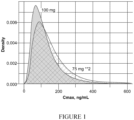
- the calculated mean ⁇ standard deviation C max and AUC from a 75 mg dose were 120 ⁇ 74.7 ng/mL and 1140 ⁇ 476 ng ⁇ h/mL, respectively.
- These estimations represent a C max and AUC that are approximately 3.3-fold and 2-fold lower, respectively, than the 200 mg single dose and 9.2-fold and 6-fold lower, respectively, than the 400 mg single dose.
- Example 4 demonstrated a dose-dependent effect on micturitions as seen in Table 20. Conversely, a dose dependent effect on urge incontinence or total incontinence was not observed. These data reveal a relatively shallow dose-response relationship between 50 and 100 mg once daily. Since vibegron efficacy begins to plateau from 50 to 100 mg, 75 mg captures a majority of the efficacy achieved with 100 mg.
- Vibegron demonstrates greater than a dose proportional increase in exposures. Surprisingly, an increase in dose from 50 to 100 mg results in an approximate 4-fold increase in C max , the PK parameter considered most closely associated with cardiovascular effects.
- dose-C max and dose-AUC models were created using data from Phase 1 studies. Based on simulations, it was found that a vibegron dose of 75 mg avoids approximately 29% of the exposures observed with a 100 mg dose, subsequently reducing the upper range of exposures that would be achieved with a 100 mg dose. This reduction in outlier C max values reduces the potential for clinically relevant cardiovascular effects.
- a lower exposure with the 75 mg dose compared to a 100 mg dose disproportionally reduces the risk of adverse events in special populations as well.
- Subjects with moderate renal impairment had a mean increase in AUC of 1.6-fold compared to subjects with normal renal function whereas subjects receiving a potent CYP3A/P-gp inhibitor had an approximate 2-fold higher exposure.
- the probability of these special populations achieving a vibegron C max greater than those observed with 100 mg is 15% (see Figure 1 ).
- Minimizing exposures of subjects who fall at the extremes is important for elderly and females who demonstrated approximately a 50-70% higher C max than healthy young males.
- Some beta-3 adrenergic receptors ( ⁇ 3 -ARs) agonists have shown efficacy (with improved safety relative to anticholinergics) in treating persistent OAB symptoms in men on BPH therapies.
- This subset of the broader OAB population setting has unique safety needs (e.g., possibility of urinary retention) that have not been fully evaluated in previous clinical programs of OAB treatments.
- This study is designed to evaluate the safety, tolerability, and efficacy of vibegron (75 mg once daily (QD) administered for 24 weeks) or placebo in men with symptoms of OAB while receiving pharmacological therapy for BPH.
- the primary study objective is to assess the efficacy, safety, and tolerability of vibegron versus placebo in men with OAB symptoms on pharmacological therapy for BPH.
- the primary clinical efficacy assessment is to evaluate whether vibegron + BPH pharmacological therapy is more effective than placebo + BPH pharmacological therapy in reducing both a) the mean daily micturition episodes and b) mean daily urgency episodes, based on a 3-day diary.
- the safety assessment will evaluate whether vibegron + BPH pharmacological therapy is safe and tolerable in men with OAB symptoms and BPH.
- This study is an international Phase 3, randomized, double-blind, placebo-controlled, 2-part, parallel-group, multicenter study to evaluate the safety, tolerability, and efficacy of vibegron 75 mg in men with symptoms of OAB on stable doses of pharmacological therapy for BPH.
- subjects who meet all eligibility criteria are randomized 1:1 to receive either vibegron 75 mg, or placebo in a double-blind fashion. Randomization will be stratified based on baseline average number of micturition episodes per day ( ⁇ 12 or > 12), alpha blocker use with or without 5-ARI (yes or no), and urinary incontinence (yes or no).
- Part 1 The study consists of two parts: Part 1 (approximately 80 subjects) and Part 2 (approximately 1008 subjects).
- Part 1 includes additional orthostatic blood pressure and heart rate measurements at Screening, Run-in, Baseline, Week 2, and Week 4 to assess for potential orthostatic changes (pre-dose through 6 hours post dose except pre-dose for Screening and Run-In), but is otherwise consistent with the schedule for Part 2.
- Part 2 will proceed following review of 4-week safety data from Part 1 (including results from the orthostatic blood pressure) by an independent Data and Safety Monitoring Board (DSMB).
- Part 2 will also include a urodynamics sub-study (approximately 60 subjects).
- Both study parts will consist of a Screening Period (1 to 4 weeks), a single-blind Run-in Period (2 weeks) in which placebo is added to BPH pharmacological therapy, and a randomized double-blind Treatment Period (24 weeks).
- Subjects who complete the Week 24 Visit maybe offered the opportunity to enroll in a 28-week extension study, which will be conducted under a separate study protocol (See Example 8).
- Subjects who do not enroll into the extension study will have a Safety Follow-up assessment (via telephone call) approximately 21 days (+ up to 4 days) after the subject's last dose of study treatment (i.e., at Week 27 for subjects who complete the Week 24 Visit, or approximately 3 weeks after withdrawal for subjects who discontinue the study early.). Additionally, Unscheduled Visit(s) may be arranged as needed.
- Efficacy assessments will be collected in the form of 3-day Subject Bladder Diary. Information collected in the diaries will be used for assessment of the primary and secondary efficacy endpoints related to the number of micturition, urgency, nocturia, and incontinence episodes per day as well as one 24-hr the volume voided of urine. In addition, subjects will complete IPSS assessments, OAB-q LF, EQ-5D-5L, and PGI scores to assess quality of life endpoints.
- Subjects will complete questionnaires at the site at the start of each required study visit (before vital signs and blood draws) to assess subject-perceived symptom relief and health-related quality of life.
- the Bladder Diary is used by subjects to record the frequency of daily OAB symptoms including all micturitions, urgency, incontinence, nocturia, one 24-hr volume voided of urine, and main reason for incontinence, and volume voided per micturition (over one 24-hour period) by selecting the respective box for each symptom occurring during the course of a given day and night.
- the Bladder Diary should be completed by the subject on all 3 days within the 7 days prior to Visit 2 (Run-in), Visit 3 (Baseline) and Weeks 2, 4, 8, 12, 16, 20 and 24.
- Urine volume may be collected during any one (1) of the 7 Diary Days prior to the visit, and it should be recorded for ⁇ 24-hours starting from the time the patient gets up for the day and continues until the time the patient gets up for the day on the next day.
- a “Diary Day” is defined as the time between when the subject gets up for the day each morning (i.e., the time the subject got up for the day yesterday to the time the subject got up for the day today; approximately a 24-hour period).
- the site staff should inquire whether the subject had any difficulties with the diary and address any questions subjects may have. Instructions for proper completion of the diary should be re-reviewed. Subjects will be trained to enter data immediately following each event (in real time) and to input data from any "missed" events as soon as they are able. They will review and confirm that data from all events occurring within the preceding Diary Day (approximately 24 hours) have been entered at a consistent time each morning (e.g., upon getting up for the day).
- Subjects will complete questionnaires at the site at the start of each required study visit (before vital signs and blood draws) to assess subject-perceived symptom relief, symptom bother, and health-related quality of life at the study visits.
- Recommended guidelines for the use of patient-reported outcome measures can be found in "Guidance for Industry, Patient-Reported Outcome Measures: Use in Medical Product Development to Support Labeling Claims," U.S. Department of Health and Human Services, Food and Drug Administration, December 209, which is incorporated by reference in its entirety. These include the following questionnaires:
- the International Prostate Symptom Score includes 8 questions (7 concerning urinary symptoms and 1 concerning quality of life), each with answers based on a 6-point scale indicating increasing severity.
- the urinary symptom responses are assigned points from 0 to 5.
- the Total IPSS Score can therefore range from 0 to 35 (asymptomatic to very symptomatic).
- the quality of life responses are assigned points from 0 to 6.
- Global Impression Items include Patient Global Impression of Severity (PGI Severity), Patient Global Impression of Control (PGI-Control), Patient Global Impression of Frequency (PGI-Frequency), Patient Global Impression of Leakage (PGI-Leakage), and Patient Global Impression of Change (PGI-Change).
- Overactive Bladder Questionnaire (OAB-q long form [OAB-q LF], 1-week recall) is a 33-item patient-administered, disease-specific questionnaire that includes a Health-Related QoL (HRQL) scale (25 items) and a Symptom Bother Scale (8 items).
- HRQL Health-Related QoL
- the HRQL is a multidomain concept that represents the patient's general perception of the effect of illness and treatment on physical, psychological, and social aspects of life. Claiming a statistical and meaningful improvement in HRQL implies: (1) that all HRQL domains that are important to interpreting change in how the clinical trial's population feels or functions as a result of the targeted disease and its treatment were measured; (2) that a general improvement was demonstrated; and (3) that no decrement was demonstrated in any domain.
- the HRQL scale is divided into 4 subscales: Coping, Concern/Worry, Sleep, and Social Interaction.
- the Coping subscale was a key secondary endpoint, with items scored from 1 (none of the time) to 6 (all the time), with higher scores indicating better QoL.
- the HRQL total score is calculated by summating the individual HRQL subscale scores.
- the Symptom Bother Scale items are scored from 1 (not at all) to 6 (a very great deal), with higher Symptom Bother scores indicating greater symptom severity.
- the instrument was developed and validated in both continent and incontinent OAB patients, including both men and women.
- the EQ-5D health questionnaire is a standardized instrument for use as a measure of health outcome. See , Rabin et al. Value in Health; 17(1):70-76 (2014 ).
- IIEF The Internal Index of Erectile Function
- the safety endpoints include safety and tolerability parameters such as adverse events (AEs), clinical laboratory values, and vital sign assessments.
- AEs adverse events
- clinical laboratory values clinical laboratory values
- vital sign assessments vital sign assessments
- An AE is any untoward medical occurrence in a clinical study subject, temporally associated with the use of study drug, whether or not considered related to the study drug.
- An AE can therefore be any unfavorable and unintended sign (including an abnormal laboratory finding), symptom, or disease (new or exacerbated) temporally associated with the use of study drug.
- Example 7 An international, Phase 3, open-label 28-week study is being conducted as an extension of the study described in Example 7 ("parent study") to evaluate the safety and efficacy of vibegron 75 mg in men with symptoms of OAB on stable doses of pharmacological therapy for BPH. Approximately 300 men with symptoms of OAB on stable doses of pharmacological therapy for BPH who completed 24 weeks in the parent study and continue to qualify for this study may be permitted to enroll in this extension study, from approximately 60 study sites.
- alpha-blockers e.g., tamsulosin, doxazosin, and alfuzosin
- 5-ARIs 5 ⁇ -reductase inhibitors 5-ARIs
- CFB Change from baseline
- “per day” refers to a “Diary Day,” which is defined as the time between when the subject gets up for the day each morning and the time the subject gets up for the day the next morning as recorded in the subject bladder diary (approximately a 24-hour period).
- the study consisted of a Screening Period (1 to 5 weeks), a single-blind Run-in Period (2 weeks), a randomized double-blind Treatment Period (12 weeks), and a follow-up Period (4 weeks).
- Tolterodine ER 4 mg was the active control. Patients were randomized 5:5:4 in a double-blind fashion to one of three treatment arms: vibegron 75 mg, placebo, or tolterodine ER 4 mg, all administered once daily for 12 weeks during the Treatment Period. Between the Baseline and Week 12 Visits, patients had study assessments at Week 4 and Week 8.
- the Investigator or qualified designee reviewed prior medication use, including any protocol-specified washout requirement, and recorded prior medication taken by the patient within 28 days prior to beginning completion of the Screening eDiary.
- PVR Post-Void Residual
- the volume of urine that remains in the bladder after voiding is an objective measurement that may serve as a proxy for impaired ability to void.
- PVR were performed via ultrasound at the visits indicated in the Schedule of Activities.
- MMRM mixed model for repeated measure
- This model corrects for dropout and accounts for the fact that measurements taken on the same patient over time tend to be correlated by using all available information on patients within the same covariate set to derive an estimate of the treatment effect for a dropout-free population.
- the analysis model for each efficacy endpoint includes terms for treatment, visit, OAB Type (Wet vs Dry), Sex (Female vs Male), Region (US vs Rest of World), baseline score, and interaction of visit by treatment.
- An unstructured covariance matrix was used to model the correlation among repeated measurements.
- the Kenward-Roger adjustment was used with restricted (or residual) maximum likelihood (REML) to make statistical inference. If the unstructured covariance model fails to converge with the default Newton-Raphson algorithm, the Fisher scoring algorithm or other appropriate methods can be used to provide initial values of the covariance parameters. In the rare event that none of the above methods yield convergence, a structured covariance would be used to model the correlation among repeated measurements.
- Exploratory responder analyses were analyzed using the same Cochran-Mantel-Haenszel model as described above for secondary endpoints.
- the treatment-emergent period is defined as the period of time from the first dose date of the double blinded Study Treatment through 28 days after the last dose of Study Treatment, or the date of initiation of another investigational agent or surgical intervention or rollover to the extension study, whichever occurs first. Safety was assessed through summaries of adverse events, the frequency of treatment discontinuations due to adverse events, and clinical laboratory evaluations.
- results or effects reported herein should be understood as being statistically significant based on the statistical analysis described above.
- the level of statistical significance can be, for example, of at least p ⁇ 0.05, of at least p ⁇ 0.01, of at least p ⁇ 0.005, or of at least p ⁇ 0.001.
- a measurable result or effect is expressed or identified herein, it will be understood that the result or effect can be evaluated based upon its statistical significance relative to a baseline, typically placebo based.
- Vibegron 75mg demonstrated statistically significantly reductions in total incontinence by week 2 and maintained this significance throughout the 12-week treatment period. Vibegron 75mg demonstrated a clear increase in volume voided per micturition, a relatively objective measure increasing bladder capacity. Total incontinence episodes were reduced by half in the vibegron group vs baseline, and almost half of vibegron-treated patients with UUI at baseline had at least 75% reductions in UUI episodes after 12 weeks of vibegron therapy. Vibegron tolerability was favorable, with very few adverse events >2% and greater than placebo.
- mice Changes in micturitions for all subjects and for men with and without a medical history of BPH are shown in Table 23. Descriptive statistics are shown in Table 24. Table 23. Micturitions: Overall and by Subgroup (Descriptive Statistics: Week 12 CFB Mean (Q1, Q3) Subgroup Placebo Mean (Q1,Q3) n Vibegron Mean (Q1,Q3) n Tolterodine Mean (Q1,Q3) n Overall -1.62 (-2.89, 0.14) 475 -2.04 (03.43, -0.57) 492 -1.78 (-3.14, -0.29) 378 Males with BPH -0.68 (-2.29, 0.43) 15 -1.50 (-2.90, -0.14) 29 -1.25 (-2.29, 0.29) 21 Males without BPH -1.60 (-2.29, 0.29) 54 -2.26 (-3.43, -0.57) 46 -1.29 (-3.13, 0.29) 39 Table 24.
- mice Males With and Without BPH (Descriptive Statistics) Subgroup Visit Placebo n Vibegron n Tolterodine n Overall for Males Baseline Mean (Q1, Q3) 11.95 (9.71, 13.14) 75 11.79 (9.14, 12.86) 77 12.12 (9.14, 13.43) 65 Week 12 CFB Mean (Q1, Q3) -1.40 (-2.29, 0.29) 69 -1.97 (-3.43, -0.38) 75 -1.28 (-2.99, 0.29) 60 Males with BPH Baseline Mean (Q1, Q3) 11.45 (9.79, 12.21) 15 11.22 (8.83, 12.14) 29 12.65 (10.00, 14.29) 21 Week 12 CFB Mean (Q1, Q3) -0.68 (-2.29, 0.43) 16 -1.50 (-2.90, -0.14) 16 -1.25 (-2.29, 0.29) 9 Males without BPH Baseline Mean (Q1, Q3) 12.09 (9.67, 13.29) 59 12.14 (9.36, 14.
- Urgency Episodes Overall and by Subgroup (Descriptive Statistics: Week 12 CFB Mean (Q1, Q3) Subgroup Placebo Mean (Q1,Q3) n Vibegron Mean (Q1,Q3) n Tolterodine Mean (Q1,Q3) n Overall -2.26 (-4.00, -0.29) 475 -2.93 (-4.71, -0.65) 492 -2.57 (-4.17, -0.57) 378 Males with BPH -2.43 (-4.29, -0.0) 15 -1.90 (-4.71, 0.10) 29 -3.29 (-5.14, 0.31) 21 Males without BPH -2.38 (-3.84, -0.40) 54 -2.56 (-3.71, 0.24) 46 -2.32 (-4.29, -0.04) 39
Landscapes
- Health & Medical Sciences (AREA)
- Life Sciences & Earth Sciences (AREA)
- Public Health (AREA)
- Veterinary Medicine (AREA)
- Chemical & Material Sciences (AREA)
- General Health & Medical Sciences (AREA)
- Animal Behavior & Ethology (AREA)
- Medicinal Chemistry (AREA)
- Pharmacology & Pharmacy (AREA)
- Epidemiology (AREA)
- Organic Chemistry (AREA)
- Nuclear Medicine, Radiotherapy & Molecular Imaging (AREA)
- Bioinformatics & Cheminformatics (AREA)
- Chemical Kinetics & Catalysis (AREA)
- Engineering & Computer Science (AREA)
- General Chemical & Material Sciences (AREA)
- Urology & Nephrology (AREA)
- Molecular Biology (AREA)
- Nutrition Science (AREA)
- Physiology (AREA)
- Reproductive Health (AREA)
- Endocrinology (AREA)
- Gynecology & Obstetrics (AREA)
- Emergency Medicine (AREA)
- Biophysics (AREA)
- Pharmaceuticals Containing Other Organic And Inorganic Compounds (AREA)
- Acyclic And Carbocyclic Compounds In Medicinal Compositions (AREA)
- Medicines That Contain Protein Lipid Enzymes And Other Medicines (AREA)
- Medicines Containing Plant Substances (AREA)
- Medicinal Preparation (AREA)
Applications Claiming Priority (5)
| Application Number | Priority Date | Filing Date | Title |
|---|---|---|---|
| US201862775818P | 2018-12-05 | 2018-12-05 | |
| US201962830298P | 2019-04-05 | 2019-04-05 | |
| US201962842418P | 2019-05-02 | 2019-05-02 | |
| PCT/IB2019/060490 WO2020115705A1 (en) | 2018-12-05 | 2019-12-05 | Vibegron for the treatment of overactive bladder symptoms |
| EP19823999.8A EP3890743A1 (de) | 2018-12-05 | 2019-12-05 | Vibigron zur behandlung von überaktiven blasensymptomen |
Related Parent Applications (1)
| Application Number | Title | Priority Date | Filing Date |
|---|---|---|---|
| EP19823999.8A Division EP3890743A1 (de) | 2018-12-05 | 2019-12-05 | Vibigron zur behandlung von überaktiven blasensymptomen |
Publications (2)
| Publication Number | Publication Date |
|---|---|
| EP4545072A2 true EP4545072A2 (de) | 2025-04-30 |
| EP4545072A3 EP4545072A3 (de) | 2025-07-02 |
Family
ID=68965948
Family Applications (2)
| Application Number | Title | Priority Date | Filing Date |
|---|---|---|---|
| EP25150168.0A Pending EP4545072A3 (de) | 2018-12-05 | 2019-12-05 | Verwendung von vibegron zur behandlung von blasenhypersymptomen bei männern mit benigner prostatahyperplasie |
| EP19823999.8A Withdrawn EP3890743A1 (de) | 2018-12-05 | 2019-12-05 | Vibigron zur behandlung von überaktiven blasensymptomen |
Family Applications After (1)
| Application Number | Title | Priority Date | Filing Date |
|---|---|---|---|
| EP19823999.8A Withdrawn EP3890743A1 (de) | 2018-12-05 | 2019-12-05 | Vibigron zur behandlung von überaktiven blasensymptomen |
Country Status (15)
| Country | Link |
|---|---|
| US (1) | US12357636B2 (de) |
| EP (2) | EP4545072A3 (de) |
| JP (2) | JP2022510084A (de) |
| KR (1) | KR102940911B1 (de) |
| CN (1) | CN113164486A (de) |
| AU (1) | AU2019393372B2 (de) |
| BR (1) | BR112021010856A2 (de) |
| CA (1) | CA3115190A1 (de) |
| CL (1) | CL2021001397A1 (de) |
| IL (1) | IL283031A (de) |
| MX (1) | MX2021003980A (de) |
| PH (1) | PH12021550741A1 (de) |
| SG (1) | SG11202103662VA (de) |
| TW (2) | TW202438077A (de) |
| WO (1) | WO2020115705A1 (de) |
Families Citing this family (3)
| Publication number | Priority date | Publication date | Assignee | Title |
|---|---|---|---|---|
| EP3634420A1 (de) | 2017-06-06 | 2020-04-15 | Urovant Sciences GmbH | Verwendung von vibegron zur behandlung einer überaktiven blase |
| CA3202926A1 (en) * | 2020-12-22 | 2022-06-30 | Paul N. Mudd Jr. | Methods of monitoring digoxin with concomitant use of vibegron to treat overactive bladder |
| US12274680B2 (en) | 2022-09-13 | 2025-04-15 | II George William Creasy | Treatment of benign prostatic hypertrophy with capsinoids |
Citations (4)
| Publication number | Priority date | Publication date | Assignee | Title |
|---|---|---|---|---|
| US8247415B2 (en) | 2008-04-04 | 2012-08-21 | Merck Sharp & Dohme Corp. | Hydroxymethyl pyrrolidines as β3 adrenergic receptor agonists |
| US20140242645A1 (en) | 2011-10-27 | 2014-08-28 | John Y.L. Chung | Process for making beta 3 agonists and intermediates |
| US20150087832A1 (en) | 2011-10-27 | 2015-03-26 | Merck Sharp & Dohme, Corp. | Process for making beta 3 agonists and intermediates |
| US20170145014A1 (en) | 2013-03-15 | 2017-05-25 | Merck Sharp & Dohme Corp. | Process for preparing beta 3 agonists and intermediates |
Family Cites Families (32)
| Publication number | Priority date | Publication date | Assignee | Title |
|---|---|---|---|---|
| ATE266639T1 (de) | 1997-10-17 | 2004-05-15 | Yamanouchi Pharma Co Ltd | Amidderivate oder deren salze |
| GB9812709D0 (en) | 1998-06-13 | 1998-08-12 | Glaxo Group Ltd | Chemical compounds |
| US6562375B1 (en) | 1999-08-04 | 2003-05-13 | Yamanouchi Pharmaceuticals, Co., Ltd. | Stable pharmaceutical composition for oral use |
| US6525202B2 (en) | 2000-07-17 | 2003-02-25 | Wyeth | Cyclic amine phenyl beta-3 adrenergic receptor agonists |
| US7342117B2 (en) | 2001-10-30 | 2008-03-11 | Astellas Pharma Inc. | α-form or β-form crystal of acetanilide derivative |
| DOP2003000587A (es) | 2002-02-27 | 2003-08-30 | Pfizer Prod Inc | AGONISTAS DEL RECEPTOR ß3-ADRENERGICO |
| DK1559427T3 (da) | 2002-11-07 | 2011-04-26 | Astellas Pharma Inc | Lægemiddel til overaktiv blære omfattende eddikesyreanilidderivat som den aktive bestanddel |
| FR2874011B1 (fr) | 2004-08-03 | 2007-06-15 | Sanofi Synthelabo | Derives de sulfonamides, leur preparation et leur application en therapeutique |
| EP2198018B1 (de) | 2007-09-13 | 2013-11-20 | Codexis, Inc. | Ketoreduktase-polypeptide zur reduktion von acetophenonen |
| CA2704298C (en) | 2007-11-02 | 2015-07-21 | Astellas Pharma Inc. | Pharmaceutical composition for treating overactive bladder |
| EP2156847A1 (de) * | 2008-08-19 | 2010-02-24 | Sanofi-Aventis | Neue Kombination von Wirkstoffen mit einem alpha1-Antagonisten und einem PDE-4-Hemmer |
| US8273554B2 (en) | 2008-08-29 | 2012-09-25 | Codexis, Inc. | Ketoreductase polypeptides for the stereoselective production of (4S)-3-[(5S)-5-(4-fluorophenyl)-5-hydroxypentanoyl]-4-phenyl-1,3-oxazolidin-2-one |
| WO2011043942A1 (en) | 2009-10-07 | 2011-04-14 | Merck Sharp & Dohme Corp. | Combination therapy using a beta 3 adrenergic receptor agonist and an antimuscarinic agent |
| WO2011137054A1 (en) | 2010-04-30 | 2011-11-03 | Merck Sharp & Dohme Corp. | Novel beta 3 adrenergic receptor agonists |
| US9907767B2 (en) | 2010-08-03 | 2018-03-06 | Velicept Therapeutics, Inc. | Pharmaceutical compositions and the treatment of overactive bladder |
| AU2011285928B9 (en) | 2010-08-03 | 2018-08-02 | B3Ar Therapeutics, Inc. | Combinations of beta - 3 adrenergic receptor agonists and muscarinic receptor antagonists for treating overactive bladder |
| US9522129B2 (en) | 2010-08-03 | 2016-12-20 | Velicept Therapeutics, Inc. | Pharmaceutical Combination |
| IN2014CN04470A (de) | 2011-11-18 | 2015-09-04 | Codexis Inc | |
| EA033168B1 (ru) * | 2013-03-15 | 2019-09-30 | Сайклерион Терапьютикс, Инк. | СТИМУЛЯТОРЫ sGC |
| HK1245117A1 (zh) | 2014-12-03 | 2018-08-24 | Velicept Therapeutics, Inc. | 使用调节释放索拉贝隆用於下尿路症状的组合物和方法 |
| US20160361380A1 (en) * | 2015-06-12 | 2016-12-15 | Nymox Corporation | Combination compositions for treating disorders requiring removal or destruction of unwanted cellular proliferations |
| ES2967863T3 (es) | 2015-10-23 | 2024-05-06 | B3Ar Therapeutics Inc | Ion dipolar de solabegron y usos del mismo |
| JP6197971B1 (ja) * | 2016-04-22 | 2017-09-20 | 小野薬品工業株式会社 | Kcnq2〜5チャネル関連疾患の予防および/または治療剤 |
| US20170348288A1 (en) * | 2016-06-03 | 2017-12-07 | Velicept Therapeutics, Inc. | Dosing regimens for beta-3 adrenoceptor agonists and anti-muscarinic agents for the treatment and prevention of lower urinary tract symptoms and overactive bladder |
| EP3463307A4 (de) | 2016-06-03 | 2020-01-15 | Velicept Therapeutics, Inc. | Zusammensetzungen und verfahren zur verwendung von solabegron mit modifizierter freisetzung für symptome der unteren harnwege |
| EP3634420A1 (de) * | 2017-06-06 | 2020-04-15 | Urovant Sciences GmbH | Verwendung von vibegron zur behandlung einer überaktiven blase |
| JP7670461B2 (ja) * | 2017-06-06 | 2025-04-30 | ウロバント サイエンシズ ゲゼルシャフト ミット ベシュレンクター ハフトゥング | 過活動膀胱の治療のためのビベグロンの投薬 |
| KR102735800B1 (ko) | 2017-12-21 | 2024-11-28 | 교린 세이야쿠 가부시키가이샤 | 야간빈뇨 치료제 |
| SG11202010683PA (en) | 2018-05-23 | 2020-12-30 | Urovant Sciences Gmbh | Use of vibegron to treat pain associated with irritable bowel syndrome |
| JP2022524576A (ja) | 2019-03-18 | 2022-05-09 | ウロバント サイエンシズ ゲーエムベーハー | 過活動膀胱を処置するためのビベグロンの使用 |
| CA3202926A1 (en) | 2020-12-22 | 2022-06-30 | Paul N. Mudd Jr. | Methods of monitoring digoxin with concomitant use of vibegron to treat overactive bladder |
| TW202245781A (zh) | 2021-02-16 | 2022-12-01 | 瑞士商優洛凡特科學公司 | 用維貝格龍(vibegron)治療心臟衰竭之方法 |
-
2019
- 2019-12-05 SG SG11202103662VA patent/SG11202103662VA/en unknown
- 2019-12-05 BR BR112021010856A patent/BR112021010856A2/pt unknown
- 2019-12-05 KR KR1020217017279A patent/KR102940911B1/ko active Active
- 2019-12-05 TW TW112148725A patent/TW202438077A/zh unknown
- 2019-12-05 CN CN201980080591.9A patent/CN113164486A/zh active Pending
- 2019-12-05 EP EP25150168.0A patent/EP4545072A3/de active Pending
- 2019-12-05 US US17/311,239 patent/US12357636B2/en active Active
- 2019-12-05 MX MX2021003980A patent/MX2021003980A/es unknown
- 2019-12-05 JP JP2021518592A patent/JP2022510084A/ja active Pending
- 2019-12-05 CA CA3115190A patent/CA3115190A1/en active Pending
- 2019-12-05 WO PCT/IB2019/060490 patent/WO2020115705A1/en not_active Ceased
- 2019-12-05 TW TW108144524A patent/TW202038963A/zh unknown
- 2019-12-05 AU AU2019393372A patent/AU2019393372B2/en active Active
- 2019-12-05 EP EP19823999.8A patent/EP3890743A1/de not_active Withdrawn
-
2021
- 2021-04-05 PH PH12021550741A patent/PH12021550741A1/en unknown
- 2021-05-09 IL IL283031A patent/IL283031A/en unknown
- 2021-05-27 CL CL2021001397A patent/CL2021001397A1/es unknown
-
2024
- 2024-11-22 JP JP2024203903A patent/JP2025032143A/ja active Pending
Patent Citations (6)
| Publication number | Priority date | Publication date | Assignee | Title |
|---|---|---|---|---|
| US8247415B2 (en) | 2008-04-04 | 2012-08-21 | Merck Sharp & Dohme Corp. | Hydroxymethyl pyrrolidines as β3 adrenergic receptor agonists |
| US8399480B2 (en) | 2008-04-04 | 2013-03-19 | Merck Sharp & Dohme Corp. | Hydroxymethyl pyrrolidines as beta 3 adrenergic receptor agonists |
| US20140242645A1 (en) | 2011-10-27 | 2014-08-28 | John Y.L. Chung | Process for making beta 3 agonists and intermediates |
| US20150087832A1 (en) | 2011-10-27 | 2015-03-26 | Merck Sharp & Dohme, Corp. | Process for making beta 3 agonists and intermediates |
| US20160176884A1 (en) | 2011-10-27 | 2016-06-23 | Merck Sharp & Dohme Corp. | Process for Making Beta 3 Agonists and Intermediates |
| US20170145014A1 (en) | 2013-03-15 | 2017-05-25 | Merck Sharp & Dohme Corp. | Process for preparing beta 3 agonists and intermediates |
Non-Patent Citations (10)
| Title |
|---|
| "Remington's Pharmaceutical Sciences", 2000, MACK PUBLISHING |
| ABRAMS P ET AL., UROLOGY, vol. 62, no. 1, 2003, pages 28 - 37,40-42 |
| CHAPPLE ET AL.: "Terminology report from the International Continence Society (ICS) Working Group on Underactive Bladder (UAB", NEUROLOGY AND URODYNAMICS, vol. 37, 2018, pages 2928 - 2931 |
| EDMONDSON ET AL., J. MED. CHEM., vol. 59, 2016, pages 609 - 623 |
| HASHIM, H. ET AL.: "International Continence Society (ICS) Report on the Terminology for Nocturia and Nocturnal Lower Urinary Tract Function", NEUROLOGY AND URODYNAMICS, 2019, pages 1 - 10 |
| INT. J. UROLOGY, vol. 25, 2018, pages 36 - 44 |
| JOURNAL OF PHARMACEUTICAL SCIENCE, vol. 66, 1977, pages 2 |
| OTSUKI ET AL., INT UROL NEPHROL., vol. 45, no. 1, 2013, pages 53 - 60 |
| RABIN ET AL., VALUE IN HEALTH, vol. 17, no. 1, 2014, pages 70 - 76 |
| YOSHIDA ET AL., EUROPEAN UROLOGY, vol. 73, 2018, pages 783 - 790 |
Also Published As
| Publication number | Publication date |
|---|---|
| AU2019393372B2 (en) | 2025-08-21 |
| TW202438077A (zh) | 2024-10-01 |
| AU2019393372A1 (en) | 2021-05-13 |
| EP3890743A1 (de) | 2021-10-13 |
| NZ774649A (en) | 2025-07-25 |
| KR102940911B1 (ko) | 2026-03-17 |
| PH12021550741A1 (en) | 2021-10-04 |
| KR20210102892A (ko) | 2021-08-20 |
| JP2022510084A (ja) | 2022-01-26 |
| JP2025032143A (ja) | 2025-03-11 |
| CN113164486A (zh) | 2021-07-23 |
| SG11202103662VA (en) | 2021-06-29 |
| BR112021010856A2 (pt) | 2021-11-16 |
| WO2020115705A1 (en) | 2020-06-11 |
| US20220117971A1 (en) | 2022-04-21 |
| CL2021001397A1 (es) | 2021-11-26 |
| CA3115190A1 (en) | 2020-06-11 |
| EP4545072A3 (de) | 2025-07-02 |
| MX2021003980A (es) | 2021-07-21 |
| US12357636B2 (en) | 2025-07-15 |
| TW202038963A (zh) | 2020-11-01 |
| IL283031A (en) | 2021-06-30 |
Similar Documents
| Publication | Publication Date | Title |
|---|---|---|
| JP2025032143A (ja) | 良性前立腺肥大症の男性の過活動膀胱症状を治療するためのビベグロンの使用 | |
| US20230218624A1 (en) | Dosing of vibegron for treatment of overactive bladder | |
| US20260014158A1 (en) | Use of vibegron to treat overactive bladder | |
| JP2025084777A (ja) | 過活動膀胱を処置するためのビベグロンの使用 | |
| HK40126413A (en) | Use of vibegron to treat overactive bladder symptoms in men with benign prostatic hyperplasia | |
| EA052961B1 (ru) | Вибегрон для лечения симптомов гиперактивного мочевого пузыря | |
| BR122024021845A2 (pt) | Usos de vibegron para tratar sintomas de bexiga hiperativa e reduzir ou diminuir as micções | |
| HK40114255A (en) | Use of vibegron to treat overactive bladder | |
| EA045454B1 (ru) | Применение вибегрона для лечения гиперактивного мочевого пузыря |
Legal Events
| Date | Code | Title | Description |
|---|---|---|---|
| PUAI | Public reference made under article 153(3) epc to a published international application that has entered the european phase |
Free format text: ORIGINAL CODE: 0009012 |
|
| STAA | Information on the status of an ep patent application or granted ep patent |
Free format text: STATUS: THE APPLICATION HAS BEEN PUBLISHED |
|
| AC | Divisional application: reference to earlier application |
Ref document number: 3890743 Country of ref document: EP Kind code of ref document: P |
|
| AK | Designated contracting states |
Kind code of ref document: A2 Designated state(s): AL AT BE BG CH CY CZ DE DK EE ES FI FR GB GR HR HU IE IS IT LI LT LU LV MC MK MT NL NO PL PT RO RS SE SI SK SM TR |
|
| REG | Reference to a national code |
Ref country code: DE Ref legal event code: R079 Free format text: PREVIOUS MAIN CLASS: A61K0009200000 Ipc: A61K0031519000 |
|
| PUAL | Search report despatched |
Free format text: ORIGINAL CODE: 0009013 |
|
| AK | Designated contracting states |
Kind code of ref document: A3 Designated state(s): AL AT BE BG CH CY CZ DE DK EE ES FI FR GB GR HR HU IE IS IT LI LT LU LV MC MK MT NL NO PL PT RO RS SE SI SK SM TR |
|
| RIC1 | Information provided on ipc code assigned before grant |
Ipc: A61K 9/20 20060101ALI20250527BHEP Ipc: A61K 9/00 20060101ALI20250527BHEP Ipc: A61P 43/00 20060101ALI20250527BHEP Ipc: A61P 15/10 20060101ALI20250527BHEP Ipc: A61P 13/10 20060101ALI20250527BHEP Ipc: A61P 13/08 20060101ALI20250527BHEP Ipc: A61K 45/06 20060101ALI20250527BHEP Ipc: A61K 31/7048 20060101ALI20250527BHEP Ipc: A61K 31/567 20060101ALI20250527BHEP Ipc: A61K 31/554 20060101ALI20250527BHEP Ipc: A61K 31/496 20060101ALI20250527BHEP Ipc: A61K 31/138 20060101ALI20250527BHEP Ipc: A61K 31/137 20060101ALI20250527BHEP Ipc: A61K 31/519 20060101AFI20250527BHEP |
|
| REG | Reference to a national code |
Ref country code: HK Ref legal event code: DE Ref document number: 40126413 Country of ref document: HK |
|
| STAA | Information on the status of an ep patent application or granted ep patent |
Free format text: STATUS: REQUEST FOR EXAMINATION WAS MADE |
|
| 17P | Request for examination filed |
Effective date: 20251219 |
|
| RAP1 | Party data changed (applicant data changed or rights of an application transferred) |
Owner name: SUMITOMO PHARMA CO., LTD. |