EP4545792A1 - Pompe de régulation de température avec un noyau de rotor structuré - Google Patents
Pompe de régulation de température avec un noyau de rotor structuré Download PDFInfo
- Publication number
- EP4545792A1 EP4545792A1 EP24204770.2A EP24204770A EP4545792A1 EP 4545792 A1 EP4545792 A1 EP 4545792A1 EP 24204770 A EP24204770 A EP 24204770A EP 4545792 A1 EP4545792 A1 EP 4545792A1
- Authority
- EP
- European Patent Office
- Prior art keywords
- rotor
- rotor core
- holes
- grooves
- pump
- Prior art date
- Legal status (The legal status is an assumption and is not a legal conclusion. Google has not performed a legal analysis and makes no representation as to the accuracy of the status listed.)
- Withdrawn
Links
Images


Classifications
-
- F—MECHANICAL ENGINEERING; LIGHTING; HEATING; WEAPONS; BLASTING
- F04—POSITIVE - DISPLACEMENT MACHINES FOR LIQUIDS; PUMPS FOR LIQUIDS OR ELASTIC FLUIDS
- F04D—NON-POSITIVE-DISPLACEMENT PUMPS
- F04D13/00—Pumping installations or systems
- F04D13/02—Units comprising pumps and their driving means
- F04D13/06—Units comprising pumps and their driving means the pump being electrically driven
- F04D13/0606—Canned motor pumps
-
- F—MECHANICAL ENGINEERING; LIGHTING; HEATING; WEAPONS; BLASTING
- F04—POSITIVE - DISPLACEMENT MACHINES FOR LIQUIDS; PUMPS FOR LIQUIDS OR ELASTIC FLUIDS
- F04D—NON-POSITIVE-DISPLACEMENT PUMPS
- F04D13/00—Pumping installations or systems
- F04D13/02—Units comprising pumps and their driving means
- F04D13/06—Units comprising pumps and their driving means the pump being electrically driven
- F04D13/0606—Canned motor pumps
- F04D13/064—Details of the magnetic circuit
-
- B—PERFORMING OPERATIONS; TRANSPORTING
- B60—VEHICLES IN GENERAL
- B60H—ARRANGEMENTS OF HEATING, COOLING, VENTILATING OR OTHER AIR-TREATING DEVICES SPECIALLY ADAPTED FOR PASSENGER OR GOODS SPACES OF VEHICLES
- B60H1/00—Heating, cooling or ventilating devices
- B60H1/32—Cooling devices
- B60H1/3204—Cooling devices using compression
- B60H1/3226—Self-contained devices, i.e. including own drive motor
-
- B—PERFORMING OPERATIONS; TRANSPORTING
- B60—VEHICLES IN GENERAL
- B60L—PROPULSION OF ELECTRICALLY-PROPELLED VEHICLES; SUPPLYING ELECTRIC POWER FOR AUXILIARY EQUIPMENT OF ELECTRICALLY-PROPELLED VEHICLES; ELECTRODYNAMIC BRAKE SYSTEMS FOR VEHICLES IN GENERAL; MAGNETIC SUSPENSION OR LEVITATION FOR VEHICLES; MONITORING OPERATING VARIABLES OF ELECTRICALLY-PROPELLED VEHICLES; ELECTRIC SAFETY DEVICES FOR ELECTRICALLY-PROPELLED VEHICLES
- B60L58/00—Methods or circuit arrangements for monitoring or controlling batteries or fuel cells, specially adapted for electric vehicles
- B60L58/10—Methods or circuit arrangements for monitoring or controlling batteries or fuel cells, specially adapted for electric vehicles for monitoring or controlling batteries
- B60L58/24—Methods or circuit arrangements for monitoring or controlling batteries or fuel cells, specially adapted for electric vehicles for monitoring or controlling batteries for controlling the temperature of batteries
- B60L58/26—Methods or circuit arrangements for monitoring or controlling batteries or fuel cells, specially adapted for electric vehicles for monitoring or controlling batteries for controlling the temperature of batteries by cooling
-
- F—MECHANICAL ENGINEERING; LIGHTING; HEATING; WEAPONS; BLASTING
- F04—POSITIVE - DISPLACEMENT MACHINES FOR LIQUIDS; PUMPS FOR LIQUIDS OR ELASTIC FLUIDS
- F04D—NON-POSITIVE-DISPLACEMENT PUMPS
- F04D13/00—Pumping installations or systems
- F04D13/02—Units comprising pumps and their driving means
- F04D13/06—Units comprising pumps and their driving means the pump being electrically driven
-
- F—MECHANICAL ENGINEERING; LIGHTING; HEATING; WEAPONS; BLASTING
- F04—POSITIVE - DISPLACEMENT MACHINES FOR LIQUIDS; PUMPS FOR LIQUIDS OR ELASTIC FLUIDS
- F04D—NON-POSITIVE-DISPLACEMENT PUMPS
- F04D29/00—Details, component parts, or accessories
- F04D29/40—Casings; Connections of working fluid
- F04D29/42—Casings; Connections of working fluid for radial or helico-centrifugal pumps
- F04D29/426—Casings; Connections of working fluid for radial or helico-centrifugal pumps especially adapted for liquid pumps
-
- F—MECHANICAL ENGINEERING; LIGHTING; HEATING; WEAPONS; BLASTING
- F04—POSITIVE - DISPLACEMENT MACHINES FOR LIQUIDS; PUMPS FOR LIQUIDS OR ELASTIC FLUIDS
- F04D—NON-POSITIVE-DISPLACEMENT PUMPS
- F04D29/00—Details, component parts, or accessories
- F04D29/58—Cooling; Heating; Diminishing heat transfer
- F04D29/5806—Cooling the drive system
-
- F—MECHANICAL ENGINEERING; LIGHTING; HEATING; WEAPONS; BLASTING
- F04—POSITIVE - DISPLACEMENT MACHINES FOR LIQUIDS; PUMPS FOR LIQUIDS OR ELASTIC FLUIDS
- F04D—NON-POSITIVE-DISPLACEMENT PUMPS
- F04D29/00—Details, component parts, or accessories
- F04D29/58—Cooling; Heating; Diminishing heat transfer
- F04D29/586—Cooling; Heating; Diminishing heat transfer specially adapted for liquid pumps
-
- H—ELECTRICITY
- H02—GENERATION; CONVERSION OR DISTRIBUTION OF ELECTRIC POWER
- H02K—DYNAMO-ELECTRIC MACHINES
- H02K1/00—Details of the magnetic circuit
- H02K1/06—Details of the magnetic circuit characterised by the shape, form or construction
- H02K1/22—Rotating parts of the magnetic circuit
- H02K1/27—Rotor cores with permanent magnets
-
- H—ELECTRICITY
- H02—GENERATION; CONVERSION OR DISTRIBUTION OF ELECTRIC POWER
- H02K—DYNAMO-ELECTRIC MACHINES
- H02K1/00—Details of the magnetic circuit
- H02K1/06—Details of the magnetic circuit characterised by the shape, form or construction
- H02K1/22—Rotating parts of the magnetic circuit
- H02K1/27—Rotor cores with permanent magnets
- H02K1/2706—Inner rotors
- H02K1/272—Inner rotors the magnetisation axis of the magnets being perpendicular to the rotor axis
- H02K1/274—Inner rotors the magnetisation axis of the magnets being perpendicular to the rotor axis the rotor consisting of two or more circumferentially positioned magnets
- H02K1/2753—Inner rotors the magnetisation axis of the magnets being perpendicular to the rotor axis the rotor consisting of two or more circumferentially positioned magnets the rotor consisting of magnets or groups of magnets arranged with alternating polarity
- H02K1/278—Surface mounted magnets; Inset magnets
-
- H—ELECTRICITY
- H02—GENERATION; CONVERSION OR DISTRIBUTION OF ELECTRIC POWER
- H02K—DYNAMO-ELECTRIC MACHINES
- H02K1/00—Details of the magnetic circuit
- H02K1/06—Details of the magnetic circuit characterised by the shape, form or construction
- H02K1/22—Rotating parts of the magnetic circuit
- H02K1/28—Means for mounting or fastening rotating magnetic parts on to, or to, the rotor structures
-
- H—ELECTRICITY
- H02—GENERATION; CONVERSION OR DISTRIBUTION OF ELECTRIC POWER
- H02K—DYNAMO-ELECTRIC MACHINES
- H02K7/00—Arrangements for handling mechanical energy structurally associated with dynamo-electric machines, e.g. structural association with mechanical driving motors or auxiliary dynamo-electric machines
- H02K7/14—Structural association with mechanical loads, e.g. with hand-held machine tools or fans
-
- F—MECHANICAL ENGINEERING; LIGHTING; HEATING; WEAPONS; BLASTING
- F05—INDEXING SCHEMES RELATING TO ENGINES OR PUMPS IN VARIOUS SUBCLASSES OF CLASSES F01-F04
- F05D—INDEXING SCHEME FOR ASPECTS RELATING TO NON-POSITIVE-DISPLACEMENT MACHINES OR ENGINES, GAS-TURBINES OR JET-PROPULSION PLANTS
- F05D2260/00—Function
- F05D2260/20—Heat transfer, e.g. cooling
-
- H—ELECTRICITY
- H01—ELECTRIC ELEMENTS
- H01M—PROCESSES OR MEANS, e.g. BATTERIES, FOR THE DIRECT CONVERSION OF CHEMICAL ENERGY INTO ELECTRICAL ENERGY
- H01M10/00—Secondary cells; Manufacture thereof
- H01M10/60—Heating or cooling; Temperature control
- H01M10/62—Heating or cooling; Temperature control specially adapted for specific applications
- H01M10/625—Vehicles
-
- H—ELECTRICITY
- H01—ELECTRIC ELEMENTS
- H01M—PROCESSES OR MEANS, e.g. BATTERIES, FOR THE DIRECT CONVERSION OF CHEMICAL ENERGY INTO ELECTRICAL ENERGY
- H01M10/00—Secondary cells; Manufacture thereof
- H01M10/60—Heating or cooling; Temperature control
- H01M10/65—Means for temperature control structurally associated with the cells
- H01M10/656—Means for temperature control structurally associated with the cells characterised by the type of heat-exchange fluid
-
- H—ELECTRICITY
- H02—GENERATION; CONVERSION OR DISTRIBUTION OF ELECTRIC POWER
- H02K—DYNAMO-ELECTRIC MACHINES
- H02K2213/00—Specific aspects, not otherwise provided for and not covered by codes H02K2201/00 - H02K2211/00
- H02K2213/03—Machines characterised by numerical values, ranges, mathematical expressions or similar information
Definitions
- the invention relates to a pump for driving a fluid, preferably a temperature control medium, in particular for use in a vehicle, very particularly for use for temperature control of a drive battery of an electric vehicle, wherein the pump comprises a stator and a rotor, wherein the rotor has a rotor body and a rotor block and is mounted rotatably about a rotation axis, wherein the rotor block comprises a metallic rotor core and magnets, wherein the rotor core comprises a plurality of holes in a cross section.
- the pump comprises a stator and a rotor, the rotor in turn comprising a rotor body, two rotary bearings, and a rotor block.
- the rotor block has a rotor core made of stacked electrical sheets and magnets attached to a radial outer side of the rotor core.
- the electrical sheets have a plurality of holes, which serve, on the one hand, to reduce the weight of the rotor core or block or the rotor, and, on the other hand, to guide the magnetic field lines in the rotor core.
- the energy and mobility transition requires the development of new technologies, particularly electric vehicles with a drive battery and an electric motor.
- Drive batteries achieve their greatest efficiency at temperatures around 20°C, so they must be heated or cooled depending on the situation. Heating is particularly useful shortly after starting in winter, while cooling is especially important after the vehicle has been in operation for some time.
- the thermal management of the drive train differs in electric vehicles from Combustion-engine vehicles, especially during the cold season.
- the entire component chain (pipes, quick connectors, pumps, battery housings, etc.) of the thermal management system in electric vehicles must also be designed to operate during the cold season and thus without the assistance of airflow.
- the invention is therefore based on the object of making the pumps for thermal management more efficient.
- the invention is preferably based on the object of increasing performance without increasing manufacturing costs or material usage.
- a pump for driving a fluid preferably a temperature control medium, in particular for use in a vehicle, very particularly for use for temperature control of a drive battery of an electric vehicle
- the pump comprises a stator and a rotor
- the rotor has a rotor body and a rotor block and is mounted so as to be rotatable about a rotation axis
- the rotor block comprises a metallic rotor core and magnets
- the rotor core comprises a plurality of holes in a cross section
- the rotor core has a plurality of grooves and a plurality of projections on its radial inner wall in a cross section.
- the invention is based on the finding that the rotor, and in particular the rotor core, can be further improved to increase the pump's performance. It was found that Magnetic field lines tend to leave the intended, radially outer regions of the rotor core in certain rotational positions of the rotor relative to the stator. The magnetic field lines can then extend within the rotor core, sometimes between a radial inner side of the holes and a radial inner side of the rotor core. The scattering of the magnetic field lines increases the magnetic resistance and reduces motor efficiency. Leakage fluxes are particularly pronounced in electric pumps, as the distance between the stator and the rotor block is relatively large due to the partition wall, the block housing, and the annular gap provided for the secondary current, which intensifies the leakage fluxes.
- the rotational axis A defines an axial, a radial, and/or a tangential or circumferential direction.
- the expression “radially inward” means the radial direction toward the rotational axis A.
- the term “axially inward” means the axial direction corresponding to the direction of the fluid flowing in the inlet.
- “axially inward” means an axial direction from the pump wheel toward the rotor block.
- the axially outermost section of the pump is preferably also the uppermost section of the pump.
- the end of the pump axially opposite the uppermost section is the lowermost section or the lower end.
- the Tangential directions are either clockwise or counterclockwise. The rotor rotates preferentially clockwise.
- the magnets are preferably permanent magnets.
- the rotor or rotor block preferably comprises at least six or eight magnets in a cross-section.
- the rotor or rotor block advantageously comprises a maximum of 20, 16 or 14 magnets in cross-section.
- the rotor core is advantageously circular-arc-shaped at least in sections along its circumference.
- the rotor core preferably comprises magnet locations on its radial outer side for arranging one magnet at a time. It is very preferred that the magnets are circular-arc-shaped on their radial inner side and/or on their radial outer side when viewed in plan view or in cross section. It is advantageous that the magnet locations have a circular-arc-shaped contour in plan view or in cross-section and in particular have a surface complementary to the magnets.
- the rotor core has a plurality of laminations, in particular rotor laminations, stacked one above the other.
- the rotor laminations are preferably electrical laminations.
- the rotor core comprises at least 10, 15, or 20 laminations or rotor laminations.
- the rotor core has a maximum of 50, 40, or 30 rotor laminations.
- a plurality of laminations or rotor laminations are aligned over a complete revolution.
- the laminations/rotor laminations can be connected to one another to form the rotor core by means of stamping or baking varnish. It is advantageous that the rotor laminations are provided with an insulating coating.
- the pump is designed so that the fluid in pump operation enters the block housing of the The fluid flows around the rotor body. This allows a secondary flow from the wheel chamber or a wheel chamber into the drive chamber. The secondary flow of fluid can then flow through the rotor in an axially outward direction back into the wheel chamber via return channels or a return channel. The secondary flow thereby carries away the heat from the stator, the rotor, and/or a circuit board, thereby cooling the pump and allowing it to operate more efficiently overall.
- the rotor body or the block housing comprises a plastic.
- the rotor body or the block housing is advantageously formed in one piece and preferably integrally. If the rotor body is manufactured integrally, for example by injection molding or overmolding, then the rotor body is lightweight yet very robust. This allows a large number of details to be implemented on the rotor body, of which return channels and blades are particularly noteworthy. As a result, the rotor body can be manufactured inexpensively, even though it contains a considerable number of technical details. At the same time, the rotor body, with an integral construction, is characterized by a correspondingly high level of robustness, which allows it to be constructed with relatively thin walls. The same applies analogously to the block housing.
- the rotor expediently comprises a pump impeller and/or a shaft.
- the pump impeller advantageously has a wheel plate and/or blades and/or a wheel cover.
- the wheel plate is expediently arranged axially inwardly relative to the blades.
- the blades preferably define blade channels between them. It is possible for the blades to be covered in the axially outward direction by a wheel cover.
- the wheel cover can be attached to the blades in particular by means of plugging or welding.
- the rotor body comprises the blades and/or the wheel disc and/or the shaft.
- the shaft advantageously has a drive section and/or a connecting section.
- the drive section and the block housing expediently overlap in the axial direction.
- the block housing, the drive section, the connecting section of the wheel discs and/or the blades are integrally connected to one another and preferably form the rotor body.
- the grooves alternate with the projections in a tangential direction. It is possible for the tangential extent of the grooves to correspond to that of the projections. It is preferred for the inner wall of the rotor core to be formed exclusively from the grooves and projections. This ensures that the largest possible areas of the radial inner wall contribute to guiding the field lines.
- the grooves and projections preferably extend along at least 50, 60, 70, 80, 90, or 100% of the axial extent of the rotor core or rotor block.
- the upper cover lamination, the lower cover lamination, the holder laminations, and/or the block laminations have the grooves and projections. This ensures that the largest possible areas of the radial inner wall contribute to guiding the field lines.
- the holes are offset in the tangential direction relative to the grooves.
- the holes and grooves alternate in the tangential direction. It is particularly preferred that the holes and grooves do not overlap in the tangential direction.
- at least one of the free spaces is associated with a groove in the tangential direction.
- at least one of the free spaces overlaps with the associated groove in the tangential direction.
- the at least one free space and its associated groove are axially symmetrical with respect to a common radius line. This enables the field lines to be guided or spatially limited radially inward, thereby keeping the magnetic field compact and the magnetic resistance low.
- the number of magnets in a cross-section of the rotor core corresponds to the number of holes, grooves, and/or projections. This results in the targeted influence of the magnetic field lines relative to each magnet. If each magnet is assigned a hole, each magnet can be supported in the same way in guiding the field lines through the hole. As a result, each magnet provides practically the same drive to the rotor, thereby achieving the smoothest possible running.
- At least one of the magnets, preferably each of the magnets, of the rotor block is assigned one of the holes and/or one of the projections - in particular in the tangential direction.
- the at least one magnet overlaps in the tangential direction with the assigned hole and/or with the assigned projection.
- the at least one magnet and/or the hole assigned to the magnet and/or the projection assigned to the magnet are axially symmetrical with respect to a common radius line. The axial symmetry causes the magnetic fields are always as similar as possible when passing through the rotor block or core, which allows for very smooth running.
- At least one of the holes and a projection associated with the at least one hole in the tangential direction overlap in the tangential direction. It is preferred that all of the holes overlap in the tangential direction with the respectively associated projection in the tangential direction.
- the at least one hole and the projection associated with the hole are axially symmetrical with respect to a common radius line. It is preferred that a tangential extension of the projection corresponds to at least 50, 60, 70, 80, or 90% of the tangential extension of the hole.
- a radial extension of a groove RN corresponds to a radial extension of a projection.
- a cross-sectional area of the projection formed by the radial extension of the projection and the tangential extension of the projection corresponds to at least 50, 60, 70, 80, or 90% of the cross-sectional area of the associated hole. This results in a relatively uniform distribution of the rotor core material throughout one revolution, thereby reducing electromagnetic or mechanical irregularities and increasing smooth running.
- two of the magnets and preferably all of the magnets of the rotor block in a cross-section of the rotor core have the same shape and/or the same magnetic properties and/or the same radial position.
- two of the holes and preferably all of the holes of the rotor core have the same shape and/or the same radial position.
- two of the projections and preferably all of the projections of the inner wall of the rotor core have the same shape and/or the same radial position.
- two of the grooves, and preferably all of the grooves in the inner wall of the rotor core have the same shape and/or the same radial position. This enables a uniform or repeating design of the rotor block in the tangential direction, thereby achieving extremely smooth running.
- a radial extent RL of the holes and a radial extent RKV of the rotor core at a circumferential position of a projection have a ratio RL/RKV of at most 0.80, 0.70, 0.60, 0.55, or 0.50. This causes the holes to be relatively flat in relation to the radial extent of the rotor core. This allows somewhat more space to be left for the field lines in a radially outer region of the rotor core, so that the field lines can be well confined in a radially outer region.
- an outer radius AR of the rotor core and a radial extent RKN of the rotor core at a circumferential position of a groove have a ratio AR/RKN of at least 2.0, 2.3, 2.5, 2.7, 3.0, or 3.2. This keeps the rotor core relatively thin or slender in the radial direction compared to the outer radius AR or diameter of the rotor core.
- the AR/RKN ratio can be larger the smaller the RL/RKV ratio.
- At least one of the grooves and/or at least one of the projections has a polygonal and preferably quadrangular shape.
- all grooves and/or all projections have a polygonal and preferably quadrangular shape. This tangentially relatively uniform shape evens out the radially acting effects of the grooves or projections in the tangential direction.
- a tangential extension of the at least one groove is at least a factor of 1.5, 2.0, or 2.5 greater than the radial Extension of the groove.
- the tangential extension of the at least one projection be at least 1.5, 2.0, or 2.5 times greater than the radial extension of the projection.
- the groove or projection is elongated in the tangential direction. This enables a sufficiently pronounced tangential effect relative to the radial effects of the projections or grooves.
- At least one of the holes, and preferably all of the holes, of the rotor core have a polygonal and in particular pentagonal shape in a cross-section of the rotor core.
- the at least one hole comprises a tip, which is preferably directed radially outwards. The tip serves primarily to cleanly separate the magnetic fields and thus to prevent stray flux.
- the at least one hole comprises a radial outer side.
- the tip of the hole represents the radially outermost point of the radial outer side of the hole.
- the at least one hole comprises two tangential outer sides.
- the at least one hole comprises a radial inner side. The radial inner side of the hole expediently connects the two tangential outer sides of the hole.
- the rotor core has an upper and/or a lower cover lamination.
- the upper and/or lower cover lamination preferably has no hole.
- the upper and/or lower cover lamination is/are advantageously designed such that no plastic flows into the holes in the rotor core during an overmolding process. This results in better guidance of the field lines.
- the holes advantageously extend over at least 50 or 60 or 70 or 80 or 90% of the axial extent of the rotor core or rotor block.
- At least one of the grooves has a radial extension RN, with the ratio RN/RKN preferably being at least 0.1, 0.14, or 0.17. This ensures that the magnetic field lines are sufficiently limited.
- the ratio RN/RKN is advantageously at most 0.60, 0.50, 0.40, 0.30, or 0.25. This ensures that the field lines are not excessively limited or deformed, thus preventing an increase in the magnetic resistance.
- a pump according to the invention advantageously comprises an inlet 8 and an outlet 9, shown in dashed lines due to the selected longitudinal section.
- the pump has a rotor 2, which advantageously comprises a pump wheel 6.
- the pump has a stator 1, which has a Rotor block 4 drives the rotor.
- the rotor block 4 is a component of the rotor 2.
- the rotor 2 expediently comprises a shaft 7, which transmits the torque of the rotor block 4 to the impeller 6.
- the impeller 6 preferably comprises blades 19 and/or a wheel plate 31.
- the blades 19 propel the fluid flowing in through the inlet 8 radially outward, where it is conveniently collected by a collecting channel 28 along almost its entire circumference.
- the collecting channel 28 conveniently opens into the outlet 9.
- the fluid flow from the inlet 8 via the impeller 6 into the collecting channel 28 to the outlet 9 is the main fluid flow.
- the chain of elements 8, 6, 28, 9 forms a main flow path.
- the pump preferably comprises a partition wall 16 and a housing 15. It is highly preferred that the partition wall 16 separates a space within the housing 15 into a dry area and a wet area.
- the stator 1 is preferably arranged in the dry area.
- the pump advantageously comprises a circuit board 18 for controlling pump operation and in particular for controlling the stator 1. It is preferred that the circuit board 18 is located in the dry area of the pump.
- the wet area of the pump preferably comprises the inlet 8 and the outlet 9. It is preferred that the wet area has a wheel chamber 10 within which the pump wheel 6 is arranged.
- a circumferential gap is located between the partition wall 16 and the wheel plate 31 or the pump wheel 6, through which the fluid can flow from the wheel chamber 10 into the drive chamber 11.
- the rotor 2 has at least one return channel 12 and preferably a plurality of return channels 12, which extend approximately axially within the rotor 2 and connect a lowermost region of the drive chamber 11 to the wheel chamber 10.
- the secondary flow Due to the pressure difference between the radial inside and radial outside generated by the impeller 6, a small portion of the fluid—the secondary flow—flows from the wheel chamber 10 into the drive chamber 11 and from there past the rotor block 4 to the lowest region of the drive chamber 11. The secondary flow then enters a lower inlet of the return channel 12(s), flows through the rotor 2, and finally exits at the top in a radially inner region of the wheel chamber 10. There, the secondary flow mixes with the main flow.
- the secondary current has the advantage of dissipating the heat from the stator 1, the rotor block 4, and the circuit board 18, allowing the pump to operate more efficiently overall.
- this also means that the rotor block 4 is located within a wet area, and corresponding technical requirements must be placed on the rotor block 4 and the rotor 2.
- the rotor 2 of this embodiment comprises a rotor body 3, which preferably comprises a plastic material.
- the rotor body 3 can comprise the blades 19, the wheel plate 31, the shaft 7, the return channels 12, and/or a block housing 17.
- the rotor body 3 is manufactured by injection molding or by overmolding the rotor block 4.
- the block housing 17 of this exemplary embodiment completely encloses the rotor block 4 with the magnets 13 and the rotor core 22. This ensures very good protection of the rotor block 4 from the secondary current.
- the overmolding makes it possible to create very smooth outer surfaces of the rotor 2 or the rotor body 3, so that the rotor 2 rotating in the fluid has good fluid dynamic properties.
- an axle 23 is mounted in a rotationally fixed manner in a base of the partition 16.
- the axle 23 defines an axis of rotation A around which the rotor 2 rotates.
- the rotor 2 can advantageously have a pivot bearing 5, which can be optimized from a tribological point of view and may in particular comprise graphite.
- the pump preferably comprises an axle holder 24, which in this exemplary embodiment is pressed into a receptacle of a spider. Consequently, an upper, axial end face of the pivot bearing 5 rotates relative to a lower, axial end face of the axle bearing 24.
- the rotor body 3 be produced by overmolding the pivot bearing 5 and the rotor block 4.
- the rotor 2 can have a rotor cover 25, which is preferably plugged onto the blades 19.
- a rotor cap can be arranged at a lower end of the motor 2, which is preferably only attached to the rotor 2 after overmolding.
- the rotor block 4 or rotor core 22 is shown in a simplified manner because there are no grooves (not shown) on a radial inner wall of the rotor core 22. These grooves 32 and projections 33 are, however, in the Figures 3 and 4 visible.
- the grooves 32 and projections 33 particularly preferably extend along the entire axial length of the rotor block 4 or the rotor core 22.
- the upper cover lamination 27a, the lower cover lamination 27b, the holder laminations 21 and/or the block laminations 20 have the grooves 32 and the projections 33.
- the magnets 13 are preferably arranged on a radial outer side of the rotor core 22, see.
- the rotor block 4 comprises magnet holders 14, which hold the magnets 13 to the rotor core 22. By holding the magnets 13 to the rotor core 22, the rotor block 4 is sufficiently stable overall for subsequent overmolding.
- the rotor core 22 of this exemplary embodiment consists of 25 stacked laminations 20, 21, 27.
- the laminations 20, 21, 27 are preferably electrical steel sheets.
- the electrical steel sheets are expediently provided with an insulating coating to prevent eddy currents—particularly in the axial direction.
- the laminations 20, 21, 27 of this initial example can be connected to one another by means of stamped stacking or by means of baked enamel to form the coherent rotor core 22.
- the rotor core 22 has exactly twenty-two block laminations 20 made of electrical steel sheets, each of which has the same shape.
- the rotor block 4 of this embodiment comprises a total of ten magnets 13, which are preferably designed as permanent magnets. For the sake of clarity, Figure 2 However, only five magnets 13 are shown. It is preferred that the magnets 13 are arranged on their radial
- the rotor core 22 is configured in a circular arc shape on its inner side and/or on its radial outer side in a plan view of the rotor block.
- the rotor core 22 advantageously has ten magnet locations 30 on its radial outer side, each magnet location 30 being assigned to a magnet 13.
- the magnet holders 14 or magnet locations 30 or magnets 13 are arranged equidistant from one another in the tangential direction.
- the lowermost lamella is designed as a lower cover lamella 27b.
- the lower cover lamella can comprise an electrical steel sheet or a plastic.
- the lower cover lamella 27b preferably comprises several, and in this exemplary embodiment, ten, axial holders 29. Each axial holder 29 is expediently assigned to a magnet location 30.
- the axial holders 29 are preferably designed as axial stops, so that the magnets 13 are securely held on the rotor core 22 in the axial direction downwards.
- the rotor core may have an upper cover lamella 27a, which is preferably designed as a block lamella 20. It is possible for the lower cover lamella 27b to be located above the upper cover lamella 27a after assembly of the pump, so that the directional convention of the lamellas can deviate from the above directional convention of the pump.
- the rotor core 22 comprises two holder laminations 21, or an upper holder lamination 21 and a lower holder lamination 21.
- the two holder laminations 21 of this exemplary embodiment preferably have a plurality of magnet holders 14, preferably each having a number corresponding to the number of magnets.
- the magnet holders 14 are an integral component of the holder lamination(s) 21.
- the magnet holders 14 or the holder lamination(s) 21 are produced by means of stamping.
- the holder lamination 21 is provided in an upper half, an upper third, or an upper quarter of the rotor core 22.
- the lower holder lamination 21 is expediently arranged in a lower half or in a lower third or in a lower quarter of the rotor core 22.
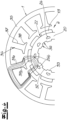
- FIG 3 a simplified top view of the rotor block 4 is shown because the upper cover lamella 27a has been omitted to reveal a top block lamella 20.
- the Figure 3 is opposite the Figure 2 also simplified in that the grooves on the radial outer wall of the rotor core 22 are missing.
- Figure 3 is opposite Figure 2 also simplified in that only one magnet holder 14 is shown.
- the rotor core 22 has grooves 32 and projections 33 on its radial inner wall 34.
- the grooves 32 expediently alternate with the projections 33 in a tangential direction.
- the tangential extent of the grooves 32 corresponds to that of the projections 33.
- the rotor core 22 is advantageously designed such that the grooves 32 and the projections 33 complement each other to form the inner wall 34 of the rotor core 22. It is preferred that the inner wall 34 of the rotor core 22 be formed exclusively from the grooves 32 and projections 33. It is possible for a tangential extent of one of the grooves 32 to correspond to a tangential extent of an adjacent projection 33.
- the rotor core 22 has holes 26.
- the block laminations and/or the holder laminations have the holes 26.
- the upper cover lamination 27a and/or the lower cover lamination 27b have no holes.
- the holes 26 are preferably filled with air. This is advantageously achieved via the upper cover lamination 27a and the lower cover lamination 27b, which both have no holes and the holes 26 of the other slats 20, 21. This prevents the holes 26 from being filled with plastic during an overmolding process.
- the holes 26 extend in the axial direction over at least 50, 60, 70, 80, or 90% of the axial extent of the magnets 13. It is advantageous that the grooves 32 extend over at least 50, 60, 70, 80, 90, or 95% of the axial extent of the magnets 13. It is highly preferred that the upper cover plate 27a and/or the lower cover plate 27b have the grooves 32 and the projections 33 on their radial inner side.
- the number of magnets 13 corresponds to the number of holes 26, grooves 32, and/or projections 33.
- at least one of the magnets 13, and preferably each of the magnets 13, is assigned one of the holes 26 and/or one of the projections 33—particularly in the tangential direction.
- the at least one magnet 13 preferably overlaps in the tangential direction with the associated hole 26 and/or with the associated projection 33.
- one hole 26 and one projection 33 each overlap in the tangential direction.
- the at least one magnet 13 and/or the hole 26 assigned to the magnet 13 and/or the projection 33 assigned to the magnet 13 are axially symmetrical with respect to a common radius line.
- the holes 26 are offset in the tangential direction relative to the grooves 32. It is highly preferred that the holes 26 and the grooves 32 alternate in the tangential direction. Particularly preferably, the holes 26 and the grooves 32 do not overlap in the tangential direction.
- the free spaces overlap in the tangential direction between the magnets 13. with the grooves 32 in the tangential direction. It is highly preferred that one of the free spaces between the magnets and a groove 32 overlapping this free space in the tangential direction are axially symmetrical with respect to a common radius.
- At least one hole 26 and preferably all of the holes 26 are polygonal, preferably at least triangular, and particularly preferably pentagonal.
- the at least one hole 26 preferably comprises a tip 26a, which advantageously faces radially outwards. It is very preferred that the at least one hole 26 comprises a radial outer side 26b.
- the tip 26a represents the radially outermost point of the radial outer side 26b.
- the radial outer side 26b is formed by two straight lines converging on one another, which advantageously each extend in a tangential and a radial direction.
- the at least one hole 26 comprises two tangential outer sides 26c.
- the at least one hole 26 comprises a radial inner side 26d.
- the radial inner side 26d expediently connects the two tangential outer sides 26c.
- the at least one hole 26, and preferably all holes 26, is/are preferably relatively flat. It is preferred that a tangential extension TL of the at least one hole 26 is greater than a radial extension RL of the hole 26.
- the rotor core 22 (K) has a radial (R) extension RKV at the location of a projection 33 (V). It is very preferred that a ratio RL/RKV is at most 0.70, 0.65, or 0.50. In this exemplary embodiment, the ratio RL/RKV may be approximately 0.40.
- the rotor core is advantageously designed to be relatively slim in the radial direction, particularly in the area of the slots 32.
- the rotor core 22 (K) has A slot 32 (N) has a radial (R) extension RKN.
- the rotor core 22 has an outer radius AR.
- the outer radius AR is preferably the arithmetically averaged value of all outer radii over a full revolution. It is very preferred that a ratio AR/RKN is at least 2.3, 2.7, or 3.0. In this exemplary embodiment, this ratio may be 3.5.
- a slot 32 (N) has a radial (R) extension RN.
- the ratio RN/RKN is preferably at least 0.1, 0.14, or 0.17, and in the exemplary embodiment, approximately 0.21.
- FIG 4 is a partial view of the rotor block 4 from Figure 3 shown, with the rotor block 4 opposite Figure 3 is additionally surrounded by a simplified stator 1.
- Figure 4 In particular, stator windings and the partition 16 have been omitted.
- the stator 1 shown here essentially corresponds to a cross-section of a stator core or a top view of a lamination of the stator core.
- Figure 4 the magnet holders 14 and the grooves on the radial outer side of the rotor core 22 are omitted.
- the stator 1 or stator core has a stator ring 35 and a plurality of inwardly projecting poles 36.
- the poles 36 expediently each comprise a pole core 37 and a pole shoe 38.
- the stator winding (not shown) is wound in particular in the tangential direction around the pole core 37 and is held in the radial direction by the pole shoe 38 and the stator ring 35.
- Figure 4 magnetic field lines 39a, 39b.
- the magnetic field lines 39a, 39b form a closed circuit over a first pole core 37, the stator ring 35, a second pole core 37, a first magnet 13, the rotor core 22 and a second magnet 13.
- line 39a symbolizes an outer field line
- line 39b represents an inner field line.
- the holes 26 - preferably filled with air - influence an expansion of the field lines 39a, 39b and in particular the outer field line 39a, so that the outer field line 39a runs along the radial outer side 26b and along the tangential outer side 26c of the holes 26.
- the outer field line 39a is also limited radially inward, in particular by the groove 32.
- the field lines 39a, 39b are concentrated on the smallest possible outer region within the rotor block 4 or rotor core 22, thereby achieving a correspondingly lower magnetic resistance.
- the holes 26 and the grooves 32 concentrate the magnetic field lines on a radially outer region of the rotor core 22 and also prevent stray fluxes. This is particularly advantageous for pumps with a partition and secondary current, because the distance between the stator 1 and rotor block 4 is greater and, consequently, the tendency toward field line divergence and stray fluxes is also greater.
Landscapes
- Engineering & Computer Science (AREA)
- Mechanical Engineering (AREA)
- Power Engineering (AREA)
- General Engineering & Computer Science (AREA)
- Physics & Mathematics (AREA)
- Thermal Sciences (AREA)
- Life Sciences & Earth Sciences (AREA)
- Sustainable Development (AREA)
- Sustainable Energy (AREA)
- Transportation (AREA)
- Iron Core Of Rotating Electric Machines (AREA)
- Connection Of Motors, Electrical Generators, Mechanical Devices, And The Like (AREA)
- Permanent Field Magnets Of Synchronous Machinery (AREA)
- Structures Of Non-Positive Displacement Pumps (AREA)
Applications Claiming Priority (1)
| Application Number | Priority Date | Filing Date | Title |
|---|---|---|---|
| DE102023129592.6A DE102023129592A1 (de) | 2023-10-26 | 2023-10-26 | Temperierpumpe mit einem strukturierten Rotorkern |
Publications (1)
| Publication Number | Publication Date |
|---|---|
| EP4545792A1 true EP4545792A1 (fr) | 2025-04-30 |
Family
ID=93014137
Family Applications (1)
| Application Number | Title | Priority Date | Filing Date |
|---|---|---|---|
| EP24204770.2A Withdrawn EP4545792A1 (fr) | 2023-10-26 | 2024-10-04 | Pompe de régulation de température avec un noyau de rotor structuré |
Country Status (6)
| Country | Link |
|---|---|
| US (1) | US20250141289A1 (fr) |
| EP (1) | EP4545792A1 (fr) |
| JP (1) | JP2025074022A (fr) |
| KR (1) | KR20250060834A (fr) |
| CN (1) | CN119906178A (fr) |
| DE (1) | DE102023129592A1 (fr) |
Families Citing this family (3)
| Publication number | Priority date | Publication date | Assignee | Title |
|---|---|---|---|---|
| USD1083631S1 (en) * | 2023-11-22 | 2025-07-15 | Noritz Corporation | Temperature control collar |
| USD1085363S1 (en) * | 2023-11-22 | 2025-07-22 | Noritz Corporation | Temperature control collar |
| USD1085362S1 (en) * | 2023-11-22 | 2025-07-22 | Noritz Corporation | Temperature control collar |
Citations (7)
| Publication number | Priority date | Publication date | Assignee | Title |
|---|---|---|---|---|
| US20150061443A1 (en) * | 2013-08-29 | 2015-03-05 | Denso Corporation | Rotor and rotary electric machine having the same |
| US20190234417A1 (en) * | 2016-11-03 | 2019-08-01 | New Motech Co., Ltd. | Water pump |
| US20200350793A1 (en) * | 2017-10-31 | 2020-11-05 | Nidec Corporation | Rotor and motor |
| EP3121937B1 (fr) | 2015-07-24 | 2021-09-15 | Zhejiang Sanhua Automotive Components Co., Ltd. | Pompe entraînée électriquement et son procédé de fabrication |
| CN215990361U (zh) * | 2021-06-23 | 2022-03-08 | 宁波圣龙汽车动力系统股份有限公司 | 转子及具有该转子的电机和电子泵 |
| CN217984682U (zh) * | 2022-05-31 | 2022-12-06 | 常州市金坛微特电机有限公司 | 一种用于永磁同步电机的定子、转子铁芯结构 |
| US20220399768A1 (en) * | 2020-01-24 | 2022-12-15 | Mitsubishi Electric Corporation | Rotor, motor, pump, refrigeration cycle apparatus, and manufacturing method of rotor |
Family Cites Families (4)
| Publication number | Priority date | Publication date | Assignee | Title |
|---|---|---|---|---|
| JP2007014178A (ja) * | 2005-07-04 | 2007-01-18 | Aisin Seiki Co Ltd | ロータ |
| EP2903139B1 (fr) * | 2014-02-04 | 2017-10-04 | Baumüller Nürnberg GmbH | Paquet de tôles de rotor, notamment pour un moteur électrique |
| DE102014202570A1 (de) * | 2014-02-12 | 2015-08-13 | BSH Hausgeräte GmbH | Elektrischer Antriebsmotor, Pumpe und Haushaltsgerät mit einer solchen Pumpe |
| DE102020100306A1 (de) * | 2020-01-09 | 2021-07-15 | Schaeffler Technologies AG & Co. KG | Elektromotor aufweisend einen Rotor mit Berstschutzhülse ohne Verklebung der Magnetelemente |
-
2023
- 2023-10-26 DE DE102023129592.6A patent/DE102023129592A1/de active Pending
-
2024
- 2024-10-04 EP EP24204770.2A patent/EP4545792A1/fr not_active Withdrawn
- 2024-10-18 JP JP2024183595A patent/JP2025074022A/ja active Pending
- 2024-10-25 US US18/926,812 patent/US20250141289A1/en not_active Abandoned
- 2024-10-25 CN CN202411496698.0A patent/CN119906178A/zh active Pending
- 2024-10-25 KR KR1020240147967A patent/KR20250060834A/ko active Pending
Patent Citations (7)
| Publication number | Priority date | Publication date | Assignee | Title |
|---|---|---|---|---|
| US20150061443A1 (en) * | 2013-08-29 | 2015-03-05 | Denso Corporation | Rotor and rotary electric machine having the same |
| EP3121937B1 (fr) | 2015-07-24 | 2021-09-15 | Zhejiang Sanhua Automotive Components Co., Ltd. | Pompe entraînée électriquement et son procédé de fabrication |
| US20190234417A1 (en) * | 2016-11-03 | 2019-08-01 | New Motech Co., Ltd. | Water pump |
| US20200350793A1 (en) * | 2017-10-31 | 2020-11-05 | Nidec Corporation | Rotor and motor |
| US20220399768A1 (en) * | 2020-01-24 | 2022-12-15 | Mitsubishi Electric Corporation | Rotor, motor, pump, refrigeration cycle apparatus, and manufacturing method of rotor |
| CN215990361U (zh) * | 2021-06-23 | 2022-03-08 | 宁波圣龙汽车动力系统股份有限公司 | 转子及具有该转子的电机和电子泵 |
| CN217984682U (zh) * | 2022-05-31 | 2022-12-06 | 常州市金坛微特电机有限公司 | 一种用于永磁同步电机的定子、转子铁芯结构 |
Also Published As
| Publication number | Publication date |
|---|---|
| US20250141289A1 (en) | 2025-05-01 |
| JP2025074022A (ja) | 2025-05-13 |
| KR20250060834A (ko) | 2025-05-07 |
| CN119906178A (zh) | 2025-04-29 |
| DE102023129592A1 (de) | 2025-04-30 |
Similar Documents
| Publication | Publication Date | Title |
|---|---|---|
| DE102023129592A1 (de) | Temperierpumpe mit einem strukturierten Rotorkern | |
| DE102008064495B3 (de) | Elektrische Maschine mit mehreren Kühlströmen und Kühlverfahren | |
| WO2021058052A1 (fr) | Machine à flux axial | |
| EP2368308B1 (fr) | Machine électrique à courant de refroidissement axial et déplacé radialement, et procédé correspondant | |
| EP0317946B1 (fr) | Palier magnétique axial | |
| DE102016210930B4 (de) | Elektrische Maschine | |
| DE2834988A1 (de) | Rotorblechaufbau fuer eine dynamoelektrische maschine mit einem gegossenen rotor | |
| WO2023110769A1 (fr) | Rotor pour une machine électrique comprenant un canal de refroidissement dans un séparateur de pôles | |
| DE102011102959A1 (de) | Bürstenloser Motor | |
| DE4443427C2 (de) | Elektrische Maschine | |
| DE102012220239A1 (de) | Elektrische Maschine mit innerer Luftkühlung | |
| EP3105838B1 (fr) | Moteur d'entraînement électrique, pompe et appareil ménager équipé d'une telle pompe | |
| EP3352331A1 (fr) | Tôle de rotor pour un moteur électrique à excitation permanente et rotor | |
| WO2010115539A1 (fr) | Moteur électrique | |
| WO2016005082A1 (fr) | Moteur électrique à refroidissement hydraulique comprenant un rotor à disque | |
| WO2020192978A1 (fr) | Noyau feuilleté pour une machine électrique, machine électrique ainsi que procédé de fabrication d'un noyau feuilleté | |
| DE102016118370A1 (de) | Bürstenloser Motor | |
| DE102016118507A1 (de) | Bürstenloser Motor | |
| DE102017011391A1 (de) | Blechpaket für eine elektrische Maschine, insbesondere eines Kraftfahrzeugs, sowie Aktivteil für eine elektrische Maschine, insbesondere eines Kraftfahrzeugs | |
| WO2021047729A1 (fr) | Machine électrique ayant un positionnement défini de divers évidements dans un stator immergé | |
| DE102016118373A1 (de) | Bürstenloser Motor | |
| EP0609410A1 (fr) | Machine electrique | |
| DE102020200134A1 (de) | Stator einer elektrischen Maschine mit einer Fluidkanalanordnung zum Führen eines Kühlfluids und elektrische Maschine | |
| DE102006014498A1 (de) | Stator für eine elektrische Maschine | |
| DE102011053138A1 (de) | "Elektrischer Außenläufermotor mit Nutkühlung" |
Legal Events
| Date | Code | Title | Description |
|---|---|---|---|
| PUAI | Public reference made under article 153(3) epc to a published international application that has entered the european phase |
Free format text: ORIGINAL CODE: 0009012 |
|
| STAA | Information on the status of an ep patent application or granted ep patent |
Free format text: STATUS: THE APPLICATION HAS BEEN PUBLISHED |
|
| AK | Designated contracting states |
Kind code of ref document: A1 Designated state(s): AL AT BE BG CH CY CZ DE DK EE ES FI FR GB GR HR HU IE IS IT LI LT LU LV MC ME MK MT NL NO PL PT RO RS SE SI SK SM TR |
|
| STAA | Information on the status of an ep patent application or granted ep patent |
Free format text: STATUS: THE APPLICATION IS DEEMED TO BE WITHDRAWN |
|
| 18D | Application deemed to be withdrawn |
Effective date: 20251031 |