EP4545860A1 - Appareil ménager - Google Patents
Appareil ménager Download PDFInfo
- Publication number
- EP4545860A1 EP4545860A1 EP24208635.3A EP24208635A EP4545860A1 EP 4545860 A1 EP4545860 A1 EP 4545860A1 EP 24208635 A EP24208635 A EP 24208635A EP 4545860 A1 EP4545860 A1 EP 4545860A1
- Authority
- EP
- European Patent Office
- Prior art keywords
- wire
- wire guide
- cavity
- disposed
- home appliance
- Prior art date
- Legal status (The legal status is an assumption and is not a legal conclusion. Google has not performed a legal analysis and makes no representation as to the accuracy of the status listed.)
- Pending
Links
Images





Classifications
-
- F—MECHANICAL ENGINEERING; LIGHTING; HEATING; WEAPONS; BLASTING
- F24—HEATING; RANGES; VENTILATING
- F24C—DOMESTIC STOVES OR RANGES ; DETAILS OF DOMESTIC STOVES OR RANGES, OF GENERAL APPLICATION
- F24C15/00—Details
- F24C15/02—Doors specially adapted for stoves or ranges
-
- F—MECHANICAL ENGINEERING; LIGHTING; HEATING; WEAPONS; BLASTING
- F24—HEATING; RANGES; VENTILATING
- F24C—DOMESTIC STOVES OR RANGES ; DETAILS OF DOMESTIC STOVES OR RANGES, OF GENERAL APPLICATION
- F24C15/00—Details
-
- E—FIXED CONSTRUCTIONS
- E05—LOCKS; KEYS; WINDOW OR DOOR FITTINGS; SAFES
- E05D—HINGES OR SUSPENSION DEVICES FOR DOORS, WINDOWS OR WINGS
- E05D11/00—Additional features or accessories of hinges
- E05D11/0081—Additional features or accessories of hinges for transmitting energy, e.g. electrical cable routing
-
- F—MECHANICAL ENGINEERING; LIGHTING; HEATING; WEAPONS; BLASTING
- F24—HEATING; RANGES; VENTILATING
- F24C—DOMESTIC STOVES OR RANGES ; DETAILS OF DOMESTIC STOVES OR RANGES, OF GENERAL APPLICATION
- F24C7/00—Stoves or ranges heated by electric energy
- F24C7/08—Arrangement or mounting of control or safety devices
- F24C7/082—Arrangement or mounting of control or safety devices on ranges, e.g. control panels, illumination
-
- F—MECHANICAL ENGINEERING; LIGHTING; HEATING; WEAPONS; BLASTING
- F24—HEATING; RANGES; VENTILATING
- F24C—DOMESTIC STOVES OR RANGES ; DETAILS OF DOMESTIC STOVES OR RANGES, OF GENERAL APPLICATION
- F24C7/00—Stoves or ranges heated by electric energy
- F24C7/08—Arrangement or mounting of control or safety devices
- F24C7/082—Arrangement or mounting of control or safety devices on ranges, e.g. control panels, illumination
- F24C7/085—Arrangement or mounting of control or safety devices on ranges, e.g. control panels, illumination on baking ovens
-
- H—ELECTRICITY
- H01—ELECTRIC ELEMENTS
- H01R—ELECTRICALLY-CONDUCTIVE CONNECTIONS; STRUCTURAL ASSOCIATIONS OF A PLURALITY OF MUTUALLY-INSULATED ELECTRICAL CONNECTING ELEMENTS; COUPLING DEVICES; CURRENT COLLECTORS
- H01R13/00—Details of coupling devices of the kinds covered by groups H01R12/70 or H01R24/00 - H01R33/00
- H01R13/46—Bases; Cases
-
- E—FIXED CONSTRUCTIONS
- E05—LOCKS; KEYS; WINDOW OR DOOR FITTINGS; SAFES
- E05Y—INDEXING SCHEME ASSOCIATED WITH SUBCLASSES E05D AND E05F, RELATING TO CONSTRUCTION ELEMENTS, ELECTRIC CONTROL, POWER SUPPLY, POWER SIGNAL OR TRANSMISSION, USER INTERFACES, MOUNTING OR COUPLING, DETAILS, ACCESSORIES, AUXILIARY OPERATIONS NOT OTHERWISE PROVIDED FOR, APPLICATION THEREOF
- E05Y2400/00—Electronic control; Electrical power; Power supply; Power or signal transmission; User interfaces
- E05Y2400/65—Power or signal transmission
- E05Y2400/654—Power or signal transmission by electrical cables
-
- E—FIXED CONSTRUCTIONS
- E05—LOCKS; KEYS; WINDOW OR DOOR FITTINGS; SAFES
- E05Y—INDEXING SCHEME ASSOCIATED WITH SUBCLASSES E05D AND E05F, RELATING TO CONSTRUCTION ELEMENTS, ELECTRIC CONTROL, POWER SUPPLY, POWER SIGNAL OR TRANSMISSION, USER INTERFACES, MOUNTING OR COUPLING, DETAILS, ACCESSORIES, AUXILIARY OPERATIONS NOT OTHERWISE PROVIDED FOR, APPLICATION THEREOF
- E05Y2900/00—Application of doors, windows, wings or fittings thereof
- E05Y2900/30—Application of doors, windows, wings or fittings thereof for domestic appliances
- E05Y2900/308—Application of doors, windows, wings or fittings thereof for domestic appliances for ovens
Definitions
- the present invention relates to a home appliance.
- Commonly used home appliances such as cooking appliances, refrigerators, and garment care devices, have a door that provides access to an internal space for storing items.
- These appliances typically consist of a cavity exterior with an interior compartment designed for storing objects, along with a door for opening and closing this compartment.
- a touch sensor device for example, a touch sensor device, a display device, a lighting device, communication device, etc. may be installed on the door. These electronic components may be operated by being supplied with power from a main body of the home appliance.
- the electronic components may be electrically connected to a main control part provided in the home appliance body through a wire.
- the wire may be arranged along the inside of a main body of the home appliance to connect between the electronic components of the door and the main control part. Both ends of the wire disposed inside the main body may be connected to the electronic components of the door and the main control part, respectively.
- the wire provided in an electric home appliance with a very high internal temperature such as a cooking appliance equipped with a heating device, may be heated higher than an allowable temperature.
- the wire disposed inside a main body of the home appliance is close to the heating device, so there is a risk that the wire is heated and damaged more easily.
- wires used to connect communication devices or imaging devices are more vulnerable to high-temperature environments because it is difficult to apply high heat-resistant coating due to the nature of the product.
- the wire may be provided along the outer edge of the cavity.
- the wire may be provided along the cavity surface of the home appliance.
- the temperature of the wire may be relatively lowered compared to when the wire is disposed inside the main body of the home appliance, but since the cavity of the home appliance is also made of metal, there is still a problem that heat from the heating device is transmitted to the wire.
- the wire may be arranged around the outer edge of the cavity so as not to be adjacent to the cavity of the home appliance main body.
- the wire may extend from a lower portion of the door along the bottom of the home appliance to the rear of the home appliance.
- the wire extending to the rear of the home appliance moves upward along the rear of the home appliance and may be connected to the main control part.
- the wire is arranged around the outer edge of the home appliance like this, not only does the length of the wire increase, increasing manufacturing costs, but there is also the problem of increased noise in the signal.
- communication devices and imaging devices are sensitive to noise mixed with signals, leading to performance degradation as the length of the wire increases.
- the present invention is specified by the independent claim. Preferred embodiments are defined by the dependent claims.
- the present invention has been made in an effort to solve various problems in the related art, with the objective of providing a home appliance that shortens a wire installation path connecting a main body and a door while also insulating the wire from the heat/cold air of the home appliance transmitted to the wire.
- Another object of the present invention is to arrange the wire along a certain installation path inside the home appliance.
- a further object of the present invention is to minimize wire exposure by arranging the wire slightly toward the rear, away from the front of the home appliance.
- a home appliance of the present invention may include a cavity having a storage compartment therein.
- a first electronic component may be disposed outside the cavity.
- a door may be disposed in front of the storage compartment, and a second electronic component may be disposed at the door.
- a wire may electrically connect the first electronic component and the second electronic component.
- a wire guide may be disposed between the cavity and the wire to laterally shield the surface of the cavity and the wire. This helps to prevent the direct transfer of heat/ cold air from the home appliance to the wire.
- the wire guide may be disposed to be spaced apart from a side surface of the cavity.
- the wire does not need to extend from a front surface (door) of the home appliance through a rear surface of the home appliance to an upper portion of the home appliance, and thus the entire path of the wire may be shortened.
- the wire guide may be provided in a height direction of the cavity.
- the wire may be disposed in a height direction of the cavity along the wire guide. Accordingly, the wire may be disposed in a predetermined path along the wire guide.
- an equipment room in which the first electronic component is disposed may be provided outside the cavity.
- the wire guide may be disposed between a first point entering the interior of the equipment room and a second point entering the door.
- a cover plate surrounding the cavity may be further included.
- the wire guide may be disposed between the cavity and the cover plate.
- the wire may be disposed between the wire guide and the cover plate.
- the wire guide may function as a mounting bracket for mounting the cover plate.
- the cover plate may include a side cover surrounding the side of the cavity.
- the wire guide may be disposed between the side cover and the cavity.
- a guide path along which the wire is placed may be formed between the side cover and the wire guide. Since the guide path is a path with two directions blocked, an influence of external temperature / humidity / vibration transmitted to the wire may be reduced.
- the wire guide may be disposed closer to the surface of the cover plate than to the surface of the cavity.
- a first end of the wire guide may be disposed at a lower position than the equipment room.
- One end of the wire guide may be disposed at a higher position than the bottom of the door.
- the second electronic component may be disposed inside the door.
- One end of the wire may enter the inside of the door from the lower portion of the door. Accordingly, since the wire extends in the vertical direction along the wire guide disposed on the side surface of the cavity, the wire may not be exposed to the outside.
- a mounting frame may be provided at an edge of the equipment room.
- the wire may pass through the mounting frame and be connected to the equipment room.
- the wire guide may be coupled to the mounting frame.
- the wire guide may include a plate-shaped insulating body.
- the wire guide may include a fixing body coupled to the cavity or a frame part surrounding the cavity.
- the thin plate wire guide not only prevents the overall thickness of the home appliance from increasing, but also provides a wide guide path for the wire.
- the insulating body may be provided with a spacing part protruding toward the cavity or the wire.
- the cavity is provided with a front frame surrounding the edge of the entrance to the storage compartment.
- the wire guide may be fixed to the front frame. In this way, the wire guide may be provided on the front frame, so the convenience of installing the wire guide may be improved.
- the wire guide may be disposed closer to the front of the cavity rather than the rear of the cavity.
- the wire guide may be provided with a binding member that surrounds and secures the wire.
- the surface of the wire guide and the side of the cavity are spaced apart from each other.
- An insulating material may be provided at the spaced portion. Accordingly, the wire guide may secure the insulating material disposed between the cavity and the cover plate.
- the wire guide is provided with a fastening piece protruding in the direction of the cavity, and the fastening piece may be inserted into a fastening groove provided in the cavity.
- both ends of the wire guide are connected to the equipment room and a lower part of the cavity, respectively, and a flow path through which air flows may be formed between the wire guide and the side cover.
- the wire guide may include a first wire guide and a second wire guide that forms a guide path continuous with the first wire guide.
- the second wire guide may be arranged at a different height from the first wire guide.
- the second wire guide may form a continuous guide path with the first wire guide, and the wire may be arranged along the guide path.
- the wire guide may include a first plate body provided to be spaced apart from the side of the cavity and a second plate body extending toward the side of the cavity.
- the wire may include a main wire connected to the first electronic component and a door wire connected between the main wire and the second electronic component.
- the main wire and the door wire may be connected to each other at the lower portion of the door.
- the wire guide may be disposed between the main wire and the surface of the cavity.
- the home appliance according to the present invention as described above has the following effects.
- an electronic component disposed at the door may be connected to a main body of the home appliance through a wire.
- a wire guide is disposed between a cavity and the wire to block each other. Accordingly, heat/cold air of the home appliance directly transmitted to the wire may be blocked.
- the insulation function by the wire guide may increase the durability of the wire and the operational reliability of the electronic component.
- the wire guide is disposed on the side of the home appliance, and the wire may extend from the side of the home appliance to the height direction of the home appliance along the wire guide.
- the wire does not need to extend from the front surface (door) of the home appliance to the rear surface of the home appliance, and thus the entire path of the wire may be shortened.
- the entire path of the shortened wire may reduce noise of a signal transmitted through the wire and improve the quality of the home appliance.
- the wire guide may form a path in which the wire extends. Since the wires may be arranged in a certain path along the wire guide, there is an effect of increasing the convenience of installing the wires. In addition, since the wires have a consistent path, interference with peripheral components may be prevented.
- the wire guide may be disposed between the cavity and a cover plate, and a guide path may be naturally created between the wire guide and the cover plate. Since the guide path is a path that is blocked in both directions, the influence of the external temperature/humidity/vibration transmitted to the wire may be reduced.
- the wire since the wire may be disposed on the side of the cavity, compared to installing the wire under the cavity or inside the frame, the operation of mounting/removing the wire may be easily performed. In particular, when the cover plate is removed, the wire may be exposed, providing the advantage of easy maintenance.
- connectors coupled to the wire may be assembled or separated from each other at the lower portion of the door located in the front of the home appliance, thereby improving accessibility to the connectors. Accordingly, the process of assembly and disassembly of the connector may be enhanced.
- the wire may exit from the lower portion of the door and be inserted into an equipment room provided in an upper portion of the home appliance.
- the wire since the wire extends in the vertical direction along the wire guide disposed on the side surface of the cavity, the wire may not be exposed to the outside. This helps maintain the aesthetics of the home appliance by prevention the wire from being exposed.
- the wire guide may secure an insulating material disposed between the cavity and the cover plate.
- the wire guide may function as a mounting bracket for mounting the cover plate covering the cavity. In this way, the wire guide may perform multiple functions, including insulating the wire, securing the insulating material, and mounting the cover plate, allowing the various features of this disclosure to be implemented without adding extra parts.
- the wire guide may function as a cooling duct for flowing air between a lower portion and an upper portion of the home appliance.
- the cooling air passing through the cooling duct may also cool the wire disposed in the cooling duct. Therefore, overheating of the wire due to the internal temperature of the home appliance may be more effectively prevented.
- a plurality of wire guides are connected to each other, and the connected wire guides may form a continuous guide path.
- the plurality of wire guides may insulate the wire provided in a home appliance having a high height. Therefore, the present invention may have compatibility applicable to home appliances of various sizes.
- the wire guide may have a thin flat plate structure.
- the wire guide of the thin flat plate may prevent an increase in the overall thickness of the home appliance, and may provide a wide guide path to the wire.
- the wire guide of the present invention may be fixed to a front frame connected to the cavity. Since the wire guide may be disposed on the existing front frame, convenience in installing the wire guide may be improved.
- the present invention relates to a home appliance.
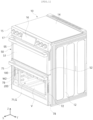
- the home appliance may mean a device that has storage compartments 31 and 41 inside, and the storage compartments 31 and 41 are opened and closed by doors 50 and 70.
- the doors 50 and 70 are disposed in front of the storage compartments 31 and 41 and may serve to open and close the storage compartments 31 and 41.
- "front” refers to the direction a user faces when the user is positioned in front of the home appliance.
- the X-axis direction may be forward.
- the Y-axis direction may be the width direction of the home appliance.
- the Z-axis direction may be the height direction of the home appliance. Below, description will be made based on this direction.
- the home appliance may include various home appliances such as cooking appliances, refrigerators, freezers, kimchi refrigerators, plant cultivation devices, stylers, and washing machines. Below, a cooking appliance among the home appliances will be described as an example.
- the door consists of two doors 50 and 70, but it may also be applied to a home appliance provided with only one lower door 70.
- the following is an example of the application of the two doors 50 and 70 of the present invention to a cooking appliance.
- the door placed relatively above is referred to the upper door 50, and the door placed below is referred to as the lower door 70.
- a first electronic component 90 may be disposed in an equipment room (S1 in FIG. 11 ).
- a second electronic component 100 may be disposed on the lower door 70, which is one of the doors 50 and 70.
- the first electronic component 90 and the second electronic component 100 may be electrically connected to each other through wires W1 and W2.
- the first electronic component 90 may be a control part that controls the second electronic component 100.
- the first electronic component 90 may also control a display part 16 of the home appliance.
- the second electronic component 100 may provide various functions to the lower door 70.
- an image sensing device 170 (see FIG. 7 ) may be provided in the image acquisition module 100 to acquire internal images of the storage compartment 31 and 41.
- a lighting device (not shown) may be provided in the lower door 70 to increase illuminance of the storage compartments 31 and 41.
- a display device may be disposed on the lower door 70 as the second electronic component 100.
- the display device may provide information on the home appliance to a user.
- the user may input an operation command through the display device.
- a portion of the image acquisition module 100 or the display device may be disposed at the lower door 70.
- the second electronic component 100 such as the image acquisition module 100 or the display device, may exchange an electrical signal with the first electronic component 90 provided in the home appliance main body or may be connected to the main body through wires W1 and W2 for power supply.
- the image acquisition module 100 will be described as an example of the second electronic component 100.
- the second electronic component 100 may be disposed inside the lower door 70.
- the wires W1 and W2 connected to the second electronic component 100 may exit the lower door 70 and may be connected to the first electronic component 90.
- a section connected from the lower door 70 to the equipment room S1 may be disposed outside the side surfaces of cavities 30 and 40 to be described below.
- a portion of the wires W1 and W2 connected from the lower door 70 to the equipment room S1 may be disposed along a wire guide 300.
- the wire guide 300 disposed on the side surfaces of the cavities 30 and 40 is illustrated.
- the wire guide 300 may include two wire guides 300A and 300B. The wire guide 300 will be described again below.
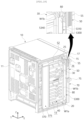
- a main body 10 of the cooking appliance may have an approximately hexahedral shape.
- the main body 10 of the cooking appliance may include two doors 50 and 70.
- the two doors 50 and 70 may be disposed to have different heights from each other.
- the two doors 50 and 70 may serve to shield the different storage compartments 31 and 41.
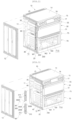
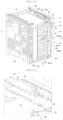
- FIG. 2 illustrates a separated state of a side cover 12 constituting the main body 10 of the cooking appliance.
- an inner space 13 of the main body 10 of the cooking appliance may be exposed.
- Two cavities 30 and 40 may be disposed in the inner space 13 at different heights from each other.
- Storage compartments 31 and 41 separated from each other may be provided in the two cavities 30 and 40.
- only one cavity may be provided or three or more cavities may be disposed in the inner space 13.
- the two cavities 30 and 40 may be disposed in the left and right directions.
- Reference numeral 11 illustrates a rear cover constituting the main body 10 of the cooking appliance.
- An upper cover 14 may be provided in the main body 10 of the cooking appliance.
- the upper cover 14 may cover an upper portion of the inner space 13 so that the cavities 30 and 40 are not exposed upward.
- the equipment room S1 may be disposed under the upper cover 14.
- the upper cover 14 may cover and shield the equipment room S1.
- a lower frame 20 may be provided under the main body 10 opposite to the upper cover 14.
- the lower frame 20 may shield a lower portion of the inner space 13.
- a wire pipe 23 may be provided in the lower frame 20 to guide a mounting direction of a main wire W1.
- the main wire W1 may be disposed on a lower side surface of the main body 10 along the wire pipe 23.
- reference numeral 22 represents a support leg for adjusting the height of the main body 10.
- the rear cover 11, the side cover 12, the upper cover 14, and the lower frame 20 may constitute a cover plate.
- the cover plate may surround an outer periphery of the main body 10 except for a front surface of the main body 10.
- An upper panel 15 may be provided on the upper portion of the cooking appliance.
- the upper panel 15 may be disposed on the front upper portion of the cooking appliance.
- the display part 16 may be provided on the upper panel 15.
- the display part 16 may serve to manipulate the function of the cooking appliance and display the state of the cooking appliance.
- the display part 16 may be configured as a display capable of performing a touch manipulation.
- the upper panel 15 may include a knob 17 performing a rotating operation or a pressing operation together with the display part 16.
- the display part 16 may not be provided in the upper panel 15, but the display part may be disposed at the lower door 70.
- An equipment room S1 may be disposed behind the upper panel 15.
- the equipment room S1 may be a space partitioned from the inner space 13 and the cavities 30 and 40.
- the equipment room S1 is disposed below the upper cover 14.
- a first electronic component 90 connected to the display part 16 may be disposed in the equipment room S1.
- a main wire W1 may be connected to the first electronic component 90.
- the main wire W1 may connect the first electronic component 90 including the display part 16 to a second electronic component 100. That is, the main wire W1 may connect the display part 16 and the second electronic component 100 of the lower door 70 such as an image acquisition module 100.
- the main wire W1 may be connected to a door wire W2 through a connector module 200 to be described below.
- a mounting frame 25 may be provided on an upper side of the main body 10.
- the mounting frame 25 may be disposed above the first cavity 30.
- the mounting frame 25 may be disposed to cross a front frame 80, to be described later, from the rear cover 11.
- the mounting frame 25 may constitute a part of the equipment room S1.
- a cooling duct 370 to be described below, may be fixed to the mounting frame 25.
- a wire hole 26 may be opened in the mounting frame 25.
- the wire hole 26 may be formed to penetrate the mounting frame 25.
- the main wire W1 may pass through the wire hole 26 and enter the machine chamber S1. Meanwhile, the main wire W1 may pass through the wire hole 26 and exit the equipment room S1.
- the wire hole 26 may be provided at a position closer to the doors 50 and 70 than the rear cover 11 in the mounting frame 25.
- the two cavities 30 and 40 may be divided into a first cavity 30 and a second cavity 40.
- the first cavity 30 and the second cavity 40 may be placed in the inner space 13 at different heights.
- An upper storage compartment 31 may be provided inside the first cavity 30.
- a lower storage compartment 41 may be provided inside the second cavity 40. In this case, the upper storage compartment31 and the lower storage compartment 41 are separated from each other, and only the front of each may be opened.
- An upper door 50 may be placed in front of the first cavity 30.
- a lower door 70 may be disposed in front of the second cavity 40.
- the upper door 50 and the lower door 70 may each be operated in a kind of pull-down method in which the upper end rotates up and down around the lower end.
- the upper door 50 and the lower door 70 may each be operated in a side swing manner.
- the front 51 of the upper door 50 may have a structure that allows the upper storage compartment 31 to be seen through.
- the front 51 of the upper door 50 has a panel structure made of glass, so that the user may observe the inside of the upper storage compartment 31 through the upper door 50.
- the front 51 of the upper door 50 may be made of a dark material or coated with a separate film so that the upper storage compartment31 may not be visible from the outside.
- Reference numeral 55 denotes a first handle for opening and closing the upper door 50.
- the lower door 70 may be placed below the upper door 50.
- the lower door 70 may be placed in front of the second cavity 40.
- the lower storage compartment 41 may be seen through the front of the lower door 70. The user may observe the inside of the lower storage compartment 41 through the front of the lower door 70.
- a viewing part V may be provided at the lower door 70.
- the viewing part V is for seeing the lower storage compartment 41 from the outside, and may be made of a transparent material.
- the viewing part V may be seen as a part of a front panel Ga forming the front surface of the lower door 70.
- the viewing part V may be provided at a central portion of the front panel Ga.
- the edge portion of the front panel Ga may have a material having a high surface roughness, unlike the viewing part V.
- a separate opaque film may be applied to the edge portion of the front panel Ga. In this case, the edge portion of the front panel Ga except the viewing part V may not see through the lower storage compartment 41.
- the edge of the front panel Ga corresponding to the outside of the viewing part V may be covered by a door frame 72.
- the outside of the viewing part V may mean an edge of the front panel Ga disposed around the edge of the viewing part V.
- the lower door 70 may be made of a dark material or coated with a separate film so that the lower storage compartment 41 may not be seen from the outside.
- a door panel G (see FIG. 2 ) may be omitted from the lower door 70, and an opaque metal or non-metal plate may constitute the front surface of the lower door 70. Even in this case, the lower storage compartment 41 may not be seen from the outside.
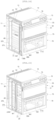
- FIG. 2 a state in which the image acquisition module 100 and the connector module 200 are mounted inside the lower door 70 is illustrated.
- FIG. 2 illustrates positions where the image acquisition module 100 and the connector module 200 are mounted inside the lower door 70, the image acquisition module 100 and the connector module 200 may not be visible from the front of the cooking appliance. This is because, as described above, the edge portion of the front panel Ga is opaque except for the viewing part V.
- Reference numeral 75 denotes a second handle for opening and closing the lower door 70.
- the image acquisition module 100 may be disposed at the upper door 50.
- two image acquisition modules 100 may be disposed at the upper door 50 and the lower door 70, respectively.
- the image acquisition module 100 and the connector module 200 may be divided into the upper door 50 and the lower door 70.
- the image acquisition module 100 may be disposed outside the lower door 70 rather than inside the lower door 70.
- the image acquisition module 100 may be disposed on the upper surface, the bottom surface, the front surface, the rear surface, the side surface, or the second handle 75 of the lower door 70.
- a plurality of heating devices 35, 38, 45, 48 may be disposed behind the cooking appliance and inside the cavities 30, 40.
- the heating devices 35, 38, 45, and 48 may heat the upper storage compartment 31 and the lower storage compartment 41.
- the first heating device 35 and the second heating device 38 may heat the upper storage compartment 31, respectively.
- the third heating device 45 and the fourth heating device 48 may heat the lower storage compartment 41, respectively.
- the fourth heating device may be a convection type heating device including a motor.
- the upper storage compartment 31 and the lower storage compartment 41 may be heated by the plurality of heating devices 35, 38, 45, and 48. Heat from the upper storage compartment 31 and the lower storage compartment 41 may be transmitted to the wires W1 and W2.
- the wire guide 300 is disposed between the cavities 30 and 40 and the wires W1 and W2 to block heat in the cavities 30 and 40 from being transferred to the wires W1 and W2. If this embodiment is applied to an appliance that generates cold air, such as a freezer among home appliances, the wire guide 300 may block cold air from the cavities 30 and 40 from being transferred to the wires W1 and W2.
- FIG. 5 shows the lower door 70 and the wires W1 and W2 viewed from the front of the lower door 70.
- the reference symbol Is denotes an inward direction toward the main body 10
- Os denotes outward direction away from the main body 10.
- the wires W1 and W2 for power supply or signal transmission may be disposed inside the main body 10 of the home appliance and the lower door 70.
- These wires W1, W2 are a main wire W1 for connecting the connector module 200 of the lower door 70 and the first electronic component 100 inside the main body 10, and a door wire W2 for connecting between the connector module 200 and the image acquisition module 100.
- the structure of the wires W1 and W2 will be described again below.
- a worker may separate the main wire W1 from the connector module 200 and maintain/repair the image acquisition module 100.
- the image acquisition module 100 may be shielded by an edge portion of the front panel Ga (see FIG. 5 ).
- a door connector 270 constituting the connector module 200 may be assembled with a mating connector 290.
- the door connector 270 may be connected to the door wire W2.
- the mating connector 290 may be connected to the main wire W1.
- the main wire W1 and the door wire W2 may be electrically connected to each other.
- the two connectors 270 and 290 may be omitted, and the main wire W1 and the door wire W2 may be directly connected.
- the main wire W1 and the door wire W2 may be integrally formed.
- the connector module 200 may be placed in a connector storage portion CM.
- the connector storage portion CM may be placed in an installation area provided inside the lower door 70.
- the connector storage portion CM may be viewed as an empty space that is part of the installation area.
- the connector storage portion CM may be integrally formed in the installation area, or may be a type of bracket formed separately.
- the connector storage portion CM may be disposed adjacent to a lower side of the lower door 70.
- a worker may access the connector module 200 through the lower part of the lower door 70. If the connector storage portion CM is disposed at the lower end of the lower door 70, the connector module 200 may not be exposed to the outside. Additionally, since the entrance of the connector storage portion CM opens to the lower end of the lower door 70, the worker may easily access the connector module 200.
- the connector storage portion CM may be disposed adjacent to the upper side of the lower door 70. Additionally, the entrance of the connector storage portion CM may be open to the side of the lower door 70.
- the skeleton of the lower door 70 may be formed by a door frame 72.
- the door frame 72 may include a frame body 72a that has a rectangular frame shape.
- a penetrating portion 72b which is a kind of empty space, may be opened at the center of the frame body 72a.
- the front panel Ga may be disposed in the penetrating portion 72b.
- Reference numeral 77a denotes a frame outlet 77a, which may be an outlet through which air passing through a cooling passage formed inside the lower door 70 is discharged to the outside.
- the second electronic component 100 may include a main unit 100A and a connection unit 100B.
- the main unit 100A may include an image sensing device 170.
- the connection unit 100B may create a path through which the door wire W2 is guided to the main unit 100A.
- the wires W1, W2 may include the main wire connecting the first electronic component 90 of the lower door 70 and the mating connector 290 and the door wire W2 connecting between the door connector 270 and the second electronic component 100.
- the signal or power of the first electronic component 90 may be transmitted to the second electronic component 100 through the main wire W1 - the mating connector 290 - the door connector 270 - the door wire W2. there is.
- the signal of the second electronic component 100 may be provided to the first electronic component 90 through the door wire W2 - the door connector 270 - the mating connector 290 - the main wire W1.
- the main wire W1 may include a connector connection part W1a connected to the mating connector 290, a component connection part W1c connected to the first electronic component 90, and a transmission part W1b connected between the connector connection part W1a and the component connection part W1c.
- the connector connection part W1a, the component connection part W1c, and the transmission part W1b are configured integrally with each other, but are classified for convenience of explanation.
- the connector connection part W1a may be disposed in the front-rear direction (X-axis direction).
- the connector connection part W1a may extend rearward from the mating connector 290 along the lower portion of the main body 10.
- the component connection part W1c may extend in the direction of the equipment room S1 from the upper end of the transmission part W1b, and in the present embodiment, a part of the component connection part W1c may extend in the left-right direction (Y-axis direction).
- the transmission part W1b may extend in the height direction (Z-axis direction) of the main body 10.
- the transmission part W1b may be disposed on the side surfaces of the cavities 30 and 40. Since the transmission part W1b is disposed on the side surfaces of the cavities 30 and 40, the entire length of the main wire W1 may be reduced as compared with that of the main wire W1 connected to the first electronic component 90 via the rear side of the main body 10.
- a dotted wire illustrates a path when the main wire W1 rotates on the rear surface of the main body 10 and enters the equipment room S1.
- the transmission part W1b is disposed closer to the front of the main body 10, that is, closer to the lower door 70, than to the rear of the main body 10, there is no need for the connector connection part W1a to extend to the rear of the main body 10. Accordingly, the entire length of the main wire W1 may be shortened, and noise mixed with signals may be reduced.
- the transmission part W1b since the transmission part W1b is disposed on the side surfaces of the cavities 30 and 40, it may be more directly affected by heat diffused from the cavities 30 and 40 as compared with the connector connection part W1a or the component connection part W1c. Therefore, it is necessary to block the transmission part W1b from the cavities 30 and 40. Blocking between the transmission part W1b and the cavities 30 and 40 may be performed by the wire guide 300.
- an arrow indicates a direction in which heat of the upper storage compartment 31 is transferred.
- the heat of the upper storage compartment 31 is transferred outward, and a side insulation space S3 may be provided outside the first cavity 30.
- the side insulation space S3 may be filled with an insulation material (not shown).
- the insulation material may block the flow of heat of the upper storage compartment 31 that is transferred to the outside.
- An upper insulation space S2 (see FIG. 7 ) partitioned from the equipment room S1 and connected to the side insulation space S3 may be provided under the equipment room S1.
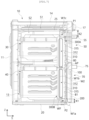
- the wire guide 300 may be disposed to be spaced apart from the side surfaces of the cavities 30 and 40.
- the wire guide 300 may be disposed to face the side surfaces of the cavities 30 and 40.
- the side insulation space S3 may be viewed as being formed in a portion of the wire guide 300 spaced apart from the side surfaces of the cavities 30 and 40.
- the wire guide 300 may be disposed outside the side insulation space S3.
- the wire guide 300 may laterally block a space between the cavities 30 and 40 and the transmission part W1b of the main wire W1.
- the wire guide 300 may block the flow of heat transferred from the upper storage compartment 31 to the transmission part W1b of the main wire W1. Therefore, in the present embodiment, the heat insulating material and the wire guide 300 may doubly block the flow of heat transferred to the transmission part W1b of the main wire W1.
- Blocking laterally means that the cavities 30 and 40 and the main wire W1 do not face each other directly. In this case, radiant heat generated from the surfaces of the cavities 30 and 40 may not be directly transferred to the main wire W1.
- the wire guide 300 may be disposed between the cavities 30 and 40 and the side cover 12. In this case, the wire guide 300 may be spaced apart from the surface of the side cover 12.
- a guide space S4 may be formed between the wire guide 300 and the side cover 12.
- the transmission part W1b of the main wire W1 may be disposed in the guide space S4 formed between the wire guide 300 and the side cover 12. Accordingly, the guide space S4 may form a guide path S4 blocked in both directions, and the influence of the temperature/humidity/vibration transmitted to the transmission part W1b of the main wire W1 may be reduced.
- the wire guide 300 may be disposed closer to the surface of the side cover 12 than to the surfaces of the cavities 30 and 40. Accordingly, the main wire W1 may also be disposed closer to the surface of the side cover 12 than to the surfaces of the cavities 30 and 40, and the transmission part W1b of the main wire W1 may be less affected by heat transferred from the cavity.
- the main wire W1 may be guided from a lower portion to an upper portion of the main body 10 along the wire guide 300. Both the wire guide 300 and the transmission part W1b of the main wire W1 may be disposed closer to the front surface than the rear surface of the main body 10.
- the wire guide 300 may be disposed between a first point P1 entering the inside of the equipment room S1 and a second point P2 entering the doors 50 and 70.
- first point P1 entering the inside of the equipment room S1
- second point P2 entering the doors 50 and 70.
- both ends of the main wire W1 may be guided to the lower door 70 and the equipment room S1, respectively.
- the second point P2 refers to a portion between a lower portion of the lower door 70 and a lower portion close to a bottom of the main body 10.
- the first point P1 refers to an upper portion of the main body 10 close to a mounting frame 25 to be described below.
- the wire guide 300 may be disposed between the first point P1 and the second point P2 along a straight wire path.
- the first point P1 and the second point P2 are spaced apart from each other in the height direction (Z-axis direction) of the main body 10. Accordingly, the wire guide 300 may be provided in the height direction of the main body 10.
- the main wire W1 may also be disposed along a straight wire path between the first point P1 and the second point P2 along the wire guide 300.
- the straight wire path may be the shortest distance connecting the first point P1 and the second point P2.
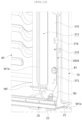
- one end of the wire guide 300 may be disposed at a position higher than the lower end of the lower door 70. It may be viewed that the second point P2 is located between one end of the wire guide 300 and the bottom surface of the equipment room S1. One end of the wire guide 300 and the lower frame 20 may be spaced apart by a predetermined distance K1.
- the other end of the wire guide 300 may be disposed at a position lower than the equipment room S1. It may be viewed that the first point P1 is located between the other end of the wire guide 300 and the bottom surface of the equipment room S1. The other end of the wire guide 300 and the bottom surface of the equipment room S1 may be spaced apart by a predetermined distance K2.
- the wire guide 300 may be connected to a front frame 80.
- the front frame 80 may constitute the front surface of the cavities 30 and 40 in which the doors 50 and 70 are disposed.
- the front frame 80 may be provided around the front inlet of the cavities 30 and 40.
- the front frame 80 may extend outward from the front inlet of the cavities 30 and 40.
- the front frame 80 may be viewed as a part of the cavities 30 and 40 or a part of a frame part.
- the wire guide 300 may be connected to the side surface of the front frame 80.
- a fixing body 315 of wire guides 300A and 300B may be disposed on the front frame 80.
- the fixing body 315 may be fastened to the front frame 80 through a plate fastener B2.
- the wire guides 300A and 300B are disposed on the side surfaces of the front frame 80, the remaining portions of the wire guides 300A and 300B except for the portions connected to the front frame 80 may be spaced apart from the side surfaces of the cavities 30 and 40.
- the wire guides 300A and 300B may extend from the front frame 80 in the form of a kind of cantilever.
- the wire guide 300 may include a plurality of wire guides 300A and 300B.
- a first wire guide 300A and a second wire guide 300B are provided to be disposed at a different height from each other.
- the second wire guide 300B may form a continuous guide path S4 (see FIG. 6 ) with the first wire guide 300A, and the wires W1 and W2 may be disposed along the guide path S4.
- the first wire guide 300A and the second wire guide 300B may have the same shape.
- the plurality of wire guides 300A and 300B may also insulate the wires W1 and W2 provided in the home appliance having a high height.
- the first wire guide 300A may be disposed adjacent to the first cavity 30.
- the second wire guide 300B may be disposed adjacent to the second cavity 40.
- Reference numeral AP indicates a portion where the first wire guide 300A and the second wire guide 300B contact each other.
- One end of the first wire guide 300A and the second wire guide 300B may be disposed in contact with each other.
- the first wire guide 300A and the second wire guide 300B may be arranged to be spaced apart from each other.
- a fastening groove 82 may be formed in the front frame 80.
- the fastening groove 82 may be formed by penetrating the front frame 80 in the left and right directions (Y-axis direction in FIG. 1 ).
- the first wire guide 300A may be provided with a fastening piece 318 protruding in the direction of the cavity.
- the fastening piece 318 may be inserted into the fastening groove 82.
- the first wire guide 300A may be fixed to the front frame 80. In this state, when the plate fastener B2 passes through the fixing body 315, the wire guide 300 may be completely fixed to the front frame 80.
- the fastening piece 318 and the fastening groove 82 may be omitted.
- the plate fastener B2 may be omitted, and the first wire guide 300A may be fixed only with the fastening piece 318 and the fastening groove 82.
- the first wire guide 300A may be fixed to the front frame 80 by welding.
- the equipment room S1 may be provided in an upper portion of the main body 10.
- the equipment room S1 may be disposed below the upper cover 14.
- the equipment room S1 may be formed in a place corresponding to below the upper cover 14 and behind the upper panel 15.
- the equipment room S1 may be disposed on the side, back, or bottom of the main body 10. In this case, the location of the first point P1 may also change.
- the first electronic component 90 and a cooling fan may be placed in the equipment room S1.
- the cooling fan may serve to lower the temperature of the main body 10 by drawing in and circulating outside air.
- reference numeral 370 denotes a cooling duct 370 for guiding the flow of air drawn by the cooling fan.
- a cooling passage 375 may be formed in the cooling duct 370. Air flows through the cooling passage 375, thereby lowering the temperature of the equipment room S1.
- the cooling passage 375 may be covered by the side cover 12 to form a sealed air passage.
- the first electronic component 90 may include a control part that controls the display part 16 and the second electronic component 100.
- the first electronic component 90 may be composed of a substrate.
- a plurality of electrodes 92 may be disposed on the substrate.
- the display part 16 and the knob 17 may be disposed in front of the substrate.
- Some electrodes 93 of the plurality of electrodes 92 may be connected to the main wire W1.
- the main wire W1 may be provided with an extension part W1d.
- the extension part W1d may be further extended from the component connection part W1c of the main wire W1.
- a first extension connector LC1 and a second extension connector LC2 may be provided at both ends of the extension part W1d, respectively.
- the first extension connector LC1 may be coupled to the component connection part W1c.
- the second extension connector LC2 may be coupled to the elements.
- the extension part W1d may be omitted, and the component connection part W1c may be directly coupled to the electrodes.
- the wire guides 300A, 300B may be made of a thin plate-shaped material.
- the wire guides 300A, 300B may have a structure where the height is greater than the width. Since the wire guides 300A, 300B are made of a plate-shaped structure, the thickness of the main body 10 of the home appliance may be prevented from increasing due to the wire guides 300A, 300B.
- the wire guides 300A and 300B may not have a plate-shaped structure but may have a block structure with a predetermined thickness. As another example, the wire guides 300A and 300B may have a block structure with an empty space inside.
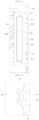
- the wire guides 300A and 300B may include a plate-shaped insulating body 310.
- the insulating body may be spaced apart from the side of the cavities 30 and 40 (refer to the Y-axis direction of FIG.4 ).
- the insulating body 310 may serve to block between the main wire W1 and the cavities 30 and 40. Also, the insulating body 310 may serve to guide the main wire W1.
- a spacing part 312 may be provided in the insulating body 310.
- the spacing part 312 may protrude from the insulating body 310 toward the surfaces of the cavities 30 and 40.
- the spacing part 312 may serve to reinforce the strength of the insulating body 310.
- the spacing part 312 may reduce the area in which the insulating body 310 is in contact with the main wire W1. As shown in FIG. 12 , the spacing part 312 may have a structure recessed from the insulating body 310.
- the insulating body 310 may be provided with a fixing body 315.
- the fixing body 315 may be provided at a portion extended from one side of the insulating body 310.
- the fixing body 315 may be viewed as a part of the insulating body 310.
- the fixing body 315 may be fixed to the front frame 80.
- the fixing body 315 may be provided with a plurality of fixing holes 317 and 319, and the plate fastener B2 (refer to FIG. 8 ) may be assembled to the fixing holes 317 and 319.
- the fixing body 315 may be provided with a mounting groove 316.
- the mounting groove 316 may be formed by omitting a portion of the fixing body 315.
- a cover fastener B1 may be disposed in the mounting groove 316.
- the cover fastener B1 may pass through the mounting groove 316 to be assembled with the front frame 80.
- a portion of the side cover 12 may be hung and fixed to the cover fastener B1.
- the fixing body 315 may be provided with a fastening piece 318.
- the fastening piece 318 may be bent in a direction orthogonal to the fixing body 315.
- the fastening piece 318 may be inserted into the fastening groove 82 of the front frame 80.
- the fastening piece 318 may temporarily fix the wire guides 300A and 300B to the front frame 80 before the plate fastener B2 is assembled.
- the second wire guide 300B may be provided with a winding fastener WF configured to surround and fix the main wire W1.
- the winding fastener WF may surround the main wire W1 so that the main wire W1 does not deviate from the second wire guide 300B.
- a plurality of winding fasteners WF may be disposed along the longitudinal direction (height direction) of the second wire guide 300B.
- FIG. 13 a state before the winding fastener WF surrounds the main wire W1 is illustrated.
- One end of the winding fastener WF is fixed to the second wire guide 300B, and the other end of the winding fastener WF may be freely bent.
- the winding fastener WF may maintain the shape while surrounding the main wire W1.
- the winding fastener WF may be made of a metal material.
- the winding fastener WF may be a cable-tie or a general string structure.
- the fixing body 315 may be fixed to the front frame 80 to form a continuous side surface without being separated between the second wire guide 300B and the front frame 80.
- the main wire W1 may be prevented from escaping into the gap between the second wire guide 300B and the front frame 80 or from being damaged by the gap between the second wire guide 300B and the front frame 80.
- Side surfaces of the wire guide 300 and the cavities 30 and 40 may be spaced apart from each other.
- the side surface of the second cavity 40 is exposed, but the insulating material may cover the side surface of the second cavity 40.
- the insulating material may be filled between the second wire guide 300B and the second cavity 40 spaced apart from each other.
- the second wire guide 300B may cover one end of the insulating material and may serve to press the insulating material.
- the wire guide 1300 may be composed of a single component. Unlike the previous embodiment, the wire guide 1300 may not be composed of a plurality of wire guides 1300, but may be composed of only one wire guide 300. One wire guide 1300 may create a continuous guide path. The entire height of the wire guide 1300 may be lower than or equal to the height of the main body 10.
- FIG. 15 a third embodiment of the home appliance according to the present invention is illustrated.
- the same reference numerals are assigned to the same parts as those of the previous embodiment, and a description thereof will be omitted.
- the wire guide 2300 may be disposed at a position retreating from the doors 50 and 70 toward the rear cover. Referring to FIG. 15 , the wire guide 2300 may be disposed at a center portion of a side surface of the main body 10.
- the wire guide 2300 is spaced apart from the front frame 80 and thus cannot be fixed to the front frame 80.
- One end of the wire guide 2300 may be fixed to the mounting frame 25, not the front frame 80.
- the other end of the wire guide 2300 may be fixed to the lower frame 20.
- only one of both end portions of the wire guide 2300 may be fixed to the mounting frame 25 or the lower frame 20.
- FIG. 16 a fourth embodiment of the home appliance according to the present invention is illustrated.
- the same reference numerals are assigned to the same parts as in the previous embodiment, and a description thereof will be omitted.
- the main body 10 may be provided with a cooling duct 370 guiding the flow of air.
- the cooling duct 370 is for guiding the flow of air drawn by the cooling fan.
- the cooling duct 370 may be provided in the height direction of the main body 10.
- the cooling duct 370 may be disposed in the height direction of the main body 10, and one end thereof may extend to the side surface of the equipment room S1.
- the cooling duct 370 may be the wire guide 3300. That is to say, the cooling duct 370 may serve to cover the main wire W1 from the cavities 30 and 40 along with the flow of air.
- the cooling duct 370 may be referred to as the wire guide 3300.
- FIG. 17 A fifth embodiment of the home appliance according to the present invention is illustrated in FIG. 17 .
- the same reference numerals are assigned to the same parts as in the previous embodiment, and a description thereof will be omitted.
- the home appliance may be a single-stage cooking appliance.
- the cooking appliance of the single-stage structure has a relatively lower height compared to the previous embodiment.
- the wire guide 300 may be configured as one.
- the lower end of the wire guide 4300 extends to the lower part of the cavity, and the other end thereof extends to the equipment room S1.
- the wire guide 5300 may have an orthogonal cross-sectional structure.
- the wire guide 5300 may include a first plate body 5310 spaced apart from the side surfaces of the cavities 30 and 40.
- the wire guide 5300 may include a second plate body 5340 connected to the first plate body 5310, and extending toward the side surfaces of the cavities 30 and 40.
- the first plate body 5310 and the second plate body 5340 may be connected to each other, but may be bent.
- the main wire W1 may be disposed along a surface of any one of the first plate body 5310 and the second plate body 5340. In FIG. 18 , the main wire W1 is supported by the second plate body 5340, but unlike this, the main wire W1 may be supported by the first plate body 5310.
- the second plate body 5340 may protrude toward the side surfaces of the cavities 30 and 40, and may provide space between the first plate body 5310 and the side surfaces of the cavities 30 and 40.
- the first plate body 5310 may be fixed to the front frame 80.
- FIG. 19 illustrates a structure of the wire guide 6300 constituting a seventh embodiment of the home appliance according to the present invention.
- the wire guide 6300 may have a plate body 6310 of a flat structure. Both surfaces of the wire guide 6300 may have a flat structure.
- the wire guide 6300 may be fixed by being welded or bonded to the front frame 80.
- FIG. 20 illustrates a structure of the wire guide 7300 constituting an eighth embodiment of the home appliance according to the present invention.
- the wire guide 7300 may have a flat plate structure.
- the wire guide 7300 may include a plurality of spacing parts 7312.
- the plurality of spacing parts 7312 may protrude in lateral directions of the cavities 30 and 40. Since the plurality of spacing parts 7312 do not contact the main wire W1, a contact area between the wire guide 7300 and the main wire W1 may be reduced. Additionally, the plurality of spacing parts 7312 may increase the strength of the wire guide 7300 and prevent the wire guide 7300 from being deformed due to high heat.
- FIG. 21 illustrates a structure of the wire guide 8300 constituting a ninth embodiment of the home appliance according to the present invention.
- the wire guide 8300 may have a flat plate structure.
- the wire guide 8300 may be provided with a plurality of spacing parts 8312.
- the plurality of spacing parts 8312 may protrude toward the surface of the side cover 12. Since portions of the wire guide 8300 except for the plurality of spacing parts 8312 do not contact the main wire W1, a contact area between the wire guide 8300 and the main wire W1 may be reduced. Additionally, the plurality of spacing parts 8312 may increase the strength of the wire guide 7300 and prevent the wire guide 8300 from being deformed due to high heat.
Landscapes
- Engineering & Computer Science (AREA)
- Mechanical Engineering (AREA)
- Chemical & Material Sciences (AREA)
- Combustion & Propulsion (AREA)
- General Engineering & Computer Science (AREA)
- Devices That Are Associated With Refrigeration Equipment (AREA)
- Insertion, Bundling And Securing Of Wires For Electric Apparatuses (AREA)
Applications Claiming Priority (1)
| Application Number | Priority Date | Filing Date | Title |
|---|---|---|---|
| KR1020230142875A KR20250059023A (ko) | 2023-10-24 | 2023-10-24 | 가전기기 |
Publications (1)
| Publication Number | Publication Date |
|---|---|
| EP4545860A1 true EP4545860A1 (fr) | 2025-04-30 |
Family
ID=93283901
Family Applications (1)
| Application Number | Title | Priority Date | Filing Date |
|---|---|---|---|
| EP24208635.3A Pending EP4545860A1 (fr) | 2023-10-24 | 2024-10-24 | Appareil ménager |
Country Status (3)
| Country | Link |
|---|---|
| US (1) | US20250129945A1 (fr) |
| EP (1) | EP4545860A1 (fr) |
| KR (1) | KR20250059023A (fr) |
Citations (10)
| Publication number | Priority date | Publication date | Assignee | Title |
|---|---|---|---|---|
| JP2000012209A (ja) | 1998-06-18 | 2000-01-14 | Matsushita Electric Ind Co Ltd | 加熱調理装置 |
| US6300609B1 (en) | 1999-08-21 | 2001-10-09 | Lg Electronics Inc. | Door to microwave oven, control panel and cable assembly |
| US20100089903A1 (en) * | 2005-09-19 | 2010-04-15 | Bsh Bosch Und Siemens Hausgerate Gmbh | Cooking Appliance |
| EP2397601A1 (fr) * | 2010-06-14 | 2011-12-21 | PAS Deutschland GmbH | Traverse pour un appareil ménager, groupe pour l'assemblage d'un appareil ménager et appareil ménager |
| US8253074B2 (en) | 2008-12-06 | 2012-08-28 | General Electric Company | Wiring assembly for an appliance |
| US20170000292A1 (en) * | 2015-07-03 | 2017-01-05 | Samsung Electronics Co., Ltd. | Oven |
| US20180202665A1 (en) * | 2015-07-03 | 2018-07-19 | Samsung Electronics Co., Ltd | Oven |
| US20190128533A1 (en) * | 2016-04-11 | 2019-05-02 | Electrolux Appliances Aktiebolag | Door for a domestic appliance |
| CN113846470A (zh) * | 2020-06-28 | 2021-12-28 | 青岛海尔滚筒洗衣机有限公司 | 走线槽结构及洗衣机 |
| WO2023156009A1 (fr) * | 2022-02-21 | 2023-08-24 | Electrolux Appliances Aktiebolag | Appareil ménager et procédé de fonctionnement associé |
Family Cites Families (8)
| Publication number | Priority date | Publication date | Assignee | Title |
|---|---|---|---|---|
| EP1120606B1 (fr) * | 2000-01-24 | 2006-03-29 | Sharp Kabushiki Kaisha | Appareil de cuisson |
| US6863316B2 (en) * | 2001-12-21 | 2005-03-08 | Emerson Electric Co. | Door latch mechanism and associated components for a self-cleaning oven |
| JP2004028358A (ja) * | 2002-06-21 | 2004-01-29 | Hitachi Home & Life Solutions Inc | 警告器付冷蔵庫 |
| EP2620087A1 (fr) * | 2012-01-27 | 2013-07-31 | Miele & Cie. KG | Lave-vaisselle |
| JP6092027B2 (ja) * | 2013-07-12 | 2017-03-08 | 東芝ライフスタイル株式会社 | 冷蔵庫 |
| KR101880083B1 (ko) * | 2015-07-29 | 2018-07-20 | 삼성전자주식회사 | 세탁기 |
| US10294712B2 (en) * | 2016-11-14 | 2019-05-21 | Whirlpool Corporation | Appliance door assembly |
| KR102412060B1 (ko) * | 2017-04-26 | 2022-06-23 | 엘지전자 주식회사 | 냉장고 |
-
2023
- 2023-10-24 KR KR1020230142875A patent/KR20250059023A/ko active Pending
-
2024
- 2024-10-24 US US18/925,807 patent/US20250129945A1/en active Pending
- 2024-10-24 EP EP24208635.3A patent/EP4545860A1/fr active Pending
Patent Citations (10)
| Publication number | Priority date | Publication date | Assignee | Title |
|---|---|---|---|---|
| JP2000012209A (ja) | 1998-06-18 | 2000-01-14 | Matsushita Electric Ind Co Ltd | 加熱調理装置 |
| US6300609B1 (en) | 1999-08-21 | 2001-10-09 | Lg Electronics Inc. | Door to microwave oven, control panel and cable assembly |
| US20100089903A1 (en) * | 2005-09-19 | 2010-04-15 | Bsh Bosch Und Siemens Hausgerate Gmbh | Cooking Appliance |
| US8253074B2 (en) | 2008-12-06 | 2012-08-28 | General Electric Company | Wiring assembly for an appliance |
| EP2397601A1 (fr) * | 2010-06-14 | 2011-12-21 | PAS Deutschland GmbH | Traverse pour un appareil ménager, groupe pour l'assemblage d'un appareil ménager et appareil ménager |
| US20170000292A1 (en) * | 2015-07-03 | 2017-01-05 | Samsung Electronics Co., Ltd. | Oven |
| US20180202665A1 (en) * | 2015-07-03 | 2018-07-19 | Samsung Electronics Co., Ltd | Oven |
| US20190128533A1 (en) * | 2016-04-11 | 2019-05-02 | Electrolux Appliances Aktiebolag | Door for a domestic appliance |
| CN113846470A (zh) * | 2020-06-28 | 2021-12-28 | 青岛海尔滚筒洗衣机有限公司 | 走线槽结构及洗衣机 |
| WO2023156009A1 (fr) * | 2022-02-21 | 2023-08-24 | Electrolux Appliances Aktiebolag | Appareil ménager et procédé de fonctionnement associé |
Also Published As
| Publication number | Publication date |
|---|---|
| US20250129945A1 (en) | 2025-04-24 |
| KR20250059023A (ko) | 2025-05-02 |
Similar Documents
| Publication | Publication Date | Title |
|---|---|---|
| EP3896343B1 (fr) | Appareil de cuisson | |
| EP3557136B1 (fr) | Appareil de cuisson | |
| EP2107317B1 (fr) | Four électrique | |
| EP4545860A1 (fr) | Appareil ménager | |
| KR20220144538A (ko) | 조리기기 | |
| US20250079760A1 (en) | Door for a home appliance and the home appliance including the same | |
| EP4545859A1 (fr) | Appareil ménager | |
| EP1135834B1 (fr) | Connecteurs de cables | |
| KR20250031824A (ko) | 가전기기용 도어 및 이를 포함하는 가전기기 | |
| KR102362996B1 (ko) | 조리기기 | |
| KR20260029193A (ko) | 가전기기 | |
| EP4517185A1 (fr) | Porte pour appareil domestique | |
| US12590753B2 (en) | Refrigeration appliance | |
| KR20250031835A (ko) | 가전기기용 도어 및 이를 포함하는 가전기기 | |
| CN213850164U (zh) | 机架组件与烹饪设备 | |
| US20250314384A1 (en) | Door for home appliance and home appliance including the same | |
| KR20240177392A (ko) | 조리기기 | |
| KR20250033431A (ko) | 가전기기용 도어 및 이를 포함하는 가전기기 | |
| KR20250033430A (ko) | 가전기기용 도어 및 이를 포함하는 가전기기 | |
| KR20250031834A (ko) | 가전기기용 도어 및 이를 포함하는 가전기기 | |
| ITMI940822U1 (it) | Apparecchio per uso domestico | |
| KR20250031833A (ko) | 가전기기용 도어 및 이를 포함하는 가전기기 | |
| KR20250177703A (ko) | 조리기기 | |
| KR20250130104A (ko) | 가전기기용 도어 및 이를 포함하는 가전기기 |
Legal Events
| Date | Code | Title | Description |
|---|---|---|---|
| PUAI | Public reference made under article 153(3) epc to a published international application that has entered the european phase |
Free format text: ORIGINAL CODE: 0009012 |
|
| STAA | Information on the status of an ep patent application or granted ep patent |
Free format text: STATUS: REQUEST FOR EXAMINATION WAS MADE |
|
| 17P | Request for examination filed |
Effective date: 20241124 |
|
| AK | Designated contracting states |
Kind code of ref document: A1 Designated state(s): AL AT BE BG CH CY CZ DE DK EE ES FI FR GB GR HR HU IE IS IT LI LT LU LV MC ME MK MT NL NO PL PT RO RS SE SI SK SM TR |
|
| RIN1 | Information on inventor provided before grant (corrected) |
Inventor name: JANG, JAEBONG Inventor name: CHOI, JINSEOK |