EP4546491A1 - Batterie secondaire au lithium - Google Patents
Batterie secondaire au lithium Download PDFInfo
- Publication number
- EP4546491A1 EP4546491A1 EP23912844.0A EP23912844A EP4546491A1 EP 4546491 A1 EP4546491 A1 EP 4546491A1 EP 23912844 A EP23912844 A EP 23912844A EP 4546491 A1 EP4546491 A1 EP 4546491A1
- Authority
- EP
- European Patent Office
- Prior art keywords
- active material
- negative electrode
- weight
- parts
- positive electrode
- Prior art date
- Legal status (The legal status is an assumption and is not a legal conclusion. Google has not performed a legal analysis and makes no representation as to the accuracy of the status listed.)
- Pending
Links
Images
Classifications
-
- H—ELECTRICITY
- H01—ELECTRIC ELEMENTS
- H01M—PROCESSES OR MEANS, e.g. BATTERIES, FOR THE DIRECT CONVERSION OF CHEMICAL ENERGY INTO ELECTRICAL ENERGY
- H01M10/00—Secondary cells; Manufacture thereof
- H01M10/05—Accumulators with non-aqueous electrolyte
- H01M10/052—Li-accumulators
- H01M10/0525—Rocking-chair batteries, i.e. batteries with lithium insertion or intercalation in both electrodes; Lithium-ion batteries
-
- H—ELECTRICITY
- H01—ELECTRIC ELEMENTS
- H01M—PROCESSES OR MEANS, e.g. BATTERIES, FOR THE DIRECT CONVERSION OF CHEMICAL ENERGY INTO ELECTRICAL ENERGY
- H01M10/00—Secondary cells; Manufacture thereof
- H01M10/05—Accumulators with non-aqueous electrolyte
- H01M10/056—Accumulators with non-aqueous electrolyte characterised by the materials used as electrolytes, e.g. mixed inorganic/organic electrolytes
- H01M10/0564—Accumulators with non-aqueous electrolyte characterised by the materials used as electrolytes, e.g. mixed inorganic/organic electrolytes the electrolyte being constituted of organic materials only
- H01M10/0566—Liquid materials
- H01M10/0567—Liquid materials characterised by the additives
-
- H—ELECTRICITY
- H01—ELECTRIC ELEMENTS
- H01M—PROCESSES OR MEANS, e.g. BATTERIES, FOR THE DIRECT CONVERSION OF CHEMICAL ENERGY INTO ELECTRICAL ENERGY
- H01M10/00—Secondary cells; Manufacture thereof
- H01M10/05—Accumulators with non-aqueous electrolyte
- H01M10/056—Accumulators with non-aqueous electrolyte characterised by the materials used as electrolytes, e.g. mixed inorganic/organic electrolytes
- H01M10/0564—Accumulators with non-aqueous electrolyte characterised by the materials used as electrolytes, e.g. mixed inorganic/organic electrolytes the electrolyte being constituted of organic materials only
- H01M10/0566—Liquid materials
- H01M10/0569—Liquid materials characterised by the solvents
-
- H—ELECTRICITY
- H01—ELECTRIC ELEMENTS
- H01M—PROCESSES OR MEANS, e.g. BATTERIES, FOR THE DIRECT CONVERSION OF CHEMICAL ENERGY INTO ELECTRICAL ENERGY
- H01M4/00—Electrodes
- H01M4/02—Electrodes composed of, or comprising, active material
- H01M4/36—Selection of substances as active materials, active masses, active liquids
- H01M4/38—Selection of substances as active materials, active masses, active liquids of elements or alloys
- H01M4/386—Silicon or alloys based on silicon
-
- H—ELECTRICITY
- H01—ELECTRIC ELEMENTS
- H01M—PROCESSES OR MEANS, e.g. BATTERIES, FOR THE DIRECT CONVERSION OF CHEMICAL ENERGY INTO ELECTRICAL ENERGY
- H01M4/00—Electrodes
- H01M4/02—Electrodes composed of, or comprising, active material
- H01M4/36—Selection of substances as active materials, active masses, active liquids
- H01M4/48—Selection of substances as active materials, active masses, active liquids of inorganic oxides or hydroxides
- H01M4/483—Selection of substances as active materials, active masses, active liquids of inorganic oxides or hydroxides for non-aqueous cells
-
- H—ELECTRICITY
- H01—ELECTRIC ELEMENTS
- H01M—PROCESSES OR MEANS, e.g. BATTERIES, FOR THE DIRECT CONVERSION OF CHEMICAL ENERGY INTO ELECTRICAL ENERGY
- H01M4/00—Electrodes
- H01M4/02—Electrodes composed of, or comprising, active material
- H01M4/36—Selection of substances as active materials, active masses, active liquids
- H01M4/58—Selection of substances as active materials, active masses, active liquids of inorganic compounds other than oxides or hydroxides, e.g. sulfides, selenides, tellurides, halogenides or LiCoFy; of polyanionic structures, e.g. phosphates, silicates or borates
-
- H—ELECTRICITY
- H01—ELECTRIC ELEMENTS
- H01M—PROCESSES OR MEANS, e.g. BATTERIES, FOR THE DIRECT CONVERSION OF CHEMICAL ENERGY INTO ELECTRICAL ENERGY
- H01M4/00—Electrodes
- H01M4/02—Electrodes composed of, or comprising, active material
- H01M2004/026—Electrodes composed of, or comprising, active material characterised by the polarity
- H01M2004/027—Negative electrodes
-
- H—ELECTRICITY
- H01—ELECTRIC ELEMENTS
- H01M—PROCESSES OR MEANS, e.g. BATTERIES, FOR THE DIRECT CONVERSION OF CHEMICAL ENERGY INTO ELECTRICAL ENERGY
- H01M2300/00—Electrolytes
- H01M2300/0017—Non-aqueous electrolytes
- H01M2300/0025—Organic electrolyte
-
- H—ELECTRICITY
- H01—ELECTRIC ELEMENTS
- H01M—PROCESSES OR MEANS, e.g. BATTERIES, FOR THE DIRECT CONVERSION OF CHEMICAL ENERGY INTO ELECTRICAL ENERGY
- H01M2300/00—Electrolytes
- H01M2300/0017—Non-aqueous electrolytes
- H01M2300/0025—Organic electrolyte
- H01M2300/0028—Organic electrolyte characterised by the solvent
- H01M2300/0034—Fluorinated solvents
-
- H—ELECTRICITY
- H01—ELECTRIC ELEMENTS
- H01M—PROCESSES OR MEANS, e.g. BATTERIES, FOR THE DIRECT CONVERSION OF CHEMICAL ENERGY INTO ELECTRICAL ENERGY
- H01M2300/00—Electrolytes
- H01M2300/0017—Non-aqueous electrolytes
- H01M2300/0025—Organic electrolyte
- H01M2300/0028—Organic electrolyte characterised by the solvent
- H01M2300/0037—Mixture of solvents
-
- Y—GENERAL TAGGING OF NEW TECHNOLOGICAL DEVELOPMENTS; GENERAL TAGGING OF CROSS-SECTIONAL TECHNOLOGIES SPANNING OVER SEVERAL SECTIONS OF THE IPC; TECHNICAL SUBJECTS COVERED BY FORMER USPC CROSS-REFERENCE ART COLLECTIONS [XRACs] AND DIGESTS
- Y02—TECHNOLOGIES OR APPLICATIONS FOR MITIGATION OR ADAPTATION AGAINST CLIMATE CHANGE
- Y02E—REDUCTION OF GREENHOUSE GAS [GHG] EMISSIONS, RELATED TO ENERGY GENERATION, TRANSMISSION OR DISTRIBUTION
- Y02E60/00—Enabling technologies; Technologies with a potential or indirect contribution to GHG emissions mitigation
- Y02E60/10—Energy storage using batteries
Definitions
- the present application relates to a lithium secondary battery.
- lithium secondary batteries having high energy density and voltage, long cycle life, and low self-discharging rate have been commercialized and widely used.
- research is being actively conducted on a method for manufacturing a high-density electrode having a higher energy density per unit volume as an electrode for such a high-capacity lithium secondary battery.
- a secondary battery in general, includes a positive electrode, a negative electrode, an electrolyte, and a separator.
- the negative electrode includes a negative electrode active material for intercalating and deintercalating lithium ions coming from the positive electrode.
- a negative electrode material carbon-based materials such as graphite are excellent in stability and reversibility, but have a limitation in terms of capacity. Therefore, in fields for the purpose of high capacity, attempts to use Si-based materials with high theoretical capacity as the negative electrode material are increasing.
- a lithium secondary battery is usually manufactured by using a lithium-intercalated compound, such as LiCoO 2 or LiMn 2 O 4 for the positive electrode, and a non-lithium intercalated material, such as a carbon-based or Si-based material for the negative electrode.
- a lithium-intercalated compound such as LiCoO 2 or LiMn 2 O 4
- a non-lithium intercalated material such as a carbon-based or Si-based material for the negative electrode.
- the lithium ions intercalated to the positive electrode move to the negative electrode through the electrolyte solution.
- the lithium ions move back to the positive electrode from the negative electrode.
- lithium moving from the positive electrode to the negative electrode reacts with the electrolyte solution to form a kind of passivation film, that is, a solid electrolyte interface (SEI), on a surface of the negative electrode.
- SEI solid electrolyte interface
- the SEI inhibits transport of electrons required for the reaction of the negative electrode with the electrolyte solution to prevent decomposition of the electrolyte, thereby stabilizing a structure of the negative electrode.
- formation of SEI is irreversible to cause consumption of lithium ions. That is, the lithium consumed due to the formation of SEI does not return to the positive electrode during the subsequent discharging process, resulting in a reduction in capacity of the battery.
- a battery design is being made to reduce a diffusion distance of lithium by forming a negative electrode active material layer to have a thickness at a level of a thin film, and to achieve high output by reducing internal resistance by forming a carbon-coated layer on a surface of the negative electrode active material layer to increase conductivity.
- a carbonate compound including a fluoro group is limitedly used for a solvent contained in the electrolyte of a lithium secondary battery. That is, the carbonate compound including a fluoro group is included in order to ensure the ionic conductivity of the electrolyte, but when the carbonate compound is used in an excessive amount, problems arise such as an increase in an amount of Lewis acid and an increase in an amount of gas generation. Accordingly, in the related art, despite advantages of the carbonate compound including a fluoro group, the carbonate compound is included with a lowered content and a material with high dielectric constant such as PC is used in order to compensate for the resulting ionic conductivity. However, even in this case, the problem of the amount of gas generation at high temperatures has not been solved.
- Patent Literature 1 Japanese Patent Application Publication No. 2009-080971
- the present application relates to a lithium secondary battery including a silicon-based negative electrode and an electrolyte including a specific additive.
- An exemplary embodiment of the present specification provides a lithium secondary battery including a positive electrode; a silicon-based negative electrode; a separator provided between the positive electrode and the negative electrode; and an electrolyte
- the silicon-based negative electrode includes a negative electrode current collector layer and a negative electrode active material layer provided on one surface or both surfaces of the negative electrode current collector layer
- the negative electrode active material layer includes a negative electrode active material layer composition
- the negative electrode active material layer composition includes a silicon-based active material
- the electrolyte includes a solvent, a lithium salt, a fluoro group-containing additive, and vinylene carbonate (VC), wherein the vinylene carbonate is included in an amount of 0.3 part by weight or less based on 100 parts by weight of the electrolyte, wherein a carbonate compound including a fluoro group is
- the lithium secondary battery according to the present application can enable a battery with high capacity and high energy density to be ensured by using the silicon-based negative electrode, and can also ensure rapid charging performance by using the silicon-based active material with excellent capacity characteristics to form a negative electrode thickness at a level of a thin film.
- the lithium secondary battery according to the present application includes, as an electrolyte, a solvent, a lithium salt, a fluoro group-containing additive, and vinylene carbonate (VC).
- a carbonate compound including a fluoro group is included in an amount of 10 parts by weight or more based on 100 parts by weight of the solvent, so that the ionic conductivity can be ensured.
- an amount of gas generation increases, so the fluoro group-containing additive that forms an F-derived film is included in an amount of parts by weight described above, and the content of vinylene carbonate having a low thin film forming effect on the Si-based active material layer is lowered to the ranged described above, thereby adjusting the amount of gas generation.
- vinylene carbonate does not form an effective film on the silicon-based negative electrode and remains, and a large amount of gas is generated due to an oxidation reaction at the positive electrode. Therefore, an additive that adjusts the content of vinylene carbonate and forms an effective film on the silicon-based negative electrode is included.
- the lithium secondary battery according to the present application has the features of ensuring performance by reducing the amount of gas generation even during long-term storage at high temperatures and ensuring ionic conductivity.
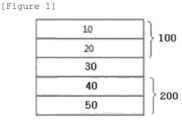
- FIG. 1 shows a lithium secondary battery according to the present application.
- 'p to q' means a range of 'p or more and q or less'.
- the “specific surface area” is measured by the BET method, and specifically, is calculated from a nitrogen gas adsorption amount at a liquid nitrogen temperature (77K) by using BELSORP-mino II available from BEL Japan, Inc. That is, in the present application, the BET specific surface area may refer to the specific surface area measured by the above measurement method.
- Dn means a particle size distribution, and means a particle diameter at the n% point in the cumulative distribution of the number of particles according to the particle diameter. That is, D50 is a particle diameter at the 50% point in the cumulative distribution of the number of particles according to the particle diameter, D90 is a particle diameter at the 90% point in the cumulative distribution of the number of particles according to the particle diameter, and D10 is a particle diameter at the 10% point in the cumulative distribution of the number of particles according to the particle diameter. Meanwhile, the particle size distribution may be measured using a laser diffraction method.
- the resultant dispersion is introduced into a commercially available laser diffraction particle size measurement apparatus (for example, Microtrac S3500) in which a difference in a diffraction pattern according to the particle size is measured, when a laser beam passes through particles, and then a particle size distribution is calculated.
- a laser diffraction particle size measurement apparatus for example, Microtrac S3500
- a polymer includes a certain monomer as a monomer unit
- the description "a polymer includes a certain monomer as a monomer unit” means that the monomer participates in a polymerization reaction and is included as a repeating unit in the polymer.
- this is interpreted as the same as that the polymer includes a monomer as a monomer unit.
- a weight-average molecular weight (Mw) and a number-average molecular weight (Mn) are polystyrene converted molecular weights measured by gel permeation chromatography (GPC) while employing, as a standard material, a monodispersed polystyrene polymer (standard sample) having various degrees of polymerization commercially available for measuring a molecular weight.
- GPC gel permeation chromatography
- a molecular weight refers to a weight-average molecular weight unless particularly described otherwise.
- An exemplary embodiment of the present specification provides a lithium secondary battery including a positive electrode; a silicon-based negative electrode; a separator provided between the positive electrode and the negative electrode; and an electrolyte
- the silicon-based negative electrode includes a negative electrode current collector layer and a negative electrode active material layer provided on one surface or both surfaces of the negative electrode current collector layer
- the negative electrode active material layer includes a negative electrode active material layer composition
- the negative electrode active material layer composition includes a silicon-based active material
- the electrolyte includes a solvent, a lithium salt, a fluoro group-containing additive, and vinylene carbonate (VC), wherein the vinylene carbonate is included in an amount of 0.3 part by weight or less based on 100 parts by weight of the electrolyte, wherein a carbonate compound including a fluoro group is included in
- the electrolyte is a major factor for gas generation during long-term storage at high temperatures, and that adjusting the composition and content of the electrolyte can reduce the amount of gas generated without affecting the performance of the lithium secondary battery.
- the present application can ensure the ionic conductivity by including 10 parts by weight or more of the carbonate compound including a fluoro group based on 100 parts by weight of the solvent.
- the amount of gas generation increases, so the fluoro group-containing additive that forms an F-derived film is included in an amount of parts by weight described above, and the content of vinylene carbonate having a low thin film forming effect on the Si-based active material layer is lowered to the ranged described above, thereby adjusting the amount of gas generation.
- FIG. 1 is a view showing a stack structure of a lithium secondary battery according to an exemplary embodiment of the present application. Specifically, a negative electrode 100 including a negative electrode active material layer 20 on one surface of a negative electrode current collector layer 10 can be seen, a positive electrode 200 including a positive electrode active material layer 40 on one surface of a positive electrode current collector layer 50 can be seen, and the negative electrode 100 and the positive electrode 200 for a lithium secondary battery are formed in a stack structure with a separator 30 interposed therebetween.
- the positive electrode, negative electrode, electrolyte, and separator included in the lithium secondary battery will be described, respectively.
- the electrolyte may include a solvent, a lithium salt, a fluoro group-containing additive, and vinylene carbonate (VC).
- VC vinylene carbonate
- the lithium secondary battery according to the present application relates to the composition of the electrolyte that can reduce an amount of gas generation even during storage at high temperatures.
- an aprotic organic solvent such as N-methyl-2-pyrrolidinone, propylene carbonate, ethylene carbonate, butylene carbonate, dimethyl carbonate, diethyl carbonate, gamma-butyllolactone, 1,2-dimetoxy ethane, tetrahydrofuran, 2-methyltetrahydrofuran, dimethylsulfoxide, 1,3-dioxolane, formamide, dimethylformamide, dioxolane, acetonitrile, nitromethane, methyl formate, methyl acetate, phosphoric acid triester, trimethoxy methane, dioxolane derivative, sulfolane, methyl sulfolane, 1,3-dimethyl-2-imidazolidinone, propylene carbonate derivative, tetrahydrofuran derivative, ether, methyl propionate, or ethyl propionate
- an aprotic organic solvent such as N-methyl-2-pyrroli
- the lithium secondary battery in which the solvent is a mixed solvent including two types of carbonate-based compounds.
- ethylene carbonate and propylene carbonate which are cyclic carbonates
- a linear carbonate with low viscosity and low permittivity such as dimethyl carbonate and diethyl carbonate
- an electrolyte having high electric conductivity may be prepared, and therefore, may be more preferably used.
- the carbonate compound including a fluoro group is included in an amount of 10 parts by weight or more based on 100 parts by weight of the solvent.
- the carbonate compound including a fluoro group may be included in an amount of 10 parts by weight or more, preferably 12 parts by weight or more, and more preferably 15 parts by weight or more, and 30 parts by weight or less, preferably 25 parts by weight or less, and more preferably 20 parts by weight or less based on 100 parts by weight based on the solvent.
- a carbonate compound including a fluoro group is limitedly used for a solvent contained in the electrolyte of a lithium secondary battery. That is, the carbonate compound including a fluoro group is included in order to ensure the ionic conductivity of the electrolyte, but when the carbonate compound is used in an excessive amount, problems arise such as an increase in an amount of Lewis acid and an increase in an amount of gas generation. Accordingly, in the related art, despite advantages of the carbonate compound including a fluoro group, the carbonate compound is included with a lowered content and a material with high dielectric constant such as PC is used in order to compensate for the resulting ionic conductivity. However, even in this case, the problem of the amount of gas generation at high temperatures has not been solved.
- the ionic conductivity can be ensured by including the carbonate compound including a fluoro group, as a solvent, in an amount of the parts by weight described above, and at the same time, the problem of gas generation accordingly is addressed by adjusting the content of vinylene carbonate content, which will be described later, and including a specific content of the fluoro group-containing additive.
- the lithium secondary battery in which the fluoro group-containing additive is included in an amount of 2 parts by weight or less based on 100 parts by weight of the electrolyte.
- the fluoro group-containing additive may be included in an amount of 2 parts by weight or less, preferably 1.8 parts by weight or less, and less preferably 1.5 parts by weight or less, and 0.5 part by weight or more or 1 part by weight or more based on 100 parts by weight of the electrolyte.
- the fluoro group-containing additive When the fluoro group-containing additive is included in the electrolyte, it serves to form an F-derived film on the silicon-based negative electrode. Accordingly, as described above, even when the carbonate compound including a fluoro group is included in an amount of the parts by weight described above, the problem of an amount of gas generation can be addressed.
- the lithium secondary battery in which the fluoro group-containing additive is LiCF 3 COO or LiDFP.
- the LiDFP may refer to lithium difluorophosphate.
- the fluoro group-containing additive is reduced and decomposed to form stable inorganic film components (LiF, Li 2 O, etc.) on the silicon-based negative electrode.
- FEC Fluoro-Ethylene Carbonate
- an F-rich film that is advantageous for a silicon-based negative electrode is formed, so an advantageous room temperature performance feature is obtained.
- an F-rich film can be formed by applying a Li salt-type additive together, which replaces FEC and forms a film advantageous for a silicon-based negative electrode, making it possible to maintain room temperature performance.
- the electrolyte may include vinylene carbonate.
- vinylene carbonate may be included in an amount of 0.3 part by weight or less based on 100 parts by weight of the electrolyte.
- vinylene carbonate may be included in an amount of 0.3 part by weight or less, and preferably 0.2 part by weight or less, and 0 part by weight or more or 0.1 part by weight or more based on 100 parts by weight of the electrolyte.
- the electrolyte of the lithium secondary battery including the silicon-based negative electrode according to the present application which maximizes capacity characteristics, includes vinylene carbonate in the content as described above.
- vinylene carbonate is included in an amount of parts by weight described above, vinylene carbonate enables proper film formation on a surface of the negative electrode together with the fluoro group-containing additive, so the amount of gas generation can be reduced and unreacted vinylene carbonate (VC) is not left in the battery.
- the lithium secondary battery in which the electrolyte has a viscosity of 1.1 g/cm 3 or higher and an ionic conductivity of 5.5 mS/cm or higher under a condition of 25°C.
- the electrolyte may have a viscosity of 1.1 g/cm 3 or higher under the condition of 25°C, preferably a viscosity of 1.11 g/cm 3 or higher under the condition of 25°C, or a viscosity of 1.12 g/cm 3 or higher under the condition of 25°C, and a viscosity of 2.0 g/cm 3 or less under the condition of 25°C, preferably a viscosity of 1.3 g/cm 3 or less under the condition of 25°C, and more preferably a viscosity of 1.25 g/cm 3 or less under the condition of 25°C.
- the electrolyte may have an ionic conductivity of 5.5 mS/cm or higher, preferably 5.6 mS/cm or higher, and more preferably 5.7 mS/cm or higher, and 6.5 mS/cm or less, specifically 6.3 mS/cm or less, and more specifically 6.0 mS/cm or less, under the condition of 25°C.
- the ionic conductivity within the range described above can be ensured by including the carbonate compound including a fluoro group, as a solvent, in an amount of the parts by weight described above, and at the same time, the problem of gas generation accordingly is addressed by adjusting the content of vinylene carbonate content, and including a specific content of the fluoro group-containing additive, so that an electrolyte with suitable viscosity and ionic conductivity can be derived.
- the aforementioned viscosity and ionic conductivity are ensured as physical properties that the electrolyte of the present invention should have from the standpoint of optimizing a Li ion migration speed of the High Ni NCM and the silicon-based positive electrode.
- the lithium salt is a material that is readily soluble in the non-aqueous electrolyte solution, and the lithium salt includes two or more species of anions selected from the group consisting of (CF 3 ) 2 PF 4 - , (CF 3 ) 3 PF 3 - , (CF 3 ) 4 PF 2 - , (CF 3 ) 5 PF - , (CF 3 ) 6 P - , CF 3 SO 3 - , CF 3 CF 2 SO 3 - , (CF 3 SO 2 ) 2 N - , (FSO 2 ) 2 N - , CF 3 CF 2 (CF 3 ) 2 CO - , (CF 3 SO 2 ) 2 CH - , (SF 5 ) 3 C - , (CF 3 SO 2 ) 3 C - , CF 3 (CF 2 ) 7 SO 3 - , CF 3 CO 2 - , CH 3 CO 2 - , SCN - , and
- the lithium salt may include LiPF 6 and LiFSI.
- One or more additives for example, a haloalkylene carbonate-based compound such as difluoroethylene carbonate, pyridine, triethylphosphite, triethanolamine, cyclic ether, ethylenediamine, n-glyme, hexaphosphoric triamide, a nitrobenzene derivative, sulfur, a quinone imine dye, N-substituted oxazolidinone, N,N-substituted imidazolidine, ethylene glycol dialkyl ether, an ammonium salt, pyrrole, 2-methoxy ethanol, or aluminum trichloride, may be further included in the electrolyte for the purpose of improving life characteristics of the battery, suppressing a decrease in battery capacity, improving discharge capacity of the battery, and the like, in addition to the above-described electrolyte components.
- a haloalkylene carbonate-based compound such as difluoroethylene carbonate, pyridine, triethylpho
- the silicon-based negative electrode may include a negative electrode current collector layer, and a negative electrode active material layer provided on one surface or both surfaces of the negative electrode current collector layer.
- the negative electrode current collector layer generally has a thickness of 1 ⁇ m to 100 ⁇ m.
- a negative electrode current collector is not particularly limited as long as it has high conductivity without causing a chemical change in the battery.
- copper, stainless steel, aluminum, nickel, titanium, fired carbon, copper or stainless steel each surface-treated with carbon, nickel, titanium, silver, or the like, an aluminum-cadmium alloy, or the like may be used.
- the negative electrode current collector layer may have microscopic irregularities formed on a surface to enhance a bonding force of the negative electrode active material, and may be used in various forms such as a film, a sheet, a foil, a net, a porous body, a foamed body, or a non-woven fabric body.
- the thickness may be variously modified depending on a type and a use of negative electrode used, and is not limited thereto.
- the negative electrode active material layer may include a negative electrode active material layer composition
- the negative electrode active material layer composition may include a silicon-based active material
- the negative electrode active material layer may include a negative electrode active material layer composition
- the negative electrode active material layer composition may include one or more selected from the group consisting of a silicon-based active material, a negative electrode conductive material, and a negative electrode binder.
- the negative electrode active material layer may include a negative electrode active material layer composition
- the negative electrode active material layer composition may include a silicon-based active material; a negative electrode conductive material; and a negative electrode binder.
- pure silicon (Si) may be particularly used as the silicon-based active material.
- an average particle diameter (D50) of the silicon-based active material of the present invention may be 5 ⁇ m to 10 ⁇ m, specifically 5.5 ⁇ m to 8 ⁇ m, and more specifically 6 ⁇ m to 7 ⁇ m. If the average particle diameter is less than 5 ⁇ m, the specific surface area of the particle increases excessively, causing the viscosity of the negative electrode slurry to increase excessively. Accordingly, the particles constituting the negative electrode slurry are not smoothly dispersed.
- the size of the silicon-based active material is excessively small, a contact area between the silicon particles and the conductive material is reduced due to the composite consisting of the conductive material and the binder in the negative electrode slurry, so that a disconnection possibility of the conductive network increases, thereby lowering the capacity retention rate.
- the average particle diameter is greater than 10 ⁇ m, excessively large silicon particles are present, so that the surface of the negative electrode is not smooth, causing current density unevenness during charging and discharging.
- the silicon particles are excessively large, the phase stability of the negative electrode slurry becomes unstable, degrading processability. As a result, the capacity retention rate of the battery decreases.
- the silicon-based active material generally has a characteristic BET surface area.
- the BET surface area of the silicon-based active material is preferably 0.01 m 2 /g to 150.0 m 2 /g, more preferably 0.1 m 2 /g to 100.0 m 2 /g, particularly preferably 0.2 m 2 /g to 80.0 m 2 /g, and most preferably 0.2 m 2 /g to 18.0 m 2 /g.
- the BET specific surface area is measured in accordance with DIN 66131 (using nitrogen).
- the silicon-based active material may be present, for example, in a crystalline or amorphous form, and is preferably not porous.
- the silicon particles are preferably spherical or fragment-shaped particles.
- the silicon particles may also have a fiber structure or be present in the form of a silicon-containing film or coating.
- the silicon-based active material may be included in an amount of 60 parts by weight or more based on 100 parts by weight of the negative electrode active material layer composition.
- the silicon-based active material may be included in an amount of 60 parts by weight or more, preferably 65 parts by weight or more, and more preferably 70 parts by weight or more, and 95 parts by weight or less, preferably 90 parts by weight or less, and more preferably 80 parts by weight or less based on 100 parts by weight of the negative electrode active material layer composition.
- the negative electrode active material layer composition according to the present application uses the specific negative electrode conductive material and negative electrode binder capable of controlling the volume expansion rate during charging and discharging even when the silicon-based active material having a significantly high capacity is used within the above range. Accordingly, even when the silicon-based active material is within the above range, the negative electrode active material layer composition does not degrade the performance of the negative electrode and has excellent output characteristics in charging and discharging.
- the silicon-based active material may have a non-spherical shape and its sphericity (circularity) is, for example, 0.9 or less, for example, 0.7 to 0.9, for example 0.8 to 0.9, and for example 0.85 to 0.9.
- Equation 1 the sphericity is determined by Equation 1 below, in which A is an area and P is a boundary line. 4 ⁇ A / P 2
- the negative electrode active material layer composition may include a negative electrode conductive material and a negative electrode binder. That is, the negative electrode conductive material plays a role in securing a conductive path, and the binder plays a role in holding the negative electrode conductive material during charging and discharging.
- the negative electrode conductive material may include one or more selected from the group consisting of a point-like conductive material, a planar conductive material and a linear conductive material.
- the point-like conductive material refers to a conductive material that may be used for improving conductivity of the negative electrode, forms conductivity without causing a chemical change and has a circular or point shape.
- the point-like conductive material may be one or more selected from the group consisting of natural graphite, artificial graphite, carbon black, acetylene black, Ketjen black, channel black, furnace black, lamp black, thermal black, conductive fiber, fluorocarbon, aluminum powder, nickel powder, zinc oxide, potassium titanate, titanium oxide, and a polyphenylene derivative, and preferably may include carbon black in terms of high conductivity and excellent dispersibility.
- the point-like conductive material may have a BET specific surface area of 40 m 2 /g or greater and 70 m 2 /g or less, preferably 45 m 2 /g or greater and 65 m 2 /g or less, and more preferably 50 m 2 /g or greater and 60 m 2 /g or less.
- a particle diameter of the point-like conductive material may be 10 nm to 100 nm, preferably 20 nm to 90 nm, and more preferably 40 nm to 60 nm.
- the conductive material may include a planar conductive material.
- the planar conductive material refers to a conductive material that improves conductivity by increasing surface contact between silicon particles in the negative electrode and at the same time serves to suppress disconnection of the conductive path due to the volume expansion.
- the planar conductive material may be expressed as a plate-like conductive material or a bulk-type conductive material.
- the planar conductive material may include one or more selected from the group consisting of plate-like graphite, graphene, graphene oxide, and graphite flake, and preferably may be plate-like graphite.
- an average particle diameter (D50) of the planar conductive material may be 2 ⁇ m to 7 ⁇ m, specifically 3 ⁇ m to 6 ⁇ m, and more specifically 4 ⁇ m to 5 ⁇ m.
- D50 average particle diameter
- the negative electrode composition in which the planar conductive material has D10 of 0.5 ⁇ m or greater and 1.5 ⁇ m or less, D50 of 4.0 ⁇ m or greater and 5.0 ⁇ m or less, and D90 of 7.0 ⁇ m or greater and 15.0 ⁇ m or less.
- planar conductive material for the planar conductive material, a planar conductive material with a high specific surface area having a high BET specific surface area or a planar conductive material with a low specific surface area may be used.
- planar conductive material for the planar conductive material, a planar conductive material with a high specific surface area or a planar conductive material with a low specific surface area may be used without limitation.
- the planar conductive material according to the present application can be affected by dispersion to some extent in the electrode performance, so that a planar conductive material with a low specific surface area that does not cause a problem in dispersion is used particularly preferably.
- the planar conductive material may have a BET specific surface area of 1 m 2 /g or greater.
- the planar conductive material may have a BET specific surface area of 1 m 2 /g or greater and 500 m 2 /g or less, preferably 5 m 2 /g or greater and 300 m 2 /g or less, and more preferably 5 m 2 /g or greater and 250 m 2 /g or less.
- the planar conductive material is a planar conductive material with a high specific surface area, and the BET specific surface area may satisfy a range of 50 m 2 /g or greater and 500 m 2 /g or less, preferably 80 m 2 /g or greater and 300 m 2 /g or less, and more preferably 100 m 2 /g or greater and 250 m 2 /g or less.
- the planar conductive material is a planar conductive material with a low specific surface area
- the BET specific surface area may satisfy a range of 1 m 2 /g or greater and 40 m 2 /g or less, preferably 5 m 2 /g or greater and 30 m 2 /g or less, and more preferably 5 m 2 /g or greater and 25 m 2 /g or less.
- Other conductive materials may include linear conductive materials such as carbon nanotubes.
- the carbon nanotubes may be bundle-type carbon nanotubes.
- the bundle-type carbon nanotubes may include a plurality of carbon nanotube units.
- the term 'bundle type' herein refers to, unless otherwise specified, a bundle or rope-shaped secondary shape in which a plurality of carbon nanotube units are aligned side by side in such an orientation that longitudinal axes of the carbon nanotube units are substantially the same, or are entangled.
- the carbon nanotube unit has a graphite sheet having a cylindrical shape with a nano-sized diameter, and has an sp2 bonding structure.
- the characteristics of a conductor or a semiconductor may be exhibited depending on the rolled angle and structure of the graphite sheet.
- the bundle-type carbon nanotubes can be more uniformly dispersed during the manufacture of the negative electrode, and can form more smoothly a conductive network in the negative electrode to improve the conductivity of the negative electrode.
- the negative electrode conductive material may include a linear conductive material and the linear conductive material may be carbon nanotubes.
- the carbon nanotubes may be SWCNT or/and MWCNT.
- a length of the SWCNT may be 0.5 ⁇ m to 100 ⁇ m, and preferably 1 ⁇ m to 80 ⁇ m.
- the negative electrode conductive material may be included in an amount of 5 parts by weight or more and 40 parts by weight or less based on 100 parts by weight of the negative electrode active material layer composition.
- the negative electrode conductive material may be included in an amount of 5 parts by weight or more and 40 parts by weight or less, preferably 5 parts by weight or more and 30 parts by weight or less, and more preferably 5 parts by weight or more and 25 parts by weight or less based on 100 parts by weight of the negative electrode active material layer composition.
- the negative electrode conductive material may include a planar conductive material and a linear conductive material, and a ratio of the planar conductive material to the linear conductive material may satisfy 1:0.001 to 1:0.3.
- the negative electrode conductive material includes the planar conductive material and the linear conductive material and the composition and ratio described above are satisfied, respectively, the life characteristics of an existing lithium secondary battery are not significantly affected, and the number of points where the battery can be charged and discharged increases, so that output characteristics are excellent at a high C-rate.
- the negative electrode conductive material according to the present application is applied to a silicon-based active material, and has a completely different configuration from that of a conductive material that is applied to a graphite-based active material. That is, since a conductive material that is used for an electrode having a graphite-based active material simply has smaller particles than the active material, the conductive material has characteristics of improving output characteristics and imparting some conductivity, and is completely different from the negative electrode conductive material that is applied together with the silicon-based active material as in the present invention, in terms of configuration and role.
- the plate-like conductive material that is used as the negative electrode conductive material described above has a different structure and role from those of the carbon-based active material that is generally used as the negative electrode active material.
- the carbon-based active material that is used as the negative electrode active material may be artificial graphite or natural graphite, and refers to a material that is processed into a spherical or point-like shape and used so as to facilitate storage and release of lithium ions.
- the plate-like conductive material that is used as the negative electrode conductive material is a material having a planar or plate-like shape, and may be expressed as plate-like graphite. That is, the plate-like conductive material is a material that is included in order to maintain a conductive path in the negative electrode active material layer, and refers to a material for securing a conductive path in a planar shape inside the negative electrode active material layer, rather than playing a role in storing and releasing lithium.
- the use of plate-like graphite as a conductive material means that graphite is processed into a planar or plate-like shape and used as a material for securing a conductive path rather than playing a role in storing or releasing lithium.
- the negative electrode active material included together has high-capacity characteristics with respect to storing and releasing lithium, and serves to store and release all lithium ions transferred from the positive electrode.
- the use of a carbon-based active material as an active material means that the carbon-based active material is processed into a point-like or spherical shape and used as a material for storing or releasing lithium.
- the negative electrode binder may include at least one selected from the group consisting of polyvinylidenefluoride-hexafluoropropylene copolymer (PVDF-co-HFP), polyvinylidenefluoride, polyacrylonitrile, polymethylmethacrylate, polyvinyl alcohol, carboxymethylcellulose (CMC), starch, hydroxypropylcellulose, regenerated cellulose, polyvinylpyrrolidone, tetrafluoroethylene, polyethylene, polypropylene, polyacrylic acid, ethylene-propylene-diene monomer (EPDM), sulfonated EPDM, styrene butadiene rubber (SBR), fluoro rubber, poly acrylic acid, and the above-described materials in which a hydrogen is substituted with Li, Na, Ca, etc., and may also include various copolymers thereof.
- PVDF-co-HFP polyvinylidenefluoride-hexafluoropropylene copolymer
- the negative electrode binder serves to hold the silicon-based active material and the negative electrode conductive material in order to prevent distortion and structural deformation of the negative electrode structure when the volume of the silicon-based active material expands and relaxes.
- all of the general negative electrode binders can be applied.
- an aqueous binder may be used, and more specifically, a PAM-based binder may be used.
- the negative electrode binder may be included in an amount of 30 parts by weight or less, preferably 25 parts by weight or less, more preferably 20 parts by weight or less, and 5 parts by weight or more, and 8 parts by weight or more based on 100 parts by weight of the negative electrode active material layer composition.
- an aqueous binder is applied in parts by weight described above, allowing the use of a point-like conductive material with a low functional group content.
- the above characteristics allows the point-like conductive material to have hydrophobicity and the excellent bond strength between the conductive material/binder.
- the silicon-based negative electrode may be formed by coating a negative electrode slurry including the negative electrode active material layer composition on one surface or both surfaces of the negative electrode current collector layer.
- the negative electrode slurry may include a negative electrode active material layer composition and a slurry solvent.
- a solid content of the negative electrode slurry may satisfy a range of 5% or more and 40% or less.
- the solid content of the negative electrode slurry may satisfy a range of 5% or more and 40% or less, preferably 7% or more and 35% or less, and more preferably 10% or more and 30% or less.
- the solid content of the negative electrode slurry may mean a content of the negative electrode composition included in the negative electrode slurry, and may mean a content of the negative electrode composition based on 100 parts by weight of the negative electrode slurry.
- the viscosity is appropriate during formation of the negative electrode active material layer, so that particle agglomeration of the negative electrode composition is minimized to efficiently form the negative electrode active material layer.
- the slurry solvent may be used without limitation as long as it can disperse the negative electrode composition described above, and specifically, water or NMP may be used.
- a porosity of the negative electrode active material layer may satisfy a range of 10% or greater and 60% or less.
- the porosity of the negative electrode active material layer may satisfy a range of 10% or greater and 60% or less, preferably 20% or greater and 50% or less, and more preferably 30% or greater and 45% or less.
- the porosity varies depending on compositions and contents of the silicon-based active material, the conductive material, and the binder included in the negative electrode active material layer, and in particular, satisfies the range described above when the silicon-based active material and the conductive material are included in the specific compositions and contents according to the present application, so that the electrode has electric conductivity and resistance within appropriate ranges.
- the positive electrode includes a positive electrode current collector layer and a positive electrode active material layer provided on one surface or both surfaces of the positive electrode current collector layer.
- the positive electrode active material layer may include a positive electrode active material layer composition
- the positive electrode active material layer composition may include one or more selected from the group consisting of a positive electrode active material, a positive electrode conductive material, and a positive electrode binder.
- the positive electrode current collector layer is not particularly limited as long as it has conductivity without causing a chemical change in the battery.
- stainless steel, aluminum, nickel, titanium, fired carbon, aluminum or stainless steel each surface-treated with carbon, nickel, titanium, silver, or the like, or the like may be used.
- the positive electrode current collector layer may typically have a thickness of 1 to 500 ⁇ m, and a surface of the positive electrode current collector layer may be formed with microscopic irregularities to enhance adhesive force with the positive electrode active material.
- the positive electrode current collector layer may be used in various forms such as a film, a sheet, a foil, a net, a porous body, a foamed body, and a non-woven fabric body.
- the lithium secondary battery in which thicknesses of the positive electrode and negative electrode current collector layers are 1 ⁇ m or greater and 100 ⁇ m or less and thicknesses of the positive electrode and negative electrode active material layers are 20 ⁇ m or greater and 500 ⁇ m or less.
- the positive electrode active material may be a positive electrode active material that is typically used.
- the positive electrode active material is not limited thereto.
- NCM or NCMA that is commonly used may be used.
- the positive electrode active material may be a layered compound such as a lithium cobalt oxide (LiCoO 2 ) and a lithium nickel oxide (LiNiO 2 ), or a compound substituted with one or more transition metals; a lithium iron oxide such as LiFe 3 O 4 ; a lithium manganese oxide such as chemical formula Li 1+c1 Mn 2-c1 O 4 (0 ⁇ c1 ⁇ 0.33), LiMnO 3 , LiMn 2 O 3 and LiMnO 2 ; a lithium copper oxide (Li 2 CuO 2 ); a vanadium oxide such as LiV 3 O 8 , V 2 O 5 and Cu 2 V 2 O 7 ; Ni-site type lithium nickel oxide represented by chemical formula LiNi 1-c2 M c2 O 2 (where M is at least one selected from the group consisting of Co, Mn, Al, Cu, Fe, Mg, B, and Ga, and satisfies 0.01 ⁇ c2 ⁇ 0.6); a lithium manganese composite oxide represented by chemical formula LiMn
- the positive electrode active material includes a lithium composite transition metal compound including nickel (Ni), cobalt (Co), and manganese (Mn), the lithium composite transition metal compound includes single particles or secondary particles, and an average particle diameter (D50) of the single particles may be 1 ⁇ m or greater.
- the average particle diameter (D50) of the single particles may be 1 ⁇ m or greater and 12 ⁇ m or less, 1 ⁇ m or greater and 8 ⁇ m or less, 1 ⁇ m or greater and 6 ⁇ m or less, greater than 1 ⁇ m and 12 ⁇ m or less, greater than 1 ⁇ m and 8 ⁇ m or less, or greater than 1 ⁇ m and 6 ⁇ m or less.
- the particle strength may be excellent.
- the single particle may have a particle strength of 100 to 300 MPa when roll-pressing with a force of 650 kgf/cm 2 . Accordingly, even when the single particles are roll-pressed with a strong force of 650 kgf/cm 2 , the phenomenon of an increase in micro-particle in an electrode due to particle breakage is alleviated, which improves the life characteristics of the battery.
- the single particles may be manufactured by mixing and firing a transition metal precursor and a lithium source material.
- the secondary particles may be manufactured by a method different from that of the single particles, and the composition thereof may be the same as or different from that of the single particles.
- the method of forming the single particles is not particularly limited, but generally can be formed by over-firing with raised firing temperature, or may be manufactured by using additives such as grain growth promoters that help over-firing, or by changing a starting material.
- the firing is performed at a temperature at which single particles can be formed.
- the firing should be performed at a temperature higher than a temperature during manufacture of the secondary particles.
- the firing should be performed at a temperature about 30°C to 100°C higher than a temperature during manufacture of the secondary particles.
- the firing temperature for forming the single particles may vary depending on the metal composition in the precursor. For example, when forming single particles with a high-Ni NCM-based lithium composite transition metal oxide having a nickel (Ni) content of 80 mol% or more, the firing temperature may be about 700°C to 1000°C, and preferably about 800°C to 950°C.
- a positive electrode active material including single particles having excellent electrochemical properties can be manufactured. If the firing temperature is below 790°C, a positive electrode active material including a lithium composite transition metal compound in the form of secondary particles may be manufactured, and if the firing temperature exceeds 950°C, excessive firing occurs and a layered crystal structure is not properly formed, so that the electrochemical properties may be deteriorated.
- the single particle is a term used to distinguish the same from typical secondary particles resulting from agglomeration of tens to hundreds of primary particles, and is a concept including a single particle consisting of one primary particle and a quasi-single particle form that is an agglomerate of 30 or less primary particles.
- the single particle may be a single particle consisting of one primary particle or a quasi-single particle form that is an agglomerate of 30 or less primary particles, and the secondary particle may be an agglomerate form of hundreds of primary particles.
- the lithium composite transition metal compound which is the positive electrode active material, further includes secondary particles, and the average particle diameter (D50) of the single particles is smaller than the average particle diameter (D50) of the secondary particles.
- the single particle may be a single particle consisting of one primary particle or a quasi-single particle form that is an agglomerate of 30 or less primary particles, and the secondary particle may be an agglomerate form of hundreds of primary particles.
- the above-described lithium composite transition metal compound may further include secondary particles.
- the secondary particle means a form formed by agglomeration of primary particles, and can be distinguished from the concept of a single particle including one primary particle, one single particle and a quasi-single particle form, which is an agglomerate of 30 or less primary particles.
- the secondary particle is an agglomerate of primary particles, and the average particle diameter (D50) of the primary particles is 0.5 ⁇ m to 3 ⁇ m.
- the secondary particle may be an agglomerate form of hundreds of primary particles, and the average particle diameter (D50) of the primary particles may be 0.6 ⁇ m to 2.8 ⁇ m, 0.8 ⁇ m to 2.5 ⁇ m, or 0.8 ⁇ m to 1.5 ⁇ m.
- the average particle diameter (D50) of the primary particles satisfies the above range, a single-particle positive electrode active material having excellent electrochemical properties can be formed. If the average particle diameter (D50) of the primary particles is too small, the number of agglomerates of primary particles forming lithium nickel-based oxide particles increases, reducing the effect of suppressing particle breakage during roll-pressing, and if the average particle diameter (D50) of the primary particles is too large, a lithium diffusion path inside the primary particles may be lengthened, increasing a resistance and degrading an output characteristic.
- the average particle diameter (D50) of the single particles is smaller than the average particle diameter (D50) of the secondary particles.
- the single particles may have excellent particle strength even if they are formed with a small particle diameter, and accordingly, the increase phenomenon of micro-particles in an electrode due to particle breakage is alleviated, which can improve the life characteristics of the battery.
- the average particle diameter (D50) of the single particles is 1 ⁇ m to 18 ⁇ m smaller than the average particle diameter (D50) of the secondary particles.
- the single particles When the average particle diameter (D50) of the single particles is smaller than the average particle diameter (D50) of the secondary particles, for example, when the above range is satisfied, the single particles may have excellent particle strength even if they are formed with a small particle diameter, and as a result, the increase phenomenon of micro-particles in an electrode due to particle breakage is alleviated, which improves the life characteristics and energy density of the battery.
- the single particles are included in an amount of 15 parts by weight to 100 parts by weight based on 100 parts by weight of the positive electrode active material.
- the single particles may be included in an amount of 20 parts by weight to 100 parts by weight, or 30 parts by weight to 100 parts by weight based on 100 parts by weight of the positive electrode active material.
- the single particles may be included in an amount of 15 parts by weight or more, 20 parts by weight or more, 25 parts by weight or more, 30 parts by weight or more, 35 parts by weight or more, 40 parts by weight or more, or 45 parts by weight or more based on 100 parts by weight of the positive electrode active material.
- the single particles may be included in an amount of 100 parts by weight or less based on 100 parts by weight of the positive electrode active material.
- the single particles When the single particles are included within the above range, excellent battery characteristics may be exhibited in combination with the negative electrode material described above.
- the single particles when the single particles are included in an amount of 15 parts by weight or more, the increase phenomenon of micro-particles in an electrode due to particle breakage in a roll-pressing process after fabrication of an electrode can be alleviated, which can improve the life characteristics of the battery.
- the lithium composite transition metal compound may further include secondary particles, and the secondary particles may be included in an amount of 85 parts by weight or less based on 100 parts by weight of the positive electrode active material.
- the secondary particles may be included in an amount of 80 parts by weight or less, 75 parts by weight or less, or 70 parts by weight or less based on 100 parts by weight of the positive electrode active material.
- the secondary particles may be included in an amount of 0 part by weight or more based on 100 parts by weight of the positive electrode active material.
- the above-described effects due to the existence of the single particles in the positive electrode active material can be maximized.
- the components thereof may be the same as or different from those exemplified in the single-particle positive electrode active material described above, and may mean an agglomerate form of single particles.
- the positive electrode active material in 100 parts by weight of the positive electrode active material layer may be included in an amount of 80 parts by weight or more and 99.9 parts by weight or less, preferably 90 parts by weight or more and 99.9 parts by weight or less, more preferably 95 parts by weight or more and 99.9 parts by weight or less, most preferably 98 parts by weight or more and 99.9 parts by weight or less.
- the positive electrode active material layer may include a positive electrode conductive material and a positive electrode binder together with the positive electrode active material described above.
- the positive electrode conductive material is used to impart conductivity to the electrode, and can be used without particular limitation as long as the positive electrode conductive material has electronic conductivity without causing a chemical change in a battery to be constituted.
- Specific examples may include graphite such as natural graphite and artificial graphite; a carbonbased material such as carbon black, acetylene black, Ketjen black, channel black, furnace black, lamp black, thermal black and carbon fiber; metal powders or metal fibers such as copper, nickel, aluminum and silver; a conductive whisker such as zinc oxide and potassium titanate; a conductive metal oxide such as titanium oxide; or a conductive polymer such as polyphenylene derivative, or the like, and any one thereof or a mixture of two or more thereof may be used.
- the positive electrode binder serves to improve bonding between particles of the positive electrode active material and adhesive force between the positive electrode active material and the positive electrode current collector.
- Specific examples may include polyvinylidene fluoride (PVDF), vinylidene fluoridehexafluoropropylene copolymer (PVDF-co-HFP), polyvinyl alcohol, polyacrylonitrile, carboxymethylcellulose (CMC), starch, hydroxypropylcellulose, regenerated cellulose, polyvinylpyrrolidone, tetrafluoroethylene, polyethylene, polypropylene, ethylene-propylene-diene polymer (EPDM), sulfonated-EPDM, styrene butadiene rubber (SBR), fluoro rubber, or various copolymers thereof, and the like, and any one thereof or a mixture of two or more thereof may be used.
- PVDF polyvinylidene fluoride
- PVDF-co-HFP vinylidene fluoridehexaflu
- the separator serves to separate the negative electrode and the positive electrode and to provide a migration path of lithium ions, in which any separator may be used as the separator without particular limitation as long as it is typically used in a secondary battery, and particularly, a separator having high moisture-retention ability for an electrolyte as well as a low resistance to the migration of electrolyte ions may be preferably used.
- a porous polymer film for example, a porous polymer film manufactured from a polyolefin-based polymer, such as an ethylene homopolymer, a propylene homopolymer, an ethylene/butene copolymer, an ethylene/hexene copolymer, and an ethylene/methacrylate copolymer, or a laminated structure having two or more layers thereof may be used.
- a usual porous non-woven fabric for example, a non-woven fabric formed of high melting point glass fibers, polyethylene terephthalate fibers, or the like may be used.
- a coated separator including a ceramic component or a polymer material may be used to secure heat resistance or mechanical strength, and the separator having a single layer or multilayer structure may be selectively used.
- Li (Ni a Co b Mn c ) O 2 was used as the positive electrode active material.
- D50 was 3.8 ⁇ m
- Dmin and Dmax were 1.2 ⁇ m and 13 ⁇ m
- the BET specific surface area was 0.64 m 2
- the true density was 4.78 to 4.80 g/cm 3 .
- the positive electrode active material, the positive electrode conductive material (LB. CNT), and the binder (PVdF, KF9700) were added to a solvent (N-methylpyrrolidone, NMP) at a weight ratio of 97.96:0.8:1.24 to prepare a positive electrode slurry.
- the positive electrode slurry was applied to an aluminum (Al) thin film having a thickness of 25 ⁇ m, which was a positive electrode current collector, dried, and then roll-pressed to prepare a positive electrode.
- a negative electrode active material layer composition was prepared using Si (average particle diameter (D50): 5 ⁇ m) as a silicon-based active material, a first conductive material, a second conductive material, and polyacrylamide as a binder at a weight ratio of 80:9.6:0.4:10.
- a negative electrode slurry (solid concentration: 28 wt%) was prepared by adding the composition to distilled water as a solvent for formation of a negative electrode slurry.
- the first conductive material was plate-like graphite (specific surface area: 17 m 2 /g, average particle diameter (D50): 3.5 ⁇ m), and the second conductive material was carbon nanotubes.
- the first conductive material, the second conductive material, the binder and water were dispersed at 2500 rpm for 30 minutes by using a homo mixer, the active material was added thereto, and the resultant mixture was dispersed at 2500 rpm for 30 minutes to fabricate a slurry.
- the negative electrode slurry was coated on both surfaces of a copper current collector (thickness: 15 ⁇ m) serving as a negative electrode current collector with a loading amount of 3.00 mg/ cm 2 , which was then roll-pressed and dried in a vacuum oven at 130°C for 10 hours to form a negative electrode active material layer (thickness: 23 ⁇ m).
- An electrode assembly was prepared by interposing a compression-resistant thin film separator (PE 12 ⁇ m) with ceramic coating 3 ⁇ m /3 ⁇ m between the positive electrode and the negative electrode. After placing the electrode assembly inside a case, an electrolyte was injected into the case to prepare a lithium secondary battery.
- PE 12 ⁇ m compression-resistant thin film separator
- life and capacity retention rate were evaluated using an electrochemical charging and discharging device.
- the in-situ cycle test was conducted on the secondary battery at 4.2-3.2 V 2 C/1 C, and during the test, 1 C/1 C charging/discharging (4.2-3.2 V) was performed every 50 cycles to measure the capacity retention rate, and results thereof are listed in Table 4.
- life retention rate (%) ⁇ (discharge capacity in the Nth cycle)/(discharge capacity in the first cycle) ⁇ ⁇ 100
- Example 1 91.5 36.8 2.5
- Example 2 92.5 31.4
- Example 3 92.0 35.5 2.0 Comparative Example 1 85.5 50.0 6.5
- Comparative Example 2 87.0 48.0 8.2
- Comparative Example 6 89.1 43.0 6.8
- Examples 1 to 3 according to the present application the content of vinylene carbonate was adjusted and the additive that forms an effective film on the silicon-based negative electrode was included, so it could be confirmed that the problems that vinylene carbonate does not form an effective film on the silicon-based negative electrode and remains and a large amount of gas is generated due to the oxidation reaction at the positive electrode could be solved. Accordingly, it could be confirmed that the lithium secondary battery according to the present application has the features of ensuring performance by reducing the amount of gas generation even during long-term storage at high temperatures and ensuring ionic conductivity.
- Comparative Example 1 in which the carbonate compound including a fluoro group was included in an amount of less than 10 parts by weight based on 100 parts by weight of the solvent, it could be confirmed that an effective film was not formed on the negative electrode, so the capacity retention rate decreased and the resistance increase rate increased.
- Comparative Example 2 corresponds to a case in which the fluoro group-containing additive according to the present application is not included. In this case, it could be confirmed that the excessive amount of FEC was included, so the amount of gas generation rapidly increased at high temperatures, resulting in a large volume change rate and a decrease in life performance.
- Comparative Example 3 corresponds to a case in which the fluoro group-containing additive according to the present application is included but the content of vinylene carbonate exceeds the range according to the present application.
- Comparative Example 3 using a silicon-based negative electrode it could be confirmed that vinylene carbonate did not form an effective film on the negative electrode and remained, a large amount of gas was generated due to the oxidation reaction at the positive electrode, increasing the amount of gas generation compared to the Examples, and thus the capacity retention rate was lowered and the resistance increase rate increased.
- Comparative Examples 4 to 6 each correspond to a case in which the fluoro group-containing additive according to the present application is not included and the content of vinylene carbonate is adjusted. In this case, it could also be confirmed that FEC was included, so the amount of gas generation rapidly increased at high temperatures, resulting in a large volume change rate and a decrease in life performance.
Landscapes
- Chemical & Material Sciences (AREA)
- General Chemical & Material Sciences (AREA)
- Chemical Kinetics & Catalysis (AREA)
- Electrochemistry (AREA)
- Inorganic Chemistry (AREA)
- Engineering & Computer Science (AREA)
- Manufacturing & Machinery (AREA)
- General Physics & Mathematics (AREA)
- Condensed Matter Physics & Semiconductors (AREA)
- Physics & Mathematics (AREA)
- Materials Engineering (AREA)
- Battery Electrode And Active Subsutance (AREA)
- Secondary Cells (AREA)
- Cell Electrode Carriers And Collectors (AREA)
Applications Claiming Priority (3)
| Application Number | Priority Date | Filing Date | Title |
|---|---|---|---|
| KR20220187433 | 2022-12-28 | ||
| KR1020230189424A KR20240105264A (ko) | 2022-12-28 | 2023-12-22 | 리튬 이차 전지 |
| PCT/KR2023/021518 WO2024144169A1 (fr) | 2022-12-28 | 2023-12-25 | Batterie secondaire au lithium |
Publications (2)
| Publication Number | Publication Date |
|---|---|
| EP4546491A1 true EP4546491A1 (fr) | 2025-04-30 |
| EP4546491A4 EP4546491A4 (fr) | 2026-01-14 |
Family
ID=91718752
Family Applications (1)
| Application Number | Title | Priority Date | Filing Date |
|---|---|---|---|
| EP23912844.0A Pending EP4546491A4 (fr) | 2022-12-28 | 2023-12-25 | Batterie secondaire au lithium |
Country Status (4)
| Country | Link |
|---|---|
| EP (1) | EP4546491A4 (fr) |
| JP (1) | JP7789989B2 (fr) |
| CN (1) | CN119522497A (fr) |
| WO (1) | WO2024144169A1 (fr) |
Family Cites Families (13)
| Publication number | Priority date | Publication date | Assignee | Title |
|---|---|---|---|---|
| JP5252386B2 (ja) | 2007-09-25 | 2013-07-31 | 学校法人東京理科大学 | リチウムイオン電池用負極 |
| JP5277043B2 (ja) | 2009-03-31 | 2013-08-28 | 三和油化工業株式会社 | 非水電解液 |
| KR101412899B1 (ko) * | 2010-02-12 | 2014-06-26 | 미쓰비시 가가꾸 가부시키가이샤 | 비수계 전해액 및 비수계 전해액 2 차 전지 |
| JP2012079593A (ja) | 2010-10-04 | 2012-04-19 | Sony Corp | 非水電解質二次電池および非水電解質 |
| JP2012119150A (ja) | 2010-11-30 | 2012-06-21 | Sony Corp | 電解液および電池 |
| JP6065367B2 (ja) * | 2011-06-07 | 2017-01-25 | ソニー株式会社 | 非水電解質電池、電池パック、電子機器、電動車両、蓄電装置および電力システム |
| CN112136242B (zh) | 2018-05-14 | 2024-03-08 | 大金工业株式会社 | 电解液、电化学器件、锂离子二次电池和组件 |
| JP2020102309A (ja) * | 2018-12-20 | 2020-07-02 | 古河電池株式会社 | リチウムイオン二次電池 |
| KR102463234B1 (ko) * | 2019-03-28 | 2022-11-07 | 주식회사 엘지에너지솔루션 | 리튬 이차 전지 |
| JP7276957B2 (ja) | 2019-03-29 | 2023-05-18 | 三井化学株式会社 | リチウムイオン二次電池 |
| JP7322684B2 (ja) | 2019-12-06 | 2023-08-08 | Tdk株式会社 | リチウムイオン二次電池 |
| WO2022098503A1 (fr) * | 2020-11-04 | 2022-05-12 | Novonix Battery Technology Solutions Inc. | Mélanges additifs pour électrolytes de batterie non aqueux |
| US20220149425A1 (en) * | 2020-11-07 | 2022-05-12 | Eocell Limited | Nonaqueous electrolyte for lithium ion secondary battery, and lithium ion secondary battery containing the same |
-
2023
- 2023-12-25 WO PCT/KR2023/021518 patent/WO2024144169A1/fr not_active Ceased
- 2023-12-25 JP JP2025504118A patent/JP7789989B2/ja active Active
- 2023-12-25 EP EP23912844.0A patent/EP4546491A4/fr active Pending
- 2023-12-25 CN CN202380054909.2A patent/CN119522497A/zh active Pending
Also Published As
| Publication number | Publication date |
|---|---|
| JP7789989B2 (ja) | 2025-12-22 |
| EP4546491A4 (fr) | 2026-01-14 |
| WO2024144169A1 (fr) | 2024-07-04 |
| JP2025526375A (ja) | 2025-08-13 |
| CN119522497A (zh) | 2025-02-25 |
Similar Documents
| Publication | Publication Date | Title |
|---|---|---|
| EP4345946A1 (fr) | Composition d'anode, anode pour batterie secondaire au lithium la comprenant, batterie secondaire au lithium comprenant une anode, et procédé de préparation de la composition d'anode | |
| EP4340060A1 (fr) | Composition d'anode, anode pour batterie secondaire au lithium, et batterie secondaire au lithium comprenant l'anode | |
| US20240213558A1 (en) | Method for manufacturing lithium secondary battery and lithium secondary battery | |
| EP4546447A1 (fr) | Anode pour batterie secondaire au lithium, procédé de fabrication de l'anode pour batterie secondaire au lithium et batterie secondaire au lithium comprenant l'anode | |
| EP4542674A1 (fr) | Électrode négative pour batterie secondaire au lithium, et batterie secondaire au lithium comprenant une électrode négative | |
| EP4439705A1 (fr) | Électrode négative destinée à une batterie secondaire au lithium, procédé de fabrication d'électrode négative destinée à une batterie secondaire au lithium, et batterie secondaire au lithium comprenant une électrode négative | |
| US20250055020A1 (en) | Lithium secondary battery anode, method for manufacturing lithium secondary battery anode, and lithium secondary battery comprising anode | |
| US20240347700A1 (en) | Anode composition, anode comprising same for lithium secondary battery, lithium secondary battery comprising anode, and method for preparing anode composition | |
| EP4546491A1 (fr) | Batterie secondaire au lithium | |
| EP4539145A1 (fr) | Batterie secondaire au lithium | |
| EP4546446A1 (fr) | Batterie secondaire au lithium | |
| EP4447147A1 (fr) | Composition d'électrode négative, électrode négative pour batterie secondaire au lithium comprenant celle-ci, et batterie secondaire au lithium comprenant une électrode négative | |
| EP4439704A1 (fr) | Anode de batterie secondaire au lithium, procédé de fabrication d'anode de batterie secondaire au lithium et batterie secondaire au lithium comprenant l'anode | |
| US20260074190A1 (en) | Negative electrode for lithium secondary battery, method for manufacturing negative electrode for lithium secondary battery, and lithium secondary battery comprising negative electrode | |
| US20250140845A1 (en) | Lithium secondary battery | |
| EP4629333A1 (fr) | Batterie secondaire au lithium | |
| US20250140818A1 (en) | Negative electrode composition, negative electrode for lithium secondary battery, comprising same, and lithium secondary battery comprising negative electrode | |
| EP4539143A1 (fr) | Anode de batterie secondaire au lithium comprenant un motif, et batterie secondaire au lithium comprenant une anode | |
| EP4546448A1 (fr) | Batterie secondaire au lithium | |
| EP4447146A1 (fr) | Électrode négative pour batterie secondaire au lithium, et batterie secondaire au lithium comprenant une électrode négative | |
| EP4451384A1 (fr) | Composition d'électrode négative, électrode négative pour batterie secondaire au lithium la comprenant et batterie secondaire au lithium comprenant cette électrode négative | |
| EP4546492A1 (fr) | Batterie secondaire au lithium comprenant un électrolyte | |
| US20250070146A1 (en) | Negative electrode for lithium secondary battery, and lithium secondary battery comprising negative electrode | |
| US20250054960A1 (en) | Negative electrode for lithium secondary battery, method for manufacturing negative electrode for lithium secondary battery, and lithium secondary battery comprising negative electrode | |
| EP4614597A1 (fr) | Matériau actif d'anode, composition d'anode, anode de batterie secondaire au lithium le comprenant, et batterie secondaire au lithium comprenant l'anode |
Legal Events
| Date | Code | Title | Description |
|---|---|---|---|
| STAA | Information on the status of an ep patent application or granted ep patent |
Free format text: STATUS: THE INTERNATIONAL PUBLICATION HAS BEEN MADE |
|
| PUAI | Public reference made under article 153(3) epc to a published international application that has entered the european phase |
Free format text: ORIGINAL CODE: 0009012 |
|
| STAA | Information on the status of an ep patent application or granted ep patent |
Free format text: STATUS: REQUEST FOR EXAMINATION WAS MADE |
|
| 17P | Request for examination filed |
Effective date: 20250124 |
|
| AK | Designated contracting states |
Kind code of ref document: A1 Designated state(s): AL AT BE BG CH CY CZ DE DK EE ES FI FR GB GR HR HU IE IS IT LI LT LU LV MC ME MK MT NL NO PL PT RO RS SE SI SK SM TR |
|
| A4 | Supplementary search report drawn up and despatched |
Effective date: 20251211 |
|
| RIC1 | Information provided on ipc code assigned before grant |
Ipc: H01M 10/0567 20100101AFI20251205BHEP Ipc: H01M 4/38 20060101ALI20251205BHEP Ipc: H01M 4/48 20100101ALI20251205BHEP Ipc: H01M 4/134 20100101ALI20251205BHEP Ipc: H01M 4/131 20100101ALI20251205BHEP Ipc: H01M 10/0569 20100101ALI20251205BHEP Ipc: H01M 10/052 20100101ALI20251205BHEP Ipc: H01M 4/02 20060101ALI20251205BHEP Ipc: H01M 10/0525 20100101ALI20251205BHEP Ipc: H01M 4/58 20100101ALI20251205BHEP |
|
| DAV | Request for validation of the european patent (deleted) | ||
| DAX | Request for extension of the european patent (deleted) |