EP4546697A2 - Flexible zeitduplexkonfiguration - Google Patents
Flexible zeitduplexkonfiguration Download PDFInfo
- Publication number
- EP4546697A2 EP4546697A2 EP25164032.2A EP25164032A EP4546697A2 EP 4546697 A2 EP4546697 A2 EP 4546697A2 EP 25164032 A EP25164032 A EP 25164032A EP 4546697 A2 EP4546697 A2 EP 4546697A2
- Authority
- EP
- European Patent Office
- Prior art keywords
- slot
- information element
- aspects
- slot format
- time division
- Prior art date
- Legal status (The legal status is an assumption and is not a legal conclusion. Google has not performed a legal analysis and makes no representation as to the accuracy of the status listed.)
- Pending
Links
Images



Classifications
-
- H—ELECTRICITY
- H04—ELECTRIC COMMUNICATION TECHNIQUE
- H04L—TRANSMISSION OF DIGITAL INFORMATION, e.g. TELEGRAPHIC COMMUNICATION
- H04L5/00—Arrangements affording multiple use of the transmission path
- H04L5/0091—Signalling for the administration of the divided path, e.g. signalling of configuration information
- H04L5/0094—Indication of how sub-channels of the path are allocated
-
- H—ELECTRICITY
- H04—ELECTRIC COMMUNICATION TECHNIQUE
- H04L—TRANSMISSION OF DIGITAL INFORMATION, e.g. TELEGRAPHIC COMMUNICATION
- H04L5/00—Arrangements affording multiple use of the transmission path
- H04L5/14—Two-way operation using the same type of signal, i.e. duplex
- H04L5/1469—Two-way operation using the same type of signal, i.e. duplex using time-sharing
-
- H—ELECTRICITY
- H04—ELECTRIC COMMUNICATION TECHNIQUE
- H04W—WIRELESS COMMUNICATION NETWORKS
- H04W72/00—Local resource management
- H04W72/04—Wireless resource allocation
- H04W72/044—Wireless resource allocation based on the type of the allocated resource
- H04W72/0446—Resources in time domain, e.g. slots or frames
-
- H—ELECTRICITY
- H04—ELECTRIC COMMUNICATION TECHNIQUE
- H04L—TRANSMISSION OF DIGITAL INFORMATION, e.g. TELEGRAPHIC COMMUNICATION
- H04L5/00—Arrangements affording multiple use of the transmission path
- H04L5/003—Arrangements for allocating sub-channels of the transmission path
- H04L5/0053—Allocation of signalling, i.e. of overhead other than pilot signals
- H04L5/0055—Physical resource allocation for ACK/NACK
Definitions
- aspects of the present disclosure generally relate to wireless communication and to techniques and apparatuses for flexible time division duplexing (TDD) configuration.
- TDD time division duplexing
- Wireless communication systems are widely deployed to provide various telecommunication services such as telephony, video, data, messaging, and broadcasts.
- Typical wireless communication systems may employ multiple-access technologies capable of supporting communication with multiple users by sharing available system resources (e.g., bandwidth, transmit power, or the like).
- multiple-access technologies include code division multiple access (CDMA) systems, time division multiple access (TDMA) systems, frequency-division multiple access (FDMA) systems, orthogonal frequency-division multiple access (OFDMA) systems, single-carrier frequency-division multiple access (SC-FDMA) systems, time division synchronous code division multiple access (TD-SCDMA) systems, and Long Term Evolution (LTE).
- LTE/LTE-Advanced is a set of enhancements to the Universal Mobile Telecommunications System (UMTS) mobile standard promulgated by the Third Generation Partnership Project (3GPP).
- UMTS Universal Mobile Telecommunications System
- a wireless network may include a number of base stations (BSs) that can support communication for a number of user equipment (UEs).
- UE may communicate with a BS via the downlink and uplink.
- the downlink (or forward link) refers to the communication link from the BS to the UE
- the uplink (or reverse link) refers to the communication link from the UE to the BS.
- a BS may be referred to as a Node B, a gNB, an access point (AP), a radio head, a transmit receive point (TRP), a New Radio (NR) BS, a 5G Node B, or the like.
- NR which may also be referred to as 5G
- 5G is a set of enhancements to the LTE mobile standard promulgated by the 3GPP.
- NR is designed to better support mobile broadband Internet access by improving spectral efficiency, lowering costs, improving services, making use of new spectrum, and better integrating with other open standards using orthogonal frequency division multiplexing (OFDM) with a cyclic prefix (CP) (CP-OFDM) on the downlink (DL), using CP-OFDM and/or SC-FDM (e.g., also known as discrete Fourier transform spread OFDM (DFT-s-OFDM)) on the uplink (UL), as well as supporting beamforming, multiple-input multiple-output (MIMO) antenna technology, and carrier aggregation.
- OFDM orthogonal frequency division multiplexing
- SC-FDM e.g., also known as discrete Fourier transform spread OFDM (DFT-s-OFDM)
- MIMO multiple-input multiple-output
- a method of wireless communication performed by a UE includes receiving an information element that includes a half-slot or full-slot slot-type to identify a slot format, of a plurality of slot formats for supporting time division duplexing, for use during time division duplexing; selecting the slot format for use during time division duplexing based at least in part on whether the information element includes the half-slot or full-slot slot-type to identify the slot format; and communicating with a BS in a time division duplexing mode in accordance with the slot format.
- a non-transitory computer-readable medium stores a set of instructions for wireless communication includes one or more instructions that, when executed by one or more processors of a BS, cause the BS to: select, from a plurality of slot formats for supporting time division duplexing, a slot format for use during time division duplexing; transmit an information element that includes a half-slot slot-type to identify the slot format for use during time division duplexing; and communicate with a UE in a time division duplexing mode in accordance with the slot format.
- a non-transitory computer-readable medium stores a set of instructions for wireless communication includes one or more instructions that, when executed by one or more processors of an UE, cause the UE to: receive an information element that includes a half-slot or full-slot slot-type to identify a slot format, of a plurality of slot formats for supporting time division duplexing, for use during time division duplexing; select the slot format for use during time division duplexing based at least in part on whether the information element includes the half-slot or full-slot slot-type to identify the slot format; and communicate with a BS in a time division duplexing mode in accordance with the slot format.
- an apparatus for wireless communication includes means for selecting, from a plurality of slot formats for supporting time division duplexing, a slot format for use during time division duplexing; means for transmitting an information element that includes a half-slot slot-type to identify the slot format for use during time division duplexing; and means for communicating with a UE in a time division duplexing mode in accordance with the slot format.
- an apparatus for wireless communication includes means for receiving an information element that includes a half-slot or full-slot slot-type to identify a slot format, of a plurality of slot formats for supporting time division duplexing, for use during time division duplexing; means for selecting the slot format for use during time division duplexing based at least in part on whether the information element includes the half-slot or full-slot slot-type to identify the slot format; and means for communicating with a BS in a time division duplexing mode in accordance with the slot format.
- a method of wireless communication performed by a BS includes transmitting an information element identifying a slot format pattern for use during time division duplexing, wherein a length of, or indicated by, a parameter of the information element satisfies a threshold that is based at least in part on a periodicity of the slot format pattern; and communicating with a UE in a time division duplexing (TDD) mode in accordance with the slot format pattern.
- TDD time division duplexing
- a method of wireless communication performed by a BS includes receiving an information element identifying a slot format pattern for use during time division duplexing, wherein a length of, or indicated by, a parameter of the information element satisfies a threshold that is based at least in part on a periodicity of the slot format pattern; and communicating with a UE or BS in a TDD mode in accordance with the slot format pattern.
- a BS for wireless communication includes memory; and one or more processors, coupled to the memory, configured to: transmit an information element identifying a slot format pattern for use during time division duplexing, wherein a length of, or indicated by, a parameter of the information element satisfies a threshold that is based at least in part on a periodicity of the slot format pattern; and communicate with a UE in a TDD mode in accordance with the slot format pattern.
- a BS for wireless communication includes memory; and one or more processors, coupled to the memory, configured to: receive an information element identifying a slot format pattern for use during time division duplexing, wherein a length of, or indicated by, a parameter of the information element satisfies a threshold that is based at least in part on a periodicity of the slot format pattern; and communicate with a UE or BS in a TDD mode in accordance with the slot format pattern.
- a non-transitory computer-readable medium stores a set of instructions for wireless communication includes one or more instructions that, when executed by one or more processors of a BS, cause the BS to: transmit an information element identifying a slot format pattern for use during time division duplexing, wherein a length of, or indicated by, a parameter of the information element satisfies a threshold that is based at least in part on a periodicity of the slot format pattern; and communicate with a UE in a TDD mode in accordance with the slot format pattern.
- a non-transitory computer-readable medium stores a set of instructions for wireless communication includes one or more instructions that, when executed by one or more processors of an BS, cause the BS to: receive an information element identifying a slot format pattern for use during time division duplexing, wherein a length of, or indicated by, a parameter of the information element satisfies a threshold that is based at least in part on a periodicity of the slot format pattern; and communicate with a UE or BS in a TDD mode in accordance with the slot format pattern.
- an apparatus for wireless communication includes means for transmitting an information element identifying a slot format pattern for use during time division duplexing, wherein a length of, or indicated by, a parameter of the information element satisfies a threshold that is based at least in part on a periodicity of the slot format pattern; and means for communicating with a UE in a TDD mode in accordance with the slot format pattern.
- an apparatus for wireless communication includes means for receiving an information element identifying a slot format pattern for use during time division duplexing, wherein a length of, or indicated by, a parameter of the information element satisfies a threshold that is based at least in part on a periodicity of the slot format pattern; and means for communicating with a UE or BS in a TDD mode in accordance with the slot format pattern.
- aspects generally include a method, apparatus, system, computer program product, non-transitory computer-readable medium, user equipment, base station, wireless communication device, and/or processing system as substantially described herein with reference to and as illustrated by the drawings and specification.
- aspects are described in the present disclosure by illustration to some examples, those skilled in the art will understand that such aspects may be implemented in many different arrangements and scenarios.
- Techniques described herein may be implemented using different platform types, devices, systems, shapes, sizes, and/or packaging arrangements.
- some aspects may be implemented via integrated chip embodiments or other non-module-component based devices (e.g., end-user devices, vehicles, communication devices, computing devices, industrial equipment, retail/purchasing devices, medical devices, or artificial intelligence-enabled devices).
- aspects may be implemented in chip-level components, modular components, non-modular components, non-chip-level components, device-level components, or system-level components.
- Devices incorporating described aspects and features may include additional components and features for implementation and practice of claimed and described aspects.
- transmission and reception of wireless signals may include a number of components for analog and digital purposes (e.g., hardware components including antenna, RF chains, power amplifiers, modulators, buffer, processor(s), interleaver, adders, or summers). It is intended that aspects described herein may be practiced in a wide variety of devices, components, systems, distributed arrangements, or end-user devices of varying size, shape, and constitution.
- aspects may be described herein using terminology commonly associated with a 5G or NR radio access technology (RAT), aspects of the present disclosure can be applied to other RATs, such as a 3G RAT, a 4G RAT, and/or a RAT subsequent to 5G (e.g., 6G).
- RAT radio access technology
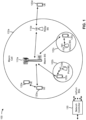
- Fig. 1 is a diagram illustrating an example of a wireless network 100, in accordance with the present disclosure.
- the wireless network 100 may be or may include elements of a 5G (NR) network and/or an LTE network, among other examples.
- the wireless network 100 may include a number of base stations 110 (shown as BS 110a, BS 110b, BS 110c, and BS 110d) and other network entities.
- a base station (BS) is an entity that communicates with user equipment (UEs) and may also be referred to as an "NR BS", a "Node B", a "gNB”, a "5G node B (NB)", "an access point", a "transmit receive point” ("TRP”), or the like.
- Each BS may provide communication coverage for a particular geographic area.
- the term "cell” can refer to a coverage area of a BS and/or a BS subsystem serving this coverage area, depending on the context in which the term is used.
- a BS for a pico cell may be referred to as a pico BS.
- a BS for a femto cell may be referred to as a femto BS or a home BS.
- a BS 110a may be a macro BS for a macro cell 102a
- a BS 110b may be a pico BS for a pico cell 102b
- a BS 110c may be a femto BS for a femto cell 102c.
- a BS may support one or multiple (e.g., three) cells.
- the terms "eNB”, “base station”, “NR BS”, “gNB”, “TRP”, “AP”, “node B", “5G NB”, and “cell” may be used interchangeably herein.
- a cell may not necessarily be stationary, and the geographic area of the cell may move according to the location of a mobile BS.
- the BSs may be interconnected to one another and/or to one or more other BSs or network nodes (not shown) in the wireless network 100 through various types of backhaul interfaces, such as a direct physical connection or a virtual network, using any suitable transport network.
- Wireless network 100 may be a heterogeneous network that includes BSs of different types, such as macro BSs, pico BSs, femto BSs, relay BSs, or the like. These different types of BSs may have different transmit power levels, different coverage areas, and different impacts on interference in wireless network 100. For example, macro BSs may have a high transmit power level (e.g., 5 to 40 watts) whereas pico BSs, femto BSs, and relay BSs may have lower transmit power levels (e.g., 0.1 to 2 watts).
- macro BSs may have a high transmit power level (e.g., 5 to 40 watts)
- pico BSs, femto BSs, and relay BSs may have lower transmit power levels (e.g., 0.1 to 2 watts).
- a network controller 130 may couple to a set of BSs and may provide coordination and control for these BSs.
- Network controller 130 may communicate with the BSs via a backhaul.
- the BSs may also communicate with one another, e.g., directly or indirectly via a wireless or wireline backhaul.
- UEs 120 may be dispersed throughout wireless network 100, and each UE may be stationary or mobile.
- a UE may also be referred to as an access terminal, a terminal, a mobile station, a subscriber unit, a station, or the like.
- a UE may be a cellular phone (e.g., a smart phone), a personal digital assistant (PDA), a wireless modem, a wireless communication device, a handheld device, a laptop computer, a cordless phone, a wireless local loop (WLL) station, a tablet, a camera, a gaming device, a netbook, a smartbook, an ultrabook, a medical device or equipment, biometric sensors/devices, wearable devices (smart watches, smart clothing, smart glasses, smart wrist bands, smart jewelry (e.g., smart ring, smart bracelet)), an entertainment device (e.g., a music or video device, or a satellite radio), a vehicular component or sensor, smart meters/sensors, industrial manufacturing equipment, a global positioning system device, or any other suitable device that is configured to communicate via a wireless or wired medium.
- a cellular phone e.g., a smart phone
- PDA personal digital assistant
- WLL wireless local loop
- Some UEs may be considered machine-type communication (MTC) or evolved or enhanced machine-type communication (eMTC) UEs.
- MTC and eMTC UEs include, for example, robots, drones, remote devices, sensors, meters, monitors, and/or location tags, that may communicate with a base station, another device (e.g., remote device), or some other entity.
- a wireless node may provide, for example, connectivity for or to a network (e.g., a wide area network such as Internet or a cellular network) via a wired or wireless communication link.
- Some UEs may be considered Internet-of-Things (IoT) devices, and/or may be implemented as NB-IoT (narrowband internet of things) devices.
- IoT Internet-of-Things
- NB-IoT narrowband internet of things
- UE 120 may be included inside a housing that houses components of UE 120, such as processor components and/or memory components.
- the processor components and the memory components may be coupled together.
- the processor components e.g., one or more processors
- the memory components e.g., a memory
- the processor components and the memory components may be operatively coupled, communicatively coupled, electronically coupled, and/or electrically coupled.
- any number of wireless networks may be deployed in a given geographic area.
- Each wireless network may support a particular RAT and may operate on one or more frequencies.
- a RAT may also be referred to as a radio technology, an air interface, or the like.
- a frequency may also be referred to as a carrier, a frequency channel, or the like.
- Each frequency may support a single RAT in a given geographic area in order to avoid interference between wireless networks of different RATs.
- NR or 5G RAT networks may be deployed.
- two or more UEs 120 may communicate directly using one or more sidelink channels (e.g., without using a base station 110 as an intermediary to communicate with one another).
- the UEs 120 may communicate using peer-to-peer (P2P) communications, device-to-device (D2D) communications, a vehicle-to-everything (V2X) protocol (e.g., which may include a vehicle-to-vehicle (V2V) protocol or a vehicle-to-infrastructure (V2I) protocol), and/or a mesh network.
- V2X vehicle-to-everything
- the UE 120 may perform scheduling operations, resource selection operations, and/or other operations described elsewhere herein as being performed by the base station 110.
- Devices of wireless network 100 may communicate using the electromagnetic spectrum, which may be subdivided based on frequency or wavelength into various classes, bands, channels, or the like.
- devices of wireless network 100 may communicate using an operating band having a first frequency range (FR1), which may span from 410 MHz to 7.125 GHz, and/or may communicate using an operating band having a second frequency range (FR2), which may span from 24.25 GHz to 52.6 GHz.
- FR1 and FR2 are sometimes referred to as mid-band frequencies.
- FR1 is often referred to as a "sub-6 GHz" band.
- FR2 is often referred to as a "millimeter wave” band despite being different from the extremely high frequency (EHF) band (30 GHz - 300 GHz) which is identified by the International Telecommunications Union (ITU) as a “millimeter wave” band.
- EHF extremely high frequency
- ITU International Telecommunications Union
- sub-6 GHz or the like, if used herein, may broadly represent frequencies less than 6 GHz, frequencies within FR1, and/or mid-band frequencies (e.g., greater than 7.125 GHz).
- millimeter wave may broadly represent frequencies within the EHF band, frequencies within FR2, and/or mid-band frequencies (e.g., less than 24.25 GHz). It is contemplated that the frequencies included in FR1 and FR2 may be modified, and techniques described herein are applicable to those modified frequency ranges.
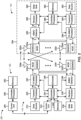
- Fig. 2 is a diagram illustrating an example 200 of a base station 110 in communication with a UE 120 in a wireless network 100, in accordance with the present disclosure.
- Base station 110 may be equipped with T antennas 234a through 234t
- UE 120 may be equipped with R antennas 252a through 252r, where in general T ⁇ 1 and R ⁇ 1.
- a transmit processor 220 may receive data from a data source 212 for one or more UEs, select one or more modulation and coding schemes (MCS) for each UE based at least in part on channel quality indicators (CQIs) received from the UE, process (e.g., encode and modulate) the data for each UE based at least in part on the MCS(s) selected for the UE, and provide data symbols for all UEs. Transmit processor 220 may also process system information (e.g., for semi-static resource partitioning information (SRPI)) and control information (e.g., CQI requests, grants, and/or upper layer signaling) and provide overhead symbols and control symbols.
- MCS modulation and coding schemes
- a transmit processor 264 may receive and process data from a data source 262 and control information (e.g., for reports that include RSRP, RSSI, RSRQ, and/or CQI) from controller/processor 280. Transmit processor 264 may also generate reference symbols for one or more reference signals. The symbols from transmit processor 264 may be precoded by a TX MIMO processor 266 if applicable, further processed by modulators 254a through 254r (e.g., for DFT-s-OFDM or CP-OFDM), and transmitted to base station 110.
- control information e.g., for reports that include RSRP, RSSI, RSRQ, and/or CQI
- Transmit processor 264 may also generate reference symbols for one or more reference signals.
- the symbols from transmit processor 264 may be precoded by a TX MIMO processor 266 if applicable, further processed by modulators 254a through 254r (e.g., for DFT-s-OFDM or CP-OFDM
- the uplink signals from UE 120 and other UEs may be received by antennas 234, processed by demodulators 232, detected by a MIMO detector 236 if applicable, and further processed by a receive processor 238 to obtain decoded data and control information sent by UE 120.
- Receive processor 238 may provide the decoded data to a data sink 239 and the decoded control information to controller/processor 240.
- Base station 110 may include communication unit 244 and communicate to network controller 130 via communication unit 244.
- Base station 110 may include a scheduler 246 to schedule UEs 120 for downlink and/or uplink communications.
- a modulator and a demodulator (e.g., MOD/DEMOD 232) of the base station 110 may be included in a modem of the base station 110.
- the base station 110 includes a transceiver.
- the transceiver may include any combination of antenna(s) 234, modulators and/or demodulators 232, MIMO detector 236, receive processor 238, transmit processor 220, and/or TX MIMO processor 230.
- the transceiver may be used by a processor (e.g., controller/processor 240) and memory 242 to perform aspects of any of the methods described herein, for example, as described with reference to Figs. 3-7 .
- Controller/processor 240 of base station 110, controller/processor 280 of UE 120, and/or any other component(s) of Fig. 2 may perform one or more techniques associated with flexible time division duplexing (TDD) configuration, as described in more detail elsewhere herein.
- controller/processor 240 of base station 110, controller/processor 280 of UE 120, and/or any other component(s) of Fig. 2 may perform or direct operations of, for example, process 400 of Fig. 4 , process 500 of Fig. 5 , process 600 of Fig. 6 , process 700 of Fig. 7 , and/or other processes as described herein.
- Memories 242 and 282 may store data and program codes for base station 110 and UE 120, respectively.
- memory 242 and/or memory 282 may include a non-transitory computer-readable medium storing one or more instructions (e.g., code and/or program code) for wireless communication.
- the one or more instructions when executed (e.g., directly, or after compiling, converting, and/or interpreting) by one or more processors of the base station 110 and/or the UE 120, may cause the one or more processors, the UE 120, and/or the base station 110 to perform or direct operations of, for example, process 400 of Fig. 4 , process 500 of Fig. 5 , process 600 of Fig. 6 , process 700 of Fig. 7 , and/or other processes as described herein.
- executing instructions may include running the instructions, converting the instructions, compiling the instructions, and/or interpreting the instructions, among other examples.
- a BS includes means for selecting, from a plurality of slot formats for supporting time division duplexing, a slot format for use during time division duplexing; means for transmitting an information element that includes a half-slot slot-type to identify the slot format for use during time division duplexing; or means for communicating with a UE in a time division duplexing mode in accordance with the slot format.
- the means for the BS to perform operations described herein may include, for example, one or more of transmit processor 220, TX MIMO processor 230, modulator 232, antenna 234, demodulator 232, MIMO detector 236, receive processor 238, controller/processor 240, memory 242, or scheduler 246.
- a UE includes means for receiving an information element that includes a half-slot or full-slot slot-type to identify a slot format, of a plurality of slot formats for supporting time division duplexing, for use during time division duplexing; means for selecting the slot format for use during time division duplexing based at least in part on whether the information element includes the half-slot or full-slot slot-type to identify the slot format; or means for communicating with a BS in a time division duplexing mode in accordance with the slot format.
- the means for the UE to perform operations described herein may include, for example, one or more of antenna 252, demodulator 254, MIMO detector 256, receive processor 258, transmit processor 264, TX MIMO processor 266, modulator 254, controller/processor 280, or memory 282.
- a BS includes means for transmitting an information element identifying a slot format pattern for use during time division duplexing, wherein a length of, or indicated by, a parameter of the information element satisfies a threshold that is based at least in part on a periodicity of the slot format pattern; or means for communicating with a UE in a TDD mode in accordance with the slot format pattern.
- the means for the base station to perform operations described herein may include, for example, one or more of transmit processor 220, TX MIMO processor 230, modulator 232, antenna 234, demodulator 232, MIMO detector 236, receive processor 238, controller/processor 240, memory 242, or scheduler 246.
- the BS includes means for receiving an information element identifying a slot format pattern for use during time division duplexing, wherein a length of, or indicated by, a parameter of the information element satisfies a threshold that is based at least in part on a periodicity of the slot format pattern; or means for communicating with a UE or BS in a TDD mode in accordance with the slot format pattern.
- the means for the base station to perform operations described herein may include, for example, one or more of transmit processor 220, TX MIMO processor 230, modulator 232, antenna 234, demodulator 232, MIMO detector 236, receive processor 238, controller/processor 240, memory 242, or scheduler 246.
- While blocks in Fig. 2 are illustrated as distinct components, the functions described above with respect to the blocks may be implemented in a single hardware, software, or combination component or in various combinations of components.
- the functions described with respect to the transmit processor 264, the receive processor 258, and/or the TX MIMO processor 266 may be performed by or under the control of controller/processor 280.
- Fig. 2 is provided as an example. Other examples may differ from what is described with regard to Fig. 2 .
- a plurality of different TDD uplink (UL) downlink (DL) (UL-DL) configurations may be possible.
- Each TDD UL-DL configuration may have an associated set of slot formats for a plurality of symbols during a communication cycle.
- symbols may be assigned as downlink symbols (D), uplink symbols (U), flexible symbols (F), and/or the like, as shown in Third Generation Partnership Project (3GPP) Technical Specification (TS) 38.213 Table 11.1.1-1 Slot Formats For Normal Cyclic Prefix.
- the slot format table includes an all downlink symbol format (Format 0), an all uplink symbol format (Format 1), and an all flexible symbol format (Format 2).
- Formats 3 through 55 include different combinations of at least one flexible symbol and one or more uplink symbols and/or downlink symbols.
- a BS may transmit an information element (IE), such as an "Intended TDD DL-UL Configuration NR" information element to establish a slot format for communications.
- IE information element
- the defined information element may support enumeration of slot formats 0-45 of the aforementioned slot format table.
- the defined information element does not support indication of slot formats 46-55.
- slot formats 46-53 and 55 include a plurality of DL-UL direction switches, which may result in the information element including insufficient bits to indicate the slot format.
- slot format 54 neither starts with a downlink symbol nor ends with an uplink symbol (slot format 54 starts with a flexible symbol and ends with a downlink symbol), which may necessitate a greater quantity of bits to identify than are available in the defined information element.
- other possible slot formats may be defined for a communication system, which may not be identifiable using the defined information element. By restricting a set of slot formats that may be configured for a communication system, a flexibility to adapt to network traffic conditions is restricted, thereby reducing network efficiency, network performance, and/or the like.
- a BS may transmit an information element that includes slot format configuration information for either a full-slot slot-type or a half-slot slot-type.
- the UE may interpret the information element to be either identifying a full-slot slot-type or a half-slot slot-type and may identify the slot format based at least in part on whether the information element identifies a full-slot slot-type or a half-slot slot-type.
- the BS and the UE enable the information element to identify each slot format of the aforementioned slot format table, as well as other possible slot formats to provide additional flexibility to network communications.
- the BS may provide the information element to another BS, to a node in a hierarchical network, and/or the like, thereby providing flexibility for TDD configuration in other types of deployments.
- Fig. 3 is a diagram illustrating an example 300 of flexible TDD configuration, in accordance with various aspects of the present disclosure. As shown in Fig. 3 , example 300 includes a BS 110 and a UE 120.
- BS 110 may transmit an information element to UE 120.
- BS 110 may determine a slot format that UE 120 is to use for communication and may transmit an information element to convey information identifying the slot format.
- BS 110 may transmit the information element to UE 120 to identify the slot format.
- BS 110 may transmit the information element to UE 120 to enable UE 120 to determine the slot format.
- BS 110 may transmit the information element to another BS 110, a child node (e.g., in an integrated access and backhauling (IAB) deployment), and/or the like.
- IAB integrated access and backhauling
- BS 110 may transmit the information element on an Xn application protocol (AP) interface, an F1-AP interface, and/or the like. Additionally, or alternatively, BS 110 may transmit the information element using radio resource control (RRC) signaling, system information block (SIB) signaling, and/or the like.
- RRC radio resource control
- SIB system information block
- BS 110 may be associated with a plurality of cells, a plurality of distributed units (DUs) each with one or more cells, and/or the like.
- BS 110 may be a central unit (CU) with a plurality of DUs, and each DU may have a plurality of cells.
- BS 110 may indicate a TDD UL-DL configuration at a node level (e.g., a DU level or at a cell level) by including information identifying the slot format (e.g., the information element) in a configuration message.
- BS 110 may provide information identifying the slot format in an Xn-AP configuration update message, an Xn-AP configuration update acknowledgement message, an Xn setup request message, an Xn setup response message, and/or the like. Additionally, or alternatively, BS 110 may provide the information identifying the slot format in an F1-AP CU configuration update message, an F1-AP DU configuration update message, and/or the like. In some aspects, BS 110 may identify the slot format on for a particular frequency carrier.
- BS 110 may transmit the information element with a particular slot-type for identifying the slot format. For example, BS 110 may transmit the information element with a half-slot slot-type, which may enable BS 110 to identify a plurality of different slot formats, such as each slot format of the aforementioned slot format table. Additionally, or alternatively, BS 110 may transmit the information element with a full-slot slot-type, which may enable identification of a subset of slot formats of the plurality of different slot formats. Additionally, or alternatively, BS 110 may transmit the information element with the full-slot slot-type to provide backwards compatibility with some UEs 120 that are not configured for using an information element with a half-slot slot-type in the information element.
- UE 120 may determine a slot format based at least in part on the information element. For example, UE 120 may interpret the information element to identify a slot format identified by the information element. In some aspects, UE 120 may determine whether the information element includes a full-slot slot-type or a half-slot slot-type. For example, UE 120 may determine whether the information element includes the full-slot slot-type or the half-slot slot-type based at least in part on a subcarrier spacing (SCS), a transmission periodicity, a length of, or indicated by, a slot configuration list, and/or the like.
- SCS subcarrier spacing
- UE 120 may determine whether (SCS/15 kilohertz (kHz)) * NR DL-UL Transmission Periodicity parameter is equal to the length of a slot configuration list (the information element includes a full-slot slot-type) or is less than the length of the slot configuration list (the information element includes a half-slot slot-type). In this case, based at least in part on whether the information element includes the full-slot slot-type or the half-slot slot-type, UE 120 may determine which slot format UE 120 is to use to communicate with BS 110.
- the length of, or indicated by, the slot configuration list identifying a slot format pattern may be extended to support additional TDD UL-DL transmission periodicities.
- BS 110 may transmit an information element with an extended slot configuration list to support transmission periodicities of between 10 milliseconds (ms) and 160 ms.
- a maximum quantity of slots may be extended to 5120 from a maximum quantity of slots of 320 that is used for 10 ms periodicities. This may improve network performance relative to other maximum lengths of a slot configuration list.
- a maximumnoofslots parameter may be set to 320, which may support full flexibility for a 10 ms UL-DL transmission periodicity. However, by setting the parameter, maximumnoofslots , to 5120, full flexibility may be achieved for a 160 ms UL-DL transmission periodicity.
- UE 120 may communicate with BS 110 in accordance with the identified slot format. For example, UE 120 may transmit on an uplink during an uplink symbol or a flexible symbol, receive on a downlink during a downlink symbol or a flexible symbol, and/or the like.
- Fig. 3 is provided as an example. Other examples may differ from what is described with respect to Fig. 3 .
- Fig. 4 is a diagram illustrating an example process 400 performed, for example, by a BS or another network element, in accordance with various aspects of the present disclosure.
- Example process 400 is an example where the BS (e.g., BS 110 and/or the like) performs operations associated with flexible TDD configuration.
- the BS e.g., BS 110 and/or the like
- process 400 may include selecting, from a plurality of slot formats for supporting time division duplexing, a slot format for use during time division duplexing (block 410).
- the BS e.g., using transmit processor 220, receive processor 238, controller/processor 240, memory 242, and/or the like
- process 400 may include transmitting an information element that includes a half-slot slot-type to identify the slot format for use during time division duplexing (block 420).
- the BS e.g., using transmit processor 220, receive processor 238, controller/processor 240, memory 242, and/or the like
- process 400 may include communicating with a UE in a time division duplexing mode in accordance with the slot format (block 430).
- the BS e.g., using transmit processor 220, receive processor 238, controller/processor 240, memory 242, and/or the like
- Process 400 may include additional aspects, such as any single aspect or any combination of aspects described below and/or in connection with one or more other processes described elsewhere herein.
- a maximum number of slots in a slot configuration list of the information element includes a threshold quantity of slots associated with a set of periodicities of the plurality of slot formats.
- the information element is an Xn- AP or F 1-AP information element.
- the information element is a radio resource control information element.
- the slot format is indicated, in the information element, at a node level or a cell level.
- the information element is included in at least one of a configuration update message, a configuration update acknowledgement message, a setup request message, or a setup response message.
- process 500 may include selecting the slot format for use during time division duplexing based at least in part on whether the information element includes the half-slot or full-slot slot-type to identify the slot format (block 520).
- the UE e.g., using receive processor 258, transmit processor 264, controller/processor 280, memory 282, and/or the like
- process 500 may include communicating with a BS in a time division duplexing mode in accordance with the slot format (block 530).
- the UE e.g., using receive processor 258, transmit processor 264, controller/processor 280, memory 282, and/or the like
- process 500 includes determining the information element includes the half-slot or full-slot slot-type to identify the slot format based at least in part on at least one of a length of, or indicated by, a slot configuration list of the information element, a subcarrier spacing, or a transmission periodicity.
- a maximum number of slots in a slot configuration list of the information element includes a threshold quantity of slots associated with a set of periodicities of the plurality of slot formats.
- the information element is an Xn AP or F1-AP information element.
- the information element is a radio resource control information element.
- the slot format is indicated, in the information element, at a node level or a cell level.
- the information element is included in at least one of a configuration update message, a configuration update acknowledgement message, a setup request message, or a setup response message.
- process 500 may include additional blocks, fewer blocks, different blocks, or differently arranged blocks than those depicted in Fig. 5 . Additionally, or alternatively, two or more of the blocks of process 500 may be performed in parallel.
- Fig. 6 is a diagram illustrating an example process 600 performed, for example, by a BS or another network element, in accordance with the present disclosure.
- Example process 600 is an example where the BS (e.g., BS 110) performs operations associated with flexible time division duplexing configuration.
- process 600 may include transmitting an information element identifying a slot format pattern for use during time division duplexing, wherein a length of, or indicated by, a parameter of the information element satisfies a threshold that is based at least in part on a periodicity of the slot format pattern (block 610).
- the BS e.g., using transmission component 804, depicted in Fig. 8
- the BS may select a slot format pattern for use during TDD based at least in part on whether the information element includes a half-slot or full-slot slot-type to identify the slot format pattern.
- process 600 may include communicating with a UE or BS (or another network element) in a TDD mode in accordance with the slot format pattern (block 620).
- the BS e.g., using reception component 802 and/or transmission component 804, depicted in Fig. 8
- Process 600 may include additional aspects, such as any single aspect or any combination of aspects described below and/or in connection with one or more other processes described elsewhere herein.
- the periodicity is a 160 millisecond TDD UL/DL periodicity.
- the length of the parameter or indicated by the parameter is up to 5120.
- the parameter is a slot configuration list length.
- the parameter is a maximum number of slots parameter.
- the information element is an Xn- AP or F1-AP information element.
- the information element is a radio resource control information element.
- the slot format pattern is indicated, in the information element, at a node level or a cell level.
- the information element is included in at least one of a configuration update message, a configuration update acknowledgement message, a setup request message, or a setup response message.
- process 600 may include additional blocks, fewer blocks, different blocks, or differently arranged blocks than those depicted in Fig. 6 . Additionally, or alternatively, two or more of the blocks of process 600 may be performed in parallel.
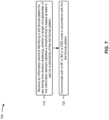
- Fig. 7 is a diagram illustrating an example process 700 performed, for example, by a BS or another network element, in accordance with the present disclosure.
- Example process 700 is an example where the BS (e.g., BS 110) performs operations associated with flexible time division duplexing configuration.
- process 700 may include receiving an information element identifying a slot format pattern for use during time division duplexing, wherein a length of, or indicated by, a parameter of the information element satisfies a threshold that is based at least in part on a periodicity of the slot format pattern (block 710).
- the BS e.g., using reception component 802, depicted in Fig. 8
- the BS may select a slot format pattern for use during TDD based at least in part on whether the information element includes a half-slot or full-slot slot-type to identify the slot format pattern.
- process 700 may include communicating with a UE or BS (or another network element) in a TDD mode in accordance with the slot format pattern (block 720).
- the BS e.g., using reception component 802 and/or transmission component 804, depicted in Fig. 8
- Process 700 may include additional aspects, such as any single aspect or any combination of aspects described below and/or in connection with one or more other processes described elsewhere herein.
- the periodicity is a 160 ms TDD UL/DL periodicity.
- the length of the parameter or indicated by the parameter is up to 5120.
- the parameter is a slot configuration list length.
- the parameter is a maximum number of slots parameter.
- the information element is included in at least one of a configuration update message, a configuration update acknowledgement message, a setup request message, or a setup response message.
- the information element is an Xn AP or F1-AP information element.
- the information element is a radio resource control information element.
- process 700 may include additional blocks, fewer blocks, different blocks, or differently arranged blocks than those depicted in Fig. 7 . Additionally, or alternatively, two or more of the blocks of process 700 may be performed in parallel.
- Fig. 8 is a block diagram of an example apparatus 800 for wireless communication.
- the apparatus 800 may be a BS, or a BS may include the apparatus 800.
- the apparatus 800 includes a reception component 802 and a transmission component 804, which may be in communication with one another (for example, via one or more buses and/or one or more other components).
- the apparatus 800 may communicate with another apparatus 806 (such as a UE, a base station, or another wireless communication device) using the reception component 802 and the transmission component 804.
- the apparatus 800 may include a selection component 808, among other examples.
- the apparatus 800 may be configured to perform one or more operations described herein in connection with Fig. 3 . Additionally, or alternatively, the apparatus 800 may be configured to perform one or more processes described herein, such as process 400 of Fig. 4 , process 600 of Fig. 6 , process 700 of Fig. 7 , or a combination thereof.
- the apparatus 800 and/or one or more components shown in Fig. 8 may include one or more components of the BS described above in connection with Fig. 2 . Additionally, or alternatively, one or more components shown in Fig. 8 may be implemented within one or more components described above in connection with Fig. 2 . Additionally, or alternatively, one or more components of the set of components may be implemented at least in part as software stored in a memory. For example, a component (or a portion of a component) may be implemented as instructions or code stored in a non-transitory computer-readable medium and executable by a controller or a processor to perform the functions or operations of the component.
- the reception component 802 may receive communications, such as reference signals, control information, data communications, or a combination thereof, from the apparatus 806.
- the reception component 802 may provide received communications to one or more other components of the apparatus 800.
- the reception component 802 may perform signal processing on the received communications (such as filtering, amplification, demodulation, analog-to-digital conversion, demultiplexing, deinterleaving, de-mapping, equalization, interference cancellation, or decoding, among other examples), and may provide the processed signals to the one or more other components of the apparatus 806.
- the reception component 802 may include one or more antennas, a demodulator, a MIMO detector, a receive processor, a controller/processor, a memory, or a combination thereof, of the BS described above in connection with Fig. 2 .
- the transmission component 804 may transmit communications, such as reference signals, control information, data communications, or a combination thereof, to the apparatus 806.
- one or more other components of the apparatus 806 may generate communications and may provide the generated communications to the transmission component 804 for transmission to the apparatus 806.
- the transmission component 804 may perform signal processing on the generated communications (such as filtering, amplification, modulation, digital-to-analog conversion, multiplexing, interleaving, mapping, or encoding, among other examples), and may transmit the processed signals to the apparatus 806.
- the transmission component 804 may include one or more antennas, a modulator, a transmit MIMO processor, a transmit processor, a controller/processor, a memory, or a combination thereof, of the BS described above in connection with Fig. 2 . In some aspects, the transmission component 804 may be co-located with the reception component 802 in a transceiver.
- the selection component 808 may select, from a plurality of slot format patterns for supporting time division duplexing, a slot format for use during time division duplexing.
- the transmission component 804 may transmit an information element that includes a half-slot slot-type to identify the slot format for use during time division duplexing.
- the reception component 802 and/or the transmission component 804 may communicate with a UE, such as the apparatus 806, in a TDD mode in accordance with the slot format.
- the transmission component 804 may transmit an information element identifying a slot format pattern for use during time division duplexing, wherein a length of, or indicated by, a parameter of the information element satisfies a threshold that is based at least in part on a periodicity of the slot format pattern.
- the reception component may receive an information element identifying a slot format pattern for use during time division duplexing.
- Fig. 8 The number and arrangement of components shown in Fig. 8 are provided as an example. In practice, there may be additional components, fewer components, different components, or differently arranged components than those shown in Fig. 8 . Furthermore, two or more components shown in Fig. 8 may be implemented within a single component, or a single component shown in Fig. 8 may be implemented as multiple, distributed components. Additionally, or alternatively, a set of (one or more) components shown in Fig. 8 may perform one or more functions described as being performed by another set of components shown in Fig. 8 .
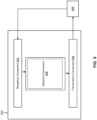
- Fig. 9 is a block diagram of an example apparatus 900 for wireless communication.
- the apparatus 900 may be a UE, or a UE may include the apparatus 900.
- the apparatus 900 includes a reception component 902 and a transmission component 904, which may be in communication with one another (for example, via one or more buses and/or one or more other components).
- the apparatus 900 may communicate with another apparatus 906 (such as a UE, a base station, or another wireless communication device) using the reception component 902 and the transmission component 904.
- the apparatus 900 may include a selection component 908, among other examples.
- the apparatus 900 may be configured to perform one or more operations described herein in connection with Fig. 3 . Additionally, or alternatively, the apparatus 900 may be configured to perform one or more processes described herein, such as process 500 of Fig. 5 .
- the apparatus 900 and/or one or more components shown in Fig. 9 may include one or more components of the UE described above in connection with Fig. 2 . Additionally, or alternatively, one or more components shown in Fig. 9 may be implemented within one or more components described above in connection with Fig. 2 . Additionally, or alternatively, one or more components of the set of components may be implemented at least in part as software stored in a memory. For example, a component (or a portion of a component) may be implemented as instructions or code stored in a non-transitory computer-readable medium and executable by a controller or a processor to perform the functions or operations of the component.
- the reception component 902 may receive communications, such as reference signals, control information, data communications, or a combination thereof, from the apparatus 906.
- the reception component 902 may provide received communications to one or more other components of the apparatus 900.
- the reception component 902 may perform signal processing on the received communications (such as filtering, amplification, demodulation, analog-to-digital conversion, demultiplexing, deinterleaving, de-mapping, equalization, interference cancellation, or decoding, among other examples), and may provide the processed signals to the one or more other components of the apparatus 906.
- the reception component 902 may include one or more antennas, a demodulator, a MIMO detector, a receive processor, a controller/processor, a memory, or a combination thereof, of the UE described above in connection with Fig. 2 .
- the transmission component 904 may transmit communications, such as reference signals, control information, data communications, or a combination thereof, to the apparatus 906.
- one or more other components of the apparatus 906 may generate communications and may provide the generated communications to the transmission component 904 for transmission to the apparatus 906.
- the transmission component 904 may perform signal processing on the generated communications (such as filtering, amplification, modulation, digital-to-analog conversion, multiplexing, interleaving, mapping, or encoding, among other examples), and may transmit the processed signals to the apparatus 906.
- the transmission component 904 may include one or more antennas, a modulator, a transmit MIMO processor, a transmit processor, a controller/processor, a memory, or a combination thereof, of the UE described above in connection with Fig. 2 .
- the transmission component 904 may be co-located with the reception component 902 in a transceiver.
- the reception component 902 may receive an information element that includes a half-slot or full-slot slot-type to identify a slot format, of a plurality of slot formats for supporting time division duplexing, for use during time division duplexing.
- the selection component 908 may select the slot format for use during time division duplexing based at least in part on whether the information element includes the half-slot or full-slot slot-type to identify the slot format.
- the reception component 902 and/or the transmission component 904 may communicate with a base station in a time division duplexing mode in accordance with the slot format.
- the selection component 908 may determine the information element includes the half-slot or full-slot slot-type to identify the slot format based at least in part on at least one of a length of, or indicated by, a slot configuration list of the information element, a subcarrier spacing, or a transmission periodicity.
- the reception component 902 may receive an information element identifying a slot format for use during time division duplexing, wherein a length of, or indicated by, a parameter of the information element satisfies a threshold that is based at least in part on a periodicity of the slot format.
- Fig. 9 The number and arrangement of components shown in Fig. 9 are provided as an example. In practice, there may be additional components, fewer components, different components, or differently arranged components than those shown in Fig. 9 . Furthermore, two or more components shown in Fig. 9 may be implemented within a single component, or a single component shown in Fig. 9 may be implemented as multiple, distributed components. Additionally, or alternatively, a set of (one or more) components shown in Fig. 9 may perform one or more functions described as being performed by another set of components shown in Fig. 9 .
- the term "component” is intended to be broadly construed as hardware and/or a combination of hardware and software.
- Software shall be construed broadly to mean instructions, instruction sets, code, code segments, program code, programs, subprograms, software modules, applications, software applications, software packages, routines, subroutines, objects, executables, threads of execution, procedures, and/or functions, among other examples, whether referred to as software, firmware, middleware, microcode, hardware description language, or otherwise.
- a processor is implemented in hardware and/or a combination of hardware and software. It will be apparent that systems and/or methods described herein may be implemented in different forms of hardware and/or a combination of hardware and software.
- satisfying a threshold may, depending on the context, refer to a value being greater than the threshold, greater than or equal to the threshold, less than the threshold, less than or equal to the threshold, equal to the threshold, not equal to the threshold, or the like.
- "at least one of: a, b, or c” is intended to cover a, b, c, a-b, a-c, b-c, and a-b-c, as well as any combination with multiples of the same element (e.g., a-a, a-a-a, a-a-b, a-a-c, a-b-b, a-c-c, b-b, b-b-b, b-b-c, c-c, and c-c-c or any other ordering of a, b, and c).
- the terms “has,” “have,” “having,” or the like are intended to be open-ended terms. Further, the phrase “based on” is intended to mean “based, at least in part, on” unless explicitly stated otherwise. Also, as used herein, the term “or” is intended to be inclusive when used in a series and may be used interchangeably with “and/or,” unless explicitly stated otherwise (e.g., if used in combination with “either” or “only one of”).
Landscapes
- Engineering & Computer Science (AREA)
- Signal Processing (AREA)
- Computer Networks & Wireless Communication (AREA)
- Mobile Radio Communication Systems (AREA)
- Bidirectional Digital Transmission (AREA)
Applications Claiming Priority (3)
| Application Number | Priority Date | Filing Date | Title |
|---|---|---|---|
| PCT/CN2020/083860 WO2021203339A1 (en) | 2020-04-09 | 2020-04-09 | Flexible time division duplexing configuration |
| EP21784705.2A EP4133856B1 (de) | 2020-04-09 | 2021-04-09 | Flexible zeitduplex-konfiguration |
| PCT/CN2021/086152 WO2021204240A1 (en) | 2020-04-09 | 2021-04-09 | Flexible time division duplexing configuration |
Related Parent Applications (2)
| Application Number | Title | Priority Date | Filing Date |
|---|---|---|---|
| EP21784705.2A Division-Into EP4133856B1 (de) | 2020-04-09 | 2021-04-09 | Flexible zeitduplex-konfiguration |
| EP21784705.2A Division EP4133856B1 (de) | 2020-04-09 | 2021-04-09 | Flexible zeitduplex-konfiguration |
Publications (2)
| Publication Number | Publication Date |
|---|---|
| EP4546697A2 true EP4546697A2 (de) | 2025-04-30 |
| EP4546697A3 EP4546697A3 (de) | 2025-06-11 |
Family
ID=78022501
Family Applications (2)
| Application Number | Title | Priority Date | Filing Date |
|---|---|---|---|
| EP21784705.2A Active EP4133856B1 (de) | 2020-04-09 | 2021-04-09 | Flexible zeitduplex-konfiguration |
| EP25164032.2A Pending EP4546697A3 (de) | 2020-04-09 | 2021-04-09 | Flexible zeitduplexkonfiguration |
Family Applications Before (1)
| Application Number | Title | Priority Date | Filing Date |
|---|---|---|---|
| EP21784705.2A Active EP4133856B1 (de) | 2020-04-09 | 2021-04-09 | Flexible zeitduplex-konfiguration |
Country Status (4)
| Country | Link |
|---|---|
| US (2) | US12341730B2 (de) |
| EP (2) | EP4133856B1 (de) |
| CN (2) | CN121098465A (de) |
| WO (2) | WO2021203339A1 (de) |
Families Citing this family (1)
| Publication number | Priority date | Publication date | Assignee | Title |
|---|---|---|---|---|
| EP4611425A4 (de) * | 2023-02-10 | 2025-12-31 | New H3C Tech Co Ltd | Verfahren und vorrichtung zur messung von querverbindungsinterferenzen, basisstation und steuergerät |
Family Cites Families (13)
| Publication number | Priority date | Publication date | Assignee | Title |
|---|---|---|---|---|
| US10660090B2 (en) | 2017-06-26 | 2020-05-19 | Qualcomm Incorporated | Slot format indicator signaling in wireless communication systems |
| US11290987B2 (en) | 2017-08-04 | 2022-03-29 | Qualcomm Incorporated | Slot structure linkage in wireless systems |
| US10938635B2 (en) | 2017-09-15 | 2021-03-02 | Huawei Technologies Co., Ltd. | Systems and methods for configuring slot formats with multiple switching points per slot |
| EP3716703B1 (de) * | 2017-11-24 | 2022-09-07 | Guangdong Oppo Mobile Telecommunications Corp., Ltd. | Datenübertragungsverfahren, endgerätevorrichtung und netzwerkvorrichtung |
| US10728895B2 (en) * | 2017-12-01 | 2020-07-28 | Qualcomm Incorporated | Slot format indicator in frequency division duplexing |
| US11025456B2 (en) | 2018-01-12 | 2021-06-01 | Apple Inc. | Time domain resource allocation for mobile communication |
| EP3567789B1 (de) * | 2018-05-11 | 2020-11-25 | ASUSTek Computer Inc. | Verfahren und vorrichtung zur bestimmung der schlitzkonfiguration in einem drahtloskommunikationssystem |
| JP7227987B2 (ja) * | 2018-06-04 | 2023-02-22 | ノキア テクノロジーズ オサケユイチア | NR TDD無線フレーム構成およびCLI感度のgNB間Xnシグナリング |
| US11153872B2 (en) | 2018-07-31 | 2021-10-19 | Asustek Computer Inc. | Method and apparatus for indicating slot format of an unlicensed cell in a wireless communication system |
| WO2020027615A1 (en) * | 2018-08-02 | 2020-02-06 | Lg Electronics Inc. | Method and communication device for performing measurement |
| PL3834337T3 (pl) * | 2018-08-10 | 2023-08-28 | Telefonaktiebolaget Lm Ericsson (Publ) | Przyznanie szeregowania łącza wstępującego dla wielu fizycznych kanałów współdzielonych łącza wstępującego |
| US10945264B2 (en) * | 2018-08-10 | 2021-03-09 | Asustek Computer Inc. | Method and apparatus for applying slot format indication (SFI) to a cell in unlicensed spectrum in a wireless communication system |
| US10951386B2 (en) * | 2018-09-20 | 2021-03-16 | At&T Intellectual Property I, L.P. | Indication of interoperability and deployment tested time-division duplex slot formats |
-
2020
- 2020-04-09 WO PCT/CN2020/083860 patent/WO2021203339A1/en not_active Ceased
-
2021
- 2021-04-09 EP EP21784705.2A patent/EP4133856B1/de active Active
- 2021-04-09 EP EP25164032.2A patent/EP4546697A3/de active Pending
- 2021-04-09 WO PCT/CN2021/086152 patent/WO2021204240A1/en not_active Ceased
- 2021-04-09 US US17/904,770 patent/US12341730B2/en active Active
- 2021-04-09 CN CN202511433948.0A patent/CN121098465A/zh active Pending
- 2021-04-09 CN CN202180023523.6A patent/CN115316019B/zh active Active
-
2025
- 2025-05-16 US US19/210,369 patent/US20250343668A1/en active Pending
Also Published As
| Publication number | Publication date |
|---|---|
| WO2021204240A1 (en) | 2021-10-14 |
| EP4133856A1 (de) | 2023-02-15 |
| US12341730B2 (en) | 2025-06-24 |
| EP4133856B1 (de) | 2025-10-29 |
| US20230040309A1 (en) | 2023-02-09 |
| CN121098465A (zh) | 2025-12-09 |
| WO2021203339A1 (en) | 2021-10-14 |
| US20250343668A1 (en) | 2025-11-06 |
| EP4133856A4 (de) | 2024-04-10 |
| CN115316019A (zh) | 2022-11-08 |
| EP4546697A3 (de) | 2025-06-11 |
| CN115316019B (zh) | 2025-10-28 |
Similar Documents
| Publication | Publication Date | Title |
|---|---|---|
| US11864238B2 (en) | Mapping aspects of random access channel procedure | |
| EP4169196B1 (de) | Downlink-steuerungsinformationen zur anzeige des frequenzdomänen-schlitzformats | |
| EP4397115A2 (de) | Bandbreitenteilspezifische downlink-uplink-muster | |
| EP4315974B1 (de) | Wiederholungen eines gemeinsam genutzten physikalischen uplink-kanals während der übergabe | |
| US11943748B2 (en) | Dynamic determination of available slots for transmission of sounding reference signal (SRS) information | |
| WO2022236729A1 (en) | Rate matching for full duplex communications | |
| WO2021243355A1 (en) | Physical uplink control channel transmission for low latency communication deployments | |
| US20250343668A1 (en) | Flexible time division duplexing configuration | |
| US11706660B2 (en) | Sidelink and UU link buffer status report | |
| WO2021232033A1 (en) | Time division duplexing downlink-uplink configuration signaling | |
| EP4278801B1 (de) | Wiederholung eines physikalischen downlink-steuerkanals bei umschaltung eines suchraumsatzes | |
| WO2022205410A1 (en) | Channel measurements in channel sensing contention slots | |
| WO2022056553A1 (en) | Multiplexing or prioritization of conflicting transmissions | |
| US11647509B2 (en) | Gap between downlink control information and corresponding downlink and uplink communications | |
| US12069674B2 (en) | Downlink and uplink scheduling using resource configurations | |
| WO2022135452A1 (en) | Dynamic determination of available slots for transmission of sounding reference signal (srs) information | |
| KR20230026329A (ko) | 사용자 장비에 대해 구성된 디폴트 대역폭의 함수로서의 대역폭 부분에 걸친 디폴트 빔 동작 |
Legal Events
| Date | Code | Title | Description |
|---|---|---|---|
| PUAI | Public reference made under article 153(3) epc to a published international application that has entered the european phase |
Free format text: ORIGINAL CODE: 0009012 |
|
| STAA | Information on the status of an ep patent application or granted ep patent |
Free format text: STATUS: REQUEST FOR EXAMINATION WAS MADE |
|
| 17P | Request for examination filed |
Effective date: 20250317 |
|
| AC | Divisional application: reference to earlier application |
Ref document number: 4133856 Country of ref document: EP Kind code of ref document: P |
|
| AK | Designated contracting states |
Kind code of ref document: A2 Designated state(s): AL AT BE BG CH CY CZ DE DK EE ES FI FR GB GR HR HU IE IS IT LI LT LU LV MC MK MT NL NO PL PT RO RS SE SI SK SM TR |
|
| PUAL | Search report despatched |
Free format text: ORIGINAL CODE: 0009013 |
|
| AK | Designated contracting states |
Kind code of ref document: A3 Designated state(s): AL AT BE BG CH CY CZ DE DK EE ES FI FR GB GR HR HU IE IS IT LI LT LU LV MC MK MT NL NO PL PT RO RS SE SI SK SM TR |
|
| RIC1 | Information provided on ipc code assigned before grant |
Ipc: H04W 72/0446 20230101ALI20250502BHEP Ipc: H04L 5/14 20060101ALI20250502BHEP Ipc: H04L 5/00 20060101AFI20250502BHEP |
|
| GRAP | Despatch of communication of intention to grant a patent |
Free format text: ORIGINAL CODE: EPIDOSNIGR1 |
|
| STAA | Information on the status of an ep patent application or granted ep patent |
Free format text: STATUS: GRANT OF PATENT IS INTENDED |