EP4546760A1 - Procédé d'appel, dispositif d'appel et support d'informations - Google Patents
Procédé d'appel, dispositif d'appel et support d'informations Download PDFInfo
- Publication number
- EP4546760A1 EP4546760A1 EP24173883.0A EP24173883A EP4546760A1 EP 4546760 A1 EP4546760 A1 EP 4546760A1 EP 24173883 A EP24173883 A EP 24173883A EP 4546760 A1 EP4546760 A1 EP 4546760A1
- Authority
- EP
- European Patent Office
- Prior art keywords
- incoming call
- call
- apparatuses
- eligible
- request
- Prior art date
- Legal status (The legal status is an assumption and is not a legal conclusion. Google has not performed a legal analysis and makes no representation as to the accuracy of the status listed.)
- Pending
Links
Images


Classifications
-
- H—ELECTRICITY
- H04—ELECTRIC COMMUNICATION TECHNIQUE
- H04M—TELEPHONIC COMMUNICATION
- H04M1/00—Substation equipment, e.g. for use by subscribers
- H04M1/006—Call diverting means
-
- H—ELECTRICITY
- H04—ELECTRIC COMMUNICATION TECHNIQUE
- H04M—TELEPHONIC COMMUNICATION
- H04M3/00—Automatic or semi-automatic exchanges
- H04M3/42—Systems providing special services or facilities to subscribers
- H04M3/42136—Administration or customisation of services
-
- H—ELECTRICITY
- H04—ELECTRIC COMMUNICATION TECHNIQUE
- H04M—TELEPHONIC COMMUNICATION
- H04M3/00—Automatic or semi-automatic exchanges
- H04M3/42—Systems providing special services or facilities to subscribers
- H04M3/54—Arrangements for diverting calls for one subscriber to another predetermined subscriber
-
- H—ELECTRICITY
- H04—ELECTRIC COMMUNICATION TECHNIQUE
- H04M—TELEPHONIC COMMUNICATION
- H04M1/00—Substation equipment, e.g. for use by subscribers
- H04M1/72—Mobile telephones; Cordless telephones, i.e. devices for establishing wireless links to base stations without route selection
- H04M1/724—User interfaces specially adapted for cordless or mobile telephones
- H04M1/72403—User interfaces specially adapted for cordless or mobile telephones with means for local support of applications that increase the functionality
- H04M1/72409—User interfaces specially adapted for cordless or mobile telephones with means for local support of applications that increase the functionality by interfacing with external accessories
- H04M1/724094—Interfacing with a device worn on the user's body to provide access to telephonic functionalities, e.g. accepting a call, reading or composing a message
-
- H—ELECTRICITY
- H04—ELECTRIC COMMUNICATION TECHNIQUE
- H04M—TELEPHONIC COMMUNICATION
- H04M1/00—Substation equipment, e.g. for use by subscribers
- H04M1/72—Mobile telephones; Cordless telephones, i.e. devices for establishing wireless links to base stations without route selection
- H04M1/724—User interfaces specially adapted for cordless or mobile telephones
- H04M1/72448—User interfaces specially adapted for cordless or mobile telephones with means for adapting the functionality of the device according to specific conditions
-
- H—ELECTRICITY
- H04—ELECTRIC COMMUNICATION TECHNIQUE
- H04M—TELEPHONIC COMMUNICATION
- H04M1/00—Substation equipment, e.g. for use by subscribers
- H04M1/72—Mobile telephones; Cordless telephones, i.e. devices for establishing wireless links to base stations without route selection
- H04M1/724—User interfaces specially adapted for cordless or mobile telephones
- H04M1/72484—User interfaces specially adapted for cordless or mobile telephones wherein functions are triggered by incoming communication events
Definitions
- the present invention relates to the fields of interaction design, interconnection and intercommunication, and more particularly, to a calling method, a calling device, and a storage medium.
- both the tablet and the computer can receive an incoming call notification, and the user can answer the incoming call using the tablet or the computer.
- the present invention provides a calling method, a calling device, and a storage medium.
- a calling method includes: displaying an incoming call notification corresponding to an incoming call request on a first apparatus and one or more eligible second apparatuses, in response to receiving the incoming call request by the first apparatus, in which eligibility of the one or more eligible second apparatuses includes a communication connection established between the first apparatus and the one or more eligible second apparatuses and operability on the incoming call request by the one or more eligible second apparatuses; and transferring a call corresponding to the incoming call request to a target apparatus and answering the call on the target apparatus, in response to determining, by the first apparatus, that the incoming call request is to be answered on the target apparatus based on the incoming call notification, in which the target apparatus is the first apparatus or any of the one or more eligible second apparatuses.
- displaying the incoming call notification corresponding to the incoming call request on the first apparatus and the one or more eligible second apparatuses includes: in response to the first apparatus displaying the incoming call notification corresponding to the incoming call request, sending a first request to the one or more eligible second apparatuses to display the incoming call notification corresponding to the incoming call request on the one or more eligible second apparatuses, in which the first request requests display of the incoming call notification.
- the target apparatus is any of the one or more eligible second apparatuses
- answering the call on the target apparatus includes: collecting far-end audio data of the call based on a sound collection device of the first apparatus, and sending the far-end audio data to the target apparatus, to enable the target apparatus to invoke a sound playing device of the target apparatus to play the far-end audio data and invoke a sound collection device of the target apparatus to collect near-end audio data of the call; and obtaining the near-end audio data of the call collected by the sound collection device of the target apparatus, and sending the near-end audio data to a far-end apparatus of the call.
- the calling method further includes: stopping display of the incoming call notification on an apparatus other than the target apparatus among the first apparatus and the one or more eligible second apparatuses, and displaying an icon on the first apparatus, in response to determining, by the first apparatus, that the incoming call request is answered on the target apparatus based on the incoming call notification, in which the icon represents that the call is running in background.
- the calling method further includes: displaying a call interface on the first apparatus in response to detecting that the icon is selected, in which the call interface includes a first controller configured to display and/or switch an apparatus in a current call; displaying an apparatus list in response to the first controller being selected, in which the apparatus list includes a third apparatus for a user to select for call transfer, and the third apparatus includes the one or more eligible second apparatuses; and transferring the current call to the third apparatus and answering the call on the third apparatus, in response to that the third apparatus in the apparatus list is selected.
- the eligibility includes at least one of: the one or more eligible second apparatuses sharing a same account with the first apparatus; Bluetooth of the one or more eligible second apparatuses and Bluetooth of the first apparatus being in an open state and within a discoverable range; the one or more eligible second apparatuses and the first apparatus being in a same local area network; or the first apparatus communicating with the one or more eligible second apparatuses through a network system.
- the communication between the first apparatus and the one or more eligible second apparatuses through the network system includes that the first apparatus and the one or more eligible second apparatuses perform secure transmission of call instructions, messages, and audio data based on a Tianqin soft bus; discovery of the one or more eligible second apparatuses; and perform transfer of related data.
- the target apparatus is one second apparatus selected from the one or more eligible second apparatuses
- displaying the incoming call notification corresponding to the incoming call request includes: receiving a first request sent by the first apparatus, in response to the first apparatus displaying the incoming call notification corresponding to the incoming call request, in which the first request requests display of the incoming call notification; and displaying the incoming call notification corresponding to the incoming call request on the one second apparatus, in response to the first request.
- answering the call on the target apparatus includes: receiving far-end audio data sent by the first apparatus, in which the far-end audio data is far-end audio data of the call collected by a sound collection device of the first apparatus; invoking a sound playing device of the one second apparatus to play the far-end audio data, and invoking a sound collection device of the one second apparatus to collect near-end audio data of the call; and sending the near-end audio data of the call collected by the sound collection device of the one second apparatus to a far-end apparatus of the call through the first apparatus.
- the calling method further includes: transferring a current call to a third apparatus and answering the call on the third apparatus, in response to that the third apparatus in an apparatus list of a first controller of the first apparatus is selected, in which the first controller is configured to display and/or switch an apparatus in the current call, the apparatus list includes the third apparatus for a user to select for call transfer, and the third apparatus includes one or more second apparatuses.
- a telephone collaboration service of the first apparatus sends the incoming call request to the one or more eligible second apparatuses; a telephone collaboration service of the one or more eligible second apparatuses sends request information to an incoming call display interface; and the incoming call notification is displayed on the incoming call display interface of the one or more eligible second apparatuses.
- the calling method further includes: displaying a call status bar on the first apparatus, and clicking the call status bar to switch to any of the one or more eligible second apparatuses.
- the calling method further includes: in response to the call being answered on one second apparatus of the one or more eligible second apparatuses, invoking a microphone and a speaker corresponding to the first apparatus and the one second apparatus through a virtualization audio apparatus service corresponding to the first apparatus and the one second apparatus.
- a calling device including: a processor; and a memory for storing instructions executable by the processor.
- the processor is configured to execute the instructions to execute the calling method according to the first aspect or any one of the embodiments of the first aspect.
- a storage medium having stored therein instructions that, when executed by a processor of a terminal, cause the terminal to execute the calling method according to the first aspect or any one of the embodiments of the first aspect.
- the technical solutions according to the embodiments of the present invention have the following beneficial effects.
- the first apparatus receives the incoming call request, and the incoming call notification is displayed on the first apparatus and the one or more eligible second apparatuses.
- the first apparatus or any of the second apparatuses i.e., the target apparatus is intended to pick up the call.
- the call corresponding to the incoming call request is transferred to the target apparatus and is answered on the target apparatus. Consequently, call transfer between the first apparatus and the one or more eligible second apparatuses can be achieved.
- both a tablet and a computer can receive an incoming call notification when a mobile phone has an incoming call, and the tablet and the computer can be used to answer the incoming call of the mobile phone.
- it does not support free switch among the mobile phone, the tablet, and the computer during an answering process.
- embodiments of the present invention provide a calling method that uses a nearest apparatus to answer a phone call. During the answering process, free switch among a plurality of apparatuses can be achieved, improving user experience.
- Fig. 1 is a flow chart of a calling method according to an embodiment of the present invention. As shown in Fig. 1 , the calling method includes the following steps.
- step S 11 an incoming call notification corresponding to an incoming call request is displayed on a first apparatus and one or more eligible second apparatuses, in response to receiving the incoming call request by the first apparatus.
- the first apparatus receives the incoming call request, and the incoming call notification corresponding to the incoming call request is displayed on the first apparatus and the one or more eligible second apparatuses.
- Fig. 2 is a schematic diagram of a tablet and a computer nearby with a same account being notified when a mobile phone receives an incoming call, according to an embodiment of the present invention. As shown in Fig. 2 , interaction among the mobile phone, the tablet, and the computer is presented. The mobile phone receives the incoming call notification, and both the tablet and the computer will also receive the incoming call notification.
- eligibility of the one or more eligible second apparatuses includes a communication connection established between the first apparatus and the one or more eligible second apparatuses and operability on the incoming call request by the one or more eligible second apparatuses.
- step S12 the first apparatus determines that the incoming call request is to be answered on a target apparatus based on the incoming call notification.
- the target apparatus is the first apparatus or any of the one or more eligible second apparatuses.
- the first apparatus determines that the incoming call is to be answered by the first apparatus or any of the second apparatuses.
- step S 13 a call corresponding to the incoming call request is transferred to the target apparatus, to answer the call on the target apparatus.
- the call if the first apparatus answers, the call will be taken on the first apparatus; if any of the second apparatuses answers, the call corresponding to the incoming call request will be transferred to the corresponding second apparatus, and the call will be taken on the second apparatus.
- the interaction among the mobile phone, the tablet, and the computer is presented as an example.
- the computer or the tablet can be chosen to answer the phone during the answering.
- the computer can be chosen to answer the phone through the mobile phone.
- the tablet can be chosen to answer the phone through the mobile phone during the answering.
- the computer or the tablet can be chosen to answer the phone during the answering. If the tablet is chosen to answer the phone. Firstly, the tablet can continue to control the computer to answer the phone. Secondly, the computer can continue to control the mobile phone to answer the phone. On the contrary, if the computer is chosen to answer the phone. Firstly, the computer can continue to control the tablet to answer the phone. Secondly, the tablet can continue to control the phone to answer the phone. I.e., the process of answering the phone can freely transfer between the mobile phone, the tablet, and the computer.
- a first request is sent to the one or more eligible second apparatuses to display the incoming call notification corresponding to the incoming call request on the one or more eligible second apparatuses, in which the first request requests display of the incoming call notification.
- the one or more eligible second apparatuses share a same account with the first apparatus; Bluetooth of the one or more eligible second apparatuses and Bluetooth of the first apparatus are in an open state and within a discoverable range; the one or more eligible second apparatuses and the first apparatus are in a same local area network; or the first apparatus communicates with the one or more eligible second apparatuses through a network system.
- the communication between the first apparatus and the second apparatus through the network system means that the first apparatus and the second apparatus perform secure transmission of call instructions, messages, and audio data based on a Tianqin soft bus, discovery of one or more eligible second apparatuses, and perform transfer of related data.
- the interaction among the mobile phone, the tablet, and the computer is presented as an example.
- the mobile phone, the tablet and the computer share the same account, and Bluetooth of the mobile phone, that of the tablet and that of the computer are all in the open state and within a discoverable range, or the mobile phone, the tablet and the computer are within the same local area network.
- the mobile phone receives the incoming call notification and sends the first request to the tablet and the computer, and the corresponding incoming call notification is displayed on the tablet and the computer.
- a telephone collaboration service of the first apparatus sends the incoming call request to the one or more eligible second apparatuses.
- a telephone collaboration service of the one or more eligible second apparatuses sends request information to an incoming call display interface, and the incoming call notification is displayed on the incoming call display interface of the one or more eligible second apparatuses.
- Both the mobile phone and the tablet have a phone application, an application which is able to answer a phone can be installed on the computer to achieve a call functionality. If the computer has a phone application in future, it is also applicable.
- restricting the second apparatus to share the same account with the first apparatus can determine that it is a user's private apparatus, avoiding displaying the notification message on other user's apparatuses.
- Fig. 3 is a flow chart of a calling method according to an embodiment of the present invention. As shown in Fig. 3 , the calling method includes the following steps.
- step S21 far-end audio data of the call is collected based on a sound collection device of the first apparatus, and the far-end audio data is sent to the second apparatus, to enable the second apparatus to invoke a sound playing device of the second apparatus to play the far-end audio data and invoke a sound collection device of the second apparatus to collect near-end audio data of the call.
- a microphone and a speaker corresponding to the first apparatus and the second apparatus are invoked through a virtualization audio apparatus service corresponding to the first apparatus and the second apparatus.
- the near-end audio data is the audio data of the first apparatus
- the far-end audio data is the audio data of a far-end apparatus that is calling with the first apparatus.
- the far-end audio data of the call collected by the microphone of the first apparatus is sent to the microphone of the second apparatus.
- the remote audio information of the call received by the microphone of the first apparatus is played through the speaker of the second apparatus.
- the audio information at the second apparatus is collected through the microphone of the second apparatus.
- step S22 the near-end audio data of the call collected by the sound collection device of the second apparatus is obtained and sent to a far-end apparatus of the call.
- the audio information at the second apparatus collected by the microphone of the second apparatus is sent to the microphone of the first apparatus.
- the first apparatus sends the audio information collected by the second apparatus received by the microphone of the first apparatus to the far-end apparatus communicating with the first apparatus.
- display of the incoming call notification on another apparatus is stopped, and an icon is displayed on the first apparatus, in response to determining, by the first apparatus, that the incoming call request is answered on the target apparatus based on the incoming call notification.
- the second apparatus is not limited to a tablet, a computer, a wearable apparatus, etc. Any apparatus that shares the same account with the mobile phone, is within a discoverable range of Bluetooth, or is within the same local area network can serve as the second apparatus to achieve the purpose of the present invention.
- another apparatus is an apparatus other than the target apparatus among the first apparatus and the one or more eligible second apparatuses.
- the icon represents that the call is running in background.
- Fig. 4 is a schematic diagram of the mobile phone and the tablet after the computer answers according to an embodiment of the present invention.
- the mobile phone determines that the incoming call has been answered by the eligible computer.
- a connection sign is displayed on the computer, and the incoming call notification on other apparatus i.e., the tablet is stopped.
- a mobile phone call interface is pushed to the background, i.e., a call status bar is displayed on the mobile phone, where "zz:yy" shown in the call status bar represents a duration of the call.
- the call status bar is displayed on the first apparatus.
- the call status bar can be clicked to switch to the other apparatus.
- Fig. 5 is a flow chart of a calling method according to an embodiment of the present invention. As shown in Fig. 5 , the calling method includes the following steps.
- step S31 a call interface is displayed on the first apparatus in response to detecting that the icon is selected.
- the call interface includes a first controller.
- the first controller is configured to display and/or switch an apparatus in a current call.
- the call status bar is clicked, and the first apparatus displays the call interface.
- the other apparatus can be switched to answer the call, in the call interface.
- step S32 an apparatus list is displayed in response to the first controller being selected.
- the apparatus list includes a third apparatus for a user to select for call transfer, and the third apparatus includes the one or more eligible second apparatuses.
- step S33 the current call is transferred to the third apparatus and the call is answered on the third apparatus, in response to that the third apparatus in the apparatus list is selected.
- the first apparatus when the other apparatus is answered, displays the call status bar.
- the first apparatus displays the call interface by clicking the call status bar.
- the first controller for switching to the other apparatus for answering is included in the call interface, thereby achieving the switch to other apparatus.
- Fig. 6 is a flow chart of a calling method according to an embodiment of the present invention. As shown in Fig. 6 , the calling method includes the following steps.
- step S41 an incoming call notification corresponding to an incoming call request is displayed on a second apparatus, in response to receiving the incoming call request by a first apparatus, in which a communication connection is established between the second apparatus and the first apparatus, and the second apparatus is operable on the incoming call request.
- the communication connection is established between the mobile phone, the tablet and the computer.
- the mobile phone receives the incoming call request, and the incoming call notification is displayed on the tablet and the computer.
- step S42 a call corresponding to the incoming call request is transferred to the second apparatus and answered on the second apparatus, in response to determining that the call is to be answered on the second apparatus based on the incoming call notification.
- the mobile phone or the tablet is intended to answer the call.
- the call corresponding to the incoming call request is transferred to the mobile phone or the tablet, to answer the call on the mobile phone or the tablet.
- Fig. 7 is a flow chart of a calling method according to an embodiment of the present invention. As shown in Fig. 7 , the calling method includes the following steps.
- the first request requests display of the incoming call notification.
- step S52 the incoming call notification corresponding to the incoming call request is displayed on the second apparatus, in response to the first request.
- Fig. 8 is a flow chart of a calling method according to an embodiment of the present invention. As shown in Fig. 8 , the calling method includes the following steps.
- step S61 far-end audio data sent by the first apparatus is received.
- the far-end audio data is far-end audio data of the call collected by a sound collection device of the first apparatus.
- the tablet or the computer receives the audio data of the apparatus that communicates with the mobile phone through the microphone, i.e., the far-end audio data.
- the far-end audio data is collected based on the microphone of the mobile phone.
- step S62 a sound playing device of the second apparatus is invoked to play the far-end audio data, and a sound collection device of the second apparatus is invoked to collect near-end audio data of the call.
- the speaker of the tablet or the computer is invoked to play far-end audio data
- the microphone of the tablet or the computer is invoked to collect the near-end audio data of the call.
- step S63 the near-end audio data of the call collected by the sound collection device of the second apparatus is sent, so that the first apparatus sends the near-end audio data to a far-end apparatus of the call.
- the near-end audio data of the call collected by the microphone of the tablet or the computer is sent to the far-end apparatus that makes the call to the mobile phone.
- the transfer of the call between the first apparatus and the second apparatus is achieved, thereby improving user experience.
- a current call is transferred to a third apparatus and answering the call on the third apparatus, in response to that the third apparatus in an apparatus list of a first controller of the first apparatus is selected.
- the first controller is configured to display and/or switch an apparatus in the current call.
- the apparatus list includes the third apparatus for a user to select for call transfer, and the third apparatus includes one or more second apparatuses.
- switching of the apparatus is performed based on the first controller of the first apparatus, making it more convenient to switch the apparatus or the call, improving user's experience.
- the second apparatus shares the same account with the first apparatus.
- Bluetooth of the second apparatus and Bluetooth of the first apparatus are in an open state and within a discoverable range.
- the second apparatus and the first apparatus are in a same local area network.
- the first apparatus communicates with the second apparatus through a network system.
- the second apparatus shares the same account with the first apparatus.
- Bluetooth of the second apparatus and Bluetooth of the first apparatus are in an open state and within a discoverable range.
- the second apparatus and the first apparatus are in a same local area network.
- the first apparatus communicates with the second apparatus through a network system.
- the communication between the first apparatus and the second apparatus through the network system means that the first apparatus and the second apparatus perform secure transmission of call instructions, messages, and audio data based on a Tianqin soft bus, discovery of one or more eligible second apparatuses, and perform transfer of related data.
- the interaction among the mobile phone, the tablet, and the computer is presented as an example.
- Fig. 9 is a schematic diagram of switching an answering apparatus on a mobile phone according to an embodiment of the present invention.
- the computer is in an answering state.
- the first controller of the mobile phone is clicked to display the apparatus list, and an earpiece of the mobile phone, a speaker of the mobile phone, the computer or the tablet can be selected to playback.
- the figure shows a schematic diagram of using the earpiece of the mobile phone to answer the call when selecting the earpiece of the mobile phone.
- Fig. 10 is a schematic diagram of switching an answering apparatus on a mobile phone according to an embodiment of the present invention.
- the computer is in an answering state.
- the first controller of the mobile phone is clicked to display the apparatus list, then an earpiece of the mobile phone, a speaker of the mobile phone, the computer or the tablet can be selected to playback.
- the figure shows a schematic diagram of using the tablet to answer the call when selecting the tablet.
- Fig. 11 is a block diagram of a calling method according to an embodiment of the present invention.
- the calling method includes: a telephone collaboration service: call local management in combination with collaborative management of call messages and apparatus switching; a virtual audio apparatus service: recording the incoming call by a client, collecting sound of a speaker and a microphone at a server, achieving capability sharing between the client and the server through a soft bus, and ensuring secure encryption of shared content; and a Tianqin soft bus: secure transmission of call instructions, messages, and audio data streams.
- the discovery among apparatuses and the transfer of data are achieved based on the Tianqin soft bus.
- the first apparatus receives the incoming call request and sends the telephone collaboration service of the first apparatus to the telephone collaboration service of the one or more eligible second apparatuses.
- the telephone collaboration service of the one or more eligible second apparatuses sends the request to a corresponding upper layer phone display interface of the second apparatus for displaying the incoming call notification.
- the telephone collaboration service receives audio data based on the microphone and the speaker of the virtual audio apparatus and makes calls sequentially.
- embodiments of the present invention also provide a calling device.
- the application display device includes corresponding hardware structures and/or software modules for executing various functions in order to realize the above functions.
- embodiments of the present invention can be realized in the form of hardware or a combination of hardware and computer software. Whether a function is executed by hardware or computer software drives hardware depends on the specific application and design constraints of the technical solution. Those skilled in the art can use different methods to realize the described functions for each specific application, while this realization should not be considered beyond the scope of the technical solution of the disclosed embodiments.
- Fig. 12 is a block diagram of a calling device 100 according to an embodiment of the present invention.
- the device 100 includes a display unit 101 and an execution unit 102.
- the display unit 101 is configured to display an incoming call notification corresponding to an incoming call request on a first apparatus and one or more eligible second apparatuses, in response to receiving the incoming call request by the first apparatus, in which eligibility of the one or more eligible second apparatuses includes a communication connection established between the first apparatus and the one or more eligible second apparatuses and operability on the incoming call request by the one or more eligible second apparatuses.
- the display unit 101 displays the incoming call notification corresponding to the incoming call request on the first apparatus and the one or more eligible second apparatuses by: in response to that the first apparatus displays the incoming call notification corresponding to the incoming call request, sending a first request to the one or more eligible second apparatuses to display the incoming call notification corresponding to the incoming call request on the one or more eligible second apparatuses, in which the first request requests display of the incoming call notification.
- the target apparatus is any of the one or more eligible second apparatuses
- the execution unit answers the call on the target apparatus by: collecting far-end audio data of the call based on a sound collection device of the first apparatus, and sending the far-end audio data to the target apparatus, to enable the target apparatus to invoke a sound playing device of the target apparatus to play the far-end audio data and invoke a sound collection device of the target apparatus to collect near-end audio data of the call; and obtaining the near-end audio data of the call collected by the sound collection device of the target apparatus, and sending the near-end audio data to a far-end apparatus of the call.
- the display unit 101 is further configured to stop display of the incoming call notification on an apparatus other than the target apparatus among the first apparatus and the one or more eligible second apparatuses, and display an icon on the first apparatus, in response to determining, by the first apparatus, that the incoming call request is answered on the target apparatus based on the incoming call notification.
- the icon represents that the call is running in background.
- the execution unit 102 is further configured to display a call interface on the first apparatus in response to detecting that the icon is selected, in which the call interface includes a first controller configured to display and/or switch an apparatus in a current call; display an apparatus list in response to the first controller being selected, in which the apparatus list includes a third apparatus for a user to select for call transfer, and the third apparatus includes the one or more eligible second apparatuses; and transfer the current call to the third apparatus and answer the call on the third apparatus, in response to that the third apparatus in the apparatus list is selected.
- the eligibility includes at least one of: the one or more eligible second apparatuses sharing a same account with the first apparatus; Bluetooth of the one or more eligible second apparatuses and Bluetooth of the first apparatus being in an open state and within a discoverable range; the one or more eligible second apparatuses and the first apparatus being in a same local area network; or the first apparatus communicating with the one or more eligible second apparatuses through a network system.
- Fig. 13 is a block diagram of a calling device 400 according to an embodiment of the present invention.
- the device 100 includes a display unit 401 and an execution unit 402.
- the display unit 401 is configured to display an incoming call notification corresponding to an incoming call request on a second apparatus, in response to receiving the incoming call request by a first apparatus, in which a communication connection is established between the second apparatus and the first apparatus, and the second apparatus is operable on the incoming call request.
- the execution unit 402 is configured to transfer a call corresponding to the incoming call request to the second apparatus and answer the call on the second apparatus, in response to determining that the call is to be answered on the second apparatus based on the incoming call notification.
- the display unit 401 displays the incoming call notification corresponding to the incoming call request on the second apparatus, in response to receiving the incoming call request by the first apparatus, by: receiving a first request sent by the first apparatus, in response to that the first apparatus displays the incoming call notification corresponding to the incoming call request, in which the first request requests display of the incoming call notification; and displaying the incoming call notification corresponding to the incoming call request on the second apparatus, in response to the first request.
- the execution unit 402 answers the call on the second apparatus by: receiving far-end audio data sent by the first apparatus, in which the far-end audio data is far-end audio data of the call collected by a sound collection device of the first apparatus; invoking a sound playing device of the second apparatus to play the far-end audio data, and invoking a sound collection device of the second apparatus to collect near-end audio data of the call; and sending the near-end audio data of the call collected by the sound collection device of the second apparatus to a far-end apparatus of the call through the first apparatus.
- the execution unit 402 is further configured to transfer a current call to a third apparatus and answer the call on the third apparatus, in response to that the third apparatus in an apparatus list of a first controller of the first apparatus is selected, in which the first controller is configured to display and/or switch an apparatus in the current call, the apparatus list includes the third apparatus for a user to select for call transfer, and the third apparatus includes one or more second apparatuses.
- the second apparatus satisfies at least one of the following conditions: the second apparatus sharing a same account with the first apparatus; Bluetooth of the second apparatus and Bluetooth of the first apparatus being in an open state and within a discoverable range; the second apparatus and the first apparatus being in a same local area network; or the first apparatus communicating with the second apparatus through a network system.
- Fig. 14 is a block diagram of a calling device 200 according to an embodiment of the present invention.
- the device 200 can be provided as a terminal.
- the device 200 can be a mobile phone, a computer, a digital broadcasting terminal, a message sending and receiving apparatus, a game console, a tablet apparatus, a medical apparatus, a fitness apparatus, a personal digital assistant, etc.
- the device 200 can include one or more of following components: a processing component 202, a memory 204, a power component 206, a multimedia component 208, an audio component 210, an input/output (I/O) interface 212, a sensor component 214 and a communication component 216.
- the processing component 202 typically controls the overall operation of the device 200, such as operations associated with display, telephone calls, data communication, camera operations, and recording operations.
- the processing component 202 can include one or more processors 220 to execute instructions to complete all or part of the steps of the above method.
- the processing component 202 can include one or more modules to facilitate the interaction between the processing component 202 and other components.
- the processing component 202 can include a multimedia module to facilitate interaction between the multimedia component 208 and the processing component 202.
- the memory 204 is configured to store various types of data to support operations on the device 200. Examples of these data include instructions for any application program or method operated on the device 200, contact data, phone book data, messages, images, videos, etc.
- the memory 204 can be implemented by any type of volatile or non-volatile storage apparatus or a combination thereof, such as a static random access memory (SRAM), an electrically erasable programmable read-only memory (EEPROM), an erasable programmable read-only memory (EPROM), a programmable read-only memory (PROM), a read-only memory (ROM), a magnetic memory, a flash memory, a magnetic disk or an optical disc.
- SRAM static random access memory
- EEPROM electrically erasable programmable read-only memory
- EPROM erasable programmable read-only memory
- PROM programmable read-only memory
- ROM read-only memory
- the power component 206 provides power to various components of the device 200.
- the power component 206 can include a power management system, at least one power supply, and other components associated with generating, managing, and distributing power for the device 200.
- the multimedia component 208 includes a screen providing an output interface between the device 200 and a user.
- the screen can include a liquid crystal display (LCD) and a touch panel (TP). If the screen includes the touch panel, the screen can be implemented as a touch screen to receive input signals from the user.
- the touch panel includes at least one touch sensor to sense touches, slides and gestures on the touch panel. The touch sensor can not only sense the boundaries of the touch or slide action, but also detect the wake-up time and pressure associated with the touch or slide operation.
- the multimedia component 208 includes a front camera and/or a rear camera. The front camera and/or the rear camera can receive external multimedia data when the device 200 is in an operating mode, such as a shooting mode or a video mode. Each front camera and rear camera can be a fixed optical lens system or have a focal length and an optical zoom capability.
- the audio component 210 is configured to output and/or input audio signals.
- the audio component 210 includes a microphone (MIC) that is configured to receive external audio signals when the device 200 is in the operating mode, such as a call mode, a recording mode, and a speech recognition mode.
- the received audio signals can be further stored in the memory 204 or transmitted through the communication component 216.
- the audio component 210 further includes a speaker for outputting the audio signals.
- the Input/output (I/O) interface 212 provides an interface between the processing component 202 and a peripheral interface module
- the peripheral interface module can be a keypad, a click wheel, a button, and the like. These buttons can include, but are not limited to, a home button, a volume button, a start button, and a lock button.
- the sensor component 214 includes at least one sensor for providing state assessments of various aspects for the device 200.
- the sensor component 214 can detect the on/off state of the apparatus 800, the relative positioning of components, such as a display and a keypad of the device 200.
- the sensor component 214 can also detect the position change of the device 200 or a component of the device 200, the presence or absence of user contact with the device 200, the orientation or acceleration/deceleration of the device 200 and the temperature change of the device 200.
- the sensor component 214 can include a proximity sensor configured to detect the presence of a nearby object without any physical contact.
- the sensor component 214 can also include an optical sensor, such as a CMOS or CCD image sensor, for use in imaging applications.
- the sensor component 214 can also include an acceleration sensor, a gyroscope sensor, a magnetic sensor, a pressure sensor, or a temperature sensor.
- the communication component 216 is configured to facilitate wired or wireless communication between the device 200 and other apparatus.
- the device 200 can access to a wireless network based on a communication standard, such as Wi-Fi, 2G or 3G, or a combination thereof.
- the communication component 216 receives broadcast signals or broadcast-related information from an external broadcast management system via a broadcast channel.
- the communication component 216 further includes a near field communication (NFC) module to facilitate short range communication.
- NFC modules can be implemented based on Radio Frequency Identification (RFID) technology, Infrared Data Association (IrDA) technology, Ultra-Wide Band (UWB) technology, Bluetooth (BT) technology and other technologies.
- RFID Radio Frequency Identification
- IrDA Infrared Data Association
- UWB Ultra-Wide Band
- Bluetooth Bluetooth
- the device 200 can be implemented by at least one application specific integrated circuit (ASIC), digital signal processor (DSP), digital signal processing device (DSPD), programmable logic device (PLD), field programmable gate array (FPGA), controller, microcontroller, microprocessor, or another electronic element, for executing the above methods.
- ASIC application specific integrated circuit
- DSP digital signal processor
- DSPD digital signal processing device
- PLD programmable logic device
- FPGA field programmable gate array
- controller microcontroller, microprocessor, or another electronic element, for executing the above methods.
- non-transitory computer-readable storage medium including instructions, such as the memory 204 including instructions, the instructions can be executed by the processor 220 of the device 200 to complete the above methods.
- the non-transitory computer-readable storage medium can be a ROM, a random access memory (RAM), a CD-ROM, a magnetic tape, a floppy disk, and an optical data storage apparatus, etc.
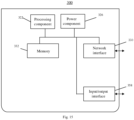
- Fig. 15 is a block diagram of a calling device 300 according to an embodiment of the present invention.
- the device 300 can be provided as a server.
- the device 300 includes a processing component 322, which further includes one or more processors, as well as memory resources represented by a memory 332, for storing instructions that can be executed by the processing component 322, such as application programs.
- the application programs stored in the memory 332 can include one or more modules, each of which corresponds to a set of instructions.
- the processing component 322 is configured to execute instructions to execute the above method.
- the device 300 can further include a power component 326 configured to execute the power management of the device 300, a wired or wireless network interface 350 configured to connect the device 300 to the network, and an input output (I/O) interface 358.
- the device 300 can operate an operating system based on storage in the memory 332, such as a Windows ServerTM, a Mac OS XTM, a UnixTM, a LinuxTM, a FreeBSDTM, or similar.
- non-transitory computer-readable storage medium including instructions, such as the memory 804 including instructions, the instructions can be executed by the processor 820 of the electronic apparatus 800 to complete the above methods.
- the non-transitory computer-readable storage medium can be a ROM, a random access memory (RAM), a CD-ROM, a magnetic tape, a floppy disk, and an optical data storage apparatus, etc.
- first and second are configured to describe various information, but these information should not be limited to these terms. These terms are only used to distinguish the same type of information from each other and do not indicate a specific order or importance. In fact, the expressions “first” and “second” can be used interchangeably. For example, without departing from the scope of the present invention, first information may also be called second information, and similarly, second information may also be called first information.
- connection includes direct connection between two members without other members, and indirect connection between two members through other members.
Landscapes
- Engineering & Computer Science (AREA)
- Signal Processing (AREA)
- Human Computer Interaction (AREA)
- Computer Networks & Wireless Communication (AREA)
- Telephonic Communication Services (AREA)
Applications Claiming Priority (1)
| Application Number | Priority Date | Filing Date | Title |
|---|---|---|---|
| CN202311398449.3A CN119906790A (zh) | 2023-10-26 | 2023-10-26 | 通话方法、装置及存储介质 |
Publications (1)
| Publication Number | Publication Date |
|---|---|
| EP4546760A1 true EP4546760A1 (fr) | 2025-04-30 |
Family
ID=90971726
Family Applications (1)
| Application Number | Title | Priority Date | Filing Date |
|---|---|---|---|
| EP24173883.0A Pending EP4546760A1 (fr) | 2023-10-26 | 2024-05-02 | Procédé d'appel, dispositif d'appel et support d'informations |
Country Status (3)
| Country | Link |
|---|---|
| US (1) | US20250141994A1 (fr) |
| EP (1) | EP4546760A1 (fr) |
| CN (1) | CN119906790A (fr) |
Citations (3)
| Publication number | Priority date | Publication date | Assignee | Title |
|---|---|---|---|---|
| US11483359B2 (en) * | 2018-10-15 | 2022-10-25 | Huawei Technologies Co., Ltd. | Voice call method, electronic device, and system |
| CN116264600A (zh) * | 2021-12-13 | 2023-06-16 | 荣耀终端有限公司 | 来电提醒方法、电子设备和计算机可读存储介质 |
| EP4199491A1 (fr) * | 2021-12-17 | 2023-06-21 | Beijing Xiaomi Mobile Software Co., Ltd. | Procédés et appareils de mise en uvre d'appel et support d'enregistrement |
-
2023
- 2023-10-26 CN CN202311398449.3A patent/CN119906790A/zh active Pending
-
2024
- 2024-04-18 US US18/639,699 patent/US20250141994A1/en active Pending
- 2024-05-02 EP EP24173883.0A patent/EP4546760A1/fr active Pending
Patent Citations (3)
| Publication number | Priority date | Publication date | Assignee | Title |
|---|---|---|---|---|
| US11483359B2 (en) * | 2018-10-15 | 2022-10-25 | Huawei Technologies Co., Ltd. | Voice call method, electronic device, and system |
| CN116264600A (zh) * | 2021-12-13 | 2023-06-16 | 荣耀终端有限公司 | 来电提醒方法、电子设备和计算机可读存储介质 |
| EP4199491A1 (fr) * | 2021-12-17 | 2023-06-21 | Beijing Xiaomi Mobile Software Co., Ltd. | Procédés et appareils de mise en uvre d'appel et support d'enregistrement |
Also Published As
| Publication number | Publication date |
|---|---|
| CN119906790A (zh) | 2025-04-29 |
| US20250141994A1 (en) | 2025-05-01 |
Similar Documents
| Publication | Publication Date | Title |
|---|---|---|
| US9661390B2 (en) | Method, server, and user terminal for sharing video information | |
| US12386500B2 (en) | Method, an apparatus, an electronic device and a storage medium for sharing multimedia information in social media | |
| EP3934265A1 (fr) | Procédé de commande de lecture audio, appareil de commande de lecture audio et support de stockage | |
| US11596018B2 (en) | Region configuration method and device | |
| US20170279898A1 (en) | Method for Accessing Virtual Desktop and Mobile Terminal | |
| US20220007074A1 (en) | Method and apparatus for playing videos, and electronic device and storage medium thereof | |
| EP3264774A1 (fr) | Dispositif et procédé de diffusion en direct pour une diffusion en direct | |
| CN113365153A (zh) | 数据分享方法、装置、存储介质及电子设备 | |
| CN112104913A (zh) | 连麦切换方法、装置、计算机设备及存储介质 | |
| RU2609138C2 (ru) | Способ, аппарат и терминал для перевода вызова | |
| CN112243142B (zh) | 一种处理音频数据的方法、装置及存储介质 | |
| CN113556614A (zh) | 信息发布方法、装置和电子设备 | |
| EP3001660B1 (fr) | Procédé, dispositif et système d'interaction téléphonique | |
| CN114339320B (zh) | 一种虚拟资源处理方法、装置、设备及存储介质 | |
| CN111246032B (zh) | 通话管理方法和装置 | |
| CN114268691A (zh) | 通话方法、装置、终端设备及可读存储介质 | |
| EP4546760A1 (fr) | Procédé d'appel, dispositif d'appel et support d'informations | |
| CN113692067A (zh) | 一种设备的连接方法、装置及可读存储介质 | |
| US12457253B2 (en) | Call processing method and apparatus, storage medium, and electronic | |
| US12457535B2 (en) | Connection method and apparatus for wireless smart wearable device and storage medium | |
| CN116301515A (zh) | 一种播放控制方法、装置、电子设备及存储介质 | |
| US20240195845A1 (en) | Call control method and apparatus, storage medium, and chip | |
| CN120956836A (zh) | 音频通话系统及其控制方法、装置、设备、程序产品 | |
| CN118555440A (zh) | 投屏方法、投屏装置及存储介质 | |
| CN119883174A (zh) | 音频设备虚拟化方法和装置、第一设备、第二设备 |
Legal Events
| Date | Code | Title | Description |
|---|---|---|---|
| PUAI | Public reference made under article 153(3) epc to a published international application that has entered the european phase |
Free format text: ORIGINAL CODE: 0009012 |
|
| STAA | Information on the status of an ep patent application or granted ep patent |
Free format text: STATUS: REQUEST FOR EXAMINATION WAS MADE |
|
| 17P | Request for examination filed |
Effective date: 20240502 |
|
| AK | Designated contracting states |
Kind code of ref document: A1 Designated state(s): AL AT BE BG CH CY CZ DE DK EE ES FI FR GB GR HR HU IE IS IT LI LT LU LV MC ME MK MT NL NO PL PT RO RS SE SI SK SM TR |