EP4546885A1 - Verfahren zur verwaltung der verbindung zwischen vorrichtungen sowie vorrichtung und system - Google Patents
Verfahren zur verwaltung der verbindung zwischen vorrichtungen sowie vorrichtung und system Download PDFInfo
- Publication number
- EP4546885A1 EP4546885A1 EP23845466.4A EP23845466A EP4546885A1 EP 4546885 A1 EP4546885 A1 EP 4546885A1 EP 23845466 A EP23845466 A EP 23845466A EP 4546885 A1 EP4546885 A1 EP 4546885A1
- Authority
- EP
- European Patent Office
- Prior art keywords
- chip
- broadcast
- processor
- scanning
- online
- Prior art date
- Legal status (The legal status is an assumption and is not a legal conclusion. Google has not performed a legal analysis and makes no representation as to the accuracy of the status listed.)
- Pending
Links
Images







Classifications
-
- H—ELECTRICITY
- H04—ELECTRIC COMMUNICATION TECHNIQUE
- H04W—WIRELESS COMMUNICATION NETWORKS
- H04W8/00—Network data management
- H04W8/005—Discovery of network devices, e.g. terminals
-
- H—ELECTRICITY
- H04—ELECTRIC COMMUNICATION TECHNIQUE
- H04W—WIRELESS COMMUNICATION NETWORKS
- H04W4/00—Services specially adapted for wireless communication networks; Facilities therefor
- H04W4/06—Selective distribution of broadcast services, e.g. multimedia broadcast multicast service [MBMS]; Services to user groups; One-way selective calling services
-
- H—ELECTRICITY
- H04—ELECTRIC COMMUNICATION TECHNIQUE
- H04W—WIRELESS COMMUNICATION NETWORKS
- H04W4/00—Services specially adapted for wireless communication networks; Facilities therefor
- H04W4/80—Services using short range communication, e.g. near-field communication [NFC], radio-frequency identification [RFID] or low energy communication
-
- H—ELECTRICITY
- H04—ELECTRIC COMMUNICATION TECHNIQUE
- H04W—WIRELESS COMMUNICATION NETWORKS
- H04W48/00—Access restriction; Network selection; Access point selection
- H04W48/08—Access restriction or access information delivery, e.g. discovery data delivery
-
- H—ELECTRICITY
- H04—ELECTRIC COMMUNICATION TECHNIQUE
- H04W—WIRELESS COMMUNICATION NETWORKS
- H04W48/00—Access restriction; Network selection; Access point selection
- H04W48/08—Access restriction or access information delivery, e.g. discovery data delivery
- H04W48/10—Access restriction or access information delivery, e.g. discovery data delivery using broadcasted information
-
- H—ELECTRICITY
- H04—ELECTRIC COMMUNICATION TECHNIQUE
- H04W—WIRELESS COMMUNICATION NETWORKS
- H04W48/00—Access restriction; Network selection; Access point selection
- H04W48/16—Discovering, processing access restriction or access information
-
- H—ELECTRICITY
- H04—ELECTRIC COMMUNICATION TECHNIQUE
- H04W—WIRELESS COMMUNICATION NETWORKS
- H04W52/00—Power management, e.g. Transmission Power Control [TPC] or power classes
- H04W52/02—Power saving arrangements
- H04W52/0209—Power saving arrangements in terminal devices
-
- H—ELECTRICITY
- H04—ELECTRIC COMMUNICATION TECHNIQUE
- H04W—WIRELESS COMMUNICATION NETWORKS
- H04W76/00—Connection management
- H04W76/10—Connection setup
-
- H—ELECTRICITY
- H04—ELECTRIC COMMUNICATION TECHNIQUE
- H04W—WIRELESS COMMUNICATION NETWORKS
- H04W52/00—Power management, e.g. Transmission Power Control [TPC] or power classes
- H04W52/02—Power saving arrangements
- H04W52/0209—Power saving arrangements in terminal devices
- H04W52/0225—Power saving arrangements in terminal devices using monitoring of external events, e.g. the presence of a signal
- H04W52/0229—Power saving arrangements in terminal devices using monitoring of external events, e.g. the presence of a signal where the received signal is a wanted signal
-
- H—ELECTRICITY
- H04—ELECTRIC COMMUNICATION TECHNIQUE
- H04W—WIRELESS COMMUNICATION NETWORKS
- H04W76/00—Connection management
- H04W76/10—Connection setup
- H04W76/14—Direct-mode setup
-
- H—ELECTRICITY
- H04—ELECTRIC COMMUNICATION TECHNIQUE
- H04W—WIRELESS COMMUNICATION NETWORKS
- H04W84/00—Network topologies
- H04W84/18—Self-organising networks, e.g. ad-hoc networks or sensor networks
-
- Y—GENERAL TAGGING OF NEW TECHNOLOGICAL DEVELOPMENTS; GENERAL TAGGING OF CROSS-SECTIONAL TECHNOLOGIES SPANNING OVER SEVERAL SECTIONS OF THE IPC; TECHNICAL SUBJECTS COVERED BY FORMER USPC CROSS-REFERENCE ART COLLECTIONS [XRACs] AND DIGESTS
- Y02—TECHNOLOGIES OR APPLICATIONS FOR MITIGATION OR ADAPTATION AGAINST CLIMATE CHANGE
- Y02D—CLIMATE CHANGE MITIGATION TECHNOLOGIES IN INFORMATION AND COMMUNICATION TECHNOLOGIES [ICT], I.E. INFORMATION AND COMMUNICATION TECHNOLOGIES AIMING AT THE REDUCTION OF THEIR OWN ENERGY USE
- Y02D30/00—Reducing energy consumption in communication networks
- Y02D30/70—Reducing energy consumption in communication networks in wireless communication networks
Definitions
- the SH chip may perform conflict avoidance on a task of the AP processor by monitoring a status of a protocol stack.
- an early connection can be implemented through early discovery in the background, so that the user can perform direct transmission during use (for example, perform transmission immediately after a service enters a foreground interface).
- a mobile phone may perform connection authentication with a device 1 in advance in the background.
- the device 1 is displayed on a HyperTerminal interface or a slide-up widget on which a surrounding available device list is displayed in real time shown in FIG. 5B , so that the user can quickly select a target device.
- Embodiment 1 to Embodiment 5 With reference to specific Embodiment 1 to Embodiment 5, the following separately describes in detail an inter-device connection management method based on the foregoing technology 1 to technology 5.
- device discovery is mainly implemented according to a unidirectional declarative discovery strategy.
- FIG. 6 is a diagram of a device discovery process according to the unidirectional declarative discovery strategy according to this embodiment of this application.
- a device A broadcasts, to a peripheral device (including a device B) in a declarative manner, a capability supported by the device A.
- a peripheral device including a device B
- the device B obtains a broadcast message through scanning, it is considered that the device A is online. In this way, the device B can successfully discover the device A through unidirectional broadcast.
- FIG. 7 is a diagram of a device discovery process according to an embodiment of this application.
- the device discovery process provided in this embodiment of this application may mainly include S701 to S705.
- S701 An AP processor of a device A and an AP processor of a device B separately start a broadcast and scanning of an SH chip, and configure a broadcast strategy and a scanning strategy.
- the broadcast strategy may include but is not limited to a broadcast type, a broadcast parameter corresponding to the broadcast type, and the like.
- the scanning strategy may include but is not limited to a scanning type, a scanning parameter corresponding to the scanning type, and the like.
- the broadcast type may include but is not limited to a regular broadcast (also referred to as a common broadcast) or a burst (burst) broadcast.
- the regular broadcast is, for example, a BLE broadcast (also referred to as an alwaysOn broadcast).
- FIG. 8 is a diagram of a sending strategy of a regular broadcast message according to an embodiment of this application.
- the regular broadcast message is sent based on a packet sending interval (advInterval).
- a device sends the broadcast message once at an interval of duration corresponding to a broadcast interval.
- FIG. 9 is a diagram of a sending strategy of a burst (burst) broadcast message according to an embodiment of this application.
- the burst (burst) broadcast message is sent based on three broadcast parameters.
- the three broadcast parameters are respectively a packet sending interval (advInterval), a packet sending window (burstWindow), and a broadcast interval (burstInterval).
- burst (burst) broadcast a cluster of broadcast sets at a high frequency in burstWindow may be periodically sent.
- the burst (burst) broadcast may be considered as a cluster-like BLE periodic broadcast.
- the broadcast set is periodically sent at a high frequency, so that a device discovery success rate can be greatly increased, and further, a device discovery result with high performance and high reliability is obtained.
- the burst (burst) broadcast is sent by a low-power-consumption SH chip, the low-power-consumption broadcast is sent.
- the device B can obtain only one broadcast message through scanning in one scanning window. If the device A sends the burst (burst) broadcast message shown in FIG. 10 , the device B can obtain two broadcast messages through scanning in one scanning window. Therefore, compared with the regular broadcast, the burst (burst) broadcast can be used to greatly increase the device discovery success rate.
- a Bluetooth chip does not need to be re-enabled when the burst (burst) broadcast changes from a high-frequency state to an idle state. Therefore, the Bluetooth chip does not need to be restarted, so that consumption of Bluetooth resources can be reduced, and an upper-layer continuous service cannot be interrupted. For example, it is assumed that the Bluetooth chip is performing a BLE connection. If the Bluetooth chip needs to be re-enabled when the broadcast message changes from a high-frequency state to an idle state, the BLE connection fails.
- a bottom layer (for example, the Bluetooth chip or a Wi-Fi chip) of the device A may further return an identification (identification, ID) to an application layer by layer after starting a broadcast (advertiser) based on an indication of the AP processor.
- ID uniquely identifies the started broadcast.
- the application may set different broadcast parameters for the broadcast with the ID via the AP processor, to implement broadcast type switching, scanning parameter modification, and the like. For example, if only advInterval is set for the broadcast with the ID, it indicates that a broadcast type of the broadcast is the regular broadcast. If the three broadcast parameters advInterval, burstWindow, and burstInterval are set for the broadcast with the ID, it indicates that a broadcast type of the broadcast is the burst (burst) broadcast.
- S702 The AP processor of the device A indicates the SH chip to send a broadcast message.
- S703 The SH chip of the device A sends the broadcast message.
- the declarative broadcast sent by the device A to the peripheral device may be the regular broadcast message (also referred to as a common broadcast message).
- the declarative broadcast sent by the device A to the peripheral device may be the burst (burst) broadcast.
- the device A may switch a type of the broadcast message sent to the peripheral device (including the device B). For example, the device A may send the burst (burst) broadcast message in a period of time, and send the regular broadcast message in another period of time.
- the burst burst
- the device A may switch a type of the broadcast message based on a screen status of the device A.
- the screen status is, for example, a screen-on state or a screen-off state.
- the device A may send the burst (burst) broadcast message when a screen of the device A is in the screen-on state, and switch to sending the regular broadcast message when the screen of the device A is in the screen-off state.
- the device A may switch a type of the broadcast message based on a quantity of devices around the device A. For example, the device A may send the burst (burst) broadcast message when the quantity of devices around the device A is less than or equal to a preset value (for example, 20), and switch to sending the regular broadcast message when the quantity of devices around the device A is greater than the preset value.
- a preset value for example, 20
- the device around the device A may be an online device around the device A, or a device scanned by the device A.
- the device A may switch a type of the broadcast message based on accumulated foreground running duration in the device discovery process. For example, the device A may send the burst (burst) broadcast message when the accumulated foreground running duration in the device discovery process does not exceed preset duration (for example, 5 seconds), and switch to sending the regular broadcast message when the device discovers that the accumulated foreground running duration in the device discovery process exceeds the preset duration (for example, 5 seconds).
- preset duration for example, 5 seconds
- the type of the broadcast message is switched, so that dense broadcast messages of a single device do not fully occupy the scanning window, and arrival of a broadcast message from another device is not affected.
- the foregoing bases for switching the type of the broadcast message are merely used as examples, and the device may alternatively switch the type of the broadcast message based on other related information. This is not limited in embodiments of this application.
- the device may send the broadcast message through a fixed broadcast channel (for example, a channel 37, a channel 38, or a channel 39).
- a fixed broadcast channel for example, a channel 37, a channel 38, or a channel 39.
- the device may scan the broadcast message through the fixed broadcast channel (for example, the channel 37, the channel 38, or the channel 39).
- the fixed broadcast channel for example, the channel 37, the channel 38, or the channel 39.
- S705 The SH chip of the device B reports, to the AP processor of the device B, that the device A is online.
- the SH chip of the device B reports, to the AP processor of the device B, that the device A is online, so that the AP processor of the device B performs subsequent processing to perform connection authentication with the device A.
- An inter-device connection authentication (Paring) process includes processes such as capability exchange, device authentication, key generation, connection encryption, and confidential information distribution.
- An objective of pairing is to implement connection encryption, device authentication, and key generation.
- a Bluetooth configuration menu of a device includes a device with which the device is paired.
- a key is a long-term key (long-term key, LTK).
- LTK long-term key
- the LTK may be used by both pairing parties to store the LTK, so that a pairing procedure can be skipped based on the LTK in a next device reconnection authentication process.
- the device B may generate a key, allocate the key to the device A through a data channel (for example, a channel 0 to a channel 36), and is bound (Bind) to the device A.
- a data channel for example, a channel 0 to a channel 36
- the device B and the device A store address information (for example, a media access control (media access control, MAC) address and a resolving key (identity resolving key, IRK)) of each other, and the like.
- address information for example, a media access control (media access control, MAC) address and a resolving key (identity resolving key, IRK)
- MAC media access control
- IRK resolving key
- a communication connection established between the devices after discovery may be a BLE connection.
- the BLE connection may be established between the devices in the following three phases: a BLE service discovery phase, a connection establishment phase, and an MTU exchange phase.
- the BLE service discovery phase is most time-consuming.
- the unidirectional declarative device discovery strategy provided in Embodiment 1 of this application can be used to reduce half of time for device discovery. Therefore, a delay during device discovery can be greatly reduced, and device power consumption can be reduced. In addition, because successful device discovery can be implemented after unidirectional communication between the device A and the device B, communication resources can be greatly reduced.
- the delay during device discovery can be greatly reduced, device power consumption can be reduced, a broadcast storm can be avoided, interference between devices can be avoided, and a device discovery success rate can be increased.
- a trust relationship on a network is maintained mainly by using an SH chip as a proxy of an AP processor to maintain a real-time and reliable online device list.
- the SH chip wakes up the AP processor to establish a connection to a scanned device only when the SH chip discovers that the scanned device is not on the network, so that the scanned device is online.
- the device has a capability of updating the online device list (also referred to as a connected device list). For example, when networking is started (for example, when the device is powered on), a networking application starts a broadcast and scanning of a low-power-consumption SH chip by using the AP processor, and configures the online device list, a proxy reply template, a broadcast strategy, a scanning strategy, and the like.
- a networking application starts a broadcast and scanning of a low-power-consumption SH chip by using the AP processor, and configures the online device list, a proxy reply template, a broadcast strategy, a scanning strategy, and the like.
- the SH chip may always serve as the proxy of the AP processor to perform device discovery and keepalive work until a new device is scanned.
- the SH chip may interact with another device by using a broadcast message.
- the SH chip When the SH chip obtains a broadcast message from a device through scanning, if the device is in the online device list, the SH chip may reply to the broadcast message based on the proxy reply template, to maintain a communication connection between devices; or if the device is not in the online device list, the SH chip may wake up the AP processor to perform device connection authentication. Further, after the AP processor completes connection authentication on the device, the AP processor updates the device to the online device list.
- FIG. 11 is a diagram of a device discovery and keepalive process according to an embodiment of this application by using an example in which a broadcast message is a Bluetooth broadcast message.
- the device discovery and keepalive process provided in this embodiment of this application may mainly include S1101 to S1110.
- An AP processor of a device B indicates a Bluetooth chip to start a broadcast/scanning, and receives a callback after the Bluetooth chip starts the broadcast/scanning.
- the callback is used to notify the AP processor that the Bluetooth chip starts the broadcast/scanning.
- the AP processor of the device B obtains a broadcast ID/scanning ID.
- the broadcast ID/scanning ID uniquely identifies the broadcast/scanning that has been started by the Bluetooth chip.
- the broadcast ID/scanning ID may be a broadcast ID/scanning ID corresponding to the started broadcast/scanning that is reported by the Bluetooth chip to the AP processor of the device B layer by layer.
- the AP processor of the device B indicates an SH chip to serve as a proxy of the AP processor.
- the AP processor of the device B may carry the broadcast ID, the scanning ID, the online device list, the proxy reply template, the broadcast strategy, the scanning strategy, and the like to an indication message.
- the online device list includes information about a device that has established a connection to the device. For example, Embodiment 2 is performed based on the solution provided in Embodiment 1. After the device B obtains a unidirectional declarative broadcast from a device A through scanning, the device B updates the online device list, where an updated online device list includes information about the device A that is discovered by the device B and connected to the device B in Embodiment 1.
- the broadcast strategy includes, for example, a broadcast type and a broadcast parameter corresponding to the broadcast type.
- the broadcast type is a regular broadcast
- a broadcast parameter corresponding to the regular broadcast is advInterval.
- the broadcast type is a burst broadcast
- broadcast parameters corresponding to the burst broadcast are advInterval, burstWindow, and burstInterval.
- the scanning strategy includes a scanning type and a scanning parameter corresponding to the scanning type.
- the scanning parameter may include a scanning window, a scanning filtering condition, and the like.
- the scanning filtering condition is a broadcast that needs to be filtered (namely, ignored) during scanning, for example, a broadcast message sent by a vendor device with a universally unique identifier (universally unique identifier, UUID), or a broadcast message sent by a device with an ID.
- the scanning filtering condition may be represented by a whitelist or a blacklist.
- the whitelist includes a UUID of a vendor, a device ID, and the like that do not need to be filtered during scanning
- the blacklist includes a UUID of a vendor, a device ID, and the like that need to be filtered during scanning.
- S1104 When receiving a broadcast message from the Bluetooth chip of the device B, the SH chip of the device B sends the broadcast message according to the broadcast strategy.
- the broadcast message from the Bluetooth chip of the device B carries the broadcast ID, and the SH chip of the device B may serve, based on the broadcast ID, as the proxy of the AP processor to execute a corresponding broadcast proxy service.
- the SH chip of the device B may send the corresponding broadcast message based on the broadcast type and the corresponding broadcast parameter that are indicated by the broadcast strategy.
- the broadcast type is the regular broadcast, and advInterval is 20 milliseconds (ms).
- the SH chip of the device B may continuously send the regular broadcast at an interval of 20 ms.
- the broadcast type is the burst broadcast, burstInterval is 20 ms, burstWindow is 7 ms, and advInterval is 1 ms.
- the SH chip of the device B may continuously send the broadcast message at an interval of 1 ms in the 7 ms sending window based on a period of 20 ms.
- S1105 When receiving a scanning startup indication from the Bluetooth chip of the device B, the SH chip of the device B performs scanning according to the scanning strategy.
- the scanning startup indication from the Bluetooth chip of the device B carries the scanning ID, and the SH chip of the device B may serve, based on the scanning ID, as the proxy of the AP processor to execute a corresponding scanning service.
- the SH chip of the device B may determine the scanning window based on the scanning parameter indicated by the scanning strategy, and then perform scanning in the scanning window to discover another device.
- S1106 When obtaining a broadcast message from a device C through scanning, the SH chip of the device B determines whether the device C is an online device.
- the SH chip of the device B may determine, by determining whether the device C is in the online device list, whether the device C is the online device.
- the SH chip of the device B determines that the device C is in the online device list, that is, determines that the device C is the online device, the SH chip performs S1107-1, that is, replies to the device C through broadcast based on the proxy reply template, to maintain a communication connection between the device B and the device C. If the SH chip of the device B determines that the device C is not in the online device list, that is, determines that the device C is not the online device, the SH chip performs S1107-2, that is, report the discovery event to the AP processor. Further, the AP processor performs S1108 and S1109.
- S1107-1 The SH chip of the device B replies to the device C through broadcast based on the proxy reply template.
- S1107-2 The SH chip of the device B reports, to the AP processor, that the device C is discovered.
- S1108 The AP processor of the device B performs connection authentication with the device C.
- S1109 The AP processor of the device B updates the online device list.
- the AP processor of the device B updates the device C to the online device list.
- An updated online device list includes information about the device C, for example, an ID of the device C and a capability supported by the device C.
- the AP processor of the device B may further regularly and periodically update the online device list, to ensure the real-time and reliable online device list.
- S1110 The AP processor of the device B synchronizes the updated online device list to the SH chip.
- the SH chip of the device B continues to serve as the proxy of the AP processor to perform device discovery and keepalive work until a new device is scanned.
- the AP processor of the device may indicate the SH chip to serve as the proxy of the device to perform device discovery and keepalive work, or may reclaim proxy permission of the SH chip.
- the AP processor of the device may reclaim the proxy permission of the SH chip for broadcast/scanning by sending a proxy permission reclaim command to the SH chip.
- the command carries the broadcast ID/scanning ID.
- the AP processor of the device may reclaim the proxy permission of the SH chip for broadcast/scanning by destroying the broadcast ID/scanning ID.
- the AP processor of the device B may adjust the broadcast strategy (for example, the broadcast type and the broadcast parameter corresponding to the broadcast type) and/or the scanning strategy (for example, the scanning parameter) based on an actual requirement by using the broadcast ID as an identifier, and synchronize the adjustment to the SH chip.
- the broadcast strategy for example, the broadcast type and the broadcast parameter corresponding to the broadcast type
- the scanning strategy for example, the scanning parameter
- Embodiment 2 of this application may be combined with Embodiment 1 to be used in an inter-device connection management process.
- the SH chip of the device B reports, to the AP processor, that the device A is discovered, and the AP processor of the device B performs connection authentication with the device A and updates the online device list.
- the updated online device list includes information about the device A.
- the AP processor is always responsible for device discovery and connection and the like, the AP processor is usually in a high power consumption state. Especially in a scenario in which there is a multi-device discovery and connection networking requirement, the AP processor is always in the high power consumption state. In addition, a large quantity of invalid broadcasts further cause a broadcast storm, and quick consumption of hardware resources leads to no resource available for normal discovery, connection, and transmission. In addition, in the conventional device discovery technology, once one end does not reply to a message within a timeout period (for example, more than 10 seconds), a trust relationship between devices is cancelled. If there is a transmission requirement, discovery and connection need to be performed again.
- a timeout period for example, more than 10 seconds
- the connection between devices is usually disconnected when a message is not replied to within a timeout period due to a special reason like screen-off, a packet loss, or another service being performed, and device discovery needs to be performed again when there is a data transmission requirement again. It can be learned that the conventional device discovery technology does not have an appropriate and effective keepalive mechanism.
- the device maintains the real-time and reliable online device list, so that when there is no newly discovered device, the SH chip can serve as the proxy of the AP processor to perform device discovery and keepalive work, and the devices between which the communication connection has been established can maintain the trust relationship at the low-power-consumption SH chip layer. In this way, power consumption of the AP processor can be greatly reduced.
- a keepalive strategy with low power consumption and high performance provided in Embodiment 2 of this application can resolve a problem of slow networking caused by re-establishing the trust relationship due to frequent online and offline and a problem of a networking failure caused by single-end offline due to delayed interaction.
- an early connection can be implemented through early discovery in the background, so that the user can perform direct transmission during use (for example, perform transmission immediately after a service enters a foreground interface).
- the SH chip may perform conflict avoidance on a task of the AP processor by monitoring a status of a protocol stack. For example, it is assumed that the AP processor is performing a BR Bluetooth audio connection task. The SH chip actively performs temporary delay avoidance after monitoring a status of a Bluetooth protocol stack.
- a device offline condition for determining that a device is offline and a device online condition for determining that the device is online are mainly set in an SH chip.
- the SH chip serves as a proxy of an AP processor to perform device discovery and keepalive work, it is determined, based on the specified device offline condition, whether the device is offline, and determined, based on the specified device online condition, whether the device is online.
- a connection between devices is a Bluetooth connection.
- an onLost mode/onFound mode of a Bluetooth protocol stack may be used to determine whether the device is offline/online.
- the onFound mode is also referred to as an onFirst mode.
- the device offline condition in the onLost mode is: receiving no valid broadcast message from the device within preset duration (for example, first preset duration), or receiving no valid broadcast message of a preset quantity (for example, a first preset quantity) from a same device within preset duration (for example, first preset duration).
- the valid broadcast message is a broadcast message whose signal strength is greater than a preset signal strength threshold.
- the preset signal strength threshold is, for example, -78 dBm.
- the device online condition in the onFound mode is: receiving a valid broadcast message from the device, or obtaining, through scanning from the same device within preset duration (for example, second preset duration), a valid broadcast message whose quantity is greater than the preset quantity.
- preset duration for example, second preset duration
- the first preset duration is the same as the first preset duration.
- the first preset duration is different from the first preset duration.
- FIG. 12 is a logic diagram of determining an OnFound mode/OnLost mode according to Embodiment 3 of this application.
- the SH chip in an initial state (initstate), if the SH chip receives a valid broadcast message (for example, rssi>rssi_high_thresh) that meets a scanning filtering condition (filter_k_match), the SH chip may monitor a status of a broadcast message obtained through scanning within pre-found cache duration (pre-found linger) (namely, the second preset duration).
- pre-found cache duration pre-found linger
- the SH chip determines that the device is in the onFound mode, and the SH chip reports, to the AP, that the device is online (for example, reports onFound).
- the SH chip determines that the device is in the onLost mode, and the SH chip reports, to the AP, that the device is offline (for example, reports onLost).
- the SH chip determines that the device is in the onLost mode, and the SH chip reports, to the AP, that the device is offline (for example, reports onLost).
- SH parameters in the onLost mode/onFound mode that include parameters such as onfound_timeout, onfound_timeout_cnt, onlost_timeout, rssi_low_thresh and rssi_high_thresh, refer to the following Table 1.
- Table 1 SH parameters Description onfound_timeout Duration for the SH chip to stay and scan another broadcast message before reporting onFound onfound_timeout_cnt If the SH chip scans another broadcast message within onfound_timeout duration, the SH chip simultaneously collects a quantity of broadcast messages that meet a preset condition (for example, the device online condition) within the onfound_timeout duration.
- a preset condition for example, the device online condition
- the SH chip reports onFound. onlost_timeout After the SH chip obtains a broadcast message through scanning, if the SH chip does not obtain the broadcast message through scanning again within the lost_timeout duration, the SH chip reports onLost. rssi_low_thresh If the SH chip obtains, through scanning, a broadcast message whose RSSI is lower than rssi_low_thresh, it is considered that the broadcast message is not scanned. rssi_high_thresh If the SH chip obtains, through scanning, a broadcast message whose RSSI is higher than rssi_high_thresh, it is considered that the broadcast message is scanned.
- Embodiment 3 of this application may be combined with Embodiment 1 and/or Embodiment 2 to be used in an inter-device connection management process.
- Embodiment 3 is performed based on the solution provided in Embodiment 1. It is assumed that the device B performs device offline/online management according to the method in Embodiment 3, and the AP processor of the device A performs unidirectional declarative broadcast according to the method in Embodiment 1.
- the SH chip of the device B obtains, through scanning, a broadcast message that is from the device A and that meets the device online condition
- the SH chip of the device B determines that the device A is online, and reports, to the AP processor of the device B, that the device A is online.
- the device online condition is the broadcast message obtained through scanning is a valid broadcast message, or obtaining, through scanning within preset duration (for example, the second preset duration), a quantity of valid broadcast messages from the device A that is greater than a preset quantity.
- the SH chip of the device B determines that the device A is offline, and reports, to the AP processor of the device B, that the device A is online.
- the device offline condition is: receiving no valid broadcast message from the device A within preset duration (for example, the first preset duration), or receiving no valid broadcast message of a preset quantity (for example, the first preset quantity) from the device A within preset duration (for example, the first preset duration).
- Embodiment 3 is performed based on the solution provided in Embodiment 2. It is assumed that the device B performs device offline/online management according to the method in Embodiment 3. After the SH chip of the device B obtains, through scanning, a broadcast message that is from the device A and that meets the device online condition, the SH chip of the device B determines whether the device A is in the online device list. If the device A is in the online device list, the SH chip of the device B replies to the device A through broadcast based on the proxy reply template. If the device A is not in the online device list, the SH chip of the device B reports, to the AP processor, that the device A is online, and the AP processor of the device B performs connection authentication with the device A and updates the online device list. An updated online device list includes information about the device A.
- the SH chip of the device B determines whether the device A is in the online device list. If the device A is in the online device list, the SH chip of the device B reports, to the AP processor, that the device A is offline, and the AP processor of the device B cancels a trust relationship with the device A (for example, cancels pairing) and updates the online device list.
- An updated online device list does not include information about the device A.
- Embodiment 3 is performed based on the solutions provided in Embodiment 2 and Embodiment 1. It is assumed that the device B performs device offline/online management according to the method in Embodiment 3, and the AP processor of the device A performs unidirectional declarative broadcast according to the method in Embodiment 1. After the SH chip of the device A obtains, through scanning, a broadcast message that is from the device B and that meets the device online condition, the SH chip of the device B determines whether the device A is in the online device list. If the device A is in the online device list, the SH chip of the device B replies to the device A through broadcast based on the proxy reply template.
- the SH chip of the device B reports, to the AP processor, that the device A is discovered, and the AP processor of the device B performs connection authentication with the device A and updates the online device list.
- An updated online device list includes information about the device A.
- the SH chip of the device B determines whether the device A is in the online device list. If the device A is in the online device list, the SH chip of the device B reports, to the AP processor, that the device A is offline, and the AP processor of the device B cancels a trust relationship with the device A and updates the online device list.
- An updated online device list does not include information about the device A.
- the AP processor is always responsible for controlling device discovery and connection and the like, and a strategy for determining that the device is offline is that when a threshold (for example, no reply message is received within preset duration) specified for a service is met, the AP processor determines that the device is offline, and cancels the trust relationship between devices. In this case, the AP processor needs to periodically poll whether the reply message is received. If no reply message is received within the preset duration (for example, within 10 seconds), the AP processor determines that the device is offline, and cancels the trust relationship between the devices. If there is a transmission requirement subsequently, discovery and connection need to be performed again.
- a threshold for example, no reply message is received within preset duration
- the AP processor determines that the device is offline, and cancels the trust relationship between the devices. If there is a transmission requirement subsequently, discovery and connection need to be performed again.
- the device does not reply with the message within the preset duration may be caused by screen-off, a packet loss, another service being performed, or the like, and there is a data transmission requirement. In these cases, it is definitely inappropriate to cancel the trust relationship between the devices.
- the AP processor does not need to repeatedly perform complex offline monitoring to determine whether the device is offline, but may enter the sleep state, and hand over a related online/offline monitoring task to the low-power-consumption SH chip. Then, the SH chip determines, by determining whether the preset condition for determining that the device is offline/online is met, whether the device is offline or online. If it is determined that the device is offline, it is determined, at the SH device layer, that the device is offline. Only when determining that the device is online or offline, the SH chip wakes up the AP processor to perform connection authentication on the discovered device or cancel the trust relationship with the offline device (for example, cancel pairing). In this way, power consumption of the AP processor can be reduced.
- an early connection can be implemented through early discovery in a background, so that a user can perform direct transmission during use.
- a keepalive strategy with low power consumption and high performance provided in Embodiment 3 of this application can resolve a problem of slow networking caused by re-establishing the trust relationship due to frequent online and offline and a problem of a networking failure caused by single-end offline due to delayed interaction.
- a master device on a network broadcasts information such as a hardware clock, a broadcast parameter, and a scanning parameter of the master device, and then a slave device adjusts a hardware clock and an AP clock of the slave device based on the foregoing information, so that the hardware clock and the AP clock of the slave device are respectively synchronized with the hardware clock and an AP clock of the master device.
- the slave device adjusts the broadcast parameter based on an adjusted hardware clock and AP clock, and then an SH chip of the slave device may send a broadcast message in a broadcast window aligned with a scanning window of the master device; and adjusts the scanning parameter based on the adjusted hardware clock and AP clock, and then the SH chip of the slave device may scan the broadcast message in a scanning window aligned with a broadcast window of the master device.
- the master device on the network may be determined through election by devices on the network.
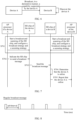
- FIG. 13 is a flowchart of a window alignment process according to an embodiment of this application by using an example in which a network includes a device A and a device B.
- the device discovery process provided in this embodiment of this application may include S1301 to S1310.
- S1301 An AP processor of the device A triggers master device election on the network.
- devices on the network may trigger master device election on the network in one or more of the following cases 1 to 3.
- Case 1 A new device joins the network.
- a new device C joins a network A (the network A includes the device A and the device B, where the device A is a master device on the original network A)
- master device election on the network A is triggered.
- a device C on a network B the network includes the device C and a device D, where the device D is an original master device on the original network B
- joins a network A the network A includes the device A and the device B, where the device A is a master device on the original network A
- master device election on the network A is triggered.
- Case 2 A device exits the network.
- a device C exits a network A (the network A includes the device A, the device B, and a device C, where the device C is a master device on the original network A)
- master device election on the network A is triggered.
- the network A includes the device A, the device B, the device C, and the device D, where the device C or the device D is a master device on the original network A
- master device election on the network A is triggered.
- that the master device no longer serves as the master device may be caused by one or more of the following reasons: A battery level of the master device is lower than a preset value, the master device moves away from another device on the network, the master device enters a sleep state, load of the master device is higher than a preset value, triggering is performed at scheduled time, and the like. This is not specifically limited in this application.
- S1302 The AP processor of the device A and an AP processor of the device B determine, through election, that the device A is the master device on the network.
- all devices on the network may broadcast respective master device election parameters, and the devices on the network may determine, based on a master device election parameter of another device and the master device election parameters of the devices, whether the devices meet a condition for serving as the master device.
- the master device election parameter may be device information.
- the device information may include but is not limited to one or more of the following: a device scenario (for example, a home scenario or a travel scenario), a device type, a device function (for example, a communication capability), power supply information (for example, a power supply manner and a battery level), a device status (for example, an active state and a sleep state), a motion status (for example, a static state or a moving state), service information (for example, whether a high-load service is being performed), duration of entering the network, and the like.
- a device scenario for example, a home scenario or a travel scenario
- a device type for example, a device function (for example, a communication capability)
- power supply information for example, a power supply manner and a battery level
- a device status for example, an active state and a sleep state
- a motion status for example, a static state or a moving state
- service information for example, whether a high-load service is being
- the master device on the network has one or more of the following features: having a strong device function, being powered by a direct plug-in power supply, being powered by a battery but having a high remaining battery level, being in an active state, being in a static state, and carrying no high-load service.
- the master device election parameter may be a score for the device information
- the devices on the network may determine, based on a score of another device for the device information and scores of the devices for the device information, whether the devices meet a condition for serving as the master device.
- the score for the device information may be determined by a device based on a score of one or more of the following indicators of the device: a device scenario, a device type, a device function, power supply information, a device status, a motion status, service information, and duration for entering the network.
- a score of a device with a strong device function is higher than a score of a device with a weak device function
- a score of a device powered by a direct plug-in power supply is higher than a score of a device powered by a battery
- a score of a device with a high remaining battery level is higher than a score of a device with a low remaining battery level
- a score of a device in an active state is higher than a score of a device in a sleep state
- a score of a static device is higher than a score of a moving device
- a score of a device carrying no high-load service is higher than a score of a device carrying a high-load service.
- the device may calculate a score of the device for the device information according to a calculation formula: score of a device type + score of a communication capability + score of a power supply type. Scores of different device types, different communication capabilities, and different power supply types are separately shown in the following Table 2, Table 3, and Table 4.
- Table 2 Device type Score Mobile phone and tablet computer 500 In-vehicle infotainment, large screen, and PC 500 Smartwatch and speaker 300 Speaker and router 300 Smart band and sports watch 0 IOT device and sensor 0 Table 3 Communication capability Score Wi-Fi 300 LAN 300 BLE 100 BR 0 USB 0 Other 0 Table 4 Power supply type Score Powered by a power supply 500 Powered by a battery insensitive to power consumption 80 Powered by a battery sensitive to power consumption 20
- the LAN means a local area network (local area network).
- both the BR and the USB communication modes are point-to-point communication, and therefore are not suitable for serving as the master device on the network, and then scores are all 0.
- the BLE communication may support access for an unlimited quantity of times, and therefore a score of the BLE communication is slightly higher than that of the BR communication and the USB communication.
- the LAN has a high-bandwidth characteristic, Wi-Fi has wider coverage and is more flexible than the LAN. In this case, Wi-Fi is more suitable for serving as the master device on the network than the LAN, and then a score of Wi-Fi is higher than that of the LAN.
- a device powered by a power supply is, for example, a large screen, a router, a speaker, an in-vehicle infotainment, or a smart home device like a light or a switch.
- a device powered by a battery insensitive to power consumption is, for example, a mobile phone or a tablet computer.
- a device powered by a battery sensitive to power consumption is, for example, a smartwatch, a smart band, a sports watch, a phone watch, a wireless headset, or a door lock.
- scores of devices in descending order may be as follows: Router > Speaker > Large screen (for example, a television) > PC > Mobile phone.
- scores of devices in descending order may be as follows: In-vehicle infotainment > PC > Mobile phone > Smartwatch.
- the devices on the network may determine the master device on the network through election in another manner.
- a specific manner is not limited in embodiments of this application.
- the AP processor of the device A sends an AP clock of the device A to an SH chip of the device A.
- the clocks in this embodiment of this application include the AP clock and a hardware clock, and may be a time length starting from a past time point.
- S1304 The SH chip of the device A determines a software and hardware clock offset of the device A.
- the SH chip of the device A sends a broadcast message, where the broadcast message carries a hardware clock, a broadcast parameter, and a scanning parameter of the device A.
- the hardware clock of the device A is obtained through calculation by the SH chip of the device A based on the AP clock of the device A and the software and hardware clock offset of the device A. For example, the hardware clock of the device A equals the AP clock of the device A plus the software and hardware clock offset of the device A.
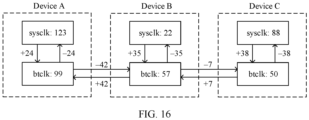
- FIG. 16 is a diagram of a clock alignment process according to this embodiment of this application.
- the AP clock of the device A is sysclk: 123
- the software and hardware clock offset is 24.
- the SH chip of the device B may recalculate the hardware clock of the device B based on the hardware clock of the device A carried in the broadcast message and a hardware clock offset between the device B and the master device (namely, the device A), to align the hardware clock of the device B.
- the SH chip of the device B may obtain the hardware clock offset between the device B and the master device (namely, the device A) in a command (for example, a HCI_Read_Clock_Offset command) query manner.
- a command for example, a HCI_Read_Clock_Offset command
- the device A shown in FIG. 16 is a master device of the device B, and the device B is a master device of the device C.
- the AP clock of the device A is sysclk: 123, and the software and hardware clock offset is 24; an AP clock of the device B is sysclk: 22, and a software and hardware clock offset is -35; and an AP clock of the device C is sysclk: 88, and a software and hardware clock offset is 38.
- the SH chip of the device A obtains the hardware clock (for example, btclk) of the device A, that is, 99, through calculation based on the AP clock of the device A (namely, sysclk: 123) and the software and hardware clock offset (namely, 24) of the device A
- the SH chip of the device A broadcasts the hardware clock of the device A to the SH chip of the device B.
- the SH chip of the device B may periodically align the hardware clock of the device B based on the broadcast message sent by the SH chip of the device A, to maintain high-precision clock alignment.
- S1307 The SH chip of the device B reports the aligned hardware clock of the device B to the AP processor of the device B.
- the AP processor of the device B aligns the AP clock of the device B based on a software and hardware clock offset of the device B.
- the AP processor of the device B may obtain the AP clock of the device B through calculation based on the aligned hardware clock of the device B reported by the SH chip of the device B and the software and hardware clock offset of the device B. For example, the AP clock of the device B equals the hardware clock of the device B minus the software and hardware clock offset of the device B.
- an aligned hardware clock namely, sysclk: 50
- a software and hardware clock offset 38 shown in FIG. 16
- the device B may align the hardware clock of the device B based on the hardware clock of the device A, and align the AP clock of the device B based on the hardware clock of the device B.
- the device C may align the hardware clock of the device C based on the hardware clock of the device B, and align the AP clock of the device C based on the hardware clock of the device C. In this way, multi-device software and hardware clock alignment can be implemented in a relay manner.
- S1309 The AP processor of the device B aligns a broadcast window with a scanning window of the device A, and aligns a scanning window with a broadcast window of the device A.
- the alignment in Embodiment 4 of this application may mean complete alignment.
- each broadcast window is aligned with the scanning window of the device A, and each scanning window is aligned with the broadcast window of the device A.
- the AP processor of the device B may align the broadcast window with the scanning window of the device A and align the scanning window with the broadcast window of the device A by using a waiting or an advancing window offset.
- the alignment in Embodiment 4 of this application may be periodic alignment.
- the AP processor of the device B may adjust a broadcast (/scanning) frequency of the AP processor of the device B, so that the broadcast (/scanning) frequency of the device B is in a multiple relationship with a scanning (/broadcast) frequency of the device A.
- the scanning window of the device B is periodically aligned with the broadcast window of the device A, and the broadcast window of the device B is periodically aligned with the scanning window of the device A.
- S1310 The AP processor of the device B synchronizes an aligned broadcast window of the device B and an aligned scanning window of the device B to the SH chip of the device B.
- the SH chip of the device B may send the broadcast message in the aligned broadcast window, and perform scanning in the aligned scanning window. This improves a hit rate of the broadcast message, and further improves a keepalive effect.
- a broadcast device and a scanning device perform time alignment in advance Send 2400 broadcasts in total within 24 minutes, and successfully receive 1625 broadcasts 67.7% 6s 100% 2.
- the scanning device BLE performs reset alignment, and performs reset alignment scanning every 600 ms 3.
- the broadcast device performs BLE broadcast and sends a regular broadcast packet every 600 ms 4. Record reception of the broadcast
- a hit rate is 6.8%, keepalive performance is 20s, and a keepalive success rate is 95%; and for the ordered broadcast, a hit rate is 67.7%, keepalive performance is 6s, and a keepalive success rate is 100%.
- the ordered broadcast is used to implement alignment between the broadcast window of the device and the scanning window of a peer device by dynamically adjusting the broadcast parameter, and implement alignment between the scanning window of the device and the broadcast window of the peer device by dynamically adjusting the scanning parameter, so that a hit rate of the broadcast message can be increased, and a keepalive effect can be significantly improved. Therefore, device discovery and keepalive performance can be improved.
- the window alignment may be periodically performed, and the windows can always be aligned with high precision through periodic window alignment.
- Embodiment 4 of this application is applicable to clock alignment and window alignment between single-chip devices, or is applicable to clock alignment inside a dual-chip device and window alignment between dual-chip devices.
- the dual-chip device is a dual-Bluetooth chip device or a dual-Wi-Fi chip device.
- clock synchronization and window alignment are implemented on the network, if a case in which master device election on the network is triggered occurs on the network, for example, a new device joins the network, a device exits the network, or the master device no longer serves as the master device, the devices on the network determine the master device through re-election, and re-perform clock alignment according to the solution in Embodiment 4, to implement window alignment.
- a network structure shown in FIG. 19A is used as an example.
- a device A is the master device on the network, and devices on the network have completed clock alignment and window alignment.
- the device A serving as the master device on the network may periodically send a broadcast message. If slave devices (a device B, a device C, a device D, and a device E shown in FIG. 19A ) on the network do not obtain the broadcast message from the master device through scanning in a corresponding scanning window, it is determined that the device A is not online. In this case, master device re-election on the network may be triggered.
- the SH chip of the device B when the SH chip of the device B sends the broadcast message and scans the broadcast message respectively based on the aligned broadcast window and scanning window, if it is determined that a channel in a nearest broadcast window/scanning window is occupied by a task with a higher priority, the SH chip of the device B may not send a broadcast signal in the broadcast window/scanning the broadcast message in the scanning window, and continue to perform accurate broadcast/scanning in a subsequent broadcast window/scanning window.
- FIG. 18 is a diagram of a process of yielding to a high-priority service according to this embodiment of this application.
- the device may start to periodically send a broadcast message in the broadcast window and scan the broadcast message in the scanning window. Because the second window is occupied by a high-priority task, the device does not perform broadcasting in the second broadcast window and does not perform scanning in the second scan window. After the priority service is completed, the device may continue to perform broadcast/scanning in a subsequent broadcast window/scanning window.
- the high-priority service cannot be interrupted or affected, and normal and timely running of the high-priority service can be ensured.
- the master device and the slave device on the network in Embodiment 4 of this application may align BLE periodic broadcasts.
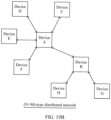
- the network in this embodiment of this application may include but is not limited to an (N+M)-type distributed network (also referred to as an (N+M) star topology network) shown in FIG. 19B or an [N ⁇ (N+1)+M]-type distributed network (also referred to as a multi-center heterogeneous topology network) shown in FIG. 20 .
- N+M an (N+M)-type distributed network
- N+M star topology network shown in FIG. 19B
- [N ⁇ (N+1)+M]-type distributed network also referred to as a multi-center heterogeneous topology network
- the (N+M)-type distributed network shown in FIG. 19B is used as an example. It is assumed that the master device on the network is the device A, and the devices on the network may align the BLE periodic broadcasts by performing the following step A to step D.
- Step A The master device (namely, the device A) starts periodic broadcast, carries a broadcast content identifier identifying that the device A is the master device, and indicates a time window for the periodic broadcast to another device.
- Step B The another device (namely, the slave device) on the network scans a periodic broadcast message in the specified time window.
- Step C After obtaining a broadcast message from the device A through scanning, the another device (namely, the slave device) on the network replies to the broadcast message from the device A in the time window for the periodic broadcast indicated by the master device.
- the another device namely, the slave device
- Step D Complete establishment of the periodic BLE broadcasts on the network after the master device (namely, the device A) receives the reply from the another device (namely, the slave device).
- the master device on the network may establish the periodic broadcast according to the following method: A master node starts periodic broadcast, and starts to monitor a broadcast response of the slave device on the network. After the periodic broadcast response of the slave device on the network is received, establishment of the periodic broadcast from the master node is completed.
- the master device on the network may initiate a task by using the periodic broadcast.
- the master device may carry device information of the master device, target device information, and task information data in the periodic broadcast.
- the device that obtains the periodic broadcast by scanning may identify, based on the target device information carried in the periodic broadcast, whether the task to be initiated by the master device is performed for the device. If the device determines that the task to be initiated by the master device is performed for the device, the device may initiate a fast BLE connection to the master device or reply to the periodic broadcast.
- the master device on the network may alternatively broadcast device statuses of devices on the network by using the periodic broadcast.
- the master device on the network may maintain a status information list of the devices on the network.
- the slave device on the network may also store the status information list of the devices on the network. If the master device on the network perceives that a device status of a device on the network changes, the master device may notify the device status of the device or notify an updated status information list of the devices on the network to another device on the network by using the periodic broadcast, so that the slave device updates the status information list of the devices on the network.
- the slave device on the network may establish the periodic broadcast group according to the following method: subscribing to a periodic broadcast from the master device after the slave device on the network is online. The slave device completes synchronization of the periodic broadcast after obtaining the periodic broadcast from the master device through scanning, and replies to the periodic broadcast from the master device after completing synchronization of the periodic broadcast.
- the slave device on the network may initiate a task by using the periodic broadcast.
- the slave device may carry device information of the slave device, target device information, and task information data in the periodic broadcast.
- the master device that obtains the periodic broadcast through scanning may initiate the task to all devices on the network.
- the master device may carry the device information of the master device, the target device information, and the task information data in the periodic broadcast.
- the device that obtains the periodic broadcast by scanning may identify, based on the target device information carried in the periodic broadcast, whether the task to be initiated by the master device is performed for the device. If the device determines that the task to be initiated by the master device is performed for the device, the device may initiate a fast BLE connection to the master device or reply to the periodic broadcast.
- the slave device on the network may initiate master device election on the network by using the periodic broadcast. For example, it is assumed that the slave device on the network perceives that the master device on the network changes from an active state to an idle state. In this case, the slave device may initiate master device election on the network by using the periodic broadcast, to re-determine the master device on the network.
- the [N ⁇ (N+1)+M]-type distributed network shown in FIG. 20 is used as an example. It is assumed that the master device on the network is the device A, and the devices on the network may align the BLE periodic broadcasts by performing the following step a to step d.
- Step a The master device (namely, the device A) starts periodic broadcast on a first channel, carries a broadcast content identifier identifying that the device A is the master device, and indicates a time window for the periodic broadcast to another device.
- Step b The another device (namely, the slave device) on the network scans a periodic broadcast message in the specified time window.
- Step c After obtaining a broadcast message from the device A scanning, the another device (namely, the slave device) on the network starts local periodic broadcast based on the time window assigned on the network.
- Step d Complete establishment of the periodic BLE broadcasts on the network after the master device (namely, the device A) obtains the periodic broadcast from the another device (namely, the slave device) through scanning.
- the master device on the network may establish periodic broadcast according to the following method: A master node starts periodic broadcast on a first channel, and subscribes to a periodic broadcast on the first channel of the online slave device on the network. After obtaining the periodic broadcast from the slave device on the network through scanning, the master device completes synchronization of the periodic broadcasts, in other words, completes establishment of the periodic broadcast from the master node.
- the slave device on the network may establish the periodic broadcast according to the following method: after the slave device on the network is online, subscribing to a periodic broadcast from the master device, and starting periodic broadcast from the slave device. After obtaining the periodic broadcast from the master device through scanning, the slave device completes synchronization of the periodic broadcast, in other words, completes establishment of the periodic broadcast from a master node.
- the master device or the slave device on the network may initiate a task by using the periodic broadcast.
- a task initiation device may carry device information of the task initiation device, target device information, and task information data in the periodic broadcast.
- a device that obtains the periodic broadcast by scanning may identify, based on the target device information carried in the periodic broadcast, whether the task to be initiated is performed for the device. If the device determines that the task to be initiated is performed for the device, the device may initiate a fast BLE connection to the task initiation device or reply to the periodic broadcast.
- the master device or the slave device on the network may alternatively periodically broadcast a device status of the master device or the slave device.
- the devices on the network may maintain a status information list of the devices on the network. If a device status of a device changes, the device may notify the status of the device to another device on the network by using the periodic broadcast, so that the another device updates the status information list of the devices on the network.
- each device on the network may periodically send a broadcast message, where the broadcast message carries device information of the device.
- the broadcast message carries device information of the device.
- a device 1 on the network periodically sends the broadcast message.
- Other devices on the network perform scanning in respective scanning windows. If the broadcast message from the device 1 is obtained through scanning, the device 1 is identified as online. If the broadcast message from the device 1 is not obtained through scanning, the device 1 is identified as offline. In this way, all the devices on the network may update the status information list of the devices on the network.
- Embodiment 4 of this application may be combined with one or more of Embodiment 1 to Embodiment 3 to be used in an inter-device connection management process.
- Embodiment 4 is performed based on the solution provided in Embodiment 1. It is assumed that the AP processor of the device A performs unidirectional declarative broadcast according to the method in Embodiment 1. After the device B obtains, through scanning, a broadcast message that is from the device A and that meets the device online condition, the device A and device B perform connection authentication, and determine the master device on the network. It is assumed that the master device on the network is the device A.
- the device A broadcasts information such as a hardware clock, a broadcast parameter, and a scanning parameter of the device A, and then the slave device (namely, the device B) adjusts a hardware clock and an AP clock of the slave device based on the foregoing information, so that the hardware clock and the AP clock of the slave device are respectively synchronized with the hardware clock and an AP clock of the master device.
- the slave device namely, the device B
- the slave device adjusts a hardware clock and an AP clock of the slave device based on the foregoing information, so that the hardware clock and the AP clock of the slave device are respectively synchronized with the hardware clock and an AP clock of the master device.
- the device B adjusts the broadcast parameter based on an adjusted hardware clock and AP clock, and then an SH chip of the device B may send a broadcast message in a broadcast window aligned with a scanning window of the device A; and adjusts the scanning parameter based on the adjusted hardware clock and AP clock, and then the SH chip of the device B may scan the broadcast message in a scanning window aligned with a broadcast window of the device A.
- Embodiment 4 is performed based on the solutions provided in Embodiment 1 and Embodiment 2. It is assumed that the AP processor of the device A performs unidirectional declarative broadcast according to the method in Embodiment 1.
- the SH chip of the device A obtains a broadcast message from the device B through scanning
- the SH chip of the device B determines whether the device A is in the online device list. If the device A is in the online device list, the SH chip of the device B replies to the device A through broadcast based on the proxy reply template. If the device A is not in the online device list, the SH chip of the device B reports, to the AP processor, that the device A is discovered, and the AP processor of the device B performs connection authentication with the device A and updates the online device list.
- the device A and the device B determine the master device on the network. It is assumed that the master device on the network is the device A.
- the device A broadcasts information such as a hardware clock, a broadcast parameter, and a scanning parameter of the device A, and then the slave device (namely, the device B) adjusts a hardware clock and an AP clock of the slave device based on the foregoing information, so that the hardware clock and the AP clock of the slave device are respectively synchronized with the hardware clock and an AP clock of the master device.
- the device B adjusts the broadcast parameter based on an adjusted hardware clock and AP clock, and then an SH chip of the device B may send a broadcast message in a broadcast window aligned with a scanning window of the device A; and adjusts the scanning parameter based on the adjusted hardware clock and AP clock, and then the SH chip of the device B may scan the broadcast message in a scanning window aligned with a broadcast window of the device A.
- Embodiment 4 is performed based on the solutions provided in Embodiment 1 and Embodiment 3. It is assumed that the device B performs device offline/online management according to the method in Embodiment 3, and the AP processor of the device A performs unidirectional declarative broadcast according to the method in Embodiment 1. After the SH chip of the device A obtains, through scanning, a broadcast message that is from the device B and that meets the device online condition, the SH chip of the device A reports, to the AP processor, that the device A is discovered, and the AP processor of the device B performs connection authentication with the device A and updates the online device list. After performing the connection authentication, the device A and the device B determine the master device on the network.
- the master device on the network is the device A.
- the device A broadcasts information such as a hardware clock, a broadcast parameter, and a scanning parameter of the device A, and then the slave device (namely, the device B) adjusts a hardware clock and an AP clock of the slave device based on the foregoing information, so that the hardware clock and the AP clock of the slave device are respectively synchronized with the hardware clock and an AP clock of the master device.
- the device B adjusts the broadcast parameter based on an adjusted hardware clock and AP clock, and then an SH chip of the device B may send a broadcast message in a broadcast window aligned with a scanning window of the device A; and adjusts the scanning parameter based on the adjusted hardware clock and AP clock, and then the SH chip of the device B may scan the broadcast message in a scanning window aligned with a broadcast window of the device A.
- the SH chip of the device B reports, to the AP processor, that the device A is discovered, and the AP processor of the device B performs connection authentication with the device A and updates the online device list.
- the device A and the device B determine the master device on the network. It is assumed that the master device on the network is the device A.
- the device A broadcasts information such as a hardware clock, a broadcast parameter, and a scanning parameter of the device A, and then the slave device (namely, the device B) adjusts a hardware clock and an AP clock of the slave device based on the foregoing information, so that the hardware clock and the AP clock of the slave device are respectively synchronized with the hardware clock and an AP clock of the master device.
- the device B adjusts the broadcast parameter based on an adjusted hardware clock and AP clock, and then an SH chip of the device B may send a broadcast message in a broadcast window aligned with a scanning window of the device A; and adjusts the scanning parameter based on the adjusted hardware clock and AP clock, and then the SH chip of the device B may scan the broadcast message in a scanning window aligned with a broadcast window of the device A.
- master device election is performed on the network.
- the master device initiates clock alignment and window alignment, and the slave devices separately (or in a relay manner) complete alignment with the broadcast window/scanning window of the master device based on the hardware clock of the master device.
- the broadcast window of the device is aligned with the scanning window of the peer device by dynamically adjusting the broadcast parameter, or the scanning window of the device is aligned with the broadcast window of the peer device by dynamically adjusting the scanning parameter, so that a hit rate of the broadcast message can be increased, and a keepalive effect is significantly improved. Therefore, device discovery performance can be improved.
- alignment of software and hardware clocks namely, the AP clocks and the hardware clocks
- high-precision discovery and keepalive performance of the devices on the network can be implemented.
- Embodiment 5 when there are a large quantity of online devices on a network, a connection relationship between the devices may be established through a fast BLE connection.
- a directional notification may be sent through a fast BLE connection established between the devices, for example, the directional notification is sent to a specified device on the network.
- FIG. 21 is a diagram of a process of establishing the fast BLE connection according to this embodiment of this application by using an example in which a device A is a master device on the network.
- a method for establishing the fast BLE connection provided in this embodiment of this application may include S2101 to S2104.
- S2101 The device A discovers that a quantity of online devices on the network reaches an upper limit.
- the device A discovers that a quantity of online devices on the network is greater than a preset quantity threshold.
- S2102 The device A resolves a random address by using an address resolving key (identity resolving key, IRK), to obtain a corresponding real address, where the real address corresponds to a device B.
- an address resolving key identity resolving key, IRK
- the IRK is cached in the device A when the device B and the device A are paired last time. Generally, the IRK is automatically generated before delivery based on a specific requirement. After Bluetooth pairing is performed between the device A and the device B, the IRK of the device is generated and cached in a peer device. In an example, the device A may cache the IRK of the device B in a form of IRK key address pair.
- a service discovery handle (Handle) is cached together with the IRK.
- the service discovery handle is used to directly establish the fast BLE connection by invoking a previous service discovery result when the fast BLE connection is subsequently established, and a time-consuming service discovery phase does not need to be performed again. Therefore, the fast BLE connection is established faster.
- the real address of the device B may be obtained by resolving the random address of the device B. After knowing the real address of the device B, the device A may skip the time-consuming service discovery phase according to a Bluetooth low energy communication protocol (generic attributes, GATT), and directly establish the fast BLE connection to the device B.
- GATT Bluetooth low energy communication protocol
- the device A and the device B may establish the fast BLE connection.
- Establishment of the fast BLE connection mainly includes two phases: a connection establishment phase (namely, S2103) and an MTU exchange phase (namely, S2104). It can be learned that, compared with a conventional BLE connection, the fast BLE connection skips the most time-consuming BLE service discovery phase, so that a BLE connection establishment speed is faster.
- S2103 The device A establishes the connection to the device B.
- S2104 The device A and the device B exchange maximum transmission units (maximum transmission units, MTUs).
- the device A and the device B exchange the MTUs, to notify a peer device of a maximum size of a data packet that can be accepted by the device A or the device B.
- MTU For related descriptions of the MTU, refer to the conventional technology. Details are not described herein again.
- the BLE connection is based on Characteristic for communication
- a device may read data from Characteristic or write data to Characteristic.
- Characteristic may be identified by different UUIDs. Therefore, communication performed through the BLE connection is equivalent to receiving and sending separately performed through a reading channel and a writing channel that do not affect each other.
- the BLE connection compared with another type of Bluetooth connection (for example, a BR Bluetooth connection), the BLE connection has the following advantages.
- the BLE connection supports bidirectional communication, and therefore, there is no bidirectional conflict (also referred to as concurrency conflict) problem.
- a communication speed of the BLE connection is fast.
- a packet sending interval based on the BLE connection is 2.5 ms
- a packet sending interval based on the BR Bluetooth connection is 20 ms.
- the BLE connection supports a large quantity of connectable devices.
- the BLE connection does not limit a quantity of connectable devices, but the BR Bluetooth connection supports connection to only seven devices.
- the fast BLE connection is established when there are a large quantity of devices on the network, and the peer device is directionally notified or woken up through the fast BLE connection. This can avoid a broadcast storm, support bidirectional communication, improve a communication speed on the network, and allow another device to continue to join the network. In addition, because the most time-consuming BLE service discovery phase is skipped during establishment of the fast BLE connection, the BLE connection is established faster.
- the directional notification when there are a large quantity of online devices on the network, the directional notification may be further sent through the fast BLE connection established between the devices, for example, the directional notification is sent to a specified device on the network. In this way, according to this method, another irrelevant device is not disturbed, information can be accurately sent, and the broadcast storm existing in broadcast can be avoided.
- Embodiment 5 of this application may be combined with one or more of Embodiment 1 to Embodiment 4 to be used in an inter-device connection management process.
- a connection relationship between devices may be established through the fast BLE connection.
- a strategy, an interaction process, and the like of an inter-device connection are improved from different aspects (such as a device discovery manner, a broadcast type, an SH chip proxy function, online/offline determining, window alignment, and a connection manner).
- This can reduce a device discovery delay (for example, according to a test, a device discovery delay is about 10s, device discovery delays of 99% of devices are less than 30s), save communication resources, and reduce device power consumption.
- this can avoid a broadcast storm, avoid interference between devices, increase a device discovery success rate, improve a keepalive effect, and improve device discovery and keepalive performance.
- sequence numbers of the foregoing processes do not mean execution sequences in various embodiments of this application.
- the execution sequences of the processes should be determined based on functions and internal logic of the processes, and should not be construed as any limitation on the implementation processes of embodiments of this application.
- an electronic device includes a corresponding hardware structure and/or software module for executing each function.
- a person skilled in the art should easily be aware that, in combination with units and algorithm steps of the examples described in embodiments disclosed in this specification, this application may be implemented by hardware or a combination of hardware and computer software. Whether a function is performed by hardware or hardware driven by computer software depends on particular applications and design constraints of the technical solutions. A person skilled in the art may use different methods to implement the described functions for each particular application, but it shall not be considered that the implementation goes beyond the scope of this application.
- the electronic device may be divided into functional modules.
- each functional module corresponding to each function may be obtained through division, or two or more functions may be integrated into one processing module.
- the integrated module may be implemented in a form of hardware, or may be implemented in a form of software functional module. It should be noted that, in embodiments of this application, module division is an example, and is merely logical function division. During actual implementation, another division manner may be used.
- each module in the electronic device may be implemented in a form of software and/or hardware. This is not specifically limited herein. In other words, a smart rope jumping/the electronic device is presented in a form of functional module.
- the "module” herein may be an application-specific integrated circuit ASIC, a circuit, a processor that executes one or more software or firmware programs and a memory, an integrated logic circuit, and/or another component that can provide the foregoing functions.
- the data transmission may be completely or partially implemented in a form of computer program product.
- the computer program product includes one or more computer instructions. When the computer program instructions are loaded and executed on a computer, the procedures or functions according to embodiments of this application are completely or partially implemented.
- the computer may be a general-purpose computer, a dedicated computer, a computer network, or other programmable apparatuses.
- the computer instructions may be stored in a computer-readable storage medium or may be transmitted from a computer-readable storage medium to another computer-readable storage medium.
- the computer instructions may be transmitted from a website, computer, server, or data center to another website, computer, server, or data center in a wired manner (for example, a coaxial cable, an optical fiber, or a digital subscriber line (digital subscriber line, DSL)) or a wireless manner (for example, infrared, radio, microwave, or the like).
- the computer-readable storage medium may be any usable medium accessible by the computer, or a data storage device, for example, a server or a data center, integrating one or more usable media.
- the usable medium may be a magnetic medium (for example, a floppy disk, a hard disk, or a magnetic tape), an optical medium (for example, a digital video disk (digital video disk, DVD)), a semiconductor medium (for example, a solid state disk (solid state disk, SSD)), or the like.
- a magnetic medium for example, a floppy disk, a hard disk, or a magnetic tape
- an optical medium for example, a digital video disk (digital video disk, DVD)
- a semiconductor medium for example, a solid state disk (solid state disk, SSD)
- the software instructions may include a corresponding software module.
- the software module may be stored in a RAM memory, a flash memory, a ROM memory, an EPROM memory, an EEPROM memory, a register, a hard disk, a removable hard disk, a CD-ROM memory, or a storage medium in any other form well-known in the art.
- a storage medium is coupled to the processor, so that the processor can read information from the storage medium and write information into the storage medium.
- the storage medium may be a component of the processor.
- the processor and the storage medium may be disposed in an ASIC.
- the ASIC may be located in the electronic device.
- the processor and the storage medium may alternatively exist in the electronic device as discrete components.
Landscapes
- Engineering & Computer Science (AREA)
- Computer Networks & Wireless Communication (AREA)
- Signal Processing (AREA)
- Databases & Information Systems (AREA)
- Computer Security & Cryptography (AREA)
- Multimedia (AREA)
- Mobile Radio Communication Systems (AREA)
Applications Claiming Priority (2)
| Application Number | Priority Date | Filing Date | Title |
|---|---|---|---|
| CN202210894268.9A CN117528477A (zh) | 2022-07-27 | 2022-07-27 | 一种设备间连接的管理方法、设备及系统 |
| PCT/CN2023/108693 WO2024022256A1 (zh) | 2022-07-27 | 2023-07-21 | 一种设备间连接的管理方法、设备及系统 |
Publications (2)
| Publication Number | Publication Date |
|---|---|
| EP4546885A1 true EP4546885A1 (de) | 2025-04-30 |
| EP4546885A4 EP4546885A4 (de) | 2025-10-01 |
Family
ID=89705486
Family Applications (1)
| Application Number | Title | Priority Date | Filing Date |
|---|---|---|---|
| EP23845466.4A Pending EP4546885A4 (de) | 2022-07-27 | 2023-07-21 | Verfahren zur verwaltung der verbindung zwischen vorrichtungen sowie vorrichtung und system |
Country Status (4)
| Country | Link |
|---|---|
| US (1) | US20260019791A1 (de) |
| EP (1) | EP4546885A4 (de) |
| CN (1) | CN117528477A (de) |
| WO (1) | WO2024022256A1 (de) |
Families Citing this family (2)
| Publication number | Priority date | Publication date | Assignee | Title |
|---|---|---|---|---|
| CN119254560A (zh) * | 2024-08-19 | 2025-01-03 | 广东电网有限责任公司广州供电局 | 一种运行轻量化电鸿物联操作系统的软总线自发现技术 |
| CN120475550B (zh) * | 2024-10-18 | 2026-04-03 | 荣耀终端股份有限公司 | 一种连接方法及电子设备 |
Family Cites Families (7)
| Publication number | Priority date | Publication date | Assignee | Title |
|---|---|---|---|---|
| EP1411686A3 (de) * | 2002-10-18 | 2006-10-11 | Samsung Electronics Co., Ltd. | Drahtloses Kommunikationsgerät und Verfahren für verbindungsloses Rundumsenden |
| CN108769973B (zh) * | 2018-07-19 | 2021-04-02 | 深圳全志在线有限公司 | 一种蓝牙设备的隐私保护方法 |
| CN109769240A (zh) * | 2019-03-12 | 2019-05-17 | 百度在线网络技术(北京)有限公司 | 蓝牙连接方法、装置和系统 |
| JP7358074B2 (ja) * | 2019-05-31 | 2023-10-10 | キヤノン株式会社 | 情報処理装置、制御方法及びプログラム |
| CN111263339B (zh) * | 2020-01-14 | 2021-06-04 | 荣耀终端有限公司 | 无线通信方法和具有无线通信功能的设备 |
| CN114257996B (zh) * | 2020-09-21 | 2025-09-02 | 华为技术有限公司 | 一种设备的发现方法和装置 |
| CN113794529B (zh) * | 2021-09-10 | 2025-05-13 | 苏州光格科技股份有限公司 | 时钟同步系统 |
-
2022
- 2022-07-27 CN CN202210894268.9A patent/CN117528477A/zh active Pending
-
2023
- 2023-07-21 WO PCT/CN2023/108693 patent/WO2024022256A1/zh not_active Ceased
- 2023-07-21 US US18/995,454 patent/US20260019791A1/en active Pending
- 2023-07-21 EP EP23845466.4A patent/EP4546885A4/de active Pending
Also Published As
| Publication number | Publication date |
|---|---|
| US20260019791A1 (en) | 2026-01-15 |
| EP4546885A4 (de) | 2025-10-01 |
| WO2024022256A1 (zh) | 2024-02-01 |
| CN117528477A (zh) | 2024-02-06 |
Similar Documents
| Publication | Publication Date | Title |
|---|---|---|
| US12581411B2 (en) | Sleep scheduling method and device | |
| US11082815B2 (en) | Method of operating function and resource of electronic device | |
| CN110622123B (zh) | 一种显示方法及装置 | |
| CN111263339B (zh) | 无线通信方法和具有无线通信功能的设备 | |
| KR102577358B1 (ko) | 다중 주파수 대역을 이용한 통신 방법 및 장치 | |
| CN115826810A (zh) | 一种电子设备间的交互方法及电子设备 | |
| EP4546885A1 (de) | Verfahren zur verwaltung der verbindung zwischen vorrichtungen sowie vorrichtung und system | |
| KR20160063041A (ko) | 근접 서비스 데이터 송신 방법 및 그 전자 장치 | |
| EP3567752A1 (de) | Verfahren und vorrichtung zum erfassen und senden von systeminformationen | |
| KR102444897B1 (ko) | 통신 연결을 형성하는 방법 및 장치 | |
| WO2023174043A1 (zh) | 一种电力线通信系统、在网状态检测方法及设备 | |
| WO2019158016A1 (zh) | 确定寻呼消息位置的方法、通信设备、网络侧、用户设备 | |
| US20160316338A1 (en) | Device Control Method and Device | |
| EP3060012B1 (de) | Stromsparverfahren in einem ad-hoc-netzwerk und elektronische vorrichtung zur durchführung des verfahrens | |
| WO2023142993A1 (zh) | 一种探测方法、相关电子设备及系统 | |
| AU2014315883A1 (en) | Method of controlling short-range wireless communication and apparatus supporting the same | |
| EP2961237B1 (de) | Verfahren und elektronische vorrichtung zum betreiben eines kommunikationsdienstes | |
| KR102113550B1 (ko) | 전자 장치의 기능 및 리소스 운용 방법 | |
| CN117156597B (zh) | 基于自组网的设备处理方法、设备以及存储介质 | |
| CN114697932A (zh) | 一种降低功耗的方法及电子设备 | |
| WO2024240191A1 (zh) | 近距离扫描方法及相关装置 | |
| WO2024082906A1 (zh) | 信息获取方法、装置、蓝牙设备、终端设备及存储介质 | |
| CN117998397A (zh) | 一种系统、感知电子设备下线的方法以及电子设备 | |
| EP4366333A1 (de) | Vorrichtungserkennungsverfahren, -vorrichtung und -system | |
| CN116708046B (zh) | 路由器关闭方法、系统及路由器 |
Legal Events
| Date | Code | Title | Description |
|---|---|---|---|
| STAA | Information on the status of an ep patent application or granted ep patent |
Free format text: STATUS: THE INTERNATIONAL PUBLICATION HAS BEEN MADE |
|
| PUAI | Public reference made under article 153(3) epc to a published international application that has entered the european phase |
Free format text: ORIGINAL CODE: 0009012 |
|
| STAA | Information on the status of an ep patent application or granted ep patent |
Free format text: STATUS: REQUEST FOR EXAMINATION WAS MADE |
|
| 17P | Request for examination filed |
Effective date: 20250124 |
|
| AK | Designated contracting states |
Kind code of ref document: A1 Designated state(s): AL AT BE BG CH CY CZ DE DK EE ES FI FR GB GR HR HU IE IS IT LI LT LU LV MC ME MK MT NL NO PL PT RO RS SE SI SK SM TR |
|
| RIC1 | Information provided on ipc code assigned before grant |
Ipc: H04W 52/02 20090101AFI20250618BHEP Ipc: H04W 4/80 20180101ALI20250618BHEP Ipc: H04W 76/10 20180101ALI20250618BHEP Ipc: H04W 4/06 20090101ALI20250618BHEP Ipc: H04W 12/06 20210101ALI20250618BHEP Ipc: H04W 8/00 20090101ALI20250618BHEP Ipc: H04W 48/10 20090101ALI20250618BHEP Ipc: H04W 48/16 20090101ALI20250618BHEP Ipc: H04W 88/02 20090101ALI20250618BHEP |
|
| A4 | Supplementary search report drawn up and despatched |
Effective date: 20250902 |
|
| RIC1 | Information provided on ipc code assigned before grant |
Ipc: H04W 52/02 20090101AFI20250827BHEP Ipc: H04W 4/80 20180101ALI20250827BHEP Ipc: H04W 76/10 20180101ALI20250827BHEP Ipc: H04W 4/06 20090101ALI20250827BHEP Ipc: H04W 12/06 20210101ALI20250827BHEP Ipc: H04W 8/00 20090101ALI20250827BHEP Ipc: H04W 48/10 20090101ALI20250827BHEP Ipc: H04W 48/16 20090101ALI20250827BHEP Ipc: H04W 88/02 20090101ALI20250827BHEP Ipc: H04W 84/18 20090101ALI20250827BHEP Ipc: H04W 48/08 20090101ALI20250827BHEP |
|
| DAV | Request for validation of the european patent (deleted) | ||
| DAX | Request for extension of the european patent (deleted) | ||
| GRAP | Despatch of communication of intention to grant a patent |
Free format text: ORIGINAL CODE: EPIDOSNIGR1 |
|
| STAA | Information on the status of an ep patent application or granted ep patent |
Free format text: STATUS: GRANT OF PATENT IS INTENDED |
|
| RIC1 | Information provided on ipc code assigned before grant |
Ipc: H04W 52/02 20090101AFI20260318BHEP Ipc: H04W 4/80 20180101ALI20260318BHEP Ipc: H04W 76/10 20180101ALI20260318BHEP Ipc: H04W 4/06 20090101ALI20260318BHEP Ipc: H04W 12/06 20210101ALI20260318BHEP Ipc: H04W 8/00 20090101ALI20260318BHEP Ipc: H04W 48/10 20090101ALI20260318BHEP Ipc: H04W 48/16 20090101ALI20260318BHEP Ipc: H04W 88/02 20090101ALI20260318BHEP Ipc: H04W 84/18 20090101ALI20260318BHEP Ipc: H04W 48/08 20090101ALI20260318BHEP Ipc: H04W 76/14 20180101ALI20260318BHEP |