EP4548840A1 - Système portable - Google Patents
Système portable Download PDFInfo
- Publication number
- EP4548840A1 EP4548840A1 EP24209691.5A EP24209691A EP4548840A1 EP 4548840 A1 EP4548840 A1 EP 4548840A1 EP 24209691 A EP24209691 A EP 24209691A EP 4548840 A1 EP4548840 A1 EP 4548840A1
- Authority
- EP
- European Patent Office
- Prior art keywords
- wearable
- user
- computerised
- sensors
- carbon monoxide
- Prior art date
- Legal status (The legal status is an assumption and is not a legal conclusion. Google has not performed a legal analysis and makes no representation as to the accuracy of the status listed.)
- Pending
Links
Images



Classifications
-
- A—HUMAN NECESSITIES
- A61—MEDICAL OR VETERINARY SCIENCE; HYGIENE
- A61B—DIAGNOSIS; SURGERY; IDENTIFICATION
- A61B5/00—Measuring for diagnostic purposes; Identification of persons
- A61B5/02—Detecting, measuring or recording for evaluating the cardiovascular system, e.g. pulse, heart rate, blood pressure or blood flow
- A61B5/0205—Simultaneously evaluating both cardiovascular conditions and different types of body conditions, e.g. heart and respiratory condition
-
- A—HUMAN NECESSITIES
- A61—MEDICAL OR VETERINARY SCIENCE; HYGIENE
- A61B—DIAGNOSIS; SURGERY; IDENTIFICATION
- A61B5/00—Measuring for diagnostic purposes; Identification of persons
- A61B5/103—Measuring devices for testing the shape, pattern, colour, size or movement of the body or parts thereof, for diagnostic purposes
- A61B5/11—Measuring movement of the entire body or parts thereof, e.g. head or hand tremor or mobility of a limb
- A61B5/1107—Measuring contraction of parts of the body, e.g. organ or muscle
-
- A—HUMAN NECESSITIES
- A61—MEDICAL OR VETERINARY SCIENCE; HYGIENE
- A61B—DIAGNOSIS; SURGERY; IDENTIFICATION
- A61B5/00—Measuring for diagnostic purposes; Identification of persons
- A61B5/103—Measuring devices for testing the shape, pattern, colour, size or movement of the body or parts thereof, for diagnostic purposes
- A61B5/11—Measuring movement of the entire body or parts thereof, e.g. head or hand tremor or mobility of a limb
- A61B5/112—Gait analysis
-
- A—HUMAN NECESSITIES
- A61—MEDICAL OR VETERINARY SCIENCE; HYGIENE
- A61B—DIAGNOSIS; SURGERY; IDENTIFICATION
- A61B5/00—Measuring for diagnostic purposes; Identification of persons
- A61B5/103—Measuring devices for testing the shape, pattern, colour, size or movement of the body or parts thereof, for diagnostic purposes
- A61B5/11—Measuring movement of the entire body or parts thereof, e.g. head or hand tremor or mobility of a limb
- A61B5/1124—Determining motor skills
-
- A—HUMAN NECESSITIES
- A61—MEDICAL OR VETERINARY SCIENCE; HYGIENE
- A61B—DIAGNOSIS; SURGERY; IDENTIFICATION
- A61B5/00—Measuring for diagnostic purposes; Identification of persons
- A61B5/145—Measuring characteristics of blood in vivo, e.g. gas concentration or pH-value ; Measuring characteristics of body fluids or tissues, e.g. interstitial fluid or cerebral tissue
- A61B5/14546—Measuring characteristics of blood in vivo, e.g. gas concentration or pH-value ; Measuring characteristics of body fluids or tissues, e.g. interstitial fluid or cerebral tissue for measuring analytes not otherwise provided for, e.g. ions, cytochromes
-
- A—HUMAN NECESSITIES
- A61—MEDICAL OR VETERINARY SCIENCE; HYGIENE
- A61B—DIAGNOSIS; SURGERY; IDENTIFICATION
- A61B5/00—Measuring for diagnostic purposes; Identification of persons
- A61B5/40—Detecting, measuring or recording for evaluating the nervous system
- A61B5/4076—Diagnosing or monitoring particular conditions of the nervous system
- A61B5/4082—Diagnosing or monitoring movement diseases, e.g. Parkinson, Huntington or Tourette
-
- A—HUMAN NECESSITIES
- A61—MEDICAL OR VETERINARY SCIENCE; HYGIENE
- A61B—DIAGNOSIS; SURGERY; IDENTIFICATION
- A61B5/00—Measuring for diagnostic purposes; Identification of persons
- A61B5/40—Detecting, measuring or recording for evaluating the nervous system
- A61B5/4076—Diagnosing or monitoring particular conditions of the nervous system
- A61B5/4088—Diagnosing of monitoring cognitive diseases, e.g. Alzheimer, prion diseases or dementia
-
- A—HUMAN NECESSITIES
- A61—MEDICAL OR VETERINARY SCIENCE; HYGIENE
- A61B—DIAGNOSIS; SURGERY; IDENTIFICATION
- A61B2560/00—Constructional details of operational features of apparatus; Accessories for medical measuring apparatus
- A61B2560/02—Operational features
- A61B2560/0242—Operational features adapted to measure environmental factors, e.g. temperature, pollution
Definitions
- the present disclosure relates generally to a wearable system for detecting and monitoring an indicator for a disease or a disease induced by an actual air pollution and wearables adapted thereto.
- the present invention relates to a wearable device for detecting pollution.
- the present invention relates to a wearable device for detecting pollutants such as carbon monoxide in the environment of a user and mediators that cause diseases as a result of exposure to indoor and outdoor pollutants.
- the invention relates to a method for detecting and monitoring an indicator for a disease or a disease induced by an actual air pollution.
- Air quality is essential to the wellbeing of human beings. It is now accepted that air pollution contributes to ill health and death. Air pollutants are present both indoors and outdoors.
- Household air pollution was estimated to be responsible for around 3.2 million deaths in 2020, including over 237,000 deaths of children under the age of 5 (WHO). Household air pollution is caused by smoking and the use of open fires and wood burning stoves, along with cooking indoors using open fires or inefficient stoves. Household air pollution can lead to the development of a number of diseases including stroke, heart disease, lung cancer and both chronic and acute respiratory diseases including asthma and COPD.
- Air pollution outdoors is one of the greatest environmental risks to health and in 2019, it was estimated that 99% of the world's population was living in places where the WHO 25 air quality guidelines were not met (WHO). Outdoor air pollution is estimated to have caused 4.2 million premature deaths worldwide in 2019 and this is demonstrated by a coroner's court verdict in London on the death of a child with asthma (Ella Adoo-Kissi-Debrah: Air Pollution a factor in girl's death, Inquest finds: BBC News 16-12-2020).
- Common pollutants include particulate matter, carbon monoxide, nitrogen dioxide and sulphur dioxide and are caused by incomplete combustion (carbon monoxide), and burning of fossil fuels and fuels for transport, for example.
- outdoor air pollution is a known cause of diseases such as ischaemic heart disease and stroke, COPD, cancers of the upper airways and lungs and respiratory diseases.
- carbon monoxide is a colourless and tasteless gas that is released from exhausts of gasoline powered automobile vehicles, wood fires, stoves, forest fires, smoking tobacco in any form and bush fires. There are many other sources of carbon monoxide. Poor ventilation allows carbon monoxide levels to increase indoors.
- Carbon monoxide binds to haemoglobin, a protein that transports oxygen around the body. Carbon monoxide has a 200 times greater affinity for haemoglobin than oxygen and thus carbon monoxide displaces oxygen from haemoglobin to form carboxyhaemoglobin.
- haemoglobin a protein that transports oxygen around the body.
- oxygen-carrying capability of the blood is decreased which can cause hypoxia and acidosis.
- Such lack of oxygen affects vital organs such as the brain and heart.
- the effect of carbon monoxide can be detected by the amount of inhaled carbon monoxide and the reduced oxygen levels.
- Levels of carbon monoxide above 70 parts per million (ppm) cause dizziness, increased breathing rate, loss of consciousness, brain damage and death.
- levels of carbon monoxide above 5 ppm can affect the developing foetus.
- Foetal haemoglobin has a particular affinity for carbon monoxide, which results in the foetus being deprived of oxygen more severely than the mother. Premature birth, death of the foetus and damage to the infant's brain are reported following exposure to carbon monoxide.
- Carbon monoxide levels are monitored at antenatal appointments using a breath monitor, which indicates the ppm of carbon monoxide or percentage of carboxyhaemoglobin present in the breath.
- breath monitors which indicates the ppm of carbon monoxide or percentage of carboxyhaemoglobin present in the breath.
- these monitors are only used intermittently at antenatal appointments and therefore do not immediately alert the mother to the presence of carbon monoxide and/or carbon monoxide poisoning.
- very low levels of carbon monoxide need to be detected using any monitor.
- Measurement of carboxyhaemoglobin is an accurate way of assessing the severity of carbon monoxide poisoning and can be measured using pulse oximetry or, more accurately with a CO-oximeter, which measures the carbon monoxide bound to haemoglobin in a blood sample.
- CO-oximeters measure the absorption of light passing through the blood in order to distinguish between oxyhaemoglobin, deoxyhaemoglobin and carboxyhaemoglobin.
- the present invention relates to a wearable system comprising at least one wearable device for monitoring an indicator for a disease or a disease induced by an actual air pollution and is based, in part, on studies by the inventor in which he has shown it is possible to accurately measure, among other things, the level of the pollutant carbon monoxide at low levels using a wearable device. Furthermore, the invention relates to a method for detecting and monitoring an indicator for a disease or a disease induced by an actual air pollution.
- the wearable system comprising at least one wearable device with at least one sensor, which is enabled to detect pollutants and mediators that cause diseases as a result of exposure to indoor and outdoor pollutants.
- a wearable system for detecting and monitoring an indicator for a disease or a disease induced by an actual air pollution comprising:
- the wearable system for detecting and monitoring an indicator for a disease or a disease induced by an actual air pollution enables the detection of vital signs, environmental pollution such as particulate matter or gases such as carbon monoxide and diseases caused by environmental pollutants.
- the at least one wearable device includes sensors enabled to detect pollutants such as carbon monoxide, carbon dioxide, particulate matter, both small and large, sulphur dioxide, nitrous oxide, nitrogen dioxide, circulating fibrinogen and interleukin. All the sensors communicate to the computerised device worn by the user securely by means of secure Bluetooth or Wi-Fi.
- Such wearable device is of use to detect a variety of diseases that include heart diseases, Parkinson's disease and cancer induced by long-term exposure to pollution, protect the vulnerable, detect fatigue, drowsiness and improve the lives of those exposed to pollution and living alone.
- the wearable device worn by the user is configured to monitor the gait of the user.
- a gait analysis can be performed by means of measuring the horizontal distance of movement of legs, the speed, posture, pressure exerted vertically, laterally and direction of the leg perpendicular to the floor with each step of the user.
- Such a methodology allows analysis of the user's gait.
- a suitable combination of wearable devices allows distinguishing various types of gait. By way of example, combining information received by a ring and an anklet as wearable devices it may be possible to distinguish the gait in Parkinson's disease from Dementia and Alzheimer's.
- detection of fatigue due to chronic inhalation of indoor and outdoor pollutant is enabled using such sensors that can detect activity, muscle weakness as characterised by changes in amplitude and frequency of muscle fibre contraction.
- the computerised device may comprise a computerised algorithm configured to analyse the activity of the user by measurement of muscle contractility, wherein the detection of amplitude and frequency of such muscle movements results in decision making based on artificial intelligence, machine learning and deep learning.
- the variation in amplitude and frequency of muscle movements helps to characterise muscle diseases as in fatigue detection, Parkinson's disease and dementia.
- Parkinson's disease the muscle contractions are of higher amplitude and lower frequency
- the muscle contraction in another medical condition known as essential tremor the muscle contraction is of lower amplitude and the frequency is higher.
- a low frequency and high amplitude is to be found in multiple sclerosis.
- the computerised device may comprise a computerised algorithm configured to analyse muscle movement, amplitude and frequency of muscle contraction and gait to arrive distinguishing various types of gait based on artificial intelligence, machine learning and deep learning.
- the computerised device comprises a computerised algorithm configured to analyse movements, which may a tremor of fingers, wherein the detection of amplitude and frequency of such finger movements results in decision-making based on artificial intelligence, machine learning and deep learning.
- the computerised device is adapted to detect carbon monoxide by means of a spectrophotometric method.
- the computerised device is adapted to determine the presence of carboxyhaemoglobin value based on a wavelength measurement of oxyhaemoglobin and methaemoglobin.
- At least one of the sensors being is configured to detect a biomarker.
- Mediators of diseases caused by environmental pollution are also known as biomarkers. These may be carboxy haemoglobin in carbon monoxide inhalation.
- the wearable device for detecting and/or monitoring an indicator for a disease or a disease induced by an actual air pollution in the environment of a user comprises a plurality of sensors attached to the wearable device, whereby the sensors being configured to detect an air pollutant in the environment of the user.
- the sensors are both miniaturised mechanical and electrochemical elements.
- the wearable system of the present invention is, among other, able to detect the presence of an air pollutant in the environment of a user of the wearable device.
- air pollutant as used herein is used to mean airborne pollutants present in the environment which cause harm to humans.
- the pollutants may be particulates of various sizes, gases or vapours, for example.
- the air pollutant may be selected from: carbon monoxide, carbon dioxide, nitrous oxide, nitrogen dioxide, sulphur dioxide and particulate matter. Pollutants also include lead and ozone, for example. In embodiments, the air pollutant is carbon monoxide.
- the wearable system of the present invention is able to accurately and quickly inform a user of the device that carbon monoxide is present in the environment, even at low levels.
- a user can therefore quickly address the presence of carbon monoxide and/or remove themselves from the area to avoid carbon monoxide poisoning.
- Such early detection is advantageous as the presence of carbon monoxide can be identified before any adverse effects become apparent.
- Such a wearable system may be particularly useful to pregnant women, since the developing foetus is particularly at risk of very low levels of carbon monoxide, as well as people working in industries where exposure to carbon monoxide is possible, for example gas engineers.
- the wearable system may be used by the general public to provide information regarding the environmental pollutants and enable then to adjust their exposure to pollutants accordingly.
- the term "environment of the user” as used herein is used to mean the surroundings of the user at the time the user is wearing the wearable device of the wearable system.
- the environment may be indoors or outdoors.
- the environment may be the home or workplace of the user.
- the environment may be outdoors while travelling, taking exercise or commuting, for example.
- detecting as used herein is used to mean identify the presence of the air pollutant.
- the wearable device may be able to detect the exact level of the air pollutant in the user's environment.
- monitoring as used herein is used to mean observe the presence or absence of the air pollutant. The monitoring may be done over time such that the level of the air pollutant over time can be analysed.
- a wearable device is a device which can be worn as an accessory of the user or embedded in the clothes of the user, for example.
- the device may be any suitable wearable device.
- the wearable device comprises a ring, armlet, armband, anklet, legband, wrist strap, headband or ear loop.
- the wearable device configured as an anklet can be clasped around the ankle or lower leg.
- the device configured as an ear loop sits around the lobule of ear.
- Such wearable devices are easy to attach to the user and comfortable to wear.
- user compliance is increased due to ease of use.
- the skilled person will be aware of wearable devices.
- the term ear loop as used herein means a loop which sits around the lobule of the ear.
- the wearable device may be composed of any suitable material.
- the material is a sustainable or recyclable material such as textile and metal (rather than plastic).
- the wearable device may be composed of a metal, for example stainless steel or titanium.
- the wearable device may be composed of a textile, for example electronic textile.
- Electronic textiles include, for example, e textile where the sensor is fabricated into the textile.
- a metal may be titanium or silver.
- a more flexible textile material may provide advantages as the sensor could be fabricated and the device washable.
- the wearable device may comprise a frame to which the sensors are attached.
- the sensors may be moulded into the frame or integrated into the frame.
- integral or “moulded” into the frame, it is to be understood that the sensor is held within the frame material and not simply attached to a surface of the frame. This may allow the sensor to be more securely integrated and less likely to be detached from the frame.
- the wearable device of the wearable system comprise a plurality of sensors.
- the multiple sensors may detect a single pollutant type, for example carbon monoxide.
- one sensor may detect a single pollutant type, for example carbon monoxide and/or a second sensor may detect a second pollutant type, for example particulate matter and/or a third sensor may detect a third pollutant type, for example nitrous oxide.
- the sensors may detect diverse biochemical substances such as carboxyhaemoglobin or fibrinogen or interleukin, a protein and physiological vital signs.
- the sensors are both miniaturised mechanical and electrochemical elements.
- At least one of the sensors may configured to detect a user parameter, optionally wherein the user parameter is selected from: fibrinogen level, interleukin level, blood pressure, heart rate, breathing rate, respiratory rate, skin temperature and blood oxygen level.
- the plurality of sensors in wearable device enables to detect carbon monoxide, carbon dioxide, particulate matter, sulphur dioxide, nitrous oxide and fibrinogen levels and/or interleukin levels in circulating blood based on the optical wavelength of these, among other things. Additionally, such wearable device is enabled to detect health impacts of such pollutants.
- the sensors of the present invention may comprise an LED of photonic origin or may be formed from graphene, graphene oxide or a silicon composition.
- the sensors uses plain graphene or graphene oxide or photonic diode as source of light for measurement of pollutants and substances that pollutants induce in the body called biomarkers.
- the wearable device configured as ear loop may include an electrode made of plain graphene or graphene oxide as a sensor to detect brain waves.
- the air pollutants may be detected directly or indirectly.
- the sensor may detect carboxyhaemoglobin in the user. This is indirect detection of the carbon monoxide. Measurement of carboxy haemoglobin, which is the amount of oxygen that is bound carbon monoxide, is an accurate way of assessing the severity of carbon monoxide poisoning.
- the carbon monoxide sensor may be a sensor detecting the concentration of carbon monoxide by optical absorbance. Thus in such embodiments, the sensor may be an optical sensor. Such detection would be used based on the absorption of light passing through the user in order to distinguish between oxyhaemoglobin, deoxyhaemoglobin and carboxyhaemoglobin. Absorption of light may be detected at one or more of the following wavelengths: 420 nm (oxyhaemoglobin), 432 nm (methaemoglobin), 540 nm, 579 nm.
- COHb% 100 * C ⁇ B / A ⁇ B
- Such sensors would enable extremely accurate and direct contemporary readings and at low levels of carbon monoxide.
- the use of such sensors in the present invention would improve usage in both on the spot measurement and continuous monitoring and quickly alert the user as a way of preventing health issues developing.
- the carbon monoxide sensor may detect carbon monoxide in the air. Such detection would be direct detection of the carbon monoxide.
- the senor may comprise an infrared sensor. In embodiments in which the pollutant comprises nitrous oxide the sensor may detect light absorption (enabling detection of 25 ppm).
- the sensor may detect intensity of light scattering in the region of 90° and/or 45° and/or at an angle or angles therebetween.
- the pollutant comprises nitrogen dioxide the sensor may comprise an electrochemical sensor.
- the pollutant comprises sulphur dioxide the sensor may comprise an electrochemical sensor.
- At least one sensor of the wearable device is configured to detect a user parameter.
- the term "user parameter" as used herein means a physiological characteristic of the user of the wearable device. As discussed above, air pollution contributes to ill health and death. Therefore, it is advantageous if the wearable device can detect physiological characteristics of the user which are indicative of health and/or disease.
- the user parameter may be selected from blood pressure, heart rate, breathing rate, respiratory rate, skin temperature and blood oxygen level.
- a person with asthma or illness affecting blood vessels or heart may be susceptible to lower levels of pollutants and therefore observing user parameters in addition to pollutant levels may be beneficial.
- Other user parameters may include activity of the user, for example muscle activity.
- the wearable device of the present invention By sensing user parameters which are indicative of health and/or disease it is possible for the wearable device of the present invention to be used to determine adverse health effects associated with exposure to pollutants.
- the device may be used to alert the user if a user parameter exceeds a particular threshold and the user could then take action accordingly.
- At least one sensor in the wearable device may be configured to detect fibrinogen and/or interleukin in the user.
- Fibrinogen is a glycoprotein used in the risk assessment and diagnosis of diseases of cardiac, metabolic, immune and cancer origin. Fibrinogen is also a marker of diseases affecting the heart, cancer and a group of autoimmune diseases.
- Interleukin is a peptide hormone belonging to the cytokines, i.e. they are the body's own messenger substances of the cells of the immune system. Interleukins circulate in the blood stream of the user.
- interleukin-6 which regulate the inflammatory reaction of the organism, causes the increased synthesis of acute phase proteins in the liver. It is important in the prognosis and assessment of trauma and sepsis.
- Pollution induces all such diseases and fibrinogen can therefore be used to detect damage caused by outdoor pollutants such as coronary artery disease or cancer in its early stages.
- Fibrinogen levels are usually detected using enzyme linked immunosorbent assay (ELISA), radio immunoassay (RIA) or electro chemiluminescence immunoassay (ECLIA).
- ELISA enzyme linked immunosorbent assay
- RIA radio immunoassay
- ELIA electro chemiluminescence immunoassay
- At least one of the sensors may be an optical sensor.
- the sensor may detect absorbance at 540 nm to detect and quantify the fibrinogen levels.
- the sensor may detect absorbance in the region of 254 nm to detect and quantify the interleukin levels.
- the sensor may be a plain graphene or graphene oxide sensor or another light source or silicone composition.
- the wearable device detects both indoor and outdoor pollutants.
- the wearable device of the invention is advantageously able to detect pollutants in both indoor and outdoor environments.
- the wearable device may further comprise a computerised device.
- the computerised device may be configured to communicate with the sensors to receive data from the sensors.
- the data may relate to the pollutant or user parameters detected or monitored by the sensors.
- the computerised device may comprise one or more of a processor, non-transitory memory and a user interface/display.
- the processor may be arranged to process air pollutant and/or user parameter data received from the sensors; and analyse the air pollutant and/or user parameter data by comparing an air pollutant and/or user parameter value with a threshold value.
- the processor may comprise one or more functional or physical parts, for example one for processing the data, one for analysing the data, etc.
- the processor may be further arranged to provide an output indicating whether an air pollutant is present and/or providing information regarding a user parameter.
- the output may be provided on a display/user interface.
- the processor and display/user interface may be integrated in a single device.
- the wearable device may also be integrated into said single device.
- the wearable device, processor and display may each be single devices which are interconnected.
- the computerised device may be integral with the wearable device.
- the computerised device may comprise a second device.
- the computerised device may be a phone or tablet of the user, for example.
- the computerised device may be a wearable device.
- the computerised device may comprise a user interface.
- a user interface or display, allows the user to obtain information from the computerised device.
- the information displayed on the interface may relate to the pollutant or user parameter readings obtained by the sensors, for example.
- the computerised device may be configured to analyse the data obtained from the sensors.
- the computerised device may generate an alert (which may be displayed on the user interface) if a threshold value for the pollutant or user parameter is exceeded.
- the alert may be a visual or audible alert.
- the computerised device may generate an alert when a level of carbon monoxide over 2 ppm, 3 ppm, 4 ppm, 5 ppm, 10 ppm, 15 ppm, 20 ppm, 25 ppm, 30 ppm, 35 ppm, 40 ppm, 45 ppm or 50 ppm is reached.
- the threshold value may be altered depending on the user.
- a low threshold value of 5 ppm may be advantageous due to the high binding affinity of carbon monoxide for foetal haemoglobin.
- Suitable threshold values may be set depending on the pollutants and/or user parameters which are to be detected.
- the user By providing an alert to the user, the user is quickly informed of the presence of a pollutant or harmful user parameter and can act accordingly, for example by moving to a different environment or seeking the input of a health professional.
- the wearable device and/or computerised device may comprise wireless communication modules which allow the sensor to communicate with the computerised device to provide data to said computerised device.
- the present invention also provides a method for detecting and monitoring an indicator for a disease or a disease induced by an actual air pollution, the method comprising:
- Figure 1 shows a wearable device 1 as part of a wearable system according to the invention.
- the wearable device 1 in this example is in the form of a ring to be worn on a user's finger 5.
- the ring is formed of a sustainable and recyclable metal.
- the ring forms a frame into which a plurality of sensors 6 are moulded within the shank 8 (the metal frame covering the phalanx of the finger) on either side of the finger 5.
- the sensors 6 are able to detect ambient carbon monoxide levels/carboxyhaemoglobin levels.
- the plurality of sensors 6 are enabled to detect the level of carbon monoxide that is bound to haemoglobin, a protein molecule in the circulating blood that carries oxygen. This is termed carboxy haemoglobin. Such a method of continuous detection method enables early identification of those exposed to excessive levels of carbon monoxide.
- the sensor 6 is made from graphene.
- sensors may be present which are able to detect activity, blood pressure, heart rate, respiratory rate, temperature and blood oxygen levels of the user.
- the sensors 6 communicates the data obtained with a wearable computerised device 9.
- the computerised device 9 may be a mobile phone or watch, for example.
- the wearable device 1 of the invention may be connected to the computerised device 9 by way of secure Bluetooth or Wi-Fi.
- the computerised device 9 analyses and monitors the data 5 received from the wearable device 1 and may generate an alert if a threshold value for the detected pollutant or other parameter of interest is exceeded. The alert will notify the user of the threshold value being exceeded such that they can take mitigating action, for example moving to an alternative location to avoid the pollutant.
- the head On the dorsal aspect of the hand commonly known as the back of the hand, is the top part of the ring, called the head.
- the head here is fabricated from transparent touch sensitive material that displays values on user interface 11. Such values may be chosen by the individual wearer to display any particular function as required or desired by such individual. It may also be possible to change the particular function. By way of example, tapping the surface on the head of the ring, it may be possible to show detection of the carbon monoxide or other pollutant or user parameters such as the heart rate, breathing rate, respiratory rate, blood pressure, oxygen levels in the blood and the skin temperature of wearer.
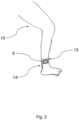
- the device may be in the form of an anklet or leg strap 13.
- the wearable device 1 is formed of sustainable and recyclable metallic or textile material which encircles the ankle 14 or the leg 15.
- a sensor 6 in the anklet 13 detects the presence of carbon monoxide.
- additional sensors 6 (not shown) in the anklet detect heart rate, respiratory rate and blood pressure.
- the device of Figure 2 can detect the pollutant carbon monoxide and communicate the data obtained with a computerised device 9 (as shown in Fig. 3 ).
- the computerised device 9 analyses the data and may generate an alert for the user if a threshold value for the carbon monoxide is exceeded.
- the anklet 13 that encircles the ankle allows detection of effects on infants and children exposed to low levels of pollution. These may be carbon monoxide or particulate matter also called aerosol. It is made possible by sensors 6 that detect carboxyhaemoglobin and fibrinogen, a protein.
- Figure 3 shows a further alternate device in which the device comprises an ear loop 16.
- the ear loop 16 sits above the lobule of the ear 18 with an extension 7 that abuts the facial skin above the zygoma.
- the device 1 includes a sensor 6 integrated into the ear loop 16 which detect one or more pollutants in the environment, in this case carbon monoxide.
- one of the sensors 6 also detects a user parameter, in this case the fibrinogen level.
- the sensor 6 communicates the data obtained with the computerised device 9.
- the computerised device 9 may be a mobile phone or watch, for example.
- the wearable device 1 may be connected to the computerised device 9 by way of secure Bluetooth or Wi-Fi.
- the computerised device 9 analyses and monitors the data 5 received from the wearable device 1 and may generate an alert if a threshold value for the detected pollutant or other parameter of interest is exceeded.
- the alert will notify the user of the threshold value being exceeded such that they can take mitigating action, for example moving to an alternative location to avoid the pollutant.
- a combination of the ring and the ear loop allows the detection of fatigue due to chronic inhalation of indoor and outdoor pollutant. This is made possible by means of sensors that detect activity, muscle weakness as characterised by changes in amplitude and frequency of muscle fibre contraction.
- the upper part of the ear loop 16 that is above the lobule of the ear 18 is fitted with graphene electrodes 12 to detect brain waves emerging from the temporal area of the brain.
- FIG. 4 shows a further alternative device.
- the wearable device 20 takes the form of a wrist strap containing an integrated sensor (not shown), computerised device (not shown) and alert system 22.
- the sensor detects the presence of a pollutant, for example carbon monoxide and communicates with the computerised device 9 which analyses the data and provides an alert to the user if a threshold value for the pollutant is exceeded.
- a pollutant for example carbon monoxide
- the inventor has undertaken testing of the device of Figure 4 and shown that the device can detect pollutants, such as carbon monoxide at low levels.
- pollutants such as carbon monoxide at low levels.
- Such a device is particularly useful for pregnant women, for example, where detection of low levels of carbon monoxide is essential due to the high affinity of carbon monoxide for foetal haemoglobin.
- Figure 5 shows an embodiment of the wearable system for detecting and monitoring an indicator for a disease or a disease induced by an actual air pollution.
- the wearable system comprises at least one wearable device 1 as described in detail above, to be worn on the body by a user.
- the at least one wearable device 1 comprises a plurality of integrated sensors 6 as described above.
- the integrated sensors 6 are configured to detect biochemical and/or physiological vital signs of the user as well as environmental parameters indicative of an air pollution in the environment surrounding the user.
- Each wearable device 1 is configured to transmit sensor data to the computerised device 9.
- the computerised device 9 comprises at least one processor 23, a non-transitory memory 24, and at least one user interface 25.
- the computerised device 9 analyses and monitors said vital signs and environmental parameters detected by the wearable device 1.
- the computerised device 9 is configured to generate an alert if at least one threshold for the detected biochemical and/or physiological vital signs and/or the detected environmental parameter is exceeded.
- the computerised device 9 comprises a computerised algorithm 27, which is configured to analyse the activity of the user by measurement of muscle contractility, wherein the detection of amplitude and frequency of such muscle movements results in decision making based on artificial intelligence, machine learning and deep learning.
- the computerised device 9 comprises a computerised algorithm 28, which is configured to analyse muscle movement, amplitude and frequency of muscle contraction and gait to arrive distinguishing various types of gait based on artificial intelligence, machine learning and deep learning.
- the computerised device 9 comprises a computerised algorithm 29, which is configured to analyse movements, in particular a tremor of fingers, wherein the detection of amplitude and frequency of such finger movements results in decision-making based on artificial intelligence, machine learning and deep learning.
- the term “comprising” or “comprises” means including the component(s) specified but not to the exclusion of the presence of other components.
- the term “consisting essentially of” or “consists essentially of” means including the components specified but excluding other components except for materials present as impurities, unavoidable materials present as a result of processes used to provide the components, and components added for a purpose other than achieving the technical effect of the invention.
Landscapes
- Health & Medical Sciences (AREA)
- Life Sciences & Earth Sciences (AREA)
- Physics & Mathematics (AREA)
- Public Health (AREA)
- Veterinary Medicine (AREA)
- General Health & Medical Sciences (AREA)
- Animal Behavior & Ethology (AREA)
- Surgery (AREA)
- Physiology (AREA)
- Molecular Biology (AREA)
- Medical Informatics (AREA)
- Biophysics (AREA)
- Pathology (AREA)
- Engineering & Computer Science (AREA)
- Biomedical Technology (AREA)
- Heart & Thoracic Surgery (AREA)
- Neurology (AREA)
- Neurosurgery (AREA)
- Oral & Maxillofacial Surgery (AREA)
- Dentistry (AREA)
- Cardiology (AREA)
- Developmental Disabilities (AREA)
- Psychology (AREA)
- Child & Adolescent Psychology (AREA)
- Psychiatry (AREA)
- Optics & Photonics (AREA)
- Hospice & Palliative Care (AREA)
- Pulmonology (AREA)
- Measurement Of The Respiration, Hearing Ability, Form, And Blood Characteristics Of Living Organisms (AREA)
Applications Claiming Priority (2)
| Application Number | Priority Date | Filing Date | Title |
|---|---|---|---|
| GBGB2316643.2A GB202316643D0 (en) | 2023-10-31 | 2023-10-31 | Wearable device |
| DE202024104839.3U DE202024104839U1 (de) | 2024-08-28 | 2024-08-28 | Tragbare Vorrichtung |
Publications (1)
| Publication Number | Publication Date |
|---|---|
| EP4548840A1 true EP4548840A1 (fr) | 2025-05-07 |
Family
ID=93335236
Family Applications (1)
| Application Number | Title | Priority Date | Filing Date |
|---|---|---|---|
| EP24209691.5A Pending EP4548840A1 (fr) | 2023-10-31 | 2024-10-30 | Système portable |
Country Status (1)
| Country | Link |
|---|---|
| EP (1) | EP4548840A1 (fr) |
Citations (5)
| Publication number | Priority date | Publication date | Assignee | Title |
|---|---|---|---|---|
| US20150126825A1 (en) * | 2006-12-19 | 2015-05-07 | Valencell, Inc. | Physiological Monitoring Apparatus |
| US20170351221A1 (en) * | 2016-06-01 | 2017-12-07 | Withings | Wearable device with air quality sensor |
| CN109770863A (zh) * | 2018-12-14 | 2019-05-21 | 天津大学 | 适用于高温高湿场所下人员安全监督手环 |
| US20210174778A1 (en) * | 2015-10-26 | 2021-06-10 | Staton Techiya Llc | Biometric, physiological or environmental monitoring using a closed chamber |
| US20220084672A1 (en) * | 2020-09-17 | 2022-03-17 | Sportsmedia Technology Corporation | Temperature monitoring wearable with an artificial intelligence engine |
-
2024
- 2024-10-30 EP EP24209691.5A patent/EP4548840A1/fr active Pending
Patent Citations (5)
| Publication number | Priority date | Publication date | Assignee | Title |
|---|---|---|---|---|
| US20150126825A1 (en) * | 2006-12-19 | 2015-05-07 | Valencell, Inc. | Physiological Monitoring Apparatus |
| US20210174778A1 (en) * | 2015-10-26 | 2021-06-10 | Staton Techiya Llc | Biometric, physiological or environmental monitoring using a closed chamber |
| US20170351221A1 (en) * | 2016-06-01 | 2017-12-07 | Withings | Wearable device with air quality sensor |
| CN109770863A (zh) * | 2018-12-14 | 2019-05-21 | 天津大学 | 适用于高温高湿场所下人员安全监督手环 |
| US20220084672A1 (en) * | 2020-09-17 | 2022-03-17 | Sportsmedia Technology Corporation | Temperature monitoring wearable with an artificial intelligence engine |
Non-Patent Citations (2)
| Title |
|---|
| "Ambient Air Pollution: Fact Sheet", WORLD HEALTH ORGANISATION GLOBA, 19 December 2022 (2022-12-19) |
| "Global Burden of Disease Study", LANCET, vol. 8, 2021, pages e839 - 49 |
Similar Documents
| Publication | Publication Date | Title |
|---|---|---|
| US20220071562A1 (en) | Face mask with integrated physiological sensors | |
| Islam et al. | Validation and acceptability of a cuffless wrist-worn wearable blood pressure monitoring device among users and health care professionals: mixed methods study | |
| CN105379306B (zh) | 光导装置和包含光导装置的监测装置 | |
| US9955919B2 (en) | Light-guiding devices and monitoring devices incorporating same | |
| Kim et al. | Measurement accuracy of heart rate and respiratory rate during graded exercise and sustained exercise in the heat using the Zephyr BioHarnessTM | |
| US9289135B2 (en) | Physiological monitoring methods and apparatus | |
| WO2018049852A1 (fr) | Procédé, appareil et système d'évaluation du sommeil | |
| US20230000388A1 (en) | Oxygen mask respirometer | |
| Lee et al. | Beyond pathogen filtration: Possibility of smart masks as wearable devices for personal and group health and safety management | |
| JP2009136423A (ja) | 睡眠時無呼吸症候群の検査器具 | |
| EP4548840A1 (fr) | Système portable | |
| WO2025093846A1 (fr) | Système pouvant être porté | |
| CN120203546A (zh) | 基于指尖穿戴式光谱传感器感知健康的方法、系统及计算机程序产品 | |
| Arulvallal et al. | Design and development of wearable device for continuous monitoring of sleep apnea disorder | |
| Wongtaweesup et al. | Using Consumer-Graded Wearable Devices for Sleep Apnea Pre-Diagnosis: A Survey and Recommendations | |
| DE202024104839U1 (de) | Tragbare Vorrichtung | |
| Ummel | Noninvasive measurement of heartrate, respiratory rate, and blood oxygenation through wearable devices | |
| US20230405374A1 (en) | Methods, apparatuses, and systems for evaluating respiratory protective devices | |
| Liu et al. | Reducing asthma attacks with a portable CO sensor | |
| Consoli | A modular wearable device for vital signs monitoring in heavy industries | |
| Badhan | Non-invasive Wearable Wristband for Heart Rate and Respiration Rate Estimation Using Photoplethysmography with Motion Artifact Removal | |
| CN121867726A (zh) | 实时安全监测与安全管理系统 | |
| TR2021007836A2 (tr) | Uyku bozukluklari erken tani ve i̇zleme si̇stemi̇ | |
| Steiner | Combined Measurement System for the Evaluation of Multi-Causal Strain at Mobile Workplaces | |
| HK1230383A1 (en) | Light-guiding devices and monitoring devices incorporating same |
Legal Events
| Date | Code | Title | Description |
|---|---|---|---|
| PUAI | Public reference made under article 153(3) epc to a published international application that has entered the european phase |
Free format text: ORIGINAL CODE: 0009012 |
|
| STAA | Information on the status of an ep patent application or granted ep patent |
Free format text: STATUS: THE APPLICATION HAS BEEN PUBLISHED |
|
| AK | Designated contracting states |
Kind code of ref document: A1 Designated state(s): AL AT BE BG CH CY CZ DE DK EE ES FI FR GB GR HR HU IE IS IT LI LT LU LV MC ME MK MT NL NO PL PT RO RS SE SI SK SM TR |
|
| STAA | Information on the status of an ep patent application or granted ep patent |
Free format text: STATUS: REQUEST FOR EXAMINATION WAS MADE |
|
| 17P | Request for examination filed |
Effective date: 20251027 |
|
| STAA | Information on the status of an ep patent application or granted ep patent |
Free format text: STATUS: EXAMINATION IS IN PROGRESS |
|
| 17Q | First examination report despatched |
Effective date: 20260210 |