EP4548890A1 - Article vestimentaire jetable de type caleçon - Google Patents
Article vestimentaire jetable de type caleçon Download PDFInfo
- Publication number
- EP4548890A1 EP4548890A1 EP23928765.9A EP23928765A EP4548890A1 EP 4548890 A1 EP4548890 A1 EP 4548890A1 EP 23928765 A EP23928765 A EP 23928765A EP 4548890 A1 EP4548890 A1 EP 4548890A1
- Authority
- EP
- European Patent Office
- Prior art keywords
- absorber
- region
- groove
- width direction
- lower torso
- Prior art date
- Legal status (The legal status is an assumption and is not a legal conclusion. Google has not performed a legal analysis and makes no representation as to the accuracy of the status listed.)
- Pending
Links
Images







Classifications
-
- A—HUMAN NECESSITIES
- A61—MEDICAL OR VETERINARY SCIENCE; HYGIENE
- A61F—FILTERS IMPLANTABLE INTO BLOOD VESSELS; PROSTHESES; DEVICES PROVIDING PATENCY TO, OR PREVENTING COLLAPSING OF, TUBULAR STRUCTURES OF THE BODY, e.g. STENTS; ORTHOPAEDIC, NURSING OR CONTRACEPTIVE DEVICES; FOMENTATION; TREATMENT OR PROTECTION OF EYES OR EARS; BANDAGES, DRESSINGS OR ABSORBENT PADS; FIRST-AID KITS
- A61F13/00—Bandages or dressings; Absorbent pads
- A61F13/15—Absorbent pads, e.g. sanitary towels, swabs or tampons for external or internal application to the body; Supporting or fastening means therefor; Tampon applicators
- A61F13/45—Absorbent pads, e.g. sanitary towels, swabs or tampons for external or internal application to the body; Supporting or fastening means therefor; Tampon applicators characterised by the shape
- A61F13/49—Absorbent pads, e.g. sanitary towels, swabs or tampons for external or internal application to the body; Supporting or fastening means therefor; Tampon applicators characterised by the shape specially adapted to be worn around the waist, e.g. diapers, nappies
- A61F13/496—Absorbent pads, e.g. sanitary towels, swabs or tampons for external or internal application to the body; Supporting or fastening means therefor; Tampon applicators characterised by the shape specially adapted to be worn around the waist, e.g. diapers, nappies in the form of pants or briefs
-
- A—HUMAN NECESSITIES
- A61—MEDICAL OR VETERINARY SCIENCE; HYGIENE
- A61F—FILTERS IMPLANTABLE INTO BLOOD VESSELS; PROSTHESES; DEVICES PROVIDING PATENCY TO, OR PREVENTING COLLAPSING OF, TUBULAR STRUCTURES OF THE BODY, e.g. STENTS; ORTHOPAEDIC, NURSING OR CONTRACEPTIVE DEVICES; FOMENTATION; TREATMENT OR PROTECTION OF EYES OR EARS; BANDAGES, DRESSINGS OR ABSORBENT PADS; FIRST-AID KITS
- A61F13/00—Bandages or dressings; Absorbent pads
- A61F13/15—Absorbent pads, e.g. sanitary towels, swabs or tampons for external or internal application to the body; Supporting or fastening means therefor; Tampon applicators
- A61F13/45—Absorbent pads, e.g. sanitary towels, swabs or tampons for external or internal application to the body; Supporting or fastening means therefor; Tampon applicators characterised by the shape
- A61F13/49—Absorbent pads, e.g. sanitary towels, swabs or tampons for external or internal application to the body; Supporting or fastening means therefor; Tampon applicators characterised by the shape specially adapted to be worn around the waist, e.g. diapers, nappies
- A61F13/49007—Form-fitting, self-adjusting disposable diapers
- A61F13/49009—Form-fitting, self-adjusting disposable diapers with elastic means
- A61F13/49011—Form-fitting, self-adjusting disposable diapers with elastic means the elastic means is located at the waist region
-
- A—HUMAN NECESSITIES
- A61—MEDICAL OR VETERINARY SCIENCE; HYGIENE
- A61F—FILTERS IMPLANTABLE INTO BLOOD VESSELS; PROSTHESES; DEVICES PROVIDING PATENCY TO, OR PREVENTING COLLAPSING OF, TUBULAR STRUCTURES OF THE BODY, e.g. STENTS; ORTHOPAEDIC, NURSING OR CONTRACEPTIVE DEVICES; FOMENTATION; TREATMENT OR PROTECTION OF EYES OR EARS; BANDAGES, DRESSINGS OR ABSORBENT PADS; FIRST-AID KITS
- A61F13/00—Bandages or dressings; Absorbent pads
- A61F13/15—Absorbent pads, e.g. sanitary towels, swabs or tampons for external or internal application to the body; Supporting or fastening means therefor; Tampon applicators
- A61F13/53—Absorbent pads, e.g. sanitary towels, swabs or tampons for external or internal application to the body; Supporting or fastening means therefor; Tampon applicators characterised by the absorbing medium
- A61F13/531—Absorbent pads, e.g. sanitary towels, swabs or tampons for external or internal application to the body; Supporting or fastening means therefor; Tampon applicators characterised by the absorbing medium having a homogeneous composition through the thickness of the pad
- A61F13/532—Absorbent pads, e.g. sanitary towels, swabs or tampons for external or internal application to the body; Supporting or fastening means therefor; Tampon applicators characterised by the absorbing medium having a homogeneous composition through the thickness of the pad inhomogeneous in the plane of the pad
- A61F13/533—Absorbent pads, e.g. sanitary towels, swabs or tampons for external or internal application to the body; Supporting or fastening means therefor; Tampon applicators characterised by the absorbing medium having a homogeneous composition through the thickness of the pad inhomogeneous in the plane of the pad having discontinuous areas of compression
Definitions
- the present invention relates to an underpants-type disposable wearable article excellent in shape maintainability of an inner member.
- an underpants-type disposable wearable article such as an underpants-type disposable diaper or an underpants-type sanitary product includes: an outer member having a front lower torso portion, a back lower torso portion, and side seals formed by bonding both side portions of the front lower torso portion and the back lower torso portion; and an inner member attached to the outer member so as to extend from the front lower torso portion to the back lower torso portion, and both side portions of the front lower torso portion and both side portions of the back lower torso portion are bonded to each other to form the side seals, whereby a waist opening and a pair of left and right leg openings are formed (see, for example, Patent Literature 1).
- An elastic member is disposed in the lower torso portion of the outer member, whereby a stretchable region that contracts in the width direction in a natural length state and is extensible in the width direction is formed. With this stretchable region, the lower torso portion fits well to a body surface of a wearer.
- the inner member includes an absorber that continues from the front lower torso portion to the back lower torso portion through a crotch portion, and a liquid content of an excrement is absorbed and held by the absorber.
- the front lower torso portion and the back lower torso portion each have a fixing region for fixing the inner member to the outer member, and substantially the entire region of the absorber overlapping the outer member is fixed to the outer member. Therefore, when the stretchable regions of the front lower torso portion and the back lower torso portion overlap the absorber, not only elasticity of the stretchable regions is limited by rigidity of the absorber, but also the absorber receives a contraction force in the width direction, whereby there is a possibility that twisting or cracking is likely to occur, absorption performance is deteriorated, or wearing feeling or appearance is deteriorated.
- an elongated elastic member is continuously attached to both a first region including a portion overlapping the absorber and a portion between the overlapped portion and the side seals in the front lower torso portion and the back lower torso portion and a second region between the first region and the waist opening in the width direction over the entire outer member in the front-back direction, and substantially the entire elastic member in the portion overlapping the absorber is finely cut in the first region, whereby a non-stretchable region in which a contraction force in the width direction does not act (a contraction force is killed) is formed in the portion overlapping the absorber, and the other regions are stretchable regions.
- a region having the absorber is the non-stretchable region, and a side seal side of the non-stretchable region (portion close to the side seal) is an intermittent stretchable band of the stretchable region, and in the second region, the entire region from one of the side seals to the other of the side seals is a continuous stretchable band of the stretchable region.
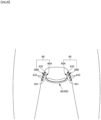
- both corner portions of the absorber on the waist opening side selectively contract in the width direction
- an intermediate portion in the width direction at an end portion of the absorber on the waist opening side hardly contracts
- the intermediate portion in the width direction at the end portion of the absorber on the waist opening side has a shape bulging toward a back surface side (external surface side).
- the underpants-type disposable wearable article has a problem that compactness (decrease in thickness) at the time of product packaging or product carrying is hindered, or the underpants-type disposable wearable article appears to a user as a low-quality product.
- Patent Literature 1 JP 2019-150655 A
- a main object of the present invention is, for example, to provide an underpants-type disposable wearable article that suppresses deformation at an end portion of an absorber on a waist opening side due to an elastic member.
- An underpants-type disposable wearable article including:
- the shape maintainability of the edge region of the absorber increases as it approaches both corner portions. Therefore, it is possible to suppress deformation at an end portion of the absorber on a waist opening side due to an elastic member while suppressing a decrease in flexibility of the edge region of the absorber, which is preferable.
- the shape maintainability of the edge region of the absorber increases as it approaches both corner portions, and therefore it is possible to suppress deformation at an end portion of the absorber on a waist opening side due to an elastic member while suppressing a decrease in flexibility of the edge region of the absorber.
- an elongated elastic member is often used as a means for adding elasticity to a lower torso portion of the outer member.
- the interval in the front-back direction between the elastic member closest to the edge region of the absorber and the edge region is 15 mm or less, the end portion of the absorber on the waist opening side is particularly easily deformed. Therefore, in such a case, when the rigidity of the edge region is increased stepwise or continuously as it goes from the center of the absorber in the width direction toward both side edges of the absorber, it is particularly significant.
- underpants-type disposable wearable article wherein when a test piece obtained by cutting a portion of the continuous stretchable band up to 15 mm from the edge region of the absorber to the waist opening side from one of the side seals to the other of the side seals is extended to 90% of a maximum width in an unfolded state and then contracted to 50% of the maximum width in the unfolded state, a contraction force is 0.4 N or more.
- the end portion of the absorber on the waist opening side is particularly easily deformed. Therefore, in such a case, when the rigidity of the edge region is increased stepwise or continuously as it goes from the center of the absorber in the width direction toward both side edges of the absorber, it is particularly significant.
- the outer members 12F and 12B include the rectangular front outer member 12F which is a portion constituting at least the front lower torso portion FT (lower torso portion of the front body F) and the rectangular back outer member 12B which is a portion constituting at least the back lower torso portion BT (lower torso portion of the back body B).
- the front outer member 12F and the back outer member 12B may be separated from each other in the front-back direction LD without being continuous on a crotch side (outer member separated type), or may be continuous from the front body F to the back body B through the crotch portion M (outer integral type) although not illustrated.
- a separation distance 12d in the front-back direction in the outer member separated type can be, for example, about 40 to 60% of the maximum length Y.
- lower edges of the front outer member 12F and the back outer member 12B are linear in the width direction WD, but a lower edge of at least one of the front outer member 12F and the back outer member 12B may be curved along a periphery of the leg.
- a cover nonwoven fabric layer 13 extending from a portion between the front outer member 12F and the inner member 200 to a portion between the back outer member 12B and the inner member 200 is preferably provided on the back surface of the inner member 200.
- An inner surface and an outer surface of the cover nonwoven fabric layer 13 can be bonded to facing surfaces thereof via a second hot melt adhesive HM2 and a third hot melt adhesive HM3, respectively.
- a nonwoven fabric used for the cover nonwoven fabric layer 13 for example, a similar material to that of the outer members 12F and 12B can be appropriately selected.
- the size of the back outer member 12B in the front-back direction is longer than that of the front outer member 12F, the front outer member 12F does not have a portion corresponding to the intermediate region L, and the back outer member 12B has a gluteal cover portion 14 extending from a lower torso region T toward the intermediate region L.
- the size of the front outer member 12F in the front-back direction LD may be equal to that of the back outer member 12B, and each of the front outer member 12F and the back outer member 12B does not have to have a portion corresponding to the intermediate region L.
- the outer members 12F and 12B are formed by bonding an outer sheet layer 12S and an inner sheet layer 12H adjacent to an outer side and an inner side of elastic members 15 to 17 described later, respectively, by a bonding means such as a hot melt adhesive or welding.
- the outer sheet layer 12S and the inner sheet layer 12H can be formed by folding a single sheet of a sheet material such that a fold is located on the waist opening side.
- the outer sheet layer 12S and the inner sheet layer 12H can be formed by sticking two sheets of a sheet material to each other although not illustrated.
- the sheet material used for the outer sheet layer 12S and the inner sheet layer 12H any material can be used without particular limitation, but a nonwoven fabric is preferable.
- the nonwoven fabric preferably has a basis weight of about 8 to 20 g/m 2 per sheet.
- the elastic members 15 to 17 are attached between the outer sheet layer 12S and the inner sheet layer 12H at a predetermined stretch rate, and a stretchable region that elastically stretches and contracts in the width direction WD together with the elastic members 15 to 17 is formed.
- the stretchable region contracts together with the elastic member 15 to 17, and can stretch and contract between a natural length state in which the stretchable region contracts together with the elastic member 15 to 17 to form wrinkles or pleats and a stretched state in which the stretchable region is stretched in the width direction to a predetermined stretch rate at which the stretchable region is stretched without wrinkles together with the elastic members 15 to 17.
- the elastic members 15 to 17 in addition to an elongated elastic member (illustrated example) such as a rubber thread, a known elastic member such as a belt-shaped member, a net-shaped member, or a film-shaped member can be used without particular limitation.
- a synthetic rubber or a natural rubber may be used.
- at least one of a hot melt adhesive by various application methods and a fixing means by material welding such as heat sealing or ultrasonic sealing can be used.
- a portion other than a bonded portion of the elongated elastic members 15 to 17 is not bonded or weakly bonded.
- an application means such as a comb gun or a SureWrap nozzle
- sandwiching the elongated elastic members 15 to 17 between both the sheet layers 12S and 12H the elongated elastic members 15 to 17 are fixed to both the sheet layers 12S and 12H only with the hot melt adhesive applied to the outer peripheral surfaces of the elongated elastic members 15 to 17, and both the sheet layers 12S and 12H are fixed to each other.
- the illustrated elastic members 15 to 17 will be described in more detail.
- a plurality of waist elastic members 17 are attached at intervals in the front-back direction and in an extended state in the width direction at a predetermined stretch rate, and a waist stretchable region continuous over the entire width direction WD is formed.
- One or more waist elastic members 17 disposed in a region adjacent to the under-waist portion U may overlap the inner member 200, or may be disposed on each side thereof in the width direction WD except for a central portion in the width direction overlapping the inner member 200.
- the waist elastic member 17 it is preferable to dispose 2 to 15 rubber threads, particularly 4 to 10 rubber threads each having a fineness of 300 to 940 dtex, particularly about 470 to 780 dtex (in a case of a synthetic rubber.
- a stretch rate of the waist portion W in the width direction WD due to the waist elastic member 17 is preferably 150 to 300%, and particularly preferably about 220 to 280%.
- all of the elastic members in the front-back direction LD do not have to have the same fineness and the same stretch rate.
- the fineness and the stretch rate of the elastic member may be partially different.
- a plurality of under-waist elastic members 15 formed of an elongated elastic member are attached at intervals in the front-back direction and in an extended state in the width direction at a predetermined stretch rate, and an under-waist stretchable region is formed on each side in the width direction WD excluding a central portion in the width direction overlapping the inner member 200.
- the under-waist elastic member 15 it is preferable to dispose 5 to 30 rubber threads each having a fineness of 300 to 940 dtex, particularly about 470 to 780 dtex (in a case of a synthetic rubber.
- a stretch rate of the under-waist portion U in the width direction WD due to the under-waist elastic member 15 is preferably 200 to 350%, and particularly preferably about 240 to 300%.
- all of the elastic members in the front-back direction LD do not have to have the same fineness and the same stretch rate. The fineness and the stretch rate of the elastic member may be partially different.
- the gluteal cover elastic member 16 it is preferable to fix 2 to 10 rubber threads each having a fineness of 300 to 940 dtex, particularly about 470 to 780 dtex (in a case of a synthetic rubber.
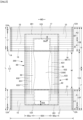
- the first region including a portion overlapping the absorber 56 and a portion between the overlapped portion and the side seals 12A is preferably an intermittent stretchable band A1 having a non-stretchable region 12X provided at least at an intermediate portion in the width direction WD in the portion overlapping the absorber 56 and a stretchable region provided between the non-stretchable region 12X and each of the side seals 12A, and the second region located between the intermittent stretchable band A1 and the waist opening WO is preferably a continuous stretchable band A2 in which a stretchable region is continuous in the width direction WD from one of the side seals 12A to the other of the side seals 12A.
- the intermittent stretchable band A1 in the illustrated example may extend beyond the range of the first region (beyond the absorber 56) to the waist opening WO side as long as the intermittent stretchable band A1 includes the first region.
- the intermittent stretchable band A1 in the illustrated example in the back lower torso portion BT, only the first region is the intermittent stretchable band A1, and a portion between the first region and the waist opening WO is the continuous stretchable band A2, and in the front lower torso portion FT, a region including a portion overlapping the fixing region 201 of the inner member 200 and a portion between the overlapped portion and the side seal 12A (a region extending to the waist opening WO side beyond the first region) is the intermittent stretchable band A1.
- the present invention is not limited thereto. Therefore, these may be reversed.
- a region including a portion overlapping the fixing region 201 of the inner member 200 and a portion between the overlapped portion and the side seal 12A may be the intermittent stretchable band A1 in each of the front lower torso portion FT and the back lower torso portion BT, or only the first region may be the intermittent stretchable band A1 in each of the front lower torso portion FT and the back lower torso portion BT.
- the intermittent stretchable band A1 of the illustrated example is formed in the range including only the under-waist stretchable region having the under-waist elastic member 15 in the front-back direction LD, but the range may be expanded to the waist opening WO side so as to include a part of the waist stretchable region having the waist elastic member 17.
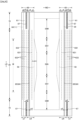
- the thickness of the bottom portion 51 of the groove 53 can be changed while the area ratio of the bottom portion 51 of the groove 53 is substantially constant, but it is more preferable to change the area ratio of the bottom portion 51 of the groove 53 while the thickness of the bottom portion 51 of the groove 53 is substantially constant.
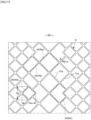
- the pattern of the groove 53 in the edge region 56E of the example illustrated in Fig. 12 is also an oblique lattice shape.
- rhombic first unit frames 54e having the largest area are arranged without a gap at the center in the width direction WD
- rhombic second unit frames 54f in which the length of one side is 1/2 of one side of the first unit frame 54e and L-shaped third unit frames 54g in which the length of each of two long sides is the same as the length of one side of the first unit frame 54e and the length of each of four short sides is 1/2 of the length of one side of the first unit frame 54e are arranged without a gap along a side edge of the group of the first unit frames 54e
- the rhombic second unit frames 54f in which the length of one side is 1/2 of the length of one side of the first unit frame 54e are arranged without a gap along a side edge of the third unit frames 54g.
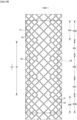
- the pattern of the groove 53 in the edge region 56E of the example illustrated in Fig. 13 is also an oblique lattice shape.
- rhombic first unit frames 54h having the largest area are arranged without a gap at the center in the width direction WD
- rhombic second unit frames 54i in which the length of one side is 1/2 of one side of the first unit frame 54h are arranged without a gap along a side edge of the group of the first unit frames 54h
- rhombic third unit frames 54j in which the length of one side is 1/3 of one side of the first unit frame 54h are arranged without a gap along a side edge of the group of the second unit frames 54i.
- a minimum of the area of each of the unit frames 54h to 54j is 1/9 when a maximum thereof is 1.
- the rigidity of the edge region 56E is preferably increased stepwise or continuously as it goes from the center of the absorber 56 in the width direction WD toward both side edges of the absorber 56 by the above-described pattern change of the groove 53 or the like.
- the rigidity of the edge region 56E can be increased stepwise or continuously as it goes from the center of the absorber 56 in the width direction WD toward both side edges of the absorber 56 by the above-described pattern change of the groove 53 or the like in one body, and the rigidity of the edge region 56E cannot be increased stepwise or continuously as it goes from the center of the absorber 56 in the width direction WD toward both side edges of the absorber 56 by the pattern change of the groove 53 or the like in the other body (that is, the groove 53 is formed in a constant pattern in the width direction WD, or the groove 53 is not formed at all).
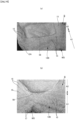
- a sample A pattern illustrated in Figs. 9 to 11
- a sample B oblique lattice-shaped pattern in which the same unit frame 54 as the maximum unit frame 54a of the sample A is repeated over the entire absorber 56
- the sample A and the sample B had different patterns of the groove 53, were prepared.
- the present invention can be used for an underpants-type disposable wearable article such as the underpants-type disposable diaper of the above example.
Landscapes
- Health & Medical Sciences (AREA)
- Epidemiology (AREA)
- Engineering & Computer Science (AREA)
- Biomedical Technology (AREA)
- Heart & Thoracic Surgery (AREA)
- Vascular Medicine (AREA)
- Life Sciences & Earth Sciences (AREA)
- Animal Behavior & Ethology (AREA)
- General Health & Medical Sciences (AREA)
- Public Health (AREA)
- Veterinary Medicine (AREA)
- Absorbent Articles And Supports Therefor (AREA)
Applications Claiming Priority (2)
| Application Number | Priority Date | Filing Date | Title |
|---|---|---|---|
| JP2023043217A JP2024132453A (ja) | 2023-03-17 | 2023-03-17 | パンツタイプ使い捨て着用物品 |
| PCT/JP2023/041205 WO2024195196A1 (fr) | 2023-03-17 | 2023-11-16 | Article vestimentaire jetable de type caleçon |
Publications (2)
| Publication Number | Publication Date |
|---|---|
| EP4548890A1 true EP4548890A1 (fr) | 2025-05-07 |
| EP4548890A4 EP4548890A4 (fr) | 2026-04-29 |
Family
ID=92841179
Family Applications (1)
| Application Number | Title | Priority Date | Filing Date |
|---|---|---|---|
| EP23928765.9A Pending EP4548890A4 (fr) | 2023-03-17 | 2023-11-16 | Article vestimentaire jetable de type caleçon |
Country Status (5)
| Country | Link |
|---|---|
| EP (1) | EP4548890A4 (fr) |
| JP (1) | JP2024132453A (fr) |
| CN (1) | CN119654121A (fr) |
| TW (1) | TW202446351A (fr) |
| WO (1) | WO2024195196A1 (fr) |
Family Cites Families (6)
| Publication number | Priority date | Publication date | Assignee | Title |
|---|---|---|---|---|
| JP5812651B2 (ja) * | 2011-03-31 | 2015-11-17 | ユニ・チャーム株式会社 | 使い捨ておむつ |
| JP2014097132A (ja) * | 2012-11-13 | 2014-05-29 | Uni Charm Corp | 吸収性物品 |
| NZ732546A (en) * | 2014-12-10 | 2018-05-25 | Oji Holdings Corp | Absorbent article |
| US10376428B2 (en) | 2015-01-16 | 2019-08-13 | The Procter & Gamble Company | Absorbent pant with advantageously channeled absorbent core structure and bulge-reducing features |
| JP7129832B2 (ja) * | 2018-06-29 | 2022-09-02 | 花王株式会社 | 吸収性物品 |
| JP7476139B2 (ja) * | 2021-06-14 | 2024-04-30 | 大王製紙株式会社 | 使い捨ておむつ |
-
2023
- 2023-03-17 JP JP2023043217A patent/JP2024132453A/ja active Pending
- 2023-11-16 CN CN202380058015.0A patent/CN119654121A/zh active Pending
- 2023-11-16 WO PCT/JP2023/041205 patent/WO2024195196A1/fr not_active Ceased
- 2023-11-16 EP EP23928765.9A patent/EP4548890A4/fr active Pending
- 2023-12-18 TW TW112149249A patent/TW202446351A/zh unknown
Also Published As
| Publication number | Publication date |
|---|---|
| EP4548890A4 (fr) | 2026-04-29 |
| TW202446351A (zh) | 2024-12-01 |
| CN119654121A (zh) | 2025-03-18 |
| JP2024132453A (ja) | 2024-10-01 |
| WO2024195196A1 (fr) | 2024-09-26 |
Similar Documents
| Publication | Publication Date | Title |
|---|---|---|
| EP3639799B1 (fr) | Couche jetable de type culotte | |
| EP3199132B1 (fr) | Structure extensible pour article absorbant, et procédé de formation de celle-ci | |
| EP3117813A1 (fr) | Couche jetable de type couche-culotte | |
| US11452645B2 (en) | Absorbent article | |
| EP3117809B1 (fr) | Couche jetable du type culotte, et son procédé de production | |
| CN107874914B (zh) | 一次性穿着物品和有孔无纺布的粘贴方法 | |
| EP3760175B1 (fr) | Article vestimentaire jetable | |
| WO2021060133A1 (fr) | Article absorbant | |
| JP6202614B2 (ja) | 使い捨ておむつ | |
| EP3639800B1 (fr) | Couche-culotte d'apprentissage jetable | |
| EP3831352B1 (fr) | Article jetable pouvant être porté | |
| EP4356891A1 (fr) | Couche jetable | |
| EP4548890A1 (fr) | Article vestimentaire jetable de type caleçon | |
| EP4417174A1 (fr) | Article vestimentaire jetable du type culotte | |
| EP3689306B1 (fr) | Couche jetable de type culotte | |
| EP4088698A1 (fr) | Article absorbant jetable | |
| EP4464294A1 (fr) | Article vestimentaire jetable du type culotte | |
| EP4464293A1 (fr) | Article vestimentaire jetable de type caleçon | |
| EP4309636A1 (fr) | Article à porter jetable du type à raccord | |
| JP7129179B2 (ja) | 吸収性物品の伸縮構造 | |
| WO2024257440A1 (fr) | Couche jetable | |
| JP2023045583A5 (fr) | ||
| JP2023162994A5 (fr) | ||
| JP2023045583A (ja) | 使い捨て着用物品 |
Legal Events
| Date | Code | Title | Description |
|---|---|---|---|
| STAA | Information on the status of an ep patent application or granted ep patent |
Free format text: STATUS: THE INTERNATIONAL PUBLICATION HAS BEEN MADE |
|
| PUAI | Public reference made under article 153(3) epc to a published international application that has entered the european phase |
Free format text: ORIGINAL CODE: 0009012 |
|
| STAA | Information on the status of an ep patent application or granted ep patent |
Free format text: STATUS: REQUEST FOR EXAMINATION WAS MADE |
|
| 17P | Request for examination filed |
Effective date: 20250203 |
|
| AK | Designated contracting states |
Kind code of ref document: A1 Designated state(s): AL AT BE BG CH CY CZ DE DK EE ES FI FR GB GR HR HU IE IS IT LI LT LU LV MC ME MK MT NL NO PL PT RO RS SE SI SK SM TR |
|
| A4 | Supplementary search report drawn up and despatched |
Effective date: 20260326 |
|
| RIC1 | Information provided on ipc code assigned before grant |
Ipc: A61F 13/532 20060101AFI20260323BHEP |