EP4548982A1 - Verfahren und system zur verarbeitung von bewegungsdaten - Google Patents
Verfahren und system zur verarbeitung von bewegungsdaten Download PDFInfo
- Publication number
- EP4548982A1 EP4548982A1 EP22969468.2A EP22969468A EP4548982A1 EP 4548982 A1 EP4548982 A1 EP 4548982A1 EP 22969468 A EP22969468 A EP 22969468A EP 4548982 A1 EP4548982 A1 EP 4548982A1
- Authority
- EP
- European Patent Office
- Prior art keywords
- user
- stride
- frequency
- motion data
- stride frequency
- Prior art date
- Legal status (The legal status is an assumption and is not a legal conclusion. Google has not performed a legal analysis and makes no representation as to the accuracy of the status listed.)
- Pending
Links
Images




Classifications
-
- A—HUMAN NECESSITIES
- A61—MEDICAL OR VETERINARY SCIENCE; HYGIENE
- A61B—DIAGNOSIS; SURGERY; IDENTIFICATION
- A61B5/00—Measuring for diagnostic purposes; Identification of persons
- A61B5/103—Measuring devices for testing the shape, pattern, colour, size or movement of the body or parts thereof, for diagnostic purposes
- A61B5/11—Measuring movement of the entire body or parts thereof, e.g. head or hand tremor or mobility of a limb
- A61B5/112—Gait analysis
-
- A—HUMAN NECESSITIES
- A61—MEDICAL OR VETERINARY SCIENCE; HYGIENE
- A61B—DIAGNOSIS; SURGERY; IDENTIFICATION
- A61B5/00—Measuring for diagnostic purposes; Identification of persons
- A61B5/103—Measuring devices for testing the shape, pattern, colour, size or movement of the body or parts thereof, for diagnostic purposes
- A61B5/11—Measuring movement of the entire body or parts thereof, e.g. head or hand tremor or mobility of a limb
- A61B5/1107—Measuring contraction of parts of the body, e.g. organ or muscle
-
- A—HUMAN NECESSITIES
- A61—MEDICAL OR VETERINARY SCIENCE; HYGIENE
- A61B—DIAGNOSIS; SURGERY; IDENTIFICATION
- A61B5/00—Measuring for diagnostic purposes; Identification of persons
- A61B5/103—Measuring devices for testing the shape, pattern, colour, size or movement of the body or parts thereof, for diagnostic purposes
- A61B5/11—Measuring movement of the entire body or parts thereof, e.g. head or hand tremor or mobility of a limb
-
- A—HUMAN NECESSITIES
- A61—MEDICAL OR VETERINARY SCIENCE; HYGIENE
- A61B—DIAGNOSIS; SURGERY; IDENTIFICATION
- A61B5/00—Measuring for diagnostic purposes; Identification of persons
- A61B5/22—Ergometry; Measuring muscular strength or the force of a muscular blow
-
- A—HUMAN NECESSITIES
- A61—MEDICAL OR VETERINARY SCIENCE; HYGIENE
- A61B—DIAGNOSIS; SURGERY; IDENTIFICATION
- A61B5/00—Measuring for diagnostic purposes; Identification of persons
- A61B5/24—Detecting, measuring or recording bioelectric or biomagnetic signals of the body or parts thereof
- A61B5/25—Bioelectric electrodes therefor
- A61B5/279—Bioelectric electrodes therefor specially adapted for particular uses
- A61B5/28—Bioelectric electrodes therefor specially adapted for particular uses for electrocardiography [ECG]
-
- A—HUMAN NECESSITIES
- A61—MEDICAL OR VETERINARY SCIENCE; HYGIENE
- A61B—DIAGNOSIS; SURGERY; IDENTIFICATION
- A61B5/00—Measuring for diagnostic purposes; Identification of persons
- A61B5/24—Detecting, measuring or recording bioelectric or biomagnetic signals of the body or parts thereof
- A61B5/25—Bioelectric electrodes therefor
- A61B5/279—Bioelectric electrodes therefor specially adapted for particular uses
- A61B5/296—Bioelectric electrodes therefor specially adapted for particular uses for electromyography [EMG]
-
- A—HUMAN NECESSITIES
- A61—MEDICAL OR VETERINARY SCIENCE; HYGIENE
- A61B—DIAGNOSIS; SURGERY; IDENTIFICATION
- A61B5/00—Measuring for diagnostic purposes; Identification of persons
- A61B5/24—Detecting, measuring or recording bioelectric or biomagnetic signals of the body or parts thereof
- A61B5/316—Modalities, i.e. specific diagnostic methods
- A61B5/318—Heart-related electrical modalities, e.g. electrocardiography [ECG]
-
- A—HUMAN NECESSITIES
- A61—MEDICAL OR VETERINARY SCIENCE; HYGIENE
- A61B—DIAGNOSIS; SURGERY; IDENTIFICATION
- A61B5/00—Measuring for diagnostic purposes; Identification of persons
- A61B5/24—Detecting, measuring or recording bioelectric or biomagnetic signals of the body or parts thereof
- A61B5/316—Modalities, i.e. specific diagnostic methods
- A61B5/389—Electromyography [EMG]
-
- A—HUMAN NECESSITIES
- A61—MEDICAL OR VETERINARY SCIENCE; HYGIENE
- A61B—DIAGNOSIS; SURGERY; IDENTIFICATION
- A61B5/00—Measuring for diagnostic purposes; Identification of persons
- A61B5/24—Detecting, measuring or recording bioelectric or biomagnetic signals of the body or parts thereof
- A61B5/316—Modalities, i.e. specific diagnostic methods
- A61B5/389—Electromyography [EMG]
- A61B5/397—Analysis of electromyograms
-
- A—HUMAN NECESSITIES
- A61—MEDICAL OR VETERINARY SCIENCE; HYGIENE
- A61B—DIAGNOSIS; SURGERY; IDENTIFICATION
- A61B5/00—Measuring for diagnostic purposes; Identification of persons
- A61B5/45—For evaluating or diagnosing the musculoskeletal system or teeth
- A61B5/4519—Muscles
-
- A—HUMAN NECESSITIES
- A61—MEDICAL OR VETERINARY SCIENCE; HYGIENE
- A61B—DIAGNOSIS; SURGERY; IDENTIFICATION
- A61B5/00—Measuring for diagnostic purposes; Identification of persons
- A61B5/48—Other medical applications
- A61B5/486—Biofeedback
-
- A—HUMAN NECESSITIES
- A61—MEDICAL OR VETERINARY SCIENCE; HYGIENE
- A61B—DIAGNOSIS; SURGERY; IDENTIFICATION
- A61B5/00—Measuring for diagnostic purposes; Identification of persons
- A61B5/68—Arrangements of detecting, measuring or recording means, e.g. sensors, in relation to patient
- A61B5/6801—Arrangements of detecting, measuring or recording means, e.g. sensors, in relation to patient specially adapted to be attached to or worn on the body surface
- A61B5/6802—Sensor mounted on worn items
-
- A—HUMAN NECESSITIES
- A61—MEDICAL OR VETERINARY SCIENCE; HYGIENE
- A61B—DIAGNOSIS; SURGERY; IDENTIFICATION
- A61B5/00—Measuring for diagnostic purposes; Identification of persons
- A61B5/72—Signal processing specially adapted for physiological signals or for diagnostic purposes
-
- A—HUMAN NECESSITIES
- A61—MEDICAL OR VETERINARY SCIENCE; HYGIENE
- A61B—DIAGNOSIS; SURGERY; IDENTIFICATION
- A61B5/00—Measuring for diagnostic purposes; Identification of persons
- A61B5/74—Details of notification to user or communication with user or patient; User input means
- A61B5/7455—Details of notification to user or communication with user or patient; User input means characterised by tactile indication, e.g. vibration or electrical stimulation
-
- A—HUMAN NECESSITIES
- A63—SPORTS; GAMES; AMUSEMENTS
- A63B—APPARATUS FOR PHYSICAL TRAINING, GYMNASTICS, SWIMMING, CLIMBING, OR FENCING; BALL GAMES; TRAINING EQUIPMENT
- A63B24/00—Electric or electronic controls for exercising apparatus of preceding groups; Controlling or monitoring of exercises, sportive games, training or athletic performances
-
- G—PHYSICS
- G16—INFORMATION AND COMMUNICATION TECHNOLOGY [ICT] SPECIALLY ADAPTED FOR SPECIFIC APPLICATION FIELDS
- G16H—HEALTHCARE INFORMATICS, i.e. INFORMATION AND COMMUNICATION TECHNOLOGY [ICT] SPECIALLY ADAPTED FOR THE HANDLING OR PROCESSING OF MEDICAL OR HEALTHCARE DATA
- G16H20/00—ICT specially adapted for therapies or health-improving plans, e.g. for handling prescriptions, for steering therapy or for monitoring patient compliance
- G16H20/30—ICT specially adapted for therapies or health-improving plans, e.g. for handling prescriptions, for steering therapy or for monitoring patient compliance relating to physical therapies or activities, e.g. physiotherapy, acupressure or exercising
-
- G—PHYSICS
- G16—INFORMATION AND COMMUNICATION TECHNOLOGY [ICT] SPECIALLY ADAPTED FOR SPECIFIC APPLICATION FIELDS
- G16H—HEALTHCARE INFORMATICS, i.e. INFORMATION AND COMMUNICATION TECHNOLOGY [ICT] SPECIALLY ADAPTED FOR THE HANDLING OR PROCESSING OF MEDICAL OR HEALTHCARE DATA
- G16H50/00—ICT specially adapted for medical diagnosis, medical simulation or medical data mining; ICT specially adapted for detecting, monitoring or modelling epidemics or pandemics
- G16H50/30—ICT specially adapted for medical diagnosis, medical simulation or medical data mining; ICT specially adapted for detecting, monitoring or modelling epidemics or pandemics for calculating health indices; for individual health risk assessment
-
- A—HUMAN NECESSITIES
- A61—MEDICAL OR VETERINARY SCIENCE; HYGIENE
- A61B—DIAGNOSIS; SURGERY; IDENTIFICATION
- A61B5/00—Measuring for diagnostic purposes; Identification of persons
- A61B5/72—Signal processing specially adapted for physiological signals or for diagnostic purposes
- A61B5/7235—Details of waveform analysis
- A61B5/7264—Classification of physiological signals or data, e.g. using neural networks, statistical classifiers, expert systems or fuzzy systems
Definitions
- the present disclosure relates to the technical field of data collection and processing, and in particular, to a method and system for processing motion data.
- a stride frequency and a stride length of running are used to measure whether the people are running scientifically.
- the stride length is closely related to the height, leg length, joint flexibility, core strength, etc. of a person.
- the stride frequency is easier to change through training, thereby improving the exercise effect of running.
- a current method for determining the stride frequency is to use a standard stride frequency of running athletes (e.g., 180 steps per minute) as a recommended running stride frequency for the general population, whereas the stride frequency of the running athletes does not apply to every general population, considering differences in fitness between the general population and the athletes, as well as differences in physical fitness between the general populations.
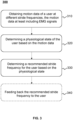
- Embodiments of the present disclosure provide a method for processing motion data, including: obtaining motion data of a user at different stride frequencies, the motion data at least including electromyographic (EMG) signals; determining a physiological state of the user based on the motion data; and determining a recommended stride frequency for the user based on the physiological state.
- EMG electromyographic
- the obtaining the motion data of a user at different stride frequencies includes: determining a target speed interval; and obtaining the motion data at different stride frequencies within the target speed interval based on the target speed interval
- the physiological state includes a muscle efficiency, a muscle tension, and a muscle fatigue
- the determining a recommended stride frequency for the user based on the physiological state includes: determining a correspondence between physiological states and stride frequencies based on at least one of the muscle efficiency, the muscle tension, and the muscle fatigue; and determining the recommended stride frequency for the user based on the correspondence.
- the determining a physiological state of the user based on the motion data includes: determining at least one of the muscle efficiency, the muscle tension, and the muscle fatigue of the user based on the EMG signals.
- the motion data includes electrocardio (ECG) signals and/or posture signals
- ECG electrocardio
- the determining a recommended stride frequency for the user based on the physiological state includes: determining a correspondence between physiological states and stride frequencies based on the ECG signals and/or the posture signals; and determining the recommended stride frequency for the user based on the correspondence.
- the determining the physiological state of the user based on the motion data includes: determining the physiological state of the user based on the ECG signals and/or the posture signals, the physiological state including an injury risk for the motion of the user.
- the obtaining motion data of a user at different stride frequencies includes: obtaining a real-time stride frequency and real-time motion data of the user; dividing the real-time stride frequency into a plurality of stride frequency intervals; and determining, based on the plurality of stride frequency intervals, the motion data within each different stride frequency interval from the real-time motion data.
- the real-time stride frequency is obtained by an inertial sensor, or the real-time stride frequency is obtained from the EMG signals.
- the method further includes: feeding back the recommended stride frequency to the user.
- the feeding back the recommended stride frequency to the user includes: obtaining a real-time stride frequency of the user; determining a stride frequency adjustment trend for the user based on a frequency difference between the real-time stride frequency and the recommended stride frequency; and guiding the user based on the stride frequency adjustment trend until a stride frequency of the user is the same as the recommended stride frequency.
- the feeding back the recommended stride frequency to the user includes: feeding back a beat that is the same as the recommended stride frequency to the user based on a preset feedback manner.
- the preset feedback manner includes at least one of a voice feedback, a vibration feedback, a light feedback, and a display feedback.
- the feeding back the recommended stride frequency to the user includes: stimulating a body portion of the user based on a biofeedback manner to feed back the recommended stride frequency to the user.
- the stimulation has a stimulation frequency same as the recommended stride frequency.
- the obtaining motion data of a user at different stride frequencies includes: obtaining a plurality of sets of motion data of the user at a plurality of preset stride frequencies, each of the plurality of sets of motion data corresponding to one of the plurality of preset stride frequencies.
- the obtaining a plurality of sets of motion data of the user at a plurality of preset stride frequencies includes: obtaining physiological information of the user, the physiological information including body information and motion information; and determining the plurality of sets of motion data of the user at the plurality of preset stride frequencies based on the physiological information.
- Embodiments of the present disclosure also provide a system for processing motion data including: an obtaining module configured to obtain motion data of a user at different stride frequencies, the motion data at least including electromyographic (EMG) signals; a processing module configured to determine a physiological state of the user based on the motion data; and a recommendation module configured to determine a recommended stride frequency for the user based on the physiological state.
- EMG electromyographic
- the system further includes a feedback module configured to feed back the recommended stride frequency to the user.
- Embodiments of the present disclosure also provide a wearing body provided with at least one sensor, the at least one sensor being configured to obtain motion data of a user; and a processor configured to perform the method for processing motion data in any embodiment of the present disclosure.
- the wearing body is further provided with electrodes contacting a skin of the user, and the electrodes are configured to provide stimulation to a body portion of the user.
- FIG. 1 is a schematic diagram illustrating an exemplary system for processing motion data according to some embodiments of the present disclosure.
- a system for processing motion data 100 includes a processing device 110, a network 120, a storage device 130, a terminal device 140, and a data collection device 150.
- Components in the system for processing motion data 100 are connected in various manners.
- the data collection device 150 is connected to the storage device 130 and/or the processing device 110 via the network 120, or directly connected to the storage device 130 and/or the processing device 110.
- the storage device 130 is directly connected to the processing device 110 or connected via the network 120.
- the terminal device 140 is connected to the storage device 130 and/or the processing device 110 via the network 120 or is directly connected to the storage device 130 and/or the processing device 110.
- the system for processing motion data 100 also includes a wearable device 160, with the data collection device 150 disposed on the wearable device 160 (e.g., a top 160-1, pants 160-2, a belt 160-3).
- the wearable device 160 is connected to various components of the system for processing motion data 100 via the data collection device 150.
- the system for processing motion data 100 determines a recommended stride frequency for a user while running by implementing the methods and/or processes disclosed in the present disclosure. For example, when the user wears the wearable device 160 and runs, the data collection device 150 fits on a human skin to collect motion data of the user while running.
- the processing device 110 directly or indirectly obtains the motion data (e.g., electromyographic (EMG) signals, posture signals, electrocardio (ECG) signals, etc.) from the data collection device 150 and determines a physiological state of the user based on the motion data, thereby determining the recommended stride frequency for the user when running.
- EMG electromyographic
- ECG electrocardio
- the processing device 110 processes data and/or information obtained from the data collection device 150, the storage device 130, the terminal device 140, and/or other components of the system for processing motion data 100.
- the processing device 110 obtains the motion data of the user from any one or more of the data collection device 150, the storage device 130, or the terminal device 140, and determines the recommended stride frequency for the user by processing the motion data.
- the processing device 110 obtains pre-stored computer instructions from the storage device 130 and performs the computer instructions to implement a method for processing the motion data described herein.
- the processing device 110 is a single server or a server group.
- the server group is centralized or distributed.
- the processing device 110 is local or remote.
- the processing device 110 accesses the information and/or data from the data collection device 150, the storage device 130, and/or the terminal device 140 via the network 120.
- the processing device 110 is directly connected to the data collection device 150, the storage device 130, and/or the terminal device 140 to access the information and/or data.
- the processing device 110 is implemented on a cloud platform.
- the cloud platform includes a private cloud, a public cloud, a hybrid cloud, a community cloud, a distributed cloud, an internal cloud, a multi-layer cloud, etc., or any combination thereof.
- the network 120 connects various components of the system for processing motion data 100 and/or connects the system for processing motion data 100 to an external resource portion.
- the network 120 enables communications between components of the system for processing motion data 100, and between other portions apart from the system for processing motion data 100, to facilitate an exchange of the data and/or information.
- the processing device 110 obtains the motion data from the data collection device 150 and/or the storage device 130 via the network 120.
- the processing device 110 controls the terminal device 140 to feed back the recommended stride frequency via the network 120 to the user.
- Exemplary feedback manners include at least one of a voice feedback, a vibration feedback, a light feedback, a display feedback, etc.
- the network 120 is any form of wired or wireless network, or any combination thereof.
- the network 120 includes a cable network, a wired network, a fiber optic network, a telecommunication network, an intranet, the Internet, a local area network (LAN), a wide area network (WAN), a wireless local area network (WLAN), a metropolitan area network (MAN), a public switched telephone network (PSTN), a Bluetooth network, a ZigBee network, a near-field communication (NFC) network, etc., or any combination thereof.
- the network 120 includes one or more network access points.
- the network 120 includes wired or wireless network access points, such as base stations and/or inter-network switching points 120-1, 120-2, ..., through which one or more components of the system for processing motion data 100 are connected to the network 120 to exchange the data and/or information.
- data such as the motion data, the physiological states of a user, etc. is communicated via the network 120.
- the storage device 130 stores data, instructions, and/or any other information.
- the storage device 130 stores the data obtained from the data collection device 150, the processing device 110, and/or the terminal device 140.
- the storage device 130 stores the motion data collected by the data collection device 150.
- the storage device 130 stores the data and/or instructions used by the processing device 110 to accomplish the exemplary methods described in the present disclosure.
- the storage device 130 includes a mass memory, a removable memory, a volatile read-write memory, a read-only memory (ROM), etc., or any combination thereof.
- Exemplary mass storages includes disks, optical disks, solid state disks, etc.
- the storage device 130 is implemented on the cloud platform.
- the cloud platform includes the private cloud, the public cloud, the hybrid cloud, the community cloud, the distributed cloud, an internal cloud, a multi-layer cloud, etc., or any combination thereof.
- the storage device 130 is connected to the network 120 to communicate with at least one other component (e.g., the data collection device 150, the processing device 110, the terminal device 140) of the system for processing motion data 100. At least one component of the system for processing motion data 100 accesses the data, the instructions, or other information stored in the storage device 130 via the network 120. In some embodiments, the storage device 130 is directly connected or in communication with one or more components (e.g., the data collection device 150, the terminal device 140) of the system for processing motion data 100. In some embodiments, the storage device 130 is a portion of the data collection device 150 and/or the processing device 110.
- the terminal device 140 receives, sends, and/or displays data.
- the data received by the terminal device 140 includes data collected by the data collection device 150, data stored by the storage device 130, the recommended stride frequency generated by the processing device 110, etc.
- the data received and/or displayed by the terminal device 140 includes the motion data collected by the data collection device 150, physiological state data of the user obtained by processing the motion data by the processing device 110, the recommended stride frequency determined by the processing device 110 based on the physiological state, etc.
- the data sent by the terminal device 140 includes user input data and instructions, etc.
- the terminal device 140 sends the user input operation instructions to the data collection device 150 via the network 120 to control the data collection device 150 to perform corresponding data collection (e.g., collecting EMG signals, ECG signals, posture signals, etc.).
- the terminal device 140 includes a mobile device 141, a tablet computer 142, a laptop computer 143, etc., or any combination thereof.
- the mobile device 141 includes a mobile phone, a smart mobile device, a virtual reality (VR) device, an augmented reality (AR) device, etc., or any combination thereof.
- the smart mobile device includes a smart phone, a personal digital assistant (PDA), a gaming device, a navigation device, a point of sales (POS) device, etc., or any combination thereof.
- the VR device and/or the AR device includes a VR headset, VR glasses, a VR eyepatch, an AR headset, AR glasses, an AR eyepatch, etc., or any combination thereof.
- the processing device 110 is a portion of the terminal device 140.
- the system for processing motion data 100 may not include the terminal device 140, and functions or portions of the functions of the terminal device 140 are performed by the wearable device 160.
- the wearable device 160 is used to control the data collection device 150 to perform the corresponding data collection.
- data e.g., the recommended stride frequency
- displayed to the user via the terminal device 140 is displayed by the wearable device 160 (e.g., the wearable device 160 feeds back the recommended stride frequency in the form of electrical stimulation to the user).
- the data collection device 150 is a device that performs motion data collection on the user.
- the motion data refers to signals generated by the user while running.
- Exemplary motion data includes one or more of the EMG signals, the posture signals, the ECG signals, respiratory signals, sweat signals, mechanical signals, etc.
- the data collection device 150 includes an EMG data collection device, a posture data collection device, and a mechanical data collection device.
- the EMG data collection device includes one or more electrodes.
- the EMG data collection device includes a plurality of electrodes disposed at different positions of the wearable device 160 for fitting to different portions of the user (e.g., a chest, a back, elbows, legs, abdomen, wrists, etc.) to collect the EMG signals from the different portions of the user.
- the posture data collection device includes a velocity sensor, an inertial sensor (e.g., an acceleration sensor, an angular velocity sensor (e.g., a gyroscope), etc.), an optical sensor (e.g., an optical distance sensor, a video/image grabber), an acoustic distance sensor, a tension sensor, etc., or any combination thereof.
- the mechanical data collection device includes a pressure sensor.
- the pressure sensor is provided at different portions of the user to collect pressure signals at different portions.
- the data collection device 150 also includes an ECG data collection device, a respiratory data collection device, a sweat data collection device, etc.
- the ECG data collection device includes a plurality of electrodes, and the plurality of electrodes are used to fit different portions of the user (e.g., to the abdomen via the belt device 160-3) to collect the ECG signals from the user.
- the respiratory data collection device includes a respiratory frequency sensor, a flow rate sensor, etc. for detecting signals such as a respiratory frequency, a gas flow rate, etc., respectively, of the user during exercise.
- the sweat data collection device includes a plurality of electrodes that are in contact with a user's skin for detecting a sweat flow of the user and analyzing the composition of the sweat, etc.
- the data collection device 150 has an independent power supply and sends the collected data to other components (e.g., the processing device 110, the storage device 130, the terminal device 140) via wired or wireless (e.g., Bluetooth, WiFi, etc.) manners.
- the wearable device 160 refers to a wearable garment or device.
- the wearable device 160 includes, but is not limited to, a top device 160-1, a pants device 160-2, a belt device 160-3, a shoe device 160-4, etc.
- one or more data collection devices 150 are disposed in the wearable device 160 to collect the motion data from different portions of the body. When the user wears the wearable device 160 and exercises, the one or more data collection devices 150 are in contact with body portions of the user to collect the motion data.
- the one or more data collection devices 150 (e.g., the electrodes) on the wearable device 160 are in contact with a plurality of portions of the human body, e.g., calves, thighs, hips, the waist, the chest, shoulders, etc., to obtain the EMG signals from the portions of the body.
- the one or more data collection devices 150 (e.g., the inertial sensor) on the wearable device 160 are in contact with a plurality of limbs (e.g., upper arms, forearms, thighs, calves, etc.) or joint portions (e.g., knee joints, ankles, elbow joints, etc.) of the human body to obtain the posture signals from the corresponding portions.
- devices such as the top device 160-1, the pants device 160-2, the belt device 160-3, and the shoe device 160-4 serve as a wearing body of the wearable device 160, and the data collection device 150 is disposed on the wearing body.
- the wearing body of the wearable device 160 is not limited to the top device 160-1, the pants device 160-2, the belt device 160-3, and the shoe device 160-4 shown in FIG. 1 , but also includes other devices, such as a wristband device, a glove device, etc., which are not specifically limited herein. It is appreciated that the user who wears the wearable device 160 and runs may be a runner, a tester of a sports device, etc. The count of the users can be one or more.
- FIG. 2 is a block diagram illustrating an exemplary device for processing motion data according to some embodiments of the present disclosure.
- a device for processing motion data 200 shown in FIG. 2 is applied to the system for processing motion data 100 shown in FIG. 1 , e.g., the device for processing motion data 200 is configured to the processing device 130 and/or the terminal device 140 in a form of software and/or hardware and applied in determining a recommended stride frequency for a user based on motion data of the user.
- the device for processing motion data 200 includes an obtaining module 210, a processing module 220, a recommendation module 230, and a feedback module 240.
- the obtaining module 210 may be configured to obtain the motion data of the user at different stride frequencies. For example, the obtaining module 210 obtains the motion data from any one or more of the data collection device 150, the storage device 130, or the terminal device 140. In some embodiments, the motion data includes EMG signals, posture signals, ECG signals, respiratory signals, sweat signals, mechanical signals, etc.
- the processing module 220 may be configured to determine a physiological state of the user based on the motion data.
- the physiological state includes a muscle efficiency, a muscle tension, a muscle fatigue, an injury risk for the motion, etc.
- the processing module 220 determines at least one of the muscle efficiency, the muscle tension, and the muscle fatigue of the user based on the EMG signals, thereby determining the physiological state of the user.
- the processing module 220 determines the injury risk of the motion for the user based on the ECG signal and/or the posture signal, thereby determining the physiological state of the user.
- the recommendation module 230 may be configured to determine a recommended stride frequency for the user based on the physiological state. In some embodiments, the recommendation module 230 is configured to determine the recommended stride frequency for the user based on a correspondence between physiological states and stride frequencies. For example, the recommendation module 230 determines the recommended stride frequency based on a correspondence between the muscle efficiency, the muscle tension, and the muscle fatigue, and the stride frequencies. As another example, the recommendation module 230 determines the recommended stride frequency based on the correspondence between the injury risk for the motion and the stride frequencies.
- the feedback module 240 may be configured to feed back the recommended stride frequency to the user.
- the feedback module 240 feeds back a beat that is the same as the recommended stride frequency to the user based on a preset feedback manner. (e.g., a voice feedback, a vibration feedback, etc.).
- the feedback module 240 guides the user to adjust the stride frequency based on a real-time stride frequency of the user until the stride frequency of the user is the same as the recommended stride frequency.
- a feedback manner of the feedback module 240 is a real-time feedback. The user views or receives feedback results in real time via a terminal device (e.g., a cell phone, a watch).
- the feedback manner of the feedback module 240 is non-real-time feedback.
- the user views statistics of a motion situation generated after the motion via the terminal device (e.g., the cell phone, the watch, a computer).
- the feedback module 240 is configured to provide feedback to the user on the recommended stride frequency, and the feedback module 240 may also be omitted, with components of other modules (e.g., the obtaining module 210) performing a feedback function. More details regarding the various modules of the device for processing motion data 200 may be found in FIG. 3 - FIG. 6 of the present disclosure and the related descriptions.
- the above descriptions of the device for processing motion data 200 and the modules are provided only for descriptive convenience, and do not limit the present disclosure to the scope of the cited embodiments. It is to be understood that, for those skilled in the art, with an understanding of the principle of the device and/or the modules, it may be possible to arbitrarily combine the individual modules, or form sub-modules to connect to the other modules, without departing from the principle.
- the feedback module 240 is omitted or substituted with other devices or modules, and such variations are within the scope of protection of the present disclosure.
- FIG. 3 is a flowchart illustrating an exemplary process for processing motion data according to some embodiments of the present disclosure.
- a process 300 is executed according to a processing logic that includes a hardware (e.g., a circuitry, a specialized logic, a programmable logic, a microcode, etc.), software (running on a processing device to execute instructions simulated by the hardware), etc., or any combination thereof.
- one or more operations in the process 300 for processing motion data illustrated in FIG. 3 are implemented by the processing device 110 and/or the terminal device 140 illustrated in FIG. 1 .
- the process 300 is stored in a form of an instruction in the storage device 130 and is invoked and/or executed by the processing device 110 and/or the terminal device 140.
- the process 300 includes the following operations.
- motion data of a user at different stride frequencies is obtained, the motion data at least including EMG signals.
- operation 310 is performed by the obtaining module 210.
- the motion data is data generated by the user during running.
- the motion data is used to characterize a state (e.g., a physiological state) of the user during running.
- the motion data includes the EMG signals.
- the EMG signals are bioelectrical signals generated by muscles during a motion process.
- the EMG signals are used to determine the physiological state of the user during running (e.g., a muscle efficiency, a muscle tension).
- the EMG signals are obtained by a data collection device (e.g., one or more electrodes) fitted to the user.
- the one or more electrodes are fitted to the muscles in different portions of the user (e.g., thighs, calves, waist, buttocks) to collect the EMG signals from the corresponding muscle portions.
- the motion data also includes posture signals and the ECG signals.
- the posture signals include information such as angles, velocities, and accelerations of various joints, or Euler angles, angular velocities, and angular accelerations of various body portions.
- the posture signals are used to characterize the physiological state of a current motion (e.g., injury risk for the motion) of the user.
- the posture signals are obtained by the data collection device (e.g., a posture data collection device).
- Exemplary posture data collection devices include a velocity sensor, an inertial sensor (e.g., an acceleration sensor, an angular velocity sensor (e.g., a gyroscope), etc.), an optical sensor (e.g., an optical distance sensor, a video/image grabber), an acoustic distance sensor, a tension sensor, etc., or any combination thereof.
- the ECG signals refer to signals used to indicate a heart activity of the user.
- the ECG signals are collected by an ECG data collection device.
- the ECG data collection device includes a plurality of electrodes. The plurality of electrodes are used to fit different portions of the user, for example, an abdomen, for obtaining the ECG signals of the user. More descriptions regarding the posture signals and the ECG signals may be found in FIG.5 of the present disclosure and the related descriptions.
- the motion data also includes respiratory signals, mechanical signals, sweat signals, etc., or any combination thereof.
- the respiratory signals refer to signals used to indicate the respiratory of the user.
- the respiratory signals are collected by a respiratory data collection device.
- the respiratory data collection device includes a respiratory frequency sensor, a flow rate sensor, etc. for detecting data such as a respiratory frequency, a gas flow rate, etc., respectively, of the user during motion.
- the sweat signals refer to signals used to indicate a sweating of the user.
- the sweat signals are collected by a sweat data collection device.
- the sweat data collection device includes a plurality of electrodes contacting the skin of the user for detecting a flow of sweat or analyzing a composition of the sweat of the user, etc.
- the mechanical signals refer to corresponding forces at the joints of the user, and the mechanical signals are used to characterize the injury risk for the motion of the user (e.g., a pressure at ankles, a pressure at knees, etc.).
- the mechanical signals are obtained by a mechanical sensor.
- the mechanical sensor includes a pressure sensor, and pressure signals from different portions of the user are obtained as the mechanical signals of the user using the pressure sensor.
- the mechanical signals are obtained based on the posture signals and the EMG signals.
- the EMG signals, the ECG signals, the posture signals, the respiratory signals, the sweat signals, etc., or any combination thereof are used to characterize the physiological state (e.g., a muscle efficiency, a muscle fatigue state, an injury risk for the motion, etc.) of the user during running.
- the physiological state e.g., a muscle efficiency, a muscle fatigue state, an injury risk for the motion, etc.
- the processing device 110 obtains the motion data directly from the data collection device (e.g., the data collection device 150).
- the motion data is stored in a storage device (e.g., the storage device 130), and the processing device 110 obtains the motion data from the storage device.
- a plurality of sets of motion data of the user at a plurality of preset stride frequencies are obtained.
- Each of the plurality of preset stride frequencies is located in a specific frequency range (also referred to as a step range), and each of the plurality of sets of motion data corresponds to one of the plurality of preset stride frequencies.
- the stride frequency is a count of steps of running per unit time (e.g., per minute).
- a professional runner has a stride frequency of 180 steps per minute.
- each of the preset stride frequencies is a preset stride frequency within a specific frequency range. The plurality of preset stride frequencies correspond to different frequency ranges.
- the frequency ranges of the preset stride frequencies are default. In some embodiments, the frequency ranges of the preset stride frequencies are personalized for different users.
- the set preset stride frequencies and/or the corresponding frequency ranges are stored in the storage device.
- the plurality of preset stride frequencies include a first preset stride frequency, a second preset stride frequency, whil an Nth preset stride frequency, which correspond to different frequency ranges.
- the first preset stride frequency is located at or corresponds to a frequency range of 100 steps per minute to 110 steps per minute
- the second preset stride frequency is located at or corresponds to a frequency range of 110 steps to 120 steps per minute
- the Nth preset stride frequency is located at or corresponds to a frequency range of 180 steps per minute to 190 steps per minute.
- the motion data at each of the plurality of preset stride frequencies is obtained respectively.
- the plurality of sets of motion data at the plurality of preset stride frequencies are obtained during the running of the user. For example, when the user is running at the first preset stride frequency, the first set of motion data of the user at the first preset stride frequency is obtained; then, the user adjusts the stride frequency to the second preset stride frequency, and the second set of motion data of the user at the second preset stride frequency is obtained, ..., and similarly, an Nth motion data of the user at an Nth preset stride frequency is obtained.
- the plurality of sets of motion data at different preset stride frequencies are obtained based on a historical motion record (e.g., a stride frequency record, a motion data record corresponding to the stride frequency record) of the user.
- a historical motion record e.g., a stride frequency record, a motion data record corresponding to the stride frequency record
- each of the plurality of sets of motion data characterizes the physiological state of the user at the corresponding preset stride frequency.
- the preset stride frequency is fed back to the user via a feedback manner (e.g., a voice manner, a vibration manner, etc.) so that the user follows the preset stride frequency to move to generate the motion data at the preset stride frequency.
- a feedback manner e.g., a voice manner, a vibration manner, etc.
- the preset stride frequency is fed back to the user through the voice manner, and the wearable device or the terminal device (e.g., a cell phone) plays a voice rhythm.
- a frequency of the voice rhythm is the same as the preset stride frequency, the user runs following the voice rhythm, and the data collection device is utilized to obtain the motion data of the user during the running process.
- the motion data is the motion data generated at the preset stride frequency.
- the obtaining a plurality of sets of motion data of the user at the plurality of preset stride frequencies includes: obtaining physiological information of the user, and determining the plurality of sets of motion data of the user at the plurality of preset stride frequencies based on the physiological information.
- the physiological information of the user includes body information and motion information.
- the body information refers to information related to the physical condition or a physical feature of the user.
- the body information includes, but is not limited to, one or more of a gender, age, height, weight, body composition information, etc.
- the body composition information includes a body fat percentage, a muscle mass, a skeletal muscle percentage, a bone mass, subcutaneous fat, body water, etc.
- the motion information refers to information related to a historical motion of the user.
- the motion information includes a motion habit, a motion performance, etc.
- the motion habit includes, but is not limited to, a motion frequency, a motion type, a motion duration, etc.
- the physiological information corresponds to different users is stored in the storage device.
- the physiological information of different users e.g., as testers used to obtain the plurality of sets of motion data
- the physiological information of the user is obtained from the storage device, and based on the physiological information of the user, the plurality of sets of motion data under the plurality of preset stride frequencies are determined.
- the testers include a user 1, a user 2, ..., a user m, and the physiological information of the m users are stored in the storage device.
- the physiological data of the user 1 is obtained from the storage device, and based on the physiological data of the user 1, the plurality of sets of motion data (e.g., the EMG signals, the posture signals, the ECG signals, etc.) of the user 1 at the different preset stride frequencies are determined.
- the plurality of sets of motion data of different users i.e., the users with different physiological information
- the motion data of the users with different physiological information is different at the same preset stride frequency, and the physiological information of the users affects the motion data generated by the users during motion, thereby affecting the physiological state of the user.
- a relationship between the stride frequencies and the physiological states of the user under different conditions is determined based on the physiological information of the user, as described elsewhere in the present disclosure (e.g., operation 330).
- the motion data of the user at different stride frequencies is obtained in other manners.
- real-time motion data of the user is obtained based on a real-time stride frequency of the user, as described in FIG. 4 and the related descriptions thereof.
- a motion speed of the user is correlated with the stride frequency, and the stride frequency is taken as an indicator for evaluating the motion speed.
- the motion speed is approximated as a product of the stride frequency and a stride length.
- the motion data of the user obtained at a current speed or a speed range is used as a stable criterion for determining the stride frequency.
- the obtaining the motion data of the user at different stride frequencies includes: determining a target speed interval; and obtaining the motion data at different stride frequencies within the target speed interval based on the target speed interval.
- the speed interval refers to a range of values of a running speed during the motion of the user.
- the target speed interval is a preset speed interval with a specific speed range.
- the speed range defined by the target speed interval is relatively small, i.e., there is less variation in the running speed within the target speed interval.
- the motion data obtained at this time is the first motion data
- the motion data obtained at this time is the second motion data
- the motion data obtained at this time is the second motion data
- the motion data obtained at this time is the Nth motion data.
- An influencing factor of a difference between the first motion data, the second motion data, ..., and the Nth motion data is mainly the stride frequency, and the motion speed is ignored.
- the motion data obtained by the data collection device is valid, and the motion data corresponds to the preset stride frequency and is used for subsequent analytical processing (e.g., determining the physiological state of the user).
- the data collection device does not collect the motion data, or the collected motion data is invalid, and the invalid motion data is not used for the subsequent analytical processing.
- a suitable target speed interval is set according to an actual situation (e.g., different users, road environments) as well as an application scenario, and the present disclosure does not make any specific limitations on a value range of the target speed interval.
- the motion data of the user at different stride frequencies but at the same motion speed is obtained.
- the motion data of the user at different stride frequencies and different motion speeds is obtained. In this situation, the motion speed of the user is monitored, and the influence brought by different motion speeds is compensated in a result of the motion data.
- the physiological state of the user is determined based on the motion data.
- operation 320 is performed by the processing module 220.
- the physiological state is used to characterize the physiological situation of the user and a state of change thereof during the running.
- the physiological state includes the muscle efficiency, a muscle fatigue (also referred to as the muscle fatigue state), and a muscle tension.
- the muscle efficiency, the muscle fatigue state, and the muscle tension change may be different, which results in different motion efficiencies (e.g., running performances, fitness results, etc.) of the user.
- the physiological state of the user is determined based on the EMG signals. For example, the physiological state of the user is determined based on the feature values of the EMG signals.
- the feature values of the EMG signals are characteristic parameters of the EMG signals that reflect the physiological state of the user.
- Exemplary characteristic parameters include amplitudes, an absolute value of the amplitudes, an average value of the amplitudes (or an absolute value), a maximum value of the amplitudes (or an absolute value), a minimum value of the amplitudes (or an absolute value), a median frequency, a peak frequency, a total value of the force, an EMG power, a foot touch time, an average frequency, etc. of the EMG signals.
- whether the muscles of the user are in the fatigue state is determined based on the EMG signals in the motion data. For example, a total value of force generated by leg muscles in the fatigue state is greater than a total value of force generated by the leg muscles in a non-fatigue state.
- the total value of force is characterized by a sum of the amplitudes (e.g., a sum of the absolute amplitudes, a sum of the multiple squares of amplitudes, a sum of the multiple amplitudes, etc.) of the EMG signals over a preset time period (e.g., a running cycle, a time period in which the foot touches the ground, a time period in which the foot is in the air, etc.).
- the EMG power of the leg muscles in the fatigue state is greater than the EMG power of the leg muscles in the non-fatigue state.
- the EMG power refers to the sum of amplitudes of the EMG signals per unit time.
- a portion of the leg muscles are relaxed when the leg is in the air, and the corresponding amplitude of the EMG signals is the minimum value in a cycle; and when entering the fatigue state, the portion of the leg muscles is in a tightened state when the leg is in the air, which is manifested, for example, as an increase in the amplitude of the EMG signals of the muscles when the leg is in the air.
- the amplitude of the EMG signals of the leg muscles when the leg is in the air is determined.
- a portion of the leg muscles are tightened when the foot touches the ground, and the amplitude of the corresponding EMG signals is the maximum value in a cycle; and when entering the fatigue state, muscle strength of the portion of the leg muscles increases abnormally when foot touches the ground, which is manifested, for example, as the amplitude of the EMG signals increases at a speed greater than a speed threshold.
- a speed threshold With the increased speed of the amplitude of the EMG signals of the leg muscles when the foot touches the ground as the characteristic parameter, whether or not the muscle of the user is in the fatigue state is determined.
- the average frequency, the median frequency, etc. of the leg muscles drop.
- the average frequency is a ratio of a weighted sum of the amplitudes of the EMG signals at each frequency (e.g., the amplitude at each frequency multiplied by the corresponding frequency, multiple squares of the amplitude at each frequency, multiple values of the amplitude at each frequency, etc.) to a sum of the amplitudes.
- the average frequency of the EMG signals as the characteristic parameters, whether the muscles of the user are in a fatigue state is determined.
- the muscle strength of the leg muscles in the fatigue state is greater than the muscle strength in the non-fatigue state when performing the same running action. And as the degree of fatigue increases, the muscle strength further increases. When the muscle strength is too high, the leg muscles may be damaged due to excessive fatigue.
- the fatigue state of the muscles is determined based on an intensity change of the EMG signals.
- the EMG signals are segmented according to a plurality of time windows divided by time periods, and an average of the amplitudes (e.g., the absolute values of the amplitudes) of the EMG signals of each segment is used as the feature value of the EMG signals of each segment, thereby determining a plurality of feature values within the plurality of time periods.
- the average of the amplitudes reflects the average intensity of each segment of the EMG signals in each time period, such that the change in the average intensity of the EMG signals during running is determined based on the plurality of feature values, and the fatigue state of the muscles may be characterized.
- the muscle efficiency refers to the muscle output required to maintain the same motion capacity. In some embodiments, the higher the muscle output required to maintain the same motion capacity, the lower the muscle efficiency. In some embodiments, the muscle efficiency is determined based on an integral value of the EMG signals in a specific interval (e.g., a specific time period). In some embodiments, the muscle efficiency is also determined based on the average of the amplitudes of the EMG signals in a specific interval.
- the level of the muscle tension of the user is determined based on the EMG signals.
- the level of the muscle tension is the degree to which the muscles relax during motion.
- the leg muscles move periodically. When the leg is in the air, a portion of the leg muscles (e.g., calf muscles) are relaxed, and the amplitude of the corresponding EMG signals is the minimum value within a cycle; and when the leg (i.e., the foot) touches the ground, a portion of the leg muscles are tightened, and the amplitude of the corresponding EMG signals is a maximum value within the cycle.
- the force generation of the leg muscles are determined using the amplitude (e.g., the minimum value, the maximum value) of the EMG signals as the characteristic parameter, thereby determining the tension state of the leg muscles.
- the EMG signals are segmented according to a plurality of time windows divided by time periods, and the minimum value of the amplitudes (e.g., the absolute value of the amplitudes) of the EMG signals in each segment is used as the feature value of the EMG signals in each segment, thereby determining a plurality of feature values within the plurality of time periods.
- the minimum value of the amplitudes reflects a minimum intensity of each segment of the EMG signals in each time period, so that changes of the minimum intensity of the EMG signals during running are determined based on the plurality of feature values, and the level of the muscle tension is characterized.
- a recommended stride frequency for the user is determined based on the physiological state.
- operation 330 is performed by the recommendation module 230.
- the fatigue state, the muscle efficiency, and the muscle tension of the muscles of the user when the user is running at different stride frequencies are different, which makes the motion efficiency of the user different.
- a correspondence between the physiological states and the stride frequencies of the user is determined based on at least one of the muscle efficiency, the muscle tension, and the fatigue state, and based on the correspondence, the recommended stride frequency for the user is determined.
- a correspondence between physiological states and the stride frequencies which is determined based on the muscle fatigue, the muscle efficiency, and/or the muscle tension, is referred to as a first correspondence.
- the first correspondence includes a correspondence between muscle efficiencies and the stride frequencies.
- a correspondence between the muscle efficiencies and a plurality of preset stride frequencies is determined.
- the EMG signals at the first preset stride frequency are analyzed and processed (e.g., a feature value calculation processing) to obtain the muscle efficiency at the first preset stride frequency (referred to as a first muscle efficiency), thereby determining a correspondence between the first preset stride frequency and the first muscle efficiency.
- the first muscle efficiency corresponds to the first preset stride frequency.
- the correspondence between the second preset stride frequency and the second muscle efficiency, the correspondence between the third preset stride frequency and the third muscle efficiency,..., the correspondence between the Nth preset stride frequency and the Nth muscle efficiency are determined.
- the correspondence between the muscle efficiencies and the real-time stride frequencies is determined.
- a real-time stride frequency of the user and real-time EMG signals corresponding to the real-time stride frequency are obtained, and the real-time EMG signals are analyzed and processed to obtain a real-time muscle efficiency at the real-time stride frequency.
- the recommended stride frequency for the user is determined based on the correspondence between the muscle efficiencies and the stride frequencies. In some embodiments, based on the correspondence between the muscle efficiencies and the stride frequencies, one or more stride frequencies are determined from different stride frequencies as the recommended stride frequencies. For example, one or more of the different stride frequencies (e.g., the plurality of preset stride frequencies) corresponding to a relatively high muscle efficiency (or a relatively low muscle fatigue state) are determined as the recommended stride frequencies.
- the first correspondence includes a correspondence between the muscle tensions and the stride frequencies.
- the correspondences between the muscle tensions and a plurality of preset stride frequencies are determined.
- the EMG signals at the first preset stride frequency are analyzed and processed to obtain the muscle tension at the first preset stride frequency (referred to as a first muscle tension), so as to determine the correspondence between the first preset stride frequency and the first muscle tension. That is, the first muscle tension corresponds to the first preset stride frequency.
- a correspondence between the second preset stride frequency and the second muscle tension, a correspondence between the third preset stride frequency and the third muscle tension,..., a correspondence between the Nth preset stride frequency and the Nth muscle tension are determined.
- the correspondence between the muscle tensions and real-time stride frequencies is determined.
- the real-time stride frequency of the user and the real-time EMG signals corresponding to the real-time stride frequency are obtained, and the real-time EMG signals are analyzed and processed to obtain a real-time muscle tension at the real-time stride frequency.
- the recommended stride frequency for the user is determined based on the correspondence between the muscle tensions and the stride frequencies. In some embodiments, based on the correspondence between the muscle tensions and the stride frequencies, one or more stride frequencies are determined from different stride frequencies as the recommended stride frequencies. For example, one or more of the different stride frequencies (e.g., the plurality of preset stride frequencies) corresponding to the muscle tension within a tolerance range of a human body and with a high degree are determined as the recommended stride frequencies.
- the different stride frequencies e.g., the plurality of preset stride frequencies
- the first correspondence includes a correspondence between the muscle fatigues and the stride frequencies.
- the correspondence between the muscle fatigues and the plurality of preset stride frequencies are determined.
- the EMG signals at the first preset stride frequency are analyzed and processed to obtain the muscle fatigue at the first preset stride frequency (referred to as a first muscle fatigue), so as to determine the correspondence between the first preset stride frequency and the first muscle fatigue. That is, the first muscle fatigue corresponds to the first preset stride frequency.
- a correspondence between the second preset stride frequency and a second muscle fatigue,... a correspondence between the Nth preset stride frequency and a Nth muscle fatigue are determined.
- a correspondence between the muscle fatigues and the real-time stride frequencies is also determined.
- the real-time stride frequency of the user and the real-time EMG signals corresponding to the real-time stride frequency are obtained, and the real-time EMG signals are analyzed and processed to obtain the real-time muscle fatigue at the real-time stride frequency.
- the recommended stride frequency for the user is determined based on the correspondence between the muscle fatigues and the stride frequencies. In some embodiments, based on the correspondence between the muscle fatigues and the stride frequencies, one or more stride frequencies are determined from different stride frequencies as the recommended stride frequencies. In some embodiments, the correspondence between the muscle efficiencies and the stride frequencies, the correspondence between the muscle tensions and the stride frequencies, and the correspondence between the muscle fatigues and the stride frequencies are used together to determine the recommended stride frequency for the user.
- the correspondence between the stride frequencies and the physiological states of the user is determined based on a correspondence determination model.
- inputs to the correspondence determination model include, but are not limited to, the stride frequencies.
- An output of the correspondence determination model is the correspondence between the stride frequencies and the physiological states (e.g., the muscle fatigue, the muscle tension, the muscle efficiency, the injury risk for the motion, etc.).
- the correspondence determination model is a trained machine learning model.
- the correspondence determination model is pre-trained by the processing device and stored in the storage device, and the processing device accesses the storage device to obtain the correspondence determination model.
- the machine learning model includes one or more of a linear classification model (LR), a support vector machine model (SVM), a naive Bayesian model (NB), a k-nearest neighbor model (KNN), a decision tree model (DT), an integration model (RF/GDBT, etc.), etc.
- LR linear classification model
- SVM support vector machine model
- NB naive Bayesian model
- KNN k-nearest neighbor model
- DT decision tree model
- RF/GDBT integration model
- the correspondence determination model is obtained through a training process performed based on sample information.
- the sample information includes different preset stride frequencies of different users.
- the stride frequency is used as the sample information, the physiological state of the user is monitored while the stride frequency is obtained.
- the sample information is labeled when training the machine learning model.
- the body of the user has a first physiological state when moving at the first preset stride frequency, and the first preset stride frequency is labeled as "the first preset stride frequency corresponding to the first physiological state"; the body of the user has a second physiological state when moving at the second preset frequency, and the second preset stride frequency is labeled as "the second preset stride frequency corresponds to the second physiological state”.
- Different preset stride frequencies correspond to different physiological states.
- the correspondence determination model is trained using the labeled sample information (i.e., each labeled preset stride frequency) as the input to the machine learning model.
- the correspondence between the stride frequency and the physiological state is output when the stride frequency (which includes the real-time stride frequency) is input to the correspondence determination model.
- the physiological information of the user is also used as the input of the machine learning model for training.
- the correspondence between the stride frequencies and the physiological state under different conditions e.g., different physiological information
- the recommended stride frequency for the user is determined based on the correspondence, thereby making the recommended stride frequency more suitable for the user.
- the recommended stride frequency under a target training task (also referred to as an initial recommended stride frequency) is estimated based on the actual input information of the user.
- the user first moves at the initial recommended stride frequency, the real-time motion data of the user is collected during the motion process, and the system for processing motion data iteratively updates the correspondence determination model based on the real-time motion data, so as to make the correspondence determination model output a correspondence more suitable for actual needs.
- a recommended stride frequency that more accurately fits the real-time motion state of the user i.e., an iteratively updated recommended stride frequency
- the system for processing motion data collects more motion data accumulated during a long-term motion, so as to make the recommended stride frequency recommended by the system for processing motion data more reasonable and more closely fits the motion habit of the user.
- the physiological state and the recommended stride frequency of the user are also determined in other ways or manners.
- the physiological state of the user and the recommended stride frequency are determined based on the ECG signals and/or the posture signals, details of which can be found in FIG.5 and the related descriptions thereof.
- the recommended stride frequency for the user is determined based on one or any combination of the correspondence between the muscle efficiencies and the stride frequencies, the correspondence between the muscle tensions and the stride frequencies, and the correspondence between other physiological states (e.g., the injury risk for the motion) and stride frequencies.
- the correspondence between the physiological state determined based on a variety of motion data such as the EMG signals, the posture signals, the ECG signals, the respiratory signals, etc., and the stride frequencies is considered comprehensively to determine the recommended stride frequency.
- the recommended stride frequency is determined based on the historical motion of the user. In some embodiments, the recommended stride frequency is determined based on historical EMG signals. For example, the recommended stride frequency for a current user is determined based on a historical stride frequency corresponding to the muscle fatigue determined based on the historical EMG signals. Merely by way of example, the recommended stride frequency is less or slightly less than the historical stride frequency. As another example, a historical recommended stride frequency is combined with current EMG signals to determine the recommended stride frequency for the current user.
- the recommended stride frequency is determined in conjunction with road environment (e.g., an uphill, a downhill) as well as the personal physical condition (e.g., a historical motion record) of the user. For example, when the user is running on an inclined section of the road or on a treadmill, the recommended stride frequency for the inclined section is appropriately smaller than the recommended stride frequency for a gentle section under the same physiological state, so as to prevent a knee injury.
- an initial stride frequency is first recommended to the user (determined based on a historical motion record of the user or determined based on running data of other groups of people). After the user moves for a certain period of time under the initial stride frequency, the physiological state of the user is determined based on the motion data during the period of time, and the recommended stride frequency is then determined according to the physiological state.
- the recommended stride frequency is fed back to the user.
- operation 340 is performed by the feedback module 240.
- the recommended stride frequency for the user is determined based on the aforementioned operations 310, 320, and 330, the recommended stride frequency is further fed back to the user. The user may adjust his or her stride frequency according to the recommended stride frequency, thereby improving the motion efficiency.
- a beat that is the same as the recommended stride frequency is fed back to the user based on a preset feedback manner.
- the user adjusts his/her stride frequency based on the recommended stride frequency so that the stride frequency is the same as the recommended stride frequency. Then the user can run at the recommended stride frequency.
- the preset feedback manner includes at least one of voice feedback, vibration feedback, light feedback, and display feedback.
- the beat that is the same as the recommended stride frequency is fed to the user based on a voice feedback manner.
- a device e.g., a cell phone, a watch, a headset
- a sound output function in the system for processing motion data plays a voice beat that is the same as the recommended stride frequency, and the user adjusts his or her stride frequency according to the voice beat to make the stride frequency same or substantially same as the recommended stride frequency.
- the beat that is the same as the recommended stride frequency is fed back to the user based on a vibration feedback manner.
- the device e.g., the cell phone, the watch
- the device with a vibration generation function in the system for processing motion data may vibrate at the recommended stride frequency.
- the beat that is the same as the recommended stride frequency is fed to the user based on a light feedback manner.
- an electronic device e.g., the cell phone, the watch
- the beat that is the same as the recommended stride frequency is fed back to the user based on a display feedback manner.
- the electronic device e.g., the cell phone
- the system for processing motion data may display the recommended stride frequency.
- the recommended stride frequency is fed back to the user via a virtual reality device and/or an augmented reality device (e.g., AR glasses).
- a virtual reality device and/or an augmented reality device e.g., AR glasses
- the user wears the AR glasses during running
- the recommended stride frequency is displayed in the form of data in the AR glasses
- the user adjusts his or her stride frequency according to the data of the recommended stride frequency.
- the AR glasses to feed back the recommended stride frequency to the user, the user ca be more clearly informed of the recommended stride frequency, and the reliance of the user on the cell phone, the watch, and a bracelet can be reduced, thereby reducing a burden of the user during running.
- the recommended stride frequency is also fed back to the user based on a biofeedback manner (e.g., an electrical stimulation).
- stimulation is performed to a body portion of the user based on the biofeedback manner to provide feedback to the user on the recommended stride frequency.
- the stimulation performed to the body portion of the user has a stimulation frequency that is the same as the recommended stride frequency.
- electrodes are provided on a wearing body (e.g., a top, pants, a belt, etc.) of the wearable device, and the electrodes are in contact with human skin when the user is wearing the wearable device.
- the processing device controls the electrodes to stimulate the body portions of the user based on the stimulation frequency (i.e., the recommended stride frequency).
- the user adjusts his/her real-time stride frequency according to the recommended stride frequency, so that the real-time stride frequency is consistent with the recommended stride frequency and the user runs under the recommended stride frequency.
- the user can move more scientifically and efficiently, thereby improving motion efficiency.
- process 300 is intended to be exemplary and illustrative only and do not limit the scope of application of the present disclosure.
- various corrections and changes are made to the process 300 under the guidance of the present disclosure.
- the motion data of the user is not limited to the EMG signals, the posture signals, and the ECG signals described above, but can also be other physiological parameter signals, such as temperature signals, humidity signals, a blood oxygen concentration, a respiratory frequency, etc., and all the physiological parameter signals involved in human motion are considered as the motion data in the embodiment of the present disclosure.
- operation 340 can be omitted.
- these corrections and changes remain within the scope of the present disclosure.
- FIG. 4 is a flowchart illustrating an exemplary process for obtaining motion data according to some embodiments of the present disclosure.
- a process 400 is performed by the obtaining module 210.
- the process 400 includes the following operations.
- a real-time stride frequency and real-time motion data of the user are obtained.
- the obtaining module 210 obtains a real-time stride frequency as well as real-time motion data of the user.
- the real-time stride frequency of the user changes during different time periods during the running. For example, the real-time stride frequency tends to gradually increase or decrease.
- the real-time stride frequency of the user is relatively high when the user starts running; and after running for a period of time, the real-time stride frequency gradually decreases.
- the real-time stride frequency of the user is sometimes high and sometimes low.
- the motion data generated by running at different real-time stride frequencies that is, the real-time motion data corresponding to the real-time stride frequency
- the real-time stride frequency and the real-time motion data of the user are obtained.
- the real-time stride frequency is obtained by a data collection device.
- the real-time stride frequency is obtained via an inertial sensor.
- a running motion is a periodic motion.
- the running motion consists of a plurality of running motions repeated periodically, and signals collected by the inertial sensor (e.g., the posture sensor) are correspondingly periodic signals (or approximately periodic signals).
- a completion of one running motion by the user is regarded as a completion of a periodic motion, in this way, the real-time stride frequency is obtained based on the inertial sensor.
- the real-time stride frequency is extracted from EMG signals. For example, when the user is running, the periodic running motion generates periodically changing EMG signals. By extracting a period of the EMG signals, the real-time stride frequency is obtained.
- the real-time stride frequency is divided into a plurality of stride frequency intervals.
- the real-time stride frequency is divided into the plurality of stride frequency intervals based on a plurality of stride frequency ranges, with each stride frequency interval corresponding to a stride frequency range.
- the plurality of stride frequency ranges include 150 steps/min-160 steps/min, 160 steps/min-170 steps/min, 170 steps/min-180 steps/min, 180 steps/min- 190 steps/minute, 200 steps/minute-210 steps/minute
- the real-time stride frequency is divided into 5 corresponding stride frequency intervals according to the stride frequency ranges. Each stride frequency interval has a corresponding stride frequency.
- the stride frequency of a first stride frequency interval is 140 steps/minute-150 steps/minute,..., and the stride frequency of a fifth stride frequency interval is 200 steps/minute-210 steps/minute.
- the stride frequency range is relatively small to ensure that a difference of real-time motion data within a single stride frequency interval is relatively small, thereby ensuring the accuracy of the motion data at different stride frequencies.
- the stride frequency range is set to be smaller.
- the difference between upper and lower limits of the stride frequency range is less than 10 (in steps/minute).
- the difference between the upper and the lower limits of a preset range is set less than 8. In some embodiments, the difference between the upper and the lower limits of the preset range is less than 6.
- the difference between the upper and the lower limits of the preset range is less than 5. In some embodiments, the difference between the upper and the lower limits of the preset range is less than 3. In some embodiments, the preset range is set according to actual needs, which is not limited in the embodiments of the present disclosure.
- the motion data within each different stride frequency interval is determined from the real-time motion data based on the plurality of stride frequency intervals.
- the real-time motion data is different at different real-time stride frequencies. For example, when a change in the real-time stride frequencies is great, a change in the real-time motion data is also great; and when the change in the real-time stride frequencies is small, the change in the real-time motion data is also small.
- the motion data corresponding to the stride frequency interval is determined based on different stride frequency intervals. For example, at least a portion of the real-time motion data corresponding to the same stride frequency interval is concentrated as the motion data corresponding to the stride frequency interval.
- a motion speed corresponding to the real-time stride frequency is or is not within a target speed interval (i.e., the motion speed of the user is or is not within the target speed interval when the data collection device collects the real-time stride frequency).
- the motion speed corresponding to the real-time stride frequency lies in the target speed interval, all of the real-time motion data corresponding to the same stride frequency interval is concentrated together as the motion data corresponding to the stride frequency interval.
- the real-time stride frequency corresponding to the motion speed within the target speed interval is filtered out, and then the real-time motion data corresponding to the real-time stride frequency which are filtered out and located in the same stride frequency interval is concentrated together as the motion data corresponding to that stride frequency interval.
- a manner of obtaining the motion data based on the real-time stride frequency has a higher flexibility compared to obtaining the motion data based on a preset stride frequency. This is due to the fact that when obtaining the motion data based on the preset stride frequency, the user needs to keep the stride frequency within a preset stride frequency interval, and if the stride frequency of the user exceeds the preset stride frequency interval, the accuracy of the motion data is affected. Obtaining the motion data based on the real-time stride frequency does not require controlling the stride frequency of the user. The user can move freely with different stride frequencies.
- FIG. 5 is a flowchart illustrating an exemplary process for determining a recommended stride frequency according to some embodiments of the present disclosure.
- a process 500 is performed by the determination module 220.
- Process 500 includes the following operations.
- a correspondence between physiological states of the user and stride frequencies is determined based on ECG signals and/or posture signals.
- the physiological state also includes an injury risk for the motion.
- Incorrect motions of the user during running e.g., an incorrect running posture, an inappropriate running stride frequency, a fast heart rate, etc., may lead to damage on the human body as well as failure to achieve an expected motion efficiency.
- the injury risk for the motion includes an injury risk for a posture.
- the injury risk for a posture includes an injury error, a compensation error, an efficiency error, a symmetry error, etc., or any combination thereof.
- the injury error refers to that the motion error causes an injury to the human body.
- the compensation error refers to an error that uses a non-target portion (e.g., knees, ankles) to assist in exerting force.
- the efficiency error refers to that when performing a running motion, a range of swings or steps is too great or too small such that a target portion is in a non-optimal level of activation.
- the symmetry error refers to a situation where two symmetrical (e.g., bilateral symmetrical, anterior-posterior symmetrical) portions of the human body are not balanced in exerting force.
- the injury risk for the motion includes injury scales.
- the injury risk scales include a severe, a moderate, a mild, etc.
- the injury risk for the motion of the user is determined based on the posture signals.
- the posture signals include information such as angles, speeds, and accelerations of various joints, or Euler angles, angular speeds, and angular accelerations of various body portions.
- the posture signals are used to characterize the technical accuracy of the current motion of the user (e.g., the joint angles, a force sequence, etc.), thereby determining the injury risk for the motion (e.g., a knee injury, an ankle injury).
- the posture signals are obtained by a posture data collection device.
- Exemplary posture data collection devices include a velocity sensor, an inertial sensor (e.g., an acceleration sensor, an angular velocity sensor (e.g., a gyroscope), etc.), an optical sensor (e.g., an optical distance sensor, a video/image grabber), an acoustic distance sensor, a tension sensor, etc., or any combination thereof.
- an inertial sensor e.g., an acceleration sensor, an angular velocity sensor (e.g., a gyroscope), etc.
- an optical sensor e.g., an optical distance sensor, a video/image grabber
- an acoustic distance sensor e.g., a tension sensor, etc., or any combination thereof.
- the injury risk for the motion includes an injury risk for the heart.
- the heart rate gradually accelerates, and the injury risk for the heart occurs when the heart rate is larger than a heart rate threshold.
- the injury risk for the heart of the user is determined based on the ECG signals.
- the ECG signals refer to signals that indicate the heart activity of the user.
- the ECG signals are collected by an ECG data collection device.
- the ECG data collection device includes a plurality of electrodes used to fit different portions of the user for collecting the ECG signals of the user.
- a correspondence between the physiological states and the stride frequencies determined based on the ECG signals and/or the posture signals is also referred to as a second correspondence.
- the second correspondence includes a correspondence between the injury risks for the posture and the stride frequencies.
- the correspondence between the injury risks for the posture and a plurality of preset stride frequencies is determined.
- the posture signals at a first preset stride frequency are processed (e.g., feature value processing) to obtain the injury risk for the posture at the first preset stride frequency (referred to as a first injury risk for the posture), thereby determining a correspondence between the first preset stride frequency and the first injury risk for the posture.
- the first injury risk for the posture corresponds to the first preset stride frequency.
- the correspondence between a second preset stride frequency and a second injury risk for the posture, a correspondence between a third preset stride frequency and a third injury risk for the posture,..., and a correspondence between a Nth preset stride frequency and a Nth injury risk for the posture are determined.
- the correspondence between the injury risk for the posture and a real-time stride frequency is also determined.
- the second correspondence includes a correspondence between the injury risks for the heart and the stride frequencies.
- the correspondence between the injury risks for the heart and the stride frequencies of the user is determined based on the ECG signals.
- the correspondence between the injury risks for the heart and the plurality of preset stride frequencies is determined.
- the ECG signals at the first preset stride frequency are processed to obtain the injury risk for the heat at the first preset stride frequency (referred to as the first injury risk for the heat), i.e., the first injury risk for the heart corresponds to the first preset stride frequency.
- the correspondence between a second preset stride frequency and a second injury risk for the heart, a third preset stride frequency and a third injury risk for the heart,..., and the correspondence between the Nth preset stride frequency and a Nth injury risk for the heart are determined.
- the correspondence between the injury risk for the heart and the real-time stride frequency is also determined.
- the recommended stride frequency for the user is determined based on the correspondence.
- the recommended stride frequency for the user is determined based on the correspondence between the injury risks for the motion and the stride frequencies. For example, the stride frequency with the lowest injury risk for the motion is determined as the recommended stride frequency. In some embodiments, one stride frequency is determined from different stride frequencies as the recommended stride frequency based on the correspondence between the injury risks for the motion and the stride frequencies. In some embodiments, one stride frequency is determined from different stride frequencies as the recommended stride frequency based on the correspondence between the injury risks for the heart and the stride frequencies.
- the recommended stride frequency for the user is also determined in conjunction with the correspondence between the physiological states determined by the other motion data, such as respiratory signals, pressure signals, sweat signals, etc., and the stride frequency.
- the user runs with a certain respiratory rhythm, e.g., breathing once for a few steps.
- the respiratory rhythm of the user affects the physiological state of the user.
- a strain sensor (or a contact impedance) is disposed on a waistband of the wearable device, and when the user breathes, the dimensions of the waistband change, and a signal value collected by the strain sensor changes.
- the respiratory frequency of the user while running is detected by the strain sensor, and the respiratory rhythm is adjusted according to the respiratory frequency, which helps the user to perform motions more scientifically.
- process 500 is intended to be exemplary and illustrative only and do not limit the scope of application of the present disclosure.
- various corrections and changes are made to the process 500 under the guidance of the present disclosure. However, these corrections and changes remain within the scope of the present disclosure.
- FIG. 6 is a flowchart illustrating an exemplary process for feeding back a recommended stride frequency according to some embodiments of the present disclosure.
- a process 600 is performed by the feedback module 240.
- Process 600 includes the following operations.
- a real-time stride frequency of the user is obtained.
- the real-time stride frequency refers to a stride frequency at a current moment when the user runs. In some embodiments, the real-time stride frequency is obtained through a data collection device. In some embodiments, the real-time stride frequency is obtained through an inertial sensor. More descriptions regarding the manner in which the stride frequency is obtained using the data collection device may be found elsewhere in the present disclosure, e.g., in FIG. 4 and the related descriptions, which are not repeated here.
- a stride frequency adjustment trend for the user is determined based on a frequency difference between the real-time stride frequency and the recommended stride frequency.
- the stride frequency adjustment trend includes a frequency decrease trend and a frequency increase trend.
- the stride frequency adjustment trend is the frequency decrease trend; and when the frequency difference between the real-time stride frequency and the recommended stride frequency is negative, the stride frequency adjustment trend of the user is the frequency increase trend.
- the stride frequency adjustment trend includes a constant frequency, in which case the real-time stride frequency is the same as the recommended stride frequency.
- the user is guided based on the stride frequency adjustment trend until a stride frequency of the user is the same as the recommended stride frequency.
- the user adjusts his or her real-time stride frequency based on the recommended stride frequency to make the real-time stride frequency same as the recommended stride frequency.
- the stride frequency adjustment trend is the frequency decrease trend
- the user is guided to gradually reduce his or her real-time stride frequency until the real-time stride frequency is the same as the recommended stride frequency.
- the stride frequency adjustment trend is the frequency increase trend
- the user is guided to gradually increase his or her real-time stride frequency until the real-time stride frequency is the same as the recommended stride frequency.
- the stride frequency adjustment trend is the constant frequency
- the real-time stride frequency is the same as the recommended stride frequency, and the user does not need to adjust the stride frequency.
- a dynamic beat with gradually changing frequency is fed back to the user based on a preset feedback manner (e.g., a voice feedback, a vibration feedback, a light feedback, a display feedback, a biofeedback manner, etc.).
- the dynamic beat has the same frequency change trend as the stride frequency adjustment trend. For example, when the stride frequency adjustment trend is a frequency decrease trend, an initial frequency of the dynamic beat is the real-time stride frequency of the user, a target frequency of the dynamic beat is the recommended stride frequency, and the frequency of the dynamic beat gradually decreases from the initial frequency to the target frequency.
- the initial frequency of the dynamic beat is the real-time stride frequency of the user
- the target frequency of the dynamic beat is the recommended stride frequency
- the frequency of the dynamic beat gradually increases from the initial frequency to the target frequency.
- a frequency adjustment process of the dynamic beat changes uniformly.
- the frequency adjustment process of the dynamic beat changes non-uniformly.
- the manner of guiding the user to adjust the stride frequency adjustment trend makes the process of adjusting the stride frequency more scientific and healthier.
- the recommended stride frequency described in the embodiments of the present disclosure is adjusted in real-time based on the state of the user during running.
- the user adjusts his or her stride frequency according to the recommended stride frequency, so that after the stride frequency is the same as the recommended stride frequency, the user keeps running at the recommended stride frequency.
- the data collection device While running at the recommended stride frequency, the data collection device continues to collect the motion data of the user.
- the recommended stride frequency is adjusted according to the current physiological state of the user, or the recommended stride frequency is re-determined.
- the recommended stride frequency can be re-determined or updated according to the current physiological state of the user.
- the current physiological state of the user is poor, for example, a heart rate is too fast and the muscles are in the fatigue state for a long time, which indicates that the stride frequency of the user can be reduced based on the recommended stride frequency
- the recommended stride frequency can be re-determined or updated according to the current physiological state of the user.
- the method for processing motion data described in FIG. 3-FIG. 6 is to first determine the physiological state of the user based on the motion data of the user at different stride frequencies, and then determine the recommended stride frequency of the user based on the physiological state.
- the operation of determining the physiological state can be omitted, and the recommended stride frequency for the user is determined directly based on the motion data. In such cases, the user can be informed of his or her recommended stride frequency in a shorter period of time, thereby further improving the motion efficiency.
- the recommended stride frequency for the user is determined based on the motion data. In some embodiments, the recommended stride frequency for the user is determined based on a stride frequency recommendation model.
- inputs to the stride frequency recommendation model include, but are not limited to, various types of motion data at a preset stride frequency, for example, any one or a combination of the EMG signals, the posture signals, the ECG signals, the respiratory signals, the pressure signals, etc.
- An output of the stride frequency recommendation model is the recommended stride frequency.
- the stride frequency recommendation model is a trained machine learning model.
- the stride frequency recommendation model is pre-trained by a processing device and stored in a storage device. The processing device accesses the storage device to obtain the stride frequency recommendation model.
- the stride frequency recommendation model is obtained by a training process performed based on sample information.
- the sample information includes the motion data from professionals (e.g., fitness trainers) and/or non-professionals while exercising.
- the sample information also includes historical motion data of the user.
- the user wears the wearable device and performs multiple running motions at different stride frequencies, and the data collection device is used to obtain the motion data, which is used as historical motion data.
- the motion data in the sample information is processed signals (e.g., through segmentation, burr processing, conversion processing, etc.).
- the motion data is used as the input to the machine learning model to train the machine learning model.
- feature information corresponding to the motion data is used as the input to the machine learning model to train the machine learning model.
- frequency information and amplitude information of the EMG signals are used as the input to the machine learning model.
- angular speed, an angular speed direction/ an angular speed acceleration value of the posture signals are used as the inputs to the machine learning model.
- the machine learning model includes one or more of a linear classification model (LR), a support vector machine model (SVM), a naive Bayesian model (NB), a k-nearest neighbor model (KNN), a decision tree model (DT), an integration model (RF/GDBT, etc.), etc.
- LR linear classification model
- SVM support vector machine model
- NB naive Bayesian model
- KNN k-nearest neighbor model
- DT decision tree model
- RF/GDBT integration model
- the EMG signal generated by the user moving at a first stride frequency is labeled as "the first stride frequency.”
- the EMG signal generated by the user moving at a second stride frequency is labeled as “the second stride frequency.”
- Different EMG signals correspond to different physiological states, and the labeled sample information (i.e., each labeled EMG signal) is used as the input to the machine learning model to train the machine learning model, so as to obtain the stride frequency recommendation model for determining the recommended stride frequency.
- the recommended stride frequency is output when inputting the motion data and/or the feature information to the machine learning model.
- the motion speed of the user when obtaining the sample information (i.e., the motion data at different stride frequencies) used to train the machine learning model, the motion speed of the user is constant. In some embodiments, when obtaining the sample information (i.e., the motion data at different stride frequencies) used to train the machine learning model, the motion speed of the user is different. At this point, the motion speed while obtaining the motion data is monitored, and an effect brought by different motion speeds is compensated in the data processing process.
- the user first moves at the initial recommended stride frequency, and the actual motion data of the user is collected during the motion process.
- the system for processing motion data iteratively updates the stride frequency recommendation model based on the actual motion data, so that the stride frequency recommendation model outputs a more accurate recommended stride frequency.
- the system for processing motion data collects more motion data, thereby making the recommended stride frequency recommended by the system for processing motion data more reasonable.
- inventions of the present disclosure also provide the wearable device.
- the wearable device includes a wearing body provided with at least one sensor used to obtain the motion data of the user, and a processor configured to perform the method for processing the motion data described in FIG. 3-FIG. 6 .
- the wearing body includes, but is not limited to, one or more of a top, pants, a belt, socks, knee pads, wrist pads, etc.
- the sensor includes one or more of an EMG sensor (one or more electrodes), a posture sensor (e.g., a velocity sensor, an inertial sensor, an angular velocity sensor, etc.), a pressure sensor, etc.
- the EMG sensor When the user wears the wearable device and runs, the sensor is in contact with the body portions of the user, so that the motion data is collected while the user is moving.
- the EMG sensor includes one or more electrodes, and the one or more electrodes, when located at the wearable device corresponding to a muscle portion of the human body, collect the EMG signals of the muscles of the corresponding portion.
- the one or more electrodes when located on the wearable device corresponding to the abdomen of the human body, collect the ECG signals (or the respiratory signals) of the user during motion.
- the posture sensor located at the position of the wearable device corresponding to a joint portion of the human body collects the posture signals of the user during motion. More descriptions regarding the wearable device and the method for processing motion data performed by the processor may be found in the related descriptions of FIG. 1- FIG. 6 .
- the electrodes provided on the wearing body in contact with the skin of the user are utilized to provide stimulation to the body portion of the user.
- the electrodes are utilized to provide the stimulation to the body portions of the user to provide feedback to the user on the recommended stride frequency.
- the frequency at which the electrodes stimulate the body portion i.e., a stimulation frequency
- the user adjusts the real-time stride frequency based on the stimulation received by the body until the stride frequency is the same as the stimulation frequency.
- the electrodes are also utilized to stimulate the body portion of the user at a dynamic stimulation frequency, a changing trend of the dynamic stimulation frequency is the same as the stride frequency adjustment trend.
- the initial frequency of the dynamic stimulation frequency is the real-time stride frequency of the user
- the target frequency of the dynamic stimulation frequency is the recommended stride frequency
- the dynamic stimulation frequency gradually decreases from the initial frequency to the target frequency.
- the stride frequency of the user and the dynamic stimulation frequency are consistent, and the user follows the dynamic stimulation frequency to gradually adjust the stride frequency to the recommended stride frequency.
- the adjustment process of the dynamic stimulation frequency changes uniformly. In some embodiments, the adjustment process of the dynamic stimulation frequency changes non-uniformly.
- aspects of the present disclosure may be illustrated and described by a number of patentable categories or circumstances, including any new and useful process, machine, product, or combination of substances, or any of their new and useful improvements. Accordingly, all aspects of the present disclosure may be performed entirely by hardware, may be performed entirely by software (including firmware, resident software, microcode, etc.), or may be performed by a combination of hardware and software.
- the above hardware or software may be referred to as "data block,” “module,” “engine,” “unit,” “component,” or “system.”
- aspects of the present disclosure may appear as a computer product located in one or more computer-readable media, the product including computer-readable program codes.
- Computer storage media may contain propagated data signals with a computer program encoded within it, e.g., on a baseband or as a portion of a carrier.
- the propagation signals have a variety of manifestations, including an EMG form, an optical form, etc., or suitable combinations thereof.
- the computer storage medium may be any computer-readable medium, other than a computer-readable storage medium, which is used by connecting to an instruction-executing system, device, or apparatus for communicating, propagating, or transmitting for use.
- the program code disposed on the computer storage medium is disseminated via any suitable medium, including a radio, a cable, a fiber optic cable, an RF, etc., or a combination thereof.
- the computer program code required for the operation of each portion of the present disclosure is written in any one or more programming languages, including object-oriented programming languages such as Java, Scala, Smalltalk, Eiffel, JADE, Emerald, C++, C#, VB.NET, Python, etc., conventional procedural programming languages such as C, Visual Basic, Fortran 2003, Perl, COBOL 2002, PHP, ABAP, dynamic programming languages such as Python, Ruby and Groovy, or other programming languages.
- the program code can be run entirely on the user's computer, or as a stand-alone package on the user's computer, or partially on the user's computer and partially on a remote computer, or entirely on a remote computer or processing device.
- the remote computer can be connected to the user's computer through any form of network, such as a local area network (LAN) or wide area network (WAN), or connected to an external computer (e.g., via the Internet), or in a cloud computing environment, or used as a service such as software as a service (SaaS).
- LAN local area network
- WAN wide area network
- SaaS software as a service
- Some embodiments use numbers to describe the number of components, attributes, and it should be understood that such numbers used in the description of the embodiments are modified in some examples by the modifiers "about,” “approximately,” or “substantially.” Unless otherwise noted, the terms “about,” “approximately,” or “substantially” indicates that a ⁇ 20% variation in the stated number is allowed.
- the numerical parameters used in the present disclosure and the claims are approximations, which can change depending on the desired characteristics of individual embodiments. In some embodiments, the numerical parameters should take into account the specified number of valid digits and employ a general place-keeping. While the numerical domains and parameters used in some embodiments of the present disclosure to confirm the breadth of their ranges are approximations, in specific embodiments such values are set to be as precise as possible within a feasible range.
Landscapes
- Health & Medical Sciences (AREA)
- Life Sciences & Earth Sciences (AREA)
- Engineering & Computer Science (AREA)
- Medical Informatics (AREA)
- General Health & Medical Sciences (AREA)
- Public Health (AREA)
- Biophysics (AREA)
- Pathology (AREA)
- Biomedical Technology (AREA)
- Physics & Mathematics (AREA)
- Veterinary Medicine (AREA)
- Heart & Thoracic Surgery (AREA)
- Molecular Biology (AREA)
- Surgery (AREA)
- Animal Behavior & Ethology (AREA)
- Physiology (AREA)
- Dentistry (AREA)
- Oral & Maxillofacial Surgery (AREA)
- Physical Education & Sports Medicine (AREA)
- Cardiology (AREA)
- Primary Health Care (AREA)
- Epidemiology (AREA)
- Artificial Intelligence (AREA)
- Databases & Information Systems (AREA)
- Data Mining & Analysis (AREA)
- Computer Vision & Pattern Recognition (AREA)
- Psychiatry (AREA)
- Signal Processing (AREA)
- Orthopedic Medicine & Surgery (AREA)
- Rheumatology (AREA)
- Biodiversity & Conservation Biology (AREA)
- Measurement Of The Respiration, Hearing Ability, Form, And Blood Characteristics Of Living Organisms (AREA)
Applications Claiming Priority (1)
| Application Number | Priority Date | Filing Date | Title |
|---|---|---|---|
| PCT/CN2022/141898 WO2024138311A1 (zh) | 2022-12-26 | 2022-12-26 | 一种运动数据处理方法及系统 |
Publications (2)
| Publication Number | Publication Date |
|---|---|
| EP4548982A1 true EP4548982A1 (de) | 2025-05-07 |
| EP4548982A4 EP4548982A4 (de) | 2025-06-18 |
Family
ID=91715951
Family Applications (1)
| Application Number | Title | Priority Date | Filing Date |
|---|---|---|---|
| EP22969468.2A Pending EP4548982A4 (de) | 2022-12-26 | 2022-12-26 | Verfahren und system zur verarbeitung von bewegungsdaten |
Country Status (4)
| Country | Link |
|---|---|
| US (1) | US20250194955A1 (de) |
| EP (1) | EP4548982A4 (de) |
| CN (1) | CN119630455A (de) |
| WO (1) | WO2024138311A1 (de) |
Families Citing this family (1)
| Publication number | Priority date | Publication date | Assignee | Title |
|---|---|---|---|---|
| CN118253079A (zh) * | 2022-12-26 | 2024-06-28 | 深圳市韶音科技有限公司 | 一种运动数据处理方法及系统 |
Family Cites Families (10)
| Publication number | Priority date | Publication date | Assignee | Title |
|---|---|---|---|---|
| WO2007017739A2 (en) * | 2005-08-08 | 2007-02-15 | Dayton Technologies Limited | Performance monitoring apparatus |
| WO2012040402A2 (en) * | 2010-09-21 | 2012-03-29 | Somaxis Incorporated | Methods for promoting fitness in connection with electrophysiology data |
| KR101829028B1 (ko) * | 2015-07-11 | 2018-03-29 | 홍선기 | 운동 선수가 착용하는 보호대와 연동하여 운동 선수의 상태를 관리하는 선수 관리 장치, 선수 관리 시스템 및 이를 이용한 선수 관리 방법 |
| CN205411180U (zh) * | 2015-11-16 | 2016-08-03 | 闽南师范大学 | 一种运动疲劳肌电信号采集装置 |
| CN108211307B (zh) * | 2017-05-25 | 2019-11-12 | 深圳市未来健身科技有限公司 | 一种运动训练预警方法及装置 |
| CN109829107A (zh) * | 2019-01-23 | 2019-05-31 | 华为技术有限公司 | 一种基于用户运动状态的推荐方法及电子设备 |
| CN111854737A (zh) * | 2019-04-28 | 2020-10-30 | 百应科技(北京)有限公司 | 一种运动类型的判断方法及系统 |
| CN111202955A (zh) * | 2019-12-11 | 2020-05-29 | 华为技术有限公司 | 运动数据处理方法及电子设备 |
| CN113761266B (zh) * | 2020-06-01 | 2025-09-09 | 华为技术有限公司 | 一种预测稳定步频的方法及装置 |
| CN115105819B (zh) * | 2021-03-19 | 2024-06-04 | 深圳市韶音科技有限公司 | 一种运动监控方法及其系统 |
-
2022
- 2022-12-26 EP EP22969468.2A patent/EP4548982A4/de active Pending
- 2022-12-26 WO PCT/CN2022/141898 patent/WO2024138311A1/zh not_active Ceased
- 2022-12-26 CN CN202280098105.8A patent/CN119630455A/zh active Pending
-
2025
- 2025-01-16 US US19/026,076 patent/US20250194955A1/en active Pending
Also Published As
| Publication number | Publication date |
|---|---|
| WO2024138311A1 (zh) | 2024-07-04 |
| EP4548982A4 (de) | 2025-06-18 |
| CN119630455A (zh) | 2025-03-14 |
| US20250194955A1 (en) | 2025-06-19 |
Similar Documents
| Publication | Publication Date | Title |
|---|---|---|
| KR102892408B1 (ko) | 운동감시방법 및 운동감시장치 | |
| JP2023521655A (ja) | 運動データ処理方法及び運動監視システム | |
| CN115105819B (zh) | 一种运动监控方法及其系统 | |
| WO2016157217A2 (en) | Technological device to assist user in workouts and healthy living | |
| CN112137832A (zh) | 学习系统、复健辅助系统、方法、程序及学习完毕模型 | |
| CN107961523A (zh) | 基于心率检测的人体训练系统和智能健身系统 | |
| US20250194955A1 (en) | Methods and systems for processing motion data | |
| US20220313119A1 (en) | Artificial intelligence-based shoulder activity monitoring system | |
| US20250057461A1 (en) | Wearable device | |
| CN116549850A (zh) | 电刺激系统及其控制方法、相关装置 | |
| US20210228942A1 (en) | Method for optimizing stretching actions | |
| CN116785659A (zh) | 一种运动监控方法和设备 | |
| KR20160127509A (ko) | 생체정보 측정용 신발 및 이를 포함하는 시스템 | |
| US20240350864A1 (en) | Motion evaluation methods and systems | |
| CN115920359B (zh) | 用于调整用户的训练计划的计算机实现的方法、计算机系统和计算机程序分发介质 | |
| Perego et al. | TWINMED T-SHIRT, a smart wearable system for ECG and EMG monitoring for rehabilitation with exoskeletons | |
| CN112137836A (zh) | 学习系统、复健辅助系统、方法、程序及学习完毕模型 | |
| TWI837620B (zh) | 運動監控方法及系統 | |
| CN118253079A (zh) | 一种运动数据处理方法及系统 | |
| KR101722510B1 (ko) | 신체 밸런스 측정 시스템 및 이를 이용한 신체 밸런스 측정 방법 | |
| KR101722511B1 (ko) | 신체 밸런스 측정 시스템 | |
| KR102868183B1 (ko) | 런워크 소프트 테이핑 기술을 적용한 밴드와 호환되는 웨어러블 기기를 이용한 센서밴드의 관절 트레이닝 시스템 | |
| KR102833289B1 (ko) | 소리를 통한 보행 분석 및 보행 안내 방법 | |
| WO2024103547A1 (zh) | 一种可穿戴设备 | |
| WO2025159150A1 (ja) | 情報処理装置、方法、プログラム、およびシステム |
Legal Events
| Date | Code | Title | Description |
|---|---|---|---|
| STAA | Information on the status of an ep patent application or granted ep patent |
Free format text: STATUS: THE INTERNATIONAL PUBLICATION HAS BEEN MADE |
|
| PUAI | Public reference made under article 153(3) epc to a published international application that has entered the european phase |
Free format text: ORIGINAL CODE: 0009012 |
|
| STAA | Information on the status of an ep patent application or granted ep patent |
Free format text: STATUS: REQUEST FOR EXAMINATION WAS MADE |
|
| 17P | Request for examination filed |
Effective date: 20250130 |
|
| AK | Designated contracting states |
Kind code of ref document: A1 Designated state(s): AL AT BE BG CH CY CZ DE DK EE ES FI FR GB GR HR HU IE IS IT LI LT LU LV MC ME MK MT NL NO PL PT RO RS SE SI SK SM TR |
|
| A4 | Supplementary search report drawn up and despatched |
Effective date: 20250519 |
|
| RIC1 | Information provided on ipc code assigned before grant |
Ipc: A61B 5/397 20210101ALI20250513BHEP Ipc: A61B 5/00 20060101ALI20250513BHEP Ipc: G16H 50/30 20180101ALI20250513BHEP Ipc: G16H 20/30 20180101ALI20250513BHEP Ipc: A61B 5/389 20210101ALI20250513BHEP Ipc: A61B 5/318 20210101ALI20250513BHEP Ipc: A61B 5/22 20060101ALI20250513BHEP Ipc: A61B 5/11 20060101ALI20250513BHEP Ipc: A63B 71/06 20060101ALI20250513BHEP Ipc: A63B 24/00 20060101AFI20250513BHEP |
|
| STAA | Information on the status of an ep patent application or granted ep patent |
Free format text: STATUS: EXAMINATION IS IN PROGRESS |
|
| DAV | Request for validation of the european patent (deleted) | ||
| DAX | Request for extension of the european patent (deleted) | ||
| 17Q | First examination report despatched |
Effective date: 20260311 |