EP4549042A1 - Verfahren zur herstellung eines pressgeformten artikels - Google Patents
Verfahren zur herstellung eines pressgeformten artikels Download PDFInfo
- Publication number
- EP4549042A1 EP4549042A1 EP23854884.6A EP23854884A EP4549042A1 EP 4549042 A1 EP4549042 A1 EP 4549042A1 EP 23854884 A EP23854884 A EP 23854884A EP 4549042 A1 EP4549042 A1 EP 4549042A1
- Authority
- EP
- European Patent Office
- Prior art keywords
- press
- actual
- formed article
- blank
- shape
- Prior art date
- Legal status (The legal status is an assumption and is not a legal conclusion. Google has not performed a legal analysis and makes no representation as to the accuracy of the status listed.)
- Pending
Links
Images



















Classifications
-
- G—PHYSICS
- G06—COMPUTING OR CALCULATING; COUNTING
- G06F—ELECTRIC DIGITAL DATA PROCESSING
- G06F30/00—Computer-aided design [CAD]
- G06F30/20—Design optimisation, verification or simulation
-
- B—PERFORMING OPERATIONS; TRANSPORTING
- B21—MECHANICAL METAL-WORKING WITHOUT ESSENTIALLY REMOVING MATERIAL; PUNCHING METAL
- B21D—WORKING OR PROCESSING OF SHEET METAL OR METAL TUBES, RODS OR PROFILES WITHOUT ESSENTIALLY REMOVING MATERIAL; PUNCHING METAL
- B21D22/00—Shaping without cutting, by stamping, spinning, or deep-drawing
- B21D22/20—Deep-drawing
-
- B—PERFORMING OPERATIONS; TRANSPORTING
- B21—MECHANICAL METAL-WORKING WITHOUT ESSENTIALLY REMOVING MATERIAL; PUNCHING METAL
- B21D—WORKING OR PROCESSING OF SHEET METAL OR METAL TUBES, RODS OR PROFILES WITHOUT ESSENTIALLY REMOVING MATERIAL; PUNCHING METAL
- B21D22/00—Shaping without cutting, by stamping, spinning, or deep-drawing
- B21D22/20—Deep-drawing
- B21D22/24—Deep-drawing involving two drawing operations having effects in opposite directions with respect to the blank
-
- B—PERFORMING OPERATIONS; TRANSPORTING
- B21—MECHANICAL METAL-WORKING WITHOUT ESSENTIALLY REMOVING MATERIAL; PUNCHING METAL
- B21D—WORKING OR PROCESSING OF SHEET METAL OR METAL TUBES, RODS OR PROFILES WITHOUT ESSENTIALLY REMOVING MATERIAL; PUNCHING METAL
- B21D22/00—Shaping without cutting, by stamping, spinning, or deep-drawing
- B21D22/20—Deep-drawing
- B21D22/26—Deep-drawing for making peculiarly, e.g. irregularly, shaped articles
-
- G—PHYSICS
- G06—COMPUTING OR CALCULATING; COUNTING
- G06F—ELECTRIC DIGITAL DATA PROCESSING
- G06F30/00—Computer-aided design [CAD]
- G06F30/10—Geometric CAD
- G06F30/17—Mechanical parametric or variational design
-
- B—PERFORMING OPERATIONS; TRANSPORTING
- B21—MECHANICAL METAL-WORKING WITHOUT ESSENTIALLY REMOVING MATERIAL; PUNCHING METAL
- B21D—WORKING OR PROCESSING OF SHEET METAL OR METAL TUBES, RODS OR PROFILES WITHOUT ESSENTIALLY REMOVING MATERIAL; PUNCHING METAL
- B21D53/00—Making other particular articles
- B21D53/88—Making other particular articles other parts for vehicles, e.g. cowlings, mudguards
-
- G—PHYSICS
- G06—COMPUTING OR CALCULATING; COUNTING
- G06F—ELECTRIC DIGITAL DATA PROCESSING
- G06F2113/00—Details relating to the application field
- G06F2113/24—Sheet material
-
- G—PHYSICS
- G06—COMPUTING OR CALCULATING; COUNTING
- G06F—ELECTRIC DIGITAL DATA PROCESSING
- G06F2119/00—Details relating to the type or aim of the analysis or the optimisation
- G06F2119/14—Force analysis or force optimisation, e.g. static or dynamic forces
Definitions
- the present invention relates to a technology for manufacturing a press-formed article by performing press forming on a blank extracted from a metal sheet having a shape variation.
- the present invention relates to a press-formed article manufacturing method that can reduce the influence of a shape variation of a blank.
- a press-formed article is manufactured by performing press forming on a blank.
- An actual metal sheet from which the blank for press forming is extracted does not necessarily have a completely flat surface but may have corrugations (a shape variation) along its surface in the related art.
- an actual blank extracted from the metal sheet may not be necessarily flat and may have a shape variation.
- a press-formed article provided after the press forming may be influenced by the shape variation and may deviate from a target dimensional accuracy.
- Patent Documents 1 and 2 describe technologies for selecting an article deviating from a target dimensional accuracy out of press-formed articles provided after press forming, for example.
- Patent Document5 describes the use of a developed blank in performing press forming of a crash box.
- Patent Document3 describes a technology for providing a flange portion with a bead in order to equalize residual stress in a press-formed article for the purpose of restraining spring back caused in the press-formed article.
- Patent Document 4 describes a technology for restraining spring back such that a bead is provided for a die in drawing to restrain a material flow during press forming.
- Patent Documents 1 and 2 are to compare shapes of formed articles after press forming with each other and is not intended to reduce the influence of a shape variation of a blank before press forming.
- a blank to be used for press forming is extracted from a metal sheet such as a steel sheet by punching or shearing. Accordingly, in a case where a plurality of blanks is extracted from a metal sheet having a shape variation, the blanks are extracted from different positions, and therefore, even the blanks extracted from the same metal sheet have recesses and protrusions in different portions.
- Patent Document 5 In performing press forming of a press-formed article, a developed blank having a shape obtained by developing a press-formed article to a plane is used in the related art as described in Patent Document 5, for example.
- the technology described in Patent Document 5 is not to specify a shape variation portion of a blank before press forming and take measures for the shape variation portion.
- the shape variation portion influences the dimension accuracy of a press-formed article to be provided after press forming.
- Patent Documents 3 and 4 describes a technology to restrain spring back by providing beads. However, the beads are to equalize or reduce stress remaining in a press-formed article released after press forming due to strain applied thereto during the press forming. Accordingly, the technology described in Patent Documents 3 and 4 is intended to control a material flow during press forming and not intended to reduce the influence of a shape variation of a blank, differently from the present invention.
- An object of the present invention is to reduce the influence of a shape variation of a blank on dimensional accuracy of a press-formed article manufactured by performing press forming on the blank, the blank being extracted from a metal sheet having a shape variation.
- one aspect of the present invention relates to a press-formed article manufacturing method for manufacturing a press-formed article by performing press forming with use of a press die on a blank extracted from a metal sheet having a shape variation
- the press-formed article manufacturing method includes: a reference press-formed article shape acquisition step of acquiring a press-formed article shape after die release as a reference press-formed article shape by performing press forming analysis to perform press forming with use of a flat blank model having a flat shape by a predetermined die model set based on a shape of a target press-formed article; a first actual blank press-formed article shape acquisition step of acquiring a press-formed article shape after die release as a first actual blank press-formed article shape by generating a first actual blank model based on measurement data acquired by measuring a first actual blank extracted from the metal sheet having the shape variation, and performing press forming analysis to perform press forming with use of the generated first actual blank model by the predetermined die model; a first actual deviation amount acquisition step of finding
- a portion of a press-formed article which portion is largely influenced by a shape variation of a blank is specified in consideration of differences in shape variation between individual blanks. Then, by taking measures suitable for this portion, it is possible to reduce the influence of the shape variation of the blank.
- a press-formed article manufacturing method uses a blank extracted from a metal sheet having a shape variation (recesses and protrusions).
- a press-formed article is manufactured by performing press forming such as stamping or drawing on such a blank by a press die corresponding to a target press-formed article shape.
- the influence of the shape variation of the blank on a press-formed article to be manufactured is reduced so as to manufacture a press-formed articles with a higher dimensional accuracy.
- the shape variation of a metal sheet indicates, for example, a shape variation in which recesses and protrusions are consecutively formed in a predetermined direction.
- a material for a target metal sheet may be a steel material, aluminum alloy, or the like but is not limited to them.
- the present invention provides a technology suitable for a high-strength steel sheet having a tensile strength of 980 MPa or more, and particularly, a super high-strength steel sheet having a tensile strength of 1470 MPa or more.
- a shape variation of the metal sheet or a blank largely influences dimensional accuracy in comparison with a case where the tensile strength is low.
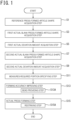
- the press-formed article manufacturing method includes a reference press-formed article shape acquisition step S1, a first actual blank press-formed article shape acquisition step S3, a first actual deviation amount acquisition step S5, a second actual blank press-formed article shape acquisition step S7, a second actual deviation amount acquisition step S9, a measures-required portion specifying step S11, a forming accuracy improving step S13, and an actual press forming step S15.
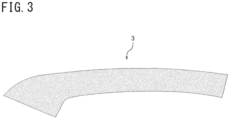
- the reference press-formed article shape acquisition step S1 uses a flat blank model 3 as illustrated in FIG. 3 .
- This step is a step of acquiring a press-formed article shape after die release as a reference press-formed article shape by performing press forming analysis by a predetermined die model.
- the predetermined die model is set based on a forming-surface shape of an actual die used for press forming on a flat blank into a target press-formed article shape. For example, a die model having a shape corresponding to the target press-formed article shape is taken as the predetermined die model. However, a die model corrected just by the amount of spring back after die release is preferable as the predetermined die model.
- press forming analysis in this description includes analysis to acquire a shape at a forming bottom dead center, and analysis to acquire a shape after die release, namely, after spring back.
- the flat blank model 3 is a blank model which is generally used for press forming analysis and which has a flat shape without any protrusion and recess.
- the press forming analysis is generally performed by CAE analysis such as a finite element method (FEM). That is, the press forming analysis should be performed by structural analysis using a computer, e.g., well-known CAE analysis or the like. Press forming includes stamping, drawing, and the like, but the present invention is applicable to any press forming. The present embodiment deals with a case of drawing.
- CAE analysis such as a finite element method (FEM). That is, the press forming analysis should be performed by structural analysis using a computer, e.g., well-known CAE analysis or the like.
- Press forming includes stamping, drawing, and the like, but the present invention is applicable to any press forming.
- the present embodiment deals with a case of drawing.
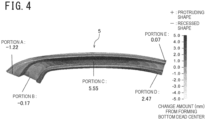
- FIG. 4 A reference press-formed article shape 5 after die release, which is acquired by the press forming analysis, is illustrated in FIG. 4 .
- change amounts due to die release from the forming bottom dead center are illustrated with light and shade.
- FIG. 4 a portion having a recessed shape relative to the forming bottom dead center is illustrated with light color, and a portion having a protruding shape is illustrated with dark color.
- a positive (+) number in FIG. 4 is a change amount to a protruding direction (toward the near side on the plane of paper), a negative (-) number is a change amount to a recessed direction (toward the deep side on the plane of paper), and they are indicated in a unit of mm. This also applies to numbers or the like in the following other drawings.
- a left end portion (a portion A) of the reference press-formed article shape 5 had a change amount of -1.22 mm.
- a left end (a portion B) of a top portion had a change amount of -0.17 mm
- a longitudinally central portion (a portion C) had a change amount of 5.55 mm
- a right end (a portion D) of a lower flange portion had a change amount of 2.47 mm
- a right end portion (a portion E) had a change amount of 0.07 mm.
- the first actual blank press-formed article shape acquisition step S3 uses a blank model corresponding to a shape variation of a metal sheet. This step is a step of acquiring a press-formed article shape after die release by performing the same press forming analysis as in the reference press-formed article shape acquisition step S1.
- a first actual blank model 11 in a shape corresponding to the shape variation of the metal sheet is generated based on the shape variation of the metal sheet.
- An example of the first actual blank model 11 is illustrated in FIG. 5 and is described below more specifically.
- FIG. 5(a) is a drawing illustrating the first actual blank model 11 in a plan view.
- FIG. 5(b) is a sectional view taken along a line A-A in FIG. 5(a) , and light and shade in color in FIG. 5B express recesses and protrusions.
- FIG. 5(c) illustrates a graph indicative of respective heights of the recesses and the protrusions in FIG. 5(b) .
- the first actual blank model 11 is a blank model having a shape variation similar to that of the first actual blank extracted from the metal sheet having the shape variation and has an irregular recessed-protruding shape.
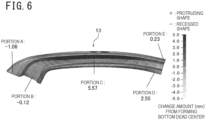
- FIG. 6 illustrates the first actual blank press-formed article shape 13 acquired by the press forming analysis. Colors and values illustrated in FIG. 6 have the same meanings as those in FIG. 4 .
- the left end portion (the portion A) had a change amount of -1.06 mm.
- the left end (the portion B) of the top portion had a change amount of -0.12 mm
- the longitudinally central portion (the portion C) had a change amount of 5.57 mm
- the right end (the portion D) of the lower flange portion had a change amount of 2.55 mm
- the right end portion (the portion E) had a change amount of 0.23 mm.
- the reference press-formed article shape 5 ( FIG. 4 ) is compared with the first actual blank press-formed article shape 13 ( FIG. 6 ).
- This step is a step of finding a deviation portion where those shapes deviate from each other, and a deviation amount (a first actual deviation amount) in the deviation portion.
- a plurality of regions is set in the shape of a press-formed article, and respective representative points in the regions are taken as portions where a deviation amount is found.
- a region estimated to easily have spring back after die release may be set representatively, for example.
- data of a set of the deviation portion and the first actual deviation amount may be stored, for example.
- a press-formed article shape at the forming bottom dead center is regarded as a reference shape, and a change amount (a spring back amount) from the reference shape is found at each portion of a press-formed article shape after die release. Then, a difference between respective change amounts in two press-formed article shapes is found as a deviation amount.
- the first actual deviation amount found in the first actual deviation amount acquisition step S5 is a value acquired by subtracting the change amount ( FIG. 4 ) of the reference press-formed article shape 5 from the change amount ( FIG. 6 ) of the first actual blank press-formed article shape 13.
- the change amount ( FIG. 6 ) of the first actual blank press-formed article shape 13 is a change amount acquired by use of an actual blank having a shape variation.
- the change amount ( FIG. 4 ) of the reference press-formed article shape 5 is a change amount acquired by use of a flat blank model. Accordingly, in a case where the first actual deviation amount is positive (+), its corresponding portion in the first actual blank press-formed article shape 13 has a shape protruding relative to the reference press-formed article shape 5. In the meantime, in a case where the first actual deviation amount is negative (-), its corresponding portion in the first actual blank press-formed article shape 13 has a shape recessed relative to the reference press-formed article shape 5.
- the first actual deviation amounts found as described above are illustrated in FIG. 7 .
- the following values were found as the first actual deviation amounts between the first actual blank press-formed article shape 13 and the reference press-formed article shape 5. That is, the first actual deviation amount in the portion A was 0.16 mm, the first actual deviation amount in the portion B was 0.05 mm, the first actual deviation amount in the portion C was 0.02 mm, the first actual deviation amount in the portion D was 0.08 mm, and the first actual deviation amount in the portion E was 0.16 mm.
- the second actual blank press-formed article shape acquisition step S7 uses an actual blank model different from the first actual blank model 11. This step is a step of acquiring a press-formed article shape after die release by performing the same press forming analysis as in the reference press-formed article shape acquisition step S1.
- a second actual blank model 21 is generated with use of an actual blank different from the first actual blank.
- An example of the second actual blank model 21 is illustrated in FIG. 8 and is described below more specifically.
- the second actual blank model 21 is a blank model generated based on measurement data acquired by measuring the shape of an actual blank (a second actual blank) extracted from a portion of the metal sheet having the shape variation which portion is different from the portion from which the first actual blank is extracted.
- the shape of the second actual blank is measured by a three-dimensional shape measuring apparatus or the like including a laser range finder, for example, and the second actual blank model 21 is generated based on the measurement result.
- FIG. 8(a) is a drawing illustrating the second actual blank model 21 in a plan view.
- FIG. 8(b) is a sectional view taken along a line B-B in FIG. 8(a) , and light and shade in color in FIG. 8(b) express recesses and protrusions.
- FIG. 8(c) illustrates a graph indicative of respective heights of the recesses and the protrusions in FIG. 8(b) .
- the second actual blank model 21 is a blank model having a shape variation similar to that of the second actual blank extracted from the metal sheet having the shape variation.
- the second actual blank model 21 has an irregular recessed-protruding shape different from the first actual blank model 11.
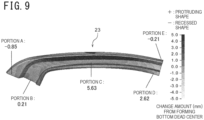
- FIG. 9 illustrates the second actual blank press-formed article shape 23. Colors and values illustrated in FIG. 9 have the same meanings as those in FIGs. 4 and 6 .
- the portion A had a change amount of -0.85 mm.
- the portion B had a change amount of 0.21 mm, the portion C had a change amount of 5.63 mm, the portion D had a change amount of 2.62 mm, and the portion E had a change amount of -0.21 mm.
- the second actual deviation amount acquisition step S9 is a step of comparing the reference press-formed article shape 5 with the second actual blank press-formed article shape 23 to find a deviation portion where those shapes deviate from each other, and a deviation amount (a second actual deviation amount) in the deviation portion.
- a method for finding the second actual deviation amount is similar to the method described in the first actual deviation amount acquisition step S5, and therefore, is not described herein.
- FIG. 10 illustrates second actual deviation amounts found in comparison between the reference press-formed article shape 5 ( FIG. 4 ) and the second actual blank press-formed article shape 23 ( FIG. 9 ).
- the following values were found as the second actual deviation amounts between the second actual blank press-formed article shape 23 and the reference press-formed article shape 5. That is, the second actual deviation amount in the portion A was 0.37 mm, the second actual deviation amount in the portion B was 0.38 mm, the second actual deviation amount in the portion C was 0.08 mm, the second actual deviation amount in the portion D was 0.15 mm, and the second actual deviation amount in the portion E was -0.28 mm.
- the measures-required portion specifying step S11 is a step of specifying, as measures-required portions, portions of the press-formed article 1 which portions correspond to a portion having a first actual deviation amount exceeding a threshold in the first actual deviation amount acquisition step S5 and a portion having a second actual deviation amount exceeding the threshold in the second actual deviation amount acquisition step S9.
- a portion to be largely influenced by a shape variation of a blank that is, a portion assumed to have a large deviation is specified as a measures-required portion.
- FIG. 11 illustrates both the first actual deviation amounts (see FIG. 7 ) found in the first actual deviation amount acquisition step S5 and the second actual deviation amounts (see FIG. 10 ) found in the second actual deviation amount acquisition step S9 in such a manner as to correspond to the target shape.
- the first actual deviation amounts and the second actual deviation amounts were as follows. That is, the first actual deviation amount and the second actual deviation amount in the portion A were from 0.16 mm to 0.37 mm, the first actual deviation amount and the second actual deviation amount in the portion B were from 0.05 mm to 0.38 mm, the first actual deviation amount and the second actual deviation amount in the portion C were from 0.02 mm to 0.08 mm, the first actual deviation amount and the second actual deviation amount in the portion D were from 0.08 mm to 0.15 mm, and the first actual deviation amount and the second actual deviation amount in the portion E were from -0.28 mm to 0.16 mm.
- a minimum range including the first actual deviation amount and the second actual deviation amount in each portion is illustrated as a range of a deviation amount that can be caused in each portion.
- one second actual deviation amount is found for each portion.
- a minimum range including one first actual deviation amount and two or more second actual deviation amounts in each portion may be set as a range of a deviation amount estimated to be caused in each portion.
- a portion having a deviation amount exceeding the threshold is the portion A, the portion B, the portion D, and the portion E.
- the portions A, B, D, E are specified as measures-required portions.
- a process of providing beads for portions of an actual die surface which portions correspond to the measures-required portions is performed.
- the measures to reduce the influence of the shape variation of the blank correspond to the forming accuracy improving step S13.
- press forming is performed with use of the actual die provided with the beads.
- a correction process is performed to reduce the deviation amount in the measures-required portion specified in the measures-required portion specifying step S11. That is, a process of correcting a shape of at least either one selected from a forming surface of an actual die as a press die to be used in the manufacture of a press-formed article and an actual blank as a blank to be used in the manufacture of a press-formed article is performed.
- the forming accuracy improving step in the present embodiment in order to reduce the influence of the shape variation of the blank, the forming surface of the actual die to be used for press forming is corrected.
- the forming accuracy improving step S13 in the present embodiment includes a bead providing step S13A.
- the bead providing step S13A is a step of providing the actual die with the beads described above.
- the bead is provided for a portion of on an actual die surface which portion is to form a measures-required portion, or a measures-required portion and its peripheral portion.
- the bead should be provided for the actual die such that the bead mark 32 formed in the portion B, the portion D, or the portion E in FIGS. 12 to 16 is formed.
- the bead should be also provided for the actual die such that the longitudinal direction of the bead mark 32 is along a direction intersecting with an end side of the press-formed article.
- the bead may be provided for the actual die such that the longitudinal direction of the bead mark 32 is along a direction parallel to the end side of the press-formed article.
- the bead should be provided for the actual die such that the longitudinal direction of the bead mark 32 is along a direction intersecting with an end side of the press-formed article 1 which end side is closest to a corresponding measures-required portion.
- the bead is set in a vicinal area where the bead can be set, e.g. , the vicinity of the measures-required portion or the like.
- the bead may be provided for the actual die such that the longitudinal direction of the bead mark 32 is along a direction where the recesses and the protrusions of the shape variation are consecutive in a corresponding measures-required portion or its vicinal portion.
- the shape variation (actual corrugations) of the blank can be held down by the bead of the actual die, around the forming bottom dead center in press forming.
- the press-formed article can be acquired with the shape variation being held down, thereby making it possible to improve dimensional accuracy.
- the bead should be provided for the actual die in the following manner. That is, the bead should be provided for the actual die such that the longitudinal direction of the bead mark is along a direction where the recesses and the protrusions in the shape variation of the blank are consecutive, in the measures-required portion or its vicinal portion of the press-formed article.
- the bead be provided such that the longitudinal direction of the bead mark is along the direction where the recesses and the protrusions in the shape variation of the blank are consecutive, in the measures-required portion of the press-formed article.
- the bead may be provided such that the longitudinal direction of the bead mark is along the direction where the recesses and the protrusions in the shape variation of the blank are consecutive, in a vicinal portion around the measures-required portion of the press-formed article, for example.
- the bead mark to be formed in the measures-required portion may have a protruding shape or a recessed shape.
- the length, width, or height of the bead mark should be determined appropriately to correspond to an allowable degree from a shape required for a target press-formed article in consideration of an acceptable height or pitch of actual corrugations (shape variation) remaining in the press-formed article.
- the shape of the bead mark can be a circular shape, an oval shape, an elliptical shape, a square shape, a rectangular shape, a triangular shape, a diamond shape, or the like in a top view. Furthermore, a mountain shape, a trapezoidal shape, a semicircular shape, a semielliptical shape, or the like is also applicable in a side view.
- the shape of the bead mark has a shape similar to a bead shape to be provided for the actual die.
- the actual press forming step S15 is a step of performing press forming on an actual blank with use of the actual die provided with the beads in the bead providing step S13A.
- beads were provided for respective portions corresponding to measures-required portions, in the predetermined die model used for the above press forming analysis.
- analysis was performed in a similar manner to the reference press-formed article shape acquisition step S1 to the second actual deviation amount acquisition step S9. Note that change amounts and deviation amounts described in the following description were found in the same manner as those illustrated in FIGS. 4 to 11 .
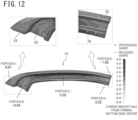
- FIG. 12 illustrates a reference press-formed article shape 31 acquired by performing press forming analysis on the flat blank model 3 (see FIG. 3 ) with use of the bead-provided die model.
- bead shapes on the bead-provided die model were transferred to the reference press-formed article shape 31, so that bead marks 32 were formed.
- a bead was provided for a portion of the die model which portion corresponded to the portion A. More specifically, a bead was provided such that the longitudinal direction of the bead mark 32 transferred to the press-formed article shape was parallel to a left end side of the press-formed article shape.
- a bead was provided for a portion of the die model which portion corresponded to each of the portion B, the portion D, and the portion E such that the longitudinal direction of its corresponding bead mark 32 was along a direction intersecting with an end side of the press-formed article shape which end side was closest to the portion provided with the bead.
- the portion A of the reference press-formed article shape 31 had a change amount of 0.07 mm.
- the portion B had a change amount of -0.04 mm, the portion C had a change amount of 5.50 mm, the portion D had a change amount of 2.52 mm, and the portion E had a change amount of -1.02 mm.
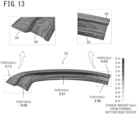
- FIG. 13 illustrates a first actual blank press-formed article shape 33 acquired by performing press forming analysis on the first actual blank model 11 (see FIG. 5 ) with use of the bead-provided die model.
- the portion A of the first actual blank press-formed article shape 33 had a change amount of 0.13 mm.
- the portion B had a change amount of -0.05 mm, the portion C had a change amount of 5.51 mm, the portion D had a change amount of 2.56 mm, and the portion E had a change amount of -0.93 mm.
- FIG. 14 illustrates first actual deviation amounts found in comparison between the reference press-formed article shape 31 ( FIG. 12 ) and the first actual blank press-formed article shape 33 ( FIG. 13 ).
- the following first actual deviation amounts were found between the reference press-formed article shape 31 and the first actual blank press-formed article shape 33. That is, the first actual deviation amount in the portion A was 0.06 mm, the first actual deviation amount in the portion B was -0.01 mm, the first actual deviation amount in the portion C was 0.01 mm, the first actual deviation amount in the portion D was 0.04 mm, and the first actual deviation amount in the portion E was 0.09 mm.
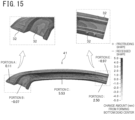
- FIG. 15 illustrates a second actual blank press-formed article shape 41 acquired by performing press forming analysis on the second actual blank model 21 (see FIG. 8 ) with use of the bead-provided die model.
- the portion A of the second actual blank press-formed article shape 41 had a change amount of 0.11 mm.
- the portion B had a change amount of -0.07 mm, the portion C had a change amount of 5.53 mm, the portion D had a change amount of 2.50 mm, and the portion E had a change amount of -0.97 mm.
- FIG. 16 illustrates second actual deviation amounts found in comparison between the reference press-formed article shape 31 ( FIG. 12 ) and the second actual blank press-formed article shape 41 ( FIG. 15 ).
- the following second actual deviation amounts were found between the reference press-formed article shape 31 and the second actual blank press-formed article shape 41. That is, the second actual deviation amount in the portion A was 0.04 mm, the second actual deviation amount in the portion B was -0.03 mm, the second actual deviation amount in the portion C was 0.03 mm, the second actual deviation amount in the portion D was -0.02 mm, and the second actual deviation amount in the portion E was 0.05 mm.
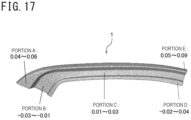
- FIG. 17 illustrates both the first actual deviation amounts in FIG. 14 and the second actual deviation amounts in FIG. 16 in such a manner as to correspond to the target shape.
- the first actual deviation amounts and the actual second deviation amounts were found as follows. That is, the first actual deviation amount and the second actual deviation amount in the portion A was from 0.04 mm to 0.06 mm, the first actual deviation amount and the second actual deviation amount in the portion B was from -0.03 mm to -0.01 mm, the first actual deviation amount and the second actual deviation amount in the portion C was from 0.01 mm to 0.03 mm, the first actual deviation amount and the second actual deviation amount in the portion D was from -0.02 mm to 0.04 mm, and the first actual deviation amount and the second actual deviation amount in the portion E was from 0.05 mm to 0.09 mm.
- the deviation amounts in FIG. 17 are markedly reduced in comparison with the deviation amounts before measures are taken as illustrated in FIG. 11 . More specifically, the deviation amounts after measures were taken were in a range of less than ⁇ 0.15 mm as the threshold in the measures-required portion specifying step S11 in each portion.
- the providing of beads for a die in such a manner as to correspond to measures-required portions specified in the measures-required portion specifying step S11 is effective in reducing the influence of the shape variation of the blank.
- the shape of a press-formed article provided after press forming has a result similar to an analysis result in FIG. 17 . That is, the influence of the shape variation of the blank is reduced, and an excellent dimensional accuracy is achieved.
- a plurality of patterns of blank models for a blank having a shape variation is generated, and measures-required portions are specified by finding deviation amounts in each of the patterns. Accordingly, the present embodiment is achieved in consideration of differences in shape variation between individual actual blanks.
- a second actual blank model of only one type is generated, but second actual blank models of several types may be generated.
- a plurality of second actual blanks is extracted from different portions of a metal sheet having a shape variation to generate the second actual blank models of the several types.
- the present invention is not limited to this.
- a height of each portion in one of the press-formed article shapes after die release is acquired.
- the deviation amount may be a difference acquired by subtracting, from the height of each portion, a height of its corresponding portion in the other one of the press-formed article shapes after die release (after spring back).
- the actual press forming step S15 may further include the following restriking step S15A at the time when press forming is performed with use of a corrected actual die. That is, the actual press forming step S15 may further include the restriking step S15A of repressing a press-formed article to which the bead marks 32 are transferred from the actual die provided with the beads, in such a manner as to crush the bead marks 32.
- the restriking step S15A of repressing a press-formed article to which the bead marks 32 are transferred from the actual die provided with the beads, in such a manner as to crush the bead marks 32.
- portions provided with the bead marks 32 and their peripheral portions receive strain and harden due to the strain, thereby further improving the rigidity of the press-formed article.
- the beads marks 32 may be also crushed and straightened in the restriking step.
- a clear bead mark it is not necessary to form a clear bead mark on the press-formed article.
- a clear bead mark may not be transferred to the press-formed article.
- press forming can be performed while the bead on the actual die is holding down the shape variation of the blank, so that it is possible to reduce the influence of the shape variation of the blank.
- the press-formed article manufacturing method described in FIG. 1 was performed.
- the press-formed article 1 in FIG. 2 is a target shape, similarly to the above embodiment.
- the forming in the press forming analysis is stamping in the present example, whereas the forming is drawing in the above embodiment. Further, change amounts and deviation amounts in the present example were found by a method similar to that in the above embodiment.
- press forming analysis was performed on the flat blank model 3 (see FIG. 3 ) with use of a predetermined die model.
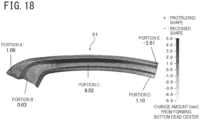
- a press-formed article shape after die release was acquired as a reference press-formed article shape 51. This is illustrated in FIG. 18 .
- the portion A of the reference press-formed article shape 51 had a change amount of 1.06 mm.
- the portion B had a change amount of 0.63 mm
- the portion C had a change amount of 6.02 mm
- the portion D had a change amount of 1.10 mm
- the portion E had a change amount of -2.61 mm.
- first actual blank press-formed article shape acquisition step S3 press forming analysis was performed on the first actual blank model 11 in FIG. 5 with use of a predetermined die model similar to the above.
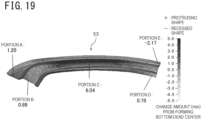
- a first actual blank press-formed article shape 53 as a press-formed article shape after die release is illustrated in FIG. 19 .
- the portion A of the first actual blank press-formed article shape 53 had a change amount of 1.20 mm.
- the portion B had a change amount of 0.89 mm
- the portion C had a change amount of 6.04 mm
- the portion D had a change amount of 0.78 mm
- the portion E had a change amount of -2.17 mm.
- the reference press-formed article shape 51 ( FIG. 18 ) was compared with the first actual blank press-formed article shape 53 ( FIG. 19 ). Then, deviation amounts (first actual deviation amounts) between those shapes were found.
- the following first actual deviation amounts were found between the first actual blank press-formed article shape 53 and the reference press-formed article shape 51. That is, the first actual deviation amount in the portion A was 0.14 mm, the first actual deviation amount in the portion B was 0.26 mm, the first actual deviation amount in the portion C was 0.02 mm, the first actual deviation amount in the portion D was -0.32 mm, and the first actual deviation amount in the portion E was 0.44 mm.
- the second actual blank model 21 described in FIG. 8 is used in the above embodiment.
- a second actual blank model 61 illustrated in FIG. 21 was used in the present example.
- the second actual blank model 61 is a blank model generated based on measurement data acquired by measuring the shape of an actual blank extracted from a portion of the metal sheet having the shape variation which portion is different from respective portions from which the first actual blank and the second actual blank in the above embodiment are extracted.
- the shape of the above actual blank is measured by a three-dimensional shape measuring apparatus or the like including a laser range finder, for example, and the second actual blank model 61 is generated based on the measurement result.
- FIG. 21(a) is a drawing illustrating the second actual blank model 61 in a plan view.
- FIG. 21(b) is a sectional view taken along a line C-C in FIG. 21(a) , and light and shade in color in FIG. 21(b) express recesses and protrusions.
- FIG. 21(c) illustrates a graph indicative of respective heights of the recesses and the protrusions in FIG. 21(b) .
- the second actual blank model 61 is a blank model having a shape variation similar to that of the actual blank extracted from the metal sheet having the shape variation. As illustrated in FIG. 21 , the second actual blank model 61 has an irregular recessed-protruding shape different from the first actual blank model 11 and the second actual blank model 21 in the above embodiment.
- FIG. 22 illustrates a second actual blank press-formed article shape 63 acquired by performing press forming analysis on the second actual blank model 61 in FIG. 21 with use of the predetermined die model.
- the portion A of the second actual blank press-formed article shape 63 had a change amount of 0.80 mm.
- the portion B had a change amount of 0.65 mm
- the portion C had a change amount of 5.88 mm
- the portion D had a change amount of 0.90 mm
- the portion E had a change amount of -2.58 mm.
- the reference press-formed article shape 51 ( FIG. 18 ) was compared with the second actual blank press-formed article shape 63 ( FIG. 22 ). Then, deviation amounts (second actual deviation amounts) were found.
- the following second actual deviation amounts were found between the second actual blank press-formed article shape 63 and the reference press-formed article shape 51. That is, the second actual deviation amount in the portion A was -0.26 mm, the second actual deviation amount in the portion B was 0.02 mm, the second actual deviation amount in the portion C was -0.14mm, the second actual deviation amount in the portion D was -0.20 mm, and the second actual deviation amount in the portion E was 0.03 mm.
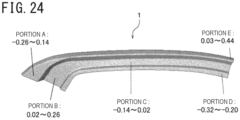
- FIG. 24 illustrates both the first actual deviation amounts ( FIG. 20 ) found in the first actual deviation amount acquisition step S5 and the second actual deviation amounts ( FIG. 23 ) found in the second actual deviation amount acquisition step S9 in such a manner as to correspond to the target shape.
- the deviation amount in the portion A was from -0.26 mm to 0.14 mm
- the deviation amount in the portion B was from 0.02 mm to 0.26 mm
- the deviation amount in the portion C was from -0.14 mm to 0.02 mm
- the deviation amount in the portion D was from -0.32 mm to - 0.20 mm
- the deviation amount in the portion E was from 0.03 mm to 0.44 mm.
- the threshold in the measures-required portion specifying step S11 is ⁇ 0.15 mm.
- a portion having a deviation amount exceeding the threshold is the portion A, the portion B, the portion D, and the portion E. Accordingly, these portions were specified as measures-required portions.
- beads similar to those in the above embodiment were provided for a predetermined die model, and the die model (a bead-provided die model) was used. Analysis similar to the reference press-formed article shape acquisition step S1 to the second actual deviation amount acquisition step S9 was performed.
- FIG. 25 illustrates a reference press-formed article shape 71 acquired by performing press forming analysis on the flat blank model 3 (see FIG. 3 ) with use of the bead-provided die model.
- the portion A of the reference press-formed article shape 71 had a change amount of 1.29 mm.
- the portion B had a change amount of 0.07 mm
- the portion C had a change amount of 6.50 mm
- the portion D had a change amount of 2.10 mm
- the portion E had a change amount of 1.80 mm.
- FIG. 26 illustrates a first actual blank press-formed article shape 73 acquired by performing press forming analysis on the first actual blank model 11 (see FIG. 5 ) with use of the bead-provided die model.
- the portion A of the first actual blank press-formed article shape 73 had a change amount of -1.34 mm.
- the portion B had a change amount of 0.11 mm
- the portion C had a change amount of 6.48 mm
- the portion D had a change amount of 2.03 mm
- the portion E had a change amount of 1.86 mm.
- the first actual deviation amount in the portion A was 0.05 mm
- the first actual deviation amount in the portion B was 0.04 mm
- the first actual deviation amount in the portion C was -0.02 mm
- the first actual deviation amount in the portion D was -0.07 mm
- the first actual deviation amount in the portion E was 0.06 mm.
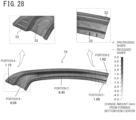
- FIG. 28 illustrates a second actual blank press-formed article shape 75 acquired by performing press forming analysis on the second actual blank model 61 (see FIG. 21 ) with use of the bead-provided die model.
- the portion A of the second actual blank press-formed article shape 75 had a change amount of 1.19 mm.
- the portion B had a change amount of 0.04 mm
- the portion C had a change amount of 6.45 mm
- the portion D had a change amount of 1.99 mm
- the portion E had a change amount of 1.92 mm.
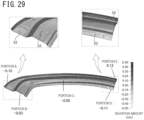
- FIG. 29 illustrates second actual deviation amounts found in comparison between the reference press-formed article shape 71 ( FIG. 25 ) and the second actual blank press-formed article shape 75 ( FIG. 28 ).
- the second actual deviation amount in the portion A was -0.10 mm
- the second actual deviation amount in the portion B was - 0.03 mm
- the second actual deviation amount in the portion C was -0.05mm
- the second actual deviation amount in the portion D was -0.11 mm
- the second actual deviation amount in the portion E was 0.12 mm.
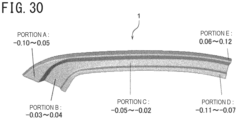
- FIG. 30 illustrates the first actual deviation amounts in FIG. 27 and the second actual deviation amounts in FIG. 29 in such a manner as to correspond to the target shape.
- the deviation amount in the portion A was from -0.10 mm to 0.05 mm
- the deviation amount in the portion B was from -0.03 mm to 0.04 mm
- the deviation amount in the portion C was from -0.05 mm to - 0.02 mm
- the deviation amount in the portion D was from - 0.11 mm to -0.07 mm
- the deviation amount in the portion E was from 0.06 mm to 0.12 mm .
- the deviation amounts in FIG. 30 were markedly reduced in comparison with the deviation amounts before measures were taken as illustrated in FIG.
- beads similar to those in the bead-provided die model were provided for an actual die surface. More specifically, the beads were provided for portions of a die which portions were to form measures-required portions in the present example, or the measures-required portions and their peripheral portions.
- press forming was performed on an actual blank having a shape variation with use of the actual die provided with the beads.
- the actual blank used herein was a 1.5 GPa-grade steel sheet having a board thickness of 1.2 mm and corresponding to the above-mentioned blank model.
- the shape of a press-formed article acquired by press forming in the actual press forming step S15 was less influenced by the shape variation of the blank, and a press-formed article with an excellent dimensional accuracy was achieved, similarly to the analysis result in FIG. 30 .
- a press-formed article manufacturing method uses a blank extracted from a metal sheet having a shape variation (recesses and protrusions).
- the press-formed article manufacturing method is a method to reduce the influence of the shape variation of the blank before press forming on the dimensional accuracy of a press-formed article at the time when press forming such as stamping or drawing is performed by a predetermined die.
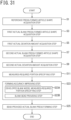
- the press-formed article manufacturing method includes the reference press-formed article shape acquisition step S1, the first actual blank press-formed article shape acquisition step S3, the first actual deviation amount acquisition step S5, the second actual blank press-formed article shape acquisition step S7, the second actual deviation amount acquisition step S9, the measures-required portion specifying step S11, the forming accuracy improving step S13, and a bead-provided actual blank press forming step S25.
- Respective configurations of the reference press-formed article shape acquisition step S1, the first actual blank press-formed article shape acquisition step S3, the first actual deviation amount acquisition step S5, the second actual blank press-formed article shape acquisition step S7, the second actual deviation amount acquisition step S9, and the measures-required portion specifying step S11 are similar to respective configurations of the steps described in the first embodiment.
- the reference press-formed article shape acquisition step S1 performs press forming analysis by a die model with use of the flat blank model 3 illustrated in FIG. 33 .
- This step is a step of acquiring a press-formed article shape after die release as a flat blank press-formed article shape.
- press forming analysis includes analysis to acquire a shape at a press forming bottom dead center, and analysis to acquire a shape after die release, namely, after spring back.
- the flat blank model 3 is a blank model which is generally used for press forming analysis and which has a flat shape without any recesses and protrusions.
- the press forming analysis is generally performed by CAE analysis such as a finite element method (FEM).
- the press forming is not limited particularly and may be stamping, drawing, or the like.
- the present embodiment deals with a case where the press forming is stamping.
- the die model used for press forming analysis is acquired by modeling a predetermined die to be used for actual press forming.
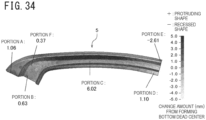
- FIG. 34 The reference press-formed article shape 5 after die release, acquired by press forming analysis, is illustrated in FIG. 34 .
- a shape and change amounts from a forming bottom dead center are illustrated with light and shade in color.
- a change amount is a value acquired by subtracting, from a height, in a press forming direction, of each portion of a press-formed article shape after die release and spring back after press forming, a height of its corresponding portion of a forming bottom dead center shape. This corresponds to a spring back amount in the press forming direction.
- a height difference (a change amount) is positive (+)
- the shape after die release is a protruding shape relative to the forming bottom dead center shape.
- the height difference (the change amount) is negative (-)
- the shape after die release is a recessed shape relative to the forming bottom dead center shape.
- FIG. 34 a portion having a recessed shape relative to the forming bottom dead center is illustrated with light color, and a portion having a protruding shape is illustrated with dark color.
- a positive (+) number in the drawing is a change amount to a protruding direction (toward the near side on the plane of paper), a negative (-) number is a change amount to a recessed direction (toward the deep side on the plane of paper), and they are indicated in a unit of mm.
- a left end portion of a shape after press forming analysis is defined as a portion A
- a left end of a top portion thereof is defined as a portion B
- a longitudinally central portion thereof is defined as a portion C
- a right end of a lower flange portion thereof is defined as a portion D
- a right end portion thereof is defined as a portion E
- a left top portion is defined as a portion F.
- change amounts found in the reference press-formed article shape 5 are as illustrated in FIG. 34 . That is, the portion A had a change amount of 1.06 mm, the portion B had a change amount of 0.63 mm, the portion C had a change amount of 6.02 mm, the portion D had a change amount of 1.10 mm, the portion E had a change amount of -2.61 mm, and the portion F had a change amount of 0.37 mm.
- the first actual blank press-formed article shape acquisition step S3 performs press forming analysis with use of a blank model corresponding to a shape variation of an actual blank. This step is a step of acquiring a press-formed article shape after die release.
- the first actual blank model 11 having a shape corresponding to the shape variation of the actual blank is generated.
- An example of the first actual blank model 11 is illustrated in FIG. 35 and is described below more specifically.
- the first actual blank model 11 is a blank model generated based on measurement data acquired by measuring the shape of an actual blank (a first actual blank) extracted from a predetermined position of a metal sheet having a shape variation. More specifically, the shape of the first actual blank is measured by a three-dimensional shape measuring apparatus or the like including a laser range finder, for example, and the first actual blank model 11 is generated based on the measurement result.
- FIG. 35A is a drawing illustrating the first actual blank model 11 in a plan view
- FIG. 35B is a sectional view taken along a line A-A in FIG. 35A
- Light and shade in color in FIGS. 35A, 35B express recesses and protrusions. Note that a portion with dark color has a shape protruding toward the near side on the plane of paper, and a portion with light color has a shape recessed toward the deep side on the plane of paper.
- FIG. 35C illustrates a graph indicative of respective heights of the recesses and the protrusions in FIG. 35B .
- the first actual blank model 11 is a blank model having a shape variation similar to that of the first actual blank extracted from the metal sheet having the shape variation and has an irregular recessed-protruding shape.
- FIG. 36 illustrates the first actual blank press-formed article shape 13 acquired by performing press forming analysis on the first actual blank model 11. Colors and values illustrated in FIG. 36 have the same meanings as those in FIG. 34 .
- the following change amounts were found in the first actual blank press-formed article shape 13. That is, the portion A had a change amount of 1.20 mm, the portion B had a change amount of 0.89 mm, the portion C had a change amount of 6.04 mm, the portion D had a change amount of 0.78 mm, the portion E had a change amount of - 2.17 mm, and the portion F had a change amount of 0.32 mm.
- the reference press-formed article shape 5 ( FIG. 34 ) is compared with the first actual blank press-formed article shape 13 ( FIG. 36 ).
- This step is a step of finding a deviation portion where those shapes deviate from each other, and a deviation amount in the deviation portion.
- a press-formed article shape at the forming bottom dead center is regarded as a reference shape, and a change amount (a spring back amount) from the reference shape is found in each portion of a press-formed article shape after die release. Then, a difference between respective change amounts of two press-formed article shapes is found as a deviation amount.
- the deviation amount found in the first actual deviation amount acquisition step S5 is a value acquired by subtracting the change amount ( FIG. 34 ) in the reference press-formed article shape 5 from the change amount ( FIG. 36 ) in the first actual blank press-formed article shape 13. Accordingly, in a case where the difference (the deviation amount) between the change amounts is positive (+), its corresponding portion in the first actual blank press-formed article shape 13 has a shape protruding relative to the reference press-formed article shape 5. In the meantime, in a case where the difference (the deviation amount) is negative (-), its corresponding portion in the first actual blank press-formed article shape 13 has a shape recessed relative to the reference press-formed article shape 5.
- FIG. 37 illustrates the deviation amounts found as described above in such a manner as to correspond to the first actual blank press-formed article shape 13.
- the following deviation amounts were found between the first actual blank press-formed article shape 13 and the reference press-formed article shape 5. That is, the deviation amount in the portion A was 0.14 mm, the deviation amount in the portion B was 0.26 mm, the deviation amount in the portion C was 0.02 mm, the deviation amount in the portion D was -0.32 mm, the deviation amount in the portion E was 0.44 mm, and the deviation amount in the portion F was -0.05 mm.
- the second actual blank press-formed article shape acquisition step S7 performs press forming analysis with use of an actual blank model different from the first actual blank model 11. This step is a step of acquiring a press-formed article shape after die release.
- the second actual blank model 21 is generated with use of an actual blank different from the first actual blank.
- FIG. 38 illustrates an example of the second actual blank model 21. The following describes the second actual blank model 21 more specifically.
- the second actual blank model 21 is a blank model generated based on measurement data acquired by measuring the shape of an actual blank (a second actual blank) extracted from a portion of the metal sheet having the shape variation which portion is different from the portion from which the first actual blank is extracted.
- the shape of the second actual blank is measured by a three-dimensional shape measuring apparatus or the like including a laser range finder, for example, and the second actual blank model 21 is generated based on the measurement result.
- FIG. 38(a) is a drawing illustrating the second actual blank model 21 in a plan view
- FIG. 38(b) is a sectional view taken along a line B-B in FIG. 38(a) .
- Light and shade in FIGS. 38(a), 38B express recesses and protrusions such that a portion with dark color has a shape protruding toward the near side on the plane of paper, and a portion with light color has a shape recessed toward the deep side on the plane of paper.
- FIG. 38(c) illustrates a graph indicative of respective heights of the recesses and the protrusions in FIG. 38(b) .
- the second actual blank model 21 is a blank model having a shape variation similar to that of the second actual blank extracted from the metal sheet having the shape variation. As illustrated in FIG. 38 , the second actual blank model 21 has an irregular recessed-protruding shape different from the first actual blank model 11.
- FIG. 39 illustrates the second actual blank press-formed article shape 23. Colors and values illustrated in FIG. 39 have the same meanings as those in FIGs. 34 and 36 .
- the following change amounts were found in the second actual blank press-formed article shape 23. That is, the portion A had a change amount of 0.80 mm, the portion B had a change amount of 0.65 mm, the portion C had a change amount of 5.88 mm, the portion D had a change amount of 0.90 mm, the portion E had a change amount of - 2.58 mm, and the portion F had a change amount of 0.21 mm.
- the second actual deviation amount acquisition step S9 is a step of comparing the reference press-formed article shape 5 with the second actual blank press-formed article shape 23 to find a deviation portion where those shapes deviate from each other, and a deviation amount in the deviation portion.
- a method for finding the deviation amount is similar to the method described in the first actual deviation amount acquisition step S5, and therefore, is not described herein.
- the reference press-formed article shape 5 ( FIG. 34 ) is compared with the second actual blank press-formed article shape 23 ( FIG. 39 ).
- FIG. 40 illustrates deviation amounts found therebetween at this time in such a manner as to correspond to the second actual blank press-formed article shape 23.
- the following deviation amounts were found between the second actual blank press-formed article shape 23 and the reference press-formed article shape 5. That is, the deviation amount in the portion A was -0.26 mm, the deviation amount in the portion B was 0.02 mm, the deviation amount in the portion C was -0.14 mm, the deviation amount in the portion D was -0.20 mm, the deviation amount in the portion E was 0.03 mm, and the deviation amount in the portion F was -0.16 mm.
- the measures-required portion specifying step S11 is a step of specifying, as a measures-required portion, a portion where either of the deviation amounts found in the first actual deviation amount acquisition step S5 and the second actual deviation amount acquisition step S9 exceeds a threshold.
- a portion expected to be largely influenced by a shape variation of an actual blank is specified as a measures-required portion, and measures to reduce the influence of the shape deviation are taken.
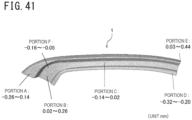
- FIG. 41 illustrates ranges of both the deviation amounts (see FIG. 37 ) found in the first actual deviation amount acquisition step S5 and the deviation amounts (see FIG. 40 ) found in the second actual deviation amount acquisition step S9 in such a manner as to correspond to the target shape (the press-formed article 1).
- the deviation amount in the portion A was from -0.26 mm to 0.14 mm
- the deviation amount in the portion B was from 0.02 mm to 0.26 mm
- the deviation amount in the portion C was from -0.14 mm to 0.02 mm
- the deviation amount in the portion D was from - 0.32 mm to -0.20 mm
- the deviation amount in the portion E was from 0.03 mm to 0.44 mm
- the deviation amount in the portion F was -0.16 mm to -0.05 mm.
- the threshold in the measures-required portion specifying step S11 is ⁇ 0.20 mm.
- a portion having a deviation amount exceeding the threshold is the portion A, the portion B, the portion D, and the portion E. Accordingly, these portions are specified as measures-required portions in the press-formed article shape.
- the forming accuracy improving step S23 is a step of performing a correction process to reduce the deviation amount in the measures-required portion specified in the measures-required portion specifying step S11. More specifically, a process of correcting a shape of at least either one selected from a forming surface of an actual die as a press die to be used in the manufacture of a press-formed article and an actual blank as a blank to be used in the manufacture of a press-formed article is performed.
- the forming accuracy improving step S23 in the present embodiment in order to reduce the influence of a shape variation of a blank, the actual blank to be used for press forming is corrected. Accordingly, the forming accuracy improving step S23 in the present embodiment includes a developed blank model measures-required portion specifying step S23A, and a blank bead providing step S23B.
- the developed blank model measures-required portion specifying step S23A is a step of specifying a portion of a blank model which portion corresponds to a measures-required portion of a press-formed article shape.
- the press-formed article shape is subjected to reverse forming analysis and developed to a blank model.
- which portion of the blank model corresponds to the measures-required portion in the press-formed article shape can be calculated.
- a portion having a deviation amount exceeding the threshold in the first actual blank press-formed article shape 13 was the portions B, D, E (see FIG. 37 ).
- a portion having a deviation amount exceeding the threshold in the second actual blank press-formed article shape 23 was the portions A, D (see FIG. 40 ).
- the portions A, B, D, E were specified as measures-required portions in the press-formed article shape.
- the specified measures-required portions are set on one press-formed article shape.
- the measures-required portions in the present example are the portions A, B, D, and E.
- the press-formed article shape to which the measures-required portions are set may be any of the reference press-formed article shape 5, the first actual blank press-formed article shape 13, and the second actual blank press-formed article shape 23.
- the press-formed article shape to which the measures-required portions are set is subjected to reverse forming analysis and is developed to a blank model.
- measures-required portions on the blank model can be specified.
- measures to reduce the influence of a shape variation of a blank can be taken for the blank before press forming.
- the measures beads are provided for portions of an actual blank which portions correspond to the measures-required portions on the blank model.
- the measures-required portions (the portions A, B, D, and E) were set in the reference press-formed article shape 5.
- the reference press-formed article shape 5 was developed to specify measures-required portions on the flat blank model 3. Then, beads were provided for the measures-required portions on the flat blank model 3.
- FIG. 42 also illustrates portions corresponding to the portions A to E of the reference press-formed article shape 5 and respective ranges (the same as in FIG. 41 ) of deviation amounts to be caused in those portions.
- each bead 15 is provided in a direction where its longitudinal direction intersects with or is parallel to an end side of the blank model.
- the bead of the present invention is not limited to this.
- the bead may be provided in a direction along the advancing direction of corrugations of the first actual blank model 11 or the second actual blank model 21 (along a pitch direction of recesses and protrusions).
- the beads 15 were also provided for the first actual blank model 11 and the second actual blank model 21 in a similar manner. Then, similar analysis was performed from the reference press-formed article shape acquisition step S1 to the second actual deviation amount acquisition step S9 with use of each blank model provided with the beads 15.
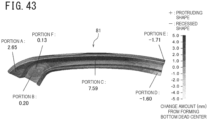
- FIG. 43 illustrates a bead-provided reference press-formed article shape 81 acquired by performing press forming analysis on the flat blank model 3 provided with the beads 15 as illustrated in FIG. 42 .
- the following change amounts were found in the bead-provided reference press-formed article shape 81. That is, the portion A had a change amount of 2.65 mm, the portion B had a change amount of 0.20 mm, the portion C had a change amount of 7.59 mm, the portion D had a change amount of -1.60 mm, the portion E had a change amount of -1.71 mm, and the portion F had a change amount of 0.13 mm.
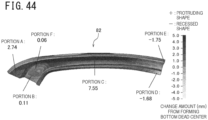
- FIG. 44 illustrates a bead-provided first actual blank press-formed article shape 82 acquired by performing press forming analysis on the first actual blank model 11 provided with the beads 15.
- the following change amounts were found in the bead-provided first actual blank press-formed article shape 82. That is, the portion A had a change amount of 2.74 mm, the portion B had a change amount of 0.11 mm, the portion C had a change amount of 7.55 mm, the portion D had a change amount of -1.68 mm, the portion E had a change amount of -1.75 mm, and the portion F had a change amount of 0.06 mm.
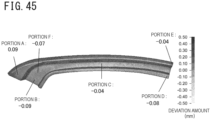
- FIG. 45 illustrates deviation amounts found in comparison between the bead-provided reference press-formed article shape 81 ( FIG. 43 ) and the bead-provided first actual blank press-formed article shape 82 ( FIG. 44 ), similarly to the first actual deviation amount acquisition step S5.
- the following deviation amounts were found between the bead-provided first actual blank press-formed article shape 82 and the bead-provided reference press-formed article shape 81. That is, the deviation amount in the portion A was 0.09 mm, the deviation amount in the portion B was -0.09 mm, the deviation amount in the portion C was -0.04 mm, the deviation amount in the portion D was -0.08 mm, the deviation amount in the portion E was -0.04 mm, and the deviation amount in the portion F was -0.07 mm.
- the deviation amounts in the case of the blank model provided with the beads 15 are markedly reduced in comparison with the deviation amounts (see FIG. 37 ) in the case of the blank model with no bead 15.
- the beads 15 provided for the blank model reduce the influence of the shape variation of the blank before press forming on the dimensional accuracy of the press-formed article.
- FIG. 46 illustrates a bead-provided second actual blank press-formed article shape 83 acquired by performing press forming analysis on the second actual blank model 21 provided with the beads 15.
- the following change amounts were found in the bead-provided second actual blank press-formed article shape 83. That is, the portion A had a change amount of 2.79 mm, the portion B had a change amount of 0.17 mm, the portion C had a change amount of 7.57 mm, the portion D had a change amount of -1.64 mm, the portion E had a change amount of -1.77 mm, and the portion F had a change amount of 0.12 mm.
- the bead-provided reference press-formed article shape 81 ( FIG. 43 ) was compared with the bead-provided second actual blank press-formed article shape 83 ( FIG. 46 ).
- FIG. 47 illustrates deviation amounts found in the comparison.
- the following deviation amounts were found between the bead-provided second actual blank press-formed article 25 and the bead-provided reference press-formed article shape 81. That is, the deviation amount in the portion A was 0.14 mm, the deviation amount in the portion B was -0.03 mm, the deviation amount in the portion C was -0.02 mm, the deviation amount in the portion D was -0.04 mm, the deviation amount in the portion E was -0.06 mm, and the deviation amount in the portion F was -0.01 mm.
- the deviation amounts in the blank model provided with the beads 15 are markedly reduced in comparison with the deviation amounts (see FIG. 40 ) in the case of the blank model with no bead 15. That is, it can be found that the influence of the shape variation of the blank is reduced.
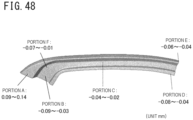
- FIG. 48 illustrates both the deviation amounts (see FIG. 45 ) found in the first actual deviation amount acquisition step S5 and the deviation amounts (see FIG. 47 ) found in the second actual deviation amount acquisition step S9 in such a manner as to correspond to the target shape.
- the following deviation amounts were found in a case where a blank model was provided with the beads 15. That is, the deviation amount in the portion A was from 0.09 to 0.14 mm, the deviation amount in the portion B was -0.09 mm to -0.03 mm, the deviation amount in the portion C was -0.04 mm to -0.02 mm, the deviation amount in the portion D was -0.08 mm to -0.04 mm, the deviation amount in the portion E was -0.06 mm to -0.04 mm, and the deviation amount in the portion F was -0.07 mm to -0.01 mm. Thus, the deviation amounts are markedly reduced in comparison with the deviation amounts before measures are taken as illustrated in FIG. 41 .
- the beads 15 were provided for the measures-required portions on the blank model which measured-required portions were specified in the developed blank model measures-required portion specifying step S23A.
- the influence of the shape variation of the blank was reduced, and the dimensional accuracy of the press-formed article shape was improved.
- the blank bead providing step S23B is a step of providing the bead 15 to a portion of an actual blank which portion corresponds to the measures-required portion specified in the developed blank model measures-required portion specifying step S23A.
- the portion of the actual blank which portion corresponds to the measures-required portion (the portions A, B, D, and E in FIG. 42 ) specified in the developed blank model measures-required portion specifying step S23A is set as a measures-required portion in the actual blank.
- the bead should be provided like the bead 15 formed in the portion B, the portion D, or the portion E in FIG. 42 . That is, the bead should be provided such that its longitudinal direction is along a direction intersecting with an end side of the actual blank which end side is closest to the measures-required portion. Note that, in a case where the bead cannot be set on the end side closest to the measures-required portion for component design reasons or the like, the bead is set in a vicinal area where the bead can be set, e.g., the vicinity of the measures-required portion or the like.
- the bead may be provided as follows. That is, the bead 15 may be provided for the actual blank such that, in the measures-required portion or its vicinal portion in the actual blank, the longitudinal direction of the bead is along a direction where the recesses and the protrusions in the shape variation of the actual blank are consecutive.
- the bead 15 it is preferable that the bead 15 be provided such that its longitudinal direction is along the direction where the recesses and the protrusions in the shape variation of the actual blank are consecutive, in the measures-required portion of the actual blank.
- the bead may be provided such that the longitudinal direction is along the direction where the recesses and the protrusions in the shape variation of the actual blank are consecutive, in the vicinal portion around the measures-required portion of the actual blank, for example.
- the bead may have a protruding shape or a recessed shape.
- the length, width, or height of the bead should be determined appropriately to correspond to an allowable degree from a shape required for a target press-formed article in consideration of an acceptable height or pitch of the corrugations (shape variation) remaining in the press-formed article.
- the shape of the bead can be a circular shape, an oval shape, an elliptical shape, a square shape, a rectangular shape, a triangular shape, a diamond shape, or the like in a top view. Furthermore, a mountain shape, a trapezoidal shape, a semicircular shape, a semielliptical shape, or the like is also applicable in a side view.
- the bead-provided actual blank press forming step S25 is a step of performing press forming on the actual blank provided with the bead 15 in a portion corresponding to the measures-required portion specified in the developed blank model measures-required portion specifying step S23A.
- the bead-provided actual blank press forming step S25 corresponds to a forming step.
- press forming is performed on the actual blank provided with the bead 15 by an actual die of the same type as the predetermined die model in the press forming analysis described above.
- press forming is performed on the actual blank provided with the bead 15 by an actual die of the same type as the die model in the press forming analysis described above.
- the shape of a press-formed article after press forming can be less influenced by the shape variation of the blank as illustrated in an analysis result in FIG. 48 . Accordingly, even in comparison with a press-formed article shape acquired by performing press forming analysis on the flat blank model, its deviation amount is less than ⁇ 0.20 mm, so that it is possible to acquire a press-formed article with an excellent dimensional accuracy.
- the corrugations of the actual blank can be held down, and it is possible to achieve a press-formed article with an excellent dimensional accuracy by performing press forming with the corrugations of the actual blank being held down.
- the bead provided for the actual blank may be crushed in press forming.
- a portion provided with the bead and its peripheral portion receive strain and harden due to the strain, so that the rigidity further improves and the corrugations remaining in the press-formed article can be held down, thereby making it possible to improve dimensional accuracy.
- a plurality of patterns of blank models for a blank having a shape variation is generated, and measures-required portions are specified by finding deviation amounts in each of the patterns. Accordingly, the present embodiment is achieved in consideration of differences in shape variation between individual actual blanks.
- second actual blank model of only one type is generated, but second actual blank models of several types may be generated.
- a plurality of second actual blanks is extracted from different portions of a metal sheet having a shape variation to generate the second actual blank models of the several types.
- the press-formed article shape in the case of a flat blank model is compared with the press-formed article shape in the case of a blank model including recesses and protrusions.
- a difference therebetween in the change amount from the forming bottom dead center in the press forming direction is taken as the deviation amount.
- the present invention is not limited to this.
- a difference acquired by subtracting the height, in the press forming direction, of a portion in the press-formed article shape after die release in the case of the flat blank model from the height of its corresponding portion of the press-formed article shape after die release (after spring back) in the case of the blank model including recesses and protrusions may be taken as the deviation amount.
- the present embodiment deals with stamping as an example, but even when the present embodiment is carried out in drawing, an excellent dimensional accuracy can be achieved similarly to stamping.
- the forming accuracy improving step S23 may further include the bead providing step S13A in the first embodiment.
- at least either of the blank bead providing step S23B and the bead providing step S13A may be performed selectively based on a predetermined condition such as a target accuracy.
- This disclosure can also take the following configurations.
Landscapes
- Engineering & Computer Science (AREA)
- Physics & Mathematics (AREA)
- Mechanical Engineering (AREA)
- Geometry (AREA)
- Theoretical Computer Science (AREA)
- General Physics & Mathematics (AREA)
- Computer Hardware Design (AREA)
- Evolutionary Computation (AREA)
- General Engineering & Computer Science (AREA)
- Mathematical Optimization (AREA)
- Pure & Applied Mathematics (AREA)
- Mathematical Analysis (AREA)
- Computational Mathematics (AREA)
- Shaping Metal By Deep-Drawing, Or The Like (AREA)
Applications Claiming Priority (3)
| Application Number | Priority Date | Filing Date | Title |
|---|---|---|---|
| JP2022130912 | 2022-08-19 | ||
| JP2022198306 | 2022-12-13 | ||
| PCT/JP2023/029453 WO2024038850A1 (ja) | 2022-08-19 | 2023-08-14 | プレス成形品の製造方法 |
Publications (2)
| Publication Number | Publication Date |
|---|---|
| EP4549042A1 true EP4549042A1 (de) | 2025-05-07 |
| EP4549042A4 EP4549042A4 (de) | 2025-10-22 |
Family
ID=89307827
Family Applications (1)
| Application Number | Title | Priority Date | Filing Date |
|---|---|---|---|
| EP23854884.6A Pending EP4549042A4 (de) | 2022-08-19 | 2023-08-14 | Verfahren zur herstellung eines pressgeformten artikels |
Country Status (5)
| Country | Link |
|---|---|
| EP (1) | EP4549042A4 (de) |
| JP (1) | JP7405319B1 (de) |
| KR (1) | KR20250038762A (de) |
| CN (1) | CN119730972A (de) |
| MX (1) | MX2025002011A (de) |
Family Cites Families (11)
| Publication number | Priority date | Publication date | Assignee | Title |
|---|---|---|---|---|
| JPS6247504A (ja) | 1985-08-27 | 1987-03-02 | Nissan Motor Co Ltd | 形状検査装置 |
| JP2005205450A (ja) * | 2004-01-22 | 2005-08-04 | Nissan Motor Co Ltd | 成形型の型面形状修正方法およびそのプログラム |
| JP5380890B2 (ja) | 2008-04-15 | 2014-01-08 | 新日鐵住金株式会社 | 形状凍結性に優れたプレス成形方法およびその装置 |
| JP5389841B2 (ja) | 2011-02-14 | 2014-01-15 | 株式会社豊田中央研究所 | スプリングバック解析方法、スプリングバック解析装置、プログラム、及び記憶媒体 |
| JP6314626B2 (ja) * | 2014-04-21 | 2018-04-25 | 新日鐵住金株式会社 | プレス成形性の評価方法、装置、プログラム及びコンピュータ読み取り可能な記憶媒体 |
| JP2015053075A (ja) | 2014-11-10 | 2015-03-19 | 株式会社東芝 | メモリシステム、情報処理装置および記憶装置 |
| CA2977041A1 (en) * | 2015-03-27 | 2016-10-06 | Nippon Steel & Sumitomo Metal Corporation | Computer implemented blank manufacturing method and press forming method |
| JP6408654B1 (ja) | 2017-06-16 | 2018-10-17 | 株式会社オプトン | 検査装置 |
| JP6519639B1 (ja) * | 2017-12-07 | 2019-05-29 | Jfeスチール株式会社 | スプリングバック量変動要因部位特定方法 |
| US20210260640A1 (en) * | 2018-07-03 | 2021-08-26 | Jfe Steel Corporation | Method for designing mold shape and method for producing pressed part |
| EP3912743B1 (de) * | 2019-01-17 | 2025-01-08 | Nippon Steel Corporation | Verfahren zur herstellung eines pressformkörpers und pressenlinie |
-
2023
- 2023-08-14 KR KR1020257005307A patent/KR20250038762A/ko active Pending
- 2023-08-14 EP EP23854884.6A patent/EP4549042A4/de active Pending
- 2023-08-14 JP JP2023562315A patent/JP7405319B1/ja active Active
- 2023-08-14 CN CN202380060165.5A patent/CN119730972A/zh active Pending
-
2025
- 2025-02-18 MX MX2025002011A patent/MX2025002011A/es unknown
Also Published As
| Publication number | Publication date |
|---|---|
| MX2025002011A (es) | 2025-04-02 |
| EP4549042A4 (de) | 2025-10-22 |
| JP7405319B1 (ja) | 2023-12-26 |
| CN119730972A (zh) | 2025-03-28 |
| JPWO2024038850A1 (de) | 2024-02-22 |
| KR20250038762A (ko) | 2025-03-19 |
Similar Documents
| Publication | Publication Date | Title |
|---|---|---|
| EP3663012B1 (de) | Verfahren zur herstellung eines pressgeformten produkts | |
| KR101466660B1 (ko) | 바인더 트림 구성요소를 구비한 금속 블랭크 및 제조 방법 | |
| EP3760330B1 (de) | Metallplatte zum pressformen, pressformvorrichtung und herstellungsverfahren für pressbauteil | |
| CN111163875A (zh) | 变形极限的评价方法、破裂预测方法及冲压模具的设计方法 | |
| JP6512191B2 (ja) | 金型の設計方法およびプレス成形品の製造方法 | |
| KR20170120156A (ko) | 프레스 성형 방법 및 그 프레스 성형 방법을 사용한 부품의 제조 방법 그리고 그 프레스 성형 방법을 사용하여 제조된 부품 | |
| JP4693475B2 (ja) | プレス成形方法およびそれに用いる金型 | |
| EP3760331A1 (de) | Herstellungsverfahren für gepresste komponenten, pressformvorrichtung und metallplatte zum pressformen | |
| CN102574192B (zh) | 弯曲部件及其制造方法 | |
| EP3909697B1 (de) | Pressformverfahren,verfahren zur herstellung eines pressformteils | |
| US11260443B2 (en) | Method for manufacturing press formed product | |
| KR20180105216A (ko) | 프레스 성형품의 제조 방법 | |
| JP4992048B2 (ja) | 形状凍結性に優れたプレス成形部品のプレス成形方法 | |
| EP4282553A1 (de) | Verfahren zur herstellung eines formartikels, rohling und formartikel mit polygonalem rohrtiefziehen | |
| US10052673B2 (en) | Forming method and die assembly using a bead with a step | |
| EP4549042A1 (de) | Verfahren zur herstellung eines pressgeformten artikels | |
| EP4541477A1 (de) | Verfahren zur herstellung eines pressgeformten artikels | |
| EP3778053A1 (de) | Entwurfsverfahren für einen pressformgegenstand, pressformwerkzeug, pressformgegenstand und herstellungsverfahren für einen pressformgegenstand | |
| JP2004025273A (ja) | プレス成形品の製造装置および製造法 | |
| CN114845822A (zh) | 冲压成形品的制造方法、冲压成形装置及冲压成形生产线 | |
| WO2024019168A1 (ja) | プレス成形品の製造方法 | |
| JP6176430B1 (ja) | プレス成形品の製造方法 | |
| JP2018020351A (ja) | プレス成形品の製造方法 | |
| WO2024038850A1 (ja) | プレス成形品の製造方法 | |
| JP2021186833A (ja) | プレス成形品の剛性評価方法、形状決定方法およびプレス成形品 |
Legal Events
| Date | Code | Title | Description |
|---|---|---|---|
| STAA | Information on the status of an ep patent application or granted ep patent |
Free format text: STATUS: THE INTERNATIONAL PUBLICATION HAS BEEN MADE |
|
| PUAI | Public reference made under article 153(3) epc to a published international application that has entered the european phase |
Free format text: ORIGINAL CODE: 0009012 |
|
| STAA | Information on the status of an ep patent application or granted ep patent |
Free format text: STATUS: REQUEST FOR EXAMINATION WAS MADE |
|
| 17P | Request for examination filed |
Effective date: 20250203 |
|
| AK | Designated contracting states |
Kind code of ref document: A1 Designated state(s): AL AT BE BG CH CY CZ DE DK EE ES FI FR GB GR HR HU IE IS IT LI LT LU LV MC ME MK MT NL NO PL PT RO RS SE SI SK SM TR |
|
| REG | Reference to a national code |
Ref country code: DE Ref legal event code: R079 Free format text: PREVIOUS MAIN CLASS: B21D0022000000 Ipc: B21D0022260000 |
|
| A4 | Supplementary search report drawn up and despatched |
Effective date: 20250919 |
|
| RIC1 | Information provided on ipc code assigned before grant |
Ipc: B21D 22/26 20060101AFI20250915BHEP Ipc: B21D 22/20 20060101ALI20250915BHEP Ipc: G06F 30/20 20200101ALI20250915BHEP Ipc: G06F 30/15 20200101ALI20250915BHEP Ipc: B21D 53/88 20060101ALI20250915BHEP Ipc: G01B 11/24 20060101ALI20250915BHEP Ipc: B21D 22/24 20060101ALI20250915BHEP Ipc: G06F 30/17 20200101ALI20250915BHEP Ipc: G06F 119/14 20200101ALN20250915BHEP Ipc: G06F 119/18 20200101ALN20250915BHEP Ipc: G06F 113/24 20200101ALN20250915BHEP |
|
| DAV | Request for validation of the european patent (deleted) | ||
| DAX | Request for extension of the european patent (deleted) |