EP4549043A1 - Procédé de fabrication de produit formé à la presse - Google Patents
Procédé de fabrication de produit formé à la presse Download PDFInfo
- Publication number
- EP4549043A1 EP4549043A1 EP23859704.1A EP23859704A EP4549043A1 EP 4549043 A1 EP4549043 A1 EP 4549043A1 EP 23859704 A EP23859704 A EP 23859704A EP 4549043 A1 EP4549043 A1 EP 4549043A1
- Authority
- EP
- European Patent Office
- Prior art keywords
- formed part
- wave
- press formed
- amount
- shape
- Prior art date
- Legal status (The legal status is an assumption and is not a legal conclusion. Google has not performed a legal analysis and makes no representation as to the accuracy of the status listed.)
- Pending
Links
Images






Classifications
-
- B—PERFORMING OPERATIONS; TRANSPORTING
- B21—MECHANICAL METAL-WORKING WITHOUT ESSENTIALLY REMOVING MATERIAL; PUNCHING METAL
- B21D—WORKING OR PROCESSING OF SHEET METAL OR METAL TUBES, RODS OR PROFILES WITHOUT ESSENTIALLY REMOVING MATERIAL; PUNCHING METAL
- B21D24/00—Special deep-drawing arrangements in, or in connection with, presses
- B21D24/005—Multi-stage presses
-
- G—PHYSICS
- G06—COMPUTING OR CALCULATING; COUNTING
- G06F—ELECTRIC DIGITAL DATA PROCESSING
- G06F30/00—Computer-aided design [CAD]
- G06F30/20—Design optimisation, verification or simulation
-
- B—PERFORMING OPERATIONS; TRANSPORTING
- B21—MECHANICAL METAL-WORKING WITHOUT ESSENTIALLY REMOVING MATERIAL; PUNCHING METAL
- B21D—WORKING OR PROCESSING OF SHEET METAL OR METAL TUBES, RODS OR PROFILES WITHOUT ESSENTIALLY REMOVING MATERIAL; PUNCHING METAL
- B21D22/00—Shaping without cutting, by stamping, spinning, or deep-drawing
- B21D22/20—Deep-drawing
-
- B—PERFORMING OPERATIONS; TRANSPORTING
- B21—MECHANICAL METAL-WORKING WITHOUT ESSENTIALLY REMOVING MATERIAL; PUNCHING METAL
- B21D—WORKING OR PROCESSING OF SHEET METAL OR METAL TUBES, RODS OR PROFILES WITHOUT ESSENTIALLY REMOVING MATERIAL; PUNCHING METAL
- B21D22/00—Shaping without cutting, by stamping, spinning, or deep-drawing
- B21D22/20—Deep-drawing
- B21D22/24—Deep-drawing involving two drawing operations having effects in opposite directions with respect to the blank
-
- B—PERFORMING OPERATIONS; TRANSPORTING
- B21—MECHANICAL METAL-WORKING WITHOUT ESSENTIALLY REMOVING MATERIAL; PUNCHING METAL
- B21D—WORKING OR PROCESSING OF SHEET METAL OR METAL TUBES, RODS OR PROFILES WITHOUT ESSENTIALLY REMOVING MATERIAL; PUNCHING METAL
- B21D22/00—Shaping without cutting, by stamping, spinning, or deep-drawing
- B21D22/20—Deep-drawing
- B21D22/26—Deep-drawing for making peculiarly, e.g. irregularly, shaped articles
-
- G—PHYSICS
- G06—COMPUTING OR CALCULATING; COUNTING
- G06F—ELECTRIC DIGITAL DATA PROCESSING
- G06F30/00—Computer-aided design [CAD]
- G06F30/10—Geometric CAD
- G06F30/17—Mechanical parametric or variational design
-
- B—PERFORMING OPERATIONS; TRANSPORTING
- B21—MECHANICAL METAL-WORKING WITHOUT ESSENTIALLY REMOVING MATERIAL; PUNCHING METAL
- B21D—WORKING OR PROCESSING OF SHEET METAL OR METAL TUBES, RODS OR PROFILES WITHOUT ESSENTIALLY REMOVING MATERIAL; PUNCHING METAL
- B21D53/00—Making other particular articles
- B21D53/88—Making other particular articles other parts for vehicles, e.g. cowlings, mudguards
-
- G—PHYSICS
- G06—COMPUTING OR CALCULATING; COUNTING
- G06F—ELECTRIC DIGITAL DATA PROCESSING
- G06F2113/00—Details relating to the application field
- G06F2113/22—Moulding
-
- G—PHYSICS
- G06—COMPUTING OR CALCULATING; COUNTING
- G06F—ELECTRIC DIGITAL DATA PROCESSING
- G06F2113/00—Details relating to the application field
- G06F2113/24—Sheet material
-
- G—PHYSICS
- G06—COMPUTING OR CALCULATING; COUNTING
- G06F—ELECTRIC DIGITAL DATA PROCESSING
- G06F2119/00—Details relating to the type or aim of the analysis or the optimisation
- G06F2119/14—Force analysis or force optimisation, e.g. static or dynamic forces
Definitions
- the present invention relates to a press formed part manufacturing method for reducing an influence of shape variation of a blank in a press formed part obtained by press forming the blank collected from a metal sheet having shape variation.
- an actual metal sheet from which a blank for obtaining a press formed part is collected is not completely flat, but has a wavy shape (shape variation). Therefore, the actual blank collected from the metal sheet is not necessarily flat as well and may have shape variations.
- a press formed part obtained after press forming may deviate from a target dimensional accuracy due to the influence of the shape variation.
- Patent Literature 1 and Patent Literature 2 disclose techniques for selecting and removing a press formed part deviating from a target dimensional accuracy for the press formed part after press forming.
- Patent Literatures 3 and 4 disclose means for providing unevenness to the surface of a tool of press forming.
- Patent Literature 1 and Patent Literature 2 compare shapes of press formed parts after press forming to identify a portion having poor dimensional accuracy. In the techniques disclosed in Patent Literature 1 and Patent Literature 2, it is not identified which portion of the press formed part is susceptible to the influence of the shape variation of the blank due to the shape variation of the blank before the press forming, and it is difficult to take measures.
- the blank used for press forming is collected by punching or shearing a metal sheet such as a steel sheet. Therefore, when a plurality of blanks is collected from a metal sheet having a shape variation, the collection positions are different, so that even in the case of blanks collected from the same metal sheet, the individual blanks have different portions exhibiting unevenness. Therefore, in order to reduce the influence of the shape variation of the blank, it is necessary to take measures in consideration of the difference in the shape variation of each blank.
- the present invention has been made in view of the above problems, and an object of the present invention is to provide a press formed part manufacturing method that reduces the influence of the shape variation of a blank in a press formed part obtained by press forming a blank collected from a metal sheet having a shape variation.
- a press formed part manufacturing method is the method for reducing an influence of a shape variation of a blank in a press formed part obtained by press forming the blank collected from a metal sheet having a shape variation.
- the method includes: a reference press formed part shape acquisition step of performing press forming analysis when press forming is performed with a predetermined tool model using a flat blank model having a flat shape, and acquiring a press formed part shape after tool release as a reference press formed part shape; a wave-shaped blank press formed part shape acquisition step of generating a wave-shaped blank model having a wave shape with a predetermined wavelength and a predetermined amplitude corresponding to the shape variation, performing press forming analysis when press forming is performed with the predetermined tool model using the generated wave-shaped blank model, and acquiring a press formed part shape after tool release as a wave-shaped blank press formed part shape; a first amount of deviation acquisition step of comparing the reference press formed part shape with the wave-shaped blank press formed part shape to obtain a portion where both shapes are deviated from each other and an amount of deviation; a periodically deviated wave-shaped blank press formed part shape acquisition step of generating one type or a plurality of types of periodically deviated wave-shaped blank models each having a wave
- the protrusion pattern may include a plurality of protrusions formed at predetermined intervals on a flat face or a curved face, a length A of each of a vertical length and a horizontal length of each of the protrusions may be set to 3 mm or more and 50 mm or less, and a distance between adjacent protrusions may be set to 1.2A or more and 2.0A or less
- the protrusion pattern providing step may include providing the upper tool and the lower tool with the protrusion pattern so that a protrusion of the upper tool faces a flat face or a curved face of the lower tool and a protrusion of the lower tool faces a flat face or a curved face of the upper tool
- the actual press forming step may include performing press forming so that a distance between a lower face of the protrusion of the upper tool and an upper face of the protrusion of the lower tool at a bottom dead center when the blank having a sheet thickness t (mm
- the press formed part manufacturing method it is possible to reduce the influence of the shape variation of the blank by identifying a portion, of the blank, where influence of the shape variation of the press formed part is large and taking measures for the portion in consideration of the difference in the shape variation of the individual blank.
- a press formed part with good dimensional accuracy can be produced, and a press formed part with good dimensional accuracy can be produced with good yield even when a blank collected from a metal sheet having a shape variation is used.
- the press formed part manufacturing method according to the embodiment is a method of reducing the influence of the shape variation of the blank in the press formed part when the blank collected from the metal sheet having the shape variation (unevenness) is press formed such as crash forming or deep drawing.
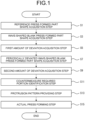
- the press formed part manufacturing method according to the embodiment includes a press formed part reference press formed part shape acquisition step S1 to an actual press forming step S15.
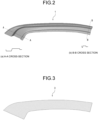
- each configuration will be described in detail below by exemplifying a case where a press formed part 1 illustrated in FIG. 2 is press formed as a target shape.
- a blank made of a 1.5 GPa-class steel sheet having a sheet thickness of 1.2 mm and a blank model corresponding thereto are used, but the present invention is not limited thereto.
- the reference press formed part shape acquisition step S1 is a step of performing press forming analysis with a predetermined tool model using a flat blank model 3 as illustrated in FIG. 3 and acquiring a press formed part shape after tool release as a reference press formed part shape.
- the "press forming analysis” in the present description includes an analysis for acquiring the bottom dead center shape and an analysis for acquiring the shape after tool release, that is, after spring back.
- the flat blank model 3 is a blank model generally used in press forming analysis, and has a flat shape without unevenness.
- press forming analysis such as a finite element method (FEM) is usually performed.
- FEM finite element method
- FIG. 4 is a view illustrating a reference press formed part shape 5 after tool release by press forming analysis.
- the amount of change from the bottom dead center is indicated by numerical values and color shading.
- the amount of change is a value obtained by subtracting the height of the corresponding portion of the bottom dead center shape from the height of each portion of the press formed part shape after tool release and springback after press forming in the press forming direction, and corresponds to the spring back amount in the press forming direction.
- the height difference (amount of change) is + (plus)
- the shape is convex relative to the bottom dead center shape
- the height difference (amount of change) is - (minus)
- the shape is concave relative to the bottom dead center shape.
- the color of a portion that is concave relative to the bottom dead center shape is lighter, and the color of a portion that is convex is darker.
- + is the amount of change to the convex direction (in front of the paper surface)
- - is the amount of change to the concave direction (behind the paper surface)
- the unit is mm.
- the amount of change in the left end portion (portion A) of the reference press formed part shape 5 was 1.06 mm.
- the left end (portion B) of the top portion of the reference press formed part shape 5 was 0.63 mm.
- the center portion (portion C) of the reference press formed part shape 5 in the longitudinal direction was 6.02 mm.
- the right end (portion D) of the lower flange portion of the reference press formed part shape 5 was 1.10 mm.
- the right end portion (portion E) of the reference press formed part shape 5 was -2.61 mm.
- the wave-shaped blank press formed part shape acquisition step S3 is a step of performing the same press forming analysis as in the reference press formed part shape acquisition step S1 using the blank model corresponding to the shape variation of the metal sheet to acquire the press formed part shape after tool release.
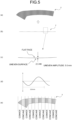
- FIG. 5(a) is a diagram illustrating an example of the wave-shaped blank model 7, and a specific shape thereof will be described below.
- the wave-shaped blank model 7 illustrated in FIG. 5(a) is a blank model having a waveform shape having a predetermined wavelength and a predetermined amplitude.
- the shading in FIG. 5(a) represents unevenness, and a dark color portion has a shape protruding in front of the paper surface, and a light color portion has a shape recessed behind the paper surface.
- FIG. 5(b) is a state in which FIG. 5(a) is viewed from a direction of an arrow outline with a blank inside, and FIG. 5(c) is a partially enlarged view thereof.
- a sheet thickness is 1.2 mm
- an amplitude of a waveform is 5.0 mm ( ⁇ 2.5 mm)
- a wavelength see FIG.
- FIG. 5(d) is 320 mm.
- the start position and the end position of the wave shape set in the blank are not necessarily the end of the metal sheet.
- FIG. 5(e) is a diagram illustrating the wavy unevenness of FIG. 5(a) in an emphasized manner.
- the wave-shaped blank model 7 may be generated based on a measurement result obtained by measuring a shape of an actual blank collected from a predetermined position of a metal sheet having a shape variation.
- the wave-shaped blank model 7 may be generated by measuring the shape of the actual blank with a three-dimensional shape measuring instrument using a laser telemeter and using a representative wavelength and amplitude in the measurement result.
- FIG. 6 is a diagram illustrating the wave-shaped blank press formed part shape 9 obtained by performing press forming analysis.
- the colors and numerical values illustrated in FIG. 6 are similar to those in FIG. 4 .
- the amount of change in the left end portion (portion A) of the wave-shaped blank press formed part shape 9 was 1.37 mm.
- the left end (portion B) of the top portion of the wave-shaped blank press formed part shape 9 was 0.72 mm.
- the center portion (portion C) of the wave-shaped blank press formed part shape 9 in the longitudinal direction was 6.02 mm.
- the right end (portion D) of the lower flange portion of the wave-shaped blank press formed part shape 9 was 0.96 mm.
- the right end portion (portion E) of the wave-shaped blank press formed part shape 9 was -2.11 mm.
- the first amount of deviation acquisition step S5 is a step of comparing the reference press formed part shape 5 ( FIG. 4 ) with the wave-shaped blank press formed part shape 9 ( FIG. 6 ) to obtain a portion where both shapes are deviated from each other and an amount of deviation (first amount of deviation).
- the press formed part shape at the bottom dead center is used as the reference shape, the amount of change (spring back amount) in each portion of the press formed part shape after tool release from the reference shape is obtained, and the difference between the amounts of change in the two press formed part shapes was obtained as the amount of deviation. That is, the first amount of deviation obtained in the first amount of deviation acquisition step S5 is a value obtained by subtracting the amount of change in the reference press formed part shape 5 using the flat blank model ( FIG. 4 ) from the amount of change in the wave-shaped blank press formed part shape 9 using the blank model having shape variation ( FIG. 6 ).
- the portion of the wave-shaped blank press formed part shape 9 has a convex shape as compared with the reference press formed part shape 5.
- the portion of the wave-shaped blank press formed part shape 9 has a recessed shape as compared with the reference press formed part shape 5.
- FIG. 7 is a diagram illustrating the first amount of deviation obtained as described above.
- the first amount of deviation between the wave-shaped blank press formed part shape 9 and the reference press formed part shape 5 was 0.31 mm at the left end portion (portion A).
- the first amount of deviation was 0.09 mm at the left end (portion B) of the top portion.
- the first amount of deviation was 0.00 mm at the center portion in the longitudinal direction (portion C).
- the first amount of deviation was -0.14 mm at the right end (portion D) of the lower flange portion.
- the first amount of deviation was 0.50 mm at the right end portion (portion E).
- the periodically deviated wave-shaped blank press formed part shape acquisition step S7 is a step of performing the same press forming analysis as in the reference press formed part shape acquisition step S1 using a wave-shaped blank model having a shape different from that of the wave-shaped blank model 7 to acquire the press formed part shape after tool release.
- a periodically deviated wave-shaped blank model 11 having a wave shape whose amplitude and wavelength are the same as those of the wave shape of the wave-shaped blank model 7 and whose period is deviated from a period of the wave-shaped blank model 7 is generated.
- FIG. 8 is a diagram illustrating an example of the periodically deviated wave-shaped blank model 11, and a specific shape thereof will be described below.
- FIG. 8(a) is a blank model having a periodic waveform shape having a predetermined wavelength and a predetermined amplitude
- the shading in FIG. 8(a) represents the waveform shape.
- FIG. 8(b) is a state in which FIG. 8(a) is viewed from a direction of an arrow outline with a blank inside
- FIG. 8 (c) is a partially enlarged view thereof.
- the sheet thickness is 1.2 mm
- the wave-shaped amplitude and wavelength are the same as those of the wave-shaped blank model 7 in FIG. 5 , but the period of the wave-shaped is shifted rightward on the paper surface by 1/4 wavelength from that of the wave-shaped blank model 7 (see FIGS. 8(d) and 8(e) ).
- FIG. 9 is a diagram illustrating the periodically deviated wave-shaped blank press formed part shape 13.
- the colors and numerical values illustrated in FIG. 9 are similar to those in FIGS. 4 and 6 .
- the amount of change in the left end portion (portion A) of the periodically deviated wave-shaped blank press formed part shape 13 was 1.64 mm.
- the amount of change in the left end (portion B) of the top portion of the periodically deviated wave-shaped blank press formed part shape 13 was 0.83 mm.
- the amount of change at the center portion (portion C) of the periodically deviated wave-shaped blank press formed part shape 13 in the longitudinal direction was 6.13 mm.
- the amount of change in the right end (portion D) of the lower flange portion of the periodically deviated wave-shaped blank press formed part shape 13 was 1.41 mm.
- the amount of change in the right end portion (portion E) of the periodically deviated wave-shaped blank press formed part shape 13 was -2.96 mm.
- the second amount of deviation acquisition step S9 is a step of comparing the reference press formed part shape 5 with the periodically deviated wave-shaped blank press formed part shape 13 and obtaining a portion where both shapes are deviated and an amount of deviation (second amount of deviation). Since the method of obtaining the second amount of deviation is similar to the method described in the first amount of deviation acquisition step S5, the description thereof will be omitted.
- FIG. 10 is a diagram illustrating a second amount of deviation when the reference press formed part shape 5 ( FIG. 4 ) is compared with the periodically deviated wave-shaped blank press formed part shape 13 ( FIG. 9 ).
- the second amount of deviation between the periodically deviated wave-shaped blank press formed part shape 13 and the reference press formed part shape 5 was 0.58 mm at the left end portion (portion A).
- the second amount of deviation was 0.20 mm at the left end (portion B) of the top portion.
- the second amount of deviation was 0.11 mm at the center portion (portion C) in the longitudinal direction.
- the second amount of deviation was 0.31 mm at the right end (portion D) of the lower flange portion.
- the second amount of deviation was -0.35 mm at the right end portion (portion E).
- the countermeasure required portion identification step S11 is a step of identifying, as the countermeasure required portions, portions of the press formed part 1 corresponding to a portion where the first amount of deviation exceeding the threshold value has occurred in the first amount of deviation acquisition step S5 and a portion where the second amount of deviation exceeding the threshold value has occurred in the second amount of deviation acquisition step S9.
- FIG. 11 is a diagram illustrating both the first amount of deviation (see FIG. 7 ) obtained in the first amount of deviation acquisition step S5 and the second amount of deviation (see FIG. 10 ) obtained in the second amount of deviation acquisition step S9 in correspondence with the target shape of the press formed part 1.
- the amount of deviation was 0.31 mm to 0.58 mm at the portion A.
- the amount of deviation was 0.09 mm to 0.20 mm at the portion B.
- the amount of deviation was 0.00 mm to 0.11 mm at the portion C.
- the amount of deviation was -0.14 mm to 0.31 mm at the portion D.
- the amount of deviation was -0.35 mm to 0.50 mm at the portion E.
- the portions where the amount of deviation exceeding the threshold value has occurred are the portion A, the portion B, the portion D, and the portion E. Therefore, in the countermeasure required portion identification step S11, these portions are identified as the countermeasure required portions.
- a protrusion pattern is provided to a portion, of an actual tool for forming a press formed part, where the above countermeasure required portion is formed, and press forming is performed using the actual tool.
- the protrusion pattern is provided to each of the portions of the upper tool and the lower tool constituting the actual tool.
- FIG. 12 is a diagram illustrating an example of a protrusion pattern provided to an actual tool. The protrusion pattern shape will be described.
- FIG. 12(a) is a side view of a protrusion pattern 23 of an upper tool 21 and a protrusion pattern 27 of a lower tool 25 at the bottom dead center.
- FIG. 12(b) is a diagram taken along line C-C of FIG. 12(a) .
- the position of the protrusion pattern 27 of the facing lower tool 25 is indicated by broken lines.
- the protrusion patterns 23 and 27 of the present embodiment include a plurality of protrusions 23a and 27a (protrusion group) formed at predetermined intervals on a flat face or a curved face on the surface of the upper tool 21 or the lower tool 25.
- each of the distal end faces of the protrusions 23a and 27a is a square having a side length of A (mm).
- Such protrusions 23a and 27a are disposed vertically and horizontally with a predetermined distance B (mm) to form regular protrusion patterns 23 and 27.
- the size (vertical length and horizontal length) A of each of the distal end faces of the protrusions 23a and 27a is preferably 3 mm or more and 50 mm or less.
- the shape variation (waveform) of the blank may remain in the press formed part after press forming, and the effect is reduced.
- the size A of each of the distal end faces of the protrusions 23a and 27a exceeds 50 mm
- the size of the protrusion is larger than the portions such as the top portion and the flange portion of the tool, and the blank is pressed by a wide distal end face of the protrusion, so that the forming is similar to a forming without the protrusion and there is no effect.
- the distance B between the adjacent protrusions is preferably 1.2A or more and 2.0A or less with respect to the size A of each of the distal end faces of the protrusions 23a and 27a.
- the distance B (mm) between adjacent protrusions is less than 1.2A or more than 2.0A, the shape variation (wavy shape) of the blank may remain in the press formed part after press forming, which is not preferable.
- the number and arrangement of the protrusions 23a and 27a and the shape of the distal end face illustrated in FIG. 12 are examples, and do not limit the aspect of the protrusion pattern of the present invention.
- the shape of the distal end face of the protrusion may be a rectangle or a circle.
- the protrusion pattern 23 provided to the upper tool 21 and the protrusion pattern 27 provided to the lower tool 25 may be configured so that the protrusions do not face each other. That is, when the protrusion patterns 23 and 27 are provided, the protrusion patterns 23 and 27 may be provided to the upper tool 21 and the lower tool 25 so that the protrusion 23a of the upper tool 21 faces a flat face 25a (or curved face) of the lower tool 25 and the protrusion 27a of the lower tool 25 faces a flat face 21a (or curved face) of the upper tool 21.
- the distance d between the lower face of the protrusion 23a of the upper tool 21 and the upper face of the protrusion 27a of the lower tool 25 at the bottom dead center is preferably 0.1 t or more and 0.5 t or less.
- the distance d is less than 0.1 t, the amount of strain is too large, and the shape of each of the distal end faces of the protrusions 23a and 27a are clearly transferred to the surface of the press formed part after press forming, which is not preferable.
- the distance d exceeds 0.5 t, the amount of strain is insufficient and the effect of alleviating the shape variation of the blank is reduced, which is not preferable.
- the protrusion pattern 23 of the upper tool 21 and the protrusion pattern 27 of the lower tool 25 were provided so that the protrusions did not face each other.
- the positions of the protrusion 23a of the upper tool 21 and the protrusion 27a of the lower tool 25 were set so as to be shifted from each other in the lateral direction on the paper surface and the longitudinal direction on the paper surface.
- the positional relationship between the protrusion of the upper tool and the protrusion of the lower tool is not limited to this, and may be shifted only in the lateral direction on the paper surface or only in the longitudinal direction on the paper surface.
- the distance d between the lower face of the protrusion 23a of the upper tool 21 and the upper face of the protrusion 27a of the lower tool 25 at the bottom dead center was 0.36 mm.
- the above protrusion patterns 23 and 27 are provided to the portion corresponding to the countermeasure required portion in the predetermined tool model used for the press forming analysis described above.
- similar analysis as in the reference press formed part shape acquisition step S1 to the second amount of deviation acquisition step S9 was performed using the tool model (hereinafter, referred to as a "protrusion pattern providing tool model"). Note that the amount of change and the amount of deviation in the following description are obtained by a method similar to that illustrated in FIGS. 4 to 11 .
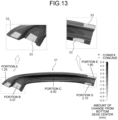
- FIG. 13 is a diagram illustrating a reference press formed part shape 31 obtained by performing press forming analysis on the flat blank model 3 (see FIG. 3 ) using the protrusion pattern providing tool model.
- a region (strain provided region 33) to which strain is provided by the protrusion patterns 23 and 27 of the protrusion pattern providing tool model is shaded (the same applies to FIGS. 14 to 18 ).
- the amount of change of the portion A of the reference press formed part shape 31 was 1.29 mm when performing press forming analysis using the protrusion pattern providing tool model.
- the amount of change of the portion B of the reference press formed part shape 31 was 0.07 mm.
- the amount of change of the portion C of the reference press formed part shape 31 was 6.50 mm.
- the amount of change of the portion D of the reference press formed part shape 31 was 2.10 mm.
- the amount of change of the portion E of the reference press formed part shape 31 was 1.80 mm.
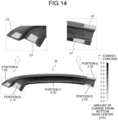
- FIG. 14 is a diagram illustrating a wave-shaped blank press formed part shape 35 obtained by performing press forming analysis on the wave-shaped blank model 7 (see FIG. 5 ) using the protrusion pattern providing tool model.
- the amount of change of the portion A of the wave-shaped blank press formed part shape 35 was 1.45 mm.
- the amount of change of the portion B of the wave-shaped blank press formed part shape 35 was 0.12 mm.
- the amount of change of the portion C of the wave-shaped blank press formed part shape 35 was 6.50 mm.
- the amount of change of the portion D of the wave-shaped blank press formed part shape 35 was 2.03 mm.
- the amount of change of the portion E of the wave-shaped blank press formed part shape 35 was 2.05 mm.
- FIG. 15 is a diagram illustrating a first amount of deviation obtained by comparing the reference press formed part shape 31 ( FIG. 13 ) with the wave-shaped blank press formed part shape 35 ( FIG. 14 ).
- the first amount of deviation between the reference press formed part shape 31 and the wave-shaped blank press formed part shape 35 when performing press forming analysis using the protrusion pattern providing tool model was 0.16 mm at the portion A.
- the first amount of deviation was 0.05 mm at the portion B.
- the first amount of deviation was 0.00 mm at the portion C.
- the first amount of deviation was -0.07 mm at the portion D.
- the first amount of deviation was 0.25 mm at the portion E.
- FIG. 16 is a diagram illustrating a periodically deviated wave-shaped blank press formed part shape 37 obtained by performing press forming analysis on the periodically deviated wave-shaped blank model 11 (see FIG. 8 ) using the protrusion pattern providing tool model.
- the amount of change of the portion A of the periodically deviated wave-shaped blank press formed part shape 37 was 1.58 mm.
- the amount of change of the portion B of the periodically deviated wave-shaped blank press formed part shape 37 was 0.17 mm.
- the amount of change of the portion C of the periodically deviated wave-shaped blank press formed part shape 37 was 6.60 mm.
- the amount of change of the portion D of the periodically deviated wave-shaped blank press formed part shape 37 was 2.26 mm.
- the amount of change of the portion E of the periodically deviated wave-shaped blank press formed part shape 37 was 1.63 mm.
- FIG. 17 is a diagram illustrating a second amount of deviation obtained by comparing the reference press formed part shape 31 ( FIG. 13 ) with the periodically deviated wave-shaped blank press formed part shape 37 ( FIG. 16 ).
- the second amount of deviation between the reference press formed part shape 31 and the periodically deviated wave-shaped blank press formed part shape 37 was 0.29 mm at the portion A.
- the second amount of deviation was 0.10 mm at the portion B.
- the second amount of deviation was 0.10 mm at the portion C.
- the second amount of deviation was 0.16 mm at the portion D.
- the second amount of deviation was -0.17 mm at the portion E.
- FIG. 18 is a diagram illustrating both the first amount of deviation in FIG. 15 and the second amount of deviation in FIG. 17 in association with the target shape.
- the first amount of deviation and the second amount of deviation were 0.16 mm to 0.29 mm at the portion A.
- the first amount of deviation and the second amount of deviation were 0.05 mm to 0.10 mm at the portion B.
- the first amount of deviation and the second amount of deviation were 0.00 mm to 0.10 mm at the portion C.
- the first amount of deviation and the second amount of deviation were -0.07 mm to 0.16 mm at the portion D.
- the first amount of deviation and the second amount of deviation were -0.17 mm to 0.25 mm at the portion E.
- the amount of deviation in FIG. 18 is smaller than the amount of deviation before the countermeasure illustrated in FIG. 11 . Therefore, it was confirmed that there was an effect of reducing the influence of the shape variation of the blank by using the protrusion pattern providing tool model.
- the protrusion pattern providing step S13 is a step of providing the protrusion patterns 23 and 27 described in FIG. 12 to the actual tool.
- the protrusion patterns 23 and 27 may be provided by performing laser processing, etching processing, or the like on the surface of the actual tool.
- the protrusion patterns 23 and 27 are provided to a portion, of the upper tool 21 and the lower tool 25 of the actual tool, for forming a countermeasure required portion, or the countermeasure required portion and its periphery. At this time, as described with reference to FIG.
- the protrusion 23a of the upper tool 21 faces the flat face 25a or the curved face of the lower tool 25, and the protrusion 27a of the lower tool 25 faces the flat face 21a or the curved face of the upper tool 21.
- the protrusion patterns 23 and 27 similar to that of the protrusion pattern providing tool model used for the press forming analysis described in FIGS. 13 to 18 were provided to the actual tool.
- the actual press forming step S15 is a step of press forming the actual blank using the upper tool 21 and the lower tool 25 provided with the protrusion patterns 23 and 27 in the protrusion pattern providing step S13.
- the present embodiment since it is possible to identify a portion where influence of the shape variation of the blank is large and take an appropriate measure, it is possible to stably obtain a press formed part with favorable dimensional accuracy. Note that, in the present embodiment, since a plurality of patterns of blank models assuming blanks having shape variations is generated, and the amount of deviation in each case is obtained to identify the countermeasure required portion, a difference in shape variation occurring between individual actual blanks is taken into consideration.
- the waveforms of the periodically deviated wave-shaped blank models have periods deviated from each other (the wavelength and the amplitude are common in the wave-shaped blank model and all the periodically deviated wave-shaped blank models).
- the difference in the amount of change (spring back amount) from the bottom dead center in the press forming direction is defined as the amount of deviation but the present invention is not limited thereto.
- a difference obtained by subtracting, from the height of each portion after tool release (after spring back) in one press formed part shape in the press forming direction, the height of each portion after tool release (after spring back) in the other press formed part shape may be used as the amount of deviation.
- the amount of deviation can be accurately and easily obtained, which is preferable.
- crash forming is described as an example, but deep drawing may be used.
- a recess/protrusion pattern may be formed on the press formed part after press forming by using the upper tool and the lower tool provided with the protrusion pattern.
- a re-strike process of re-pressing the press formed part on which the recess/protrusion pattern is formed to crush the recess/protrusion pattern may be further included.
- the press formed part manufacturing method described in FIG. 1 was performed.
- the press formed part 1 of FIG. 2 was set to a target shape.
- the forming of the CAE analysis in the present example was crash forming as in the embodiment. The amount of change and the amount of deviation in the present example were obtained in the same manner as in the embodiment.
- the reference press formed part shape acquisition step S1 was performed using the flat blank model 3 (see FIG. 3 ).
- the amount of change in the reference press formed part shape 5 when performing press forming analysis on the flat blank model 3 with a predetermined tool model is as follows. That is, as described with reference to FIG. 4 , the amount of change was 1.06 mm at the portion A, 0.63 mm at the portion B, 6.02 mm at the portion C, 1.10 mm at the portion D, and - 2.61 mm at the portion E.
- the wave-shaped blank press formed part shape acquisition step S3 was performed using the wave-shaped blank model 7 (see FIG. 5 ).
- the amount of change in the wave-shaped blank press formed part shape 9 when performing press forming analysis on the wave-shaped blank model 7 using a predetermined tool model is as follows. That is, as described in FIG. 6 , the amount of change was 1.37 mm at the portion A, 0.72 mm at the portion B, 6.02 mm at the portion C, 0.96 mm at the portion D, and -2.11 mm at the portion E.
- the reference press formed part shape 5 ( FIG. 4 ) and the wave-shaped blank press formed part shape 9 ( FIG. 6 ) were compared to obtain the amount of deviation (first amount of deviation) between both shapes.
- the first amount of deviation was 0.31 mm at the portion A, 0.09 mm at the portion B, 0.00 mm at the portion C, - 0.14 mm at the portion D, and 0.50 mm at the portion E.
- a wave-shaped blank model having a shape different from that of the wave-shaped blank model 7 was generated.
- press forming analysis was performed using a predetermined tool model similar to the above, and the press formed part shape after tool release was obtained.
- the wave-shaped blank model having a shape different from that of the wave-shaped blank model 7 the periodically deviated wave-shaped blank model 11 described in FIG. 8 was used in the embodiment, but a periodically deviated wave-shaped blank model 41 illustrated in FIG. 19 was used in the present example. A specific shape of the periodically deviated wave-shaped blank model 41 will be described below.
- FIG. 19 is a blank model having a periodic waveform shape having a predetermined wavelength and a predetermined amplitude, and the shading in FIG. 19(a) represents unevenness.
- FIG. 19(b) is a state in which FIG. 19(a) is viewed from a direction of an arrow outline with a blank inside, and FIG. 19(c) is a partially enlarged view thereof.
- the sheet thickness is 1.2 mm, and the amplitude and wavelength of the unevenness are the same as those of the wave-shaped blank model 7 in FIG. 5 , but the wave-shaped period is shifted rightward on the paper surface by 1/2 wavelength from that of the wave-shaped blank model 7 (see FIGS. 19(d) and 19 (e) ).
- FIG. 20 is a diagram illustrating a periodically deviated wave-shaped blank press formed part shape 43 when performing press forming analysis on the periodically deviated wave-shaped blank model 41 in FIG. 19 using a predetermined tool model.
- the amount of change of the portion A of the periodically deviated wave-shaped blank press formed part shape 43 when performing press forming analysis using a predetermined tool model was 0.85 mm.
- the amount of change of the portion B of the periodically deviated wave-shaped blank press formed part shape 43 was 0.88 mm.
- the amount of change of the portion C of the periodically deviated wave-shaped blank press formed part shape 43 was 5.95 mm.
- the amount of change of the portion D of the periodically deviated wave-shaped blank press formed part shape 43 was 0.86 mm.
- the amount of change of the portion E of the periodically deviated wave-shaped blank press formed part shape 43 was -2.64 mm.
- the reference press formed part shape 5 ( FIG. 4 ) and the periodically deviated wave-shaped blank press formed part shape 43 ( FIG. 20 ) were compared to obtain the amount of deviation (second amount of deviation).
- the second amount of deviation between the periodically deviated wave-shaped blank press formed part shape 43 and the reference press formed part shape 5 was -0.21 mm at the portion A, 0.25 mm at the portion B, -0.07 mm at the portion C, -0.24 mm at the portion D, and -0.03 mm at the portion E.
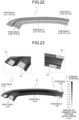
- FIG. 22 is a diagram illustrating both the first amount of deviation ( FIG. 7 ) obtained in the first amount of deviation acquisition step S5 and the second amount of deviation ( FIG. 21 ) obtained in the second amount of deviation acquisition step S9 in association with the press formed part 1 (target shape).
- the amount of deviation before the countermeasure was -0.21 mm to 0.31 mm at the portion A, 0.09 mm to 0.25 mm at the portion B, -0.07 mm to 0.00 mm at the portion C, -0.24 mm to -0.14 mm at the portion D, and -0.03 mm to 0.50 mm at the portion E.
- the portions where the amount of deviation exceeding the threshold value has occurred are the portion A, the portion B, the portion D, and the portion E. Therefore, these portions were identified as countermeasure required portions.
- the protrusion patterns 23 and 27 described in FIG. 12 were provided on the surface of the actual tool corresponding to the above countermeasure required portion.
- the effect has been confirmed by press forming analysis, and will be described below.
- the protrusion pattern 23 of the upper tool 21 and the protrusion pattern 27 of the lower tool 25 were provided so that the protrusions 23a and 27a did not face each other.
- the positions of the protrusion 23a of the upper tool 21 and the protrusion 27a of the lower tool 25 were set so as to be shifted from each other in the lateral direction on the paper surface and the longitudinal direction on the paper surface.
- the above protrusion patterns 23 and 27 were provided to the portion corresponding to the countermeasure required portion in the predetermined tool model, and the similar analysis as in the reference press formed part shape acquisition step S1 to the second amount of deviation acquisition step S9 was performed using the tool model (protrusion pattern providing tool model).
- the amount of change in the reference press formed part shape 31 when performing press forming analysis on the flat blank model 3 (see FIG. 3 ) using the protrusion pattern providing tool model was 1.29 mm at the portion A as described with reference to FIG. 13 .
- the amount of change in the reference press formed part shape 31 was 0.07 mm at the portion B.
- the amount of change in the reference press formed part shape 31 was 6.50 mm at the portion C.
- the amount of change in the reference press formed part shape 31 was 2.10 mm at the portion D.
- the amount of change in the reference press formed part shape 31 was 1.80 mm at the portion E.
- the amount of change in the wave-shaped blank press formed part shape 35 when performing press forming analysis on the wave-shaped blank model 7 (see FIG. 5 ) using the protrusion pattern providing tool model was 1.45 mm at the portion A as described with reference to FIG. 14 .
- the amount of change in the wave-shaped blank press formed part shape 35 was 0.12 mm at the portion B.
- the amount of change in the wave-shaped blank press formed part shape 35 was 6.50 mm at the portion C.
- the amount of change in the wave-shaped blank press formed part shape 35 was 2.03 mm at the portion D.
- the amount of change in the wave-shaped blank press formed part shape 35 was 2.05 mm at the portion E.
- the first amount of deviation obtained by comparing the reference press formed part shape 31 ( FIG. 13 ) and the wave-shaped blank press formed part shape 35 ( FIG. 14 ) was 0.16 mm at the portion A as described with reference to FIG. 15 .
- the first amount of deviation was 0.05 mm at the portion B.
- the first amount of deviation was 0.00 mm at the portion C.
- the first amount of deviation was -0.07 mm at the portion D.
- the first amount of deviation was 0.25 mm at the portion E.
- FIG. 23 is a diagram illustrating a periodically deviated wave-shaped blank press formed part shape 51 obtained by performing press forming analysis on the periodically deviated wave-shaped blank model 41 (see FIG. 19 ) using the protrusion pattern providing tool model.
- the amount of change of the portion A of the periodically deviated wave-shaped blank press formed part shape 51 in the case of using the protrusion pattern providing tool model was 1.19 mm.
- the amount of change of the portion B of the periodically deviated wave-shaped blank press formed part shape 51 was 0.20 mm.
- the amount of change of the portion C of the periodically deviated wave-shaped blank press formed part shape 51 was 6.44 mm.
- the amount of change of the portion D of the periodically deviated wave-shaped blank press formed part shape 51 was 1.98 mm.
- the amount of change of the portion E of the periodically deviated wave-shaped blank press formed part shape 51 was 1.82 mm.
- FIG. 24 is a diagram illustrating a second amount of deviation obtained by comparing the reference press formed part shape 31 ( FIG. 13 ) with the periodically deviated wave-shaped blank press formed part shape 51 ( FIG. 23 ).
- the second amount of deviation between the reference press formed part shape 31 and the periodically deviated wave-shaped blank press formed part shape 51 in the case of using the protrusion pattern providing tool model was -0.10 mm at the portion A.
- the second amount of deviation was 0.13 mm at the portion B.
- the second amount of deviation was -0.06 mm at the portion C.
- the second amount of deviation was -0.12 mm at the portion D.
- the second amount of deviation was 0.02 mm at the portion E.
- FIG. 25 is a diagram illustrating both the first amount of deviation in FIG. 15 and the second amount of deviation in FIG. 24 in association with the press formed part 1 (target shape).
- the amount of deviation in the case of using the protrusion pattern providing tool model was -0.10 mm to 0.16 mm at the portion A.
- the amount of deviation was 0.05 mm to 0.13 mm at the portion B.
- the amount of deviation was -0.06 mm to 0.00 mm at the portion C.
- the amount of deviation was - 0.12 mm to -0.07 mm at the portion D.
- the amount of deviation was 0.02 mm to 0.25 mm at the portion E.
- the amount of deviation in FIG. 25 is significantly smaller than the amount of deviation before the countermeasure illustrated in FIG. 22 . Therefore, it has been confirmed that there is an effect of reducing the influence of the shape variation of the blank by providing the protrusion pattern to the tool corresponding to the countermeasure required portion.
- the protrusion patterns 23 and 27 similar to those of the above protrusion pattern providing tool model were provided to the surface of the actual tool. Specifically, the protrusion patterns 23 and 27 were provided to the portion, of the tool, for forming the countermeasure required portion in the present example or the countermeasure required portion and its periphery.
- the actual press forming step S15 the actual blank having the shape variation was press formed using the actual tool provided with the above protrusion patterns 23 and 27. As the actual blank, a 1.5 GPa-class steel sheet having a sheet thickness of 1.2 mm corresponding to the above-described blank model was used.
- the shape of the press formed part press formed in the actual press forming step S15 influence of the shape variation of the blank was small as in the analysis result of FIG. 25 , and good dimensional accuracy was obtained.
Landscapes
- Engineering & Computer Science (AREA)
- Physics & Mathematics (AREA)
- Theoretical Computer Science (AREA)
- Mechanical Engineering (AREA)
- Geometry (AREA)
- General Physics & Mathematics (AREA)
- Evolutionary Computation (AREA)
- General Engineering & Computer Science (AREA)
- Computer Hardware Design (AREA)
- Computational Mathematics (AREA)
- Mathematical Analysis (AREA)
- Mathematical Optimization (AREA)
- Pure & Applied Mathematics (AREA)
- Shaping Metal By Deep-Drawing, Or The Like (AREA)
Applications Claiming Priority (2)
| Application Number | Priority Date | Filing Date | Title |
|---|---|---|---|
| JP2022135509A JP7343015B1 (ja) | 2022-08-29 | 2022-08-29 | プレス成形品の製造方法 |
| PCT/JP2023/015563 WO2024047933A1 (fr) | 2022-08-29 | 2023-04-19 | Procédé de fabrication de produit formé à la presse |
Publications (2)
| Publication Number | Publication Date |
|---|---|
| EP4549043A1 true EP4549043A1 (fr) | 2025-05-07 |
| EP4549043A4 EP4549043A4 (fr) | 2025-10-29 |
Family
ID=87934848
Family Applications (1)
| Application Number | Title | Priority Date | Filing Date |
|---|---|---|---|
| EP23859704.1A Pending EP4549043A4 (fr) | 2022-08-29 | 2023-04-19 | Procédé de fabrication de produit formé à la presse |
Country Status (7)
| Country | Link |
|---|---|
| US (1) | US20260037687A1 (fr) |
| EP (1) | EP4549043A4 (fr) |
| JP (1) | JP7343015B1 (fr) |
| KR (1) | KR20250042790A (fr) |
| CN (1) | CN119768240A (fr) |
| MX (1) | MX2025002349A (fr) |
| WO (1) | WO2024047933A1 (fr) |
Families Citing this family (1)
| Publication number | Priority date | Publication date | Assignee | Title |
|---|---|---|---|---|
| CN119610500B (zh) * | 2024-10-25 | 2025-11-14 | 浙江天能氢能源科技有限公司 | 一种减轻回弹影响的燃料电池模压石墨板模具设计方法 |
Family Cites Families (8)
| Publication number | Priority date | Publication date | Assignee | Title |
|---|---|---|---|---|
| JPS6247504A (ja) * | 1985-08-27 | 1987-03-02 | Nissan Motor Co Ltd | 形状検査装置 |
| JPH0761505B2 (ja) * | 1989-08-14 | 1995-07-05 | 川崎製鉄株式会社 | 意匠性金属板及びその製造方法 |
| JP4052211B2 (ja) * | 2003-09-10 | 2008-02-27 | 日産自動車株式会社 | プレスシミュレーション用モデルの初期形状作成装置、プレスシミュレーション装置、プレスシミュレーション用モデルの初期形状作成方法、およびシミュレーション方法 |
| JP5963184B1 (ja) * | 2016-03-29 | 2016-08-03 | フレキシースクラム株式会社 | 拘束材およびそれを用いた加工装置,搬送装置 |
| JP6658465B2 (ja) * | 2016-11-16 | 2020-03-04 | Jfeスチール株式会社 | プレス成形用金型およびプレス成形方法 |
| JP6408654B1 (ja) * | 2017-06-16 | 2018-10-17 | 株式会社オプトン | 検査装置 |
| EP3912743B1 (fr) * | 2019-01-17 | 2025-01-08 | Nippon Steel Corporation | Procédé de fabrication d'articles formés à la pression et ligne de formage à la presse |
| JP2020127959A (ja) * | 2019-02-08 | 2020-08-27 | 盛岡セイコー工業株式会社 | 板金部品、板金部品の製造方法及び順送金型 |
-
2022
- 2022-08-29 JP JP2022135509A patent/JP7343015B1/ja active Active
-
2023
- 2023-04-19 CN CN202380062047.8A patent/CN119768240A/zh active Pending
- 2023-04-19 EP EP23859704.1A patent/EP4549043A4/fr active Pending
- 2023-04-19 WO PCT/JP2023/015563 patent/WO2024047933A1/fr not_active Ceased
- 2023-04-19 US US18/997,869 patent/US20260037687A1/en active Pending
- 2023-04-19 KR KR1020257005721A patent/KR20250042790A/ko active Pending
-
2025
- 2025-02-26 MX MX2025002349A patent/MX2025002349A/es unknown
Also Published As
| Publication number | Publication date |
|---|---|
| CN119768240A (zh) | 2025-04-04 |
| MX2025002349A (es) | 2025-04-02 |
| EP4549043A4 (fr) | 2025-10-29 |
| JP2024032070A (ja) | 2024-03-12 |
| US20260037687A1 (en) | 2026-02-05 |
| WO2024047933A1 (fr) | 2024-03-07 |
| JP7343015B1 (ja) | 2023-09-12 |
| KR20250042790A (ko) | 2025-03-27 |
Similar Documents
| Publication | Publication Date | Title |
|---|---|---|
| US11712729B2 (en) | Production method for pressed components, press forming device, and metal sheet for press forming | |
| EP4549043A1 (fr) | Procédé de fabrication de produit formé à la presse | |
| EP3441153A1 (fr) | Procédé de production d'article moulé à la presse et sa chaîne de production | |
| EP3909697B1 (fr) | Procédé de moulage à la presse, procédé de fabrication d'article moulé à la presse | |
| EP3179207B1 (fr) | Procédé d'évaluation de déplacement de ligne, dispositif d'évaluation de déplacement de ligne, programme, et support d'enregistrement | |
| US20250077739A1 (en) | Analysis accuracy evaluation method of press-forming analysis | |
| EP4431201B1 (fr) | Procédé d'analyse du formage à la presse, dispositif d'analyse du formage à la presse et programme d'analyse du formage à la presse | |
| WO2024019168A1 (fr) | Procédé de fabrication d'un article moulé à la presse | |
| EP4446028A1 (fr) | Procédé d'analyse de formage à la presse, dispositif d'analyse de formage à la presse et programme d'analyse de formage à la presse | |
| EP4446026B1 (fr) | Procédé d'analyse de formage à la presse, dispositif d'analyse de formage à la presse et programme d'analyse de formage à la presse | |
| EP4420804B1 (fr) | Procédé d'analyse du formage à la presse, dispositif d'analyse du formage à la presse et programme d'analyse du formage à la presse | |
| JP7409583B1 (ja) | プレス成形品の製造方法 | |
| JP7405319B1 (ja) | プレス成形品の製造方法 | |
| WO2024038850A1 (fr) | Procédé de fabrication d'un article moulé à la presse | |
| CN118541228A (zh) | 冲压成型分析方法、冲压成型分析装置以及冲压成型分析程序 | |
| JP2023084637A (ja) | プレス成形解析方法、プレス成形解析装置及びプレス成形解析プログラム | |
| JP2023107176A (ja) | プレス成形解析の解析精度評価方法 | |
| CN118524898A (zh) | 冲压成型分析方法、冲压成型分析装置以及冲压成型分析程序 |
Legal Events
| Date | Code | Title | Description |
|---|---|---|---|
| STAA | Information on the status of an ep patent application or granted ep patent |
Free format text: STATUS: THE INTERNATIONAL PUBLICATION HAS BEEN MADE |
|
| PUAI | Public reference made under article 153(3) epc to a published international application that has entered the european phase |
Free format text: ORIGINAL CODE: 0009012 |
|
| STAA | Information on the status of an ep patent application or granted ep patent |
Free format text: STATUS: REQUEST FOR EXAMINATION WAS MADE |
|
| 17P | Request for examination filed |
Effective date: 20250131 |
|
| AK | Designated contracting states |
Kind code of ref document: A1 Designated state(s): AL AT BE BG CH CY CZ DE DK EE ES FI FR GB GR HR HU IE IS IT LI LT LU LV MC ME MK MT NL NO PL PT RO RS SE SI SK SM TR |
|
| REG | Reference to a national code |
Ref country code: DE Ref legal event code: R079 Free format text: PREVIOUS MAIN CLASS: B21D0022000000 Ipc: B21D0022200000 |
|
| A4 | Supplementary search report drawn up and despatched |
Effective date: 20250926 |
|
| RIC1 | Information provided on ipc code assigned before grant |
Ipc: B21D 22/20 20060101AFI20250922BHEP Ipc: G06F 30/20 20200101ALI20250922BHEP Ipc: G06F 30/17 20200101ALI20250922BHEP Ipc: B21D 22/24 20060101ALI20250922BHEP Ipc: B21D 53/88 20060101ALI20250922BHEP Ipc: G06F 113/24 20200101ALN20250922BHEP Ipc: G06F 119/14 20200101ALN20250922BHEP |
|
| DAV | Request for validation of the european patent (deleted) | ||
| DAX | Request for extension of the european patent (deleted) |