EP4549065A1 - Bohrer und schneidverfahren - Google Patents
Bohrer und schneidverfahren Download PDFInfo
- Publication number
- EP4549065A1 EP4549065A1 EP22949350.7A EP22949350A EP4549065A1 EP 4549065 A1 EP4549065 A1 EP 4549065A1 EP 22949350 A EP22949350 A EP 22949350A EP 4549065 A1 EP4549065 A1 EP 4549065A1
- Authority
- EP
- European Patent Office
- Prior art keywords
- cutting edge
- curvature radius
- drill
- curved portion
- face
- Prior art date
- Legal status (The legal status is an assumption and is not a legal conclusion. Google has not performed a legal analysis and makes no representation as to the accuracy of the status listed.)
- Pending
Links
Images




Classifications
-
- B—PERFORMING OPERATIONS; TRANSPORTING
- B23—MACHINE TOOLS; METAL-WORKING NOT OTHERWISE PROVIDED FOR
- B23B—TURNING; BORING
- B23B35/00—Methods for boring or drilling, or for working essentially requiring the use of boring or drilling machines; Use of auxiliary equipment in connection with such methods
-
- B—PERFORMING OPERATIONS; TRANSPORTING
- B23—MACHINE TOOLS; METAL-WORKING NOT OTHERWISE PROVIDED FOR
- B23B—TURNING; BORING
- B23B51/00—Tools for drilling machines
- B23B51/02—Twist drills
-
- B—PERFORMING OPERATIONS; TRANSPORTING
- B23—MACHINE TOOLS; METAL-WORKING NOT OTHERWISE PROVIDED FOR
- B23B—TURNING; BORING
- B23B2222/00—Materials of tools or workpieces composed of metals, alloys or metal matrices
- B23B2222/84—Steel
-
- B—PERFORMING OPERATIONS; TRANSPORTING
- B23—MACHINE TOOLS; METAL-WORKING NOT OTHERWISE PROVIDED FOR
- B23B—TURNING; BORING
- B23B2251/00—Details of tools for drilling machines
- B23B2251/12—Cross sectional views of the cutting edges
- B23B2251/122—Bevelled cutting edges
-
- B—PERFORMING OPERATIONS; TRANSPORTING
- B23—MACHINE TOOLS; METAL-WORKING NOT OTHERWISE PROVIDED FOR
- B23B—TURNING; BORING
- B23B2251/00—Details of tools for drilling machines
- B23B2251/12—Cross sectional views of the cutting edges
- B23B2251/125—Rounded cutting edges
Definitions
- the present disclosure relates to a drill and a cutting method.
- Japanese Patent Laying-Open No. 2007-007809 discloses a drill.
- the drill disclosed in PTL 1 has a flank face, a rake face, and a cutting edge on a ridgeline between the flank face and the rake face.
- the cutting edge includes a negative land.
- Japanese Patent Laying-Open No. 2014-008549 discloses a drill.
- the drill disclosed in PTL 2 has a flank face, a rake face, and a cutting edge on a ridgeline between the flank face and the rake face.
- the cutting edge has a first curved portion having a curved shape contiguous with the flank face and a second curved portion having a curved shape contiguous with the rake face in a sectional view orthogonal to an extending direction of the cutting edge.
- a curvature radius of the first curved portion is smaller than a curvature radius of the second curved portion.
- a drill of the present disclosure includes a flank, a rake face, and a main cutting edge on a ridgeline between the rake face and the flank face.
- the main cutting edge includes a first curved portion having a curved shape contiguous with the flank face and a second curved portion having a curved shape contiguous with the rake face in a sectional view orthogonal to an extending direction of the main cutting edge.
- a first curvature radius of the first curved portion is larger than a second curvature radius of the second curved portion.
- the present disclosure has been made in view of the above problems of the related art. Specifically, the present disclosure provides a drill capable of suppressing occurrence of chipping on a flank face even under a cutting condition of high feed.
- the drill of the present disclosure can suppress occurrence of chipping on the flank face even under a cutting condition of high feed.
- the drill according to an embodiments is referred to as a drill 100.
- Fig. 1 is a perspective view of drill 100.
- a center axis of drill 100 is defined as a central axis A.
- Drill 100 has a front end 100a and a rear end 100b in a direction of central axis A.
- Rear end 100b is an end opposite to front end 100a.
- Drill 100 includes, for example, cemented carbide.
- the cemented carbide is a sintered material of metal carbide particles containing a binder.
- the metal carbide particles are, for example, tungsten carbide (WC) particles, and the binder is, for example, cobalt (Co).
- Fig. 2 is a front view of drill 100 as viewed from front end 100a.
- Fig. 3 is a first enlarged side view of drill 100.
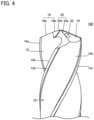
- Fig. 4 is a second enlarged side view of drill 100.
- drill 100 has an outer peripheral face 10.
- a flute 11 and a flute 12 are formed on outer peripheral face 10.
- Flute 11 and flute 12 extend in a helix around central axis A from front end 100a toward rear end 100b.
- Flute 11 and flute 12 are flutes for discharging chips cut out by a cutting edge 15 and a cutting edge 16 described later.
- Outer peripheral face 10 includes a land 13 and a land 14.
- Land 13 is a part of outer peripheral face 10 between flute 11 and flute 12.
- Land 14 is a part of outer peripheral face 10 between flute 11 and flute 12, the part being different from land 13.
- An end of land 13 closer to flute 11 is referred to as a leading edge 13a, and an end of land 13 closer to flute 12 is referred to as a heel 13b.
- An end of land 14 closer to flute 12 is referred to as a leading edge 14a, and an end of land 14 closer to flute 11 is referred to as a heel 14b.
- Land 13 includes a main margin 13c, a sub margin 13d, and a body clearance 13e.
- Main margin 13c is at an end of land 13 closer to leading edge 13a.
- Sub margin 13d is at an end of land 13 closer to heel 13b.
- Main margin 13c and sub margin 13d protrude from body clearance 13e outward in a radial direction. That is, there is a step at a boundary between main margin 13c and body clearance 13e and a boundary between sub margin 13d and body clearance 13e.
- Land 14 includes a main margin 14c, a sub margin 14d, and a body clearance 14e.
- Main margin 14c is at an end of land 14 closer to leading edge 14a.
- Sub margin 14d is at an end of land 14 closer to heel 14b.
- Main margin 14c and sub margin 14d protrude from body clearance 14e outward in a radial direction. That is, there is a step at a boundary between main margin 14c and body clearance 14e and a boundary between sub margin 14d and body clearance 14e.
- Drill 100 has a cutting edge 15 and a cutting edge 16 on a side closer to front end 100a.
- Cutting edge 15 extends from an end of leading edge 13a closer to front end 100a toward central axis A in a front view as viewed from front end 100a.
- Cutting edge 16 extends from an end of leading edge 14a closer to front end 100a toward central axis A in a front view as viewed from front end 100a.
- Cutting edge 15 includes a main cutting edge 15a and a thinning cutting edge 15b.
- Main cutting edge 15a is a part of cutting edge 15 extending from an end of leading edge 13a closer to front end 100a.
- Flute 11 is contiguous with main cutting edge 15a from a side opposite to a first flank face 17 described later. From another point of view, main cutting edge 15a is on a ridgeline between flute 11 and first flank face 17, and a part of flute 11 contiguous with main cutting edge 15a is a rake face of main cutting edge 15a.
- Thinning cutting edge 15b is a part of cutting edge 15 extending from an end of main cutting edge 15a opposite to leading edge 13a.
- Cutting edge 16 includes a main cutting edge 16a and a thinning cutting edge 16b.
- Main cutting edge 16a is a part of cutting edge 16 extending from an end of leading edge 14a closer to front end 100a.
- Flute 12 is contiguous with main cutting edge 16a from a side opposite to a first flank face 19 described later. From another point of view, main cutting edge 16a is on a ridgeline between flute 12 and first flank face 19, and a part of flute 12 contiguous with main cutting edge 16a is a rake face of main cutting edge 16a.
- Thinning cutting edge 16b is a part of cutting edge 16 extending from an end of main cutting edge 16a opposite to leading edge 14a.
- Drill 100 further includes the first flank face 17, a second flank face 18, the first flank face 19, a second flank face 20, a thinning face 21, a thinning face 22, an oil hole 23, and an oil hole 24 on a side closer to front end 100a.
- First flank face 17 is contiguous with cutting edge 15.
- Second flank face 18 is contiguous with first flank face 17 from a side opposite to cutting edge 15.
- First flank face 19 is contiguous with cutting edge 16.
- Second flank face 20 is contiguous with first flank face 19 from a side opposite to cutting edge 16.
- Tinning face 21 and thinning face 22 are faces formed to reduce a core thickness of drill 100 at front end 100a (faces formed by thinning front end 100a).
- thinning face 21 and thinning face 22 are faces formed by performing X-shaped thinning on front end 100a.
- Thinning face 21 has a thinning heel face 21a and a thinning rake face 21b.
- Thinning heel face 21a is contiguous with flute 11 and second flank face 20. That is, thinning heel face 21a is a part of thinning face 21 closer to heel 14b.
- Thinning rake face 21b is contiguous with cutting edge 15 from a side opposite to first flank face 17. That is, thinning cutting edge 15b is on a ridgeline between first flank face 17 and thinning rake face 21b.
- Thinning face 22 has a thinning heel face 22a and a thinning rake face 22b.
- Thinning heel face 22a is contiguous with flute 12 and second flank face 18. That is, thinning heel face 22a is a part of thinning face 22 closer to heel 13b.
- Thinning rake face 22b is contiguous with cutting edge 16 from a side opposite to first flank face 19. That is, thinning cutting edge 16b is on a ridgeline between first flank face 19 and thinning rake face 22b.
- Fig. 5 is a sectional view of drill 100 orthogonal to central axis A.
- oil hole 23 and oil hole 24 are formed inside drill 100.
- Oil hole 23 is opened in second flank face 18 (see Fig. 2 ).
- Oil hole 24 is opened in second flank face 20 (see Fig. 2 ).
- Oil hole 23 and oil hole 24 extend from front end 100a toward rear end 100b while being twisted along with a twist of flute 11 and flute 12 inside drill 100. Oil hole 23 and oil hole 24 do not need to be formed in drill 100.
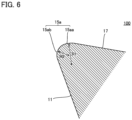
- Fig. 6 is a sectional view taken along line VI-VI in Fig. 2 .
- Fig. 6 shows a cross section orthogonal to an extending direction of main cutting edge 15a.
- main cutting edge 15a has a first curved portion 15aa and a second curved portion 15ab in a sectional view orthogonal to the extending direction of main cutting edge 15a.
- First curved portion 15aa is contiguous with first flank face 17.
- Second curved portion 15ab is contiguous with flute 11.
- First curved portion 15aa and second curved portion 15ab have a curved shape in a sectional view orthogonal to the extending direction of main cutting edge 15a.
- First curved portion 15aa and second curved portion 15ab preferably have a partial arc shape in a sectional view orthogonal to the extending direction of main cutting edge 15a.
- first curved portion 15aa and second curved portion 15ab are contiguous with each other.
- a curvature radius of first curved portion 15aa is defined as a first curvature radius R1.
- a curvature radius of second curved portion 15ab is defined as a second curvature radius R2.
- First curvature radius R1 is larger than second curvature radius R2.
- First curvature radius R1 is preferably 1.5 times or more of second curvature radius R2 and 0.07 mm or less.
- Second curvature radius R2 is preferably 0.02 mm or more and 0.05 mm or less.
- First curvature radius R1 and second curvature radius R2 are only required to be measured at any position on main cutting edge 15a.
- First curvature radius R1 does not need to be constant within a range of first curved portion 15aa, and second curvature radius R2 does not need to be constant within a range of second curved portion 15ab.
- first curvature radius R1 is larger than a maximum value of second curvature radius R2
- second curvature radius R2 a relationship in which "first curvature radius R1 is larger than second curvature radius R2" is satisfied.
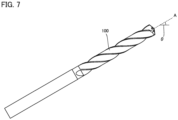
- Fig. 7 is a first schematic view illustrating the method of measuring first curvature radius R1 and second curvature radius R2.
- drill 100 is disposed to be inclined with respect to a horizontal direction. Assuming that an angle formed by central axis A and the horizontal direction is an inclination angle ⁇ , drill 100 is disposed so that inclination angle ⁇ is a torsion angle of flute 11 (flute 12) ⁇ 20°.
- the torsion angle of flute 11 (flute 12) is an angle formed between an extending direction of flute 11 (flute 12) and central axis A.
- a contour near main cutting edge 15a is measured by Contracer (C3000 manufactured by Mitutoyo Corporation).
- a measurement software is FORMTRACEPAK for Windows Version 5.202
- a stylus is a conical stylus (SPH-77/12AAE867 manufactured by Mitutoyo Corporation).
- a measurement pitch is 1.0 ⁇ m, and a measurement speed is 0.02 mm/sec. The measurement pitch is a distance between adjacent measurement points.
- Contracer is scanned along a direction orthogonal to the extending direction of main cutting edge 15a at a measurement position.
- an intersection point between first curved portion 15aa and first flank face 17 and an intersection point between second curved portion 15ab and flute 11 are calculated on the basis of the contour described above.
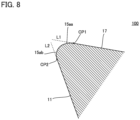
- Fig. 8 is a second schematic view illustrating the method of measuring first curvature radius R1 and second curvature radius R2.
- Fig. 8 shows, as an example, a cross section at a position corresponding to VI-VI in Fig. 2 .
- a straight line parallel to first flank face 17 and 1 ⁇ m away from first flank face 17 toward inside of drill 100 is defined as a first virtual straight line L1.
- a straight line parallel to a part of flute 11 contiguous with main cutting edge 15a (that is, a rake face of main cutting edge 15a) and 1 ⁇ m away from the part toward inside of drill 100 is defined as a second virtual straight line L2.
- intersection point between first virtual straight line L1 and the contour is regarded as an intersection point between first curved portion 15aa and first flank face 17 (first intersection point CP1), and an intersection point between second virtual straight line L2 and the contour is regarded as an intersection point between second curved portion 15ab and flute 11 (second intersection point CP2).
- first curvature radius R1 and second curvature radius R2 are calculated on the basis of the contour between first intersection point CP1 and second intersection point CP2. Specifically, first, a curvature center of a curve indicated by 20 measurement points closest to first intersection point CP1 is calculated on the basis of a least squares method. Next, an average value of distances between the curvature center and each of the 20 measurement points closest to first intersection point CP1 is calculated. This average value is first curvature radius R1. Second curvature radius R2 is calculated in a similar manner.
- a curvature center of a curve indicated by 20 measurement points closest to second intersection point CP2 is calculated on the basis of the least squares method, and an average value of distances between each of the 20 measurement points and the curvature center is second curvature radius R2.
- main cutting edge 16a has the same configuration as main cutting edge 15a. Specifically, in a sectional view orthogonal to main cutting edge 16a, main cutting edge 16a includes first curved portion 16aa having a curved shape (partial arc shape) contiguous with first flank face 19, and second curved portion 16ab having a curved shape (partial arc shape) contiguous with flute 12. A curvature radius of first curved portion 16aa is larger than a curvature radius of second curved portion 16ab.
- the curvature radius of first curved portion 16aa is preferably 1.5 times or more of the curvature radius of second curved portion 16ab and 0.07 mm or less, and the curvature radius of second curved portion 16ab is preferably 0.2 mm or more and 0.05 mm or less.
- Fig. 9 is a sectional view of drill 100 according to a modification.
- Fig. 9 shows a cross section at a position corresponding to VI-VI in Fig. 2 .
- main cutting edge 15a may further include a connecting portion 15ac in a sectional view orthogonal to the extending direction of main cutting edge 15a.
- Connecting portion 15ac is contiguous with first curved portion 15aa and second curved portion 15ab.
- Connecting portion 15ac has, for example, a linear shape in a sectional view orthogonal to the extending direction of main cutting edge 15a.
- a width W of connecting portion 15ac is preferably 0.05 mm or less.
- Connecting portion 15ac may have a curved shape (partial arc shape) in a sectional view orthogonal to the extending direction of main cutting edge 15a.
- a curvature radius of connecting portion 15ac is larger than first curvature radius R1.
- Cutting processing using drill 100 is performed by bringing cutting edge 15 and cutting edge 16 into contact with a workpiece while rotating drill 100 about central axis A.
- a feed rate per edge is preferably 5% or more of an edge diameter D of drill 100.
- Edge diameter D is a circumscribed circle of cutting edge 15 (cutting edge 16) in a front view as viewed from front end 100a (see Fig. 2 ).
- the feed rate per edge is, for example, 8% or less of edge diameter D.
- Drill 100 is used, for example, for cutting processing for carbon steel such as S50C.
- first curvature radius R1 is smaller than second curvature radius R2.
- a configuration of the drill according to Comparative Example 1 and a configuration of the drill according to Comparative Example 2 are common to the configuration of drill 100.
- first curvature radius R1 and second curvature radius R2 are not naturally determined by the width for performing the cutting edge processing.
- chipping is likely to occur on first flank face 17.
- first curvature radius R1 and second curvature radius R2 are not naturally determined by the width for performing the cutting edge processing.
- the curvature radius of main cutting edge 15a is larger on the flank face (that is, first curvature radius R1 is larger than second curvature radius R2), chipping less likely occurs on first flank face 17 even when drill 100 is used for cutting processing under a cutting condition of high feed.
- main cutting edge 15a of drill 100 further includes connecting portion 15ac, it is easy to adjust the width for performing the cutting edge processing.
- samples 1 to 5 were used as drill samples.
- first curvature radius R1 was smaller than second curvature radius R2.
- first curvature radius R1 and second curvature radius R2 were 0.024 mm and 0.065 mm, respectively, and in sample 2, first curvature radius R1 and second curvature radius R2 were 0.029 mm and 0.079 mm, respectively.
- first curvature radius R1 was larger than second curvature radius R2. That is, samples 4 and 5 correspond to drill 100. Specifically, in sample 4, first curvature radius R1 and second curvature radius R2 were 0.045 mm and 0.0314 mm, respectively, and in sample 5, first curvature radius R1 and second curvature radius R2 were 0.060 mm and 0.028 mm, respectively. In samples 1 to 5, edge diameter D was 8 mm.
- cutting processing of the workpiece was performed by using samples 1 to 5.
- the workpiece for the cutting processing was S50C.
- the cutting processing was performed by using NV5000 ⁇ 1A/40 manufactured by DMG MORI CO., LTD.
- the cutting processing was performed by forming a through hole having a depth of 38 mm under the conditions of a cutting speed of 140 m/min and a feed rate per edge of 0.40 mm/rev (5% of edge diameter D).
- coolant was supplied from oil hole 23 and oil hole 24.
- a cutting life of each sample was evaluated by a cutting distance until chipping occurred on first flank face 17. It was considered that chipping occurred on first flank face 17 when an area of a chip generated on first flank face 17 was 0.00025 mm 2 or more.
- first curvature radius R1 is larger than second curvature radius R2 in samples 4 and 5, but this condition is not satisfied in samples 1 to 3. From this comparison, it has become clear that, by making first curvature radius R1 larger than second curvature radius R2, chipping is less likely to occur on first flank face 17 even when the cutting processing is performed under a cutting condition of high feed.
Landscapes
- Engineering & Computer Science (AREA)
- Mechanical Engineering (AREA)
- Drilling Tools (AREA)
Applications Claiming Priority (1)
| Application Number | Priority Date | Filing Date | Title |
|---|---|---|---|
| PCT/JP2022/025935 WO2024004075A1 (ja) | 2022-06-29 | 2022-06-29 | ドリル及び切削方法 |
Publications (2)
| Publication Number | Publication Date |
|---|---|
| EP4549065A1 true EP4549065A1 (de) | 2025-05-07 |
| EP4549065A4 EP4549065A4 (de) | 2025-09-17 |
Family
ID=89382374
Family Applications (1)
| Application Number | Title | Priority Date | Filing Date |
|---|---|---|---|
| EP22949350.7A Pending EP4549065A4 (de) | 2022-06-29 | 2022-06-29 | Bohrer und schneidverfahren |
Country Status (5)
| Country | Link |
|---|---|
| US (1) | US12605773B2 (de) |
| EP (1) | EP4549065A4 (de) |
| JP (1) | JP7589425B2 (de) |
| CN (1) | CN118613341A (de) |
| WO (1) | WO2024004075A1 (de) |
Families Citing this family (4)
| Publication number | Priority date | Publication date | Assignee | Title |
|---|---|---|---|---|
| USD1061644S1 (en) * | 2021-12-02 | 2025-02-11 | Sumitomo Electric Hardmetal Corp. | Drill |
| USD1061643S1 (en) * | 2021-12-02 | 2025-02-11 | Sumitomo Electric Hardmetal Corp. | Drill |
| WO2025187212A1 (ja) * | 2024-03-06 | 2025-09-12 | 株式会社Moldino | ドリル |
| JP1784957S (ja) * | 2024-05-23 | 2024-11-19 | ドリルヘッド |
Family Cites Families (13)
| Publication number | Priority date | Publication date | Assignee | Title |
|---|---|---|---|---|
| JPS59219108A (ja) * | 1983-05-25 | 1984-12-10 | Sumitomo Electric Ind Ltd | ドリル |
| EP0690758B1 (de) * | 1993-11-15 | 2002-07-03 | Rogers Tool Works, Inc. | Oberflächen-entkohlung eines bohrer mit rafinierter primärschneidkante |
| JPH11114713A (ja) | 1997-10-09 | 1999-04-27 | Nissan Motor Co Ltd | 極小径ドリル及び穴あけ加工方法 |
| JP3477183B2 (ja) * | 2001-06-15 | 2003-12-10 | オーエスジー株式会社 | ダイヤモンド被覆切削工具 |
| JP2006055965A (ja) * | 2004-08-23 | 2006-03-02 | Osg Corp | 低加工硬化超硬ドリル |
| DE102005003496A1 (de) | 2005-01-25 | 2006-07-27 | Gühring, Jörg, Dr. | Variabler Schneidkantenabzug für Bohrwerkzeuge |
| JP4471894B2 (ja) | 2005-07-01 | 2010-06-02 | オーエスジー株式会社 | 低加工硬化超硬ドリル |
| JP2014008549A (ja) * | 2012-06-28 | 2014-01-20 | Sumitomo Electric Hardmetal Corp | ドリル |
| JP6287197B2 (ja) * | 2013-12-26 | 2018-03-07 | 三菱マテリアル株式会社 | ドリル用インサートおよび刃先交換式ドリル |
| JP2016175141A (ja) | 2015-03-19 | 2016-10-06 | 三菱マテリアル株式会社 | 硬質炭素被膜付切削工具 |
| JP6439200B2 (ja) | 2015-11-25 | 2018-12-19 | 住友電工ハードメタル株式会社 | 表面被覆切削工具の製造方法 |
| CN113195139B (zh) | 2018-10-11 | 2025-02-25 | 株式会社不二越 | 硬质皮膜包覆钻头 |
| DE102019102334A1 (de) * | 2019-01-30 | 2020-07-30 | Kennametal Inc. | Verfahren zur Herstellung eines Schneidwerkzeugs sowie Schneidwerkzeug |
-
2022
- 2022-06-29 CN CN202280090222.XA patent/CN118613341A/zh active Pending
- 2022-06-29 EP EP22949350.7A patent/EP4549065A4/de active Pending
- 2022-06-29 JP JP2022568436A patent/JP7589425B2/ja active Active
- 2022-06-29 WO PCT/JP2022/025935 patent/WO2024004075A1/ja not_active Ceased
- 2022-06-29 US US18/024,306 patent/US12605773B2/en active Active
Also Published As
| Publication number | Publication date |
|---|---|
| US20240307979A1 (en) | 2024-09-19 |
| EP4549065A4 (de) | 2025-09-17 |
| WO2024004075A1 (ja) | 2024-01-04 |
| CN118613341A (zh) | 2024-09-06 |
| JP7589425B2 (ja) | 2024-11-26 |
| US12605773B2 (en) | 2026-04-21 |
| JPWO2024004075A1 (de) | 2024-01-04 |
Similar Documents
| Publication | Publication Date | Title |
|---|---|---|
| EP4549065A1 (de) | Bohrer und schneidverfahren | |
| EP2286945B1 (de) | Spiralbohrer | |
| US20240261878A1 (en) | Drill | |
| US7597509B2 (en) | Insert retention screw and tool body and insert therewith | |
| US20040223818A1 (en) | Cutting insert with elliptical cutting edge | |
| US20100054884A1 (en) | Drill | |
| US8651778B2 (en) | Drill | |
| EP3733334A1 (de) | Bohrer | |
| US10357832B2 (en) | Drill and method for manufacturing machined product using same | |
| EP3100810B1 (de) | Fingerfräser und herstellungsverfahren für schneidprodukte | |
| EP2913131A1 (de) | Bohrer mit kleinem durchmesser | |
| US7018144B2 (en) | Drill | |
| US20210291282A1 (en) | Drill | |
| JP3483859B2 (ja) | スローアウェイ式チップ、及び、そのスローアウェイ式チップが装着されるフライス工具 | |
| JP3929901B2 (ja) | ドリル | |
| JP3477182B2 (ja) | ダイヤモンド被覆切削工具 | |
| EP4316710A1 (de) | Bohrkopf, spitzenwechselbohrer und bohrer | |
| JP3337804B2 (ja) | エンドミル | |
| EP4431211A1 (de) | Drehschneidwerkzeug mit einer spanspaltender einrichtung | |
| EP1439019A1 (de) | Bohrer | |
| US11446742B2 (en) | Cutting insert for drill, and drill | |
| US20250214155A1 (en) | Drill and method of manufacturing machined product | |
| US12083605B2 (en) | Cutting tool | |
| EP3812070A1 (de) | Schaftfräser | |
| US20220339713A1 (en) | Rotatable Cutting Head Having Tip Portion with Radially Extending Cutting Edges Forming a Cutting Profile Having Concave and Convex Sub-Portions |
Legal Events
| Date | Code | Title | Description |
|---|---|---|---|
| STAA | Information on the status of an ep patent application or granted ep patent |
Free format text: STATUS: THE INTERNATIONAL PUBLICATION HAS BEEN MADE |
|
| PUAI | Public reference made under article 153(3) epc to a published international application that has entered the european phase |
Free format text: ORIGINAL CODE: 0009012 |
|
| STAA | Information on the status of an ep patent application or granted ep patent |
Free format text: STATUS: REQUEST FOR EXAMINATION WAS MADE |
|
| 17P | Request for examination filed |
Effective date: 20240828 |
|
| AK | Designated contracting states |
Kind code of ref document: A1 Designated state(s): AL AT BE BG CH CY CZ DE DK EE ES FI FR GB GR HR HU IE IS IT LI LT LU LV MC MK MT NL NO PL PT RO RS SE SI SK SM TR |
|
| REG | Reference to a national code |
Ref country code: DE Ref legal event code: R079 Free format text: PREVIOUS MAIN CLASS: B23B0051000000 Ipc: B23B0051020000 |
|
| A4 | Supplementary search report drawn up and despatched |
Effective date: 20250820 |
|
| RIC1 | Information provided on ipc code assigned before grant |
Ipc: B23B 51/02 20060101AFI20250813BHEP Ipc: B23B 35/00 20060101ALI20250813BHEP |
|
| DAV | Request for validation of the european patent (deleted) | ||
| DAX | Request for extension of the european patent (deleted) |