EP4549163A2 - Procédé amélioré pour la coloration partielle de pièces en matière plastique - Google Patents
Procédé amélioré pour la coloration partielle de pièces en matière plastique Download PDFInfo
- Publication number
- EP4549163A2 EP4549163A2 EP24216362.4A EP24216362A EP4549163A2 EP 4549163 A2 EP4549163 A2 EP 4549163A2 EP 24216362 A EP24216362 A EP 24216362A EP 4549163 A2 EP4549163 A2 EP 4549163A2
- Authority
- EP
- European Patent Office
- Prior art keywords
- layer
- plastic part
- bis
- thermoplastic
- coloring
- Prior art date
- Legal status (The legal status is an assumption and is not a legal conclusion. Google has not performed a legal analysis and makes no representation as to the accuracy of the status listed.)
- Pending
Links
Images
Classifications
-
- B—PERFORMING OPERATIONS; TRANSPORTING
- B05—SPRAYING OR ATOMISING IN GENERAL; APPLYING FLUENT MATERIALS TO SURFACES, IN GENERAL
- B05D—PROCESSES FOR APPLYING FLUENT MATERIALS TO SURFACES, IN GENERAL
- B05D1/00—Processes for applying liquids or other fluent materials
- B05D1/18—Processes for applying liquids or other fluent materials performed by dipping
-
- B—PERFORMING OPERATIONS; TRANSPORTING
- B05—SPRAYING OR ATOMISING IN GENERAL; APPLYING FLUENT MATERIALS TO SURFACES, IN GENERAL
- B05D—PROCESSES FOR APPLYING FLUENT MATERIALS TO SURFACES, IN GENERAL
- B05D3/00—Pretreatment of surfaces to which liquids or other fluent materials are to be applied; After-treatment of applied coatings, e.g. intermediate treating of an applied coating preparatory to subsequent applications of liquids or other fluent materials
- B05D3/06—Pretreatment of surfaces to which liquids or other fluent materials are to be applied; After-treatment of applied coatings, e.g. intermediate treating of an applied coating preparatory to subsequent applications of liquids or other fluent materials by exposure to radiation
-
- B—PERFORMING OPERATIONS; TRANSPORTING
- B05—SPRAYING OR ATOMISING IN GENERAL; APPLYING FLUENT MATERIALS TO SURFACES, IN GENERAL
- B05D—PROCESSES FOR APPLYING FLUENT MATERIALS TO SURFACES, IN GENERAL
- B05D3/00—Pretreatment of surfaces to which liquids or other fluent materials are to be applied; After-treatment of applied coatings, e.g. intermediate treating of an applied coating preparatory to subsequent applications of liquids or other fluent materials
- B05D3/10—Pretreatment of surfaces to which liquids or other fluent materials are to be applied; After-treatment of applied coatings, e.g. intermediate treating of an applied coating preparatory to subsequent applications of liquids or other fluent materials by other chemical means
- B05D3/107—Post-treatment of applied coatings
-
- B—PERFORMING OPERATIONS; TRANSPORTING
- B05—SPRAYING OR ATOMISING IN GENERAL; APPLYING FLUENT MATERIALS TO SURFACES, IN GENERAL
- B05D—PROCESSES FOR APPLYING FLUENT MATERIALS TO SURFACES, IN GENERAL
- B05D5/00—Processes for applying liquids or other fluent materials to surfaces to obtain special surface effects, finishes or structures
- B05D5/06—Processes for applying liquids or other fluent materials to surfaces to obtain special surface effects, finishes or structures to obtain multicolour or other optical effects
-
- B—PERFORMING OPERATIONS; TRANSPORTING
- B42—BOOKBINDING; ALBUMS; FILES; SPECIAL PRINTED MATTER
- B42D—BOOKS; BOOK COVERS; LOOSE LEAVES; PRINTED MATTER CHARACTERISED BY IDENTIFICATION OR SECURITY FEATURES; PRINTED MATTER OF SPECIAL FORMAT OR STYLE NOT OTHERWISE PROVIDED FOR; DEVICES FOR USE THEREWITH AND NOT OTHERWISE PROVIDED FOR; MOVABLE-STRIP WRITING OR READING APPARATUS
- B42D25/00—Information-bearing cards or sheet-like structures characterised by identification or security features; Manufacture thereof
- B42D25/20—Information-bearing cards or sheet-like structures characterised by identification or security features; Manufacture thereof characterised by a particular use or purpose
- B42D25/23—Identity cards
-
- B—PERFORMING OPERATIONS; TRANSPORTING
- B42—BOOKBINDING; ALBUMS; FILES; SPECIAL PRINTED MATTER
- B42D—BOOKS; BOOK COVERS; LOOSE LEAVES; PRINTED MATTER CHARACTERISED BY IDENTIFICATION OR SECURITY FEATURES; PRINTED MATTER OF SPECIAL FORMAT OR STYLE NOT OTHERWISE PROVIDED FOR; DEVICES FOR USE THEREWITH AND NOT OTHERWISE PROVIDED FOR; MOVABLE-STRIP WRITING OR READING APPARATUS
- B42D25/00—Information-bearing cards or sheet-like structures characterised by identification or security features; Manufacture thereof
- B42D25/20—Information-bearing cards or sheet-like structures characterised by identification or security features; Manufacture thereof characterised by a particular use or purpose
- B42D25/24—Passports
-
- B—PERFORMING OPERATIONS; TRANSPORTING
- B42—BOOKBINDING; ALBUMS; FILES; SPECIAL PRINTED MATTER
- B42D—BOOKS; BOOK COVERS; LOOSE LEAVES; PRINTED MATTER CHARACTERISED BY IDENTIFICATION OR SECURITY FEATURES; PRINTED MATTER OF SPECIAL FORMAT OR STYLE NOT OTHERWISE PROVIDED FOR; DEVICES FOR USE THEREWITH AND NOT OTHERWISE PROVIDED FOR; MOVABLE-STRIP WRITING OR READING APPARATUS
- B42D25/00—Information-bearing cards or sheet-like structures characterised by identification or security features; Manufacture thereof
- B42D25/30—Identification or security features, e.g. for preventing forgery
- B42D25/324—Reliefs
-
- B—PERFORMING OPERATIONS; TRANSPORTING
- B42—BOOKBINDING; ALBUMS; FILES; SPECIAL PRINTED MATTER
- B42D—BOOKS; BOOK COVERS; LOOSE LEAVES; PRINTED MATTER CHARACTERISED BY IDENTIFICATION OR SECURITY FEATURES; PRINTED MATTER OF SPECIAL FORMAT OR STYLE NOT OTHERWISE PROVIDED FOR; DEVICES FOR USE THEREWITH AND NOT OTHERWISE PROVIDED FOR; MOVABLE-STRIP WRITING OR READING APPARATUS
- B42D25/00—Information-bearing cards or sheet-like structures characterised by identification or security features; Manufacture thereof
- B42D25/30—Identification or security features, e.g. for preventing forgery
- B42D25/36—Identification or security features, e.g. for preventing forgery comprising special materials
-
- B—PERFORMING OPERATIONS; TRANSPORTING
- B42—BOOKBINDING; ALBUMS; FILES; SPECIAL PRINTED MATTER
- B42D—BOOKS; BOOK COVERS; LOOSE LEAVES; PRINTED MATTER CHARACTERISED BY IDENTIFICATION OR SECURITY FEATURES; PRINTED MATTER OF SPECIAL FORMAT OR STYLE NOT OTHERWISE PROVIDED FOR; DEVICES FOR USE THEREWITH AND NOT OTHERWISE PROVIDED FOR; MOVABLE-STRIP WRITING OR READING APPARATUS
- B42D25/00—Information-bearing cards or sheet-like structures characterised by identification or security features; Manufacture thereof
- B42D25/30—Identification or security features, e.g. for preventing forgery
- B42D25/36—Identification or security features, e.g. for preventing forgery comprising special materials
- B42D25/378—Special inks
- B42D25/382—Special inks absorbing or reflecting infrared light
-
- B—PERFORMING OPERATIONS; TRANSPORTING
- B42—BOOKBINDING; ALBUMS; FILES; SPECIAL PRINTED MATTER
- B42D—BOOKS; BOOK COVERS; LOOSE LEAVES; PRINTED MATTER CHARACTERISED BY IDENTIFICATION OR SECURITY FEATURES; PRINTED MATTER OF SPECIAL FORMAT OR STYLE NOT OTHERWISE PROVIDED FOR; DEVICES FOR USE THEREWITH AND NOT OTHERWISE PROVIDED FOR; MOVABLE-STRIP WRITING OR READING APPARATUS
- B42D25/00—Information-bearing cards or sheet-like structures characterised by identification or security features; Manufacture thereof
- B42D25/40—Manufacture
- B42D25/405—Marking
- B42D25/41—Marking using electromagnetic radiation
-
- B—PERFORMING OPERATIONS; TRANSPORTING
- B42—BOOKBINDING; ALBUMS; FILES; SPECIAL PRINTED MATTER
- B42D—BOOKS; BOOK COVERS; LOOSE LEAVES; PRINTED MATTER CHARACTERISED BY IDENTIFICATION OR SECURITY FEATURES; PRINTED MATTER OF SPECIAL FORMAT OR STYLE NOT OTHERWISE PROVIDED FOR; DEVICES FOR USE THEREWITH AND NOT OTHERWISE PROVIDED FOR; MOVABLE-STRIP WRITING OR READING APPARATUS
- B42D25/00—Information-bearing cards or sheet-like structures characterised by identification or security features; Manufacture thereof
- B42D25/40—Manufacture
- B42D25/48—Controlling the manufacturing process
-
- C—CHEMISTRY; METALLURGY
- C08—ORGANIC MACROMOLECULAR COMPOUNDS; THEIR PREPARATION OR CHEMICAL WORKING-UP; COMPOSITIONS BASED THEREON
- C08K—Use of inorganic or non-macromolecular organic substances as compounding ingredients
- C08K3/00—Use of inorganic substances as compounding ingredients
- C08K3/02—Elements
- C08K3/04—Carbon
-
- C—CHEMISTRY; METALLURGY
- C08—ORGANIC MACROMOLECULAR COMPOUNDS; THEIR PREPARATION OR CHEMICAL WORKING-UP; COMPOSITIONS BASED THEREON
- C08L—COMPOSITIONS OF MACROMOLECULAR COMPOUNDS
- C08L101/00—Compositions of unspecified macromolecular compounds
-
- B—PERFORMING OPERATIONS; TRANSPORTING
- B05—SPRAYING OR ATOMISING IN GENERAL; APPLYING FLUENT MATERIALS TO SURFACES, IN GENERAL
- B05D—PROCESSES FOR APPLYING FLUENT MATERIALS TO SURFACES, IN GENERAL
- B05D2201/00—Polymeric substrate or laminate
- B05D2201/02—Polymeric substrate
-
- B—PERFORMING OPERATIONS; TRANSPORTING
- B41—PRINTING; LINING MACHINES; TYPEWRITERS; STAMPS
- B41M—PRINTING, DUPLICATING, MARKING, OR COPYING PROCESSES; COLOUR PRINTING
- B41M5/00—Duplicating or marking methods; Sheet materials for use therein
- B41M5/26—Thermography ; Marking by high energetic means, e.g. laser otherwise than by burning, and characterised by the material used
- B41M5/267—Marking of plastic artifacts, e.g. with laser
Definitions
- the present invention relates to an improved method for the partial coloring, in particular for colored laser engraving, of plastic parts, in particular thermoplastic parts, very particularly thermoplastic parts comprising a layer structure, the resulting partially colored, preferably colored laser-engraved, plastic parts, in particular thermoplastic parts, and a device for the partial coloring of plastic parts.
- transparent plastic films can be colored engraved on the back and then back-injected with a thermoplastic, according to the film insert molding process, to achieve glossy or uniform-looking surfaces. This process is used, for example, in EP-A 0691201 Example 1 reveals.
- ID documents In the market for security and/or valuable documents, especially identification documents (ID documents), there is a need for color personalization of these documents using lasers.
- Personalizing ID documents, which are partially or completely made of polymer films, using laser engraving is state of the art.
- the laser engraving processes known to date only create images and Text in various shades of gray. Colored elements cannot be created using laser engraving. Only in combination with previously applied color layers, which are subsequently modified using a laser, is it possible to generate colored images in or on plastic parts or ID documents.
- the unpublished patent application LU-A100327 discloses an improved process for the partial coloring, in particular for colored laser engraving, of plastic parts, in particular thermoplastic parts, especially plastic films.
- the plastic parts contain additives which have an absorption maximum in the wavelength range of the focused non-ionizing electromagnetic radiation used or the plastic part is coated with an additive in the form of a coating agent.
- the object of the present invention was to provide an improved method for the partial coloring, in particular for colored laser engraving, of plastic parts, preferably of thermoplastic parts, very particularly of thermoplastic parts comprising a layer structure, such as plastic films and/or film layer composites, so that a positionally accurate, sharp and uniformly intensive partial coloring, in particular colored laser engraving, results.
- Immersion in step i) refers to the at least partial wetting of the surface of the plastic part (A) with the dye bath (B) containing at least one colorant. Immersion in step i) can also be achieved by otherwise wetting the surface of the plastic part (A) using a dye layer b).
- constant temperature of the dyeing bath (B) is understood to mean that the temperature of the dyeing bath can deviate from the selected temperature of the dyeing bath (B) by a maximum of 10 °C upwards or downwards, preferably by a maximum of 8 °C upwards or downwards, particularly preferably by a maximum of 5 °C upwards or downwards, during the duration of the process.
- the dyeing bath (B) may experience a variation in temperature of more than 10 °C, preferably up to 20 °C, further preferably up to 50 °C, particularly preferably up to 100 °C, during the duration of the process.
- the method according to the invention is characterized in that the partial coloring of the plastic part, in particular the thermoplastic part, very particularly the thermoplastic part comprising a layer structure, takes place essentially at the areas at least partially wetted in step i') of the alternative method described later or irradiated in step ii), with an improved intensity and improved sharpness of the coloring.
- the remaining plastic part (A) has no or only very weak coloring in the non-irradiated areas.
- it is possible to color specific areas of the plastic part in order to apply, for example, an image, personalization, logo, symbol, or lettering to this plastic part using the method according to the invention. These cannot be easily removed from the plastic surface.
- the method according to the invention is therefore particularly suitable for the production of security and identification documents.
- these colored elements achieve particularly high resolutions of 5000 dpi and possibly even higher.
- the method according to the invention requires neither a high-precision printing technology nor the use of different laser strengths, for example, lasers emitting at different wavelengths, provided that the irradiation in step ii) is carried out with laser radiation.
- the method according to the invention and preferably also the alternative method according to the invention, as described further below are suitable for applying colored elements both to two- and/or three-dimensional plastic parts (A) and to thermoplastic parts (A) comprising a layer structure containing one or more layers of a thermoplastic.
- Highly focused laser systems can produce continuous colored lines, a feature of security printing, with a width of 10 ⁇ m. This is not possible with any of the printing processes available today.
- the plate (D) can be placed in the dyeing bath (B) in such a way that a constant distance between the surface of the plastic part (A) and plate (D) results over the duration of the entire process. This distance between the surface of the The depth of the immersion depth between the plastic part (A) and the plate (D) is also referred to as the immersion depth. Within the immersion depth range, the focused non-ionizing electromagnetic radiation (C) penetrates the dye bath (B) before reaching the surface of (A).
- the immersion depth can be precisely adjusted throughout the entire process and can thus also be kept constant throughout the entire process to achieve partial coloring of high intensity and sharpness.
- the immersion depth can be ⁇ 120 mm, preferably ⁇ 0.01 to ⁇ 100 mm, particularly preferably >_ 0.1 to ⁇ 20 mm, and most preferably >_ 0.1 to ⁇ 5.0 mm.
- a preferably flat plate (D) can be used for two-dimensionally shaped plastic parts (A), in particular thermoplastic parts comprising a layer structure containing one or more layers of a thermoplastic.
- the plate (D) is arranged parallel to the surface of (A).
- a plate (D) of the size of the partial coloring of the plastic part to be achieved can be used in the process according to the invention.
- a correspondingly three-dimensionally shaped plate (D) can be used to achieve a consistent immersion depth.
- a plate (D) is used that is the size of the partial coloring to be achieved in the plastic part (A). This can reduce the shape complexity of the plate (D).
- the plate (D) is arranged parallel to the tangent of the three-dimensional shape (A) that is to be described in color.
- (C) is irradiated perpendicular to the plate (D).
- the focused non-ionizing electromagnetic beam (C), preferably a laser beam passes through the plate (D) comprising one or more radiation-outcoupling materials.
- the radiation-outcoupling material of the plate (D) is preferably selected from those with a high surface quality and radiation permeability.
- Radiation-outcoupling materials of the plate (D) can have a scratch-dig value, determined according to ISO 10110-8, of ⁇ 80-50 to ⁇ 10-10, preferably of ⁇ 60-40 to ⁇ 20-10, a surface roughness Rq, determined according to ISO 10110-8, from ⁇ 0.5 to ⁇ 500 nm, preferably from ⁇ 0.7 to ⁇ 100 nm, particularly preferably from ⁇ 1 nm to ⁇ 10 nm, and a radiation transmittance for the selected radiation, determined according to the UV-VIS-NIR-MIR method in accordance with DIN EN ISO/IEC 17025, from ⁇ 50% to ⁇ 99.95%, preferably from ⁇ 60% to ⁇ 99.9%, particularly preferably from ⁇ 70% to ⁇ 99.89%.
- one or more radiation-outcoupling materials of the plate (D) can comprise at least one or more compounds from the group consisting of glass, such as non-oxide glasses, in particular halide glasses or chalcogenide glasses, oxide glasses, in particular phosphate-containing glasses, silicate-containing glasses, borate glasses, aluminosilicate glasses, lead silicate glasses, alkali silicate glasses, borosilicate glasses, alkali borate glasses, alkali-alkaline earth silicate glass, quartz glass, organic glasses, radiation-permeable plastic, mineral glass, synthetic glass, radiation-permeable ceramic material (e.g.
- glass such as non-oxide glasses, in particular halide glasses or chalcogenide glasses, oxide glasses, in particular phosphate-containing glasses, silicate-containing glasses, borate glasses, aluminosilicate glasses, lead silicate glasses, alkali silicate glasses, borosilicate glasses, alkali borate glasses, alkali-alkaline earth silicate glass, quartz glass, organic glasses, radiation
- Perlucor TM from CeramTec GmbH or fine-crystalline spinel ceramics from the Fraunhofer Institute for Ceramic Technologies and Systems IKTS, or radiation-permeable glass-ceramic Robax TM from Schott AG) and/or mixtures of at least two of the above compounds.
- the temperature of the dyeing bath (B) can be varied during the duration of the process in a temperature range from 0 °C to 100 °C, preferably from 5 °C to 80 °C, further preferably from 10 °C to 60 °C, more preferably from 15 °C to 40 °C, particularly preferably from 20 °C to 30 °C.
- the temperature of the dyeing bath (B), in particular the temperature of the dyeing bath (B) between the surface of the plastic part (A) and the plate (D), can be kept constant by appropriate temperature control devices, in particular cooling devices.
- the dye bath (B) can be continuously passed through the gap between the surface of the plastic part (A) and the plate (D) so that no heat build-up occurs between the surface of (A) and (D) and so the temperature between the surface of (A) and (D) is kept constant in the selected temperature range.
- thermoplastic plastic parts in particular thermoplastic plastic parts, very particularly thermoplastic plastic parts comprising a layer structure.
- the preferably thermoplastic plastic parts, very particularly thermoplastic plastic parts comprising a layer structure can particularly preferably be a thermoplastic selected from polymers of ethylenically unsaturated monomers and/or polycondensates of bifunctional reactive compounds and/or polyaddition products of bifunctional reactive compounds.
- thermoplastic plastic parts very particularly thermoplastic plastic parts comprising a layer structure
- thermoplastic plastic parts can particularly preferably be a thermoplastic selected from polymers of ethylenically unsaturated monomers and/or polycondensates of bifunctional reactive compounds and/or polyaddition products of bifunctional reactive compounds.
- thermoplastics are one or more polycarbonates or copolycarbonates based on diphenols or blends containing at least one Polycarbonate or copolycarbonate.
- blends comprising at least one polycarbonate or copolycarbonate and at least one poly- or copolycondensate of terephthalic acid, naphthalenedicarboxylic acid, or a cycloalkyldicarboxylic acid, preferably cyclohexanedicarboxylic acid.
- polycarbonates or copolycarbonates in particular with average molecular weights Mw of 500 to 100,000, preferably from 10,000 to 80,000, particularly preferably from 15,000 to 40,000, or blends thereof with at least one poly- or copolycondensate of terephthalic acid with average molecular weights Mw of 10,000 to 200,000, preferably from 21,000 to 120,000.
- polyalkylene terephthalates are suitable as poly- or copolycondensates of terephthalic acid.
- Suitable polyalkylene terephthalates are, for example, reaction products of aromatic dicarboxylic acids or their reactive derivatives (e.g., dimethyl esters or anhydrides) and aliphatic, cycloaliphatic, or araliphatic diols, and mixtures of these reaction products.
- Preferred polyalkylene terephthalates can be prepared from terephthalic acid (or its reactive derivatives) and aliphatic or cycloaliphatic diols with 2 to 10 C atoms by known methods ( Plastics Handbook, Vol. VIII, p. 695 ff, Karl-Hanser-Verlag, Kunststoff 1973 ).
- Preferred polyalkylene terephthalates contain at least 80 mol%, preferably 90 mol% of terephthalic acid residues, based on the dicarboxylic acid component, and at least 80 mol%, preferably at least 90 mol% of ethylene glycol and/or 1,4-butanediol and/or 1,4-cyclohexanedimethanol residues, based on the diol component.
- the preferred polyalkylene terephthalates may contain, in addition to ethylene or butanediol-1,4-glycol residues, up to 80 mol% of other aliphatic diols having 3 to 12 C atoms or cycloaliphatic diols having 6 to 21 C atoms, e.g.
- the polyalkylene terephthalates can be prepared by incorporating relatively small amounts of 3- or 4-hydric alcohols or 3- or 4-basic carboxylic acids, as used, for example, in DE-OS 19 00 270 and the US Patent 3,692,744
- preferred branching agents are trimesic acid, trimellitic acid, trimethylolethane and propane, and pentaerythritol.
- not more than 1 mol% of the branching agent is used, based on the acid component.
- Preferred polyalkylene terephthalates are also copolyesters made from at least two of the above-mentioned acid components and/or from at least two of the above-mentioned alcohol components; particularly preferred copolyesters are poly(ethylene glycol/butanediol-1,4) terephthalates.
- the polyalkylene terephthalates preferably used as components preferably have an intrinsic viscosity of approximately 0.4 to 1.5 dl/g, preferably 0.5 to 1.3 dl/g, each measured in phenol/o-dichlorobenzene (1:1 parts by weight) at 25°C.
- the blend of at least one polycarbonate or copolycarbonate with at least one poly- or copolycondensate of terephthalic acid is a blend of at least one polycarbonate or copolycarbonate with poly- or copolybutylene terephthalate or glycol-modified poly- or copolycyclohexanedimethylene terephthalate.
- Poly- or copolycyclohexane dimethylene terephthalate can preferably be one with 1 to 90 wt.% polycarbonate or copolycarbonate and 99 to 10 wt.% poly- or copolybutylene terephthalate or glycol-modified poly- or copolycyclohexane dimethylene terephthalate, preferably with 1 to 90 wt.% polycarbonate and 99 to 10 wt.% polybutylene terephthalate or glycol-modified polycyclohexane dimethylene terephthalate, the proportions adding up to 100 wt.%.
- the polycarbonates or copolycarbonates can be linear or branched in a known manner.
- a particularly preferred dihydroxydiphenylcycloalkane of formula (Ia) is 1,1-bis-(4-hydroxyphenyl)-3,3,5-trimethylcyclohexane (formula (Ia-1) with R 1 and R 2 equal to H).
- Such polycarbonates can be EP-A 359 953 from dihydroxydiphenylcycloalkanes of formula (Ia).
- dihydroxyaryl compounds are resorcinol, 4,4'-dihydroxydiphenyl, bis-(4-hydroxyphenyl)-diphenyl-methane, 1,1-bis-(4-hydroxyphenyl)-1-phenyl-ethane, bis-(4-hydroxyphenyl)-1-(1-naphthyl)-ethane, bis-(4-hydroxyphenyl)-1-(2-naphthyl)-ethane, 2,2-bis-(4-hydroxyphenyl)-propane, 2,2-bis(3,5-dimethyl-4-hydroxyphenyl)-propane, 1,1-bis-(4-hydroxyphenyl)-cyclohexane, 1,1-bis-(3,5-dimethyl-4-hydroxyphenyl)-cyclohexane, 1,1-bis-(4-hydroxyphenyl)-3,3,5-trimethyl-cyclohexane, 1,1'-bis-(4-hydroxyphenyl)
- dihydroxyaryl compounds are 4,4'-dihydroxydiphenyl and 2,2-bis-(4-hydroxyphenyl)-propane.
- the molar ratio of dihydroxyaryl compounds of formula (Ia) to the other dihydroxyaryl compounds of formula (I) optionally to be used is preferably between 99 mol% (Ia) to 1 mol% (I) and 2 mol% (Ia) to 98 mol% (I), preferably between 99 mol% (Ia) to 1 mol% (I) and 10 mol% (Ia) to 90 mol% (I) and in particular between 99 mol% (Ia) to 1 mol% (I) and 30 mol% (Ia) to 70 mol% (I).
- a particularly preferred copolycarbonate can be prepared using 1,1-bis-(4-hydroxyphenyl)-3,3,5-trimethyl-cyclohexane and 2,2-bis-(4-hydroxyphenyl)-propane dihydroxyaryl compounds of formula (Ia) and (I).
- diaryl compounds are diphenyl carbonate, 4-tert-butylphenyl phenyl carbonate, di-(4-tert-butylphenyl) carbonate, biphenyl 4-yl phenyl carbonate, di-(biphenyl 4-yl) carbonate, 4-(1-methyl-1-phenylethyl) phenyl phenyl carbonate, di-[4-(1-methyl-1-phenylethyl) phenyl] carbonate, and di-(methyl salicylate) carbonate.
- Diphenyl carbonate is very particularly preferred.
- Either one diaryl carbonate or different diaryl carbonates can be used.
- Such monohydroxyaryl compounds are, for example, 1-, 2- or 3-methylphenol, 2,4-dimethylphenol, 4-ethylphenol, 4-n-propylphenol, 4-iso-propylphenol, 4-n-butylphenol, 4-isobutylphenol, 4-tert-butylphenol, 4-n-pentylphenol, 4-n-hexylphenol, 4-iso-octylphenol, 4-n-nonylphenol, 3-pentadecylphenol, 4-cyclohexylphenol, 4-(1-methyl-1-phenylethyl)phenol, 4-phenylphenol, 4-phenoxyphenol, 4-(1-naphthyl)phenol, 4-(2-naphthyl)phenol, 4-tritylphenol, methyl salicylate, Ethyl salicylate, n-propyl salicylate, iso-propyl salicylate, n-butyl salicylate, iso-butyl salicylate, tert-buty
- Suitable branching agents can be compounds with three or more functional groups, preferably those with three or more hydroxyl groups.
- Suitable compounds with three or more phenolic hydroxyl groups are, for example, phloroglucinol, 4,6-dimethyl-2,4,6-tri-(4-hydroxyphenyl)-2-heptene, 4,6-dimethyl-2,4,6-tri-(4-hydroxyphenyl)-heptane, 1,3,5-tri-(4-hydroxyphenyl)-benzene, 1,1,1-tri-(4-hydroxyphenyl)-ethane, tri-(4-hydroxyphenyl)-phenylmethane, 2,2-bis-(4,4-bis-(4-hydroxyphenyl)-cyclohexyl]-propane, 2,4-bis-(4-hydroxyphenyl-isopropyl)-phenol and tetra-(4-hydroxyphenyl)-methane.
- Suitable compounds with three or more functional groups are, for example, 2,4-dihydroxybenzoic acid, trimesic acid trichloride, cyanuric acid trichloride and 3,3-bis-(3-methyl-4-hydroxyphenyl)-2-oxo-2,3-dihydroindole.
- Preferred branching agents are 3,3-bis-(3-methyl-4-hydroxyphenyl)-2-oxo-2,3-dihydroindole and 1,1,1-tri-(4-hydroxyphenyl)ethane.
- the plastic part (A) in particular a thermoplastic plastic part, very particularly a thermoplastic plastic part comprising a layer structure, comprises at least one additive which has an absorption maximum in the wavelength range of the focused non-ionizing electromagnetic radiation used, or (A) is coated with at least one additive in the form of a coating agent which has an absorption maximum in the wavelength range of the focused non-ionizing electromagnetic radiation used.
- Suitable inorganic IR absorbers are, for example, mixed oxides of metals such as phosphorus-containing tin-copper mixed oxides, as in WO-A 2006/042714 described, those from the group of borides and/or tungstates and mixtures thereof, preferably at least one or more IR absorbers from the group of borides and/or tungstates, and mixtures thereof, particularly preferably at least one or more IR absorbers from the group of tungstates.
- woframates are preferable to borides due to their low inherent coloration, provided that the process according to the invention is to be carried out on plastic parts which have a radiation transmittance of ⁇ 10% to ⁇ 99%, preferably of ⁇ 30% to ⁇ 95%, particularly preferably ⁇ 40% to ⁇ 93% for the selected radiation, determined according to the UV-VIS-NIR-MIR method according to DIN EN ISO/IEC 17025 .
- tungsten trioxide, tungsten dioxide, a hydrate of a tungsten oxide, tungsten hexachloride, ammonium tungstate or tungstic acid and optionally further salts containing the element M, such as cesium carbonate, are mixed in certain stoichiometric ratios so that the molar ratios of the individual components are represented by the formula M x W y O z
- This mixture is then treated at temperatures between 100 °C and 850 °C in a reducing atmosphere, e.g. an argon-hydrogen atmosphere, and finally the resulting powder is tempered at temperatures between 550 °C and 1200 °C in an inert gas atmosphere.
- the IR absorber can be mixed with the dispersants described below and other organic solvents, such as toluene, benzene or similar aromatic hydrocarbons, and ground in suitable mills, such as ball mills, with the addition of zirconium oxide (e.g. with a diameter of 0.3 mm) in order to produce the desired particle size distribution.
- the nanoparticles are obtained in the form of a dispersion. After grinding, further dispersants can be added if desired.
- the solvent is removed at elevated temperatures and reduced pressure. Preference is given to nanoparticles which have an average size of less than 200 nm, particularly preferably less than 100 nm.
- the size of the particles can be determined using transmission electron spectroscopy (TEM).
- TEM transmission electron spectroscopy
- the particles thus obtained are dispersed in an organic matrix, e.g. in an acrylate, and optionally ground as described above in a mill using suitable auxiliaries such as zirconium dioxide and optionally using organic solvents such as toluene, benzene or similar hydrocarbons.
- Preferred dispersants are polyacrylates, polyethers, and polyester-based polymers, with polyacrylates such as polymethyl methacrylate and polyester being particularly preferred as high-temperature-stable dispersants. Mixtures of these polymers or acrylate-based copolymers can also be used. Such dispersing aids and methods for preparing tungstate dispersions are described, for example, in JP 2008214596 as well as in Adachi et al. J.Am. Ceram. Soc. 2007, 90 4059-4061 , described. Suitable dispersants are commercially available.
- Polyacrylate-based dispersants are particularly suitable. Suitable dispersants of this type are available from Ciba Specialty Chemicals under the trade names EFKA TM , e.g., EFKA TM 4500 and EFKA TM 4530. Polyester-containing dispersants are also suitable. They are available, for example, under the trade names Solsperse TM , e.g., Solsperse TM 22000, 24000SC, 26000, 27000 from Avecia. Polyether-containing dispersants are also known, for example, under the trade names Disparlon TM DA234 and DA325 from Kusumoto Chemicals. Polyurethane-based systems are also suitable. Polyurethane-based systems are available from Ciba Specialty Chemicals under the trade names EFKA TM 4046 and EFKA TM 4047. Texaphor TM P60 and P63 are corresponding trade names of Cognis.
- EFKA TM e.g., EFKA TM 4500 and
- the amount of IR absorber in the dispersant can be 0.2 wt.% to 50.0 wt.%, preferably 1.0 wt.% - 40.0 wt.%, more preferably 5.0 wt.% - 35.0 wt.%, and most preferably 10.0 wt.% - 30.0 wt.%, based on the dispersion of the inorganic IR absorber used according to the invention.
- the ready-to-use IR absorber formulation may also contain other auxiliary substances such as zirconium dioxide and residual solvents such as toluene, benzene or similar aromatic hydrocarbons.
- the inorganic IR absorbers according to the invention can be used in an amount of ⁇ 0.7% by weight to ⁇ 4.5% by weight, preferably ⁇ 0.6% by weight to ⁇ 2% by weight, and particularly preferably ⁇ 0.7% by weight to ⁇ 1.5% by weight, calculated as the solids content of inorganic IR absorber, in the overall polymer composition.
- the solid content of inorganic IR absorber means the inorganic IR absorber, in particular the tungstate, as a pure substance and not a dispersion, suspension or other preparation containing the pure substance, whereby the following information on the content of IR additive, in particular the tungstate content, always refers to this solid content, unless explicitly stated otherwise.
- additional IR absorbers can optionally be used in addition to the tungstates as IR absorbers, although their proportion in such a mixture is in each case lower than that of the tungstates described above.
- compositions containing two to five, and particularly preferably two or three, different IR absorbers are preferred.
- the additional IR absorber is preferably selected from the group of borides and tin oxides, particularly preferably LaB 6 or antimony-doped tin oxide or indium tin oxide.
- Such mixtures of IR absorbers are predominantly used in applications where an inherent coloration of the component up to a Delta E of 20, preferably up to a Delta E of 15, can be accepted compared to the plastic part without IR absorber.
- the plastic part can be coated with an additive in the form of a coating agent which is in the wavelength range of the used focused non-ionizing electromagnetic Radiation has an absorption maximum.
- coating agents preferably comprise an IR absorber which absorbs in the wavelength range from ⁇ 0.70 ⁇ m to ⁇ 1000 ⁇ m, preferably in the range from ⁇ 1.0 ⁇ m to ⁇ 50 ⁇ m, particularly preferably in the range from ⁇ 1.0 ⁇ m to ⁇ 2.5 ⁇ m.
- These coating agents are commercially available, for example, under the name Clearweld TM LD920, LD930, or LD940.
- the at least one additive which has an absorption maximum in the wavelength range of the focused non-ionizing electromagnetic radiation used can be contained in the plastic part.
- the dyeing bath (B) may comprise at least one colorant, preferably at least one dye, particularly preferably at least one dye from the group of solvent dyes and/or disperse dyes according to the Colour Index classification, or mixtures of these dyes.
- Dyes belonging to the solvent dye group according to the Color Index classification can include, for example, the so-called Macrolex TM dyes from Lanxess AG, Germany. Examples include Macrolex TM Blue 3R, Macrolex TM Red H, Macrolex TM Yellow 6G (Solvent Yellow 179 according to CI), Macrolex TM Violet Red R (Disperse Violet 31 according to CI), Macrolex TM Orange R (Solvent Orange 107 according to CI), or mixtures of these dyes.
- Dyes belonging to the Disperse Dyes group according to the Colour Index classification can be, for example, diazo, diphenylamine, and anthraquinone compounds, acetate dyes, disperse dyes, and/or disperse dyes, and include Disperse Blue #3, Disperse Blue #14, Disperse Yellow #3, Disperse Red #134, and Disperse Red #7.
- the classification and designation of the dyes cited above are consistent with " The Colour Index", 3rd edition, published jointly by the Society of Dyes and Colors and the American Association of Textile Chemists and Colorists (1971 ).
- the dyes can generally be used either as the sole dye component or as a component of a Mixtures can be applied depending on the desired color.
- the term "dye" used here also includes the dye mixture.
- Suitable dyes include water-insoluble diazo-diphenylamine and anthraquinone compounds. Particularly suitable are acetate dyes, dispersed acetate dyes, disperse dyes, and disperse dyes, as described in Color Index 3rd edition, Volume 2, The Societey of Dyers and Colourists, 1971. pp. 2479 and 2187-2743 are disclosed.
- the preferred dispersed dyes include Dystar's Palanil Blue E-R150 (anthraquinone/disperse blue), DIANIX Orange E-3RN (azo dye/Cl Disperse Orange 25) and the above-mentioned Macrolex TM dyes as solvent dyes.
- Dyeing baths suitable for uniform dyeing of polycarbonate plastic parts at temperatures > 80 °C have proven advantageous. These are described, for example, in WO-A 03/ 040461 , EP-A 2050866 , WO-A 03/083207 . Under the conditions of the method according to the invention, the plastic part is essentially partially coloured in the irradiated areas, so that an intensive engraving becomes visible precisely at these points.
- the dyeing bath comprises a dye and/or a dye mixture selected from the group of disperse dyes according to the Colour Index classification, very particularly a dye selected from the group consisting of azo, diphenylamine and anthraquinone compounds.
- the dyeing bath comprises a dye and/or a dye mixture from the group of solvent dyes according to the Colour Index classification, very particularly preferably a dye and/or dye mixture of the Makrolex TM dyes.
- Water and/or organic solvents can be used as solvent and/or dispersant a). Water is preferred.
- organic solvents All common solvents that do not attack the plastic part upon contact can be used as organic solvents. Examples include butyl alcohol, butylene glycol, diethylene glycol, ethyl alcohol, ethylene glycol, heptane, hexane, pentane, propargyl alcohol, propyl alcohol, or mixtures of the above.
- water and c) are used in the process according to the invention.
- the irradiation of the plastic part (A) in step ii) is carried out with focused non-ionizing electromagnetic radiation, wherein the wavelength range of the focused non-ionizing electromagnetic radiation is selected such that the dye bath has a radiation transmittance of ⁇ 2% to ⁇ 99%, preferably ⁇ 30% to ⁇ 95%, particularly preferably ⁇ 40% to ⁇ 93% for the selected radiation, determined according to the UV-VIS-NIR-MIR method in accordance with DIN EN ISO/IEC 17025
- the irradiation in step ii) is carried out with laser radiation having a wavelength in the range from ⁇ 0.1 ⁇ m to ⁇ 1000 ⁇ m, preferably from ⁇ 1.0 ⁇ m to ⁇ 50 ⁇ m, particularly preferably from ⁇ 1.0 ⁇ m to ⁇ 2.5 ⁇ m.
- Pulsed laser radiation is particularly preferred for irradiating plastic parts.
- a laser pulse duration of just a fraction of a second is sufficient to color the plastic part at the laser-irradiated areas.
- Pulse durations of 10 -18 to 10 -1 seconds are preferred, with pulse durations of 10 -9 to 10 -2 seconds being particularly preferred, and pulse durations of 10 -6 to 10 -3 seconds being even more preferred.
- the intensity of the coloring at the lasered areas can be influenced, depending on the requirements of the desired application.
- the higher the laser power used the more intense the coloring at the lasered areas of the plastic part.
- Sufficiently good colored engravings can be achieved with the medium power range of a 7.5-watt marking laser. Pulsed operation allows significantly higher power levels and thus more intense coloring in the plastic part.
- NdYAG lasers neodymium-doped yttrium aluminum garnet lasers
- the laser energy is no longer sufficient to achieve black or gray colors, but engraving in blue, magenta, or yellow can still be achieved at these energy densities.
- NdYAG lasers neodymium-doped yttrium aluminum garnet lasers
- laser types suitable for engraving and welding plastics can also be used for the color laser engraving of plastic parts. For example, a CO2 laser can also be used. This allows engraving to be preferably carried out in blue, magenta, and yellow.
- the color concentration of the dye bath can also influence the intensity of the partial coloring of the plastic part after irradiation.
- a molded part made of plastic is used, which is produced in an injection mold according to known methods such as, for example, the in-mold decoration (IMD), film insert molding (FIM) or high-pressure forming (HPF) method.
- IMD in-mold decoration
- FIM film insert molding
- HPF high-pressure forming
- the plastic part is a layer structure containing at least one layer of a thermoplastic selected from polymers of ethylenically unsaturated monomers and/or polycondensates of bifunctional reactive compounds, preferably one or more polycarbonate(s) or copolycarbonate(s) based on diphenols, poly- or copolyacrylate(s) and poly- or copolymethacrylate(s), poly- or Copolymer(s) with styrene, polyurethane(s), and polyolefin(s), poly- or copolycondensate(s) of terephthalic acid, poly- or copolycondensate(s) of naphthalenedicarboxylic acid, poly- or copolycondensate(s) of at least one cycloalkyldicarboxylic acid, or mixtures of these, particularly preferably one or more polycarbonate(s) or copolycarbonate(s) based on diphenols, poly- or copolyacryl
- the at least one layer containing at least one thermoplastic material is a film.
- This film preferably has a layer thickness of ⁇ 1 ⁇ m to ⁇ 1000 ⁇ m, preferably ⁇ 5 to ⁇ 800 ⁇ m, most preferably ⁇ 10 to ⁇ 500 ⁇ m.
- thermoplastic material with regard to preferred embodiments, material, composition and additives.
- At least one layer containing at least one thermoplastic material can also comprise at least one filler.
- the filler is preferably at least one color pigment and/or at least one other filler for creating translucency in the filled layers, particularly preferably a white pigment, most preferably titanium dioxide, zirconium dioxide, or barium sulfate, and in a preferred embodiment, titanium dioxide.
- a layer containing at least one thermoplastic material with at least one such filler improves the visibility of the applied inscription or image(s), which also improves the perception of the improved sharpness and Resolution is further increased.
- This layer structure is known from WO-A 2010/089035 and is described in detail there.
- the layer structure can comprise at least one layer of a thermoplastic material and at least one additive which has an absorption maximum in the wavelength range of the focused non-ionizing electromagnetic radiation used, and wherein this at least one layer of a thermoplastic material has a radiation transmittance of ⁇ 10% to ⁇ 99%, preferably of ⁇ 30% to ⁇ 95%, particularly preferably ⁇ 40% to ⁇ 93%, for the selected radiation, determined according to the UV-VIS-NIR-MIR method according to DIN EN ISO/IEC 17025, preferably an inorganic IR absorber, particularly preferably an inorganic IR absorber from the group of tungstates.
- This layer preferably forms an outer layer of the layer structure, which is ultimately also laser engraved in color.
- this comprises at least one outer layer of a thermoplastic material containing at least one additive which has an absorption maximum in the wavelength range of the focused non-ionizing electromagnetic radiation used, and wherein this at least one layer of a thermoplastic material has a radiation transmittance of ⁇ 10% to ⁇ 99%, preferably of ⁇ 30% to ⁇ 95%, particularly preferably ⁇ 40% to ⁇ 93%, for the selected radiation, determined according to the UV-VIS-NIR-MIR method according to DIN EN ISO/IEC 17025, preferably an inorganic IR absorber, particularly preferably an inorganic IR absorber from the group of tungstates, and a further layer containing at least one thermoplastic material and at least one laser-sensitive additive, preferably black pigment, particularly preferably carbon black and optionally a further layer of a thermoplastic material comprising a Filler, preferably a white pigment, particularly preferably titanium dioxide, zirconium dioxide or barium sulfate, most preferably titanium
- the plastic part (A), comprising the layer structure described above, can be irradiated with C) either before step i) and/or after step ii) in the absence of the dyeing bath (B) as in step ii).
- the same radiation (C) can be used for this further irradiation.
- a Black engraving is applied to the surface, preferably in the underlying transparent and/or white layers of the layered structure at the desired location.
- the high laser reactivity of these layered structures leads to blackening at the laser-irradiated areas when laser engraved outside the coloring bath. If the layered structure is in the coloring bath, the intensity of the laser beam is reduced by the coloring bath so that only coloring occurs at the irradiated areas, but no blackening of the surface of the layered structure is caused.
- the partial dyeing of the plastic part (A) can also be carried out by means of a dyeing layer b) containing at least one colorant, which is produced in a first step i').
- the non-ionizing electromagnetic radiation (C) is laser radiation having a wavelength in the range of ⁇ 0.1 ⁇ m ⁇ m to ⁇ 1000 ⁇ m, preferably in the range of ⁇ 1.0 ⁇ m to ⁇ 50 ⁇ m, particularly preferably in the range of ⁇ 1.0 ⁇ m to ⁇ 2.5 ⁇ m.
- the coloring layer b) is preferably applied as a solid or a liquid layer to the plastic part (A), such that the plastic part (A) is at least partially wetted with the coloring layer b).
- a solid layer can be created by drying the liquid-applied coloring layer b).
- a process selected from the group consisting of spraying, coating, pouring, dipping, and printing such as inkjet, screen printing, offset printing, gravure printing, doctor blade printing, gravure printing, pad printing, or a combination of at least two thereof, is preferably used.
- partial coloring is achieved by applying colorant in the form of the coloring layer b) only to specific locations on the plastic part (A).
- the irradiation in step ii') can be partial or full-surface, depending on whether the colorant is applied to the full surface or part of the plastic part (A).
- the irradiation in step ii') is carried out over a partial surface.
- the irradiation in step ii') can also be carried out over the entire surface.
- the non-irradiated portion of the coloring layer b) is preferably removed after step ii').
- the removal of the coloring layer b) can be carried out, for example, in a water bath, assisted by ultrasonic cleaning, or by mechanical cleaning devices such as sponges or brushes, which can also be driven by a motor (rotation, oscillation, vibration, etc.).
- Coloring layer b) preferably has a colorant, preferably dye, concentration of 0.01 to 98 wt. %, preferably 0.1 to 50 wt. %, particularly preferably 0.2 to 25 wt. %, based on the total weight of coloring layer b).
- the ink layer thickness is preferably precisely adjusted throughout the entire process and is preferably kept constant throughout the entire process to achieve partial coloring of high intensity and sharpness.
- the ink layer thickness is preferably 0.001 mm to 10 mm, more preferably 0.005 mm to 5 mm, and most preferably 0.01 mm to 1 mm.
- the invention further relates to plastic articles, in particular security and/or valuable documents, especially identification documents, obtainable by the method according to the invention.
- security documents personalized or color-engraved according to the method according to the invention are characterized by a high level of forgery security of the applied personalized or color-engraved information.
- blank documents can be personalized in color in a decentralized and forgery-proof manner.
- Plastic articles in particular security and/or valuable documents, especially identification documents, can also be obtained using the alternative process according to the invention. These documents are also characterized by a high level of counterfeit security due to the personalized or color-engraved information applied.
- the invention further relates to a device comprising a dyeing bath (B), a plate (D) comprising one or more radiation-coupling materials and a radiation source (E) for generating a focused non-ionizing electromagnetic radiation (C), characterized in that the dyeing bath (B) has a temperature of ⁇ 99°C to ⁇ -60°C, preferably from 99°C to 0°C, more preferably from ⁇ 70°C to ⁇ 10°C, particularly preferably from ⁇ 50°C to ⁇ 15°C, wherein the temperature preferably remains constant when the device is started up and that the focused non-ionizing electromagnetic radiation (C) passes through the plate (D) comprising one or more radiation-coupling materials before impinging on the plastic part (A).
- a device comprising a dyeing bath (B), a plate (D) comprising one or more radiation-coupling materials and a radiation source (E) for generating a focused non-ionizing electromagnetic radiation (C), characterized in that the dyeing bath (B)
- the temperature can be maintained in a temperature range of 100°C, preferably from 80 °C, particularly preferably 50 °C, further preferably 30 °C, more preferably 20 °C. If the temperature does not vary by more than 10 °C, it is considered a constant temperature.
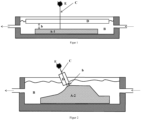
- a dyeing bath B is shown schematically, into which a two-dimensional plastic part A-1 is immersed such that at least one of its surfaces comes into contact with the colorant located in the dyeing bath B.
- a plate D comprising one or more radiation-coupling materials.
- focused non-ionizing electromagnetic radiation C is directed from a radiation source for generating focused non-ionizing electromagnetic radiation E onto the surface of the plastic part A-1 in order to partially dye the plastic part A-1.
- the dyeing bath B can have an outlet and an inlet for the colorant, so that fresh Colorant can be introduced into the dyeing bath B, for example to keep the dyeing bath B at a substantially constant temperature.
- the radiation source E can be arranged to be movable in at least two dimensions relative to the plastic part A-1 and the plate D, so that different areas on the surface of the plastic part A-1 can be irradiated.
- the plate D is optional and the dyeing bath B can be in contact with the plastic part A-1 in such a way that only parts of the surface of the plastic part A-1 are covered with colorant.
- Figure 2 is a schematic diagram of an arrangement with a dye bath B, as in Figure 1 which is suitable for irradiating a three-dimensional plastic part A-2.
- Both the radiation source E and the plate D are arranged to be movable relative to the surface of the plastic part A-2, so that the radiation source E with the plate D can be moved in three dimensions relative to the plastic part A-2 in order to be able to carry out engravings on the three-dimensional plastic part A-2.
- the masterbatch for the production of film 2 was produced using a conventional twin-screw compounding extruder (ZSK 32) at processing temperatures of 250 to 330°C, which are typical for polycarbonate.
- the master batch granules were conveyed from the dryer into the extruder's hopper.
- the material was melted and conveyed in the extruder's barrel/screw plasticizing system.
- the melt was then discharged from the slot die onto the Smoothing calender.
- the final shaping and cooling of the film took place on the smoothing calender (consisting of three rolls).
- a structured steel roll (6-side) and a structured silicone rubber roll (2-side) were used to emboss the surfaces.
- the rubber roll used for structuring the film surface is US-4 368 240 by Nauta Roll Corporation.
- the film was then transported through a haul-off device and then wound up.
- the laminate A was placed (transparent side (foil 2) facing upwards) in the dyeing bath (B) of the above composition.
- a NdYAG laser from Foba, model D84 with a laser power of approximately 7.5 watts, a laser frequency of 8 kHz in pulsed mode, and a current of 30 A was used.
- the feed speed of the laser, immersion depth, and the temperature of the dye bath (B) are given in Table 1.
- immersion depth refers to the depth of penetration of the radiation into the dye bath down to the surface of the plastic part to which the partial dyeing is to be applied.
- the part was irradiated with the laser beam.
- laminate A was removed from the dye bath and the quality of the laser engraving was visually assessed.
- the engraving was not uniform in terms of color intensity and sharpness of the typeface.
- Example 2 (according to the invention according to the process according to claim 1 (laminate A) or according to the alternative process (laminate A'))
- Laminate A (A-1) was placed (transparent side (film 2) facing up) in the dye bath (B) of the above-mentioned composition. Laminate A' was coated with a dye layer by printing.
- a 3 mm thick silicate glass plate (D) was placed on top of laminate A. Spacers were used to maintain a distance of 1 mm (immersion depth) between laminate A and glass plate (D).
- the dye bath (B) was filled so that the top surface of the glass plate (B) remained free of dyeing fluid.
- the laminate A' was clamped in a holder.
- a NdYAG laser from Foba, model D84 with a laser power of approximately 7.5 watts, a laser frequency of 8 kHz for laminate A or 30 kHz for laminate A' in pulsed mode, and a current of 30 A was used.
- the feed speed of the laser, immersion depth or ink layer thickness (b), and the temperature of the dye bath (B) are given in Table 2.
- Immersion depth or ink layer thickness (b) in the context of this invention is understood to mean the penetration depth of the radiation used into the dye bath (B) or into the Coloring layer b) to the surface of the plastic part to which the partial coloring is to be applied. It was irradiated with the laser beam.
- Table 2 Conditions for color laser engraving ⁇ /b> Temperature of the dye bath for laminate A or the dye layer for laminate A' 40 °C Immersion depth or paint layer thickness 1 or 0.3 mm defined by the distance between laminate and glass plate or thickness of the dye layer Feed rate in the method according to claim 1 or alternative method 100 or 50 mm/s
- laminate A was removed from the dye bath (B), and the unexposed ink layer of laminate A' was removed in a water bath using a sponge. The quality of the laser engraving was then visually assessed. Compared to Example 1, the engraving of both laminate A and laminate A' was significantly more uniform in terms of color intensity and sharpness of the typeface.
Landscapes
- Physics & Mathematics (AREA)
- Engineering & Computer Science (AREA)
- Manufacturing & Machinery (AREA)
- Chemical & Material Sciences (AREA)
- Health & Medical Sciences (AREA)
- Optics & Photonics (AREA)
- Chemical Kinetics & Catalysis (AREA)
- Electromagnetism (AREA)
- General Health & Medical Sciences (AREA)
- Toxicology (AREA)
- Medicinal Chemistry (AREA)
- Polymers & Plastics (AREA)
- Organic Chemistry (AREA)
- General Chemical & Material Sciences (AREA)
- Plasma & Fusion (AREA)
- Laminated Bodies (AREA)
- Compositions Of Macromolecular Compounds (AREA)
- Thermal Transfer Or Thermal Recording In General (AREA)
- Lining Or Joining Of Plastics Or The Like (AREA)
- Laser Beam Processing (AREA)
- Coloring (AREA)
Applications Claiming Priority (3)
| Application Number | Priority Date | Filing Date | Title |
|---|---|---|---|
| EP18190363.4A EP3613602A1 (fr) | 2018-08-23 | 2018-08-23 | Procédé amélioré pour la coloration partielle de pièces en matière plastique |
| EP19755643.4A EP3840958B1 (fr) | 2018-08-23 | 2019-08-22 | Procédé amélioré pour la coloration partielle de pièces en matière plastique |
| PCT/EP2019/072431 WO2020039018A1 (fr) | 2018-08-23 | 2019-08-22 | Procédé amélioré pour la coloration partielle de pièces en matière plastique |
Related Parent Applications (2)
| Application Number | Title | Priority Date | Filing Date |
|---|---|---|---|
| EP19755643.4A Division-Into EP3840958B1 (fr) | 2018-08-23 | 2019-08-22 | Procédé amélioré pour la coloration partielle de pièces en matière plastique |
| EP19755643.4A Division EP3840958B1 (fr) | 2018-08-23 | 2019-08-22 | Procédé amélioré pour la coloration partielle de pièces en matière plastique |
Publications (2)
| Publication Number | Publication Date |
|---|---|
| EP4549163A2 true EP4549163A2 (fr) | 2025-05-07 |
| EP4549163A3 EP4549163A3 (fr) | 2025-05-21 |
Family
ID=63452401
Family Applications (3)
| Application Number | Title | Priority Date | Filing Date |
|---|---|---|---|
| EP18190363.4A Ceased EP3613602A1 (fr) | 2018-08-23 | 2018-08-23 | Procédé amélioré pour la coloration partielle de pièces en matière plastique |
| EP19755643.4A Active EP3840958B1 (fr) | 2018-08-23 | 2019-08-22 | Procédé amélioré pour la coloration partielle de pièces en matière plastique |
| EP24216362.4A Pending EP4549163A3 (fr) | 2018-08-23 | 2019-08-22 | Procédé amélioré pour la coloration partielle de pièces en matière plastique |
Family Applications Before (2)
| Application Number | Title | Priority Date | Filing Date |
|---|---|---|---|
| EP18190363.4A Ceased EP3613602A1 (fr) | 2018-08-23 | 2018-08-23 | Procédé amélioré pour la coloration partielle de pièces en matière plastique |
| EP19755643.4A Active EP3840958B1 (fr) | 2018-08-23 | 2019-08-22 | Procédé amélioré pour la coloration partielle de pièces en matière plastique |
Country Status (6)
| Country | Link |
|---|---|
| US (2) | US11311904B2 (fr) |
| EP (3) | EP3613602A1 (fr) |
| JP (1) | JP2021535002A (fr) |
| KR (1) | KR20210045982A (fr) |
| CN (1) | CN112654508B (fr) |
| WO (1) | WO2020039018A1 (fr) |
Families Citing this family (5)
| Publication number | Priority date | Publication date | Assignee | Title |
|---|---|---|---|---|
| CN114650915B (zh) | 2019-11-22 | 2024-05-31 | 科思创德国股份有限公司 | 具有改变的结构的层构造及其生产 |
| CN116348308B (zh) | 2020-10-26 | 2026-03-17 | 科思创德国股份有限公司 | 作为可见安全元件的具有雕刻花纹的层结构 |
| WO2022218900A1 (fr) * | 2021-04-14 | 2022-10-20 | Covestro Deutschland Ag | Procédé de coloration partielle de pièces en plastique en utilisant des colorants solides dans des couches de porteuses de couleur |
| WO2024219861A1 (fr) * | 2023-04-18 | 2024-10-24 | 삼성전자 주식회사 | Dispositif électronique comprenant boîtier et procédé de fabrication de boîtier |
| EP4644131A1 (fr) | 2024-05-03 | 2025-11-05 | Covestro Deutschland AG | Structure en couches comprenant au moins deux couches présentant des gravures différentes |
Citations (17)
| Publication number | Priority date | Publication date | Assignee | Title |
|---|---|---|---|---|
| FR1561518A (fr) | 1967-03-10 | 1969-03-28 | ||
| DE1900270A1 (de) | 1968-01-04 | 1969-11-06 | Rhodiaceta | Neue thermoplastische Formmassen |
| US4368240A (en) | 1981-07-27 | 1983-01-11 | Nauta Roll Corporation | High gloss rubber roll |
| DE3832396A1 (de) | 1988-08-12 | 1990-02-15 | Bayer Ag | Dihydroxydiphenylcycloalkane, ihre herstellung und ihre verwendung zur herstellung von hochmolekularen polycarbonaten |
| EP0359953A1 (fr) | 1988-08-12 | 1990-03-28 | Bayer Ag | Dihydroxydiphénylcycloalkanes, leur préparation et leur utilisation pour la fabrication de polycarbonates à haut poids moléculaire |
| EP0691201A2 (fr) | 1994-07-08 | 1996-01-10 | Bayer Ag | Stratifiés revêtus par projection comprenant une couche de couleur |
| WO2003056507A1 (fr) | 2001-12-24 | 2003-07-10 | Digimarc Id Systems, Llc | Systemes, compositions et procedes de gravure au laser en couleur de documents d'identification |
| WO2003083207A1 (fr) | 2002-03-26 | 2003-10-09 | Bayer Materialscience Llc | Procede de production d'articles teints |
| WO2004050767A1 (fr) | 2002-12-04 | 2004-06-17 | Dsm Ip Assets B.V. | Composition d'ecriture par laser |
| WO2006042714A1 (fr) | 2004-10-15 | 2006-04-27 | Ticona Gmbh | Matieres moulables marquables au laser ; produits obtenus a partir de ces matieres et procede de marquage au laser |
| EP1801815A1 (fr) | 2004-08-31 | 2007-06-27 | Sumitomo Metal Mining Co., Ltd. | Particule conductrice, conducteur dispersé de particules transmissives de lumière visible, procédé de production, couche mince conductrice transparente, procédé de production, article conducteur transparent utilisant ce procédé, et article de blindage à rayons i |
| JP2008214596A (ja) | 2007-03-08 | 2008-09-18 | Sumitomo Metal Mining Co Ltd | ポリカーカーボネート樹脂組成物及びそれを用いた熱線遮蔽成形体 |
| EP2050866A2 (fr) | 2007-10-09 | 2009-04-22 | Bayer MaterialScience LLC | Procédé de coloration d'un article plastique |
| WO2010089035A1 (fr) | 2009-02-04 | 2010-08-12 | Bayer Materialscience Ag | Structure stratifiée et feuilles pour documents d'identité offrant des possibilités de gravure au laser améliorées |
| JP2012011688A (ja) | 2010-07-01 | 2012-01-19 | Laser Oyo Giken:Kk | レーザーカラーマーキング方法及び装置 |
| EP2752302A2 (fr) | 2012-11-15 | 2014-07-09 | Oberthur Technologies | Agencement de pixels pour réalisation d'une image couleur |
| WO2017167651A1 (fr) | 2016-03-29 | 2017-10-05 | Covestro Deutschland Ag | Procédé de coloration partielle de pièces en matière plastique |
Family Cites Families (24)
| Publication number | Priority date | Publication date | Assignee | Title |
|---|---|---|---|---|
| GB955314A (en) * | 1959-10-24 | 1964-04-15 | Egon Elod | Improvements in or relating to methods of dyeing plastics foils or sheets |
| JPS5039599B2 (fr) | 1973-03-30 | 1975-12-18 | ||
| DE2407776A1 (de) | 1974-02-19 | 1975-09-04 | Licentia Gmbh | Schaltung zur regelung der betriebsspannung fuer die transistor-zeilenendstufe eines fernsehempfaengers |
| DE2507776C2 (de) | 1975-02-22 | 1983-09-22 | Bayer Ag, 5090 Leverkusen | Schnellkristallisierende Poly(äthylen/alkylen)-terephthalate |
| DE2507674A1 (de) | 1975-02-22 | 1976-09-09 | Bayer Ag | Schnellkristallisierende poly(aethylen/alkylen)-terephthalate |
| DE2715932A1 (de) | 1977-04-09 | 1978-10-19 | Bayer Ag | Schnellkristallisierende poly(aethylen/alkylen)-terephthalate |
| DE3536133A1 (de) * | 1985-10-10 | 1987-04-16 | Bosch Gmbh Robert | Waermestrahlungssensor |
| JPH0424294A (ja) * | 1990-05-14 | 1992-01-28 | Sumitomo Metal Ind Ltd | 模様付樹脂被覆金属板の製造方法 |
| JPH07195845A (ja) * | 1993-12-28 | 1995-08-01 | Gunma Toobi:Kk | 透明体の表示形成方法 |
| CN1189129A (zh) * | 1995-06-26 | 1998-07-29 | 拜尔公司 | 用激光能量造成局部颜色改变以产生非常高对比度视觉信息的聚合物模塑料的应用 |
| CA2246505A1 (fr) * | 1998-09-03 | 2000-03-03 | Christophe U. Ryser | Procede pour teinter des materiaux plastiques colorables en utilisant l'energie micro-ondes |
| JP2003041489A (ja) * | 2001-07-30 | 2003-02-13 | Tama Tlo Kk | 着色方法および着色システム |
| US6749646B2 (en) | 2001-11-07 | 2004-06-15 | Bayer Polymers Llc | Dip-dyeable polycarbonate process |
| US6994735B2 (en) * | 2003-05-08 | 2006-02-07 | Bayer Materialscience Llc | Process for tinting plastic articles |
| JP2005297326A (ja) * | 2004-04-09 | 2005-10-27 | Yamakoo:Kk | 樹脂成形品のマーキング方法 |
| JP2008000996A (ja) * | 2006-06-22 | 2008-01-10 | Kochi Univ Of Technology | 着色方法 |
| EP2094497B1 (fr) * | 2006-11-07 | 2010-12-15 | Basf Se | Marquage au laser de substrats pigmentés |
| DE102007005917A1 (de) * | 2007-02-01 | 2008-08-07 | Leonhard Kurz Gmbh & Co. Kg | Farbige Markierung und Beschriftung mittels energiereicher Strahlung |
| US20150191037A1 (en) * | 2007-12-07 | 2015-07-09 | Bundesdruckerei Gmbh | Method for producing a security and/or valuable document with personalized information |
| JP2010047850A (ja) * | 2008-08-19 | 2010-03-04 | Shizuoka Prefecture | レーザー照射を利用したアラミド繊維の染色方法 |
| DE102014211513B4 (de) * | 2014-06-16 | 2018-11-22 | Bundesdruckerei Gmbh | Verfahren und Vorrichtung zur Personalisierung eines Dokumentenrohlings mit einer Grafik |
| DE102015106800B4 (de) * | 2015-04-30 | 2021-12-30 | Leonhard Kurz Stiftung & Co. Kg | Verfahren zum Herstellen eines Mehrschichtkörpers |
| EP3210948B1 (fr) * | 2016-02-29 | 2019-12-04 | Schott Ag | Article en vitroceramique ou en verre revetu |
| CN110785288A (zh) | 2017-06-28 | 2020-02-11 | 科思创德国股份有限公司 | 用于对塑料部件部分着色的改进方法 |
-
2018
- 2018-08-23 EP EP18190363.4A patent/EP3613602A1/fr not_active Ceased
-
2019
- 2019-08-22 JP JP2021509901A patent/JP2021535002A/ja active Pending
- 2019-08-22 EP EP19755643.4A patent/EP3840958B1/fr active Active
- 2019-08-22 EP EP24216362.4A patent/EP4549163A3/fr active Pending
- 2019-08-22 KR KR1020217002736A patent/KR20210045982A/ko not_active Withdrawn
- 2019-08-22 CN CN201980055377.8A patent/CN112654508B/zh active Active
- 2019-08-22 WO PCT/EP2019/072431 patent/WO2020039018A1/fr not_active Ceased
- 2019-08-22 US US17/268,483 patent/US11311904B2/en active Active
-
2022
- 2022-04-19 US US17/723,837 patent/US20220241814A1/en not_active Abandoned
Patent Citations (19)
| Publication number | Priority date | Publication date | Assignee | Title |
|---|---|---|---|---|
| FR1561518A (fr) | 1967-03-10 | 1969-03-28 | ||
| DE1900270A1 (de) | 1968-01-04 | 1969-11-06 | Rhodiaceta | Neue thermoplastische Formmassen |
| US3692744A (en) | 1968-01-04 | 1972-09-19 | Rhodiaceta | Injection molded branched polyesters |
| US4368240A (en) | 1981-07-27 | 1983-01-11 | Nauta Roll Corporation | High gloss rubber roll |
| DE3832396A1 (de) | 1988-08-12 | 1990-02-15 | Bayer Ag | Dihydroxydiphenylcycloalkane, ihre herstellung und ihre verwendung zur herstellung von hochmolekularen polycarbonaten |
| EP0359953A1 (fr) | 1988-08-12 | 1990-03-28 | Bayer Ag | Dihydroxydiphénylcycloalkanes, leur préparation et leur utilisation pour la fabrication de polycarbonates à haut poids moléculaire |
| EP0691201A2 (fr) | 1994-07-08 | 1996-01-10 | Bayer Ag | Stratifiés revêtus par projection comprenant une couche de couleur |
| WO2003056507A1 (fr) | 2001-12-24 | 2003-07-10 | Digimarc Id Systems, Llc | Systemes, compositions et procedes de gravure au laser en couleur de documents d'identification |
| WO2003083207A1 (fr) | 2002-03-26 | 2003-10-09 | Bayer Materialscience Llc | Procede de production d'articles teints |
| WO2004050767A1 (fr) | 2002-12-04 | 2004-06-17 | Dsm Ip Assets B.V. | Composition d'ecriture par laser |
| WO2004050766A1 (fr) | 2002-12-04 | 2004-06-17 | Dsm Ip Assets B.V. | Additif absorbeur de lumiere laser |
| EP1801815A1 (fr) | 2004-08-31 | 2007-06-27 | Sumitomo Metal Mining Co., Ltd. | Particule conductrice, conducteur dispersé de particules transmissives de lumière visible, procédé de production, couche mince conductrice transparente, procédé de production, article conducteur transparent utilisant ce procédé, et article de blindage à rayons i |
| WO2006042714A1 (fr) | 2004-10-15 | 2006-04-27 | Ticona Gmbh | Matieres moulables marquables au laser ; produits obtenus a partir de ces matieres et procede de marquage au laser |
| JP2008214596A (ja) | 2007-03-08 | 2008-09-18 | Sumitomo Metal Mining Co Ltd | ポリカーカーボネート樹脂組成物及びそれを用いた熱線遮蔽成形体 |
| EP2050866A2 (fr) | 2007-10-09 | 2009-04-22 | Bayer MaterialScience LLC | Procédé de coloration d'un article plastique |
| WO2010089035A1 (fr) | 2009-02-04 | 2010-08-12 | Bayer Materialscience Ag | Structure stratifiée et feuilles pour documents d'identité offrant des possibilités de gravure au laser améliorées |
| JP2012011688A (ja) | 2010-07-01 | 2012-01-19 | Laser Oyo Giken:Kk | レーザーカラーマーキング方法及び装置 |
| EP2752302A2 (fr) | 2012-11-15 | 2014-07-09 | Oberthur Technologies | Agencement de pixels pour réalisation d'une image couleur |
| WO2017167651A1 (fr) | 2016-03-29 | 2017-10-05 | Covestro Deutschland Ag | Procédé de coloration partielle de pièces en matière plastique |
Non-Patent Citations (4)
| Title |
|---|
| ADACHI ET AL., J. AM. CERAM. SOC., vol. 90, 2007, pages 4059 - 4061 |
| ADACHI ET AL., J. AM. CERAM. SOC., vol. 91, 2008, pages 2897 - 2902 |
| D.G. LEGRANDJ.T. BENDLER: "Handbook of Polycarbonate Science and Technology", 2000, MARCEL DEKKER |
| H. SCHNELL: "Chemistry and Physics of Polycarbonates", 1964, INTERSCIENCE PUBLISHERS |
Also Published As
| Publication number | Publication date |
|---|---|
| EP3840958B1 (fr) | 2025-02-19 |
| EP3840958A1 (fr) | 2021-06-30 |
| JP2021535002A (ja) | 2021-12-16 |
| WO2020039018A1 (fr) | 2020-02-27 |
| CN112654508A (zh) | 2021-04-13 |
| KR20210045982A (ko) | 2021-04-27 |
| US20210170441A1 (en) | 2021-06-10 |
| US20220241814A1 (en) | 2022-08-04 |
| EP4549163A3 (fr) | 2025-05-21 |
| EP3613602A1 (fr) | 2020-02-26 |
| CN112654508B (zh) | 2022-11-08 |
| US11311904B2 (en) | 2022-04-26 |
Similar Documents
| Publication | Publication Date | Title |
|---|---|---|
| EP3840958B1 (fr) | Procédé amélioré pour la coloration partielle de pièces en matière plastique | |
| EP3436284B1 (fr) | Procede de coloration partielle de pieces en plastique | |
| EP2393656B1 (fr) | Structure stratifiée et feuilles pour documents d'identité offrant des possibilités de gravure au laser améliorées | |
| EP2349733B2 (fr) | Cartes id à blocage d'inscriptibilité par gravure laser | |
| EP3645297B1 (fr) | Procédé amélioré de coloration partielle de pièces en matière plastique | |
| EP3727851B1 (fr) | Feuilles en matière plastique pour document d'id à luminosité des hologrammes estampés améliorée | |
| US12023953B2 (en) | Layer structure with modified structure, and production thereof | |
| WO2022218900A1 (fr) | Procédé de coloration partielle de pièces en plastique en utilisant des colorants solides dans des couches de porteuses de couleur | |
| EP4644131A1 (fr) | Structure en couches comprenant au moins deux couches présentant des gravures différentes |
Legal Events
| Date | Code | Title | Description |
|---|---|---|---|
| PUAI | Public reference made under article 153(3) epc to a published international application that has entered the european phase |
Free format text: ORIGINAL CODE: 0009012 |
|
| STAA | Information on the status of an ep patent application or granted ep patent |
Free format text: STATUS: THE APPLICATION HAS BEEN PUBLISHED |
|
| REG | Reference to a national code |
Ref country code: DE Ref legal event code: R079 Free format text: PREVIOUS MAIN CLASS: B41M0005260000 Ipc: B42D0025410000 |
|
| PUAL | Search report despatched |
Free format text: ORIGINAL CODE: 0009013 |
|
| AC | Divisional application: reference to earlier application |
Ref document number: 3840958 Country of ref document: EP Kind code of ref document: P |
|
| AK | Designated contracting states |
Kind code of ref document: A2 Designated state(s): AL AT BE BG CH CY CZ DE DK EE ES FI FR GB GR HR HU IE IS IT LI LT LU LV MC MK MT NL NO PL PT RO RS SE SI SK SM TR |
|
| AK | Designated contracting states |
Kind code of ref document: A3 Designated state(s): AL AT BE BG CH CY CZ DE DK EE ES FI FR GB GR HR HU IE IS IT LI LT LU LV MC MK MT NL NO PL PT RO RS SE SI SK SM TR |
|
| RIC1 | Information provided on ipc code assigned before grant |
Ipc: B41M 5/26 20060101ALI20250414BHEP Ipc: C09B 67/00 20060101ALI20250414BHEP Ipc: B42D 25/24 20140101ALI20250414BHEP Ipc: B42D 25/23 20140101ALI20250414BHEP Ipc: B42D 25/324 20140101ALI20250414BHEP Ipc: B42D 25/382 20140101ALI20250414BHEP Ipc: B42D 25/36 20140101ALI20250414BHEP Ipc: B42D 25/48 20140101ALI20250414BHEP Ipc: B42D 25/41 20140101AFI20250414BHEP |
|
| STAA | Information on the status of an ep patent application or granted ep patent |
Free format text: STATUS: REQUEST FOR EXAMINATION WAS MADE |
|
| 17P | Request for examination filed |
Effective date: 20251121 |