EP4549232A1 - Charge d'une pluralité de véhicules électriques - Google Patents
Charge d'une pluralité de véhicules électriques Download PDFInfo
- Publication number
- EP4549232A1 EP4549232A1 EP23207222.3A EP23207222A EP4549232A1 EP 4549232 A1 EP4549232 A1 EP 4549232A1 EP 23207222 A EP23207222 A EP 23207222A EP 4549232 A1 EP4549232 A1 EP 4549232A1
- Authority
- EP
- European Patent Office
- Prior art keywords
- vehicle
- charging
- predicted time
- time
- battery
- Prior art date
- Legal status (The legal status is an assumption and is not a legal conclusion. Google has not performed a legal analysis and makes no representation as to the accuracy of the status listed.)
- Pending
Links
Images

Classifications
-
- B—PERFORMING OPERATIONS; TRANSPORTING
- B60—VEHICLES IN GENERAL
- B60L—PROPULSION OF ELECTRICALLY-PROPELLED VEHICLES; SUPPLYING ELECTRIC POWER FOR AUXILIARY EQUIPMENT OF ELECTRICALLY-PROPELLED VEHICLES; ELECTRODYNAMIC BRAKE SYSTEMS FOR VEHICLES IN GENERAL; MAGNETIC SUSPENSION OR LEVITATION FOR VEHICLES; MONITORING OPERATING VARIABLES OF ELECTRICALLY-PROPELLED VEHICLES; ELECTRIC SAFETY DEVICES FOR ELECTRICALLY-PROPELLED VEHICLES
- B60L53/00—Methods of charging batteries, specially adapted for electric vehicles; Charging stations or on-board charging equipment therefor; Exchange of energy storage elements in electric vehicles
- B60L53/60—Monitoring or controlling charging stations
- B60L53/63—Monitoring or controlling charging stations in response to network capacity
-
- B—PERFORMING OPERATIONS; TRANSPORTING
- B60—VEHICLES IN GENERAL
- B60L—PROPULSION OF ELECTRICALLY-PROPELLED VEHICLES; SUPPLYING ELECTRIC POWER FOR AUXILIARY EQUIPMENT OF ELECTRICALLY-PROPELLED VEHICLES; ELECTRODYNAMIC BRAKE SYSTEMS FOR VEHICLES IN GENERAL; MAGNETIC SUSPENSION OR LEVITATION FOR VEHICLES; MONITORING OPERATING VARIABLES OF ELECTRICALLY-PROPELLED VEHICLES; ELECTRIC SAFETY DEVICES FOR ELECTRICALLY-PROPELLED VEHICLES
- B60L53/00—Methods of charging batteries, specially adapted for electric vehicles; Charging stations or on-board charging equipment therefor; Exchange of energy storage elements in electric vehicles
- B60L53/60—Monitoring or controlling charging stations
- B60L53/66—Data transfer between charging stations and vehicles
-
- B—PERFORMING OPERATIONS; TRANSPORTING
- B60—VEHICLES IN GENERAL
- B60L—PROPULSION OF ELECTRICALLY-PROPELLED VEHICLES; SUPPLYING ELECTRIC POWER FOR AUXILIARY EQUIPMENT OF ELECTRICALLY-PROPELLED VEHICLES; ELECTRODYNAMIC BRAKE SYSTEMS FOR VEHICLES IN GENERAL; MAGNETIC SUSPENSION OR LEVITATION FOR VEHICLES; MONITORING OPERATING VARIABLES OF ELECTRICALLY-PROPELLED VEHICLES; ELECTRIC SAFETY DEVICES FOR ELECTRICALLY-PROPELLED VEHICLES
- B60L53/00—Methods of charging batteries, specially adapted for electric vehicles; Charging stations or on-board charging equipment therefor; Exchange of energy storage elements in electric vehicles
- B60L53/60—Monitoring or controlling charging stations
- B60L53/68—Off-site monitoring or control, e.g. remote control
-
- B—PERFORMING OPERATIONS; TRANSPORTING
- B60—VEHICLES IN GENERAL
- B60L—PROPULSION OF ELECTRICALLY-PROPELLED VEHICLES; SUPPLYING ELECTRIC POWER FOR AUXILIARY EQUIPMENT OF ELECTRICALLY-PROPELLED VEHICLES; ELECTRODYNAMIC BRAKE SYSTEMS FOR VEHICLES IN GENERAL; MAGNETIC SUSPENSION OR LEVITATION FOR VEHICLES; MONITORING OPERATING VARIABLES OF ELECTRICALLY-PROPELLED VEHICLES; ELECTRIC SAFETY DEVICES FOR ELECTRICALLY-PROPELLED VEHICLES
- B60L58/00—Methods or circuit arrangements for monitoring or controlling batteries or fuel cells, specially adapted for electric vehicles
- B60L58/10—Methods or circuit arrangements for monitoring or controlling batteries or fuel cells, specially adapted for electric vehicles for monitoring or controlling batteries
- B60L58/12—Methods or circuit arrangements for monitoring or controlling batteries or fuel cells, specially adapted for electric vehicles for monitoring or controlling batteries responding to state of charge [SoC]
-
- B—PERFORMING OPERATIONS; TRANSPORTING
- B60—VEHICLES IN GENERAL
- B60L—PROPULSION OF ELECTRICALLY-PROPELLED VEHICLES; SUPPLYING ELECTRIC POWER FOR AUXILIARY EQUIPMENT OF ELECTRICALLY-PROPELLED VEHICLES; ELECTRODYNAMIC BRAKE SYSTEMS FOR VEHICLES IN GENERAL; MAGNETIC SUSPENSION OR LEVITATION FOR VEHICLES; MONITORING OPERATING VARIABLES OF ELECTRICALLY-PROPELLED VEHICLES; ELECTRIC SAFETY DEVICES FOR ELECTRICALLY-PROPELLED VEHICLES
- B60L2240/00—Control parameters of input or output; Target parameters
- B60L2240/40—Drive Train control parameters
- B60L2240/54—Drive Train control parameters related to batteries
- B60L2240/545—Temperature
-
- B—PERFORMING OPERATIONS; TRANSPORTING
- B60—VEHICLES IN GENERAL
- B60L—PROPULSION OF ELECTRICALLY-PROPELLED VEHICLES; SUPPLYING ELECTRIC POWER FOR AUXILIARY EQUIPMENT OF ELECTRICALLY-PROPELLED VEHICLES; ELECTRODYNAMIC BRAKE SYSTEMS FOR VEHICLES IN GENERAL; MAGNETIC SUSPENSION OR LEVITATION FOR VEHICLES; MONITORING OPERATING VARIABLES OF ELECTRICALLY-PROPELLED VEHICLES; ELECTRIC SAFETY DEVICES FOR ELECTRICALLY-PROPELLED VEHICLES
- B60L2260/00—Operating Modes
- B60L2260/40—Control modes
- B60L2260/50—Control modes by future state prediction
Definitions
- the present invention generally relates to the field of charging electric vehicles, and more particularly to the field of charging a plurality of electric vehicles at one or more charging stations.
- Electric vehicles have become ubiquitous. However, given the present state of the art in battery technology, charging an electric vehicle generally takes longer than filling a fuel tank of a gasoline-powered vehicle. Furthermore, as the number of electric vehicles on the streets grows, there is often a lack of available charging stations. During busy times, all charging stations within easy reach may be occupied, leading to undesirable wait times. This is especially true for high-powered DC (Direct Current) charging stations, as even large charging installations tend to have only a small number of charging stations according to the latest available technology.
- DC Direct Current
- the fleet operators may have contractual agreements with one or more, but not all, operators of charging installations, which may limit the choice of charging installations and/or charging stations that can be used in an economical way. This also applies if the fleet operator has its own charging installation(s) that should preferably or exclusively be used, as it would not be economical for the fleet operator to provide such a large number of charging stations that no scarcity exists even at peak times.
- usage of the vehicles of a commercial fleet is generally not evenly distributed, but may show certain patterns, such as little usage during weekends, or high usage peaks at the beginning of each working day.
- the present invention is based on the insight that, when operating a fleet of vehicles, not only the requirements of charging each individual vehicle should be taken into account, but also the requirement of making the best possible use of a limited number of charging stations.
- the typical charging curves of electric vehicles imply that it may be preferable to end charging operations relatively early, so that advantage may be taken of the high permissible charging rates at low states of charge of a vehicle battery.
- This teaching is based on the technical properties of electric vehicle batteries.
- the machine-readable medium may comprise suitable program instructions to realize the recited operations, for example on a general-purpose computer, or on a device comprising a processor, or in a programmable integrated circuit.
- the machine-readable medium may be any kind of transitory or non-transitory data carrier like, for example, a hard disk, or an optical data carrier, or a semiconductor memory, or a signal transmitted via a carrier wave over a computer network.
- the machine-readable medium is a tangible and/or non-transitory data carrier, which excludes carrier waves.
- Fig. 1 shows a charging installation 10 with a number of charging stations, which are collectively designated as charging stations 12.x in the present document.
- Fig. 1 exemplarily shows just two charging stations 12.1, 12.2, but it is apparent that any number of charging stations 12.x - ranging from a single one to tens or even more - can be provided.
- the charging stations 12.x may all have identical properties or may have different properties, in particular with respect to the maximum available charging rate (e.g., 11 kW or 22 kW or 150 kW or 250 kW or any other value).
- Fig. 1 further shows two electric vehicles 14.1, 14.2, each of which comprising a rechargeable battery 16.1, 16.2 and an on-board unit 18.1, 18.2. These entities are collectively designated as vehicles 14.x, batteries 16.x, and on-board units 18.x, respectively.
- the battery 16.x is the main or driving battery of the vehicle 14.x.
- a typical capacity of the battery 16.x in presently available vehicles 14.x may be in the range of 50 kWh to 100 kWh, but the invention is not limited to any particular capacity or chemical composition or technology of the battery 16.x.
- the first vehicle 14.1 is currently connected to the first charging station 12.1 and is engaged in an ongoing charging operation, whereas the second vehicle 14.2 is currently not connected to any charging station.
- the vehicles 14.x are part of a vehicle fleet managed by a fleet operator.
- the fleet operator may be an enterprise having its own fleet of cars, or a car rental/leasing entity, or a service company providing dedicated fleet management services.
- the size of the fleet may be, for example and without limitation, tens or hundreds or thousands of vehicles, and some or all of the vehicles of the fleet may be electric vehicles 14.x.
- the on-board units 18.x may be implemented in different ways, such as, without limitation, (i) using internal hardware in the vehicle 14.x, and/or (ii) using an external device connected to the vehicle 14.x via an on-board diagnostic interface, and/or (iii) as a software implementation running on a computer system of the vehicle 14.x, and/or (iv) as a software module or application running on a device (such as a smartphone) located in or near the vehicle.
- Some embodiments may use a particular implementation of the on-board units 18.x, but there are also embodiments in which different implementations of the on-board units 18.x are used together.
- the on-board units 18.x are adapted to measure or determine or receive certain pieces of information of interest, and to communicate these pieces of information with an external server system 20.
- the pieces of information may include, for example and without limitation, state of charge information regarding the respective batteries 16.x, state of health information regarding the respective batteries 16.x, temperature information regarding the respective batteries 16.x, and/or range to drive information regarding the respective vehicles 14.x.
- each on-board unit 18.x is just a piece of software executed by a computer system of the vehicle 14.x, but several other implementations are possible, as further explained below.
- the network 22 may comprise any combination of wired and wireless networks, including any one or more of (i) the Internet, (ii) mobile data communication networks according to various standards and technologies (e.g., 3G, 4G, 5G, and so on), and/or (iii) local wired or wireless networks.
- the server system 20 may comprise any number of physical or virtual servers, which are not individually shown in Fig. 1 .
- the server system 20 may consist of a single dedicated hardware server, or may comprise a local installation of a few interconnected physical or virtual servers, or may be implemented as a service provided by a large cloud computing installation, such as one of the services commercially available under the names or trademarks AWS, Microsoft Azure, Google Cloud, and so on.
- the various functions provided by the server system 20 are distributed between a plurality of servers, which may be operated by different entities.
- the server system 20 may comprise one or more servers operated by the car manufacturer to provide "connected car" functionality, in conjunction with one or more servers operated by a provider of fleet management services.
- the distribution of functions between individual servers of the server system 20 may be chosen according to technical and/or administrative requirements.
- the server system 20 Besides receiving the information from the on-board units 18.x, the server system 20 has access to additional required or useful information 26, which will be further explained below.
- additional information 26 include one or more of weather reports, traffic predictions, and power grid data.
- a database 28 may be accessible by or incorporated into the server system 20.
- the database 28 may include, without limitation, information such as a listing of the locations of available charging stations 12.x, and/or a listing of identifications of electric vehicles 14.x which are part of the managed fleet.
- the respective on-board unit 18.x of each electric vehicle 14.x is adapted to access certain information related to the vehicle 14.x and its battery 16.x, and to convey this information to the server system 20 via the network 22. As will be explained in more detail below, according to non-limiting examples this information may include any one or more of a current state of charge or a current charging current or a current temperature of the battery 16.x.
- the on-board unit 18.x may generally be any unit comprising one or more hardware and/or software components.
- the on-board unit 18.x may be retrofitted (i.e., not present in the vehicle 14.x as originally delivered from the factory), or it may be factory-installed as part of the original vehicle configuration.
- the on-board unit 18.1 is configured as a compact hardware device ("dongle") plugged into a control or diagnosis port 24.1 of the vehicle 14.1, such as an OBD, OBD2, or EOBD port.
- the on-board unit 18.1 is configured as an embedded computer having an interface unit connected to the port 24.1, a location determining unit, and a wireless communication unit.
- the on-board unit 18.1 obtains the information related to the vehicle 14.1 and its battery 16.1 from the vehicle 14.1 via the port 24.1, and further determines the current location of the vehicle 14.1 from signals of a global navigation satellite system (GNSS), such as one of the systems commonly known as GPS or GLONASS or Galileo or BeiDou.
- GNSS global navigation satellite system
- the on-board unit 18.x is implemented not as a dedicated hardware device, but rather as a software module which runs on available hardware, such as a control system or an entertainment system or a navigation system or a user interface system of the vehicle 14.x.
- Fig. 1 shows, as an example, the vehicle 14.2 equipped with such an on-board unit 18.2 in the form of a piece of software.
- the on-board unit 18.2 obtains the required information (such as battery-related information and location information) from the vehicle 14.2, and uses a mobile data communication unit of the vehicle 14.2 to communicate with the server system 20 via the network 22.
- inventions described in the present paragraph include embodiments in which the software module that implements the on-board unit 18.2 is part of the standard software of the vehicle 14.2 and the presently discussed information is part of the information the vehicle 14.2 transmits to a server of the vehicle manufacturer in any case to provide a so-called "connected car” functionality or telematics services.
- the on-board unit 18.x is implemented as a software module or "app" running on a mobile device such as a mobile phone or smartphone or similar device of a driver of the vehicle 14.x or a passenger.
- the on-board unit 18.x may obtain all or part of the required information (such as battery-related information) from the vehicle 14.x, and further information from other sources (such as location information from a GNSS receiver of the mobile device).
- the on-board unit 18.x may further use any available means (such as a mobile data communication unit of the vehicle 14.x or of the mobile device) to communicate data to and from the server system 20 via the network 22.
- vehicle hardware may be used to send the data to the server system 20, while information received from the server system 20 and intended for a user may be displayed on a screen of a mobile device or played via a speaker of the mobile device.
- Fig. 1 shows a first status message 30.1 communicated from the on-board unit 18.1 of the first vehicle 14.1 to the server system 20, and a second status message 30.2 communicated from the on-board unit 18.2 of the second vehicle 14.2 to the server system 20, a first instruction message 32.1 communicated from the server system 20 to the first on-board unit 18.1, and a second instruction message 32.2 communicated from the server system 20 to the second on-board unit 18.2.
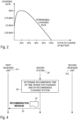
- Fig. 2 shows, as a non-limiting example, a schematic charging curve of a typical electric vehicle 14.x for a high-powered DC charging station 12.x.
- This charging station 12.x may support, for example, a maximum charging rate of 250 kW, but the battery 16.x can only be charged at this maximum rate under a narrow range of conditions, such as when the state of charge of the battery 16.x is between 5% and 25%. If the state of charge of the battery 16.x is higher than about 25%, then the permissible charging rate gradually drops until it reaches only a small percentage of the maximum charging rate when the state of charge is close to 100%. Further factors such as the temperature of the battery 16.x also influence the permissible charging rate; these factors are not shown in Fig. 2 . As a rule of thumb, a typical electric vehicle 14.x supports good charging rates when the state of charge is between 10% and 60%.
- Each vehicle model and configuration has its own specific charging curve, which is carefully determined by the vehicle manufacturer to balance disparate requirements, such as the requirement for rapid charging and the requirement to avoid premature wear of the battery 16.x.
- the vehicle's charging curve and further information such as the dependency of the charging curve from the vehicle's current battery temperature are available to the server system 20 as additional information 26 or information stored in the database 28.
- an essentially empty battery 16.x can be charged to around 50% capacity in 15 minutes, while it takes more than 40 minutes to achieve an above 90% charge state. If a single vehicle 14.x is to be charged at an available charging station 12.x, then a determination when to end the charging operation can be made solely based on factors such as the remaining distance to the destination, a battery state preselected at the client side, the next charging station on a preselected route, and/or any of a wide variety of further influencing factors.
- the situation is more difficult if multiple vehicles 14.x of a fleet are to be charged while there is a shortness of available charging stations 12.x.
- both the first vehicle 14.1 and the second vehicle 14.2 should be charged at the first charging station 12.1, as the second charging station 12.2 may be out of order or not be available to the fleet operator.
- the result of this determination may be that it is preferable to stop the charging operation of the first vehicle 14.1 relatively early (i.e., while the permissible charging rate is still high), and switch to charging the second vehicle 14.2.
- the vehicles 14.1 and 14.2 can be charged to 50% of their capacity in a total of 30 minutes, while it would take considerably longer to charge the first vehicle 14.1 to 70% of its capacity and the second vehicle 14.2 to 30% of its capacity.
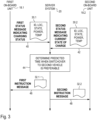
- Fig. 3 shows an exemplary process for facilitating efficient charging according to embodiments of the present disclosure.
- the process shown in Fig. 3 starts in a situation in which the first vehicle 14.1 is being charged at the first charging station 12.1 and the second vehicle 14.2 needs to be charged. It is assumed that only the first charging station 12.1 is available for charging the second vehicle 14.2.
- the second vehicle 14.2 may be located near the first charging station 12.1 or at some distance.
- each first status message 30.1 includes identifying information and indicates a charging status of the ongoing charging operation of the first vehicle 14.1.
- the first charging message 30.1 includes, without limitation, the following pieces of information:
- first status messages 30.1 may use first status messages 30.1 which include additional and/or different pieces of information.
- the first charging messages 30.1 may be sent at regular time intervals during the ongoing charging operation, or they may be sent in response to certain triggering events, such as whenever an additional percentage point of electrical energy has been charged into the battery 16.1 of the first vehicle 14.1.
- the server system 20 further receives, in step 42, a second status message 30.2 from the second vehicle 14.2.
- the second status message 30.2 comprises information necessary or desirable for the determination whether, and at what predicted time, it is preferable to charge the second vehicle 14.2 instead of the first vehicle 14.1.
- the pieces of information provided in the second status message 30.2 may be similar to the ones provided in the first status message 30.1, except for differences caused by the fact that there is no ongoing operation of charging the second vehicle 14.2.
- the second status message 30.2 may comprise the following pieces of information:
- the invention also comprises embodiments in which the second status message 30.2 comprises only a minimal amount of information, and even embodiments which do not require second status messages 30.2 to be sent in all circumstances. For example, if there are several vehicles 14.x in a parking lot of a fleet operator on a workday morning, it may be assumed that all of these vehicles 14.x should be charged even if no explicit second status messages 30.2 are sent. As another example, the current state of charge of each battery 16.x of each vehicle 14.x may be available in the database 28 from other sources and may be sufficient information so that no second status messages 30.2 are necessary.
- Step 44 shown in Fig. 3 involves the server system 20 determining a predicted time when it would be preferable to switch over the charging operation at the first charging station 12.1 from charging the first vehicle 14.1 to charging the second vehicle 14.2.
- one important factor for this determination in step 44 is a determination how charging the second vehicle 14.2 instead of the first vehicle 14.1 would affect utilization of a charging capacity of the first charging station 12.1, given the respective charging curves for the first and second vehicles 14.1, 14.2 as shown in Fig. 2 .
- the actual charging rate of the first vehicle 14.1 becomes lower and lower during the ongoing charging operation, it becomes more and more attractive to switch to charging the second vehicle 14.2 which can be expected to make better use of the charging capacity of the first charging station 12.1.
- maximizing utilization of the charging capacity of the first charging station 12.1 is not the only factor taken into account in the determination of the predicted time in step 44.
- This minimum amount may be a threshold which applies to all vehicles 14.x - such as charging to at least 50% capacity -, or it may be an amount individually determined for each vehicle 14.x - such as an amount based on the distance of a particular vehicle 14.x to its intended destination or to the next charging station 12.x on the way. For example, if the intended destination of the first vehicle 14.1 requires a 60% state of charge, then it may be preferable to charge the first vehicle 14.1 to a bit more than 60% even if this will lead to a slightly lower overall utilization of the first charging station 12.1.
- the predicted time determined in step 44 is a time in the future.
- the server system 20 extrapolates the expected charging rate based on the vehicle's charging curve and further available information, and predicts a future time when it will become preferable to change over from charging the first vehicle 14.1 to charging the second vehicle 14.2.
- step 44 may also include the server system 20 extrapolating the future development of the state of charge of the battery 16.2 of the second vehicle 14.2.
- Determining a time in the future as the predicted time has the benefit that it allows the drivers of both vehicles 14.1, 14.2 to prepare for switching over the charging operation. For example, the drivers may have sufficient time to return to their respective vehicles 14.1, 14.2 and perform any necessary actions to be ready for the switchover as soon as the predicted point in time arrives. This may also involve the driver of the second vehicle 14.2 queueing for use of the first charging station 12.1 after the first vehicle 14.1. This avoids the risk that another vehicle might block the first charging station 12.1 if the first vehicle 14.1 leaves before the second vehicle 14.2 arrives.
- the time interval by which the predicted time is in the future is fixed and may be, for example and without limitation, 5 minutes or 10 minutes. In other embodiments, the time interval may depend on one or more further factors, such as the duration of the charging operation so far (which influences the likelihood that the driver of the first vehicle 14.1 might have left the vehicle), or a determination whether the drivers are present in their respective vehicles 14.1, 14.2, or a size of the overall charging installation 10. Furthermore, in embodiments in which the second vehicle 14.2 might still be driving when the determination is made, the time interval may depend on the distance between the second vehicle 14.2 and the first charging station 12.1, so that there is sufficient time available for the second vehicle 14.2 to arrive at the first charging station 12.1 before the predicted time.
- the invention further comprises embodiments in which the predicted time is the present time, with the consequence that the switchover should be made as soon as the predicted time is determined in step 44. This may render the prediction process more accurate, but it may make the switchover more prone to mishaps, as exemplified above.
- the predicted time is communicated to the first and second on-board units 18.1, 18.2. More in detail, the server system 20 transmits a first instruction message 32.1 to the first on-board unit 18.1, and further transmits a second instruction message 32.2 to the second on-board unit 18.2.
- the on-board units 18.1, 18.2 may consist of or comprise any device that is part of or located in the vehicle 14.1, 14.2, as well as any device associated with a respective driver or passenger of the vehicle 14.1, 14.2, including a smartphone.
- the invention comprises embodiments in which both the first and the second instruction messages 31.1, 31.2 are being sent, as well as embodiments which employ only a first instruction message 31.1 sent to the first on-board unit 18.1, and embodiments which employ only a second instruction message 32.2 sent to the second on-board unit 18.2.
- embodiments are feasible because, in some cases, the instructions to one of the drivers of one of the vehicles 14.1, 14.2 may be conveyed by other means, such as via the driver of the other one of the vehicles 14.1, 14.2.
- the first instruction message 32.1 indicates that the ongoing operation of charging the first vehicle 14.1 is to be stopped at the predicted time.
- the first instruction message 32.1 may be a human-readable message and may just ask the driver of the first vehicle 14.1 to stop the ongoing charging operation and make the first charging station 12.1 available for the second vehicle 14.2.
- the server 20 and/or the first on-board unit 18.1 may send one or more reminder messages as the predicted time is approaching, and may request and process an acknowledgement action from the driver of the first vehicle 14.1.
- the first instruction message 32.1 may also be processed automatically, so that the ongoing charging operation is stopped at the predicted time.
- the second instruction message 32.2 sent in step 48 indicates that a new operation of charging the second vehicle 14.2 at the first charging station 12.1 is to be commenced at the predicted time.
- the second instruction message 32.2 may be human-readable, automatically processed, or both.
- the second instruction message 32.2 may comprise location information of the first charging station 12.1, and may be used to automatically program a navigation facility of the second vehicle 14.2 with the first charging station 12.1 as a destination.
- the second vehicle 14.2 may then use fully or partially autonomous driving functions to navigate to the first charging station 12.1.
- the first instruction message 32.1 and/or the second instruction message 32.2 may be sent, in different embodiments, either at the predicted time or some time interval earlier, to allow the drivers of both vehicles 14.1, 14.2 to prepare for the switchover, and to allow, if applicable, the second vehicle 14.2 to reach the first charging station 12.1 at the predicted time.
- the server system 20 can be configured so that it not only determines a predicted time for switching between vehicles 14.x in a charging process, but also determines a recommended time or time interval when charging an electric vehicle 14.x would be particularly economical.
- This aspect is also considered as new and non-obvious in its own right, no matter whether or not the further functionality related to the switchover operation is present.
- the combination of both aspects is especially beneficial, as there may be a marked shortage of charging stations 12.x if many vehicles 14.x of a fleet are to be charged at or around a recommended time when charging is particularly economical.
- Determining a recommended time or time period for a charging operation is based on the observation that today's electrical grids use more and more energy from renewable sources. This leads to huge swings in electricity prices.
- operators of conventional power plants e.g., gas, coal, nuclear, etc.
- Shutting down a coal plant takes more than 35 minutes and is associated with high costs. Therefore, operators of such power plants prefer selling at a negative price than powering the plant down for a short period of time.
- Fig. 4 shows an exemplary process in which the server system 20 determines, in step 50, a recommended time or time period for commencing the operation of charging the first vehicle 14.1 at the first charging station 12.1.
- the recommended time is communicated to the on-board unit 18.1 of the first vehicle 12.1 via a recommendation message 54.
- the recommendation message 54 may alternatively or additionally be sent to a driver of the first vehicle 14.1 or to another person (e.g., an authorized person of a fleet operator) by other means, such as to the driver's or other person's smartphone. It is apparent that the process shown in Fig.
- recommendation message 54 which may contain identical or different (e.g., staggered) recommended times - may be sent with respect to many further vehicles 14.x, such as all vehicles of a particular fleet.
- the recommendation message 54 may also contain information which charging station 12.x a particular vehicle 14.x should use.
- the determination in step 50 may occur prior to the operations shown in Fig. 3 in embodiments which combine both aspects.
- the process of Fig. 4 is also regarded an invention in its own right, i.e., without the further operations of Fig. 3 .
- the determination in step 50 uses one or more or all of the following pieces of information:
- the above pieces of information are available to the server system 20 as parts of the additional information 26 or from the database 28.
- the server system 20 monitors the first vehicle 14.1 or all vehicles 14.x of a fleet so that the state of charge of each monitored vehicle 14.x is known. This state of charge is then matched to a prediction of low energy electricity prices in the next 24 hours based on, for example and without limitation, EPEX (European Power Exchange) prices and/or local weather predictions. This enables a recommendation of which charging station 12.x to visit in the next 24 hours.
- the determination in step 50 can also be used to reserve a charging station 12.x and set up any pre-authorizations needed for payment so the users can just drive and use the charging station 12.x at the time needed.
- the server system 20 monitors a large number of vehicles 14.x in a particular locality and information about the activity on a plurality of charging stations 12.x is known, a fair allocation can be proposed even if only a limited number of charging stations 12.x are available at a geographically close charging installation 10 and a distribution of vehicles 14.x to other charging stations at other installations further away makes economic sense.
- server system 20 has access to many electric vehicles 14.x across a region the behavior of many drivers is known (so-called swarm intelligence). This behavior can be taken into account when making the prediction in step 50.
- the server system 20 maintains data of how much electric charge a fleet user needs every day. If this is, for example, just 60% of the maximum charge, then on a predicted expensive day the recommendation message 54 can instruct the driver and/or the vehicle 14.x to charge only to 60%, while on other cheaper days the driver and/or the vehicle 14.x will be instructed to charge to 100% so that an energy reserve will be available for expensive days.
Landscapes
- Engineering & Computer Science (AREA)
- Power Engineering (AREA)
- Transportation (AREA)
- Mechanical Engineering (AREA)
- Life Sciences & Earth Sciences (AREA)
- Sustainable Development (AREA)
- Sustainable Energy (AREA)
- Electric Propulsion And Braking For Vehicles (AREA)
- Charge And Discharge Circuits For Batteries Or The Like (AREA)
Priority Applications (1)
| Application Number | Priority Date | Filing Date | Title |
|---|---|---|---|
| EP23207222.3A EP4549232A1 (fr) | 2023-10-31 | 2023-10-31 | Charge d'une pluralité de véhicules électriques |
Applications Claiming Priority (1)
| Application Number | Priority Date | Filing Date | Title |
|---|---|---|---|
| EP23207222.3A EP4549232A1 (fr) | 2023-10-31 | 2023-10-31 | Charge d'une pluralité de véhicules électriques |
Publications (1)
| Publication Number | Publication Date |
|---|---|
| EP4549232A1 true EP4549232A1 (fr) | 2025-05-07 |
Family
ID=88647468
Family Applications (1)
| Application Number | Title | Priority Date | Filing Date |
|---|---|---|---|
| EP23207222.3A Pending EP4549232A1 (fr) | 2023-10-31 | 2023-10-31 | Charge d'une pluralité de véhicules électriques |
Country Status (1)
| Country | Link |
|---|---|
| EP (1) | EP4549232A1 (fr) |
Citations (1)
| Publication number | Priority date | Publication date | Assignee | Title |
|---|---|---|---|---|
| EP2768693B1 (fr) * | 2011-10-19 | 2019-05-29 | Nec Corporation | Procédé, système et station de charge pour charger des véhicules électriques |
-
2023
- 2023-10-31 EP EP23207222.3A patent/EP4549232A1/fr active Pending
Patent Citations (1)
| Publication number | Priority date | Publication date | Assignee | Title |
|---|---|---|---|---|
| EP2768693B1 (fr) * | 2011-10-19 | 2019-05-29 | Nec Corporation | Procédé, système et station de charge pour charger des véhicules électriques |
Similar Documents
| Publication | Publication Date | Title |
|---|---|---|
| US20170043671A1 (en) | Control system for electric vehicle service network | |
| US11584237B2 (en) | Mobile internet-based integrated vehicle energy replenishment system and method, and storage medium | |
| US9626823B2 (en) | System and method of predicting future demand of a charging station | |
| Yuan et al. | p^ 2charging: Proactive partial charging for electric taxi systems | |
| US6826460B2 (en) | Range prediction in fleet management of electric and fuel-cell vehicles | |
| US10112497B2 (en) | System and method of monitoring usage of a charging station | |
| US20150294329A1 (en) | System and method of predicting usage of a charging station | |
| CN110081900A (zh) | 一种充电桩智能推荐方法、装置、服务终端和存储介质 | |
| US9744873B2 (en) | Method and control device for charging a battery of a vehicle | |
| US20160280089A1 (en) | Grid overlay for a zip coded map system and method therefor | |
| JP6997289B2 (ja) | 電力管理システム、およびプログラム | |
| JP2019095196A (ja) | 充電設備案内システム、充電設備案内方法及びプログラム | |
| CN114298559A (zh) | 换电站的换电方法、换电管理平台及存储介质 | |
| CN111055716B (zh) | 确定充电策略的方法及装置、存储介质与处理器 | |
| CN106004725A (zh) | 车载终端和有序充电方法 | |
| CN117455253A (zh) | 电量预测模型的构建及充电控制方法、系统、设备和介质 | |
| EP4549232A1 (fr) | Charge d'une pluralité de véhicules électriques | |
| CN108229708B (zh) | 基于无人机的预约充电方法和装置 | |
| CN120517251A (zh) | 车队充电站系统和方法 | |
| JP7621527B2 (ja) | 情報処理装置、情報処理方法及びプログラム | |
| CN108216623B (zh) | 基于无人机的信息显示方法和装置 | |
| JP6719501B2 (ja) | バッテリー交換料金決定システム | |
| US20240408994A1 (en) | System and method for optimizing an on-demand transport arrangement service for recharging of vehicles | |
| CN118618112B (zh) | 一种bms充放电控制方法、装置及存储介质 | |
| CN119250806B (zh) | 基于共享的维保推荐方法、装置、电子设备及存储介质 |
Legal Events
| Date | Code | Title | Description |
|---|---|---|---|
| PUAI | Public reference made under article 153(3) epc to a published international application that has entered the european phase |
Free format text: ORIGINAL CODE: 0009012 |
|
| STAA | Information on the status of an ep patent application or granted ep patent |
Free format text: STATUS: THE APPLICATION HAS BEEN PUBLISHED |
|
| AK | Designated contracting states |
Kind code of ref document: A1 Designated state(s): AL AT BE BG CH CY CZ DE DK EE ES FI FR GB GR HR HU IE IS IT LI LT LU LV MC ME MK MT NL NO PL PT RO RS SE SI SK SM TR |
|
| STAA | Information on the status of an ep patent application or granted ep patent |
Free format text: STATUS: REQUEST FOR EXAMINATION WAS MADE |
|
| 17P | Request for examination filed |
Effective date: 20251105 |