EP4549274A1 - Verfahren zum ermitteln einer anweisung zum zumindest teilweisen autonomen steuern des fahrens eines ego-fahrzeugs bei einem überholvorgang - Google Patents
Verfahren zum ermitteln einer anweisung zum zumindest teilweisen autonomen steuern des fahrens eines ego-fahrzeugs bei einem überholvorgang Download PDFInfo
- Publication number
- EP4549274A1 EP4549274A1 EP23207721.4A EP23207721A EP4549274A1 EP 4549274 A1 EP4549274 A1 EP 4549274A1 EP 23207721 A EP23207721 A EP 23207721A EP 4549274 A1 EP4549274 A1 EP 4549274A1
- Authority
- EP
- European Patent Office
- Prior art keywords
- vehicle
- data
- ego
- ego vehicle
- detection
- Prior art date
- Legal status (The legal status is an assumption and is not a legal conclusion. Google has not performed a legal analysis and makes no representation as to the accuracy of the status listed.)
- Pending
Links
Images

Classifications
-
- B—PERFORMING OPERATIONS; TRANSPORTING
- B60—VEHICLES IN GENERAL
- B60W—CONJOINT CONTROL OF VEHICLE SUB-UNITS OF DIFFERENT TYPE OR DIFFERENT FUNCTION; CONTROL SYSTEMS SPECIALLY ADAPTED FOR HYBRID VEHICLES; ROAD VEHICLE DRIVE CONTROL SYSTEMS FOR PURPOSES NOT RELATED TO THE CONTROL OF A PARTICULAR SUB-UNIT
- B60W30/00—Purposes of road vehicle drive control systems not related to the control of a particular sub-unit, e.g. of systems using conjoint control of vehicle sub-units
- B60W30/14—Adaptive cruise control
- B60W30/16—Control of distance between vehicles, e.g. keeping a distance to preceding vehicle
-
- B—PERFORMING OPERATIONS; TRANSPORTING
- B60—VEHICLES IN GENERAL
- B60W—CONJOINT CONTROL OF VEHICLE SUB-UNITS OF DIFFERENT TYPE OR DIFFERENT FUNCTION; CONTROL SYSTEMS SPECIALLY ADAPTED FOR HYBRID VEHICLES; ROAD VEHICLE DRIVE CONTROL SYSTEMS FOR PURPOSES NOT RELATED TO THE CONTROL OF A PARTICULAR SUB-UNIT
- B60W30/00—Purposes of road vehicle drive control systems not related to the control of a particular sub-unit, e.g. of systems using conjoint control of vehicle sub-units
- B60W30/10—Path keeping
- B60W30/12—Lane keeping
-
- B—PERFORMING OPERATIONS; TRANSPORTING
- B60—VEHICLES IN GENERAL
- B60K—ARRANGEMENT OR MOUNTING OF PROPULSION UNITS OR OF TRANSMISSIONS IN VEHICLES; ARRANGEMENT OR MOUNTING OF PLURAL DIVERSE PRIME-MOVERS IN VEHICLES; AUXILIARY DRIVES FOR VEHICLES; INSTRUMENTATION OR DASHBOARDS FOR VEHICLES; ARRANGEMENTS IN CONNECTION WITH COOLING, AIR INTAKE, GAS EXHAUST OR FUEL SUPPLY OF PROPULSION UNITS IN VEHICLES
- B60K2310/00—Arrangements, adaptations or methods for cruise controls
- B60K2310/26—Distance setting methods, e.g. determining target distance to target vehicle
- B60K2310/264—Distance setting methods, e.g. determining target distance to target vehicle changing distance, e.g. reducing the distance for overtaking
-
- B—PERFORMING OPERATIONS; TRANSPORTING
- B60—VEHICLES IN GENERAL
- B60W—CONJOINT CONTROL OF VEHICLE SUB-UNITS OF DIFFERENT TYPE OR DIFFERENT FUNCTION; CONTROL SYSTEMS SPECIALLY ADAPTED FOR HYBRID VEHICLES; ROAD VEHICLE DRIVE CONTROL SYSTEMS FOR PURPOSES NOT RELATED TO THE CONTROL OF A PARTICULAR SUB-UNIT
- B60W2554/00—Input parameters relating to objects
- B60W2554/40—Dynamic objects, e.g. animals, windblown objects
- B60W2554/404—Characteristics
- B60W2554/4045—Intention, e.g. lane change or imminent movement
-
- B—PERFORMING OPERATIONS; TRANSPORTING
- B60—VEHICLES IN GENERAL
- B60W—CONJOINT CONTROL OF VEHICLE SUB-UNITS OF DIFFERENT TYPE OR DIFFERENT FUNCTION; CONTROL SYSTEMS SPECIALLY ADAPTED FOR HYBRID VEHICLES; ROAD VEHICLE DRIVE CONTROL SYSTEMS FOR PURPOSES NOT RELATED TO THE CONTROL OF A PARTICULAR SUB-UNIT
- B60W2554/00—Input parameters relating to objects
- B60W2554/80—Spatial relation or speed relative to objects
- B60W2554/802—Longitudinal distance
-
- B—PERFORMING OPERATIONS; TRANSPORTING
- B60—VEHICLES IN GENERAL
- B60W—CONJOINT CONTROL OF VEHICLE SUB-UNITS OF DIFFERENT TYPE OR DIFFERENT FUNCTION; CONTROL SYSTEMS SPECIALLY ADAPTED FOR HYBRID VEHICLES; ROAD VEHICLE DRIVE CONTROL SYSTEMS FOR PURPOSES NOT RELATED TO THE CONTROL OF A PARTICULAR SUB-UNIT
- B60W2720/00—Output or target parameters relating to overall vehicle dynamics
- B60W2720/10—Longitudinal speed
- B60W2720/106—Longitudinal acceleration
-
- B—PERFORMING OPERATIONS; TRANSPORTING
- B60—VEHICLES IN GENERAL
- B60W—CONJOINT CONTROL OF VEHICLE SUB-UNITS OF DIFFERENT TYPE OR DIFFERENT FUNCTION; CONTROL SYSTEMS SPECIALLY ADAPTED FOR HYBRID VEHICLES; ROAD VEHICLE DRIVE CONTROL SYSTEMS FOR PURPOSES NOT RELATED TO THE CONTROL OF A PARTICULAR SUB-UNIT
- B60W2754/00—Output or target parameters relating to objects
- B60W2754/10—Spatial relation or speed relative to objects
- B60W2754/30—Longitudinal distance
-
- B—PERFORMING OPERATIONS; TRANSPORTING
- B60—VEHICLES IN GENERAL
- B60W—CONJOINT CONTROL OF VEHICLE SUB-UNITS OF DIFFERENT TYPE OR DIFFERENT FUNCTION; CONTROL SYSTEMS SPECIALLY ADAPTED FOR HYBRID VEHICLES; ROAD VEHICLE DRIVE CONTROL SYSTEMS FOR PURPOSES NOT RELATED TO THE CONTROL OF A PARTICULAR SUB-UNIT
- B60W2756/00—Output or target parameters relating to data
- B60W2756/10—Involving external transmission of data to or from the vehicle
Definitions
- the present disclosure relates to a method for determining an instruction for at least partially autonomically controlling driving of an ego vehicle in an overtaking maneuver involving two or more further vehicles in a vicinity of the ego vehicle, a data processing apparatus, a vehicle, and a computer program product.
- Overtaking is a problematic maneuver when driving a vehicle because it is a major cause of traffic accidents.
- Statistically, more than 70% of overtaking accidents are caused by human factors due to lack of experience, psychological factors, little safety distance, and speed judgment errors.
- External factors e.g., icy pavements, slippery roads, and poor road condition, may contribute to the causing of an accident when overtaking.
- Automated vehicles can employ different sensors and cameras for detection of road condition, road objects and road participants. Based on such data, automated vehicles may evaluate a current driving situation and perform an overtaking maneuver with as little risk as possible such that it is ensured that no traffic accident occurs. This mostly rules out overtaking accidents due to the factors mentioned above.
- a method for determining an instruction for at least partially autonomically controlling driving of an ego vehicle in an overtaking maneuver involving two or more further vehicles in a vicinity of the ego vehicle comprising:
- the method is based on the finding of the inventors that while an at least partially autonomically controlled ego vehicle may not safely perform overtaking maneuvers itself, such ego vehicle may provide assistance to further or, in other words, other vehicles, which are involved in an overtaking maneuver.
- This assistance may be provided in the form of the instruction for the at least partially autonomically controlled ego vehicle, which, when being carried out, causes the ego vehicle to be at least partially autonomically controlled in its driving.
- the instruction and thereby the driving performed by the ego vehicle depends on the first data and the second data and thereby on the overtaking maneuver as being indicated by the first data and the second data.
- the traffic safety may be increased for the further vehicles, the ego vehicle itself and/or any other vehicles in the vicinity by reducing the risk that an accident between the further vehicles and/or the ego vehicle occurs.
- the ego vehicle may be an at least partially autonomically controlled vehicle.
- the ego vehicle may be an at least partially automated or autonomous vehicle.
- the vehicle may comprise at least one or several (advanced) driver assistance functions or systems such as but not limited to cruise control, adaptive cruise control, collision avoidance system, emergency driver assistance, lance control and/ or lane change assistance.
- the at least partially autonomically controlling of the driving of the ego vehicle based on the instruction may be any control by any one or a combination of the aforementioned functions or systems.
- the at least partially autonomically controlling of the driving of the ego vehicle may be a change in speed, e.g., decrease or increase, e.g., by breaking or accelerating, a change in distance to a road object or other road participant, e.g., other vehicle, a change of driving trajectory, a lane centering or lane diversion to the edge of the lane by the lane control, a lane change, any combination of the aforesaid and similar.
- the ego vehicle may also be an autonomically controlled vehicle or, in other words, an automated or autonomous vehicle of any automated level.
- the driving of the vehicle may be fully controlled by the vehicle. This may also be referred to unsupervised driving.
- any of the first vehicle, the second vehicle or any other of the vehicles in the further vehicles may be manually or at least partially autonomically controlled vehicles. Accordingly, any one of the further vehicles may have or may not have driver assistance functions or systems as specified above.
- the vicinity of the ego vehicle, in which the further vehicles are, may be defined by a detection range or detection area of the detection system of the ego vehicle. Accordingly, the ego vehicle may perform the method for any further vehicles in its detection range or detection area.
- the method may be at least partly computer-implemented, and may be implemented in software or in hardware, or in software and hardware. For example, one, multiple or all of the steps of the method may be carried out by a computer, which may be from the ego vehicle. For example, the obtaining of the first data, obtaining of the second data and the determining of the instruction may be carried out by such computer or different computers. Further, the method may be carried out by computer program instructions running on means that provide data processing functions.
- the data processing means may be a suitable computing means, such as an electronic control module etc., which may also be a distributed computer system.
- the data processing means or the computer, respectively, may comprise one or more of a processor, a memory, a data interface, or the like.
- the method may comprise further steps to carry out at least partially autonomically controlling of the driving of the ego vehicle based on the determined instruction.
- the method may comprise providing the instruction to and/or receiving the instruction by a data processing apparatus, in particular a computer and/or control unit, of the ego vehicle for at least partially autonomically controlling the driving of the ego vehicle.
- the method may comprise carrying out the instruction by the data processing apparatus.
- the method may comprise at least partially autonomically controlling the driving of the ego vehicle based on the instruction.
- the obtaining of the first data and/or second data may in particular be a determination of the respective data.
- the first data being indicative of the overtaking maneuver may comprise an evaluation of the respective detection of the first vehicle and, optionally, any other of the further vehicles mentioned herein in order to determine whether an overtaking maneuver is taking place or not.
- the determination of the second data may include the determination of the position of the ego vehicle and, optionally, any other positions mentioned herein. Further detailed examples of the obtaining steps and the determining step of the method are given below.
- the first data may be further based on a detection of the second vehicle by the detection system.
- the overtaking maneuver may be better evaluated for determining an appropriate instruction and thereby at least partial autonomic control of the driving of the ego vehicle to assist the overtaking maneuver.
- the first data may be determined based on a detection of at least one of a position, a speed, a driving direction and signaling of the first vehicle.
- the first data may be determined based on a detection of at least one of a position, a speed and a driving direction of the second vehicle by the detection system.
- the position of the first vehicle and/or the second vehicle may be a relative and/or absolute position.
- the speed of the first vehicle and/or second vehicle may be determined by determining the position of the first vehicle and/or second vehicle at at least two different times, in particular by continuously monitoring the position and therefrom calculating the speed.
- the driving direction may be calculated similar to the speed and based on the own driving direction of the ego vehicle, for example.
- the signaling of the first vehicle may for example be an acoustical and/or optical signaling, e.g. by a horn and/or indicator light of the first vehicle. Such signaling may be included in the first data by means of a camera and/or microphone of the detection system detecting the signaling.
- the signaling may be an indication that the first vehicle is about to overtake the second vehicle.
- the indication of the overtaking maneuver is not limited to being based on such signaling as is apparent from the different data types relating to the first vehicle and/or the second vehicle, e.g., position, speed, driving direction and signaling, which the first data may comprise. Based on any one or multiple of the aforementioned different data types, the first data may be indicative of the overtaking maneuver.
- a position of the first vehicle adjacent the second vehicle and a speed of the first vehicle being higher than the speed of the second vehicle may be indicative of the overtaking maneuver without requiring the signaling.
- multiple or all of the aforementioned data types may be used to more accurately indicate the overtaking maneuver.
- the second data may be further indicative of the position of the ego vehicle relative to the second vehicle based on the detection of the second vehicle by the detection system. For example, it may be sufficient to obtain first data having a relative position of the first vehicle and/or the second vehicle to the ego vehicle. However, it may additionally or alternatively be provided that the first data has absolute positions of the first vehicle and/or second vehicle.
- such absolute positions may be determined by determining the GPS position of the ego vehicle by means of a GPS unit of the ego vehicle, which may be part of the detection system, and calculating the GPS position of the first vehicle and/or second vehicle based on the position of the first vehicle and/or second vehicle relative to the ego vehicle, as may be determined by one or more detection units of the detection system, e.g., by one or more cameras.
- the second data may be indicative of a position of the ego vehicle in a lane behind the first vehicle
- the instruction may be configured for decelerating the ego vehicle by at least partially autonomically controlling the driving of the ego vehicle.
- the instruction allows for the ego vehicle to increase its distance from the first vehicle and the second vehicle, which is about to be overtaken by the first vehicle. The increased distance creates more space between the ego vehicle and second vehicle, into which the first vehicle may merge when the overtaking of the second vehicle becomes too dangerous, e.g., due to opposing traffic in case the first vehicle is driving on the lane of the opposing traffic during the overtaking maneuver.
- the created space allows the first vehicle to abort the overtaking maneuver safely merge into the space without a risk of collision with the ego vehicle. Thereby, the first vehicle may avoid a collision with opposing traffic in case the first vehicle is driving on the lane of the opposing traffic during the overtaking maneuver.
- the second data may be based on a detection of at least one of a distance between the ego vehicle and the first vehicle, a lane of the ego vehicle and a lane of the first vehicle by the detection system. Additionally, the second data may be based on a detection of at least one of a distance between the ego vehicle and the second vehicle and a lane of the second vehicle by the detection system.
- the instruction may be based on the position of the respective vehicles, i.e., ego vehicle, first vehicle and/or second vehicle, on the respective lanes of the road in the vicinity of the ego vehicle or, in other words, the road being travelled by these vehicles.
- the detection of the lanes may include their relative positioning on the road and/or the intended travel direction.
- the overtaking maneuver may be particularly accurately evaluated. For example, if it is determined that the second vehicle is travelling in the wrong direction on a lane, this may be seen as determinant for the overtaking maneuver and/or determining the instruction.
- the instruction may be configured for lateral movement of the ego vehicle towards an edge of its lane by at least partially autonomically controlling the driving of the ego vehicle.
- the ego vehicle may laterally move towards that edge of its lane for giving the first vehicle a better view on a lane with opposing traffic.
- the ego vehicle may assist the first vehicle in its overtaking maneuver when the ego vehicle is located in front of the first vehicle. With the better view, the first vehicle may make a better judgement on when to start the overtaking maneuver.
- Any herein described configuration of the instruction may be alternative or in addition to any other one of the herein described configurations of the instruction.
- the instruction may be configured to increase a distance between the ego vehicle and the first vehicle by at least partially autonomically controlling the driving of the ego vehicle. This may be done by accelerating or decelerating the ego vehicle and/or a lane switch operation of the ego vehicle, for example, and depend on the relative position of the ego vehicle with respect to the first vehicle and/or the second vehicle.
- the first data may be indicative of opposing traffic in the overtaking maneuver, in which the first vehicle is about to overtake the second vehicle on a lane with the opposing traffic from a third vehicle of the further vehicles. Further, the first data may be based on a detection of the third vehicle by the detection system, and the second data may further be indicative of a position of the ego vehicle relative to the third vehicle based on the detection of the third vehicle by the detection system. Where opposing traffic from a third vehicle is involved, there may be an increased risk for an accident.
- the first data may in particular be further determined based on a detection of at least one of a position, a speed, a driving direction and signaling of the third vehicle.
- the method may further comprise transmitting an indication of the overtaking maneuver based on the first data and second data to the third vehicle via a wireless communication system of the ego vehicle.
- the third vehicle may be notified by the ego vehicle of the overtaking maneuver and the potentially dangerous situation.
- the indication of the overtaking maneuver may comprise a notification relating to the first vehicle driving on the lane of the third vehicle, the first data and/or second data as such and/or an instruction for the third vehicle, e.g., to slow down or perform emergency braking, which may be based on an evaluation of the first data and/or second data of the method, for example.
- the detection system may comprise one or more of a LiDAR system, a radar system, a camera system, an ultrasonic system, and a communication system for vehicle-to-everything communication.
- a LiDAR system a LiDAR system
- a radar system a radar system
- a camera system a camera system
- an ultrasonic system a communication system for vehicle-to-everything communication.
- Each one of the aforementioned systems may comprise one or more detection units.
- the camera system may comprise multiple camera units as detection units arranged at different locations of the ego vehicle for increased detection radius.
- the wireless communication system may comprise a transmitting detection unit and/or a receiving detection unit for the vehicle-to-everything communication and vice versa.
- a data processing apparatus comprising means for carrying out the method of the first aspect of this disclosure.
- the data processing apparatus may be a computer, in particular of or for the ego vehicle, for example.
- a vehicle comprising the data processing apparatus of the second aspect of this disclosure.
- a computer program product comprising instructions which, when the program is executed by a computer, cause the computer to carry out the method of the first aspect of this disclosure.
- the computer program product may be a computer program as such or a product, e.g., a computer-readable storage medium, comprising the computer program.
- the computer program product may comprise different modules for carrying out the respective steps of the method of the first aspect of this disclosure.
- the computer program product may comprise one or two obtaining modules for obtaining the first data and/or the second data, and/or one or more determining modules for determining the instruction. Any of the herein mentioned steps of the method may be carried out by the aforementioned modules or any other modules, which may be provided specifically for carrying out the respective step.
- Figure 1 shows a method 100 for determining an instruction for at least partially autonomically controlling driving of an ego vehicle 10 in an overtaking maneuver involving two or more further vehicles 40, 42, 44 in a vicinity of the ego vehicle 10.
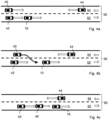
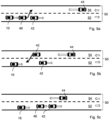
- Exemplary different driving scenarios with exemplary different overtaking maneuvers exemplary involving three further vehicles 40, 42, 44 are schematically illustrated in Figs. 4a to 4c and Figs. 5a to 5c .
- Figure 2 shows a schematic illustration of the ego vehicle 10 with its components.
- first data indicative of the overtaking maneuver in which a first vehicle 40 of the further vehicles 40, 42, 44 is about to overtake a second vehicle 42 of the further vehicles 40, 42, 44, based on a detection of the first vehicle 40 and optionally the second vehicle 42 and/or a third vehicle 44 by a detection system 20 of the ego vehicle 10 (see Fig. 2 ), is obtained, in particular by determination of a data processing apparatus 12.
- the first data may be determined based on a detection of at least one of a position, a speed, a driving direction and signaling of the first vehicle 40 and, optionally, of at least one of a position, a speed and a driving direction of the second vehicle 42 and/or the third vehicle 44 by the detection system 20.
- the detection system 20 may comprise one or more of the LiDAR system 21, radar system 22, camera system 23, ultrasonic system 24, and a wireless communication system 25 for vehicle-to-everything communication as shown in Fig. 2 .
- Step 102 may be carried out by the detection system 20 itself and/or the data processing apparatus 12 of the vehicle 10 as shown in Fig. 2 .
- Such data processing apparatus 12 may be a computer of the vehicle 10, for example.
- the data processing apparatus 12 may determine the first data indicative of the overtaking maneuver based on the detection of the first vehicle 40 and optionally the second vehicle 42 and/or the third vehicle 44 by the detection system 20.
- the detection system 20 may provide the data processing apparatus 12 with data relating to its detection.
- step 104 of method 100 following step 102, second data indicative of a position of the ego vehicle 10 relative to the first vehicle 40 based on the detection of the first vehicle 40 by the detection system 20 is obtained, in particular by determination of the data processing apparatus 12. Additionally, the first data may be determined such that it is further indicative of the position of the ego vehicle 10 relative to the second vehicle 42 and/or the third vehicle 44 based on the detection of the second vehicle 42 and/or the third vehicle 44 by the detection system 20.
- Step 104 may be carried out by the detection system 20 itself and/or a data processing apparatus 12 of the vehicle 10 as shown in Fig. 2 .
- the data processing apparatus 12 may determine the second data based on the detection of the first vehicle 40 by the detection system 20 and/or a known position of the ego vehicle 10, e.g., in the form of GPS data.
- the detection system 20 may provide the data processing apparatus 12 with data relating to its detection.
- the second data may be based on a detection of at least one of a distance between the ego vehicle 10 and the first vehicle 40 and, optionally the second vehicle 42, a lane 52, 54 of the ego vehicle 10, a lane 52, 54 of the first vehicle 40 and, optionally, a lane 52, 54 of the second vehicle 42 and/or the third vehicle 44 by the detection system 20.
- an instruction for at least partially autonomically controlling the driving of the ego vehicle 10 based on the first data and the second data may be determined.
- the ego vehicle 10 may be an at least partially autonomous or automated vehicle with one or more advanced driver assistant functions or systems.
- the instruction may be determined by the data processing apparatus 12.
- the instruction may be configured for reducing a risk of collision between any of the further vehicles 40, 42, 44 and/or the ego vehicle 10 based on the first data and the second data.
- the instruction is being carried out by the data processing apparatus 108, thereby at least partially autonomically controlling the driving of the ego vehicle 10 based on the instruction such that the risk of a collision of the further vehicles 40, 42, 44 and/or the ego vehicle 10 may be reduced.
- Figure 2 schematically illustrates the ego vehicle 10 and shows that the ego vehicle 10 may comprise a computer program product 14 besides the detection system 20 and the data processing apparatus 12.
- the computer program product 14 may be a computer program as such or a computer-readable storage medium having a computer program 30 stored thereon as shown in Fig. 2 .
- Such computer program 30 may be read and executed by the data processing apparatus 12, thereby causing the method 100 to be carried out.
- FIG. 3 illustrates an exemplary configuration of the computer program 30 in modules 31, 32, 33, 34, 35, specifically as software modules.
- the individual modules may be involved in the obtaining of the first data and/or second data and/or in the determining of the instruction, for example.
- the number and specification of modules 31, 32, 33, 34, 35 herein is merely exemplary and may be different. Accordingly, the detailed description of the steps 102, 104, 106, 108 are merely exemplary with reference to the modules 31, 32, 33, 34, 35 and may alternatively be applied independently from the modules 31, 32, 33, 34, 35 or the computer program 30 altogether.
- the first module 31 is configured for detecting an overtaking intention by the first vehicle 40. This may be done based on the detection of the first vehicle 40 and the second vehicle 42, for example. In particular, their detected position, speed, driving direction and/or signaling may be evaluated by the first module 31. In case the overtaking intention is determined by the first module 31 based on such evaluation, the second module 32 and/or the third module 33 may be activated.
- the first module 31 may comprise machine learning for learning different overtaking types, e.g., uniform overtaking or accelerated overtaking, thereby allowing for a better evaluation.
- the overtaking intention determination by the first module 31 may occur before obtaining the first data, such that the first data is indicative of the overtaking maneuver, e.g., by determining the first data, or after its obtaining or determination, e.g., when determining the instruction.
- the obtaining of the first data and/or the determining of the instruction may comprise a determination of the overtaking maneuver as an overtaking intention by the first vehicle 40, in particular based on an evaluation of the detection of the first vehicle 40 and/or second vehicle 42.
- the second module 32 is configured for tracking or, in other words, monitoring the first vehicle 40 and/or the second vehicle 42 by the detection system 20.
- the first vehicle 40 and/or the second vehicle 42 may be continuously, i.e., at different times, detected.
- the first data and/or second data may be continuously obtained and/or determined or, in other words, the first data and/or second data may be based on a continuous detection of the first vehicle 40, the second vehicle 42 and/or the third vehicle 44. As previously explained, this may include a detection of their position, speed and/or driving direction. This enables to determine the instruction, i.e., the driving operation or adaptation of the ego vehicle 10 that is best suited to assist the overtaking maneuver in real time.
- the third module 33 is configured to detect oncoming or, in other words, opposing traffic of the third vehicle 44 of the further vehicles 40, 42, 44. Similar to the first vehicle 40 and/or second vehicle 42, the first data may be based on a detection of the third vehicle 44, in particular its position, speed and/or driving direction, by the detection system 20. The third module 33 may further consider other factors such as the environment conditions e.g., road friction.
- the opposing traffic or third vehicle 44 may be tracked or, in other words, monitored by the detection system 20 similar to the tracking carried out by the second module 32.
- the fourth module 34 is configured to determine the instruction.
- the fourth module 34 may be configured for determining how the ego vehicle 10 is to adopt its driving behavior by determining the instruction for at least partially autonomically controlling the driving of the ego vehicle 10.
- the output, e.g., the evaluations, of all modules 31, 32, 33 may be provided to the fourth module 34 for this purpose.
- the fourth module 34 may determine one or more adjustments of a current trajectory of the ego vehicle 10, with the purpose to provide safer margins for the overtaking of the first vehicle 40 or to help it aborting the overtaking in a smooth manner.
- the fourth module 34 may not be activated. For example, if the first data is not obtained or determined indicative of the overtaking maneuver and/or if there is no risk of opposing traffic to the first vehicle 40, i.e., the third vehicle 44 is not detected, there may be no need for the ego vehicle 10 to adopt its driving.
- the fifth module 35 receives the instruction from the fourth module 34 and may carry out the step 108 of method 100 as previously explained.
- the fifth module 35 may be part of another computer program and/or use one or more other computer programs.
- the fifth module 35 may be implemented in hardware and/or software, e.g., it may be a control unit of the ego vehicle 10, for example.
- Fig. 4a shows a driving scenario with an overtaking maneuver of the first vehicle 40 on a second lane 54 with opposing traffic in form of the third vehicle 44, the first vehicle 40 intending to overtake the second vehicle 42 driving on the first lane 52 of the road 50.
- the ego vehicle 10 is driving in the first lane 52 in front of the second vehicle 42.
- the mandatory driving direction of the lanes 52, 54 is indicated by an arrow on the right end of the lanes 52, 54.
- the ego vehicle 10 will obtain the first data and second data. Based on the first data and second data, the ego vehicle 10 will know about the overtaking maneuver, e.g., by evaluating the position on the lanes of the further vehicles 40, 42, 44 and the distances relative to the ego vehicle 10, their speed and/or their driving direction, for example.
- the driving directions and/or trajectories of the vehicles 10, 40, 42, 44 are exemplary indicated by arrows.
- the ego vehicle 10 may determine that to assist the overtaking maneuver and to avoid any potentially dangerous situation involving the first vehicle 40 and the third vehicle 44 as opposing traffic, it needs to accelerate to gain distance from the second vehicle 42.
- Such driving of the ego vehicle 10 may be based on an at least partially autonomically control based on the determined instruction.
- the first vehicle 40 may be provided with an increased space or distance between the second vehicle 42 and the ego vehicle 10 as seen in Fig. 4b , which may be few milliseconds or seconds later in the driving scenario than Fig. 4a .
- the ego vehicle 40 may laterally move towards the edge of its lane 52 as exemplary shown for the ego vehicle 40 in Figs. 5a to 5c to increase the space between the second vehicle 42 and the ego vehicle 10.
- the first vehicle 40 may maneuver into this increased space case it is too dangerous for the first vehicle 40 to overtake both, the second vehicle 42 and the ego vehicle 10, e.g., due to too small distance between the first vehicle 40 and the third vehicle 44, a too low speed and/or acceleration of the first vehicle 40 and/or a too high speed and/or acceleration of the third vehicle 44, for example.
- Fig. 4c few milliseconds or seconds later than Fig. 4b , the first vehicle 40 maneuvered into the created or increased space between the second vehicle 42 and the ego vehicle 10, thereby avoiding an accident.
- FIG. 5a A different driving scenario with another exemplary overtaking maneuver is shown in Figs. 5a to 5c .
- the ego vehicle 10 is located on the first lane 52 behind the first vehicle 40 setting out to overtake the second vehicle 42 located in front of the first vehicle 40.
- the ego vehicle 10 may, based on the first data and second data, assess that the overtaking maneuver may be too dangerous and determine and carry out an instruction for at least partially autonomously controlling the driving of the ego vehicle 10 to ensure that the overtaking maneuver may be resolved without accident.
- the ego vehicle 10 decelerated, e.g., by braking, such that the distance between the ego vehicle 10 and the second vehicle 42 is increased.
- This once again creates extra space, which the first vehicle 40 may use if it intends to abort the overtaking maneuver.
- the extra space allows the first vehicle 40 to safely abort the overtaking maneuver because the risk of collision with the ego vehicle 10 behind the second vehicle 42 is greatly reduced by the extra space due to the driving adaptation of the ego vehicle 10.
- the first vehicle 40 was able to abort the overtaking maneuver and is now in the first lane 52 again.
- the phrase "at least one,” in reference to a list of one or more entities should be understood to mean at least one entity selected from any one or more of the entities in the list of entities, but not necessarily including at least one of each and every entity specifically listed within the list of entities and not excluding any combinations of entities in the list of entities.
- This definition also allows that entities may optionally be present other than the entities specifically identified within the list of entities to which the phrase "at least one" refers, whether related or unrelated to those entities specifically identified.
- At least one of A and B may refer, in one example, to at least one, optionally including more than one, A, with no B present (and optionally including entities other than B); in another example, to at least one, optionally including more than one, B, with no A present (and optionally including entities other than A); in yet another example, to at least one, optionally including more than one, A, and at least one, optionally including more than one, B (and optionally including other entities).
- each of the expressions “at least one of A, B, and C,” “at least one of A, B, or C,” “one or more of A, B, and C,” “one or more of A, B, or C,” and “A, B, and/or C” may mean A alone, B alone, C alone, A and B together, A and C together, B and C together, A, B, and C together, and optionally any of the above in combination with at least one other entity.
- a computer program may be stored/distributed on a suitable medium such as an optical storage medium or a solid-state medium supplied together with or as part of other hardware, but may also be distributed in other forms, such as via the Internet or other wired or wireless telecommunication systems. Any reference signs in the claims should not be construed as limiting the scope of the claims.
Landscapes
- Engineering & Computer Science (AREA)
- Automation & Control Theory (AREA)
- Transportation (AREA)
- Mechanical Engineering (AREA)
- Traffic Control Systems (AREA)
Priority Applications (1)
| Application Number | Priority Date | Filing Date | Title |
|---|---|---|---|
| EP23207721.4A EP4549274A1 (de) | 2023-11-03 | 2023-11-03 | Verfahren zum ermitteln einer anweisung zum zumindest teilweisen autonomen steuern des fahrens eines ego-fahrzeugs bei einem überholvorgang |
Applications Claiming Priority (1)
| Application Number | Priority Date | Filing Date | Title |
|---|---|---|---|
| EP23207721.4A EP4549274A1 (de) | 2023-11-03 | 2023-11-03 | Verfahren zum ermitteln einer anweisung zum zumindest teilweisen autonomen steuern des fahrens eines ego-fahrzeugs bei einem überholvorgang |
Publications (1)
| Publication Number | Publication Date |
|---|---|
| EP4549274A1 true EP4549274A1 (de) | 2025-05-07 |
Family
ID=88689990
Family Applications (1)
| Application Number | Title | Priority Date | Filing Date |
|---|---|---|---|
| EP23207721.4A Pending EP4549274A1 (de) | 2023-11-03 | 2023-11-03 | Verfahren zum ermitteln einer anweisung zum zumindest teilweisen autonomen steuern des fahrens eines ego-fahrzeugs bei einem überholvorgang |
Country Status (1)
| Country | Link |
|---|---|
| EP (1) | EP4549274A1 (de) |
Citations (7)
| Publication number | Priority date | Publication date | Assignee | Title |
|---|---|---|---|---|
| DE102012005245A1 (de) * | 2012-03-14 | 2012-09-20 | Daimler Ag | Unterstützen eines Fahrers eines Kraftfahrzeugs bei einem Überholvorgang |
| DE102014008980A1 (de) * | 2014-06-17 | 2014-11-27 | Daimler Ag | Verfahren zur Kollisionsvermeidung von Fahrzeugen in Überholsituationen mit Gegenverkehr und ein Fahrzeug |
| DE102015223241A1 (de) * | 2015-11-24 | 2017-05-24 | Bayerische Motoren Werke Aktiengesellschaft | Verfahren und Steuereinheit zur Unterstützung bei Überholmanövern |
| US20180111617A1 (en) * | 2015-04-07 | 2018-04-26 | Lucas Automotive Gmbh | Control system and method for allowing another motor vehicle to pull in front from a neighboring lane during acc operation of one's own motor vehicle |
| DE102018215008A1 (de) * | 2018-09-04 | 2020-03-05 | Audi Ag | Verfahren zum Betreiben eines Kraftfahrzeugsystems eines Kraftfahrzeugs, Fahrerassistenzeinrichtung, und Kraftfahrzeug |
| US20200339125A1 (en) * | 2019-04-23 | 2020-10-29 | Robert Bosch Gmbh | Method for operating a driving assistance system, and driving assistance system |
| CN115465298A (zh) * | 2022-10-11 | 2022-12-13 | 梅赛德斯-奔驰集团股份公司 | 用于控制本车辆对超车行为进行协助的方法和设备 |
-
2023
- 2023-11-03 EP EP23207721.4A patent/EP4549274A1/de active Pending
Patent Citations (7)
| Publication number | Priority date | Publication date | Assignee | Title |
|---|---|---|---|---|
| DE102012005245A1 (de) * | 2012-03-14 | 2012-09-20 | Daimler Ag | Unterstützen eines Fahrers eines Kraftfahrzeugs bei einem Überholvorgang |
| DE102014008980A1 (de) * | 2014-06-17 | 2014-11-27 | Daimler Ag | Verfahren zur Kollisionsvermeidung von Fahrzeugen in Überholsituationen mit Gegenverkehr und ein Fahrzeug |
| US20180111617A1 (en) * | 2015-04-07 | 2018-04-26 | Lucas Automotive Gmbh | Control system and method for allowing another motor vehicle to pull in front from a neighboring lane during acc operation of one's own motor vehicle |
| DE102015223241A1 (de) * | 2015-11-24 | 2017-05-24 | Bayerische Motoren Werke Aktiengesellschaft | Verfahren und Steuereinheit zur Unterstützung bei Überholmanövern |
| DE102018215008A1 (de) * | 2018-09-04 | 2020-03-05 | Audi Ag | Verfahren zum Betreiben eines Kraftfahrzeugsystems eines Kraftfahrzeugs, Fahrerassistenzeinrichtung, und Kraftfahrzeug |
| US20200339125A1 (en) * | 2019-04-23 | 2020-10-29 | Robert Bosch Gmbh | Method for operating a driving assistance system, and driving assistance system |
| CN115465298A (zh) * | 2022-10-11 | 2022-12-13 | 梅赛德斯-奔驰集团股份公司 | 用于控制本车辆对超车行为进行协助的方法和设备 |
Similar Documents
| Publication | Publication Date | Title |
|---|---|---|
| US10710580B2 (en) | Tailgating situation handling by an automated driving vehicle | |
| CN111439199B (zh) | 报告装置 | |
| EP3086990B1 (de) | Verfahren und system zur fahrerassistenz für ein fahrzeug | |
| US10829120B2 (en) | Proactive safe driving for an automated vehicle | |
| US9550496B2 (en) | Travel control apparatus | |
| WO2021249020A1 (zh) | 一种行驶状态的预测方法、装置和终端设备 | |
| US10179590B2 (en) | Park out assist | |
| CN110678372B (zh) | 车辆控制装置 | |
| CN109017785B (zh) | 车辆换道行驶方法 | |
| US20160325750A1 (en) | Travel control apparatus | |
| CN115320630B (zh) | 自动驾驶系统、自动驾驶控制方法以及非暂时性记录介质 | |
| CN109035863B (zh) | 车辆强制换道行驶方法 | |
| CN116039624A (zh) | 一种aeb主目标选取方法及系统 | |
| CN112977442A (zh) | 控制车辆行驶的方法及装置 | |
| CN115497323B (zh) | 基于v2x的车辆协同变道方法及设备 | |
| WO2024022003A1 (zh) | 车辆避让方法、装置、终端设备以及存储介质 | |
| EP4549274A1 (de) | Verfahren zum ermitteln einer anweisung zum zumindest teilweisen autonomen steuern des fahrens eines ego-fahrzeugs bei einem überholvorgang | |
| JP2020060674A (ja) | 地図情報システム | |
| CN114616154A (zh) | 用于控制车辆的方法以及距离调整控制装置 | |
| JP7334107B2 (ja) | 車両制御方法及び車両制御装置 | |
| CN114194192A (zh) | 用于在宽车道中自动超车的方法和相应的计算机程序产品 | |
| JP2023010320A (ja) | 自動運転方法、自動運転システム、及び自動運転プログラム | |
| CN120080844B (zh) | 一种车辆轨迹规划方法、装置、设备和介质 | |
| CN113002533A (zh) | 车辆及其控制方法与装置 | |
| JP2024154525A (ja) | 車両制御方法及び車両制御装置 |
Legal Events
| Date | Code | Title | Description |
|---|---|---|---|
| PUAI | Public reference made under article 153(3) epc to a published international application that has entered the european phase |
Free format text: ORIGINAL CODE: 0009012 |
|
| STAA | Information on the status of an ep patent application or granted ep patent |
Free format text: STATUS: REQUEST FOR EXAMINATION WAS MADE |
|
| 17P | Request for examination filed |
Effective date: 20240801 |
|
| AK | Designated contracting states |
Kind code of ref document: A1 Designated state(s): AL AT BE BG CH CY CZ DE DK EE ES FI FR GB GR HR HU IE IS IT LI LT LU LV MC ME MK MT NL NO PL PT RO RS SE SI SK SM TR |
|
| STAA | Information on the status of an ep patent application or granted ep patent |
Free format text: STATUS: EXAMINATION IS IN PROGRESS |
|
| 17Q | First examination report despatched |
Effective date: 20250807 |