EP4549399A1 - Matériau actif d'électrode positive, son procédé de préparation, électrode positive et batteries au lithium rechargeables - Google Patents
Matériau actif d'électrode positive, son procédé de préparation, électrode positive et batteries au lithium rechargeables Download PDFInfo
- Publication number
- EP4549399A1 EP4549399A1 EP24209009.0A EP24209009A EP4549399A1 EP 4549399 A1 EP4549399 A1 EP 4549399A1 EP 24209009 A EP24209009 A EP 24209009A EP 4549399 A1 EP4549399 A1 EP 4549399A1
- Authority
- EP
- European Patent Office
- Prior art keywords
- mol
- positive electrode
- electrode active
- active material
- content
- Prior art date
- Legal status (The legal status is an assumption and is not a legal conclusion. Google has not performed a legal analysis and makes no representation as to the accuracy of the status listed.)
- Pending
Links
Images








Classifications
-
- H—ELECTRICITY
- H01—ELECTRIC ELEMENTS
- H01M—PROCESSES OR MEANS, e.g. BATTERIES, FOR THE DIRECT CONVERSION OF CHEMICAL ENERGY INTO ELECTRICAL ENERGY
- H01M4/00—Electrodes
- H01M4/02—Electrodes composed of, or comprising, active material
- H01M4/36—Selection of substances as active materials, active masses, active liquids
- H01M4/362—Composites
- H01M4/366—Composites as layered products
-
- C—CHEMISTRY; METALLURGY
- C01—INORGANIC CHEMISTRY
- C01G—COMPOUNDS CONTAINING METALS NOT COVERED BY SUBCLASSES C01D OR C01F
- C01G53/00—Compounds of nickel
- C01G53/40—Complex oxides containing nickel and at least one other metal element
- C01G53/42—Complex oxides containing nickel and at least one other metal element containing alkali metals, e.g. LiNiO2
- C01G53/44—Complex oxides containing nickel and at least one other metal element containing alkali metals, e.g. LiNiO2 containing manganese
- C01G53/50—Complex oxides containing nickel and at least one other metal element containing alkali metals, e.g. LiNiO2 containing manganese of the type (MnO2)n-, e.g. Li(NixMn1-x)O2 or Li(MyNixMn1-x-y)O2
-
- H—ELECTRICITY
- H01—ELECTRIC ELEMENTS
- H01M—PROCESSES OR MEANS, e.g. BATTERIES, FOR THE DIRECT CONVERSION OF CHEMICAL ENERGY INTO ELECTRICAL ENERGY
- H01M10/00—Secondary cells; Manufacture thereof
- H01M10/05—Accumulators with non-aqueous electrolyte
- H01M10/052—Li-accumulators
-
- H—ELECTRICITY
- H01—ELECTRIC ELEMENTS
- H01M—PROCESSES OR MEANS, e.g. BATTERIES, FOR THE DIRECT CONVERSION OF CHEMICAL ENERGY INTO ELECTRICAL ENERGY
- H01M4/00—Electrodes
- H01M4/02—Electrodes composed of, or comprising, active material
- H01M4/36—Selection of substances as active materials, active masses, active liquids
- H01M4/38—Selection of substances as active materials, active masses, active liquids of elements or alloys
- H01M4/46—Alloys based on magnesium or aluminium
- H01M4/463—Aluminium based
-
- H—ELECTRICITY
- H01—ELECTRIC ELEMENTS
- H01M—PROCESSES OR MEANS, e.g. BATTERIES, FOR THE DIRECT CONVERSION OF CHEMICAL ENERGY INTO ELECTRICAL ENERGY
- H01M4/00—Electrodes
- H01M4/02—Electrodes composed of, or comprising, active material
- H01M4/36—Selection of substances as active materials, active masses, active liquids
- H01M4/48—Selection of substances as active materials, active masses, active liquids of inorganic oxides or hydroxides
- H01M4/52—Selection of substances as active materials, active masses, active liquids of inorganic oxides or hydroxides of nickel, cobalt or iron
- H01M4/525—Selection of substances as active materials, active masses, active liquids of inorganic oxides or hydroxides of nickel, cobalt or iron of mixed oxides or hydroxides containing iron, cobalt or nickel for inserting or intercalating light metals, e.g. LiNiO2, LiCoO2 or LiCoOxFy
-
- C—CHEMISTRY; METALLURGY
- C01—INORGANIC CHEMISTRY
- C01P—INDEXING SCHEME RELATING TO STRUCTURAL AND PHYSICAL ASPECTS OF SOLID INORGANIC COMPOUNDS
- C01P2002/00—Crystal-structural characteristics
- C01P2002/50—Solid solutions
- C01P2002/52—Solid solutions containing elements as dopants
- C01P2002/54—Solid solutions containing elements as dopants one element only
-
- C—CHEMISTRY; METALLURGY
- C01—INORGANIC CHEMISTRY
- C01P—INDEXING SCHEME RELATING TO STRUCTURAL AND PHYSICAL ASPECTS OF SOLID INORGANIC COMPOUNDS
- C01P2002/00—Crystal-structural characteristics
- C01P2002/80—Crystal-structural characteristics defined by measured data other than those specified in group C01P2002/70
- C01P2002/85—Crystal-structural characteristics defined by measured data other than those specified in group C01P2002/70 by XPS, EDX or EDAX data
-
- C—CHEMISTRY; METALLURGY
- C01—INORGANIC CHEMISTRY
- C01P—INDEXING SCHEME RELATING TO STRUCTURAL AND PHYSICAL ASPECTS OF SOLID INORGANIC COMPOUNDS
- C01P2004/00—Particle morphology
- C01P2004/01—Particle morphology depicted by an image
- C01P2004/03—Particle morphology depicted by an image obtained by SEM
-
- C—CHEMISTRY; METALLURGY
- C01—INORGANIC CHEMISTRY
- C01P—INDEXING SCHEME RELATING TO STRUCTURAL AND PHYSICAL ASPECTS OF SOLID INORGANIC COMPOUNDS
- C01P2004/00—Particle morphology
- C01P2004/60—Particles characterised by their size
- C01P2004/61—Micrometer sized, i.e. from 1-100 micrometer
-
- C—CHEMISTRY; METALLURGY
- C01—INORGANIC CHEMISTRY
- C01P—INDEXING SCHEME RELATING TO STRUCTURAL AND PHYSICAL ASPECTS OF SOLID INORGANIC COMPOUNDS
- C01P2004/00—Particle morphology
- C01P2004/80—Particles consisting of a mixture of two or more inorganic phases
-
- C—CHEMISTRY; METALLURGY
- C01—INORGANIC CHEMISTRY
- C01P—INDEXING SCHEME RELATING TO STRUCTURAL AND PHYSICAL ASPECTS OF SOLID INORGANIC COMPOUNDS
- C01P2006/00—Physical properties of inorganic compounds
- C01P2006/40—Electric properties
-
- H—ELECTRICITY
- H01—ELECTRIC ELEMENTS
- H01M—PROCESSES OR MEANS, e.g. BATTERIES, FOR THE DIRECT CONVERSION OF CHEMICAL ENERGY INTO ELECTRICAL ENERGY
- H01M4/00—Electrodes
- H01M4/02—Electrodes composed of, or comprising, active material
- H01M2004/021—Physical characteristics, e.g. porosity, surface area
-
- H—ELECTRICITY
- H01—ELECTRIC ELEMENTS
- H01M—PROCESSES OR MEANS, e.g. BATTERIES, FOR THE DIRECT CONVERSION OF CHEMICAL ENERGY INTO ELECTRICAL ENERGY
- H01M4/00—Electrodes
- H01M4/02—Electrodes composed of, or comprising, active material
- H01M2004/026—Electrodes composed of, or comprising, active material characterised by the polarity
- H01M2004/028—Positive electrodes
-
- Y—GENERAL TAGGING OF NEW TECHNOLOGICAL DEVELOPMENTS; GENERAL TAGGING OF CROSS-SECTIONAL TECHNOLOGIES SPANNING OVER SEVERAL SECTIONS OF THE IPC; TECHNICAL SUBJECTS COVERED BY FORMER USPC CROSS-REFERENCE ART COLLECTIONS [XRACs] AND DIGESTS
- Y02—TECHNOLOGIES OR APPLICATIONS FOR MITIGATION OR ADAPTATION AGAINST CLIMATE CHANGE
- Y02E—REDUCTION OF GREENHOUSE GAS [GHG] EMISSIONS, RELATED TO ENERGY GENERATION, TRANSMISSION OR DISTRIBUTION
- Y02E60/00—Enabling technologies; Technologies with a potential or indirect contribution to GHG emissions mitigation
- Y02E60/10—Energy storage using batteries
Definitions
- a rechargeable lithium battery having relatively high energy density and easy portability may be used as a driving power source for a portable information device such as a cell phone, a laptop, smart phone, and/or the like, as a driving power source for hybrid or electric vehicles (automotive battery), and/or as a power storage power source for energy storage systems (ESS) or power walls.
- a rechargeable lithium battery with relatively high energy density as the driving power source for the hybrid and/or electric vehicles and/or as the power storage power source.
- lithium nickel-based oxide, lithium nickel manganese cobalt composite oxide, lithium nickel cobalt aluminium composite oxide, and/or lithium cobalt oxide may be used as positive electrode active materials.
- the supply of positive electrode active materials containing cobalt, a rare metal is expected to be severely insufficient (short supply).
- cobalt is expensive and there are not many remaining reserves, there is a need or desire to develop suitable positive electrode active materials that exclude cobalt or reduce its content (e.g., amount).
- One or more aspects of embodiments of the present disclosure are directed toward a positive electrode active material including lithium nickel-manganese-based composite oxide including an optimal or desire coating layer to improve the performance of rechargeable lithium batteries at high temperature and high voltage, capacity characteristics, initial charge/discharge efficiency, and/or high-temperature cycle-life characteristics.
- a positive electrode active material includes core particles including a layered lithium nickel-manganese-based composite oxide having a nickel content (e.g., amount) of greater than or equal to about 60 mol% based on 100 mol% of a total metal excluding lithium in the layered lithium nickel-manganese-based composite oxide, and a coating layer located on the surface of each of the plurality of the core particle and containing aluminium (Al) and titanium (Ti).
- a method of preparing a positive electrode active material includes (i) preparing a plurality of core particles including a layered lithium nickel-manganese-based composite oxide having a nickel content (e.g., amount) of greater than or equal to about 60 mol% based on 100 mol% of a total metal excluding lithium in the layered lithium nickel-manganese-based composite oxide, (ii) adding and mixing an aluminium raw material and a titanium raw material to an aqueous solvent to prepare a coating solution, (iii) adding and mixing the plurality of core particles to the coating solution to prepare a mixed solution, and (iv) removing the aqueous solvent from the mixed solution, drying the resulting product, and performing heat treatment to obtain a positive electrode active material.
- a nickel content e.g., amount
- a positive electrode includes a positive electrode current collector and a positive electrode active material layer on the positive electrode current collector, wherein the positive electrode active material layer includes the positive electrode active material of the present embodiments.
- Some embodiments provide a rechargeable lithium battery including the positive electrode, a negative electrode, and an electrolyte.
- the positive electrode active material may maximize or increase capacity, while minimizing or reducing production cost, may ensure or improve long cycle-life characteristics and improve high-voltage characteristics and high-temperature characteristics. If (e.g., when) the positive electrode active material is applied to a rechargeable lithium battery, relatively high initial charge/discharge capacity and efficiency may be achieved under high-voltage operating conditions, and long cycle-life characteristics may be realized under high-voltage and high-temperature conditions.
- ком ⁇ онент thereof refers to a mixture, a stack, a composite, a copolymer, an alloy, a blend, a reaction product, and/or the like of the constituents.
- the terms “substantially”, “about”, and similar terms are used as terms of approximation and not as terms of degree, and are intended to account for the inherent deviations in measured or calculated values that would be recognized by those of ordinary skill in the art.
- “About” or “approximately,” as used herein, are inclusive of the stated value and mean within an acceptable range of deviation for the particular value as determined by one of ordinary skill in the art, considering the measurement in question and the error associated with measurement of the particular quantity (i.e., the limitations of the measurement system). For example, “about” may mean within one or more standard deviations, or within ⁇ 30%, 20%, 10%, 5% of the stated value.
- any numerical range recited herein is intended to include all sub-ranges of the same numerical precision subsumed within the recited range.
- a range of "1.0 to 10.0" is intended to include all subranges between (and including) the recited minimum value of 1.0 and the recited maximum value of 10.0, that is, having a minimum value equal to or greater than 1.0 and a maximum value equal to or less than 10.0, such as, for example, 2.4 to 7.6.
- Any maximum numerical limitation recited herein is intended to include all lower numerical limitations subsumed therein and any minimum numerical limitation recited in this specification is intended to include all higher numerical limitations subsumed therein.
- the battery management system and/or any other relevant devices or components according to embodiments of the present disclosure described herein may be implemented utilizing any suitable hardware, firmware (e.g. an application-specific integrated circuit), software, or a combination of software, firmware, and hardware.
- the various components of the device may be formed on one integrated circuit (IC) chip or on separate IC chips.
- the various components of the device may be implemented on a flexible printed circuit film, a tape carrier package (TCP), a printed circuit board (PCB), or formed on one substrate.
- the various components of the device may be a process or thread, running on one or more processors, in one or more computing devices, executing computer program instructions and interacting with other system components for performing the various functionalities described herein.
- the computer program instructions are stored in a memory which may be implemented in a computing device using a standard memory device, such as, for example, a random access memory (RAM).
- the computer program instructions may also be stored in other non-transitory computer readable media such as, for example, a CD-ROM, flash drive, or the like.
- a person of skill in the art should recognize that the functionality of various computing devices may be combined or integrated into a single computing device, or the functionality of a particular computing device may be distributed across one or more other computing devices without departing from the scope of the embodiments of the present disclosure.
- a positive electrode active material includes a plurality of core particles including a layered lithium nickel-manganese-based composite oxide having a nickel content (e.g., amount) of greater than or equal to about 60 mol% based on 100 mol% of a total metal excluding lithium in the layered lithium nickel-manganese-based composite oxide, and a coating layer located on the surface of each of the plurality of the core particle and containing Al and Ti.
- nickel content e.g., amount
- a positive electrode active material having an olivine crystal structure such as lithium iron phosphate (LFP), lithium manganese phosphate (LMP), lithium manganese iron phosphate (LMFP), and/or the like, or a spinel crystal structure such as lithium manganese oxide (LMO) and/or the like, has a limitation in realizing suitably high capacity due to a small (e.g., low) available lithium amount within the structure.
- LFP lithium iron phosphate
- LMP lithium manganese phosphate
- LMFP lithium manganese iron phosphate
- LMO lithium manganese oxide
- the layered lithium nickel-manganese positive electrode active material has excellent or suitable capacity and efficiency characteristics due to the suitably high available lithium capacity in the structure, making it suitable as a material for high-capacity batteries.
- cobalt which plays a key role in the layered structure, is removed, structural stability decreases, resistance increases, and it becomes difficult to secure long cycle-life characteristics.
- the layered lithium nickel-manganese positive electrode active material, from which cobalt is excluded, may have a problem of accelerated side reaction with an electrolyte under high-voltage and high-temperature conditions, thus resulting in increased amount of gas generation and deteriorated cycle-life characteristics.
- a method of improving the cycle-life characteristics by coating the positive electrode active material with elements such as Al may be considered.
- these coating elements use electrochemically inactive non-transition metal elements, resistance may increase and charge/discharge efficiency may be lower than before coating.
- a coating layer including both (e.g., simultaneously) Al and Ti is introduced onto the surface of a layered lithium nickel-manganese-based positive electrode active material, thereby strengthening the particle surface and forming a coating layer with a structural 3D lithium channel, thereby improving cycle-life characteristics under high-voltage, high-temperature operation conditions and initial charging and discharging efficiency.
- the core particles include layered lithium nickel-manganese-based composite oxide.
- a nickel content e.g., amount
- a manganese content may be, for example, greater than or equal to about 10 mol%, for example, about 10 mol% to about 40 mol%, about 15 mol% to about 35 mol%, about 15 mol% to about 30 mol%, or about 20 mol% to about 30% based on 100 mol% of a total metal excluding lithium in the layered lithium nickel-manganese-based composite oxide. If the manganese content (e.g., amount) satisfies any of the above ranges, the positive electrode active material may improve structural stability while realizing suitably high capacity.
- the layered lithium nickel-manganese-based composite oxide may be a layered lithium nickel-manganese-aluminium-based composite oxide that further includes aluminium, in addition to nickel and manganese. If the composite oxide contains aluminium, it is advantageous to maintain a suitably or substantially stable layered structure even if the cobalt element is excluded from the structure.
- An aluminium content (e.g., amount) based on 100 mol% excluding lithium in the lithium nickel-manganese-based composite oxide may be greater than about 0, greater than or equal to about 0.1 mol%, greater than or equal to about 0.5 mol%, or greater than or equal to about 1 mol%, for example, greater than about 0 and less or equal to about 3 mol%, about 1 mol% to about 3 mol%, about 1 mol% to about 2.5 mol%, about 1 mol% to about 2 mol%, or about 1.5 mol% to about 2.5 mol%.
- the aluminium content e.g., amount
- the aluminium content satisfies any of the above ranges, a suitably or substantially stable layered structure may be maintained even if cobalt is excluded, the problem of structure collapse due to charging and discharging may be suppressed or reduced, and long cycle-life characteristics of the positive electrode active material may be realized.
- the concentration of aluminium within the core particle may be substantially uniform.
- Such structure may be obtained by using an aluminium raw material during precursor production without additional doping of aluminium during the synthesis of the core particles, thereby synthesizing a composite oxide using a nickel-manganese-aluminium-based hydroxide as a precursor.
- the core particles may be in a form of a secondary particle in which a plurality of primary particles are agglomerated, and the aluminium content (e.g., amount) inside the primary particle may be the same or similar regardless of the location of the primary particle.
- the aluminium content e.g., amount
- the aluminium content may be the same/similar/substantially uniform.
- a suitably stable layered structure can be maintained even if cobalt is absent or is present in a very small (e.g., significantly or substantially reduced) amount, and aluminium by-products and/or aluminium aggregates are not generated, so that the capacity, efficiency, and cycle-life characteristics of the positive electrode active material can be improved at the same time (e.g., concurrently).
- the layered lithium nickel-manganese-based composite oxide may be represented by Chemical Formula 1.
- Chemical Formula 1 Li a1 Ni x1 Mn y1 Al z1 M 1 w1 O 2-b1 X b1 .
- M 1 is one or more elements selected from among B, Ba, Ca, Ce, Cr, Fe, Mg, Mo, Nb, Si, Sn, Sr, Ti, V, W, Y, and Zr
- X is one or more elements selected from among F, P, and S.
- Chemical Formula 1 for example, 0.9 ⁇ a1 ⁇ 1.5, or 0.9 ⁇ a1 ⁇ 1.2.
- Chemical Formula 1 may contain aluminium, in which case 0.6 ⁇ x1 ⁇ 0.8, 0.1 ⁇ y1 ⁇ 0.39, 0.01 ⁇ z1 ⁇ 0.03, and 0 ⁇ w1 ⁇ 0.29 may be satisfied, or, for example, 0.6 ⁇ x1 ⁇ 0.8, 0.1 ⁇ y1 ⁇ 0.39, 0.01 ⁇ z1 ⁇ 0.03, and 0 ⁇ w1 ⁇ 0.29 may be satisfied.
- the layered lithium nickel-manganese-based composite oxide may not contain cobalt or may contain a small amount of cobalt and the cobalt content (e.g., amount) may be about 0 mol% to about 0.01 mol% based on 100 mol% of a total metal excluding lithium in the layered lithium nickel-manganese-based composite oxide.
- the core particles may be in the form of secondary particles made by agglomerating a plurality of primary particles.
- the secondary particles may be spherical, elliptical, polyhedral, and/or irregular in shape and the primary particles may be spherical, elliptical, plate-shaped, or a combination thereof.
- the core particle is susceptible to chemical attacks from components in an electrolyte, if (e.g., when) a battery is operated under high-voltage or high-temperature conditions, and thus may have many side reactions with the electrolyte, resulting in an increased amount of gas generation and thereby, deteriorated battery cycle-life and safety.
- these problems may be solved by introducing thereto a coating layer according to the present embodiments which will be described in more detail herein below.
- the positive electrode active material includes a coating layer located on the surface of the core particle and containing Al and Ti.
- the Al content may be about 5 at% to about 35 at%, for example, about 5 at% to about 30 at%, about 5 at% to about 25 at%, about 5 at% to about 20 at%, or about 10 at% to about 20 at% based on 100 at% of a total element on the surface of the positive electrode active material, as measured through X-ray photoelectron spectroscopy (XPS).
- the Ti content e.g., amount
- the Ti content may be about 0.1 at% to about 3.0 at%, for example, about 0.3 at% to about 2.5 at%, or about 0.5 at% to about 2.0 at% based on 100 at% of a total element of the surface of the positive electrode active material, as measured through XPS.
- the total elements may be, for example, Li, Ni, Mn, Al, Ti, O, and C.
- the Al and Ti contents on the surface may be measured through XPS depth profile analysis. If the Al and Ti contents on the surface of the positive electrode active material satisfy any of the above respective ranges, the initial charge/discharge capacity, initial charge/discharge efficiency, and cycle-life characteristics at high temperature and high voltage of a rechargeable lithium battery using the positive electrode active material may be improved at the same time (e.g., concurrently).
- the Al content (e.g., amount) of the coating layer may be about 0.1 mol% to about 3.0 mol%, for example, about 0.1 mol% to about 2.0 mol%, about 0.5 mol% to about 1.5 mol%, or about 0.7 mol% to about 1.3 mol% based on 100 mol% of a total metal excluding lithium in the positive electrode active material.
- the Al content (e.g., amount) of the coating layer refers to the Al content (e.g., amount) alone contained in the coating layer, regardless of the Al contained in the core particles.
- the total metal excluding lithium in the positive electrode active material which is a reference for the above content (e.g., amount) range, refers to the content (e.g., amount) of all metals (excluding lithium) present in the entire positive electrode active material particles, not components on the surface of the positive electrode active material.
- the Ti content (e.g., amount) of the coating layer may be about 0.01 mol% to about 1.5 mol%, for example, about 0.05 mol% to about 1.0 mol%, about 0.1 mol% to about 1.0 mol%, about 0.1 mol% to about 0.5 mol%, or about 0.1 mol% to about 0.4 mol% based on 100 mol% of a total metal excluding lithium in the positive electrode active material.
- a total amount of Al and Ti in the coating layer may be about 0.11 mol% to about 4.5 mol%, for example, about 0.5 mol% to about 1.5 mol%, based on 100 mol% of a total metal excluding lithium in the positive electrode active material. This may refer to the Al and Ti contents alone included in the coating layer, regardless of the Al and Ti that are included or may be included in the core particles.
- the Al and Ti contents in the coating layer of the total positive electrode active material may be measured, for example, through SEM-EDS analysis of the surface or cross-section of the positive electrode active material. Therefore, "on the surface of the positive electrode active material, a ratio (Al/Ti) of Al content (e.g., amount) to Ti content (e.g., amount) may be greater than or equal to about 2" can be understood as "a ratio (Al/Ti) of Al content (e.g., amount) of the coating layer to Ti content (e.g., amount) of the coating layer may be greater than or equal to about 2.
- the coating layer may have a substantially uniform and thin thickness, which may not increase (e.g., may not undesirably increase) resistance of the positive electrode active material and effectively or suitably suppress or reduce a side reaction with the electrolyte and thereby, improve cycle-life characteristics of a rechargeable lithium battery under high-voltage and high-temperature conditions.
- the Al and Ti contents of the coating layer are excessive (e.g., outside of the recited ranges), a suitably uniform coating layer may not be formed and/or resistance may increase, which may reduce charge/discharge efficiency and cycle-life characteristics, and if the aluminium content (e.g., amount) of the coating layer is too small (e.g., outside of the recited ranges), a coating layer of an appropriate or suitable thickness may not be formed and an effect of suppressing or reducing side reactions with the electrolyte may be reduced.
- a ratio (Al/Ti) of Al content (e.g., amount) to Ti content (e.g., amount) may satisfy (e.g., may be) greater than or equal to about 2, for example, about 2 to about 50, about 2 to about 40, about 2 to about 30, about 2 to about 20, about 2 to about 10, or about 3 to about 7. If any of the above ratios are satisfied, the initial charge/discharge capacity, initial charge/discharge efficiency, and cycle-life characteristics at high temperature and high voltage of the rechargeable lithium battery may be improved at the same time (e.g., concurrently).
- the coating layer may be in the form of a film that continuously surrounds the surface of the core particle, or may be in the form of a shell that surrounds the entire surface of the core particle. This is distinct from a structure in which only a portion of the surface of the core particle is partially coated.
- the coating layer may be formed to entirely cover (or encapsulate) the surface of the core particle and may be formed to be very (or suitably or substantially) thin and substantially uniform in thickness, and therefore the positive electrode active material does not increase resistance or decrease capacity, improves structural stability, effectively or suitably or substantially suppresses or reduces side reactions with electrolytes, reduces the amount of gas generated under high-voltage and high-temperature conditions, and achieves long cycle-life characteristics.
- Al and Ti may be mixed together, and Ti may be distributed in part or all of the area where Al is distributed.
- the coating layer may have a thickness of about 5 nm to about 200 nm, for example, about 5 nm to about 150 nm, about 5 nm to about 100 nm, about 5 nm to about 80 nm, about 5 nm to about 50 nm, or about 10 nm to about 50 nm. If the coating layer satisfies the thickness range, the structural stability of the positive electrode active material may be improved without increasing (e.g., undesirably increasing) resistance or reducing (e.g., undesirably reducing) capacity due to the coating, and the side reaction with the electrolyte may be effectively or suitably suppressed or reduced.
- the thickness of the coating layer may be measured through, for example, SEM, transmission electron microscopy (TEM), Time-of-Flight Secondary Ion Mass Spectrometry (TOF-SIMS), XPS, and/or EDS analysis, and, for example, may be measured through EDS line profile analysis of the cross-section of the positive electrode active material.
- SEM transmission electron microscopy
- TOF-SIMS Time-of-Flight Secondary Ion Mass Spectrometry
- XPS Time-of-Flight Secondary Ion Mass Spectrometry
- EDS analysis for example, may be measured through EDS line profile analysis of the cross-section of the positive electrode active material.
- the coating layer according to some embodiments is characterized by being suitably thin and substantially uniform in thickness, in a range of tens to hundreds of nanometers.
- the deviation in coating layer thickness in one positive electrode active material particle may be less than or equal to about 20%, less than or equal to about 18%, or less than or equal to about 15%.
- the deviation in coating layer thickness refers to the coating layer thickness within one positive electrode active material particle.
- the deviation of the coating layer thickness may be calculated by measuring the thickness of about 10 points in an electron microscope image of the cross-section of a single positive electrode active material particle to calculate an arithmetic average, and then dividing the absolute value of the difference between one data point and the arithmetic mean value by the arithmetic mean value and then multiplying by 100%. If the deviation and/or standard deviation of the coating layer thickness satisfies the above range, then a coating layer of substantially or suitably uniform thickness may be formed in a form of a good or suitable film on the surface of the positive electrode active material particle. Accordingly, the structural stability of the positive electrode active material is improved, side reactions with the electrolyte may be effectively or suitably suppressed or reduced, and the undesirable increase in resistance or decrease in capacity due to coating may be minimized or reduced.
- the coating layer may include, for example, a layered aluminium compound, aluminium oxide, lithium-aluminium oxide, LiAlO 2 , or a combination thereof.
- the coating layer may include a titanium compound, for example, titanium oxide, lithium-titanium oxide, or a combination thereof, and for example, Li 2 TiO 3 .
- the titanium compound may have a 3D lithium channel, thereby further improving the charging and discharging efficiency of rechargeable lithium batteries.
- the coating layer may further contain nickel, manganese, or a combination thereof, in addition to aluminium and titanium.
- An average particle diameter (D 50 ) of the positive electrode active material in a form of particles i.e., form of positive electrode active material particles, the positive electrode active material particles including the core particles and the coating layer on the surface of each of the core particles
- D 50 An average particle diameter of the positive electrode active material in a form of particles (i.e., form of positive electrode active material particles, the positive electrode active material particles including the core particles and the coating layer on the surface of each of the core particles) according to some embodiments is not particularly limited, but may be, for example, (i.e., the average diameter of the particles may be) about 1 ⁇ m to about 25 ⁇ m, about 5 ⁇ m to about 25 ⁇ m, about 10 ⁇ m to about 25 ⁇ m, about 11 ⁇ m to about 20 ⁇ m, or about 12 ⁇ m to about 18 ⁇ m.
- the average particle diameter refers to a diameter (D 50 ) of particles having a cumulative volume of 50 volume% in the particle size distribution that is obtained by measuring the size (diameter or major axis length) of about 20 particles at random in a scanning electron microscope image for positive electrode active materials. If the average particle diameter of the positive electrode active material satisfies any of the above ranges, suitably high capacity and suitably long cycle-life can be realized and it can be advantageous to form a coating layer according to some embodiments.
- the positive electrode active material may be characterized as not containing (e.g., excluding) sodium.
- sodium ions can be used in the preparing process of a positive electrode active material, but according to the preparing method described in more detail herein below, core particles with a suitably stable structure and a coating layer of substantially uniform thickness can be formed without using sodium ions.
- the positive electrode active material may contain a sulfur (S) component on the surface, which may be caused by (e.g., may come from) a coating raw material to be described in more detail herein below.
- S sulfur
- a method of preparing a positive electrode active material includes (i) preparing a plurality of core particles including a layered lithium nickel-manganese-based composite oxide having a nickel content (e.g., amount) of greater than or equal to about 60 mol% based on 100 mol% of a total metal excluding lithium in the layered lithium nickel-manganese-based composite oxide, (ii) adding and mixing an aluminium raw material and a titanium raw material to an aqueous solvent to prepare a coating solution, (iii) adding and mixing the plurality of core particles to the coating solution to prepare a mixed solution, and (iv) removing the aqueous solvent from the mixed solution, drying the resulting product, and performing heat treatment to obtain a positive electrode active material.
- the positive electrode active material according to the present embodiments may be prepared through the method.
- the layered lithium nickel-manganese-based composite oxide may be prepared, for example, by mixing a nickel-manganese-based composite hydroxide and a lithium raw material, and performing a first heat treatment.
- the nickel-manganese-based composite hydroxide may be a precursor of core particles and may be in the form of secondary particles in which a plurality of primary particles are agglomerated.
- the nickel-manganese-based composite hydroxide (or nickel-manganese-based composite hydroxide) may be prepared by a suitable coprecipitation method.
- the content (e.g., amount) of nickel may satisfy a range of greater than or equal to about 60 mol% and may be, for example, about 60 mol% to about 80 mol%, about 65 mol% to about 80 mol%, about 70 mol% to about 80 mol%, about 60 mol% to about 79 mol%, about 60 mol% to about 78 mol%, or about 60 mol% to about 75 mol% based on 100 mol% of a total metal in the nickel-manganese-based composite hydroxide.
- the nickel content (e.g., amount) satisfies any of the above ranges, suitably high capacity may be achieved and structural stability may be increased even if the cobalt content (e.g., amount) is reduced.
- the content (e.g., amount) of manganese may be greater than or equal to about 15 mol%, for example, about 15 mol% to about 40 mol%, about 15 mol% to about 39 mol%, about 15 mol% to about 35 mol%, about 15 mol% to about 30 mol%, or about 20 mol% to about 30%, etc., based on 100 mol% of a total metal in the nickel-manganese-based composite hydroxide.
- the aluminium content (e.g., amount) may be greater than or equal to about 0.1 mol%, greater than or equal to about 0.5 mol%, or greater than or equal to about 1 mol%, for example, about 1 mol% to about 3 mol%, about 1 mol% to about 2.5 mol%, about 1 mol% to about 2 mol%, or about 1 mol% to about 1.9 mol%, based on 100 mol% of a total metal in the nickel-manganese-based composite hydroxide. If the manganese and aluminium contents of the composite hydroxide satisfy any of their respective above ranges, suitably high capacity may be realized while structural stability of the positive electrode active material may be increased, and production price may be lowered to increase economic efficiency.
- a method for preparing a positive electrode active material in the preparation of core particles, aluminium is not additionally doped, but an aluminium raw material may be used to prepare a precursor, so that a nickel-manganese-aluminium-based composite hydroxide, in which aluminium is uniformly (e.g., substantially uniformly) dispersed in the structure, may be used as the precursor.
- a nickel-manganese-aluminium-based composite hydroxide in which aluminium is uniformly (e.g., substantially uniformly) dispersed in the structure, may be used as the precursor.
- the positive electrode active material may stably or suitably maintain a layered structure even after repeated charges and discharges, and undesirable aluminium byproducts and/or aluminium aggregates may not be formed, thus improving capacity and efficiency characteristics and cycle-life characteristics of the positive electrode active material.
- the cobalt content (e.g., amount) in the nickel-manganese-based composite hydroxide may be less than or equal to about 0.01 mol%, less than or equal to about 0.005 mol%, or less than or equal to about 0.001 mol%, based on 100 mol% of a total metal in the nickel-manganese-based composite hydroxide.
- This nickel-manganese-based composite hydroxide may be economical as it avoids or reduces the increase in unit cost caused by the addition of cobalt (i.e., it uses substantially reduced cobalt or no cobalt), maximizes or increases capacity, and improves structural stability.
- M 2 may be one or more elements selected from among B, Ba, Ca, Ce, Cr, Fe, Mg, Mo, Nb, Si, Sn, Sr, Ti, V, W, Y, and Zr.
- layered lithium nickel-manganese-based composite oxides have significantly different residual lithium contents on the particle surface and have different characteristics from oxides of other composition (e.g., lithium nickel-cobalt-manganese-based composite oxide, lithium nickel-cobalt-aluminum-based composite oxide, lithium cobalt-based oxide, and/or the like), it is impossible (or difficult) to form a satisfactory or suitable coating layer in the form of a substantially uniform film using a conventional coating method.
- a method of coating the surface of a layered lithium nickel-manganese-based composite oxide particle with Al and Ti at a very (e.g., substantially) uniform thickness is provided.
- a coating solution is first prepared by adding an aluminium raw material and a titanium raw material to an aqueous solvent and mixing them, and then core particles are added to the coating solution and mixed.
- This is a salt-dissolution wet coating method and can be referred to as a pre-addition method in which the salt (e.g., aluminium salt and/or titanium salt), which is the coating raw material, is first completely dissolved and then the active material particles are added.
- the aqueous solvent may include distilled water, alcohol-based solvent, or a combination thereof.
- the aluminium raw material may be aluminium sulfate.
- the aluminium sulfate may be an optimal or suitable raw material for forming a substantially uniform Al coating layer on the layered lithium nickel-manganese-based composite oxide.
- the titanium raw material may be titanium sulfate, titanium nitrate, or a combination thereof.
- the Al content (e.g., amount) in the aluminium raw material may be designed to be about 0.1 mol% to about 3.0 mol%, for example, about 0.1 mol% to about 2.0 mol%, about 0.5 mol% to about 1.5 mol%, about 0.6 mol% to about 1.4 mol%, about 0.7 mol% to about 1.3 mol%, or about 0.8 mol% to about 1.2 mol% based on 100 mol% of a total metal excluding lithium in the positive electrode active material that includes a total metal excluding lithium in the layered lithium nickel-manganese-based composite oxide, aluminium of the aluminium raw material, and titanium of the titanium raw material.
- the coating layer may be formed to have a suitably thin thickness of several to hundreds of nanometers and substantially uniform thickness, thus reducing an amount of gas generated by rechargeable lithium batteries under high-voltage and/or high-temperature operation conditions and improving high-capacity and long cycle-life characteristics.
- the Ti content (e.g., amount) in the titanium raw material may be designed to be about 0.01 mol% to about 1.5 mol%, for example, about 0.05 mol% to about 1.0 mol%, about 0.1 mol% to about 1.0 mol%, about 0.1 mol% to about 0.5 mol%, or about 0.1 mol% to about 0.4 mol% based on 100 mol% of a total metal excluding lithium in the positive electrode active material that includes a total metal excluding lithium in the layered lithium nickel-manganese-based composite oxide, aluminium of the aluminium raw material, and titanium of the titanium raw material.
- the coating layer may be formed to have a suitably thin thickness of several to hundreds of nanometers and a substantially uniform thickness, improving cycle-life characteristics under high-voltage and/or high-temperature operation conditions and increasing the initial charge and discharge efficiency.
- the adding and mixing of the aluminium raw material and titanium raw material into an aqueous solvent may proceed for approximately about 1 minute to about 60 minutes, for example, about 1 minute to about 30 minutes, about 3 minutes to about 30 minutes, or about 5 minutes to about 10 minutes.
- the mixing speed may be about 100 rpm to about 800 rpm, for example, about 200 rpm to about 600 rpm, or about 250 rpm to about 500 rpm.
- the aluminium raw material and titanium raw material are completely or suitably dissolved in the aqueous solvent to obtain a colorless transparent coating solution, and this coating solution may be used to effectively or suitably form the substantially uniform coating layer according to some embodiments.
- the pH of the mixed coating solution may be, for example, about 1.5 to about 4, for example, about 2.0 to about 3.5, about 2.5 to about 3.3, about 2.7 to about 3.3, or about 2.9 to about 3.2.
- the core particles are added thereto to increase coating quality.
- time taken to add the core particles to the coating solution may be about 30 seconds/about 500 g to about 2 minutes/about 500 g, for example, about 30 seconds/about 500 g to about 1.5 minutes/about 500 g, and/or the like.
- the speed of adding the core particles may be appropriately or suitably adjusted to control pH of a supernatant after completing the coating, inducing effective or suitable formation of the substantially uniform coating layer according to some embodiments. If the speed of adding core particles is too slow, the reaction rate for each particle may vary and a substantially uniform coating layer may not be formed. In some embodiments, if the speed at which core particles are added is too fast, the pH may change quickly (e.g., undesirably quickly) and a substantially uniform coating layer may not be formed.
- the stirring may be performed for about 15 minutes to about 60 minutes, for example, about 20 minutes to about 50 minutes, or about 30 minutes to about 45 minutes.
- Time taken from starting the addition of the core particles to the coating solution to completion of the stirring, i.e. coating reaction time, may be adjusted within about 1 hour.
- pH of the supernatant after completing the mixing may be in a range of about 5.5 to about 8.5. If the pH of the supernatant is less than 5.5, the acidity may become unsuitably strong and a substantially uniform coating layer may not be formed, and if the pH is more than 8.5, the alkalinity may become unsuitably strong, making it difficult to form a substantially uniform Al coating layer.
- a product therefrom may be for example, dried at about 40 °C to about 240 °C, about 100 °C to about 220 °C, or about 150 °C to about 200 °C and, for example, under a vacuum condition, and under these conditions a satisfactory or suitable coated product may be obtained.
- the dried product after removing the aqueous solvent from the mixed solution may be referred to as a coated product.
- the coated product includes core particles and a coating layer located on the surface of the core particle and containing Al and Ti.
- the coating layer containing Al and Ti may include a fiber shape (e.g., in a form of fibers), for example, a mesh shape and/or a spiderweb shape. Such a mesh may be continuously formed over the entire surface of the core particles.
- the mesh-shaped coating layer may surround the core particles with a very or suitably thin and substantially uniform thickness to strengthen the surface of the positive electrode active material and improve structural stability and thereby, enhance high-temperature and high-voltage characteristics.
- the heat treatment of such mixture may be referred to as a primary (e.g. first) heat treatment, while the heat treatment of the coated product may be referred to as a secondary (e.g. second) heat treatment.
- the second heat treatment temperature range may be about 730 °C to about 800 °C, for example, about 740 °C to about 800 °C, about 750 °C to about 800 °C, about 750 °C to about 780 °C, or about 750 °C to about 775 °C. If the second heat treatment temperature is set to any of the above ranges, the tendency of aluminium to diffuse into the secondary particle may be reduced and it may mainly remain on the surface of the secondary particle and at the same time (e.g., concurrently), the surface of the secondary particle can be coated in the form of a very or suitably thin and substantially uniformly thick shell, and titanium can also be well or suitably coated on the surface of the secondary particle.
- the second heat treatment temperature exceeds about 800 °C, the tendency (e.g., concentration) of aluminium to diffuse into the secondary particles increases, making it difficult to form a high-concentration Al-rich coating layer on the surface, and accordingly, the initial charge/discharge capacity and efficiency characteristics at high voltage may be reduced, and cycle-life characteristics at high voltage and high temperature conditions may be reduced.
- the second heat treatment temperature is less than about 730 °C, a portion of aluminium and/or titanium may be aggregated (e.g., agglomerated) and/or be distributed unevenly on the surface of the secondary particles, which may result in reduced cycle-life characteristics under high temperature and high voltage conditions and lower initial charge/discharge efficiency.
- the second heat treatment may be performed, for example, in an oxygen atmosphere for about 2 to about 20 hours, or about 3 to about 10 hours.
- the obtained positive electrode active material includes a plurality of core particles including a layered lithium nickel-manganese-based composite oxide having a nickel content (e.g., amount) of greater than or equal to about 60 mol% based on 100 mol% of a total metal excluding lithium in the layered lithium nickel-manganese-based composite oxide, and a coating layer located on the surface of the core particle and containing Al and Ti.
- the coating layer may include a layered aluminium-based compound and a titanium-based compound.
- a positive electrode includes a positive electrode current collector and a positive electrode active material layer on the positive electrode current collector, wherein the positive electrode active material layer includes the positive electrode active material according to the present embodiments.
- the positive electrode active material layer may further include other types (kinds) of positive electrode active materials, in addition to the positive electrode active materials of the present embodiments.
- the positive electrode active material layer may optionally further include a binder, a conductive material, or a combination thereof.
- a loading level of the positive electrode active material layer may be about 10 mg/cm 2 to about 40 mg/cm 2 , for example, about 10 mg/cm 2 to about 30 about mg/cm 2 , or about 10 mg/cm 2 to about 20 mg/cm 2 .
- a density of the positive electrode active material layer in the final compressed positive electrode may be about 3.3 g/cc to about 3.7 g/cc, for example, about 3.3 g/cc to about 3.6 g/cc, or about 3.4 g/cc to about 3.58 g/cc.
- the positive electrode active material When applying the positive electrode active material according to some embodiments, it is advantageous to implement such a loading level and the density of the positive electrode active material layer, and a positive electrode that satisfies the loading level and the density of the positive electrode active material layer in the above ranges is suitable for implementing a high-capacity, high-energy-density rechargeable lithium battery.
- the binder improves binding properties of positive electrode active material particles with one another and with a current collector.
- binders may include polyvinyl alcohol, carboxymethyl cellulose, hydroxypropyl cellulose, diacetyl cellulose, polyvinyl chloride, carboxylated polyvinyl chloride, polyvinyl fluoride, an ethylene oxide-containing polymer, polyvinylpyrrolidone, polyurethane, polytetrafluoroethylene, polyvinylidene fluoride, polyethylene, polypropylene, a styrene-butadiene rubber, a (meth)acrylated styrene-butadiene rubber, an epoxy resin, a (meth)acrylic resin, a polyester resin, or nylon, but are not limited thereto.
- the conductive material (e.g., electron conductor) is included to provide electrode conductivity and any suitable electrically conductive material may be used as a conductive material unless it causes a chemical change (e.g., an undesirable chemical change) in the battery.
- the conductive material may include a carbon-based material such as natural graphite, artificial graphite, carbon black, acetylene black, ketjen black, a carbon fiber, a carbon nanofiber, a carbon nanotube, and/or the like; a metal-based material of a metal powder and/or a metal fiber including copper, nickel, aluminium, silver, and/or the like; a conductive polymer such as a polyphenylene derivative; or a mixture thereof.
- Each content (e.g., amount) of the binder and the conductive material may be about 0.5 wt% to about 5 wt% based on 100 wt% of the positive electrode active material layer.
- the positive electrode current collector may include Al foil, but the present disclosure is not limited thereto.
- Some embodiments provide a rechargeable lithium battery including the positive electrode of the present embodiments, a negative electrode, and an electrolyte.
- the rechargeable lithium battery may include a positive electrode, a negative electrode, a separator between the positive electrode and the negative electrode, and an electrolyte.
- the rechargeable lithium battery may be rechargeable at a high voltage (e.g., in high voltage conditions) and/or may be suitable for being driven at a high voltage.
- the charging upper limit voltage of a rechargeable lithium battery may be greater than or equal to about 4.45 V, about 4.45 V to about 4.7 V, about 4.45 V to about 4.6 V, about 4.45 V to about 4.55 V, and/or the like.
- the rechargeable lithium battery can significantly reduce an amount of gas generated even if (e.g., when) charged at high voltage and can achieve suitably high capacity and long cycle-life characteristics.
- the negative electrode may include a current collector and a negative electrode active material layer on the current collector, and may further include a negative electrode active material, a binder, a conductive material, or a combination thereof.
- the negative electrode active material may include a material that reversibly intercalates/deintercalates lithium ions, a lithium metal, a lithium metal alloy, a material capable of doping/dedoping lithium, and/or transition metal oxide.
- the material that reversibly intercalates/deintercalates lithium ions may include, for example, crystalline carbon, amorphous carbon, or a combination thereof as a carbon-based negative electrode active material.
- the crystalline carbon may have an irregular shape, or may be sheet, flake, spherical, and/or fiber shaped natural graphite and/or artificial graphite.
- the amorphous carbon may be a soft carbon, a hard carbon, a mesophase pitch carbonization product, calcined coke, and/or the like.
- the lithium metal alloy includes an alloy of lithium and a metal selected from among Na, K, Rb, Cs, Fr, Be, Mg, Ca, Sr, Si, Sb, Pb, In, Zn, Ba, Ra, Ge, Al, and Sn.
- the material capable of doping/dedoping lithium may be a Si-based negative electrode active material and/or a Sn-based negative electrode active material.
- the Si-based negative electrode active material may include silicon, a silicon-carbon composite, SiO x (0 ⁇ x ⁇ 2), a Si-Q alloy (wherein Q is an element selected from among an alkali metal, an alkaline-earth metal, a Group 13 element, a Group 14 element (excluding Si), a Group 15 element, a Group 16 element, a transition metal, a rare earth element, and a combination thereof, for example Mg, Ca, Sr, Ba, Ra, Sc, Y, Ti, Zr, Hf, Rf, V, Nb, Ta, Db, Cr, Mo, W, Sg, Tc, Re, Bh, Fe, Pb, Ru, Os, Hs, Rh, Ir, Pd, Pt, Cu, Ag, Au, Zn, Cd, B, Al, Ga, Sn, In, TI, Ge,
- the silicon-carbon composite may be a composite of silicon and amorphous carbon.
- An average particle diameter (D 50 ) of the silicon-carbon composite particles may be, for example, about 0.5 ⁇ m to about 20 ⁇ m.
- the silicon-carbon composite may be in the form of silicon particles and amorphous carbon coated on the surface of the silicon particles.
- it may include a secondary particle (core) in which silicon primary particles are assembled and an amorphous carbon coating layer (shell) on the surface of the secondary particle.
- the amorphous carbon may also be present between the silicon primary particles, for example, the silicon primary particles may be coated with amorphous carbon.
- the secondary particles may exist dispersed in an amorphous carbon matrix.
- the silicon-carbon composite may further include crystalline carbon.
- the silicon-carbon composite may include a core including crystalline carbon and silicon particles, and an amorphous carbon coating layer on the surface of the core.
- the crystalline carbon may be artificial graphite, natural graphite, or a combination thereof.
- the amorphous carbon may include soft carbon, hard carbon, a mesophase pitch carbonized product, and/or calcined coke.
- a content (e.g., amount) of silicon may be about 10 wt% to about 50 wt% and a content (e.g., amount) of amorphous carbon may be about 50 wt% to about 90 wt% based on 100 wt% of the silicon-carbon composite.
- a content (e.g., amount) of silicon may be about 10 wt% to about 50 wt%
- a content (e.g., amount) of crystalline carbon may be about 10 wt% to about 70 wt%
- a content (e.g., amount) of amorphous carbon may be about 20 wt% to about 40 wt% based on 100 wt% of the silicon-carbon composite.
- a thickness of the amorphous carbon coating layer may be about 5 nm to about 100 nm.
- An average particle diameter (D 50 ) of the silicon particles (primary particles) may be about 10 nm to about 1 ⁇ m, or about 10 nm to about 200 nm.
- the silicon particles may exist as silicon alone, in the form of a silicon alloy, and/or in an oxidized form.
- the oxidized form of silicon may be represented by SiO x (0 ⁇ x ⁇ 2).
- the atomic content (e.g., amount) ratio of Si:O which indicates a degree of oxidation, may be about 99:1 to about 33:67.
- an average particle diameter (D 50 ) indicates a diameter of a particle where a cumulative volume is about 50 volume% in a particle size distribution.
- the Si-based negative electrode active material and/or Sn-based negative electrode active material may be mixed with the carbon-based negative electrode active material.
- the mixing ratio may be a weight ratio of about 1:99 to about 90:10.
- the binder serves to well or suitably adhere the negative electrode active material particles to each other and also to adhere the negative electrode active material to the current collector.
- the binder may be a non-aqueous binder, an aqueous binder, a dry binder, or a combination thereof.
- the non-aqueous binder may include polyvinyl chloride, carboxylated polyvinyl chloride, polyvinyl fluoride, an ethylene propylene copolymer, polystyrene, polyurethane, polytetrafluoroethylene, polyvinylidene fluoride, polyethylene, polypropylene, polyamideimide, polyimide, or a combination thereof.
- the aqueous binder may include a styrene-butadiene rubber, a (meth)acrylated styrene-butadiene rubber, a (meth)acrylonitrile-butadiene rubber, a (meth)acrylic rubber, butyl rubber, a fluorine rubber, polyethylene oxide, polyvinylpyrrolidone, polyepichlorohydrin, polyphosphazene, poly(meth)acrylonitrile, an ethylene propylene diene copolymer, polyvinylpyridine, chlorosulfonated polyethylene, latex, a polyester resin, a (meth)acrylic resin, a phenol resin, an epoxy resin, polyvinyl alcohol, or a combination thereof.
- a cellulose-based compound capable of imparting viscosity may be further included.
- the cellulose-based compound one or more of carboxymethyl cellulose, hydroxypropylmethyl cellulose, methyl cellulose, or alkali metal salts thereof may be mixed and used.
- the alkali metal may be Na, K, and/or Li.
- the dry binder may be a polymer material capable of being fiberized, and may be, for example, polytetrafluoroethylene, polyvinylidene fluoride, a polyvinylidene fluoride-hexafluoropropylene copolymer, polyethylene oxide, or a combination thereof.
- the conductive material is included to provide electrode conductivity and any suitable electrically conductive material may be used as a conductive material unless it causes a chemical change (e.g., an undesirable chemical change) in the battery.
- the conductive material include a carbon-based material such as natural graphite, artificial graphite, carbon black, acetylene black, ketjen black, a carbon fiber, a carbon nanofiber, a carbon nanotube, and/or the like; a metal-based material of a metal powder and/or a metal fiber including copper, nickel, aluminium, silver, and/or the like; a conductive polymer such as a polyphenylene derivative; or a mixture thereof.
- a content (e.g., amount) of the negative electrode active material may be about 95 wt% to about 99.5 wt% based on 100 wt% of the negative electrode active material layer, and a content (e.g., amount) of the binder may be about 0.5 wt% to about 5 wt% based on 100 wt% of the negative electrode active material layer.
- the negative electrode active material layer may include about 90 wt% to about 99 wt% of the negative electrode active material, about 0.5 wt% to about 5 wt% of the binder, and about 0.5 wt% to about 5 wt% of the conductive material.
- the negative electrode current collector may include, for example, indium (In), copper (Cu), magnesium (Mg), stainless steel, titanium (Ti), iron (Fe), cobalt (Co), nickel (Ni), zinc (Zn), aluminium (Al), germanium (Ge), lithium (Li), or an alloy thereof, and may be in the form of a foil, sheet, and/or foam.
- a thickness of the negative electrode current collector may be, for example, about 1 ⁇ m to about 20 ⁇ m, about 5 ⁇ m to about 15 ⁇ m , or about 7 ⁇ m to about 10 ⁇ m.
- the electrolyte for a rechargeable lithium battery may be an electrolyte, which may include a non-aqueous organic solvent and a lithium salt.
- the non-aqueous organic solvent serves as a medium for transmitting ions taking part in the electrochemical reaction of a battery.
- the non-aqueous organic solvent may be a carbonate-based, ester-based, ether-based, ketone-based, and/or alcohol-based solvent, an aprotic solvent, or a combination thereof.
- the carbonate-based solvent may include dimethyl carbonate (DMC), diethyl carbonate (DEC), dipropyl carbonate (DPC), methylpropyl carbonate (MPC), ethylpropyl carbonate (EPC), methylethyl carbonate (MEC), ethylene carbonate (EC), propylene carbonate (PC), butylene carbonate (BC), and/or the like.
- the ester-based solvent may include methyl acetate, ethyl acetate, n-propyl acetate, dimethyl acetate, methyl propionate, ethyl propionate, decanolide, mevalonolactone, valerolactone, caprolactone, and/or the like.
- the ether-based solvent may include dibutyl ether, tetraglyme, diglyme, dimethoxyethane, 2-methyltetrahydrofuran, 2,5-dimethyltetrahydrofuran, tetrahydrofuran, and/or the like.
- the ketone-based solvent may include cyclohexanone, and/or the like.
- the alcohol-based solvent may include ethanol, isopropyl alcohol, and/or the like
- the aprotic solvent may include nitriles such as R-CN (wherein R is a C2 to C20 linear, branched, or cyclic hydrocarbon group, a double bond, an aromatic ring, an ether group, and/or the like); amides such as dimethylformamide; dioxolanes such as 1,3-dioxolane, 1,4-dioxolane, and/or the like; sulfolanes, and/or the like.
- R-CN wherein R is a C2 to C20 linear, branched, or cyclic hydrocarbon group, a double bond, an aromatic ring, an ether group, and/or the like
- amides such as dimethylformamide
- dioxolanes such as 1,3-dioxolane, 1,4-dioxolane, and/or the like
- sulfolanes and/
- the non-aqueous organic solvent can be used alone or in a mixture of two or more types (kinds), and if (e.g., when) two or more types (kinds) are used in a mixture, a mixing ratio can be appropriately or suitably adjusted according to the desired or suitable battery performance.
- a cyclic carbonate and a chain carbonate may be mixed and used, and the cyclic carbonate and the chain carbonate may be mixed in a volume ratio of about 1:1 to about 1:9.
- the non-aqueous organic solvent may further include an aromatic hydrocarbon-based organic solvent.
- an aromatic hydrocarbon-based organic solvent for example, a carbonate-based solvent and an aromatic hydrocarbon-based organic solvent may be mixed and used in a volume ratio of about 1:1 to about 30:1.
- the electrolyte may further include vinylethylene carbonate, vinylene carbonate, and/or an ethylene carbonate-based compound to improve battery cycle-life.
- Examples of the ethylene carbonate-based compound may include fluoroethylene carbonate, difluoroethylene carbonate, chloroethylene carbonate, dichloroethylene carbonate, bromoethylene carbonate, dibromoethylene carbonate, nitroethylene carbonate, and/or cyanoethylene carbonate.
- the lithium salt dissolved in the organic solvent supplies lithium ions in a battery, enables (e.g., facilitates) a basic operation of a rechargeable lithium battery, and improves transportation of the lithium ions between positive and negative electrodes.
- the lithium salt may include at least one selected from among LiPF 6 , LiBF 4 , LiSbF 6 , LiAsF 6 , LiClO 4 , LiAlO 2 , LiAlCl 4 , LiPO 2 F 2 , LiCI, Lil, LiN(SO 3 C 2 F 5 ) 2 , Li(FSO 2 ) 2 N (lithium bis(fluorosulfonyl) imide; LiFSI), LiC 4 F 9 SO 3 , LiN(C x F 2x+1 SO 2 )(C y F 2y+1 SO 2 ) (wherein x and y are integers of 1 to 20), lithium trifluoromethane sulfonate, lithium tetrafluoroethane sulfon
- a concentration of lithium salt may be within the range of about 0.1 M to about 2.0 M.
- the electrolyte has appropriate or suitable ionic conductivity and viscosity, and thus excellent or suitable performance can be achieved and lithium ions can move effectively or suitably.
- a separator may be present between the positive electrode and the negative electrode.
- the separator may include polyethylene, polypropylene, polyvinylidene fluoride, or a multilayer film of two or more layers thereof, and may include, for example, a mixed multilayer film such as a polyethylene/polypropylene two-layer separator, polyethylene/polypropylene/polyethylene three-layer separator, polypropylene/polyethylene/polypropylene three-layer separator, and/or the like.
- the separator may include a porous substrate and a coating layer including an organic material, an inorganic material, or a combination thereof on one or both surfaces (e.g., opposite surfaces) of the porous substrate.
- the porous substrate may be a polymer film formed of any one (e.g., at least one) polymer selected from among polyolefin (such as polyethylene and/or polypropylene), polyester (such as polyethylene terephthalate and/or polybutylene terephthalate), polyacetal, polyamide, polyimide, polycarbonate, polyether ketone, polyarylether ketone, polyetherimide, polyamideimide, polybenzimidazole, polyethersulfone, polyphenylene oxide, a cyclic olefin copolymer, polyphenylene sulfide, polyethylene naphthalate, a glass fiber, polytetrafluoroethylene (TEFLON), or a copolymer or mixture of two or more thereof.
- polyolefin such as polyethylene and/or polypropylene
- polyester such as polyethylene terephthalate and/or polybutylene terephthalate
- polyacetal polyamide, polyimide, polycarbonate
- the porous substrate may have a thickness of about 1 ⁇ m to about 40 ⁇ m, for example, about 1 ⁇ m to about 30 ⁇ m, about 1 ⁇ m to about 20 ⁇ m, about 5 ⁇ m to about 15 ⁇ m, or about 10 ⁇ m to about 15 ⁇ m.
- the organic material may include a (meth)acrylic copolymer including a first structural unit derived from (meth)acrylamide, and a second structural unit including at least one selected from among a structural unit derived from (meth)acrylic acid or (meth)acrylate, and a structural unit derived from (meth)acrylamidosulfonic acid and/or a salt thereof.
- the inorganic material may include inorganic particles selected from among Al 2 O 3 , SiO 2 , TiO 2 , SnO 2 , CeO 2 , MgO, NiO, CaO, GaO, ZnO, ZrO 2 , Y 2 O 3 , SrTiO 3 , BaTiOs, Mg(OH) 2 , boehmite, and a combination thereof, but the present disclosure is not limited thereto.
- An average particle diameter (D 50 ) of the inorganic particles may be about 1 nm to about 2000 nm, for example, about 100 nm to about 1000 nm, or about 100 nm to about 700 nm.
- the organic material and the inorganic material may be mixed in one coating layer, or a coating layer including an organic material and a coating layer including an inorganic material may be stacked.
- the thickness of the coating layer may be about 0.5 ⁇ m to about 20 ⁇ m, for example, about 1 ⁇ m to about 10 ⁇ m, or about 1 ⁇ m to about 5 ⁇ m.
- Ni 0.75 Mn 0.23 Al 0.02 (OH) 2 and LiOH were mixed in a molar ratio of 1:1.05 and then, primarily heat-treated (e.g., subjected to a primary heat treatment) at 845 °C under an oxygen atmosphere for 8 hours to prepare a layered lithium nickel-manganese-based composite oxide in a form of secondary particles having a composition of Li 1.05 Ni 0.75 Mn 0.23 Al 0.02 O 2 and an average particle diameter (D 50 ) of about 14 ⁇ m.
- a coating solution was prepared by adding aluminium sulfate and titanium sulfate with 600 g of distilled water to a 1 L reactor and then, stirring the mixture at about 350 rpm for about 5 minutes to dissolve the salts. As the salts were completely dissolved, the coating solution was confirmed to be colorless and transparent. Subsequently, 500 g of the layered lithium nickel-manganese-based composite oxide was added to the coating solution, which was being stirred, for 1.5 minutes and then, the stirring was continued for about 30 more minutes.
- the aluminium sulfate was designed to have an aluminium content (e.g., amount) of 0.875 mol% based on 100 mol% of a total metal excluding lithium in a final positive electrode active material
- the titanium sulfate was designed to have a titanium content (e.g., amount) of 0.125 mol% based on 100 mol% of the total metal excluding lithium in the final positive electrode active material.
- the coated product was secondarily heat-treated at 750 °C for 8 hours under an oxygen atmosphere to obtain the final positive electrode active material.
- a loading level of the positive electrode active material layer was 10 mg/cm 2
- a density of the finally compressed positive electrode was about 3.4 g/cc.
- the positive electrode was used with a lithium metal as a counter electrode and a polytetrafluoroethylene separator, and in addition, an electrolyte solution prepared by dissolving 1 M LiPF 6 in a mixed solvent of ethylene carbonate and dimethyl carbonate (volume ratio of the mixed solvent was 3:7) was used to manufacture a coin cell in a conventional manufacturing method.
- a positive electrode active material and a coin cell were manufactured in substantially the same manner as in Example 1 except that the aluminium content (e.g., amount) of the aluminium sulfate was changed to 0.75 mol% based on 100 mol% of the total metal excluding lithium in the final positive electrode active material, and the titanium content (e.g., amount) of the titanium sulfate was changed to 0.25 mol% based on 100 mol% of the total metal excluding lithium in the final positive electrode active material.
- a positive electrode active material and a coin cell were manufactured in substantially the same manner as in Example 1 except that the layered lithium nickel-manganese-based composite oxide by itself, without the Al and Ti coating, was used as the positive electrode active material.
- a positive electrode active material and a coin cell were manufactured substantially in the same manner as in Example 1, except that the Al coating alone was performed (provided), without the Ti coating, by changing the aluminium content (e.g., amount) in the aluminium sulfate to 0.8 mol% based on 100 mol% of the total metal excluding lithium in the final positive electrode active material.
- the aluminium content e.g., amount
- a positive electrode active material and a coin cell were manufactured substantially in the same manner as in Comparative Example 2, except that the aluminium content (e.g., amount) in the aluminium sulfate was changed to 1 mol%.
- a positive electrode active material and a coin cell were manufactured substantially in the same manner as in Comparative Example 2 except that the aluminium content (e.g., amount) in the aluminium sulfate was changed to 1.2 mol%.
- a positive electrode active material and a coin cell were manufactured substantially in the same manner as in Comparative Example 2, except that the aluminium content (e.g., amount) in the aluminium sulfate was changed to 1.5 mol%.
- a positive electrode active material and a coin cell were manufactured substantially in the same manner as in Example 1, except that the Ti coating was performed without the Al coating, wherein the titanium content (e.g., amount) in the titanium raw material was changed to 0.25 mol% based on 100 mol% of the total metal excluding lithium in the final positive electrode active material.
- a positive electrode active material and a coin cell were manufactured substantially in the same manner as in Comparative Example 6, except that the titanium content (e.g., amount) in the titanium raw material was changed to 0.5 mol% based on 100 mol% of the total metal excluding lithium in the final positive electrode active material.
- a positive electrode active material and a coin cell were manufactured substantially in the same manner as in Comparative Example 6, except that the titanium content (e.g., amount) in the titanium raw material was changed to 1.0 mol% based on 100 mol% of the total metal excluding lithium in the final positive electrode active material.
- a positive electrode active material and a coin cell were manufactured substantially in the same manner as in Example 1, except that the aluminium content (e.g., amount) of the aluminium sulfate was changed to 0.5 mol% based on 100 mol% of the total metal excluding lithium in the final positive electrode active material, and the titanium content (e.g., amount) of the titanium sulfate was changed to 0.5 mol% based on 100 mol% of the total metal excluding lithium in the final positive electrode active material.
- FIG. 5 is an SEM image of the surface of the coated product prepared in Example 1
- FIG. 6 is an EDS analysis image highlighting the Al element in FIG. 5
- FIG. 7 is an EDS analysis image highlighting the Ti element in FIG. 5 .
- a coating layer was formed with a spiderweb shape on the secondary particle surface
- FIG. 6 it can be seen that Al was detected in a similar distribution to this spiderweb shape
- FIG. 7 it can be seen that Ti was detected in a portion of the Al distribution region.
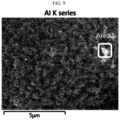
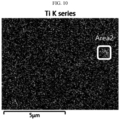
- FIG. 8 is an SEM image of the surface of the coated product prepared in Example 1
- FIG. 9 is an EDS analysis image highlighting the Al element in the white square area of Figure 8
- FIG. 10 is an EDS analysis image highlighting the Ti element in the white square area of FIG. 8
- FIG. 11 is an EDS analysis graph of Area 2 marked in FIGs. 8 to 10 . Referring to FIG. 11 , an Al peak and a Ti peak were detected on the secondary particle surface.
- FIG. 12 is an SEM image of the surface of the final positive electrode active material prepared in Example 1, and FIG. 13 is an enlarged image thereof.
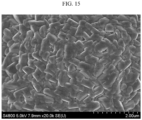
- FIG. 14 is an SEM image of the surface of the final positive electrode active material prepared in Comparative Example 1, and FIG. 15 is an enlarged image thereof.
- Comparative Example 1 of FIGs. 14 and 15 exhibited a smooth secondary particle surface, however, Example 1 of FIGs. 12 and 13 exhibited an Al coating layer found on the secondary particle surface.
- an Al component was detected, as shown in FIG. 16
- a Ti component was detected, as shown in FIG. 17 .
- an XPS depth profile of the final positive electrode active material of Example 1 was analyzed, and the results are shown in FIG. 18 , and in FIG. 19 , an Al element profile and a Ti element profile are shown.
- the Al and Ti existed on the positive electrode active material secondary particle surface, but the Al and Ti contents decreased from the surface toward the inside, wherein graphs of Al and Ti contents had a similar decreasing shape (e.g., graphs showing decreasing Al content and decreasing Ti content had similar shapes).
- the Al content e.g., amount
- the Ti content e.g., amount
- the coin cells of Examples 1 and 2 and Comparative Examples 1 to 9 were charged to an upper limit voltage of 4.45 V at a constant current of 0.2 C and to 0.05 C at a constant voltage and then, discharged to a cut-off voltage of 3.0 V at 0.2 C at 25 °C for initial charge and discharge.
- initial charge capacity, initial discharge capacity, and a ratio of the initial discharge capacity to the initial charge capacity as efficiency are provided.
- the cells were 50 times or more repeatedly charged and discharged at 1.0 C within a voltage range of 3.0 V to 4.45 V at 45 °C to calculate a ratio of 50 th cycle discharge capacity to the initial discharge capacity, which is shown as high temperature cycle-life in Table 1.
- Examples 1 and 2 each concurrently (e.g., simultaneously) realized suitably high (or improved) initial charge and discharge capacity, suitably high (or improved) initial charging and discharging efficiency, and excellent or improved high-temperature cycle-life characteristics as compared with the comparative examples. That is, Example 1, compared with Comparative Example 3 in which 1 mol% of Al alone was coated, exhibited improved initial discharge capacity, initial charging and discharging efficiency, and high-temperature cycle-life characteristics, and Example 2, compared with Comparative Example 3, exhibited significantly improved high-temperature cycle-life characteristics.
- Comparative Example 1 into which the Al and Ti coating layer was not introduced, exhibited inferior high-temperature cycle-life characteristics compared to the example embodiments, and Comparative Examples 2 and 3, in which Al alone was respectively coated in an amount of 0.8 mol% and in an amount of 1 mol%, each exhibited a little (e.g., slightly) deteriorated high-temperature cycle-life characteristics. Comparative Examples 4 and 5, in which Al alone was respectively coated in an amount of 1.2 mol% and in an amount of 1.5 mol%, each exhibited significantly deteriorated high-temperature cycle-life characteristics.
- Comparative Examples 6 to 8 in which Ti alone was coated without the Al coating, each exhibited significantly lower initial discharge capacity and initial charging and discharging efficiency compared to the Examples, and Comparative Example 8, in which Ti alone was coated in an amount of 1 mol%, exhibited significantly deteriorated high-temperature cycle-life characteristics.
- Comparative Example 9 in which a ratio of the Al coating content (e.g., amount) to the Ti coating content (e.g., amount) was 1, exhibited slightly deteriorated initial discharge capacity, initial charging and discharging efficiency, and high-temperature cycle-life characteristics, while the example embodiments (i.e., the Examples), in each of which the ratio (AI:Ti) was 2 or more, each exhibited significantly improved battery performance.
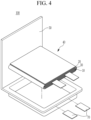
- Reference Numerals 100 rechargeable lithium battery 10: positive electrode 11: positive electrode lead tab 12: positive electrode terminal 20: negative electrode 21: negative electrode lead tab 22: negative electrode terminal 30: separator 40: electrode assembly 50: case 60: sealing member 70: electrode tab 71: positive electrode tab 72: negative electrode tab
Landscapes
- Chemical & Material Sciences (AREA)
- Chemical Kinetics & Catalysis (AREA)
- Electrochemistry (AREA)
- General Chemical & Material Sciences (AREA)
- Organic Chemistry (AREA)
- Inorganic Chemistry (AREA)
- Composite Materials (AREA)
- Engineering & Computer Science (AREA)
- Manufacturing & Machinery (AREA)
- Battery Electrode And Active Subsutance (AREA)
- Materials Engineering (AREA)
- Inorganic Compounds Of Heavy Metals (AREA)
Applications Claiming Priority (1)
| Application Number | Priority Date | Filing Date | Title |
|---|---|---|---|
| KR1020230148299A KR102764220B1 (ko) | 2023-10-31 | 2023-10-31 | 양극 활물질과 그 제조 방법, 이를 포함하는 양극, 및 리튬 이차 전지 |
Publications (1)
| Publication Number | Publication Date |
|---|---|
| EP4549399A1 true EP4549399A1 (fr) | 2025-05-07 |
Family
ID=93288847
Family Applications (1)
| Application Number | Title | Priority Date | Filing Date |
|---|---|---|---|
| EP24209009.0A Pending EP4549399A1 (fr) | 2023-10-31 | 2024-10-25 | Matériau actif d'électrode positive, son procédé de préparation, électrode positive et batteries au lithium rechargeables |
Country Status (5)
| Country | Link |
|---|---|
| US (1) | US20250140811A1 (fr) |
| EP (1) | EP4549399A1 (fr) |
| JP (1) | JP2025076387A (fr) |
| KR (1) | KR102764220B1 (fr) |
| CN (1) | CN119920865A (fr) |
Citations (1)
| Publication number | Priority date | Publication date | Assignee | Title |
|---|---|---|---|---|
| CN108598400A (zh) * | 2018-04-11 | 2018-09-28 | 桑德集团有限公司 | 一种三层核壳结构正极材料,制备方法及锂离子电池 |
Family Cites Families (7)
| Publication number | Priority date | Publication date | Assignee | Title |
|---|---|---|---|---|
| JP7366662B2 (ja) * | 2019-09-18 | 2023-10-23 | 太平洋セメント株式会社 | リチウムイオン二次電池用正極活物質複合体及びその製造方法 |
| CN111434618B (zh) * | 2020-01-17 | 2022-07-22 | 蜂巢能源科技有限公司 | 无钴层状正极材料及制备方法、锂离子电池 |
| CN111592052B (zh) * | 2020-05-25 | 2022-04-12 | 蜂巢能源科技股份有限公司 | 镍锰酸锂复合材料、其制备方法及锂离子电池 |
| KR102713195B1 (ko) * | 2020-08-25 | 2024-10-04 | 한양대학교 산학협력단 | 무코발트 양극활물질 및 이를 포함하는 리튬이차전지 |
| JP7669650B2 (ja) * | 2020-09-02 | 2025-04-30 | 株式会社プロテリアル | リチウムイオン二次電池用正極活物質の製造方法 |
| KR102761656B1 (ko) * | 2021-08-24 | 2025-02-03 | 삼성에스디아이 주식회사 | 리튬 이차 전지용 양극 활물질 전구체, 이를 이용한 양극 활물질의 제조 방법 및 리튬 이차 전지용 양극 활물질 |
| US20250183315A1 (en) * | 2022-02-28 | 2025-06-05 | Panasonic Intellectual Property Management Co., Ltd. | Secondary battery |
-
2023
- 2023-10-31 KR KR1020230148299A patent/KR102764220B1/ko active Active
-
2024
- 2024-10-25 EP EP24209009.0A patent/EP4549399A1/fr active Pending
- 2024-10-29 US US18/930,911 patent/US20250140811A1/en active Pending
- 2024-10-30 JP JP2024190602A patent/JP2025076387A/ja active Pending
- 2024-10-30 CN CN202411530623.XA patent/CN119920865A/zh active Pending
Patent Citations (1)
| Publication number | Priority date | Publication date | Assignee | Title |
|---|---|---|---|---|
| CN108598400A (zh) * | 2018-04-11 | 2018-09-28 | 桑德集团有限公司 | 一种三层核壳结构正极材料,制备方法及锂离子电池 |
Non-Patent Citations (2)
| Title |
|---|
| QU XINGYU ET AL: "Enhanced Electrochemical Performance of Ni-Rich Cathode Materials with Li 1.3 Al 0.3 Ti 1.7 (PO 4 ) 3 Coating", ACS SUSTAINABLE CHEMISTRY & ENGINEERING, vol. 8, no. 15, 19 September 2018 (2018-09-19), US, pages 5819 - 5830, XP093214115, ISSN: 2168-0485, Retrieved from the Internet <URL:https://pubs.acs.org/doi/pdf/10.1021/acssuschemeng.9b05539> DOI: 10.1021/acssuschemeng.9b05539 * |
| SONG GUOWEN ET AL: "Interfacial Film Li 1.3 Al 0.3 Ti 1.7 PO 4 -Coated LiNi 0.6 Co 0.2 Mn 0.2 O 2 for the Long Cycle Stability of Lithium-Ion Batteries", ACS APPLIED ENERGY MATERIALS, vol. 2, no. 11, 14 October 2019 (2019-10-14), pages 7923 - 7932, XP093257067, ISSN: 2574-0962, DOI: 10.1021/acsaem.9b01412 * |
Also Published As
| Publication number | Publication date |
|---|---|
| CN119920865A (zh) | 2025-05-02 |
| KR102764220B1 (ko) | 2025-02-05 |
| JP2025076387A (ja) | 2025-05-15 |
| US20250140811A1 (en) | 2025-05-01 |
Similar Documents
| Publication | Publication Date | Title |
|---|---|---|
| EP4571872A1 (fr) | Matériaux actifs d'électrode positive, leurs procédés de préparation, électrodes positives et batteries au lithium rechargeables | |
| EP4567927A1 (fr) | Matériaux actifs d'électrode positive, leurs procédés de préparation, électrodes positives et batteries au lithium rechargeables | |
| EP4545489A1 (fr) | Matériaux actifs d'électrode positive, électrodes positives et batteries au lithium rechargeables | |
| EP4501862B1 (fr) | Matériau actif d'électrode positive, électrode positive et batteries au lithium rechargeables | |
| EP4520726A1 (fr) | Matériau actif pour électrode positive, méthode de préparation, électrode positive et batteries rechargeables au lithium | |
| EP4512779A1 (fr) | Matériau actif pour électrode positive, méthode de préparation, électrode positive et batteries rechargeables au lithium | |
| EP4477625A1 (fr) | Matériau actif d'électrode positive, son procédé de préparation, électrode positive et batteries au lithium rechargeables | |
| EP4549399A1 (fr) | Matériau actif d'électrode positive, son procédé de préparation, électrode positive et batteries au lithium rechargeables | |
| EP4520725A1 (fr) | Matériau actif pour électrode positive, méthode de préparation, électrode positive et batteries rechargeables au lithium | |
| EP4549400A1 (fr) | Matériau actif d'électrode positive, son procédé de préparation, électrode positive et batteries au lithium rechargeables | |
| EP4593105A1 (fr) | Matériaux actifs d'électrode positive, électrodes positives et batteries au lithium rechargeables | |
| EP4686703A1 (fr) | Matériau actif d'électrode positive, son procédé de préparation, électrode positive et batteries au lithium rechargeables | |
| EP4593115A1 (fr) | Matériaux actifs d'électrode positive, leurs procédés de préparation, électrodes positives et batteries au lithium rechargeables | |
| EP4620920A1 (fr) | Matériaux actifs d'électrode positive, électrodes positives et batteries rechargeables au lithium | |
| EP4600219A1 (fr) | Matériaux actifs d'électrode positive, leurs procédés de préparation, électrodes positives et batteries au lithium rechargeables | |
| EP4593110A1 (fr) | Matériaux actifs d'électrode positive, électrodes positives et batteries au lithium rechargeables | |
| EP4477624A1 (fr) | Matériau actif d'électrode positive, son procédé de préparation, électrode positive et batteries au lithium rechargeables | |
| US20250273658A1 (en) | Positive electrode active materials, positive electrodes, and rechargeable lithium batteries | |
| EP4549398A1 (fr) | Matériau actif d'électrode positive, son procédé de préparation, électrode positive et batteries au lithium rechargeables | |
| EP4636838A1 (fr) | Électrodes positives et batteries au lithium rechargeables | |
| EP4654279A1 (fr) | Matériaux actifs d'électrode positive, procédés de préparation de matériaux actifs d'électrode positive, d'électrodes positives et de batteries au lithium rechargeables | |
| EP4501860B1 (fr) | Matériau actif d'électrode positive, électrode positive et batteries au lithium rechargeables | |
| EP4593104A1 (fr) | Matériaux actifs d'électrode positive, leurs procédés de préparation, électrodes positives et batteries au lithium rechargeables | |
| EP4640636A1 (fr) | Matériau actif d'électrode positive, son procédé de préparation, électrode positive et batteries au lithium rechargeables | |
| EP4530257A1 (fr) | Matériau actif d'électrode positive, électrode positive et batteries au lithium rechargeables |
Legal Events
| Date | Code | Title | Description |
|---|---|---|---|
| PUAI | Public reference made under article 153(3) epc to a published international application that has entered the european phase |
Free format text: ORIGINAL CODE: 0009012 |
|
| STAA | Information on the status of an ep patent application or granted ep patent |
Free format text: STATUS: REQUEST FOR EXAMINATION WAS MADE |
|
| 17P | Request for examination filed |
Effective date: 20241025 |
|
| AK | Designated contracting states |
Kind code of ref document: A1 Designated state(s): AL AT BE BG CH CY CZ DE DK EE ES FI FR GB GR HR HU IE IS IT LI LT LU LV MC ME MK MT NL NO PL PT RO RS SE SI SK SM TR |