EP4549401A1 - Matériau actif d'électrode positive et batterie secondaire au lithium le comprenant - Google Patents
Matériau actif d'électrode positive et batterie secondaire au lithium le comprenant Download PDFInfo
- Publication number
- EP4549401A1 EP4549401A1 EP24207382.3A EP24207382A EP4549401A1 EP 4549401 A1 EP4549401 A1 EP 4549401A1 EP 24207382 A EP24207382 A EP 24207382A EP 4549401 A1 EP4549401 A1 EP 4549401A1
- Authority
- EP
- European Patent Office
- Prior art keywords
- positive electrode
- electrode active
- active material
- primary particles
- lithium
- Prior art date
- Legal status (The legal status is an assumption and is not a legal conclusion. Google has not performed a legal analysis and makes no representation as to the accuracy of the status listed.)
- Pending
Links
Images

Classifications
-
- H—ELECTRICITY
- H01—ELECTRIC ELEMENTS
- H01M—PROCESSES OR MEANS, e.g. BATTERIES, FOR THE DIRECT CONVERSION OF CHEMICAL ENERGY INTO ELECTRICAL ENERGY
- H01M4/00—Electrodes
- H01M4/02—Electrodes composed of, or comprising, active material
- H01M4/36—Selection of substances as active materials, active masses, active liquids
- H01M4/48—Selection of substances as active materials, active masses, active liquids of inorganic oxides or hydroxides
- H01M4/52—Selection of substances as active materials, active masses, active liquids of inorganic oxides or hydroxides of nickel, cobalt or iron
- H01M4/525—Selection of substances as active materials, active masses, active liquids of inorganic oxides or hydroxides of nickel, cobalt or iron of mixed oxides or hydroxides containing iron, cobalt or nickel for inserting or intercalating light metals, e.g. LiNiO2, LiCoO2 or LiCoOxFy
-
- H—ELECTRICITY
- H01—ELECTRIC ELEMENTS
- H01M—PROCESSES OR MEANS, e.g. BATTERIES, FOR THE DIRECT CONVERSION OF CHEMICAL ENERGY INTO ELECTRICAL ENERGY
- H01M4/00—Electrodes
- H01M4/02—Electrodes composed of, or comprising, active material
- H01M4/36—Selection of substances as active materials, active masses, active liquids
- H01M4/362—Composites
- H01M4/366—Composites as layered products
-
- C—CHEMISTRY; METALLURGY
- C01—INORGANIC CHEMISTRY
- C01G—COMPOUNDS CONTAINING METALS NOT COVERED BY SUBCLASSES C01D OR C01F
- C01G53/00—Compounds of nickel
- C01G53/40—Complex oxides containing nickel and at least one other metal element
- C01G53/42—Complex oxides containing nickel and at least one other metal element containing alkali metals, e.g. LiNiO2
- C01G53/44—Complex oxides containing nickel and at least one other metal element containing alkali metals, e.g. LiNiO2 containing manganese
- C01G53/50—Complex oxides containing nickel and at least one other metal element containing alkali metals, e.g. LiNiO2 containing manganese of the type (MnO2)n-, e.g. Li(NixMn1-x)O2 or Li(MyNixMn1-x-y)O2
- C01G53/502—Complex oxides containing nickel and at least one other metal element containing alkali metals, e.g. LiNiO2 containing manganese of the type (MnO2)n-, e.g. Li(NixMn1-x)O2 or Li(MyNixMn1-x-y)O2 containing lithium and cobalt
- C01G53/504—Complex oxides containing nickel and at least one other metal element containing alkali metals, e.g. LiNiO2 containing manganese of the type (MnO2)n-, e.g. Li(NixMn1-x)O2 or Li(MyNixMn1-x-y)O2 containing lithium and cobalt with the molar ratio of nickel with respect to all the metals other than alkali metals higher than or equal to 0.5, e.g. Li(MzNixCoyMn1-x-y-z)O2 with x ≥ 0.5
- C01G53/506—Complex oxides containing nickel and at least one other metal element containing alkali metals, e.g. LiNiO2 containing manganese of the type (MnO2)n-, e.g. Li(NixMn1-x)O2 or Li(MyNixMn1-x-y)O2 containing lithium and cobalt with the molar ratio of nickel with respect to all the metals other than alkali metals higher than or equal to 0.5, e.g. Li(MzNixCoyMn1-x-y-z)O2 with x ≥ 0.5 with the molar ratio of nickel with respect to all the metals other than alkali metals higher than or equal to 0.8, e.g. Li(MzNixCoyMn1-x-y-z)O2 with x ≥ 0.8
-
- C—CHEMISTRY; METALLURGY
- C01—INORGANIC CHEMISTRY
- C01G—COMPOUNDS CONTAINING METALS NOT COVERED BY SUBCLASSES C01D OR C01F
- C01G53/00—Compounds of nickel
- C01G53/80—Compounds containing nickel, with or without oxygen or hydrogen, and containing one or more other elements
- C01G53/84—Hydroxides
-
- H—ELECTRICITY
- H01—ELECTRIC ELEMENTS
- H01M—PROCESSES OR MEANS, e.g. BATTERIES, FOR THE DIRECT CONVERSION OF CHEMICAL ENERGY INTO ELECTRICAL ENERGY
- H01M10/00—Secondary cells; Manufacture thereof
- H01M10/05—Accumulators with non-aqueous electrolyte
- H01M10/052—Li-accumulators
-
- H—ELECTRICITY
- H01—ELECTRIC ELEMENTS
- H01M—PROCESSES OR MEANS, e.g. BATTERIES, FOR THE DIRECT CONVERSION OF CHEMICAL ENERGY INTO ELECTRICAL ENERGY
- H01M10/00—Secondary cells; Manufacture thereof
- H01M10/05—Accumulators with non-aqueous electrolyte
- H01M10/052—Li-accumulators
- H01M10/0525—Rocking-chair batteries, i.e. batteries with lithium insertion or intercalation in both electrodes; Lithium-ion batteries
-
- H—ELECTRICITY
- H01—ELECTRIC ELEMENTS
- H01M—PROCESSES OR MEANS, e.g. BATTERIES, FOR THE DIRECT CONVERSION OF CHEMICAL ENERGY INTO ELECTRICAL ENERGY
- H01M10/00—Secondary cells; Manufacture thereof
- H01M10/42—Methods or arrangements for servicing or maintenance of secondary cells or secondary half-cells
- H01M10/52—Removing gases inside the secondary cell, e.g. by absorption
-
- H—ELECTRICITY
- H01—ELECTRIC ELEMENTS
- H01M—PROCESSES OR MEANS, e.g. BATTERIES, FOR THE DIRECT CONVERSION OF CHEMICAL ENERGY INTO ELECTRICAL ENERGY
- H01M4/00—Electrodes
- H01M4/02—Electrodes composed of, or comprising, active material
- H01M4/13—Electrodes for accumulators with non-aqueous electrolyte, e.g. for lithium-accumulators; Processes of manufacture thereof
- H01M4/131—Electrodes based on mixed oxides or hydroxides, or on mixtures of oxides or hydroxides, e.g. LiCoOx
-
- H—ELECTRICITY
- H01—ELECTRIC ELEMENTS
- H01M—PROCESSES OR MEANS, e.g. BATTERIES, FOR THE DIRECT CONVERSION OF CHEMICAL ENERGY INTO ELECTRICAL ENERGY
- H01M4/00—Electrodes
- H01M4/02—Electrodes composed of, or comprising, active material
- H01M4/36—Selection of substances as active materials, active masses, active liquids
- H01M4/48—Selection of substances as active materials, active masses, active liquids of inorganic oxides or hydroxides
- H01M4/50—Selection of substances as active materials, active masses, active liquids of inorganic oxides or hydroxides of manganese
- H01M4/505—Selection of substances as active materials, active masses, active liquids of inorganic oxides or hydroxides of manganese of mixed oxides or hydroxides containing manganese for inserting or intercalating light metals, e.g. LiMn2O4 or LiMn2OxFy
-
- C—CHEMISTRY; METALLURGY
- C01—INORGANIC CHEMISTRY
- C01P—INDEXING SCHEME RELATING TO STRUCTURAL AND PHYSICAL ASPECTS OF SOLID INORGANIC COMPOUNDS
- C01P2002/00—Crystal-structural characteristics
- C01P2002/50—Solid solutions
- C01P2002/52—Solid solutions containing elements as dopants
- C01P2002/54—Solid solutions containing elements as dopants one element only
-
- C—CHEMISTRY; METALLURGY
- C01—INORGANIC CHEMISTRY
- C01P—INDEXING SCHEME RELATING TO STRUCTURAL AND PHYSICAL ASPECTS OF SOLID INORGANIC COMPOUNDS
- C01P2002/00—Crystal-structural characteristics
- C01P2002/60—Compounds characterised by their crystallite size
-
- C—CHEMISTRY; METALLURGY
- C01—INORGANIC CHEMISTRY
- C01P—INDEXING SCHEME RELATING TO STRUCTURAL AND PHYSICAL ASPECTS OF SOLID INORGANIC COMPOUNDS
- C01P2002/00—Crystal-structural characteristics
- C01P2002/70—Crystal-structural characteristics defined by measured X-ray, neutron or electron diffraction data
- C01P2002/72—Crystal-structural characteristics defined by measured X-ray, neutron or electron diffraction data by d-values or two theta-values, e.g. as X-ray diagram
-
- C—CHEMISTRY; METALLURGY
- C01—INORGANIC CHEMISTRY
- C01P—INDEXING SCHEME RELATING TO STRUCTURAL AND PHYSICAL ASPECTS OF SOLID INORGANIC COMPOUNDS
- C01P2004/00—Particle morphology
- C01P2004/51—Particles with a specific particle size distribution
- C01P2004/53—Particles with a specific particle size distribution bimodal size distribution
-
- C—CHEMISTRY; METALLURGY
- C01—INORGANIC CHEMISTRY
- C01P—INDEXING SCHEME RELATING TO STRUCTURAL AND PHYSICAL ASPECTS OF SOLID INORGANIC COMPOUNDS
- C01P2004/00—Particle morphology
- C01P2004/60—Particles characterised by their size
- C01P2004/61—Micrometer sized, i.e. from 1-100 micrometer
-
- C—CHEMISTRY; METALLURGY
- C01—INORGANIC CHEMISTRY
- C01P—INDEXING SCHEME RELATING TO STRUCTURAL AND PHYSICAL ASPECTS OF SOLID INORGANIC COMPOUNDS
- C01P2004/00—Particle morphology
- C01P2004/60—Particles characterised by their size
- C01P2004/62—Submicrometer sized, i.e. from 0.1-1 micrometer
-
- C—CHEMISTRY; METALLURGY
- C01—INORGANIC CHEMISTRY
- C01P—INDEXING SCHEME RELATING TO STRUCTURAL AND PHYSICAL ASPECTS OF SOLID INORGANIC COMPOUNDS
- C01P2004/00—Particle morphology
- C01P2004/60—Particles characterised by their size
- C01P2004/64—Nanometer sized, i.e. from 1-100 nanometer
-
- H—ELECTRICITY
- H01—ELECTRIC ELEMENTS
- H01M—PROCESSES OR MEANS, e.g. BATTERIES, FOR THE DIRECT CONVERSION OF CHEMICAL ENERGY INTO ELECTRICAL ENERGY
- H01M4/00—Electrodes
- H01M4/02—Electrodes composed of, or comprising, active material
- H01M2004/021—Physical characteristics, e.g. porosity, surface area
-
- H—ELECTRICITY
- H01—ELECTRIC ELEMENTS
- H01M—PROCESSES OR MEANS, e.g. BATTERIES, FOR THE DIRECT CONVERSION OF CHEMICAL ENERGY INTO ELECTRICAL ENERGY
- H01M4/00—Electrodes
- H01M4/02—Electrodes composed of, or comprising, active material
- H01M2004/026—Electrodes composed of, or comprising, active material characterised by the polarity
- H01M2004/028—Positive electrodes
-
- Y—GENERAL TAGGING OF NEW TECHNOLOGICAL DEVELOPMENTS; GENERAL TAGGING OF CROSS-SECTIONAL TECHNOLOGIES SPANNING OVER SEVERAL SECTIONS OF THE IPC; TECHNICAL SUBJECTS COVERED BY FORMER USPC CROSS-REFERENCE ART COLLECTIONS [XRACs] AND DIGESTS
- Y02—TECHNOLOGIES OR APPLICATIONS FOR MITIGATION OR ADAPTATION AGAINST CLIMATE CHANGE
- Y02E—REDUCTION OF GREENHOUSE GAS [GHG] EMISSIONS, RELATED TO ENERGY GENERATION, TRANSMISSION OR DISTRIBUTION
- Y02E60/00—Enabling technologies; Technologies with a potential or indirect contribution to GHG emissions mitigation
- Y02E60/10—Energy storage using batteries
Definitions
- the present invention relates to a positive electrode active material and a lithium secondary battery including the same, and more particularly, to a positive electrode active material, capable of maintaining the electrochemical properties of a lithium secondary battery using a lithium composite oxide as a positive electrode active material while preventing and/or mitigating gas generation and swelling due to the positive electrode active material in a lithium secondary battery by suppressing the excessive growth of primary particles and improving the crystallinity of primary particles, and a lithium secondary battery including the same.
- Batteries store power by using materials capable of undergoing electrochemical reactions at a positive electrode and a negative electrode.
- a representative example of batteries is a lithium secondary battery that stores electrical energy by the difference in chemical potential when lithium ions are intercalated/deintercalated into/from the positive electrode and the negative electrode.
- the lithium secondary battery is manufactured by using materials capable of reversible intercalation/deintercalation of lithium ions as positive and negative electrode active materials and filling an organic electrolyte or a polymer electrolyte between the positive and negative electrodes.
- a lithium composite oxide is used as a positive electrode active material for a lithium secondary battery, and as an example, composite oxides such as LiCoO 2 , LiMn 2 O 4 , LiNiO 2 , LiMnO 2 , and the like are being studied.
- LiCoO 2 is the most widely used due to its excellent lifetime and charge/discharge efficiency, but its price competitiveness is low because cobalt, which is used as a raw material, is expensive.
- Lithium manganese oxides such as LiMnO 2 and LiMn 2 O 4 have excellent thermal stability and low costs, but have small capacity and poor high temperature characteristics.
- an LiNiO 2 -based positive electrode active material has high discharge capacity, but is difficult to synthesize due to active cation mixing of Li and Ni, and the rate performance and lifetime of the synthesized positive electrode active material are very low.
- ternary lithium composite oxides such as the so-called NCM (Ni-Co-Mn) and NCA (Ni-Co-Al), in which part of the nickel is substituted with cobalt, manganese, and/or aluminum, or quaternary lithium composite oxides such as NCMA (Ni-Co-Mn-Al) have been developed. Since the reversible capacity is reduced as the nickel content in the ternary or quaternary lithium composite oxide decreases, research has been widely conducted to increase the nickel content in the lithium composite oxide.
- lithium secondary batteries using lithium iron phosphate have been mainly used in terms of ensuring safety, but recently, the use of nickel-based lithium composite oxides, which have a higher energy capacity per weight than LFP, is expanding (of course, relatively inexpensive LFP is still used to reduce costs).
- nickel-based lithium composite oxides which have recently been mainly used as positive electrode active materials for high-capacity lithium secondary batteries, have a ternary composition such as NCM (Ni-Co-Mn) and NCA (Ni-Co-Al) or a quaternary composition such as NCMA (Ni-Co-Mn-Al).
- the nickel content in the lithium composite oxide needs to be increased, but as the nickel content in the lithium composite oxide increases, the change in crystallinity may increase, such as an increase in cation mixing in the crystal structure of the lithium composite oxide, or the content of lithium impurities remaining on the surface of the lithium composite oxide may increase.
- the present invention is directed to providing a positive electrode active material capable of maintaining the electrochemical properties of a lithium secondary battery using a lithium composite oxide as a positive electrode active material while preventing and/or mitigating gas generation and swelling due to the positive electrode active material in a lithium secondary battery by using a dopant that hinders the growth of primary particles constituting the lithium composite oxide during the calcination process and increasing the calcination temperature to suppress the excessive growth of primary particles and improve the crystallinity of primary particles.
- the present invention is also directed to providing a positive electrode active material capable of preventing and/or mitigating cracks occurring due to strain caused by random volume contraction/expansion of primary particles during charging/discharging by reducing crystal defects in the crystal structure of the primary particles constituting the lithium composite oxide.
- the present invention is also directed to providing a lithium secondary battery using the positive electrode active material defined herein.
- a positive electrode active material including primary particles capable of intercalation/deintercalation of lithium and secondary particles in which the primary particles are aggregated.
- the secondary particles may include at least one selected from nickel, cobalt, manganese, and aluminum.
- the secondary particles preferably include nickel.
- interplanar distance (d-spacing) of the (003) plane in the crystal structure of the primary particles may vary slightly depending on the charging state and the composition (such as mole fraction of nickel) of the positive electrode active material.
- the mole fraction of nickel to all elements excluding lithium in the positive electrode active material may be 70% or more, and when the positive electrode active material is charged to 4.3 V, the maximum value (d1) of the interplanar distance (d-spacing) of the (003) plane in the crystal structure of the primary particles may be less than 0.4794 nm, and the minimum value (d2) of the interplanar distance (d-spacing) of the (003) plane in the crystal structure of the primary particles present in the secondary particles may be 0.456 nm or more.
- the maximum value (d1) and/or the minimum value (d2) of the interplanar distance (d-spacing) of the (003) plane in the crystal structure of the primary particles may vary slightly depending on the charging state and the composition (such as mole fraction of nickel) of the positive electrode active material.
- the difference ( ⁇ d) between the maximum value (d1) and the minimum value (d2) of the interplanar distance (d-spacing) of the (003) plane in the crystal structure of the primary particles is not significantly affected by the charging state of the positive electrode active material or the change in the mole fraction of nickel in the positive electrode active material, the difference may be used as an indicator of crystal defects in the crystal structure of primary particles.
- the difference ( ⁇ d) between the maximum value (d1) and the minimum value (d2) of the interplanar distance (d-spacing) of the (003) plane in the crystal structure of the primary particles may be less than 0.019.
- the positive electrode active material may have a crystallite size of 70 nm to 130 nm.
- the positive electrode active material may have a crystallite size of 70 nm to 135 nm.
- the secondary particles may be represented by Chemical Formula 1 below.
- Chemical Formula 1 Li a Ni 1-(b+c+d) Co b M1 c M2 d O 2
- M1 is at least one selected from Mn and Al
- M2 is at least one selected from Na, K, Mg, Ca, Ba, Mn, B, Ce, Hf, Ta, Cr, F, Al, V, Ti, Fe, Zr, Zn, Si, Y, Nb, Ga, Sn, Mo, W, P, Sr, Ge, Nd, Gd, and Cu
- M1 and M2 are different, and 0.5 ⁇ a ⁇ 1.5, 0 ⁇ b ⁇ 0.20, 0 ⁇ c ⁇ 0.30, 0 ⁇ d ⁇ 0.10.
- the mole fraction of nickel to all elements excluding lithium may be 70% or more.
- a positive electrode including the positive electrode active material described above.
- the positive electrode active material according to an aspect of the present invention includes primary particles capable of reversible intercalation/deintercalation of lithium ions and secondary particles in which the primary particles are aggregated.
- the primary particles and/or the secondary particles may be referred to as lithium composite oxides herein.
- the lithium composite oxide is a metal composite oxide capable of intercalation/deintercalation of lithium ions and has a layered crystal structure belonging to the R-3m space group.
- the lithium composite oxide with a layered crystal structure has specific peaks in the 2 ⁇ region of 18° to 20° in the diffraction pattern obtained from XRD analysis.
- the lithium composite oxide may include at least one selected from nickel, cobalt, manganese, and aluminum.
- the lithium composite oxide may be preferably a lithium nickel-based composite oxide containing nickel.
- the lithium composite oxide may be a lithium nickel-based composite oxide containing nickel and at least one transition metal. Further, the lithium nickel-based composite oxide optionally comprises at least one main group metal, at least one transition metal, at least one metalloid and/or at least one non-metal.
- the lithium nickel-based composite oxide in order to improve the low rate and lifetime characteristics of LiNiO 2 while maintaining its high reversible capacity, may be a ternary lithium composite oxide such as the so-called NCM (Ni-Co-Mn) and NCA (Ni-Co-Al), in which part of the nickel is substituted with cobalt, manganese, and/or aluminum, or a quaternary lithium composite oxide such as NCMA (Ni-Co-Mn-Al).
- the lithium nickel-based composite oxide may be a cobalt-free lithium composite oxide.
- Primary particles constituting the secondary particles may have a rod shape, an elliptical shape, and/or an irregular shape.
- primary particles of various shapes may be present in the same positive electrode active material.
- the primary particle refers to a particle unit in which no grain boundary appears when observed at a magnification of 5,000 to 20,000x using a scanning electron microscope.
- the primary particles constituting the lithium composite oxide as defined herein may have an average particle diameter of 0.04 ⁇ m to 2 ⁇ m, 0.06 ⁇ m to 2 ⁇ m, 0.08 ⁇ m to 2 ⁇ m, 0.1 ⁇ m to 2 ⁇ m, 0.25 ⁇ m to 2 ⁇ m, 0.04 ⁇ m to 1 ⁇ m, 0.06 ⁇ m to 1.0 ⁇ m, 0.08 ⁇ m to 1 ⁇ m, 0.1 ⁇ m to 1 ⁇ m, 0.25 ⁇ m to 1 ⁇ m, 0.04 ⁇ m to 0.75 ⁇ m, 0.06 ⁇ m to 0.75 ⁇ m, 0.08 ⁇ m to 0.75 ⁇ m, 0.1 ⁇ m to 0.75 ⁇ m, or 0.25 ⁇ m to 0.75 ⁇ m.
- the average particle diameter of the primary particles may be the average value of the length of the primary particles in the major axis direction and the length of the primary particles in the minor axis direction ([major axis length + minor axis length]/2).
- the primary particles may be composed of a single crystallite or a plurality of crystallites.
- the crystallite size may be calculated through XRD analysis of the positive electrode active material.
- the crystallite size may be calculated using 1 all peaks present in the diffraction pattern obtained from XRD analysis (a method using pattern fitting and Rietveld refinement) or 2 substituting the full width at half maximum of specific peaks present in the diffraction pattern obtained from XRD analysis (such as peaks specific to the crystal plane corresponding to the (003) plane) into the Scherrer equation.
- the size of crystallites present in the lithium composite oxide may be preferably 70 nm to 130 nm.
- the size of crystallites present in the lithium composite oxide may be preferably 70 nm to 120 nm, 70 nm to 110 nm, 70 nm to 105 nm, 70 nm to 103 nm, 75 nm to 120 nm, 75 nm to 110 nm, 75 nm to 105 nm, 75 nm to 103 nm, 80 nm to 120 nm, 80 nm to 110 nm, 80 nm to 105 nm, 80 nm to 103 nm, 85 nm to 120 nm, 85 nm to 110 nm, 85 nm to 105 nm, 85 nm to 103 nm, 90 nm to 120 nm, 90 nm to 110 nm, 90 nm to 110 nm, 90 nm to 110 nm, 90
- the size of the crystallites constituting the positive electrode active material is excessively small, and thus the particle strength of the lithium composite oxide may be reduced.
- the specific surface area may increase, thereby promoting gas generation due to side reactions with an electrolyte.
- the primary particles grow excessively, thereby reducing the electrochemical properties such as rate performance of a lithium secondary battery using the primary particles as a positive electrode active material.
- the positive electrode active material may have a crystallite size of 70 nm to 130 nm by using a dopant that hinders the growth of primary particles during the calcination process of the positive electrode active material and increasing the calcination temperature to suppress the excessive growth of primary particles and improve the crystallinity of the primary particles.
- the dopant that hinders the growth of primary particles during the calcination process of the positive electrode active material may be at least one selected from Al 2 O 3 , Al(OH) 3 , AlPO 4 , Al(PO 3 ) 3 , WO 3 , Nb 2 O 5 , TiO 2 , H 3 BO 3 , H 2 B 4 O 7 , B 2 O 3 , B 2 O 5 , C 6 H 5 B(OH) 2 , (C 6 H 5 O) 3 B, [(CH 3 (CH 2 ) 3 O) 3 B, C 3 H 9 B 3 O 6 , and (C 3 H 7 O 3 )B.
- the crystallites and the primary particles may excessively grow.
- a phase transition for example, layered structure ⁇ rock salt structure
- Changes in the crystal structure such as the phase transition may change the surface resistance of the positive electrode active material and reduce the lifetime of the positive electrode active material.
- the growth of the crystallites and the primary particles may be excessively suppressed.
- the specific surface area may increase, thereby promoting gas generation due to side reactions with an electrolyte.
- the average particle diameter of the secondary particles may be 0.5 ⁇ m to 20 ⁇ m, 2.0 ⁇ m to 18 ⁇ m, 2.0 ⁇ m to 15 ⁇ m, or 3.0 ⁇ m to 12 ⁇ m.
- the average particle diameter of the secondary particles may be 7 ⁇ m or less, 6.5 ⁇ m or less, 6 ⁇ m or less, 5.5 ⁇ m or less, 5 ⁇ m or less, 4.5 ⁇ m or less, 4 ⁇ m or less, 3.5 ⁇ m or less, or 3 ⁇ m or less, 0.5 ⁇ m or more, 1 ⁇ m or more, 1.5 ⁇ m or more, or 2 ⁇ m or more.
- the upper and lower limits of the average particle diameter of the secondary particles may be appropriately selected within a range that satisfies the above definition.
- the average particle diameter of the secondary particles may be more than 7 ⁇ m, 7.5 ⁇ m or more, 8 ⁇ m or more, 8.5 ⁇ m or more, 9 ⁇ m or more, 9.5 ⁇ m or more, 10 ⁇ m or more, 10.5 ⁇ m or more, 11 ⁇ m or more, 11.5 ⁇ m or more, or 12 ⁇ m or more, 30 ⁇ m or less, 27.5 ⁇ m or less, 25 ⁇ m or less, 22.5 ⁇ m or less, 20 ⁇ m or less, 17.5 ⁇ m or less, or 15 ⁇ m or less.
- the upper and lower limits of the average particle diameter of the secondary particles may be appropriately selected within a range that satisfies the above definition.
- the average particle diameter of the positive electrode active material may be 4 ⁇ m to 18 ⁇ m, 6 ⁇ m to 16 ⁇ m, or 8 ⁇ m to 14 ⁇ m.
- the average particle diameter of the secondary particles may vary depending on the number of primary particles constituting the secondary particles.
- the average particle diameter (D50) of the secondary particles may be calculated using a laser diffraction method. For example, after dispersing secondary particles in a dispersion medium and irradiating the same with ultrasonic waves at about 28 kHz at an output of 60 W using a commercially available laser diffraction particle size measurement device (such as Microtrac MT 3000), a volume cumulative particle size distribution graph is obtained, and the particle size corresponding to 50% of the volume cumulative amount can be defined as the average particle diameter (D 50 ). In other cases, the average particle diameter of the secondary particles may be calculated as the average value of the particle diameters of secondary particles confirmed through SEM images.
- the present invention by using a dopant that hinders the growth of primary particles and increasing the calcination temperature to suppress the excessive growth of primary particles and improve the crystallinity of the primary particles, it is possible to reduce crystal defects in the crystal structure of the primary particles and prevent and/or mitigate cracks occurring due to strain caused by random volume contraction/expansion of primary particles during charging/discharging.
- Crystal defects in the crystal structure of the primary particles may include point defects and/or line defects, but according to the present invention, in particular, line defects among the crystal defects in the crystal structure of the primary particles may be reduced.
- the line defects may be present extending in a direction parallel to the (003) plane in the crystal structure of the primary particles.
- Line defects present in the crystal structure of the primary particles may be caused by dislocation of the layered crystal structure in the primary particles.
- dislocation of the layered crystal structure in the primary particles occurs, the interplanar distance between some crystal planes may be changed. Such change in the interplanar distance may be measured through XRD analysis of the positive electrode active material using Cu-K ⁇ rays or other known methods.
- the charging conditions of the positive electrode active material before XRD analysis may be general formation and/or charging conditions of a lithium secondary battery.
- the positive electrode active material may be charged to 4.3 V before XRD analysis.
- a lithium secondary battery which uses the positive electrode active material as a positive electrode and a lithium foil as a negative electrode, is charged/discharged 2 times under the conditions of 25 °C, a voltage range of 3.0 V to 4.3 V, and 0.05 C/0.05 C and then charged to 4.3 V again, the positive electrode active material is recovered from the half-cell to perform XRD analysis.
- the difference in 2 ⁇ between the two split peaks may be preferably 0.75° or less, 0.70° or less, 0.69° or less, or 0.681° or less.
- the maximum value (d1) and/or the minimum value (d2) of the interplanar distance (d-spacing) of the (003) plane in the crystal structure of the primary particles may vary slightly depending on the charging state and the composition (such as mole fraction of nickel) of the positive electrode active material.
- the difference ( ⁇ d) between the maximum value (d1) and the minimum value (d2) of the interplanar distance (d-spacing) of the (003) plane in the crystal structure of the primary particles is not significantly affected by the charging state of the positive electrode active material or the change in the mole fraction of nickel in the positive electrode active material, the difference may be used as an indicator of crystal defects in the crystal structure of primary particles.
- the mole fraction of nickel to all elements excluding lithium in the positive electrode active material may be 70% or more, and when the positive electrode active material is charged to 4.3 V, the maximum value (d1) of the interplanar distance (d-spacing) of the (003) plane in the crystal structure of the primary particles present in the secondary particles may be less than 0.4794 nm, 0.4789 nm or less, 0.478 nm or less, or 0.4775 nm or less, and the minimum value (d2) of the interplanar distance (d-spacing) of the (003) plane in the crystal structure of the primary particles present in the secondary particles may be 0.456 nm or more, 0.457 nm or more, 0.458 nm or more, 0.459 nm or more, or 0.4598 nm or more.
- the maximum value (d1) of the interplanar distance (d-spacing) of the (003) plane in the crystal structure of the primary particles present in the secondary particles is 0.4794 nm or more, the interplanar distance of another (003) plane neighboring the (003) plane may become excessively narrow.
- the minimum value (d2) of the interplanar distance (d-spacing) of the (003) plane in the crystal structure of the primary particles present in the secondary particles is 0.456 nm or less, the interplanar distance of another (003) plane neighboring the (003) plane may become excessively wide.
- line defects may occur along a direction parallel to the (003) plane in the crystal structure of the primary particles.
- the difference ( ⁇ d) between the maximum value (d1) and the minimum value (d2) of the interplanar distance (d-spacing) of the (003) plane in the crystal structure of the primary particles present in the secondary particles may be preferably less than 0.019 nm, 0.018 nm or less, 0.0175 nm or less, or 0.0172 nm or less.
- the lithium composite oxide defined herein may be represented by Chemical Formula 1 below. Unless otherwise defined, the primary particles and secondary particles also have a composition represented by Chemical Formula 1 below. [Chemical Formula 1] Li a Ni 1-(b+c+d) Co b M1 c M2 d O 2
- M1 is at least one selected from Mn and Al
- M2 is at least one selected from Na, K, Mg, Ca, Ba, Mn, B, Ce, Hf, Ta, Cr, F, Al, V, Ti, Fe, Zr, Zn, Si, Y, Nb, Ga, Sn, Mo, W, P, Sr, Ge, Nd, Gd, and Cu
- M1 and M2 are different, and 0.5 ⁇ a ⁇ 1.5, 0 ⁇ b ⁇ 0.20, 0 ⁇ c ⁇ 0.30, 0 ⁇ d ⁇ 0.10.
- a which represents the ratio of lithium to all elements excluding lithium in the lithium composite oxide (Li/(Ni+Co+M1+M2)), may be 0.5 or more and 1.5 or less, 0.75 or more and 1.25 or less, 0.90 or more and 1.1 or less, or 0.95 or more and 1.05 or less.
- the mole fraction of nickel to all elements excluding lithium in the lithium composite oxide may be 70% or more.
- b+c+d in Chemical Formula 1 is 0.30 or less.
- the mole fraction of nickel to all elements excluding lithium in the lithium composite oxide may be 75% or more (where b+c+d is 0.25 or less), 80% or more (where b+c+d is 0.20 or less), 85% or more (where b+c+d is 0.15 or less), or 90% or more (where b+c+d is 0.10 or less).
- the mole fraction of cobalt to all elements excluding lithium in the lithium composite oxide may be 20% or less (where b is 0.20 or less), 15% or less (where b is 0.15 or less), 10% or less (where b is 0.10 or less) or 5% or less (where b is 0.05 or less).
- b in Chemical Formula 1 is greater than 0.
- the mole fraction of manganese and/or aluminum to all elements excluding lithium in the lithium composite oxide may be 30% or less (where c is 0.30 or less), 25% or less (where c is 0.25 or less), 20% or less (where c is 0.20 or less), 15% or less (where c is 0.15 or less), 10% or less (where c is 0.10 or less), or 5% or less (where c is 0.05 or less).
- the secondary particles include manganese and/or aluminum, c in Chemical Formula 1 is greater than 0.
- M2 refers to a dopant present in the lithium composite oxide.
- the dopant may be present in a doped state in the crystal lattice of the primary particles.
- M2 may optionally include a dopant used to hinder the growth of primary particles during the calcination of the positive electrode active material. As the dopant is doped, the electrochemical properties of the positive electrode active material may be improved.
- the mole fraction of the dopant to all elements excluding lithium in the lithium composite oxide may be 10% or less (where d is 0.10 or less), 5% or less (where d is 0.05 or less), 4% or less (where d is 0.04 or less), 3% or less (where d is 0.03 or less), 2% or less (where d is 0.02 or less), 1% or less (where d is 0.01 or less), 0.5% or less (where d is 0.005 or less), 0.4% or less (where d is 0.004 or less), 0.3% or less (where d is 0.003 or less), 0.2% or less (where d is 0.002 or less), or 0.1% or less (where d is 0.001 or less).
- the dopant may include at least one selected from Na, K, Mg, Ca, Ba, Mn, B, Ce, Hf, Ta, Cr, F, Al, V, Ti, Fe, Zr, Zn, Si, Y, Nb, Ga, Sn, Mo, W, P, Sr, Ge, Nd, Gd, and Cu, or at least one selected from B, Al, Nb, and W.
- the type and combination of the dopant may be appropriately selected within a range that does not negatively affect the electrochemical properties and stability of the positive electrode active material.
- a positive electrode including a positive electrode current collector and a positive electrode active material layer formed on the positive electrode current collector.
- the positive electrode active material layer may include the positive electrode active material according to various embodiments of the present invention. Since the content of positive electrode active material is the same as described above, detailed description will be omitted for convenience, and only the remaining components not described above will be described below.
- the positive electrode current collector is not particularly limited as long as it does not cause a chemical change in a battery and has conductivity, and for example, stainless steel, aluminum, nickel, titanium, calcined carbon, or aluminum or stainless steel whose surface is treated with carbon, nickel, titanium or silver may be used.
- the positive electrode current collector may conventionally have a thickness of 3 to 500 ⁇ m, and fine irregularities may be formed on the surface of the current collector, thereby increasing the adhesive strength of a positive electrode active material.
- the positive electrode current collector may be used in various forms such as a film, a sheet, a foil, a net, a porous body, foam, a non-woven fabric, etc.
- the positive electrode active material layer may be prepared by coating the positive electrode current collector with a positive electrode slurry composition including the positive electrode active material, a conductive material, and optionally as needed, a binder.
- the positive electrode active material is included at 80 to 99 wt%, and specifically, 85 to 98.5 wt% with respect to the total weight of a positive electrode slurry for forming the positive electrode active material layer.
- the positive electrode active material is included in the above content range, excellent capacity characteristics may be exhibited, but the present invention is not limited thereto.
- the conductive material is used to impart conductivity to an electrode, and is not particularly limited as long as it has electron conductivity without causing a chemical change in a battery.
- a specific example of the conductive material may be graphite such as natural graphite or artificial graphite; a carbon-based material such as carbon black, acetylene black, Ketjen black, channel black, furnace black, lamp black, thermal black or a carbon fiber; a metal powder or metal fiber consisting of copper, nickel, aluminum, or silver; a conductive whisker consisting of zinc oxide or potassium titanate; a conductive metal oxide such as titanium oxide; or a conductive polymer such as a polyphenylene derivative, and one or a mixture of two or more thereof may be used.
- the conductive material may be generally contained at 0.1 to 15 wt% with respect to the total weight of a positive electrode slurry for forming the positive electrode active material layer.
- the binder serves to improve the adhesion between particles of the positive electrode active material and the adhesion between the positive electrode active material and the current collector.
- a specific example of the binder may be polyvinylidene fluoride (PVDF), a vinylidene fluoride-hexafluoropropylene copolymer (PVDF-co-HFP), polyvinyl alcohol, polyacrylonitrile, carboxymethylcellulose (CMC), starch, hydroxypropylcellulose, regenerated cellulose, polyvinylpyrrolidone, tetrafluoroethylene, polyethylene, polypropylene, an ethylenepropylene-diene polymer (EPDM), a sulfonated EPDM, styrene butadiene rubber (SBR), fluorine rubber, or various copolymers thereof, and one or a mixture of two or more thereof may be used.
- the binder may be included at 0.1 to 15 wt% with respect to the total weight of a positive electrode s
- the positive electrode may be manufactured according to a conventional method of manufacturing a positive electrode, except that the above-described positive electrode active material is used. Specifically, the positive electrode may be manufactured by coating the positive electrode current collector with a positive electrode slurry composition prepared by dissolving or dispersing the positive electrode active material, and optionally, a binder and a conductive material in a solvent, and drying and rolling the resulting product.
- a positive electrode slurry composition prepared by dissolving or dispersing the positive electrode active material, and optionally, a binder and a conductive material in a solvent, and drying and rolling the resulting product.
- the solvent may be a solvent generally used in the art, and may be dimethyl sulfoxide (DMSO), isopropyl alcohol, N-methylpyrrolidone (NMP), acetone or water, and one or a mixture of two or more thereof may be used.
- DMSO dimethyl sulfoxide
- NMP N-methylpyrrolidone
- acetone or water, and one or a mixture of two or more thereof may be used.
- the solvent is used at a sufficient amount for dissolving or dispersing the positive electrode active material, the conductive material and the binder and then imparting a viscosity for exhibiting excellent thickness uniformity when the slurry is applied to manufacture a positive electrode.
- the positive electrode may be manufactured by casting the positive electrode slurry composition on a separate support, and laminating a film obtained by delamination from the support on the positive electrode current collector.
- electrochemical device including the above-described positive electrode.
- the electrochemical device may be, specifically, a battery, a capacitor, and more specifically, a lithium secondary battery.
- the lithium secondary battery may specifically include a positive electrode, a negative electrode disposed opposite to the positive electrode, and a separator and a liquid electrolyte, which are interposed between the positive electrode and the negative electrode.
- a positive electrode since the positive electrode is the same as described above, for convenience, detailed description of the positive electrode will be omitted, and other components which have not been described above will be described in detail.
- the lithium secondary battery may further include a battery case accommodating an electrode assembly of the positive electrode, the negative electrode and the separator, and optionally, a sealing member for sealing the battery case.
- the negative electrode may include a negative electrode current collector and a negative electrode active material layer disposed on the negative electrode current collector.
- the negative electrode current collector is not particularly limited as long as it has high conductivity without causing a chemical change in a battery, and may be, for example, copper, stainless steel, aluminum, nickel, titanium, calcined coke, or copper or stainless steel whose surface is treated with carbon, nickel, titanium or silver, or an aluminum-cadmium alloy.
- the negative electrode current collector may generally have a thickness of 3 to 500 ⁇ m, and like the positive electrode current collector, fine irregularities may be formed on the current collector surface, thereby enhancing the binding strength of the negative electrode active material.
- the negative electrode current collector may be used in various forms such as a film, a sheet, a foil, a net, a porous body, foam, a non-woven fabric, etc.
- the negative electrode active material layer may be formed by coating the negative electrode current collector with a negative electrode slurry composition including the negative electrode active material, a conductive material, and optionally as needed, a binder.
- the negative electrode active material a compound enabling the reversible intercalation and deintercalation of lithium may be used.
- a specific example of the negative electrode active material may be a carbonaceous material such as artificial graphite, natural graphite, graphitized carbon fiber or amorphous carbon; a metallic compound capable of alloying with lithium, such as Si, Al, Sn, Pb, Zn, Bi, In, Mg, Ga, Cd, an Si alloy, an Sn alloy or an Al alloy; a metal oxide capable of doping and dedoping lithium such as SiO ⁇ (0 ⁇ 2), SnO 2 , vanadium oxide, or lithium vanadium oxide; or a composite including the metallic compound and the carbonaceous material such as an Si-C composite or an Sn-C composite, and any one or a mixture of two or more thereof may be used.
- a metallic lithium thin film may be used as the negative electrode active material.
- a carbon material both low-crystalline carbon and high-crystalline carbon may be used.
- Representative examples of the low-crystalline carbon include soft carbon and hard carbon
- representative examples of the high-crystalline carbon include amorphous, sheet-type, flake-type, spherical or fiber-type natural or artificial graphite, Kish graphite, pyrolytic carbon, mesophase pitch-based carbon fiber, meso-carbon microbeads, mesophase pitches, and high-temperature calcined carbon such as petroleum or coal tar pitch derived cokes.
- the negative electrode active material may be included at 80 to 99 wt% with respect to the total weight of a negative electrode slurry for forming the negative electrode active material layer.
- the binder is a component aiding bonding between a conductive material, an active material and a current collector, and may be generally added at 0.1 to 10 wt% with respect to the total weight of a negative electrode slurry for forming the negative electrode active material layer.
- binder examples include polyvinylidene fluoride (PVDF), polyvinyl alcohol, carboxymethylcellulose (CMC), starch, hydroxypropylcellulose, regenerated cellulose, polyvinylpyrrolidone, tetrafluoroethylene, polyethylene, polypropylene, ethylene-propylene-diene monomer (EPDM), sulfonated EPDM, styrene butadiene rubber, nitrile-butadiene rubber, fluorine rubber, and various copolymers thereof.
- PVDF polyvinylidene fluoride
- CMC carboxymethylcellulose
- EPDM ethylene-propylene-diene monomer
- EPDM ethylene-propylene-diene monomer
- EPDM ethylene-propylene-diene monomer
- EPDM ethylene-propylene-diene monomer
- EPDM ethylene-propylene-diene monomer
- EPDM ethylene-propylene-diene monomer
- the conductive material is a component for further improving the conductivity of the negative electrode active material, and may be added at 10 wt% or less, and preferably, 5 wt% or less with respect to the total weight of a negative electrode slurry for forming the negative electrode active material layer.
- the conductive material is not particularly limited as long as it does not cause a chemical change in the battery, and has conductivity, and may be, for example, graphite such as natural graphite or artificial graphite; carbon black such as acetylene black, Ketjen black, channel black, furnace black, lamp black or thermal black; a conductive fiber such as a carbon fiber or a metal fiber; a conductive powder such as fluorinated carbon, aluminum, or nickel powder; a conductive whisker such as zinc oxide or potassium titanate; a conductive metal oxide such as titanium oxide; or a conductive material such as a polyphenylene or a derivative thereof.
- graphite such as natural graphite or artificial graphite
- carbon black such as acetylene black, Ketjen black, channel black, furnace black, lamp black or thermal black
- a conductive fiber such as a carbon fiber or a metal fiber
- a conductive powder such as fluorinated carbon, aluminum, or nickel powder
- a conductive whisker such
- the negative electrode active material layer may be prepared by coating the negative electrode current collector with a negative electrode slurry composition prepared by dissolving or dispersing a negative electrode active material, and optionally, a binder and a conductive material in a solvent, and drying the coated composition, or may be prepared by casting the negative electrode slurry composition on a separate support and then laminating a film delaminated from the support on the negative electrode current collector.
- a negative electrode slurry composition prepared by dissolving or dispersing a negative electrode active material, and optionally, a binder and a conductive material in a solvent, and drying the coated composition, or may be prepared by casting the negative electrode slurry composition on a separate support and then laminating a film delaminated from the support on the negative electrode current collector.
- the separator is not particularly limited as long as it is generally used in a lithium secondary battery to separate a negative electrode from a positive electrode and provide a diffusion path for lithium ions, and particularly, the separator has low resistance to ion mobility of a liquid electrolyte and an excellent electrolyte solution impregnability.
- a porous polymer film for example, a porous polymer film prepared of a polyolefin-based polymer such as an ethylene homopolymer, a propylene homopolymer, an ethylene/butene copolymer, an ethylene/hexene copolymer and an ethylene/methacrylate copolymer, or a stacked structure including two or more layers thereof may be used.
- a conventional porous non-woven fabric for example, a non-woven fabric formed of a high melting point glass fiber or a polyethylene terephthalate fiber may be used.
- a coated separator including a ceramic component or a polymer material may be used to ensure thermal resistance or mechanical strength, and may be optionally used in a single- or multi-layered structure.
- the electrolyte used in the present invention may be an organic electrolyte, an inorganic electrolyte, a solid polymer electrolyte, a gel-type polymer electrolyte, a solid inorganic electrolyte, or a molten-type inorganic electrolyte, which is able to be used in the production of a lithium secondary battery, but the present invention is not limited thereto.
- the electrolyte may include an organic solvent and a lithium salt.
- the organic solvent is not particularly limited as long as it can serve as a medium enabling the movement of ions involved in an electrochemical reaction of a battery.
- the organic solvent may be an ester-based solvent such as methyl acetate, ethyl acetate, ⁇ -butyrolactone, or ⁇ -caprolactone; an ether-based solvent such as dibutyl ether or tetrahydrofuran; a ketone-based solvent such as cyclohexanone; an aromatic hydrocarbon-based solvent such as benzene or fluorobenzene; a carbonate-based solvent such as dimethyl carbonate (DMC), diethyl carbonate (DEC), methyl ethyl carbonate (MEC), ethyl methyl carbonate (EMC), ethylene carbonate (EC), or propylene carbonate (PC); an alcohol-based solvent such as ethyl alcohol or isopropyl alcohol; a nitrile-based solvent such as R-CN (R iso
- a carbonate-based solvent is preferably used, and a mixture of a cyclic carbonate (for example, ethylene carbonate or propylene carbonate) having high ion conductivity and high permittivity to increase the charging/discharging performance of a battery and a low-viscosity linear carbonate-based compound (for example, ethyl methyl carbonate, dimethyl carbonate or diethyl carbonate) is more preferably used.
- a mixture of a cyclic carbonate and a chain-type carbonate in a volume ratio of approximately 1:1 to 1:9, the electrolyte solution may exhibit excellent performance.
- the lithium salt is not particularly limited as long as it is a compound capable of providing a lithium ion used in a lithium secondary battery.
- the lithium salt may be LiPF 6 , LiClO 4 , LiAsF 6 , LiBF 4 , LiSbF 6 , LiAlO 4 , LiAlCl 4 , LiCF 3 SO 3 , LiC 4 F 9 SO 3 , LiN(C 2 F 5 SO 3 ) 2 , LiN(C 2 F 5 SO 2 ) 2 , LiN(CF 3 SO 2 ) 2 , LiCl, LiI, or LiB(C 2 O 4 ) 2 .
- the concentration of the lithium salt is preferably in the range of 0.1 to 2.0M. When the concentration of the lithium salt is included in the above-mentioned range, since the electrolyte has suitable conductivity and viscosity, the electrolyte solution can exhibit excellent electrolytic performance and lithium ions can effectively migrate.
- the electrolyte used herein is a solid electrolyte
- a solid inorganic electrolyte such as a sulfide-based solid electrolyte, an oxide-based solid electrolyte, a nitride-based solid electrolyte, or a halide-based solid electrolyte may be used, and preferably, a sulfide-based solid electrolyte is used.
- a solid electrolyte containing Li, an X element Wherein, X is at least one selected from P, As, Sb, Si, Ge, Sn, B, Al, Ga and In) and S may be used.
- Examples of the sulfide-based solid electrolyte material may include Li 2 S-P 2 S 5 , Li 2 S-P 2 S-LiX (wherein, X is a halogen element such as I or Cl), Li 2 S-P 2 S 5 -Li 2 O, Li 2 S-P 2 S 5 -Li 2 O-LiI, Li 2 S-SiS 2 , Li 2 S-SiS 2 -LiI, Li 2 S-SiS 2 -LiBr, Li 2 S-SiS 2 -LiCl, Li 2 S-SiS 2 -B 2 S 3 -LiI, Li 2 S-SiS 2 -P 2 S 5 -LiI, Li 2 S-B 2 S 3 , Li 2 S-P 2 S 5 -Z m S n (wherein, m and n are integers, and Z is Ge, Zn or Ga), Li 2 S-GeS 2 , Li 2 S-SiS 2
- a solid electrolyte, and preferably, a sulfide-based solid electrolyte may be amorphous, crystalline, or a state in which an amorphous phase and crystalline phase are mixed.
- Materials for an oxide-based solid electrolyte include Li 7 La 3 Zr 2 O 12 , Li 7-x La 3 Zr 1-x Nb x O 12 , Li 7-3x La 3 Zr 2 Al x O 12 , Li 3x La 2/3-x TiO 3 , Li 1+x Al x Ti 2-x (PO 4 ) 3 , Li 1+x Al x Ge 2-x (PO 4 ) 3 , Li 3 PO 4 , Li 3+x PO 4-x N x (LiPON), and Li 2+2x Zn 1-x GeO 4 (LISICON).
- the above-described solid electrolyte may be disposed as a separate layer (solid electrolyte layer) between a positive electrode and a negative electrode.
- the solid electrolyte may be partially included in a positive electrode active material layer of the positive electrode independent of the solid electrolyte layer, or the solid electrolyte may be partially included in a negative electrode active material of the negative electrode independent of the solid electrolyte layer.
- the electrolyte may further include one or more types of additives, for example, a haloalkylene carbonate-based compound such as difluoroethylene carbonate, pyridine, triethylphosphite, triethanolamine, cyclic ether, ethylene diamine, n-glyme, hexaphosphoric triamide, a nitrobenzene derivative, sulfur, a quinone imine dye, N-substituted oxazolidinone, N,N-substituted imidazolidine, ethylene glycol dialkyl ether, an ammonium salt, pyrrole, 2-methoxy ethanol or aluminum trichloride, in addition to the components of the electrolyte.
- the additive(s) may be included at 0.1 to 5 wt% with respect to the total weight of the electrolyte.
- the lithium secondary battery including the positive electrode active material according to the present invention stably exhibits an excellent discharge capacity, excellent output characteristics and excellent lifetime characteristics, it is useful in portable devices such as a mobile phone, a notebook computer and a digital camera and an electric vehicle field such as a hybrid electric vehicle (HEV).
- portable devices such as a mobile phone, a notebook computer and a digital camera and an electric vehicle field such as a hybrid electric vehicle (HEV).
- HEV hybrid electric vehicle
- the outer shape of the lithium secondary battery according to the present invention is not particularly limited, but may be a cylindrical, prismatic, pouch or coin type.
- the lithium secondary battery may be used in a battery cell that is not only used as a power source of a small device, but also preferably used as a unit battery for a medium-to-large battery module including a plurality of battery cells.
- a battery module including the lithium secondary battery as a unit cell and/or a battery pack including the same is provided.
- the battery module or the battery pack may be used as a power source of any one or more medium-to-large devices including a power tool; an electric motor vehicle such as an electric vehicle (EV), a hybrid electric vehicle, and a plug-in hybrid electric vehicle (PHEV); and a power storage system.
- a power tool such as an electric vehicle (EV), a hybrid electric vehicle, and a plug-in hybrid electric vehicle (PHEV)
- a power storage system such as a power tool.
- an electric motor vehicle such as an electric vehicle (EV), a hybrid electric vehicle, and a plug-in hybrid electric vehicle (PHEV)
- PHEV plug-in hybrid electric vehicle
- a spherical Ni 0.90 Co 0.05 Mn 0.05 (OH) 2 hydroxide precursor was synthesized through a coprecipitation method. Specifically, 50 wt% of NaOH and 18 wt% of NH 4 OH were added to a 1.5 M aqueous solution of composite transition metal sulfuric acid in which nickel sulfate, cobalt sulfate, and manganese sulfate were mixed at a molar ratio of 90:5:5 in a 90 L reactor. The reactor was maintained at pH 12.0 and a temperature of 45 °C, and N 2 , an inert gas, was input to the reactor to prevent the prepared precursor from being oxidized.
- a spherical Ni 0.90 Co 0.05 Mn 0.05 (OH) 2 hydroxide precursor was synthesized through a coprecipitation method. Specifically, 50 wt% of NaOH and 18 wt% of NH 4 OH were added to a 1.5 M aqueous solution of composite transition metal sulfuric acid in which nickel sulfate, cobalt sulfate, and manganese sulfate were mixed at a molar ratio of 90:5:5 in a 90 L reactor. The reactor was maintained at pH 12.0 and a temperature of 45 °C, and N 2 , an inert gas, was input to the reactor to prevent the prepared precursor from being oxidized.
- a spherical Ni 0.90 Co 0.05 Mn 0.05 (OH) 2 hydroxide precursor was synthesized through a coprecipitation method. Specifically, 50 wt% of NaOH and 30 wt% of NH 4 OH were added to a 1.5 M aqueous solution of composite transition metal sulfuric acid in which nickel sulfate, cobalt sulfate, and manganese sulfate were mixed at a molar ratio of 90:5:5 in a 90 L reactor. The reactor was maintained at pH 11.5 and a temperature of 60 °C, and N 2 , an inert gas, was input to the reactor to prevent the prepared precursor from being oxidized.
- a spherical Ni 0.90 Co 0.05 Mn 0.05 (OH) 2 hydroxide precursor was synthesized through a coprecipitation method. Specifically, 50 wt% of NaOH and 30 wt% of NH 4 OH were added to a 1.5 M aqueous solution of composite transition metal sulfuric acid in which nickel sulfate, cobalt sulfate, and manganese sulfate were mixed at a molar ratio of 90:5:5 in a 90 L reactor. The reactor was maintained at pH 11.5 and a temperature of 60 °C, and N 2 , an inert gas, was input to the reactor to prevent the prepared precursor from being oxidized.
- a positive electrode active material was prepared in the same manner as in Example 1, except that H 3 BO 3 was used so that the mole fraction of boron among the metal elements was 0.015 based on the overall composition of the hydroxide precursor.
- a spherical Ni 0.90 Co 0.05 Mn 0.05 (OH) 2 hydroxide precursor was synthesized through a coprecipitation method. Specifically, 50 wt% of NaOH and 30 wt% of NH 4 OH were added to a 1.5 M aqueous solution of composite transition metal sulfuric acid in which nickel sulfate, cobalt sulfate, and manganese sulfate were mixed at a molar ratio of 90:5:5 in a 90 L reactor. The reactor was maintained at pH 11.5 and a temperature of 60 °C, and N 2 , an inert gas, was input to the reactor to prevent the prepared precursor from being oxidized.
- a spherical Ni 0.90 Co 0.05 Mn 0.05 (OH) 2 hydroxide precursor was synthesized through a coprecipitation method. Specifically, 50 wt% of NaOH and 30 wt% of NH 4 OH were added to a 1.5 M aqueous solution of composite transition metal sulfuric acid in which nickel sulfate, cobalt sulfate, and manganese sulfate were mixed at a molar ratio of 90:5:5 in a 90 L reactor. The reactor was maintained at pH 11.5 and a temperature of 60 °C, and N 2 , an inert gas, was input to the reactor to prevent the prepared precursor from being oxidized.
- a spherical Ni 0.90 Co 0.05 Mn 0.05 (OH) 2 hydroxide precursor was synthesized through a coprecipitation method. Specifically, 50 wt% of NaOH and 30 wt% of NH 4 OH were added to a 1.5 M aqueous solution of composite transition metal sulfuric acid in which nickel sulfate, cobalt sulfate, and manganese sulfate were mixed at a molar ratio of 90:5:5 in a 90 L reactor. The reactor was maintained at pH 11.5 and a temperature of 60 °C, and N 2 , an inert gas, was input to the reactor to prevent the prepared precursor from being oxidized. After completion of synthesis and stirring, washing and dehydration were performed using a filter press (F/P) device to obtain an Ni 0.90 Co 0.05 Mn 0.05 (OH) 2 hydroxide precursor.
- F/P filter press
- each positive electrode active material prepared according to Preparation Example 1 3 wt% of carbon black, and 3 wt% of a PVDF binder were dispersed in 30 g of N-methyl-2 pyrrolidone (NMP) to prepare a positive electrode slurry.
- NMP N-methyl-2 pyrrolidone
- the positive electrode slurry was uniformly applied on an aluminum thin film with a thickness of 15 ⁇ m and vacuum dried at 135 °C to manufacture a positive electrode for a lithium secondary battery.
- a half-cell was manufactured using a lithium foil as a counter electrode to the positive electrode, a porous polyethylene membrane (Celgard 2300, thickness: 25 ⁇ m) as a separator, and an electrolyte in which LiPF 6 was dissolved at a concentration of 1.15 M in a mixed solvent of ethylene carbonate and ethyl methyl carbonate at a volume ratio of 3:7.
- each positive electrode active material prepared according to Preparation Example 1 4.5 wt% of carbon black, and 5.5 wt% of a PVDF binder were dispersed in N-methyl-2 pyrrolidone (NMP) to prepare a positive electrode slurry.
- NMP N-methyl-2 pyrrolidone
- the positive electrode slurry was uniformly applied on an aluminum thin film with a thickness of 15 ⁇ m and vacuum dried at 135 °C to manufacture a positive electrode for a lithium secondary battery in which a positive electrode active material layer was formed.
- a full-cell was manufactured using a graphite electrode as a counter electrode to the positive electrode, a porous polyethylene membrane (Celgard 2300, thickness: 20 ⁇ m) as a separator, and an electrolyte in which LiPF 6 was dissolved at a concentration of 1.15 M in a mixed solvent of ethylene carbonate, dimethyl carbonate, and ethyl methyl carbonate at a volume ratio of 2:4:4.
- X-ray diffraction (XRD) analysis was performed to measure the crystallite size and the interplanar distance of the (003) plane of the positive electrode active material.
- the XRD analysis was performed through a Bruker D8 Endeavor diffractometer using Cu-K ⁇ radiation (1.540598 ⁇ ).
- the crystallite size of the positive electrode active material was calculated from the Lvol-IB value through Rietveld refinement using TOPAS software from the diffraction pattern obtained through XRD analysis of each positive electrode active material prepared according to Preparation Example 1.
- the lithium secondary batteries (half-cell) manufactured in Preparation Example 2 were charged/discharged twice using an electrochemical analysis device (Toscat-3100 from TOYO SYSTEM CO., LTD.) under the conditions of 25 °C, a voltage range of 3.0 V to 4.3 V, and 0.05 C/0.05 C, and then charged to 4.3 V Afterward, the positive electrode active materials were recovered from the half-cells and XRD analysis was performed to calculate the degree of peak splitting in the 2 ⁇ region of 18° to 20° from the (003) plane diffraction peak, and the maximum value (d1) and the minimum value (d2) of the interplanar distance (d-spacing) of the (003) plane.
- an electrochemical analysis device Toscat-3100 from TOYO SYSTEM CO., LTD.
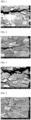
- FIGS. 1 to 5 showing cross-sectional SEM images of the positive electrode active materials (Example 1, Comparative Examples 1, 2, 4, and 5) recovered from the half-cell, it can be seen that a lot of line defects occur in the primary particles of the positive electrode active materials according to Comparative Examples 1, 2, 4, and 5, compared to the positive electrode active material according to Example 1.
- the positive electrode active materials according to Examples 1 and 2 use a dopant that hinders the growth of the primary particles constituting the lithium composite oxide during the calcination process and increase the calcination temperature to suppress the excessive growth of primary particles and improve the crystallinity of primary particles, thereby maintaining the electrochemical properties including initial efficiency and rate performance of a lithium secondary battery using the lithium composite oxide as a positive electrode active material while reducing crystal defects in the crystal structure of the primary particles constituting the lithium composite oxide to improve lifetime characteristics.
- the 3-cycle formation process was completed using an electrochemical analysis device (Toscat-3100 from TOYO SYSTEM CO., LTD.) under the conditions of 25 °C, a voltage range of 2.75 V to 4.3 V, and 0.2 C/0.2 C. Afterward, the positive electrode charged to 4.3 V was recovered from the full-cell to manufacture a new pouch cell in which an electrolyte was injected. Each pouch cell was stored at 70 °C, and the change in volume compared to the initial pouch cell volume was measured using an electronic densimeter (SID-220 W) after 14 and 28 days, respectively.
- SID-220 W electronic densimeter
- the positive electrode active material according to the present invention suppresses the excessive growth of primary particles and improves the crystallinity of primary particles, it is possible to prevent and/or mitigate gas generation and swelling in a lithium secondary battery compared to lithium secondary batteries using other positive electrode active materials with similar particle sizes.
- the present invention it is possible to maintain the electrochemical properties of a lithium secondary battery using a lithium composite oxide as a positive electrode active material while preventing and/or mitigating gas generation and swelling due to the positive electrode active material in a lithium secondary battery by using a dopant that hinders the growth of primary particles constituting the lithium composite oxide during the calcination process and increasing the calcination temperature to suppress the excessive growth of primary particles and improve the crystallinity of primary particles.
- the present invention can prevent and/or mitigate cracks occurring due to strain caused by random volume contraction/expansion of primary particles during charging/discharging by reducing crystal defects in the crystal structure of the primary particles constituting the lithium composite oxide.
Landscapes
- Chemical & Material Sciences (AREA)
- Chemical Kinetics & Catalysis (AREA)
- Electrochemistry (AREA)
- General Chemical & Material Sciences (AREA)
- Engineering & Computer Science (AREA)
- Inorganic Chemistry (AREA)
- Manufacturing & Machinery (AREA)
- Materials Engineering (AREA)
- Organic Chemistry (AREA)
- Composite Materials (AREA)
- Battery Electrode And Active Subsutance (AREA)
Applications Claiming Priority (1)
| Application Number | Priority Date | Filing Date | Title |
|---|---|---|---|
| KR1020230144435A KR20250060421A (ko) | 2023-10-26 | 2023-10-26 | 양극 활물질 및 이를 포함하는 리튬 이차전지 |
Publications (1)
| Publication Number | Publication Date |
|---|---|
| EP4549401A1 true EP4549401A1 (fr) | 2025-05-07 |
Family
ID=93211896
Family Applications (1)
| Application Number | Title | Priority Date | Filing Date |
|---|---|---|---|
| EP24207382.3A Pending EP4549401A1 (fr) | 2023-10-26 | 2024-10-18 | Matériau actif d'électrode positive et batterie secondaire au lithium le comprenant |
Country Status (6)
| Country | Link |
|---|---|
| US (1) | US20250140839A1 (fr) |
| EP (1) | EP4549401A1 (fr) |
| JP (1) | JP2025074047A (fr) |
| KR (1) | KR20250060421A (fr) |
| CN (1) | CN119905543A (fr) |
| CA (1) | CA3249083A1 (fr) |
Citations (3)
| Publication number | Priority date | Publication date | Assignee | Title |
|---|---|---|---|---|
| US20130313471A1 (en) * | 2010-12-27 | 2013-11-28 | Gs Yuasa International Ltd. | Positive active material for nonaqueous electrolyte secondary battery, method of manufacturing the positive active material, electrode for nonaqueous electrolyte secondary battery, nonaqueous electrolyte secondary battery and method of manufacturing the secondary battery |
| US20180294514A1 (en) * | 2015-11-10 | 2018-10-11 | Nec Energy Devices, Ltd. | Lithium ion secondary battery and method for manufacturing the same |
| WO2019188092A1 (fr) * | 2018-03-30 | 2019-10-03 | 株式会社エンビジョンAescエナジーデバイス | Pile rechargeable aux ions lithium, et procédé de production correspondant |
Family Cites Families (5)
| Publication number | Priority date | Publication date | Assignee | Title |
|---|---|---|---|---|
| JP6578634B2 (ja) * | 2013-11-22 | 2019-09-25 | 住友金属鉱山株式会社 | 非水系電解質二次電池用正極活物質の製造方法、非水系電解質二次電池用正極活物質及びこれを用いた非水系電解質二次電池 |
| JP2019192325A (ja) * | 2016-08-31 | 2019-10-31 | パナソニックIpマネジメント株式会社 | 非水電解質二次電池用正極活物質及び非水電解質二次電池 |
| KR102603503B1 (ko) * | 2016-12-26 | 2023-11-20 | 스미토모 긴조쿠 고잔 가부시키가이샤 | 비수계 전해질 이차 전지용 정극 활물질과 그의 제조 방법 및 비수계 전해질 이차 전지 |
| CN112885991B (zh) * | 2019-11-29 | 2024-08-02 | 艾可普罗Bm有限公司 | 锂复合氧化物及包括其的锂二次电池 |
| KR102747002B1 (ko) * | 2021-10-26 | 2024-12-24 | 주식회사 에코프로비엠 | 양극 활물질 및 이를 포함하는 리튬 이차전지 |
-
2023
- 2023-10-26 KR KR1020230144435A patent/KR20250060421A/ko active Pending
-
2024
- 2024-10-14 CN CN202411432190.4A patent/CN119905543A/zh active Pending
- 2024-10-15 CA CA3249083A patent/CA3249083A1/fr active Pending
- 2024-10-18 EP EP24207382.3A patent/EP4549401A1/fr active Pending
- 2024-10-22 US US18/923,449 patent/US20250140839A1/en active Pending
- 2024-10-24 JP JP2024187084A patent/JP2025074047A/ja active Pending
Patent Citations (3)
| Publication number | Priority date | Publication date | Assignee | Title |
|---|---|---|---|---|
| US20130313471A1 (en) * | 2010-12-27 | 2013-11-28 | Gs Yuasa International Ltd. | Positive active material for nonaqueous electrolyte secondary battery, method of manufacturing the positive active material, electrode for nonaqueous electrolyte secondary battery, nonaqueous electrolyte secondary battery and method of manufacturing the secondary battery |
| US20180294514A1 (en) * | 2015-11-10 | 2018-10-11 | Nec Energy Devices, Ltd. | Lithium ion secondary battery and method for manufacturing the same |
| WO2019188092A1 (fr) * | 2018-03-30 | 2019-10-03 | 株式会社エンビジョンAescエナジーデバイス | Pile rechargeable aux ions lithium, et procédé de production correspondant |
Non-Patent Citations (1)
| Title |
|---|
| SUN HO-HYUN ET AL: "Control of electrochemical properties of nickel-rich layered cathode materials for lithium ion batteries by variation of the manganese to cobalt ratio", JOURNAL OF POWER SOURCES, ELSEVIER, AMSTERDAM, NL, vol. 275, 18 November 2014 (2014-11-18), pages 877 - 883, XP029109360, ISSN: 0378-7753, DOI: 10.1016/J.JPOWSOUR.2014.11.075 * |
Also Published As
| Publication number | Publication date |
|---|---|
| JP2025074047A (ja) | 2025-05-13 |
| KR20250060421A (ko) | 2025-05-07 |
| CN119905543A (zh) | 2025-04-29 |
| US20250140839A1 (en) | 2025-05-01 |
| CA3249083A1 (fr) | 2025-06-17 |
Similar Documents
| Publication | Publication Date | Title |
|---|---|---|
| KR102600818B1 (ko) | 양극 활물질 및 이를 포함하는 리튬 이차전지 | |
| KR102461125B1 (ko) | 리튬 이차전지용 양극 활물질의 제조 방법 | |
| US12506147B2 (en) | Positive electrode active material and lithium secondary battery comprising the same | |
| US12170370B2 (en) | Lithium composite oxide and lithium secondary battery comprising the same | |
| US12580190B2 (en) | Positive electrode active material and lithium secondary battery using the same | |
| US20230106467A1 (en) | Positive electrode active material and lithium secondary battery comprising the same | |
| US20240145695A1 (en) | Positive electrode active material and lithium secondary battery comprising the same | |
| US20230207803A1 (en) | Positive electrode active material and lithium secondary battery comprising the same | |
| EP4549401A1 (fr) | Matériau actif d'électrode positive et batterie secondaire au lithium le comprenant | |
| US20250140836A1 (en) | Positive electrode active material and lithium secondary battery comprising the same | |
| US20250132330A1 (en) | Positive electrode active material and lithium secondary battery comprising the same | |
| US20250118746A1 (en) | Positive electrode active material and lithium secondary battery comprising the same | |
| EP4545487A1 (fr) | Matériau actif d'électrode positive et batterie secondaire au lithium le comprenant | |
| US20260058137A1 (en) | Positive electrode active material and lithium secondary battery comprising the same | |
| US12620578B2 (en) | Positive electrode active material and lithium secondary battery comprising the same | |
| US20260121037A1 (en) | Positive electrode active material and lithium secondary battery comprising the same | |
| US20260121036A1 (en) | Positive electrode active material and lithium secondary battery including the same | |
| EP4611059A1 (fr) | Matériau actif d'électrode positive et batterie secondaire au lithium le comprenant | |
| EP4733267A1 (fr) | Matériau actif d'électrode positive et batterie secondaire au lithium le comprenant | |
| EP4693484A1 (fr) | Matériau actif de cathode et batterie secondaire au lithium le comprenant | |
| US20250132328A1 (en) | Positive electrode active material and lithium secondary battery comprising the same | |
| KR20250094287A (ko) | 리튬 이차 전지용 양극 활물질, 이의 제조방법 및 이를 포함하는 리튬 이차 전지 | |
| CA3268439A1 (fr) | Matériau actif d'électrode positive et batterie secondaire au lithium le comprenant | |
| KR20240057355A (ko) | 양극 활물질 및 이를 포함하는 리튬 이차전지 | |
| US20220069294A1 (en) | Positive electrode active material and lithium secondary battery comprising the same |
Legal Events
| Date | Code | Title | Description |
|---|---|---|---|
| PUAI | Public reference made under article 153(3) epc to a published international application that has entered the european phase |
Free format text: ORIGINAL CODE: 0009012 |
|
| STAA | Information on the status of an ep patent application or granted ep patent |
Free format text: STATUS: THE APPLICATION HAS BEEN PUBLISHED |
|
| AK | Designated contracting states |
Kind code of ref document: A1 Designated state(s): AL AT BE BG CH CY CZ DE DK EE ES FI FR GB GR HR HU IE IS IT LI LT LU LV MC ME MK MT NL NO PL PT RO RS SE SI SK SM TR |
|
| STAA | Information on the status of an ep patent application or granted ep patent |
Free format text: STATUS: REQUEST FOR EXAMINATION WAS MADE |
|
| 17P | Request for examination filed |
Effective date: 20251106 |