EP4549714A1 - Gasturbinentriebwerk - Google Patents
Gasturbinentriebwerk Download PDFInfo
- Publication number
- EP4549714A1 EP4549714A1 EP24204406.3A EP24204406A EP4549714A1 EP 4549714 A1 EP4549714 A1 EP 4549714A1 EP 24204406 A EP24204406 A EP 24204406A EP 4549714 A1 EP4549714 A1 EP 4549714A1
- Authority
- EP
- European Patent Office
- Prior art keywords
- hydrogen
- tank
- fuel
- pump
- fuel system
- Prior art date
- Legal status (The legal status is an assumption and is not a legal conclusion. Google has not performed a legal analysis and makes no representation as to the accuracy of the status listed.)
- Pending
Links
Images


Classifications
-
- F—MECHANICAL ENGINEERING; LIGHTING; HEATING; WEAPONS; BLASTING
- F02—COMBUSTION ENGINES; HOT-GAS OR COMBUSTION-PRODUCT ENGINE PLANTS
- F02C—GAS-TURBINE PLANTS; AIR INTAKES FOR JET-PROPULSION PLANTS; CONTROLLING FUEL SUPPLY IN AIR-BREATHING JET-PROPULSION PLANTS
- F02C3/00—Gas-turbine plants characterised by the use of combustion products as the working fluid
- F02C3/20—Gas-turbine plants characterised by the use of combustion products as the working fluid using a special fuel, oxidant, or dilution fluid to generate the combustion products
- F02C3/22—Gas-turbine plants characterised by the use of combustion products as the working fluid using a special fuel, oxidant, or dilution fluid to generate the combustion products the fuel or oxidant being gaseous at standard temperature and pressure
-
- B—PERFORMING OPERATIONS; TRANSPORTING
- B64—AIRCRAFT; AVIATION; COSMONAUTICS
- B64D—EQUIPMENT FOR FITTING IN OR TO AIRCRAFT; FLIGHT SUITS; PARACHUTES; ARRANGEMENT OR MOUNTING OF POWER PLANTS OR PROPULSION TRANSMISSIONS IN AIRCRAFT
- B64D37/00—Arrangements in connection with fuel supply for power plant
- B64D37/30—Fuel systems for specific fuels
-
- B—PERFORMING OPERATIONS; TRANSPORTING
- B64—AIRCRAFT; AVIATION; COSMONAUTICS
- B64D—EQUIPMENT FOR FITTING IN OR TO AIRCRAFT; FLIGHT SUITS; PARACHUTES; ARRANGEMENT OR MOUNTING OF POWER PLANTS OR PROPULSION TRANSMISSIONS IN AIRCRAFT
- B64D37/00—Arrangements in connection with fuel supply for power plant
- B64D37/34—Conditioning fuel, e.g. heating
-
- F—MECHANICAL ENGINEERING; LIGHTING; HEATING; WEAPONS; BLASTING
- F02—COMBUSTION ENGINES; HOT-GAS OR COMBUSTION-PRODUCT ENGINE PLANTS
- F02C—GAS-TURBINE PLANTS; AIR INTAKES FOR JET-PROPULSION PLANTS; CONTROLLING FUEL SUPPLY IN AIR-BREATHING JET-PROPULSION PLANTS
- F02C7/00—Features, components parts, details or accessories, not provided for in, or of interest apart form groups F02C1/00 - F02C6/00; Air intakes for jet-propulsion plants
- F02C7/22—Fuel supply systems
- F02C7/224—Heating fuel before feeding to the burner
-
- F—MECHANICAL ENGINEERING; LIGHTING; HEATING; WEAPONS; BLASTING
- F02—COMBUSTION ENGINES; HOT-GAS OR COMBUSTION-PRODUCT ENGINE PLANTS
- F02C—GAS-TURBINE PLANTS; AIR INTAKES FOR JET-PROPULSION PLANTS; CONTROLLING FUEL SUPPLY IN AIR-BREATHING JET-PROPULSION PLANTS
- F02C7/00—Features, components parts, details or accessories, not provided for in, or of interest apart form groups F02C1/00 - F02C6/00; Air intakes for jet-propulsion plants
- F02C7/22—Fuel supply systems
- F02C7/232—Fuel valves; Draining valves or systems
-
- F—MECHANICAL ENGINEERING; LIGHTING; HEATING; WEAPONS; BLASTING
- F02—COMBUSTION ENGINES; HOT-GAS OR COMBUSTION-PRODUCT ENGINE PLANTS
- F02C—GAS-TURBINE PLANTS; AIR INTAKES FOR JET-PROPULSION PLANTS; CONTROLLING FUEL SUPPLY IN AIR-BREATHING JET-PROPULSION PLANTS
- F02C7/00—Features, components parts, details or accessories, not provided for in, or of interest apart form groups F02C1/00 - F02C6/00; Air intakes for jet-propulsion plants
- F02C7/22—Fuel supply systems
- F02C7/236—Fuel delivery systems comprising two or more pumps
-
- F—MECHANICAL ENGINEERING; LIGHTING; HEATING; WEAPONS; BLASTING
- F05—INDEXING SCHEMES RELATING TO ENGINES OR PUMPS IN VARIOUS SUBCLASSES OF CLASSES F01-F04
- F05D—INDEXING SCHEME FOR ASPECTS RELATING TO NON-POSITIVE-DISPLACEMENT MACHINES OR ENGINES, GAS-TURBINES OR JET-PROPULSION PLANTS
- F05D2220/00—Application
- F05D2220/30—Application in turbines
- F05D2220/32—Application in turbines in gas turbines
- F05D2220/323—Application in turbines in gas turbines for aircraft propulsion, e.g. jet engines
Definitions
- This disclosure relates to fuel systems for hydrogen-fuelled aero gas turbine engines.
- pressure within the liquid hydrogen tank is maintained during operation by heated and pressurised hydrogen from the pump and pre-heater, thereby maintaining positive tank pressure during depletion, and reducing pump pressure head.
- the hydrogen tank may be configured to store cooled compressed hydrogen as a supercritical fluid at a pressure between 50 and 350 Bar.
- a higher proportion of hydrogen stored in the tank can be obtained for the gas turbine engine, since high tank pressure is maintained throughout operation.
- the hydrogen tank may be configured to store liquid hydrogen.
- the hydrogen tank may be configured to store liquid hydrogen at a pressure of between 1 and 4 Bar.
- the fuel system may comprise a valve and a controller operable to control flow through the offtake to the tank.
- the controller may be configured to maintain pressure within the tank above a saturation pressure.
- pump cavitation is avoided, since the pressure within the liquid hydrogen tank can be maintained above a saturation pressure at the pump inlet.
- the fuel system may comprise a pump return offtake configured to divert a portion of fuel from an outlet of the pump to the tank.
- the fuel system may comprise a mixer configured to mix flow from the preheater return offtake and pump return offtake prior to return of the mixed flow to the tank.
- a mixer configured to mix flow from the preheater return offtake and pump return offtake prior to return of the mixed flow to the tank.
- the temperature, pressure and phase of the hydrogen returned to the tank can be controlled by controlling relative flows from the preheater and pump return offtakes.
- the mixer may comprise an ejector, wherein flow from the preheater return offtake is configured to drive flow from the pump return offtake.
- the relatively low-pressure pump return offtake flow can be driven by the higher pressure preheater return offtake flow, to ensure that a sufficient volume of sufficiently high pressure, cold gaseous hydrogen is returned to the tank.
- the fuel system may comprise a plurality of hydrogen pumps provided in series.
- the pump return offtake may be provided downstream of at least a first hydrogen pump outlet, and upstream of a further hydrogen pump inlet.
- the return line is not provided with the full pressure rise of the hydrogen pumping system, reducing the requirement for throttling, and reducing additional heat input to the hydrogen tank.
- the preheater may comprise a burner configured to burn a portion of hydrogen fuel to produce heated hydrogen fuel.
- a method of delivering hydrogen fuel to a gas turbine engine in accordance with the first aspect comprising:
- the method may comprise, by a controller, controlling a valve configured to control flow through the offtake to the tank, to maintain pressure within the tank above a saturation pressure.
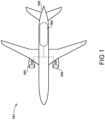
- FIG. 1 A hydrogen-fuelled airliner is illustrated in Figure 1 .
- the airliner 101 is of substantially conventional tube-and-wing twinjet configuration with a central fuselage 102 and substantially identical underwing-mounted turbofan engines 103.
- a hydrogen storage tank 104 is located in the fuselage 102.
- the hydrogen storage tank 104 is a cryogenic hydrogen storage tank and thus stores the hydrogen fuel in a liquid state, for example between 20 and 26 kelvin, and in a specific example at 25 kelvin.
- the hydrogen fuel is pressurised to a pressure from around 1 bar to around 3 bar, in a specific example 2 bar.
- FIG. 2 A block diagram of one of the turbofan engines 103 is shown in Figure 2 , which shows a first fuel system for the engine 103.
- the turbofan engine 103 comprises a core gas turbine 201.
- the core gas turbine 201 comprises, in fluid flow series, a low-pressure compressor 202, a high-pressure compressor 204, a fuel injection system 206, a combustor 207, a high-pressure turbine 208, a low-pressure turbine 209, and a core nozzle 210.
- the high-pressure compressor 204 is driven by the high-pressure turbine 208 via a first shaft 211
- the low-pressure compressor 203 is driven by the low-pressure turbine 209 via a second shaft 212.
- the core gas turbine could be of three-shaft configuration.
- the low-pressure turbine 209 drives a fan 213 via shaft 212.
- hydrogen fuel is pumped from the hydrogen storage tank 104 by a pump 216 and into a main fuel conduit 217 which ultimately delivers fuel to the fuel injection system 206.
- the pump may be driven by an electric machine or via one or more of the gas turbine engine core shafts 211, 212 via an auxiliary gearbox, or by a turbine powered by heated fuel , exhaust gases from the preheater, or compressed air from the core compressor.
- the pump provides a "head" of pressure, raising the pressure from the inlet (defined by the pressure conditions upstream of the pump, in particular tank pressure), to a higher pressure at an outlet.
- the injection temperature is from 250 to 300 kelvin, for example 250 kelvin.
- a preheater 218 is therefore provided for heating of the hydrogen fuel, and possibly to implement a phase change where the hydrogen is stored as a liquid. In the present embodiment, this takes place between the pump 216 and the fuel injection system 206. In an embodiment, the preheater 218 is configured to raise the temperature of the hydrogen fuel to the required injection temperature.
- the pre-heater 218 comprises a burner offtake 220 to divert a portion of the hydrogen fuel from the main fuel conduit 217.
- the amount of hydrogen bled from the main fuel conduit 217 is controlled by a valve (not shown).
- the valve is controlled actively, for example in response to the temperature of the fuel at the fuel injection system 206.
- the valve may be passively controlled.
- the pre-heater 218 comprises a burner 222 in which hydrogen is combined with air from a compressed air source such as a compressor bleed 215 and combusted. Combustion gases pass through a heat exchanger 223, where the hot exhaust gases warm the hydrogen in the main hydrogen fuel conduit 217.
- the pressure of hydrogen within the tank may steadily reduce. It is important to maintain a positive pressure within the tank relative to external pressure, in order to maintain structural integrity of the tank, to assist in pumping further hydrogen from the tank, and to prevent cavitation of downstream turbomachinery. Such pressure control may be difficult in view of the varying external pressure as the aircraft climbs and descends. Additionally, the hydrogen may increase in temperature during storage. In view of both the increased pressure and temperature, there is a risk that supercritical or gaseous hydrogen bubbles may form within the hydrogen fuel conduit 217 upstream of the pump. Such bubbles may also be formed or increased in volume due to the low pressure caused by suction from the pump 216.
- Bubbles within the hydrogen fuel may result in cavitation within the pump 216, which may result in bearing damage (due to unbalanced impeller forces) and damage to the impeller itself, thereby reducing pump life and increasing risk of failure.
- the pumping system relies on a minimum delivery pressure from the tank. A reduced delivery pressure will require greater pumping work, which necessitates large pumps, and possibly more pumping stages, which results in increased weight. Consequently, the present disclosure provides means for increasing or at least maintaining the pressure within the tank 104, and upstream of the pump 216 within the main fuel conduit 217.
- a pre-heater offtake return valve 224 Downstream of the pre-heater 218 in main hydrogen fuel flow is a pre-heater offtake return valve 224, which is configured to control flow from the main fuel conduit 217 to the injection system 206 and to a pre-heater return line 226.
- the return line 226 communicates between the offtake return valve 224 and the tank 104. Consequently, pressurised, heated hydrogen fuel diverted from the main fuel conduit 217 downstream of the pump and the pre-heater 218 can be provided back to the hydrogen tank 104 by operation of the pre-heater offtake return valve 224.
- fuel pressure within the return line 226 will be higher than tank pressure in view of operation of the pump 216 and pre-heater 218, such that hydrogen will flow toward the tank 104.
- the return flow may be provided to an ullage space within the tank 104.
- the valve 224 is controlled by a controller 228 to ensure pressure at a pump 216 inlet is above a saturation pressure, such that bubbles do not form within the flow.
- Pressure and / or temperature pump sensors 230 may be provided, configured to sense pressure and / or temperature conditions at the pump inlet. In the event that conditions are present which are indicative of the fluid approaching the saturation pressure, the controller 228 may be configured to control the valve 224 to increase return flow to the tank 104.
- pressure and / or temperature tank sensors 232 may be provided to sense pressure and / or temperature conditions within the tank 104.
- the controller 228 may be configured to control the valve 224 to increase return flow in the event that conditions are non-optimal, e.g. if pressure within the tank 104 is too low.
- the system may take into account one or more pressure requirements.
- a first pressure requirement may comprise a saturation pressure requirement.
- a second pressure requirement may comprise a pump inlet pressure requirement, i.e. a minimum pressure required at an inlet to the pump 216 to provide for operation.
- a third pressure requirement may comprise a tank structural integrity requirement, i.e. a minimum pressure required to prevent collapse or excess stress on the tank 104.
- the system may be configured to operate the valve 224 such that all three requirements are met.
- Figure 3 illustrates a first alternative fuel system for the engine 103.
- the system is similar to that shown in figure 2 , but additional features are provided.
- the system of figure 3 includes a pump return offtake line 302.
- a first end of the pump return offtake line 302 is in fluid communication with an offtake located in the main hydrogen conduit 217 between an outlet of the pump 216 and an inlet of the pre-heater heat exchanger 223.
- a second end of the pump return offtake line 302 is in fluid communication with a mixer 304, which is in turn provided in fluid communication with the pre-heater return line 226, downstream of the offtake return valve in hydrogen fuel flow.
- Flow through the return line 302 is controlled by a valve 303.
- the return lines 302, 226 bleed a portion of hydrogen fuel flow from the main conduit 217 from points between the pump 216 and the pre-heater heat exchanger 223, and downstream of the pre-heater heat exchanger respectively, and provide them to the mixer 304.
- the pump return offtake line 302 carries liquid hydrogen in operation, while the hydrogen in the pre-heater return line 226 from the valve 224 is in a gaseous or supercritical state.
- the mixer 304 takes the two flows, which may be at different pressures, temperatures and phases, and combines them to provide a mixed flow back to the hydrogen tank 104.
- the mixer may operate as an ejector, with the higher energy flow from downstream of the heater entraining and pumping flow bled from the pump return line 302.
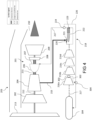
- Figure 4 shows a second alternative fuel system for the engine 103.
- the system is similar to that shown in figure 3 , but further additional features are provided.
- a plurality of hydrogen pumps 216a, 216b, 216c, 216d are provided in series.
- a first hydrogen pump 216a is provided downstream of the tank 104 is main hydrogen fuel conduit 217 flow, and will encounter the lowest inlet pressure of the pumps 216a-d. As such, this pump will be most susceptible to cavitation.
- Second, third and fourth pumps 216b-d are provided downstream in series.
- the pump return line 302 is provided having an offtake point between an outlet of the first pump 216a and an inlet of the second pump 216b. Operation of the valve 303 thereby both controls flow to the mixer 304, and also relieves pressure downstream of the first pump 216a and upstream of the second pump 216b. As such, pressure head provided by the pumps 216a, 216b can be controlled, to provide improved operability and increased stall margin.
- the pumps 216a-d could be spaced significantly from each other.
- the first pump 216a may be provided within the wing or fuselage of the aircraft, physically proximate the tank 104.
- the second, third and fourth pumps 216b-d may be provided within an engine nacelle, proximate the engine 103.
- the return line 302 is provided on the aircraft within the fuselage or wing, thereby reducing the length of ducting required.
- the hydrogen tank could be configured to store hydrogen in a compressed gaseous or supercritical state.
Landscapes
- Engineering & Computer Science (AREA)
- Chemical & Material Sciences (AREA)
- Combustion & Propulsion (AREA)
- Mechanical Engineering (AREA)
- General Engineering & Computer Science (AREA)
- Aviation & Aerospace Engineering (AREA)
- Filling Or Discharging Of Gas Storage Vessels (AREA)
Applications Claiming Priority (1)
| Application Number | Priority Date | Filing Date | Title |
|---|---|---|---|
| GBGB2316850.3A GB202316850D0 (en) | 2023-11-03 | 2023-11-03 | Gas turbine engine |
Publications (1)
| Publication Number | Publication Date |
|---|---|
| EP4549714A1 true EP4549714A1 (de) | 2025-05-07 |
Family
ID=89164893
Family Applications (1)
| Application Number | Title | Priority Date | Filing Date |
|---|---|---|---|
| EP24204406.3A Pending EP4549714A1 (de) | 2023-11-03 | 2024-10-03 | Gasturbinentriebwerk |
Country Status (3)
| Country | Link |
|---|---|
| US (1) | US20250250929A1 (de) |
| EP (1) | EP4549714A1 (de) |
| GB (1) | GB202316850D0 (de) |
Citations (4)
| Publication number | Priority date | Publication date | Assignee | Title |
|---|---|---|---|---|
| GB869274A (en) * | 1956-11-08 | 1961-05-31 | Rolls Royce | Improvements in or relating to fuel systems for internal combustion engines |
| FR3110936A1 (fr) * | 2020-05-28 | 2021-12-03 | Safran | Dispositif de régulation de la pression d'un réservoir de carburant cryogénique d’un aéronef. |
| EP3978738A1 (de) | 2020-09-30 | 2022-04-06 | Rolls-Royce plc | Wasserstoffbrennstoffverdampfer |
| WO2022263307A1 (fr) * | 2021-06-14 | 2022-12-22 | Safran | Système et procédé de conditionnement de carburant configuré pour alimenter un turbomoteur d'aéronef à partir de carburant issu d'un réservoir cryogénique |
Family Cites Families (5)
| Publication number | Priority date | Publication date | Assignee | Title |
|---|---|---|---|---|
| DE102012204820A1 (de) * | 2012-03-26 | 2013-09-26 | Bayerische Motoren Werke Aktiengesellschaft | Fahrzeug-Tanksystem zur Speicherung eines Betriebsstoffes in tiefkaltem Zustand |
| US10443503B2 (en) * | 2015-03-27 | 2019-10-15 | Pratt & Whitney Canada Corp. | Fuel system for a gas turbine engine |
| FR3042821B1 (fr) * | 2015-10-26 | 2017-12-01 | Snecma | Procede de regulation de la pression au sein d'un premier reservoir d'ergol de moteur fusee |
| US11674443B2 (en) * | 2020-11-06 | 2023-06-13 | General Electric Company | Hydrogen fuel system |
| US20220178306A1 (en) * | 2020-12-09 | 2022-06-09 | Pratt & Whitney Canada Corp. | Method of operating an aircraft engine and fuel system using multiple fuel types |
-
2023
- 2023-11-03 GB GBGB2316850.3A patent/GB202316850D0/en not_active Ceased
-
2024
- 2024-10-03 EP EP24204406.3A patent/EP4549714A1/de active Pending
- 2024-10-16 US US18/916,845 patent/US20250250929A1/en active Pending
Patent Citations (4)
| Publication number | Priority date | Publication date | Assignee | Title |
|---|---|---|---|---|
| GB869274A (en) * | 1956-11-08 | 1961-05-31 | Rolls Royce | Improvements in or relating to fuel systems for internal combustion engines |
| FR3110936A1 (fr) * | 2020-05-28 | 2021-12-03 | Safran | Dispositif de régulation de la pression d'un réservoir de carburant cryogénique d’un aéronef. |
| EP3978738A1 (de) | 2020-09-30 | 2022-04-06 | Rolls-Royce plc | Wasserstoffbrennstoffverdampfer |
| WO2022263307A1 (fr) * | 2021-06-14 | 2022-12-22 | Safran | Système et procédé de conditionnement de carburant configuré pour alimenter un turbomoteur d'aéronef à partir de carburant issu d'un réservoir cryogénique |
Also Published As
| Publication number | Publication date |
|---|---|
| US20250250929A1 (en) | 2025-08-07 |
| GB202316850D0 (en) | 2023-12-20 |
Similar Documents
| Publication | Publication Date | Title |
|---|---|---|
| EP3978738A1 (de) | Wasserstoffbrennstoffverdampfer | |
| EP4239170B1 (de) | Kombitriebwerke | |
| EP3211200B1 (de) | System zur gestuften verbrennung | |
| US9234464B2 (en) | Fuel metering system electrically servoed metering pump | |
| EP4187070B1 (de) | Gasturbine | |
| EP4488498A1 (de) | Brennstoffsystem für gasturbinenmotor | |
| JP2025530897A (ja) | 水素燃料配送システム | |
| EP4361418B1 (de) | Flugzeugtriebwerktreibstoffsystem | |
| US10563588B2 (en) | Fuel system with vacuum generator to purge fuel from fuel nozzles | |
| EP4549714A1 (de) | Gasturbinentriebwerk | |
| US12365477B1 (en) | Hydrogen fuelled aircraft propulsion system | |
| EP4513018B1 (de) | Brennstoffsystem für gasturbinenmotor | |
| EP4488497A1 (de) | Brennstoffsystem für gasturbinenmotor | |
| US12092024B1 (en) | Gas turbine engine | |
| US12618361B2 (en) | Hydrogen fuelled gas turbine engine | |
| US12474054B2 (en) | Gas turbine engine | |
| EP4613993A1 (de) | Wasserstoffbetriebener gasturbinenmotor | |
| US20260043351A1 (en) | Aircraft propulsion system | |
| EP4613992A1 (de) | Wasserstoffbetriebener gasturbinenmotor | |
| US20260055731A1 (en) | Gas turbine engine starting method | |
| EP4517065A1 (de) | Brennstoffsystem für gasturbinenmotor | |
| EP4647591A1 (de) | Flugzeugkraftstoffsystem und -verfahren | |
| EP4647592A1 (de) | Flugzeugkraftstoffsystem und -verfahren | |
| EP4589129A1 (de) | Wasserstoffbetriebener gasturbinenmotor | |
| EP4621200A1 (de) | Verfahren und vorrichtung für ein kryogenes kraftstoffverteilungssystem mit einem bypass |
Legal Events
| Date | Code | Title | Description |
|---|---|---|---|
| PUAI | Public reference made under article 153(3) epc to a published international application that has entered the european phase |
Free format text: ORIGINAL CODE: 0009012 |
|
| STAA | Information on the status of an ep patent application or granted ep patent |
Free format text: STATUS: THE APPLICATION HAS BEEN PUBLISHED |
|
| AK | Designated contracting states |
Kind code of ref document: A1 Designated state(s): AL AT BE BG CH CY CZ DE DK EE ES FI FR GB GR HR HU IE IS IT LI LT LU LV MC ME MK MT NL NO PL PT RO RS SE SI SK SM TR |
|
| STAA | Information on the status of an ep patent application or granted ep patent |
Free format text: STATUS: REQUEST FOR EXAMINATION WAS MADE |
|
| 17P | Request for examination filed |
Effective date: 20250512 |