EP4549865A1 - Système de refroidissement de batterie et procédé de fonctionnement d'un système de refroidissement de batterie - Google Patents
Système de refroidissement de batterie et procédé de fonctionnement d'un système de refroidissement de batterie Download PDFInfo
- Publication number
- EP4549865A1 EP4549865A1 EP23217379.9A EP23217379A EP4549865A1 EP 4549865 A1 EP4549865 A1 EP 4549865A1 EP 23217379 A EP23217379 A EP 23217379A EP 4549865 A1 EP4549865 A1 EP 4549865A1
- Authority
- EP
- European Patent Office
- Prior art keywords
- coolant
- channels
- battery
- heat exchanger
- vehicle
- Prior art date
- Legal status (The legal status is an assumption and is not a legal conclusion. Google has not performed a legal analysis and makes no representation as to the accuracy of the status listed.)
- Pending
Links
Images




Classifications
-
- H—ELECTRICITY
- H01—ELECTRIC ELEMENTS
- H01M—PROCESSES OR MEANS, e.g. BATTERIES, FOR THE DIRECT CONVERSION OF CHEMICAL ENERGY INTO ELECTRICAL ENERGY
- H01M10/00—Secondary cells; Manufacture thereof
- H01M10/60—Heating or cooling; Temperature control
- H01M10/65—Means for temperature control structurally associated with the cells
- H01M10/656—Means for temperature control structurally associated with the cells characterised by the type of heat-exchange fluid
- H01M10/6567—Liquids
- H01M10/6568—Liquids characterised by flow circuits, e.g. loops, located externally to the cells or cell casings
-
- F—MECHANICAL ENGINEERING; LIGHTING; HEATING; WEAPONS; BLASTING
- F28—HEAT EXCHANGE IN GENERAL
- F28D—HEAT-EXCHANGE APPARATUS, NOT PROVIDED FOR IN ANOTHER SUBCLASS, IN WHICH THE HEAT-EXCHANGE MEDIA DO NOT COME INTO DIRECT CONTACT
- F28D7/00—Heat-exchange apparatus having stationary tubular conduit assemblies for both heat-exchange media, the media being in contact with different sides of a conduit wall
- F28D7/0008—Heat-exchange apparatus having stationary tubular conduit assemblies for both heat-exchange media, the media being in contact with different sides of a conduit wall the conduits for one medium being in heat conductive contact with the conduits for the other medium
-
- F—MECHANICAL ENGINEERING; LIGHTING; HEATING; WEAPONS; BLASTING
- F28—HEAT EXCHANGE IN GENERAL
- F28D—HEAT-EXCHANGE APPARATUS, NOT PROVIDED FOR IN ANOTHER SUBCLASS, IN WHICH THE HEAT-EXCHANGE MEDIA DO NOT COME INTO DIRECT CONTACT
- F28D9/00—Heat-exchange apparatus having stationary plate-like or laminated conduit assemblies for both heat-exchange media, the media being in contact with different sides of a conduit wall
- F28D9/0031—Heat-exchange apparatus having stationary plate-like or laminated conduit assemblies for both heat-exchange media, the media being in contact with different sides of a conduit wall the conduits for one heat-exchange medium being formed by paired plates touching each other
- F28D9/0037—Heat-exchange apparatus having stationary plate-like or laminated conduit assemblies for both heat-exchange media, the media being in contact with different sides of a conduit wall the conduits for one heat-exchange medium being formed by paired plates touching each other the conduits for the other heat-exchange medium also being formed by paired plates touching each other
-
- H—ELECTRICITY
- H01—ELECTRIC ELEMENTS
- H01M—PROCESSES OR MEANS, e.g. BATTERIES, FOR THE DIRECT CONVERSION OF CHEMICAL ENERGY INTO ELECTRICAL ENERGY
- H01M10/00—Secondary cells; Manufacture thereof
- H01M10/42—Methods or arrangements for servicing or maintenance of secondary cells or secondary half-cells
- H01M10/425—Structural combination with electronic components, e.g. electronic circuits integrated to the outside of the casing
-
- H—ELECTRICITY
- H01—ELECTRIC ELEMENTS
- H01M—PROCESSES OR MEANS, e.g. BATTERIES, FOR THE DIRECT CONVERSION OF CHEMICAL ENERGY INTO ELECTRICAL ENERGY
- H01M10/00—Secondary cells; Manufacture thereof
- H01M10/60—Heating or cooling; Temperature control
-
- H—ELECTRICITY
- H01—ELECTRIC ELEMENTS
- H01M—PROCESSES OR MEANS, e.g. BATTERIES, FOR THE DIRECT CONVERSION OF CHEMICAL ENERGY INTO ELECTRICAL ENERGY
- H01M10/00—Secondary cells; Manufacture thereof
- H01M10/60—Heating or cooling; Temperature control
- H01M10/61—Types of temperature control
- H01M10/613—Cooling or keeping cold
-
- H—ELECTRICITY
- H01—ELECTRIC ELEMENTS
- H01M—PROCESSES OR MEANS, e.g. BATTERIES, FOR THE DIRECT CONVERSION OF CHEMICAL ENERGY INTO ELECTRICAL ENERGY
- H01M10/00—Secondary cells; Manufacture thereof
- H01M10/60—Heating or cooling; Temperature control
- H01M10/62—Heating or cooling; Temperature control specially adapted for specific applications
- H01M10/625—Vehicles
-
- H—ELECTRICITY
- H01—ELECTRIC ELEMENTS
- H01M—PROCESSES OR MEANS, e.g. BATTERIES, FOR THE DIRECT CONVERSION OF CHEMICAL ENERGY INTO ELECTRICAL ENERGY
- H01M10/00—Secondary cells; Manufacture thereof
- H01M10/60—Heating or cooling; Temperature control
- H01M10/63—Control systems
- H01M10/633—Control systems characterised by algorithms, flow charts, software details or the like
-
- H—ELECTRICITY
- H01—ELECTRIC ELEMENTS
- H01M—PROCESSES OR MEANS, e.g. BATTERIES, FOR THE DIRECT CONVERSION OF CHEMICAL ENERGY INTO ELECTRICAL ENERGY
- H01M10/00—Secondary cells; Manufacture thereof
- H01M10/60—Heating or cooling; Temperature control
- H01M10/65—Means for temperature control structurally associated with the cells
- H01M10/655—Solid structures for heat exchange or heat conduction
- H01M10/6551—Surfaces specially adapted for heat dissipation or radiation, e.g. fins or coatings
-
- H—ELECTRICITY
- H01—ELECTRIC ELEMENTS
- H01M—PROCESSES OR MEANS, e.g. BATTERIES, FOR THE DIRECT CONVERSION OF CHEMICAL ENERGY INTO ELECTRICAL ENERGY
- H01M10/00—Secondary cells; Manufacture thereof
- H01M10/60—Heating or cooling; Temperature control
- H01M10/65—Means for temperature control structurally associated with the cells
- H01M10/655—Solid structures for heat exchange or heat conduction
- H01M10/6556—Solid parts with flow channel passages or pipes for heat exchange
-
- F—MECHANICAL ENGINEERING; LIGHTING; HEATING; WEAPONS; BLASTING
- F28—HEAT EXCHANGE IN GENERAL
- F28F—DETAILS OF HEAT-EXCHANGE AND HEAT-TRANSFER APPARATUS, OF GENERAL APPLICATION
- F28F3/00—Plate-like or laminated elements; Assemblies of plate-like or laminated elements
- F28F3/02—Elements or assemblies thereof with means for increasing heat-transfer area, e.g. with fins, with recesses, with corrugations
- F28F3/025—Elements or assemblies thereof with means for increasing heat-transfer area, e.g. with fins, with recesses, with corrugations the means being corrugated, plate-like elements
-
- H—ELECTRICITY
- H01—ELECTRIC ELEMENTS
- H01M—PROCESSES OR MEANS, e.g. BATTERIES, FOR THE DIRECT CONVERSION OF CHEMICAL ENERGY INTO ELECTRICAL ENERGY
- H01M10/00—Secondary cells; Manufacture thereof
- H01M10/42—Methods or arrangements for servicing or maintenance of secondary cells or secondary half-cells
- H01M10/425—Structural combination with electronic components, e.g. electronic circuits integrated to the outside of the casing
- H01M2010/4271—Battery management systems including electronic circuits, e.g. control of current or voltage to keep battery in healthy state, cell balancing
-
- H—ELECTRICITY
- H01—ELECTRIC ELEMENTS
- H01M—PROCESSES OR MEANS, e.g. BATTERIES, FOR THE DIRECT CONVERSION OF CHEMICAL ENERGY INTO ELECTRICAL ENERGY
- H01M2220/00—Batteries for particular applications
- H01M2220/20—Batteries in motive systems, e.g. vehicle, ship, plane
-
- Y—GENERAL TAGGING OF NEW TECHNOLOGICAL DEVELOPMENTS; GENERAL TAGGING OF CROSS-SECTIONAL TECHNOLOGIES SPANNING OVER SEVERAL SECTIONS OF THE IPC; TECHNICAL SUBJECTS COVERED BY FORMER USPC CROSS-REFERENCE ART COLLECTIONS [XRACs] AND DIGESTS
- Y02—TECHNOLOGIES OR APPLICATIONS FOR MITIGATION OR ADAPTATION AGAINST CLIMATE CHANGE
- Y02E—REDUCTION OF GREENHOUSE GAS [GHG] EMISSIONS, RELATED TO ENERGY GENERATION, TRANSMISSION OR DISTRIBUTION
- Y02E60/00—Enabling technologies; Technologies with a potential or indirect contribution to GHG emissions mitigation
- Y02E60/10—Energy storage using batteries
Definitions
- the present invention generally relates to a battery cooling system for a vehicle battery unit and a method for operating such a battery cooling system, and, in particular embodiments, to a battery cooling system for an aeronautic vehicle.
- a heat exchanger in accordance with an embodiment, includes a base body, cooling fins protruding from a first side of the base body, first channels integrated in the base body and connected to a first connector and a second connector, the first channels configured to guide a first coolant and second channels integrated in the base body and connected to a first connector and a second connector, the second channels configured to guide a second coolant, wherein the first channels are separate from the second channels and wherein the heat exchanger is capable of being integrated in an outside surface of a vehicle.
- a vehicle in accordance with a further embodiment includes a battery temperature control system comprising a battery pack and a battery management system in connection with the battery temperature control system and configured to operate the battery temperature control system in a first cooling mode when a temperature of the battery is above a first predetermined temperature, the first mode configured to cool a coolant, to operate the battery temperature control system in a second cooling mode when the temperature of the battery is above a second predetermined temperature, the second mode configured to cool the coolant, to operate the battery temperature control system in a third heating mode when the temperature of the battery is below a third predetermined temperature, the third mode configured to heat the coolant and to operate the battery temperature control system in a fourth idle mode when the temperature of the battery is between the first predetermined temperature or the second predetermined temperature and the third predetermined temperature.
- Embodiments provide a boom integrated heat exchanger for an aviation vehicle. Further embodiments provide a heat exchanger configured to provide coolant-to-coolant cooling and/or heating, and air-to-coolant cooling for a vehicle battery unit or vehicle energy storage unit.
- the heat exchanger may provide three different functionalities: 1) cooling the battery (unit) when the aviation vehicle is airborne; 2) cooling the battery (unit) when the aviation vehicle is on ground or parked and battery (unit) temperature is elevated above a predetermined temperature in order to, e.g., precondition the battery (unit) for safe take off; and 3) heating the battery (unit) when the aviation vehicle is on ground or parked and battery (unit) temperature is below a predetermined temperature in order to, e.g., precondition the battery (unit) for efficient electrical charging.
- FIG. 1 shows a block diagram of a battery temperature control system 10 for a vehicle battery unit 1.
- the related vehicle may be an aviation vehicle such as an aircraft or a drone.
- the aviation vehicle may be a vertical take-off and landing (VTOL) vehicle and the vehicle battery unit 1 may provide power to a vehicle engine unit that is (or is part of) a vertical thrust unit (VTU).
- VTU vertical thrust unit
- the battery temperature control system 10 comprises a direct battery temperature control system 20 and a ground temperature control system 30.
- the vehicle battery unit 1 as shown in Figure 1 may be a vehicle battery unit 1 for a single vehicle engine unit/VTU and in particular for a motor controller of an electric motor and/or electric motor.
- the direct battery temperature control system 20 comprises a heat exchanger 40, a device 50 configured to move the coolant (e.g., electric pump), a battery (pack) 60 and first coolant lines 21.
- the components 40-60 of the direct battery temperature control system 20 may be independent and distinct and are connected by the first coolant lines 21.
- the first coolant lines 21 may directly connect the components 40-60 to each other.
- the system 20 with the first coolant lines 21 may form a closed battery cooling circuit or closed battery cooling loop.
- the electric pump 50 moves or circulates the first coolant through the closed battery cooling circuit or loop.
- the components 40-60 may be arranged in a different order or may include additional components.
- a single first coolant line 21 connects an element 40-60 to another element 40-60.
- multiple first coolant lines 21 can connect one element 40-60 to another element 40-60.
- the ground temperature control system 30 may comprise the heat exchanger 40, outside connectors 80 arranged at an outside surface of the vehicle 2 and second coolant lines 31.
- the second coolant lines 31 may directly connect the heat exchanger 40 to the outside connectors 80.
- the outside connectors 80 may be connectable to a ground support equipment 100.
- the ground support equipment 100 (sometimes also referred to as on-ground chiller) may be configured to provide warm or hot coolant in order to warm up the vehicle battery unit 1 (and in particular the battery (pack) 60) or cold coolant in order to cool the vehicle battery unit 1 (and especially the battery (pack) 60).
- the ground temperature control system 30 together with the connected ground support equipment 100 may form a closed cooling circuit or loop and/or a closed heating circuit or loop for the vehicle battery unit 1.
- the ground support equipment 100 comprises the pump configured to move the second coolant in the closed cooling or heating circuit. In various other embodiments such a pump is integrated in the ground temperature control system 30.
- two (e.g., more than one), three (e.g., more than two), four (e.g., more than three) or six (e.g., more than five) heat exchangers and related coolant lines are connected to one single pair of outside connectors 80 arranged at an outside (side) surface of a boom meaning at least two heat exchangers are connected via second coolant lines 31.
- one second coolant line 31 connects the heat exchanger 40 to a first outside connector 82 and another second coolant line 31 connects the heat exchanger 40 to a second outside connector 84.
- more than one second coolant line 31 can connect the outside connectors 82, 84 to the heat exchanger 40, respectively.
- the first and second coolant lines 21, 31 may be flexible, semiflexible, or hard tubes or pipes. They might be made of plastic, rubber, silicone, or a combination thereof. Alternatively, they are made from metal such as aluminum.
- the first coolant lines 21 of the direct battery temperature control system 20 and the second coolant lines 31 of the ground temperature control system 30 are two different and independent systems and do not intersect so that the first coolant in the system 20 cannot flow to the ground temperature control system 30 or can mix with the second coolant of the second system.
- second coolant i.e., it cannot flow into the first coolant system or mix with the first coolant.
- the systems are two independent systems, which are thermally connected via the heat exchanger 40.
- the heat exchanger 40 comprises and integrates an air-to-coolant (e.g. air-to-liquid) type heat exchanger and a coolant-to-coolant (liquid-to-liquid) type heat exchanger.
- the air-to-coolant type heat exchanger includes cooling fins 440 and first channels (part of the direct battery temperature control system 20) and the coolant-to-coolant type heat exchanger includes second channels (as part of the ground temperature control system 30) and the first channels.
- the first coolant in the first channels is cooled when the aviation vehicle moves, e.g., when it is airborne and air moves over the cooling fins 440.
- first coolant inside the first channels may also be cooled when a second coolant moving inside the second channels (sometimes also called cooling chambers) cools the first coolant in the first cooling channel via thermal exchange.
- first coolant in the first channels may be heated when a second coolant moving in the second channels heats the first coolant in the first cooling channel via thermal exchange.
- the heat exchanger 40 may have a first input 452 to which a first coolant line 21 is connectable and a first output 454 to which another first coolant line 21 is connectable.
- the heat exchanger 40 may comprise a second input 462 to which a second coolant line 31 is connectable and a second output 464 to which another second coolant line 31 is connectable.
- the heat exchanger 40 comprises a heat sink having the cooling fins 440.
- the device 50 configured to move the coolant might be a pump such as an electric pump.
- the operation of the pump 50 may be regulated so that the battery (pack) 60 is not subcooled below a predetermined temperature or heated above another predetermined temperature.
- the operation of the pump 50 may be controlled by a battery management system (BMS) such as a processor or a controller 70.
- BMS battery management system
- the device 50 may have an input to which a first coolant line 21 is connectable and an output to which another first coolant line 21 is connectable.
- the battery or battery pack 60 may comprises battery cells (e.g., pouch cells or cylindrical cells), an internal thermal conditioning system (i.e., coolant channels of the battery), at least one sensor 64, and a battery management system (BMS) 70.
- the temperature of the battery (pack) 60 may be measured with the at least one sensor 64.
- a plurality of sensors 64 may be used such as 4, 6 or 8 sensors.
- the coolant channels of the battery (pack) 60 may have an input to which a first coolant line 21 is connectable and an output to which another first coolant line 21 is connectable.
- the first coolant in the direct battery temperature control system 20 may be a working fluid or liquid such as water, a more vicious liquid (e.g., ethylene glycol) or a mixture of the water and the vicious liquid (e.g., an ethylene glycol water mixture in various ratios, e.g., 50/50, or 40/60).
- the second coolant in the ground temperature control system 30 may be a working fluid or liquid such as water, a more vicious liquid (e.g., ethylene glycol) or a mixture of the water and the vicious liquid (e.g., an ethylene glycol water mixture in various ratios, e.g., 50/50, or 40/60).
- the mixture may have some additional agents against corrosion added to it.
- the first and second coolants may be tuned to have a low electrical conductivity (reducing risk of fire in case of coolant leak).
- the electrical conductivity of the first and second coolants may be less or equal 100.0 ⁇ S/cm, less or equal 80.0 ⁇ S/cm, or less or equal 60.0 ⁇ S/cm.
- the coolants in both systems 20, 30 may be the same or may be different.
- the vehicle battery unit 1 comprises a battery management system (BMS) 70 comprising a processor or a controller 70 configured to control the thermal management of the battery (pack) 60 and the operation of the electric pump 50.
- BMS battery management system
- the vehicle battery unit 1 and in particular the battery (pack) 60 may comprise at least one sensor such as multiple sensor 64 configured to measure the temperature of the battery (pack) 60.
- the sensor 64 is configured to transmit sensor data (e.g., temperature data) to the BMS 70 and/or the BMS 70 is configured to read sensor data from the sensor 64. Based on these measured sensor data, the processer may control the operation of the battery temperature control system 10.
- the battery (pack) 60 In a first mode (of operation), the battery (pack) 60 needs to be cooled because the measured temperature of the battery (pack) 60 is above a first predetermined temperature (e.g., 25 °C, 30 °C, 35 °C, or 40°C) and the aviation vehicle is airborne.
- the BMS 70 controls the operation of the electric pump 50 in the direct battery temperature control system 20 so that the first coolant is cooled via air-to-coolant cooling by ambient (ram-) air moving or flowing over and between the cooling fins 440.
- a cooling of the first coolant via the second coolant does not take place and the air cooling is the only cooling for the first coolant. Since the aviation vehicle is in-flight, the heat exchanger 40 is not connected to the ground support equipment 100 and the second coolant does not move in the coolant lines 31 and thereby does not cool the first coolant.
- the battery (pack) 60 In a third mode (of operation), the battery (pack) 60 needs to be heated because the measured temperature of the battery (pack) 60 is below a third predetermined temperature (e.g., 16 °C, 18 °C, 20 °C or 22°C) and the aviation vehicle is on ground or parked. Such a scenario may take place in order to prepare the aviation vehicle for take-off or when the battery (pack) 60 needs to be charged.
- a third predetermined temperature e.g. 16 °C, 18 °C, 20 °C or 22°C
- the BMS 70 controls the operation of the electric pump 50 of the direct battery temperature control system 20 and maybe the operation of the pump in the ground temperature control system 30.
- the battery (pack) 60 needs to be heated to 20 °C in order to bring the aviation vehicle into starting condition.
- the on-ground temperature of the battery (pack) 60 is falling and is approaching -20°C, then the battery (pack) 60 needs to be heated to prevent temperature to drop below -20 °C in order to prevent the battery from deteriorating.
- Figure 2A shows a side view of the heat exchanger 40 in a first (longitudinal or length) direction L.
- the heat exchanger 40 has a main body 420. Cooling fins 440 may protrude on a first main side of the main body 420.
- First input and output connections 450 and second input and output connections 460 may be arranged on a second main side 424 of the main body 420.
- the first input and output connections 450 may comprise a first input 452 connectable to a first cooling line 21 and a first output 454 connectable to another first cooling line 21.
- the second input and output connections 460 may comprise a second input 462 connectable to a second cooling line 31 and a second output 464 connectable to another second cooling line 31.
- the first and second input and output connections 450 and 460 may be hydraulic connectors.
- first input and output connections 450 may be arranged at one end (along first direction L) of the main body 420 and the second input and output connections 460 may be arranged at the other end of the main body 420.
- the first input 452 may be an input where the first coolant (warm/hot) coming from the battery (pack) 60 enters the heat exchanger 40 and the first output 454 may be an output where the cooled first coolant leaves the heat exchanger 40 toward the pump 50.
- the second coolant may not move via the second input and output connections 460.
- a cooling of the first coolant via the coolant-to-coolant cooling may be insignificant and the cooling of the first coolant via the coolant fins 440 may be the main contributor for the cooling of the first coolant.
- the hot first coolant may enter the heat exchanger 40 at input 452, is cooled and leaves the heat exchanger 40 at the first output 454 while the cool second coolant enters the heat exchanger 40 at the first input 462 is heated and leaves the heat exchanger 40 via the second output 464.
- a cooling of the first coolant via the coolant fins 440 may be insignificant relative to the coolant-to-coolant cooling, and the coolant-to-coolant cooling may be the main contributor for the cooling of the first coolant.
- Figure 2B shows a cross sectional view of the heat exchanger 40 in a second (width) direction W orthogonal to the first direction L.
- the heat exchanger 40 comprises the main body 420 and the fins 440 orthogonally extending from the main body 420.
- Channels 430, 470 may be arranged or integrated in main body 420.
- the channels 430, 470 may be of different shapes.
- the channels 430, 470 may have the form of straight channels or regular or irregular meandering (e.g., sinusoidal wavy) channels.
- the channels 430, 470 may comprise turbulators (e.g. dimples) in order to enhance heat transfer.
- the channels 430, 470 may have the same form or different form.
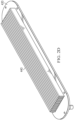
- FIG. 2E shows a top perspective view of another embodiment of the heat exchanger 40.
- a connector 445 configured to fill first coolant into the direct battery temperature control system 20 or to de-air the system 20 is arranged on the main body 420.
- the connector 445 may be arranged between the cooling fins 440.
- the connector 445 may be arranged at the end of the cooling fins 440 along first direction L. In various embodiments only one such connector 445 may be provided on the heat exchanger 40 for the direct battery temperature control system 20.
- the heat exchanger 40 may be arranged at an outside surface of a vehicle such the cooling fins 440 are exposed to ambient air and the base plate 410 or the second main side 424 is enclosed by or located in(side) the vehicle surface.
- the boom 2 does not have any ducts or openings for an air-to-liquid type heat exchanger.
- the inventive integrated heat exchanger 40 having the advantage that the boom 2 can be designed with a smaller cross sections along the direction H and W. The narrower boom may reduce cooling track.
- the inventive integrated heat exchanger 40 is advantageous because fewer components are needed since (an) additional and separate liquid-to-liquid type heat exchanger(s) (e.g., plate heat exchanger) is/are not necessary and fewer hydraulic connections (between the components) are used to assemble the battery unit 1.
- the inventive battery unit 1 is lighter (less mass) than a comparable conventional battery unit not forgoing the liquid-to-liquid type heat exchanger.
- the present disclosure is mainly described with respect to a single vehicle battery unit 1.
- a single vehicle battery unit there may be two, four, six or eight battery units integrated in a boom.
- Each battery unit may be connected to a vehicle motor and/or motor controller respectively so that, for example, eight battery units and eight vehicle motors and/or motor controllers are integrated in a single boom.
- the aeronautic vehicle may have two or four such booms.
- a single boom may have a single port at its outer surface for charging the battery unit 1/ battery 60 or the battery units 1 or batteries 60.
- This single port may also include outside connectors 80 for proving hot or cold coolant from the ground support equipment 100.
- the ground support equipment 100 is configured to provide warm (hot) or cold coolant and also provide power for charging the battery unit(s) 1/battery or batteries 60.
- the ground support equipment 100 may charge the battery unit(s) 1/ battery or batteries 60 while at the same time cooling or heating the battery unit(s) 1/battery or batteries 60.
- the single port may be arranged at a side surface of the boom 2 of the vehicle.
- FIG. 4 shows a single boom 2 with 4 VTUs and 4 related battery units 1 (one battery unit for one VTU) according to an embodiment.
- Each battery unit 1 may be mounted together with a cooling system for a vehicle engine unit (e.g., VTU) described in patent application no. _(attorney docket number TAV-230076075) titled "Cooling System for a Vehicle Engine Unit and Method for Filling such a Cooling System" in the boom 2.
- VTU vehicle engine unit
- An aviation vehicle may have two such booms, each on one side of the aviation vehicle.
- FIG. 5 shows a method for operating a battery temperature control system.
- the method 500 comprises sensing 510, by at least one sensor at a battery, a temperature of the battery. Based on the sensed information, at least one controller or a battery management system of the battery may operate 520 the battery temperature control system as follows: 1) Operate the battery temperature control system in a first (operation) mode 522 when the sensed temperature is a above a first predetermined temperature and when the vehicle moves, e.g., is airborne or in-flight. In the first mode the battery is cooled via air-to-coolant cooling (e.g., air to liquid cooling).
- air-to-coolant cooling e.g., air to liquid cooling
- the battery temperature control system in a fourth mode 528 when the sensed temperature is below the first predetermined temperature or the second predetermined temperature and above the third predetermined temperature and optionally when the vehicle is connected to a ground support equipment.
- the battery temperature control system can be operated in a further (operation) mode in order to keep the temperature of the battery above a certain minimum temperature in order to avoid deterioration of the battery.
- the controller may stop operating in one of the modes and switch to another mode whenever the sensed temperature in the battery passes one of the predetermined temperatures.
Landscapes
- Engineering & Computer Science (AREA)
- Manufacturing & Machinery (AREA)
- Chemical & Material Sciences (AREA)
- Chemical Kinetics & Catalysis (AREA)
- Electrochemistry (AREA)
- General Chemical & Material Sciences (AREA)
- Thermal Sciences (AREA)
- Physics & Mathematics (AREA)
- Mechanical Engineering (AREA)
- General Engineering & Computer Science (AREA)
- Microelectronics & Electronic Packaging (AREA)
- Automation & Control Theory (AREA)
- Secondary Cells (AREA)
Applications Claiming Priority (1)
| Application Number | Priority Date | Filing Date | Title |
|---|---|---|---|
| US18/498,929 US20250140977A1 (en) | 2023-10-31 | 2023-10-31 | Battery cooling system and method for operating a battery cooling system |
Publications (1)
| Publication Number | Publication Date |
|---|---|
| EP4549865A1 true EP4549865A1 (fr) | 2025-05-07 |
Family
ID=89223322
Family Applications (1)
| Application Number | Title | Priority Date | Filing Date |
|---|---|---|---|
| EP23217379.9A Pending EP4549865A1 (fr) | 2023-10-31 | 2023-12-15 | Système de refroidissement de batterie et procédé de fonctionnement d'un système de refroidissement de batterie |
Country Status (2)
| Country | Link |
|---|---|
| US (1) | US20250140977A1 (fr) |
| EP (1) | EP4549865A1 (fr) |
Citations (6)
| Publication number | Priority date | Publication date | Assignee | Title |
|---|---|---|---|---|
| JP2002098424A (ja) * | 2000-09-25 | 2002-04-05 | Zexel Valeo Climate Control Corp | 冷凍サイクル |
| US6540015B1 (en) * | 1999-09-16 | 2003-04-01 | Denso Corporation | Heat exchanger and method for manufacturing the same |
| US20130032315A1 (en) * | 2010-04-14 | 2013-02-07 | Kaeser Kompressoren Ag | Refrigerant dryer such as a compressed air refrigerant dryer, and heat exchanger for a refrigerant dryer such as a compressed air refrigerant dryer |
| CN103502763A (zh) * | 2011-05-06 | 2014-01-08 | 三菱电机株式会社 | 热交换器及具有该热交换器的制冷循环装置 |
| CA3208204A1 (fr) * | 2020-08-26 | 2022-08-11 | Zhaohui Li | Echangeur de chaleur, boitier de commande electrique et systeme de climatisation |
| FR3129717A1 (fr) * | 2021-11-29 | 2023-06-02 | Valeo Systemes Thermiques | Echangeur de chaleur pour vehicule electrique ou hybride |
-
2023
- 2023-10-31 US US18/498,929 patent/US20250140977A1/en active Pending
- 2023-12-15 EP EP23217379.9A patent/EP4549865A1/fr active Pending
Patent Citations (6)
| Publication number | Priority date | Publication date | Assignee | Title |
|---|---|---|---|---|
| US6540015B1 (en) * | 1999-09-16 | 2003-04-01 | Denso Corporation | Heat exchanger and method for manufacturing the same |
| JP2002098424A (ja) * | 2000-09-25 | 2002-04-05 | Zexel Valeo Climate Control Corp | 冷凍サイクル |
| US20130032315A1 (en) * | 2010-04-14 | 2013-02-07 | Kaeser Kompressoren Ag | Refrigerant dryer such as a compressed air refrigerant dryer, and heat exchanger for a refrigerant dryer such as a compressed air refrigerant dryer |
| CN103502763A (zh) * | 2011-05-06 | 2014-01-08 | 三菱电机株式会社 | 热交换器及具有该热交换器的制冷循环装置 |
| CA3208204A1 (fr) * | 2020-08-26 | 2022-08-11 | Zhaohui Li | Echangeur de chaleur, boitier de commande electrique et systeme de climatisation |
| FR3129717A1 (fr) * | 2021-11-29 | 2023-06-02 | Valeo Systemes Thermiques | Echangeur de chaleur pour vehicule electrique ou hybride |
Also Published As
| Publication number | Publication date |
|---|---|
| US20250140977A1 (en) | 2025-05-01 |
Similar Documents
| Publication | Publication Date | Title |
|---|---|---|
| US11180044B2 (en) | Electric vehicle cooling system | |
| US11214114B2 (en) | Electric vehicle thermal management system | |
| US20220072928A1 (en) | Vehicle Thermal Management System and Heat Exchangers | |
| US11660970B2 (en) | On-board liquid-cooled or gas-cooled charging cable for electric vehicles | |
| US20220285753A1 (en) | Aircraft battery pack and associated cooling system | |
| JP2022530619A (ja) | バッテリ熱管理システムおよび方法 | |
| EP1261065A2 (fr) | Gestion thermique par couverture et enveloppement de systèmes de batteries modulaires | |
| US20130183555A1 (en) | Cooling system for vehicle batteries | |
| US11646461B2 (en) | Battery cooling systems and methods | |
| US11768036B2 (en) | Heat exchanger and system for cooling a fluid comprising such a heat exchanger | |
| KR20000064376A (ko) | 공기조절시스템용열교환기장치 | |
| CN106225529A (zh) | 一种板式换热器 | |
| AU2020227257B2 (en) | Thermal management system | |
| EP3560799B1 (fr) | Capot | |
| US20230100546A1 (en) | Cooling system for an electric vehicle | |
| CN115441093A (zh) | 一种电池模组和含该电池模组的飞行器 | |
| EP4549865A1 (fr) | Système de refroidissement de batterie et procédé de fonctionnement d'un système de refroidissement de batterie | |
| CN211182455U (zh) | 电池液冷装置 | |
| CN212412130U (zh) | 具有冷热工况温度调节功能的动力电池热管理系统 | |
| CN115367118A (zh) | 一种倾转旋翼飞行器热管理系统 | |
| US20250279495A1 (en) | Versatile rechargeable energy storage system tray cooling | |
| CN219584472U (zh) | 一种飞机机翼油箱散热系统 | |
| EP3702285A1 (fr) | Système de gestion thermique | |
| CN212783577U (zh) | 一种电动汽车的动力电池水冷式散热系统 | |
| GB2581795A (en) | Thermal management system |
Legal Events
| Date | Code | Title | Description |
|---|---|---|---|
| PUAI | Public reference made under article 153(3) epc to a published international application that has entered the european phase |
Free format text: ORIGINAL CODE: 0009012 |
|
| STAA | Information on the status of an ep patent application or granted ep patent |
Free format text: STATUS: REQUEST FOR EXAMINATION WAS MADE |
|
| 17P | Request for examination filed |
Effective date: 20231218 |
|
| AK | Designated contracting states |
Kind code of ref document: A1 Designated state(s): AL AT BE BG CH CY CZ DE DK EE ES FI FR GB GR HR HU IE IS IT LI LT LU LV MC ME MK MT NL NO PL PT RO RS SE SI SK SM TR |