EP4550185A1 - Sicheres autorisierungsverfahren und -system - Google Patents
Sicheres autorisierungsverfahren und -system Download PDFInfo
- Publication number
- EP4550185A1 EP4550185A1 EP23383118.9A EP23383118A EP4550185A1 EP 4550185 A1 EP4550185 A1 EP 4550185A1 EP 23383118 A EP23383118 A EP 23383118A EP 4550185 A1 EP4550185 A1 EP 4550185A1
- Authority
- EP
- European Patent Office
- Prior art keywords
- user
- authorization
- factor
- service
- backend
- Prior art date
- Legal status (The legal status is an assumption and is not a legal conclusion. Google has not performed a legal analysis and makes no representation as to the accuracy of the status listed.)
- Granted
Links
Images


Classifications
-
- H—ELECTRICITY
- H04—ELECTRIC COMMUNICATION TECHNIQUE
- H04L—TRANSMISSION OF DIGITAL INFORMATION, e.g. TELEGRAPHIC COMMUNICATION
- H04L63/00—Network architectures or network communication protocols for network security
- H04L63/08—Network architectures or network communication protocols for network security for authentication of entities
-
- G—PHYSICS
- G06—COMPUTING OR CALCULATING; COUNTING
- G06F—ELECTRIC DIGITAL DATA PROCESSING
- G06F21/00—Security arrangements for protecting computers, components thereof, programs or data against unauthorised activity
- G06F21/30—Authentication, i.e. establishing the identity or authorisation of security principals
- G06F21/45—Structures or tools for the administration of authentication
-
- G—PHYSICS
- G06—COMPUTING OR CALCULATING; COUNTING
- G06F—ELECTRIC DIGITAL DATA PROCESSING
- G06F2221/00—Indexing scheme relating to security arrangements for protecting computers, components thereof, programs or data against unauthorised activity
- G06F2221/21—Indexing scheme relating to G06F21/00 and subgroups addressing additional information or applications relating to security arrangements for protecting computers, components thereof, programs or data against unauthorised activity
- G06F2221/2111—Location-sensitive, e.g. geographical location, GPS
-
- H—ELECTRICITY
- H04—ELECTRIC COMMUNICATION TECHNIQUE
- H04L—TRANSMISSION OF DIGITAL INFORMATION, e.g. TELEGRAPHIC COMMUNICATION
- H04L2463/00—Additional details relating to network architectures or network communication protocols for network security covered by H04L63/00
- H04L2463/082—Additional details relating to network architectures or network communication protocols for network security covered by H04L63/00 applying multi-factor authentication
Definitions
- the present invention relates to a method and system for secure authorization that provide extra factor authentication (XFA).
- XFA extra factor authentication
- OAuth One such protocol is OAuth, which has gained significant popularity in recent years.
- OAuth allows users to grant limited access to their online resources, such as granting permission for a third-party application to access their social media accounts without divulging their actual credentials.
- This delegation of authority helps ensure the privacy and security of users' sensitive information while enabling seamless integration between different applications and platforms.
- OpenID Connect Another widely adopted protocol is OpenID Connect, which builds upon OAuth's capabilities and focuses on identity verification. It allows users to authenticate themselves to multiple services using a single set of credentials, eliminating the need for separate usernames and passwords for each application. OpenlD Connect enables a streamlined and standardized process for authentication and user identity management, enhancing both security and user experience.
- Second-factor authorization also known as two-factor authentication (2FA) or multi-factor authentication (MFA)
- 2FA two-factor authentication
- MFA multi-factor authentication
- SMS-based codes SMS-based codes
- authenticator apps hardware tokens
- biometric authentication biometric authentication
- [1] provides users with the ability to modify a "latch" status in the backend, and various services can request the state of the "latch” to determine authorization. This means that the authorization process does not require any input from users.
- the Latch system only relies on a single input from the user and lacks scalability in terms of implementing multiple factors for a more secure system.
- the scalability of factors in XFA authorization system design is of utmost importance for loT headless systems where direct user interaction is absent. In such scenarios, the XFA system must rely on multiple factors associated with users to accurately determine authorization.
- the present invention proposes, according to one aspect, a secure authorization method, comprising providing, an extra factor authentication, XFA, authorization backend, the latter having registered therein a user that wants to protect access to an Internet-connected asset (for example, a smart car, a wearable device, a bank-account, among others) or protect the performance of an operation on the Internet-connected asset, the Internet-connected asset comprising (or being linked to) a service backend computer where the Internet-connected asset is assigned to the user through an identifying element of the user; receiving, by the XFA authorization backend, one or more user-configurable security factors, each one of the one or more user-configurable security factors being linked to a producer service and providing information about the user, each producer service being enrolled in the XFA authorization backend, and each one of the one or more user-configurable security factors being received after each producer service having gone through an authentication enrolling process with the XFA authorization backend using a factor enrolling authorization processing unit, and after a consumer service with the service
- a secure authorization system comprising an Internet-connected asset of a user for which the user wants to protect access to or the performance of an operation therein; a service backend computer in which the Internet-connected asset is assigned to the user through an identifying element of the user; a factor enrolling authorization processing unit; a factor subscription authorization processing unit; an extra factor authentication, XFA, authorization backend configured to assist the user in the protection of the Internet-connected asset; and a plurality of producer services, each one of the producer services being configured to provide information about the user using a user-configurable security factor.
- the XFA authorization backend is configured to receive one or more user-configurable security factors, the latter being received after each producer service having gone through an authentication enrolling process with the XFA authorization backend using the factor enrolling authorization processing unit, and after a consumer service with the service backend computer having gone through a factor subscription process with the user using the factor subscription authorization processing unit; when the user wants to access the Internet-connected asset or the performance of an operation on the Internet-connected asset, receive a checking enquire for at least one of the one or more user-configurable security factors; and in response to the checking enquire, check if the user fulfils the enquired user-configurable security factor/s using the identifying element, and authorize or deny the access or the performance of the operation based on a result of the checking.
- the identifying element comprises a phone number of the user.
- the user-configurable security factors comprise an integer, a float, a Boolean, a geolocation position, and/or a string.
- the authentication enrolling process comprises using an access token identifying the producer service, the identifying element of the user, and information descriptive of the reason of why the producer service wants to ask the user for permission for enrolling.
- the factor subscription process comprises using the access token identifying the producer service, the identifying element of the user, and information including the user-configurable security factors the producer service is interested to subscribe.
- the authentication enrolling process and/or the factor subscription process comprises using a SMS.
- the authentication enrolling process and/or the factor subscription process comprises using a software application installed in a smart computing device.
- each producer service is enrolled in the XFA authorization backend using a unique ID and a producer service identification description.
- a computer program product is one embodiment that has a computer-readable medium including computer program instructions encoded thereon that when executed on at least one processor in a computer system causes the processor to perform the operations indicated herein as embodiments of the invention.
- Present invention has the following advantages: end-user do not need to interact with service to provide the second factors; multiple factors could be aggregated to increase the security; it is suitable for loT services.
- Present invention particularly comprises the following components:
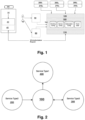
- Fig. 1 shows an embodiment of the proposed architecture of the invention.
- a user 10 wants to protect access to the Internet-connected asset 35 or protect the performance of an operation on the Internet-connected asset 35. Consequently, the user 10 registers into the XFA authorization backend 100.
- a consumer service 400 with the Internet-connected asset 35 for instance, a smart car, has the service backend computer 40 where it is assigned to the user 10 using an identifying element of the user 10, particularly a phone number (MSISDN) of the user.
- MSISDN phone number
- Each producer service 200 1, 200 2,..., 200 x is enrolled in the XFA authorization backend 100. Following the completion of an authentication enrollment procedure with the XFA authorization backend 100, utilizing the factor enrolling authorization processing unit 60, each producer service 200 1, 200 2, 200 x provides the user-configurable security factors 210 1, 210 2,..., 210 x . Additionally, these security factors 210 1, 210 2,..., 210 x are provided after the service backend computer 40 undergoes a factor subscription process with the user 10. This subscription process is facilitated by the factor subscription authorization processing unit 50.
- the XFA authorization backend 100 checks if the user 10 fulfils the user-configurable security factor/s 210 1, 210 2,..., 210 x using the identifying element. Subsequently, the XFA authorization backend 100 either grants or denies access to the Internet-connected asset 35 or the execution of the operation based on the outcome of the verification process.
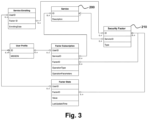
- Fig. 2 illustrates the 3 types of services that can interact with XFA authorization backend 100:
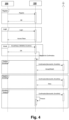
- Fig. 3 illustrates the architecture of these data structures.
- Each user 10 is represented with a unique profile. Each profile can contain a user id and contact information of the user 10.
- the contact channel is the cellular network
- the mobile telephone number (MSISDN) is the contact information.
- a producer service 200 When a producer service 200 is created, a unique ID is assigned to it. Furthermore, a short description is provided. Preferably, the service short description should be concise and easily identify the producer service 200.
- Each producer service 200 can contribute 0 to N security factors 210.
- Each security factor 210 is uniquely identified by a unique ID and it is associated to a producer service 200 by means of the ServicelD field. Different types are defined for security factors: Integer, Float, Boolean, Geolocation position, String. Other types could be easily included to extent the proposal depending to the service requirements.
- Each producer service 200 is responsible to keep the security factor state updated in real time as possible. All the security factor states are stored in Factor State structure. It contains a UserID field that references a user and a FactorlD that references a given security factor 210. The value of the security factor is stored in the Value field and the LastUpdatedTime contains the timestamp of last update.
- Any consumer service 400 can become consumer of security factors 210 with factor subscription. For instance, as seen in Fig. 1 , the consumer service 400 is consuming security factors through the service backend computer 40.
- the subscription relationship is defined in Factor Subscription table that can comprise the following fields:
- This data structure represents the interest of the user 10 to receive security factors 210 from a given producer service 200. Since each producer service 200 may generate multiple security factors 210, the enrolling is per security factor. It can comprise the following fields:
- Any producer service 200 that can identify the user 10 can publish the security factors 210 to the XFA authorization backend 100 using the set of APIs 120.
- the producer service 200 should be first registered and verified in the XFA authorization backend 100.
- the producer service 200 will also perform a login process and get access token to perform API call.
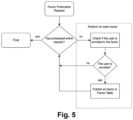
- the enroll API need the following three parameters: Token that is the access token, the identifying element of the user 10, for instance the MSISDN, and the Enrolllnfo which contains all the information about the enroll. It contains enough information to descript the reason that the producer service 200 wants to ask the user 10 for permission for enrolling.
- the user 10 will get a confirmation request in form of a SMS with a link to a confirmation web page.
- Three cases could happen. 1) the user 10 can accept the request, but changing some details like the facts that the user 10 is interested to enroll. 2) the user 10 rejects the entire request. 3) the user 10 just doesn't do anything, and the XFA authorization backend 100 will reject the request after a timeout.
- the above process is illustrated in Fig. 4 .
- the XFA authorization backend 100 creates items in Service Enrolling table. Specifically, it creates one row per security factor 210 that the user 10 accepted to enroll.
- Producer service 200 can publish the security factors 210 in the XFA authorization backend 100 by calling Publication API, including four parameters: 1) Access Token, 2) MSISDN, 3) Security factor ID and 4) Security factor related value.
- the API accepts an array of these parameters, so the producer service 200 can publish a set of security factors 210 in one single call.
- each security factor 210 in the array it makes sure that the user 10 is enrolled (specified in Service Enrolling table). If so, it publishes the security factor 210 by injecting a raw in the Factor State Table. Entire process is illustrated in Fig. 5 .
- All security factors 210 related with the given user 10 could be consumed by any consumer service 400 to perform authorization.
- the interested consumer service 400 needs, however, first ask permission from the user 10 to access required security factors 210.
- the entire process is illustrated in Fig. 6 .
- the consumer service 400 (using the service backend computer 40) performs the login process to get the access token.
- the consumer service 400 calls Subcription API together with following information: Access Token to identify the consumer service 400; MSISDN to identify the user 10, Subslnfo that descripts the subscription detail. It also includes the list of security factors 210 that the consumer service 400 is interested to subscript, so ask permission to the user 10 to authorize the access.
- the XFA authorization backend 100 will request the confirmation of the user 10 to authorize the access to the list of security factors 210 asked by the consumer service 400. For instance, it will send a SMS to the user 10 with a link to the factor subscription authorization processing unit 50.
- the latter can comprise the description of the consumer service 400, so the user can easily understand from who the request is coming from and the list of security factors 210 that the consumer service 400 is requesting.
- the user 10 can accept the request. Furthermore, the user 10 can customize the list of security factors 210 to authorize and others to reject. The user 10 can reject completely the request in the confirmation response. Other possibility is that the user 10 do not do anything. In such a case, the XFA authorization backend 100 will reject the request after a timeout.
- Fig. 7 shows a design for the webpage that the user 10 will access to confirm the subscription of security factors 210 that a consumer service 400 is requesting. It contains a service description and a list of security factors 210 that the consumer service 400 is requesting. User 10 can access more information about each security factor 210 be clicking in the information icon. For each security factor 210, user 10 can accept or reject the subscription. Furthermore, the user 10 can accept or reject entire request.
- the consumer service 400 can attach the following information:
- the XFA authorization backend 100 response Authorize of No Authorize, depending on the result of aggregation operation of all results of operations on the list of security factors. Note that there is no interaction with the user 10 for XFA authorization.
- the Internet-connected asset 35 to be protected can be a smart car.
- the invention can aim to implement two security mechanisms-one for unlocking and another for battery charging. Specifically, the smart car 35 can only be unlocked if the user 10 is nearby, and the home-based battery charging station can only be activated without the user's permission if the user 10 is at home.
- one of the producer services 200 is a cellular network service and another of the producer services 200 2 is a home security service.
- the cellular network service 200 1 can generate a security factor 210 1 related to mobile location, specifically by computing the location of the car user's mobile phone and publishing it to the XFA authorization backend 100 in real-time.
- the home security service 200 2 can detect the user 10 when at home. It can be assumed that the producer service 200 2 can determine if the user 10 is at home and publish this information to the XFA authorization backend 100 in real-time.
- there is only one consumer service 400 with the service backend computer 40 not limiting as in other embodiments several consumer services 400 can be included).
- the smart car 35 is unlocked or being charged, it communicates with the XFA authorization backend 100 (via SDK 41) to request authorization.
- the consumer service 400 can consume the security factors 210.
- the XFA authorization backend 100 initially contains descriptions of the two producer services 200 1, 200 2 and of the consumer service 400.
- Table 1 below shows the content of the service data structure.
- the factor data structure has two entries: one associated with mobile location and another with user presence at home. It's important to note that the consumer service 400 with ID S3 and service backend computer 40 is not associated with any security factor because it is a consumer service. Table 2 shows the content of the factor data structure.
- the mobile location factor is identified by ID F1 and is generated by the service with ID S1, which is the cellular network service 200 1 .
- ID S1 is the cellular network service 200 1 .
- ID F2 is generated by the service S2.
- the type of factor F1 is geolocation (phone geolocation position), while F2 contains Boolean data (whether or not the owner is at home).
- Table 1 Service data structure content ID Description S1 Your cellular network service S2 Your home security service S3 Your smart car service
- Table 2 Factor data structure content ID ServiceID Type F1 S1 Geolocation position F2 S2 Boolean
- the user 10 is correctly registered in the XFA authorization backend 100, and a profile is created in the User Profile data structure. For instance, it is assumed that the User ID is U1, the MSISDN is M1.
- the user 10 needs to enroll in the two producer services 200 1 , 200 2 to enable them to publish security factors 210 1, 210 2 to the XFA authorization backend 100.
- the enrollment process is carried out separately by each producer service 200 1, 200 2 and is defined in Fig. 4 .
- the Cellular Network Service 200 1 must undergo the authentication process with the XFA authorization backend 100 and make a call to the Enroll API.
- the XFA authorization backend 100 will then request the user's approval.
- the user 10 will need to access the Factor Enrolling Authorization Page 60 and grant permission to the Cellular Network Service 200 1 to publish Mobile Location data to the XFA authorization backend 100.
- the Home Security Service 200 2 will need to follow the same procedure to be able to publish information about user's presence to the XFA authorization backend 100.
- the XFA authorization backend 100 will contain two entries in the Service Enrolling data structure: Table 3: Service enrolling data structure content, after the user U1 enrolls to the 2 services UserID FactorID EnrollingDate U1 F1 18/152023 U1 F2 18/192023
- the two producer services 200 1 , 200 2 are entitled to publish two security factors 210 1, 210 2 into the XFA authorization backend 100 using Factor Publication API, defined in Fig. 5 .
- Factor publication result to new entries in the Factor State data structure.
- Consumer service 400 with service backend computer 40 do need to perform Factor Subscription process ( Fig. 6 ) to request the user 10 to authorize the use of the geolocation and person presence factors to implement XFA.
- the task is completed by calling API the Subscription (Token, MSISDN, Subslnfo).
- MSISDN is phone number of the user 10, M1, and Sublnfo contains the list of security factors that the service wants to subscription (F1 and F2).
- the XFA authorization backend 100 sends a link to the factor subscription authorization page 50 ( Fig. 7 ) to request the authorization.
- the user 10 accepts the subscription request by clicking in Accept ALL ( Fig. 7 ).
- two new entries are created in the Factor Subscription data structure (Table 5).
- the first entry is related with user 10 geolocation.
- the operation is GDistanceLT which receives three input parameters: 1) the value from Factor State data structure (G1), 2) the value from OperationParameter (P) and 3) the value from XFA authorization request (G2). Given these three parameters, the GDistanceLT returns true if distance between G1 and G2 is less than P. In this case, P is 100 meters. Basically, XFA authorization backend 100 returns true if the distance between user 10 and the car is less than 100 meters.
- the second entry is related with whether the user 10 is at home.
- the operation is Eq which return true is the value in Factor State is equal to value in Operation Parameters. In this case, it only returns true if the user 10 is at home.
- Table 5 Factor Subscription data structure content UserID ServiceID FactorID OperationType Operation Parameters U1 S3 F1 Geolocation Distance less than (GDistanceLT) 100m U1 S3 F2 Equal to (Eq) True
- the service backend computer 40 can contact XFA authorization backend 100 for XFA.
- the first operation is when the user 10 wants to open the smart car 35. For instance, this can be carried in the following manner:
- the car 35 can detect that user 10 is not close-by and refuses to open the door, although the key is perfectly valid.
- the car 35 needs to make sure that user 10 is at home to start charging the battery.
- the service backend computer 40 contact with XFA authorization backend 100 to check the factor F2, which indicates if the user 10 is at home.
- the XFA authorization backend 100 system provides a binding API that allows customer services to associate the user identity in the XFA backend 100 with user identity in the customer service.
- Other advantage of such an implementation is the fact that MSISDN could maintain anonymous.
- Certain aspects of the present invention include process steps or operations and instructions described herein in an algorithmic and/or algorithmic-like form. It should be noted that the process steps and/or operations and instructions of the present invention can be embodied in software, firmware, and/or hardware, and when embodied in software, can be downloaded to reside on and be operated from different platforms used by real-time network operating systems.
Landscapes
- Engineering & Computer Science (AREA)
- Computer Security & Cryptography (AREA)
- Computer Hardware Design (AREA)
- General Engineering & Computer Science (AREA)
- Computing Systems (AREA)
- Computer Networks & Wireless Communication (AREA)
- Signal Processing (AREA)
- Theoretical Computer Science (AREA)
- Software Systems (AREA)
- Physics & Mathematics (AREA)
- General Physics & Mathematics (AREA)
- Mobile Radio Communication Systems (AREA)
Priority Applications (2)
| Application Number | Priority Date | Filing Date | Title |
|---|---|---|---|
| EP23383118.9A EP4550185B1 (de) | 2023-11-03 | 2023-11-03 | Sicheres autorisierungsverfahren und -system |
| US18/934,505 US20250150443A1 (en) | 2023-11-03 | 2024-11-01 | Secure authorization method and system |
Applications Claiming Priority (1)
| Application Number | Priority Date | Filing Date | Title |
|---|---|---|---|
| EP23383118.9A EP4550185B1 (de) | 2023-11-03 | 2023-11-03 | Sicheres autorisierungsverfahren und -system |
Publications (2)
| Publication Number | Publication Date |
|---|---|
| EP4550185A1 true EP4550185A1 (de) | 2025-05-07 |
| EP4550185B1 EP4550185B1 (de) | 2026-03-25 |
Family
ID=88697450
Family Applications (1)
| Application Number | Title | Priority Date | Filing Date |
|---|---|---|---|
| EP23383118.9A Active EP4550185B1 (de) | 2023-11-03 | 2023-11-03 | Sicheres autorisierungsverfahren und -system |
Country Status (2)
| Country | Link |
|---|---|
| US (1) | US20250150443A1 (de) |
| EP (1) | EP4550185B1 (de) |
Citations (4)
| Publication number | Priority date | Publication date | Assignee | Title |
|---|---|---|---|---|
| US9589397B1 (en) | 2016-06-06 | 2017-03-07 | American Megatrends, Inc. | Securing internet of things (IoT) based entrance/exit with multi-factor authentication |
| EP3336735A1 (de) * | 2016-12-16 | 2018-06-20 | Bundesdruckerei GmbH | Erstellen einer datenbank für eine dynamische multifaktorauthentifizierung |
| US10325259B1 (en) * | 2014-03-29 | 2019-06-18 | Acceptto Corporation | Dynamic authorization with adaptive levels of assurance |
| US11159517B2 (en) | 2018-11-21 | 2021-10-26 | Citrix Systems, Inc. | Self-federation in authentication systems |
-
2023
- 2023-11-03 EP EP23383118.9A patent/EP4550185B1/de active Active
-
2024
- 2024-11-01 US US18/934,505 patent/US20250150443A1/en active Pending
Patent Citations (4)
| Publication number | Priority date | Publication date | Assignee | Title |
|---|---|---|---|---|
| US10325259B1 (en) * | 2014-03-29 | 2019-06-18 | Acceptto Corporation | Dynamic authorization with adaptive levels of assurance |
| US9589397B1 (en) | 2016-06-06 | 2017-03-07 | American Megatrends, Inc. | Securing internet of things (IoT) based entrance/exit with multi-factor authentication |
| EP3336735A1 (de) * | 2016-12-16 | 2018-06-20 | Bundesdruckerei GmbH | Erstellen einer datenbank für eine dynamische multifaktorauthentifizierung |
| US11159517B2 (en) | 2018-11-21 | 2021-10-26 | Citrix Systems, Inc. | Self-federation in authentication systems |
Also Published As
| Publication number | Publication date |
|---|---|
| EP4550185B1 (de) | 2026-03-25 |
| US20250150443A1 (en) | 2025-05-08 |
Similar Documents
| Publication | Publication Date | Title |
|---|---|---|
| US11615386B1 (en) | Block chain authentication systems and methods | |
| JP7241814B2 (ja) | 認証及び承認方法並びに認証サーバー | |
| US10367817B2 (en) | Systems and methods for challengeless coauthentication | |
| US8578454B2 (en) | Two-factor authentication systems and methods | |
| JP5514200B2 (ja) | 改良された生体認証及び識別 | |
| US8904494B2 (en) | System and method to facilitate compliance with COPPA for website registration | |
| US11665156B2 (en) | Method and system for securely authenticating a user by an identity and access service using a pictorial code and a one-time code | |
| EP3994593B1 (de) | System, verfahren und computerprogrammprodukt zur autorisierung durch dritte | |
| JP7751973B2 (ja) | 短距離トランシーバを使用したデータアクセス制御のためのシステムおよび方法 | |
| US20130160144A1 (en) | Entity verification via third-party | |
| EP3238369A1 (de) | Systeme und verfahren zur authentifizierung unter verwendung mehrerer vorrichtungen | |
| US11824856B1 (en) | Chaining of authorizations | |
| US20170257364A1 (en) | Systems and methods for authentication using authentication votes | |
| US20140282984A1 (en) | Service relationship and communication management | |
| KR20250099091A (ko) | 온라인 서비스 서버와 클라이언트 간의 상호 인증 방법 및 시스템 | |
| WO2018207174A1 (en) | Method and system for sharing a network enabled entity | |
| WO2017003651A1 (en) | Systems and methods for anonymous authentication using multiple devices | |
| EP4550185B1 (de) | Sicheres autorisierungsverfahren und -system | |
| US20230198981A1 (en) | Systems and methods for credentials sharing | |
| CN107590662B (zh) | 一种调用网银系统的认证方法及认证服务器、系统 | |
| BR102024021650A2 (pt) | Método e sistema de autorização segura | |
| US20220245629A1 (en) | A computer implemented method of authorizing a user of a communication device access to restricted content on a server. | |
| CN119210822A (zh) | 一种登录和登录验证方法、装置及设备 | |
| WO2019009971A1 (en) | SYSTEMS AND METHODS FOR CO-AUTHENTICATION WITHOUT CHALLENGE | |
| KR20160101805A (ko) | 보안성이 높은 제3자 결제방법 및 이를 위한 결제인증 시스템 |
Legal Events
| Date | Code | Title | Description |
|---|---|---|---|
| PUAI | Public reference made under article 153(3) epc to a published international application that has entered the european phase |
Free format text: ORIGINAL CODE: 0009012 |
|
| STAA | Information on the status of an ep patent application or granted ep patent |
Free format text: STATUS: THE APPLICATION HAS BEEN PUBLISHED |
|
| AK | Designated contracting states |
Kind code of ref document: A1 Designated state(s): AL AT BE BG CH CY CZ DE DK EE ES FI FR GB GR HR HU IE IS IT LI LT LU LV MC ME MK MT NL NO PL PT RO RS SE SI SK SM TR |
|
| STAA | Information on the status of an ep patent application or granted ep patent |
Free format text: STATUS: REQUEST FOR EXAMINATION WAS MADE |
|
| 17P | Request for examination filed |
Effective date: 20251008 |
|
| GRAP | Despatch of communication of intention to grant a patent |
Free format text: ORIGINAL CODE: EPIDOSNIGR1 |
|
| STAA | Information on the status of an ep patent application or granted ep patent |
Free format text: STATUS: GRANT OF PATENT IS INTENDED |
|
| RIC1 | Information provided on ipc code assigned before grant |
Ipc: G06F 21/45 20130101AFI20251118BHEP Ipc: H04L 9/40 20220101ALI20251118BHEP |
|
| INTG | Intention to grant announced |
Effective date: 20251203 |
|
| GRAS | Grant fee paid |
Free format text: ORIGINAL CODE: EPIDOSNIGR3 |
|
| GRAA | (expected) grant |
Free format text: ORIGINAL CODE: 0009210 |
|
| STAA | Information on the status of an ep patent application or granted ep patent |
Free format text: STATUS: THE PATENT HAS BEEN GRANTED |
|
| AK | Designated contracting states |
Kind code of ref document: B1 Designated state(s): AL AT BE BG CH CY CZ DE DK EE ES FI FR GB GR HR HU IE IS IT LI LT LU LV MC ME MK MT NL NO PL PT RO RS SE SI SK SM TR |
|
| REG | Reference to a national code |
Ref country code: CH Ref legal event code: F10 Free format text: ST27 STATUS EVENT CODE: U-0-0-F10-F00 (AS PROVIDED BY THE NATIONAL OFFICE) Effective date: 20260325 Ref country code: GB Ref legal event code: FG4D |
|
| REG | Reference to a national code |
Ref country code: DE Ref legal event code: R096 Ref document number: 602023014047 Country of ref document: DE |
|
| REG | Reference to a national code |
Ref country code: IE Ref legal event code: FG4D |