EP4550321A2 - Dispositif et procédé de quantification des gains des contributions adaptatives et fixes de l'excitation dans un codec celp - Google Patents
Dispositif et procédé de quantification des gains des contributions adaptatives et fixes de l'excitation dans un codec celp Download PDFInfo
- Publication number
- EP4550321A2 EP4550321A2 EP25165184.0A EP25165184A EP4550321A2 EP 4550321 A2 EP4550321 A2 EP 4550321A2 EP 25165184 A EP25165184 A EP 25165184A EP 4550321 A2 EP4550321 A2 EP 4550321A2
- Authority
- EP
- European Patent Office
- Prior art keywords
- gain
- frame
- excitation
- sub
- fixed
- Prior art date
- Legal status (The legal status is an assumption and is not a legal conclusion. Google has not performed a legal analysis and makes no representation as to the accuracy of the status listed.)
- Pending
Links
Images



Classifications
-
- G—PHYSICS
- G10—MUSICAL INSTRUMENTS; ACOUSTICS
- G10L—SPEECH ANALYSIS TECHNIQUES OR SPEECH SYNTHESIS; SPEECH RECOGNITION; SPEECH OR VOICE PROCESSING TECHNIQUES; SPEECH OR AUDIO CODING OR DECODING
- G10L19/00—Speech or audio signals analysis-synthesis techniques for redundancy reduction, e.g. in vocoders; Coding or decoding of speech or audio signals, using source filter models or psychoacoustic analysis
- G10L19/04—Speech or audio signals analysis-synthesis techniques for redundancy reduction, e.g. in vocoders; Coding or decoding of speech or audio signals, using source filter models or psychoacoustic analysis using predictive techniques
- G10L19/08—Determination or coding of the excitation function; Determination or coding of the long-term prediction parameters
- G10L19/12—Determination or coding of the excitation function; Determination or coding of the long-term prediction parameters the excitation function being a code excitation, e.g. in code excited linear prediction [CELP] vocoders
-
- G—PHYSICS
- G10—MUSICAL INSTRUMENTS; ACOUSTICS
- G10L—SPEECH ANALYSIS TECHNIQUES OR SPEECH SYNTHESIS; SPEECH RECOGNITION; SPEECH OR VOICE PROCESSING TECHNIQUES; SPEECH OR AUDIO CODING OR DECODING
- G10L19/00—Speech or audio signals analysis-synthesis techniques for redundancy reduction, e.g. in vocoders; Coding or decoding of speech or audio signals, using source filter models or psychoacoustic analysis
- G10L19/04—Speech or audio signals analysis-synthesis techniques for redundancy reduction, e.g. in vocoders; Coding or decoding of speech or audio signals, using source filter models or psychoacoustic analysis using predictive techniques
- G10L19/08—Determination or coding of the excitation function; Determination or coding of the long-term prediction parameters
- G10L19/083—Determination or coding of the excitation function; Determination or coding of the long-term prediction parameters the excitation function being an excitation gain
Definitions
- the present disclosure relates to quantization of the gain of a fixed contribution of an excitation in a coded sound signal.
- the present disclosure also relates to joint quantization of the gains of the adaptive and fixed contributions of the excitation.
- a coder of a codec structure for example a CELP (Code-Excited Linear Prediction) codec structure such as ACELP (Algebraic Code-Excited Linear Prediction)
- ACELP Algebraic Code-Excited Linear Prediction
- a CELP codec structure also produces adaptive codebook and fixed codebook contributions of an excitation that are added together to form a total excitation. Gains related to the adaptive and fixed codebook contributions of the excitation are quantized and transmitted to a decoder along with other encoding parameters.
- the adaptive codebook contribution and the fixed codebook contribution of the excitation will be referred to as "the adaptive contribution” and "the fixed contribution” of the excitation throughout the document.
- the present disclosure relates to a device for quantizing a gain of a fixed contribution of an excitation in a frame, including sub-frames, of a coded sound signal, comprising: an input for a parameter representative of a classification of the frame; an estimator of the gain of the fixed contribution of the excitation in a sub-frame of the frame, wherein the estimator is supplied with the parameter representative of the classification of the frame; and a predictive quantizer of the gain of the fixed contribution of the excitation, in the sub-frame, using the estimated gain.
- the present disclosure also relates to a method for quantizing a gain of a fixed contribution of an excitation in a frame, including sub-frames, of a coded sound signal, comprising: receiving a parameter representative of a classification of the frame; estimating the gain of the fixed contribution of the excitation in a sub-frame of the frame, using the parameter representative of the classification of the frame; and predictive quantizing the gain of the fixed contribution of the excitation, in the sub-frame, using the estimated gain.
- a device for jointly quantizing gains of adaptive and fixed contributions of an excitation in a frame of a coded sound signal comprising: a quantizer of the gain of the adaptive contribution of the excitation; and the above described device for quantizing the gain of the fixed contribution of the excitation.
- the present disclosure further relates to a method for jointly quantizing gains of adaptive and fixed contributions of an excitation in a frame of a coded sound signal, comprising: quantizing the gain of the adaptive contribution of the excitation; and quantizing the gain of the fixed contribution of the excitation using the above described method.
- a device for retrieving a quantized gain of a fixed contribution of an excitation in a sub-frame of a frame comprising: a receiver of a gain codebook index; an estimator of the gain of the fixed contribution of the excitation in the sub-frame, wherein the estimator is supplied with a parameter representative of a classification of the frame; a gain codebook for supplying a correction factor in response to the gain codebook index; and a multiplier of the estimated gain by the correction factor to provide a quantized gain of the fixed contribution of the excitation in the sub-frame.
- the present disclosure is also concerned with a method for retrieving a quantized gain of a fixed contribution of an excitation in a sub-frame of a frame, comprising: receiving a gain codebook index; estimating the gain of the fixed contribution of the excitation in the sub-frame, using a parameter representative of a classification of the frame; supplying, from a gain codebook and for the sub-frame, a correction factor in response to the gain codebook index; and multiplying the estimated gain by the correction factor to provide a quantized gain of the fixed contribution of the excitation in said sub-frame.
- the present disclosure is still further concerned with a device for retrieving quantized gains of adaptive and fixed contributions of an excitation in a sub-frame of a frame, comprising: a receiver of a gain codebook index; an estimator of the gain of the fixed contribution of the excitation in the sub-frame, wherein the estimator is supplied with a parameter representative of the classification of the frame; a gain codebook for supplying the quantized gain of the adaptive contribution of the excitation and a correction factor for the sub-frame in response to the gain codebook index; and a multiplier of the estimated gain by the correction factor to provide a quantized gain of fixed contribution of the excitation in the sub-frame.
- the disclosure describes a method for retrieving quantized gains of adaptive and fixed contributions of an excitation in a sub-frame of a frame, comprising: receiving a gain codebook index; estimating the gain of the fixed contribution of the excitation in the sub-frame, using a parameter representative of a classification of the frame; supplying, from a gain codebook and for the sub-frame, the quantized gain of the adaptive contribution of the excitation and a correction factor in response to the gain codebook index; and multiplying the estimated gain by the correction factor to provide a quantized gain of fixed contribution of the excitation in the sub-frame.
- quantization of a gain of a fixed contribution of an excitation in a coded sound signal as well as joint quantization of gains of adaptive and fixed contributions of the excitation.
- the quantization can be applied to any number of sub-frames and deployed with any input speech or audio signal (input sound signal) sampled at any arbitrary sampling frequency.
- the gains of the adaptive and fixed contributions of the excitation are quantized without the need of inter-frame prediction.
- the absence of inter-frame prediction results in improvement of the robustness against frame erasures or packet losses that can occur during transmission of encoded parameters.
- the gain of the adaptive contribution of the excitation is quantized directly whereas the gain of the fixed contribution of the excitation is quantized through an estimated gain.
- the estimation of the gain of the fixed contribution of the excitation is based on parameters that exist both at the coder and the decoder. These parameters are calculated during processing of the current frame. Thus, no information from a previous frame is required in the course of quantization or decoding which, as mentioned hereinabove, improves the robustness of the codec against frame erasures.
- CELP Code-Excited Linear Prediction
- ACELP Algebraic Code-Excited Linear Prediction
- the excitation is composed of two contributions: the adaptive contribution (adaptive codebook excitation) and the fixed contribution (fixed codebook excitation).
- the adaptive codebook is based on long-term prediction and is therefore related to the past excitation.
- the adaptive contribution of the excitation is found by means of a closed-loop search around an estimated value of a pitch lag.
- the estimated pitch lag is found by means of a correlation analysis.
- the closed-loop search consists of minimizing the mean square weighted error (MSWE) between a target signal (in CELP coding, a perceptually filtered version of the input speech or audio signal (input sound signal)) and the filtered adaptive contribution of the excitation scaled by an adaptive codebook gain.
- MSWE mean square weighted error
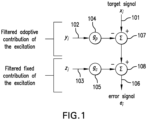
- Figure 1 is a schematic diagram describing the construction of the filtered total excitation in a CELP coder.
- the input signal 101 formed by the above mentioned target signal, is denoted as x ( i ) and is used as a reference during the search of gains for the adaptive and fixed contributions of the excitation.
- the filtered adaptive contribution of the excitation is denoted as y ( i ) and the filtered fixed contribution of the excitation (innovation) is denoted as z ( i ).
- the corresponding gains are denoted as g p for the adaptive contribution and g c for the fixed contribution of the excitation.
- an amplifier 104 applies the gain g p to the filtered adaptive contribution y ( i ) of the excitation and an amplifier 105 applies the gain g c to the filtered fixed contribution z ( i ) of the excitation.
- the optimal quantized gains are found by means of minimization of the mean square of the error signal e ( i ) calculated through a first subtractor 107 subtracting the signal g p y ( i ) at the output of the amplifier 104 from the target signal x i and a second subtractor 108 subtracting the signal g c z ( i ) at the output of the amplifier 105 from the result of the subtraction from the subtractor 107.
- the index i denotes the different signal samples and runs from 0 to L -1, where L is the length of each sub-frame.
- the optimum gains in Equation (3) are not quantized directly, but they are used in training a gain codebook as will be described later.
- the gains are quantized jointly, after applying prediction to the gain of the fixed contribution of the excitation.
- the prediction is performed by computing an estimated value of the gain g c 0 of the fixed contribution of the excitation.
- the first value corresponds to the quantized gain g p of the adaptive contribution of the excitation.
- the second value corresponds to the correction factor ⁇ which is used to multiply the estimated gain g c 0 of the fixed contribution of the excitation.
- the optimum index in the gain codebook ( g p and ⁇ ) is found by minimizing the mean squared error between the target signal and filtered total excitation. Estimation of the gain of the fixed contribution of the excitation is described in detail below.
- Each frame contains a certain number of sub-frames. Let us denote the number of sub-frames in a frame as K and the index of the current sub-frame as k.
- the estimation g c 0 of the gain of the fixed contribution of the excitation is performed differently in each sub-frame.
- Figure 2 is a schematic block diagram describing an estimator 200 of the gain of the fixed contribution of the excitation (hereinafter fixed codebook gain) in a first sub-frame of each frame.
- the estimator 200 first calculates an estimation of the fixed codebook gain in response to a parameter t representative of the classification of the current frame.
- the energy of the innovation codevector from the fixed codebook is then subtracted from the estimated fixed codebook gain to take into consideration this energy of the filtered innovation codevector.
- the resulting, estimated fixed codebook gain is multiplied by a correction factor selected from a gain codebook to produce the quantized fixed codebook gain g c .
- the estimator 200 comprises a calculator 201 of a linear estimation of the fixed codebook gain in logarithmic domain.
- the fixed codebook gain is estimated assuming unity-energy of the innovation codevector 202 from the fixed codebook. Only one estimation parameter is used by the calculator 201, the parameter t representative of the classification of the current frame.
- a subtractor 203 then subtracts the energy of the filtered innovation codevector 202 from the fixed codebook in logarithmic domain from the linear estimated fixed codebook gain in logarithmic domain at the output of the calculator 201.
- a converter 204 converts the estimated fixed codebook gain in logarithmic domain from the subtractor 203 to linear domain.
- the output in linear domain from the converter 204 is the estimated fixed codebook gain g c 0 .
- a multiplier 205 multiplies the estimated gain g c 0 by the correction factor 206 selected from the gain codebook. As described in the preceding paragraph, the output of the multiplier 205 constitutes the quantized fixed codebook gain g
- the quantized gain g p of the adaptive contribution of the excitation (hereinafter the adaptive codebook gain) is selected directly from the gain codebook.
- a multiplier 207 multiplies the filtered adaptive excitation 208 from the adaptive codebook by the quantized adaptive codebook gain g p to produce the filtered adaptive contribution 209 of the filtered excitation.
- Another multiplier 210 multiplies the filtered innovation codevector 202 from the fixed codebook by the quantized fixed codebook gain g c to produce the filtered fixed contribution 211 of the filtered excitation.
- an adder 212 sums the filtered adaptive 209 and fixed 211 contributions of the excitation to form the total filtered excitation 214.
- the inner term inside the logarithm of Equation (5) corresponds to the square root of the energy of the filtered innovation vector 202 ( E i is the energy of the filtered innovation vector in the first sub-frame of frame n ).
- This inner term (square root of the energy E i ) is determined by a first calculator 215 of the energy E i of the filtered innovation vector 202 and a calculator 216 of the square root of that energy E i .
- a calculator 217 then computes the logarithm of the square root of the energy E i for application to the negative input of the subtractor 203.
- the inner term (square root of the energy E i ) has non-zero energy; the energy is incremented by a small amount in case of all-zero frames to avoid log(0).
- the superscript (1) denotes the first sub-frame of the current frame n.
- the parameter t representative of the classification of the current frame is used in the calculation of the estimated fixed codebook gain g c 0 .
- Different codebooks can be designed for different classes of voice signals. However, this will increase memory requirements.
- estimation of the fixed codebook gain in the frames following the first frame can be based on the frame classification parameter t and the available adaptive and fixed codebook gains from previous sub-frames in the current frame. The estimation is confined to the frame boundary to increase robustness against frame erasures.
- frames can be classified as unvoiced, voiced, generic, or transition frames. Different alternatives can be used for classification. An example is given later below as a non-limitative illustrative embodiment. Further, the number of voice classes can be different from the one used hereinabove. For example the classification can be only voiced or unvoiced in one embodiment. In another embodiment more classes can be added such as strongly voiced and strongly unvoiced.
- the values for the classification estimation parameter t can be chosen arbitrarily. For example, for narrowband signals, the values of parameter t are set to: 1, 3, 5, and 7, for unvoiced, voiced, generic, and transition frames, respectively, and for wideband signals, they are set to 0, 2, 4, and 6, respectively. However, other values for the estimation parameter t can be used for each class. Including this estimation, classification parameter t in the design and training for determining estimation parameters will result in better estimation g c 0 of the fixed codebook gain.
- the sub-frames following the first sub-frame in a frame use slightly different estimation scheme. The difference is in fact that in these sub-frames, both the quantized adaptive codebook gain and the quantized fixed codebook gain from the previous sub-frame(s) in the current frame are used as auxiliary estimation parameters to increase the efficiency.
- Figure 3 is a schematic block diagram of an estimator 300 for estimating the fixed codebook gain in the sub-frames following the first sub-frame in a current frame.
- the estimation parameters include the classification parameter t and the quantized values (parameters 301) of both the adaptive and fixed codebook gains from previous sub-frames of the current frame.
- These parameters 301 are denoted as g p (1) , g c (1) , g p (2) , g c (2) , etc. where the superscript refers to first, second and other previous sub-frames.
- An estimation of the fixed codebook gain is calculated and is multiplied by a correction factor selected from the gain codebook to produce a quantized fixed codebook gain g c , forming the gain of the fixed contribution of the excitation (this estimated fixed codebook gain is different from that of the first sub-frame).
- a calculator 302 computes a linear estimation of the fixed codebook gain again in logarithmic domain and a converter 303 converts the gain estimation back to linear domain.
- the quantized adaptive codebook gains g p (1) , g p (2) , etc. from the previous sub-frames are supplied to the calculator 302 directly while the quantized fixed codebook gains g c (1) , g c (2) , etc. from the previous sub-frames are supplied to the calculator 302 in logarithmic domain through a logarithm calculator 304.
- a multiplier 305 then multiplies the estimated fixed codebook gain g c 0 (which is different from that of the first sub-frame) from the converter 303 by the correction factor 306, selected from the gain codebook. As described in the preceding paragraph, the multiplier 305 then outputs a quantized fixed codebook gain g c , forming the gain of the fixed contribution of the excitation.
- a first multiplier 307 multiplies the filtered adaptive excitation 308 from the adaptive codebook by the quantized adaptive codebook gain g p selected directly from the gain codebook to produce the adaptive contribution 309 of the excitation.
- a second multiplier 310 multiplies the filtered innovation codevector 311 from the fixed codebook by the quantized fixed codebook gain g c to produce the fixed contribution 312 of the excitation.
- An adder 313 sums the filtered adaptive 309 and filtered fixed 312 contributions of the excitation together so as to form the total filtered excitation 314 for the current frame.
- G c k log 10
- g c k is the quantized fixed codebook gain in logarithmic domain in sub-frame k
- g p k is the quantized adaptive codebook gain in sub-frame k .
- G c 0 2 a 0 + a 1 t + b 0 G c 1 + b 1 g p 1
- G c 0 3 a 0 + a 1 t + b 0 G c 1 + b 1 g p 1 + b 2 G c 2 + b 3 g p 2
- G c 0 4 a 0 + a 1 t + b 0 G c 1 + b 1 g p 1 + b 2 G c 2 + b 3 g p 2
- G c 0 4 a 0 + a 1 t + b 0 G c 1 + b 1 g p 1 + b 2 G c 2 + b 3 g p 2 + b 4 G c 3 + b 5 g p 3 .
- the above estimation of the fixed codebook gain is based on both the quantized adaptive and fixed codebook gains of all previous sub-frames of the current frame. There is also another difference between this estimation scheme and the one used in the first sub-frame.
- the energy of the filtered innovation vector from the fixed codebook is not subtracted from the linear estimation of the fixed codebook gain in the logarithmic domain from the calculator 302. The reason comes from the use of the quantized adaptive codebook and fixed codebook gains from the previous sub-frames in the estimation equation.
- the linear estimation is performed by the calculator 201 assuming unit energy of the innovation vector. Subsequently, this energy is subtracted to bring the estimated fixed codebook gain to the same energetic level as its optimal value (or at least close to it).
- the previous quantized values of the fixed codebook gain are already at this level so there is no need to take the energy of the filtered innovation vector into consideration.
- the estimation coefficients a i and b i are different for each sub-frame and they are determined offline using a large training database as will be described later below.
- An optimal set of estimation coefficients is found on a large database containing clean, noisy and mixed speech signals in various languages and levels and with male and female talkers.
- the frame index n is added to the parameters used in the training which vary on a frame basis (classification, first sub-frame innovation energy, and optimum adaptive and fixed codebook gains).
- the estimation coefficients are found by minimizing the mean square error between the estimated fixed codebook gain and the optimum gain in the logarithmic domain over all frames in the database.
- E est is the total energy (on the whole database) of the error between the estimated and optimal fixed codebook gains, both in logarithmic domain.
- the optimal, fixed codebook gain in the first sub-frame is denoted g (1) c,opt .
- E i ( n ) is the energy of the filtered innovation vector from the fixed codebook
- t ( n ) is the classification parameter of frame n.
- the upper index (1) is used to denote the first sub-frame and n is the frame index.
- Estimation of the fixed codebook gain in the first sub-frame is performed in logarithmic domain and the estimated fixed codebook gain should be as close as possible to the normalized gain of the innovation vector in logarithmic domain, G i (1) ( n ).
- G c , opt k log 10 g c , opt k .
- estimation coefficients a i and b i are different for each sub-frame, but the same symbols were used for the sake of simplicity. Normally, they would either have the superscript ( k ) associated therewith or they would be denoted differently for each sub-frame, wherein k is the sub-frame index.
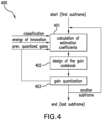
- Figure 4 is a schematic block diagram describing a state machine 400 in which the estimation coefficients are calculated (401) for each sub-frame.
- the gain codebook is then designed (402) for each sub-frame using the calculated estimation coefficients.
- Gain quantization (403) for the sub-frame is then conducted on the basis of the calculated estimation coefficients and the gain codebook design.
- Estimation of the fixed codebook gain itself is slightly different in each sub-frame, the estimation coefficients are found by means of minimum mean square error, and the gain codebook may be designed by using the KMEANS algorithm as described, for example, in MacQueen, J. B. (1967). "Some Methods for classification and Analysis of Multivariate Observations". Proceedings of 5th Berkeley Symposium on Mathematical Statistics and Probability. University of California Press. pp. 281-297 , of which the full contents is herein incorporated by reference.
- Figure 5 is a schematic block diagram describing a gain quantizer 500.
- each entry in the gain codebook 503 includes two values: the quantized adaptive codebook gain g p and the correction factor ⁇ for the fixed contribution of the excitation.
- the estimation of the fixed codebook gain is performed beforehand and the estimated fixed codebook gain g c 0 is used to multiply the correction factor ⁇ selected from the gain codebook 503.
- the gain codebook 503 is searched completely, i.e.
- the codebook entries may be sorted in ascending order according to the value of the adaptive codebook gain g p .
- the two-entry gain codebook 503 is searched and each index provides two values - the adaptive codebook gain g p and the correction factor ⁇ .
- a multiplier 504 multiplies the correction factor ⁇ by the estimated fixed codebook gain g c 0 and the resulting value is used as the quantized gain 505 of the fixed contribution of the excitation (quantized fixed codebook gain).
- Another multiplier 506 multiplies the filtered adaptive excitation 505 from the adaptive codebook by the quantized adaptive codebook gain g p from the gain codebook 503 to produce the adaptive contribution 507 of the excitation.
- a multiplier 508 multiplies the filtered innovation codevector 502 by the quantized fixed codebook gain 505 to produce the fixed contribution 509 of the excitation.
- An adder 510 sums both the adaptive 507 and fixed 509 contributions of the excitation together so as to form the filtered total excitation 511.
- a subtractor 512 subtracts the filtered total excitation 511 from the target signal x i to produce the error signal e i .
- a calculator 513 computes the energy 515 of the error signal e i and supplies it back to the gain codebook searching mechanism. All or a subset of the indices of the gain codebook 501 are searched in this manner and the index of the gain codebook 503 yielding the lowest error energy 515 is selected as the winning index and sent to the decoder.
- the gain quantization can be performed by minimizing the energy of the error in Equation (2).
- the constants or correlations c 0 , c 1 , c 2 , c 3 , c 4 and c 5 , and the estimated gain g c 0 are computed before the search of the gain codebook 503, and then the energy in Equation (16) is calculated for each codebook index (each set of entry values g p and y).
- the codevector from the gain codebook 503 leading to the lowest energy 515 of the error signal e i is chosen as the winning codevector and its entry values correspond to the quantized values g p and ⁇ .
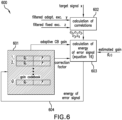
- FIG. 6 is a schematic block diagram of an equivalent gain quantizer 600 as in Figure 5 , performing calculation of the energy E i of the error signal e i using Equation (16). More specifically, the gain quantizer 600 comprises a gain codebook 601, a calculator 602 of constants or correlations, and a calculator 603 of the energy 604 of the error signal. The calculator 602 calculates the constants or correlations c 0 , c 1 , c 2 c 3 , c 4 and c 5 using Equation (4) and the target vector x , the filtered adaptive excitation vector y from the adaptive codebook, and the filtered fixed codevector z from the fixed codebook, wherein t denotes vector transpose.
- the gain quantizer 600 comprises a gain codebook 601, a calculator 602 of constants or correlations, and a calculator 603 of the energy 604 of the error signal.
- the calculator 602 calculates the constants or correlations c 0 , c 1 , c 2 c
- the calculator 603 uses Equation (16) to calculate the energy E i of the error signal e i from the estimated fixed codebook gain g c 0 , the correlations c 0 , c 1 , c 2 c 3 , c 4 and c 5 from calculator 602, and the quantized adaptive codebook gain g p and the correction factor ⁇ from the gain codebook 601.
- the energy 604 of the error signal from the calculator 603 is supplied back to the gain codebook searching mechanism. Again, all or a subset of the indices of the gain codebook 601 are searched in this manner and the index of the gain codebook 601 yielding the lowest error energy 604 is selected as the winning index and sent to the decoder.
- the gain codebook 601 has a size that can be different depending on the sub-frame. Better estimation of the fixed codebook gain is attained in later sub-frames in a frame due to increased number of estimation parameters. Therefore a smaller number of bits can be used in later sub-frames.
- four (4) sub-frames are used where the numbers of bits for the gain codebook are 8, 7, 6, and 6 corresponding to sub-frames 1, 2, 3, and 4, respectively.
- 6 bits are used in each sub-frame.
- the received index is used to retrieve the values of quantized adaptive codebook gain g p and correction factor ⁇ from the gain codebook.
- the estimation of the fixed codebook gain is performed in the same manner as in the coder, as described in the foregoing description.
- Both the adaptive codevector and the innovation codevector are decoded from the bitstream and they become adaptive and fixed excitation contributions that are multiplied by the respective adaptive and fixed codebook gains. Both excitation contributions are added together to form the total excitation.
- the synthesis signal is found by filtering the total excitation through a LP synthesis filter as known in the art of CELP coding.
- Different methods can be used for determining classification of a frame, for example parameter t of Figure 1 .
- a non-limitative example is given in the following description where frames are classified as unvoiced, voiced, generic, or transition frames.
- the number of voice classes can be different from the one used in this example.
- the classification can be only voiced or unvoiced in one embodiment. In another embodiment more classes can be added such as strongly voiced and strongly unvoiced.
- Signal classification can be performed in three steps, where each step discriminates a specific signal class.
- a signal activity detector SAD discriminates between active and inactive speech frames. If an inactive speech frame is detected (background noise signal) then the classification chain ends and the frame is encoded with comfort noise generation (CNG). If an active speech frame is detected, the frame is subjected to a second classifier to discriminate unvoiced frames. If the classifier classifies the frame as unvoiced speech signal, the classification chain ends, and the frame is encoded using a coding method optimized for unvoiced signals. Otherwise, the frame is processed through a "stable voiced" classification module. If the frame is classified as stable voiced frame, then the frame is encoded using a coding method optimized for stable voiced signals.
- SAD signal activity detector
- the frame is likely to contain a non-stationary signal segment such as a voiced onset or rapidly evolving voiced signal.
- These frames typically require a general purpose coder and high bit rate for sustaining good subjective quality.
- the disclosed gain quantization technique has been developed and optimized for stable voiced and general-purpose frames. However, it can be easily extended for any other signal class.
- the unvoiced parts of the sound signal are characterized by missing periodic component and can be further divided into unstable frames, where energy and spectrum change rapidly, and stable frames where these characteristics remain relatively stable.
- the classification of unvoiced frames uses the following parameters:
- the normalized correlation used to determine the voicing measure, is computed as part of the open-loop pitch analysis.
- the open-loop search module usually outputs two estimates per frame. Here, it is also used to output the normalized correlation measures. These normalized correlations are computed on a weighted signal and a past weighted signal at the open-loop pitch delay.
- the weighted speech signal s w ( n ) is computed using a perceptual weighting filter. For example, a perceptual weighting filter with fixed denominator, suited for wideband signals, is used.
- the arguments to the correlations are the open-loop pitch lags.
- the spectral tilt contains information about a frequency distribution of energy.
- the spectral tilt can be estimated in the frequency domain as a ratio between the energy concentrated in low frequencies and the energy concentrated in high frequencies. However, it can be also estimated in different ways such as a ratio between the two first autocorrelation coefficients of the signal.
- the energy in high frequencies and low frequencies is computed following the perceptual critical bands as described in [ J. D. Johnston, "Transform Coding of Audio Signals Using Perceptual Noise Criteria," IEEE Journal on Selected Areas in Communications, vol. 6, no. 2, pp. 314-323, February 1988 ] of which the full contents is herein incorporated by reference.
- the middle critical bands are excluded from the calculation as they do not tend to improve the discrimination between frames with high energy concentration in low frequencies (generally voiced) and with high energy concentration in high frequencies (generally unvoiced). In between, the energy content is not characteristic for any of the classes discussed further and increases the decision confusion.
- the estimated noise energies have been added to the tilt computation to account for the presence of background noise.
- This parameter dE is similar to the maximum short-time energy increase at low level with the difference that the low-level condition is not applied.
- the classification of unvoiced signal frames is based on the parameters described above, namely: the voicing measure r x , the average spectral tilt e t , the maximum short-time energy increase at low level dE 0 and the maximum short-time energy variation dE .
- the algorithm is further supported by the tonal stability parameter, the SAD flag and the relative frame energy calculated during the noise energy update phase.
- the tonal stability parameter the SAD flag and the relative frame energy calculated during the noise energy update phase.
- E rel E t ⁇ E ⁇ f
- E t is the total frame energy (in dB)
- the first line of this condition is related to low-energy signals and signals with low correlation concentrating their energy in high frequencies.
- the second line covers voiced offsets, the third line covers explosive signal segments and the fourth line is related to voiced onsets.
- the last line discriminates music signals that would be otherwise declared as unvoiced.
- the classification ends by declaring the current frame as unvoiced.
- a frame is not classified as inactive frame or as unvoiced frame then it is tested if it is a stable voiced frame.
- the decision rule is based on the normalized correlation r x in each sub-frame (with 1/4 subsample resolution), the average spectral tilt e t and open-loop pitch estimates in all sub-frames (with 1/4 subsample resolution).
- the open-loop pitch estimation procedure calculates three open-loop pitch lags: d 0 , d 1 and d 2 , corresponding to the first half-frame, the second half-frame and the look-ahead (first half-frame of the following frame).
- 1/4 sample resolution fractional pitch refinement is calculated. This refinement is calculated on a perceptually weighted input signal s wd ( n ) (for example the input sound signal s(n) filtered through the above described perceptual weighting filter).
- a short correlation analysis (40 samples) with resolution of 1 sample is performed in the interval (-7,+7) using the following delays: d 0 for the first and second sub-frames and d 1 for the third and fourth sub-frames.
- the correlations are then interpolated around their maxima at the fractional positions d max - 3/4, d max - 1/2, d max - 1/4, d max , d max + 1/4, d max + 1/2, d max + 3/4.
- the value yielding the maximum correlation is chosen as the refined pitch lag.
- the above voiced signal classification condition indicates that the normalized correlation must be sufficiently high in all sub-frames, the pitch estimates must not diverge throughout the frame and the energy must be concentrated in low frequencies. If this condition is fulfilled the classification ends by declaring the current frame as voiced. Otherwise the current frame is declared as generic.
- Embodiment 1 A device for quantizing a gain of a fixed contribution of an excitation in a frame, including sub-frames, of a coded sound signal, comprising:
- Embodiment 2 The quantizing device as recited in embodiment 1 above, wherein the predictive quantizer determines a correction factor for the estimated gain as a quantization of the gain of the fixed contribution of the excitation, and wherein the estimated gain multiplied by the correction factor gives the quantized gain of the fixed contribution of the excitation.
- Embodiment 3 The quantizing device as recited in any one of embodiments 1 or 2 above, wherein the estimator comprises, for a first sub-frame of the frame, a calculator of a first estimation of the gain of the fixed contribution of the excitation in response to the parameter representative of the classification of the frame, and a subtractor of an energy of a filtered innovation codevector from a fixed codebook from the first estimation to obtain the estimated gain.
- Embodiment 4 The quantizing device as recited in embodiment 2 above, wherein the estimator comprises, for a first sub-frame of the frame:
- Embodiment 5 The quantizing device as recited in any one of embodiments 1 to 4 above, wherein the estimator, for each sub-frame of said frame following the first sub-frame, is responsive to the parameter representative of the classification of the frame and gains of adaptive and fixed contributions of the excitation of at least one previous sub-frame of the frame to estimate the gain of the fixed contribution of the excitation.
- Embodiment 6 The quantizing device as recited in embodiment 5 above, wherein the estimator comprises, for each sub-frame following the first sub-frame, a calculator of a linear estimation of the gain of the fixed contribution of the excitation in logarithmic domain and a converter of the linear estimation in logarithmic domain in linear domain to produce the estimated gain.
- Embodiment 7 The quantizing device as recited in embodiment 6 above, wherein the gains of the adaptive and fixed contributions of the excitation of at least one previous sub-frame of the frame are quantized gains and the quantized gains of the adaptive contributions of the excitation are supplied to the calculator directly while the quantized gains of the fixed contributions of the excitation are supplied to the calculator in logarithmic domain through a logarithm calculator.
- Embodiment 9 The quantizing device as recited in any one of embodiments 6 or 7 above, wherein the calculator of a linear estimation of the gain of the fixed contribution of the excitation in logarithmic domain uses in relation to the classification parameter of the frame and the gains of the adaptive and fixed contributions of the excitation of at least one previous sub-frame estimation coefficients which are different for each sub-frame and determined using a large training database.
- Embodiment 10 The quantizing device as recited in any one of embodiments 1 to 9 above, wherein the estimator uses, for estimating the gain of the fixed contribution of the excitation, estimation coefficients different for each sub-frame of the frame.
- Embodiment 11 The quantizing device as recited in any one of embodiments 1 to 10 above, wherein the estimator confines estimation of the gain of the fixed contribution of the excitation in the frame to increase robustness against frame erasure.
- Embodiment 13 The device for jointly quantizing the gains of the adaptive and fixed contributions of the excitation as recited in embodiment 12 above, comprising a gain codebook having entries each comprising the quantized gain of the adaptive contribution of the excitation and a correction factor for the estimated gain.
- Embodiment 15 The device for jointly quantizing the gains of the adaptive and fixed contributions of the excitation as recited in embodiment 13 above, comprising a designer of the gain codebook for each sub-frame of the frame.
- Embodiment 16 The device for jointly quantizing the gains of the adaptive and fixed contributions of the excitation as recited in embodiment 15 above, wherein the gain codebook has different sizes in different sub-frames of the frame.
- Embodiment 17 The device for jointly quantizing the gains of the adaptive and fixed contributions of the excitation as recited in embodiment 14 above, wherein the quantizer of the gain of the adaptive contribution of the excitation and the predictive quantizer of the gain of the fixed contribution of the excitation search the gain codebook completely in each sub-frame.
- Embodiment 18 A device for retrieving a quantized gain of a fixed contribution of an excitation in a sub-frame of a frame, comprising:
- Embodiment 19 The device for retrieving the quantized gain of the fixed contribution of the excitation as recited in embodiment 18 above, wherein the estimator comprises, for a first sub-frame of the frame, a calculator of a first estimation of the gain of the fixed contribution of the excitation in response to the parameter representative of the classification of the frame, and a subtractor of an energy of a filtered innovation codevector from a fixed codebook from the first estimation to obtain the estimated gain.
- Embodiment 20 The device for retrieving the quantized gain of the fixed contribution of the excitation as recited in embodiment 18 above, wherein the estimator, for each sub-frame of said frame following the first sub-frame, is responsive to the parameter representative of the classification of the frame and gains of adaptive and fixed contributions of the excitation of at least one previous sub-frame of the frame to estimate the gain of the fixed contribution of the excitation.
- Embodiment 21 The device for retrieving the quantized gain of the fixed contribution of the excitation as recited in any one of embodiments 18 to 20 above, wherein the estimator uses, for estimating the gain of the fixed contribution of the excitation, estimation coefficients different for each sub-frame of the frame.
- Embodiment 22 The device for retrieving the quantized gain of the fixed contribution of the excitation as recited in any one of embodiments 18 to 21 above, wherein the estimator confines estimation of the gain of the fixed contribution of the excitation in the frame to increase robustness against frame erasure.
- Embodiment 23 A device for retrieving quantized gains of adaptive and fixed contributions of an excitation in a sub-frame of a frame, comprising:
- Embodiment 24 The device for retrieving the quantized gains of the adaptive and fixed contributions of the excitation as recited in embodiment 23 above, wherein the gain codebook comprises entries each comprising the quantized gain of the adaptive contribution of the excitation and the correction factor for the estimated gain.
- Embodiment 25 The device for retrieving the quantized gains of the adaptive and fixed contributions of the excitation as recited in any one of embodiments 23 or 24 above, wherein the gain codebook has different sizes in different sub-frames of the frame.
- Embodiment 26 A method for quantizing a gain of a fixed contribution of an excitation in a frame, including sub-frames, of a coded sound signal, comprising:
- Embodiment 27 The quantizing method as recited in embodiment 26 above, wherein predictive quantizing the gain of the fixed contribution of the excitation comprises determining a correction factor for the estimated gain as a quantization of the gain of the fixed contribution of the excitation, and wherein the estimated gain multiplied by the correction factor gives the quantized gain of the fixed contribution of the excitation.
- Embodiment 28 The quantizing method as recited in any one of embodiments 26 or 27 above, wherein the estimating the gain of the fixed contribution of the excitation comprises, for a first sub-frame of the frame, calculating a first estimation of the gain of the fixed contribution of the excitation in response to the parameter representative of the classification of the frame, and subtracting an energy of a filtered innovation codevector from a fixed codebook from the first estimation to obtain the estimated gain.
- Embodiment 29 The quantizing method as recited in embodiment 27 above, wherein estimating the gain of the fixed contribution of the excitation comprises, for a first sub-frame of the frame:
- Embodiment 30 The quantizing method as recited in any one of embodiments 26 to 29 above, wherein estimating the gain of the fixed contribution of the excitation, for each sub-frame of said frame following the first sub-frame, is responsive to the parameter representative of the classification of the frame and gains of adaptive and fixed contributions of the excitation of at least one previous sub-frame of the frame to estimate the gain of the fixed contribution of the excitation.
- Embodiment 31 The quantizing method as recited in embodiment 30 above, wherein estimating the gain of the fixed contribution of the excitation comprises, for each sub-frame following the first sub-frame, calculating a linear estimation of the gain of the fixed contribution of the excitation in logarithmic domain and converting the linear estimation in logarithmic domain in linear domain to produce the estimated gain.
- Embodiment 32 The quantizing method as recited in embodiment 31 above, wherein the gains of the adaptive contributions of the excitation of at least one previous sub-frame of the frame are quantized gains and the gains of the fixed contributions of the excitation of at least one previous sub-frame of the frame are quantized gains in logarithmic domain.
- Embodiment 33 The quantizing method as recited in any one of embodiments 28 or 29 above, wherein calculating the estimation of the gain of the fixed contribution of the excitation comprises using in relation to the classification parameter estimation coefficients determined using a large training database.
- Embodiment 34 The quantizing method as recited in any one of embodiments 31 or 32 above, wherein calculating a linear estimation of the gain of the fixed contribution of the excitation in logarithmic domain comprises using in relation to the classification parameter of the frame and the gains of the adaptive and fixed contributions of the excitation of at least one previous sub-frame estimation coefficients which are different for each sub-frame and determined using a large training database.
- Embodiment 35 The quantizing method as recited in any one of embodiments 26 to 34 above, wherein estimating the gain of the fixed contribution of the excitation comprises using, for estimating the gain of the fixed contribution of the excitation, estimation coefficients different for each sub-frame of the frame.
- Embodiment 36 The quantizing method as recited in any one of embodiments 26 to 35 above, wherein estimation of the gain of the fixed contribution of the excitation is confined in the frame to increase robustness against frame erasure.
- Embodiment 37 A method for jointly quantizing gains of adaptive and fixed contributions of an excitation in a frame of a coded sound signal, comprising:
- Embodiment 38 The method for jointly quantizing the gains of the adaptive and fixed contributions of the excitation as recited in embodiment 37 above, using a gain codebook having entries each comprising the quantized gain of the adaptive contribution of the excitation and a correction factor for the estimated gain.
- Embodiment 39 The method for jointly quantizing the gains of the adaptive and fixed contributions of the excitation as recited in embodiment 38 above, wherein quantizing the gain of the adaptive contribution of the excitation and quantizing the gain of the fixed contribution of the excitation comprises searching the gain codebook and selecting the gain of the adaptive contribution of the excitation from one entry of the gain codebook and the correction factor of the same entry of the gain codebook as a quantization of the gain of the fixed contribution of the excitation.
- Embodiment 40 The method for jointly quantizing the gains of the adaptive and fixed contributions of the excitation as recited in embodiment 38 above, comprising designing the gain codebook for each sub-frame of the frame.
- Embodiment 41 The method for jointly quantizing the gains of the adaptive and fixed contributions of the excitation as recited in embodiment 40 above, wherein the gain codebook has different sizes in different sub-frames of the frame.
- Embodiment 42 The method for jointly quantizing the gains of the adaptive and fixed contributions of the excitation as recited in embodiment 39 above, quantizing the gain of the adaptive contribution of the excitation and quantizing the gain of the fixed contribution of the excitation comprise searching the gain codebook completely in each sub-frame.
- Embodiment 43 A method for retrieving a quantized gain of a fixed contribution of an excitation in a sub-frame of a frame, comprising:
- Embodiment 44 The method for retrieving the quantized gain of the fixed contribution of the excitation as recited in embodiment 43 above, wherein estimating the gain of the fixed contribution of the excitation comprises, for a first sub-frame of the frame, calculating a first estimation of the gain of the fixed contribution of the excitation in response to the parameter representative of the classification of the frame, and subtracting an energy of a filtered innovation codevector from a fixed codebook from the first estimation to obtain the estimated gain.
- Embodiment 45 The method for retrieving the quantized gain of the fixed contribution of the excitation as recited in embodiment 43 above, wherein estimating the gain of the fixed contribution of the excitation comprises using, in each sub-frame of said frame following the first sub-frame, the parameter representative of the classification of the frame and gains of adaptive and fixed contributions of the excitation of at least one previous sub-frame of the frame to estimate the gain of the fixed contribution of the excitation.
- Embodiment 46 The method for retrieving the quantized gain of the fixed contribution of the excitation as recited in any one of embodiments 43 to 45 above, wherein estimating the gain of the fixed contribution of the excitation comprises using estimation coefficients different for each sub-frame of the frame.
- Embodiment 47 The method for retrieving the quantized gain of the fixed contribution of the excitation as recited in any one of embodiments 43 to 46 above, wherein the estimator confines estimation of the gain of the fixed contribution of the excitation in the frame to increase robustness against frame erasure.
- Embodiment 48 A method for retrieving quantized gains of adaptive and fixed contributions of an excitation in a sub-frame of a frame, comprising:
- Embodiment 49 The method for retrieving the quantized gains of the adaptive and fixed contributions of the excitation as recited in embodiment 48 above, wherein the gain codebook comprises entries each comprising the quantized gain of the adaptive contribution of the excitation and the correction factor for the estimated gain.
- Embodiment 50 The method for retrieving the quantized gains of the adaptive and fixed contributions of the excitation as recited in embodiments 48 and 49 above, wherein the gain codebook has different sizes in different sub-frames of the frame.
- Embodiment 51 A device for producing a quantized value of a gain of a fixed contribution of an excitation in a frame, including sub-frames, of a coded sound signal, comprising:
- Embodiment 52 The device according to embodiment 51, wherein the quantizer is configured to determine a correction factor for the estimated gain as a quantization of the gain of the fixed contribution of the excitation, and wherein the device further comprises a multiplier configured to multiply the estimated gain by the correction factor giving the quantized value of the gain of the fixed contribution of the excitation.
- Embodiment 53 The device according to embodiment 51 or 52, wherein the linear estimation of the gain of the fixed contribution of the excitation in logarithmic domain is performed differently in the first sub-frame of the frame than in the sub-frames of the frame following the first sub-frame.
- Embodiment 54 The device according to any one of the preceding embodiments, wherein the linear estimation of the gain of the fixed contribution of the excitation in logarithmic domain comprises a function which is linear in the parameter representative of the classification of the frame.
- Embodiment 55 The device according to any of the preceding embodiments, wherein the estimator is further configured to, for the first sub-frame of the frame:
- Embodiment 56 The device according to any one of the preceding embodiments, wherein the estimator is configured to, for each sub-frame of said frame following the first sub-frame:
- Embodiment 57 The device according to embodiment 56, wherein the gains of the adaptive and fixed contributions of the excitation of at least one previous sub-frame of the frame are quantized gains and the quantized gains of the adaptive contributions of the excitation are used directly in the calculation of the linear estimation of the gain of the fixed contribution while the quantized gains of the fixed contributions of the excitation are used in logarithmic domain in the calculation of the linear estimation of the gain of the fixed contribution.
- Embodiment 58 The device according to any one of the preceding embodiments, wherein in the calculation of the linear estimation of the gain of the fixed contribution of the excitation in logarithmic domain estimation coefficients different for each sub-frame of the frame are used.
- Embodiment 59 The device according to any one of embodiments 52 to 58, further comprising a gain codebook having entries each comprising a quantized gain of an adaptive contribution of the excitation and a correction factor for the estimated gain, wherein the quantizer is further configured to jointly quantize the gains of the adaptive and fixed contributions of the excitation by searching the gain codebook and selecting the quantized gain of the adaptive contribution of the excitation from one entry of the gain codebook and the correction factor of the same entry of the gain codebook.
- Embodiment 60 A device for retrieving a quantized gain of a fixed contribution of an excitation in a sub-frame of a frame, comprising:
- Embodiment 61 The device according to embodiment 60, wherein the linear estimation of the gain of the fixed contribution of the excitation in logarithmic domain is performed differently in the first sub-frame of the frame than in the sub-frames of the frame following the first sub-frame.
- Embodiment 62 The device according to embodiment 60 or 61, wherein the linear estimation of the gain of the fixed contribution of the excitation in logarithmic domain comprises a function which is linear in the parameter representative of the classification of the frame.
- Embodiment 63 The device according to any one of embodiments 60 to 62, wherein the estimator is further configured to, for the first sub-frame of the frame:
- Embodiment 64 The device according to any one of embodiments 60 or 63, wherein the estimator is further configured to, for each sub-frame of said frame following the first sub-frame:
- Embodiment 65 The device according to any one of embodiments 60 to 65, wherein the gain codebook comprises entries each comprising a quantized gain of an adaptive contribution of the excitation and a correction factor for the estimated gain, and wherein the gain codebook is further configured to supply the quantized gain of the adaptive contribution of the excitation.
- Embodiment 66 A method for producing a quantized value of a gain of a fixed contribution of an excitation in a frame, including sub-frames, of a coded sound signal, comprising:
- Embodiment 67 The method according to embodiment 66,
- Embodiment 68 The method according to embodiment 66 or 67, wherein the step of calculating the linear estimation of the gain of the fixed contribution of the excitation in logarithmic domain comprises performing the linear estimation differently in the first sub-frame of the frame than in the sub-frames of the frame following the first sub-frame.
- Embodiment 69 The method according to any one of embodiments 66 to 68, wherein the linear estimation of the gain of the fixed contribution of the excitation in logarithmic domain comprises a function which is linear in the parameter representative of the classification of the frame.
- Embodiment 70 The method according to any one of embodiments 66 to 69, wherein the step of producing the estimated gain of the fixed contribution of the excitation further comprises, for the first sub-frame of the frame:
- Embodiment 71 The method according to any one of embodiments 66 to 70, wherein the step of producing the estimated gain of the fixed contribution of the excitation further comprises, for each sub-frame of said frame following the first sub-frame:
- Embodiment 72 The method according to embodiment 71, wherein the gains of the adaptive and fixed contributions of the excitation of at least one previous sub-frame of the frame are quantized gains and the quantized gains of the adaptive contributions of the excitation are used directly in the calculation of the linear estimation of the gain of the fixed contribution while the quantized gains of the fixed contributions of the excitation are used in logarithmic domain in the calculation of the linear estimation of the gain of the fixed contribution.
- Embodiment 73 The method according to any one of the embodiments 66 to 72, wherein the step of calculating the linear estimation of the gain of the fixed contribution of the excitation in logarithmic domain further comprises using different estimation coefficients for each sub-frame of the frame.
- Embodiment 74 The method according to any one of embodiments 67 to 73, further comprising:
- Embodiment 75 A method for retrieving a quantized gain of a fixed contribution of an excitation in a sub-frame of a frame, comprising:
- Embodiment 76 The method of embodiment 75, wherein the step of producing the estimated gain of the fixed contribution of the excitation further comprises, for the first sub-frame of the frame:
- Embodiment 77 The method according to any one of embodiments 75 or 76, wherein the step of producing the estimated gain of the fixed contribution of the excitation further comprises, for each sub-frame of said frame following the first sub-frame:
- Embodiment 78 The method according to any one of embodiments 75 to 77,
Landscapes
- Engineering & Computer Science (AREA)
- Computational Linguistics (AREA)
- Signal Processing (AREA)
- Health & Medical Sciences (AREA)
- Audiology, Speech & Language Pathology (AREA)
- Human Computer Interaction (AREA)
- Physics & Mathematics (AREA)
- Acoustics & Sound (AREA)
- Multimedia (AREA)
- Compression, Expansion, Code Conversion, And Decoders (AREA)
- Analogue/Digital Conversion (AREA)
Applications Claiming Priority (4)
| Application Number | Priority Date | Filing Date | Title |
|---|---|---|---|
| US201161442960P | 2011-02-15 | 2011-02-15 | |
| EP20163502.6A EP3686888B1 (fr) | 2011-02-15 | 2012-02-14 | Dispositif et procédé de quantification des gains des contributions adaptatives et fixes de l'excitation dans un codec celp |
| PCT/CA2012/000138 WO2012109734A1 (fr) | 2011-02-15 | 2012-02-14 | Dispositif et procédé de quantification des gains des contributions adaptative et fixe de l'excitation dans un codec celp |
| EP12746553.2A EP2676271B1 (fr) | 2011-02-15 | 2012-02-14 | Dispositif et procédé de quantification des gains des contributions adaptative et fixe de l'excitation dans un codec celp |
Related Parent Applications (2)
| Application Number | Title | Priority Date | Filing Date |
|---|---|---|---|
| EP20163502.6A Division EP3686888B1 (fr) | 2011-02-15 | 2012-02-14 | Dispositif et procédé de quantification des gains des contributions adaptatives et fixes de l'excitation dans un codec celp |
| EP12746553.2A Division EP2676271B1 (fr) | 2011-02-15 | 2012-02-14 | Dispositif et procédé de quantification des gains des contributions adaptative et fixe de l'excitation dans un codec celp |
Publications (2)
| Publication Number | Publication Date |
|---|---|
| EP4550321A2 true EP4550321A2 (fr) | 2025-05-07 |
| EP4550321A3 EP4550321A3 (fr) | 2025-07-23 |
Family
ID=46637577
Family Applications (3)
| Application Number | Title | Priority Date | Filing Date |
|---|---|---|---|
| EP12746553.2A Active EP2676271B1 (fr) | 2011-02-15 | 2012-02-14 | Dispositif et procédé de quantification des gains des contributions adaptative et fixe de l'excitation dans un codec celp |
| EP20163502.6A Active EP3686888B1 (fr) | 2011-02-15 | 2012-02-14 | Dispositif et procédé de quantification des gains des contributions adaptatives et fixes de l'excitation dans un codec celp |
| EP25165184.0A Pending EP4550321A3 (fr) | 2011-02-15 | 2012-02-14 | Dispositif et procédé de quantification des gains des contributions adaptatives et fixes de l'excitation dans un codec celp |
Family Applications Before (2)
| Application Number | Title | Priority Date | Filing Date |
|---|---|---|---|
| EP12746553.2A Active EP2676271B1 (fr) | 2011-02-15 | 2012-02-14 | Dispositif et procédé de quantification des gains des contributions adaptative et fixe de l'excitation dans un codec celp |
| EP20163502.6A Active EP3686888B1 (fr) | 2011-02-15 | 2012-02-14 | Dispositif et procédé de quantification des gains des contributions adaptatives et fixes de l'excitation dans un codec celp |
Country Status (20)
| Country | Link |
|---|---|
| US (1) | US9076443B2 (fr) |
| EP (3) | EP2676271B1 (fr) |
| JP (2) | JP6072700B2 (fr) |
| KR (1) | KR101999563B1 (fr) |
| CN (2) | CN103392203B (fr) |
| AU (1) | AU2012218778B2 (fr) |
| CA (1) | CA2821577C (fr) |
| DE (1) | DE20163502T1 (fr) |
| DK (2) | DK2676271T3 (fr) |
| ES (2) | ES3033536T3 (fr) |
| FI (1) | FI3686888T3 (fr) |
| HR (2) | HRP20250620T1 (fr) |
| HU (2) | HUE052882T2 (fr) |
| LT (2) | LT2676271T (fr) |
| MX (1) | MX2013009295A (fr) |
| PH (1) | PH12013501216A1 (fr) |
| RU (1) | RU2591021C2 (fr) |
| SI (2) | SI3686888T1 (fr) |
| WO (1) | WO2012109734A1 (fr) |
| ZA (1) | ZA201305431B (fr) |
Families Citing this family (14)
| Publication number | Priority date | Publication date | Assignee | Title |
|---|---|---|---|---|
| US9626982B2 (en) * | 2011-02-15 | 2017-04-18 | Voiceage Corporation | Device and method for quantizing the gains of the adaptive and fixed contributions of the excitation in a CELP codec |
| US9111531B2 (en) * | 2012-01-13 | 2015-08-18 | Qualcomm Incorporated | Multiple coding mode signal classification |
| MA37890B1 (fr) | 2012-09-11 | 2017-11-30 | Ericsson Telefon Ab L M | Génération de bruit de confort |
| FR3007563A1 (fr) * | 2013-06-25 | 2014-12-26 | France Telecom | Extension amelioree de bande de frequence dans un decodeur de signaux audiofrequences |
| CN104299614B (zh) | 2013-07-16 | 2017-12-29 | 华为技术有限公司 | 解码方法和解码装置 |
| CN108364657B (zh) | 2013-07-16 | 2020-10-30 | 超清编解码有限公司 | 处理丢失帧的方法和解码器 |
| EP3038104B1 (fr) * | 2013-08-22 | 2018-12-19 | Panasonic Intellectual Property Corporation of America | Dispositif de codage de parole et procédé destiné à celui-ci |
| KR101849613B1 (ko) | 2013-10-18 | 2018-04-18 | 프라운호퍼 게젤샤프트 쭈르 푀르데룽 데어 안겐반텐 포르슝 에. 베. | 스피치 관련 스펙트럼 정형 정보를 사용하는 오디오 신호의 인코딩 및 오디오 신호의 디코딩을 위한 개념 |
| EP3779982B1 (fr) | 2013-10-18 | 2025-07-16 | Fraunhofer-Gesellschaft zur Förderung der angewandten Forschung e.V. | Concept de codage d'un signal audio et de décodage d'un signal audio au moyen d'informations déterministes et de type bruit |
| CN106683681B (zh) | 2014-06-25 | 2020-09-25 | 华为技术有限公司 | 处理丢失帧的方法和装置 |
| KR102736785B1 (ko) | 2017-09-20 | 2024-12-03 | 보이세지 코포레이션 | 씨이엘피 코덱에 있어서 서브-프레임들간에 비트-예산을 할당하는 방법 및 디바이스 |
| US11710492B2 (en) * | 2019-10-02 | 2023-07-25 | Qualcomm Incorporated | Speech encoding using a pre-encoded database |
| KR102811032B1 (ko) * | 2021-11-02 | 2025-05-20 | 한국화학연구원 | 고도로 정렬된 이온 채널을 가지는 과불소계 이오노머 멤브레인의 제조방법 및 이의 활용 |
| CN117476022A (zh) * | 2022-07-29 | 2024-01-30 | 荣耀终端有限公司 | 声音编解码方法以及相关装置、系统 |
Family Cites Families (23)
| Publication number | Priority date | Publication date | Assignee | Title |
|---|---|---|---|---|
| US5681862A (en) * | 1993-03-05 | 1997-10-28 | Buckman Laboratories International, Inc. | Ionene polymers as microbicides |
| US5450449A (en) * | 1994-03-14 | 1995-09-12 | At&T Ipm Corp. | Linear prediction coefficient generation during frame erasure or packet loss |
| SE504397C2 (sv) * | 1995-05-03 | 1997-01-27 | Ericsson Telefon Ab L M | Metod för förstärkningskvantisering vid linjärprediktiv talkodning med kodboksexcitering |
| EP0764939B1 (fr) * | 1995-09-19 | 2002-05-02 | AT&T Corp. | Synthèse de signaux de parole en l'absence de paramètres codés |
| JP3230966B2 (ja) * | 1995-10-09 | 2001-11-19 | 日本ガスケット株式会社 | 金属製ガスケット |
| TW326070B (en) * | 1996-12-19 | 1998-02-01 | Holtek Microelectronics Inc | The estimation method of the impulse gain for coding vocoder |
| US5953679A (en) * | 1997-04-16 | 1999-09-14 | The United States Of America As Represented By The Secretary Of Army | Method for recovery and separation of trinitrotoluene by supercritical fluid extraction |
| FI113571B (fi) * | 1998-03-09 | 2004-05-14 | Nokia Corp | Puheenkoodaus |
| US6141638A (en) * | 1998-05-28 | 2000-10-31 | Motorola, Inc. | Method and apparatus for coding an information signal |
| US7072832B1 (en) | 1998-08-24 | 2006-07-04 | Mindspeed Technologies, Inc. | System for speech encoding having an adaptive encoding arrangement |
| US6314393B1 (en) * | 1999-03-16 | 2001-11-06 | Hughes Electronics Corporation | Parallel/pipeline VLSI architecture for a low-delay CELP coder/decoder |
| CN1075733C (zh) * | 1999-07-30 | 2001-12-05 | 赵国林 | 一种养颜口服液及其制作方法 |
| CA2722110C (fr) * | 1999-08-23 | 2014-04-08 | Panasonic Corporation | Vocodeur et procede correspondant |
| US6574593B1 (en) * | 1999-09-22 | 2003-06-03 | Conexant Systems, Inc. | Codebook tables for encoding and decoding |
| US6636829B1 (en) * | 1999-09-22 | 2003-10-21 | Mindspeed Technologies, Inc. | Speech communication system and method for handling lost frames |
| AU7486200A (en) * | 1999-09-22 | 2001-04-24 | Conexant Systems, Inc. | Multimode speech encoder |
| US6959274B1 (en) * | 1999-09-22 | 2005-10-25 | Mindspeed Technologies, Inc. | Fixed rate speech compression system and method |
| US6782360B1 (en) * | 1999-09-22 | 2004-08-24 | Mindspeed Technologies, Inc. | Gain quantization for a CELP speech coder |
| EP1235203B1 (fr) * | 2001-02-27 | 2009-08-12 | Texas Instruments Incorporated | Procédé de dissimulation de pertes de trames de parole et décodeur pour cela |
| ATE368279T1 (de) * | 2003-05-01 | 2007-08-15 | Nokia Corp | Verfahren und vorrichtung zur quantisierung des verstärkungsfaktors in einem breitbandsprachkodierer mit variabler bitrate |
| US20070282601A1 (en) * | 2006-06-02 | 2007-12-06 | Texas Instruments Inc. | Packet loss concealment for a conjugate structure algebraic code excited linear prediction decoder |
| US8010351B2 (en) * | 2006-12-26 | 2011-08-30 | Yang Gao | Speech coding system to improve packet loss concealment |
| US8655650B2 (en) * | 2007-03-28 | 2014-02-18 | Harris Corporation | Multiple stream decoder |
-
2012
- 2012-02-14 CA CA2821577A patent/CA2821577C/fr active Active
- 2012-02-14 SI SI201232090T patent/SI3686888T1/sl unknown
- 2012-02-14 US US13/396,371 patent/US9076443B2/en active Active
- 2012-02-14 LT LTEP12746553.2T patent/LT2676271T/lt unknown
- 2012-02-14 LT LTEP20163502.6T patent/LT3686888T/lt unknown
- 2012-02-14 WO PCT/CA2012/000138 patent/WO2012109734A1/fr not_active Ceased
- 2012-02-14 MX MX2013009295A patent/MX2013009295A/es active IP Right Grant
- 2012-02-14 AU AU2012218778A patent/AU2012218778B2/en active Active
- 2012-02-14 KR KR1020137022984A patent/KR101999563B1/ko active Active
- 2012-02-14 DK DK12746553.2T patent/DK2676271T3/da active
- 2012-02-14 CN CN201280008952.7A patent/CN103392203B/zh active Active
- 2012-02-14 EP EP12746553.2A patent/EP2676271B1/fr active Active
- 2012-02-14 HR HRP20250620TT patent/HRP20250620T1/hr unknown
- 2012-02-14 SI SI201231825T patent/SI2676271T1/sl unknown
- 2012-02-14 PH PH1/2013/501216A patent/PH12013501216A1/en unknown
- 2012-02-14 HR HRP20201271TT patent/HRP20201271T1/hr unknown
- 2012-02-14 ES ES20163502T patent/ES3033536T3/es active Active
- 2012-02-14 ES ES12746553T patent/ES2812598T3/es active Active
- 2012-02-14 EP EP20163502.6A patent/EP3686888B1/fr active Active
- 2012-02-14 JP JP2013552805A patent/JP6072700B2/ja active Active
- 2012-02-14 FI FIEP20163502.6T patent/FI3686888T3/fi active
- 2012-02-14 HU HUE12746553A patent/HUE052882T2/hu unknown
- 2012-02-14 DE DE20163502.6T patent/DE20163502T1/de active Pending
- 2012-02-14 EP EP25165184.0A patent/EP4550321A3/fr active Pending
- 2012-02-14 CN CN201510023526.6A patent/CN104505097B/zh active Active
- 2012-02-14 DK DK20163502.6T patent/DK3686888T3/da active
- 2012-02-14 RU RU2013142151/08A patent/RU2591021C2/ru active
- 2012-02-14 HU HUE20163502A patent/HUE071693T2/hu unknown
-
2013
- 2013-07-18 ZA ZA2013/05431A patent/ZA201305431B/en unknown
-
2016
- 2016-12-27 JP JP2016252938A patent/JP6316398B2/ja active Active
Non-Patent Citations (4)
| Title |
|---|
| J. D. JOHNSTON: "Transform Coding of Audio Signals Using Perceptual Noise Criteria", IEEE JOURNAL ON SELECTED AREAS IN COMMUNICATIONS, vol. 6, no. 2, February 1988 (1988-02-01), pages 314 - 323, XP002003779, DOI: 10.1109/49.608 |
| JELINEK, M ET AL.: "Advances in source-controlled variable bitrate wideband speech coding", SPECIAL WORKSHOP IN MAUL (SWIM), 12 January 2004 (2004-01-12) |
| JELINEK, M.VAILLANCOURT, T.GIBBS, J.: "G.718: A new embedded speech and audio coding standard with high resilience to error-prone transmission channels", IEEE COMMUNICATIONS MAGAZINE, vol. 47, October 2009 (2009-10-01), pages 117 - 123, XP011283325, DOI: 10.1109/MCOM.2009.5273818 |
| MACQUEEN, J. B.: "Proceedings of 5th Berkeley Symposium on Mathematical Statistics and Probability", 1967, UNIVERSITY OF CALIFORNIA PRESS., article "Some Methods for classification and Analysis of Multivariate Observations", pages: 281 - 297 |
Also Published As
Similar Documents
| Publication | Publication Date | Title |
|---|---|---|
| EP3686888B1 (fr) | Dispositif et procédé de quantification des gains des contributions adaptatives et fixes de l'excitation dans un codec celp | |
| RU2441286C2 (ru) | Способ и устройство для обнаружения звуковой активности и классификации звуковых сигналов | |
| EP2313887B1 (fr) | Dispositif et procédé de quantification de filtre à codage prédictif linéaire à débit de bits variable et dispositif et procédé de quantification inverse | |
| EP3125241B1 (fr) | Procédé et dispositif de quantification d'un coefficient de prédiction linéaire, et procédé et dispositif de quantification inverse | |
| EP2102619A1 (fr) | Procédé et dispositif pour coder les trames de transition dans des signaux de discours | |
| JPH08328591A (ja) | 短期知覚重み付けフィルタを使用する合成分析音声コーダに雑音マスキングレベルを適応する方法 | |
| EP3091536B1 (fr) | Détermination de fonction de pondération pour quantifier un coefficient de codage de prédiction linéaire | |
| EP4535351A1 (fr) | Procédé de codage sonore, procédé de décodage sonore, et appareils et système associés | |
| US10115408B2 (en) | Device and method for quantizing the gains of the adaptive and fixed contributions of the excitation in a CELP codec | |
| Özaydın et al. | Matrix quantization and mixed excitation based linear predictive speech coding at very low bit rates | |
| HK40028306A (en) | Device and method for quantizing the gains of the adaptive and fixed contributions of the excitation in a celp codec | |
| HK40028306B (en) | Device and method for quantizing the gains of the adaptive and fixed contributions of the excitation in a celp codec | |
| HK1187441A (en) | Device and method for quantizing the gains of the adaptive and fixed contributions of the excitation in a celp codec | |
| HK1187441B (en) | Device and method for quantizing the gains of the adaptive and fixed contributions of the excitation in a celp codec | |
| NZ611801B2 (en) | Device and method for quantizing the gains of the adaptive and fixed contributions of the excitation in a celp codec | |
| JPH10105196A (ja) | 音声符号化装置 |
Legal Events
| Date | Code | Title | Description |
|---|---|---|---|
| PUAI | Public reference made under article 153(3) epc to a published international application that has entered the european phase |
Free format text: ORIGINAL CODE: 0009012 |
|
| STAA | Information on the status of an ep patent application or granted ep patent |
Free format text: STATUS: THE APPLICATION HAS BEEN PUBLISHED |
|
| AC | Divisional application: reference to earlier application |
Ref document number: 2676271 Country of ref document: EP Kind code of ref document: P Ref document number: 3686888 Country of ref document: EP Kind code of ref document: P |
|
| AK | Designated contracting states |
Kind code of ref document: A2 Designated state(s): AL AT BE BG CH CY CZ DE DK EE ES FI FR GB GR HR HU IE IS IT LI LT LU LV MC MK MT NL NO PL PT RO RS SE SI SK SM TR |
|
| PUAL | Search report despatched |
Free format text: ORIGINAL CODE: 0009013 |
|
| AK | Designated contracting states |
Kind code of ref document: A3 Designated state(s): AL AT BE BG CH CY CZ DE DK EE ES FI FR GB GR HR HU IE IS IT LI LT LU LV MC MK MT NL NO PL PT RO RS SE SI SK SM TR |
|
| RIC1 | Information provided on ipc code assigned before grant |
Ipc: G10L 19/083 20130101AFI20250617BHEP |
|
| RAP3 | Party data changed (applicant data changed or rights of an application transferred) |
Owner name: VOICEAGE EVS LLC Owner name: VOICEAGE EVS GMBH & CO. KG |
|
| REG | Reference to a national code |
Ref country code: HK Ref legal event code: DE Ref document number: 40124432 Country of ref document: HK |
|
| STAA | Information on the status of an ep patent application or granted ep patent |
Free format text: STATUS: REQUEST FOR EXAMINATION WAS MADE |
|
| 17P | Request for examination filed |
Effective date: 20251223 |
|
| GRAP | Despatch of communication of intention to grant a patent |
Free format text: ORIGINAL CODE: EPIDOSNIGR1 |
|
| STAA | Information on the status of an ep patent application or granted ep patent |
Free format text: STATUS: GRANT OF PATENT IS INTENDED |
|
| INTG | Intention to grant announced |
Effective date: 20260420 |