EP4550604A1 - Système de stockage d'énergie intégré dans un réseau d'alimentation - Google Patents
Système de stockage d'énergie intégré dans un réseau d'alimentation Download PDFInfo
- Publication number
- EP4550604A1 EP4550604A1 EP23207083.9A EP23207083A EP4550604A1 EP 4550604 A1 EP4550604 A1 EP 4550604A1 EP 23207083 A EP23207083 A EP 23207083A EP 4550604 A1 EP4550604 A1 EP 4550604A1
- Authority
- EP
- European Patent Office
- Prior art keywords
- esd
- energy storage
- storage system
- converter
- lcc
- Prior art date
- Legal status (The legal status is an assumption and is not a legal conclusion. Google has not performed a legal analysis and makes no representation as to the accuracy of the status listed.)
- Pending
Links
Images





Classifications
-
- H—ELECTRICITY
- H02—GENERATION; CONVERSION OR DISTRIBUTION OF ELECTRIC POWER
- H02J—ELECTRIC POWER NETWORKS; CIRCUIT ARRANGEMENTS OR SYSTEMS FOR SUPPLYING OR DISTRIBUTING ELECTRIC POWER; SYSTEMS FOR STORING ELECTRIC ENERGY
- H02J3/00—Circuit arrangements for AC mains or AC distribution networks
- H02J3/28—Arrangements for balancing of the load in networks by storage of energy
- H02J3/32—Arrangements for balancing of the load in networks by storage of energy using batteries or super capacitors with converting means
-
- H—ELECTRICITY
- H02—GENERATION; CONVERSION OR DISTRIBUTION OF ELECTRIC POWER
- H02J—ELECTRIC POWER NETWORKS; CIRCUIT ARRANGEMENTS OR SYSTEMS FOR SUPPLYING OR DISTRIBUTING ELECTRIC POWER; SYSTEMS FOR STORING ELECTRIC ENERGY
- H02J3/00—Circuit arrangements for AC mains or AC distribution networks
- H02J3/001—Arrangements for handling faults or abnormalities, e.g. emergencies or contingencies
-
- H—ELECTRICITY
- H02—GENERATION; CONVERSION OR DISTRIBUTION OF ELECTRIC POWER
- H02J—ELECTRIC POWER NETWORKS; CIRCUIT ARRANGEMENTS OR SYSTEMS FOR SUPPLYING OR DISTRIBUTING ELECTRIC POWER; SYSTEMS FOR STORING ELECTRIC ENERGY
- H02J3/00—Circuit arrangements for AC mains or AC distribution networks
- H02J3/36—Arrangements for transfer of electric power between AC networks via high-voltage DC [HVDC] links; Arrangements for transfer of electric power between generators and networks via HVDC links
-
- H—ELECTRICITY
- H02—GENERATION; CONVERSION OR DISTRIBUTION OF ELECTRIC POWER
- H02J—ELECTRIC POWER NETWORKS; CIRCUIT ARRANGEMENTS OR SYSTEMS FOR SUPPLYING OR DISTRIBUTING ELECTRIC POWER; SYSTEMS FOR STORING ELECTRIC ENERGY
- H02J4/00—Circuit arrangements for mains or distribution networks not specified as AC or DC; Circuit arrangements for mains or distribution networks combining AC and DC sections or sub-networks
Definitions
- the present disclosure generally relates to energy storage requirements to manage power imbalance in AC grids. More particularly, it relates to an energy storage system that manages the power imbalance in the AC grids.
- HVDC High Voltage Direct Current
- ESS energy storage system
- an energy storage system for providing inertia support and controlling frequency of a power network to which the ESS is connected.
- the ESS comprises a transformer with at least three windings, a primary winding out of the at least three windings of the transformer is connected to an input from the power network, a secondary winding out of the at least three windings is connected as an output to the power network.
- the ESS further comprises a converter that converts AC to DC or DC to AC received from the transformer, where an input side of the converter is connected to a tertiary winding out of the at least three windings of the transformer.
- the ESS further comprises an energy storage device (ESD) that is connected to an output side of the converter, where the ESD handles a power imbalance in the power network, and where the ESD is having a protection mechanism for protecting the ESD in case of failure conditions in the ESD.
- ESD energy storage device
- the topology of the ESS eliminates a requirement of a dedicated expensive transformer for the ESS to operate.
- the power network may share the relatively expensive high voltage transformer for connecting the ESS in order to controlling the inertia and/or the frequency in the power network caused due to penetration of more and more renewable based sources.
- frequency imbalance in the power network may be efficiently handled.
- connecting the ESS to a tertiary winding of the existing power network transformer achieves a cost reduction compared to implementing different dedicated transformers for the ESS.
- the converter is a Line-Commutated Converter (LCC).
- LCC Line-Commutated Converter
- the ESS further comprises a filtering circuit for an AC side of the LCC such that AC terminals of the LCC are connected to the tertiary winding through the filtering circuit, and the filtering circuit filters out harmonics interference with AC voltage and AC current before feeding the AC voltage and the AC current to the power network.
- the ESS further comprises a filtering circuit for a DC side of the LCC, connected between the LCC and the ESD, where the filtering circuit is configured to filter out harmonics interference with output of the LCC, that comprises DC voltage and DC current, before feeding to the ESD.
- the ESS further comprises a High Speed Switch (HSS) between the LCC and the ESD, where the HSS interchanges DC terminals between the LCC and the ESD, in order to facilitate a quick change between a rectifying mode and an inverting mode of the ESS.
- HSS High Speed Switch
- the HSS executes the interchange when DC current in the circuit of the ESS is zero and the LCC is in idle/blocking mode.
- the converter is a Voltage-Sourced Converter (VSC).
- VSC Voltage-Sourced Converter
- the ESS further comprises a pre-insertion resistor arrangement that controls an inrush current during charging of the converter and the ESD, where the pre-insertion resistor arrangement includes a bypass breaker.
- the VSC is a two-level, three-level, a half-bridge, or a full-bridge modular multilevel converter (MMC).
- MMC modular multilevel converter
- the power network is a High Voltage Direct Current system.
- the failure conditions comprise at least one of commutation failures, short-circuit failures, or ground failures in the converter during an inverting mode of operation of the converter or DC circuit faults.
- the ESS further comprises a protection circuit connected to the ESD, where the protection circuit is connected to the ESD for executing the protection mechanism, and wherein the protection circuit is connected to the ESD as one of an external circuit or in a combined modular structure.
- the protection circuit when the protection circuit is connected to the ESD as the external circuit, the protection circuit comprises a freewheeling diode and an insulated-gate bipolar transistor (IGBT) in series with the ESD.
- IGBT insulated-gate bipolar transistor
- the protection circuit comprises a pair of IGBTs connected in half-bridge configuration.
- the ESD comprises at least one of super capacitors, a battery storage, or a combination of the super capacitor and the battery storage.
- the ESS may share a relatively expensive high voltage transformer in the power network.
- the ESS may be cost-effective system with high reliability and availability.
- any of the above aspects may additionally have features identical with or corresponding to any of the various features as explained above for any of the other aspects.
- the energy storage system disclosed herein may be used for renewable energy integration, utilizing HVDC or any inverter based resource (IBR), like renewable integration with power electronic converters.
- IBR inverter based resource
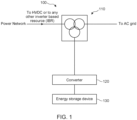
- Fig. 1 discloses a block diagram of an example Energy Storage System (ESS) 100 connected to a power network.
- the ESS 100 comprises a transformer 110, and a converter 120 along with an Energy Storage Device (ESD) 130 integrated on a tertiary winding of the transformer 110, according to some embodiments.
- the power network is an interconnected network for electricity delivery from generation units to the consumer end. In a power network, it is important to ensure stable, reliable and efficient operation of power within. Integration of large-scale renewable energy sources has introduced additional challenges in order to actively control transmission in the power network. Energy storage systems are considered as both a generation asset, as it reduces peak load and acts as a generator while injecting electricity into the power network, and a transmission asset, as it moves electricity in time thereby reducing congestion and curtailment of renewable energy sources.
- a transformer in the power network raises/lowers voltage coming from the generation end/transmission lines of the power network.
- the transformer 110 in the ESS 100 includes at least three windings.
- a primary winding out of the at least three windings of the transformer 110 is connected to an input from the power network and a secondary winding out of the at least three windings is connected as an output to the power network.
- a tertiary winding out of the at least three windings of the transformer is connected to the converter 120 and the ESD 130.
- the tertiary winding is connected either in 'delta' or in 'star' configuration.
- the converter 120 being on an input side of the converter 120 and connected to the tertiary winding converts AC to DC or DC to AC coming from the transformer 110.
- the ESD 130 connected to an output side of the converter 120, such that the ESD 130 handles the power imbalance in the power network.
- the ESD 130 is having a protection mechanism for protecting the ESD 130 in case of occurrence of failure conditions within the ESD 130.
- the ESD 130 is either supercapacitors, battery storage, or any other similar or a combination of these. In general, supercapacitors experience wide variation of DC voltage as compared to the battery storage, during energization (rectifying mode) and energy support modes (inverting mode).
- the proposed solution is quite distinctive since the ESS 100 is designed such that it shares the transformer (i.e. through its tertiary winding), thereby eliminating a need of a separate transformer.
- the ESS 200 comprises the transformer 110 with at least three windings.
- the transformer 110 referred herein may be a high voltage transformer.
- the transformer 110 comprises at least three windings.
- the primary winding and the secondary winding of the transformer 110 is connected to the input and the output from the power network, respectively.
- the tertiary winding of the transformer 110 is connected to the ESD 130 through a pair of filtering circuits 225, 235, the converter 220, a High Speed Switch (HSS) 240, and a protection circuit 150.
- HSS High Speed Switch
- the converter 120 is a Line-Commutated Converter (LCC) 220.
- LCC Line-Commutated Converter
- an LCC arrangement is used to convert electric power from AC to DC or vice versa.
- the term line-commutated indicates that AC/DC or DC/AC conversion process relies on a stable line voltage, with clear zero voltage crossings of in an AC system to which the LCC is connected in order to have a flow commutation from one switching element to another.
- the transformer 110 is a converter transformer corresponding to the LCC 220.
- the filtering circuit 225 is an AC filter.
- the filtering circuit 225 is an AC passive filter. In general, passive filters does not require a power source to operate and output of passive filters changes with change in load.
- the filtering circuit 225 is connected on an AC side of the LCC 220 such that AC terminals of the LCC 220 are connected to the tertiary winding through the filtering circuit 225.
- the filtering circuit 225 filters out harmonics interference with AC voltage and AC current before feeding the AC voltage and the AC current to the power network from the LCC.
- the filtering circuit 235 is a DC filter.
- the filtering circuit 225 is connected on a DC side of the LCC 220, connected between the LCC 220 and the ESD 130.
- the filtering circuit 235 filters out harmonics interference with output of the LCC 220, that comprises DC voltage and DC current, before feeding to the ESD 130.
- DC side filtering is used for smoothening the DC voltage and DC current before feeding to the ESD 130 connected at the DC side.
- the HSS 240 reverses the voltage polarity for changing direction of active power.
- the ESS 100 for fast interchanging of the DC terminals between the LCC 220 and the ESD 130, facilitating quick change between energization (rectifying) and energy support (inverting) modes of the ESS 100.
- the interchange with HSS 240 is performed when the DC current is zero and at LCC idle/blocking period. Du ring the inverting mode of operation, if a failure condition occurs in LCC 220, the ESD's DC terminals are short circuited. During this situation, rise of current from the ESD 130 is limited by the LCC's DC side filter inductor. Further, the protection circuit 150 is added along with the ESD 130 to handle continuous rise of the DC current above protection limits.
- the failure condition comprises at least one of commutation failures, short-circuit failures, or ground failures during the inverting mode, or DC circuit faults.
- Commutation failure is an adverse dynamic event occurring if one of a converter valve that is supposed to turn off, continues to conduct without transferring its current to the next valve in the firing sequence.
- the protection circuit 150 is connected to the ESD 130 for executing the protection mechanism, and the protection circuit 150 is connected to the ESD 130 as one of an external circuit or in a combined modular structure.
- the protection circuit 150 comprises a freewheeling diode and an insulated-gate bipolar transistor, IGBT, in series with the ESD 130.
- the protection circuit 150 comprises a pair of IGBTs connected in half-bridge configuration.
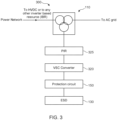
- the ESS 300 comprises the transformer 110 with at least three windings.
- the transformer 110 referred herein may be a high voltage transformer.
- the transformer 110 comprises at least three windings. Among the at least three windings of the transformer 110, the primary winding and the secondary winding of the transformer 110 is connected to the input and the output from the power network, respectively.
- the tertiary winding of the transformer 110 is connected to the ESD 130 through a pre-insertion resistor arrangement 325, the converter 320, and a protection circuit 150, as depicted in Fig. 3 ,
- the converter 320 is a Voltage Source Converter (VSC) 320.
- VSC Voltage Source Converter
- the VSC is self-commutated converter that connects the AC side and the DC side of the system using devices suitable for high power electronic applications, such as Insulated Gate Bipolar Transistor (IGBT).
- IGBT Insulated Gate Bipolar Transistor
- the VSC is capable of self-commutation, and being able to generate AC voltages without a need to rely on an AC system.
- the VSC 320 referred herein comprises one or more of: force commutated semiconductor devices, an IGBT, and a Gate turn-off thyristor (GTO).
- GTO Gate turn-off thyristor
- the VSC 320 is a two-level, three-level, a half-bridge, or a full-bridge modular multilevel converter (MMC).
- the VSC 320 is connected to the tertiary winding of the transformer 110.
- the VSC 220 is configured to work as a source or a sink of reactive power in the power network.
- the VSC 220 may handle power imbalance in the power network by generating or absorbing the reactive power present in the power network.
- the power network is a High Voltage Direct Current (HVDC) system.
- HVDC High Voltage Direct Current
- the pre-insertion resistor arrangement 325 is connected with the VSC 320 to limit an inrush currents during charging of the VSC 320 and the ESD 130.
- the pre-insertion resistor arrangement 325 is designed based on power network's voltage and energy of the switching transient. Further, the pre-insertion resistor arrangement 325 includes a bypass breaker.
- the pre-insertion resistor arrangement 325 comprises a bypass breaker in parallel to a pre-insertion resistor.
- a new transient current is generated. This transient current has a significant impact on the bypass breaker's interrupting performance. According to an example, a relationship between the insertion time and the bypass breaker's interrupting performance is calculated mathematically.
- the protection circuit 150 is added along with the ESD 130 to handle continuous rise of the DC current above protection limits.
- the failure condition comprises at least one of commutation failures, short-circuit failures, or ground failures during the inverting mode, or DC circuit faults.
- Commutation failure is an adverse dynamic event occurring if one of a converter valve that is supposed to turn off, continues to conduct without transferring its current to the next valve in the firing sequence.
- the protection circuit 150 is connected to the ESD 130 for executing the protection mechanism, and the protection circuit 150 is connected to the ESD 130 as one of an external circuit or in a combined modular structure.
- the protection circuit 150 comprises a freewheeling diode and an insulated-gate bipolar transistor, IGBT, in series with the ESD 130.
- the protection circuit 150 comprises a pair of IGBTs connected in half-bridge configuration.
- the ESS 200 comprises the transformer 110 with at least three windings.
- the primary winding and the secondary winding of the transformer 110 is connected to the input, for example to an AC grid and the output from the power network, for example to High voltage Direct Current (HVDC), respectively.
- the tertiary winding of the transformer 110 is connected to the ESD 130 through the AC side filter 225, the LCC converter 220, a High Speed Switch (HSS) 240, and a protection circuit 150.
- HSS High Speed Switch
- the LCC 220 comprises switching devices that are either uncontrolled, such as diodes, or that are only turned on (not off) by control action, such as thyristors.
- the LCC 220 has a six-pulse bridge that contains six electronic switches (T1, T2, T3, T4, T5, and T6), each connecting one of the three phases of the power network to one of two DC terminals.
- a complete switching element is referred to as a valve.
- Two valves in the six-pulse bridge conduct at a time: one to a phase in the top row and one from a different phase in the bottom row.
- the two conducting valves connect two of the three AC phase voltages, in series, to the DC terminals. therefore, DC output voltage at an instant is given by series combination of two AC phase voltages.
- a twelve-pulse bridge is used that contains 12 electronic switches.
- the AC side filter 225 is connected in series connection on the AC side of the LCC 220. Therefore, the AC side filter 225 filters out harmonics interference with AC voltage and AC current before feeding the AC voltage and the AC current to the power network from the LCC.
- a DC side filter 235 is connected in parallel to the LCC 220, and on a DC side of the LCC 220.
- the DC side filter 235 filters out harmonics interference with output of the LCC 220, that comprises DC voltage and DC current, before feeding to the ESD 130.
- DC side filtering is used for smoothening the DC voltage and DC current before feeding to the ESD 130 connected at the DC side.
- a DC smoothing reactor L DC is connected in series in between the LCC 220 and the HSS 240.
- the HSS 240 is connected in series between the LCC 220 and the ESD 130.
- the HSS 240 reverses the voltage polarity for changing direction of active power.
- in the ESS 100 for fast interchanging of the DC terminals between the LCC 220 and the ESD 130, facilitating quick change between energization (rectifying) and energy support (inverting) modes of the ESS 100.
- the interchange with HSS 240 is performed when the DC current is zero and at LCC idle/blocking period.
- the protection circuit 150 is added along with the ESD 130 to handle continuous rise of the DC current above protection limits.
- the protection circuit 150 is connected to the ESD 130 for executing the protection mechanism, and the protection circuit 150 is connected to the ESD 130 as one of an external circuit or in a combined modular structure.
- the ESS 300 comprises the transformer 110 with at least three windings.
- the transformer 110 referred herein may be a high voltage transformer.
- the transformer 110 comprises at least three windings.
- the primary winding and the secondary winding of the transformer 110 is connected to the input, for example an AC grid, and the output from the power network, for example to High Voltage Direct Current (HVDC), respectively.
- the tertiary winding of the transformer 110 is connected to the ESD 130 through a pre-insertion resistor arrangement 325, the converter 320, and a protection circuit 150,
- the pre-insertion resistor arrangement 325 is connected in series between the input from tertiary winding and the VSC 320.
- the pre-insertion resistor arrangement 325 is connected with the VSC 320 to limit an inrush currents during charging of the VSC 320 and the ESD 130.
- the pre-insertion resistor arrangement 325 is designed based on power network's voltage and energy of the switching transient. Further, the pre-insertion resistor arrangement 325 comprises a bypass breaker in parallel to a pre-insertion resistor. When the pre-insertion resistor in the pre-insertion resistor arrangement 325 is bypassed by closing the bypass breaker after a selected insertion time, a new transient current is generated. This transient current has a significant impact on the bypass breaker's interrupting performance. According to an example, a relationship between the insertion time and the bypass breaker's interrupting performance is calculated mathematically.
- the the VSC 320 is connected in series between the pre-insertion resistor arrangement 325 and the ESD 130.
- the ESD 130 is further comprises a protection circuit 150 connected to the ESD 130 for executing the protection mechanism.
- the protection circuit 150 is connected to the ESD 130 as one of an external circuit or in a combined modular structure.
- Fig. 6A depicts an embodiment when the protection circuit 150 is connected to the ESD 130 as the external circuit.
- the protection circuit 150 comprises a freewheeling diode in parallel with the ESD 130 and a parallel combination of a diode and an IGBT in series with the ESD 130.
- gate pulses for the IGBT which is in series with the ESD 130 is blocked to disconnect the ESD 130.
- the DC current in the LCC filter inductor circulates through freewheeling diode.
- the ESD 130 is connected by giving gate pulses to the IGBT and a control system changes the extinction or the firing angle of LCC to control the corresponding current in the circuit.
- the IGBT is replaced with a fast-acting mechanical switch.
- the ESD 130 comprises one or more of a supercapacitor, a battery storage, or any other similar or a mix of these.
- the supercapacitor experiences a wide variation of the DC voltage as compared to the battery storage, during energization and energy support modes.
- the LCC 220 supports this wide variation of the DC voltage by varying its firing, or extinction angle. Further, the two-level or three-level VSC is not configured so as to support this wide DC voltage variation. However, the MMC with an appropriate number of full-bridge cells supports this wide variation of the DC voltage.
- Fig. 6B depicts an embodiment when the protection circuit 150 is connected to the ESD 130 as the combined modular structure, the protection circuit 150 comprises a pair of a parallel combination of a diode and an IGBT. A first pair being in parallel with the ESD 130 and a second pair being in series with the ESD 130 thus both pairs are connected in half-bridge configuration with ESD 130.
- gate pulses for the IGBTs are blocked to disconnect the ESD 130.
- the DC current in the LCC filter inductor circulates through the diodes of parallel connected pairs.
- the ESD 130 is connected by giving gate pulses to the IGBT and a control system changes the extinction or the firing angle of LCC to control the corresponding current in the circuit.
- An advantage corresponding to embodiment of Fig. 6B is that by introduction of the modular feature to the ESD 130, its reliability and scalability is increased. Further, if the ESD 130 is selected as the supercapacitor, with proper insertion and bypass of the submodules in modular ESD, the DC voltage can be maintained close to a nominal value irrespective of the supercapacitor's discharge. Also, if any energy storage module needs to be bypassed, for example during any failure in the energy storage module, the IGBT of parallel pair of the corresponding module is turned-on and the IGBT of series connected pair is turned-off.
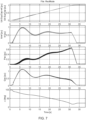
- Fig. 7 depicts a graph corresponding to an energization mode/rectifying mode of operation with supercapacitors.
- the supercapacitors are charged from zero to a nominal voltage, for example 1 pu. While charging the supercapacitor, the DC current is restricted, for example below 1.0 pu.
- the variation of active power, reactive power and the firing angle during this scenario are shown in the graph.
- the firing angle of the converter 120 starts at 90° (when DC voltage is zero) and reduces to its minimum with the increase of DC voltage to its nominal value.
- the maximum rate of charging (or rise of DC voltage) of the super capacitor is limited by the allowed DC current limit for the converter.
- the total charging is completed within 30s, however, in reality the charging time is in the range of minutes. This control also avoids the need for any external pre-insertion resistor and associated losses.
- Fig. 8 depicts a graph corresponding to an energy support mode/Inverting mode of operation with supercapacitors.
- the power is transferred from the supercapacitors to the AC grid and the corresponding results are shown in the graph of the Fig. 8 .
- the active power of the converter follows the power reference which in turn discharges the super capacitors as indicated by the decrease of DC voltage in the fig. 8 .
- the corresponding variation of DC current, reactive power and the extinction angle are also shown in the graph.
- the DC current is restricted to 1.5 pu which occurs mostly during reduced DC voltage condition to meet the required active power support.
- the reactive power drawn by the LCC 220 attains a peak value close to 1.2 pu. This includes both reactive power consumption of transformer (due to leakage reactance) and the converter (due to firing angle delay).
- the reactive power demand by the LCC 220 becomes high at certain operating conditions which is mainly influenced by the current magnitude and the firing (or extinction angle).
- This reactive power demand by the LCC 220 can be partially met by the AC side filter 225 and the remaining can be met by the HVDC converter such that the reactive power burden on the electrical grid (and hence voltage dip) can be reduced.
- Fig. 9 depicts a graph corresponding to Energy support mode with battery storage.
- the simulation results of the proposed ESS with battery as energy storage device are shown in Figure 9 .
- the ESD 130 is selected as batteries
- the reduction in terminal DC voltage is less with the discharge of the batteries.
- the terminal DC voltage is close to the nominal value during the energy support.
- the extinction angle is minimum.
- the reactive power consumption by the converter is close to 0.6 pu.
- the reactive power remains unchanged.
- the battery support is expected for longer duration (for example 10 minutes) than the super capacitors, the reduction in DC voltage will be less due to the discharge of the battery and the reactive power consumption remains unchanged.
Landscapes
- Engineering & Computer Science (AREA)
- Power Engineering (AREA)
- Rectifiers (AREA)
Priority Applications (2)
| Application Number | Priority Date | Filing Date | Title |
|---|---|---|---|
| EP23207083.9A EP4550604A1 (fr) | 2023-10-31 | 2023-10-31 | Système de stockage d'énergie intégré dans un réseau d'alimentation |
| PCT/EP2024/080848 WO2025093689A1 (fr) | 2023-10-31 | 2024-10-31 | Système de stockage d'énergie connecté par l'intermédiaire d'un enroulement tertiaire de transformée d'un réseau d'alimentation haute tension |
Applications Claiming Priority (1)
| Application Number | Priority Date | Filing Date | Title |
|---|---|---|---|
| EP23207083.9A EP4550604A1 (fr) | 2023-10-31 | 2023-10-31 | Système de stockage d'énergie intégré dans un réseau d'alimentation |
Publications (1)
| Publication Number | Publication Date |
|---|---|
| EP4550604A1 true EP4550604A1 (fr) | 2025-05-07 |
Family
ID=88647393
Family Applications (1)
| Application Number | Title | Priority Date | Filing Date |
|---|---|---|---|
| EP23207083.9A Pending EP4550604A1 (fr) | 2023-10-31 | 2023-10-31 | Système de stockage d'énergie intégré dans un réseau d'alimentation |
Country Status (2)
| Country | Link |
|---|---|
| EP (1) | EP4550604A1 (fr) |
| WO (1) | WO2025093689A1 (fr) |
Citations (3)
| Publication number | Priority date | Publication date | Assignee | Title |
|---|---|---|---|---|
| US5917251A (en) * | 1995-05-08 | 1999-06-29 | Bayernwerk Ag | Method and circuit arrangement to cover peak energy demands in electrical alternating or three-phase current networks |
| CN115207937A (zh) * | 2022-07-12 | 2022-10-18 | 西安交通大学 | 一种家用电能路由器及其控制方法和软起动方法 |
| CN116365588A (zh) * | 2023-03-31 | 2023-06-30 | 华为数字能源技术有限公司 | 功率变换器及其控制方法、不间断电源及供电系统 |
Family Cites Families (2)
| Publication number | Priority date | Publication date | Assignee | Title |
|---|---|---|---|---|
| SE543496C2 (en) * | 2018-12-21 | 2021-03-09 | Abb Power Grids Switzerland Ag | Power supporting arrangement for an ac network |
| US12401198B2 (en) * | 2020-09-04 | 2025-08-26 | Siemens Energy Global GmbH & Co. KG | Arrangement having a DC transmission link or DC transmission grid and method for the operation thereof |
-
2023
- 2023-10-31 EP EP23207083.9A patent/EP4550604A1/fr active Pending
-
2024
- 2024-10-31 WO PCT/EP2024/080848 patent/WO2025093689A1/fr active Pending
Patent Citations (3)
| Publication number | Priority date | Publication date | Assignee | Title |
|---|---|---|---|---|
| US5917251A (en) * | 1995-05-08 | 1999-06-29 | Bayernwerk Ag | Method and circuit arrangement to cover peak energy demands in electrical alternating or three-phase current networks |
| CN115207937A (zh) * | 2022-07-12 | 2022-10-18 | 西安交通大学 | 一种家用电能路由器及其控制方法和软起动方法 |
| CN116365588A (zh) * | 2023-03-31 | 2023-06-30 | 华为数字能源技术有限公司 | 功率变换器及其控制方法、不间断电源及供电系统 |
Also Published As
| Publication number | Publication date |
|---|---|
| WO2025093689A1 (fr) | 2025-05-08 |
Similar Documents
| Publication | Publication Date | Title |
|---|---|---|
| Zhao et al. | A more prospective look at IGCT: Uncovering a promising choice for dc grids | |
| US10491098B2 (en) | Soft switching solid state transformers and converters | |
| US10084387B2 (en) | LCC and MMC series-connected HVDC system with DC fault ride-through capability | |
| US10700525B2 (en) | Method and apparatus for controlling hybrid direct-current transmission system | |
| Xue et al. | Self-start control with grouping sequentially precharge for the C-MMC-based HVDC system | |
| RU2652690C2 (ru) | Модульный многоточечный вентильный преобразователь для высоких напряжений | |
| EP3231053B1 (fr) | Veille et facturation de convertisseurs multiniveaux modulaires | |
| Li et al. | A hybrid modular multilevel converter with reduced full-bridge submodules | |
| CN1118121C (zh) | 补偿设备及采用补偿设备的输电系统 | |
| CN103947099A (zh) | 功率电子模块 | |
| Li et al. | Experiment on DC-fault ride through of MMC using a half-voltage clamp submodule | |
| CN111555333B (zh) | 直流调压单元的控制方法及控制装置 | |
| Cheng et al. | A comprehensive AC fault ride-through strategy for HVDC link with serial-connected LCC-VSC hybrid inverter | |
| CN117097190B (zh) | 混合式桥臂和混合式换流器及控制方法和装置、输电系统 | |
| US11777401B2 (en) | Fault tolerant AC-DC chain-link converter | |
| US20190068081A1 (en) | Converter | |
| CN108448542A (zh) | 具有交直流故障清除能力的子模块结构及mmc拓扑结构 | |
| CN113690919A (zh) | 具有电网换相的变流器的变流器装置和用于启动其的方法 | |
| CN117097179A (zh) | 电容辅助关断的双换流器电路及控制方法和装置、系统 | |
| CN120511763A (zh) | 自换相换流器及其控制方法、控制装置、高压直流输电系统 | |
| EP3476031B1 (fr) | Protection de semi-conducteurs dans des convertisseurs de puissance | |
| US12068679B2 (en) | Power conversion device preventing overcurrent at the time of starting | |
| EP4550604A1 (fr) | Système de stockage d'énergie intégré dans un réseau d'alimentation | |
| US11677335B2 (en) | Method for operating a power converter | |
| WO2021105455A1 (fr) | Convertisseur modulaire multi-niveau |
Legal Events
| Date | Code | Title | Description |
|---|---|---|---|
| PUAI | Public reference made under article 153(3) epc to a published international application that has entered the european phase |
Free format text: ORIGINAL CODE: 0009012 |
|
| STAA | Information on the status of an ep patent application or granted ep patent |
Free format text: STATUS: THE APPLICATION HAS BEEN PUBLISHED |
|
| AK | Designated contracting states |
Kind code of ref document: A1 Designated state(s): AL AT BE BG CH CY CZ DE DK EE ES FI FR GB GR HR HU IE IS IT LI LT LU LV MC ME MK MT NL NO PL PT RO RS SE SI SK SM TR |
|
| STAA | Information on the status of an ep patent application or granted ep patent |
Free format text: STATUS: REQUEST FOR EXAMINATION WAS MADE |
|
| 17P | Request for examination filed |
Effective date: 20251105 |