EP4550714A1 - Appareil modulaire pour créer des contrats intelligents résilients - Google Patents
Appareil modulaire pour créer des contrats intelligents résilients Download PDFInfo
- Publication number
- EP4550714A1 EP4550714A1 EP23207493.0A EP23207493A EP4550714A1 EP 4550714 A1 EP4550714 A1 EP 4550714A1 EP 23207493 A EP23207493 A EP 23207493A EP 4550714 A1 EP4550714 A1 EP 4550714A1
- Authority
- EP
- European Patent Office
- Prior art keywords
- smart contract
- blockchain
- ald
- smart
- code
- Prior art date
- Legal status (The legal status is an assumption and is not a legal conclusion. Google has not performed a legal analysis and makes no representation as to the accuracy of the status listed.)
- Withdrawn
Links
Images
Classifications
-
- H—ELECTRICITY
- H04—ELECTRIC COMMUNICATION TECHNIQUE
- H04L—TRANSMISSION OF DIGITAL INFORMATION, e.g. TELEGRAPHIC COMMUNICATION
- H04L9/00—Cryptographic mechanisms or cryptographic arrangements for secret or secure communications; Network security protocols
- H04L9/50—Cryptographic mechanisms or cryptographic arrangements for secret or secure communications; Network security protocols using hash chains, e.g. blockchains or hash trees
-
- H—ELECTRICITY
- H04—ELECTRIC COMMUNICATION TECHNIQUE
- H04L—TRANSMISSION OF DIGITAL INFORMATION, e.g. TELEGRAPHIC COMMUNICATION
- H04L9/00—Cryptographic mechanisms or cryptographic arrangements for secret or secure communications; Network security protocols
- H04L9/32—Cryptographic mechanisms or cryptographic arrangements for secret or secure communications; Network security protocols including means for verifying the identity or authority of a user of the system or for message authentication, e.g. authorization, entity authentication, data integrity or data verification, non-repudiation, key authentication or verification of credentials
- H04L9/3236—Cryptographic mechanisms or cryptographic arrangements for secret or secure communications; Network security protocols including means for verifying the identity or authority of a user of the system or for message authentication, e.g. authorization, entity authentication, data integrity or data verification, non-repudiation, key authentication or verification of credentials using cryptographic hash functions
- H04L9/3239—Cryptographic mechanisms or cryptographic arrangements for secret or secure communications; Network security protocols including means for verifying the identity or authority of a user of the system or for message authentication, e.g. authorization, entity authentication, data integrity or data verification, non-repudiation, key authentication or verification of credentials using cryptographic hash functions involving non-keyed hash functions, e.g. modification detection codes [MDCs], MD5, SHA or RIPEMD
-
- H—ELECTRICITY
- H04—ELECTRIC COMMUNICATION TECHNIQUE
- H04L—TRANSMISSION OF DIGITAL INFORMATION, e.g. TELEGRAPHIC COMMUNICATION
- H04L63/00—Network architectures or network communication protocols for network security
- H04L63/04—Network architectures or network communication protocols for network security for providing a confidential data exchange among entities communicating through data packet networks
- H04L63/0428—Network architectures or network communication protocols for network security for providing a confidential data exchange among entities communicating through data packet networks wherein the data content is protected, e.g. by encrypting or encapsulating the payload
-
- H—ELECTRICITY
- H04—ELECTRIC COMMUNICATION TECHNIQUE
- H04L—TRANSMISSION OF DIGITAL INFORMATION, e.g. TELEGRAPHIC COMMUNICATION
- H04L63/00—Network architectures or network communication protocols for network security
- H04L63/12—Applying verification of the received information
Definitions
- the present invention is concerned with a system architecture, instantiated via cloud-based hardware resources, that facilitates the generation and iterative enhancement of resilient smart contracts for blockchain networks, with particular applicability to business-to-business (B2B) scenarios within the blockchain domain.
- the invention leverages both software and hardware elements, utilizing cloud infrastructure that comprises data processing units, network communication systems, and storage resources to realize a secure, efficient, and adaptable execution environment for smart contract creation.
- the proposed invention differentiates itself by employing a feedback loop mechanism, inspired by the continuous improvement protocols of the aviation industry, to enhance smart contract integrity.
- This Modular Asset Lifecycle Descriptor (ALD) within a hardware-based feedback loop provides a framework for the system that not only simplifies the development process but also imbues the generated smart contracts with an inherent capacity for evolution and refinement-qualities that are vital for the antifragility and safety of blockchain-based business operations.
- ALD Modular Asset Lifecycle Descriptor
- the present invention introduces a novel approach that leverages a linear state-machine like asset lifecycle descriptor and a modular apparatus to process incoming lifecycle descriptions into smart-contracts while incorporating a feedback loop.
- This approach offers flexibility in creating smart-contracts, standardizes well-known smart contract fragments for easier auditing, and introduces an antifragile component that enhances the safety and reliability of the smart-contracts.
- the present invention provides a system architecture designed to facilitate the creation, deployment, and iterative improvement of smart contracts within a blockchain infrastructure, specifically tailored for B2B applications.
- the architecture is underpinned by a network of cloud-based hardware resources, including but not limited to, scalable processing units, distributed data storage, and secure communication channels, to support the system's operations.
- the inventive system employs a Modular Asset Lifecycle Descriptor (ALD) to define and manage the lifecycle of assets on the blockchain.
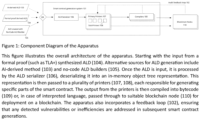
- ALD is processed by a collection of software modules, referred to as "printers,” each responsible for generating specific sections of the smart contract code. These printers operate on virtualized hardware resources provisioned in the cloud, ensuring both the flexibility and the robustness of the contract generation process.
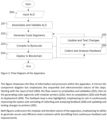
- a key innovation of the system is the integration of a feedback loop. Feedback from various sources-including automated unit tests, smart contract audits, active monitoring systems, and possibly Al-based analysis-is used to identify and implement improvements in the contract generation modules. These enhancements are then tested and validated on dedicated hardware resources, ensuring the reliability of subsequent smart contract iterations.
- the system's modularity is reflected in the ability to select and integrate different printer modules based on the requirements of the ALD. This selection process is facilitated by a hardware-implemented management module that dynamically allocates cloud-based computational resources to the appropriate printer modules.
- the system is designed to be language-agnostic, capable of supporting various blockchain programming languages and accommodating updates to the printer modules via the feedback loop.
- system's architecture allows for the possibility of decentralized governance in the form of community-driven proposals for modifications to the printer modules.
- This aspect of the system is facilitated by hardware-configured network interfaces that enable participation and voting by the user community, much like how decentralized autonomous organizations operate.
- the invention comprises a cohesive assembly of hardware components for the secure and efficient generation of smart contracts.
- the Printer Workstation integrating the functionality of both primary and sub-printers, serves as the nucleus for smart contract code generation, directly processing the structured asset descriptions from the ALD Serializer Server.
- a Compiler Server is responsible for translating the generated code into executable bytecode, while the Blockchain Node Server facilitates the secure deployment and validation of the smart contracts on the blockchain.
- this embodiment enables a meticulous and operator-driven execution of the smart contract lifecycle, supported by a robust networking infrastructure and secure data storage solutions, embodying a secure and resilient system for B2B blockchain applications.
- ALD Asset Lifecycle Descriptor
- An AI-based such as a generative pre-trained transformer system could be used to automatically generate the ALD, understanding and formalizing the asset's lifecycle stages and transitions into the structured ALD format.
- ALD could also be synthesized from formal proof-based languages such as TLA+, where the formal proofs are translated into the lifecycle descriptor, ensuring that the ALD adheres to rigorously tested logical rules and constraints.
- BPMN Business Process Model and Notation
- An "Asset Lifecycle Description" (ALD) in a blockchain context is a formalized structure that defines and tracks the various stages an asset goes through during its existence on a blockchain network. It ensures that each asset is unique (non-fungible) and that its ownership and permissions are transparent and immutable.
- the ALD encompasses the rules and logic for the asset's transitions and interactions within the network, providing a clear framework for what actions can be performed, by whom, and under what conditions.
- ALD is akin to a blueprint for the life of a blockchain asset, detailing every aspect of its existence, from creation to destruction. It provides a structured, secure, and scalable method to manage the complexities of asset lifecycles in decentralized networks, ensuring compliance, security, and adaptability in the ever-evolving landscape of blockchain technology.
- ALD serializes the states and transitions of an asset, effectively creating a state machine on the blockchain.
- This serialized format outlines how an asset can move from one state to another, encapsulating the business logic that governs these transitions. This serialization is critical for ensuring that the asset's journey is traceable and complies with predetermined rules that prevent unauthorized actions.
- ALD Since blockchains are designed around the principle of clear ownership, typically represented by non-fungible tokens (NFTs), ALD specifies the ownership of each asset state and the permissions required for transitions. This clarity in ownership and permissions is paramount in maintaining the integrity and security of the assets on the blockchain.
- ALD includes mechanisms to handle situations like reentrancy attacks or the need to withdraw funds. It does so by carefully defining the conditions and states where these actions are permissible, effectively "programming" the lifecycle of the asset to anticipate and respond to such scenarios.
- the ALD contains metadata that directs a primary printer to use specific sub-printers for different functionalities within the smart contract.
- This metadata dictates which modules to employ for given actions or components of the contract.
- the ALD may specify the use of a default payment module for handling transactions, but it can also indicate a specialized payment module hosted externally for enhanced features or compliance with certain standards. This approach allows for the customization and extension of smart contract functionalities by simply updating the printer instructions within the ALD without altering the core structure of the ALD itself.
- printers allow for the smart contract to be updated or improved as a whole.
- the primary printer interprets this change and 'reprints' the entire smart contract with the updated module integrated. This is a critical feature for maintaining the contract's relevance and optimizing its performance over time.
- the contract is not printed in segments but as a unified codebase that reflects the current state of the ALD instructions, including any specified printer versions or custom modules. This ensures that all components of the smart contract are compatible and work cohesively.
- the ALD Serializer operates through a dedicated server unit, equipped with specialized data processing hardware capable of transforming the Asset Lifecycle Description (ALD) into a structured in-memory object hierarchy. This hardware-driven process ensures the efficient translation of lifecycle information into a format that modular printing units can interpret.
- ALD Asset Lifecycle Description
- ALD decodes the ALD, which may be provided in various formats such as XML, JSON, or a custom syntax, into a structured, navigable object tree. This deserialization is the first step in bringing the abstract definitions of the ALD into a form that can be actively used by the system.
- the Serializer After the ALD is deserialized, the Serializer performs validation checks to ensure that all necessary data is present and correctly formatted. It checks for completeness and logical consistency within the ALD, guarding against errors that could arise from incomplete or malformed data.
- the object tree serves as the interface between the ALD and the plurality of printers. Printers do not interact directly with the ALD; instead, they use this deserialized tree to understand the asset's lifecycle and generate the corresponding smart contract code.
- This abstraction layer allows for printers to be agnostic of the ALD's initial format and solely focused on their task of code generation.
- the iteration through the elements of the ALD by the primary printer is a static and predetermined process. This ensures consistency and reliability in the smart contract generation, crucial for security and auditing purposes.
- the order of operations, particularly the execution of third-party calls, is fixed to adhere to security best practices and the specific language's standards.
- the system may incorporate a decentralized governance model that allows for community participation in the acceptance of changes arising from the feedback loop. This model ensures that updates to the printer modules are in alignment with user and community interests, reflecting a consensus-driven approach to system evolution.
- users have the autonomy to create, publish, and select their variants of printer modules.
- the system facilitates this by allowing users to specify in the ALD which versions, tools, or extensions to employ, thereby customizing the smart contract generation pipeline to their preferences.
- the feedback loop ensures that every encountered issue is transparently documented and utilized to improve subsequent versions of the smart contracts. This process embodies a commitment to safety and continuous improvement, mirroring how the lessons learned from each incident in aviation lead to collectively safer travel.
- the objective is to foster the growth of a business economy on the blockchain that is inherently safe and self-improving.
- Compilers play a pivotal role in converting the high-level smart contract code generated by the printers into low-level bytecode in case the language in question is not interpretable.
- These compilers are hosted on dedicated computing servers within the system's infrastructure, featuring optimized hardware designed for high-speed code compilation.
- the compiler hardware is selected based on the ability to handle multiple programming languages and blockchain platforms, ensuring broad compatibility and rapid execution of compilation tasks.
- the invention is implemented using on-premises hardware, establishing a decentralized and secure environment for organizations that opt for or necessitate local control over cloud-based solutions.
- This on-premises embodiment offers a robust and secure alternative to cloud-based systems, granting businesses full sovereignty over their smart contract generation processes.
- the selected hardware components ensure that the system's functionality aligns with the demanding requirements of smart contract creation and deployment, thus providing a reliable and efficient solution for B2B blockchain applications.
- a specialized server equipped with high-speed processors and extensive memory is dedicated to deserializing and validating the Asset Lifecycle Description (ALD). This server transforms the ALD into a structured format for subsequent processing.
- a high-performance computing workstation functions as the primary printer, containing integrated sub-printer modules. These modules are software entities with firmware-level integration that generate specific sections of the smart contract code derived from the deserialized ALD. This central workstation facilitates the composition of the entire smart contract code in a cohesive manner.
- a set of computing servers designed for high-throughput operations, compile the smart contract code into bytecode that is executable by a blockchain node.
- These servers equipped with state-of-the-art compilers, handle various programming languages and cater to different blockchain platforms.
- a fortified server featuring a secure enclave processor, creates a trusted execution environment for blockchain nodes. It hosts a full node of the specified blockchain network, which is pivotal for the validation and execution of smart contracts.
- a sophisticated control station provides the human operator with the necessary interfaces to orchestrate the smart contract generation workflow.
- the operator controls the sequence of operations, from the serialization of ALD to the deployment of smart contracts, through this station, which is outfitted with multiple monitors and control devices.
- An elaborate network architecture including routers, switches, and firewalls, ensures secure and rapid data exchange among the system's hardware components, safeguarding the system from external threats.
- High-reliability storage systems securely store the ALD, the resulting smart contract code, and other pertinent data. Redundancy and backup protocols are in place to ensure the preservation of data integrity and availability, even in the event of hardware malfunctions.
Landscapes
- Engineering & Computer Science (AREA)
- Computer Security & Cryptography (AREA)
- Computer Networks & Wireless Communication (AREA)
- Signal Processing (AREA)
- Information Retrieval, Db Structures And Fs Structures Therefor (AREA)
Priority Applications (1)
| Application Number | Priority Date | Filing Date | Title |
|---|---|---|---|
| EP23207493.0A EP4550714A1 (fr) | 2023-11-02 | 2023-11-02 | Appareil modulaire pour créer des contrats intelligents résilients |
Applications Claiming Priority (1)
| Application Number | Priority Date | Filing Date | Title |
|---|---|---|---|
| EP23207493.0A EP4550714A1 (fr) | 2023-11-02 | 2023-11-02 | Appareil modulaire pour créer des contrats intelligents résilients |
Publications (1)
| Publication Number | Publication Date |
|---|---|
| EP4550714A1 true EP4550714A1 (fr) | 2025-05-07 |
Family
ID=88690257
Family Applications (1)
| Application Number | Title | Priority Date | Filing Date |
|---|---|---|---|
| EP23207493.0A Withdrawn EP4550714A1 (fr) | 2023-11-02 | 2023-11-02 | Appareil modulaire pour créer des contrats intelligents résilients |
Country Status (1)
| Country | Link |
|---|---|
| EP (1) | EP4550714A1 (fr) |
Citations (3)
| Publication number | Priority date | Publication date | Assignee | Title |
|---|---|---|---|---|
| WO2019170174A2 (fr) * | 2019-06-27 | 2019-09-12 | Alibaba Group Holding Limited | Mise en œuvre d'un flux de travail basé sur une chaîne de blocs |
| EP3906488A1 (fr) | 2019-06-12 | 2021-11-10 | NEC Laboratories Europe GmbH | Procédé et système de cadre de réécriture de contrat servant à prendre en charge des contrats intelligents dans un réseau à chaîne de blocs |
| US20230072988A1 (en) | 2021-09-06 | 2023-03-09 | MphasiS Limited | System and a method for automatic generation of smart contracts across blockchain platforms |
-
2023
- 2023-11-02 EP EP23207493.0A patent/EP4550714A1/fr not_active Withdrawn
Patent Citations (5)
| Publication number | Priority date | Publication date | Assignee | Title |
|---|---|---|---|---|
| EP3906488A1 (fr) | 2019-06-12 | 2021-11-10 | NEC Laboratories Europe GmbH | Procédé et système de cadre de réécriture de contrat servant à prendre en charge des contrats intelligents dans un réseau à chaîne de blocs |
| US20220318399A1 (en) * | 2019-06-12 | 2022-10-06 | NEC Laboratories Europe GmbH | Method and contract rewriting framework system for supporting smart contracts in a blockchain network |
| WO2019170174A2 (fr) * | 2019-06-27 | 2019-09-12 | Alibaba Group Holding Limited | Mise en œuvre d'un flux de travail basé sur une chaîne de blocs |
| EP3673432A2 (fr) | 2019-06-27 | 2020-07-01 | Alibaba Group Holding Limited | Mise en oeuvre d'un flux de travail basé sur une chaîne de blocs |
| US20230072988A1 (en) | 2021-09-06 | 2023-03-09 | MphasiS Limited | System and a method for automatic generation of smart contracts across blockchain platforms |
Non-Patent Citations (1)
| Title |
|---|
| CUI SIWEI SIWEICUI@TAMU EDU ET AL: "VRust Automated Vulnerability Detection for Solana Smart Contracts", PROCEEDINGS OF THE 2022 ACM SIGSAC CONFERENCE ON COMPUTER AND COMMUNICATIONS SECURITY, ACMPUB27, NEW YORK, NY, USA, 7 November 2022 (2022-11-07), pages 639 - 652, XP058955759, ISBN: 978-1-4503-9466-6, DOI: 10.1145/3548606.3560552 * |
Similar Documents
| Publication | Publication Date | Title |
|---|---|---|
| US11941378B1 (en) | System and method for utilizing production insights in generative AI models | |
| US11372639B2 (en) | System and method for automated microservice source code generation and deployment | |
| Marchesi et al. | ABCDE—Agile block chain DApp engineering | |
| US11593084B2 (en) | Code development for deployment on a cloud platform | |
| US10678522B1 (en) | Compiler and method for compiling business rules for a serverless runtime environment | |
| Achilleos et al. | The cloud application modelling and execution language | |
| US8739150B2 (en) | Systems and methods for dynamically replacing code objects via conditional pattern templates | |
| EP2245532B1 (fr) | Procede et appareil pour generer une plateforme logicielle virtuelle sur la base d'un modele de composant et valider une structure de plateforme logicielle a l'aide de la plateforme | |
| US8245191B2 (en) | Policy application rules for automated configuration of software components | |
| Sorgalla et al. | Applying model-driven engineering to stimulate the adoption of devops processes in small and medium-sized development organizations: the case for microservice architecture | |
| US10656971B2 (en) | Agile framework for vertical application development and delivery | |
| Ahmad et al. | A framework for architecture-driven migration of legacy systems to cloud-enabled software | |
| Guida et al. | Supporting reuse of smart contracts through service orientation and assisted development | |
| WO2011041246A1 (fr) | Systèmes et procédés d'analyse et de transformation d'une application d'une installation source à une installation cible | |
| US20260133771A1 (en) | Agentic artificial intelligence based software development and modernization | |
| US20150220404A1 (en) | Undo configuration transactional compensation | |
| US10958514B2 (en) | Generating application-server provisioning configurations | |
| Kongdenfha et al. | Web service adaptation: Mismatch patterns and semi-automated approach to mismatch identification and adapter development | |
| Ebrahimi et al. | UPC sentinel: An accurate approach for detecting upgradeability proxy contracts in Ethereum | |
| US12504971B2 (en) | Enterprise application integration leveraging non-fungible token | |
| EP4550118A1 (fr) | Architecture de modélisation sous forme de données avec modèles et recommandations d'architecture aopinion | |
| Alshuqayran | Static microservice architecture recovery using model-driven engineering | |
| Balogh et al. | Workflow-driven tool integration using model transformations | |
| CN119396509A (zh) | 应用程序接口可视化配置方法及相关设备 | |
| Tahmasebi et al. | Dataclouddsl: Textual and visual presentation of big data pipelines |
Legal Events
| Date | Code | Title | Description |
|---|---|---|---|
| PUAI | Public reference made under article 153(3) epc to a published international application that has entered the european phase |
Free format text: ORIGINAL CODE: 0009012 |
|
| STAA | Information on the status of an ep patent application or granted ep patent |
Free format text: STATUS: THE APPLICATION HAS BEEN PUBLISHED |
|
| AK | Designated contracting states |
Kind code of ref document: A1 Designated state(s): AL AT BE BG CH CY CZ DE DK EE ES FI FR GB GR HR HU IE IS IT LI LT LU LV MC ME MK MT NL NO PL PT RO RS SE SI SK SM TR |
|
| STAA | Information on the status of an ep patent application or granted ep patent |
Free format text: STATUS: THE APPLICATION IS DEEMED TO BE WITHDRAWN |
|
| 18D | Application deemed to be withdrawn |
Effective date: 20251108 |