EP4550720A1 - Verfahren zur konfiguration eines blockchain-netzwerks und computersoftwareprogramm zur implementierung solch eines verfahrens - Google Patents
Verfahren zur konfiguration eines blockchain-netzwerks und computersoftwareprogramm zur implementierung solch eines verfahrens Download PDFInfo
- Publication number
- EP4550720A1 EP4550720A1 EP23830935.5A EP23830935A EP4550720A1 EP 4550720 A1 EP4550720 A1 EP 4550720A1 EP 23830935 A EP23830935 A EP 23830935A EP 4550720 A1 EP4550720 A1 EP 4550720A1
- Authority
- EP
- European Patent Office
- Prior art keywords
- nodes
- voter
- ring
- network
- block
- Prior art date
- Legal status (The legal status is an assumption and is not a legal conclusion. Google has not performed a legal analysis and makes no representation as to the accuracy of the status listed.)
- Pending
Links
Images



Classifications
-
- H—ELECTRICITY
- H04—ELECTRIC COMMUNICATION TECHNIQUE
- H04L—TRANSMISSION OF DIGITAL INFORMATION, e.g. TELEGRAPHIC COMMUNICATION
- H04L9/00—Cryptographic mechanisms or cryptographic arrangements for secret or secure communications; Network security protocols
- H04L9/50—Cryptographic mechanisms or cryptographic arrangements for secret or secure communications; Network security protocols using hash chains, e.g. blockchains or hash trees
-
- H—ELECTRICITY
- H04—ELECTRIC COMMUNICATION TECHNIQUE
- H04L—TRANSMISSION OF DIGITAL INFORMATION, e.g. TELEGRAPHIC COMMUNICATION
- H04L63/00—Network architectures or network communication protocols for network security
- H04L63/08—Network architectures or network communication protocols for network security for authentication of entities
Definitions
- the present invention relates to a method for configuring a blockchain network.
- a blockchain network is an autonomous distributed system in which many computers, smartphones and the like participate as nodes to thereby increase the security and reliability of the entire network and prohibit data tampering or fraud.
- networks that small mobile terminals such as smartphones can connect to are generally Wi-Fi or mobile networks, which are often significantly inferior in terms of connection stability and traffic performance to network lines used by high-performance servers such as those hosted in data centers. For this reason, it is considered that terminals may be frequently disconnected from the network and reconnected again.
- the purpose of the present invention is to provide a system and a method capable of continuing to execute consensus building (consensus) without stopping the blockchain, even in a situation where many nodes are down or disconnected.
- Fig. 1 shows a configuration of a blockchain execution server module 1 (computer software program), which is one embodiment of the present invention.
- This execution server module 1 is a service program for building a blockchain network and may run on a server machine such as Linux ® , or it may be incorporated into an application program and run on a mobile terminal. In that case, this module 1 is stored on a storage medium implemented on each device, and will be called and executed by the device's CPU (not shown) on the device's memory (not shown) as needed, to thereby operate as a respective configuration of the invention.
- This execution server module 1 has, as shown in Fig. 1 , a smart contract execution section 2, a consensus algorithm execution section 3, a blockchain data retention function section 4, a data synchronization function section 5, and a P2P network construction function section 6.
- the smart contract execution section 2 also provides an interface to the blockchain.
- the consensus algorithm execution section 3 also provides a node management function section 7.
- Each of these components 2-7 has access to shared data 9 for storing a smart contract 10, a consensus algorithm 11, blockchain data 12, node information 13, and a difficulty range 14.
- the smart contract execution section 2 is a virtual machine for, in response to an external call and/or data transfer to the blockchain network, executing a specific method (update method) of the smart contract 10 stored in the shared data 9, and returning the result.
- the P2P network building function section 6 executes functions of building a new node as a member of a blockchain P2P network and connecting blockchain execution servers among one another.
- a node for accessing the blockchain network is needed.
- one of existing nodes In order to cause a node to newly join a blockchain network, one of existing nodes must make the new node to become a member of the blockchain's P2P network.
- the data synchronization function section 5 synchronizes the latest blockchain data 12 at each node, and at the time of this synchronization, retrieves data 11 from other nodes connected via P2P, verifies its correctness, and stores it as the shared data 9.
- the blockchain data retention function section 4 retains the above blockchain shared data (blockchain data 12) in a storage area of servers or mobile terminals.
- a transaction is assembled and sent from each node to the blockchain network. This transaction is propagated to all nodes that constitute the blockchain network. At this time, each node queues the transaction as a transaction waiting to be stored in a block. Since it takes a certain amount of time for a transaction to be stored in a block, the update method is, in principle, an asynchronous process.
- Execution of the update method of the smart contract 10 corresponds to the invoking transaction of the method being stored in a new block.
- the timing of the execution of the update method is when a new block is created by a block-creating node as well as when other nodes that are not the block-creating node receive the new block and verify its correctness.
- the smart contract 10 is executed in exactly the same way on all nodes on the blockchain network, and the state updates associated with the processing reach the same result.
- the invocation and execution of the smart contract 10 reference method returns an immediate result using a verified smart contract code and an internal state that the node itself has.
- the smart contract 10 can be executed as above because all nodes on the blockchain network share data 11 as described above.
- the consensus algorithm 11 in the present embodiment is based on Proof of Authority (PoA).
- PoA Proof of Authority
- This PoA is a consensus algorithm based on the idea that only trusted nodes can sign a block, and is a consensus algorithm in which nodes called Sealers form a ring-like virtual network and take turns signing blocks at specified time intervals.
- participation in a network employing this algorithm requires being authorized and trusted via eKYC or the like (Authority), and in that sense, although it is centralized, malicious participants may be eliminated on a practical level.
- This consensus algorithm execution section 3 executes consensus building for adding data received via the above P2P network to the blockchain. Thus, it retains node information 13 related to the consensus building. Then, the node management function section 7 provided in this consensus algorithm execution section 3 manages and determines nodes to sign based on the consensus algorithm 11.
- the above node management function section 7 manages nodes participating in consensus building by dividing them into Signers and Voters.
- Signers are nodes assumed to operate on mobile terminals, whereas Voters are ones operating on server computers, such as those hosted in data centers, where computational resources such as a network, power sources, and the like may be amply provided.
- Table 1 Voter Special node with voting rights to not only sign blocks, but also to add and/or remove Signers from the blockchain network, and is built in a data center or the like capable of securing stable operations.
- Signer Node which only signs blocks, and is a common node which participates in the present blockchain network via Authority, such as eKYC, and which is also executed on mobile terminals and the like.
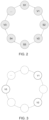
- the node management function section is configured to build a ring-like virtual network, as shown in Fig. 2 , with Voters and Signers and to operate the network by continuing to sign blocks containing transactions in order.
- the Voters and Signers are called Sealers (nodes capable of signing ("sealing") blocks and adding them to the blockchain: Sealers).
- blocks are signed in turn, in such an order as S1 -> V1 - > S2 -> V2, to be added to the blockchain.
- the blockchain network may stop its operation.
- the node management function section 7 of Voters that remain online is configured to be capable of detecting this condition.
- the node management function section 7 has a block addition monitoring section 16, which detects this by detecting that the addition of new blocks no longer occurs at each block-signing timing (normally, all nodes detect addition of new blocks and update their own blockchain).
- the node management function section 7 of the Voters each enters a mode for checking whether or not no blocks are signed for a certain period of time, and if no new blocks are added to the blockchain after that period, the Voters migrate the network to the Voter Ring constituted only by the Voters.
- the Voter Ring forms a consensus building ring (Voter Ring) having only Voter nodes, in such a way that all valid Signers at the time are excluded ( Fig. 4 ), and in this state, the Voters are configured to perform the usual new block signing and addition logic.
- a difficulty range modification section modifies the difficulty range recorded in the block as shown in Table 2 to thereby distinguish between block addition by the Voter Ring and normal block addition.
- the returning node first performs data synchronization to match the latest blockchain state.
- the node management function section 7 of the Signer detects whether the current blockchain was operating in the normal state or in the Voter Ring by referring to the difficulty included in the block.
- the Voter Ring state is resolved and a normal state with all nodes participating is restored.
- Fig. 5-Fig. 8 show flowcharts of a specific example of the transition logic between the above Sealer Ring and Voter Ring.
- Fig. 5 shows a logic for determining the Difficulty when a new block is generated, that is, when the sealer itself signs the block.
- Step S1-1 and S1-2 the past blockchain state is read and the difficulty is verified to thereby check whether the network was running in the Voter Ring. If it is not a Voter Ring (Step S1-3), an elapsed time since the previous block generation is checked (Step S1-4), and if a certain amount of time has elapsed, the decision to switch to the Voter Ring is made (S 1-5); whereas if a certain period of time has not elapsed, the switching to the Voter Ring is not performed and the normal difficulty range is set (Step S1-6).
- Step S1-7 determines whether or not itself is a Voter (Step S1-7), wherein if it is a Voter, it sets the difficulty range to that of the Voter Ring (Step S1-8), and conversely, if it is not a Voter (i.e., if the node itself is a Signer), it sets the difficulty range for dissolving the Voter Ring (Step S1-9).
- This node then continues the processing of adding new blocks with the difficulty range determined as above (Step S1-10).
- Fig. 6 shows a logic for adding a new block when a new block is received at the sealer.
- this logic executes Steps S2-2 and later as part of or after the process of checking the validity of the received block (Step S2-1).
- Step S2-2 After reading the past blockchain state in Step S2-2, whether the network was running in the Voter Ring is checked based on a difficulty value included in the block (Step S2-3).
- Step S2-5) a check for the Voter Ring is performed (Step S2-5), and if it is determined in Step S2-4 that the network is not in the Voter Ring, a check for the Sealer Ring is performed (Step S2-6). If the check result is correct in Step S-7, the block is approved and saved (Step S-8); if the check result is not correct, an error is returned (Step S2-9).
- Fig. 7 shows a processing flow of check execution in the Sealer Ring, which is performed in Step S2-6 in the above approval processing of the new block addition ( Fig. 6 ).
- Steps S3-1 to 3-3 it is determined whether the difficulty range is for the Sealer Ring, Voter Ring, or Voter Ring dissolution, respectively, and if the range is within the Voter Ring, whether the node itself is a Voter node, is determined (S3-4), wherein if it is not a Voter node, an error is returned as a check result (S3-5), and if it is a Voter node, a positive check result is returned only if a certain time has passed since the previous block generation timing (Step S3-6).
- Step S3-3 if the difficulty range is determined to be that within the Voter Ring dissolution in Step S3-3, if the node itself is not a Signer node (determined in Step S3-6), an error is returned as a check result (Step S3-7), and if it is a Signer node (determined in Step S3-6), a positive check result is returned (Step S3-10) only when it is determined that a certain time has passed since the previous block generation timing (S3-8, 3-9).
- Fig. 8 shows a processing flow of check execution in the Voter Ring, which is performed in Step S2-5 in the above processing of approving the new block addition ( Fig. 6 ).
- Steps S4-1 to 4-3 it is determined whether the difficulty range is for the Sealer Ring, Voter Ring, or Voter Ring dissolution, respectively, and if the range is within the Voter Ring (S4-2), whether the node itself is a Voter node, is determined (S4-4), wherein if it is not a Voter node, an error is returned as a check result (S4-5), and if it is a Voter node, a positive check result is returned (Step S4-6).
- Step S4-3 if the difficulty range is within the Voter Ring dissolution (Step S4-3), if the node itself is not a Signer node (Step S4-7), an error is returned as a check result (Step S4-8), and if it is a Signer node, a positive check result is returned (Step S4-6).
- the blockchain network is enable to continue operating stably without stopping the blockchain network, even if nodes using relatively unstable network infrastructure, such as mobile terminals, are allowed to participate.
Landscapes
- Engineering & Computer Science (AREA)
- Computer Security & Cryptography (AREA)
- Computer Networks & Wireless Communication (AREA)
- Signal Processing (AREA)
- Management, Administration, Business Operations System, And Electronic Commerce (AREA)
- Retry When Errors Occur (AREA)
- Hardware Redundancy (AREA)
Applications Claiming Priority (2)
| Application Number | Priority Date | Filing Date | Title |
|---|---|---|---|
| JP2022105620 | 2022-06-30 | ||
| PCT/JP2023/019955 WO2024004485A1 (ja) | 2022-06-30 | 2023-05-29 | ブロックチェーンネットワークの構成方法及びその方法を実施するためのコンピュータソフトウエアプログラム |
Publications (1)
| Publication Number | Publication Date |
|---|---|
| EP4550720A1 true EP4550720A1 (de) | 2025-05-07 |
Family
ID=89382667
Family Applications (1)
| Application Number | Title | Priority Date | Filing Date |
|---|---|---|---|
| EP23830935.5A Pending EP4550720A1 (de) | 2022-06-30 | 2023-05-29 | Verfahren zur konfiguration eines blockchain-netzwerks und computersoftwareprogramm zur implementierung solch eines verfahrens |
Country Status (5)
| Country | Link |
|---|---|
| EP (1) | EP4550720A1 (de) |
| JP (1) | JP7575833B2 (de) |
| CN (1) | CN119452597A (de) |
| TW (1) | TW202404325A (de) |
| WO (1) | WO2024004485A1 (de) |
Family Cites Families (3)
| Publication number | Priority date | Publication date | Assignee | Title |
|---|---|---|---|---|
| JP7192196B2 (ja) | 2019-04-29 | 2022-12-20 | アドボケイト リミテッド | 複数のノードに基づくネットワークトランザクション検証方法及びそのシステム並びに記憶媒体 |
| US10469605B1 (en) | 2019-06-28 | 2019-11-05 | Beatdapp Software Inc. | System and method for scalably tracking media playback using blockchain |
| CN111343208B (zh) | 2020-05-21 | 2020-08-14 | 腾讯科技(深圳)有限公司 | 基于区块链的数据检测方法、装置及计算机可读存储介质 |
-
2023
- 2023-05-29 EP EP23830935.5A patent/EP4550720A1/de active Pending
- 2023-05-29 CN CN202380049778.9A patent/CN119452597A/zh active Pending
- 2023-05-29 JP JP2024521231A patent/JP7575833B2/ja active Active
- 2023-05-29 WO PCT/JP2023/019955 patent/WO2024004485A1/ja not_active Ceased
- 2023-06-30 TW TW112124643A patent/TW202404325A/zh unknown
Also Published As
| Publication number | Publication date |
|---|---|
| JP7575833B2 (ja) | 2024-10-30 |
| TW202404325A (zh) | 2024-01-16 |
| CN119452597A (zh) | 2025-02-14 |
| WO2024004485A1 (ja) | 2024-01-04 |
| JPWO2024004485A1 (de) | 2024-01-04 |
Similar Documents
| Publication | Publication Date | Title |
|---|---|---|
| US11385975B2 (en) | Systems and methods for enabling a highly available managed failover service | |
| CN108712257B (zh) | 跨区块链的认证方法及装置、电子设备 | |
| US10984134B2 (en) | Blockchain system for leveraging member nodes to achieve consensus | |
| US11366728B2 (en) | Systems and methods for enabling a highly available managed failover service | |
| US8640210B2 (en) | Distributed computer systems with time-dependent credentials | |
| CN112347184B (zh) | 分叉处理方法以及区块链节点 | |
| EP0135499A1 (de) | Verfahren zum erhalten der einigung mehrfacher rechner zum vermeiden von fehlern. | |
| KR20220074971A (ko) | 블록체인 기반 데이터 프로세싱 방법, 장치 및 디바이스, 그리고 판독가능 저장 매체 | |
| CN112116348B (zh) | 一种对节点资源的访问控制方法 | |
| CN111324425B (zh) | 一种数据访问方法、装置、设备及存储介质 | |
| US8903889B2 (en) | Method, system and article for mobile metadata software agent in a data-centric computing environment | |
| CN113630445B (zh) | 一种基于区块链网络的数据存储方法及装置 | |
| WO2023065788A1 (zh) | 升级区块链系统的方法、装置及终端设备 | |
| Sriramoju | Designing scalable and fault-tolerant architectures for cloud-based integration platforms | |
| EP4550720A1 (de) | Verfahren zur konfiguration eines blockchain-netzwerks und computersoftwareprogramm zur implementierung solch eines verfahrens | |
| CN116974983A (zh) | 数据处理方法、装置、计算机可读介质及电子设备 | |
| KR102416337B1 (ko) | 블록체인을 관리하기 위한 장치, 방법, 시스템 및 컴퓨터 판독가능 저장 매체 | |
| CN111340481B (zh) | 基于多链区块链网络的数据处理方法、装置和设备 | |
| EP4554143A1 (de) | Verfahren zur konfiguration eines blockchain-netzwerks und computersoftwareprogramm zur ausführung davon | |
| CN118802433A (zh) | 面向物联网环境的通信系统及基于共识团机制的选举方法 | |
| HK40117365A (zh) | 区块链网络的构成方法以及用於实施该方法的计算机软件程序 | |
| CN102868594A (zh) | 一种消息处理方法和装置 | |
| TW202504295A (zh) | 區塊鏈網路的構成方法以及用於實施該方法的電腦軟體程式 | |
| Alkoudsi et al. | Tolerating resource exhaustion attacks in the time-triggered architecture | |
| Sun et al. | Building a verifiable logical clock for P2P networks |
Legal Events
| Date | Code | Title | Description |
|---|---|---|---|
| STAA | Information on the status of an ep patent application or granted ep patent |
Free format text: STATUS: THE INTERNATIONAL PUBLICATION HAS BEEN MADE |
|
| PUAI | Public reference made under article 153(3) epc to a published international application that has entered the european phase |
Free format text: ORIGINAL CODE: 0009012 |
|
| STAA | Information on the status of an ep patent application or granted ep patent |
Free format text: STATUS: REQUEST FOR EXAMINATION WAS MADE |
|
| 17P | Request for examination filed |
Effective date: 20250128 |
|
| AK | Designated contracting states |
Kind code of ref document: A1 Designated state(s): AL AT BE BG CH CY CZ DE DK EE ES FI FR GB GR HR HU IE IS IT LI LT LU LV MC ME MK MT NL NO PL PT RO RS SE SI SK SM TR |
|
| DAV | Request for validation of the european patent (deleted) | ||
| DAX | Request for extension of the european patent (deleted) |