EP4550729A1 - Auf maschinenlernen basierender empfänger in einem drahtloskommunikationsnetzwerk - Google Patents
Auf maschinenlernen basierender empfänger in einem drahtloskommunikationsnetzwerk Download PDFInfo
- Publication number
- EP4550729A1 EP4550729A1 EP23206715.7A EP23206715A EP4550729A1 EP 4550729 A1 EP4550729 A1 EP 4550729A1 EP 23206715 A EP23206715 A EP 23206715A EP 4550729 A1 EP4550729 A1 EP 4550729A1
- Authority
- EP
- European Patent Office
- Prior art keywords
- layer
- model
- mimo
- input data
- associated blocks
- Prior art date
- Legal status (The legal status is an assumption and is not a legal conclusion. Google has not performed a legal analysis and makes no representation as to the accuracy of the status listed.)
- Pending
Links
Images





Classifications
-
- H—ELECTRICITY
- H04—ELECTRIC COMMUNICATION TECHNIQUE
- H04L—TRANSMISSION OF DIGITAL INFORMATION, e.g. TELEGRAPHIC COMMUNICATION
- H04L25/00—Baseband systems
- H04L25/02—Details ; arrangements for supplying electrical power along data transmission lines
- H04L25/0202—Channel estimation
- H04L25/0224—Channel estimation using sounding signals
-
- H—ELECTRICITY
- H04—ELECTRIC COMMUNICATION TECHNIQUE
- H04B—TRANSMISSION
- H04B7/00—Radio transmission systems, i.e. using radiation field
- H04B7/02—Diversity systems; Multi-antenna system, i.e. transmission or reception using multiple antennas
- H04B7/04—Diversity systems; Multi-antenna system, i.e. transmission or reception using multiple antennas using two or more spaced independent antennas
- H04B7/0413—MIMO systems
- H04B7/0456—Selection of precoding matrices or codebooks, e.g. using matrices antenna weighting
-
- G—PHYSICS
- G06—COMPUTING OR CALCULATING; COUNTING
- G06N—COMPUTING ARRANGEMENTS BASED ON SPECIFIC COMPUTATIONAL MODELS
- G06N20/00—Machine learning
-
- H—ELECTRICITY
- H04—ELECTRIC COMMUNICATION TECHNIQUE
- H04L—TRANSMISSION OF DIGITAL INFORMATION, e.g. TELEGRAPHIC COMMUNICATION
- H04L25/00—Baseband systems
- H04L25/02—Details ; arrangements for supplying electrical power along data transmission lines
- H04L25/03—Shaping networks in transmitter or receiver, e.g. adaptive shaping networks
- H04L25/03006—Arrangements for removing intersymbol interference
- H04L25/03165—Arrangements for removing intersymbol interference using neural networks
-
- H—ELECTRICITY
- H04—ELECTRIC COMMUNICATION TECHNIQUE
- H04L—TRANSMISSION OF DIGITAL INFORMATION, e.g. TELEGRAPHIC COMMUNICATION
- H04L25/00—Baseband systems
- H04L25/02—Details ; arrangements for supplying electrical power along data transmission lines
- H04L25/03—Shaping networks in transmitter or receiver, e.g. adaptive shaping networks
- H04L25/03891—Spatial equalizers
- H04L25/03961—Spatial equalizers design criteria
- H04L25/03968—Spatial equalizers design criteria mean-square error [MSE]
-
- H—ELECTRICITY
- H04—ELECTRIC COMMUNICATION TECHNIQUE
- H04L—TRANSMISSION OF DIGITAL INFORMATION, e.g. TELEGRAPHIC COMMUNICATION
- H04L25/00—Baseband systems
- H04L25/02—Details ; arrangements for supplying electrical power along data transmission lines
- H04L25/06—DC level restoring means; Bias distortion correction ; Decision circuits providing symbol by symbol detection
- H04L25/067—DC level restoring means; Bias distortion correction ; Decision circuits providing symbol by symbol detection providing soft decisions, i.e. decisions together with an estimate of reliability
-
- H—ELECTRICITY
- H04—ELECTRIC COMMUNICATION TECHNIQUE
- H04L—TRANSMISSION OF DIGITAL INFORMATION, e.g. TELEGRAPHIC COMMUNICATION
- H04L25/00—Baseband systems
- H04L25/02—Details ; arrangements for supplying electrical power along data transmission lines
- H04L25/03—Shaping networks in transmitter or receiver, e.g. adaptive shaping networks
- H04L25/03006—Arrangements for removing intersymbol interference
- H04L2025/0335—Arrangements for removing intersymbol interference characterised by the type of transmission
- H04L2025/03426—Arrangements for removing intersymbol interference characterised by the type of transmission transmission using multiple-input and multiple-output channels
-
- H—ELECTRICITY
- H04—ELECTRIC COMMUNICATION TECHNIQUE
- H04L—TRANSMISSION OF DIGITAL INFORMATION, e.g. TELEGRAPHIC COMMUNICATION
- H04L25/00—Baseband systems
- H04L25/02—Details ; arrangements for supplying electrical power along data transmission lines
- H04L25/0202—Channel estimation
- H04L25/0204—Channel estimation of multiple channels
Definitions
- the present disclosure relates generally to the field of wireless communications.
- the present disclosure relates to a Machine Learning (ML)-based receiver and its operation method in a wireless communication network.
- ML Machine Learning
- Machine Learning (ML)-based receivers have been recently developed, with parts of the ML-based receivers being learned by Neural Networks (NN). This facilitates improved performance and higher flexibility, as everything is learned directly from input data.
- a specific implementation of such a receiver is the DeepRx receiver (e.g., see Mikko Honkala, et al., "DeepRx: Fully Convolutional Deep Learning Receiver," IEEE Transactions on Wireless Communications, vol. 20, no. 6, pp. 3925-3940, June 2021, doi: 10.1109/TWC.2021.3054520 , and D. Korpi, et al.
- DeepRx MIMO Convolutional MIMO Detection with Learned Multiplicative Transformations
- ICC International Conference on Communications
- DOl DOl: 10.1109/ICC42927.2021.9500518 .
- the DeepRx receiver is based on deep Convolutional NNs (CNNs), and it achieves high performance in various firth generation (5G) Multiple Input Multiple Output (MIMO) scenarios.
- 5G Multiple Input Multiple Output
- the DeepRx receiver achieves high performance with considerably sparser Demodulation Reference Signals (DMRS) patterns than required by conventional (non-ML-based) receivers.
- DMRS Demodulation Reference Signals
- the DeepRx receiver essentially learns to perform data-aided detection, where it utilizes unknown received data symbols to make the detection more accurate.
- the DeepRx receiver knows an underlying constellation shape and can effectively use this knowledge to properly equalize a received signal.
- a ML-based receiver in a wireless communication network comprises at least one processor and at least one memory storing instructions that, when executed by the at least one processor, cause the ML-based receiver to perform at least as follows.
- the ML-based receiver receives an array of symbols and a set of reference signals over a plurality of MIMO layers associated with a MIMO channel.
- the ML-based receiver uses the set of reference signals and the array of symbols to obtain channel information that is indicative of a state of the MIMO channel.
- the ML-based receiver obtains a set of intermediate estimates for the array of symbols by performing an equalization operation based on the channel information and the array of symbols, as well as obtains a set of final estimates for the array of symbols by using a layer-associated block of a ML model.
- Each layer-associated block of the ML model has a set of weights and is configured to receive the set of intermediate estimates as input data and, in response, output the set of final estimates.
- the layer-associated blocks of the ML model are further configured to operate in parallel and exchange the sets of weights between each other during a training phase.
- the ML-based receiver according to the first aspect may perform parallel data-aided processing of the MIMO layers using shared trained weights for each MIMO layer.
- the ML-based receiver according to the first aspect may be initially trained for a number of MIMO layers and then be directly used for a smaller amount of MIMO layers or even for a larger number of MIMO layers after simple and efficient fine-tuning. In other words, there is no need to train it whenever a new number of MIMO layer is to be processed. Therefore, the ML-based receiver according to the first aspect may be considered as a receiver that is independent of the number of MIMO layers to be processed.
- each of the layer-associated blocks of the ML model is further configured to receive the input data (i.e., the sets of intermediate estimates) from the other layer-associated blocks of the ML model as a combined value that is independent of a number of MIMO layers in the plurality of MIMO layers.
- the exchange of the input data between the layer-associated blocks of the ML model in concert with the shared or exchanged trained weights may contribute to better independence of the ML-based receiver from the number of MIMO layers, thereby resulting in its proper detection accuracy for any number of MIMO layers.
- the combined value comprises at least one of: an arithmetic mean of the input data of the other layer-associated blocks of the ML model; a sum of the input data of the other layer-associated blocks of the ML model; a difference of the input data of the other layer-associated blocks of the ML model; a product of the input data of the other layer-associated blocks of the ML model; and a value obtained by concatenating the input data of the other layer-associated blocks of the ML model.
- each of the layer-associated blocks of the ML model is further configured to process the input data iteratively until a user-defined stopping condition is met. If this stopping condition is met for one of the MIMO layers, the corresponding layer-associated block of the ML model is further configured to output a processing result obtained at a last iteration as the set of final estimates.
- this iteration scheme may provide early exit for individual MIMO layer processing if the stopping condition is met, while continuing to process the other MIMO layers. By doing so, it is possible to reduce average power consumption, since a trained model complexity is linear to the number of MIMO layers.
- each of the layer-associated blocks of the ML model is further configured to use a different set of intermediate weights at each iteration.
- the weights may be trained separately for each iteration. This embodiment may be beneficially used depending on hardware and radio performance requirements applied for the wireless communication network.
- each of the layer-associated blocks of the ML model comprises at least one of a Convolutional Neural Network (CNN), a Transformer NN (TNN) and a self-attention-based NN.
- CNN Convolutional Neural Network
- TNN Transformer NN
- self-attention-based NN By using these types of NNs, it is possible to predict the set of final estimates more efficiently, thereby improving the operation of the ML-based receiver.
- the equalization operation is a Linear Minimum Mean Square Error (LMMSE)-based equalization or a Maximum Ratio Combining (MRC)-based equalization.
- LMMSE Linear Minimum Mean Square Error
- MRC Maximum Ratio Combining
- a method for operating a ML-based receiver in a wireless communication network starts with the steps of receiving an array of symbols and a set of reference signals over a plurality of MIMO layers associated with a MIMO channel. Then, the method proceeds to the step of using the set of reference signals and the array of symbols to obtain channel information that is indicative of a state of the MIMO channel. Next, for each MIMO layer of the plurality of MIMO layers, the following steps are performed: a set of intermediate estimates for the array of symbols is obtained by performing an equalization operation based on the channel information and the array of symbols, and a set of final estimates for the array of symbols is obtained by using a layer-associated block of a ML model.
- Each layer-associated block of the ML model has a set of weights and is configured to receive the set of intermediate estimates as input data and output the set of final estimates.
- the layer-associated blocks of the ML model are further configured to operate in parallel and exchange the sets of weights between each other during a training phase.
- the ML-based receiver may perform parallel data-aided processing of the MIMO layers using shared trained weights for each MIMO layer.
- it is possible to train the ML-based receiver for a number of MIMO layers and then directly use it for a smaller amount of MIMO layers or even for a larger number of MIMO layers after simple and efficient fine-tuning. In other words, there is no need to train the ML-based receiver whenever a new number of MIMO layer is to be processed.
- each of the layer-associated blocks of the ML model is further configured to receive, during the training phase, the input data from the other layer-associated blocks of the ML model as a combined value that is independent of a number of MIMO layers in the plurality of MIMO layers.
- the exchange of the input data between the layer-associated blocks of the ML model in concert with the shared or exchanged trained weights may contribute to better independence of the ML-based receiver from the number of MIMO layers, thereby resulting in its proper detection accuracy for any number of MIMO layers.
- the combined value comprises at least one of: an arithmetic mean of the input data of the other layer-associated blocks of the ML model; a sum of the input data of the other layer-associated blocks of the ML model; a difference of the input data of the other layer-associated blocks of the ML model; a product of the input data of the other layer-associated blocks of the ML model; and a value obtained by concatenating the input data of the other layer-associated blocks of the ML model.
- each of the layer-associated blocks of the ML model is further configured to process the input data iteratively until a user-defined stopping condition is met. If this stopping condition is met for one of the MIMO layers, the corresponding layer-associated block of the ML model is further configured to output a processing result obtained at a last iteration as the set of final estimates.
- this iteration scheme may provide early exit for individual MIMO layer processing if the stopping condition is met, while continuing to process the other MIMO layers. By doing so, it is possible to reduce average power consumption, since a trained model complexity is linear to the number of MIMO layers.
- each of the layer-associated blocks of the ML model is further configured to use a different set of intermediate weights at each iteration.
- the weights may be trained separately for each iteration. This embodiment may be beneficially used depending on hardware and radio performance requirements applied for the wireless communication network.
- each of the layer-associated blocks of the ML model comprises at least one of a CNN, a TNN and a self-attention-based NN.
- the equalization operation is a LMMSE-based equalization or a MRC-based equalization.
- these types of equalization techniques it is possible to predict the set of intermediate estimates more efficiently, thereby improving the operation of the ML-based receiver.
- these types of equalization techniques may additionally "mix" information about the MIMO layers such that the dependence on the number of the MIMO layers is already excluded from further consideration. Given this, there may be no need to mix the input data of the layer-associated blocks of the ML model.
- a more simplified architecture of the ML-based receiver may be provided.
- a computer program product comprises a computer-readable storage medium that stores a computer code. Being executed by at least one processor, the computer code causes the at least one processor to perform the method according to the second aspect.
- an ML-based receiver in a wireless communication network comprises a means for receiving an array of symbols over a plurality of MIMO layers associated with a MIMO channel and a means for receiving a set of reference signals over the plurality of MIMO layers.
- the ML-based receiver further comprises a means for using the set of reference signals and the array of symbols to obtain channel information that is indicative of a state of the MIMO channel.
- the ML-based receiver further comprises a means for performing, for each MIMO layer of the plurality of MIMO layers, the following operation: obtaining a set of intermediate estimates for the array of symbols by performing an equalization operation based on the channel information and the array of symbols, and obtaining a set of final estimates for the array of symbols by using a layer-associated block of a ML model.
- Each layer-associated block of the ML model has a set of weights and is configured to receive the set of intermediate estimates as input data and output the set of final estimates.
- the layer-associated blocks of the ML model are further configured operate in parallel and exchange the sets of weights between each other during a training phase.
- the ML-based receiver according to the fourth aspect may perform parallel data-aided processing of the MIMO layers using shared trained weights for each MIMO layer.
- the ML-based receiver according to the fourth aspect may be initially trained for a number of MIMO layers and then be directly used for a smaller amount of MIMO layers or even for a larger number of MIMO layers after simple and efficient fine-tuning. In other words, there is no need to train it whenever a new number of MIMO layer is to be processed. Therefore, the ML-based receiver according to the fourth aspect may be considered as a receiver that is independent of the number of MIMO layers to be processed.
- the network node may serve different cells, such as a macrocell, a microcell, a picocell, a femtocell, and/or other types of cells.
- the macrocell may cover a relatively large geographic area (e.g., at least several kilometers in radius).
- the microcell may cover a geographic area less than two kilometers in radius, for example.
- the picocell may cover a relatively small geographic area, such, for example, as offices, shopping malls, train stations, stock exchanges, etc.
- the femtocell may cover an even smaller geographic area (e.g., a home).
- the network node serving the macrocell may be referred to as a macro node
- the network node serving the microcell may be referred to as a micro node, and so on.
- a wireless communication network in which a UE and a network node communicate with each other, may refer to a cellular or mobile network, a Wireless Local Area Network (WLAN), a Wireless Personal Area Networks (WPAN), a Wireless Wide Area Network (WWAN), a satellite communication (SATCOM) system, or any other type of wireless communication networks.
- WLAN Wireless Local Area Network
- WPAN Wireless Personal Area Networks
- WWAN Wireless Wide Area Network
- SATCOM satellite communication
- the cellular network may operate according to the Global System for Mobile Communications (GSM) standard, the Code-Division Multiple Access (CDMA) standard, the Wide-Band Code-Division Multiple Access (WCDM) standard, the Time-Division Multiple Access (TDMA) standard, or any other communication protocol standard
- GSM Global System for Mobile Communications
- CDMA Code-Division Multiple Access
- WDM Wide-Band Code-Division Multiple Access
- TDMA Time-Division Multiple Access
- the WLAN may operate according to one or more versions of the IEEE 802.11 standards
- the WPAN may operate according to the Infrared Data Association (IrDA), Wireless USB, Bluetooth, or ZigBee standard
- the WWAN may operate according to the Worldwide Interoperability for Microwave Access (WiMAX) standard.
- WiMAX Worldwide Interoperability for Microwave Access
- Data transmission between UEs, between network nodes, or between UEs and network nodes may be performed using a MIMO technology.
- the MIMO technology involves employing multiple transmit antennas at a transmitting entity (e.g., a UE or network node) and multiple receive antennas at a receiving entity (e.g., another UE or network node) for data transmission.
- a MIMO channel formed by the transmit antennas and receive antennas may be decomposed into spatial layers (also known as MIMO layers).
- the MIMO layers may be used to transmit data in parallel to achieve higher throughput and/or redundantly to achieve greater reliability.
- the MIMO layers may experience various deleterious channel conditions (e.g., fading, multipath, interference effects, etc.), for which reason they may achieve different signal-to-noise-and-interference ratios (SNRs).
- SNRs signal-to-noise-and-interference ratios
- the SNR of each MIMO layer determines its transmission capacity, which is typically quantified by a particular data rate that may be reliably transmitted on the MIMO layer.
- the channel conditions change over time and the SNR of each MIMO layer also changes over time.
- the different SNRs of the MIMO layers plus the time-varying nature of the SNR for each MIMO layer make it challenging to efficiently transmit data in a MIMO system.
- ML-based receivers have been recently developed, which allow transmitted data in MIMO systems to be efficiently and reliably restored or decoded at the receiving entity. More specifically, the ML-based receivers are configured to predict estimates (e.g., Log Likelihood Ratios (LLRs)) for the transmitted data by using a ML model (e.g., Neural Network (NN)).
- LLRs Log Likelihood Ratios
- NN Neural Network
- FIG. 1 shows a block diagram of a ML-based receiver 100 in accordance with the prior art.
- the ML-based receiver 100 corresponds to the original architecture of the DeepRx receiver.
- CNN Convolutional NN
- the block 102 is also assumed to be responsible for receiving reference or pilot signals and using them together with y to obtain the CSI matrix H.
- the block 102 may be implemented as a trained (i.e., NN-based) block.
- the ML-based receiver 100 further comprises a set 104 of equalization blocks (or, in other words, equalizers (EQs)) each configured to perform an equalization operation (e.g., LMMSE) based on y and H for one of the MIMO layers, thereby obtaining a set x ⁇ 0 of intermediate estimates associated with the transmitted array of data (i.e., x) for that MIMO layer.
- an equalization operation e.g., LMMSE
- the block 106 may be also implemented as a trained block, and its output is a set of learned projections each corresponding to one of the MIMO layers and having a size F ⁇ S ⁇ 3 N , where N is the dimension of input/output data (e.g., if the block 106 is implemented as a CNN, it may correspond to the number of convolutional channels or the number of neurons in some other ML-based architecture).
- the learned projections are next fed to a DeepRx section 108, where they are refined to obtain a set of final estimates (as a rule, probability estimates) for each MIMO layer.
- MSE Mean Squared Error
- the sets of final estimates are further fed to a demapper 110 that is configured to obtain bit LLRs for x based on the set of final estimates for each MIMO layer. More specifically, the demapper 110 outputs the array of bit LLRs L ⁇ C F ⁇ S ⁇ N t ⁇ N b , where N t is the number of MIMO layers, and N b is the number of bits.
- the demapper 110 may be also implemented as a trained block, and the ML-based receiver 100 may be configured to calculate a binary Cross Entropy (CE) loss function at its output.
- CE Binary Cross Entropy
- the trained blocks of the ML-based receiver 100 are monolithic in the sense that they are always trained to a certain exact number of MIMO layers and there is no flexibility in using the trained architecture of the ML-based receiver 100 to some other number of MIMO layers.
- the technical solution disclosed herein relates to a ML-based receiver that is invariant to the number of MIMO layers it processes. More specifically, the ML-based receiver is configured, for each MIMO layer, to obtain a set of intermediate estimates by performing an equalization operation based on channel information (e.g., the CSI matrix) and an array of symbols received over the MIMO layers constituting a MIMO channel, and then to obtain a set of final estimates for the array of symbols by using a layer-associated block of a ML model.
- channel information e.g., the CSI matrix
- Each layer-associated block of the ML model is configured to receive the set of intermediate estimates as input data and output the set of final estimates.
- the layer-associated blocks of the ML model are further configured to operate in parallel and exchange the sets of weights between each other during a training phase.
- the layer-associated blocks of the ML model may be further configured to exchange the input data between each other during the training and inference phases.
- FIG. 2 shows a block diagram of a ML-based receiver 200 in accordance with one example embodiment.
- the ML-based receiver 200 is intended to be part of a UE or a network node in a wireless communication network.
- the ML-based receiver 200 comprises a processor 202 and a memory 204.
- the memory 204 stores processor-executable instructions 206 which, when executed by the processor 202, cause the processor 202 to perform the aspects of the present disclosure, as will be described below in more detail. It should be noted that the number, arrangement, and interconnection of the constructive elements constituting the ML-based receiver 200, which are shown in FIG.
- the processor 202 may be replaced with several processors, as well as the memory 204 may be replaced with several removable and/or fixed storage devices, depending on particular applications. Furthermore, it is assumed that the processor 202 is capable of performing different operations required to perform data reception and transmission, such, for example, as signal modulation/demodulation, encoding/decoding, etc.
- the processor 202 may be implemented as a CPU, general-purpose processor, single-purpose processor, microcontroller, microprocessor, application specific integrated circuit (ASIC), field programmable gate array (FPGA), digital signal processor (DSP), complex programmable logic device, etc. It should be also noted that the processor 202 may be implemented as any combination of one or more of the aforesaid. As an example, the processor 202 may be a combination of two or more microprocessors.
- the memory 204 may be implemented as a classical nonvolatile or volatile memory used in the modern electronic computing machines.
- the nonvolatile memory may include Read-Only Memory (ROM), ferroelectric Random-Access Memory (RAM), Programmable ROM (PROM), Electrically Erasable PROM (EEPROM), solid state drive (SSD), flash memory, magnetic disk storage (such as hard drives and magnetic tapes), optical disc storage (such as CD, DVD and Blu-ray discs), etc.
- ROM Read-Only Memory
- RAM ferroelectric Random-Access Memory
- PROM Programmable ROM
- EEPROM Electrically Erasable PROM
- SSD solid state drive
- flash memory magnetic disk storage (such as hard drives and magnetic tapes), optical disc storage (such as CD, DVD and Blu-ray discs), etc.
- the volatile memory examples thereof include Dynamic RAM, Synchronous DRAM (SDRAM), Double Data Rate SDRAM (DDR SDRAM), Static RAM, etc.
- the processor-executable instructions 206 stored in the memory 204 may be configured as a computer-executable program code which causes the processor 202 to perform the aspects of the present disclosure.
- the computer-executable program code for carrying out operations or steps for the aspects of the present disclosure may be written in any combination of one or more programming languages, such as Java, C++, or the like.
- the computer-executable program code may be in the form of a high-level language or in a pre-compiled form and be generated by an interpreter (also pre-stored in the memory 204) on the fly.
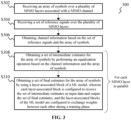
- FIG. 3 shows a flowchart of a method 300 for operating the ML-based receiver 200 in accordance with one example embodiment.
- the method 300 starts with a step S302, in which the processor 202 receives (e.g., via antennas which may be part of or coupled to the ML-based receiver 200) an array of symbols over a plurality of MIMO layers associated with a MIMO channel. Then, the method proceeds to a step S304, in which the processor 202 receives (e.g., via the same antennas) a set of reference signals (e.g., pilot signals) over the plurality of MIMO layers.
- a set of reference signals e.g., pilot signals
- the method 300 goes on to a step S306, in which the processor 202 obtains channel information based on the set of reference signals and the array of symbols.
- the channel information is indicative of a state of the MIMO channel and may comprise, for example, a CSI matrix.
- steps S308 and S310 are performed for each of the MIMO layers in parallel, in which the processor 202 obtains a set of intermediate estimates for the array of symbols first and then a set of final estimates for the array of symbols. More specifically, the set of intermediate estimates is obtained by performing an equalization operation based on the channel information and the array of symbols.
- the equalization operation may include, but not limited to, a Linear Minimum Mean Square Error (LMMSE)-based equalization or a Maximum Ratio Combining (MRC)-based equalization.
- LMMSE Linear Minimum Mean Square Error
- MRC Maximum Ratio Combining
- the set of final estimates is obtained for each MIMO layer by using a layer-associated block of a ML model (e.g., a CNN), which is configured to receive the set of intermediate estimates as input data and, in response, predict the set of final estimates.
- the layer-associated blocks of the ML model are further configured to operate in parallel and exchange their sets of weights between each other during the training phase of the ML model.
- Each of the layer-associated blocks of the ML model may be implemented as an individual block of the same NN (e.g., CNN, TNN or self-attention-based NN).
- each of the layer-associated blocks of the ML model may be further configured to receive, during the training and inference phases of the ML model, the input data (i.e., the sets of intermediate estimates) from the other layer-associated blocks of the ML model as a combined value that is independent of the number of the MIMO layers.
- the combined value may be expressed as an arithmetic mean of the input data of the other layer-associated blocks of the ML model.
- other mathematical operations may be used to combine the input data from the other layer-associated blocks of the ML model such that the combined value is independent of the number of the MIMO layers.
- Such other mathematical operations may include, but not limited to, addition, subtraction, multiplication, concatenation (e.g., the concatenation of the arithmetic mean and its variance), different moving average techniques.
- each of the layer-associated blocks of the ML model may be configured to iteratively refine the input data (i.e., the sets of intermediate estimates) until a user-defined stopping condition is met.
- this iterative refinement scheme may provide early exit for individual MIMO layer processing if the stopping condition is met, while continuing to process the other MIMO layers.
- the stopping condition may be related to the accuracy which a user desires to obtain for the set of final estimates. If the stopping condition is met for one of the layer-associated blocks of the ML model, that layer-associated block may stop the iterative processing and output the processing result obtained at the last iteration as the set of final estimates.
- each of the layer-associated blocks of the ML model may use a different set of intermediate weights at each iteration, i.e., the weights of different iterations may be not tied with each other (hereinafter referred to as the unrolled case).
- the opposite case hereafter referred to as the iterative case
- the choice between the iterative and unrolled cases may be made based on hardware and radio performance requirements applicable to the wireless communication network.
- FIG. 4 shows a block diagram of the processor 202 included in the receiver 200 in accordance with a first example embodiment.
- the processor 202 comprises a set 400 of pre-processing blocks, a set 402 of equalization blocks, and a set of layer-associated blocks 404-1, 404-2 and 404-3 of the ML model.
- Each pre-processing block of the set 400 of pre-processing blocks may be configured as the pre-processing block 102 of the ML-based receiver 100.
- each pre-processing block of the set 400 of pre-processing blocks may receive the array of symbols (in a frequency domain) and the set of reference signals over a certain MIMO layer and use them to obtain the channel information (e.g., the CSI matrix).
- the channel information e.g., the CSI matrix
- the set 402 of equalization blocks may be configured as the set 104 of equalization blocks, i.e., each equalization block of the set 402 of equalization blocks may perform the equalization operation for one of the MIMO layers.
- h i denotes i-th column of H.
- the layer-associated block 406-1 of the ML model is configured to refine the set of intermediate estimates (i.e., x ⁇ 0 ) obtained for the first MIMO layer (L 1 ), the layer-associated block 406-2 of the ML model is configured to refine the set of intermediate estimates obtained for the second MIMO layer (L 2 ), and the layer-associated block 406-3 of the ML model is configured to refine the set of intermediate estimates obtained for the third MIMO layer (L 3 ).
- Each of the layer-associated blocks 406-1, 406-2 and 406-3 of the ML model may output the set of final estimates as a set of LLRs. As also shown in FIG.
- the layer-associated blocks 406-1, 406-2 and 406-3 of the ML model are interrelated in the sense that they exchange their weights between each other during the training phase of the ML model.
- the processor 202 may comprise more than three layer-associated blocks of the ML model, with each of them being related to one of the MIMO layers to be processed.
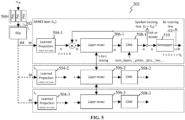
- FIG. 5 shows a block diagram of the processor 202 included in the receiver 200 in accordance with a second example embodiment.
- the processor 202 comprises a set 500 of pre-processing blocks and a set 502 of equalization blocks which may be implemented in the same or similar manner as the set 400 of pre-processing blocks and the set 402 of equalization blocks, respectively.
- the processor 202 further comprises learned projection blocks 504-1, 504-2 and 504-3, each of which may be configured as the block 106 of the ML-based receiver 100.
- each of the learned projection blocks 504-1, 504-2 and 504-3 may subject the set of intermediate estimates for one of 3 MIMO layers to scaling such that it has a proper (for further processing) size (i.e., F ⁇ S ⁇ N ) .
- a proper (for further processing) size i.e., F ⁇ S ⁇ N
- this can be done by using a linear 1x1 convolution.
- the learned projections (i.e., properly sized sets of intermediate estimates) obtained by the blocks 504-1, 504-2 and 504-3 are fed to layer mixers 506-1, 506-2 and 506-3, respectively.
- the layer mixer 506-1 is configured to mix the learned projection obtained for the first MIMO layer L 1 with the learned projections obtained for the rest (two) MIMO layers L 2 and L 3 such that the resulting learned projection is independent of the number of the MIMO layers.
- Each of the layer mixers 506-2 and 506-3 is configured to perform a similar mixing operation but for the second and third MIMO layers, respectively.
- FIG. 6 shows a block diagram of a layer mixer 600 that may be used in the processor 202 in accordance with one example embodiment.
- the layer mixer 600 may be used as any of the layer mixers 506-1, 506-2 and 506-3 in the architecture of the processor 202 according to the second example embodiment, which is shown in FIG. 5 .
- the layer mixer 600 uses linear pointwise convolutions for the first MIMO layer L 1 to select which information is to be sent to the other MIMO layers L 2 and L 3 and which information is, on the other hand, to be received from the other MIMO layers L 2 and L 3 .
- this implementation is independent of the number of the MIMO layers because of the use of the mean function for the incoming information (i.e., the incoming learned projections) from the other MIMO layers L 2 and L 3 . Similar operations may be performed for each of the MIMO layers L 2 and L 3 .
- the processor 202 further comprises CNNs 508-1, 508-2 and 508-3 which are configured to refine the output data of the layer mixers 506-1, 506-2 and 506-3, respectively. More specifically, each of the CNNs 508-1, 508-2 and 508-3 may iteratively refine the corresponding input data until a certain user-defined stopping condition is met. If it is met, then the individual MIMO layer processing may be stopped; otherwise, the next iteration may be initiated. At the end of each individual MIMO layer processing, each of the CNNs 508-1, 508-2 and 508-3 outputs the set of final estimates for one of the MIMO layers.
- the set of final estimates for the first MIMO layer L 1 may be then fed to a demapper 510 to be converted to a set of bit LLRs; the same may be done in respect of the sets of final estimates for the second and third MIMO layers L 2 and L 3 (in order not to overload FIG. 5 , no demapper is shown for each of the second and third MIMO layers L 2 and L 3 , but such demappers are intended to be included in the processor 202 according to the second example embodiment).
- the combination of the learned projection block 504-1, the layer mixer 506-1, the CNN 508-1 and the demapper 510 forms a layer-associated block for the first MIMO layer L 1 .
- Layer-associated blocks for the second and third MIMO layers L 2 and L 3 are formed by similar combinations of the blocks.
- the pre-processing blocks, the equalization blocks, the layer mixers, the CNNs, and the demappers are all trained blocks which are run separately for each MIMO layer, while sharing their trained weights across the MIMO layers.
- the MIMO layers are processed separately, independently of their total number. Given this, one may implement the above-mentioned early exit by altering the number of iterations per MIMO layer depending on the stopping condition.
- D is the set of indices corresponding to resource elements carrying data
- # D is the number of such indices
- B is the number of samples in a sample batch.
- the training is done for the maximum number of iterations N such that this number of iterations is always executed during training.
- the iterative processing of each MIMO layer may be stopped separately when the stopping condition is met.
- the ideal stopping condition for a certain MIMO layer may be given by a Low-Density Parity Check (LDPC) decoder: LDPC may be performed after each iteration and the iteration for the MIMO layer may be stopped after first successful decoding.
- LDPC Low-Density Parity Check
- this approach is not possible in practice as the LDPC is too expensive in terms of latency. Therefore, the stopping condition is approximated using a surrogate model given by a NN which predicts remaining iterations needed.
- the NN is applied for each MIMO layer.
- such a NN may be as follows:
- Training data may be generated by simulating data.
- Ground truths/labels for each sample may be obtained by running the ML-based receiver 200 for a full number of iterations and executing the LDPC after each iteration.
- the label is the first iteration index in which the LDPC succeeds.
- the LDPC needs to succeed jointly for all of the MIMO layers, but it may still be possible to stop processing some of the MIMO layers earlier and only at the decoding phase utilize the LLRs from all MIMO layers.
- the stopping condition may also be applied during the inference phase.
- the above-proposed NN evaluates the stopping condition for each MIMO layer after each iteration and outputs the estimated remaining iterations before decoding is successful.
- a trained variable depth model is used as follows:
- the set 702 of equalization blocks comprises LMMSE-based equalization blocks, the mixing operation of which is found to be enough to exclude any dependence on the number of MIMO layers from further MIMO layer processing. Therefore, the use of layer mixers does not necessarily bring benefits when using the LMMSE-based equalization blocks.
- the learned projections obtained by the blocks 704-1, 704-2 and 704-3 are directly fed to CNNs 706-1, 706-2 and 706-3, respectively.
- the CNNs 706-1, 706-2 and 706-3 may be implemented in the same or similar manner as the CNNs 508-1, 508-2 and 508-3, respectively.
- the CNNs 706-1, 706-2 and 706-3 are configured to receive the learned projections (i.e., the properly sized sets of intermediate estimates) and, in response, output the sets of final estimates for the MIMO layers L 1 , L 2 and L 3 .
- the set of final estimates outputted by the CNN 706-1 is converted to bit LLRs by a demapper 708-1
- the set of final estimates outputted by the CNN 706-2 is converted to bit LLRs by a demapper 708-2
- the set of final estimates outputted by the CNN 706-3 is converted to bit LLRs by a demapper 708-3.
- Each of the demappers 708-1, 708-2 and 708-3 may be implemented in the same or similar manner as the demapper 510.
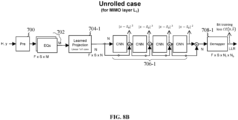
- FIGs. 8A and 8B schematically show two different approaches for training each layer-associated block of the ML model in accordance with one example embodiment. More specifically, FIG. 8A illustrates the first (iterative) approach in which each next training iteration uses intermediate weights obtained on a previous training iteration, and FIG. 8B illustrates the second (unrolled) approach in which each training iteration uses a different set of intermediate weights.
- the iterative and unrolled cases are shown in FIGs. 8A and 8B with respect to the processing of the first MIMO layer L 1 by using the layer-associated block formed by the combination of the learned projection block 704-1, the CNN 706-1 and the demapper 708-1.
- the iterative and unrolled cases with respect to the processing of the rest (second and third) MIMO layers L 2 and L 3 may be implemented in the same manner but with the aid of the other layer-associated blocks (see FIG. 7 ).
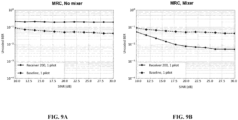
- FIGs. 9A and 9B show an uncoded Bit-Error Rate (BER) versus a Signal to Interference and Noise Ratio (SINR) in dB, as obtained by using the MRC-based equalization in two cases: without layer mixers ( FIG. 9A ) and with layer mixers ( FIG. 9B ).
- the dashed curves with rhombic points correspond to a conventional non-ML-based receiver (hereinafter referred to as the baseline) and the solid curves with circular points correspond to the ML-based receiver 200 using the MRC-based equalization with and without the layer mixers (like the layer mixer 600). All the curves have been obtained by using a single pilot signal.
- the MIMO setup is 16x4 and the used modulation scheme is 256QAM. Since the MRC-based equalization utilizes only information from the current MIMO layer (i.e., no mixing operation is provided by using the MRC-based equalization), the layer mixers are needed to improve the BER.
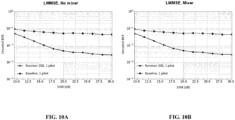
- FIGs. 10A and 10B show the uncoded BER versus the SINR in dB, as obtained by using the LMMSE-based equalization in two cases: without layer mixers ( FIG. 10A ) and with layer mixers ( FIG. 10B ).
- the dashed curves with rhombic points correspond to the baseline
- the solid curves with circular points correspond to the ML-based receiver 200 using the LMMSE-based equalization with and without the layer mixers (like the layer mixer 600).
- the LMMSE-based equalization already involves some mixing of all MIMO layers when computing the inverse. Therefore, no layer mixers can be used in this case. This is demonstrated by the curves in FIGs.
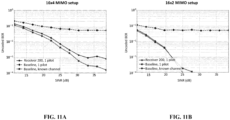
- FIGs. 11A and 11B show the uncoded BER versus the SINR in dB for two different MIMO setups, namely: 16x4 MIMO setup ( FIG. 11A ) and 16x2 MIMO setup ( FIG. 11B ).
- 16x4 MIMO setup FIG. 11A
- 16x2 MIMO setup FIG. 11B
- 5GMax generated data and 256QAM have been used.
- the dashed curves with rhombic points correspond to the baseline using a single pilot signal
- the solid curves with square points correspond to the baseline using a known MIMO channel (i.e., known channel characteristics)
- the solid curves with circular points correspond to the receiver 200 using a single pilot signal and the layer mixers (like the layer mixer 600).
- the ML-based receiver 200 (i.e., the ML model used therein) has initially been trained with respect to the 16x4 MIMO setup, and then it has been applied (without training) for the setup having lesser MIMO layers (i.e., the 16x2 MIMO setup). As can be seen, the ML-based receiver 200 works very well for both MIMO setups, thereby confirming its independence of the number of MIMO layers.
- each step or operation of the method 300 can be implemented by various means, such as hardware, firmware, and/or software.
- one or more of the steps or operations described above can be embodied by processor executable instructions, data structures, program modules, and other suitable data representations.
- the processor-executable instructions which embody the steps or operations described above can be stored on a corresponding data carrier and executed by the processor 202.
- This data carrier can be implemented as any computer-readable storage medium configured to be readable by said at least one processor to execute the processor executable instructions.
- Such computer-readable storage media can include both volatile and nonvolatile media, removable and non-removable media.
- the computer-readable media comprise media implemented in any method or technology suitable for storing information.
- the practical examples of the computer-readable media include, but are not limited to information-delivery media, RAM, ROM, EEPROM, flash memory or other memory technology, CD-ROM, digital versatile discs (DVD), holographic media or other optical disc storage, magnetic tape, magnetic cassettes, magnetic disk storage, and other magnetic storage devices.
Landscapes
- Engineering & Computer Science (AREA)
- Signal Processing (AREA)
- Computer Networks & Wireless Communication (AREA)
- Power Engineering (AREA)
- Software Systems (AREA)
- Theoretical Computer Science (AREA)
- Evolutionary Computation (AREA)
- Artificial Intelligence (AREA)
- Physics & Mathematics (AREA)
- Computing Systems (AREA)
- General Engineering & Computer Science (AREA)
- General Physics & Mathematics (AREA)
- Mathematical Physics (AREA)
- Medical Informatics (AREA)
- Data Mining & Analysis (AREA)
- Computer Vision & Pattern Recognition (AREA)
- Radio Transmission System (AREA)
Priority Applications (3)
| Application Number | Priority Date | Filing Date | Title |
|---|---|---|---|
| EP23206715.7A EP4550729A1 (de) | 2023-10-30 | 2023-10-30 | Auf maschinenlernen basierender empfänger in einem drahtloskommunikationsnetzwerk |
| US18/925,724 US20250141502A1 (en) | 2023-10-30 | 2024-10-24 | Machine learning-based receiver in wireless communication network |
| CN202411525714.4A CN119922050A (zh) | 2023-10-30 | 2024-10-30 | 无线通信网络中基于机器学习的接收机 |
Applications Claiming Priority (1)
| Application Number | Priority Date | Filing Date | Title |
|---|---|---|---|
| EP23206715.7A EP4550729A1 (de) | 2023-10-30 | 2023-10-30 | Auf maschinenlernen basierender empfänger in einem drahtloskommunikationsnetzwerk |
Publications (1)
| Publication Number | Publication Date |
|---|---|
| EP4550729A1 true EP4550729A1 (de) | 2025-05-07 |
Family
ID=88600621
Family Applications (1)
| Application Number | Title | Priority Date | Filing Date |
|---|---|---|---|
| EP23206715.7A Pending EP4550729A1 (de) | 2023-10-30 | 2023-10-30 | Auf maschinenlernen basierender empfänger in einem drahtloskommunikationsnetzwerk |
Country Status (3)
| Country | Link |
|---|---|
| US (1) | US20250141502A1 (de) |
| EP (1) | EP4550729A1 (de) |
| CN (1) | CN119922050A (de) |
Citations (1)
| Publication number | Priority date | Publication date | Assignee | Title |
|---|---|---|---|---|
| WO2023274556A1 (en) * | 2021-07-02 | 2023-01-05 | Nokia Solutions And Networks Oy | A radio receiver with an iterative neural network, and related methods and computer programs |
Family Cites Families (3)
| Publication number | Priority date | Publication date | Assignee | Title |
|---|---|---|---|---|
| CN101692665B (zh) * | 2009-09-28 | 2012-07-18 | 中兴通讯股份有限公司 | 正交频分复用-多输入多输出系统的解调方法及解调器 |
| US9042428B2 (en) * | 2012-05-04 | 2015-05-26 | Telefonaktiebolaget L M Ericsson (Publ) | Efficient frequency domain (FD) MMSE equalization weight updates in a multi-stage parallel interference cancellation receiver |
| FI20205261A1 (en) * | 2020-03-12 | 2021-09-13 | Nokia Technologies Oy | Radio receiver |
-
2023
- 2023-10-30 EP EP23206715.7A patent/EP4550729A1/de active Pending
-
2024
- 2024-10-24 US US18/925,724 patent/US20250141502A1/en active Pending
- 2024-10-30 CN CN202411525714.4A patent/CN119922050A/zh active Pending
Patent Citations (1)
| Publication number | Priority date | Publication date | Assignee | Title |
|---|---|---|---|---|
| WO2023274556A1 (en) * | 2021-07-02 | 2023-01-05 | Nokia Solutions And Networks Oy | A radio receiver with an iterative neural network, and related methods and computer programs |
Non-Patent Citations (4)
| Title |
|---|
| D. KORPI ET AL.: "DeepRx MIMO: Convolutional MIMO Detection with Learned Multiplicative Transformations", IEEE INTERNATIONAL CONFERENCE ON COMMUNICATIONS (ICC, 14 June 2021 (2021-06-14) |
| HONKALA MIKKO ET AL: "DeepRx: Fully Convolutional Deep Learning Receiver", IEEE TRANSACTIONS ON WIRELESS COMMUNICATIONS, IEEE SERVICE CENTER, PISCATAWAY, NJ, US, vol. 20, no. 6, 2 February 2021 (2021-02-02), pages 3925 - 3940, XP011859718, ISSN: 1536-1276, [retrieved on 20210609], DOI: 10.1109/TWC.2021.3054520 * |
| KORPI DANI ET AL: "DeepRx MIMO: Convolutional MIMO Detection with Learned Multiplicative Transformations", ICC 2021 - IEEE INTERNATIONAL CONFERENCE ON COMMUNICATIONS, IEEE, 14 June 2021 (2021-06-14), pages 1 - 7, XP033953740, DOI: 10.1109/ICC42927.2021.9500518 * |
| MIKKO HONKALA ET AL.: "DeepRx: Fully Convolutional Deep Learning Receiver", IEEE TRANSACTIONS ON WIRELESS COMMUNICATIONS, vol. 20, no. 6, June 2021 (2021-06-01), pages 3925 - 3940, XP011859718, DOI: 10.1109/TWC.2021.3054520 |
Also Published As
| Publication number | Publication date |
|---|---|
| US20250141502A1 (en) | 2025-05-01 |
| CN119922050A (zh) | 2025-05-02 |
Similar Documents
| Publication | Publication Date | Title |
|---|---|---|
| US20230342593A1 (en) | Neural network training method and related apparatus | |
| Wu et al. | Deep learning-driven wireless communication for edge-cloud computing: opportunities and challenges | |
| US11876531B2 (en) | Smart decoder | |
| US10171203B2 (en) | Apparatus and method for receiving signal in communication system supporting low density parity check code | |
| US10931400B2 (en) | Decoding method and apparatus in wireless communication system | |
| US11108497B2 (en) | Method and system for hierarchical decoding of data packets in cellular communication system | |
| EP3879709B1 (de) | Kanalkodierverfahren und -vorrichtung basierend auf einem neuronalen kodiernetz | |
| US11537436B2 (en) | Method of configuring a memory block allocation of a machine learning network | |
| US10277429B2 (en) | Codebook including phase rotation between layers | |
| EP4462740A1 (de) | Durch maschinenlernen unterstützte kanalschätzung in einem drahtloskommunikationsnetzwerk | |
| EP4362374B1 (de) | Frequenzoptimierung zur meldung von kanalstatusinformationen | |
| EP4550729A1 (de) | Auf maschinenlernen basierender empfänger in einem drahtloskommunikationsnetzwerk | |
| US20250261166A1 (en) | Method and apparatus for paging procedure in a wireless communication system | |
| CN111490798A (zh) | 译码的方法和译码装置 | |
| US20260113093A1 (en) | Machine learning-based receiver in wireless communication network | |
| US11689218B2 (en) | Decoding method and apparatus based on polar code in communication system | |
| CN120856506A (zh) | 无线通信系统中的节点及其执行的方法 | |
| CN119450501A (zh) | 通信方法及对应的设备 | |
| WO2025048685A1 (en) | Joint training of hybrid quantum-classical autoencoder for csi compression | |
| EP4521662A1 (de) | Verfahren und vorrichtung zur kanalcodierung/-decodierung | |
| US12471093B1 (en) | Neural network-assisted generation of interleaver in wireless communication system | |
| US20250350504A1 (en) | User equipment for removing interference signal and operating method thereof | |
| US20250015920A1 (en) | Transmitter, receiver, and method for wireless communications | |
| WO2026073391A1 (en) | Channel state information compression using neural networks | |
| WO2025134100A1 (en) | Neural network decoder adaptation in a wireless communications system involving data augmentation |
Legal Events
| Date | Code | Title | Description |
|---|---|---|---|
| PUAI | Public reference made under article 153(3) epc to a published international application that has entered the european phase |
Free format text: ORIGINAL CODE: 0009012 |
|
| STAA | Information on the status of an ep patent application or granted ep patent |
Free format text: STATUS: THE APPLICATION HAS BEEN PUBLISHED |
|
| AK | Designated contracting states |
Kind code of ref document: A1 Designated state(s): AL AT BE BG CH CY CZ DE DK EE ES FI FR GB GR HR HU IE IS IT LI LT LU LV MC ME MK MT NL NO PL PT RO RS SE SI SK SM TR |
|
| STAA | Information on the status of an ep patent application or granted ep patent |
Free format text: STATUS: REQUEST FOR EXAMINATION WAS MADE |
|
| 17P | Request for examination filed |
Effective date: 20251107 |