EP4550877A1 - Procédé et appareil de transmission de données, support de stockage et produit de programme - Google Patents
Procédé et appareil de transmission de données, support de stockage et produit de programme Download PDFInfo
- Publication number
- EP4550877A1 EP4550877A1 EP23845073.8A EP23845073A EP4550877A1 EP 4550877 A1 EP4550877 A1 EP 4550877A1 EP 23845073 A EP23845073 A EP 23845073A EP 4550877 A1 EP4550877 A1 EP 4550877A1
- Authority
- EP
- European Patent Office
- Prior art keywords
- data transmission
- terminal device
- service
- slice
- network
- Prior art date
- Legal status (The legal status is an assumption and is not a legal conclusion. Google has not performed a legal analysis and makes no representation as to the accuracy of the status listed.)
- Pending
Links
Images



Classifications
-
- H—ELECTRICITY
- H04—ELECTRIC COMMUNICATION TECHNIQUE
- H04W—WIRELESS COMMUNICATION NETWORKS
- H04W28/00—Network traffic management; Network resource management
- H04W28/16—Central resource management; Negotiation of resources or communication parameters, e.g. negotiating bandwidth or QoS [Quality of Service]
- H04W28/18—Negotiating wireless communication parameters
- H04W28/20—Negotiating bandwidth
-
- H—ELECTRICITY
- H04—ELECTRIC COMMUNICATION TECHNIQUE
- H04W—WIRELESS COMMUNICATION NETWORKS
- H04W28/00—Network traffic management; Network resource management
- H04W28/02—Traffic management, e.g. flow control or congestion control
-
- H—ELECTRICITY
- H04—ELECTRIC COMMUNICATION TECHNIQUE
- H04W—WIRELESS COMMUNICATION NETWORKS
- H04W28/00—Network traffic management; Network resource management
- H04W28/16—Central resource management; Negotiation of resources or communication parameters, e.g. negotiating bandwidth or QoS [Quality of Service]
- H04W28/26—Resource reservation
-
- H—ELECTRICITY
- H04—ELECTRIC COMMUNICATION TECHNIQUE
- H04W—WIRELESS COMMUNICATION NETWORKS
- H04W74/00—Wireless channel access
- H04W74/08—Non-scheduled access, e.g. ALOHA
- H04W74/0866—Non-scheduled access, e.g. ALOHA using a dedicated channel for access
-
- H—ELECTRICITY
- H04—ELECTRIC COMMUNICATION TECHNIQUE
- H04W—WIRELESS COMMUNICATION NETWORKS
- H04W74/00—Wireless channel access
- H04W74/08—Non-scheduled access, e.g. ALOHA
- H04W74/0866—Non-scheduled access, e.g. ALOHA using a dedicated channel for access
- H04W74/0875—Non-scheduled access, e.g. ALOHA using a dedicated channel for access with assigned priorities based access
-
- H—ELECTRICITY
- H04—ELECTRIC COMMUNICATION TECHNIQUE
- H04W—WIRELESS COMMUNICATION NETWORKS
- H04W48/00—Access restriction; Network selection; Access point selection
- H04W48/18—Selecting a network or a communication service
-
- H—ELECTRICITY
- H04—ELECTRIC COMMUNICATION TECHNIQUE
- H04W—WIRELESS COMMUNICATION NETWORKS
- H04W84/00—Network topologies
- H04W84/02—Hierarchically pre-organised networks, e.g. paging networks, cellular networks, WLAN [Wireless Local Area Network] or WLL [Wireless Local Loop]
- H04W84/10—Small scale networks; Flat hierarchical networks
- H04W84/12—WLAN [Wireless Local Area Networks]
Definitions
- Embodiments of the present disclosure relate to, but not limited to, the technical field of wireless communication, and more particularly, to a data transmission method and apparatus, a storage medium, and a program product.
- EasyMesh is an emerging technology for Wireless Local Area Network (WLAN).
- WLAN Wireless Local Area Network
- An EasyMesh network can be used to expand a WLAN network.
- one controller centrally manages other sub-nodes.
- the controller can only ensure load balancing among the sub-nodes, and cannot or is rarely able to provide support for deterministic QoS services.
- Embodiments of the present disclosure provide a data transmission method and apparatus, a storage medium, and a program product.
- an embodiment provides a data transmission method, including: acquiring service information of a terminal device; determining a slice category of a network slice corresponding to the terminal device according to the service information; determining a channel access policy according to the slice category; and performing data transmission with the terminal device according to the channel access policy.
- an embodiment provides a data transmission apparatus, including: a memory, a processor, and a computer program stored in the memory and executable by the processor, where the computer program, when executed by the processor, causes the processor to implement the data transmission method described above.
- an embodiment provides a computer-readable storage medium, storing computer-executable instructions which, when executed by a processor, cause the processor to implement the data transmission method described above.
- an embodiment provides a computer program product, including a computer program or computer instructions stored in a computer-readable storage medium, where the computer program or computer instructions, when read from the computer-readable storage medium and executed by a processor of a computer device, causes the computer device to implement the data transmission method described above.
- the term “two or more” means at least two, the term such as “greater than”, “less than”, “exceed” or variants thereof prior to a number or series of numbers is understood to not include the number adjacent to the term.
- the term “at least” prior to a number or series of numbers is understood to include the number adjacent to the term “at least”, and all subsequent numbers or integers that could logically be included, as clear from context.
- the present disclosure provides a data transmission method and apparatus, a storage medium, and a program product.
- service information of a terminal device is acquired.
- a slice category of a network slice corresponding to the terminal device is determined according to the service information.
- a channel access policy is determined according to the slice category.
- data transmission is performed with the terminal device according to the channel access policy.
- different network slices are determined according to different service information, corresponding channel access policies are determined for terminal devices of the different network slices, and data transmission is performed with the terminal devices according to the corresponding channel access policies.
- the embodiments of the present disclosure can provide support for deterministic services in WLANs.
- access terminal devices are classified using a WLAN virtual slicing technology according to services to form a virtual slice network, and the virtual slice network provides a deterministic service to a terminal device or WLAN router connected thereto.
- this scheme relies on the currently widely used Enhanced Distributed Channel Access (EDCA) technology, but cannot centrally manage all terminal devices in an EasyMesh application scenario and may even lead to the degradation of overall network performance.
- EDCA Enhanced Distributed Channel Access
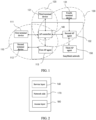
- FIG. 1 is a schematic diagram of a network system configured for executing a data transmission method according to an embodiment of the present disclosure.
- the network system includes an AP controller 140, a plurality of AP agents, and a plurality of terminal devices (or stations (STAs)).
- the AP agents include a first AP agent 113, a second AP agent 132, and a third AP agent 150.
- the terminal devices include a first terminal device 111, a second terminal device 112, a third terminal device 121, and a fourth terminal device 131.
- the first AP agent 113 and the second AP agent 132 are both connected to the AP controller 140.
- the third AP agent 150 is connected to the second AP agent 132.
- the first terminal device 111 and the third terminal device 121 are both connected to the AP controller 140.
- the second terminal device 112 is connected to the first AP agent 113.
- the fourth terminal device 131 is connected to the second AP agent 132.
- the EasyMesh network is divided into three network slices, namely, a first network slice 110 including the AP controller 140, the first AP agent 113, the first terminal device 111 and the second terminal device 112, a second network slice 120 including the AP controller 140 and the third terminal device 121, and a third network slice 130 including the AP controller 140, the second AP agent 132, and the fourth terminal device 131.
- the first terminal device 111, the second terminal device 112, the third terminal device 121, and the fourth terminal device 131 may correspond to different service types, such that different network slices can provide different deterministic services.
- the service type corresponding to the first terminal device 111 and the service type corresponding to the second terminal device 112 are both delay-sensitive services
- the service type corresponding to the third terminal device 121 is a packet loss rate type deterministic service
- the service type corresponding to the fourth terminal device 131 is a bandwidth type deterministic service.
- the first network slice 110 may provide a delay type deterministic service
- the second network slice 120 provides a packet loss rate type deterministic service
- the third network slice 130 provides a bandwidth type deterministic service, which is not particularly limited herein.
- the network system can be applied not only to an EasyMesh network, but also to an Ad hoc network, a BSS network, an OBSS network, or the like, which is not particularly limited herein.
- the Ad hoc network is a multi-hop, centerless self-organizing wireless network, also known as a Multi-hop Network, Infrastructureless Network, or Self-organizing Network.
- each terminal device can move and dynamically maintain communication with other terminal devices in an arbitrary manner.
- FIG. 2 is a schematic diagram of a hierarchical structure of a network slice according to the present disclosure.
- the network slice includes a service layer 160, a network layer 170, and an access layer 180.
- the service layer 160 may be configured for analyzing service information corresponding to a current terminal device, such as service type, service volume, and service duration. If the terminal device is not directly connected to the AP controller, the service information needs to be transmitted to the service layer 160.
- the service layer 160 analyzes and processes the service information to obtain service priority information, determines a slice category of the network slice according to the service priority information, and then transmits the slice category to the network layer 170.
- the network layer 170 determines a slice identifier of the network slice according to the slice category, and labels data information corresponding to the terminal device with the slice identifier.
- the data information may include all data information such as uplink transmission data and downlink transmission data, etc. Then, the network layer 170 addresses and forwards the data information according to the slice identifier, i.e., first addresses and forwards the data information to an AP agent connected to the terminal device, and then addresses and forwards the data information to the terminal device.
- the access layer 180 may be configured for allocating and reserving a network bandwidth and resource, where the resource may include a channel access duration, buffer space, etc.
- the access layer 180 may also periodically broadcast a time slot table and reserve a network bandwidth according to the time slot table, to provide compatibility with a WLAN while ensuring normal operation of the network slicing mechanism.
- the access layer 180 may also control the channel access priority and so on, which is not particularly limited herein.
- the hierarchical structure may be a hierarchical structure of a first network slice, a hierarchical structure of a second network slice, or a hierarchical structure of a third network slice, which is not particularly limited herein.
- a virtual network slicing technology may be used to effectively control all terminal devices corresponding to the network slice through the service layer 160, the network layer 170, and the access layer 180, to ensure that each terminal device has a balanced opportunity to transmit data, thereby providing deterministic services for different terminal devices.
- FIG. 3 is a schematic structural diagram of an AP controller 140 according to the present disclosure.
- the AP controller 140 includes a service information collection module 141, a service information analysis module 143, a slice identifier generation module 145, a slice broadcast module 142, a slice service processing module 144, and a resource processing module 146.
- the service information collection module 141 is configured for collecting service information of all terminal devices accessing an EasyMesh network.
- the service information analysis module 143 is configured for comprehensively analyzing and processing the service information of each terminal device, and determining a slice category of a network slice corresponding to a terminal device newly accessing the EasyMesh network.
- the slice identifier generation module 145 is configured for determining a slice identifier of the network slice according to the slice category, for use in an access layer.
- the slice broadcasting module 142 is configured for broadcasting network slice information managed by the AP controller 140 to AP agents 190 in network slices and terminal devices connected to the AP agents 190, such that the AP agents 190 and the terminal devices can adjust their corresponding channel access policies according to the network slice information.
- the network slice information includes information such as slice identifiers, time slot tables, and channel access policies corresponding to the network slices.
- the slice service processing module 144 is configured for checking the slice identifier, and mapping the slice identifier to different service priority information (e.g., QoS service priority). Further, the slice service processing module 144 is configured for associating the service priority information with a channel access policy and resource reservation.
- service priority information e.g., QoS service priority
- the resource processing module 146 is configured for allocating and reserving a network bandwidth and resource.
- FIG. 4 is a schematic structural diagram of an AP agent 190 according to the present disclosure.
- the AP agent 190 includes a service information collection module 141, a service information forwarding module 147, a slice information receiving module 148, a slice broadcast module 142, a slice service processing module 144, and a resource processing module 146.
- the service information forwarding module 147 is configured for forwarding the service information of the terminal devices connected to the AP agent 190 to an AP controller 140.
- the slice information receiving module 148 is configured for receiving network slice information (e.g., slice identifier, time slot table, and channel access policy) from other AP agents connected to the AP agent 190 or from an AP controller 140 connected to the AP agent 190, and broadcasting the network slice information to terminal devices connected to the AP agent 190.
- network slice information e.g., slice identifier, time slot table, and channel access policy
- the structures and functions of the service information collection module 141, the slice broadcast module 142, the slice service processing module 144, and the resource processing module 146 are the same as those of the service information collection module 141, the slice broadcast module 142, the slice service processing module 144, and the resource processing module 146 in the embodiment shown in FIG. 3 , so the details will not be repeated herein.
- the AP agent may be a first AP agent, a second AP agent, or a third AP agent, which is not particularly limited herein.
- the virtual slicing mechanism of the WLAN can be realized by the network system, the AP controller, the AP agent, the network slice, and other related structures in the above embodiments, and the AP controller can centrally control and update all network slices, thereby providing deterministic services for the WLAN.
- the network system, network slice, AP controller, AP agent, and application scenarios described in the embodiments of the present disclosure are for the purpose of illustrating the technical schemes of the embodiments of the present disclosure more clearly, and do not constitute a limitation to the technical schemes provided in the embodiments of the present disclosure.
- Those having ordinary skills in the art may know that with the evolution of the network system and the emergence of new application scenarios, the technical schemes provided in the embodiments of the present disclosure are also applicable to similar technical problems.
- the network system shown in FIG. 1 the network slice shown in FIG. 2 , the AP controller shown in FIG. 3 , and the AP agent shown in FIG. 4 do not constitute a limitation to the embodiments of the present disclosure, and more or fewer components than those shown in the figure may be included, or some components may be combined, or a different component arrangement may be used.
- FIG. 5 is a flowchart of a data transmission method according to an embodiment of the present disclosure.
- the data transmission method may be applied to an AP controller, e.g., the AP controller in the network system shown in FIG. 1 or the AP controller shown in FIG. 3 .
- the data transmission method includes, but not limited to, the following steps S110, S120, S130, and S140.
- service information of a terminal device is acquired.
- the service information of the terminal device may be acquired by receiving a probe request frame or a data packet sent by the terminal device, which is not particularly limited herein.
- the terminal device may send service information to the AP controller.
- the network may be a WLAN or an extended WLAN (i.e., EasyMesh network), which is not particularly limited herein.
- the service information may be voice service information, video service information, game service information, download service information, or the like, which is not particularly limited herein.
- the service information includes information such as a service type and a service volume, which is not particularly limited herein.
- a slice category of a network slice corresponding to the terminal device is determined according to the service information.
- the slice category of the network slice may include a network slice providing a low-delay service, a network slice providing a high-throughput service, a network slice providing a stable bandwidth, etc.
- the network slice providing a low-delay service refers to a network slice having a delay value less than or equal to a preset delay threshold.
- the network slice providing a high-throughput service refers to a network slice in which a service throughput of service information of a terminal device is greater than a preset throughput.
- the network slice providing a low-delay service may perform data transmission for terminal devices according to priorities of service information of the terminal devices, and therefore can ensure the delay of data transmission in the network slice.
- Channel access duration of the network slice providing a high-throughput service may be longer than channel access duration of network slices of other slice categories.
- the network slice providing a high-throughput service may adjust a transmission opportunity limit (TXOPlimit) value.
- TXOPlimit transmission opportunity limit
- the network slice providing a stable bandwidth may transmit data using an exclusive channel within a time slice, or may rely on a network band switching technology to guide the terminal device to use a reserved channel in the network slice to transmit data, which is not particularly limited herein.
- this embodiment can lay a foundation for solving the prior-art problem of excessively long delay or low throughput of a low-priority service due to the preferential channel occupation by a high-priority service in a WLAN, and can provide deterministic network QoS for different terminal devices.
- the low-priority service refers to a service having a priority lower than or equal to a preset priority.
- the high-priority service refers to a service having a priority higher than the preset priority.
- the preset priority, the preset delay threshold, and the preset throughput may be set according to actual requirements, and are not particularly limited herein.
- a channel access policy is determined according to the slice category.
- the channel access policy may include a Hybrid Coordination Function Controlled Channel Access (HCCA) mechanism, an EDCA mechanism, etc., which is not particularly limited herein.
- HCCA Hybrid Coordination Function Controlled Channel Access
- EDCA EDCA mechanism
- the HCCA mechanism is based on a polling mechanism, uses a Hybrid Coordinator (HC) to centrally manage channel access modes of wireless media accesses, is a continuation and extension of a Point Coordination Function (PCF) mechanism, and provides parameterized QoS guarantee.
- Parameterized QoS means that corresponding QoS parameters are formulated according to the type and characteristics of service information to meet QoS requirements (such as data rate, delay, etc.) of special services.
- the HCCA mechanism is divided into a contention period (CP) and a contention-free period (CFP).
- the EDCA mechanism In the CP phase, the EDCA mechanism is used to contend for the channel, and in the subsequent CFP phase, an HC sends a data frame (such as QoS(+)CF-Poll frame) to each terminal device to query whether there is data to be transmitted.
- a data frame such as QoS(+)CF-Poll frame
- the HCCA can poll each terminal device in the CP phase and can sort data packets based on needs of communication service flows of the terminal devices, and each polling gives the terminal device a data transmission opportunity (TXOP).
- the TXOP indicates a start time at which and a maximum duration during which the terminal device can send data.
- the EDCA mechanism is an extension of a Distributed Coordination Function (DCF) in IEEE 802.11 standards.
- the EDCA mechanism also implements channel access in a contention-based manner.
- the EDCA mechanism provides differentiated services and can effectively guarantee QoS of a high-priority service.
- the high-priority service refers to a service having a priority higher than a preset priority value.
- the preset priority value may be set according to actual situations.
- the EDCA mechanism is distributed and easy to deploy, and therefore is an important channel access mechanism in WLANs. In the EDCA mechanism, access to at least one communication channel in the WLAN may be contended for by using a contention parameter, such that the terminal device transmits locally stored data on the accessed communication channel.
- ACs access categories
- the four access categories are voice (or "AC_VO”), video (or “AC_VI”), best effort (or “AC_BE”), and background (or “AC_BK”).
- voice or "AC_VO”
- video or “AC_VI”
- best effort or "AC_BE”
- background or “AC_BK”
- voice or "AC_VO”
- AC_VI video
- AC_VI best effort
- background or “AC_BK”
- Each AC has a service queue or buffer for storing a corresponding data frame to be transmitted over the network, i.e., a data frame (i.e., MSDU) from an upper layer of a protocol stack is mapped to one of the service queues or buffers of the four ACs and is thus input into the mapped AC buffer.
- a data frame i.e., MSDU
- Each AC has a respective set of queue contention parameters and is associated with a priority value.
- Table 2 is a table of default values of the EDCA parameters, referring to Table 2, AIFSN represents an AIFS number, and a larger AIFSN value indicates a longer idle waiting time of the terminal device; DSSS and HR/DSSS PHY represent the direct sequence physical layer; and ERP-OFDM of 802.11a/g represents a physical layer standard supported by 802.11a/g.
- AIFSs are used for different AC data frames, and the inter-frame space defined in the EDCA mechanism can change with different service types.
- An AIFS value of a low-priority service is greater than that of a high-priority service, i.e., an air interface waiting time of the low-priority service is longer than that of the high-priority service.
- the value of the contention window (CW) for entering a backoff process after waiting for the channel to be idle varies with different ACs. For example, after waiting for one AIFS, each backoff process sets a timer to any value in a range of [1, CW+1], which is different from [0, CW] in the DCF.
- the transmission opportunity limit is a maximum duration value of the TXOP.
- TXOPlimit means the amount of data that the terminal device can send after successfully contending for the channel. A larger TXOPlimit value indicates a longer sending duration.
- an AP controller can acquire service information of a terminal device, then determine a slice category of a network slice corresponding to the terminal device according to the service information, determine a channel access policy according to the slice category, and finally perform data transmission with the terminal device according to the channel access policy.
- different network slices are determined according to different service information
- corresponding channel access policies are determined for terminal devices of the different network slices
- data transmission is performed with the terminal devices according to the corresponding channel access policies.
- the embodiment of the present disclosure can provide support for deterministic services in WLANs.
- the service information when the service information changes, the service information may be re-acquired through a data frame or other means, the slice category of the network slice corresponding to the terminal device is re-determined according to the re-acquired service information, then a channel access policy is determined according to the slice category, and finally data transmission is performed with the terminal device according to the channel access policy. Therefore, in the embodiment of the present disclosure, the service information of the terminal device can be detected in real time, and the channel access policy can be adjusted in a timely manner according to the service information, thereby ensuring deterministic network communication.
- S120 is further described.
- S120 may include, but not limited to, the following steps S210 and S220.
- the service information is analyzed to obtain service priority information.
- the service priority information may include an order of priorities of service information of all terminal devices in the network slices, i.e., the service priority information may be information about a descending order of priorities or information about an ascending order of priorities, which is not particularly limited herein.
- the slice category of the network slice corresponding to the terminal device is determined according to the service priority information.
- the AP controller can analyze the service information to obtain the service priority information, and then determine the slice category of the network slice corresponding to the terminal device according to the service priority information, such that in subsequent steps, the channel access policy is determined according to the slice category, and data transmission is performed with the terminal device according to the channel access policy. Therefore, in the embodiment of the present disclosure, the channel access policy can be determined according to the priority of service information, and data transmission can be performed with the terminal device according to the channel access policy in a targeted manner, thereby avoiding an excessively long delay of a low-priority service due to the preferential channel occupation by a high-priority service in a WLAN.
- the low-priority service refers to a service having a priority lower than or equal to a preset priority.
- the high-priority service refers to a service having a priority higher than the preset priority.
- the preset priority may be set according to actual requirements, and is not particularly limited herein.
- S130 is further described.
- S130 may include, but not limited to, the following steps S310 and S320.
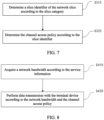
- a slice identifier of the network slice is determined according to the slice category.
- different slice categories correspond to different slice identifiers, and the slice identifier of each slice category is unique, which is not particularly limited herein.
- the channel access policy is determined according to the slice identifier.
- the AP controller can determine the slice identifier of the network slice according to the slice category, and then determine the channel access policy according to the slice identifier. Therefore, in the embodiment of the present disclosure, the slice identifier can be associated with the channel access policy, to facilitate subsequent data transmission with terminal devices in each network slice.
- S140 is further described.
- S140 may include, but not limited to, the following steps S410 and S420.
- a network bandwidth is acquired according to the service information.
- the network bandwidth includes a fixed bandwidth, a guaranteed bandwidth, and a maximum bandwidth.
- the fixed bandwidth is the traffic volume of signaling exchange, such as traffic generated by an operation such as setting, opponent selection, and equipment purchase in a game service, or browsing traffic in a video service.
- the guaranteed bandwidth is generally set to about twice the average service traffic to ensure normal and smooth data transmission.
- the maximum bandwidth is generally set to peak service traffic to reduce the packet loss rate, which is not particularly limited herein.
- the service information when the service information is service information requiring high delay, such as voice service information, video service information, game service information, etc., more network bandwidth may be acquired or it may be ensured that the network bandwidth is preferentially allocated to the service information to ensure transmission delay of data corresponding to the service information.
- the service information it is feasible to analyze the service information to obtain the service priority information, allocate a network bandwidth according to the service priority information, and use the network bandwidth to perform data transmission with the terminal device, which is not particularly limited herein.
- data transmission is performed with the terminal device according to the network bandwidth and the channel access policy.
- the AP controller can acquire the network bandwidth according to the service information, and then perform data transmission with the terminal device according to the network bandwidth and the channel access policy, which is not particularly limited herein.
- S140 is further described.
- S140 may include, but not limited to, the following steps S510, S520, and S530.
- a channel time slot table is determined according to the service information, where the channel time slot table includes a channel usage time of a data transmission channel corresponding to the network slice.
- the channel usage time includes a usage start time of the channel and a usage end time of the channel.
- data communication between the AP controller and terminal devices in the network system is constrained by the channel time slot table to ensure orderly operation of the network slice.
- the AP controller may periodically broadcast the channel time slot table to all the terminal devices, such that all the terminal devices transmit data under the constraints of the channel time slot table. This is not particularly limited herein.
- the network bandwidth is reserved according to the channel usage time.
- the AP controller may use the reserved network bandwidth to perform data transmission with the terminal device, thereby ensuring deterministic network communication.
- data transmission is performed with the terminal device according to the reserved network bandwidth and the channel access policy.
- the AP controller can determine a channel time slot table according to the service information, where the channel time slot table includes a channel usage time of a data transmission channel corresponding to the network slice; then reserve the network bandwidth according to the channel usage time; and finally perform data transmission with the terminal device according to the reserved network bandwidth and the channel access policy. Therefore, in the embodiment of the present disclosure, the AP controller can use the reserved network bandwidth to perform data transmission with the terminal device during the channel usage time, thereby ensuring deterministic network communication.
- the data transmission method may further include, but not limited to, the following steps S610 and S620.
- a delay value of the service information is determined, and when the delay value is less than or equal to a preset delay threshold, a priority of a first Medium Access Control (MAC) mechanism of the network slice is adjusted to a preset access priority.
- MAC Medium Access Control
- the preset delay threshold may be set according to actual requirements, and the preset access priority may be a highest access priority, which is not particularly limited herein.
- the terminal device is notified of the adjusted first MAC mechanism through broadcast signaling, such that the terminal device adjusts a priority of a second MAC mechanism according to the first MAC mechanism.
- the second MAC mechanism is a MAC mechanism of the terminal device.
- the AP controller may perform data transmission with the highest priority in the network slice, i.e., a data packet is transmitted on the contended channel with the highest priority, thereby ensuring the delay of data transmission in the network slice.
- the AP controller can determine the delay value of the service information, adjust the priority of the first MAC mechanism of the network slice to the preset access priority when the delay value is less than or equal to the preset delay threshold, and then notify the terminal device of the adjusted first MAC mechanism through broadcast signaling, such that the terminal device adjusts the priority of the second MAC mechanism according to the first MAC mechanism. Therefore, in the embodiment of the present disclosure, all the terminal devices in the network slice can be notified of the adjusted first MAC mechanism through broadcast signaling, such that each terminal device adjusts the second MAC mechanism to ensure the delay of data transmission in the network slice.
- the QoS mechanism adopted by most wireless network devices supporting WLAN access at present is the EDCA technology. This is because the polling-based TXOP allocation algorithm mechanism of HCCA causes a heavy burden to the HC (configured in a QoS AP (QAP), which is an access point of IEEE 802.11e providing QoS), making the implementation mechanism of HCCA complicated.
- QAP QoS AP
- HCCA uses traffic specification (TSPEC) to describe a QoS requirement of a traffic stream (TS)
- TSPEC traffic specification
- TS traffic stream
- the HC determines, according to TSPEC, a start time and a duration of a TXOP allocated thereto and a start time and a duration of a TXOP allocated to the terminal device.
- HCCA adopts a centralized coordination function and sacrifices the advantages of distributed control of wireless networks
- the implementation mechanism of HCCA is complicated in practical applications.
- the TXOPlimit value is a fixed value and cannot fully meet requirements of voice, video, and other services with strong real-time performance, and the performance of low-priority services is easily degraded, or even the low-priority service is blocked.
- the low-priority service refers to a service having a priority lower than a preset priority value.
- the preset priority value may be set according to actual situations.
- S140 is further described.
- S140 may include, but not limited to, the following steps S710 and S720.
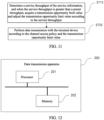
- a service throughput of the service information is determined, and when the service throughput is greater than a preset throughput, a transmission opportunity limit value is acquired and adjusted according to the service throughput.
- the preset throughput may be set according to actual requirements, and is not particularly limited herein.
- the transmission opportunity limit value is a maximum duration of TXOP, and the magnitude of the transmission opportunity limit value means the amount of data that the terminal device can transmit after successfully contending for the channel.
- a larger TXOPlimit value indicates a longer sending duration and a larger amount of data that can be sent.
- the transmission opportunity limit value may be greater than 6 ms, e.g., 7 ms, 10 ms, or more, which is not particularly limited herein.
- data transmission is performed with the terminal device according to the channel access policy and the transmission opportunity limit value.
- the channel access policy may include an HCCA mechanism, an EDCA mechanism, etc., which is not particularly limited herein.
- the AP controller can determine a service throughput of the service information, acquire a transmission opportunity limit value when the service throughput is greater than a preset throughput, adjust the transmission opportunity limit value according to the service throughput, and then perform data transmission with the terminal device according to the channel access policy and the transmission opportunity limit value. Therefore, in the embodiment of the present disclosure, the transmission opportunity limit value can be adjusted to meet requirements of voice, video, and other services with strong real-time performance, to avoid degradation of the performance of the low-priority service or blocking of the low-priority service.
- the terminal device may be a mobile phone, a tablet computer, a notebook computer, a handheld computer, a vehicle-mounted electronic device, a wearable device, an Ultra-Mobile Personal Computer (UMPC), a netbook, a Personal Digital Assistant (PDA), or other user equipment having a network access function, which is not particularly limited herein.
- UMPC Ultra-Mobile Personal Computer
- PDA Personal Digital Assistant
- an embodiment of the present disclosure provides a data transmission apparatus 200, including a memory 202, a processor 201, and a computer program stored in the memory 202 and executable by the processor 201.
- the processor 201 and the memory 202 may be connected by a bus or in other ways.
- the memory 202 may be configured for storing a non-transitory software program and a non-transitory computer-executable program.
- the memory 202 may include a high-speed random access memory, and may also include a non-transitory memory, e.g., at least one magnetic disk storage device, flash memory device, or other non-transitory solid-state storage device.
- the memory 202 may include memories located remotely from the processor 201, and the remote memories may be connected to the processor 201 via a network. Examples of the network include, but not limited to, the Internet, an intranet, a local area network, a mobile communication network, and combinations thereof.
- the data transmission apparatus 200 in this embodiment may be, for example, the AP controller in the embodiment shown in FIG. 1 , and these embodiments all belong to the same concept and therefore have the same implementation principle and technical effects, so the details will not be repeated here.
- the non-transitory software program and instructions required to implement the data transmission apparatus of the foregoing embodiments are stored in the memory 202 which, when executed by the processor 201, cause the processor 201 to implement the data transmission method of the foregoing embodiments, for example, implement the method steps S110 to S140 in FIG. 5 , the method steps S210 to S220 in FIG. 6 , the method steps S310 to S320 in FIG. 7 , the method steps S410 to S420 in FIG. 8 , the method steps S510 to S530 in FIG. 9 , the method steps S610 to S620 in FIG. 10 , or the method steps S710 to S720 in FIG. 11 .
- the device embodiments described above are merely examples.
- the units described as separate components may or may not be physically separated, i.e., they may be located in one place or may be distributed over a plurality of network units. Some or all of the modules may be selected according to actual needs to achieve the objects of the scheme of this embodiment.
- an embodiment of the present disclosure provides a computer-readable storage medium, storing computer-executable instructions which, when executed by a processor or controller, for example, by a processor in the device embodiment described above, may cause the processor to implement the data transmission method of the foregoing embodiments, implement the method steps S110 to S140 in FIG. 5 , the method steps S210 to S220 in FIG. 6 , the method steps S310 to S320 in FIG. 7 , the method steps S410 to S420 in FIG. 8 , the method steps S510 to S530 in FIG. 9 , the method steps S610 to S620 in FIG. 10 , or the method steps S710 to S720 in FIG. 11 .
- an embodiment of the present disclosure provides a computer program product, including a computer program or computer instructions stored in a computer-readable storage medium, where the computer program or the computer instructions, when read from the computer-readable storage medium and executed by a processor of a computer device, causes the computer device to implement the data transmission method in the above embodiments, for example, implement the method steps S110 to S140 in FIG. 5 , the method steps S210 to S220 in FIG. 6 , the method steps S310 to S320 in FIG. 7 , the method steps S410 to S420 in FIG. 8 , the method steps S510 to S530 in FIG. 9 , the method steps S610 to S620 in FIG. 10 , or the method steps S710 to S720 in FIG. 11 .
- Embodiments of the present disclosure include: acquiring service information of a terminal device; determining a slice category of a network slice corresponding to the terminal device according to the service information; determining a channel access policy according to the slice category; and performing data transmission with the terminal device according to the channel access policy.
- different network slices are determined according to different service information
- corresponding channel access policies are determined for terminal devices of the different network slices
- data transmission is performed with the terminal devices according to the corresponding channel access policies.
- the embodiments of the present disclosure can provide support for deterministic services in WLANs.
- the term "computer storage medium” includes volatile and nonvolatile, removable and non-removable media implemented in any method or technology for storage of information (such as computer-readable instructions, data structures, program modules, or other data).
- the computer storage medium includes, but not limited to, a Random Access Memory (RAM), a Read-Only Memory (ROM), an Electrically Erasable Programmable Read-Only Memory (EEPROM), a flash memory or other memory technology, a Compact Disc Read-Only Memory (CD-ROM), a Digital Versatile Disc (DVD) or other optical storage, a cassette, a magnetic tape, a magnetic disk storage or other magnetic storage device, or any other medium which can be used to store the desired information and can be accessed by a computer.
- the communication medium typically includes computer-readable instructions, data structures, program modules, or other data in a modulated data signal such as a carrier or other transport mechanism, and can include any information delivery medium.
Landscapes
- Engineering & Computer Science (AREA)
- Computer Networks & Wireless Communication (AREA)
- Signal Processing (AREA)
- Quality & Reliability (AREA)
- Mobile Radio Communication Systems (AREA)
Applications Claiming Priority (2)
| Application Number | Priority Date | Filing Date | Title |
|---|---|---|---|
| CN202210890003.1A CN117545020A (zh) | 2022-07-27 | 2022-07-27 | 数据传输方法及其装置、存储介质、程序产品 |
| PCT/CN2023/097879 WO2024021860A1 (fr) | 2022-07-27 | 2023-06-01 | Procédé et appareil de transmission de données, support de stockage et produit de programme |
Publications (2)
| Publication Number | Publication Date |
|---|---|
| EP4550877A1 true EP4550877A1 (fr) | 2025-05-07 |
| EP4550877A4 EP4550877A4 (fr) | 2025-10-08 |
Family
ID=89705307
Family Applications (1)
| Application Number | Title | Priority Date | Filing Date |
|---|---|---|---|
| EP23845073.8A Pending EP4550877A4 (fr) | 2022-07-27 | 2023-06-01 | Procédé et appareil de transmission de données, support de stockage et produit de programme |
Country Status (3)
| Country | Link |
|---|---|
| EP (1) | EP4550877A4 (fr) |
| CN (1) | CN117545020A (fr) |
| WO (1) | WO2024021860A1 (fr) |
Families Citing this family (2)
| Publication number | Priority date | Publication date | Assignee | Title |
|---|---|---|---|---|
| CN117858156B (zh) * | 2024-03-08 | 2024-05-10 | 国网山东省电力公司枣庄供电公司 | 一种无人化自动领料信息的处理装置与方法 |
| CN121909690A (zh) * | 2024-08-21 | 2026-04-21 | 新华三技术有限公司 | 一种报文转发方法、装置、网络设备及存储介质 |
Family Cites Families (5)
| Publication number | Priority date | Publication date | Assignee | Title |
|---|---|---|---|---|
| GB2540213B (en) * | 2015-07-10 | 2018-02-28 | Canon Kk | Trigger frames adapted to packet-based policies in an 802.11 network |
| CN107343306B (zh) * | 2016-04-28 | 2019-03-22 | 中兴通讯股份有限公司 | 网络切片的选择方法及装置 |
| EP3871438B1 (fr) * | 2018-10-26 | 2025-07-16 | Nokia Technologies Oy | Mise en tranches d'un réseau dans une interface radio |
| US12289753B2 (en) * | 2020-11-25 | 2025-04-29 | Mediatek Inc. | Delay-aware bandwidth scheduling for wireless communication network |
| CN116762319A (zh) * | 2021-01-12 | 2023-09-15 | 高通股份有限公司 | 管理无线局域网(wlan)以支持移动通信网络服务 |
-
2022
- 2022-07-27 CN CN202210890003.1A patent/CN117545020A/zh active Pending
-
2023
- 2023-06-01 WO PCT/CN2023/097879 patent/WO2024021860A1/fr not_active Ceased
- 2023-06-01 EP EP23845073.8A patent/EP4550877A4/fr active Pending
Also Published As
| Publication number | Publication date |
|---|---|
| WO2024021860A1 (fr) | 2024-02-01 |
| EP4550877A4 (fr) | 2025-10-08 |
| CN117545020A (zh) | 2024-02-09 |
Similar Documents
| Publication | Publication Date | Title |
|---|---|---|
| JP7187512B2 (ja) | 802.11axネットワークにおけるマルチユーザーEDCA送信モードのQoS管理 | |
| US9178673B1 (en) | Dynamic bandwidth allocation | |
| RU2718958C1 (ru) | Расширенное управление ас в режиме передачи многопользовательского edca в беспроводной сети | |
| US7990872B2 (en) | Wireless LAN system and transmission method of data thereof | |
| EP3694286B1 (fr) | Trames de déclenchement adaptées pour des politiques basées sur des paquets dans un réseau 802.11 | |
| US10700989B2 (en) | QoS management for multi-user and single user EDCA transmission mode in wireless networks | |
| EP3485692B1 (fr) | Équité restaurée dans un réseau 802.11 mettant en oeuvre des unités de ressources | |
| US7978636B2 (en) | System and method for controlling throughput of access classes in a WLAN | |
| EP1507367B1 (fr) | Gestion de trames en rafales | |
| US7970409B2 (en) | Wireless communication system, terminal device and base station for wireless communication system, and channel scheduling method thereof | |
| US10966247B2 (en) | Queues management for multi-user and single user EDCA transmission mode in wireless networks | |
| US8630239B2 (en) | Station and access point for EDCA communication, system thereof and communication method thereof | |
| US20260032724A1 (en) | Multi-user random access in a wireless network | |
| US10009280B2 (en) | Method and apparatus for providing an efficient multi-client access | |
| GB2539277A (en) | Backoff based selection method of channels for data transmission | |
| EP4625903A1 (fr) | Procédé et appareil d'accès en mode contention pour canal secondaire, dispositif, et support | |
| KR101353632B1 (ko) | 경쟁 기반의 데이터 송수신용 단말장치 및 베이스 스테이션그리고 이들을 포함한 시스템 및 경쟁 기반의 데이터송수신 방법 | |
| GB2529672A (en) | Method and device for data communication in a network | |
| Bankov et al. | Tuning channel access to enable real-time applications in Wi-Fi 7 | |
| WO2024021860A1 (fr) | Procédé et appareil de transmission de données, support de stockage et produit de programme | |
| KR20250152608A (ko) | 통신 방법 및 통신 장치 | |
| CN111918406B (zh) | 一种无线接入方法和装置 | |
| JP2007074210A (ja) | 無線lan基地局の制御方法およびその基地局 | |
| JP4179512B2 (ja) | 無線基地局 | |
| Rathnakar Acharya et al. | WLAN QoS issues and IEEE 802.11 e QoS enhancement |
Legal Events
| Date | Code | Title | Description |
|---|---|---|---|
| STAA | Information on the status of an ep patent application or granted ep patent |
Free format text: STATUS: THE INTERNATIONAL PUBLICATION HAS BEEN MADE |
|
| PUAI | Public reference made under article 153(3) epc to a published international application that has entered the european phase |
Free format text: ORIGINAL CODE: 0009012 |
|
| STAA | Information on the status of an ep patent application or granted ep patent |
Free format text: STATUS: REQUEST FOR EXAMINATION WAS MADE |
|
| 17P | Request for examination filed |
Effective date: 20250129 |
|
| AK | Designated contracting states |
Kind code of ref document: A1 Designated state(s): AL AT BE BG CH CY CZ DE DK EE ES FI FR GB GR HR HU IE IS IT LI LT LU LV MC ME MK MT NL NO PL PT RO RS SE SI SK SM TR |
|
| A4 | Supplementary search report drawn up and despatched |
Effective date: 20250910 |
|
| RIC1 | Information provided on ipc code assigned before grant |
Ipc: H04W 28/02 20090101AFI20250904BHEP Ipc: H04W 72/12 20230101ALI20250904BHEP Ipc: H04W 48/08 20090101ALI20250904BHEP Ipc: H04W 84/12 20090101ALI20250904BHEP |
|
| DAV | Request for validation of the european patent (deleted) | ||
| DAX | Request for extension of the european patent (deleted) |