EP4550896A1 - Procédé et appareil de traitement de communications et dispositif et support de stockage lisible - Google Patents
Procédé et appareil de traitement de communications et dispositif et support de stockage lisible Download PDFInfo
- Publication number
- EP4550896A1 EP4550896A1 EP23830133.7A EP23830133A EP4550896A1 EP 4550896 A1 EP4550896 A1 EP 4550896A1 EP 23830133 A EP23830133 A EP 23830133A EP 4550896 A1 EP4550896 A1 EP 4550896A1
- Authority
- EP
- European Patent Office
- Prior art keywords
- endc
- sim card
- network
- terminal
- card
- Prior art date
- Legal status (The legal status is an assumption and is not a legal conclusion. Google has not performed a legal analysis and makes no representation as to the accuracy of the status listed.)
- Pending
Links
Images


Classifications
-
- H—ELECTRICITY
- H04—ELECTRIC COMMUNICATION TECHNIQUE
- H04W—WIRELESS COMMUNICATION NETWORKS
- H04W8/00—Network data management
- H04W8/18—Processing of user or subscriber data, e.g. subscribed services, user preferences or user profiles; Transfer of user or subscriber data
-
- H—ELECTRICITY
- H04—ELECTRIC COMMUNICATION TECHNIQUE
- H04L—TRANSMISSION OF DIGITAL INFORMATION, e.g. TELEGRAPHIC COMMUNICATION
- H04L65/00—Network arrangements, protocols or services for supporting real-time applications in data packet communication
- H04L65/10—Architectures or entities
- H04L65/1016—IP multimedia subsystem [IMS]
-
- H—ELECTRICITY
- H04—ELECTRIC COMMUNICATION TECHNIQUE
- H04L—TRANSMISSION OF DIGITAL INFORMATION, e.g. TELEGRAPHIC COMMUNICATION
- H04L65/00—Network arrangements, protocols or services for supporting real-time applications in data packet communication
- H04L65/1066—Session management
-
- H—ELECTRICITY
- H04—ELECTRIC COMMUNICATION TECHNIQUE
- H04L—TRANSMISSION OF DIGITAL INFORMATION, e.g. TELEGRAPHIC COMMUNICATION
- H04L65/00—Network arrangements, protocols or services for supporting real-time applications in data packet communication
- H04L65/1066—Session management
- H04L65/1073—Registration or de-registration
-
- H—ELECTRICITY
- H04—ELECTRIC COMMUNICATION TECHNIQUE
- H04L—TRANSMISSION OF DIGITAL INFORMATION, e.g. TELEGRAPHIC COMMUNICATION
- H04L65/00—Network arrangements, protocols or services for supporting real-time applications in data packet communication
- H04L65/80—Responding to QoS
-
- H—ELECTRICITY
- H04—ELECTRIC COMMUNICATION TECHNIQUE
- H04W—WIRELESS COMMUNICATION NETWORKS
- H04W24/00—Supervisory, monitoring or testing arrangements
- H04W24/10—Scheduling measurement reports ; Arrangements for measurement reports
-
- H—ELECTRICITY
- H04—ELECTRIC COMMUNICATION TECHNIQUE
- H04W—WIRELESS COMMUNICATION NETWORKS
- H04W48/00—Access restriction; Network selection; Access point selection
- H04W48/18—Selecting a network or a communication service
-
- H—ELECTRICITY
- H04—ELECTRIC COMMUNICATION TECHNIQUE
- H04W—WIRELESS COMMUNICATION NETWORKS
- H04W52/00—Power management, e.g. Transmission Power Control [TPC] or power classes
- H04W52/02—Power saving arrangements
- H04W52/0209—Power saving arrangements in terminal devices
-
- H—ELECTRICITY
- H04—ELECTRIC COMMUNICATION TECHNIQUE
- H04W—WIRELESS COMMUNICATION NETWORKS
- H04W76/00—Connection management
- H04W76/10—Connection setup
- H04W76/15—Setup of multiple wireless link connections
- H04W76/16—Involving different core network technologies, e.g. a packet-switched [PS] bearer in combination with a circuit-switched [CS] bearer
-
- H—ELECTRICITY
- H04—ELECTRIC COMMUNICATION TECHNIQUE
- H04W—WIRELESS COMMUNICATION NETWORKS
- H04W8/00—Network data management
- H04W8/18—Processing of user or subscriber data, e.g. subscribed services, user preferences or user profiles; Transfer of user or subscriber data
- H04W8/183—Processing at user equipment or user record carrier
-
- H—ELECTRICITY
- H04—ELECTRIC COMMUNICATION TECHNIQUE
- H04W—WIRELESS COMMUNICATION NETWORKS
- H04W8/00—Network data management
- H04W8/22—Processing or transfer of terminal data, e.g. status or physical capabilities
-
- H—ELECTRICITY
- H04—ELECTRIC COMMUNICATION TECHNIQUE
- H04W—WIRELESS COMMUNICATION NETWORKS
- H04W88/00—Devices specially adapted for wireless communication networks, e.g. terminals, base stations or access point devices
- H04W88/02—Terminal devices
- H04W88/06—Terminal devices adapted for operation in multiple networks or having at least two operational modes, e.g. multi-mode terminals
Definitions
- This application pertains to the field of communication technologies, and specifically relates to a communication processing method and apparatus, a terminal, and a readable storage medium.
- the 5 th generation mobile communication technology (5th Generation Mobile Communication Technology, 5G) is a new generation of mobile communication technology, which includes two networking schemes: non-standalone (Non-Standalone, NSA) networking and standalone (Standalone, SA) networking. There are significant differences between the two networking schemes.
- NSA networking is deployed based on the infrastructure of the existing fourth generation mobile communication technology (Fourth Generation Mobile Communication Technology, 4G), with some services and functions still relying on the 4G network. It has the advantages of lowering construction cost and allowing for rapid coverage.
- 4G base stations are modified for transmitting 5G signals, enabling quick arrangement at low cost in the initial stage, thereby realizing rapid popularization of 5G and allowing as many users as possible to enjoy it.
- SA requires construction of independent base stations, which entails high time costs for large-scale coverage.
- SA features higher speed, lower latency, and the like.
- NSA networking relies on mature long term evolution (Long Term Evolution, LTE) network coverage while exerting the high throughput of NR nodes (NR Node B, gNB) in evolved nodeB dual connectivity (Evolved NodeB Dual Connectivity, ENDC).
- LTE Long Term Evolution
- gNB evolved nodeB dual connectivity
- ENDC evolved NodeB Dual Connectivity
- LTE and NR dual connectivity increases power consumption of new radio (New Radio, NR) connections and in turn increases power consumption of a terminal, affecting the user experience in terms of endurance.
- New Radio New Radio
- VoLTE Voice over Long-Term Evolution
- the network still makes the terminal to add NR measurement configuration during the calls.
- the terminal Upon receiving the measurement configuration and meeting measurement event conditions, the terminal triggers the reporting of the measurement reports, and then the network triggers the addition of a second cell group (Second Cell Group, SCG) to increase speed.
- SCG Second Cell Group
- VoLTE is a call service with quality of service (Quality of Service, QoS) guarantees, can guarantee call quality without requiring SCG to increase the speed, and currently does not support establishment of a dedicated bearer through SCG.
- QoS Quality of Service
- Actions such as frequent NR cell measurement and SCG addition performed by the terminal during calls do not improve user experience but increase power consumption in a call scenario under an ENDC network.
- a subscriber identity module Subscriber Identity Module, SIM
- PS Paging packet-switched paging
- Embodiments of this application are intended to provide a communication processing method and apparatus, a terminal, and a readable storage medium, so as to address the issues that in the related art, frequent NR cell measurement and SCG addition during calls do not improve user experience but increase power consumption of call scenarios in an ENDC network and cause delays or disconnections in SIM cards using mobile data.
- an embodiment of this application provides a communication processing method applied to a terminal including a first SIM card and a second SIM card.
- the method includes:
- an embodiment of this application provides a communication processing apparatus applied to a terminal including a first SIM card and a second SIM card.
- the apparatus includes:
- an embodiment of this application provides a terminal.
- the terminal includes a processor and a memory.
- the memory stores a program or instruction executable on the processor. When the program or instruction is executed by the processor, the steps of the method according to the first aspect are implemented.
- an embodiment of this application provides a readable storage medium, where the readable storage medium stores a program or instruction, and when the program or instruction is executed by a processor, the steps of the method according to the first aspect are implemented.
- an embodiment of this application provides a chip, where the chip includes a processor and a communication interface, the communication interface is coupled to the processor, and the processor is configured to run a program or instruction to implement the method according to the first aspect.
- an embodiment of this application provides a computer program product.
- the program product is stored in a storage medium.
- the program product is executed by at least one processor to implement the method according to the first aspect.
- the terminal when the terminal performs initial registration or location update in an ENDC network, the first SIM card that is conducting an IMS call is prohibited from executing ENDC B1 measurement, and the ENDC capability of the second SIM card is disabled, so that the first SIM card fails to execute ENDC B1 measurement, thereby reducing power consumption of the terminal. Since the ENDC capability of the second SIM card is disabled, actions such as SCG addition cannot be performed again, ensuring that the first SIM card is prevented from lag caused by interference when using mobile data, thus improving the user experience in network use.
- first”, “second”, and the like in the specification and claims of this application are used to distinguish between similar objects rather than to indicate a specific order or sequence. It should be understood that data used in this way is used interchangeably in appropriate circumstances so that the embodiments of this application can be implemented in other orders than the order illustrated or described herein.
- first”, “second”, and the like are usually used to distinguish objects of a same type but do not restrict a quantity of the objects. For example, there may be one or a plurality of first objects.
- “and/or” in the specification and claims represents at least one of connected objects, and the character “/" generally indicates that the contextually associated objects have an "or” relationship.
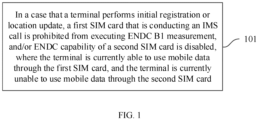
- FIG. 1 is a first schematic flowchart of a communication processing method according to an embodiment of this application.
- an embodiment of one aspect of this application provides a communication processing method applied to a terminal including a first SIM card and a second SIM card. The method includes the following step.
- Step 101 In a case that the terminal performs initial registration or location update, the first SIM card that is conducting an IMS call is prohibited from executing ENDC B1 measurement, and/or ENDC capability of the second SIM card is disabled, where the terminal is currently able to use mobile data through the first SIM card, and the terminal is currently unable to use mobile data through the second SIM card.
- the terminal using this method is a dual-card terminal with a first SIM card and a second SIM card, where either the first SIM card or the second SIM card can be a primary card, and the remaining card is a secondary card.
- the terminal can use mobile data through only one of the first SIM card or the second SIM card at the same time, and a user can switch between the first SIM card and the second SIM card to select the card for using mobile data.
- the current first SIM card and second SIM card is used as a mobile data card able to use mobile data can be determined by a value of a data distribution service (Data Distribution Service, DDS) card stored in a NAS layer.
- DDS Data Distribution Service
- the terminal performs initial registration specifically means the terminal performs initial registration in a cell with an ENDC environment.
- the initial registration is a registration process initiated by the terminal and carrying a subscriber permanent identifier (Subscriber Permanent Identifier, SUPI).
- a location update process performed by the terminal specifically refers to tracking area update (Tracking Area Update, TAU).
- the terminal can first determine which of the first SIM card and the second SIM card is a mobile data card and which is a non-mobile data card. In other words, the terminal first determines which card is selected for using mobile data currently. If the terminal can currently use mobile data through the first SIM card, whether the first SIM card is currently registered for IP multimedia subsystem (IP Multimedia Subsystem, IMS) services and is in an IMS state can be further determined. If the first SIM card is conducting an IMS call, the terminal can prohibit the first SIM card from executing ENDC B1 measurement.
- IP Multimedia Subsystem IP Multimedia Subsystem
- the terminal does not conduct any process, that is, the terminal does not prohibit the first SIM card from executing ENDC B1 measurement.
- the terminal does not prohibit the first SIM card from executing ENDC B1 measurement.
- the ENDC capability of the second SIM card can be disabled.
- the second SIM card is a non-mobile data card used in only IMS call scenarios instead of mobile data traffic usage scenarios, to prevent lag or latency caused when the second SIM card receives PS Paging sent by a network-side device and performs an SCG addition action while the first SIM card is using mobile data traffic and requires low latency, the ENDC capability of the second SIM card can be directly disabled. As a result, the second SIM card no longer performs NR cell measurement and SCG addition, thereby improving the stability when the first SIM card is using mobile data traffic and improving the use experience of the user.
- the terminal can request a non-access stratum (Non-access stratum, NAS) module to disable the ENDC capability through a radio resource control (Radio Resource Control, RRC) module.
- NAS Non-access stratum
- RRC Radio Resource Control
- the terminal when the terminal performs initial registration or location update in an ENDC network, the first SIM card that is conducting an IMS call is prohibited from executing ENDC B1 measurement, and the ENDC capability of the second SIM card is disabled, so that the first SIM card fails to execute ENDC B1 measurement, thereby reducing power consumption of the terminal. Since the ENDC capability of the second SIM card is disabled, actions such as SCG addition cannot be performed again, ensuring that the first SIM card is prevented from lag caused by interference when using mobile data, thus improving the user experience in network use.
- the method further includes: reporting first capability information to a network-side device, where the first capability information indicates that the second SIM card does not support ENDC capability.
- the first capability information can be added to an attach request (Attach Request) or a TAU Request sent to the network-side device to indicate that the second SIM card does not support ENDC capability.
- Attach Request an attach request
- TAU Request a TAU Request sent to the network-side device to indicate that the second SIM card does not support ENDC capability.
- the first capability information may be: Dual connectivity with NR: Not Support.
- the network-side device no longer instructs the second SIM card to perform actions such as SCG addition, thereby reducing power consumption.
- the method further includes: enabling the first SIM card to perform ENDC B1 measurement in a case that the IMS call on the first SIM card has ended.
- the first SIM card that is conducting an IMS call is prohibited from performing ENDC B1 measurement, if the IMS call on the first SIM card has ended, the first SIM card can be enabled again to perform ENDC B1 measurement, that is, the first SIM card is allowed to perform ENDC B1 measurement, so that the first SIM card can perform ENDC B1 measurement and perform ENDC when meeting ENDCENDC requirements, thereby improving communication efficiency.
- FIG. 2 is a second schematic flowchart of a communication processing method according to an embodiment of this application. As shown in FIG. 2 , the communication processing method in this embodiment of this application includes the following steps.
- Step 201 The terminal performs initial registration or location update.
- Step 202 Determine whether the SIM card is a data card.
- step 203 whether the SIM card is a data card is determined. If the SIM card is a data card, the terminal can currently use mobile data through this card; and if the SIM card is a non-data card, the terminal cannot currently use mobile data through this card. If the determination result is yes, step 203 is to be started; otherwise, step 208 is to be started.
- Step 203 Determine whether IMS is successfully registered.
- this step in a case that this card is a data card, whether the data card has successfully registered for IMS services is determined; if yes, step 204 is to be started; otherwise, the process is ended.
- Step 204 Determine whether an IMS call is established.
- step 205 in a case that the IMS services of the data card have been successfully registered, whether an IMS call has been established on this data card is further determined; if yes, step 205 is to be started; otherwise, the process is ended.
- Step 205 An RRC module updates a state of a current ENDC B1 measurement switch to be off.
- the RRC module updates the state of the ENDC B1 measurement switch of the data card to be off, to be specific, the data card that is conducting an IMS call is prohibited from performing ENDC B1 measurement.
- Step 206 Determine whether the IMS call has ended.
- step 207 determines whether the IMS call has ended. If the SIM call has ended, step 207 is to be started; otherwise, the state of the ENDC B1 measurement switch of the data card is still kept off.
- Step 207 The RRC module updates the state of the current ENDC B1 measurement switch to be on.
- the RRC module updates the state of the current ENDC B1 measurement switch to be a state before the IMS call, to be specific, this data card is enabled to perform ENDC B1 measurement.
- this card is a non-data card
- the RRC module updates the current ENDC capability switch, to be specific, the ENDC capability of this card is disabled.
- the method further includes:
- the first capability information, second capability information, and third capability information are further acquired, where the first capability information is used to indicate whether the target card of the terminal supports ENDC, the second capability information is used to indicate whether the network-side device currently connected to the terminal supports ENDC, and the third capability information is used to indicate whether the network-side device currently connected to the terminal restricts the terminal from accessing the ENDC network.
- the network icon corresponding to the target card is determined based on the first capability information, the second capability information, and the third capability information.
- the target card in this embodiment is the first SIM card or the second SIM card. This can ensure the display accuracy of signal icon formats of the two cards of the terminal, thereby improving the use experience of the user.
- the determining the network icon corresponding to the target card based on the first capability information, the second capability information, and the third capability information includes:
- the first capability information for indicating whether the target card supports ENDC can be obtained by the terminal querying dual-connectivity evolved UMTS universal terrestrial radio access network and new radio (Dual Connectivity E-UTRAN and NR, DCNR) capability of the terminal by the NAS module. If a modem has enabled the capability of Option 3, it indicates that the target card has ENDC capability. If the query shows that the capability of Option 3 is not enabled, it indicates that the ENDC capability of the target card is disabled, meaning the target card does not have ENDC capability.
- the network icon corresponding to the target card is displayed as a 4G icon if the network-side device currently connected to the terminal supports ENDC, the target card supports ENDC, and the network-side device restricts the terminal from accessing the ENDC network.
- the network-side device restricts the terminal from accessing the ENDC network, and therefore even if the network-side device supports ENDC capability and the terminal also supports ENDC capability, the network icon corresponding to the target card can only be displayed as a 4G icon.
- the second capability information for indicating whether the network-side device currently connected to the terminal supports ENDC can be obtained by the terminal querying system messages.
- whether the network-side device supports ENDC is determined based on system messages (the system messages refer to broadcast messages sent from the network-side device to all terminals, and the system messages received by the terminal are stored in cache).
- the system messages refer to broadcast messages sent from the network-side device to all terminals, and the system messages received by the terminal are stored in cache.
- the third capability information for indicating whether the network-side device currently connected to the terminal restricts the terminal from accessing the ENDC network can be obtained by the terminal querying an MM (mobile station) module (that is, a mobility management module) for whether the network-side device restricts the terminal from accessing the ENDC network.
- an MM (mobile station) module that is, a mobility management module
- the terminal receives Attach Accept or TAU Accept sent by the evolved UMTS terrestrial radio access network (Evolved UMTS Terrestrial Radio Access Network, E-UTRAN)
- E-UTRAN evolved UMTS terrestrial radio access network
- the target card is the second SIM card
- the method before the determining the network icon corresponding to the target card based on the first capability information, the second capability information, and the third capability information, the method further includes:
- the acquired first capability information indicates that the second SIM card does not support ENDC capability
- this operation is recorded in the target information.
- Whether the ENDC capability of the second SIM card is disabled can be determined by acquiring the target information.
- the network-side device currently connected to the terminal supports ENDC
- the second SIM card does not support ENDC
- the target information indicates that the ENDC capability of the second SIM card is disabled, and the network-side device does not restrict the terminal from accessing the ENDC network
- the second SIM card does not support ENDC, and the target information indicates that the ENDC capability of the second SIM card is not disabled, it indicates that the ENDC capability of the second SIM card is not disabled by the terminal, but actually the hardware of the second SIM card does not support the ENDC capability. Therefore, a network icon of the second SIM card should be displayed as a 4G icon.
- determining the network icon corresponding to the target card can be performed in a case that the terminal performs initial registration or location update.
- the first capability information for indicating whether the target card of the terminal supports ENDC, the second capability information for indicating whether the network-side device currently connected to the terminal supports ENDC, and third capability information for indicating whether the network-side device currently connected to the terminal restricts the terminal from accessing the ENDC network are acquired in the case that the terminal performs initial registration or location update.
- FIG. 3 is a schematic flowchart of a network icon update method according to an embodiment of this application. As shown in FIG. 3 , the network icon update method in this embodiment of this application includes the following steps.
- Step 301 The terminal performs initial registration or location update in an LTE cell.
- Step 303 The NAS module queries whether the terminal supports ENDC.
- a network icon of the card should be a 5G icon. Therefore, an icon in a 5G format can be reported to the framework and SystemUI.
- network icons that should be displayed for the current double cards can be accurately determined, thereby improving the user experience.
- the terminal when the terminal performs initial registration or location update in the ENDC network, the first SIM card that is conducting an IMS call is prohibited from executing ENDC B1 measurement, and the ENDC capability of the second SIM card is disabled, so that the first SIM card fails to execute ENDC B1 measurement, thereby reducing power consumption of the terminal. Since the ENDC capability of the second SIM card is disabled, actions such as SCG addition cannot be performed again, ensuring that the first SIM card is prevented from lag caused by interference when using mobile data, thus improving the user experience in network use.
- the communication processing method provided in the embodiments of this application may be executed by a communication processing apparatus.
- the communication processing method being executed by a communication processing apparatus is used as an example for describing the communication processing apparatus provided in the embodiments of this application.
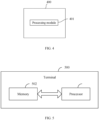
- FIG. 4 is a schematic structural diagram of a communication processing apparatus according to an embodiment of this application.
- an embodiment of another aspect of this application provides a communication processing apparatus applied to a terminal including a first SIM card and a second SIM card.
- the apparatus 400 includes:
- the terminal when the terminal performs initial registration or location update in an ENDC network, the first SIM card that is conducting an IMS call is prohibited from executing ENDC B1 measurement, and the ENDC capability of the second SIM card is disabled, so that the first SIM card fails to execute ENDC B1 measurement, thereby reducing power consumption of the terminal. Since the ENDC capability of the second SIM card is disabled, actions such as SCG addition cannot be performed again, ensuring that the first SIM card is prevented from lag caused by interference when using mobile data, thus improving the user experience in network use.
- the apparatus further includes: a reporting module, configured to report first capability information to a network-side device, where the first capability information indicates that the second SIM card does not support ENDC capability.
- a reporting module configured to report first capability information to a network-side device, where the first capability information indicates that the second SIM card does not support ENDC capability.
- the apparatus further includes: a recovery module, configured to enable the first SIM card to perform ENDC B1 measurement in a case that the IMS call on the first SIM card has ended.
- a recovery module configured to enable the first SIM card to perform ENDC B1 measurement in a case that the IMS call on the first SIM card has ended.
- the apparatus further includes:
- the determining module includes:
- the target card is the second SIM card
- the apparatus further includes: a second acquiring module, configured to acquire target information in a case that the first capability information indicates that the second SIM card does not support ENDC capability, where the target information is used to indicate whether the ENDC capability of the second SIM card is disabled.
- the determining module includes:
- the terminal when the terminal performs initial registration or location update in an ENDC network, the first SIM card that is conducting an IMS call is prohibited from executing ENDC B1 measurement, and the ENDC capability of the second SIM card is disabled, so that the first SIM card fails to execute ENDC B1 measurement, thereby reducing power consumption of the terminal. Since the ENDC capability of the second SIM card is disabled, actions such as SCG addition cannot be performed again, ensuring that the first SIM card is prevented from lag caused by interference when using mobile data, thus improving the user experience in network use.
- the communication processing apparatus in this embodiment of this application may be a terminal, or may be a component such as an integrated circuit or chip in a terminal.
- the terminal may be a mobile phone, a tablet computer, a notebook computer, a palmtop computer, a vehicle-mounted electronic device, a mobile Internet device (Mobile Internet Device, MID), an augmented reality (augmented reality, AR)/virtual reality (virtual reality, VR) device, a robot, a wearable device, an ultra-mobile personal computer (ultra-mobile personal computer, UMPC), a netbook, a personal digital assistant (personal digital assistant, PDA), or the like; or may be a personal computer (personal computer, PC), a television (television, TV), a smart speaker, a teller machine, a self-service machine, or the like. This is not specifically limited in the embodiments of this application.
- the communication processing apparatus in the embodiments of this application may be an apparatus having an operating system.
- the operating system may be an Android (Android) operating system, may be an iOS operating system, or may be another possible operating system. This is not specifically limited in the embodiments of this application.
- the communication processing apparatus provided in the embodiments of this application can implement the processes implemented in the method embodiment in FIG. 1 to FIG. 3 . To avoid repetition, details are not described herein again.
- an embodiment of this application further provides a terminal 500 including a processor 501 and a memory 502.
- the memory 502 stores a program or instruction capable of running on the processor 501.
- the steps of the foregoing communication processing method embodiment are implemented, with the same technical effects achieved. To avoid repetition, details are not described herein again.
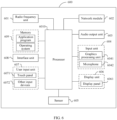
- FIG. 6 is a schematic diagram of a hardware structure of a terminal according to an embodiment of this application.
- the terminal 600 includes but is not limited to components such as a radio frequency unit 601, a network module 602, an audio output unit 603, an input unit 604, a sensor 605, a display unit 606, a user input unit 607, an interface unit 608, a memory 609, and a processor 6010.
- the terminal 600 may further include a power supply (such as a battery) for supplying power to the components.
- the power supply may be logically connected to the processor 6010 through a power management system. In this way, functions such as charge management, discharge management, and power consumption management are implemented by using the power management system.
- the structure of the terminal shown in FIG. 6 does not constitute any limitation on the terminal.
- the terminal may include more or fewer components than shown in the figure, or a combination of some components, or the components disposed differently. Details are not described herein again.
- the processor 6010 is configured to prohibit the first SIM card that is conducting an IMS call from executing ENDC B1 measurement and/or disable ENDC capability of the second SIM card in a case that the terminal performs initial registration or location update; where the terminal is currently able to use mobile data through the first SIM card, and the terminal is currently unable to use mobile data through the second SIM card.
- the terminal when the terminal performs initial registration or location update in an ENDC network, the first SIM card that is conducting an IMS call is prohibited from executing ENDC B1 measurement, and the ENDC capability of the second SIM card is disabled, so that the first SIM card fails to execute ENDC B1 measurement, thereby reducing power consumption of the terminal. Since the ENDC capability of the second SIM card is disabled, actions such as SCG addition cannot be performed again, ensuring that the first SIM card is prevented from lag caused by interference when using mobile data, thus improving the user experience in network use.
- the radio frequency unit 601 is further configured to report first capability information to a network-side device, where the first capability information indicates that the second SIM card does not support ENDC capability.
- the processor 6010 is further configured to enable the first SIM card of the terminal to perform ENDC B1 measurement in a case that the IMS call on the first SIM card has ended.
- the processor 6010 is further configured to acquire first capability information for indicating whether a target card of the terminal supports ENDC, second capability information for indicating whether a network-side device currently connected to the terminal supports ENDC, and third capability information for indicating whether the network-side device currently connected to the terminal restricts the terminal from accessing an ENDC network; and to determine a network icon corresponding to the target card based on the first capability information, the second capability information, and the third capability information, where the target card is the first SIM card or the second SIM card.
- the processor 6010 is further configured to display the network icon corresponding to the target card as a 5G icon in a case that the network-side device currently connected to the terminal supports ENDC, the target card supports ENDC, and the network-side device does not restrict the terminal from accessing the ENDC network;
- the processor 6010 is further configured to acquire target information in a case that the first capability information indicates that the second SIM card does not support ENDC capability, where the target information is used to indicate whether the ENDC capability of the second SIM card is disabled.
- the processor 6010 is further configured to display a network icon corresponding to the second SIM card as a 5G icon in a case that the network-side device currently connected to the terminal supports ENDC, the target information indicates that the ENDC capability of the second SIM card is disabled, and the network-side device does not restrict the terminal from accessing the ENDC network; and to display the network icon corresponding to the second SIM card as a 4G icon in a case that the network-side device currently connected to the terminal supports ENDC, and the target information indicates that the ENDC capability of the second SIM card is not disabled.
- the input unit 604 may include a graphics processing unit (Graphics Processing Unit, GPU) 6041 and a microphone 6042.
- the graphics processing unit 6041 processes image data of a still picture or video obtained by an image capture apparatus (such as a camera) in a video capture mode or an image capture mode.
- the display unit 606 may include a display panel 6061, and the display panel 6061 may be configured in a form of a liquid crystal display, an organic light-emitting diode, and the like.
- the user input unit 607 includes at least one of a touch panel 6071 and other input devices 6072.
- the touch panel 6071 is also referred to as a touchscreen.
- the touch panel 6071 may include two parts: a touch detection apparatus and a touch controller.
- the other input devices 6072 may include but are not limited to a physical keyboard, a function key (such as a volume control key or an on/off key), a trackball, a mouse, and a joystick. Details are not described herein.
- the memory 609 may be configured to store a software program and various data.
- the memory 609 may mainly include a first storage area for storing a program or instruction and a second storage area for storing data.
- the first storage area may store an operating system, an application program or instruction required by at least one function (for example, a sound play function or an image play function), and the like.
- the memory 609 may be a volatile memory or a non-volatile memory, or the memory 609 may include both a volatile memory and a non-volatile memory.
- the non-volatile memory may be a read-only memory (Read-Only Memory, ROM), a programmable read-only memory (Programmable ROM, PROM), an erasable programmable read-only memory (Erasable PROM, EPROM), an electrically erasable programmable read-only memory (Electrically EPROM, EEPROM), or a flash memory.
- ROM Read-Only Memory
- PROM programmable read-only memory
- Erasable PROM Erasable PROM
- EPROM electrically erasable programmable read-only memory
- EEPROM electrically erasable programmable read-only memory
- the volatile memory may be a random access memory (Random Access Memory, RAM), a static random access memory (Static RAM, SRAM), a dynamic random access memory (Dynamic RAM, DRAM), a synchronous dynamic random access memory (Synchronous DRAM, SDRAM), a double data rate synchronous dynamic random access memory (Double Data Rate SDRAM, DDRSDRAM), an enhanced synchronous dynamic random access memory (Enhanced SDRAM, ESDRAM), a synchronous link dynamic random access memory (Synch link DRAM, SLDRAM), and a direct rambus random access memory (Direct Rambus RAM, DRRAM).
- RAM Random Access Memory
- SRAM static random access memory
- DRAM dynamic random access memory
- DRAM synchronous dynamic random access memory
- SDRAM double data rate synchronous dynamic random access memory
- Enhanced SDRAM, ESDRAM enhanced synchronous dynamic random access memory
- Synch link DRAM, SLDRAM synchronous link dynamic random access memory
- Direct Rambus RAM Direct Rambus RAM
- the processor 6010 may include one or more processing units.
- the processor 6010 may integrate an application processor and a modem processor.
- the application processor primarily processes operations involving an operating system, user interface, application program, and the like.
- the modem processor primarily processes radio communication signals, for example, being a baseband processor. It can be understood that the modem processor may alternatively be not integrated in the processor 6010.
- An embodiment of this application further provides a readable storage medium, where the readable storage medium stores a program or instruction.
- the program or instruction is executed by a processor, the processes of the foregoing communication processing method embodiment can be implemented, with the same technical effects achieved. To avoid repetition, details are not described herein again.
- An embodiment of this application further provides a chip.
- the chip includes a processor and a communication interface.
- the communication interface is coupled to the processor.
- the processor is configured to run a program or instruction to implement the processes of the foregoing communication processing method embodiment, with the same technical effect achieved. To avoid repetition, details are not described herein again.
- the chip mentioned in this embodiment of this application may also be referred to as a system-level chip, a system chip, a chip system, a system-on-chip, or the like.
- An embodiment of this application provides a computer program product.
- the program product is stored in a storage medium.
- the program product is executed by at least one processor to implement the processes of the foregoing communication processing method embodiment, with the same technical effects achieved. To avoid repetition, details are not described herein again.
- the method in the foregoing embodiment can be implemented through software on a necessary hardware platform or certainly through hardware only, but in many cases, the former is the more preferred implementation.
- the technical solutions of this application essentially or the part contributing to the prior art may be implemented in a form of a computer software product.
- the computer software product is stored in a storage medium (such as a ROM/RAM, a magnetic disk, or an optical disc), and includes several instructions for instructing a terminal (which may be a mobile phone, a computer, a server, a network device, or the like) to perform the methods described in the embodiments of this application.
Landscapes
- Engineering & Computer Science (AREA)
- Computer Networks & Wireless Communication (AREA)
- Signal Processing (AREA)
- Multimedia (AREA)
- Databases & Information Systems (AREA)
- Business, Economics & Management (AREA)
- General Business, Economics & Management (AREA)
- Computer Security & Cryptography (AREA)
- Telephone Function (AREA)
- Mobile Radio Communication Systems (AREA)
Applications Claiming Priority (2)
| Application Number | Priority Date | Filing Date | Title |
|---|---|---|---|
| CN202210751243.3A CN115134901B (zh) | 2022-06-28 | 2022-06-28 | 通信处理方法及装置、终端和可读存储介质 |
| PCT/CN2023/102107 WO2024001955A1 (fr) | 2022-06-28 | 2023-06-25 | Procédé et appareil de traitement de communications et dispositif et support de stockage lisible |
Publications (2)
| Publication Number | Publication Date |
|---|---|
| EP4550896A1 true EP4550896A1 (fr) | 2025-05-07 |
| EP4550896A4 EP4550896A4 (fr) | 2025-10-22 |
Family
ID=83379451
Family Applications (1)
| Application Number | Title | Priority Date | Filing Date |
|---|---|---|---|
| EP23830133.7A Pending EP4550896A4 (fr) | 2022-06-28 | 2023-06-25 | Procédé et appareil de traitement de communications et dispositif et support de stockage lisible |
Country Status (4)
| Country | Link |
|---|---|
| US (1) | US20260122471A1 (fr) |
| EP (1) | EP4550896A4 (fr) |
| CN (1) | CN115134901B (fr) |
| WO (1) | WO2024001955A1 (fr) |
Families Citing this family (2)
| Publication number | Priority date | Publication date | Assignee | Title |
|---|---|---|---|---|
| CN115134901B (zh) * | 2022-06-28 | 2024-06-14 | 维沃移动通信有限公司 | 通信处理方法及装置、终端和可读存储介质 |
| CN116669172B (zh) * | 2023-07-27 | 2023-10-13 | 北京小米移动软件有限公司 | 网络注册方法、装置、设备及存储介质 |
Family Cites Families (12)
| Publication number | Priority date | Publication date | Assignee | Title |
|---|---|---|---|---|
| WO2013155212A1 (fr) * | 2012-04-10 | 2013-10-17 | Apple Inc. | Suspension d'une session sur un premier réseau pendant toute la durée d'un événement d'interruption prolongée |
| JP6068037B2 (ja) * | 2012-08-03 | 2017-01-25 | 株式会社Nttドコモ | 移動局、ネットワーク装置及び移動通信方法 |
| WO2020199227A1 (fr) * | 2019-04-05 | 2020-10-08 | Qualcomm Incorporated | Procédure de mise à jour de zone de suivi (tau) pour des dispositifs à double connectivité de capacité (dc) |
| KR20210089854A (ko) * | 2020-01-09 | 2021-07-19 | 삼성전자주식회사 | 복수의 가입자 식별 모듈을 포함하는 사용자 단말 |
| US11382106B2 (en) * | 2020-04-22 | 2022-07-05 | T-Mobile Usa, Inc. | Network symbol display for dual connectivity networks |
| CN112188576B (zh) * | 2020-09-22 | 2023-03-24 | 展讯通信(上海)有限公司 | 5g终端在业务并发时的功耗优化方法、装置、设备及介质 |
| CN112423289B (zh) * | 2020-11-09 | 2023-06-27 | Oppo广东移动通信有限公司 | 防止应用卡顿的方法及装置、设备、存储介质 |
| CN113163460A (zh) * | 2021-04-01 | 2021-07-23 | 维沃移动通信有限公司 | 业务处理方法、终端及网络设备 |
| CN116709499A (zh) * | 2021-05-20 | 2023-09-05 | 荣耀终端有限公司 | 双卡终端异常场景下的频段控制方法及终端设备 |
| CN113660705B (zh) * | 2021-08-13 | 2026-04-07 | 维沃移动通信有限公司 | 语音通信方法、装置及终端 |
| CN113891410A (zh) * | 2021-10-11 | 2022-01-04 | 维沃移动通信有限公司 | 一种ims网络注册方法及装置、终端、可读存储介质 |
| CN115134901B (zh) * | 2022-06-28 | 2024-06-14 | 维沃移动通信有限公司 | 通信处理方法及装置、终端和可读存储介质 |
-
2022
- 2022-06-28 CN CN202210751243.3A patent/CN115134901B/zh active Active
-
2023
- 2023-06-25 EP EP23830133.7A patent/EP4550896A4/fr active Pending
- 2023-06-25 WO PCT/CN2023/102107 patent/WO2024001955A1/fr not_active Ceased
-
2024
- 2024-12-27 US US19/003,953 patent/US20260122471A1/en active Pending
Also Published As
| Publication number | Publication date |
|---|---|
| EP4550896A4 (fr) | 2025-10-22 |
| WO2024001955A1 (fr) | 2024-01-04 |
| CN115134901A (zh) | 2022-09-30 |
| CN115134901B (zh) | 2024-06-14 |
| US20260122471A1 (en) | 2026-04-30 |
Similar Documents
| Publication | Publication Date | Title |
|---|---|---|
| US20260122471A1 (en) | Communication processing method and apparatus, terminal, and readable storage medium | |
| CN107182109B (zh) | 一种移动网络连接注册方法、装置及计算机可读存储介质 | |
| CN113271645B (zh) | 驻网方法和装置 | |
| EP2048891A1 (fr) | Procédé et équipement permettant de signaler à un utilisateur sa position dans un système mobile de communications | |
| US10225729B2 (en) | Multi-card user equipment and service processing method and device thereof | |
| EP4287710A1 (fr) | Procédé et appareil de resélection de cellule, et terminal | |
| US20230337128A1 (en) | Network selection method and apparatus, device, and storage medium | |
| CN115314962A (zh) | 小区接入方法和装置 | |
| WO2023231878A1 (fr) | Procédé et appareil de traitement d'informations, dispositif côté réseau et terminal | |
| CN114080045A (zh) | 数据发送处理方法、资源配置方法及相关设备 | |
| US20230337074A1 (en) | Cell handover method, terminal device, and network device | |
| US20230139150A1 (en) | Method and apparatus for processing call initiation anomaly | |
| US12200615B2 (en) | Network information processing method and terminal device | |
| US20250071625A1 (en) | Voice call method and apparatus, and electronic device | |
| CN114980065A (zh) | 语音呼叫方法、装置及电子设备 | |
| CN109429302B (zh) | 一种多卡终端脱网后的恢复方法及装置 | |
| CN116456389A (zh) | 资源控制方法、装置、终端、网络侧设备及可读存储介质 | |
| WO2021249438A1 (fr) | Procédé de commutation de mode, terminal et dispositif côté réseau | |
| WO2025040124A1 (fr) | Procédé et appareil de commutation de réseau, dispositif électronique et support de stockage | |
| WO2024208125A1 (fr) | Procédé de configuration de srs, appareil et dispositif associé | |
| WO2024067356A1 (fr) | Procédé et appareil de connexion de réseau, et dispositif électronique et support d'enregistrement lisible | |
| WO2024012275A1 (fr) | Procédé et appareil de traitement de notification, procédé et appareil de notification, et terminal et dispositif côté réseau | |
| WO2023174321A1 (fr) | Procédé de mise en œuvre de service vocal, appareil et terminal | |
| CN116801330A (zh) | 语音业务实现方法、装置、终端及网络侧设备 | |
| CN114173336A (zh) | 鉴权失败的处理方法、装置、终端及网络侧设备 |
Legal Events
| Date | Code | Title | Description |
|---|---|---|---|
| STAA | Information on the status of an ep patent application or granted ep patent |
Free format text: STATUS: THE INTERNATIONAL PUBLICATION HAS BEEN MADE |
|
| PUAI | Public reference made under article 153(3) epc to a published international application that has entered the european phase |
Free format text: ORIGINAL CODE: 0009012 |
|
| STAA | Information on the status of an ep patent application or granted ep patent |
Free format text: STATUS: REQUEST FOR EXAMINATION WAS MADE |
|
| 17P | Request for examination filed |
Effective date: 20250123 |
|
| AK | Designated contracting states |
Kind code of ref document: A1 Designated state(s): AL AT BE BG CH CY CZ DE DK EE ES FI FR GB GR HR HU IE IS IT LI LT LU LV MC ME MK MT NL NO PL PT RO RS SE SI SK SM TR |
|
| DAV | Request for validation of the european patent (deleted) | ||
| DAX | Request for extension of the european patent (deleted) | ||
| A4 | Supplementary search report drawn up and despatched |
Effective date: 20250922 |
|
| RIC1 | Information provided on ipc code assigned before grant |
Ipc: H04W 52/02 20090101AFI20250916BHEP Ipc: H04L 65/1073 20220101ALI20250916BHEP Ipc: H04L 65/80 20220101ALI20250916BHEP Ipc: H04W 8/18 20090101ALI20250916BHEP Ipc: H04W 24/10 20090101ALI20250916BHEP Ipc: H04W 48/18 20090101ALI20250916BHEP Ipc: H04L 65/1016 20220101ALI20250916BHEP |